

- Industry Size (2026)
- USD 963.0 Mn
- Forecast (2036)
- USD 1894.4 Mn
- CAGR (2026 to 2036)
- 7.0%
Odor-Control Silver & Zinc Ion Fiber Market Forecast and Outlook 2026 to 2036
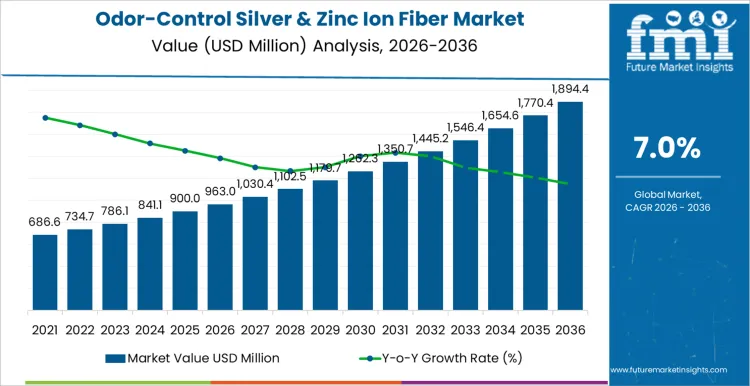
USD 963.0 million represents the opening scale of the odor-control silver and zinc ion fiber market in 2026, with the value projected to reach USD 1,894.4 million by 2036 at a 7.0% CAGR. Demand is set by hygiene standards, consumer comfort expectations, and product return policies across apparel, home textiles, and footwear. Brand teams define acceptable ion loading, wash durability, and skin contact limits during fabric platform development. Once a program enters approved production, later fiber changes require renewed sensory testing and claim review. Volume growth follows expansion of sportswear and workwear textiles positioned around controlled odor performance requirements globally.
Specification ownership governs participation in the odor-control silver and zinc ion fiber market through controlled material lists and extended approval cycles. Market access depends on documented efficacy, durability through laundering, and alignment with skin contact guidelines. Evaluation programs compare odor reduction persistence, color impact, and hand feel stability within finished fabrics. Approved material sets remain unchanged across long collection horizons. Care claims attach to specific constructions. Supplier rotation occurs during scheduled range resets. Revenue development reflects the number of programs carrying odor-control positioning. Competitive position depends on early engagement in fabric definition and placement within standardized platforms used by brands.
Odor-Control Silver & Zinc Ion Fiber Market Quick Stats
- Odor-Control Silver & Zinc Ion Fiber Market Value (2026): USD 963.0 million
- Odor-Control Silver & Zinc Ion Fiber Market Forecast Value (2036): USD 1,894.4 million
- Odor-Control Silver & Zinc Ion Fiber Market Forecast CAGR (2026 to 2036): 7.0%
- Leading Active System in Odor-Control Silver & Zinc Ion Fiber Market: Silver-ion functional fibers
- Leading End Use in Odor-Control Silver & Zinc Ion Fiber Market: Sportswear and performance apparel
- Key Growth Regions in Odor-Control Silver & Zinc Ion Fiber Market: China, USA, Germany, South Korea, Japan
- Top Players in Odor-Control Silver & Zinc Ion Fiber Market: Trevira GmbH, Lenzing AG, Toray Industries, Ascend Performance Materials, Wellman Advanced Materials
What is the Growth Forecast for the Odor Control Silver and Zinc Ion Fiber Market through 2036?
The odor control silver and zinc ion fiber market in 2026 stands near USD 963.0 million, anchored in apparel, home textiles, and interior fabrics where smell retention affects replacement cycles and user acceptance. Buyers treat this fiber as a performance insurance layer rather than as a visible feature. Evaluation focuses on ion fixation inside the polymer, wash durability, skin contact behavior, and shade stability. Program adoption sits with brand material teams and nominated mills, not with seasonal buyers. Volume builds inside sportswear, workwear, bedding, and travel textiles that carry long wear expectations. The rise toward USD 1,894.4 million in 2036 follows a 7.0% growth profile supported by wider placement in base fabric constructions and higher treated fiber share per square meter.
Commercial organization shapes the spending pattern of the odor control silver and zinc ion fiber market. Orders follow fabric platform lifetimes, collection planning cycles, and multi season commitments. Inventory policy favors continuity of approved grades and predictable lot performance. Cost structure reflects metal input management, compounding control, spinning yield, and testing overhead. Mills focus on run stability, color consistency, and retention of activity through repeated finishing and washing. Annual values move through the low and mid one billions during the early 2030s as more everyday garments and household textiles adopt permanent odor control. The rise to USD 1,894.4 million in 2036 comes from broader standardization, thicker functional zones in some fabrics, and longer contracts that place this fiber into fixed material lists across multiple textile programs.
Odor-Control Silver & Zinc Ion Fiber Market Key Takeaways
| Metric | Value |
|---|---|
| Market Value (2026) | USD 963.0 million |
| Forecast Value (2036) | USD 1,894.4 million |
| Forecast CAGR (2026-2036) | 7.0% |
How Is the Odor Control Silver and Zinc Ion Fiber Market Being Used to Stabilize Hygiene Performance Across Repeated Use Cycles?
The odor control silver and zinc ion fiber market is specified where smell management must persist through washing, drying, and daily wear without topical reapplication. Producers supplying sports and activewear focus on ion fixation and release control because short lived performance drives return and brand complaints. Manufacturers serving work uniforms examine compatibility with industrial laundering and disinfectant chemistry since residue buildup or activity loss changes acceptance results. Bedding and mattress cover programs evaluate skin contact behavior and color stability under heat exposure. Conversion plants track filament cohesion and abrasion because surface damage reduces effective area and shortens service life. Qualification centers on binding durability, wash count retention, and uniform distribution along the filament because uneven behavior forces conservative design and early product withdrawal.
The odor control silver and zinc ion fiber market is managed through compliance testing and service interval planning rather than single cycle performance claims. Laundry operators measure value through rewash rates, odor recurrence reports, and chemical consumption. Garment producers link material choice to usable life and warranty exposure rather than to initial treatment strength. Storage and handling receive attention because moisture and heat history affect surface chemistry before knitting or weaving. Contracts define acceptance limits for activity retention, shade change, and fiber damage after defined laundering cycles. Demand concentrates in applications where hygiene perception, repeat cleaning, and inspection outcomes determine continued supply approval, which places fiber selection inside routine quality assurance and risk control rather than promotional differentiation.
How do verification methods and garment service profiles shape demand in the Odor-Control Silver & Zinc Ion Fiber Market by active system and end use in 2026?
In the odor-control silver & zinc ion fiber market, adoption decisions start with test protocols, care-label claims, and retail acceptance thresholds rather than with yarn cost. Brands specify minimum odor suppression after defined wash counts, limits for skin contact, and color fastness under finishing. Programs supplying sportswear and performance apparel manufacturing, industrial garment laundry operations, and institutional textile supply chains need fibers that keep measurable activity while holding tensile and handle. By active system, use spans silver-ion, zinc-ion, hybrid multi-metal, and other chemistries. By end use, demand covers sportswear, socks and underwear, workwear, and home or institutional textiles. Once a system is written into specifications and vendor lists, change triggers retesting and reapproval, which keeps portfolios stable.
Why do silver-ion and zinc-ion platforms scale differently across product families?
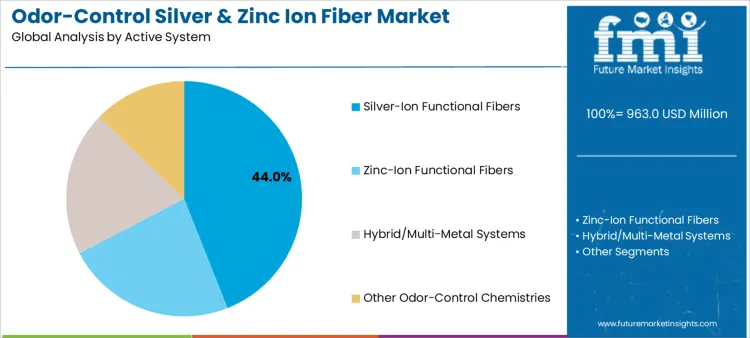
Silver-ion fibers hold about 44% share because they deliver fast, visible suppression at low add-on levels and fit existing spinning and finishing routes. In sportswear and performance apparel manufacturing, surface-available activity simplifies acceptance checks during routine audits. Zinc-ion fibers gain preference in intimate layers where skin tolerance and shade control matter more than peak kill rate, which suits socks and underwear production. Hybrid systems serve garments exposed to abrasion and heavy soil, including industrial workwear manufacturing, where redundancy of actives reduces performance drop over time. Other chemistries remain tied to narrow equipment windows. Development teams qualify systems through odor panel results after washing, ion retention, and tensile. Process teams qualify through dye uptake, lint, and pilling. Quality teams qualify through lot traceability and aging.
Once chosen, the platform becomes embedded in polymer selection, dope or finish recipes, and inspection limits. Altering it forces new wash series, new shade books, and new acceptance bands. Production planning protects the approved recipe with long campaigns. Inventory rules avoid mixing platforms in one style. Capacity grows by adding positions and colors rather than changing chemistry. This operating model explains why silver-ion keeps the lead in fast-turn programs while zinc-ion expands where comfort and appearance control dominate.
How do distribution models and care regimes fix end-use demand patterns?
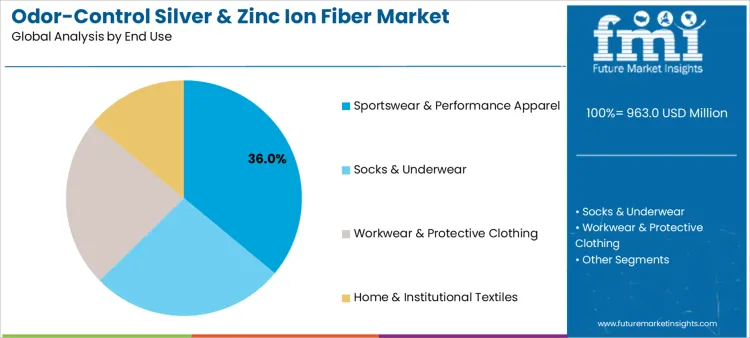
Sportswear represents about 36% of demand because high sweat load and frequent washing expose weaknesses quickly. In sportswear and performance apparel manufacturing, approval files link odor control to seam appearance and hand after repeated cycles. Socks and underwear rely on predictable daily-use performance, which favors systems that keep shade stable. Workwear consumes fibers where garments face abrasion and batch laundering in industrial garment laundry operations. Home and institutional textiles require consistency across shared inventories inside institutional textile supply chains. Other uses follow brand-specific rules. Converters approve routes through knitting or weaving stability, cutting yield, and sewing behavior. Compliance teams set sampling and storage rules. Service teams set replacement timing.
Once an end-use route is approved, labels, packing lists, and customer files assume the same behavior. Changing the route resets protocols and training. Tooling layouts and finishing schedules also change. Supervisors protect the approved mix with fixed slots. Orders expand by adding styles and volumes rather than switching systems. Demand therefore follows distribution models and care regimes that reward repeatability and audit simplicity more than experimentation.
Why Are Product Performance and Consumer Expectations Supporting the Odor-Control Silver & Zinc Ion Fiber Market?
Odor-Control Silver & Zinc Ion Fiber Market demand expands because apparel brands, textile converters, and finished goods manufacturers require fibers that mitigate odor in performance wear, uniforms, and healthcare textiles. Fibers treated with silver or zinc ions provide sustained control of odor-causing microbes when fabrics contact sweat and environmental contaminants. Buyers review data on ion retention after repeated laundering, mechanical strength, and compatibility with dyeing and finishing operations. Value for material suppliers and converters arises from fewer special treatments needed later in the supply chain and more consistent product performance across production lots. Procurement teams prioritize fibers that deliver demonstrated odor control without compromising fabric hand or durability.
What Factors Are Affecting Adoption and Scale in the Odor-Control Silver & Zinc Ion Fiber Market?
odor-control silver & zinc ion fiber market growth is influenced by manufacturing complexity, cost differentials, and qualification timelines within textile and apparel supply chains. Integrating silver or zinc ions into fiber structures affects spinning rheology, filament strength, and downstream processing behavior, which requires disciplined production control. Variability in ion concentration and retention can lead to inconsistent odor control across batches, prompting extended mill and brand testing. Higher costs relative to untreated fibers impact adoption pressures especially in price-sensitive segments like casualwear and commodity knits. Textile converters must align fiber qualification with wash durability data, which adds time to fabric development cycles and apparel collection rollouts.
How Are Product Formats and Commercial Practices Shaping the Odor-Control Silver & Zinc Ion Fiber Market?
Odor-Control Silver & Zinc Ion Fiber Market offerings are being structured around performance metrics tied to ion retention, wash cycle durability, and mechanical property benchmarks to guide selection for specific apparel categories. Suppliers provide detailed profiles that include efficacy after defined laundering protocols, tensile strength, and processing windows for knitting, weaving, and finishing lines. Portfolio segmentation by application for example activewear, corporate uniforms, and healthcare linens simplifies specification decisions and reduces trial runs. Commercial models increasingly include multi-lot performance commitments and scheduled delivery plans to align with fabric production calendars. Technical service emphasizes defect avoidance, washing protocol mapping, and integration with conventional finishing operations to help converters maintain throughput and product quality.
What is the Demand for Odor Control Silver and Zinc Ion Fiber by Country?
| Country | CAGR (%) |
|---|---|
| USA | 6.7% |
| Japan | 5.5% |
| South Korea | 6.2% |
| Germany | 6.6% |
| China | 8.2% |
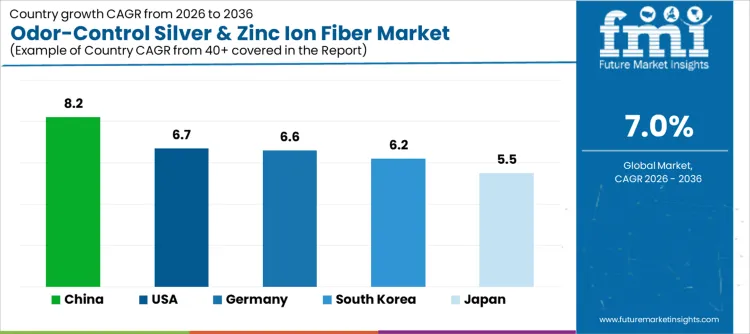
The demand for odor control silver and zinc ion fiber is increasing across apparel, home textiles, and medical fabrics where long lasting freshness and hygiene are required. China leads at 8.2% CAGR, supported by large scale textile manufacturing and expanding use of functional fibers in sportswear, innerwear, and healthcare products. The USA grows at 6.7%, driven by steady adoption in performance apparel, socks, and bedding. Germany records 6.6%, shaped by quality focused functional clothing and medical textile production. South Korea advances at 6.2%, reflecting strong sportswear and technical textile segments. Japan posts 5.5%, within a mature but specification driven market that emphasizes controlled use of antimicrobial and odor control treatments.
How Do Contract Textile Standards Define Material Selection in the Odor-Control Silver and Zinc Ion Fiber Market in the USA?
In the United States, the odor-control silver and zinc ion fiber market is advancing at a pace aligned with a 6.7% CAGR. Demand is anchored in contract textile standards that specify odor suppression persistence, laundering endurance, and appearance stability across defined service lives. Evaluation work is performed by materials engineering groups that review ion release profiles, wash cycle retention, yarn strength preservation, and shade stability after finishing. Once a fiber grade is admitted into a contract specification set, removal becomes unlikely because downstream approvals reference the same test files. Volume expands when uniform, bedding, and workwear programs extend coverage or renew multi-year supply agreements. Supplier access depends on audit performance and documentation completeness. Production planning follows contract schedules rather than spot orders. Commercial success depends on specification ownership and consistent lot performance across multiple mills.
How Do Plant-Level Control Frameworks Govern Adoption in the Odor-Control Silver and Zinc Ion Fiber Market in Japan?
Within Japan, the odor-control silver and zinc ion fiber market is developing along a trajectory consistent with a 5.5% CAGR. Plant-level control frameworks treat fiber choice as a process stability variable rather than a purchasing decision. Any proposal for change enters a controlled sequence of trials that examine odor reduction durability, ion distribution uniformity, abrasion resistance, and behavior during dyeing and heat setting. Approval requires evidence from extended production runs rather than short pilot tests. Once accepted, the same fiber remains embedded in identical constructions for long operating periods. Requalification is required for any deviation. Supplier participation depends on documentation quality and inspection outcomes. Local sources benefit from proximity to review teams. Volume growth follows gradual program extension rather than replacement cycles.
How Do Product Family Architecture Decisions Drive Volume in the Odor-Control Silver and Zinc Ion Fiber Market in South Korea?
In South Korea, product family architecture decisions explain why the odor-control silver and zinc ion fiber market is progressing in line with a 6.2% CAGR. Development groups define common material sets that support several apparel and interior textile ranges. A single fiber selection can influence multiple lines without separate mill approvals. Technical assessment focuses on odor control efficiency, ion retention after repeated washing, tensile stability, and compatibility with finishing sequences. When a grade becomes part of the approved family architecture, scale follows through coordinated product introductions. Mill-level changes remain limited because the architecture file governs material use. Suppliers secure positions through joint trials and documentation alignment. Output planning tracks launch calendars. Commercial results depend on early inclusion in family definitions and reliable execution during synchronized production ramps.
How Do Corporate Approval Lists Shape Supplier Access in the Odor-Control Silver and Zinc Ion Fiber Market in Germany?
In Germany, the odor-control silver and zinc ion fiber market is expanding at a rate consistent with a 6.6% CAGR under corporate approval list governance. Access to production programs is controlled by centrally maintained material lists that apply across multiple sites. Individual mills do not introduce new fibers independently. Reviews examine repeatability, odor control retention after defined wash cycles, and audit completeness. After approval, the same grade is released for use in several factories under uniform process conditions. Volume growth follows program expansion rather than local sourcing initiatives. Supplier standing depends on audit outcomes and documentation discipline. Change control remains formal and closely monitored. Production planning reflects coordinated capacity allocation. Commercial success depends on maintaining identical performance across distributed manufacturing environments over extended operating periods.
How Do Program Replication Models Accelerate Uptake in the Odor-Control Silver and Zinc Ion Fiber Market in China?
In China, the odor-control silver and zinc ion fiber market is advancing in line with an 8.2% CAGR through program replication models. Once a fiber meets defined odor suppression and processing stability limits in one plant, it is introduced into parallel operations with minimal redesign. Approval emphasizes consistency and tolerance to high-volume production conditions. Expansion teams rely on standardized qualification packages and line commissioning procedures. Domestic suppliers hold an advantage because they can follow rapid capacity additions and site expansions. Imported materials remain concentrated in higher specification uses. Volume increases through repetition of approved constructions across sites. Commercial advantage depends on being present when a configuration becomes a reference program rather than competing for each individual factory line.
How Do Suppliers Compete in the Odor-Control Silver & Zinc Ion Fiber Market?
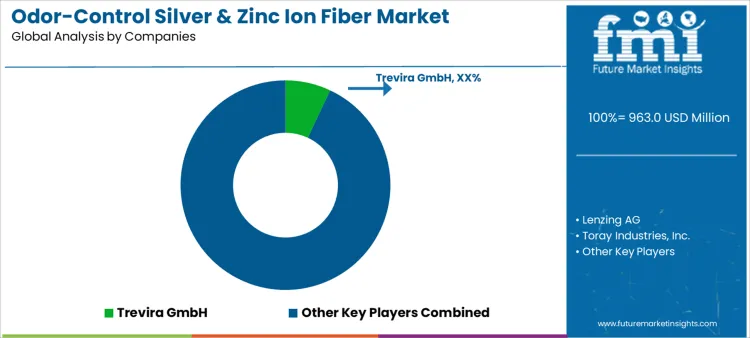
Adoption in the Odor-Control Silver & Zinc Ion Fiber Market is driven by antimicrobial efficacy, fiber integration, and durability rather than catalog range. Trevira GmbH, Lenzing AG, Toray Industries, Ascend Performance Materials, and Wellman Advanced Materials compete during fiber development, pilot spinning, and textile process validation. Once a fiber is incorporated into apparel, active odor-control retention, tensile strength, and wash durability anchor supplier selection. Trevira GmbH emphasizes silver-based functional fibers for hygiene and sportswear. Lenzing AG supplies cellulose-based fibers with integrated zinc ions for odor neutralization. Toray Industries provides high-performance polymer fibers with embedded antimicrobial metals. Ascend Performance Materials targets nylon-based fibers for durable functional textiles. Wellman Advanced Materials focuses on industrial and specialty applications requiring consistent antimicrobial activity.
Technical performance, process reproducibility, and regulatory compliance shape competitive positioning in the Odor-Control Silver & Zinc Ion Fiber Market. Product developers assess ion release rate, wash retention, fiber uniformity, and mechanical properties during qualification. Manufacturing teams prioritize suppliers who deliver reproducible lots and scalable supply. Trevira GmbH secures adoption through tested efficacy and textile process support. Lenzing AG maintains share in natural fiber blends for functional apparel. Toray Industries competes where high-performance polymer fibers are required. Ascend Performance Materials captures adoption in technical textiles and activewear. Wellman Advanced Materials serves specialty industrial applications with reliable antimicrobial performance. Market positions vary by fiber type, end-use application, processing method, and regional compliance standards.
Key Players in the Odor-Control Silver & Zinc Ion Fiber Market
- Trevira GmbH
- Lenzing AG
- Toray Industries, Inc.
- Ascend Performance Materials
- Wellman Advanced Materials
Scope of the Report
| Items | Values |
|---|---|
| Quantitative Units (2026) | USD million |
| Active System | Silver-ion functional fibers, zinc-ion functional fibers, hybrid and multi-metal systems, other odor-control chemistries |
| End Use | Sportswear and performance apparel, socks and underwear, workwear and protective clothing, home and institutional textiles |
| Fiber Type | Polyester, nylon and polyamide, cellulosics and blends, other technical fibers |
| Customer Type | Global apparel brands, specialty performance brands, private label and retailers, industrial and healthcare buyers |
| Regions Covered | Asia Pacific, Europe, North America, Latin America, Middle East & Africa |
| Countries Covered | United States, Canada, Mexico, Germany, United Kingdom, France, Italy, Spain, Nordics, BENELUX, China, Japan, South Korea, India, Australia & New Zealand, ASEAN, Brazil, Chile, Saudi Arabia, Turkey, South Africa, and other regional markets |
| Key Companies Profiled | Trevira GmbH, Lenzing AG, Toray Industries, Ascend Performance Materials, Wellman Advanced Materials |
| Additional Attributes | Dollar sales by active system, end use, fiber type, and customer type, ion retention and odor suppression performance after repeated laundering, color and shade stability, skin contact and comfort behavior, integration into apparel and home textile fabric platforms, qualification and reapproval cycles tied to brand and contract textile standards, processing compatibility with knitting, weaving, and finishing routes, and regional demand patterns driven by sportswear, workwear, bedding, and institutional textile programs |
Odor-Control Silver & Zinc Ion Fiber Market Segmentation
Active System:
- Silver-Ion Functional Fibers
- Zinc-Ion Functional Fibers
- Hybrid and Multi-Metal Systems
- Other Odor-Control Chemistries
End Use:
- Sportswear & Performance Apparel
- Socks & Underwear
- Workwear & Protective Clothing
- Home & Institutional Textiles
Fiber Type:
- Polyester
- Nylon and Polyamide
- Cellulosics & Blends
- Other Technical Fibers
Customer Type:
- Global Apparel Brands
- Specialty Performance Brands
- Private Label and Retailers
- Industrial & Healthcare Buyers
Region
- Asia Pacific
- China
- Japan
- South Korea
- India
- Australia & New Zealand
- ASEAN
- Rest of Asia Pacific
- Europe
- Germany
- United Kingdom
- France
- Italy
- Spain
- Nordic
- BENELUX
- Rest of Europe
- North America
- United States
- Canada
- Mexico
- Latin America
- Brazil
- Chile
- Rest of Latin America
- Middle East & Africa
- Kingdom of Saudi Arabia
- Other GCC Countries
- Turkey
- South Africa
- Other African Union
- Rest of Middle East & Africa
Bibliography
- American Association of Textile Chemists and Colorists. (2024). AATCC TM216‑2024: Test method for measuring the odor adsorbency of textile materials using a representative malodor of human origin. AATCC.
- European Chemicals Agency. (2023). Silver compounds and zinc compounds: Uses in treated articles and biocidal products under the Biocidal Products Regulation (BPR). ECHA.
- United States Environmental Protection Agency. (2023). Antimicrobial treated articles exemption and guidance for silver‑ and zinc‑based additives. EPA.
Frequently Asked Questions
How big is the odor-control silver and zinc ion fiber market in 2026?
The odor-control silver and zinc ion fiber market is estimated to reach USD 963.0 million in 2026.
What will be the size of the odor-control silver and zinc ion fiber market in 2036?
The odor-control silver and zinc ion fiber market is projected to attain a value of USD 1,894.4 million by 2036.
How fast will demand for odor-control silver and zinc ion fiber grow between 2026 and 2036?
Demand for odor-control silver and zinc ion fiber is forecast to expand at a 7.0% CAGR between 2026 and 2036.
Which active system holds a leading share in the odor-control silver and zinc ion fiber market in 2026?
Silver-ion functional fibers are expected to account for about a 44% share in 2026.
Which end-use segment contributes a major share in the odor-control silver and zinc ion fiber market in 2026?
Sportswear and performance apparel are projected to represent about 36% of total demand in 2026.
Preview the report firsthand - request a free sample
Get SampleGet the brochure for pricing and purchase details.
Get PDFTable of Content
- Executive Summary
- Global Market Outlook
- Demand-side Trends
- Supply-side Trends
- Technology Roadmap Analysis
- Analysis and Recommendations
- Market Overview
- Market Coverage / Taxonomy
- Market Definition / Scope / Limitations
- Market Background
- Market Dynamics
- Drivers
- Restraints
- Opportunity
- Trends
- Scenario Forecast
- Demand in Optimistic Scenario
- Demand in Likely Scenario
- Demand in Conservative Scenario
- Opportunity Map Analysis
- Product Life Cycle Analysis
- Supply Chain Analysis
- Investment Feasibility Matrix
- Value Chain Analysis
- PESTLE and Porter’s Analysis
- Regulatory Landscape
- Regional Parent Market Outlook
- Production and Consumption Statistics
- Import and Export Statistics
- Market Dynamics
- Global Market Analysis 2021 to 2025 and Forecast, 2026 to 2036
- Historical Market Size Value (USD Million) Analysis, 2021 to 2025
- Current and Future Market Size Value (USD Million) Projections, 2026 to 2036
- Y-o-Y Growth Trend Analysis
- Absolute $ Opportunity Analysis
- Global Market Pricing Analysis 2021 to 2025 and Forecast 2026 to 2036
- Global Market Analysis 2021 to 2025 and Forecast 2026 to 2036, By Active System
- Introduction / Key Findings
- Historical Market Size Value (USD Million) Analysis By Active System , 2021 to 2025
- Current and Future Market Size Value (USD Million) Analysis and Forecast By Active System , 2026 to 2036
- Silver-Ion Functional Fibers
- Zinc-Ion Functional Fibers
- Hybrid/Multi-Metal Systems
- Other Odor-Control Chemistries
- Silver-Ion Functional Fibers
- Y-o-Y Growth Trend Analysis By Active System , 2021 to 2025
- Absolute $ Opportunity Analysis By Active System , 2026 to 2036
- Global Market Analysis 2021 to 2025 and Forecast 2026 to 2036, By End Use
- Introduction / Key Findings
- Historical Market Size Value (USD Million) Analysis By End Use, 2021 to 2025
- Current and Future Market Size Value (USD Million) Analysis and Forecast By End Use, 2026 to 2036
- Sportswear & Performance Apparel
- Socks & Underwear
- Workwear & Protective Clothing
- Home & Institutional Textiles
- Sportswear & Performance Apparel
- Y-o-Y Growth Trend Analysis By End Use, 2021 to 2025
- Absolute $ Opportunity Analysis By End Use, 2026 to 2036
- Global Market Analysis 2021 to 2025 and Forecast 2026 to 2036, By Fiber Type
- Introduction / Key Findings
- Historical Market Size Value (USD Million) Analysis By Fiber Type, 2021 to 2025
- Current and Future Market Size Value (USD Million) Analysis and Forecast By Fiber Type, 2026 to 2036
- Polyester
- Nylon/Polyamide
- Cellulosics & Blends
- Other Technical Fibers
- Polyester
- Y-o-Y Growth Trend Analysis By Fiber Type, 2021 to 2025
- Absolute $ Opportunity Analysis By Fiber Type, 2026 to 2036
- Global Market Analysis 2021 to 2025 and Forecast 2026 to 2036, By Customer Type
- Introduction / Key Findings
- Historical Market Size Value (USD Million) Analysis By Customer Type, 2021 to 2025
- Current and Future Market Size Value (USD Million) Analysis and Forecast By Customer Type, 2026 to 2036
- Global Apparel Brands
- Specialty Performance Brands
- Private Label/Retailers
- Industrial & Healthcare Buyers
- Global Apparel Brands
- Y-o-Y Growth Trend Analysis By Customer Type, 2021 to 2025
- Absolute $ Opportunity Analysis By Customer Type, 2026 to 2036
- Global Market Analysis 2021 to 2025 and Forecast 2026 to 2036, By Region
- Introduction
- Historical Market Size Value (USD Million) Analysis By Region, 2021 to 2025
- Current Market Size Value (USD Million) Analysis and Forecast By Region, 2026 to 2036
- North America
- Latin America
- Western Europe
- Eastern Europe
- East Asia
- South Asia and Pacific
- Middle East & Africa
- Market Attractiveness Analysis By Region
- North America Market Analysis 2021 to 2025 and Forecast 2026 to 2036, By Country
- Historical Market Size Value (USD Million) Trend Analysis By Market Taxonomy, 2021 to 2025
- Market Size Value (USD Million) Forecast By Market Taxonomy, 2026 to 2036
- By Country
- USA
- Canada
- Mexico
- By Active System
- By End Use
- By Fiber Type
- By Customer Type
- By Country
- Market Attractiveness Analysis
- By Country
- By Active System
- By End Use
- By Fiber Type
- By Customer Type
- Key Takeaways
- Latin America Market Analysis 2021 to 2025 and Forecast 2026 to 2036, By Country
- Historical Market Size Value (USD Million) Trend Analysis By Market Taxonomy, 2021 to 2025
- Market Size Value (USD Million) Forecast By Market Taxonomy, 2026 to 2036
- By Country
- Brazil
- Chile
- Rest of Latin America
- By Active System
- By End Use
- By Fiber Type
- By Customer Type
- By Country
- Market Attractiveness Analysis
- By Country
- By Active System
- By End Use
- By Fiber Type
- By Customer Type
- Key Takeaways
- Western Europe Market Analysis 2021 to 2025 and Forecast 2026 to 2036, By Country
- Historical Market Size Value (USD Million) Trend Analysis By Market Taxonomy, 2021 to 2025
- Market Size Value (USD Million) Forecast By Market Taxonomy, 2026 to 2036
- By Country
- Germany
- UK
- Italy
- Spain
- France
- Nordic
- BENELUX
- Rest of Western Europe
- By Active System
- By End Use
- By Fiber Type
- By Customer Type
- By Country
- Market Attractiveness Analysis
- By Country
- By Active System
- By End Use
- By Fiber Type
- By Customer Type
- Key Takeaways
- Eastern Europe Market Analysis 2021 to 2025 and Forecast 2026 to 2036, By Country
- Historical Market Size Value (USD Million) Trend Analysis By Market Taxonomy, 2021 to 2025
- Market Size Value (USD Million) Forecast By Market Taxonomy, 2026 to 2036
- By Country
- Russia
- Poland
- Hungary
- Balkan & Baltic
- Rest of Eastern Europe
- By Active System
- By End Use
- By Fiber Type
- By Customer Type
- By Country
- Market Attractiveness Analysis
- By Country
- By Active System
- By End Use
- By Fiber Type
- By Customer Type
- Key Takeaways
- East Asia Market Analysis 2021 to 2025 and Forecast 2026 to 2036, By Country
- Historical Market Size Value (USD Million) Trend Analysis By Market Taxonomy, 2021 to 2025
- Market Size Value (USD Million) Forecast By Market Taxonomy, 2026 to 2036
- By Country
- China
- Japan
- South Korea
- By Active System
- By End Use
- By Fiber Type
- By Customer Type
- By Country
- Market Attractiveness Analysis
- By Country
- By Active System
- By End Use
- By Fiber Type
- By Customer Type
- Key Takeaways
- South Asia and Pacific Market Analysis 2021 to 2025 and Forecast 2026 to 2036, By Country
- Historical Market Size Value (USD Million) Trend Analysis By Market Taxonomy, 2021 to 2025
- Market Size Value (USD Million) Forecast By Market Taxonomy, 2026 to 2036
- By Country
- India
- ASEAN
- Australia & New Zealand
- Rest of South Asia and Pacific
- By Active System
- By End Use
- By Fiber Type
- By Customer Type
- By Country
- Market Attractiveness Analysis
- By Country
- By Active System
- By End Use
- By Fiber Type
- By Customer Type
- Key Takeaways
- Middle East & Africa Market Analysis 2021 to 2025 and Forecast 2026 to 2036, By Country
- Historical Market Size Value (USD Million) Trend Analysis By Market Taxonomy, 2021 to 2025
- Market Size Value (USD Million) Forecast By Market Taxonomy, 2026 to 2036
- By Country
- Kingdom of Saudi Arabia
- Other GCC Countries
- Turkiye
- South Africa
- Other African Union
- Rest of Middle East & Africa
- By Active System
- By End Use
- By Fiber Type
- By Customer Type
- By Country
- Market Attractiveness Analysis
- By Country
- By Active System
- By End Use
- By Fiber Type
- By Customer Type
- Key Takeaways
- Key Countries Market Analysis
- USA
- Pricing Analysis
- Market Share Analysis, 2025
- By Active System
- By End Use
- By Fiber Type
- By Customer Type
- Canada
- Pricing Analysis
- Market Share Analysis, 2025
- By Active System
- By End Use
- By Fiber Type
- By Customer Type
- Mexico
- Pricing Analysis
- Market Share Analysis, 2025
- By Active System
- By End Use
- By Fiber Type
- By Customer Type
- Brazil
- Pricing Analysis
- Market Share Analysis, 2025
- By Active System
- By End Use
- By Fiber Type
- By Customer Type
- Chile
- Pricing Analysis
- Market Share Analysis, 2025
- By Active System
- By End Use
- By Fiber Type
- By Customer Type
- Germany
- Pricing Analysis
- Market Share Analysis, 2025
- By Active System
- By End Use
- By Fiber Type
- By Customer Type
- UK
- Pricing Analysis
- Market Share Analysis, 2025
- By Active System
- By End Use
- By Fiber Type
- By Customer Type
- Italy
- Pricing Analysis
- Market Share Analysis, 2025
- By Active System
- By End Use
- By Fiber Type
- By Customer Type
- Spain
- Pricing Analysis
- Market Share Analysis, 2025
- By Active System
- By End Use
- By Fiber Type
- By Customer Type
- France
- Pricing Analysis
- Market Share Analysis, 2025
- By Active System
- By End Use
- By Fiber Type
- By Customer Type
- India
- Pricing Analysis
- Market Share Analysis, 2025
- By Active System
- By End Use
- By Fiber Type
- By Customer Type
- ASEAN
- Pricing Analysis
- Market Share Analysis, 2025
- By Active System
- By End Use
- By Fiber Type
- By Customer Type
- Australia & New Zealand
- Pricing Analysis
- Market Share Analysis, 2025
- By Active System
- By End Use
- By Fiber Type
- By Customer Type
- China
- Pricing Analysis
- Market Share Analysis, 2025
- By Active System
- By End Use
- By Fiber Type
- By Customer Type
- Japan
- Pricing Analysis
- Market Share Analysis, 2025
- By Active System
- By End Use
- By Fiber Type
- By Customer Type
- South Korea
- Pricing Analysis
- Market Share Analysis, 2025
- By Active System
- By End Use
- By Fiber Type
- By Customer Type
- Russia
- Pricing Analysis
- Market Share Analysis, 2025
- By Active System
- By End Use
- By Fiber Type
- By Customer Type
- Poland
- Pricing Analysis
- Market Share Analysis, 2025
- By Active System
- By End Use
- By Fiber Type
- By Customer Type
- Hungary
- Pricing Analysis
- Market Share Analysis, 2025
- By Active System
- By End Use
- By Fiber Type
- By Customer Type
- Kingdom of Saudi Arabia
- Pricing Analysis
- Market Share Analysis, 2025
- By Active System
- By End Use
- By Fiber Type
- By Customer Type
- Turkiye
- Pricing Analysis
- Market Share Analysis, 2025
- By Active System
- By End Use
- By Fiber Type
- By Customer Type
- South Africa
- Pricing Analysis
- Market Share Analysis, 2025
- By Active System
- By End Use
- By Fiber Type
- By Customer Type
- USA
- Market Structure Analysis
- Competition Dashboard
- Competition Benchmarking
- Market Share Analysis of Top Players
- By Regional
- By Active System
- By End Use
- By Fiber Type
- By Customer Type
- Competition Analysis
- Competition Deep Dive
- Trevira GmbH
- Overview
- Product Portfolio
- Profitability by Market Segments (Product/Age /Sales Channel/Region)
- Sales Footprint
- Strategy Overview
- Marketing Strategy
- Product Strategy
- Channel Strategy
- Lenzing AG
- Toray Industries, Inc.
- Ascend Performance Materials
- Wellman Advanced Materials
- Trevira GmbH
- Competition Deep Dive
- Assumptions & Acronyms Used
- Research Methodology


