

- Industry Size (2026)
- USD 129.0 Mn
- Forecast (2036)
- USD 446.0 Mn
- CAGR (2026 to 2036)
- 13.2%
Solar PV Module Glass, Silicon and Silver Recovery in EU Decommissioning Industry Size, Industry Forecast and Outlook By FMI
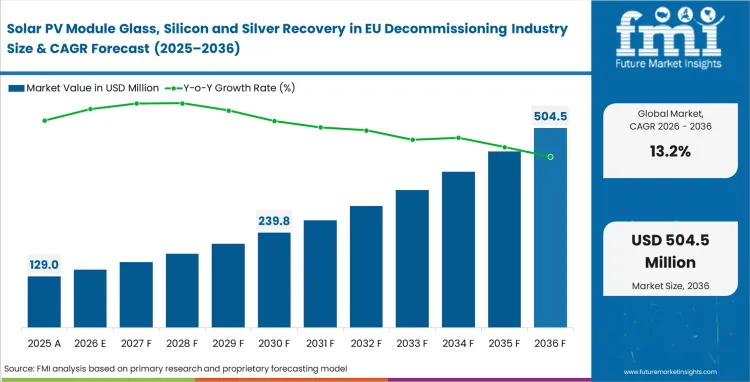
The solar PV module glass, silicon and silver recovery in the EU decommissioning industry was valued at USD 114.0 million in 2025 and is estimated to reach USD 129.0 million in 2026. FMI estimates the industry will expand at a CAGR of 13.2% from 2026 to 2036, taking total valuation to USD 446.0 million by 2036.
Summary of Solar PV Module Glass, Silicon and Silver Recovery in EU Decommissioning Industry
- The market is forecast to reach USD 446.0 million by 2036.
- The market is expected to grow at a CAGR of 13.2% from 2026 to 2036.
- The market was estimated at USD 114.0 million in 2025.
- The forecast period represents an incremental opportunity of USD 317.0 million.
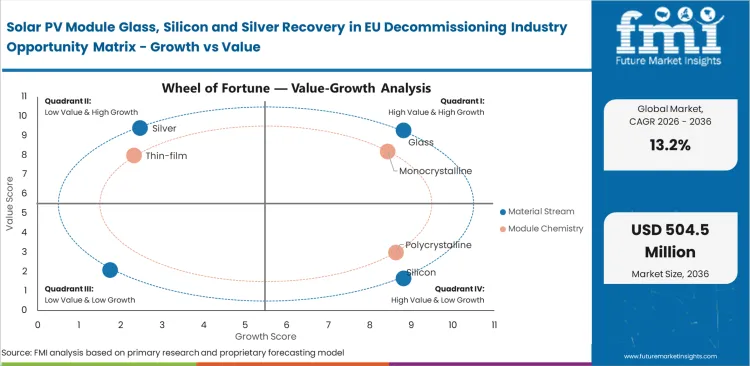
- Glass dominates the material segment with a 58.0% share, driven by its high volume and recyclability.
- Monocrystalline modules lead the technology segment with a 56.0% share, reflecting widespread silicon-based panel usage.
- Mechanical processes account for 44.0% share, as most recovery lines rely on physical separation techniques.
- Utility-scale decommissioning leads with a 49.0% share, supported by large, homogeneous project volumes.
- EPR contracts hold a 38.0% share, driven by compliance-based collection and recycling systems.
- Germany, Italy, and France are the fastest-growing markets, supported by strong regulatory enforcement and decommissioning pipelines.
- Key players in the industry include Reiling PV-Recycling, ROSI, SOLAR MATERIALS, Veolia, PV CYCLE, Galloo, and Envie 2E Aquitaine.
Industry growth is being supported by stricter recycling rules that place more focus on recovering usable materials, not just meeting weight-based compliance targets.
Decommissioning economics are changing across the EU as older solar assets move closer to retirement. Landfill exposure has become more expensive, while low-grade processing routes are losing relevance under tighter recovery requirements. Basic shredding helps clear material from site, but it does not recover enough value to match current industry requirements. That is pushing asset owners toward more specialized solar module recycling service arrangements that can handle glass separation, silicon recovery, and silver extraction with better process depth. Capacity booking is becoming more important because delayed decisions may limit access to qualified recovery lines as retirement volumes rise across the region.
Scale remains a key commercial factor in this industry. Plants with higher throughput can spread separation and recovery costs across larger volumes, making more advanced processing steps more viable. Silver recovery becomes more practical when fixed costs are distributed over a larger feedstock base. Once facilities move beyond small dismantling batches and begin handling steady volumes, deeper extraction routes become more commercially relevant than basic bulk treatment.
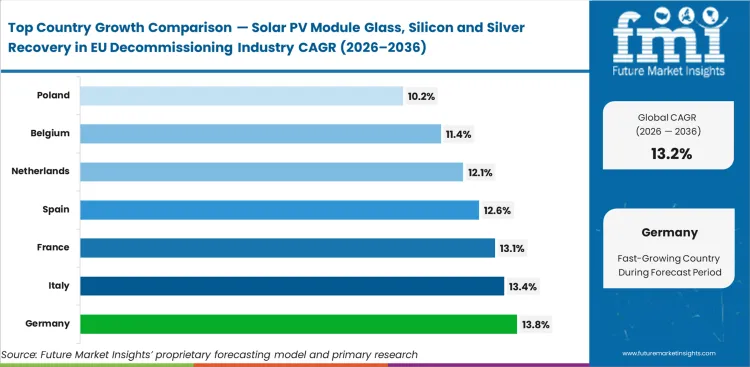
Germany is projected to witness 13.8% CAGR through 2036, supported by a large base of earlier solar installations moving closer to replacement. Italy is expected to expand at 13.4% CAGR as localized retirements and tighter compliance activity support recovery demand. France is likely to register 13.1% CAGR during the forecast period, helped by a more organized collection and treatment environment for end-of-life PV waste. Spain is estimated at 12.6% CAGR, where repowering activity is increasing module flows into recovery channels. The Netherlands is anticipated to post 12.1% CAGR as concentrated rooftop replacements support steady processing demand. Belgium is projected at 11.4% CAGR, reflecting its role as a regional processing point for nearby markets. Poland is expected to record 10.2% CAGR because its installed base is newer and large retirement volumes are still developing. Country-level differences remain important, with some markets moving faster into silicon and silver recovery while others remain more focused on bulk glass output.
Segmental Analysis
Solar PV Module Glass, Silicon and Silver Recovery in EU Decommissioning Industry Analysis by Material Stream
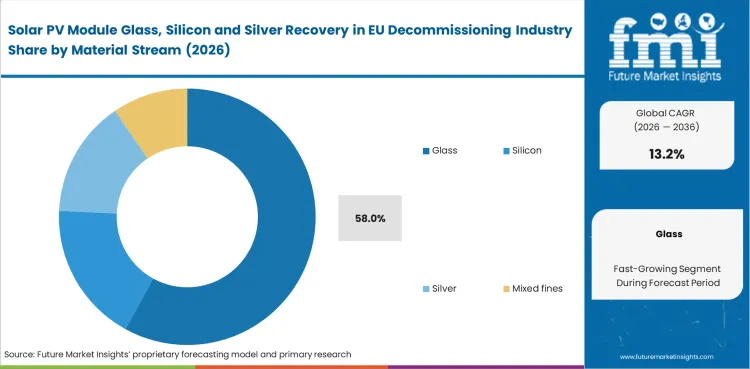
Material recovery from retired modules often begins with mass-based diversion targets rather than metal value, because compliance systems still focus first on waste diversion. Glass therefore shapes the first stage of treatment economics, and FMI’s analysis indicates it is expected to account for 58.0% share in 2026. Plants prioritize fast glass reduction because it helps process large volumes of solar photovoltaic (PV) panels and satisfy diversion requirements quickly. This improves throughput, but it can also create separation issues when fine glass mixes with silicon-bearing material. Downstream recovery of semiconductor-grade material becomes much harder. Operators focused only on bulk cullet output may lose access to higher-value refining channels when material purity falls too low.
- Bulk volume compliance: Mechanical crushing converts complete modules into manageable cullet streams at high speed. This helps facilities meet diversion requirements without delay.
- Hidden purity destruction: Fast breakage drives fine tempered glass into silicon-rich fractions. It reduces the usability of semiconductor material in later recovery stages.
- Downstream rejection risk: Secondary refiners screen incoming material for cross-contamination before acceptance. Poor aggregate separation can therefore lead to full batch rejection.
Solar PV Module Glass, Silicon and Silver Recovery in EU Decommissioning Industry Analysis by Module Chemistry
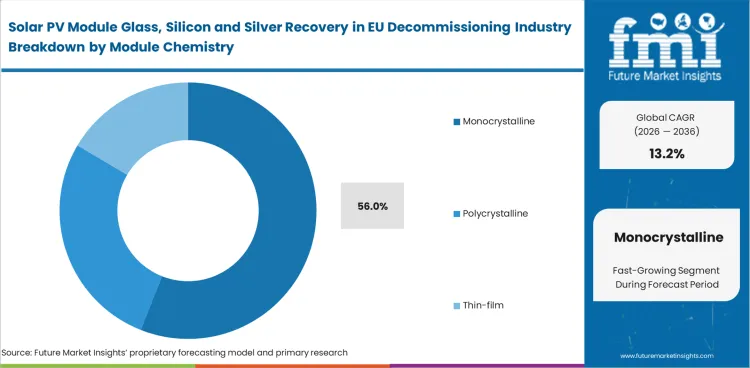
End-of-life module chemistry still reflects the installation choices made during earlier phases of European solar buildout. A large share of the decommissioning stream comes from older parks built around monocrystalline technology, which continues to shape plant design and chemical preparation requirements. Monocrystalline architectures are likely to account for 56.0% share in 2026. Facilities built around these modules usually adjust their lines to older wafer structures, which helps maintain stable throughput on familiar feedstock. The challenge is newer chemistries do not fit these same recovery conditions cleanly. Plants do not adapt to a wider chemistry mix may face weaker recovery efficiency as incoming module types become more varied.
- Baseline feedstock dominance: Early utility and commercial parks supply long runs of similar module architecture. This improves intake consistency and supports steadier processing plans.
- Chemical solvent specificity: Leaching systems calibrated for older wafer structures perform best when the incoming chemistry remains predictable. Stable feed composition supports stronger batch control.
- Architecture transition friction: Newer module formats can disrupt established recovery settings and increase chemical imbalance risk. Facilities then face more difficult process adjustment and cost control.
Solar PV Module Glass, Silicon and Silver Recovery in EU Decommissioning Industry Analysis by Recovery Process
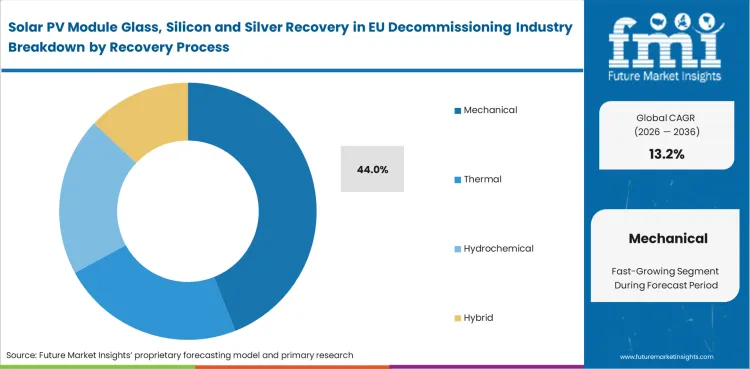
Processing route selection still depends heavily on available capital and permitting requirements. Mechanical treatment remains the most accessible entry point for operators because it can be installed faster and at lower cost than chemical recovery systems. FMI’s assessment suggests that this is why mechanical systems are projected to represent 44.0% share in 2026. Mechanical systems are most attractive where operators need to process mixed panel waste quickly, including fragmented removal volumes from building-integrated installations. Mechanical throughput helps clear incoming waste, but aggressive shredding can reduce recovery value by damaging silver and silicon-bearing layers. Facilities that rely only on mixed shredded output often face lower margins and weaker pricing from downstream buyers.
- Low capital deployment: Mechanical lines require less complex environmental infrastructure than wet chemical recovery systems. This allows operators to establish processing capacity more quickly.
- Value destruction sequence: High-speed rotor impact can push fine silver and silicon fractions deeper into polymer and mixed residue streams. Recovery quality then falls even when throughput stays high.
- Margin compression trajectory: Low-purity shredded output tends to receive weaker pricing from secondary processors. Higher volume does not necessarily translate into stronger plant economics.
Solar PV Module Glass, Silicon and Silver Recovery in EU Decommissioning Industry Analysis by Decommissioning Source
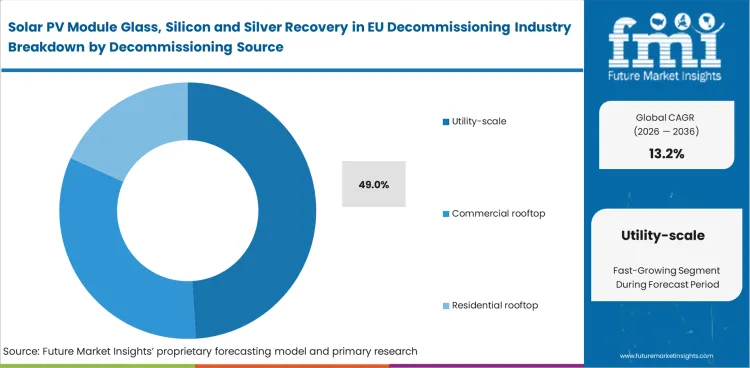
Utility-scale retirements continue to set the pace for industrial solar module recovery because they generate concentrated dismantling activity and large batches of similar hardware. The uniformity of these sites helps logistics teams organize transport, staging, and intake far more efficiently than fragmented small-system removals. Utility-scale teardowns are anticipated to account for 49.0% share in 2026, supported by the practical advantage of moving standardized solar cells and module volumes from single project locations. FMI observers note that this model works well under planned retirement schedules, but it becomes less stable when weather damage suddenly forces early removal across affected regions. Hail and storm events can release very large, damaged volumes into the chain without warning. Processors without enough staging space or transport flexibility often struggle to absorb those sudden spikes.
- Homogenous batch intake: Large solar park removals send thousands of similar units into recovery at once. This reduces sorting complexity and improves line planning.
- Logistical density advantages: Centralized teardown sites allow transport fleets to operate with higher route efficiency and fuller payload utilization. That improves handling economics at scale.
- Surge capacity failures: Severe weather events can generate abrupt decommissioning waves outside normal planning assumptions. Facilities then face pressure on storage, labor, and intake coordination.
Solar PV Module Glass, Silicon and Silver Recovery in EU Decommissioning Industry Analysis by Service model
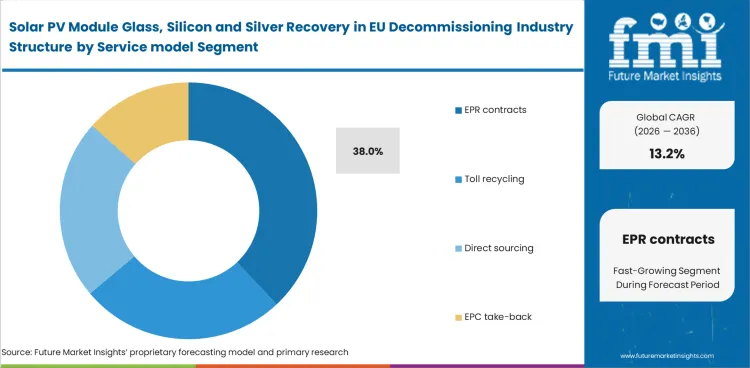
Contracting preference in this market is shaped largely by compliance burden rather than by material optimization alone. Asset owners often choose structured EPR arrangements because they transfer legal responsibility for collection and treatment to specialist organizations with established reporting systems. EPR contracts are expected to account for 38.0% share in 2026. This gives operators a simpler route to documented compliance and protects firms linked to solar farm predictive maintenance monitoring from direct exposure to waste-handling obligations once panels are retired. The trade-off is that flat contractual structures can treat high-value panels and low-value breakage in much the same way. That limits the owner’s ability to benefit when material quality is stronger than the contract assumptions.
- Liability delegation: Specialized compliance schemes take over documentation and diversion responsibility for retired panel streams. This reduces direct regulatory exposure for asset owners.
- Value capture leakage: Flat-rate processing structures can overlook material differences between panel types and conditions. Owners may therefore give up upside tied to higher-value fractions.
- Contractual lock-in risks: Long-duration agreements can restrict the ability to switch toward more advanced recovery partners later. That can limit flexibility as processing options improve.
Solar PV Module Glass, Silicon and Silver Recovery in EU Decommissioning Industry Drivers, Restraints, and Opportunities
Tightening European elemental recovery mandates force park operators into immediate compliance upgrades. Firms must execute guaranteed off-take agreements before regional waste authorities revoke operational licenses. Delaying vendor selection initiates compounding financial penalties as landfilling options vanish entirely. Advanced processing facilities leverage this urgency, dictating harsh intake terms while simultaneously maximizing PV recycling economics silver recovery at premium commodity rates.
Severe cross-contamination friction ruins semiconductor silicon yields across legacy processing lines. Microscopic glass shards embedded within silicon flakes resist standard density separation techniques completely. High-speed rotor shredding physically forces disparate materials together, requiring expensive secondary optical sorting to untangle. Emerging thermal delamination techniques offer cleaner separation pathways but require massive energy expenditures that destroy unit economics during peak utility pricing hours.
Opportunities in the Solar PV Module Glass, Silicon and Silver Recovery in EU Decommissioning Industry
- Thermal delamination retrofits: Implementing precise infrared heating lines prevents physical glass shattering entirely. High-purity silicon yields is preserved for premium secondary sales.
- Mobile processing units: Deploying containerized shredders directly to rural park teardowns eliminates heavy transportation inefficiencies. Firms cut logistical overhead while increasing polycrystalline silicon intake speeds.
- Direct smelter integration: Co-locating initial shredding steps directly adjacent to metallurgical copper smelters bypasses intermediary brokers. Financial controllers capture maximum trace silver value immediately.
Regional Analysis
Based on regional analysis, Solar PV Module Glass, Silicon and Silver Recovery in EU Decommissioning Industry is segmented into Europe across 40 plus countries.
.webp "Top Country Growth Comparison Solar Pv Module Glass, Silicon And Silver Recovery In Eu Decommissioning Industry Cagr (2026 2036)")
| Country | CAGR (2026 to 2036) |
|---|---|
| Germany | 13.8% |
| Italy | 13.4% |
| France | 13.1% |
| Spain | 12.6% |
| Netherlands | 12.1% |
| Belgium | 11.4% |
| Poland | 10.2% |
Source: Future Market Insights (FMI) analysis, based on proprietary forecasting model and primary research
Europe Solar PV Module Glass, Silicon and Silver Recovery in EU Decommissioning Industry Analysis
Landfill restrictions across Western Europe are pushing the industry beyond basic collection targets toward stricter material recovery requirements. Upgrading standard WEEE shredders with precise optical sorting arrays becomes essential to meet new compliance standards. Municipalities are becoming less willing to accept mixed fractions, so recyclers need cleaner separation results. Basic hammer mill operations risk intake suspensions as environmental auditors mandate closed-loop chemical leaching proof. Balancing high purity laws against rising energy costs dictates continent-wide technological upgrades.
- Germany: Germany remains the leading country case because a larger base of earlier installations is moving closer to replacement and organized dismantling cycles. Demand for solar component recovery in Germany is anticipated to rise at a CAGR of 13.8% through 2036. The market is likely to favor operators that can combine disciplined intake planning with better separation quality, because volume alone will not guarantee stronger margins. Processors that can handle glass efficiently while protecting silicon-bearing fractions are better placed to secure downstream refining interest. As retirement activity builds, capacity access and material purity are expected to matter more than basic collection capability.
- Italy: Regional decrees subject localized solar parks to strict compliance audits, accelerating domestic processing schedules significantly. Establishing direct links to domestic smelters helps regional facilities bypass international shipping frictions entirely. Demand within the Italy solar module recycling segment is poised to expand at a CAGR of 13.4% through 2036. Bypassing cross-border logistics allows Italian processing centers to maintain steady margins while satisfying waste diversion mandates.
- France: Soren-linked WEEE tenders consolidate scattered regional panel volumes into centralized domestic processing hubs. France is projected to witness 13.1% CAGR in the France PV recycling industry through 2036. Securing long-term municipal contracts reduces feedstock volatility for local material extractors. Consistent intake volumes allow recovery centers to optimize hydrochemical solvent consumption and plan long-term facility expansions with greater financial certainty.
- Spain: Replacement repowering initiatives generate concentrated localized teardown spikes across the Iberian peninsula. Coordinating mobile processing units helps material recovery centers reduce immediate transport overhead. Deploying containerized shredders directly to rural sites improves baseline operational efficiency, and the Spanish sector is expected to register a CAGR of 12.6% during the forecast period. Managing these irregular supply waves effectively stabilizes long-term profitability for regional recycling networks.
- Netherlands: Concentrated commercial rooftop replacements dictate complex urban collection logistics across densely populated Dutch municipalities. Navigating space-constrained WEEE intake models becomes essential for compliance within local environmental frameworks. Silver and silicon extraction demand across the Netherlands is set to rise at 12.1% CAGR through 2036. Mastering urban extraction pathways enables regional processors to secure steady material flows without disrupting existing city infrastructure.
- Belgium: Deep-water port access allows domestic recovery centers to interact with international secondary raw material spot markets efficiently. Utilizing established WEEE logistical networks streamlines regional hub processing capabilities. Sales of recovered photovoltaic materials in Belgium are expected to increase at a CAGR of 11.4% during the forecast period. Exporting purified elemental fractions through maritime routes strengthens processing economics and offsets initial mechanical separation costs.
- Poland: Newer installed solar bases push major decommissioning cycles slightly further into future decades compared to western neighbors. Building material separation capacity today positions domestic facilities to handle impending Eastern European intake volumes. Poland is anticipated to see recovery capacity grow at a CAGR of 10.2% over the forecast period. Establishing baseline infrastructure now prevents future compliance bottlenecks when regional solar arrays reach retirement.
Scope coverage extends to Austria, Sweden, and Denmark. Weather-induced damage events periodically shape unpredictable processing volume fluctuations across these secondary regional nodes. Managing erratic component intake requires flexible storage infrastructure to ensure continuous material sorting during off-peak collection months.
Competitive Aligners for Market Players
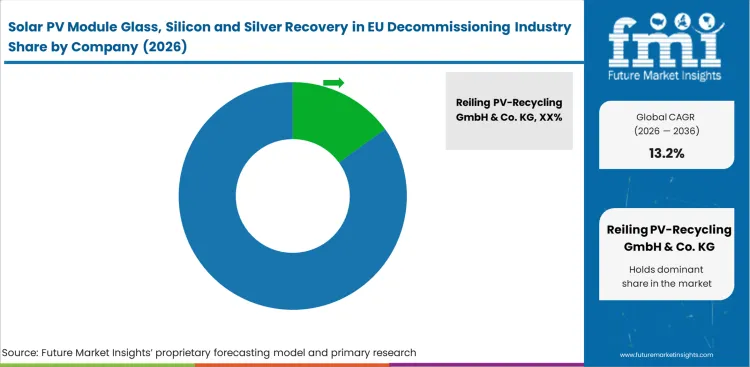
Early market leadership often comes from control over compliance risk rather than from higher recovery yields alone. Operators handling end-of-life solar modules in Europe usually favor processors that can assume documentation, handling, and downstream treatment responsibility under WEEE obligations. In that setting, secure intake terms are often won by offering regulatory certainty, even when residual material upside is less attractive to asset owners. Competitive pressure rises when processors can demonstrate stronger delamination capability and recover cleaner material streams for direct secondary processing channels instead of relying only on bulk aggregate outlets.
Established recycling hubs benefit from permitting depth that is difficult to replicate quickly. Existing chemical handling approvals, wastewater clearances, and site-level operating permissions support continuity in processes that involve acid leaching and other tightly regulated treatment steps. Entry barriers remain high because duplicating that regulatory base can take years and requires large upfront compliance effort. Scale also matters. High-volume glass handling can support the economics of trace silver recovery lines that depend on permitted infrastructure and steady feedstock flow.
Market structure is also starting to shift in response to asset owner preferences. Some operators are showing less interest in broad EPR arrangements when those contracts limit access to residual material value. Direct off-take routes with downstream smelters and specialist recovery partners are gaining attention as alternatives to standard module recycling agreements. Independent recyclers with mobile thermal delamination capability can widen collection reach, especially in rural areas where transport economics are harder to manage. As collection and processing routes diversify, competitive advantage is likely to depend more on recovery performance, treatment flexibility, and control over compliant downstream pathways.
Key Players in Solar PV Module Glass, Silicon and Silver Recovery in EU Decommissioning Industry
- Reiling PV-Recycling GmbH & Co. KG
- ROSI
- SOLAR MATERIALS GmbH
- Veolia
- Galloo
- Envie 2E Aquitaine
Scope of the Report
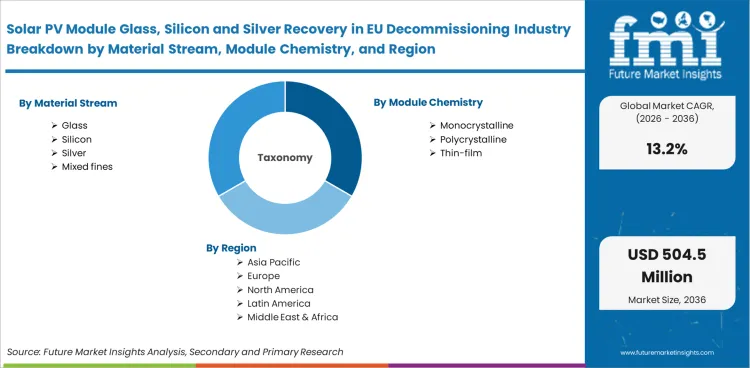
| Metric | Value |
|---|---|
| Quantitative Units | USD 129.0 million to USD 446.0 million, at a CAGR of 13.2% |
| Market Definition | Industrial recovery systems dismantle retired photovoltaic arrays to extract commercial-grade metallurgical components. Processing lines strip encapsulants to separate silver conductors and semiconductor silicon from bulk tempered glass. |
| Segmentation | Material stream, Module chemistry, Recovery process, Decommissioning source, Service model, Region |
| Regions Covered | North America, Latin America, Europe, Asia Pacific, Middle East and Africa |
| Countries Covered | Germany, Italy, France, Spain, Netherlands, Belgium, Poland |
| Key Companies Profiled | Reiling PV-Recycling GmbH & Co. KG, ROSI, SOLAR MATERIALS GmbH, Veolia, Galloo, Envie 2E Aquitaine |
| Forecast Period | 2026 to 2036 |
| Approach | Annual decommissioned megawatt capacities multiplied by regional elemental recovery yields |
Source: Future Market Insights (FMI) analysis, based on proprietary forecasting model and primary research
Solar PV Module Glass, Silicon and Silver Recovery in EU Decommissioning Industry Analysis by Segments
Material stream:
- Glass
- Silicon
- Silver
- Mixed fines
Module chemistry:
- Monocrystalline
- Polycrystalline
- Thin-film
Recovery process:
- Mechanical
- Thermal
- Hydrochemical
- Hybrid
Decommissioning source:
- Utility-scale
- Commercial rooftop
- Residential rooftop
Service model:
- EPR contracts
- Toll recycling
- Direct sourcing
- EPC take-back
Region:
- Germany
- Italy
- France
- Spain
- Netherlands
- Belgium
- Poland
- Austria
- Sweden
- Denmark
Bibliography
- Nain, P., & Anctil, A. (2024). End-of-life solar photovoltaic waste management: A comparison as per European Union and United States regulatory approaches. Resources, Conservation & Recycling Advances, 21, 200212.
- Preet, S., & Smith, S. T. (2024). A comprehensive review on the recycling technology of silicon based photovoltaic solar panels: Challenges and future outlook. Journal of Cleaner Production, 448, 141661.
- Diez-Suarez, A.-M., Martínez-Benavides, M., Manteca Donado, C., Blanes-Peiró, J.-J., & Martínez Torres, E. J. (2024). Recycling of Silicon-Based Photovoltaic Modules: Mediterranean Region Insight. Energies, 17(23), 6015.
- International Energy Agency Photovoltaic Power Systems Programme (IEA PVPS). (2024). Status of PV Module Take-Back and Recycling in Germany (Report IEA-PVPS T12-27:2024). IEA PVPS.
- International Energy Agency Photovoltaic Power Systems Programme (IEA PVPS). (2024). Advances in Photovoltaic Module Recycling: Literature Review and Update to Empirical Life Cycle Inventory Data and Patent Review. IEA PVPS.
This bibliography is provided for reader reference. The full FMI report contains the complete reference list with primary source documentation.
This Report Addresses
- Cross-contamination risks within high-speed mechanical shredding processes
- Capital allocation splits between legacy monocrystalline and emerging thin-film unit processing
- Value destruction sequences during rotor impact silver extraction
- Logistical capacity failures during sudden extreme-weather teardown spikes
- Value capture leakage embedded inside monolithic EPR contracting models
- Thermal delamination retrofit viability against standard WEEE crushing
- Municipal regulatory shifts dictating closed-loop chemical leaching proof
- Regional permitting advantages insulating established WEEE hubs from startups
Frequently Asked Questions
Exactly how big is the EU solar panel recycling market today?
Extended producer responsibility mandates force asset owners away from bulk landfilling toward exact elemental recovery. Legislative penalties attached to improper disposal outpace raw processing costs entirely.
What materials can be recovered from solar panels profitably?
Standard panel architectures rely heavily on thick protective front sheets. Basic mechanical shredders isolate this heavy fraction quickly to satisfy bulk weight diversion quotas demanded by regional auditors.
When will Europe face large solar panel waste volumes hitting processing floors?
Massive early-adopter commercial installations reach their physical end-of-life concurrently this decade. Unprecedented legacy teardown volumes demanding immediate industrial-scale processing are faced by the stakeholders.
Is solar panel recycling profitable in Europe given volatile spot pricing?
High-speed rotor mills drive shattered glass fragments deep into delicate silicon flakes, ruining profit margins. This cross-contamination forces secondary refineries to reject entire aggregate batches upon intake.
How do utility owners request quote solar panel recycling Europe services effectively?
Total legal compliance liability is transferred to specialized consortiums through formal WEEE sourcing channels. Avoiding crippling regional landfill fines outweighs the potential commodity upside of selling isolated precious metals directly.
What defines utility scale solar decommissioning services Europe versus basic crushing?
Handling thousands of liters of concentrated nitric acid requires complex municipal wastewater discharge permits. Incumbents possess these localized environmental approvals, establishing deep regional monopolies beyond basic WEEE diversion.
Why do operators seek a specialized contract recycler for end-of-life PV modules?
Blanket consortium agreements dictate flat-rate processing fees regardless of actual panel composition. In the absence of specialized off‑take agreements, third‑party processors capture all residual precious metal value.
How does a solar decommissioning tender Europe dictate volume flows?
Soren-linked WEEE tenders consolidate massive scattered regional volumes into centralized national hubs. Securing these long-term municipal contracts guarantees steady feedstock supplies for dedicated capital investments.
What prevents utility owners from monetizing silver directly?
Blanket consortium agreements dictate flat-rate processing fees regardless of actual panel composition. Residual precious metal value is entirely transferred to third‑party processors.
Why do thin-film architectures threaten existing capital investments?
Standard nitric acid blends optimized for traditional silicon units fail to strip copper-indium-gallium-selenide contacts effectively. Unexpected chemical solvent expenditures are faced by companies to process newer incoming waste streams.
How do mobile processing units shift competitive power?
Containerized shredders deploy directly to rural park teardowns, eliminating heavy transportation inefficiencies. Centralized WEEE hubs are bypassed entirely, taking initial processing directly to the waste source.
What limits thermal delamination adoption despite superior yields?
Infrared heating lines require massive baseline energy expenditures to melt encapsulant bonds cleanly. Facilities face crippling operational expenses if they run these systems during peak utility pricing hours.
How do French operators stabilize intake volatility?
Soren-linked WEEE tenders consolidate massive scattered regional volumes into centralized national hubs. Securing these long-term municipal contracts guarantees steady feedstock supplies for dedicated capital investments.
Why do Polish processing metrics lag Western Europe?
Domestic solar fleets comprise relatively newer installations that remain physically operational today. Massive decommissioning waves sit slightly further out, delaying immediate industrial-scale recovery investments.
What forces smelters to penalize low-grade WEEE inputs?
Smelting operations incur significant energy penalties when burning off residual encapsulant plastics bound to shredded silver. Financial controllers offset this inefficiency by increasing gate fees for contaminated intake fractions.
How do direct smelter integrations bypass traditional brokers?
Co-locating initial shredding steps directly adjacent to metallurgical copper furnaces establishes closed-loop recovery pathways. Financial controllers capture maximum trace metallic value instantly without paying intermediary commissions.
What drives Spain's aggressive processing expansion?
Utility owners execute massive repowering initiatives, replacing aging functional arrays with modern high-efficiency modules. These localized upgrades generate massive, predictable teardown volumes for regional recyclers.
Why do Dutch operators focus on space-constrained intake?
Concentrated urban commercial rooftop replacements dictate localized collection logistics. Demolition crews navigate complex extractions, forcing processors to optimize tight staging areas.
How do Belgian hubs manipulate international spot markets?
Centralized operations command deep-water port access, facilitating massive aggregate movement. Vendors leverage these logistical nodes to access highly favorable global secondary raw material pricing.
What characterizes the tension moving toward 2036?
Asset owners resist monolithic compliance contracts that confiscate their residual elemental value. Fragmenting collection networks forces incumbents to compete on actual recovery yields rather than simple WEEE liability assumption.
Why does silicon trace value fail to materialize for basic shredders?
Standard hammer mills shatter valuable metallic contacts into unrecoverable aerosolized dust. Companies relying purely on mechanical separation lose massive potential revenue per processed ton.
What defines the 2036 structural end state?
Hybrid facilities crossing massive annual tonnage barriers dilute heavy chemical solvent expenses across vast output volumes. Scale transforms elemental silver extraction from a net liability into the primary profit driver.
Preview the report firsthand - request a free sample
Get SampleGet the brochure for pricing and purchase details.
Get PDFTable of Content
- Executive Summary
- Global Market Outlook
- Demand-side Trends
- Supply-side Trends
- Technology Roadmap Analysis
- Analysis and Recommendations
- Market Overview
- Market Coverage / Taxonomy
- Market Definition / Scope / Limitations
- Research Methodology
- Chapter Orientation
- Analytical Lens and Working Hypotheses
- Market Structure, Signals, and Trend Drivers
- Benchmarking and Cross-market Comparability
- Market Sizing, Forecasting, and Opportunity Mapping
- Research Design and Evidence Framework
- Desk Research Programme (Secondary Evidence)
- Company Annual and Sustainability Reports
- Peer-reviewed Journals and Academic Literature
- Corporate Websites, Product Literature, and Technical Notes
- Earnings Decks and Investor Briefings
- Statutory Filings and Regulatory Disclosures
- Technical White Papers and Standards Notes
- Trade Journals, Industry Magazines, and Analyst Briefs
- Conference Proceedings, Webinars, and Seminar Materials
- Government Statistics Portals and Public Data Releases
- Press Releases and Reputable Media Coverage
- Specialist Newsletters and Curated Briefings
- Sector Databases and Reference Repositories
- FMI Internal Proprietary Databases and Historical Market Datasets
- Subscription Datasets and Paid Sources
- Social Channels, Communities, and Digital Listening Inputs
- Additional Desk Sources
- Expert Input and Fieldwork (Primary Evidence)
- Primary Modes
- Qualitative Interviews and Expert Elicitation
- Quantitative Surveys and Structured Data Capture
- Blended Approach
- Why Primary Evidence is Used
- Field Techniques
- Interviews
- Surveys
- Focus Groups
- Observational and In-context Research
- Social and Community Interactions
- Stakeholder Universe Engaged
- C-suite Leaders
- Board Members
- Presidents and Vice Presidents
- R&D and Innovation Heads
- Technical Specialists
- Domain Subject-matter Experts
- Scientists
- Physicians and Other Healthcare Professionals
- Governance, Ethics, and Data Stewardship
- Research Ethics
- Data Integrity and Handling
- Primary Modes
- Tooling, Models, and Reference Databases
- Desk Research Programme (Secondary Evidence)
- Data Engineering and Model Build
- Data Acquisition and Ingestion
- Cleaning, Normalisation, and Verification
- Synthesis, Triangulation, and Analysis
- Quality Assurance and Audit Trail
- Market Background
- Market Dynamics
- Drivers
- Restraints
- Opportunity
- Trends
- Scenario Forecast
- Demand in Optimistic Scenario
- Demand in Likely Scenario
- Demand in Conservative Scenario
- Opportunity Map Analysis
- Product Life Cycle Analysis
- Supply Chain Analysis
- Investment Feasibility Matrix
- Value Chain Analysis
- PESTLE and Porter’s Analysis
- Regulatory Landscape
- Regional Parent Market Outlook
- Production and Consumption Statistics
- Import and Export Statistics
- Market Dynamics
- Global Market Analysis 2021 to 2025 and Forecast, 2026 to 2036
- Historical Market Size Value (USD Million) Analysis, 2021 to 2025
- Current and Future Market Size Value (USD Million) Projections, 2026 to 2036
- Y-o-Y Growth Trend Analysis
- Absolute $ Opportunity Analysis
- Global Market Pricing Analysis 2021 to 2025 and Forecast 2026 to 2036
- Global Market Analysis 2021 to 2025 and Forecast 2026 to 2036, By Material Stream
- Introduction / Key Findings
- Historical Market Size Value (USD Million) Analysis By Material Stream , 2021 to 2025
- Current and Future Market Size Value (USD Million) Analysis and Forecast By Material Stream , 2026 to 2036
- Glass
- Silicon
- Silver
- Mixed fines
- Glass
- Y-o-Y Growth Trend Analysis By Material Stream , 2021 to 2025
- Absolute $ Opportunity Analysis By Material Stream , 2026 to 2036
- Global Market Analysis 2021 to 2025 and Forecast 2026 to 2036, By Module Chemistry
- Introduction / Key Findings
- Historical Market Size Value (USD Million) Analysis By Module Chemistry, 2021 to 2025
- Current and Future Market Size Value (USD Million) Analysis and Forecast By Module Chemistry, 2026 to 2036
- Monocrystalline
- Polycrystalline
- Thin-film
- Monocrystalline
- Y-o-Y Growth Trend Analysis By Module Chemistry, 2021 to 2025
- Absolute $ Opportunity Analysis By Module Chemistry, 2026 to 2036
- Global Market Analysis 2021 to 2025 and Forecast 2026 to 2036, By Recovery Process
- Introduction / Key Findings
- Historical Market Size Value (USD Million) Analysis By Recovery Process, 2021 to 2025
- Current and Future Market Size Value (USD Million) Analysis and Forecast By Recovery Process, 2026 to 2036
- Mechanical
- Thermal
- Hydrochemical
- Hybrid
- Mechanical
- Y-o-Y Growth Trend Analysis By Recovery Process, 2021 to 2025
- Absolute $ Opportunity Analysis By Recovery Process, 2026 to 2036
- Global Market Analysis 2021 to 2025 and Forecast 2026 to 2036, By Decommissioning Source
- Introduction / Key Findings
- Historical Market Size Value (USD Million) Analysis By Decommissioning Source, 2021 to 2025
- Current and Future Market Size Value (USD Million) Analysis and Forecast By Decommissioning Source, 2026 to 2036
- Utility-scale
- Commercial rooftop
- Residential rooftop
- Utility-scale
- Y-o-Y Growth Trend Analysis By Decommissioning Source, 2021 to 2025
- Absolute $ Opportunity Analysis By Decommissioning Source, 2026 to 2036
- Global Market Analysis 2021 to 2025 and Forecast 2026 to 2036, By Service model
- Introduction / Key Findings
- Historical Market Size Value (USD Million) Analysis By Service model, 2021 to 2025
- Current and Future Market Size Value (USD Million) Analysis and Forecast By Service model, 2026 to 2036
- EPR contracts
- Toll recycling
- Direct sourcing
- EPC take-back
- EPR contracts
- Y-o-Y Growth Trend Analysis By Service model, 2021 to 2025
- Absolute $ Opportunity Analysis By Service model, 2026 to 2036
- Global Market Analysis 2021 to 2025 and Forecast 2026 to 2036, By Region
- Introduction
- Historical Market Size Value (USD Million) Analysis By Region, 2021 to 2025
- Current Market Size Value (USD Million) Analysis and Forecast By Region, 2026 to 2036
- North America
- Latin America
- Western Europe
- Eastern Europe
- East Asia
- South Asia and Pacific
- Middle East & Africa
- Market Attractiveness Analysis By Region
- North America Market Analysis 2021 to 2025 and Forecast 2026 to 2036, By Country
- Historical Market Size Value (USD Million) Trend Analysis By Market Taxonomy, 2021 to 2025
- Market Size Value (USD Million) Forecast By Market Taxonomy, 2026 to 2036
- By Country
- USA
- Canada
- Mexico
- By Material Stream
- By Module Chemistry
- By Recovery Process
- By Decommissioning Source
- By Service model
- By Country
- Market Attractiveness Analysis
- By Country
- By Material Stream
- By Module Chemistry
- By Recovery Process
- By Decommissioning Source
- By Service model
- Key Takeaways
- Latin America Market Analysis 2021 to 2025 and Forecast 2026 to 2036, By Country
- Historical Market Size Value (USD Million) Trend Analysis By Market Taxonomy, 2021 to 2025
- Market Size Value (USD Million) Forecast By Market Taxonomy, 2026 to 2036
- By Country
- Brazil
- Chile
- Rest of Latin America
- By Material Stream
- By Module Chemistry
- By Recovery Process
- By Decommissioning Source
- By Service model
- By Country
- Market Attractiveness Analysis
- By Country
- By Material Stream
- By Module Chemistry
- By Recovery Process
- By Decommissioning Source
- By Service model
- Key Takeaways
- Western Europe Market Analysis 2021 to 2025 and Forecast 2026 to 2036, By Country
- Historical Market Size Value (USD Million) Trend Analysis By Market Taxonomy, 2021 to 2025
- Market Size Value (USD Million) Forecast By Market Taxonomy, 2026 to 2036
- By Country
- Germany
- UK
- Italy
- Spain
- France
- Nordic
- BENELUX
- Rest of Western Europe
- By Material Stream
- By Module Chemistry
- By Recovery Process
- By Decommissioning Source
- By Service model
- By Country
- Market Attractiveness Analysis
- By Country
- By Material Stream
- By Module Chemistry
- By Recovery Process
- By Decommissioning Source
- By Service model
- Key Takeaways
- Eastern Europe Market Analysis 2021 to 2025 and Forecast 2026 to 2036, By Country
- Historical Market Size Value (USD Million) Trend Analysis By Market Taxonomy, 2021 to 2025
- Market Size Value (USD Million) Forecast By Market Taxonomy, 2026 to 2036
- By Country
- Russia
- Poland
- Hungary
- Balkan & Baltic
- Rest of Eastern Europe
- By Material Stream
- By Module Chemistry
- By Recovery Process
- By Decommissioning Source
- By Service model
- By Country
- Market Attractiveness Analysis
- By Country
- By Material Stream
- By Module Chemistry
- By Recovery Process
- By Decommissioning Source
- By Service model
- Key Takeaways
- East Asia Market Analysis 2021 to 2025 and Forecast 2026 to 2036, By Country
- Historical Market Size Value (USD Million) Trend Analysis By Market Taxonomy, 2021 to 2025
- Market Size Value (USD Million) Forecast By Market Taxonomy, 2026 to 2036
- By Country
- China
- Japan
- South Korea
- By Material Stream
- By Module Chemistry
- By Recovery Process
- By Decommissioning Source
- By Service model
- By Country
- Market Attractiveness Analysis
- By Country
- By Material Stream
- By Module Chemistry
- By Recovery Process
- By Decommissioning Source
- By Service model
- Key Takeaways
- South Asia and Pacific Market Analysis 2021 to 2025 and Forecast 2026 to 2036, By Country
- Historical Market Size Value (USD Million) Trend Analysis By Market Taxonomy, 2021 to 2025
- Market Size Value (USD Million) Forecast By Market Taxonomy, 2026 to 2036
- By Country
- India
- ASEAN
- Australia & New Zealand
- Rest of South Asia and Pacific
- By Material Stream
- By Module Chemistry
- By Recovery Process
- By Decommissioning Source
- By Service model
- By Country
- Market Attractiveness Analysis
- By Country
- By Material Stream
- By Module Chemistry
- By Recovery Process
- By Decommissioning Source
- By Service model
- Key Takeaways
- Middle East & Africa Market Analysis 2021 to 2025 and Forecast 2026 to 2036, By Country
- Historical Market Size Value (USD Million) Trend Analysis By Market Taxonomy, 2021 to 2025
- Market Size Value (USD Million) Forecast By Market Taxonomy, 2026 to 2036
- By Country
- Kingdom of Saudi Arabia
- Other GCC Countries
- Turkiye
- South Africa
- Other African Union
- Rest of Middle East & Africa
- By Material Stream
- By Module Chemistry
- By Recovery Process
- By Decommissioning Source
- By Service model
- By Country
- Market Attractiveness Analysis
- By Country
- By Material Stream
- By Module Chemistry
- By Recovery Process
- By Decommissioning Source
- By Service model
- Key Takeaways
- Key Countries Market Analysis
- USA
- Pricing Analysis
- Market Share Analysis, 2025
- By Material Stream
- By Module Chemistry
- By Recovery Process
- By Decommissioning Source
- By Service model
- Canada
- Pricing Analysis
- Market Share Analysis, 2025
- By Material Stream
- By Module Chemistry
- By Recovery Process
- By Decommissioning Source
- By Service model
- Mexico
- Pricing Analysis
- Market Share Analysis, 2025
- By Material Stream
- By Module Chemistry
- By Recovery Process
- By Decommissioning Source
- By Service model
- Brazil
- Pricing Analysis
- Market Share Analysis, 2025
- By Material Stream
- By Module Chemistry
- By Recovery Process
- By Decommissioning Source
- By Service model
- Chile
- Pricing Analysis
- Market Share Analysis, 2025
- By Material Stream
- By Module Chemistry
- By Recovery Process
- By Decommissioning Source
- By Service model
- Germany
- Pricing Analysis
- Market Share Analysis, 2025
- By Material Stream
- By Module Chemistry
- By Recovery Process
- By Decommissioning Source
- By Service model
- UK
- Pricing Analysis
- Market Share Analysis, 2025
- By Material Stream
- By Module Chemistry
- By Recovery Process
- By Decommissioning Source
- By Service model
- Italy
- Pricing Analysis
- Market Share Analysis, 2025
- By Material Stream
- By Module Chemistry
- By Recovery Process
- By Decommissioning Source
- By Service model
- Spain
- Pricing Analysis
- Market Share Analysis, 2025
- By Material Stream
- By Module Chemistry
- By Recovery Process
- By Decommissioning Source
- By Service model
- France
- Pricing Analysis
- Market Share Analysis, 2025
- By Material Stream
- By Module Chemistry
- By Recovery Process
- By Decommissioning Source
- By Service model
- India
- Pricing Analysis
- Market Share Analysis, 2025
- By Material Stream
- By Module Chemistry
- By Recovery Process
- By Decommissioning Source
- By Service model
- ASEAN
- Pricing Analysis
- Market Share Analysis, 2025
- By Material Stream
- By Module Chemistry
- By Recovery Process
- By Decommissioning Source
- By Service model
- Australia & New Zealand
- Pricing Analysis
- Market Share Analysis, 2025
- By Material Stream
- By Module Chemistry
- By Recovery Process
- By Decommissioning Source
- By Service model
- China
- Pricing Analysis
- Market Share Analysis, 2025
- By Material Stream
- By Module Chemistry
- By Recovery Process
- By Decommissioning Source
- By Service model
- Japan
- Pricing Analysis
- Market Share Analysis, 2025
- By Material Stream
- By Module Chemistry
- By Recovery Process
- By Decommissioning Source
- By Service model
- South Korea
- Pricing Analysis
- Market Share Analysis, 2025
- By Material Stream
- By Module Chemistry
- By Recovery Process
- By Decommissioning Source
- By Service model
- Russia
- Pricing Analysis
- Market Share Analysis, 2025
- By Material Stream
- By Module Chemistry
- By Recovery Process
- By Decommissioning Source
- By Service model
- Poland
- Pricing Analysis
- Market Share Analysis, 2025
- By Material Stream
- By Module Chemistry
- By Recovery Process
- By Decommissioning Source
- By Service model
- Hungary
- Pricing Analysis
- Market Share Analysis, 2025
- By Material Stream
- By Module Chemistry
- By Recovery Process
- By Decommissioning Source
- By Service model
- Kingdom of Saudi Arabia
- Pricing Analysis
- Market Share Analysis, 2025
- By Material Stream
- By Module Chemistry
- By Recovery Process
- By Decommissioning Source
- By Service model
- Turkiye
- Pricing Analysis
- Market Share Analysis, 2025
- By Material Stream
- By Module Chemistry
- By Recovery Process
- By Decommissioning Source
- By Service model
- South Africa
- Pricing Analysis
- Market Share Analysis, 2025
- By Material Stream
- By Module Chemistry
- By Recovery Process
- By Decommissioning Source
- By Service model
- USA
- Market Structure Analysis
- Competition Dashboard
- Competition Benchmarking
- Market Share Analysis of Top Players
- By Regional
- By Material Stream
- By Module Chemistry
- By Recovery Process
- By Decommissioning Source
- By Service model
- Competition Analysis
- Competition Deep Dive
- Reiling PV-Recycling GmbH & Co. KG
- Overview
- Product Portfolio
- Profitability by Market Segments (Product/Age /Sales Channel/Region)
- Sales Footprint
- Strategy Overview
- Marketing Strategy
- Product Strategy
- Channel Strategy
- ROSI
- SOLAR MATERIALS GmbH
- Veolia
- Galloo
- Envie 2E Aquitaine
- Reiling PV-Recycling GmbH & Co. KG
- Competition Deep Dive
- Assumptions & Acronyms Used


