

- Industry Size (2026)
- USD 240.0 Mn
- Forecast (2036)
- USD 730.0 Mn
- CAGR (2026 to 2036)
- 11.8%
Coffee Capsule Organics and Residue Recovery Systems in EU Industry Size, Market Forecast and Outlook By FMI
The coffee capsule organics and residue recovery systems in EU industry value reached USD 214.7 million in 2025 across organized collection and residue handling services. The market revenue is expected to reach USD 240.0 million in 2026 and USD 730.0 million by 2036 at a 11.8% CAGR over the forecast period. Organics are estimated to account for 46.0% of material demand in 2026, while B2B pickup is expected to lead collection with a 34.0% share.
Summary of the Coffee Capsule Organics and Residue Recovery Systems in EU Market
- Demand and Growth Drivers
- Coffee capsule use across Europe has created a dense post-consumption waste stream that supports specialized recovery capacity and dedicated depackaging investment.
- Packaging rules across the European Union are directing more capital toward compliant sorting infrastructure and residue handling assets for small-format packaging waste.
- Foodservice expansion and office coffee service activity support larger return flows from concentrated commercial locations with cleaner feedstock quality.
- Product and Segment View
- Organics lead material handling volumes because the spent coffee fraction carries more weight than the shell materials inside each used capsule.
- Separation lines hold the largest system share because mixed capsules require opening and sorting before any downstream residue processing can begin.
- Compost leads end-output value in 2026, and recycled aluminum plus recycled polymer output expand from a smaller installed base.
- Geography and Competitive Outlook
- Portugal and France are expected to post the highest forecast rates among the seven benchmark countries used in this assessment.
- Germany provides the largest stable processing base because wider waste infrastructure and dense municipal handling capacity support larger throughput volumes.
- Nespresso, Veolia, and SUEZ hold the clearest branded and industrial positions. TerraCycle, TOMRA, NAFIGATE, and Envar address specialized collection and processing requirements.
- Analyst Opinion
- Nikhil Kaitwade, Principal Consultant at FMI says, “Companies with strong depackaging efficiency and dependable outlet access for spent coffee grounds, aluminum, and polymer fractions are expected to strengthen their position through 2036. Commercial scale is likely to build faster in systems connected to dense office and hospitality capsule flows across the European Union. Processing discipline, route density, and cleaner output streams will matter more than broad collection claims when operators compete for recovery contracts.”
- Coffee Capsule Organics and Residue Recovery Systems in EU Industry Value Analysis
- Capsule waste recovery in Europe is advancing from pilot activity into a defined industrial service line with clearer operating economics and more visible contract structures.
- Organics recovery supports a large share of system demand because residue mass per returned capsule remains higher than the recoverable shell fraction.
- Material recovery economics improve once clean aluminum fractions and sorted polymer outputs reach outlet specifications that support repeat off-take.
- Compliance-led investment in design-for-recycling packaging supports more structured spending on capsule recovery infrastructure and residue preparation assets.
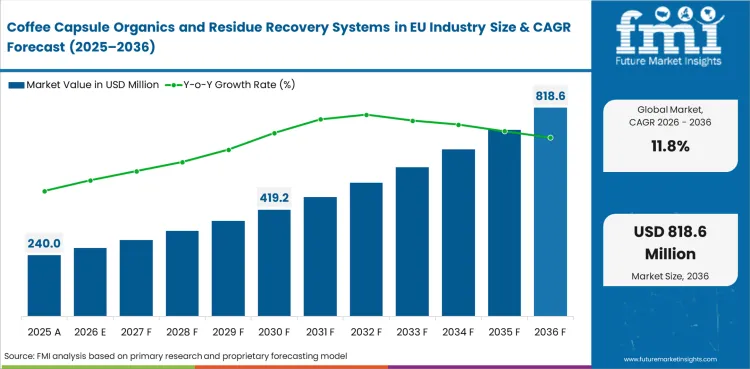
Key Takeaways, Market Size, and Forecast
- Coffee capsule organics and residue recovery systems in the European Union industry was valued at USD 214.7 million in 2025.
- Market value is estimated at USD 240.0 million in 2026 across collection systems and residue handling operations.
- Industry revenue is expected to reach USD 730.0 million by 2036 under the FMI base-case forecast for the European Union.
- The forecast implies an incremental opportunity of USD 490.0 million between 2026 and 2036 across the regional recovery value chain.
- Organics are estimated to represent 46.0% of material demand in 2026 across commercial recovery operations and downstream residue preparation lines.
- Portugal at 13.4% and France at 13.1% rank among the fastest advancing country markets in this study period.
Coffee Capsule Organics and Residue Recovery Systems in EU Industry Definition
Coffee Capsule Organics and Residue Recovery Systems in the European Union include technologies and service models used to collect and open used coffee capsules. Scope covers separation, drying, and downstream direction of approved residue fractions. Covered materials include spent coffee grounds plus separated aluminum and plastic fractions generated from single-serve coffee capsules. Collection channels include household returns and commercial service programs.
Coffee Capsule Organics and Residue Recovery Systems in EU Industry Inclusions
Market scope covers commercially deployed or contract-operated systems used for capsule collection and depackaging. Scope extends to residue separation, organics conditioning, compost preparation, digestion-feed preparation, and material recovery across European Union member states. Revenue covers system sales and handling fees tied to commercial capsule recovery programs. Processing charges and related service value are mapped across each major segment in this study.
Coffee Capsule Organics and Residue Recovery Systems in EU Industry Exclusions
Scope excludes primary capsule manufacturing and roasted coffee sales. Coffee machine sales and broad municipal organics lines without a defined capsule recovery component are excluded as well. Standalone packaging design consulting sits outside the revenue boundary used in this assessment. General waste handling contracts without capsule-specific segregation are excluded from value calculations.
Coffee Capsule Organics and Residue Recovery Systems in EU Industry Research Methodology
- Primary research included interviews with waste operators and office coffee service firms across Europe. Municipal packaging collection teams and processing equipment vendors provided a second validation layer for operating assumptions and route economics.
- Desk research combined European coffee consumption data with packaging rule updates. Waste statistics and public information on capsule return systems supported the secondary review and country-level interpretation.
- Market sizing used a hybrid model that combined capsule-use density with estimated collection intensity and recovery system revenue pools across the benchmark countries.
- Forecast validation compared modeled values with adjacent recyclable-packaging and residue-processing infrastructure benchmarks to test scale assumptions and growth direction.
Why the Coffee Capsule Organics and Residue Recovery Systems in EU Industry Is Expanding?
- Coffee pod use has reached scale across Western Europe, which supports higher residue concentration per collection point than fragmented food-waste streams usually provide.
- European packaging compliance is moving toward stricter recyclability and compostability requirements for single-serve packaging formats sold at retail and through coffee-service channels.
- Office coffee service networks and hospitality outlets create efficient return volumes with higher plant loading and lower sorting loss.
Coffee capsule recovery capacity is expanding under two direct commercial conditions. Capsule-use density creates predictable residue volumes across offices and hospitality chains. Urban households provide a second pool of recurring returns for municipal and brand-led schemes. Packaging compliance adds pressure on coffee brands and waste operators to formalize collection routes. Recovery infrastructure attracts investment across collection systems and depackaging capacity. Organics conditioning lines follow once feedstock quality reaches workable levels. Roasted coffee and coffee extracts sit close to this value chain and support adjacent outlet development for coffee-derived inputs.
Market Segmentation Analysis
- Organics lead the material split at 46.0% in 2026 because the residue fraction is heavier than the shell fraction in each returned capsule.
- Separation lines account for 28.0% of system demand because mixed capsules require opening and sorting before residue conditioning can proceed.
- B2B pickup leads collection at 34.0% because offices and hospitality groups generate lower-contamination return streams under more structured collection routines.
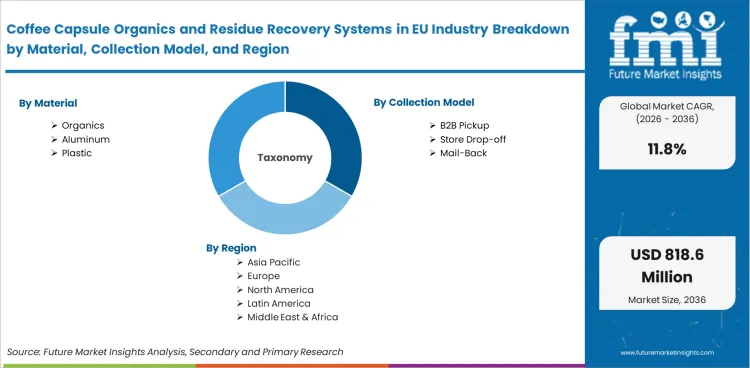
The market for coffee capsule organics and residue recovery systems in the European Union is divided by material type, system type, collection model, end output, and end user. Material segments cover Organics, Aluminum, Plastic, and Hybrid. System segments cover Separation Lines, Drying Units, Composting Units, AD Units, and Extraction Units. Collection segments cover B2B Pickup, Store Drop-off, Mail-back, Public-bin, and Civic Depots. End-output segments cover Compost, Bioenergy, Recycled Aluminum, Recycled Polymer, and Feed Ingredients. End-user segments cover Waste Operators, Coffee Brands, Roasters, Municipalities, and Hospitality Sites.
Insights into the Organics Material Segment
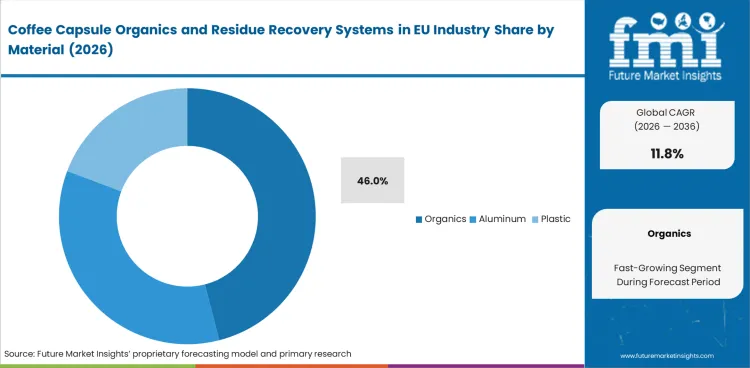
- Organics are estimated to account for 46.0% of material demand in 2026 across commercial recovery operations in the European Union.
- Higher wet mass per capsule supports more handling value in separation and drying stages. Outlet preparation adds further service value beyond packaging fractions.
- Spent coffee grounds require moisture management and contamination control before composting or digestion. Processing lines with residue quality monitoring are better placed to capture higher service value.
Insights into the B2B Pickup Collection Model
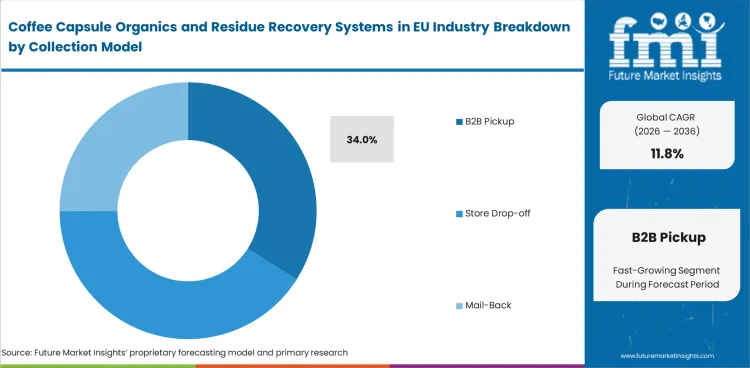
- B2B pickup is expected to hold 34.0% of collection demand in 2026 across organized commercial return programs.
- Office coffee service fleets and hospitality chains generate denser, lower-contamination return flows that support more efficient processing economics.
- Consolidated pickup patterns support lower transport cost per kilogram processed. Plant operators prefer commercial accounts during early capacity-ramp periods.
Insights into the Compost End Output Segment
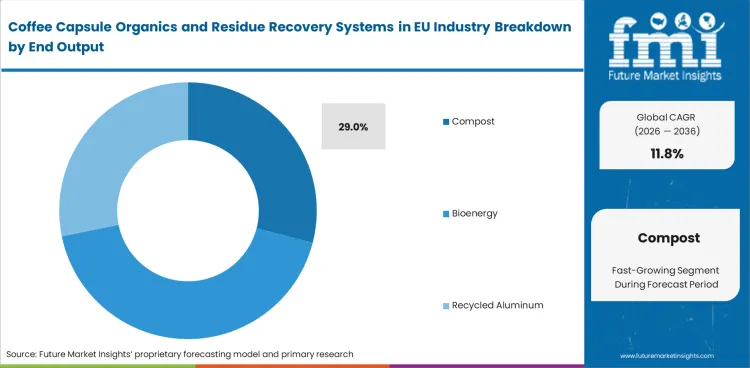
- Compost is estimated to represent 29.0% of end-output demand in 2026 across managed organics recovery channels.
- This outlet offers the broadest immediate absorption base for conditioned coffee residue under current operating conditions in the European Union.
- Feed ingredients and extraction outputs present upside for processors, although scale remains concentrated in a smaller number of specialized residue programs.
Coffee Capsule Organics and Residue Recovery Systems in EU Industry Drivers, Restraints, and Opportunities
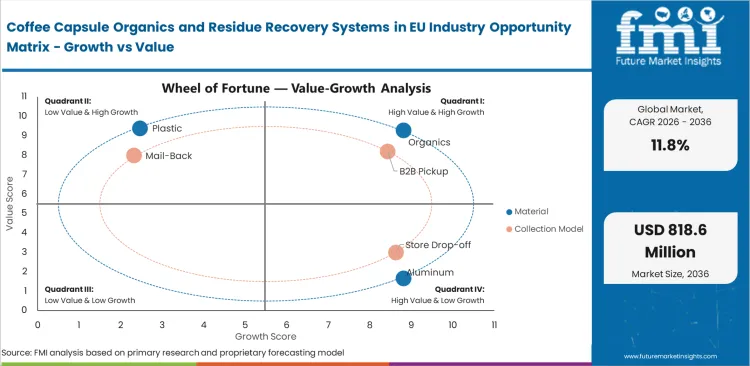
- Wider capsule penetration across Europe supports a larger post-consumption residue base for organized collection and processing services.
- Mixed-material capsule formats increase sorting complexity and raise operating cost at depackaging plants handling small-format packaging flows.
- Compostability rules and circular packaging targets are creating new demand for traceable organics recovery and cleaner material outputs.
Collection assets and depackaging lines benefit from higher utilization once capsules are aggregated through offices and hospitality groups. Cost pressure enters at the processing stage because mixed formats raise labor demand and reduce output purity. New outlet development across compost and bioenergy improves project economics over time. Extraction applications add upside in specialized residue programs where residue quality is controlled more tightly.
Coffee Price Spikes Improve Residue EconomicsIn March 2026, the ICO Composite Indicator Price averaged 273.70 US cents/lb, up 2.3% from February 2026, and Colombian Milds plus Other Milds averaged 337.45 and 334.34 US cents/lb. For EU coffee capsule organics recovery, that directly strengthens the value held inside used capsules. Elevated coffee fill costs make separation of spent grounds from capsule shells easier to justify at depackaging and residue-recovery systems.
PPWR Classification Is Reshaping Capsule RecoveryIn the EU coffee capsule organics and residue recovery industry, Belgium provides a useful operating signal. Fost Plus stated on September 24, 2025 that, from August 12, 2026, drink capsules for tea and coffee will be classified as packaging, with aluminum and plastic capsules assigned their own categories, and compostable plastic capsules treated as non-recyclable. That change matters because residue-recovery systems will require cleaner material separation and clearer routing of coffee grounds versus shell materials.
Analysis of Coffee Capsule Organics and Residue Recovery Systems in EU Industry by Key Countries
.webp "Top Country Growth Comparison Coffee Capsule Organics And Residue Recovery Systems In Eu Industry Cagr (2026 2036)")
| Country | CAGR |
|---|---|
| Portugal | 13.4% |
| France | 13.1% |
| Netherlands | 12.8% |
| Belgium | 12.2% |
| Spain | 11.9% |
| Italy | 11.3% |
| Germany | 10.4% |
Source reflects FMI analysis based on modeled recovery-system demand across EU capsule collection and residue-processing capacity.
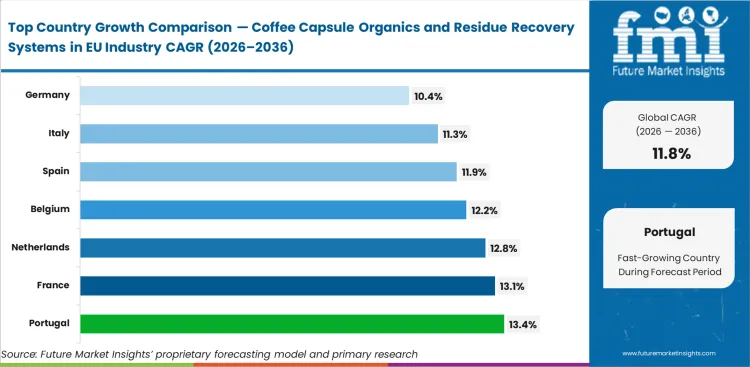
Coffee Capsule Organics and Residue Recovery Systems in EU Industry CAGR Analysis by Country
- Portugal leads the benchmark set with a forecast CAGR of 13.4%. High pod usage and compact urban collection patterns support stronger residue concentration for recovery operators.
- France is expected to advance at 13.1% through 2036. Retail pod penetration and branded collection activity support faster processing-system deployment across the country.
- The Netherlands at 12.8% and Belgium at 12.2% reflect strong packaging infrastructure and efficient reverse-logistics capability.
- Germany at 10.4% trails the group average because a larger installed waste base and a less pod-intensive coffee mix moderate dedicated line expansion.
The study covers the most commercially active European Union countries for capsule residue handling and recovery infrastructure. Country differences reflect pod penetration, municipal collection readiness, office coffee service density, and access to downstream residue outlets. Western Europe dominates the early revenue pool because capsule adoption is higher and packaging recovery systems are more mature.
Demand Outlook for Coffee Capsule Organics and Residue Recovery Systems in Portugal
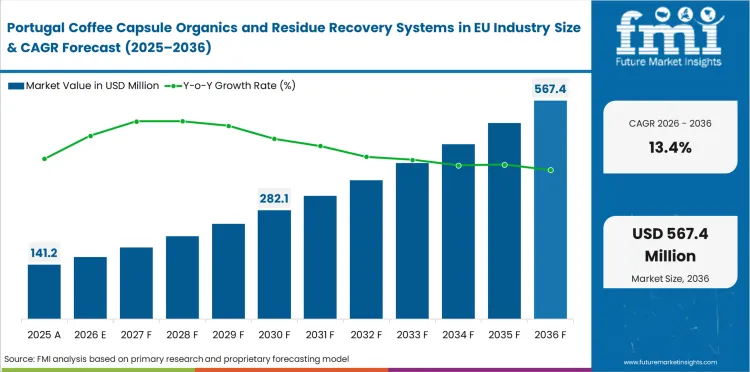
Portugal is expected to expand at a CAGR of 13.4% during 2026 to 2036. High household pod penetration supports frequent return volumes in urban areas and improves the economics of localized residue handling. Collection density supports smaller transport radii and raises the attractiveness of dedicated capsule-separation projects.
- Pod-based coffee preparation is deeply established in urban households and hospitality outlets across the country.
- Dense metropolitan capture points support higher loading for depackaging and drying equipment used in localized recovery systems.
- Compost and bioenergy outlets are better placed to absorb conditioned organics from Portugal-based processing lines.
Future Outlook for Coffee Capsule Organics and Residue Recovery Systems in France
France is estimated to record 13.1% CAGR across the forecast period. Capsule use is broad across retail coffee channels, and branded take-back participation carries wider visibility than in several neighboring markets. Processing demand benefits from large municipal waste systems and a wide household installed base using single-serve machines.
- Branded collection programs support stronger return awareness among capsule users in major French retail and service markets.
- Large retail and office coffee volumes improve the economics of consolidation and transport for recovery operators.
- Residue-processing demand benefits from wide municipal handling infrastructure and established packaging collection systems.
Opportunity Analysis of Coffee Capsule Organics and Residue Recovery Systems in the Netherlands
The Netherlands is forecast to advance at 12.8% CAGR between 2026 and 2036. Reverse-logistics capacity is well developed and packaging-sorting performance is comparatively efficient. Coffee service density across offices and urban commercial buildings supports higher-quality return streams for industrial handling.
- Office coffee service concentration improves B2B pickup economics for capsule recovery operators serving urban commercial accounts.
- Advanced sorting infrastructure supports cleaner material fractions after depackaging and residue separation stages.
- Circular packaging programs improve acceptance of recovery-system investment among municipal and commercial operators.
In-depth Analysis of Coffee Capsule Organics and Residue Recovery Systems in Belgium
Belgium is estimated to post 12.2% CAGR through 2036. National packaging recovery performance provides a supportive operating environment for capsule collection and residue sorting services. Cross-border transport links and dense urban demand improve the attractiveness of regional processing hubs.
- Packaging collection performance supports reliable feedstock capture for specialized processors working with small-format packaging flows.
- Compact transport distances reduce cost pressure on returned capsule handling and improve route productivity.
- Processing hubs can serve nearby industrial and municipal outlets with lower transport loss and better turnaround.
Sales Analysis of Coffee Capsule Organics and Residue Recovery Systems in Spain
Spain is expected to register 11.9% CAGR during the forecast window. Coffee capsule adoption is high in households and hospitality locations, which supports a broad residue base for organized collection. Regional variation in waste-handling infrastructure leaves room for operator expansion across larger metropolitan areas.
- Hospitality traffic raises the volume of capsules used outside the home and strengthens commercial return density.
- Urban concentration improves return density for collection contractors and coffee brands operating dedicated take-back schemes.
- Residue outlets connected to compost and digestion support stronger processing economics for Spain-based operators.
Demand Outlook for Coffee Capsule Organics and Residue Recovery Systems in Italy
Italy is projected to expand at 11.3% CAGR through 2036. Single-serve coffee use is broad across households and office channels, although return-system structure shows greater regional variation than in France and Belgium. Processing demand reflects both branded schemes and municipal experimentation with small-format packaging capture.
- Home coffee culture supports a large installed base of compatible capsule machines across the household segment.
- Office coffee service flows improve the economics of commercial pickup programs serving cities and business districts.
- Regional handling variation creates room for private processing operators that can build repeat local throughput.
Future Outlook for Coffee Capsule Organics and Residue Recovery Systems in Germany
Germany is estimated to advance at 10.4% CAGR during 2026 to 2036. Broad waste infrastructure and industrial sorting capacity support a large processing base, although lower pod intensity within the coffee mix moderates dedicated line deployment. Revenue growth is supported mainly by system upgrades and broader residue-valorization initiatives.
- Municipal waste systems provide a broad operational base for packaging recovery services that can absorb capsule-related material flows.
- Lower pod intensity reduces the pace of dedicated capsule-line deployment relative to Southern and Western European peers.
- Industrial processing strength supports expansion in drying and material-separation upgrades across established waste assets.
Competitive Landscape and Strategic Positioning
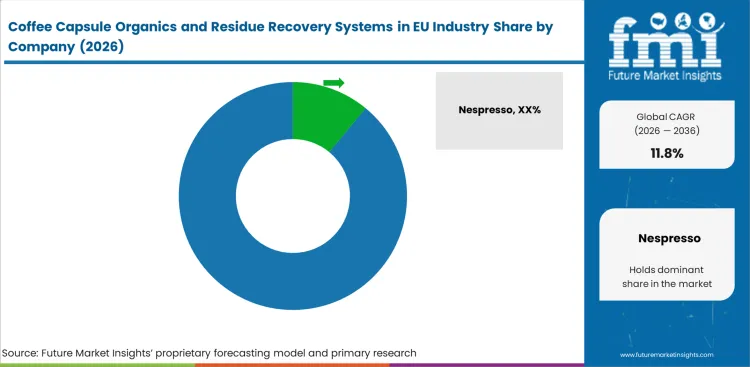
- Nespresso leads branded capsule return activity and influences collection design across several European recovery programs.
- Veolia and SUEZ bring industrial-scale processing capability with access to wider municipal and packaging-recovery operations.
- TerraCycle and TOMRA address specialized needs across managed collection flows and sorting performance. NAFIGATE and Envar support higher-value residue handling in focused programs.
Competition depends on how effectively companies combine collection, separation, and processing within one operating model. Coffee brands need traceable returns and compliant downstream outlets. Waste operators need dense feedstock and stable residue quality. Technology suppliers compete on separation efficiency and contamination reduction. This commercial structure leaves room for branded collection specialists and regional processors with dependable outlet access.
Nespresso benefits from a direct relationship with capsule users and established participation in take-back activity. Veolia and SUEZ operate at a different scale through integrated waste handling and industrial treatment capability. TerraCycle supports branded recovery programs that require managed collection flows across retail or mail-based networks. TOMRA contributes sorting technology that improves purity and plant efficiency. NAFIGATE and Envar address higher-value residue conversion and organics handling in specialized projects.
Recent Developments
- March 17, 2025: Nestlé Italia and illycaffè said their RECAP program had collected more than 750,000 used plastic coffee capsules and expanded to 28 municipalities and 37 collection centers in Italy, strengthening dedicated collection and plastic-plus-coffee-residue separation for capsule recovery.
- September 24, 2025: Fost Plus announced that coffee and other beverage capsules will have specific 2026 Green Dot declaration categories and rates in Belgium, with compostable plastic capsules treated as non-recyclable, sharpening compliance pressure around practical end-of-life recovery.
- December 4, 2025: The European Aluminium Foil Association said it was creating a European alliance with Flexible Packaging Europe to improve collection, sorting, and recycling of small aluminum packaging including coffee capsules, directly supporting stronger recovery-system economics in Europe.
Key Companies in the Coffee Capsule Organics and Residue Recovery Systems in EU Market
Major global companies
- Nespresso
- Veolia
- SUEZ
- TerraCycle
- TOMRA
Regional and specialized companies
- NAFIGATE
- Envar
Competitive Benchmarking for Coffee Capsule Organics and Residue Recovery Systems in EU Industry
| Company | Collection Reach | Processing Integration | Material Handling Breadth | Regional Footprint |
|---|---|---|---|---|
| Nespresso | High | Medium | Medium | Europe wide |
| Veolia | Medium | High | High | Europe wide |
| SUEZ | Medium | High | High | Western Europe |
| TerraCycle | High | Low | Medium | Multi-country |
| TOMRA | Low | Medium | High | Europe wide |
| NAFIGATE | Low | Medium | Medium | Central Europe |
| Envar | Medium | Medium | Medium | UK and nearby markets |
Report Scope and Coverage
| Parameter | Details |
|---|---|
| Quantitative Units | USD 240.0 million in 2026 to USD 730.0 million by 2036 at an 11.8% CAGR |
| Market Definition | Coffee capsule organics and residue recovery systems include collection, depackaging, separation, drying, and downstream conditioning of used capsule residues across the European Union. |
| Region Covered | European Union |
| Countries Covered | Portugal, France, Netherlands, Belgium, Spain, Italy, Germany, and additional EU member states |
| Key Companies Profiled | Nespresso, Veolia, SUEZ, TerraCycle, TOMRA, NAFIGATE, Envar |
| Forecast Period | 2026 to 2036 |
| Approach | Hybrid bottom-up and top-down methodology using capsule volume, collection intensity, and processing revenue assumptions. |
Coffee Capsule Organics and Residue Recovery Systems in EU Industry by Segments
Market segmented by Material Type
Market segmented by Material Type
- Organics
- Aluminum
- Plastic
- Hybrid
Market segmented by System Type
- Separation Lines
- Drying Units
- Composting Units
- AD Units
- Extraction Units
Market segmented by Collection Model
- B2B Pickup
- Store Drop-off
- Mail-back
- Public-bin
- Civic Depots
Market segmented by End Output
- Compost
- Bioenergy
- Recycled Aluminum
- Recycled Polymer
- Feed Ingredients
Market segmented by End User
- Waste Operators
- Coffee Brands
- Roasters
- Municipalities
- Hospitality Sites
Research Sources and Bibliography
- International Coffee Organization. (2026, March). Coffee Market Report - March 2026.
- Fost Plus. (2025, September 24). Everything you need to know about the Green Dot rates for 2026.
- Nestlé Italia. (2025, March 17). Gruppo Nestlé in Italia e illycaffè: con oltre 750.000 capsule raccolte, progetto RECAP modello di alleanza virtuosa pubblico-privato.
- European Aluminium Foil Association. (2025, December 4). New alliance to boost recycling performance of small aluminium packaging.
- European Coffee Federation. (2024, May). European Coffee Report 2023/2024.
- Pinto, S. M., Ribeiro, I., & Vasconcelos, M. W. (2024, April). Improving coffee capsules recyclability. Cleaner Engineering and Technology, 18, 100744.
- Wageningen University & Research. (2025, May 9). The route to circular coffee capsules.
- Wageningen University & Research. (2025, July 3). Compostable capsules most sustainable option for single-serve coffee units.
This bibliography is provided for reader reference and is not exhaustive. The full report contains the complete reference list and detailed citations.
This Report Addresses
- Current market value and long-term revenue outlook for coffee capsule organics and residue recovery systems in the European Union.
- Forecast pace for the industry between 2026 and 2036 under the FMI base-case scenario.
- Leading material type and collection model expected to account for the largest 2026 shares in this industry.
- Commercial factors supporting residue-recovery investment across organics handling and separated material fractions.
- Country-level demand differences across Portugal, France, the Netherlands, Belgium, Spain, Italy, and Germany.
- Competitive positioning among branded collection operators, waste processors, and sorting-technology providers serving this industry.
- Research method used to size and validate the market forecast for this European Union industry.
Frequently Asked Questions
What is the estimated market value of the coffee capsule organics and residue recovery systems in EU market in 2026?
The market is estimated to reach USD 240.0 million in 2026 across organized collection and processing services.
What is the projected market value of the coffee capsule organics and residue recovery systems in EU market by 2036?
The market is projected to reach USD 730.0 million by 2036 under the FMI base-case forecast.
What is the expected CAGR of the coffee capsule organics and residue recovery systems in EU market from 2026 to 2036?
The market is expected to expand at an 11.8% CAGR during the 2026 to 2036 forecast period.
Which material type is expected to lead the market in 2026?
Organics are expected to lead the market with a 46.0% share in 2026 across recovery operations.
Which collection model is expected to account for the largest share in 2026?
B2B Pickup is expected to lead the collection-model segment with a 34.0% share in 2026.
Which country is expected to record the fastest expansion in this market through 2036?
Portugal is expected to record the fastest expansion with a 13.4% CAGR through 2036 in this study.
What factors are supporting demand for coffee capsule organics and residue recovery systems in the European Union?
Demand is supported by high coffee capsule usage, wider collection programs, and stronger investment in separation plus recovery systems.
What does the coffee capsule organics and residue recovery systems in EU market include?
The market includes collection, depackaging, separation, drying, and downstream conditioning of used coffee-capsule residues in the European Union.
Which end output segment is expected to lead the market in 2026?
Compost is expected to lead the end-output segment with a 29.0% share in 2026 under current operating conditions.
Who are the key companies operating in the coffee capsule organics and residue recovery systems in EU market?
Key companies include Nespresso, Veolia, SUEZ, TerraCycle, TOMRA, NAFIGATE, and Envar in this industry.
Preview the report firsthand - request a free sample
Get SampleGet the brochure for pricing and purchase details.
Get PDFTable of Content
- Key Takeaways
- Market Size and CAGR
- Top Growth Driver
- Fastest Growing Segment
- Leading Region
- Key Companies
- Emerging Opportunities
- Executive Summary
- Global Market Outlook
- Demand-side Trends
- Supply-side Trends
- Technology Roadmap Analysis
- Analysis and Recommendations
- Analyst Perspective (What is happening? Why now? What should investors know?)
- Key Questions Answered
- How large is the market?
- What is the CAGR?
- What are key trends?
- Which region dominates?
- Who are the leaders?
- Market Overview
- Market Coverage / Taxonomy
- Market Definition / Scope / Limitations
- Research Methodology
- Chapter Orientation
- Analytical Lens and Working Hypotheses
- Market Structure, Signals, and Trend Drivers
- Benchmarking and Cross-market Comparability
- Market Sizing, Forecasting, and Opportunity Mapping
- Research Design and Evidence Framework
- Desk Research Programme (Secondary Evidence)
- Expert Input and Fieldwork (Primary Evidence)
- Tooling, Models, and Reference Databases
- Data Engineering and Model Build
- Quality Assurance and Audit Trail
- Market Background
- Market Dynamics (Drivers, Restraints, Opportunity, Trends)
- Scenario Forecast (Optimistic, Likely, Conservative)
- Impact Analysis
- AI Impact
- Sustainability Impact
- Regulatory Impact
- Technology Impact
- Consumer / Buyer Analysis
- Purchase Drivers
- Adoption Barriers
- Buyer Journey
- Opportunity Map Analysis
- Product Life Cycle Analysis
- Supply Chain Analysis
- Investment Feasibility Matrix
- Value Chain Analysis
- PESTLE and Porter's Analysis
- Regulatory Landscape
- Regional Parent Market Outlook
- Production and Consumption Statistics
- Import and Export Statistics
- Global Market Analysis and Forecast, 2021 to 2036
- Historical Market Size Value (USD Million) & Volume (Unit) Analysis, 2021 to 2025
- Current and Future Market Size Value (USD Million) & Volume (Unit) Projections, 2026 to 2036
- Y-o-Y Growth Trend Analysis
- Absolute $ Opportunity Analysis
- Global Market Pricing Analysis, 2021 to 2036
- Global Market Analysis and Forecast, By Material Type, 2021 to 2036
- Introduction / Key Findings
- Historical Market Size Value (USD Million) & Volume (Unit) Analysis By Material Type, 2021 to 2025
- Current and Future Market Size Value (USD Million) & Volume (Unit) Analysis and Forecast By Material Type, 2026 to 2036
- Organics
- Aluminum
- Plastic
- Hybrid
- Organics
- Y-o-Y Growth Trend Analysis By Material Type, 2021 to 2025
- Absolute $ Opportunity Analysis By Material Type, 2026 to 2036
- Global Market Analysis and Forecast, By System Type, 2021 to 2036
- Introduction / Key Findings
- Historical Market Size Value (USD Million) & Volume (Unit) Analysis By System Type, 2021 to 2025
- Current and Future Market Size Value (USD Million) & Volume (Unit) Analysis and Forecast By System Type, 2026 to 2036
- Separation Lines
- Drying Value (USD Million) & Volume (Unit)s
- Composting Value (USD Million) & Volume (Unit)s
- AD Value (USD Million) & Volume (Unit)s
- Extraction Value (USD Million) & Volume (Unit)s
- Separation Lines
- Y-o-Y Growth Trend Analysis By System Type, 2021 to 2025
- Absolute $ Opportunity Analysis By System Type, 2026 to 2036
- Global Market Analysis and Forecast, By Collection Model, 2021 to 2036
- Introduction / Key Findings
- Historical Market Size Value (USD Million) & Volume (Unit) Analysis By Collection Model, 2021 to 2025
- Current and Future Market Size Value (USD Million) & Volume (Unit) Analysis and Forecast By Collection Model, 2026 to 2036
- B2B Pickup
- Store Drop-off
- Mail-back
- Public-bin
- Civic Depots
- B2B Pickup
- Y-o-Y Growth Trend Analysis By Collection Model, 2021 to 2025
- Absolute $ Opportunity Analysis By Collection Model, 2026 to 2036
- Global Market Analysis and Forecast, By End Output, 2021 to 2036
- Introduction / Key Findings
- Historical Market Size Value (USD Million) & Volume (Unit) Analysis By End Output, 2021 to 2025
- Current and Future Market Size Value (USD Million) & Volume (Unit) Analysis and Forecast By End Output, 2026 to 2036
- Bioenergy
- Compost
- Recycled Aluminum
- Recycled Polymer
- Feed Ingredients
- Bioenergy
- Y-o-Y Growth Trend Analysis By End Output, 2021 to 2025
- Absolute $ Opportunity Analysis By End Output, 2026 to 2036
- Global Market Analysis and Forecast, By End User, 2021 to 2036
- Introduction / Key Findings
- Historical Market Size Value (USD Million) & Volume (Unit) Analysis By End User, 2021 to 2025
- Current and Future Market Size Value (USD Million) & Volume (Unit) Analysis and Forecast By End User, 2026 to 2036
- Waste Operators
- Coffee Brands
- Roasters
- Municipalities
- Hospitality Sites
- Waste Operators
- Y-o-Y Growth Trend Analysis By End User, 2021 to 2025
- Absolute $ Opportunity Analysis By End User, 2026 to 2036
- Global Market Analysis and Forecast, By Region, 2021 to 2036
- Introduction
- Historical Market Size Value (USD Million) & Volume (Unit) Analysis By Region, 2021 to 2025
- Current Market Size Value (USD Million) & Volume (Unit) Analysis and Forecast By Region, 2026 to 2036
- North America
- Latin America
- Western Europe
- Eastern Europe
- East Asia
- South Asia and Pacific
- Middle East & Africa
- Market Attractiveness Analysis By Region
- North America Market Analysis and Forecast, By Country, 2021 to 2036
- Historical Market Size Value (USD Million) & Volume (Unit) Trend Analysis By Market Taxonomy, 2021 to 2025
- Market Size Value (USD Million) & Volume (Unit) Forecast By Market Taxonomy, 2026 to 2036
- By Country
- USA
- Canada
- Mexico
- By Material Type
- By System Type
- By Collection Model
- By End Output
- By End User
- By Country
- Market Attractiveness Analysis
- By Country
- By Material Type
- By System Type
- By Collection Model
- By End Output
- By End User
- Key Takeaways
- Latin America Market Analysis and Forecast, By Country
- Historical Market Size Value (USD Million) & Volume (Unit) Trend Analysis By Market Taxonomy, 2021 to 2025
- Market Size Value (USD Million) & Volume (Unit) Forecast By Market Taxonomy, 2026 to 2036
- By Country
- Brazil
- Chile
- Rest of Latin America
- By Material Type
- By System Type
- By Collection Model
- By End Output
- By End User
- By Country
- Market Attractiveness Analysis
- By Country
- By Material Type
- By System Type
- By Collection Model
- By End Output
- By End User
- Key Takeaways
- Western Europe Market Analysis and Forecast, By Country
- Historical Market Size Value (USD Million) & Volume (Unit) Trend Analysis By Market Taxonomy, 2021 to 2025
- Market Size Value (USD Million) & Volume (Unit) Forecast By Market Taxonomy, 2026 to 2036
- By Country
- Germany
- UK
- Italy
- Spain
- France
- Nordic
- BENELUX
- Rest of Western Europe
- By Material Type
- By System Type
- By Collection Model
- By End Output
- By End User
- By Country
- Market Attractiveness Analysis
- By Country
- By Material Type
- By System Type
- By Collection Model
- By End Output
- By End User
- Key Takeaways
- Eastern Europe Market Analysis and Forecast, By Country
- Historical Market Size Value (USD Million) & Volume (Unit) Trend Analysis By Market Taxonomy, 2021 to 2025
- Market Size Value (USD Million) & Volume (Unit) Forecast By Market Taxonomy, 2026 to 2036
- By Country
- Russia
- Poland
- Hungary
- Balkan & Baltic
- Rest of Eastern Europe
- By Material Type
- By System Type
- By Collection Model
- By End Output
- By End User
- By Country
- Market Attractiveness Analysis
- By Country
- By Material Type
- By System Type
- By Collection Model
- By End Output
- By End User
- Key Takeaways
- East Asia Market Analysis and Forecast, By Country
- Historical Market Size Value (USD Million) & Volume (Unit) Trend Analysis By Market Taxonomy, 2021 to 2025
- Market Size Value (USD Million) & Volume (Unit) Forecast By Market Taxonomy, 2026 to 2036
- By Country
- China
- Japan
- South Korea
- By Material Type
- By System Type
- By Collection Model
- By End Output
- By End User
- By Country
- Market Attractiveness Analysis
- By Country
- By Material Type
- By System Type
- By Collection Model
- By End Output
- By End User
- Key Takeaways
- South Asia and Pacific Market Analysis and Forecast, By Country
- Historical Market Size Value (USD Million) & Volume (Unit) Trend Analysis By Market Taxonomy, 2021 to 2025
- Market Size Value (USD Million) & Volume (Unit) Forecast By Market Taxonomy, 2026 to 2036
- By Country
- India
- ASEAN
- Australia & New Zealand
- Rest of South Asia and Pacific
- By Material Type
- By System Type
- By Collection Model
- By End Output
- By End User
- By Country
- Market Attractiveness Analysis
- By Country
- By Material Type
- By System Type
- By Collection Model
- By End Output
- By End User
- Key Takeaways
- Middle East & Africa Market Analysis and Forecast, By Country
- Historical Market Size Value (USD Million) & Volume (Unit) Trend Analysis By Market Taxonomy, 2021 to 2025
- Market Size Value (USD Million) & Volume (Unit) Forecast By Market Taxonomy, 2026 to 2036
- By Country
- Kingdom of Saudi Arabia
- Other GCC Countries
- Türkiye
- South Africa
- Other African Union
- Rest of Middle East & Africa
- By Material Type
- By System Type
- By Collection Model
- By End Output
- By End User
- By Country
- Market Attractiveness Analysis
- By Country
- By Material Type
- By System Type
- By Collection Model
- By End Output
- By End User
- Key Takeaways
- Key Countries Market Analysis
- USA
- Pricing Analysis
- Market Share Analysis, 2025
- By Material Type
- By System Type
- By Collection Model
- By End Output
- By End User
- Canada
- Pricing Analysis
- Market Share Analysis, 2025
- By Material Type
- By System Type
- By Collection Model
- By End Output
- By End User
- Mexico
- Pricing Analysis
- Market Share Analysis, 2025
- By Material Type
- By System Type
- By Collection Model
- By End Output
- By End User
- Brazil
- Pricing Analysis
- Market Share Analysis, 2025
- By Material Type
- By System Type
- By Collection Model
- By End Output
- By End User
- Chile
- Pricing Analysis
- Market Share Analysis, 2025
- By Material Type
- By System Type
- By Collection Model
- By End Output
- By End User
- Germany
- Pricing Analysis
- Market Share Analysis, 2025
- By Material Type
- By System Type
- By Collection Model
- By End Output
- By End User
- UK
- Pricing Analysis
- Market Share Analysis, 2025
- By Material Type
- By System Type
- By Collection Model
- By End Output
- By End User
- Italy
- Pricing Analysis
- Market Share Analysis, 2025
- By Material Type
- By System Type
- By Collection Model
- By End Output
- By End User
- Spain
- Pricing Analysis
- Market Share Analysis, 2025
- By Material Type
- By System Type
- By Collection Model
- By End Output
- By End User
- France
- Pricing Analysis
- Market Share Analysis, 2025
- By Material Type
- By System Type
- By Collection Model
- By End Output
- By End User
- India
- Pricing Analysis
- Market Share Analysis, 2025
- By Material Type
- By System Type
- By Collection Model
- By End Output
- By End User
- ASEAN
- Pricing Analysis
- Market Share Analysis, 2025
- By Material Type
- By System Type
- By Collection Model
- By End Output
- By End User
- Australia & New Zealand
- Pricing Analysis
- Market Share Analysis, 2025
- By Material Type
- By System Type
- By Collection Model
- By End Output
- By End User
- China
- Pricing Analysis
- Market Share Analysis, 2025
- By Material Type
- By System Type
- By Collection Model
- By End Output
- By End User
- Japan
- Pricing Analysis
- Market Share Analysis, 2025
- By Material Type
- By System Type
- By Collection Model
- By End Output
- By End User
- South Korea
- Pricing Analysis
- Market Share Analysis, 2025
- By Material Type
- By System Type
- By Collection Model
- By End Output
- By End User
- Russia
- Pricing Analysis
- Market Share Analysis, 2025
- By Material Type
- By System Type
- By Collection Model
- By End Output
- By End User
- Poland
- Pricing Analysis
- Market Share Analysis, 2025
- By Material Type
- By System Type
- By Collection Model
- By End Output
- By End User
- Hungary
- Pricing Analysis
- Market Share Analysis, 2025
- By Material Type
- By System Type
- By Collection Model
- By End Output
- By End User
- Kingdom of Saudi Arabia
- Pricing Analysis
- Market Share Analysis, 2025
- By Material Type
- By System Type
- By Collection Model
- By End Output
- By End User
- Türkiye
- Pricing Analysis
- Market Share Analysis, 2025
- By Material Type
- By System Type
- By Collection Model
- By End Output
- By End User
- South Africa
- Pricing Analysis
- Market Share Analysis, 2025
- By Material Type
- By System Type
- By Collection Model
- By End Output
- By End User
- USA
- Market Structure Analysis
- Competition Dashboard
- Competition Benchmarking
- Market Share Analysis of Top Players
- By Regional
- By Material Type
- By System Type
- By Collection Model
- By End Output
- By End User
- Emerging Startups
- Innovation Benchmarking
- Competition Analysis
- Competition Deep Dive
- Nespresso
- Overview
- Product Portfolio
- Profitability by Market Segments (Product/Region/Sales Channel)
- Sales Footprint
- Strategy Overview
- Marketing Strategy
- Product Strategy
- Channel Strategy
- Veolia
- SUEZ
- TerraCycle
- TOMRA
- NAFIGATE
- Envar
- Nespresso
- Case Studies
- Success Stories
- Recent Developments
- Competition Deep Dive
- Assumptions & Acronyms Used


