

- Industry Size (2026)
- USD 354.5 Mn
- Forecast (2036)
- USD 997.5 Mn
- CAGR (2026 to 2036)
- 10.9%
Heat Pump Unit End-of-Life Refrigerant and Material Recovery in EU Industry Size, Market Forecast and Outlook By FMI
Regulatory control over refrigerant handling is changing how end-of-life heat pump units are processed across Europe. FMI estimates the industry at USD 319.7 million in 2025. Market value is projected to reach USD 354.5 million in 2026 and USD 997.5 million by 2036, reflecting a CAGR of 10.9% over the forecast period.
Summary of Heat Pump Unit End-of-Life Refrigerant and Material Recovery in EU Industry
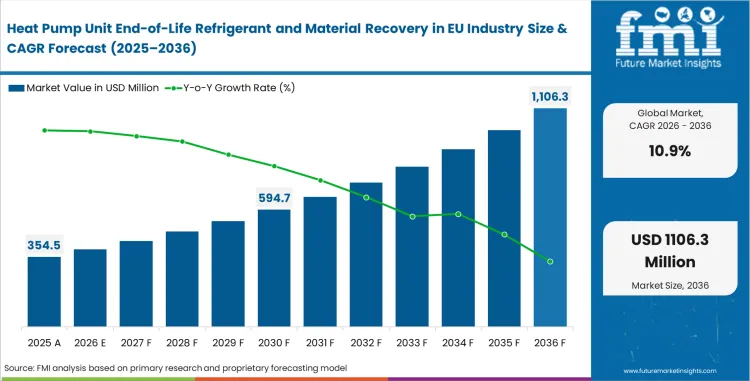
Demand is moving toward authorized recovery channels because F-gas compliance now matters before metals can be monetized at scale.
Processing economics no longer depend only on copper and steel recovery. Operators must recover refrigerant, document treatment steps, and manage intake without leakage before units move into dismantling or shredding lines. Sites that still treat retired heat pumps as ordinary scrap face weaker access to municipal programs and tighter compliance pressure when records are incomplete. Depollution capacity is becoming the first operating bottleneck, not a secondary add-on.
Collection networks also shape market behavior. Larger processors can spread the cost of compliant extraction, trained labor, and downstream sorting across higher inbound volumes. Smaller yards can still dismantle units, but many struggle when documentation, gas handling, and storage controls become more demanding. Scale matters because compliant recovery is a fixed-cost business long before it becomes a metal recovery business.
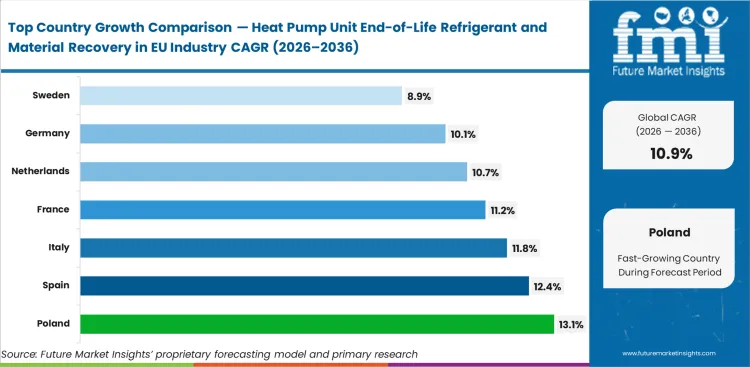
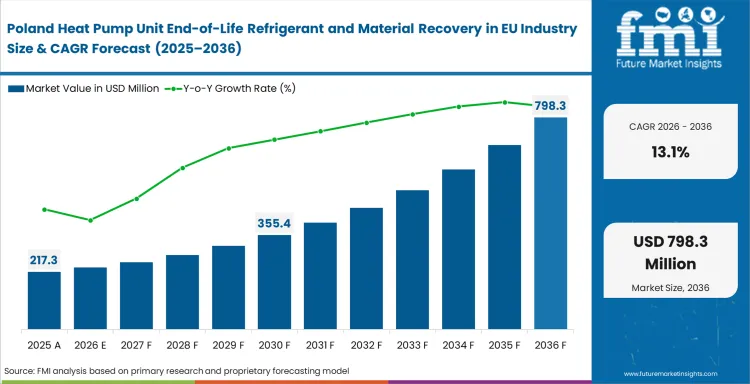
Poland is projected to register a CAGR of 13.1% through 2036, supported by earlier installation growth that is now feeding replacement volumes into formal recovery channels. Spain is expected to expand at a CAGR of 12.4%, helped by modernization of climate control systems in coastal and urban markets. Italy is likely to record 11.8% CAGR during the forecast period, reflecting tighter contractor compliance at the regional level. France is estimated to grow at 11.2%, supported by its structured producer responsibility framework. Netherlands is projected to post 10.7% CAGR, backed by dense municipal collection coverage. Germany is expected to witness 10.1% CAGR through 2036, where mature recycling infrastructure now requires more specialized upgrades for air conditioning compressor disassembly rather than broad greenfield expansion. Sweden is likely to grow at 8.9%, with a more optimized but relatively saturated resource recovery system. Regional growth differences continue to reflect how collection density, replacement cycles, and compliance investment vary across European industry.
Segmental Analysis
Heat Pump Unit End-of-Life Refrigerant and Material Recovery in EU Industry Analysis by Recovery Stream
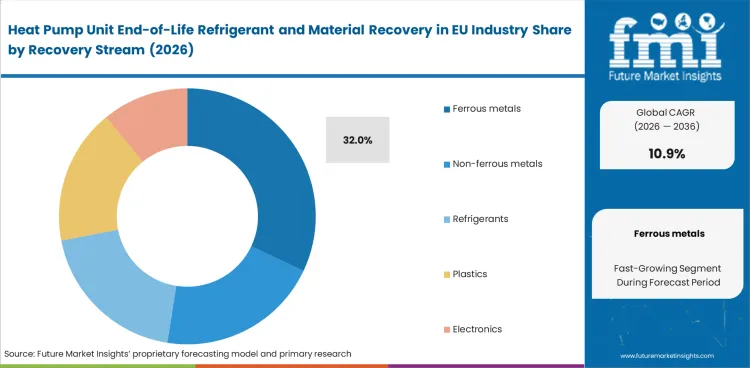
Processing economics across end-of-life units begin with the value of heavier recovered fractions. Steel remains central because it represents a large share of equipment weight and helps establish baseline line economics. FMI observes that ferrous metals are estimated to account for 32.0% share in 2026. Magnetic separation is used early to pull casing panels and shells from dismantled units before mixed shredding lowers output quality. This step becomes more important when heat pump compressors contain dense ferrous sections that can trap internal copper if they move into standard hammer mills without pre-opening. Weak sorting purity can lead to price deductions at smelters and reduce batch value. Targeted dismantling therefore protects both ferrous recovery and downstream metal separation quality.
- Margin baseline establishment: Early steel extraction supports fixed processing costs and improves line-level economics.
- Cross-contamination penalties: Mixed metal fractions attract heavy deductions, making purity control essential during separation.
- Pre-shredding requirements: Compressor shells need to be opened before bulk shredding so internal copper is not lost in downgraded mixed fractions.
Heat Pump Unit End-of-Life Refrigerant and Material Recovery in EU Industry Analysis by Equipment Type
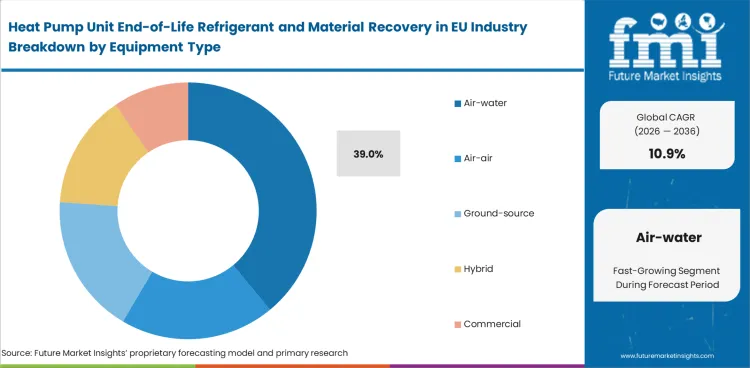
Current recovery volumes still reflect equipment installed during earlier adoption cycles across European heating industries. Older air-water systems remain common in take-back flows because they were deployed at scale in residential settings for many years. Removal of a residential air-to-water heat pump usually follows a familiar workflow, with predictable layouts and standard recovery tools. FMI analysts note that air-water is expected to hold 39.0% share in 2026. Recovery becomes more complicated when field teams treat split systems like monobloc units, since longer pipe runs can leave unrecovered refrigerant pockets in the line. Weak evacuation practice increases compliance risk and can create documentation and handling issues for authorized recovery operators. Firms that do not adapt removal protocols may face higher administrative burden and slower intake approval within formal recovery channels.
- Initial removal phase: Early-generation monobloc units continue to move through the system in large volumes with relatively predictable recovery timing.
- Complexity escalation: Split systems require longer extraction steps because refrigerant can remain trapped across extended piping layouts.
- Documentation sensitivity: Recovery logs and equipment records need to align more closely in formal treatment systems, which raises the cost of rushed field procedures.
Heat Pump Unit End-of-Life Refrigerant and Material Recovery in EU Industry Analysis by Service Stage
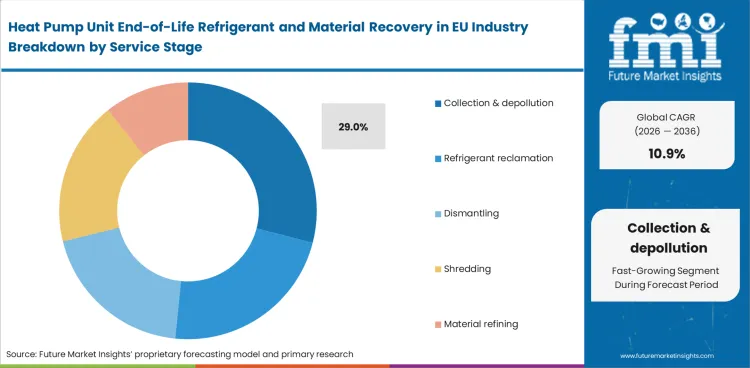
Authorized treatment starts with depollution because refrigerant release risk sits at the front of the recovery chain. Incoming units need controlled storage and rapid isolation before accidental damage creates avoidable losses. Specialized centers invest in degassing stations and oil handling because initial gas removal alone does not complete the job. Collection & depollution are expected to account for 29.0% share in 2026. Residual compounds can remain in compressor oils, so operators need a disciplined multi-step process rather than a simple extraction point.
- Atmospheric release prevention: Incoming units need secure isolation before formal extraction so handling damage does not cause gas escape.
- Residual emulsion risks: Oil and refrigerant mixtures require additional treatment because trapped compounds remain inside compressors after initial gas recovery.
- Documentation dependency: Verified depollution records support reimbursement claims and help treatment operators remain aligned with formal processing requirements.
Heat Pump Unit End-of-Life Refrigerant and Material Recovery in EU Industry Analysis by Source Channel
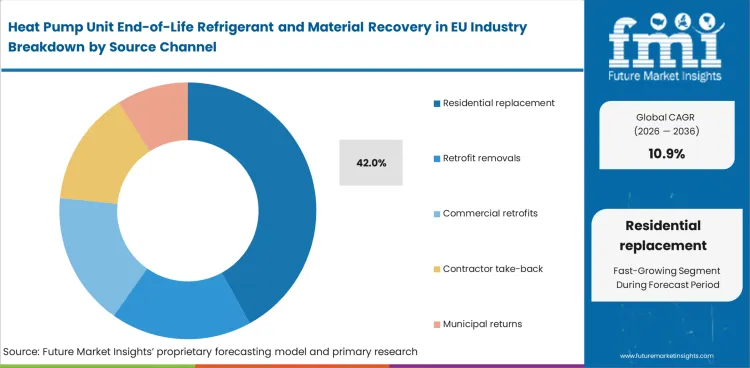
Take-back logistics are shaped by the difficulty of removing bulky equipment from occupied homes and tight building access points. Installers replacing older systems often manage both collection and transport, which makes source-channel control important for formal recovery flows. According to FMI’s estimates, residential replacement is forecast to command 42.0% share in 2026. Transport planning also matters because vehicles need lift access, tie-down systems, and legal documentation when carrying upright commercial heat pump units or other refrigerant-containing equipment. Informal diversion remains a real issue where contractors avoid take-back responsibility to reduce disposal costs. That shifts part of the waste stream away from compliant channels and weakens traceability. Certified transport discipline therefore remains as important as the recovery process itself.
- Transit compliance triggers: Decommissioned units containing hazardous gases require formal transport records and licensed movement.
- Handling damage risks: Manual removal in narrow domestic settings raises the chance of impact damage and refrigerant escape.
- Channel diversion pressures: Informal take-back avoidance can redirect volumes away from approved recovery pathways.
Heat Pump Unit End-of-Life Refrigerant and Material Recovery in EU Industry Analysis by Output Route
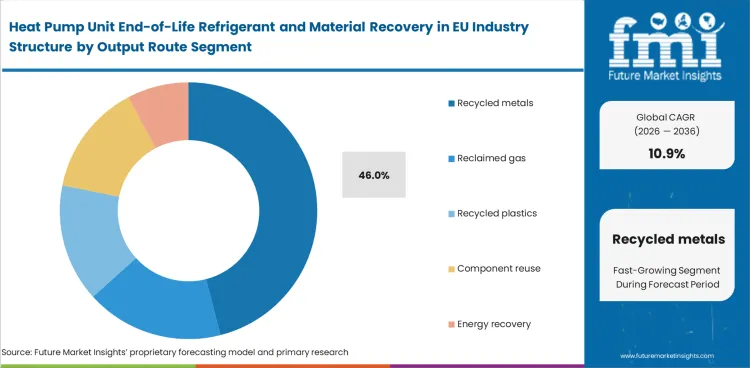
Recovered metals remain the dominant output route because smelters and refiners require large volumes of separated material with consistent purity. Shredding alone does not create saleable output unless mixed fractions are sorted into tight metal streams that match buyer specifications. In FMI’s view, recycled metals are estimated to represent 46.0% share in 2026. Clean recovery becomes especially important when heavy-duty heat pump units generate copper-bearing fractions that need low plastic contamination to achieve stronger mill pricing. Material composition is also shifting, with more aluminum replacing copper in modern heat exchanger designs. That reduces expected yield per unit and makes sensor calibration more important during downstream sorting. Output value increasingly depends on adapting separation settings to this changing material mix.
- Feedstock purity mandates: Smelters require low contamination levels, which keeps separator calibration central to output acceptance.
- Alloy identification gaps: Older equipment produces mixed fragments that are harder to classify and more likely to be downgraded.
- Future material shifts: Rising aluminum use in newer units is expected to change yield assumptions and forward sales expectations.
Heat Pump Unit End-of-Life Refrigerant and Material Recovery in EU Industry Drivers, Restraints, and Opportunities
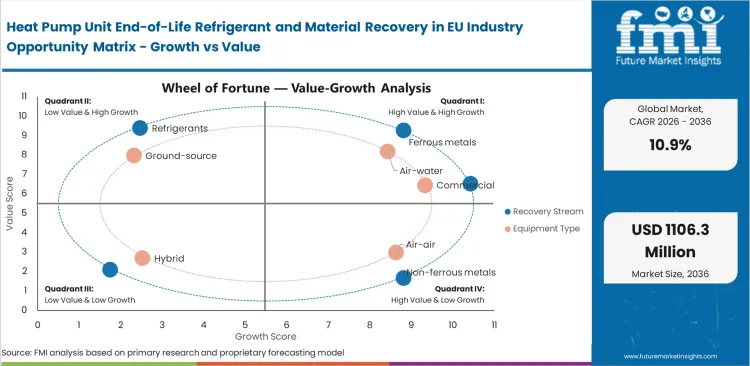
EU compliance requirements tied to heat pump recycling and F-gas handling are pushing collection facilities to update intake procedures sooner than many operators had planned. Metal recovery is no longer enough on its own when end-of-life units still contain regulated refrigerants. Facilities increasingly need documented extraction capability to participate more effectively in formal processing channels. That requirement is pushing major scrap aggregators toward dedicated degassing infrastructure or away from temperature control equipment altogether. Delay can carry a clear commercial cost. Sites that do not adapt may find it harder to secure EPR-linked volumes as take-back funding from equipment manufacturers becomes more important. Processing centers with certified extraction lines are in a better position to secure long-term contracted volumes under compliant handling models.
Space is now becoming a second major constraint. Throughput cannot rise easily in urban recycling centers even where capital is available, because intact units need controlled storage before degassing. Expanding that storage footprint is rarely straightforward. New hazardous holding areas often require added environmental approvals, longer permitting timelines, and local scrutiny over leak risk. As a result, some hubs restrict intake during peak replacement periods rather than accept more units than they can store safely. That pressure can push removed equipment into temporary contractor stockpiles that sit outside formal processing infrastructure. Mobile recycling units can ease part of the problem in isolated cases, especially for on-site extraction, but they do not solve the capacity limits facing large urban hubs handling high incoming volume.
Opportunities in the Heat Pump Unit End-of-Life Refrigerant and Material Recovery in EU Industry
- Refrigerant purification scaling: Specialized refrigerant reclaimers in Europe gas handlers secure premium margins upgrading extracted F-gases to virgin-grade purity for resale.
- Component remanufacturing partnerships: Direct buy-back channels for functional variable refrigerant flow system compressors are being set up by OEMs, allowing these components to bypass destructive shredding altogether.
- Automated dismantling deployment: Engineering leads at high-volume WEEE plants implement robotic separation lines drastically reducing labor costs associated with safe compressor removal.
Regional Analysis
Based on regional analysis, Heat Pump Unit End-of-Life Refrigerant and Material Recovery in EU is segmented into Western Europe, Southern Europe, Eastern Europe, and Nordics across multiple countries.
.webp "Top Country Growth Comparison Heat Pump Unit End Of Life Refrigerant And Material Recovery In Eu Industry Cagr (2026 2036)")
| Country | CAGR (2026 to 2036) |
|---|---|
| Poland | 13.1% |
| Spain | 12.4% |
| Italy | 11.8% |
| France | 11.2% |
| Netherlands | 10.7% |
| Germany | 10.1% |
| Sweden | 8.9% |
Source: Future Market Insights (FMI) analysis, based on proprietary forecasting model and primary research
Western Europe Heat Pump Unit End-of-Life Refrigerant and Material Recovery in EU Industry Analysis
Western Europe already has deeper collection structures and more formal treatment capacity than many other parts of the region. Market competition here is less about opening basic channels and more about improving capture quality, depollution consistency, and downstream sales realization. Operators are under pressure to keep mass balances, treatment records, and material routing tight enough to satisfy both compliance systems and industrial buyers.
France: High structural organization through national producer responsibility schemes guarantees predictable intake volumes across the country. Demand for heat pump end-of-life recovery in France is anticipated to rise at a CAGR of 11.2% during the assessment period. Centralized treatment facilities lock in steady feedstock contracts, providing manufacturers with reliable compliance data. This structured approach ensures continuous material flow and operational stability.
Netherlands: Dense urban environments compel a heavy reliance on consolidated municipal drop-off networks to manage equipment volume. Processing sites must rapidly move accumulated stock to specialized dismantling locations to avoid severe space constraints. The Netherlands is projected to witness a 10.7% CAGR in the recovery industry through 2036. Efficient transit mechanisms remain essential for preventing bottlenecks in these tightly packed collection zones.
Germany: Germany is set to record a CAGR of 10.1% in the recovery sector during the assessment period. Deeply established processing infrastructure handles massive throughput but requires technical upgrades to capture trace elements. Capital expenditure targets precision sorting rather than raw capacity as legacy systems modernize. Processors secure long-term viability by moving up value chains into high-purity rare earth extraction.
Southern Europe Heat Pump Unit End-of-Life Refrigerant and Material Recovery in EU Industry Analysis
Southern Europe is being shaped by replacement activity, fragmented contractor behavior, and the gradual shift from informal disposal routes to controlled treatment. Formal processors can benefit as compliance expectations become stricter, but they also face uneven intake timing and regional capacity strain when older systems are removed in clusters.
Spain: Coastal renovation projects accelerate the replacement of early-generation split systems across the region. Sales of recovery services in Spain are expected to increase at a CAGR of 12.4% during the forecast period. Processing centers face constant pressure managing sudden influxes of highly weathered hardware. New dedicated degassing facilities coming online will eventually help stabilize this rapid surge in decommissioned units.
Italy: Regional compliance procedures are encouraging local contractors to document disposal routes more carefully before moving into new municipal installation work. Authorized treatment receipts are becoming more important in demonstrating compliant disposal within organized project workflows. Italy is likely to post a CAGR of 11.8% in the recovery industry by 2036. Installers integrating active reverse logistics gain distinct competitive advantages when competing for large-scale commercial retrofit bids.
Eastern Europe Heat Pump Unit End-of-Life Refrigerant and Material Recovery in EU Industry Analysis
Eastern Europe is earlier in the build-out of specialized treatment capability, which is why growth rates are higher but operating maturity is less uniform. Facilities that previously focused on basic metals recovery need new handling routines, gas extraction systems, and staff capability before they can process larger end-of-life heat pump flows efficiently.
- Poland: Massive adoption of varied heating solutions over the past decades creates highly diverse incoming waste streams. Facilities face steep learning curves when handling unfamiliar equipment architectures. Heat pump recovery demand across Poland is set to rise at a 13.1% CAGR during the forecast period. Early-mover facilities that build stronger multi-refrigerant extraction capability can secure an early advantage as reverse supply chains continue to develop.
Nordics Heat Pump Unit End-of-Life Refrigerant and Material Recovery in EU Industry Analysis
Highly optimized resource recovery infrastructure dictates baseline behavior for all regional market actors. Producer responsibility legislation matured here earlier than continental averages, resulting in highly efficient, fully integrated processing lines. Technical focus shifts away from basic depollution toward extreme material recovery, targeting complex plate and frame heat exchanger alloys and specialized engineering plastics. Innovation centers around automating dismantling processes to counter labor shortages and high operating costs. Because baseline systems already capture near-maximum volume, growth metrics reflect qualitative material upgrades rather than raw tonnage expansion.
- Sweden: Saturated collection networks run efficiently, leaving little room for massive volume spikes. The recovery segment in Sweden is poised to expand at a CAGR of 8.9% through 2036. Facilities focus entirely on increasing the purity of output fractions commanding premium prices from local specialized smelters. Nordic sites frequently act as primary testing grounds for advanced robotic disassembly techniques.
FMI's report includes a detailed analysis for additional countries. Regional processing divergence also reflects differences in contractor practices, collection density, and how formal fluorinated gas handling requirements are implemented across local recovery networks.
Competitive Aligners for Market Players
Residual value recovery from degraded compressors is difficult to run profitably without scale. Small independent yards can remove units and handle basic dismantling, but compliant gas extraction, material separation, and downstream sales require a larger operating base. Competition is shaped by who can secure enough steady intake to keep degassing infrastructure fully utilized. That is why larger refrigeration and air-conditioning compressor recycling hubs compete aggressively for municipal volumes and installer-linked collection flows. Collection support also matters. Operators that arrange pickup from major installation networks make it harder for smaller regional facilities to rely on contractor-delivered supply alone.
Established processors also benefit from stronger downstream market access. Smelters and refiners want minimum volumes, cleaner fractions, and more predictable material quality before committing to regular buying arrangements. Larger recyclers are better placed to meet those requirements because they can invest in sorting and separation systems that improve output consistency. Smaller entrants may still recover refrigerant and shred housings, yet commercial pressure appears once mixed fractions need to be sold. Without reliable off-take channels, downgraded output often moves at weaker prices and can quickly erode margin.
Producer responsibility systems add another layer of pressure. Contracted facilities do not operate with full pricing freedom when processing standards and reimbursement structures are set externally. At the same time, major HVAC manufacturers often avoid concentrating regional volume with a single recycling partner. Splitting volume across authorized handlers helps preserve commercial leverage and keeps pricing disciplined. For processors, that means operating efficiency is not optional. Rising labor, compliance, and handling costs cannot always be pushed through, so profitability depends on controlling recovery yield, throughput, and downstream realization more tightly than before.
Key Players in Heat Pump Unit End-of-Life Refrigerant and Material Recovery in EU Industry
- Renewi E-Waste
- Stena Recycling
- Revac AS
- Eco Scandic
- Daikin Refrigerants Frankfurt GmbH / L∞p by Daikin
- A-Gas
Scope of the Report
| Metric | Value |
|---|---|
| Quantitative Units | USD 354.5 million to USD 997.5 million, at a CAGR of 10.9% |
| Market Definition | Operations isolate hazardous components from decommissioned temperature exchange equipment before executing mechanical separation. Revenue generation tracks recovery value of secondary raw materials minus operational cost of compliant hazardous substance extraction. |
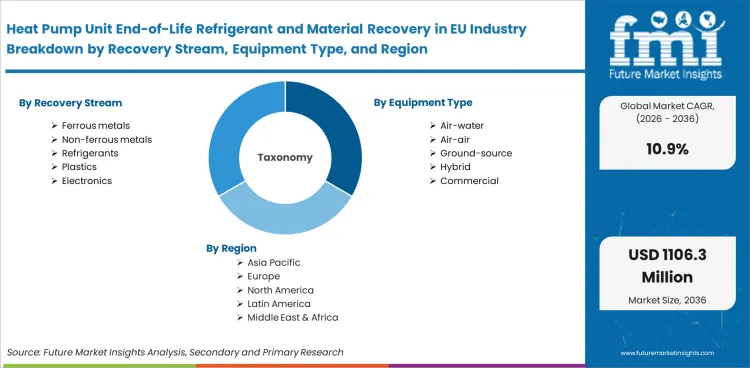
| Segmentation | By Recovery stream, By Equipment type, By Service stage, By Source channel, By Output route, and Region |
| Regions Covered | Western Europe, Southern Europe, Eastern Europe, Nordics, Rest of Europe |
| Countries Covered | Poland, Spain, Italy, France, Netherlands, Germany, Sweden |
| Key Companies Profiled | Renewi E-Waste, Stena Recycling, Revac AS, Eco Scandic, Daikin Refrigerants Frankfurt GmbH / L∞p by Daikin, A-Gas |
| Forecast Period | 2026 to 2036 |
| Approach | Installed base decommissioning rates cross-referenced against mandatory EPR collection quotas establish baseline tonnage available for formal material recovery. |
Source: Future Market Insights (FMI) analysis, based on proprietary forecasting model and primary research
Heat Pump Unit End-of-Life Refrigerant and Material Recovery in EU Industry Analysis by Segments
By Recovery stream:
- Ferrous metals
- Non-ferrous metals
- Refrigerants
- Plastics
- Electronics
By Equipment type:
- Air-water
- Air-air
- Ground-source
- Hybrid
- Commercial
By Service stage:
- Collection & depollution
- Refrigerant reclamation
- Dismantling
- Shredding
- Material refining
By Source channel:
- Residential replacement
- Retrofit removals
- Commercial retrofits
- Contractor take-back
- Municipal returns
By Output route:
- Recycled metals
- Reclaimed gas
- Recycled plastics
- Component reuse
- Energy recovery
By Region:
- Western Europe
- France
- Germany
- Netherlands
- Southern Europe
- Italy
- Spain
- Eastern Europe
- Poland
- Nordics
- Sweden
Bibliography
- European Parliament and the Council of the European Union. (2024). Regulation (EU) 2024/573 of the European Parliament and of the Council of 7 February 2024 on fluorinated greenhouse gases, amending Directive (EU) 2019/1937 and repealing Regulation (EU) No 517/2014.
- Khan, S. A., O’Hegarty, R., Finn, D., & Kinnane, O. (2024). Environmental footprint analysis of domestic air source heat pumps. Resources, Conservation & Recycling Advances, 22, 200217.
- Navarro-Peris, E., Colbourne, D., Oltersdorf, T., Palm, B., & Coronas, A. (2024). Domestic heat pumps using hydrocarbons: Current status and market overview in Europe. 58th IIR Technical Brief on Refrigeration Technologies. International Institute of Refrigeration.
- Thomsen, J. (2025). Heat pumps in a circular economy: Task 2 report (Report No. HPT-AN65-3). Heat Pump Centre, IEA Technology Collaboration Programme on Heat Pumping Technologies.
This bibliography is provided for reader reference. The full FMI report contains the complete reference list with primary source documentation.
This Report Addresses
- Specific capital upgrades required for scrap processors maintaining authorized treatment facility status
- Volume impacts of shifting residential adoption curves on future processing network capacity requirements
- Exact compliance bottlenecks restricting efficient fluorinated gas extraction at high-volume shredding locations
- Margin erosion risks tied to increased aluminum substitution in modern heat exchanger designs
- Downstream smelting penalties applied to heavily contaminated non-ferrous bales from rushed mechanical separation
- Reverse logistics challenges forcing installation contractors diverting decommissioned units away from formal channels
- Producer responsibility funding mechanisms locking processing centers into strict long-term operational standards
- Advanced robotic dismantling adoption rates across leading Nordic and Western European recycling hubs
Frequently Asked Questions
How large is this recovery market currently?
Revenue generated across formal processing networks is expected reaching USD 354.5 million in 2026. Metric captures tangible commercial value realized by authorized facilities extracting secondary metals and compliant gases from decommissioned equipment.
What condition supports this 10.9% growth forecast?
Strict enforcement of fluorinated gas reclamation mandates forces previously informal scrap handling into heavily regulated processing channels. Capital capturing volumes legally must be invested to push overall market expansion as capacity formalizes.
Why do ferrous metals dominate material streams?
Compressor shells and casings rely almost entirely on heavy steel components for durability. Massive weight fractions are captured early in processing quickly covering baseline operational overhead.
How does air-water equipment impact facility intake?
Installers deployed millions of standardized units during early adoption phases across Europe. Decommissioning teams now route highly predictable configurations into dismantling centers, creating massive stable volume streams for operators.
What non-obvious risk exists in equipment collection?
Technicians handling complex split systems frequently fail recovering gas hidden in extended piping runs. Regulators actively audit discrepancies, exposing careless contractors to massive fines and operational suspensions.
Why is Poland expanding faster than Western markets?
Rapid installation booms over past decades generate unprecedented waves of early-cycle replacements. Extraction networks are built from very low baselines, driving sharp initial capacity growth.
How do incumbents defend market positions?
Major authorized treatment facilities secure exclusive downstream contracts with massive smelters and refineries. Challengers cannot guarantee strict purity tolerances required by industrial buyers, effectively locking them out of premium pricing tiers.
What friction slows capacity scaling in urban centers?
Permitting hazardous storage zones for intact, gas-filled equipment faces municipal resistance. Stakeholders struggle expanding physical footprints legally, creating severe intake bottlenecks during peak summer replacement months.
How do OEMs interact with recovery networks?
Major manufacturing brands increasingly seek functional components directly from dismantlers. Bypassing destructive shredding phases, they secure vital hardware parts while satisfying producer responsibility obligations.
What happens to refrigerant in discarded heat pumps?
Fluorinated compounds remain chemically trapped inside compressor lubricants. When auditors test resulting metal scrap, contaminated output lead to immediate suspension of facility authorized treatment licenses if refrigerant reclamation heat pumps standards are ignored.
Why do installers dodge formal disposal networks?
Transporting hazardous equipment requires specific waste carrier licenses and involves steep tipping fees. Independent contractors dump units in informal yards avoiding bureaucratic delays and protecting narrow installation margins.
How does material substitution affect recycling margins?
Manufacturers replacing copper coils with aluminum variants permanently degrade yield values of processed units. Recycling hubs must drastically adjust forward sales assumptions accounting for shifts.
Are heat pumps covered by WEEE rules?
Inspectors enforce strict mass balances between incoming hardware weight and outgoing reclaimed materials under WEEE heat pump recycling frameworks. Active oversight prevents companies from quietly landfilling problematic insulation or low-value plastic fractions.
How do Nordic facilities offset severe labor costs?
Advanced robotic separation lines are deployed for executing dangerous compressor extraction sequences. Technical pivots reduce manual dependency while increasing purity of sorted fractions bound for local smelters.
Why do Spanish volumes show rapid acceleration?
Coastal property owners aggressively replace heavily weathered early-generation climate systems. Companies face sudden spikes in equipment intake, forcing rapid construction of dedicated degassing and processing lines.
How do Italian contractors secure large retrofit bids?
Municipalities require explicit proof of compliant disposal for removed equipment before issuing new installation permits. Installers partnering closely with certified treatment centers eliminate compliance risks for massive commercial clients.
What determines success at sorting stages?
Firms must continuously calibrate optical and eddy-current separators avoiding cross-metal contamination. Smelters apply devastating price deductions if bales contain excessive plastic or incorrect alloy mixes.
How are old heat pumps recycled in Europe?
Extracting functional parts like specialized valves or heavy-duty compressors yields significantly higher margins than raw shredding. Operations leads prioritize manual removal of specific items before sending remaining carcasses to hammer mills.
How does EPR legislation reshape facility financing?
Producer consortia supply steady funding to processors meeting strict environmental handling standards. Financial controllers leverage guaranteed payout rates securing bank loans for expensive capital equipment upgrades.
What risk do undocumented venting practices carry?
Environmental enforcement agencies use digital logs tracing missing gas volumes back to specific installation teams. Caught contractors face immediate vehicle impoundment and permanent revocation of primary operating licenses.
How do facilities handle degraded thermal insulation?
Operators cannot legally landfill complex foams contaminated with legacy blowing agents. Firms must route difficult materials to specialized high-temperature incinerators, treating them as pure cost centers.
Why is data validation critical for this analysis?
Reclaimed refrigerant volumes and secondary metal pricing indices provide hard objective evidence of actual processing activity. Independent tracking prevents reliance on self-reported and often exaggerated facility throughput claims.
How do mobile recycling hubs factor into capacity?
Agile units provide isolated extraction services directly at large commercial demolition sites. While useful for specific projects, they lack consistent throughput necessary solving systemic urban processing bottlenecks.
What end state approaches by 2036?
Networks transition from basic metal extraction toward closed-loop material integration. High-purity rare earth element recovery from advanced compressor motors defines processor viability as traditional copper yields continue declining.
Preview the report firsthand - request a free sample
Get SampleGet the brochure for pricing and purchase details.
Get PDFTable of Content
- Executive Summary
- Global Market Outlook
- Demand-side Trends
- Supply-side Trends
- Technology Roadmap Analysis
- Analysis and Recommendations
- Market Overview
- Market Coverage / Taxonomy
- Market Definition / Scope / Limitations
- Research Methodology
- Chapter Orientation
- Analytical Lens and Working Hypotheses
- Market Structure, Signals, and Trend Drivers
- Benchmarking and Cross-market Comparability
- Market Sizing, Forecasting, and Opportunity Mapping
- Research Design and Evidence Framework
- Desk Research Programme (Secondary Evidence)
- Company Annual and Sustainability Reports
- Peer-reviewed Journals and Academic Literature
- Corporate Websites, Product Literature, and Technical Notes
- Earnings Decks and Investor Briefings
- Statutory Filings and Regulatory Disclosures
- Technical White Papers and Standards Notes
- Trade Journals, Industry Magazines, and Analyst Briefs
- Conference Proceedings, Webinars, and Seminar Materials
- Government Statistics Portals and Public Data Releases
- Press Releases and Reputable Media Coverage
- Specialist Newsletters and Curated Briefings
- Sector Databases and Reference Repositories
- FMI Internal Proprietary Databases and Historical Market Datasets
- Subscription Datasets and Paid Sources
- Social Channels, Communities, and Digital Listening Inputs
- Additional Desk Sources
- Expert Input and Fieldwork (Primary Evidence)
- Primary Modes
- Qualitative Interviews and Expert Elicitation
- Quantitative Surveys and Structured Data Capture
- Blended Approach
- Why Primary Evidence is Used
- Field Techniques
- Interviews
- Surveys
- Focus Groups
- Observational and In-context Research
- Social and Community Interactions
- Stakeholder Universe Engaged
- C-suite Leaders
- Board Members
- Presidents and Vice Presidents
- R&D and Innovation Heads
- Technical Specialists
- Domain Subject-matter Experts
- Scientists
- Physicians and Other Healthcare Professionals
- Governance, Ethics, and Data Stewardship
- Research Ethics
- Data Integrity and Handling
- Primary Modes
- Tooling, Models, and Reference Databases
- Desk Research Programme (Secondary Evidence)
- Data Engineering and Model Build
- Data Acquisition and Ingestion
- Cleaning, Normalisation, and Verification
- Synthesis, Triangulation, and Analysis
- Quality Assurance and Audit Trail
- Market Background
- Market Dynamics
- Drivers
- Restraints
- Opportunity
- Trends
- Scenario Forecast
- Demand in Optimistic Scenario
- Demand in Likely Scenario
- Demand in Conservative Scenario
- Opportunity Map Analysis
- Product Life Cycle Analysis
- Supply Chain Analysis
- Investment Feasibility Matrix
- Value Chain Analysis
- PESTLE and Porter’s Analysis
- Regulatory Landscape
- Regional Parent Market Outlook
- Production and Consumption Statistics
- Import and Export Statistics
- Market Dynamics
- Global Market Analysis 2021 to 2025 and Forecast, 2026 to 2036
- Historical Market Size Value (USD Million) Analysis, 2021 to 2025
- Current and Future Market Size Value (USD Million) Projections, 2026 to 2036
- Y-o-Y Growth Trend Analysis
- Absolute $ Opportunity Analysis
- Global Market Pricing Analysis 2021 to 2025 and Forecast 2026 to 2036
- Global Market Analysis 2021 to 2025 and Forecast 2026 to 2036, By Recovery Stream
- Introduction / Key Findings
- Historical Market Size Value (USD Million) Analysis By Recovery Stream , 2021 to 2025
- Current and Future Market Size Value (USD Million) Analysis and Forecast By Recovery Stream , 2026 to 2036
- Ferrous metals
- Non-ferrous metals
- Refrigerants
- Plastics
- Electronics
- Ferrous metals
- Y-o-Y Growth Trend Analysis By Recovery Stream , 2021 to 2025
- Absolute $ Opportunity Analysis By Recovery Stream , 2026 to 2036
- Global Market Analysis 2021 to 2025 and Forecast 2026 to 2036, By Equipment Type
- Introduction / Key Findings
- Historical Market Size Value (USD Million) Analysis By Equipment Type, 2021 to 2025
- Current and Future Market Size Value (USD Million) Analysis and Forecast By Equipment Type, 2026 to 2036
- Air-water
- Air-air
- Ground-source
- Hybrid
- Commercial
- Air-water
- Y-o-Y Growth Trend Analysis By Equipment Type, 2021 to 2025
- Absolute $ Opportunity Analysis By Equipment Type, 2026 to 2036
- Global Market Analysis 2021 to 2025 and Forecast 2026 to 2036, By Service Stage
- Introduction / Key Findings
- Historical Market Size Value (USD Million) Analysis By Service Stage, 2021 to 2025
- Current and Future Market Size Value (USD Million) Analysis and Forecast By Service Stage, 2026 to 2036
- Collection & depollution
- Refrigerant reclamation
- Dismantling
- Shredding
- Material refining
- Collection & depollution
- Y-o-Y Growth Trend Analysis By Service Stage, 2021 to 2025
- Absolute $ Opportunity Analysis By Service Stage, 2026 to 2036
- Global Market Analysis 2021 to 2025 and Forecast 2026 to 2036, By Source Channel
- Introduction / Key Findings
- Historical Market Size Value (USD Million) Analysis By Source Channel, 2021 to 2025
- Current and Future Market Size Value (USD Million) Analysis and Forecast By Source Channel, 2026 to 2036
- Residential replacement
- Retrofit removals
- Commercial retrofits
- Contractor take-back
- Municipal returns
- Residential replacement
- Y-o-Y Growth Trend Analysis By Source Channel, 2021 to 2025
- Absolute $ Opportunity Analysis By Source Channel, 2026 to 2036
- Global Market Analysis 2021 to 2025 and Forecast 2026 to 2036, By Output Route
- Introduction / Key Findings
- Historical Market Size Value (USD Million) Analysis By Output Route, 2021 to 2025
- Current and Future Market Size Value (USD Million) Analysis and Forecast By Output Route, 2026 to 2036
- Recycled metals
- Reclaimed gas
- Recycled plastics
- Component reuse
- Energy recovery
- Recycled metals
- Y-o-Y Growth Trend Analysis By Output Route, 2021 to 2025
- Absolute $ Opportunity Analysis By Output Route, 2026 to 2036
- Global Market Analysis 2021 to 2025 and Forecast 2026 to 2036, By Region
- Introduction
- Historical Market Size Value (USD Million) Analysis By Region, 2021 to 2025
- Current Market Size Value (USD Million) Analysis and Forecast By Region, 2026 to 2036
- North America
- Latin America
- Western Europe
- Eastern Europe
- East Asia
- South Asia and Pacific
- Middle East & Africa
- Market Attractiveness Analysis By Region
- North America Market Analysis 2021 to 2025 and Forecast 2026 to 2036, By Country
- Historical Market Size Value (USD Million) Trend Analysis By Market Taxonomy, 2021 to 2025
- Market Size Value (USD Million) Forecast By Market Taxonomy, 2026 to 2036
- By Country
- USA
- Canada
- Mexico
- By Recovery Stream
- By Equipment Type
- By Service Stage
- By Source Channel
- By Output Route
- By Country
- Market Attractiveness Analysis
- By Country
- By Recovery Stream
- By Equipment Type
- By Service Stage
- By Source Channel
- By Output Route
- Key Takeaways
- Latin America Market Analysis 2021 to 2025 and Forecast 2026 to 2036, By Country
- Historical Market Size Value (USD Million) Trend Analysis By Market Taxonomy, 2021 to 2025
- Market Size Value (USD Million) Forecast By Market Taxonomy, 2026 to 2036
- By Country
- Brazil
- Chile
- Rest of Latin America
- By Recovery Stream
- By Equipment Type
- By Service Stage
- By Source Channel
- By Output Route
- By Country
- Market Attractiveness Analysis
- By Country
- By Recovery Stream
- By Equipment Type
- By Service Stage
- By Source Channel
- By Output Route
- Key Takeaways
- Western Europe Market Analysis 2021 to 2025 and Forecast 2026 to 2036, By Country
- Historical Market Size Value (USD Million) Trend Analysis By Market Taxonomy, 2021 to 2025
- Market Size Value (USD Million) Forecast By Market Taxonomy, 2026 to 2036
- By Country
- Germany
- UK
- Italy
- Spain
- France
- Nordic
- BENELUX
- Rest of Western Europe
- By Recovery Stream
- By Equipment Type
- By Service Stage
- By Source Channel
- By Output Route
- By Country
- Market Attractiveness Analysis
- By Country
- By Recovery Stream
- By Equipment Type
- By Service Stage
- By Source Channel
- By Output Route
- Key Takeaways
- Eastern Europe Market Analysis 2021 to 2025 and Forecast 2026 to 2036, By Country
- Historical Market Size Value (USD Million) Trend Analysis By Market Taxonomy, 2021 to 2025
- Market Size Value (USD Million) Forecast By Market Taxonomy, 2026 to 2036
- By Country
- Russia
- Poland
- Hungary
- Balkan & Baltic
- Rest of Eastern Europe
- By Recovery Stream
- By Equipment Type
- By Service Stage
- By Source Channel
- By Output Route
- By Country
- Market Attractiveness Analysis
- By Country
- By Recovery Stream
- By Equipment Type
- By Service Stage
- By Source Channel
- By Output Route
- Key Takeaways
- East Asia Market Analysis 2021 to 2025 and Forecast 2026 to 2036, By Country
- Historical Market Size Value (USD Million) Trend Analysis By Market Taxonomy, 2021 to 2025
- Market Size Value (USD Million) Forecast By Market Taxonomy, 2026 to 2036
- By Country
- China
- Japan
- South Korea
- By Recovery Stream
- By Equipment Type
- By Service Stage
- By Source Channel
- By Output Route
- By Country
- Market Attractiveness Analysis
- By Country
- By Recovery Stream
- By Equipment Type
- By Service Stage
- By Source Channel
- By Output Route
- Key Takeaways
- South Asia and Pacific Market Analysis 2021 to 2025 and Forecast 2026 to 2036, By Country
- Historical Market Size Value (USD Million) Trend Analysis By Market Taxonomy, 2021 to 2025
- Market Size Value (USD Million) Forecast By Market Taxonomy, 2026 to 2036
- By Country
- India
- ASEAN
- Australia & New Zealand
- Rest of South Asia and Pacific
- By Recovery Stream
- By Equipment Type
- By Service Stage
- By Source Channel
- By Output Route
- By Country
- Market Attractiveness Analysis
- By Country
- By Recovery Stream
- By Equipment Type
- By Service Stage
- By Source Channel
- By Output Route
- Key Takeaways
- Middle East & Africa Market Analysis 2021 to 2025 and Forecast 2026 to 2036, By Country
- Historical Market Size Value (USD Million) Trend Analysis By Market Taxonomy, 2021 to 2025
- Market Size Value (USD Million) Forecast By Market Taxonomy, 2026 to 2036
- By Country
- Kingdom of Saudi Arabia
- Other GCC Countries
- Turkiye
- South Africa
- Other African Union
- Rest of Middle East & Africa
- By Recovery Stream
- By Equipment Type
- By Service Stage
- By Source Channel
- By Output Route
- By Country
- Market Attractiveness Analysis
- By Country
- By Recovery Stream
- By Equipment Type
- By Service Stage
- By Source Channel
- By Output Route
- Key Takeaways
- Key Countries Market Analysis
- USA
- Pricing Analysis
- Market Share Analysis, 2025
- By Recovery Stream
- By Equipment Type
- By Service Stage
- By Source Channel
- By Output Route
- Canada
- Pricing Analysis
- Market Share Analysis, 2025
- By Recovery Stream
- By Equipment Type
- By Service Stage
- By Source Channel
- By Output Route
- Mexico
- Pricing Analysis
- Market Share Analysis, 2025
- By Recovery Stream
- By Equipment Type
- By Service Stage
- By Source Channel
- By Output Route
- Brazil
- Pricing Analysis
- Market Share Analysis, 2025
- By Recovery Stream
- By Equipment Type
- By Service Stage
- By Source Channel
- By Output Route
- Chile
- Pricing Analysis
- Market Share Analysis, 2025
- By Recovery Stream
- By Equipment Type
- By Service Stage
- By Source Channel
- By Output Route
- Germany
- Pricing Analysis
- Market Share Analysis, 2025
- By Recovery Stream
- By Equipment Type
- By Service Stage
- By Source Channel
- By Output Route
- UK
- Pricing Analysis
- Market Share Analysis, 2025
- By Recovery Stream
- By Equipment Type
- By Service Stage
- By Source Channel
- By Output Route
- Italy
- Pricing Analysis
- Market Share Analysis, 2025
- By Recovery Stream
- By Equipment Type
- By Service Stage
- By Source Channel
- By Output Route
- Spain
- Pricing Analysis
- Market Share Analysis, 2025
- By Recovery Stream
- By Equipment Type
- By Service Stage
- By Source Channel
- By Output Route
- France
- Pricing Analysis
- Market Share Analysis, 2025
- By Recovery Stream
- By Equipment Type
- By Service Stage
- By Source Channel
- By Output Route
- India
- Pricing Analysis
- Market Share Analysis, 2025
- By Recovery Stream
- By Equipment Type
- By Service Stage
- By Source Channel
- By Output Route
- ASEAN
- Pricing Analysis
- Market Share Analysis, 2025
- By Recovery Stream
- By Equipment Type
- By Service Stage
- By Source Channel
- By Output Route
- Australia & New Zealand
- Pricing Analysis
- Market Share Analysis, 2025
- By Recovery Stream
- By Equipment Type
- By Service Stage
- By Source Channel
- By Output Route
- China
- Pricing Analysis
- Market Share Analysis, 2025
- By Recovery Stream
- By Equipment Type
- By Service Stage
- By Source Channel
- By Output Route
- Japan
- Pricing Analysis
- Market Share Analysis, 2025
- By Recovery Stream
- By Equipment Type
- By Service Stage
- By Source Channel
- By Output Route
- South Korea
- Pricing Analysis
- Market Share Analysis, 2025
- By Recovery Stream
- By Equipment Type
- By Service Stage
- By Source Channel
- By Output Route
- Russia
- Pricing Analysis
- Market Share Analysis, 2025
- By Recovery Stream
- By Equipment Type
- By Service Stage
- By Source Channel
- By Output Route
- Poland
- Pricing Analysis
- Market Share Analysis, 2025
- By Recovery Stream
- By Equipment Type
- By Service Stage
- By Source Channel
- By Output Route
- Hungary
- Pricing Analysis
- Market Share Analysis, 2025
- By Recovery Stream
- By Equipment Type
- By Service Stage
- By Source Channel
- By Output Route
- Kingdom of Saudi Arabia
- Pricing Analysis
- Market Share Analysis, 2025
- By Recovery Stream
- By Equipment Type
- By Service Stage
- By Source Channel
- By Output Route
- Turkiye
- Pricing Analysis
- Market Share Analysis, 2025
- By Recovery Stream
- By Equipment Type
- By Service Stage
- By Source Channel
- By Output Route
- South Africa
- Pricing Analysis
- Market Share Analysis, 2025
- By Recovery Stream
- By Equipment Type
- By Service Stage
- By Source Channel
- By Output Route
- USA
- Market Structure Analysis
- Competition Dashboard
- Competition Benchmarking
- Market Share Analysis of Top Players
- By Region
- By Recovery Stream
- By Equipment Type
- By Service Stage
- By Source Channel
- By Output Route
- Competition Analysis
- Competition Deep Dive
- Renewi E-Waste
- Overview
- Product Portfolio
- Profitability by Market Segments (Product/Age /Sales Channel/Region)
- Sales Footprint
- Strategy Overview
- Marketing Strategy
- Product Strategy
- Channel Strategy
- Stena Recycling
- Revac AS
- Eco Scandic
- Daikin Refrigerants Frankfurt GmbH / L∞p by Daikin
- A-Gas
- Renewi E-Waste
- Competition Deep Dive
- Assumptions & Acronyms Used


