

- Market Size (2026)
- USD 318.0 Mn
- Forecast (2036)
- USD 619.7 Mn
- CAGR (2026 to 2036)
- 6.9%
Ceramic Tile and Sanitaryware Crushing for Secondary Raw Materials in EU Industry Size, Industry Forecast and Outlook By FMI
The Ceramic Tile and Sanitaryware Crushing for Secondary Raw Materials in EU Industry surpassed a valuation of USD 297.5 million in 2025 and is expected to reach USD 318.0 million in 2026. Industry valuation is projected to rise at a CAGR of 6.9% from 2026 to 2036, taking total market value to nearly USD 619.7 million by 2036. Expansion is being supported by steady efforts across the EU to recover fired ceramic scrap and reduce reliance on virgin mineral inputs. Ceramic manufacturers and recycling operators are giving greater priority to secondary feedstock recovery as disposal costs, raw material efficiency, and outlet development become more closely linked.
Summary of Ceramic Tile and Sanitaryware Crushing for Secondary Raw Materials in EU Industry
- The industry is forecast to reach USD 619.7 million by 2036.
- The industry is expected to grow at a CAGR of 6.9% from 2026 to 2036.
- The industry was estimated at USD 297.5 million in 2025.
- Industry value is expected to reach USD 318.0 million in 2026.
- Tile scrap is projected to lead waste type demand with 58.0% share in 2026.
- Stationary plants are expected to remain the leading plant type with 63.0% share in 2026.
- Source-separated feed is anticipated to account for 52.0% share in 2026, while post-industrial material is expected to hold 46.0% share.
- Recycled aggregate is likely to lead output form with 36.0% share in 2026, and concrete products are projected to lead end use with 29.0% share.
- Country-level growth is strongest in Spain at 7.6% CAGR, followed by Italy at 7.4%, Poland at 7.1%, and Portugal at 7.0% through 2036.
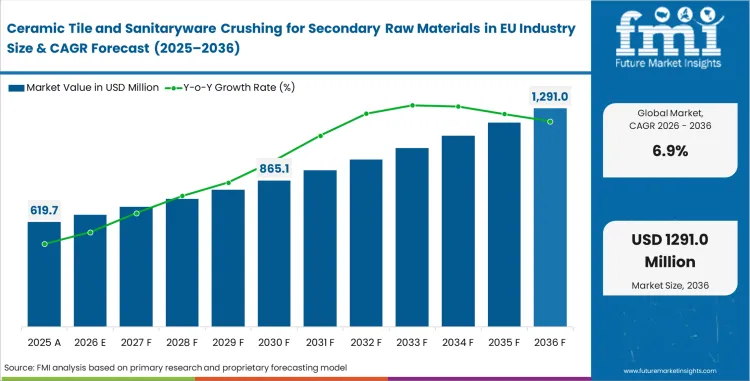
Key Takeaways, Market Size, and Forecast
- Ceramic Tile and Sanitaryware Crushing for Secondary Raw Materials in EU Industry is projected to grow from USD 318.0 million in 2026 to USD 619.7 million by 2036, at a CAGR of 6.9%.
- The ceramic tile and sanitaryware crushing for secondary raw materials in EU industry was valued at USD 297.5 million in 2025.
- By 2036, the Ceramic Tile and Sanitaryware Crushing for Secondary Raw Materials in EU Industry is expected to be worth USD 619.7 million.
- From 2026 to 2036, the industry is projected to expand at a CAGR of 6.9%.
- The industry is projected to create an incremental opportunity of USD 301.7 million between 2026 and 2036.
- In 2026, Tile scrap is expected to account for 58.0% of the waste type segment.
- Spain (7.6%) and Italy (7.4%) are two of the fastest growing markets.
Ceramic Tile and Sanitaryware Crushing for Secondary Raw Materials in EU Industry Key Takeaways
| Parameter | Details |
|---|---|
| Market value (2026) | USD 318.0 million |
| Forecast value (2036) | USD 619.7 million |
| CAGR (2026 to 2036) | 6.9% |
| Estimated market value (2025) | USD 297.5 million |
| Incremental opportunity | USD 301.7 million |
| Leading waste type | Tile scrap |
| Leading plant type | Stationary plants |
| Leading output form | Recycled aggregate |
| Key companies profiled | SACMI Imola, BHS-Sonthofen, MEKA, Matec Industries, Roca Group, Miraplas, Neos Additives |
| Companies referenced in market landscape | SACMI Imola, BHS-Sonthofen, MEKA, Metso, KLEEMANN (Wirtgen Group), Sturtevant Inc. |
Source: Future Market Insights (FMI) analysis, based on proprietary forecasting model and primary research
Growth becomes more reliable once source-separated ceramic material moves through a repeatable route with clear requirements for size, purity, and end use. Ceramic producers, demolition processors, and downstream buyers shape that route together. Once alignment improves across those groups, recovered ceramic fractions fit more easily into recycled concrete aggregates and related construction applications, where consistency matters more than simple volume recovery.
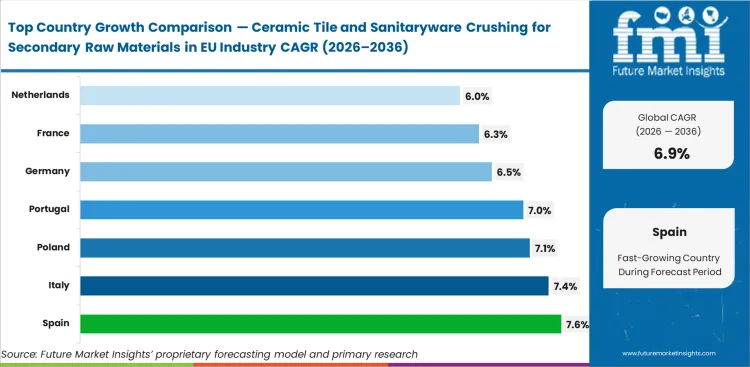
Spain is projected to register 7.6% CAGR through 2036, followed by Italy at 7.4%, Poland at 7.1%, and Portugal at 7.0%. Southern Europe remains ahead because large ceramic tiles manufacturing clusters generate cleaner industrial scrap and support shorter transport distances between ceramic production bases and secondary-material outlets. Germany is expected to expand at 6.5%, while France is likely to record 6.3% and the Netherlands 6.0%. Western Europe advances at a steadier pace as industry development depends more heavily on renovation-waste sorting quality, feed consistency, and downstream acceptance standards for recovered ceramic material.
Construction Product Traceability Will Raise Standards in Ceramic Tile and Sanitaryware Crushing for Secondary Raw Materials in EU Industry
The revised EU Construction Products Regulation changes the commercial backdrop for crushed ceramic secondary materials because it pushes the sector toward more structured product information and digital traceability. Regulation (EU) 2024/3110 establishes a construction digital product passport system, while a 2025 Commission communication notes mandatory application of the Digital Product Passport from 2028 for construction products. For secondary ceramic materials, that has a direct implication: informal recycled-content claims will become less bankable than auditable material histories and documented performance. Crushing operators supplying the EU construction chain will increasingly need to prove origin, composition, and intended use in ways that fit digital construction-product data systems. That favors processors that invest early in feedstock segregation, batch consistency, and test-backed documentation, rather than competing only on low processing cost or landfill diversion claims.
Segmental Analysis
Key Facts About Segments
- Recurring ceramic production waste keeps tile scrap in the lead, and it is expected to account for 58.0% share in 2026. Higher and more predictable volumes make dedicated crushing, grading, and resale easier than in sanitaryware or mixed ceramic streams.
- Cleaner composition and shorter handling loops support post-industrial material, which is projected to represent 46.0% share in 2026. Known material history reduces sorting burden and shortens qualification time for downstream buyers.
- Practical particle-shaping performance keeps impact crushers ahead, with 39.0% share expected in 2026. Buyers prefer them where ceramic feed needs usable fractions without creating excessive fines or oversize correction work.
- Broader buyer readiness leaves recycled aggregate as the leading output form, likely to secure 36.0% share in 2026. Simpler specifications allow it to move faster into routine construction demand than finer or more specialized ceramic outputs.
- Mineral-rich recycled ceramic material fits concrete products more easily than narrower reuse routes, which is why this end use is expected to hold 29.0% share in 2026. Concrete applications absorb recurring volumes without demanding extremely tight tolerance bands.
- Repeated waste flows near ceramic districts continue to favor stationary plants, which are projected to account for 63.0% share in 2026. Stable waste geography, tighter grading control, and shorter haul routes support their commercial lead.
- Sorting discipline remains commercially decisive, leaving source-separated feed expected to account for 52.0% share in 2026. Cleaner input improves first-pass yield and reduces repeated qualification effort for downstream buyers.
Ceramic Tile and Sanitaryware Crushing for Secondary Raw Materials in EU Industry Analysis by Waste Type
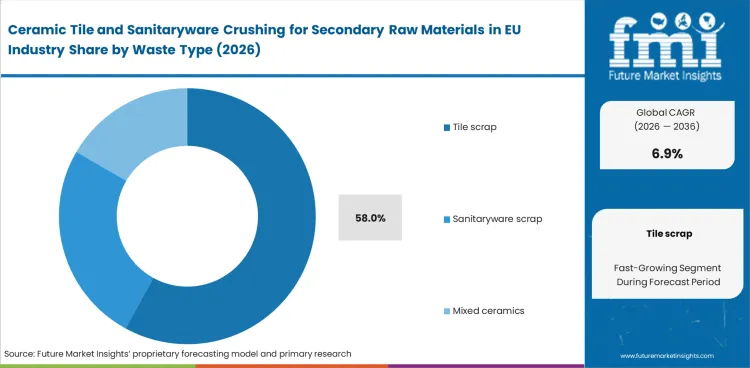
Tile scrap is expected to account for 58.0% share in 2026. This lead reflects a simple operating reality: tile scrap reaches crushing lines in larger and more repeatable volumes than sanitaryware waste. Broken and off-spec tile material reaches crushing lines in volumes that support dedicated handling across several ceramic districts. Buyers prefer tile-heavy feed because it gives them more predictable grading output and fewer contamination surprises. Particle shape breakage behavior and mineral response become easier to interpret after crushing than within bulky sanitaryware streams. Linkage with fireclay tiles and other ceramic product flows keeps this waste type commercially relevant even where closed-loop reuse remains limited. Sanitaryware scrap still matters, but it usually arrives in smaller lots and demands tighter sorting before processing begins. Mixed ceramics remain the least attractive option because each added contamination check slows the sale of secondary material. This weakens grading efficiency. Plants working with a steadier tile-heavy mix usually protect throughput, output consistency, and downstream salability more effectively than operators relying on irregular multi-material inflow.
- Volume fit: High and recurring tile volumes make dedicated crushing lines easier to justify and reduce throughput risk.
- Breakage pattern: Tile scrap fractures more predictably than bulky ceramic fixtures, which supports steadier grading output.
- Outlet match: Wider downstream acceptance keeps tile waste easier to place when buyers need consistent size and purity.
Ceramic Tile and Sanitaryware Crushing for Secondary Raw Materials in EU Industry Analysis by Source Origin
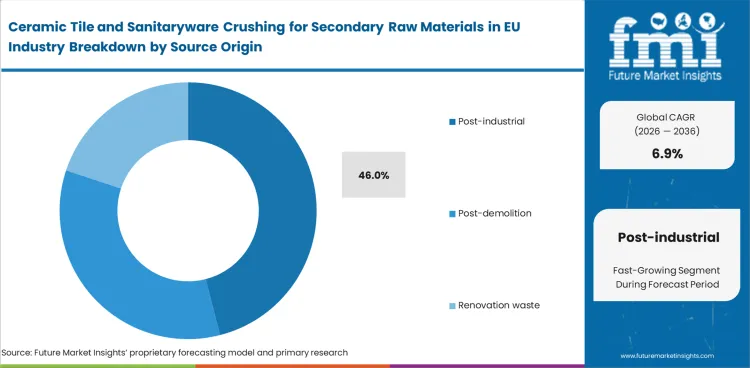
Clean feed decides margin in this market because the cost of sorting, testing, and rejection rises quickly once ceramic waste arrives with uncertain composition. Post-industrial material leads for that reason, since rejected production pieces usually come with known chemistry, lower dirt exposure, and shorter handling loops than site-derived waste. Plants can often move this material back into mineral preparation far faster than demolition processors can handle older ceramic streams. That difference matters more than headline tonnage when buyers are comparing usable yield rather than nominal supply. Market estimates place post-industrial material at 46.0% share in 2026. Connection with upstream minerals such as kaolin keeps this route tied closely to raw-material cost thinking and reuse readiness. Post-demolition waste has a broader long-term supply base, but mixed mortar, adhesives, and site debris keep sorting costs higher. Recovery performance improves when material history is clear at intake, because cleaner origin usually shortens qualification time and supports faster resale.
- Purity advantage: Factory rejects arrive with fewer foreign materials and reduce rejection risk at the grading stage.
- Reject flow: Production scrap moves through shorter handling loops, improving working-capital discipline and turnaround time.
- Reuse readiness: Known material history helps buyers accept recycled ceramic input with less verification delay.
Ceramic Tile and Sanitaryware Crushing for Secondary Raw Materials in EU Industry Analysis by Crusher Type
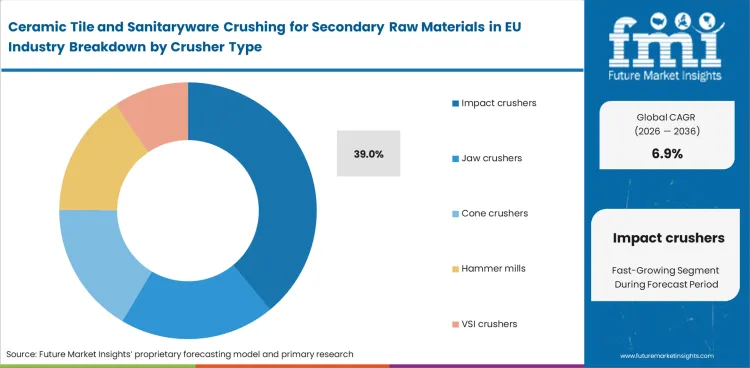
Brittle ceramic waste needs size reduction that preserves usable fractions instead of creating too much oversize or unnecessary fines. Operators value impact crushing because it offers a practical balance between breakage force and output shaping across both tile and sanitaryware waste. Jaw crushers still matter for primary reduction on bulkier loads, while hammer mills and VSI units serve narrower roles where finer products are required. Equipment logic here also overlaps with broader sand processing equipment workflows, where screening discipline and particle-size control directly influence sale value. Buyers usually favor systems that can handle mixed ceramic applications without becoming too specialized for one feed condition. For that reason, impact crushers are projected to represent 39.0% share in 2026. Abrasive wear remains a real operating issue, so poor wear planning can quickly erode the cost advantage of an otherwise well-matched line. Plants tend to perform better when crusher selection protects both grading stability and maintenance discipline at the same time.
- Impact control: Staged breakage helps plants reach target fractions with fewer correction passes and less rework.
- Size balance: Buyers prefer material that does not swing between oversize lumps and excessive fines.
- Wear management: Ceramic waste is abrasive, and weak wear planning raises stoppages and recovery cost.
Ceramic Tile and Sanitaryware Crushing for Secondary Raw Materials in EU Industry Analysis by Throughput
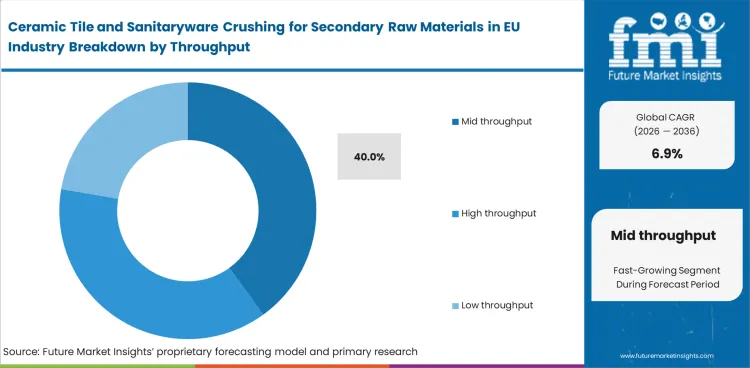
Most EU ceramic recovery projects are designed around steady local inflow rather than around very large mineral-processing scale, so capacity decisions follow realistic collection density more than headline ambition. Smaller plants can serve limited districts well, yet they often struggle to spread fixed costs across enough output to justify better washing, grading, and finishing systems. Larger facilities become attractive only where both feedstock contracts and outlet demand remain stable enough to hold utilization without compromising intake discipline. Relevance is strongest where recycled content pulls from PCR based building materials and similar outlets are rising, but still uneven by buyer and region. Mid-throughput systems stay closest to that operating reality. A 4.0% share is expected for this band in 2026 because it matches the waste profile of ceramic districts and medium-sized recyclers without pushing capital cost too far ahead of supply. Buyers in this range usually protect plant economics more successfully when line size follows proven inflow rather than speculative growth.
- Cluster scale: Mid-size lines suit the volume profile of most ceramic districts better than oversized facilities.
- Line balance: Steady feed supports more consistent screening, storage planning, and operating rhythm.
- Capex fit: Buyers prefer systems that match known waste volumes rather than locking cash into excess capacity.
Ceramic Tile and Sanitaryware Crushing for Secondary Raw Materials in EU Industry Analysis by Output Form
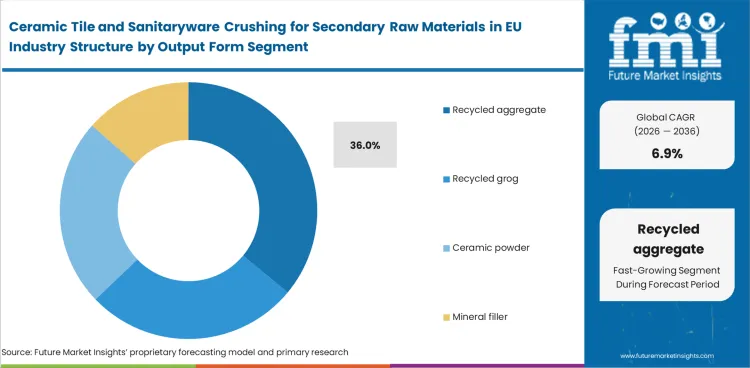
Secondary ceramic material earns faster acceptance when it leaves crushing in a form that downstream buyers can use without heavy additional processing. Many plants would prefer higher-value powdered or closed-loop ceramic applications, but those routes usually demand tighter quality control and deeper finishing capability than current feed conditions justify. Recycled grog still matters where ceramic producers can reuse stable fractions internally, and powders or fillers gain traction when grinding cost is supported by a stronger specification premium. Downstream pull from ready-mix concrete and related mineral applications reinforces a broader commercial preference for simpler outputs. Aggregate stays in front because it meets present buyer readiness more directly than more specialized forms. Recycled aggregate is expected to hold 36.0% share in 2026 for that reason. The advantage is not purely price; it also reflects how quickly a simpler specification can move through approval and into routine purchase. Plants generally build more dependable turnover when output form aligns with current buyer capability rather than idealized circularity targets.
- Aggregate reach: Broader buyer access keeps aggregate easier to sell and reduces stock buildup risk.
- Grinding depth: Finer products create better value only when feed quality can justify extra processing cost.
- Buyer acceptance: Secondary minerals move faster when the product specification stays simple and familiar.
Ceramic Tile and Sanitaryware Crushing for Secondary Raw Materials in EU Industry Analysis by End Use
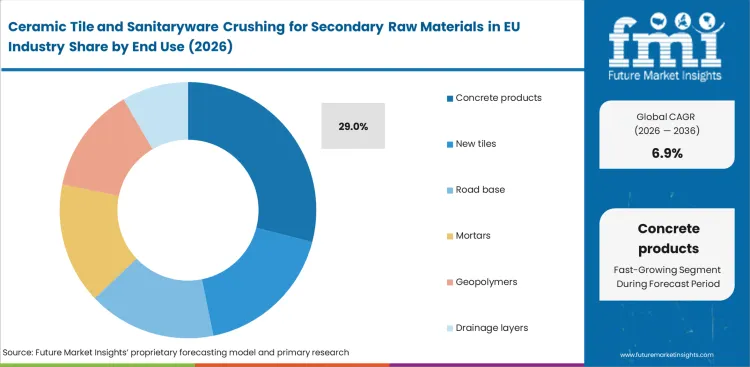
Concrete products remain in the clearest commercial home for crushed ceramic material because they can absorb mineral-rich recycled input without demanding the narrow tolerance bands seen in closed-loop ceramic reuse. That flexibility matters when waste streams vary by site, plant, and source, because it allows buyers to maintain offtake even when feed quality is not perfectly uniform. Compatibility with masonry cement and adjacent construction materials keeps this outlet commercially visible across several practical formulation routes. New tile production still offers stronger circularity credentials, but it needs tighter process control and more disciplined input preparation before it can scale consistently. Road base and drainage layers absorb volume, though usually at a lower value, while mortars and geopolymers continue to depend on more buyer education and formulation work. Market estimates place concrete products at 29.0% share in 2026. Commercial preference stays with uses that can take recurring ceramic fractions in workable volumes without forcing recyclers into excessive conditioning before sale.
- Concrete pull: Concrete buyers can use a wider range of ceramic fractions than selective outlets.
- Mix tolerance: End uses with simpler formulation limits adopt recycled input faster and scale more easily.
- Volume absorption: Large-volume construction outlets help prevent yard buildup when niche demand stays narrow.
Ceramic Tile and Sanitaryware Crushing for Secondary Raw Materials in EU Industry Analysis by Plant Type
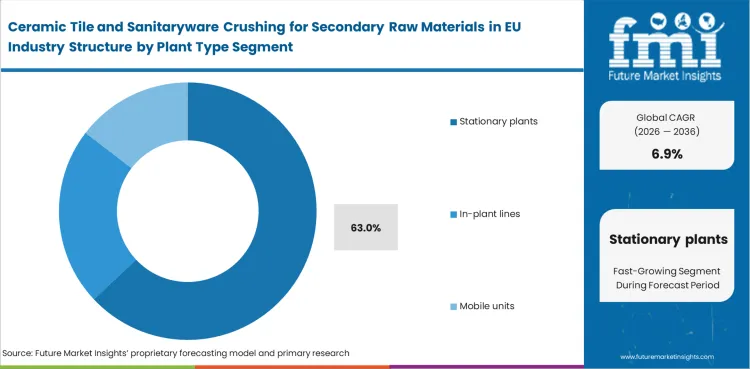
Recurring waste flows reward fixed assets placed close to ceramic production zones or stable recovery hubs because repeated supply makes process control and storage planning easier to manage. Mobile units still have a role where renovation and site-clearing work produce project-based ceramic waste, especially when linked with demolition equipment activity and temporary field logistics. Even so, variable feed and changing site conditions make mobile setups less reliable for the best-margin material in this category. Fixed plants perform better where nearby ceramic districts produce repeat scrap and where supporting recovery chains already exist. Stationary layouts also make sampling, grading, and screening control easier to hold over time. That operating discipline is one reason stationary plants are projected to represent 63.0% share in 2026. Transport economics strengthens the same argument, since longer haul routes can quickly erode recovered-value margins. Buyers usually get better commercial consistency when plant type follows stable waste geography rather than occasional project convenience alone.
- Site economics: Fixed plants work better when waste volumes repeat in the same area and support asset payback.
- Logistics ease: Close proximity to ceramic districts shortens haul routes and protects recovered value.
- Quality discipline: Stationary layouts make sampling and grading easier to control across repeated operating cycles.
Ceramic Tile and Sanitaryware Crushing for Secondary Raw Materials in EU Industry Analysis by Feed Quality
Sorting quality often decides whether ceramic waste can move as a useful secondary raw material or falls back into a low-value fill application. Clean input reduces contamination from mortar, metals, insulation, and mixed debris, and it allows crushers and screens to deliver more saleable fractions with fewer repeated handling steps. Buyers compare this logic with other mineral-based materials such as China clay, where stable feed chemistry shortens acceptance time and lowers dispute risk. Washed feed can improve usability further, though the extra cost is not always necessary when separation is already well controlled at source. Mixed feed remains active in the market, but it regularly loses value once testing, rejection risk, and sorting burden are priced into the transaction. Source-separated feed is expected to account for 52.0% share in 2026 because it supports better yield from the first pass and steadier buyer confidence afterwards. Return business usually improves when fraction quality remains consistent enough to reduce repeated qualification effort between one order and the next.
- Sorting value: Clean feed improves first-pass yield and lifts confidence in the usability of crushed output.
- Contamination risk: Adhesives and mixed rubble reduce sale value and can delay multiple downstream transactions.
- Specification stability: Buyers return more readily when fraction quality stays steady across repeat loads.
Ceramic Tile and Sanitaryware Crushing for Secondary Raw Materials in EU Industry Drivers, Restraints, and Opportunities
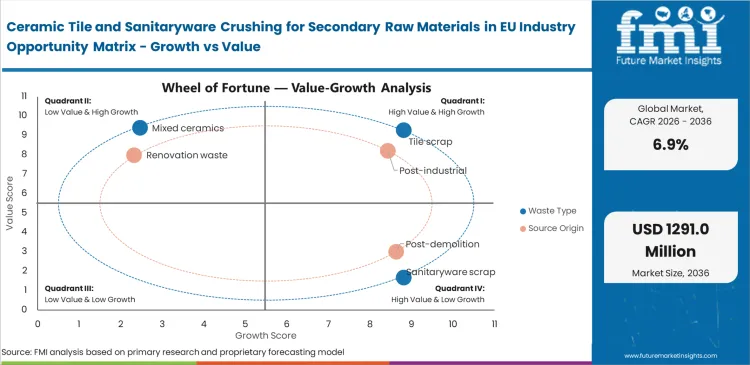
Raw material pressure is pushing ceramic plants and recyclers to look harder at waste streams that were once written off as low-value loss. Buyers now weigh recovery routes alongside disposal routes because crushed ceramic output can support circular-content needs in construction products and reduce dependence on fresh mineral extraction. FMI sees this driver as more practical than symbolic. When recovered material can move into applications linked with green cement and other lower-impact building inputs, waste recovery starts to look like an operating decision rather than a sustainability slogan. Faster movement of clean scrap also reduces yard congestion and lowers the chance that saleable ceramic waste ends up treated as mixed rubble.
Feed inconsistency still holds the market back. Many buyers like the idea of secondary ceramic input, yet approval slows when every load carries a different contamination profile, particle spread, or moisture condition. That problem is structural because it begins at source separation and continues through transport, storage, and grading. Crushing capacity alone does not solve it. Some operators answer tighter sorting rules, added screening stages, and better sampling discipline. Results improve, though added handling can weaken the margin if the final outlet is still priced like low-grade fill. Similar acceptance pressure appears in areas linked with CO2 reduced concrete where documentation and consistency matter as much as the recycled claim itself.
Ceramic Tile and Sanitaryware Crushing for Secondary Raw Materials in EU Industry Opportunities
- Closed-loop tile feed: Clean fired sherds from tile plants create a practical path back into ceramic body preparation when composition stays stable. Ceramic producers capture this opportunity by keeping internal scrap streams separate from mixed construction debris.
- District recovery hubs: Ceramic districts can combine plant scrap and sort external waste into one grading flow when haul distances stay short. Regional recyclers and material processors can use that model to supply geopolymer cement and other mineral-hungry outlets with steadier input.
- Secondary filler sales: Fine ceramic fractions can move into higher-value mineral roles when buyers trust chemistry and particle distribution. Grinding becomes commercially viable only when particle distribution and chemistry remain stable enough to avoid repeated buyer rejection.
Regional Analysis
Key Facts About Country
- Dense ceramic production clusters and shorter transport distance between scrap generation and reuse outlets give Spain the strongest country outlook. Demand in Spain is expected to rise at a CAGR of 7.6% through 2036.
- Ceramic district strength continues to support Italy, where the market is projected to expand at 7.4% CAGR over the forecast period. Recovery economics stay attractive when fired sherds and broken sanitaryware remain close to processing and reuse routes.
- A mix of ceramic manufacturing depth and construction demand keeps Poland on a stronger growth path. Industry demand in Poland is expected to increase at a CAGR of 7.1% through 2036.
- Shorter supply chains and workable recovery models continue to support Portugal. The country is likely to record 7.0% CAGR by 2036, helped by local processing logic and downstream building-material demand.
- Quality-sensitive adoption and stricter construction-material standards shape Germany, where the market is expected to grow at a CAGR of 6.5% during the assessment period.
- Renovation activity and circular-building interest support France, but feed standardization remains more demanding than in production-led ceramic markets. France is set to post 6.3% CAGR through 2036.
- Collection efficiency and downstream buyer acceptance are central in the Netherlands, where sales are projected to rise at a CAGR of 6.0% through 2036. Growth remains steadier because the market depends more on organized routing than on large ceramic production volumes.
Regional performance in this market is shaped less by broad construction growth and more by where ceramic production, demolition sorting, and downstream material demand meet in a workable radius. Countries with strong tile clusters and shorter recovery chains move faster than countries that rely mainly on scattered renovation waste.
.webp "Top Country Growth Comparison Ceramic Tile And Sanitaryware Crushing For Secondary Raw Materials In Eu Industry Cagr (2026 2036)")
| Country | CAGR (2026 to 2036) |
|---|---|
| Spain | 7.6% |
| Italy | 7.4% |
| Poland | 7.1% |
| Portugal | 7.0% |
| Germany | 6.5% |
| France | 6.3% |
| Netherlands | 6.0% |
Source: Future Market Insights (FMI) analysis, based on proprietary forecasting model and primary research
Southern Europe Ceramic Tile and Sanitaryware Crushing for Secondary Raw Materials in EU Industry Analysis
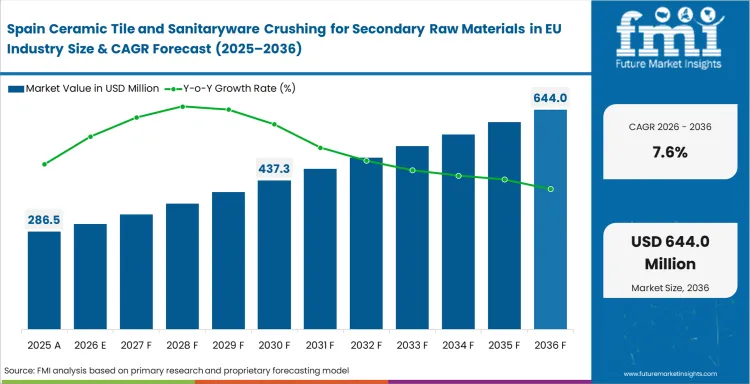
Southern Europe sets the pace because ceramic production is still rooted in district-based manufacturing, where waste volumes repeat, and processing economics are easier to defend. Tile clusters in Spain, Italy, and Portugal create a better starting point for secondary raw material recovery than markets that depend mainly on dispersed demolition waste. Sorting also tends to be easier where ceramic production scrap remains part of daily plant operations. Buyer confidence improves when recovered material comes from known sources. That combination keeps this part of Europe ahead of the rest of the region.
- Spain: Spain benefits from a dense tile manufacturing base and from the steady output of fired scrap that can be recovered with less uncertainty than mixed demolition ceramics. Demand for secondary ceramic raw materials in Spain is anticipated to rise at a CAGR of 7.6% by 2036 because plants and recyclers work closer to one another and can move material into downstream outlets without long haul costs. Castellón remains central to that logic because ceramic activity and material know-how are concentrated there. Recovery projects still need careful grading and outlet discipline. Even so, Spain has one of the clearest routes to scale because repeat industrial waste is easier to monetize than scattered site waste.
- Italy: Italy carries similar strengths, though its growth sits slightly below Spain because energy cost pressure and outlet discipline still shape investment timing. In Italy, the industry is expected to expand at a CAGR of 7.4% from 2026 to 2036 as ceramic districts continue to search for better use of fired sherds and broken sanitaryware. Sassuolo gives the country a practical advantage because waste generation, processing skill, and ceramic demand remain close together. Producers still need clean separation to protect value. Poor sorting can turn usable feed into low-priced rubble very quickly.
- Portugal: Portugal stays in the faster group because ceramic and building-material demand can still connect through relatively short supply chains. A CAGR of 7.0% is projected for Portugal through 2036, supported by ceramic activity that is smaller than Spain or Italy yet still large enough to support local processing logic. Buyers there tend to favor workable recovery models over highly engineered systems. That helps mid-sized lines find a place. Growth still depends on outlet certainty, because smaller waste volumes give plants less room to absorb poor sales planning.
FMI's report also considers other Southern Europe segment where ceramic recovery remains more selective and often tied to project-specific waste streams. Growth in those countries improves when demolition sorting becomes more disciplined and when local construction buyers accept recycled mineral inputs without repeated trial cycles.
Western Europe Ceramic Tile and Sanitaryware Crushing for Secondary Raw Materials in EU Industry Analysis
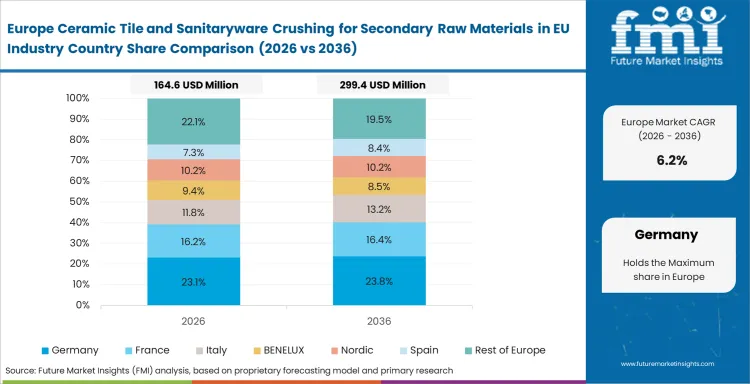
Western Europe follows a different recovery model, with growth driven more by sorting quality and downstream acceptance than by factory scrap volume. Growth here comes less from large ceramic production districts and more from sorting quality, renovation waste control, and buyer acceptance in downstream construction materials. Germany, France, and the Netherlands all have circular-economy pressure, yet commercial uptake depends on whether ceramic waste can be separated well enough to justify processing. That makes operating discipline more important than headline waste volume. Markets in this region usually reward consistency first.
- Germany: Germany's route is shaped by construction quality standards and by a buyer base that does not adopt recycled mineral feed without clear process control. Industry growth for this space in Germany is expected to run at a CAGR of 6.5% during the forecast period. Strong engineering practice helps once a ceramic stream is proven and well graded. Demolition and renovation waste can create a larger addressable pool, but mixed material loads still raise treatment cost. Buyers who ignore quality control risk for longer approval cycles and lower repeat orders.
- France: Renovation activity and circular-building interest support France, yet material acceptance remains sensitive to sorting quality and practical outlet fit. France is set to post 6.3% CAGR in this segment during the assessment period because recycled ceramic use has room to grow where construction material buyers can rely on steady fractions. Paris and other renovation-heavy zones add volume potential, but site-derived feed is harder to standardize than plant scrap. That gap keeps growth moderate. Recovery works best when local processors can pair waste separation with nearby construction demand.
- Netherlands: Logistics discipline defines the Dutch outlook more than ceramic manufacturing scale. Sales in the Netherlands are likely to increase at a CAGR of 6.0% over the forecast period because the country is strong in circular-construction thinking but depends more on organized collection and downstream buyer acceptance than on native ceramic production volume. Clean project waste can find a place quickly when routing is efficient. Mixed feed loses value fast in a compact but quality-sensitive market. That is why planning and sorting matter as much as crushing capacity.
FMI's report covers other Western Europe industry where ceramic recovery is advancing through renovation-led waste streams rather than through large factory scrap volumes. Wider progress depends on cleaner collection systems and on construction buyers who are ready to work with recycled ceramic fractions under stable specifications.
Central Europe Ceramic Tile and Sanitaryware Crushing for Secondary Raw Materials in EU Industry Analysis
Central Europe sits between production-led and demolition-led recovery models. Ceramic manufacturing still supports part of the opportunity, but market growth also depends on how quickly building-material buyers accept crushed ceramic feed in mainstream applications. Poland is the clearest case because it combines ceramic manufacturing depth with expanding construction demand. That mix gives the country more room to grow than many of its neighbors. Execution still matters at plant level.
- Poland: Poland combines a meaningful ceramic production base with construction demand that can absorb secondary mineral feed when quality is kept under control. Poland is projected to record a CAGR of 7.1% in this segment during the forecast period because buyers can source material from both production scrap and selected construction waste streams. Regional growth around industrial and housing zones supports that demand. Plants still need better sorting discipline to avoid value loss from mixed loads. When feed quality slips, downstream buyers tend to return to virgin alternatives instead of accepting variable ceramic fractions.
FMI's report includes other Central and Eastern Europe industry where recovery prospects are improving but still rely on better collection, lower transport cost, and stronger buyer confidence. Countries in this group can move faster once local processors prove that crushed ceramic material can be delivered with repeatable size and purity.
Competitive Aligners for Market Players
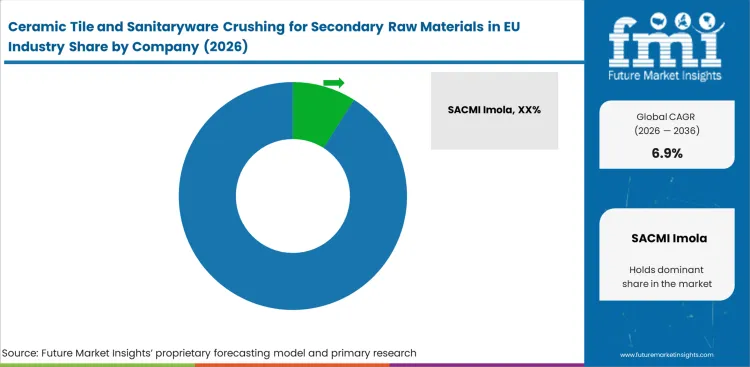
Competition remains fragmented because buyers rank feed tolerance, wear performance, output consistency, and service support ahead of brand name. They select partners that can manage hard ceramic feed while preserving usable output through the crushing stage. SACMI Imola is closely linked to ceramic production, which supports its role in fired scrap recovery and sanitaryware processing. BHS-Sonthofen approaches the market from the crushing and material preparation side. Its position depends on how well its equipment handles abrasive ceramic feed while maintaining plant reliability and usable output consistency. Available company information confirms that a group of established suppliers remains active within ceramic recovery and recycling-related crushing applications across industrial settings where uptime and output stability influence equipment choice and investment planning decisions made by plant operators and recyclers managing cost.
Buyers typically narrow the competitive field by focusing on a small set of operational questions. Feed tolerance is usually assessed first since ceramic rejects and sanitaryware waste accelerate wear when machines are poorly matched. Output control follows because recovered ceramic material must be delivered in usable fractions for aggregate grog powder or internal plant reuse. Service support carries similar weight when processing lines are connected to active ceramic plants or recycling yards with little margin for downtime. SACMI Imola and Sturtevant Inc. are selected where ceramic-specific handling and controlled size reduction are core requirements. These buyers prioritize process stability and predictable performance because ceramic plants have limited downtime tolerance and fixed quality targets.
Supplier strength in this space is defined less by equipment supply alone and more by the ability to hold output quality steady as feed conditions shift between batches. This capability strongly influences repeat purchasing and long-term relationships with plant operators. MEKA and Metso align with buyers who prioritize consistent performance across variable ceramic and mineral feed. They are positioned to support projects that require complete crushing and screening lines rather than a single processing stage. Over time, demand is expected to favor suppliers that demonstrate feed flexibility predictable wear behavior and reliable support after installation. This dynamic keeps the open to several participants while limiting the pull toward one dominant player in purchasing decision cycles globally.
Key Players in the Ceramic Tile and Sanitaryware Crushing for Secondary Raw Materials in EU Industry
- SACMI Imola
- BHS-Sonthofen
- MEKA
- Metso
- KLEEMANN (Wirtgen Group)
- Sturtevant Inc.
Scope of the Report
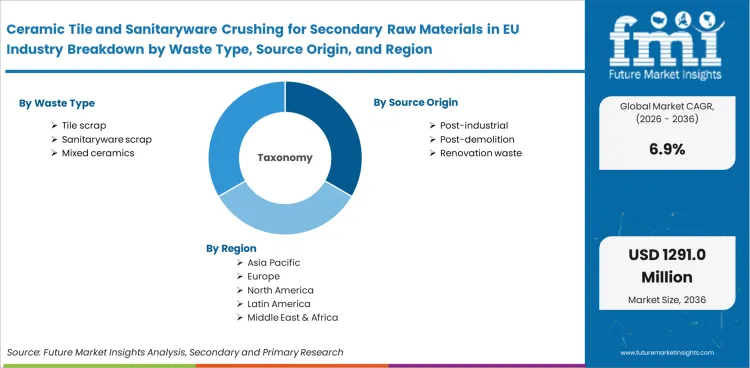
| Metric | Value |
|---|---|
| Quantitative Units | USD 318.0 million to USD 619.7 million, at a CAGR of 6.9% |
| Market Definition | Crushing, grading, and mineral preparation of ceramic tile and sanitaryware waste into usable secondary raw materials for construction and selected ceramic reuse applications within the EU. |
| Waste Type Segmentation | Tile scrap, Sanitaryware scrap, Mixed ceramics |
| Source Origin Segmentation | Post-industrial, Post-demolition, Renovation waste |
| Crusher Type Segmentation | Impact crushers, Jaw crushers, Cone crushers, Hammer mills, VSI crushers |
| Throughput Segmentation | High throughput, Mid throughput, Low throughput |
| Output Form Segmentation | Recycled aggregate, Recycled grog, Ceramic powder, Mineral filler |
| End Use Segmentation | Concrete products, New tiles, Road base, Mortars, Geopolymers, Drainage layers |
| Plant Type Segmentation | Stationary plants, In-plant lines, Mobile units |
| Feed Quality Segmentation | Source-separated feed, Washed feed, Mixed feed |
| Countries Covered | Spain, Italy, Poland, Portugal, Germany, France, Netherlands |
| Key Companies Profiled | SACMI Imola, BHS-Sonthofen, MEKA, Matec Industries, Roca Group, Miraplas, Neos Additives |
Source: Future Market Insights (FMI) analysis, based on proprietary forecasting model and primary research
Ceramic Tile and Sanitaryware Crushing for Secondary Raw Materials in EU Industry Analysis by Segments
Waste Type
- Tile scrap
- Sanitaryware scrap
- Mixed ceramics
Source Origin
- Post-industrial
- Post-demolition
- Renovation waste
Crusher Type
- Impact crushers
- Jaw crushers
- Cone crushers
- Hammer mills
- VSI crushers
Throughput
- High throughput
- Mid throughput
- Low throughput
Output Form
- Recycled aggregate
- Recycled grog
- Ceramic powder
- Mineral filler
End Use
- Concrete products
- New tiles
- Road base
- Mortars
- Geopolymers
- Drainage layers
Plant Type
- Stationary plants
- In-plant lines
- Mobile units
Feed Quality
- Source-separated feed
- Washed feed
- Mixed feed
Region
- Western Europe
- Germany
- France
- Netherlands
- Belgium
- Austria
- Switzerland
- Luxembourg
- Northern Europe
- Denmark
- Sweden
- Norway
- Finland
- Ireland
- Iceland
- Southern Europe
- Italy
- Spain
- Portugal
- Greece
- Malta
- Cyprus
- Eastern Europe
- Poland
- Czech Republic
- Hungary
- Romania
- Slovakia
- Bulgaria
- Croatia
- Slovenia
- Estonia
- Latvia
- Lithuania
Bibliography
- European Union. (2024). Regulation (EU) 2024/3110 of the European Parliament and of the Council of 27 November 2024 laying down harmonised rules for the marketing of construction products and repealing Regulation (EU) No 305/2011 (Text with EEA relevance). Official Journal of the European Union, L series.
- European Commission. (2025). Communication from the Commission to the European Parliament, the Council, the European Economic and Social Committee and the Committee of the Regions: The European Strategy for Housing Construction: a more competitive and productive construction industry (COM/2025/991 final). EUR-Lex.
- Foster, G., Galle, W., Tonini, D., et al. (2025). Policy measures to promote reuse and high-quality recycling of construction and demolition waste.
- Pinto Seppä, I., Alunni, A., & Piscaer, B. (2026). Advancing Construction Materials.
- Confindustria Ceramica. (2025, June 10). 2024 figures released for the Italian Ceramic Industry. Confindustria Ceramica.
- Javed, S., Conte, S., Molinari, C., Rosa, R., Ferrari, A. M., Dondi, M., & Zanelli, C. (2025). Strategies and pathways to improve circularity in ceramic tile production. Journal of Cleaner Production, 517, 145788.
This bibliography is provided for reader reference. The full FMI report contains the complete reference list with primary source documentation.
This Report Addresses
- Market intelligence to support strategic decision making across crushed ceramic aggregate, recycled ceramic grog, ceramic powder, and mineral filler value chains.
- Market size estimation and 10-year forecasts from 2026 to 2036, supported by waste-volume triangulation, outlet mapping, and primary research on ceramic recovery practices.
- Growth opportunity mapping across waste type, source origin, crusher type, throughput, output form, end use, plant type, and feed quality.
- Country outlook across Spain, Italy, Poland, Portugal, Germany, France, and the Netherlands with emphasis on ceramic district logic and downstream construction demand.
- Competitive assessment covering process reliability, grading discipline, local service reach, and downstream outlet acceptance.
- Evaluation of closed-loop ceramic reuse, concrete product demand, road base adoption, and mortar-linked recovery routes.
- Scope boundaries that distinguish ceramic crushing for secondary raw materials from full bathroom fixture sales, broad waste hauling, and unrelated ceramic end-product markets.
- Report delivery fit for strategy planning, circular-material sourcing, plant investment review, and operational benchmarking.
Frequently Asked Questions
What is covered in the ceramic tile and sanitaryware crushing for secondary raw materials in EU Industry report?
This report covers the EU industry for crushing ceramic tile waste and sanitaryware waste into secondary raw materials such as recycled aggregate, ceramic powder, grog, and mineral fillers.
What is driving demand in the EU industry for crushed ceramic secondary raw materials?
Demand is being supported by circular construction targets, rising interest in landfill diversion, and the need to recover usable value from tile scrap and sanitaryware waste.
Why is ceramic tile waste a leading feedstock in this market?
Ceramic tile waste leads because it is generated in larger volumes across production, renovation, and demolition activity, making it easier to build repeatable crushing and reuse flows.
Why does post-industrial ceramic waste remain important in secondary raw material recovery?
Post-industrial ceramic waste stays important because it is cleaner, more uniform, and easier to process into usable recycled ceramic inputs than mixed demolition feed.
What kinds of outputs are produced from ceramic tile and sanitaryware crushing?
Crushing lines in this market typically produce recycled aggregate, ceramic grog, ceramic powder, and mineral filler for reuse in construction materials and selected ceramic applications.
Which end uses create the strongest outlet for recycled ceramic materials in the EU?
Concrete products, road base, mortars, drainage applications, and selected new ceramic blends provide the broadest commercial outlets for recycled ceramic outputs.
Why do stationary plants account for a larger share of ceramic crushing activity?
Stationary plants stay ahead because ceramic recovery often depends on stable feed access, controlled processing conditions, and consistent output grading near industrial clusters.
What makes source-separated ceramic waste more valuable than mixed ceramic feed?
Source-separated material carries better reuse value because lower contamination improves crushing efficiency and raises the chance of meeting secondary raw material specifications.
Which countries are expected to stay most important in the EU ceramic recycling chain?
Spain and Italy remain central because they combine strong ceramic manufacturing bases with better conditions for scrap recovery, while Poland and Portugal add growth from construction-linked demand.
Why is Spain positioned strongly in this market?
Spain benefits from a deep ceramic production base and a practical route for turning fired ceramic waste into usable secondary raw materials within nearby construction and materials industries.
Why does Italy remain a key market for ceramic waste crushing and reuse?
Italy stays important because ceramic manufacturing density, process know-how, and established tile and sanitaryware activity make internal scrap recovery and external crushing more commercially workable.
What is the main restraint in the EU ceramic secondary raw materials industry?
Feed contamination remains a major restraint because mixed demolition ceramics are harder to sort, harder to process, and less likely to deliver a stable recycled material output.
Why do transport costs matter so much in ceramic waste recycling?
Transport costs matter because ceramic waste is heavy and relatively low in value per tonne, so long haul distances can weaken the economics of crushing and reuse.
How do buyers assess suppliers in this ceramic crushing market?
Buyers usually compare suppliers on feed handling ability, wear performance, output consistency, plant reliability, and the ability to support ceramic-specific processing needs.
What separates ceramic waste crushing from general construction waste recycling?
Ceramic waste crushing is more specific because brittle fired materials need controlled size reduction and cleaner recovery routes when the goal is secondary raw material value rather than basic fill use.
Can crushed sanitaryware be used as a secondary raw material in new products?
Crushed sanitaryware can be reused in selected applications where particle quality, cleanliness, and composition are suitable for construction products or controlled ceramic blends.
Why is this market still fragmented?
This market remains fragmented because value is shared across ceramic processors, crushing equipment suppliers, recyclers, and downstream material users rather than being controlled by one dominant supplier.
What is the long-term opportunity in ceramic tile and sanitaryware crushing for the EU?
The long-term opportunity lies in turning ceramic waste from a disposal cost into a repeatable secondary raw material stream that fits construction reuse, circular manufacturing, and tighter waste handling rules.
Preview the report firsthand - request a free sample
Get SampleGet the brochure for pricing and purchase details.
Get PDFTable of Content
- Executive Summary
- Global Market Outlook
- Demand-side Trends
- Supply-side Trends
- Technology Roadmap Analysis
- Analysis and Recommendations
- Market Overview
- Market Coverage / Taxonomy
- Market Definition / Scope / Limitations
- Research Methodology
- Chapter Orientation
- Analytical Lens and Working Hypotheses
- Market Structure, Signals, and Trend Drivers
- Benchmarking and Cross-market Comparability
- Market Sizing, Forecasting, and Opportunity Mapping
- Research Design and Evidence Framework
- Desk Research Programme (Secondary Evidence)
- Company Annual and Sustainability Reports
- Peer-reviewed Journals and Academic Literature
- Corporate Websites, Product Literature, and Technical Notes
- Earnings Decks and Investor Briefings
- Statutory Filings and Regulatory Disclosures
- Technical White Papers and Standards Notes
- Trade Journals, Industry Magazines, and Analyst Briefs
- Conference Proceedings, Webinars, and Seminar Materials
- Government Statistics Portals and Public Data Releases
- Press Releases and Reputable Media Coverage
- Specialist Newsletters and Curated Briefings
- Sector Databases and Reference Repositories
- FMI Internal Proprietary Databases and Historical Market Datasets
- Subscription Datasets and Paid Sources
- Social Channels, Communities, and Digital Listening Inputs
- Additional Desk Sources
- Expert Input and Fieldwork (Primary Evidence)
- Primary Modes
- Qualitative Interviews and Expert Elicitation
- Quantitative Surveys and Structured Data Capture
- Blended Approach
- Why Primary Evidence is Used
- Field Techniques
- Interviews
- Surveys
- Focus Groups
- Observational and In-context Research
- Social and Community Interactions
- Stakeholder Universe Engaged
- C-suite Leaders
- Board Members
- Presidents and Vice Presidents
- R&D and Innovation Heads
- Technical Specialists
- Domain Subject-matter Experts
- Scientists
- Physicians and Other Healthcare Professionals
- Governance, Ethics, and Data Stewardship
- Research Ethics
- Data Integrity and Handling
- Primary Modes
- Tooling, Models, and Reference Databases
- Desk Research Programme (Secondary Evidence)
- Data Engineering and Model Build
- Data Acquisition and Ingestion
- Cleaning, Normalisation, and Verification
- Synthesis, Triangulation, and Analysis
- Quality Assurance and Audit Trail
- Market Background
- Market Dynamics
- Drivers
- Restraints
- Opportunity
- Trends
- Scenario Forecast
- Demand in Optimistic Scenario
- Demand in Likely Scenario
- Demand in Conservative Scenario
- Opportunity Map Analysis
- Product Life Cycle Analysis
- Supply Chain Analysis
- Investment Feasibility Matrix
- Value Chain Analysis
- PESTLE and Porter’s Analysis
- Regulatory Landscape
- Regional Parent Market Outlook
- Production and Consumption Statistics
- Import and Export Statistics
- Market Dynamics
- Global Market Analysis 2021 to 2025 and Forecast, 2026 to 2036
- Historical Market Size Value (USD Million) Analysis, 2021 to 2025
- Current and Future Market Size Value (USD Million) Projections, 2026 to 2036
- Y-o-Y Growth Trend Analysis
- Absolute $ Opportunity Analysis
- Global Market Pricing Analysis 2021 to 2025 and Forecast 2026 to 2036
- Global Market Analysis 2021 to 2025 and Forecast 2026 to 2036, By Waste Type
- Introduction / Key Findings
- Historical Market Size Value (USD Million) Analysis By Waste Type , 2021 to 2025
- Current and Future Market Size Value (USD Million) Analysis and Forecast By Waste Type , 2026 to 2036
- Tile scrap
- Sanitaryware scrap
- Mixed ceramics
- Tile scrap
- Y-o-Y Growth Trend Analysis By Waste Type , 2021 to 2025
- Absolute $ Opportunity Analysis By Waste Type , 2026 to 2036
- Global Market Analysis 2021 to 2025 and Forecast 2026 to 2036, By Source Origin
- Introduction / Key Findings
- Historical Market Size Value (USD Million) Analysis By Source Origin, 2021 to 2025
- Current and Future Market Size Value (USD Million) Analysis and Forecast By Source Origin, 2026 to 2036
- Post-industrial
- Post-demolition
- Renovation waste
- Post-industrial
- Y-o-Y Growth Trend Analysis By Source Origin, 2021 to 2025
- Absolute $ Opportunity Analysis By Source Origin, 2026 to 2036
- Global Market Analysis 2021 to 2025 and Forecast 2026 to 2036, By Crusher Type
- Introduction / Key Findings
- Historical Market Size Value (USD Million) Analysis By Crusher Type, 2021 to 2025
- Current and Future Market Size Value (USD Million) Analysis and Forecast By Crusher Type, 2026 to 2036
- Impact crushers
- Jaw crushers
- Cone crushers
- Hammer mills
- VSI crushers
- Impact crushers
- Y-o-Y Growth Trend Analysis By Crusher Type, 2021 to 2025
- Absolute $ Opportunity Analysis By Crusher Type, 2026 to 2036
- Global Market Analysis 2021 to 2025 and Forecast 2026 to 2036, By Throughput
- Introduction / Key Findings
- Historical Market Size Value (USD Million) Analysis By Throughput, 2021 to 2025
- Current and Future Market Size Value (USD Million) Analysis and Forecast By Throughput, 2026 to 2036
- Mid throughput
- High throughput
- Low throughput
- Mid throughput
- Y-o-Y Growth Trend Analysis By Throughput, 2021 to 2025
- Absolute $ Opportunity Analysis By Throughput, 2026 to 2036
- Global Market Analysis 2021 to 2025 and Forecast 2026 to 2036, By Output Form
- Introduction / Key Findings
- Historical Market Size Value (USD Million) Analysis By Output Form, 2021 to 2025
- Current and Future Market Size Value (USD Million) Analysis and Forecast By Output Form, 2026 to 2036
- Recycled aggregate
- Recycled grog
- Ceramic powder
- Mineral filler
- Recycled aggregate
- Y-o-Y Growth Trend Analysis By Output Form, 2021 to 2025
- Absolute $ Opportunity Analysis By Output Form, 2026 to 2036
- Global Market Analysis 2021 to 2025 and Forecast 2026 to 2036, By End Use
- Introduction / Key Findings
- Historical Market Size Value (USD Million) Analysis By End Use, 2021 to 2025
- Current and Future Market Size Value (USD Million) Analysis and Forecast By End Use, 2026 to 2036
- Concrete products
- New tiles
- Road base
- Mortars
- Geopolymers
- Drainage layers
- Concrete products
- Y-o-Y Growth Trend Analysis By End Use, 2021 to 2025
- Absolute $ Opportunity Analysis By End Use, 2026 to 2036
- Global Market Analysis 2021 to 2025 and Forecast 2026 to 2036, By Plant Type
- Introduction / Key Findings
- Historical Market Size Value (USD Million) Analysis By Plant Type, 2021 to 2025
- Current and Future Market Size Value (USD Million) Analysis and Forecast By Plant Type, 2026 to 2036
- Stationary plants
- In-plant lines
- Mobile units
- Stationary plants
- Y-o-Y Growth Trend Analysis By Plant Type, 2021 to 2025
- Absolute $ Opportunity Analysis By Plant Type, 2026 to 2036
- Global Market Analysis 2021 to 2025 and Forecast 2026 to 2036, By Region
- Introduction
- Historical Market Size Value (USD Million) Analysis By Region, 2021 to 2025
- Current Market Size Value (USD Million) Analysis and Forecast By Region, 2026 to 2036
- North America
- Latin America
- Western Europe
- Eastern Europe
- East Asia
- South Asia and Pacific
- Middle East & Africa
- Market Attractiveness Analysis By Region
- North America Market Analysis 2021 to 2025 and Forecast 2026 to 2036, By Country
- Historical Market Size Value (USD Million) Trend Analysis By Market Taxonomy, 2021 to 2025
- Market Size Value (USD Million) Forecast By Market Taxonomy, 2026 to 2036
- By Country
- USA
- Canada
- Mexico
- By Waste Type
- By Source Origin
- By Crusher Type
- By Throughput
- By Output Form
- By End Use
- By Plant Type
- By Country
- Market Attractiveness Analysis
- By Country
- By Waste Type
- By Source Origin
- By Crusher Type
- By Throughput
- By Output Form
- By End Use
- By Plant Type
- Key Takeaways
- Latin America Market Analysis 2021 to 2025 and Forecast 2026 to 2036, By Country
- Historical Market Size Value (USD Million) Trend Analysis By Market Taxonomy, 2021 to 2025
- Market Size Value (USD Million) Forecast By Market Taxonomy, 2026 to 2036
- By Country
- Brazil
- Chile
- Rest of Latin America
- By Waste Type
- By Source Origin
- By Crusher Type
- By Throughput
- By Output Form
- By End Use
- By Plant Type
- By Country
- Market Attractiveness Analysis
- By Country
- By Waste Type
- By Source Origin
- By Crusher Type
- By Throughput
- By Output Form
- By End Use
- By Plant Type
- Key Takeaways
- Western Europe Market Analysis 2021 to 2025 and Forecast 2026 to 2036, By Country
- Historical Market Size Value (USD Million) Trend Analysis By Market Taxonomy, 2021 to 2025
- Market Size Value (USD Million) Forecast By Market Taxonomy, 2026 to 2036
- By Country
- Germany
- UK
- Italy
- Spain
- France
- Nordic
- BENELUX
- Rest of Western Europe
- By Waste Type
- By Source Origin
- By Crusher Type
- By Throughput
- By Output Form
- By End Use
- By Plant Type
- By Country
- Market Attractiveness Analysis
- By Country
- By Waste Type
- By Source Origin
- By Crusher Type
- By Throughput
- By Output Form
- By End Use
- By Plant Type
- Key Takeaways
- Eastern Europe Market Analysis 2021 to 2025 and Forecast 2026 to 2036, By Country
- Historical Market Size Value (USD Million) Trend Analysis By Market Taxonomy, 2021 to 2025
- Market Size Value (USD Million) Forecast By Market Taxonomy, 2026 to 2036
- By Country
- Russia
- Poland
- Hungary
- Balkan & Baltic
- Rest of Eastern Europe
- By Waste Type
- By Source Origin
- By Crusher Type
- By Throughput
- By Output Form
- By End Use
- By Plant Type
- By Country
- Market Attractiveness Analysis
- By Country
- By Waste Type
- By Source Origin
- By Crusher Type
- By Throughput
- By Output Form
- By End Use
- By Plant Type
- Key Takeaways
- East Asia Market Analysis 2021 to 2025 and Forecast 2026 to 2036, By Country
- Historical Market Size Value (USD Million) Trend Analysis By Market Taxonomy, 2021 to 2025
- Market Size Value (USD Million) Forecast By Market Taxonomy, 2026 to 2036
- By Country
- China
- Japan
- South Korea
- By Waste Type
- By Source Origin
- By Crusher Type
- By Throughput
- By Output Form
- By End Use
- By Plant Type
- By Country
- Market Attractiveness Analysis
- By Country
- By Waste Type
- By Source Origin
- By Crusher Type
- By Throughput
- By Output Form
- By End Use
- By Plant Type
- Key Takeaways
- South Asia and Pacific Market Analysis 2021 to 2025 and Forecast 2026 to 2036, By Country
- Historical Market Size Value (USD Million) Trend Analysis By Market Taxonomy, 2021 to 2025
- Market Size Value (USD Million) Forecast By Market Taxonomy, 2026 to 2036
- By Country
- India
- ASEAN
- Australia & New Zealand
- Rest of South Asia and Pacific
- By Waste Type
- By Source Origin
- By Crusher Type
- By Throughput
- By Output Form
- By End Use
- By Plant Type
- By Country
- Market Attractiveness Analysis
- By Country
- By Waste Type
- By Source Origin
- By Crusher Type
- By Throughput
- By Output Form
- By End Use
- By Plant Type
- Key Takeaways
- Middle East & Africa Market Analysis 2021 to 2025 and Forecast 2026 to 2036, By Country
- Historical Market Size Value (USD Million) Trend Analysis By Market Taxonomy, 2021 to 2025
- Market Size Value (USD Million) Forecast By Market Taxonomy, 2026 to 2036
- By Country
- Kingdom of Saudi Arabia
- Other GCC Countries
- Turkiye
- South Africa
- Other African Union
- Rest of Middle East & Africa
- By Waste Type
- By Source Origin
- By Crusher Type
- By Throughput
- By Output Form
- By End Use
- By Plant Type
- By Country
- Market Attractiveness Analysis
- By Country
- By Waste Type
- By Source Origin
- By Crusher Type
- By Throughput
- By Output Form
- By End Use
- By Plant Type
- Key Takeaways
- Key Countries Market Analysis
- USA
- Pricing Analysis
- Market Share Analysis, 2025
- By Waste Type
- By Source Origin
- By Crusher Type
- By Throughput
- By Output Form
- By End Use
- By Plant Type
- Canada
- Pricing Analysis
- Market Share Analysis, 2025
- By Waste Type
- By Source Origin
- By Crusher Type
- By Throughput
- By Output Form
- By End Use
- By Plant Type
- Mexico
- Pricing Analysis
- Market Share Analysis, 2025
- By Waste Type
- By Source Origin
- By Crusher Type
- By Throughput
- By Output Form
- By End Use
- By Plant Type
- Brazil
- Pricing Analysis
- Market Share Analysis, 2025
- By Waste Type
- By Source Origin
- By Crusher Type
- By Throughput
- By Output Form
- By End Use
- By Plant Type
- Chile
- Pricing Analysis
- Market Share Analysis, 2025
- By Waste Type
- By Source Origin
- By Crusher Type
- By Throughput
- By Output Form
- By End Use
- By Plant Type
- Germany
- Pricing Analysis
- Market Share Analysis, 2025
- By Waste Type
- By Source Origin
- By Crusher Type
- By Throughput
- By Output Form
- By End Use
- By Plant Type
- UK
- Pricing Analysis
- Market Share Analysis, 2025
- By Waste Type
- By Source Origin
- By Crusher Type
- By Throughput
- By Output Form
- By End Use
- By Plant Type
- Italy
- Pricing Analysis
- Market Share Analysis, 2025
- By Waste Type
- By Source Origin
- By Crusher Type
- By Throughput
- By Output Form
- By End Use
- By Plant Type
- Spain
- Pricing Analysis
- Market Share Analysis, 2025
- By Waste Type
- By Source Origin
- By Crusher Type
- By Throughput
- By Output Form
- By End Use
- By Plant Type
- France
- Pricing Analysis
- Market Share Analysis, 2025
- By Waste Type
- By Source Origin
- By Crusher Type
- By Throughput
- By Output Form
- By End Use
- By Plant Type
- India
- Pricing Analysis
- Market Share Analysis, 2025
- By Waste Type
- By Source Origin
- By Crusher Type
- By Throughput
- By Output Form
- By End Use
- By Plant Type
- ASEAN
- Pricing Analysis
- Market Share Analysis, 2025
- By Waste Type
- By Source Origin
- By Crusher Type
- By Throughput
- By Output Form
- By End Use
- By Plant Type
- Australia & New Zealand
- Pricing Analysis
- Market Share Analysis, 2025
- By Waste Type
- By Source Origin
- By Crusher Type
- By Throughput
- By Output Form
- By End Use
- By Plant Type
- China
- Pricing Analysis
- Market Share Analysis, 2025
- By Waste Type
- By Source Origin
- By Crusher Type
- By Throughput
- By Output Form
- By End Use
- By Plant Type
- Japan
- Pricing Analysis
- Market Share Analysis, 2025
- By Waste Type
- By Source Origin
- By Crusher Type
- By Throughput
- By Output Form
- By End Use
- By Plant Type
- South Korea
- Pricing Analysis
- Market Share Analysis, 2025
- By Waste Type
- By Source Origin
- By Crusher Type
- By Throughput
- By Output Form
- By End Use
- By Plant Type
- Russia
- Pricing Analysis
- Market Share Analysis, 2025
- By Waste Type
- By Source Origin
- By Crusher Type
- By Throughput
- By Output Form
- By End Use
- By Plant Type
- Poland
- Pricing Analysis
- Market Share Analysis, 2025
- By Waste Type
- By Source Origin
- By Crusher Type
- By Throughput
- By Output Form
- By End Use
- By Plant Type
- Hungary
- Pricing Analysis
- Market Share Analysis, 2025
- By Waste Type
- By Source Origin
- By Crusher Type
- By Throughput
- By Output Form
- By End Use
- By Plant Type
- Kingdom of Saudi Arabia
- Pricing Analysis
- Market Share Analysis, 2025
- By Waste Type
- By Source Origin
- By Crusher Type
- By Throughput
- By Output Form
- By End Use
- By Plant Type
- Turkiye
- Pricing Analysis
- Market Share Analysis, 2025
- By Waste Type
- By Source Origin
- By Crusher Type
- By Throughput
- By Output Form
- By End Use
- By Plant Type
- South Africa
- Pricing Analysis
- Market Share Analysis, 2025
- By Waste Type
- By Source Origin
- By Crusher Type
- By Throughput
- By Output Form
- By End Use
- By Plant Type
- USA
- Market Structure Analysis
- Competition Dashboard
- Competition Benchmarking
- Market Share Analysis of Top Players
- By Regional
- By Waste Type
- By Source Origin
- By Crusher Type
- By Throughput
- By Output Form
- By End Use
- By Plant Type
- Competition Analysis
- Competition Deep Dive
- SACMI Imola
- Overview
- Product Portfolio
- Profitability by Market Segments (Product/Age /Sales Channel/Region)
- Sales Footprint
- Strategy Overview
- Marketing Strategy
- Product Strategy
- Channel Strategy
- BHS-Sonthofen
- MEKA
- Metso
- KLEEMANN (Wirtgen Group)
- Sturtevant Inc.
- SACMI Imola
- Competition Deep Dive
- Assumptions & Acronyms Used


