

- Industry Size (2026)
- USD 485.4 Mn
- Forecast (2036)
- USD 925.3 Mn
- CAGR (2026 to 2036)
- 6.66%
EUDR-Compliant Pharma Secondary Carton Board Market Size, Market Forecast and Outlook By FMI
The EUDR-compliant pharma secondary carton board market crossed a valuation of USD 450.5 million in 2025. The sector is expected to reach USD 485.4 million in 2026 at a CAGR of 6.66% during the forecast period. Sustained investment propels the valuation to USD 925.3 million through 2036 as the non-optional nature of deforestation compliance for pharmaceutical products entering European borders creates a long-term lock-in for verified board suppliers.
Procurement directors in the life sciences sector are moving away from broad certification logos toward granular geolocation data verification. This shift forces a decision between maintaining diverse, opaque fiber sources or consolidating spend with a handful of vertically integrated mills capable of providing plot-level coordinates. The stakes for delay are severe, as non-compliant secondary packaging can result in entire drug batches being impounded at EU points of entry. While the industry views this as an environmental mandate, it is functionally a digital audit challenge where the carton board solutions are only as valuable as the metadata accompanying them.
Summary of EUDR-Compliant Pharma Secondary Carton Board Market
- EUDR-Compliant Pharma Secondary Carton Board Market Definition:
- EUDR-Compliant Pharma Secondary Carton Board Market encompasses fiber-based paperboard materials used in pharmaceutical secondary packaging that comply with the European Union Deforestation Regulation by ensuring traceable, legally sourced, and deforestation-free wood pulp across the supply chain.
- Demand Drivers in the Market:
- Mandatory compliance deadlines in European markets compel pharmaceutical supply chain managers to overhaul their secondary packaging sourcing.
- Institutional investor pressure regarding ESG disclosures obligates global pharmaceutical brands to eliminate deforestation risk from their value chain.
- The requirement for high-resolution serialization on drug cartons pushes converters toward high-quality, EUDR-compliant bleached board grades.
- Key Segments Analyzed in the FMI Report:
- Bleached Board: Bleached Board is expected to hold 44.5% share in 2026, as its superior surface for Datamatrix printing remains the industry standard for high-speed pharmaceutical lines.
- Prescription Drugs: Prescription Drugs is expected to grab the leading share in 2026, driven by the strict regulatory oversight and non-negotiable compliance needs of the biopharma sector.
- Aqueous Coating: Aqueous Coating is predicted to dominate through the forecast period due to its balance of ink protection and recyclability in a circular economy framework.
- China: A CAGR of 8.2% is projected as domestic manufacturers modernize to retain their status as preferred exporters to European pharmaceutical firms.
- Analyst Opinion at FMI:
- Ismail Sutaria, Principal Analyst, Packaging, at FMI, opines, "The industry assumes EUDR is a standard environmental certification, but it is actually an infrastructure paradox. Board mills have the fiber, but pharmaceutical companies have the audit requirements, and currently, the digital bridge between them is now transitioning from pilot phase to automated API integration. I have observed that the most successful players are not those with the best trees, but those with the most robust IT ecosystems capable of delivering immutable geolocation data to a procurement director's dashboard in real-time."
- Strategic Implications / Executive Takeaways:
- Carton board suppliers must establish end-to-end traceability systems for wood fiber sourcing to qualify for pharmaceutical packaging contracts tied to EUDR compliance.
- Pharma packaging converters should secure verified deforestation-free pulp supply agreements early to avoid procurement disruption as regulatory enforcement intensifies.
- Regulatory and sourcing teams must align packaging specifications with chain-of-custody documentation requirements to ensure uninterrupted access to EU pharmaceutical packaging markets.
- Methodology:
- Primary Research: Direct engagement with decision-makers who manage the transition from standard to compliant board.
- Desk Research: Comprehensive review of European Commission implementation acts and industry-specific compliance frameworks.
- Market-Sizing: Anchored to global pharmaceutical board trade flows and manufacturing capacity data.
- Data Validation: Forecasts are triangulated against the adoption rates of digital traceability platforms in the pulp and paper sector.
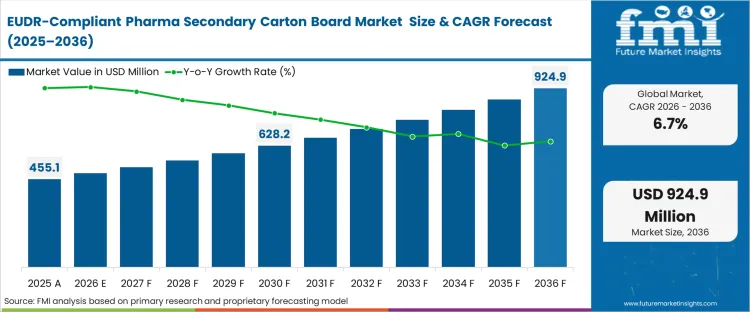
Market acceleration depends on the structural stabilization of satellite-based remote sensing as a primary proof of compliance. With EU regulatory bodies having operationalized the TRACES-NT Information System for geolocation data, the manual burden of verifying thousands of smallholder fiber plots will diminish. This transition is being triggered by a coalition of tier-1 packaging converters and software providers who are building the "digital twin" of forest origins, making the next unit of compliant board significantly easier to qualify than the first.
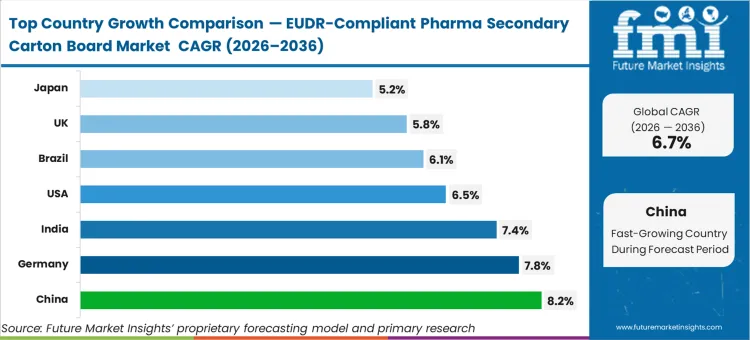
China is anticipated to record a CAGR of 8.2% as its massive contract manufacturing base aligns with European export requirements. Germany is expected to post 7.8% growth driven by its role as the primary logistics gateway for the European Union's pharmaceutical supply chain. India follows with a projected 7.4% increase, reflecting the modernization of its pharmaceutical export hubs. The USA sector is poised to expand at 6.5%, while Brazil is set to track a 6.1% growth rate. The United Kingdom is likely to follow at 5.8%, and Japan is estimated to garner a 5.2% CAGR through 2036. The divergence across these regions stems from the varying maturity of national forest tracking infrastructures rather than pharmaceutical demand alone.
EUDR-Compliant Pharma Secondary Carton Board Market Key Takeaways
| Metric | Details |
|---|---|
| Industry Size (2026) | USD 485.4 million |
| Industry Value (2036) | USD 925.3 million |
| CAGR (2026-2036) | 6.66% |
Source: Future Market Insights (FMI) analysis, based on proprietary forecasting model and primary research
EUDR-Compliant Pharma Secondary Carton Board Market Definition
The EUDR-Compliant Pharma Secondary Carton Board Market comprises specialized paperboard materials used for drug outer packaging that meet the strict requirements of the EU Deforestation Regulation. This involves a functional boundary where every square inch of board must be traceable to a specific, non-deforested plot of land through a verified chain of custody. Unlike standard carton board, this market is defined by the integration of geolocation data and legal due diligence into the material's value proposition.
EUDR-Compliant Pharma Secondary Carton Board Market Inclusions
Included within this scope are all virgin and recycled fiber board grades utilized for folding cartons, display packs, and wallet cards in pharmaceutical applications. This encompasses solid bleached sulfate (SBS), folding boxboard (FBB), and coated recycled board (CRB) that specifically carry EUDR compliance documentation. The scope also covers pharma packaging formats like tamper-evident cartons and multi-pack outers that act as the secondary layer of protection for primary medical containers.
EUDR-Compliant Pharma Secondary Carton Board Market Exclusions
Explicitly excluded from this market are primary packaging materials such as glass vials, plastic bottles, and aluminum blister foils, as these do not utilize wood-fiber board substrates. Furthermore, general-purpose carton boards lacking the specific serialization-grade surface finish required for pharmaceutical Datamatrix coding are excluded. These are omitted because they do not face the same stringent qualification and regulatory validation cycles as medicinal secondary packaging, even if they claim basic deforestation compliance.
EUDR-Compliant Pharma Secondary Carton Board Market Research Methodology
- Primary Research: FMI conducted interviews with Procurement Directors at tier-1 pharmaceutical companies and Sustainability Officers at global board mills.
- Desk Research: Data was aggregated from EUDR implementation guidelines, satellite verification platform whitepapers, and international forest certification registries.
- Market-Sizing and Forecasting: The baseline anchors to the total volume of pharmaceutical board consumption within the EU zone, adjusted for export-manufacture ratios.
- Data Validation and Update Cycle: Forecasts were cross-validated against the announced capital expenditure plans of the top eight global board producers for EUDR-compliant capacity.
Segmental Analysis
EUDR-Compliant Pharma Secondary Carton Board Market Analysis by Material Type
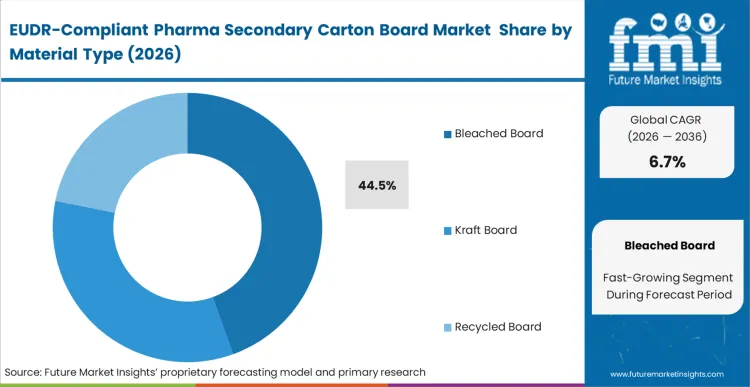
The reason bleached board holds a dominant 44.5% share comes down to the operational requirement for absolute serialization legibility. Pharmaceutical converters cannot risk the inconsistent surface brightness or high "noise" of lower-grade recycled boards when high-speed cameras must verify 2D Datamatrix codes at 400 cartons per minute. This material is not chosen merely for its strength; it is the structural substrate for the drug's digital identity. According to FMI's assessment, the transition to bleached board types is accelerating because virgin fiber offers a simpler path to EUDR compliance than the complex, mixed-origin footprint of recycled pulp. Buyers who delay this transition find themselves unable to meet the traceability standards required by tier-1 European distributors, who are increasingly refusing shipments that lack plot-level documentation.
- Automated Serialization: High-brightness surfaces provide the necessary contrast for laser-coded pharmaceutical identifiers. Operations heads capture higher line speeds and lower reject rates by using consistent bleached board substrates.
- Traceability Baseline: Virgin fiber allows for a direct, unbroken chain of custody from the forest plot to the mill. Procurement managers qualify these sources first to ensure a "clean" audit trail for European regulators.
- Aesthetic Integrity: The uniform white finish signals medical-grade quality to the end consumer. Brand managers utilize this visual consistency to maintain premium positioning in the oncology and specialty drug segments.
EUDR-Compliant Pharma Secondary Carton Board Market Analysis by End Use
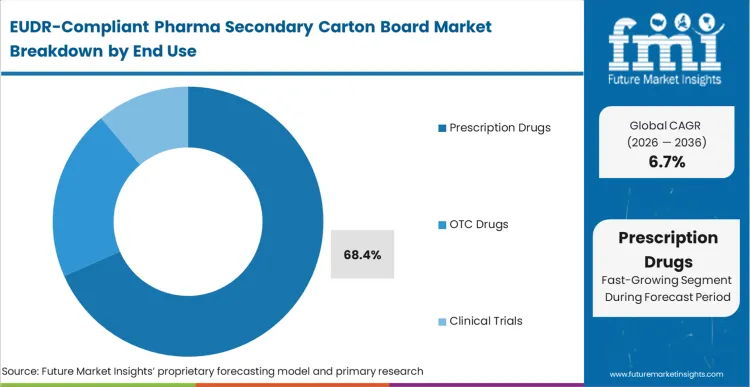
The incumbent approach of using generic, multi-origin carton board for prescription medication is failing as European regulators move toward zero-tolerance for "blind" fiber sourcing. Prescription drugs account for the majority of the market with 68.4% share because the financial stakes of a shipment rejection are highest in this segment. A single impounded batch of a biologic medication can represent millions in lost revenue, making the unit cost of compliant board a negligible insurance premium. In FMI's view, drug packaging needs are evolving from simple containment to regulatory gatekeeping. Pharmaceutical firms are now prioritizing suppliers who can offer "traceability as a service" alongside the physical material. Those who continue to source board through fragmented, unverified channels risk immediate exclusion from the major European hospital and pharmacy procurement networks that now mandate EUDR documentation.
- Optical Serialization: Specialized surfaces minimize ink bleed on microscopic text and codes. This prevents the operational bottleneck of high reject rates during the final packaging stage of high-value prescription lines.
- Regulatory Parity: Compliance documentation is integrated directly into the batch record for each drug. Regulatory affairs teams use this data to streamline market access across all 27 EU member states.
- Security Features: Board construction supports the embedding of holographic and micro-perforation anti-counterfeiting measures. Security directors capture reduced risk of diversion by using boards specifically engineered for medical authentication.
EUDR-Compliant Pharma Secondary Carton Board Market Analysis by Coating Type
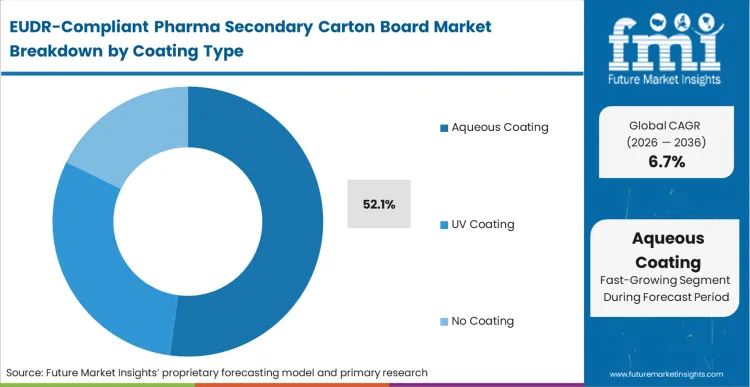
The commercial consequence of choosing the wrong coating in an EUDR-compliant environment is often the total loss of the board's recyclability profile. Aqueous coating holds 52.1% of the market because it protects the board's surface without interfering with the repulpability that European circular economy mandates demand. As per FMI's projection, coated board applications are shifting toward water-based systems because they avoid the chemical complexity of UV-cured alternatives, which can complicate the "virgin fiber" status of future recycled streams. Buyers who select non-compliant or hard-to-recycle coatings face escalating "eco-modulated" fees in several European jurisdictions, which can double the effective cost of the packaging over the product lifecycle. This forces a move toward aqueous solutions that satisfy both the physical protection of the drug carton and the environmental compliance profile required for the European market.
- Conversion Efficiency: Water-based coatings dry rapidly on high-speed folding carton lines. Production managers capture improved throughput by using coatings that do not require extended UV curing cycles.
- Ink Protection: The barrier layer prevents moisture and friction from degrading the printed dosage instructions. Quality control officers capture reduced risk of patient error caused by illegible or smudged secondary packaging.
- Disposal Compliance: Aqueous-coated boards are easily integrated into existing paper recycling streams. Sustainability officers avoid the operational headache of managing specialized waste categories for pharmaceutical packaging.
EUDR-Compliant Pharma Secondary Carton Board Market Drivers, Restraints, and Opportunities
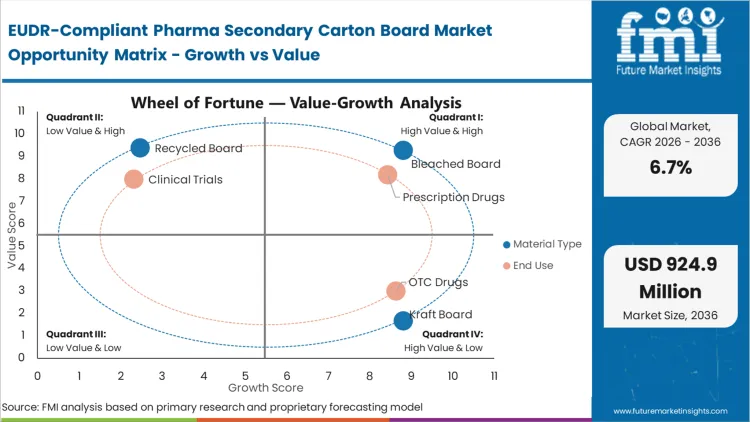
The structural forcing condition driving this market is the non-negotiable legal deadline for EUDR compliance, which requires every pharmaceutical company exporting to the Union to provide geolocation data for their packaging. This is not a voluntary ESG goal; it is a market-access requirement that forces procurement directors to choose between compliant, traceable fiber or total exclusion from European distribution. The stakes are particularly high for global brands whose centralized manufacturing hubs serve both European and non-European markets, as they must decide whether to dual-track their inventory or move the entire global supply to compliant board.
The primary restraint is the structural lack of digital integration between forest managers and pharmaceutical converters. Most global board mills still operate on paper-based or siloed chain-of-custody systems that cannot easily output the CSV or blockchain-ready coordinates required for an EUDR "Due Diligence Statement." This friction is organizational rather than technical; the data often exists but is trapped in a multi-tier supply chain where transparency is traditionally resisted. While satellite monitoring is emerging as a partial solution, the cost of verifying smallholder plots in complex sourcing regions like Brazil or Southeast Asia remains a significant barrier to total market coverage.
Opportunities in the EUDR-Compliant Pharma Secondary Carton Board Market
- Digital Traceability Integration: The transition toward mandatory geolocation creates a massive opportunity for board mills to offer integrated software-and-material packages. Suppliers who can provide a verified "fiber-to-carton" digital twin capture preferred status in tier-1 pharma sourcing reviews.
- Virgin-Recycled Hybridization: As sustainable packaging growth continues, there is a gap for boards that combine the traceability of virgin fiber with a verified percentage of compliant recycled content. Sourcing managers capture this to satisfy both EUDR mandates and broader corporate plastic-reduction targets.
- Satellite Verification Services: There is a structural need for third-party verification of forest plots using remote sensing. Independent agencies who can provide "EUDR-cleared" labels for specific board batches capture high-margin consulting and audit contracts from the pharmaceutical sector.
Regional Analysis
Based on the regional analysis, the EUDR-Compliant Pharma Secondary Carton Board Market is segmented into North America, Europe, Asia Pacific, Latin America, and Middle East & Africa across 40 plus countries.
.webp "Top Country Growth Comparison Eudr Compliant Pharma Secondary Carton Board Market Cagr (2026 2036)")
| Country | CAGR (2026 to 2036) |
|---|---|
| China | 8.2% |
| Germany | 7.8% |
| India | 7.4% |
| USA | 6.5% |
| Brazil | 6.1% |
| United Kingdom | 5.8% |
| Japan | 5.2% |
Source: Future Market Insights (FMI) analysis, based on proprietary forecasting model and primary research
Europe EUDR-Compliant Pharma Secondary Carton Board Market Analysis
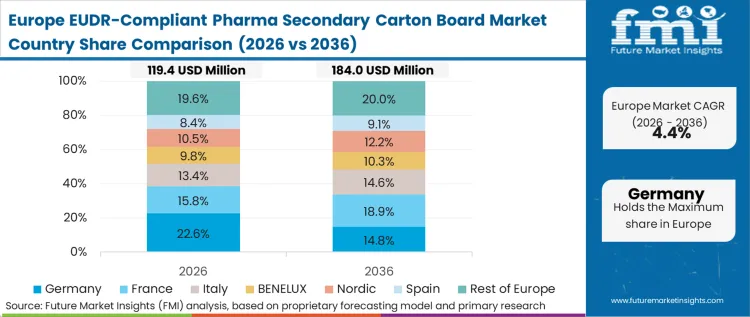
Europe's adoption pattern is driven by its role as the regulatory epicenter where compliance is the price of admission. The policy-led environment here makes the transition a legal imperative rather than a market choice, with the European Medicines Agency (EMA) standards increasingly referencing packaging sustainability. Based on FMI's assessment, pharmaceutical firms in this region are prioritizing the stabilization of their supply chains against the 2026 deadline, leading to a surge in long-term contracts for verified recycled board demand where traceability can be proven. This region serves as the global testbed for geolocation verification technologies.
- Germany: Germany's high concentration of pharmaceutical manufacturing and its role as a logistics hub for Central Europe force an immediate alignment with EUDR. Operations heads in the Rhine-Ruhr region have already begun the capital-intensive process of qualifying new board grades for their high-speed lines. The market for compliant board in Germany is forecast to register a CAGR of 7.8%. Pharmaceutical logistics clear a significant bottleneck when they can guarantee that every carton entering the "track and trace" system is also "deforestation-cleared" for the final auditor.
- United Kingdom: The UK's independent Forest Risk Commodities regime necessitates dual-compliance reporting for converters serving both London and Brussels. British board converters are positioning themselves as "EUDR-ready" to protect their contracts with European brands. Sales of compliant board in the UK are on track to record a CAGR of 5.8%. UK-based manufacturers that move first capture preferred supplier status in procurement frameworks that are unlikely to reopen once initial vendors are qualified.
Asia Pacific EUDR-Compliant Pharma Secondary Carton Board Market Analysis
The structural lens for Asia Pacific is infrastructure-led, specifically the modernization of forest-tracking systems in major export hubs. According to FMI's estimates, the region is responding to the procurement specification updates that Western brand customers push down through each annual sourcing review. This region is the primary manufacturing engine for global generics, and its board mills are under intense pressure to digitize their sourcing records to maintain access to the European market. The growth here reflects a rate of compliance-led capital refresh that tracks the brand sourcing review calendar rather than a domestic regulatory deadline.
- China: China's dominance in pharmaceutical intermediate and finished-dose manufacturing necessitates immediate alignment with global traceability standards. Domestic board mills are investing in satellite verification and blockchain to prove fiber origin for their international clients. The China market for compliant board is set to grow at 8.2% compound annually. This trajectory creates a significant competitive gap between modernized mills and traditional operators who are being slowly phased out of the export supply chain.
- India: India's pharmaceutical export sector is increasingly focused on the premium European market, requiring a total overhaul of its secondary packaging sourcing logic. Sourcing managers in Mumbai and Hyderabad are consolidating their board spend with mills that can provide verifiable chain-of-custody data. India is expected to see its sector grow at a compound annual rate of 7.4%. This shift opens up a massive commercial opportunity for domestic converters who can bridge the gap between local board production and international compliance requirements.
- Japan: Japan's pharmaceutical market is characterized by high quality standards and a strong preference for virgin bleached boards. Japanese firms are integrating EUDR compliance into their existing "Green Procurement" guidelines to ensure their global exports remain unchallenged. FMI estimates the market in Japan to expand at an annual growth rate of 5.2%. Large pharmaceutical players here capture an operational outcome of reduced audit risk by proactively moving their entire folding carton portfolio to verified board grades.
North America EUDR-Compliant Pharma Secondary Carton Board Market Analysis
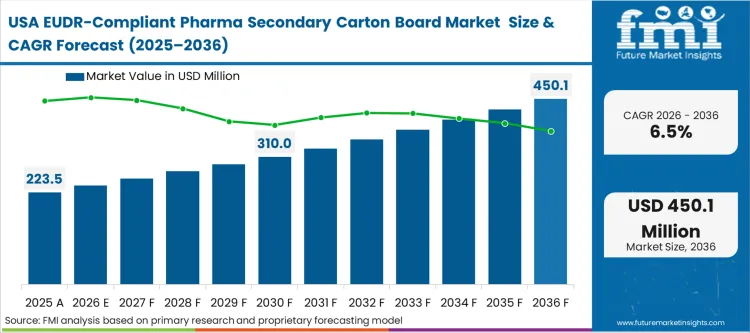
North America's market dynamic is buyer behavior-led, with global pharmaceutical giants headquartered in the US applying European standards to their global operations to avoid dual-stocking costs. FMI analysts opine that US-based procurement directors are the primary drivers of this market, as they force their domestic board suppliers to adopt EUDR-like traceability even for products sold outside of Europe. This ensures a unified global packaging specification that simplifies logistics and quality control across their international manufacturing sites.
- USA: The US pharmaceutical sector faces a structural decision between maintaining domestic board sources or switching to European-certified mills for their global product lines. Most tier-1 brands have opted to push EUDR requirements back to their US mills to ensure total compliance across their global export portfolio. The market for compliant board in the USA is likely to post a CAGR of 6.5%. The structural trajectory is heading toward a global "Gold Standard" where the distinction between EUDR and non-EUDR board eventually disappears for the pharmaceutical grade.
Latin America EUDR-Compliant Pharma Secondary Carton Board Market Analysis
- Brazil: Brazil's position as both a major pharmaceutical market and a critical source of wood fiber makes its role in the EUDR landscape highly complex. Sourcing from this region requires the most rigorous plot-level verification due to its high-risk profile for land-use change. Demand for compliant board in Brazil is set to grow at 6.1%. The practitioner reality is that the CAGR here reflects the speed at which localized "Safe Sourcing" corridors can be established for the pharmaceutical sector, rather than general demand for medicine.
FMI's report includes detailed analysis of additional markets in Southeast Asia, the Middle East, and Scandinavia. These regions are forming "traceability clusters" where shared infrastructure for forest monitoring is lowering the entry barrier for smaller board converters.
Competitive Aligners for Market Players
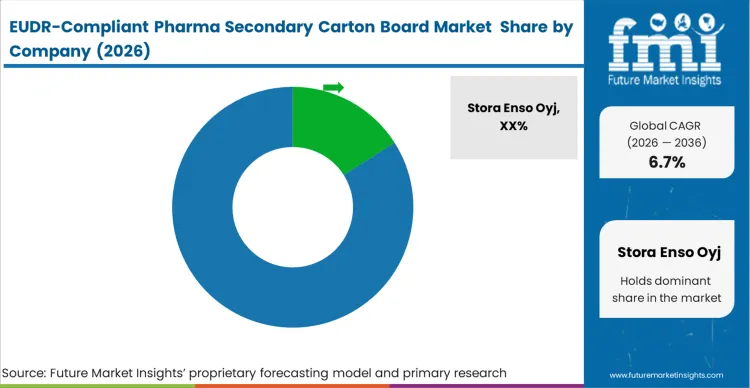
The concentrated-moderate structure of this market is a direct result of the high capital requirement for board mills and the sophisticated IT systems needed to manage geolocation metadata. Buyers distinguish between qualified and unqualified vendors not by the physical properties of the board, which are largely standardized, but by the robustness of their data verification pipelines. Companies like Stora Enso Oyj and Metsä Board Corporation have an inherent advantage because they control large portions of their fiber supply, allowing them to provide plot-level coordinates with higher reliability than a converter who buys pulp from fragmented sources.
Incumbents in the paperboard packaging leaders space are building structural advantages by integrating satellite monitoring directly into their customer portals. A challenger must build more than just a compliant board; they must develop a digital verification capability that can survive a rigorous pharmaceutical audit. Leading players like Mondi plc and WestRock are leveraging their global footprints to offer a "one-stop-shop" for compliant board, ensuring that a pharmaceutical client can use the same verified grade whether they are packaging in Ireland or the United States.
Buyer power is exerted through long-term sourcing agreements that penalize vendors for data gaps as heavily as for material defects. There is a structural tension between the buyers' need for total transparency and the board mills' desire to protect their proprietary sourcing networks. As we move toward 2036, the market is becoming more concentrated as smaller mills that cannot afford the "traceability tax" are either acquired or relegated to the less regulated industrial packaging segments. The competitive trajectory is defined by a race to automate compliance, where the winners are those who make the " Due Diligence Statement" an invisible part of the invoice.
Key Players in EUDR-Compliant Pharma Secondary Carton Board Market
- Stora Enso Oyj
- Metsä Board Corporation
- Mondi plc
- Smurfit Westrock plc
- Graphic Packaging Holding Company
- Sappi Limited
- Mayr-Melnhof Karton AG
Scope of the Report
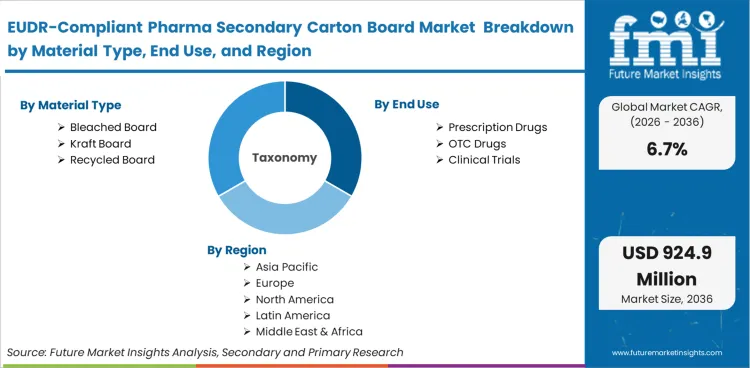
| Metric | Value |
|---|---|
| Quantitative Units | USD 485.4 million to USD 925.3 million, at a CAGR of 6.64% |
| Market Definition | Secondary packaging board for pharmaceutical use that meets the mandatory geolocation and no-deforestation requirements of Regulation (EU) 2023/1115. |
| Material Type Segmentation | Bleached Board, Kraft Board, Recycled Board |
| End Use Segmentation | Prescription Drugs, OTC Drugs, Clinical Trials |
| Coating Type Segmentation | Aqueous Coating, UV Coating, No Coating |
| Regions Covered | North America, Europe, Asia Pacific, Latin America, Middle East & Africa |
| Countries Covered | China, Germany, India, USA, Brazil, UK, Japan, and 40 plus countries |
| Key Companies Profiled | Stora Enso Oyj, Metsä Board Corporation, Mondi plc, WestRock Company, Graphic Packaging Holding Company, Sappi Limited, Mayr-Melnhof Karton AG |
| Forecast Period | 2026 to 2036 |
| Approach | Primary interviews with pharmaceutical procurement leads and board mill sustainability officers, anchored to EUDR trade flow data and validated through satellite monitoring adoption rates. |
Source: Future Market Insights (FMI) analysis, based on proprietary forecasting model and primary research
EUDR-Compliant Pharma Secondary Carton Board Market Analysis by Segments
- Material Type:
- Bleached Board
- Kraft Board
- Recycled Board
- End Use:
- Prescription Drugs
- OTC Drugs
- Clinical Trials
- Coating Type:
- Aqueous Coating
- UV Coating
- No Coating
- Region:
- North America
- USA
- Europe
- Germany
- UK
- Asia Pacific
- China
- India
- Japan
- Latin America
- Brazil
- North America
Bibliography
- European Commission. (2025, August 12). Commission Notice - Guidance Document for Regulation (EU) 2023/1115 on Deforestation-Free Products (C/2025/4524). Official Journal of the European Union.
- European Commission. (2025, May 20). Commission Staff Working Document on the methodology used for the benchmarking system.
- Forest Stewardship Council. (2024, July 1). FSC Regulatory Module (FSC-STD-01-004 V1-0).
- Programme for the Endorsement of Forest Certification. (2025, August 1). PEFC EUDR Due Diligence System Module Standard 2002-1:2024: Frequently Asked Questions (FAQs).
This bibliography is provided for reader reference. The full FMI report contains the complete reference list with primary source documentation.
This Report Addresses
- Market intelligence to support strategic decision making across EUDR-compliant bleached board and high-performance pharma carton categories
- Market size estimation and 10-year revenue forecasts from 2026 to 2036, supported by trade flow analysis of pharmaceutical grade paperboard
- Growth opportunity mapping across Material Type and End Use with emphasis on the stabilization of satellite verification platforms
- Segment and regional revenue forecasts covering prescription drug outers across the high-compliance European regulatory environment
- Competition strategy assessment including the structural advantages of vertically integrated board mills and digital traceability ecosystems
- Product development tracking including aqueous coating standards, serialization-grade finishes, and plot-level geolocation frameworks
- Market access analysis covering Regulation (EU) 2023/1115 and the qualification standards for pharma-grade folding cartons
- Market report delivery in PDF, Excel, PPT, and interactive dashboard formats for executive strategy, global procurement planning, and operational benchmarking use
Frequently Asked Questions
How large is the EUDR-Compliant Pharma Secondary Carton Board Market in 2025?
The market was valued at USD 450.5 million in 2025. This figure signals that the pharmaceutical industry has already begun the transition to compliant board ahead of the hard regulatory deadlines, effectively pricing in the cost of traceability.
What will it be valued at by 2036?
The market is projected to reach USD 925.3 million by 2036. This growth reflects the total absorption of EUDR compliance into the global pharmaceutical supply chain, where non-compliant board becomes structurally obsolete for high-value medicinal exports.
What CAGR is projected for the forecast period?
A CAGR of 6.64% is expected between 2026 and 2036. This rate is constrained by the multi-year qualification cycles of pharmaceutical packaging, which prevents overnight shifts but ensures that once a mill is qualified, it remains locked into the supply chain for the product lifecycle.
Which Material Type segment leads the market?
Bleached Board leads with a 44.5% share in 2026. This dominance is driven by the operational necessity of high contrast for serialization codes and the simpler audit trail afforded by virgin fiber compared to the fragmented origin of recycled materials.
Which End Use segment leads the market?
Prescription Drugs is the dominant end-use segment. This is because the regulatory and financial consequences of batch impoundment at EU borders are most severe for biologics and specialty medicines, making compliant board a non-negotiable procurement requirement.
Which Coating Type leads the market?
Aqueous Coating leads with a 52.1% share. The segment leads because water-based systems provide the necessary protection for pharma cartons while maintaining the easy repulpability required by European circular economy mandates.
What drives the rapid growth in this market?
The primary driver is the mandatory legal requirement of the EU Deforestation Regulation. This forces a structural shift where market access is contingent on providing geolocation data, moving compliance from a "nice to have" ESG goal to a core operational necessity for pharmaceutical exporters.
What is the primary restraint on market growth?
The primary restraint is the digital gap between forest data and pharmaceutical audit requirements. The structural friction of verifying thousands of fiber plots in complex, multi-tier supply chains creates an organizational bottleneck that slows the transition for smaller converters.
Which country is growing the fastest?
China is the fastest-growing market at an 8.2% CAGR. Structurally, Chinese board mills are modernizing faster than their domestic peers to protect their massive contract manufacturing exports to the European pharmaceutical market.
How does EUDR differ from previous certifications like FSC?
While FSC provides a broad "chain of custody" based on mass balance, EUDR requires specific geolocation coordinates for the exact plot of land where the fiber was harvested. This represents a shift from trust-based certification to data-verified evidence of no-deforestation.
Can recycled board ever be truly EUDR compliant?
Recycled board can be compliant if it consists of "pre-2020" material or if the post-consumer stream can be verified as deforestation-free. Structurally, this is much harder to prove than for virgin fiber, which is why the market is currently pivoting toward bleached virgin boards.
What happens if a drug carton is found to be non-compliant?
Under EUDR, non-compliant products can be seized at the border, and the importing company can face fines up to 4% of their annual EU turnover. This creates a zero-tolerance environment for pharmaceutical firms that forces them to use only verified, high-tier board suppliers.
How is China's forest tracking infrastructure evolving?
China is investing heavily in state-backed satellite monitoring and centralized timber tracking databases. This infrastructure-led approach allows Chinese mills to provide the "digital twin" of their board origins more efficiently than regions with fragmented private forest ownership.
Why is Germany growing faster than the UK in this market?
Germany's growth is driven by its role as the primary physical gateway and warehousing hub for the EU pharmaceutical sector. The operational outcome of having compliant board at the point of manufacture in Germany is a total reduction in customs delays across the entire Union.
What is the structural advantage of vertically integrated mills?
Mills that own their forests have a shorter, more transparent data chain. They can provide coordinates with absolute certainty, whereas a non-integrated mill must aggregate data from hundreds of external suppliers, increasing the risk of an audit failure.
How does aqueous coating improve procurement efficiency?
Aqueous coatings allow for faster line speeds on folding carton machines and do not require specialized UV waste management. This clears a bottleneck in the secondary packaging process while ensuring the final product meets EU recyclability guidelines.
What is the "traceability tax" in the board market?
The "traceability tax" refers to the overhead cost of maintaining the IT systems and audit trails required for EUDR. This cost favors large-scale producers, as they can amortize the digital investment over millions of tons, whereas smaller mills struggle to remain competitive.
Will the US adopt EUDR-like standards?
While not legally mandated in the US, major American pharmaceutical firms are adopting these standards for their global operations to maintain a single packaging specification. The structural trajectory is toward a global unified grade for medicinal cartons.
How do satellite verification platforms work?
These platforms use automated remote sensing to detect land-use changes in near real-time. By cross-referencing harvest timestamps with satellite imagery, they provide the proof of "no-deforestation" required by the European Commission.
What is the practitioner reality for sourcing board in Brazil?
The reality is that Brazil is considered a high-risk region, requiring the most intensive "Due Diligence Statements." This forces pharmaceutical firms to establish exclusive, closed-loop supply corridors with a few verified large-scale plantations to avoid any contamination from unverified land.
How does this market affect drug pricing?
The unit cost of the board is a minor component of a drug's price, but the cost of compliance is significant. Most firms are absorbing this cost as a "market access insurance" rather than passing it directly to the consumer, especially in price-regulated European markets.
What will be the dominant competitive variable in 2036?
By 2036, the competitive variable will be the level of "traceability automation." The winners will be mills that have fully integrated their forest data with their clients' ERP systems, making compliance a real-time, zero-touch process.
Preview the report firsthand - request a free sample
Get SampleGet the brochure for pricing and purchase details.
Get PDFTable of Content
- Executive Summary
- Global Market Outlook
- Demand-side Trends
- Supply-side Trends
- Technology Roadmap Analysis
- Analysis and Recommendations
- Market Overview
- Market Coverage / Taxonomy
- Market Definition / Scope / Limitations
- Research Methodology
- Chapter Orientation
- Analytical Lens and Working Hypotheses
- Market Structure, Signals, and Trend Drivers
- Benchmarking and Cross-market Comparability
- Market Sizing, Forecasting, and Opportunity Mapping
- Research Design and Evidence Framework
- Desk Research Programme (Secondary Evidence)
- Company Annual and Sustainability Reports
- Peer-reviewed Journals and Academic Literature
- Corporate Websites, Product Literature, and Technical Notes
- Earnings Decks and Investor Briefings
- Statutory Filings and Regulatory Disclosures
- Technical White Papers and Standards Notes
- Trade Journals, Industry Magazines, and Analyst Briefs
- Conference Proceedings, Webinars, and Seminar Materials
- Government Statistics Portals and Public Data Releases
- Press Releases and Reputable Media Coverage
- Specialist Newsletters and Curated Briefings
- Sector Databases and Reference Repositories
- FMI Internal Proprietary Databases and Historical Market Datasets
- Subscription Datasets and Paid Sources
- Social Channels, Communities, and Digital Listening Inputs
- Additional Desk Sources
- Expert Input and Fieldwork (Primary Evidence)
- Primary Modes
- Qualitative Interviews and Expert Elicitation
- Quantitative Surveys and Structured Data Capture
- Blended Approach
- Why Primary Evidence is Used
- Field Techniques
- Interviews
- Surveys
- Focus Groups
- Observational and In-context Research
- Social and Community Interactions
- Stakeholder Universe Engaged
- C-suite Leaders
- Board Members
- Presidents and Vice Presidents
- R&D and Innovation Heads
- Technical Specialists
- Domain Subject-matter Experts
- Scientists
- Physicians and Other Healthcare Professionals
- Governance, Ethics, and Data Stewardship
- Research Ethics
- Data Integrity and Handling
- Primary Modes
- Tooling, Models, and Reference Databases
- Desk Research Programme (Secondary Evidence)
- Data Engineering and Model Build
- Data Acquisition and Ingestion
- Cleaning, Normalisation, and Verification
- Synthesis, Triangulation, and Analysis
- Quality Assurance and Audit Trail
- Market Background
- Market Dynamics
- Drivers
- Restraints
- Opportunity
- Trends
- Scenario Forecast
- Demand in Optimistic Scenario
- Demand in Likely Scenario
- Demand in Conservative Scenario
- Opportunity Map Analysis
- Product Life Cycle Analysis
- Supply Chain Analysis
- Investment Feasibility Matrix
- Value Chain Analysis
- PESTLE and Porter’s Analysis
- Regulatory Landscape
- Regional Parent Market Outlook
- Production and Consumption Statistics
- Import and Export Statistics
- Market Dynamics
- Global Market Analysis 2021 to 2025 and Forecast, 2026 to 2036
- Historical Market Size Value (USD Million) Analysis, 2021 to 2025
- Current and Future Market Size Value (USD Million) Projections, 2026 to 2036
- Y-o-Y Growth Trend Analysis
- Absolute $ Opportunity Analysis
- Global Market Pricing Analysis 2021 to 2025 and Forecast 2026 to 2036
- Global Market Analysis 2021 to 2025 and Forecast 2026 to 2036, By Material Type
- Introduction / Key Findings
- Historical Market Size Value (USD Million) Analysis By Material Type , 2021 to 2025
- Current and Future Market Size Value (USD Million) Analysis and Forecast By Material Type , 2026 to 2036
- Bleached Board
- Kraft Board
- Recycled Board
- Bleached Board
- Y-o-Y Growth Trend Analysis By Material Type , 2021 to 2025
- Absolute $ Opportunity Analysis By Material Type , 2026 to 2036
- Global Market Analysis 2021 to 2025 and Forecast 2026 to 2036, By End Use
- Introduction / Key Findings
- Historical Market Size Value (USD Million) Analysis By End Use, 2021 to 2025
- Current and Future Market Size Value (USD Million) Analysis and Forecast By End Use, 2026 to 2036
- Prescription Drugs
- OTC Drugs
- Clinical Trials
- Prescription Drugs
- Y-o-Y Growth Trend Analysis By End Use, 2021 to 2025
- Absolute $ Opportunity Analysis By End Use, 2026 to 2036
- Global Market Analysis 2021 to 2025 and Forecast 2026 to 2036, By Coating Type
- Introduction / Key Findings
- Historical Market Size Value (USD Million) Analysis By Coating Type, 2021 to 2025
- Current and Future Market Size Value (USD Million) Analysis and Forecast By Coating Type, 2026 to 2036
- Aqueous Coating
- UV Coating
- No Coating
- Aqueous Coating
- Y-o-Y Growth Trend Analysis By Coating Type, 2021 to 2025
- Absolute $ Opportunity Analysis By Coating Type, 2026 to 2036
- Global Market Analysis 2021 to 2025 and Forecast 2026 to 2036, By Region
- Introduction
- Historical Market Size Value (USD Million) Analysis By Region, 2021 to 2025
- Current Market Size Value (USD Million) Analysis and Forecast By Region, 2026 to 2036
- North America
- Latin America
- Western Europe
- Eastern Europe
- East Asia
- South Asia and Pacific
- Middle East & Africa
- Market Attractiveness Analysis By Region
- North America Market Analysis 2021 to 2025 and Forecast 2026 to 2036, By Country
- Historical Market Size Value (USD Million) Trend Analysis By Market Taxonomy, 2021 to 2025
- Market Size Value (USD Million) Forecast By Market Taxonomy, 2026 to 2036
- By Country
- USA
- Canada
- Mexico
- By Material Type
- By End Use
- By Coating Type
- By Country
- Market Attractiveness Analysis
- By Country
- By Material Type
- By End Use
- By Coating Type
- Key Takeaways
- Latin America Market Analysis 2021 to 2025 and Forecast 2026 to 2036, By Country
- Historical Market Size Value (USD Million) Trend Analysis By Market Taxonomy, 2021 to 2025
- Market Size Value (USD Million) Forecast By Market Taxonomy, 2026 to 2036
- By Country
- Brazil
- Chile
- Rest of Latin America
- By Material Type
- By End Use
- By Coating Type
- By Country
- Market Attractiveness Analysis
- By Country
- By Material Type
- By End Use
- By Coating Type
- Key Takeaways
- Western Europe Market Analysis 2021 to 2025 and Forecast 2026 to 2036, By Country
- Historical Market Size Value (USD Million) Trend Analysis By Market Taxonomy, 2021 to 2025
- Market Size Value (USD Million) Forecast By Market Taxonomy, 2026 to 2036
- By Country
- Germany
- UK
- Italy
- Spain
- France
- Nordic
- BENELUX
- Rest of Western Europe
- By Material Type
- By End Use
- By Coating Type
- By Country
- Market Attractiveness Analysis
- By Country
- By Material Type
- By End Use
- By Coating Type
- Key Takeaways
- Eastern Europe Market Analysis 2021 to 2025 and Forecast 2026 to 2036, By Country
- Historical Market Size Value (USD Million) Trend Analysis By Market Taxonomy, 2021 to 2025
- Market Size Value (USD Million) Forecast By Market Taxonomy, 2026 to 2036
- By Country
- Russia
- Poland
- Hungary
- Balkan & Baltic
- Rest of Eastern Europe
- By Material Type
- By End Use
- By Coating Type
- By Country
- Market Attractiveness Analysis
- By Country
- By Material Type
- By End Use
- By Coating Type
- Key Takeaways
- East Asia Market Analysis 2021 to 2025 and Forecast 2026 to 2036, By Country
- Historical Market Size Value (USD Million) Trend Analysis By Market Taxonomy, 2021 to 2025
- Market Size Value (USD Million) Forecast By Market Taxonomy, 2026 to 2036
- By Country
- China
- Japan
- South Korea
- By Material Type
- By End Use
- By Coating Type
- By Country
- Market Attractiveness Analysis
- By Country
- By Material Type
- By End Use
- By Coating Type
- Key Takeaways
- South Asia and Pacific Market Analysis 2021 to 2025 and Forecast 2026 to 2036, By Country
- Historical Market Size Value (USD Million) Trend Analysis By Market Taxonomy, 2021 to 2025
- Market Size Value (USD Million) Forecast By Market Taxonomy, 2026 to 2036
- By Country
- India
- ASEAN
- Australia & New Zealand
- Rest of South Asia and Pacific
- By Material Type
- By End Use
- By Coating Type
- By Country
- Market Attractiveness Analysis
- By Country
- By Material Type
- By End Use
- By Coating Type
- Key Takeaways
- Middle East & Africa Market Analysis 2021 to 2025 and Forecast 2026 to 2036, By Country
- Historical Market Size Value (USD Million) Trend Analysis By Market Taxonomy, 2021 to 2025
- Market Size Value (USD Million) Forecast By Market Taxonomy, 2026 to 2036
- By Country
- Kingdom of Saudi Arabia
- Other GCC Countries
- Turkiye
- South Africa
- Other African Union
- Rest of Middle East & Africa
- By Material Type
- By End Use
- By Coating Type
- By Country
- Market Attractiveness Analysis
- By Country
- By Material Type
- By End Use
- By Coating Type
- Key Takeaways
- Key Countries Market Analysis
- USA
- Pricing Analysis
- Market Share Analysis, 2025
- By Material Type
- By End Use
- By Coating Type
- Canada
- Pricing Analysis
- Market Share Analysis, 2025
- By Material Type
- By End Use
- By Coating Type
- Mexico
- Pricing Analysis
- Market Share Analysis, 2025
- By Material Type
- By End Use
- By Coating Type
- Brazil
- Pricing Analysis
- Market Share Analysis, 2025
- By Material Type
- By End Use
- By Coating Type
- Chile
- Pricing Analysis
- Market Share Analysis, 2025
- By Material Type
- By End Use
- By Coating Type
- Germany
- Pricing Analysis
- Market Share Analysis, 2025
- By Material Type
- By End Use
- By Coating Type
- UK
- Pricing Analysis
- Market Share Analysis, 2025
- By Material Type
- By End Use
- By Coating Type
- Italy
- Pricing Analysis
- Market Share Analysis, 2025
- By Material Type
- By End Use
- By Coating Type
- Spain
- Pricing Analysis
- Market Share Analysis, 2025
- By Material Type
- By End Use
- By Coating Type
- France
- Pricing Analysis
- Market Share Analysis, 2025
- By Material Type
- By End Use
- By Coating Type
- India
- Pricing Analysis
- Market Share Analysis, 2025
- By Material Type
- By End Use
- By Coating Type
- ASEAN
- Pricing Analysis
- Market Share Analysis, 2025
- By Material Type
- By End Use
- By Coating Type
- Australia & New Zealand
- Pricing Analysis
- Market Share Analysis, 2025
- By Material Type
- By End Use
- By Coating Type
- China
- Pricing Analysis
- Market Share Analysis, 2025
- By Material Type
- By End Use
- By Coating Type
- Japan
- Pricing Analysis
- Market Share Analysis, 2025
- By Material Type
- By End Use
- By Coating Type
- South Korea
- Pricing Analysis
- Market Share Analysis, 2025
- By Material Type
- By End Use
- By Coating Type
- Russia
- Pricing Analysis
- Market Share Analysis, 2025
- By Material Type
- By End Use
- By Coating Type
- Poland
- Pricing Analysis
- Market Share Analysis, 2025
- By Material Type
- By End Use
- By Coating Type
- Hungary
- Pricing Analysis
- Market Share Analysis, 2025
- By Material Type
- By End Use
- By Coating Type
- Kingdom of Saudi Arabia
- Pricing Analysis
- Market Share Analysis, 2025
- By Material Type
- By End Use
- By Coating Type
- Turkiye
- Pricing Analysis
- Market Share Analysis, 2025
- By Material Type
- By End Use
- By Coating Type
- South Africa
- Pricing Analysis
- Market Share Analysis, 2025
- By Material Type
- By End Use
- By Coating Type
- USA
- Market Structure Analysis
- Competition Dashboard
- Competition Benchmarking
- Market Share Analysis of Top Players
- By Regional
- By Material Type
- By End Use
- By Coating Type
- Competition Analysis
- Competition Deep Dive
- Stora Enso Oyj
- Overview
- Product Portfolio
- Profitability by Market Segments (Product/Age /Sales Channel/Region)
- Sales Footprint
- Strategy Overview
- Marketing Strategy
- Product Strategy
- Channel Strategy
- Metsä Board Corporation
- Mondi plc
- Smurfit Westrock plc
- Graphic Packaging Holding Company
- Sappi Limited
- Mayr-Melnhof Karton AG
- Stora Enso Oyj
- Competition Deep Dive
- Assumptions & Acronyms Used


