

- Industry Size (2026)
- USD 156 Mn
- Forecast (2036)
- USD 2150.6 Mn
- CAGR (2026 to 2036)
- 30%
Pharma Quantum Computing Market Forecast and Outlook 2026 to 2036
The pharma quantum computing market is expected to grow from USD 156 million in 2026 to USD 2,150.6 million by 2036, reflecting a compound annual growth rate (CAGR) of 30%. Quantum computing in the pharmaceutical industry holds the potential to revolutionize drug discovery, molecular modeling, and personalized medicine. By enabling faster and more accurate simulations of complex molecules and biological processes, quantum computing allows pharmaceutical companies to accelerate the development of new drugs, optimize existing therapies, and improve patient outcomes. The market's growth is driven by increasing investments in quantum computing technologies, along with the growing need for more advanced computational power to tackle complex biological and chemical problems that traditional computing cannot solve efficiently.
The demand for pharma quantum computing solutions is also supported by collaborations between tech companies, pharmaceutical firms, and research institutions, all seeking to unlock the potential of quantum computing in transforming drug discovery and development. As quantum hardware and software continue to improve, their application in the pharmaceutical sector will likely expand, further fueling market growth.
Quick Stats for Pharma Quantum Computing Market
- Pharma Quantum Computing Market Value (2026): USD 156 million
- Pharma Quantum Computing Market Forecast Value (2036): USD 2,150.6 million
- Pharma Quantum Computing Market Global Forecast CAGR (2026 to 2036): 30%
- Top Application by Share in Pharma Quantum Computing Market: Drug Discovery Simulations (60%)
- Key Growth Regions in Pharma Quantum Computing Market: India, China, USA, UK, Germany
- Top Players in Pharma Quantum Computing Market: IBM Quantum, Google Quantum AI, D-Wave Systems, IonQ, Rigetti
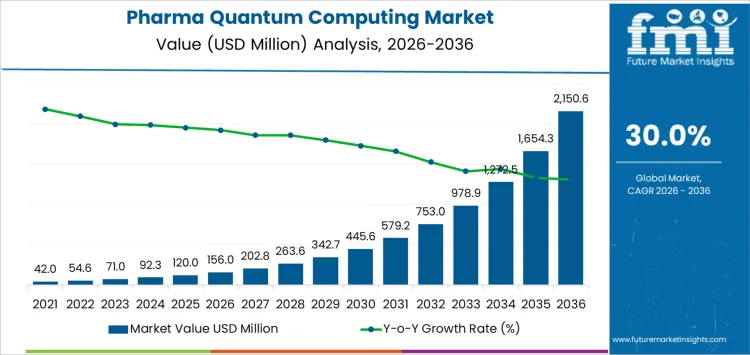
What is the Growth Forecast for the Pharma Quantum Computing Market through 2036?
The rolling CAGR analysis for the pharma quantum computing market shows impressive growth throughout the forecast period, with substantial acceleration over time. Starting at USD 156 million in 2026, the market grows to USD 202.8 million in 2027 and USD 263.64 million in 2028. These early years represent the initial adoption of quantum computing technologies within the pharmaceutical industry, as companies explore their potential in drug discovery and molecular modeling.
From 2028 to 2030, the market experiences accelerated growth, reaching USD 342.73 million in 2029 and USD 445.55 million in 2030, as quantum computing solutions begin to demonstrate their value in practical applications. From 2030 to 2035, the market sees a significant upward trajectory, with the value reaching USD 579.22 million in 2031, USD 752.98 million in 2032, and USD 978.88 million in 2033, as more pharmaceutical companies integrate quantum computing into their research and development processes.
By 2035, the market is projected to reach USD 1,272.54 million, and by 2036, it is expected to reach USD 2,150.6 million. The rolling CAGR analysis reveals that the market will experience a strong acceleration, with increasing adoption of quantum computing as its capabilities mature and its impact on the pharmaceutical industry becomes more widely recognized. This growth trajectory indicates a significant shift towards more advanced and efficient drug discovery processes, driven by quantum technology.
Pharma Quantum Computing Market Key Takeaways
| Metric | Value |
|---|---|
| Industry Sales Value (2026) | USD 156 million |
| Industry Forecast Value (2036) | USD 2,150.6 million |
| Industry Forecast CAGR (2026-2036) | 60% |
What Is Driving the Demand for the Pharma Quantum Computing Market Globally?
The global demand for quantum computing in the pharmaceutical sector is driven by the need to accelerate complex computations and solve problems that are challenging for classical computing. Drug discovery and development involve exploring vast chemical spaces, modelling molecular interactions, and optimising candidate compounds, all of which require intensive computation. Traditional high performance computing can be slow and costly when applied to large scale molecular simulations, protein folding predictions, or optimisation tasks in formulation and synthesis. Quantum computing offers the potential to process these complex calculations more efficiently through quantum parallelism and enhanced optimisation capabilities. As pharmaceutical companies seek ways to reduce time to market, lower R&D costs, and improve success rates in early discovery stages, interest in quantum computing applications is increasing. Collaborations between pharma firms, quantum hardware developers, and research institutions are expanding, signalling recognition of the technology’s potential to transform computational chemistry, pharmacokinetics modelling and lead optimisation.
Future demand for quantum computing in the pharmaceutical industry is expected to grow as hardware matures, software frameworks improve, and practical use cases become clearer. Quantum enhanced algorithms could be applied to molecular dynamics, reaction pathway analysis, and multi objective optimisation in drug design, where classical methods face limitations. Cloud based quantum access and hybrid classical quantum workflows are likely to make experimental quantum computations more accessible to researchers without requiring in house quantum hardware. Regulatory and validation pathways that accommodate quantum generated insights may further encourage adoption. As pharmaceutical R&D continues to face pressure to deliver innovative therapies faster and more efficiently, quantum computing could become an increasingly valuable tool for early discovery and complex modelling tasks. Continued investment in quantum hardware, algorithm development, and cross disciplinary expertise will shape how widely quantum computing is adopted and integrated into pharmaceutical research workflows.
What Are the Key Segments in Pharma Quantum Computing Market?
The pharma quantum computing market is segmented by product type and application. Quantum software/algorithms leads the product type segment with 40% of the market share, enabling breakthroughs in pharmaceutical research and development. Drug discovery simulations dominate the application segment with 60%, driven by the need for advanced computational models in the drug discovery process. The market is expanding as quantum computing technology offers significant potential to revolutionize pharmaceutical research by enhancing computational power and enabling faster, more accurate predictions in drug development.
Which Product Type Drives Pharma Quantum Computing Market Demand Globally?
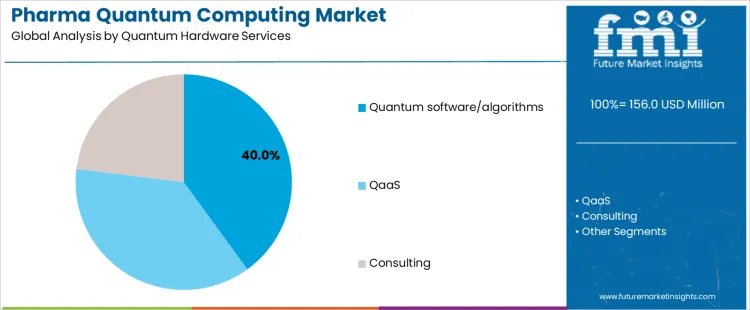
Quantum software/algorithms accounts for 40% of the market share. These software solutions and algorithms are crucial for harnessing the power of quantum computing to solve complex problems in pharmaceutical research. They are designed to run on quantum hardware, enabling more efficient and precise simulations, optimization tasks, and computational models than traditional computing methods. Quantum software and algorithms help pharmaceutical companies model molecular interactions, predict drug efficacy, and explore new compounds in ways that were previously unattainable due to the limitations of classical computing. As quantum computing continues to advance, the demand for specialized quantum software and algorithms is expected to grow, making them a central component in the development of quantum solutions for pharmaceutical applications.
Which Application Drives Pharma Quantum Computing Market Demand Globally?
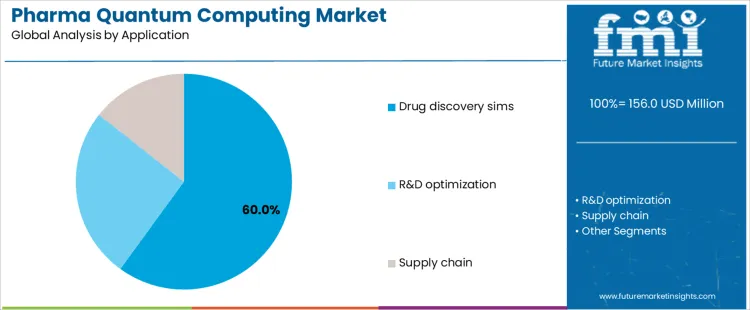
Drug discovery simulations leads the application segment with 60% of the market share. In the pharmaceutical industry, drug discovery is one of the most time-consuming and expensive processes. Quantum computing has the potential to accelerate this process by simulating molecular interactions and predicting drug efficacy more accurately and efficiently than classical computers. These simulations allow researchers to explore a wider range of molecular compounds and their interactions, speeding up the identification of promising drug candidates. As pharmaceutical companies seek faster, more cost-effective methods for drug development, drug discovery simulations powered by quantum computing are becoming increasingly important. While other applications such as R&D optimization and supply chain management contribute to market growth, drug discovery simulations remain the dominant driver due to their critical role in bringing new drugs to market more efficiently.
What are the Key Dynamics of the Global Pharma Quantum Computing Market?
The global pharma quantum computing market is expanding as pharmaceutical and biotech companies explore quantum solutions to accelerate drug discovery, molecular simulation and optimization of complex chemical processes. Traditional high performance computing can struggle with large molecular systems, and quantum computing has potential to process vast datasets and solve problems with higher efficiency. Adoption is emerging in research labs, large pharma firms and academic partnerships. Growth reflects increasing investment in quantum research, need for faster discovery cycles and demand for technologies that can advance precision medicine and formulation design.
What are the Key Drivers for the Global Pharma Quantum Computing Market?
One key driver is the complexity of drug discovery and molecular simulation tasks that require advanced computation. Quantum computing provides novel algorithms capable of modelling interactions and energetic states more efficiently than classical systems. Pharmaceutical firms are under pressure to reduce time and cost associated with discovery and development pipelines. Increasing investment by governments, technology companies and research organisations in quantum computing research supports readiness for commercial application. Collaboration initiatives between pharma and quantum hardware/software developers promote tailored solutions. Demand for personalised therapies and biologics also motivates exploration of quantum tools to handle large variable spaces and complex optimization.
What are the Restraints for the Global Pharma Quantum Computing Market?
One restraint is the early stage of quantum computing technology, which limits practical, large scale application in current pharmaceutical workflows. Quantum hardware faces challenges with stability, error rates and scaling qubit count for real world problems, which can slow adoption. High cost of access to advanced quantum systems and required expertise may deter smaller organisations. Integration of quantum methods with existing computational pipelines requires specialised skills and tools. Regulatory frameworks and validation standards around use of quantum results in regulated drug development are still maturing, creating uncertainty for broad operational deployment.
What is the Key Trends in the Global Pharma Quantum Computing Market?
A key trend is hybrid computing models that combine classical high performance computing with quantum processors for specific sub tasks in simulation and optimization. Software frameworks that allow developers to experiment with quantum algorithms in familiar environments are rising. Strategic alliances between pharma firms and quantum computing providers are increasing to co develop use cases and refine performance needs. Cloud based quantum access services enable broader experimentation without heavy capital investment. There is growing focus on quantum inspired algorithms that bring some benefits of quantum approaches to classical hardware, helping bridge current capability gaps while preparing for future full quantum adoption.
What is the Country-Wise Outlook for the Pharma Quantum Computing Market?
The Pharma Quantum Computing market is rapidly growing, driven by the increasing demand for advanced computational technologies in drug discovery, molecular modeling, and personalized medicine. Quantum computing holds the potential to revolutionize pharmaceutical research by enabling simulations of molecular structures and chemical reactions at an unprecedented scale, leading to faster drug discovery processes and more accurate predictions of drug efficacy. Countries like India, China, and the USA are at the forefront of this growth, driven by significant investments in research and development, advancements in quantum computing technology, and increasing collaborations between the pharmaceutical and tech industries. As the pharmaceutical industry seeks more efficient and effective ways to address global health challenges, the demand for quantum computing solutions is expected to rise significantly across these regions, contributing to the overall market growth.
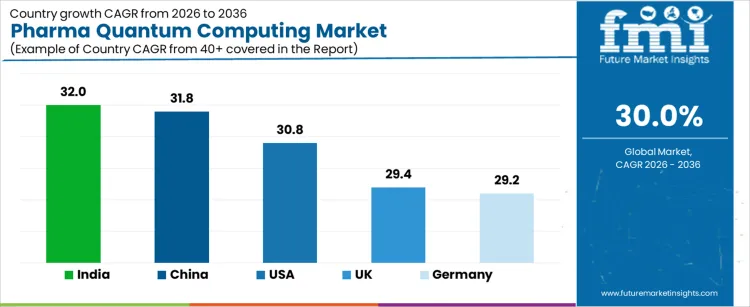
| Country | CAGR (2026 to 2036) |
|---|---|
| India | 32% |
| China | 31.8% |
| USA | 30.8% |
| UK | 29.4% |
| Germany | 29.2% |
Source: FMI analysis based on primary research and proprietary forecasting model
What is Driving the Growth of the Pharma Quantum Computing Market in India?
India’s Pharma Quantum Computing market is projected to grow at a CAGR of 32%. The country is seeing significant growth in its pharmaceutical sector, with increasing investments in research and development to improve drug discovery and treatment solutions. Quantum computing provides the ability to process vast amounts of data and simulate molecular behaviors at a molecular level, which is expected to revolutionize drug development in India. The growing demand for personalized medicine, along with the rising burden of chronic diseases, is prompting pharmaceutical companies in India to adopt more advanced technologies such as quantum computing. Furthermore, India’s rapidly expanding tech ecosystem, coupled with the government’s focus on fostering innovation, positions the country as a leader in adopting quantum computing solutions for pharmaceutical applications. As quantum computing becomes more accessible, India is expected to see significant advances in drug research, particularly in areas such as genomics and molecular biology, driving the growth of the market.
What is Contributing to the Growth of the Pharma Quantum Computing Market in China?
China’s Pharma Quantum Computing market is expected to grow at a CAGR of 31.8%. China’s large-scale investments in artificial intelligence (AI), quantum computing, and biotechnology are accelerating the adoption of quantum computing in the pharmaceutical industry. As the country continues to prioritize advancements in healthcare, quantum computing is seen as a crucial tool to enhance drug discovery, optimize treatment regimens, and reduce time-to-market for new therapies. The Chinese government’s focus on developing a robust innovation ecosystem, especially in AI and quantum computing, has created favorable conditions for the growth of the pharmaceutical quantum computing market. Additionally, China’s pharmaceutical industry is rapidly evolving, with companies investing in cutting-edge technologies to stay competitive in the global market. As research and development efforts continue to expand, China is positioned to leverage quantum computing to address some of the most pressing healthcare challenges, leading to continued market growth.
What is Driving the Pharma Quantum Computing Market Growth in the USA?
The USA’s Pharma Quantum Computing market is projected to grow at a CAGR of 30.8%. As the global leader in pharmaceutical research and development, the USA is investing heavily in quantum computing technologies to enhance drug discovery, molecular modeling, and personalized medicine. Quantum computing holds the potential to revolutionize the pharmaceutical industry by allowing for faster and more accurate simulations of molecular structures, thus speeding up the drug discovery process. The USA’s highly developed healthcare system, coupled with its world-class research institutions, is driving innovation in quantum computing applications within the pharmaceutical sector. Furthermore, the collaboration between tech companies, pharmaceutical giants, and research universities in the USA is accelerating the development of quantum computing solutions tailored for pharmaceutical applications. As demand for more effective and efficient drug discovery solutions grows, the market for pharma quantum computing in the USA is expected to expand rapidly.
What is Influencing the Growth of the Pharma Quantum Computing Market in the UK?
The UK’s Pharma Quantum Computing market is projected to grow at a CAGR of 29.4%. With a strong pharmaceutical industry and a rapidly growing interest in AI and quantum computing, the UK is increasingly adopting quantum computing technologies for drug discovery and molecular modeling. Quantum computing’s ability to simulate complex biological systems at a much faster pace than traditional computing methods is expected to drive advancements in the development of new drugs and therapies. The UK government’s focus on promoting innovation in life sciences and technology, along with its collaboration with research institutions and pharmaceutical companies, has created a supportive environment for quantum computing solutions. As the pharmaceutical industry in the UK seeks to develop more personalized and effective treatment options, the demand for quantum computing applications is expected to continue to grow, fueling the market’s expansion.
What is Contributing to the Growth of the Pharma Quantum Computing Market in Germany?
Germany’s Pharma Quantum Computing market is expected to grow at a CAGR of 29.2%. Germany’s strong pharmaceutical and biotechnology sectors, coupled with the increasing demand for advanced computational technologies, are driving the adoption of quantum computing in drug research and development. The ability of quantum computers to model and simulate complex molecules and their interactions is seen as a game-changer in the drug discovery process. Germany’s commitment to fostering innovation through public-private partnerships and its focus on integrating AI and quantum computing in healthcare is expected to accelerate the development and deployment of quantum computing solutions in the pharmaceutical industry. With a growing emphasis on precision medicine and the need for faster drug development processes, the pharmaceutical quantum computing market in Germany is poised for substantial growth.
What is the Competitive Landscape for the Pharma Quantum Computing Market?
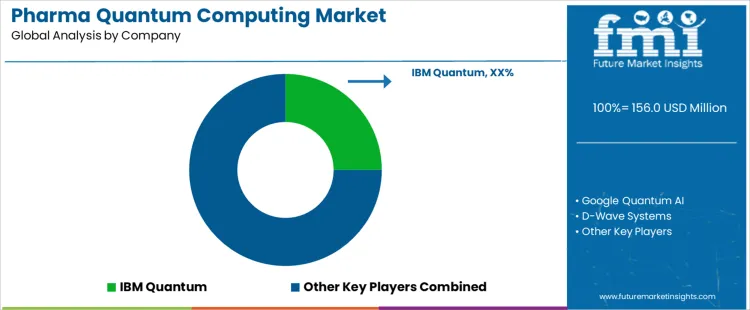
Global demand for quantum computing in the pharmaceutical industry is growing as companies seek to solve complex problems that classical computing struggles with. Drug discovery, molecular simulation, protein folding, optimisation of chemical reactions and predictive modelling are areas where quantum computing promises to shorten development timelines and reduce costly experimental cycles. Rising R&D costs in pharma, pressure to innovate faster and advances in quantum hardware and algorithms are driving interest from large drug makers, contract research organisations and computational chemistry teams. Regions with strong life science clusters, including North America, Europe and Asia Pacific, are investing in pilot projects and collaborations that test quantum advantage in real world drug research. Adoption remains early stage, but increasing partnerships between quantum providers and pharma leaders point to sustained growth in use cases that combine quantum processing with classical high performance computing and AI.
IBM Quantum is recognised as a leading player with a robust ecosystem of hardware, software tools, developer support and industry partnerships that facilitate experimentation and development for pharmaceutical applications. Other competitors include Google Quantum AI, which focuses on scalable quantum processors and software frameworks, and D Wave Systems, offering quantum annealing systems that target optimisation problems relevant to drug design and logistics. IonQ and Rigetti contribute additional approaches with trapped ion and superconducting qubit architectures, respectively, expanding the range of available technologies. Competition among these companies centres on qubit quality, error rates, coherence times, access to cloud based platforms, developer tools and the ability to demonstrate value in real pharma workflows. Providers that combine strong quantum performance with practical integration to existing computational pipelines and support for domain specific applications are best positioned to capture growth as pharma shifts toward advanced computing paradigms.
Key Players of the Pharma Quantum Computing Market
- IBM Quantum
- Google Quantum AI
- D-Wave Systems
- IonQ
- Rigetti
Scope of the Report
| Items | Values |
|---|---|
| Quantitative Units (2026) | USD Million |
| Quantum Hardware Services | Quantum Software/Algorithms, QaaS, Consulting |
| Application | Drug Discovery Simulations, R&D Optimization, Supply Chain |
| End User | Cloud QaaS, Pharma Partnerships, On-Prem |
| Companies | IBM Quantum, Google Quantum AI, D-Wave Systems, IonQ, Rigetti |
| Regions Covered | North America, Latin America, Western Europe, Eastern Europe, South Asia and Pacific, East Asia, Middle East & Africa |
| Countries Covered | United States, Canada, Mexico, Brazil, Argentina, Germany, France, United Kingdom, Italy, Spain, Netherlands, China, India, Japan, South Korea, ANZ, GCC Countries, South Africa |
| Additional Attributes | Dollar by sales by quantum hardware service, application, end-user, and region. Includes market trends in quantum computing services for pharma, performance in drug discovery simulations, R&D optimization, and supply chain, cost-effectiveness, sustainability practices, regulatory compliance, market share and competitive positioning of key companies, and the role of quantum computing in transforming pharma research, improving drug development processes, and optimizing supply chain management in the pharmaceutical industry. |
Pharma Quantum Computing Market Segmentation
Quantum Hardware Services
- Quantum software/algorithms
- QaaS
- Consulting
Application
- Drug discovery sims
- R&D optimization
- Supply chain
End User
- Cloud QaaS
- Pharma partnerships
- On-prem
Region
- Asia Pacific
- China
- Japan
- South Korea
- India
- Australia & New Zealand
- ASEAN
- Rest of Asia Pacific
- Europe
- Germany
- United Kingdom
- France
- Italy
- Spain
- Nordic
- BENELUX
- Rest of Europe
- North America
- United States
- Canada
- Mexico
- Latin America
- Brazil
- Chile
- Rest of Latin America
- Middle East & Africa
- Kingdom of Saudi Arabia
- Other GCC Countries
- Turkey
- South Africa
- Other African Union
- Rest of Middle East & Africa
Bibliography
- National Institute of Standards and Technology. (2023). Quantum information science frameworks and computational standards. NIST Technical Publications.
- National Academies of Sciences Engineering and Medicine. (2023). Applications of quantum computing in chemistry and drug discovery. National Academies Reports.
- European Medicines Agency. (2023). Emerging digital technologies and advanced modelling in pharmaceutical development. EMA Scientific and Regulatory Publications.
Frequently Asked Questions
How big is the pharma quantum computing market in 2026?
The global pharma quantum computing market is estimated to be valued at USD 156.0 million in 2026.
What will be the size of pharma quantum computing market in 2036?
The market size for the pharma quantum computing market is projected to reach USD 2,150.6 million by 2036.
How much will be the pharma quantum computing market growth between 2026 and 2036?
The pharma quantum computing market is expected to grow at a 30.0% CAGR between 2026 and 2036.
What are the key product types in the pharma quantum computing market?
The key product types in pharma quantum computing market are quantum software/algorithms, qaas and consulting.
Which application segment to contribute significant share in the pharma quantum computing market in 2026?
In terms of application, drug discovery sims segment to command 60.0% share in the pharma quantum computing market in 2026.
Preview the report firsthand - request a free sample
Get SampleGet the brochure for pricing and purchase details.
Get PDFTable of Content
- Executive Summary
- Global Market Outlook
- Demand-side Trends
- Supply-side Trends
- Technology Roadmap Analysis
- Analysis and Recommendations
- Market Overview
- Market Coverage / Taxonomy
- Market Definition / Scope / Limitations
- Market Background
- Market Dynamics
- Drivers
- Restraints
- Opportunity
- Trends
- Scenario Forecast
- Demand in Optimistic Scenario
- Demand in Likely Scenario
- Demand in Conservative Scenario
- Opportunity Map Analysis
- Product Life Cycle Analysis
- Supply Chain Analysis
- Investment Feasibility Matrix
- Value Chain Analysis
- PESTLE and Porter’s Analysis
- Regulatory Landscape
- Regional Parent Market Outlook
- Production and Consumption Statistics
- Import and Export Statistics
- Market Dynamics
- Global Market Analysis 2021 to 2025 and Forecast, 2026 to 2036
- Historical Market Size Value (USD Million) Analysis, 2021 to 2025
- Current and Future Market Size Value (USD Million) Projections, 2026 to 2036
- Y-o-Y Growth Trend Analysis
- Absolute $ Opportunity Analysis
- Global Market Pricing Analysis 2021 to 2025 and Forecast 2026 to 2036
- Global Market Analysis 2021 to 2025 and Forecast 2026 to 2036, By Quantum Hardware Services
- Introduction / Key Findings
- Historical Market Size Value (USD Million) Analysis By Quantum Hardware Services , 2021 to 2025
- Current and Future Market Size Value (USD Million) Analysis and Forecast By Quantum Hardware Services , 2026 to 2036
- Quantum software/algorithms
- QaaS
- Consulting
- Y-o-Y Growth Trend Analysis By Quantum Hardware Services , 2021 to 2025
- Absolute $ Opportunity Analysis By Quantum Hardware Services , 2026 to 2036
- Global Market Analysis 2021 to 2025 and Forecast 2026 to 2036, By Application
- Introduction / Key Findings
- Historical Market Size Value (USD Million) Analysis By Application, 2021 to 2025
- Current and Future Market Size Value (USD Million) Analysis and Forecast By Application, 2026 to 2036
- Drug discovery sims
- R&D optimization
- Supply chain
- Y-o-Y Growth Trend Analysis By Application, 2021 to 2025
- Absolute $ Opportunity Analysis By Application, 2026 to 2036
- Global Market Analysis 2021 to 2025 and Forecast 2026 to 2036, By End User
- Introduction / Key Findings
- Historical Market Size Value (USD Million) Analysis By End User, 2021 to 2025
- Current and Future Market Size Value (USD Million) Analysis and Forecast By End User, 2026 to 2036
- Cloud QaaS
- Pharma partnerships
- On-prem
- Y-o-Y Growth Trend Analysis By End User, 2021 to 2025
- Absolute $ Opportunity Analysis By End User, 2026 to 2036
- Global Market Analysis 2021 to 2025 and Forecast 2026 to 2036, By Region
- Introduction
- Historical Market Size Value (USD Million) Analysis By Region, 2021 to 2025
- Current Market Size Value (USD Million) Analysis and Forecast By Region, 2026 to 2036
- North America
- Latin America
- Western Europe
- Eastern Europe
- East Asia
- South Asia and Pacific
- Middle East & Africa
- Market Attractiveness Analysis By Region
- North America Market Analysis 2021 to 2025 and Forecast 2026 to 2036, By Country
- Historical Market Size Value (USD Million) Trend Analysis By Market Taxonomy, 2021 to 2025
- Market Size Value (USD Million) Forecast By Market Taxonomy, 2026 to 2036
- By Country
- USA
- Canada
- Mexico
- By Quantum Hardware Services
- By Application
- By End User
- By Country
- Market Attractiveness Analysis
- By Country
- By Quantum Hardware Services
- By Application
- By End User
- Key Takeaways
- Latin America Market Analysis 2021 to 2025 and Forecast 2026 to 2036, By Country
- Historical Market Size Value (USD Million) Trend Analysis By Market Taxonomy, 2021 to 2025
- Market Size Value (USD Million) Forecast By Market Taxonomy, 2026 to 2036
- By Country
- Brazil
- Chile
- Rest of Latin America
- By Quantum Hardware Services
- By Application
- By End User
- By Country
- Market Attractiveness Analysis
- By Country
- By Quantum Hardware Services
- By Application
- By End User
- Key Takeaways
- Western Europe Market Analysis 2021 to 2025 and Forecast 2026 to 2036, By Country
- Historical Market Size Value (USD Million) Trend Analysis By Market Taxonomy, 2021 to 2025
- Market Size Value (USD Million) Forecast By Market Taxonomy, 2026 to 2036
- By Country
- Germany
- UK
- Italy
- Spain
- France
- Nordic
- BENELUX
- Rest of Western Europe
- By Quantum Hardware Services
- By Application
- By End User
- By Country
- Market Attractiveness Analysis
- By Country
- By Quantum Hardware Services
- By Application
- By End User
- Key Takeaways
- Eastern Europe Market Analysis 2021 to 2025 and Forecast 2026 to 2036, By Country
- Historical Market Size Value (USD Million) Trend Analysis By Market Taxonomy, 2021 to 2025
- Market Size Value (USD Million) Forecast By Market Taxonomy, 2026 to 2036
- By Country
- Russia
- Poland
- Hungary
- Balkan & Baltic
- Rest of Eastern Europe
- By Quantum Hardware Services
- By Application
- By End User
- By Country
- Market Attractiveness Analysis
- By Country
- By Quantum Hardware Services
- By Application
- By End User
- Key Takeaways
- East Asia Market Analysis 2021 to 2025 and Forecast 2026 to 2036, By Country
- Historical Market Size Value (USD Million) Trend Analysis By Market Taxonomy, 2021 to 2025
- Market Size Value (USD Million) Forecast By Market Taxonomy, 2026 to 2036
- By Country
- China
- Japan
- South Korea
- By Quantum Hardware Services
- By Application
- By End User
- By Country
- Market Attractiveness Analysis
- By Country
- By Quantum Hardware Services
- By Application
- By End User
- Key Takeaways
- South Asia and Pacific Market Analysis 2021 to 2025 and Forecast 2026 to 2036, By Country
- Historical Market Size Value (USD Million) Trend Analysis By Market Taxonomy, 2021 to 2025
- Market Size Value (USD Million) Forecast By Market Taxonomy, 2026 to 2036
- By Country
- India
- ASEAN
- Australia & New Zealand
- Rest of South Asia and Pacific
- By Quantum Hardware Services
- By Application
- By End User
- By Country
- Market Attractiveness Analysis
- By Country
- By Quantum Hardware Services
- By Application
- By End User
- Key Takeaways
- Middle East & Africa Market Analysis 2021 to 2025 and Forecast 2026 to 2036, By Country
- Historical Market Size Value (USD Million) Trend Analysis By Market Taxonomy, 2021 to 2025
- Market Size Value (USD Million) Forecast By Market Taxonomy, 2026 to 2036
- By Country
- Kingdom of Saudi Arabia
- Other GCC Countries
- Turkiye
- South Africa
- Other African Union
- Rest of Middle East & Africa
- By Quantum Hardware Services
- By Application
- By End User
- By Country
- Market Attractiveness Analysis
- By Country
- By Quantum Hardware Services
- By Application
- By End User
- Key Takeaways
- Key Countries Market Analysis
- USA
- Pricing Analysis
- Market Share Analysis, 2025
- By Quantum Hardware Services
- By Application
- By End User
- Canada
- Pricing Analysis
- Market Share Analysis, 2025
- By Quantum Hardware Services
- By Application
- By End User
- Mexico
- Pricing Analysis
- Market Share Analysis, 2025
- By Quantum Hardware Services
- By Application
- By End User
- Brazil
- Pricing Analysis
- Market Share Analysis, 2025
- By Quantum Hardware Services
- By Application
- By End User
- Chile
- Pricing Analysis
- Market Share Analysis, 2025
- By Quantum Hardware Services
- By Application
- By End User
- Germany
- Pricing Analysis
- Market Share Analysis, 2025
- By Quantum Hardware Services
- By Application
- By End User
- UK
- Pricing Analysis
- Market Share Analysis, 2025
- By Quantum Hardware Services
- By Application
- By End User
- Italy
- Pricing Analysis
- Market Share Analysis, 2025
- By Quantum Hardware Services
- By Application
- By End User
- Spain
- Pricing Analysis
- Market Share Analysis, 2025
- By Quantum Hardware Services
- By Application
- By End User
- France
- Pricing Analysis
- Market Share Analysis, 2025
- By Quantum Hardware Services
- By Application
- By End User
- India
- Pricing Analysis
- Market Share Analysis, 2025
- By Quantum Hardware Services
- By Application
- By End User
- ASEAN
- Pricing Analysis
- Market Share Analysis, 2025
- By Quantum Hardware Services
- By Application
- By End User
- Australia & New Zealand
- Pricing Analysis
- Market Share Analysis, 2025
- By Quantum Hardware Services
- By Application
- By End User
- China
- Pricing Analysis
- Market Share Analysis, 2025
- By Quantum Hardware Services
- By Application
- By End User
- Japan
- Pricing Analysis
- Market Share Analysis, 2025
- By Quantum Hardware Services
- By Application
- By End User
- South Korea
- Pricing Analysis
- Market Share Analysis, 2025
- By Quantum Hardware Services
- By Application
- By End User
- Russia
- Pricing Analysis
- Market Share Analysis, 2025
- By Quantum Hardware Services
- By Application
- By End User
- Poland
- Pricing Analysis
- Market Share Analysis, 2025
- By Quantum Hardware Services
- By Application
- By End User
- Hungary
- Pricing Analysis
- Market Share Analysis, 2025
- By Quantum Hardware Services
- By Application
- By End User
- Kingdom of Saudi Arabia
- Pricing Analysis
- Market Share Analysis, 2025
- By Quantum Hardware Services
- By Application
- By End User
- Turkiye
- Pricing Analysis
- Market Share Analysis, 2025
- By Quantum Hardware Services
- By Application
- By End User
- South Africa
- Pricing Analysis
- Market Share Analysis, 2025
- By Quantum Hardware Services
- By Application
- By End User
- USA
- Market Structure Analysis
- Competition Dashboard
- Competition Benchmarking
- Market Share Analysis of Top Players
- By Regional
- By Quantum Hardware Services
- By Application
- By End User
- Competition Analysis
- Competition Deep Dive
- IBM Quantum
- Overview
- Product Portfolio
- Profitability by Market Segments (Product/Age /Sales Channel/Region)
- Sales Footprint
- Strategy Overview
- Marketing Strategy
- Product Strategy
- Channel Strategy
- Google Quantum AI
- D-Wave Systems
- IonQ
- Rigetti
- Others
- IBM Quantum
- Competition Deep Dive
- Assumptions & Acronyms Used
- Research Methodology


