

- Industry Size (2026)
- USD 102.8 Mn
- Forecast (2036)
- USD 349.0 Mn
- CAGR (2026 to 2036)
- 13.00%
Quantum Computing Advanced Packaging Market Forecast and Outlook 2026 to 2036
The quantum computing advanced packaging market is set to reach USD 102.8 million in 2026 and is projected to reach USD 349.0 million by 2036, growing at a CAGR of 13.00% over the forecast period. Global demand remains highly concentrated in a small number of regions where quantum hardware development, public funding, and advanced semiconductor ecosystems intersect. North America and parts of Europe account for a disproportionate share of spending due to dense clusters of research labs, startups, and government-backed quantum programs. Adoption patterns are uneven, with packaging demand accelerating fastest in regions capable of supporting cryogenic testing, precision manufacturing, and rapid iteration.
Geographic cost advantages play a meaningful role, as East Asian markets benefit from mature advanced packaging infrastructure and lower per-unit processing costs, supporting pilot-scale production. Meanwhile, European demand is shaped by publicly funded research initiatives that favor high-specification, lower-volume solutions. This regional imbalance is expected to persist as quantum development remains capital intensive and closely tied to localized expertise, infrastructure depth, and long-term research investment commitments.
Quick Stats for Quantum Computing Advanced Packaging Market
- Quantum Computing Advanced Packaging Market Value (2026): USD 102.8 Million
- Quantum Computing Advanced Packaging Market Forecast Value (2036): USD 349.0 Million
- Quantum Computing Advanced Packaging Market Forecast CAGR 2026 to 2036: 13.00%
- Leading Qubit Type in Quantum Computing Advanced Packaging Market: Superconducting Qubits
- Leading Customer Type in Quantum Computing Advanced Packaging Market: Research Labs
- Key Growth Regions in Quantum Computing Advanced Packaging Market: North America, Europe, Asia Pacific
- Top Key Players in Quantum Computing Advanced Packaging Market: ASE Technology, Amkor Technology, Intel Foundry Services, TSMC, Samsung Electronics, JCET Group
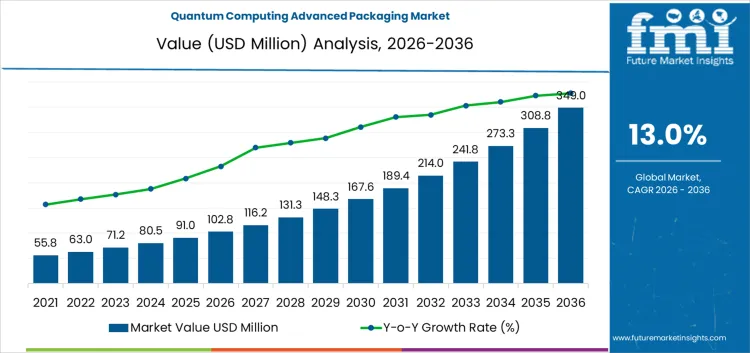
Quantum Computing Advanced Packaging Market Key Takeaways
| Metric | Value |
|---|---|
| Industry Value (2026) | USD 102.8 Million |
| Forecast Value (2036) | USD 349.0 Million |
| Forecast CAGR 2026 to 2036 | 13.00% |
How Is the Global Quantum Computing Advanced Packaging Market Advancing?
The global quantum computing advanced packaging market is advancing steadily, driven by increasing investment in quantum hardware development and the need for highly specialized packaging solutions to support fragile quantum processors. Advanced packaging plays a critical role in enabling stable qubit performance by addressing challenges related to thermal management, signal integrity, and interconnect density in quantum computing systems.
A key driver supporting market growth is the transition from laboratory-scale quantum prototypes to more scalable and integrated quantum processors. As qubit counts increase, advanced packaging technologies such as flip-chip bonding, interposers, and multi-chip module architectures are increasingly required to support high-density interconnections and precise signal routing. These solutions help maintain qubit coherence while enabling integration with control electronics and cryogenic systems.
Ongoing advancements in materials engineering and packaging processes are further strengthening market adoption. Innovations in low-loss substrates, superconducting interconnects, and cryo-compatible packaging materials are improving reliability and performance at ultra-low operating temperatures. As quantum computing platforms move toward higher qubit densities and commercial deployment, the advanced packaging market supporting quantum hardware is expected to experience strong growth over the forecast period.
What Is the Segment-Wise Overview of the Quantum Computing Advanced Packaging Market?
The quantum computing advanced packaging market is primarily shaped by dominant qubit technologies and research-driven customer demand. Superconducting qubits lead with a 41% share, as they require advanced packaging solutions capable of supporting cryogenic environments, precise signal routing, and thermal stability. These requirements are driving adoption of high-density interconnects, specialized substrates, and cryo-compatible materials. On the customer side, research labs account for 48% of total demand, reflecting their central role in quantum hardware development and system validation. Research institutions prioritize flexible and high-precision packaging to support rapid prototyping and iterative experimentation
Why Do Superconducting Qubits Lead the Quantum Computing Advanced Packaging Market?

Superconducting qubits account for 41% of the qubit type segment in the Quantum Computing Advanced Packaging Market due to their relative technological maturity and scalability advantages. These qubits require highly specialized packaging solutions that support cryogenic operation, ultra-low signal loss, and precise interconnect alignment. Advanced packaging plays a critical role in maintaining qubit coherence by enabling effective thermal management, electromagnetic shielding, and high-density signal routing. Superconducting architectures are widely adopted by major quantum developers because they integrate more readily with existing semiconductor fabrication and packaging processes. As system complexity increases, demand for multi-chip modules, advanced substrates, and cryo-compatible materials continues to grow, reinforcing the dominance of superconducting qubits in advanced quantum packaging development.
Why Do Research Labs Dominate Demand in the Quantum Computing Advanced Packaging Market?

Research labs represent 48% of customer demand, making them the largest end-user segment in the Quantum Computing Advanced Packaging Market. Academic institutions and national research laboratories are at the forefront of quantum hardware experimentation, requiring flexible and high-precision packaging solutions to support rapid prototyping and iterative design cycles. These organizations focus heavily on testing qubit stability, scaling architectures, and improving system reliability, which places strong emphasis on advanced interconnects, thermal control, and signal integrity. Research labs also drive early adoption of novel packaging materials and architectures before commercial deployment. Continuous public and institutional funding for quantum research sustains high procurement activity, positioning research labs as the primary demand drivers for advanced quantum packaging solutions.
What Are the Key Dynamics for the Quantum Computing Advanced Packaging Market?
The quantum computing advanced packaging market is driven by the need to enhance performance, connectivity, and scalability of quantum computing systems. Advanced packaging technologies are essential for integrating quantum processors with control electronics, facilitating qubit interconnection, improving thermal management, and minimizing signal loss. Key market dynamics include rising investment in quantum research and development, increasing collaborations between technology developers and packaging specialists, and growing focus on improving qubit coherence and stability. As quantum computing transitions from experimental to early commercial deployment, the demand for sophisticated packaging solutions that can meet rigorous performance and reliability requirements continues to rise.
Why Is the Quantum Computing Advanced Packaging Market Growing?
The market is expanding as governments, research institutions, and enterprises increase funding and strategic initiatives to accelerate quantum computing innovation. Advanced packaging enables higher qubit densities and improved integration with conventional semiconductor technologies, which are critical for moving toward fault-tolerant and scalable quantum systems. Progress in heterogeneous integration, cryogenic packaging, and 3D interconnects has boosted the feasibility of larger, more complex quantum processors. Partnerships between industry players and the development of standardized packaging solutions are reducing development cycles and fostering broader adoption across computing, cryptography, materials science, and pharmaceutical research applications.
How Are the Key Drivers Shaping the Quantum Computing Advanced Packaging Market?
Key drivers shaping the market include the push for higher qubit counts and system reliability that advanced packaging directly supports by enabling efficient qubit communication and suppression of environmental interference. Advances in materials science, such as superconducting wiring and novel thermal interface materials, are improving performance outcomes. The increasing convergence of classical and quantum computing architectures is also driving demand for packaging solutions that bridge disparate technologies. Furthermore, ecosystem development through joint ventures and consortiums is accelerating innovation and deployment of advanced packaging for quantum systems, enabling more compact and energy-efficient designs.
Country
| Country | CAGR (%) |
|---|---|
| USA | 13.0% |
| Netherlands | 12.5% |
| Germany | 12.0% |
| Japan | 11.5% |
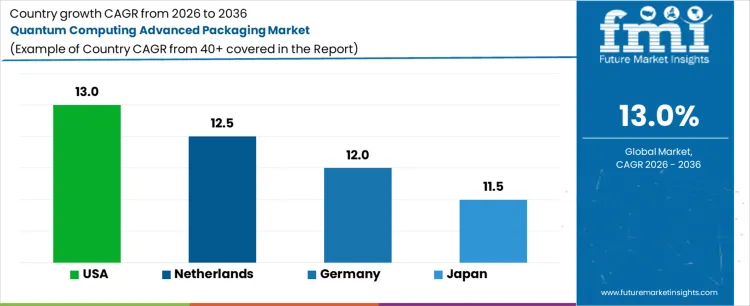
The quantum computing advanced packaging market is expanding as hardware developers focus on scaling and stabilizing quantum systems. The USA leads with a 13.0% CAGR, supported by strong investment, government funding, and a large quantum research ecosystem. The Netherlands follows at 12.5%, benefiting from advanced semiconductor equipment capabilities and strong research collaboration. Germany grows at 12.0%, driven by industrial research strength and European quantum initiatives. Japan expands at 11.5%, supported by precision manufacturing expertise and advanced materials development. As quantum computing moves closer to commercialization, advanced packaging will remain a critical enabler across all major regions.
What Is Driving the Growth of the Quantum Computing Advanced Packaging Market in the USA?
The quantum computing advanced packaging market in the USA is growing at a CAGR of 13.0%, driven by strong investment in quantum computing research and commercialization efforts. The USA hosts a large concentration of quantum hardware developers, national laboratories, and technology companies focused on scaling quantum processors. Advanced packaging plays a critical role in integrating qubits, cryogenic control electronics, interposers, and high-density interconnects required for stable quantum operations. Increasing focus on error reduction, thermal management, and signal integrity is accelerating demand for advanced packaging techniques such as 3D integration, chiplets, and wafer-level packaging. Government funding programs and defense-backed research initiatives are further strengthening domestic quantum infrastructure. Collaboration between semiconductor foundries, packaging specialists, and quantum startups is also improving manufacturability. As quantum systems move from laboratory prototypes toward scalable platforms, demand for advanced packaging solutions in the USA is expected to rise steadily.
How Is the Quantum Computing Advanced Packaging Market Expanding in the Netherlands?
The quantum computing advanced packaging market in the Netherlands is expanding at a CAGR of 12.5%, supported by the country’s strong position in semiconductor equipment, research institutions, and quantum technology ecosystems. The Netherlands is home to advanced research centers and technology companies working on quantum processors and enabling hardware. Advanced packaging is increasingly required to support precise interconnects, low-temperature performance, and high signal fidelity in quantum systems. The presence of leading semiconductor equipment suppliers and packaging innovation hubs strengthens local capabilities in wafer-level and heterogeneous integration. Government-backed quantum initiatives and public-private research collaborations are accelerating development of scalable quantum architectures. Close ties with European semiconductor and research networks support cross-border technology transfer. As quantum hardware development advances, demand for specialized advanced packaging solutions in the Netherlands is expected to grow consistently.
What Is Supporting Growth of the Quantum Computing Advanced Packaging Market in Germany?
The quantum computing advanced packaging market in Germany is growing at a CAGR of 12.0%, driven by strong industrial research capabilities and increasing focus on quantum technologies within Europe. Germany’s strengths in precision engineering, materials science, and advanced manufacturing support development of sophisticated packaging solutions for quantum hardware. Advanced packaging is essential for managing cryogenic environments, minimizing signal loss, and enabling scalable qubit architectures. Government-funded quantum research programs and collaboration between research institutes, universities, and industrial players are accelerating innovation. German semiconductor and electronics firms are also investing in advanced interconnect technologies and system-level integration. Emphasis on reliability, standardization, and manufacturability further supports adoption of advanced packaging approaches. As Germany continues to expand its quantum research and pilot production activities, demand for advanced packaging solutions is expected to grow steadily.
How Is the Quantum Computing Advanced Packaging Market Developing in Japan?
The quantum computing advanced packaging market in Japan is expanding at a CAGR of 11.5%, supported by strong expertise in semiconductor materials, precision manufacturing, and electronics packaging. Japanese companies and research institutions are actively developing quantum processors and supporting hardware, increasing demand for advanced packaging capable of high-density integration and ultra-low-temperature operation. Packaging solutions that ensure signal stability, thermal control, and long-term reliability are particularly important for Japan’s quality-focused manufacturing environment. Government initiatives promoting next-generation computing technologies are strengthening domestic quantum research and development. In addition, Japan’s established semiconductor supply chain supports innovation in substrates, interposers, and advanced bonding techniques. Collaboration between academia and industry is further improving packaging performance and scalability. As quantum computing efforts progress toward practical applications, demand for advanced packaging solutions in Japan is expected to increase steadily.
How Are Companies Competing in the Quantum Computing Advanced Packaging Market?
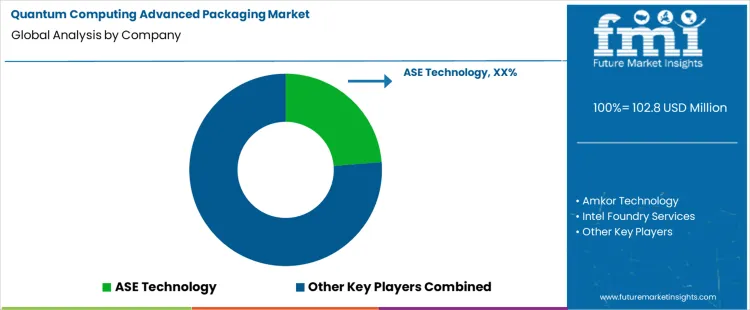
Competition in the quantum computing advanced packaging market is driven by the need to support ultra-low temperatures, signal integrity at cryogenic conditions, heterogeneous integration, and precise interconnect reliability. Quantum processors place extreme demands on packaging due to sensitivity to thermal noise, electromagnetic interference, and mechanical stress. As a result, companies differentiate through advanced 2.5D/3D packaging, wafer-level fan-out, interposer technologies, and materials engineering that enable dense interconnects while maintaining coherence and minimizing signal loss. Scalability from research-scale systems to early commercial quantum platforms is becoming a critical competitive factor.
ASE Technology, Amkor Technology, and JCET Group compete as leading OSAT providers by advancing high-density packaging platforms tailored for quantum and cryogenic applications. ASE focuses on heterogeneous integration, advanced fan-out, and system-in-package (SiP) solutions that allow close coupling of quantum processors, control chips, and interconnect layers. Amkor differentiates through precision flip-chip, advanced substrate technologies, and co-design support with quantum hardware developers. JCET leverages large-scale manufacturing expertise and cost-efficient advanced packaging capabilities, positioning itself for pilot-to-volume transitions as quantum systems move beyond laboratory environments.
Intel Foundry Services, TSMC, and Samsung Electronics compete through deep integration between process technology and advanced packaging. Intel emphasizes co-optimization of silicon process nodes with advanced packaging architectures such as EMIB and Foveros to support quantum-classical integration. TSMC competes through its advanced CoWoS and SoIC platforms, enabling high-density interconnects and thermal management solutions suited to quantum workloads. Samsung Electronics leverages its expertise in 3D integration, advanced substrates, and materials engineering to support complex quantum chip assemblies. Across the market, competitive advantage is defined by packaging precision, cryogenic compatibility, integration density, and the ability to scale advanced packaging solutions as quantum computing progresses toward commercialization.
Key Players in Quantum Computing Advanced Packaging Market
- ASE Technology
- Amkor Technology
- Intel Foundry Services
- TSMC
- Samsung Electronics
- JCET Group
Scope of Report
| Attributes | Description |
|---|---|
| Quantitative Unit (2026) | USD Million |
| Qubit Type | Superconducting, Trapped Ion, Photonic, Neutral Atom, Topological |
| Customer Type | Research Labs, Tech Companies, Government Programs |
| Regions Covered | Asia Pacific, Europe, North America, Latin America, Middle East & Africa |
| Countries Covered | China, Japan, South Korea, India, Australia & New Zealand, ASEAN, Rest of Asia Pacific, Germany, United Kingdom, France, Italy, Spain, Nordic, BENELUX, Rest of Europe, United States, Canada, Mexico, Brazil, Chile, Rest of Latin America, Kingdom of Saudi Arabia, Other GCC Countries, Turkey, South Africa, Other African Union, Rest of Middle East & Africa |
| Key Companies Profiled | ASE Technology, Amkor Technology, Intel Foundry Services, TSMC, Samsung Electronics, JCET Group |
| Additional Attributes | Dollar sales by qubit type and customer type; regional market size and forecast analysis; growth outlook across major regions; adoption trends in advanced packaging solutions for quantum processors; assessment of integration complexity, thermal management requirements, and demand patterns across research, commercial, and government-led quantum computing initiatives. |
Quantum Computing Advanced Packaging Market by Key Segments
Qubit Type
- Superconducting
- Trapped ion
- Photonic
- Neutral atom
- Topological
Customer Type
- Research labs
- Tech companies
- Government programs
Region
- Asia Pacific
- China
- Japan
- South Korea
- India
- Australia & New Zealand
- ASEAN
- Rest of Asia Pacific
- Europe
- Germany
- United Kingdom
- France
- Italy
- Spain
- Nordic
- BENELUX
- Rest of Europe
- North America
- United States
- Canada
- Mexico
- Latin America
- Brazil
- Chile
- Rest of Latin America
- Middle East & Africa
- Kingdom of Saudi Arabia
- Other GCC Countries
- Turkey
- South Africa
- Other African Union
- Rest of Middle East & Africa
Bibliography
- IEEE Standards Association. (2024). IEEE P3120 – Standard for Cryogenic Electronics and Packaging for Quantum Computing Systems. IEEE Publications.
- U.S. Department of Energy (DOE). (2024). Quantum Information Science and Technology Research Centers: Hardware and Packaging Advances 2024 Report. DOE Office of Science.
- European Commission. (2024). Quantum Flagship Annual Report: Advanced Integration and Packaging for Quantum Processors. DG CONNECT.
- National Institute of Standards and Technology (NIST). (2023). Measurement Science for Quantum Computing: Materials, Packaging, and Cryogenic Systems. U.S. Department of Commerce.
- Organisation for Economic Co-operation and Development (OECD). (2023). Emerging Technologies and Semiconductor Ecosystems: Quantum Hardware and Advanced Packaging Trends. OECD Science, Technology and Innovation Directorate.
Frequently Asked Questions
How big is the quantum computing advanced packaging market in 2026?
The global quantum computing advanced packaging market is estimated to be valued at USD 102.8 million in 2026.
What will be the size of quantum computing advanced packaging market in 2036?
The market size for the quantum computing advanced packaging market is projected to reach USD 349.0 million by 2036.
How much will be the quantum computing advanced packaging market growth between 2026 and 2036?
The quantum computing advanced packaging market is expected to grow at a 13.0% CAGR between 2026 and 2036.
What are the key product types in the quantum computing advanced packaging market?
The key product types in quantum computing advanced packaging market are superconducting, trapped ion, photonic, neutral atom and topological.
Which customer type segment to contribute significant share in the quantum computing advanced packaging market in 2026?
In terms of customer type, research labs segment to command 48.0% share in the quantum computing advanced packaging market in 2026.
Preview the report firsthand - request a free sample
Get SampleGet the brochure for pricing and purchase details.
Get PDFTable of Content
- Executive Summary
- Global Market Outlook
- Demand-side Trends
- Supply-side Trends
- Technology Roadmap Analysis
- Analysis and Recommendations
- Market Overview
- Market Coverage / Taxonomy
- Market Definition / Scope / Limitations
- Market Background
- Market Dynamics
- Drivers
- Restraints
- Opportunity
- Trends
- Scenario Forecast
- Demand in Optimistic Scenario
- Demand in Likely Scenario
- Demand in Conservative Scenario
- Opportunity Map Analysis
- Product Life Cycle Analysis
- Supply Chain Analysis
- Investment Feasibility Matrix
- Value Chain Analysis
- PESTLE and Porter’s Analysis
- Regulatory Landscape
- Regional Parent Market Outlook
- Production and Consumption Statistics
- Import and Export Statistics
- Market Dynamics
- Global Market Analysis 2021 to 2025 and Forecast, 2026 to 2036
- Historical Market Size Value (USD Million) Analysis, 2021 to 2025
- Current and Future Market Size Value (USD Million) Projections, 2026 to 2036
- Y-o-Y Growth Trend Analysis
- Absolute $ Opportunity Analysis
- Global Market Pricing Analysis 2021 to 2025 and Forecast 2026 to 2036
- Global Market Analysis 2021 to 2025 and Forecast 2026 to 2036, By Qubit Type
- Introduction / Key Findings
- Historical Market Size Value (USD Million) Analysis By Qubit Type , 2021 to 2025
- Current and Future Market Size Value (USD Million) Analysis and Forecast By Qubit Type , 2026 to 2036
- Superconducting
- Trapped ion
- Photonic
- Neutral atom
- Topological
- Superconducting
- Y-o-Y Growth Trend Analysis By Qubit Type , 2021 to 2025
- Absolute $ Opportunity Analysis By Qubit Type , 2026 to 2036
- Global Market Analysis 2021 to 2025 and Forecast 2026 to 2036, By Customer Type
- Introduction / Key Findings
- Historical Market Size Value (USD Million) Analysis By Customer Type, 2021 to 2025
- Current and Future Market Size Value (USD Million) Analysis and Forecast By Customer Type, 2026 to 2036
- Research labs
- Tech companies
- Government programs
- Research labs
- Y-o-Y Growth Trend Analysis By Customer Type, 2021 to 2025
- Absolute $ Opportunity Analysis By Customer Type, 2026 to 2036
- Global Market Analysis 2021 to 2025 and Forecast 2026 to 2036, By Region
- Introduction
- Historical Market Size Value (USD Million) Analysis By Region, 2021 to 2025
- Current Market Size Value (USD Million) Analysis and Forecast By Region, 2026 to 2036
- North America
- Latin America
- Western Europe
- Eastern Europe
- East Asia
- South Asia and Pacific
- Middle East & Africa
- Market Attractiveness Analysis By Region
- North America Market Analysis 2021 to 2025 and Forecast 2026 to 2036, By Country
- Historical Market Size Value (USD Million) Trend Analysis By Market Taxonomy, 2021 to 2025
- Market Size Value (USD Million) Forecast By Market Taxonomy, 2026 to 2036
- By Country
- USA
- Canada
- Mexico
- By Qubit Type
- By Customer Type
- By Country
- Market Attractiveness Analysis
- By Country
- By Qubit Type
- By Customer Type
- Key Takeaways
- Latin America Market Analysis 2021 to 2025 and Forecast 2026 to 2036, By Country
- Historical Market Size Value (USD Million) Trend Analysis By Market Taxonomy, 2021 to 2025
- Market Size Value (USD Million) Forecast By Market Taxonomy, 2026 to 2036
- By Country
- Brazil
- Chile
- Rest of Latin America
- By Qubit Type
- By Customer Type
- By Country
- Market Attractiveness Analysis
- By Country
- By Qubit Type
- By Customer Type
- Key Takeaways
- Western Europe Market Analysis 2021 to 2025 and Forecast 2026 to 2036, By Country
- Historical Market Size Value (USD Million) Trend Analysis By Market Taxonomy, 2021 to 2025
- Market Size Value (USD Million) Forecast By Market Taxonomy, 2026 to 2036
- By Country
- Germany
- UK
- Italy
- Spain
- France
- Nordic
- BENELUX
- Rest of Western Europe
- By Qubit Type
- By Customer Type
- By Country
- Market Attractiveness Analysis
- By Country
- By Qubit Type
- By Customer Type
- Key Takeaways
- Eastern Europe Market Analysis 2021 to 2025 and Forecast 2026 to 2036, By Country
- Historical Market Size Value (USD Million) Trend Analysis By Market Taxonomy, 2021 to 2025
- Market Size Value (USD Million) Forecast By Market Taxonomy, 2026 to 2036
- By Country
- Russia
- Poland
- Hungary
- Balkan & Baltic
- Rest of Eastern Europe
- By Qubit Type
- By Customer Type
- By Country
- Market Attractiveness Analysis
- By Country
- By Qubit Type
- By Customer Type
- Key Takeaways
- East Asia Market Analysis 2021 to 2025 and Forecast 2026 to 2036, By Country
- Historical Market Size Value (USD Million) Trend Analysis By Market Taxonomy, 2021 to 2025
- Market Size Value (USD Million) Forecast By Market Taxonomy, 2026 to 2036
- By Country
- China
- Japan
- South Korea
- By Qubit Type
- By Customer Type
- By Country
- Market Attractiveness Analysis
- By Country
- By Qubit Type
- By Customer Type
- Key Takeaways
- South Asia and Pacific Market Analysis 2021 to 2025 and Forecast 2026 to 2036, By Country
- Historical Market Size Value (USD Million) Trend Analysis By Market Taxonomy, 2021 to 2025
- Market Size Value (USD Million) Forecast By Market Taxonomy, 2026 to 2036
- By Country
- India
- ASEAN
- Australia & New Zealand
- Rest of South Asia and Pacific
- By Qubit Type
- By Customer Type
- By Country
- Market Attractiveness Analysis
- By Country
- By Qubit Type
- By Customer Type
- Key Takeaways
- Middle East & Africa Market Analysis 2021 to 2025 and Forecast 2026 to 2036, By Country
- Historical Market Size Value (USD Million) Trend Analysis By Market Taxonomy, 2021 to 2025
- Market Size Value (USD Million) Forecast By Market Taxonomy, 2026 to 2036
- By Country
- Kingdom of Saudi Arabia
- Other GCC Countries
- Turkiye
- South Africa
- Other African Union
- Rest of Middle East & Africa
- By Qubit Type
- By Customer Type
- By Country
- Market Attractiveness Analysis
- By Country
- By Qubit Type
- By Customer Type
- Key Takeaways
- Key Countries Market Analysis
- USA
- Pricing Analysis
- Market Share Analysis, 2025
- By Qubit Type
- By Customer Type
- Canada
- Pricing Analysis
- Market Share Analysis, 2025
- By Qubit Type
- By Customer Type
- Mexico
- Pricing Analysis
- Market Share Analysis, 2025
- By Qubit Type
- By Customer Type
- Brazil
- Pricing Analysis
- Market Share Analysis, 2025
- By Qubit Type
- By Customer Type
- Chile
- Pricing Analysis
- Market Share Analysis, 2025
- By Qubit Type
- By Customer Type
- Germany
- Pricing Analysis
- Market Share Analysis, 2025
- By Qubit Type
- By Customer Type
- UK
- Pricing Analysis
- Market Share Analysis, 2025
- By Qubit Type
- By Customer Type
- Italy
- Pricing Analysis
- Market Share Analysis, 2025
- By Qubit Type
- By Customer Type
- Spain
- Pricing Analysis
- Market Share Analysis, 2025
- By Qubit Type
- By Customer Type
- France
- Pricing Analysis
- Market Share Analysis, 2025
- By Qubit Type
- By Customer Type
- India
- Pricing Analysis
- Market Share Analysis, 2025
- By Qubit Type
- By Customer Type
- ASEAN
- Pricing Analysis
- Market Share Analysis, 2025
- By Qubit Type
- By Customer Type
- Australia & New Zealand
- Pricing Analysis
- Market Share Analysis, 2025
- By Qubit Type
- By Customer Type
- China
- Pricing Analysis
- Market Share Analysis, 2025
- By Qubit Type
- By Customer Type
- Japan
- Pricing Analysis
- Market Share Analysis, 2025
- By Qubit Type
- By Customer Type
- South Korea
- Pricing Analysis
- Market Share Analysis, 2025
- By Qubit Type
- By Customer Type
- Russia
- Pricing Analysis
- Market Share Analysis, 2025
- By Qubit Type
- By Customer Type
- Poland
- Pricing Analysis
- Market Share Analysis, 2025
- By Qubit Type
- By Customer Type
- Hungary
- Pricing Analysis
- Market Share Analysis, 2025
- By Qubit Type
- By Customer Type
- Kingdom of Saudi Arabia
- Pricing Analysis
- Market Share Analysis, 2025
- By Qubit Type
- By Customer Type
- Turkiye
- Pricing Analysis
- Market Share Analysis, 2025
- By Qubit Type
- By Customer Type
- South Africa
- Pricing Analysis
- Market Share Analysis, 2025
- By Qubit Type
- By Customer Type
- USA
- Market Structure Analysis
- Competition Dashboard
- Competition Benchmarking
- Market Share Analysis of Top Players
- By Regional
- By Qubit Type
- By Customer Type
- Competition Analysis
- Competition Deep Dive
- ASE Technology
- Overview
- Product Portfolio
- Profitability by Market Segments (Product/Age /Sales Channel/Region)
- Sales Footprint
- Strategy Overview
- Marketing Strategy
- Product Strategy
- Channel Strategy
- Amkor Technology
- Intel Foundry Services
- TSMC
- Samsung Electronics
- JCET Group
- ASE Technology
- Competition Deep Dive
- Assumptions & Acronyms Used
- Research Methodology


