

- Market Size (2026)
- USD 0.8 Bn
- Forecast (2036)
- USD 1.6 Bn
- CAGR (2026 to 2036)
- 7.4%
Odor-Control Silver and Zinc Ion-Embedded Fiber Market Size, Forecast, and Outlook By FMI
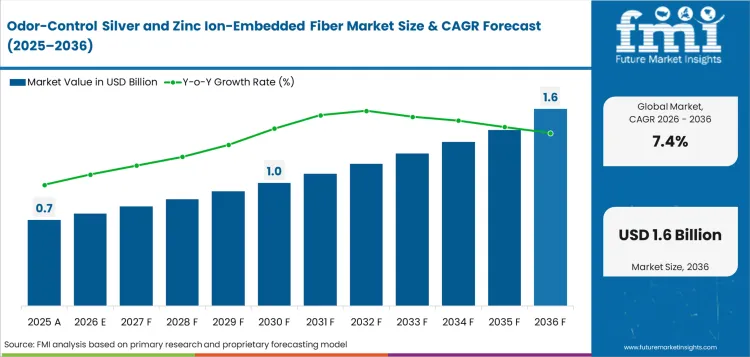
Odor-control silver and zinc ion-embedded fiber value stood at USD 0.7 billion in 2025 and is projected to reach USD 0.8 billion in 2026. Industry revenue is forecast to reach USD 1.6 billion by 2036 at 7.4% CAGR. Direct mill supply is expected to account for 68.0% share of sales channel in 2026. Silver ion fibers are projected to hold 52.0% share of ion system in 2026.
Summary of the Odor-Control Silver and Zinc Ion-Embedded Fiber Market
- Demand and Growth Drivers
- Activewear makers are specifying odor-control fibers as sweat-heavy use makes repeated washing a cost and wear problem.
- Healthcare buyers are reviewing antimicrobial hospital textiles as laundering cycles and linen turnover raise product protection needs.
- Military and uniform users are comparing embedded-ion fibers with topical finishes as field garments need longer freshness between washes.
- Product and Segment View
- Silver ion fibers are forecast to account for 52.0% share in 2026, supported by supplier familiarity and broad activewear adoption.
- Polyester fiber is projected to capture 47.0% share in 2026 as high-volume synthetic fabric programs accept masterbatch integration.
- Masterbatch extrusion is expected to hold 44.0% share in 2026 since embedded additives reduce finish loss during repeated laundering.
- Geography and Competitive Outlook
- China is projected to record 8.8% CAGR by 2036, supported by export-scale synthetic fabric mills and functional apparel production.
- India is expected to expand at 8.4% CAGR by 2036, backed by technical textile policy support and apparel export upgrading.
- Noble Biomaterials and Sciessent shape competition through embedded-ion platforms and textile-grade antimicrobial additives.
- Analyst Opinion
- Nikhil Kaitwade, Principal Consultant for Chemicals and Materials at FMI, observes, “Odor-control fiber buying is moving from freshness claims toward proof of ion placement and wash durability. Brands need clear product-protection wording while mills need additives suited to extrusion and dyeing routes. Suppliers able to support both compliance and fabric performance will control better-margin programs.”
- Odor-Control Silver and Zinc Ion-Embedded Fiber Market Value Analysis
- Value is shifting from finish-only odor control toward embedded-ion fibers with stronger wash-resistance claims.
- Operator spending is tied to ion loading accuracy as mills compare antibacterial persistence and yarn process stability.
- Apparel brands are linking freshness claims with lower wash frequency as fabric odor eliminator positioning becomes harder to prove after purchase.
- Demand is supported by sportswear and healthcare fabrics requiring product-protection claims with clear compliance boundaries.
Key Takeaways, Market Size, and Forecast
- The odor-control silver and zinc ion-embedded fiber industry was valued at USD 0.7 billion in 2025.
- By 2036, odor-control silver and zinc ion-embedded fiber value is expected to reach USD 1.6 billion.
- From 2026 to 2036, sector is projected to expand at 7.4% CAGR.
- Industry revenue is projected to create an incremental opportunity of USD 0.8 billion between 2026 and 2036.
- Direct mill supply is expected to account for 68.0% share of sales channel in 2026.
- Silver ion fibers are projected to account for 52.0% share of ion system in 2026.
- China at 8.8% CAGR and India at 8.4% CAGR by 2036 are projected to record stronger country-level expansion.
Buyer screening is tightening around odor-control fibers because brands now need performance evidence and permitted claim language before adding silver or zinc systems to apparel. European approval of silver zinc zeolite for biocidal product-types 2, 7 and 9 from 1 March 2026 creates a clearer regulatory route for treated articles but also raises label and exposure checks for suppliers. Noble’s March 2024 Ionic+ Pro update gives the premium side of the market a wash-life benchmark since embedded silver yarn can register 99% bacteria reduction over 200 washes. Such shifts supplier selection toward yarn-level integration over after-finishing for buyers selling durable activewear and medical textiles. Acteev’s 2026 zinc-ion nylon 6,6 positioning extends the same argument into zinc systems since the technology is embedded into the material matrix and claims are approved in the United States and China. Brand owners are likely to favor fiber partners able to combine embedded chemistry with regional claim control and category-specific proof.
Odor-Control Silver and Zinc Ion-Embedded Fiber Market Definition
Odor-control silver and zinc ion-embedded fiber covers synthetic and cellulosic fibers containing silver ions or zinc ions for inhibition of odor-causing bacteria on textile surfaces. Scope includes ion-loaded chips, masterbatch fibers, yarns and treated fiber products sold to mills or brands. Revenue excludes household sprays and finished apparel value unless fiber-level pricing is identifiable.
Odor-Control Silver and Zinc Ion-Embedded Fiber Market Inclusions
Scope includes silver ion fibers, zinc ion fibers and dual-ion mineral systems sold for activewear, socks, uniforms, bedding and hospital textiles. Embedded masterbatch routes and durable yarn finishing are included. Direct mill supply, brand licensing and distributor sales are counted if revenue reflects functional fiber value.
Odor-Control Silver and Zinc Ion-Embedded Fiber Market Exclusions
Scope excludes fragrance-only technologies, laundry additives, household sprays and detachable odor-control sachets. Medical claims against human disease are excluded unless product evidence relates only to textile protection. Copper-only and quaternary ammonium-only fiber systems are outside core scope unless blended with silver or zinc ion platforms.
Odor-Control Silver and Zinc Ion-Embedded Fiber Market Research Methodology
- Primary Research: FMI analysts reviewed fiber additive specifications, mill qualification steps and buyer claim language across apparel and healthcare textile channels.
- Desk Research: Official fiber output data, pesticide labeling rules and company technology disclosures supported demand assessment.
- Market sizing and forecasting: Forecast values used a top-down share of antimicrobial additives and bottom-up checks from functional yarn adoption.
- Data validation: Checks compared global polyester output, USA textile import volumes and silver zinc zeolite regulatory status.
Why is the Odor-Control Silver and Zinc Ion-Embedded Fiber Market Growing?
- Activewear brands are using embedded-ion yarns to reduce permastink complaints in polyester garments after repeated sweat exposure.
- Healthcare textile users are reviewing product-protection finishes as linen and gown programs need better freshness between wash cycles.
- Outdoor gear suppliers are comparing silver and zinc systems with odor-neutralizing agents for fabrics as heavy-metal scrutiny changes product briefs.
Fiber-scale demand is rising as synthetic textiles keep gaining volume share in apparel. Textile Exchange reported global fiber production at 132 million tonnes in 2024 and polyester output near 78 million tonnes. Polyester scale makes embedded-ion adoption practical because mills can trial masterbatch routes in familiar yarn systems. Such scale favors suppliers able to prove additive dispersion and color stability during dyeing. FMI is of the opinion, embedded fibers will gain attention over fabric care products if brands need performance built into garments.
Regulation is becoming a stronger filter for treated textile claims. USA EPA guidance on consumer products treated with pesticides limits exempt article claims to protection of the article itself. European Union approval of silver zinc zeolite for product type 9 fiber preservatives begins in March 2026 and runs to February 2036. Those rules create a clearer route for compliant fiber protection language. Suppliers with label files and safe-use data will gain an advantage over sellers relying on broad hygiene claims.
Market Segmentation Analysis
- Direct mill supply is projected to capture 68.0% share in 2026, reflected by large mills needing technical dosing support and claim review before yarn conversion.
- Silver ion fibers are forecast to account for 52.0% share in 2026 since sportswear and medical textile users know silver-based odor-control performance better.
- Polyester fiber is projected to hold 47.0% share in 2026 as synthetic activewear programs accept embedded additives without large equipment changes.
- Masterbatch extrusion is expected to account for 44.0% share in 2026 due to additive placement inside fiber reducing wash-off risk compared with surface finishes.
- Apparel brands are projected to capture 39.0% share in 2026 led by sportswear lines using freshness claims as a product life extension signal.
- Activewear is forecast to hold 34.0% share in 2026 as sweat-heavy garments give a visible reason for odor-control testing and brand claims.
Market segmentation is divided into six primary groups based on ion system and fiber type in the first view. Application and end use explain buyer need by apparel, healthcare and uniform use. Technology explains whether ions are embedded during extrusion or applied after yarn formation. Sales channel shows how additive suppliers reach mills, brands and textile converters.
Insights into Odor-Control Silver and Zinc Ion-Embedded Fiber Market by Ion System
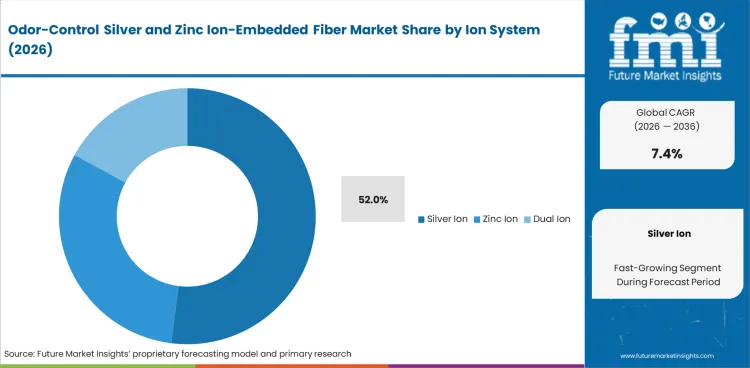
- Silver ion fibers are projected to account for 52.0% share in 2026 since established supplier data and wider brand familiarity lower approval effort for activewear programs.
- Zinc ion fibers gain attention after EPA-labeled silver zinc zeolite activity as buyers compare dual-ion stability with single-metal odor-control systems.
Insights into Odor-Control Silver and Zinc Ion-Embedded Fiber Market by Fiber Type
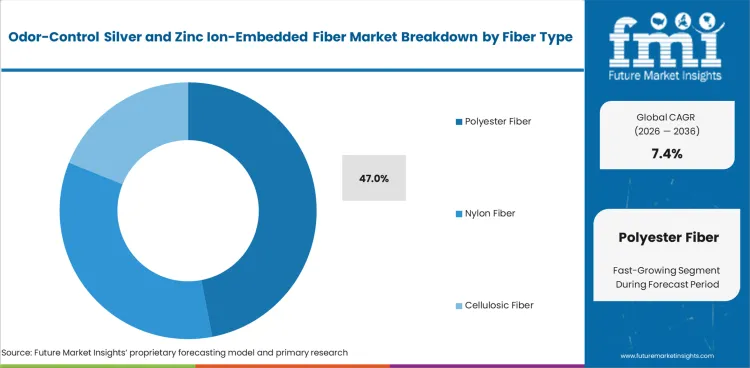
- Polyester fiber is expected to hold 47.0% share in 2026 due to synthetic yarn volume providing mills with a lower-risk route for embedded antimicrobial additives.
- Nylon fiber stays relevant for socks and compression wear since abrasion resistance and odor control need to work in tight-fit garments.
Insights into Odor-Control Silver and Zinc Ion-Embedded Fiber Market by Application
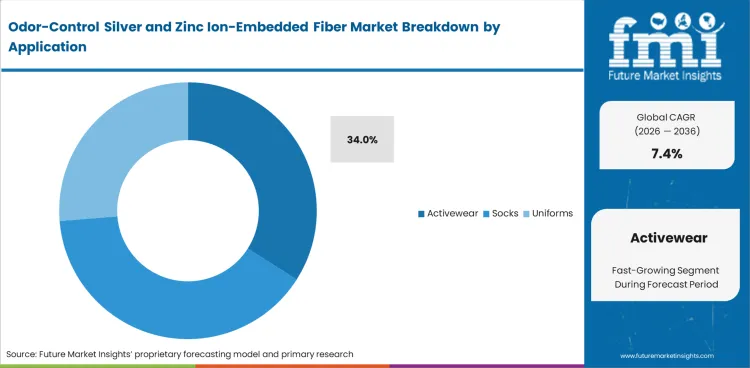
- Activewear is forecast to account for 34.0% share in 2026, led by sweat odor creates a direct consumer complaint across training shirts and base layers.
- Hospital textiles build a second use case as disposable medical gowns and reusable linens require product-protection language without medical overclaiming.
Insights into Odor-Control Silver and Zinc Ion-Embedded Fiber Market by End Use
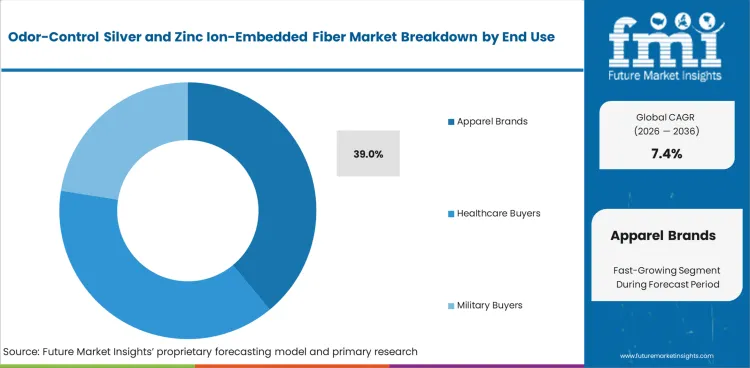
- Apparel brands are projected to capture 39.0% share in 2026, driven by freshness claims support premium pricing and lower garment return risk.
- Healthcare buyers use stricter compliance screens as antimicrobial hospital textiles need evidence of treated-article positioning and wash performance.
Insights into Odor-Control Silver and Zinc Ion-Embedded Fiber Market by Technology
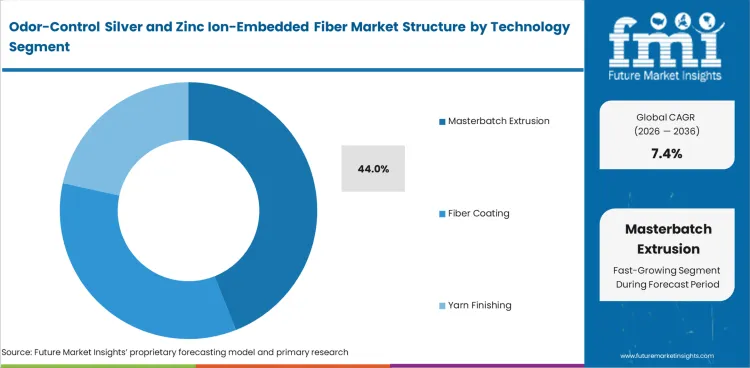
- Masterbatch extrusion is expected to hold 44.0% share in 2026, reflected by ion additives inside filaments able to survive washing.
- Fiber coating keeps use in smaller fabric runs since technical textile production equipment can apply functional chemistry without new spinning investment.
Insights into Odor-Control Silver and Zinc Ion-Embedded Fiber Market by Sales Channel
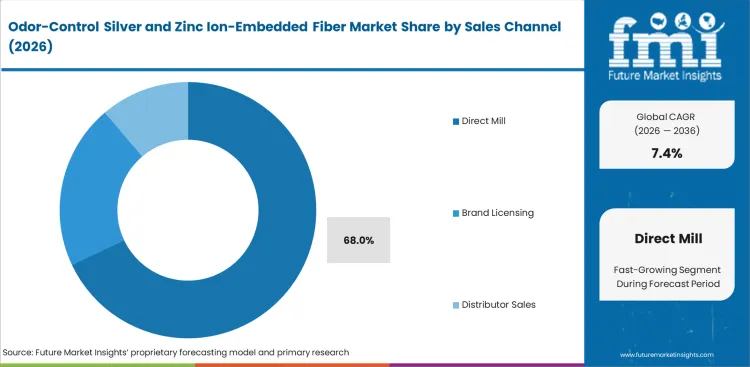
- Direct mill supply is anticipated to account for 68.0% share in 2026 as mills need dosing advice and test reports before commercial fabric approval.
- Brand licensing supports premium programs as smart fabrics buyers ask for recognizable freshness platforms with traceable textile tester results.
Odor-Control Silver and Zinc Ion-Embedded Fiber Market Drivers, Restraints and Opportunities
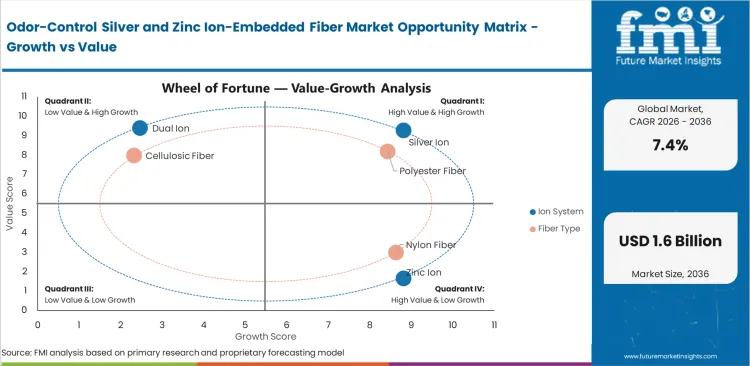
- Wash-durable freshness claims are moving fiber selection toward embedded silver ion and zinc ion systems.
- Biocidal labeling rules can slow launch timing as brands must avoid public-health claims on apparel tags.
- Dual-ion mineral systems create opportunity as silver zinc zeolite approval gives suppliers a clearer regulatory reference point.
stain-resistant fabric & fabric freshener Growth is expected to come from apparel and healthcare textile users needing odor control without shifting care routines to end consumers. WHO reported in October 2025 its global antibiotic resistance surveillance analysis drew on over 23 million bacteriologically confirmed cases. Healthcare buyers will not use fiber claims as infection-control substitutes. Product protection language will matter in hospital textile briefs. At consumer level, stain-resistant fabric and fabric freshener categories show broader interest in longer-lasting textile performance. Embedded-ion fibers can capture a premium once wash durability and claim limits are documented before launch.
Installed Base and Replacement Cycle Analysis
Specification renewal is a better signal than equipment replacement in odor-control fiber supply. Mills already spin polyester and nylon at scale, so adoption happens through additive qualification and yarn recipe approval. USA OTEXA reported year-to-date December 2024 apparel imports at 25,766.2 million square meter equivalents. Import scale gives brands many garment programs for functional fiber trials. Requalification cycles are expected to favor vendors with repeatable ion loading and clear care-label support.
Production Capacity and Supplier Footprint Analysis
high-transparency silicone textile coatings Supplier footprint is judged by ion chemistry access, textile processing support and regional converter coverage. Noble Biomaterials says Ionic+ technologies use silver at textile surfaces for antimicrobial and odor control applications. Sciessent describes Agion as a zeolite carrier delivering silver and copper ions for product protection. Microban lists silver, zinc and odor-control technologies across its antimicrobial additive range. Such supplier breadth will shape selection as mills compare embedded yarns with high-transparency silicone textile coatings and surface finishes.
Analysis of Odor-Control Silver and Zinc Ion-Embedded Fiber Market by Key Countries
.webp "Top Country Growth Comparison Odor Control Silver And Zinc Ion Embedded Fiber Market Cagr (2026 2036)")
| Country | CAGR |
|---|---|
| China | 8.8% |
| India | 8.4% |
| Vietnam | 8.1% |
| Bangladesh | 7.9% |
| United States | 7.2% |
| Germany | 6.7% |
| Japan | 6.3% |
Source: Future Market Insights, 2026.
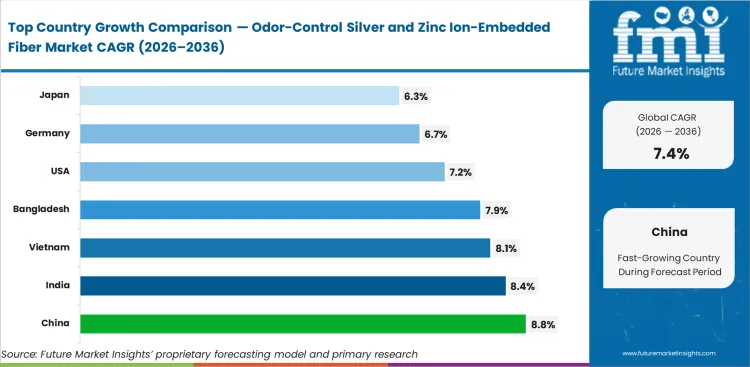
Odor-Control Silver and Zinc Ion-Embedded Fiber Market CAGR Analysis by Country
- China is projected to record 8.8% CAGR by 2036 due to synthetic fabric scale and export-oriented activewear manufacturing.
- India is expected to expand at 8.4% CAGR by 2036, led by technical textile upgrading and apparel exports supporting fiber differentiation.
- Vietnam is forecast to grow at 8.1% CAGR by 2036 since global sportswear sourcing raises interest in functional yarn programs.
- Bangladesh is expected to advance at 7.9% CAGR by 2036 as knitwear exporters need higher-value garment features beyond cut-and-sew scale.
- United States is projected to rise at 7.2% CAGR by 2036 through healthcare linen needs and premium activewear specification. Germany is forecast at 6.7% CAGR by 2036, influenced by EU biocide rules require cleaner documentation. Japan is expected to post 6.3% CAGR by 2036 as quality screening keeps adoption measured.
Country performance differs by apparel export scale, healthcare textile maturity and regulatory pressure. China, India and Vietnam track above global pace due to large textile conversion capacity. United States and Germany stay close to global line as claim scrutiny slows weak products. Japan expands at a measured pace as buyers favor tested materials over broad freshness claims.
Demand Outlook for Odor-Control Silver and Zinc Ion-Embedded Fiber in China
Sector in China is projected to record 8.8% CAGR by 2036, driven by synthetic fiber mills influencing activewear and uniform programs. China customs data cited textile and apparel exports at USD 301.1 billion in 2024. Such export depth gives additive suppliers a broad mill network for silver and zinc ion yarn trials. Buyers will favor embedded platforms with stable color and hand-feel through dyeing.
- Activewear exporters can use embedded silver ion fiber to defend premium garment positioning in overseas sportswear orders.
- Uniform fabric users are expected to compare dual-ion systems with existing finish routes before accepting cost premiums.
- Large synthetic yarn capacity keeps China central for masterbatch extrusion scale-up and repeat sampling.
Demand Analysis of Odor-Control Silver and Zinc Ion-Embedded Fiber in India
The market in India is expected to expand at 8.4% CAGR by 2036, led by textile exporters moving toward functional fabrics. India’s Press Information Bureau reported total textile exports including handicrafts at ₹3,16,334.9 crore in FY 2025 to 2026. Export growth gives mills a reason to add odor control to polyester and blended yarns. Supplier selection will depend on test files and brand audit support.
- Apparel exporters can add odor-control fibers to premium sportswear orders requiring measurable freshness claims.
- Technical textile users are expected to favor embedded fibers as policy support widens interest in value-added materials.
- Mill buyers will screen ion additives for dyeing compatibility and long-run process stability before repeat orders.
Sales Analysis of Odor-Control Silver and Zinc Ion-Embedded Fiber in Vietnam
Sales in Vietnam are forecast to grow at 8.1% CAGR by 2036 due to global apparel buyers maintaining sourcing for higher-specification garments. Vietnam textile industry bodies targeted USD 44 billion in 2024 textile and garment exports. Export focus gives functional fibers a practical route through activewear and socks. Buyers are expected to ask for wash-cycle evidence before moving from trial fabric to bulk programs.
- Sportswear factories can use silver ion fibers for training garments aimed at repeated sweat exposure.
- Sock manufacturers are expected to test zinc ion blends as odor claims need comfort and durability together.
- Brand-backed sourcing gives suppliers a clear route once yarn performance and claim files are ready.
Opportunity Analysis of Odor-Control Silver and Zinc Ion-Embedded Fiber in Bangladesh
Industry in Bangladesh is expected to advance at 7.9% CAGR by 2036, influenced by knitwear exporters add functional features defending margins. OEC trade data recorded Bangladesh textile exports at USD 52.9 billion in 2024. Knit garment scale makes odor-control fibers relevant for T-shirts and base layers. Suppliers need low-disruption yarn options as factories run high-volume programs with tight lead times.
- Knitwear exporters can add embedded-ion fibers to basic garments aimed at premium private-label orders.
- Cost sensitivity will favor silver ion and zinc ion systems with low dosage and simple mill handling.
- Exporter reliance on large overseas buyers keeps claim documentation important during sample approval.
Opportunity Analysis of Odor-Control Silver and Zinc Ion-Embedded Fiber in United States
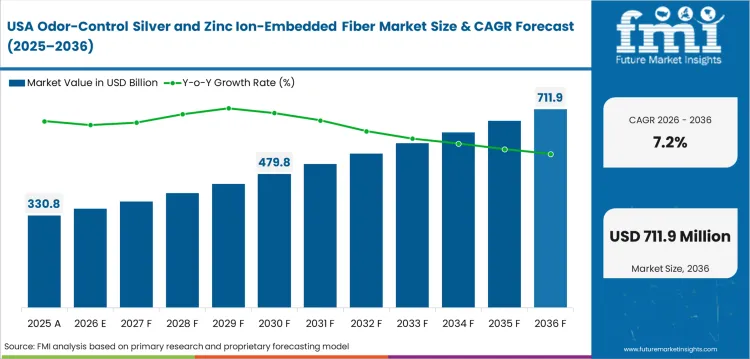
Demand in the United States is projected to rise at 7.2% CAGR by 2036 as premium activewear and healthcare textiles create two demand pools. OTEXA data showed December 2024 year-to-date apparel imports at 25,766.2 million square meter equivalents. Import scale supports many brand-led material trials. Healthcare and sportswear buyers will select suppliers able to meet treated-article wording limits.
- Premium activewear brands can specify embedded-ion yarns for odor control in polyester-heavy training lines.
- Healthcare textile buyers are expected to prefer suppliers with USA EPA claim guidance and wash-test records.
- Imported garment programs give additive suppliers leverage through brand specifications rather than fiber ownership.
Demand Outlook for Odor-Control Silver and Zinc Ion-Embedded Fiber in Germany
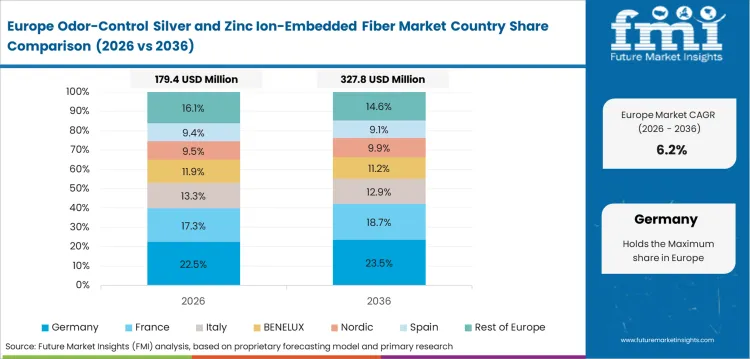
The sector in Germany is forecast at 6.7% CAGR by 2036 since EU biocide controls attract buyers toward documented treated textile chemistry. Commission Implementing Regulation 2024/2635 approves silver zinc zeolite for product type 9 from March 2026 to February 2036. German buyers will place more weight on supplier authorization and use conditions. Compliance will shape adoption as much as odor-control performance.
- Workwear and medical textile users can adopt embedded-ion fibers with stricter supplier declarations.
- EU labeling needs are expected to reduce weak claims and favor vendors with complete biocidal files.
- Premium apparel buyers will compare silver-zinc systems with metal-free alternatives as policy checks tighten.
In-depth Analysis of Odor-Control Silver and Zinc Ion-Embedded Fiber in Japan
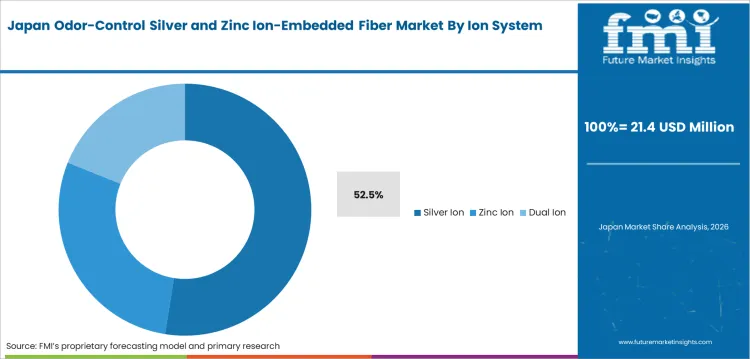
Sales in Japan are expected to post 6.3% CAGR by 2036, reflected by buyers implementing careful quality checks to functional textiles. Japan’s textile and apparel buyers are expected to use odor-control fibers selectively in sportswear and care-related soft goods. Premium programs will favor low-odor performance without comfort loss. Supplier success will depend on repeatable fiber feel and conservative claim language.
- Activewear brands can use embedded silver ion yarns in garments requiring odor control with soft hand-feel.
- Care textile users are expected to favor products with clear washing guidance and material safety documents.
- Measured adoption supports premium grades more than fast commodity rollout across basic apparel.
Competitive Landscape and Strategic Positioning
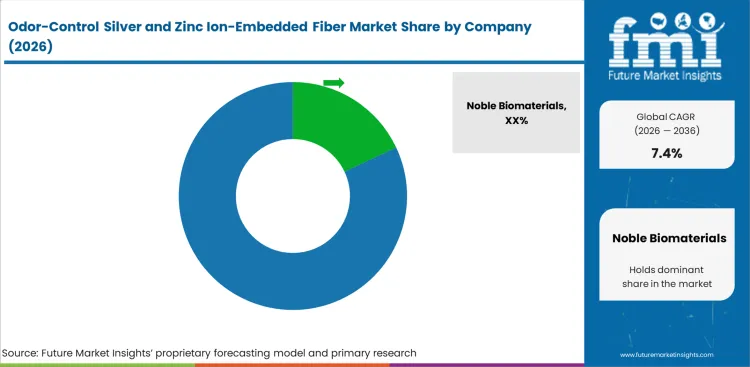
- Embedded-ion specialists are expected to hold an advantage based on wash durability and yarn-level integration evidence.
- Chemical additive suppliers are gaining buyers with silver and zinc chemistry ranges built for mill use.
- Brand-facing technology owners defend share by linking freshness claims with licensed ingredient recognition.
Competition in odor-control silver and zinc ion-embedded fibers is centered on wash durability and evidence for the ion system integrating textile processing. Embedded-ion specialists compete against chemical additive suppliers and brand-facing technology owners on mill qualification support and claim control. Noble Biomaterials has a strong position through Ionic+ silver technology for soft surfaces. Sciessent competes with Agion and Agion Active X2 for anti-odor and antimicrobial use. Microban brings a wider additive portfolio covering silver and non-metal odor control. Larger accounts are expected to favor vendors able to shorten mill qualification and support claim review.
Regional and application specialists remain important due to fabric programs often beginning with converters before moving into brand-level adoption. Polygiene competes depending on StayFresh silver ion technology and brand partnerships. HeiQ and Archroma strengthen odor-control choices through their January 2026 textile partnership. Sanitized and Rudolf add specialist odor management options for mills evaluating metal-free alternatives. Competitive strength is expected to move toward suppliers proving wash durability without relying on broad public-health language. Vendors best positioned to win will combine fiber-level performance evidence with practical support for mills and apparel brands.
Key Companies in the Odor-Control Silver and Zinc Ion-Embedded Fiber Market
Competition is best categorized by role as embedded-ion specialists and additive formulators serve different buyer needs.
- Embedded-Ion Fiber Specialists: Noble Biomaterials and Reolite support silver and dual-ion platforms for textile and medical soft-goods use.
- Textile Additive Formulators: Sciessent, Microban and Sanitized support mills with antimicrobial and odor-control chemistry ranges.
- Brand-Facing Freshness Platforms: Polygiene and HeiQ connect odor-control technologies with apparel brands and textile partners.
Competitive Benchmarking: Odor-Control Silver and Zinc Ion-Embedded Fiber Market
| Company | Embedded Ion Depth | Wash Durability Proof | Claim Compliance Support | Geographic Footprint |
|---|---|---|---|---|
| Noble Biomaterials | High | Strong | Strong | Americas and global soft goods |
| Sciessent | High | Strong | Strong | United States with global mills |
| Microban International | High | Strong | Strong | Global additive reach |
| Polygiene Group | Medium | Strong | Strong | Europe centered with global brands |
| Reolite | High | Medium | Strong | United States with dual-ion focus |
| HeiQ Materials | Medium | Medium | Medium | Europe and Asia textile channels |
| Sanitized AG | Medium | Medium | Strong | Europe centered textile chemistry |
Source: Future Market Insights competitive analysis, 2026. Ratings reflect relative positioning based on embedded ion depth, wash durability proof and claim compliance support.
Key Developments in Odor-Control Silver and Zinc Ion-Embedded Fiber Market
- In February 2025, Noble Biomaterials and Coolcore launched COOLPRO fabric using Ionic+ Pro yarn technology with Coolcore Biomimetic Fiber Geometry.
- In July 2025, Reolite received USA EPA registration for Reolite under EPA Reg. No. 102257-2.
- In January 2026, Archroma and HeiQ entered a co-marketing agreement for antimicrobial and odor-control textile solutions.
Key Players in the Odor-Control Silver and Zinc Ion-Embedded Fiber Market
Major Global Players:
- Noble Biomaterials
- Sciessent
- Microban International
- Polygiene Group
- HeiQ Materials
Specialist and Regional Players:
- Reolite
- Sanitized AG
- Rudolf GmbH
- Trevira GmbH
- Thai Acrylic Fibre
- PurThread Technologies
- Milliken & Company
Report Scope and Coverage
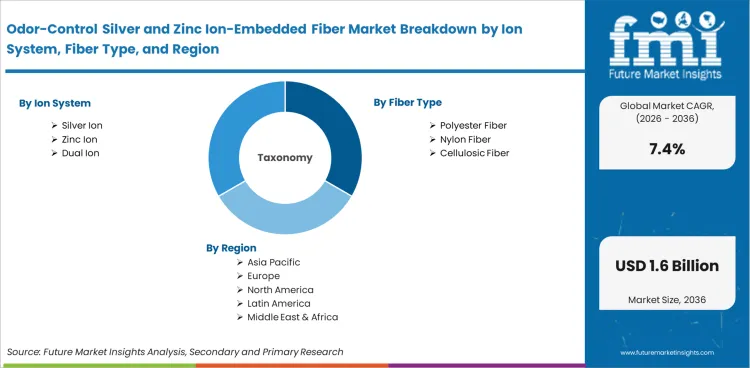
Odor-Control Silver and Zinc Ion-Embedded Fiber Market Breakdown by Ion System, Fiber Type, Application, End Use, Technology, Sales Channel and Region.
| Parameter | Details |
|---|---|
| Quantitative Units | USD 0.8 billion to USD 1.6 billion, at 7.4% CAGR |
| Market Definition | Silver or zinc ion-bearing fibers sold for odor-control and textile product-protection use |
| Ion System | Silver ion, zinc ion, dual ion, hybrid mineral |
| Fiber Type | Polyester fiber, nylon fiber, cellulosic fiber, blended fiber |
| Application | Activewear, socks, uniforms, hospital textiles, bedding |
| End Use | Apparel brands, healthcare buyers, military buyers, hospitality buyers |
| Technology | Masterbatch extrusion, fiber coating, yarn finishing, topical finish |
| Sales Channel | Direct mill, brand licensing, distributor sales, converter supply |
| Regions Covered | North America, Latin America, Western Europe, Eastern Europe, East Asia, South Asia and Pacific, Middle East and Africa |
| Countries Covered | China, India, Vietnam, Bangladesh, United States, Germany, Japan |
| Key Companies Profiled | Noble Biomaterials, Sciessent, Microban International, Polygiene Group, Reolite, HeiQ Materials, Sanitized AG |
| Forecast Period | 2026 to 2036 |
| Approach | Hybrid top-down and bottom-up sizing using fiber output, textile trade and supplier evidence |
Source: Future Market Insights, 2026.
Odor-Control Silver and Zinc Ion-Embedded Fiber Market by Segments
Odor-Control Silver and Zinc Ion-Embedded Fiber Market Segmented by Ion System:
- Silver Ion
- Zinc Ion
- Dual Ion
- Hybrid Mineral
Odor-Control Silver and Zinc Ion-Embedded Fiber Market Segmented by Fiber Type:
- Polyester Fiber
- Nylon Fiber
- Cellulosic Fiber
- Blended Fiber
Odor-Control Silver and Zinc Ion-Embedded Fiber Market Segmented by Application:
- Activewear
- Socks
- Uniforms
- Hospital Textiles
- Bedding
Odor-Control Silver and Zinc Ion-Embedded Fiber Market Segmented by End Use:
- Apparel Brands
- Healthcare Buyers
- Military Buyers
- Hospitality Buyers
Odor-Control Silver and Zinc Ion-Embedded Fiber Market Segmented by Technology:
- Masterbatch Extrusion
- Fiber Coating
- Yarn Finishing
- Topical Finish
Odor-Control Silver and Zinc Ion-Embedded Fiber Market Segmented by Sales Channel:
- Direct Mill
- Brand Licensing
- Distributor Sales
- Converter Supply
Odor-Control Silver and Zinc Ion-Embedded Fiber Market by Region:
- North America
- United States
- Canada
- Mexico
- Latin America
- Brazil
- Argentina
- Rest of Latin America
- Western Europe
- Germany
- United Kingdom
- France
- Italy
- Spain
- Rest of Western Europe
- Eastern Europe
- Poland
- Romania
- Rest of Eastern Europe
- East Asia
- China
- Japan
- South Korea
- South Asia and Pacific
- India
- Vietnam
- Bangladesh
- Australia and New Zealand
- Rest of South Asia and Pacific
- Middle East and Africa
- Saudi Arabia
- United Arab Emirates
- South Africa
- Rest of Middle East and Africa
Research Sources and Bibliography
Bibliography uses official regulatory sources, trade data, company evidence and non-commercial fiber output data relevant to odor-control embedded fibers.
This Report Answers
- What is the current and future size of the odor-control silver and zinc ion-embedded fiber market?
- How fast is the odor-control silver and zinc ion-embedded fiber market expected to expand between 2026 and 2036?
- Which ion system is expected to account for the leading odor-control embedded fiber share in 2026?
- Which sales channel is projected to account for the leading share in 2026?
- Why are silver ion fibers important for odor-control textile demand?
- How does masterbatch extrusion support embedded-ion fiber adoption?
- Which countries are projected to record faster expansion during the forecast period?
- Who are the main companies active in silver and zinc ion embedded fiber supply?
- How does FMI define odor-control silver and zinc ion-embedded fiber scope?
- How does FMI estimate and validate the odor-control embedded fiber forecast?
Frequently Asked Questions
What is the global market demand for odor-control silver and zinc ion-embedded fiber in 2026?
In 2026, odor-control silver and zinc ion-embedded fiber value is anticipated to cross USD 0.8 billion as functional apparel programs widen embedded freshness sourcing.
How big will the odor-control silver and zinc ion-embedded fiber market be in 2036?
By 2036, odor-control silver and zinc ion-embedded fiber industry is estimated to reach USD 1.6 billion as durable textile protection gains broader use.
How much is demand expected to expand between 2026 and 2036?
Between 2026 and 2036, sector is projected to expand at 7.4% CAGR as mills shift from finish-only odor control toward embedded fibers.
Which ion system is expected to lead the market by 2026?
Silver ion fibers are projected to represent 52.0% share in 2026 as activewear and medical textile users recognize silver-based performance data.
Which sales channel is expected to lead demand in 2026?
Direct mill supply is expected to account for 68.0% share in 2026 as mills need dosing support and claim documents before approval.
Which country is forecast to grow at a stronger pace?
China is anticipated to record 8.8% CAGR by 2036 as synthetic fabric conversion scale supports functional yarn programs.
What does the odor-control silver and zinc ion-embedded fiber market include?
Scope includes silver ion, zinc ion and dual-ion fibers sold for odor-control use in apparel, healthcare textiles and uniform fabrics.
How does FMI estimate the odor-control embedded fiber forecast?
FMI uses fiber output, textile trade checks and supplier product evidence to validate forecast size and segment shares.
Why is masterbatch extrusion important in odor-control embedded fiber?
Masterbatch extrusion places ions inside the filament. Such placement can improve wash durability compared with surface-only textile finishes.
Who uses odor-control silver and zinc ion-embedded fibers?
Main users include activewear brands and healthcare textile buyers. Uniform suppliers and hospitality linen programs complete the core buyer group.
Preview the report firsthand - request a free sample
Get SampleGet the brochure for pricing and purchase details.
Get PDFTable of Content
- Executive Summary
- Global Market Outlook
- Demand-side Trends
- Supply-side Trends
- Technology Roadmap Analysis
- Analysis and Recommendations
- Market Overview
- Market Coverage / Taxonomy
- Market Definition / Scope / Limitations
- Research Methodology
- Chapter Orientation
- Analytical Lens and Working Hypotheses
- Market Structure, Signals, and Trend Drivers
- Benchmarking and Cross-market Comparability
- Market Sizing, Forecasting, and Opportunity Mapping
- Research Design and Evidence Framework
- Desk Research Programme (Secondary Evidence)
- Company Annual and Sustainability Reports
- Peer-reviewed Journals and Academic Literature
- Corporate Websites, Product Literature, and Technical Notes
- Earnings Decks and Investor Briefings
- Statutory Filings and Regulatory Disclosures
- Technical White Papers and Standards Notes
- Trade Journals, Industry Magazines, and Analyst Briefs
- Conference Proceedings, Webinars, and Seminar Materials
- Government Statistics Portals and Public Data Releases
- Press Releases and Reputable Media Coverage
- Specialist Newsletters and Curated Briefings
- Sector Databases and Reference Repositories
- FMI Internal Proprietary Databases and Historical Market Datasets
- Subscription Datasets and Paid Sources
- Social Channels, Communities, and Digital Listening Inputs
- Additional Desk Sources
- Expert Input and Fieldwork (Primary Evidence)
- Primary Modes
- Qualitative Interviews and Expert Elicitation
- Quantitative Surveys and Structured Data Capture
- Blended Approach
- Why Primary Evidence is Used
- Field Techniques
- Interviews
- Surveys
- Focus Groups
- Observational and In-context Research
- Social and Community Interactions
- Stakeholder Universe Engaged
- C-suite Leaders
- Board Members
- Presidents and Vice Presidents
- R&D and Innovation Heads
- Technical Specialists
- Domain Subject-matter Experts
- Scientists
- Physicians and Other Healthcare Professionals
- Governance, Ethics, and Data Stewardship
- Research Ethics
- Data Integrity and Handling
- Primary Modes
- Tooling, Models, and Reference Databases
- Desk Research Programme (Secondary Evidence)
- Data Engineering and Model Build
- Data Acquisition and Ingestion
- Cleaning, Normalisation, and Verification
- Synthesis, Triangulation, and Analysis
- Quality Assurance and Audit Trail
- Market Background
- Market Dynamics
- Drivers
- Restraints
- Opportunity
- Trends
- Scenario Forecast
- Demand in Optimistic Scenario
- Demand in Likely Scenario
- Demand in Conservative Scenario
- Opportunity Map Analysis
- Product Life Cycle Analysis
- Supply Chain Analysis
- Investment Feasibility Matrix
- Value Chain Analysis
- PESTLE and Porter’s Analysis
- Regulatory Landscape
- Regional Parent Market Outlook
- Production and Consumption Statistics
- Import and Export Statistics
- Market Dynamics
- Global Market Analysis 2021 to 2025 and Forecast, 2026 to 2036
- Historical Market Size Value (USD Million) Analysis, 2021 to 2025
- Current and Future Market Size Value (USD Million) Projections, 2026 to 2036
- Y-o-Y Growth Trend Analysis
- Absolute $ Opportunity Analysis
- Global Market Pricing Analysis 2021 to 2025 and Forecast 2026 to 2036
- Global Market Analysis 2021 to 2025 and Forecast 2026 to 2036, By Chloride Product
- Introduction / Key Findings
- Historical Market Size Value (USD Million) Analysis By Chloride Product , 2021 to 2025
- Current and Future Market Size Value (USD Million) Analysis and Forecast By Chloride Product , 2026 to 2036
- Anhydrous magnesium chloride
- Industrial grade
- Electrolysis grade
- Chemical processing grade
- High purity grade
- Hexahydrate magnesium chloride
- Liquid magnesium chloride brine
- Anhydrous magnesium chloride
- Y-o-Y Growth Trend Analysis By Chloride Product , 2021 to 2025
- Absolute $ Opportunity Analysis By Chloride Product , 2026 to 2036
- Global Market Analysis 2021 to 2025 and Forecast 2026 to 2036, By Form
- Introduction / Key Findings
- Historical Market Size Value (USD Million) Analysis By Form, 2021 to 2025
- Current and Future Market Size Value (USD Million) Analysis and Forecast By Form, 2026 to 2036
- Solid magnesium chloride
- Crystalline solid
- Powder
- Granules
- Liquid magnesium chloride
- Brine solution
- Solid magnesium chloride
- Y-o-Y Growth Trend Analysis By Form, 2021 to 2025
- Absolute $ Opportunity Analysis By Form, 2026 to 2036
- Global Market Analysis 2021 to 2025 and Forecast 2026 to 2036, By Grade
- Introduction / Key Findings
- Historical Market Size Value (USD Million) Analysis By Grade, 2021 to 2025
- Current and Future Market Size Value (USD Million) Analysis and Forecast By Grade, 2026 to 2036
- Industrial grade
- Technical grade
- Food grade
- Pharmaceutical grade
- Industrial grade
- Y-o-Y Growth Trend Analysis By Grade, 2021 to 2025
- Absolute $ Opportunity Analysis By Grade, 2026 to 2036
- Global Market Analysis 2021 to 2025 and Forecast 2026 to 2036, By Application
- Introduction / Key Findings
- Historical Market Size Value (USD Million) Analysis By Application, 2021 to 2025
- Current and Future Market Size Value (USD Million) Analysis and Forecast By Application, 2026 to 2036
- De-icing and dust control
- Industrial processing
- Construction materials
- Agriculture
- Water treatment
- Food and beverage
- Pharmaceuticals
- De-icing and dust control
- Y-o-Y Growth Trend Analysis By Application, 2021 to 2025
- Absolute $ Opportunity Analysis By Application, 2026 to 2036
- Global Market Analysis 2021 to 2025 and Forecast 2026 to 2036, By End Use
- Introduction / Key Findings
- Historical Market Size Value (USD Million) Analysis By End Use, 2021 to 2025
- Current and Future Market Size Value (USD Million) Analysis and Forecast By End Use, 2026 to 2036
- Chemical industry
- Oil and gas industry
- Metallurgy industry
- Agriculture industry
- Municipal services
- Food industry
- Healthcare industry
- Construction industry
- Chemical industry
- Y-o-Y Growth Trend Analysis By End Use, 2021 to 2025
- Absolute $ Opportunity Analysis By End Use, 2026 to 2036
- Global Market Analysis 2021 to 2025 and Forecast 2026 to 2036, By Distribution Channel
- Introduction / Key Findings
- Historical Market Size Value (USD Million) Analysis By Distribution Channel, 2021 to 2025
- Current and Future Market Size Value (USD Million) Analysis and Forecast By Distribution Channel, 2026 to 2036
- Direct sales
- Distributors and traders
- Online B2B channels
- Direct sales
- Y-o-Y Growth Trend Analysis By Distribution Channel, 2021 to 2025
- Absolute $ Opportunity Analysis By Distribution Channel, 2026 to 2036
- Global Market Analysis 2021 to 2025 and Forecast 2026 to 2036, By Tier
- Introduction / Key Findings
- Historical Market Size Value (USD Million) Analysis By Tier, 2021 to 2025
- Current and Future Market Size Value (USD Million) Analysis and Forecast By Tier, 2026 to 2036
- Premium pricing
- Mid-range pricing
- Economy pricing
- Premium pricing
- Y-o-Y Growth Trend Analysis By Tier, 2021 to 2025
- Absolute $ Opportunity Analysis By Tier, 2026 to 2036
- Global Market Analysis 2021 to 2025 and Forecast 2026 to 2036, By Region
- Introduction
- Historical Market Size Value (USD Million) Analysis By Region, 2021 to 2025
- Current Market Size Value (USD Million) Analysis and Forecast By Region, 2026 to 2036
- North America
- Latin America
- Western Europe
- Eastern Europe
- East Asia
- South Asia and Pacific
- Middle East & Africa
- Market Attractiveness Analysis By Region
- North America Market Analysis 2021 to 2025 and Forecast 2026 to 2036, By Country
- Historical Market Size Value (USD Million) Trend Analysis By Market Taxonomy, 2021 to 2025
- Market Size Value (USD Million) Forecast By Market Taxonomy, 2026 to 2036
- By Country
- USA
- Canada
- Mexico
- By Chloride Product
- By Form
- By Grade
- By Application
- By End Use
- By Distribution Channel
- By Tier
- By Country
- Market Attractiveness Analysis
- By Country
- By Chloride Product
- By Form
- By Grade
- By Application
- By End Use
- By Distribution Channel
- By Tier
- Key Takeaways
- Latin America Market Analysis 2021 to 2025 and Forecast 2026 to 2036, By Country
- Historical Market Size Value (USD Million) Trend Analysis By Market Taxonomy, 2021 to 2025
- Market Size Value (USD Million) Forecast By Market Taxonomy, 2026 to 2036
- By Country
- Brazil
- Chile
- Rest of Latin America
- By Chloride Product
- By Form
- By Grade
- By Application
- By End Use
- By Distribution Channel
- By Tier
- By Country
- Market Attractiveness Analysis
- By Country
- By Chloride Product
- By Form
- By Grade
- By Application
- By End Use
- By Distribution Channel
- By Tier
- Key Takeaways
- Western Europe Market Analysis 2021 to 2025 and Forecast 2026 to 2036, By Country
- Historical Market Size Value (USD Million) Trend Analysis By Market Taxonomy, 2021 to 2025
- Market Size Value (USD Million) Forecast By Market Taxonomy, 2026 to 2036
- By Country
- Germany
- UK
- Italy
- Spain
- France
- Nordic
- BENELUX
- Rest of Western Europe
- By Chloride Product
- By Form
- By Grade
- By Application
- By End Use
- By Distribution Channel
- By Tier
- By Country
- Market Attractiveness Analysis
- By Country
- By Chloride Product
- By Form
- By Grade
- By Application
- By End Use
- By Distribution Channel
- By Tier
- Key Takeaways
- Eastern Europe Market Analysis 2021 to 2025 and Forecast 2026 to 2036, By Country
- Historical Market Size Value (USD Million) Trend Analysis By Market Taxonomy, 2021 to 2025
- Market Size Value (USD Million) Forecast By Market Taxonomy, 2026 to 2036
- By Country
- Russia
- Poland
- Hungary
- Balkan & Baltic
- Rest of Eastern Europe
- By Chloride Product
- By Form
- By Grade
- By Application
- By End Use
- By Distribution Channel
- By Tier
- By Country
- Market Attractiveness Analysis
- By Country
- By Chloride Product
- By Form
- By Grade
- By Application
- By End Use
- By Distribution Channel
- By Tier
- Key Takeaways
- East Asia Market Analysis 2021 to 2025 and Forecast 2026 to 2036, By Country
- Historical Market Size Value (USD Million) Trend Analysis By Market Taxonomy, 2021 to 2025
- Market Size Value (USD Million) Forecast By Market Taxonomy, 2026 to 2036
- By Country
- China
- Japan
- South Korea
- By Chloride Product
- By Form
- By Grade
- By Application
- By End Use
- By Distribution Channel
- By Tier
- By Country
- Market Attractiveness Analysis
- By Country
- By Chloride Product
- By Form
- By Grade
- By Application
- By End Use
- By Distribution Channel
- By Tier
- Key Takeaways
- South Asia and Pacific Market Analysis 2021 to 2025 and Forecast 2026 to 2036, By Country
- Historical Market Size Value (USD Million) Trend Analysis By Market Taxonomy, 2021 to 2025
- Market Size Value (USD Million) Forecast By Market Taxonomy, 2026 to 2036
- By Country
- India
- ASEAN
- Australia & New Zealand
- Rest of South Asia and Pacific
- By Chloride Product
- By Form
- By Grade
- By Application
- By End Use
- By Distribution Channel
- By Tier
- By Country
- Market Attractiveness Analysis
- By Country
- By Chloride Product
- By Form
- By Grade
- By Application
- By End Use
- By Distribution Channel
- By Tier
- Key Takeaways
- Middle East & Africa Market Analysis 2021 to 2025 and Forecast 2026 to 2036, By Country
- Historical Market Size Value (USD Million) Trend Analysis By Market Taxonomy, 2021 to 2025
- Market Size Value (USD Million) Forecast By Market Taxonomy, 2026 to 2036
- By Country
- Kingdom of Saudi Arabia
- Other GCC Countries
- Turkiye
- South Africa
- Other African Union
- Rest of Middle East & Africa
- By Chloride Product
- By Form
- By Grade
- By Application
- By End Use
- By Distribution Channel
- By Tier
- By Country
- Market Attractiveness Analysis
- By Country
- By Chloride Product
- By Form
- By Grade
- By Application
- By End Use
- By Distribution Channel
- By Tier
- Key Takeaways
- Key Countries Market Analysis
- USA
- Pricing Analysis
- Market Share Analysis, 2025
- By Chloride Product
- By Form
- By Grade
- By Application
- By End Use
- By Distribution Channel
- By Tier
- Canada
- Pricing Analysis
- Market Share Analysis, 2025
- By Chloride Product
- By Form
- By Grade
- By Application
- By End Use
- By Distribution Channel
- By Tier
- Mexico
- Pricing Analysis
- Market Share Analysis, 2025
- By Chloride Product
- By Form
- By Grade
- By Application
- By End Use
- By Distribution Channel
- By Tier
- Brazil
- Pricing Analysis
- Market Share Analysis, 2025
- By Chloride Product
- By Form
- By Grade
- By Application
- By End Use
- By Distribution Channel
- By Tier
- Chile
- Pricing Analysis
- Market Share Analysis, 2025
- By Chloride Product
- By Form
- By Grade
- By Application
- By End Use
- By Distribution Channel
- By Tier
- Germany
- Pricing Analysis
- Market Share Analysis, 2025
- By Chloride Product
- By Form
- By Grade
- By Application
- By End Use
- By Distribution Channel
- By Tier
- UK
- Pricing Analysis
- Market Share Analysis, 2025
- By Chloride Product
- By Form
- By Grade
- By Application
- By End Use
- By Distribution Channel
- By Tier
- Italy
- Pricing Analysis
- Market Share Analysis, 2025
- By Chloride Product
- By Form
- By Grade
- By Application
- By End Use
- By Distribution Channel
- By Tier
- Spain
- Pricing Analysis
- Market Share Analysis, 2025
- By Chloride Product
- By Form
- By Grade
- By Application
- By End Use
- By Distribution Channel
- By Tier
- France
- Pricing Analysis
- Market Share Analysis, 2025
- By Chloride Product
- By Form
- By Grade
- By Application
- By End Use
- By Distribution Channel
- By Tier
- India
- Pricing Analysis
- Market Share Analysis, 2025
- By Chloride Product
- By Form
- By Grade
- By Application
- By End Use
- By Distribution Channel
- By Tier
- ASEAN
- Pricing Analysis
- Market Share Analysis, 2025
- By Chloride Product
- By Form
- By Grade
- By Application
- By End Use
- By Distribution Channel
- By Tier
- Australia & New Zealand
- Pricing Analysis
- Market Share Analysis, 2025
- By Chloride Product
- By Form
- By Grade
- By Application
- By End Use
- By Distribution Channel
- By Tier
- China
- Pricing Analysis
- Market Share Analysis, 2025
- By Chloride Product
- By Form
- By Grade
- By Application
- By End Use
- By Distribution Channel
- By Tier
- Japan
- Pricing Analysis
- Market Share Analysis, 2025
- By Chloride Product
- By Form
- By Grade
- By Application
- By End Use
- By Distribution Channel
- By Tier
- South Korea
- Pricing Analysis
- Market Share Analysis, 2025
- By Chloride Product
- By Form
- By Grade
- By Application
- By End Use
- By Distribution Channel
- By Tier
- Russia
- Pricing Analysis
- Market Share Analysis, 2025
- By Chloride Product
- By Form
- By Grade
- By Application
- By End Use
- By Distribution Channel
- By Tier
- Poland
- Pricing Analysis
- Market Share Analysis, 2025
- By Chloride Product
- By Form
- By Grade
- By Application
- By End Use
- By Distribution Channel
- By Tier
- Hungary
- Pricing Analysis
- Market Share Analysis, 2025
- By Chloride Product
- By Form
- By Grade
- By Application
- By End Use
- By Distribution Channel
- By Tier
- Kingdom of Saudi Arabia
- Pricing Analysis
- Market Share Analysis, 2025
- By Chloride Product
- By Form
- By Grade
- By Application
- By End Use
- By Distribution Channel
- By Tier
- Turkiye
- Pricing Analysis
- Market Share Analysis, 2025
- By Chloride Product
- By Form
- By Grade
- By Application
- By End Use
- By Distribution Channel
- By Tier
- South Africa
- Pricing Analysis
- Market Share Analysis, 2025
- By Chloride Product
- By Form
- By Grade
- By Application
- By End Use
- By Distribution Channel
- By Tier
- USA
- Market Structure Analysis
- Competition Dashboard
- Competition Benchmarking
- Market Share Analysis of Top Players
- By Regional
- By Chloride Product
- By Form
- By Grade
- By Application
- By End Use
- By Distribution Channel
- By Tier
- Competition Analysis
- Competition Deep Dive
- ICL Group
- Overview
- Product Portfolio
- Profitability by Market Segments (Product/Age /Sales Channel/Region)
- Sales Footprint
- Strategy Overview
- Marketing Strategy
- Product Strategy
- Channel Strategy
- Intrepid Potash, Inc.
- K+S Aktiengesellschaft
- Nedmag B.V.
- Thermo Fisher Scientific
- Merck KGaA
- Weifang Yuze Chemical Co. Ltd.
- ICL Group
- Competition Deep Dive
- Assumptions & Acronyms Used


