

- Market Size (2026)
- USD 46.8 Mn
- Forecast (2036)
- USD 91.2 Mn
- CAGR (2026 to 2036)
- 6.9%
Odor Emission Measurement and Dynamic Ollfactometry Test Equipment Market Size, Market Forecast and Outlook By FMI
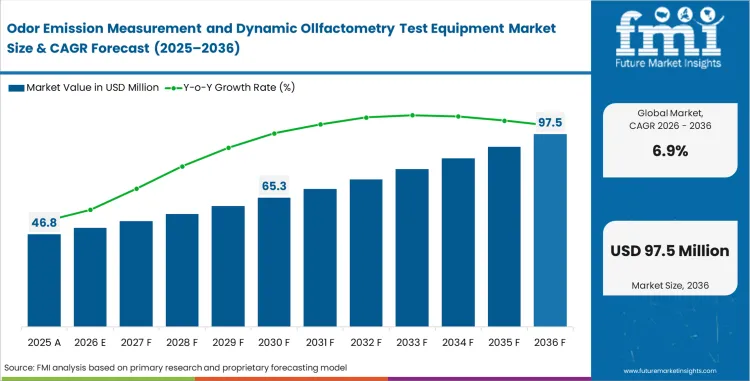
Odor emission measurement and dynamic olfactometry test equipment market was valued at USD 43.8 million in 2025. Sector valuation is projected to reach USD 46.8 million in 2026, with a forecast CAGR of 6.9% from 2026 to 2036. Industry outlook indicates a rise to USD 91.2 million by 2036 as odor compliance work moves beyond occasional complaint response and becomes more routine in source testing, method validation, and laboratory replacement cycles.
Summary of Odor Emission Measurement and Dynamic Olfactometry Test Equipment Market
- The market is forecast to reach USD 1.84 billion by 2036.
- The market is expected to grow at a CAGR of 8.4% from 2026 to 2036.
- The market was estimated at USD 0.76 billion in 2025.
- The market value is expected to rise to USD 0.82 billion in 2026.
- The forecast period represents an incremental opportunity of USD 1.02 billion.
- Indoor exposure assessment is moving closer to routine building operations, complaint handling, remediation validation, and continuous evidence capture rather than occasional one-time checks.
- PM monitors remain the leading product type, PM2.5 continues to anchor pollutant demand, and optical scattering stays ahead in technology preference.
- India is identified as the fastest-growing country in the supplied dataset through 2036.
Key Takeaways, Market Size, and Forecast
- Odor Emission Measurement and Dynamic Olfactometry Test Equipment Market is projected to grow from USD 46.8 million in 2026 to USD 91.2 million by 2036, at a CAGR of 6.9%.
- The odor emission measurement and dynamic olfactometry test equipment market was valued at USD 43.8 million in 2025.
- By 2036, the Odor Emission Measurement and Dynamic Olfactometry Test Equipment Market is expected to be worth USD 91.2 million.
- During 2026 to 2036, the market is anticipated to expand at a CAGR of 6.9%.
- The market is expected to create an incremental opportunity of USD 44.4 million between 2026 and 2036.
- In 2026, Bench Olfactometers are predicted to account for 42.0% of the equipment type segment.
- China (8.3%) and India (8.0%) are anticipated to be two of the fastest growing markets.
Odor Emission Measurement and Dynamic Olfactometry Test Equipment Market Key Takeaways
| Parameter | Details |
|---|---|
| Market value (2026) | USD 0.82 billion |
| Forecast value (2036) | USD 1.84 billion |
| CAGR (2026 to 2036) | 8.4% |
| Estimated market value (2025) | USD 0.76 billion |
| Incremental opportunity | USD 1.02 billion |
| Leading product type | PM Monitors |
| Leading target pollutant | PM2.5 |
| Leading technology | Optical Scattering |
| Leading product share (2026) | 34.0% |
| Leading pollutant share (2026) | 32.0% |
| Leading technology share (2026) | 38.0% |
Source: Future Market Insights (FMI) analysis, based on proprietary forecasting model and primary research
Laboratory managers are now weighing whether existing odor testing setups can still support tighter repeatability, stronger documentation, and more demanding inter-laboratory comparison work, or whether full-system replacement offers the safer path. Older installations can remain serviceable for limited assignments, yet laboratories handling permit-linked work are placing greater emphasis on audit readiness, panel discipline, and reproducible dilution control than they did a few years ago. Spending no longer comes only from new laboratory creation. A larger portion is likely to come from laboratories and specialist consultants upgrading hardware, software, and accessories so reported results remain defensible when odor disputes move into regulatory, operational, or legal review. Adjacent industrial odor management activity adds to that pattern because measurement quality often determines whether later mitigation expenditure is accepted or questioned.
Broader adoption becomes easier once permit holders, consultants, and laboratory networks treat validated odor measurement as a routine part of compliance planning rather than a specialist add-on used only after complaints intensify. Consulting groups and utilities are likely to set that process in motion. Once regular testing calendars are built into plant practice, instrument replacement, accessory use, software upgrades, and panel-control services become easier to justify within annual budgets.
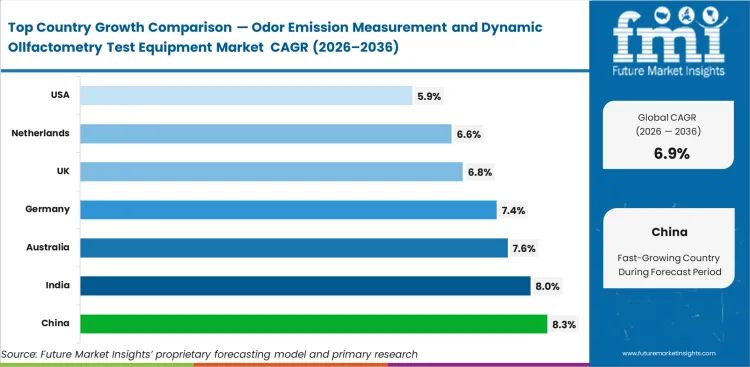
China is expected to post a forecast CAGR of 8.3% through 2036, followed by India at 8.0%, Australia at 7.6%, Germany at 7.4%, the United Kingdom at 6.8%, the Netherlands at 6.6%, and the United States at 5.9%. Faster-moving countries are likely to benefit from newer method adoption, firmer compliance formalization, or quicker expansion in specialist testing capacity. More mature markets still show a positive trend, though replacement timing there tends to remain more measured because installed bases are already established.
Segmental Analysis
Key Facts About Segments
- Laboratory-grade testing requirements keep bench olfactometers at the center of equipment demand, with 42% share projected in 2026. High repeatability, controlled dilution, and audit-ready performance continue to outweigh the flexibility offered by portable systems.
- Method alignment continues to anchor purchasing decisions, with EN 13725 expected to hold 58% share in 2026. Familiar workflows, cross-laboratory comparability, and regulatory acceptance sustain its dominance across accredited testing environments.
- Specialist testing ownership remains concentrated within environmental laboratories, which are projected to account for 38% share in 2026. Consistent assignment flow, reporting responsibility, and accreditation requirements keep demand anchored in this segment.
- Source-based compliance work keeps stack emissions as the leading application, with 36% share anticipated in 2026. Clear emission points and easier linkage to corrective action continue to support higher spending in this area.
- System performance continues to depend on core components, placing dilution units at 31% share in 2026. Stable dilution control and result consistency make them the most critical element within the testing chain.
Odor Emission Measurement and Dynamic Olfactometry Test Equipment Market Analysis by Equipment Type
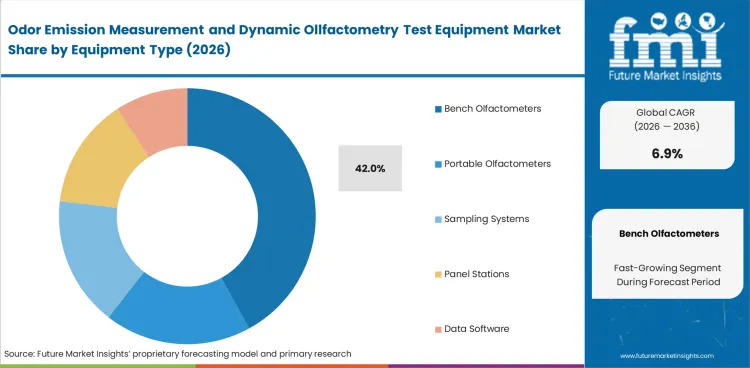
Laboratory work can lose credibility quickly when dilution control, panel sequencing, and software logging rely on patched systems that were not built for current audit expectations. Fixed systems continue to matter for that reason. Bench olfactometers are expected to account for 42% share in 2026 because repeatability carries more weight than portability in high-value odor testing work. Environmental labs, specialist consultants, and permit-linked test houses rely on them when source measurements must stand up to internal review, client scrutiny, and regulatory assessment without procedural doubt. Equipment choice in this segment is usually tied to assignment quality before flexibility becomes a priority. Portable units still serve field-led work, yet most critical olfactometric reporting continues to depend on stable dilution control, controlled panel presentation, and smoother integration with documentation routines. Weak equipment decisions rarely fail at the start. Trouble usually appears later, when result consistency declines and laboratories spend more time defending method discipline than delivering interpretation. Interest in adjacent environmental test equipment continues to support that preference for reference-grade systems.
- Calibration-first: Stable dilution control keeps repeat testing aligned across projects and reduces avoidable disputes during report review.
- Repeatability edge: Fixed-system use gives laboratory teams tighter control over panel handling, which matters when assignments move from advisory work into compliance files.
- Panel discipline: Better session management lowers rework pressure and protects turnaround time when laboratories are balancing multiple client programs.
Odor Emission Measurement and Dynamic Olfactometry Test Equipment Market Analysis by Standard Protocol
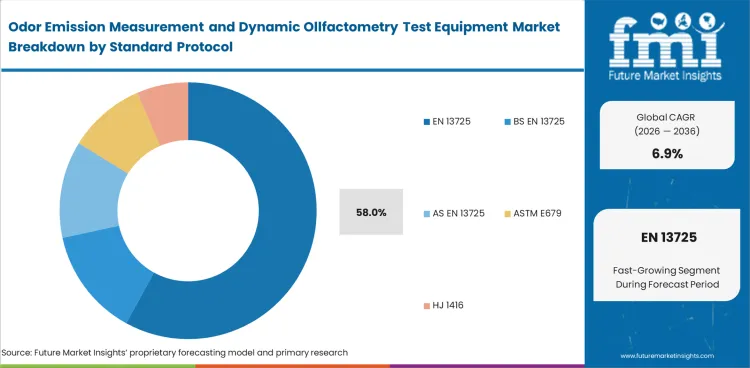
Method choice affects more than reporting language. It also influences whether instrument users are operating within a broad comparison pool or a narrower local practice. EN 13725 is anticipated to represent 58% of the market in 2026 because much of the specialist odor-testing base still aligns system design, panel practice, and data review around that method family. Laboratories selecting equipment under this protocol usually want compatibility with established operating routines, consultant expectations, and cross-border interpretation standards. Familiarity in both hardware setup and service support lowers hesitation at replacement time. Alternative protocols remain relevant in their own settings, yet many users still view EN-led compatibility as the safer commercial route when test reports may be reviewed by several parties. Support needs around inspection and certification services add to that preference because recognized method alignment can influence who secures higher-stakes testing assignments.
- Reference pathway: Recognized protocol alignment gives laboratories a clearer route for equipment selection, training, and result presentation.
- Method continuity: Consultants and plant teams prefer systems that fit existing reporting habits when odor disputes already carry interpretation risk.
- Workflow acceptance: Familiar method logic reduces time lost in internal explanation when laboratories adopt replacement systems.
Odor Emission Measurement and Dynamic Olfactometry Test Equipment Market Analysis by End User
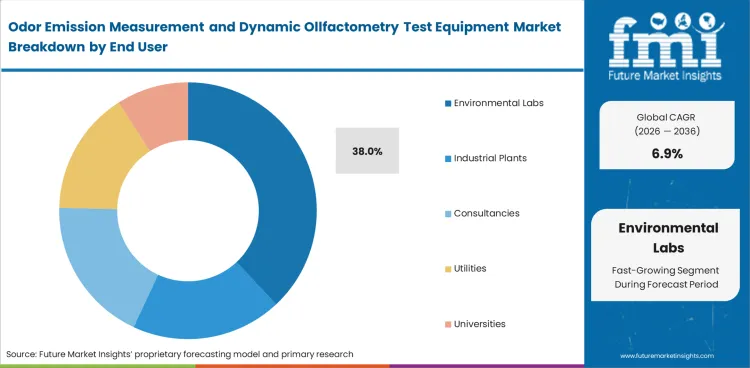
Qualified result ownership still rests mainly with specialist laboratories, even when industrial operators and consultants influence the buying cycle. Environmental labs are likely to secure 38% share in 2026 because sampling discipline, panel control, and final documentation continue to come together most clearly in that setting. Installed systems within this group often serve repeated assignments across wastewater, waste handling, composting, and industrial source testing, which keeps replacement activity steadier than one-off plant purchases. Leadership in this segment comes from work concentration rather than sheer site count. Industrial plants may fund projects and consultants may shape method choice, yet reportable olfactometric results are still most often produced through laboratory-led operations. Users in this segment also place greater weight on service support, software continuity, and documentation stability than on short-term price advantage. Need for adjacent air quality monitoring equipment often sits alongside, rather than within, this buying stream, which keeps dynamic olfactometry a specialist laboratory decision.
- Lab concentration: Repeated assignment flow into specialist labs supports steadier replacement timing than occasional plant-led purchases.
- Service depth: Support quality matters because downtime affects report schedules and can delay permit or complaint-response work.
- Documentation fit: Software and reporting continuity carry real weight when laboratories must keep old and new records comparable.
Odor Emission Measurement and Dynamic Olfactometry Test Equipment Market Analysis by Application
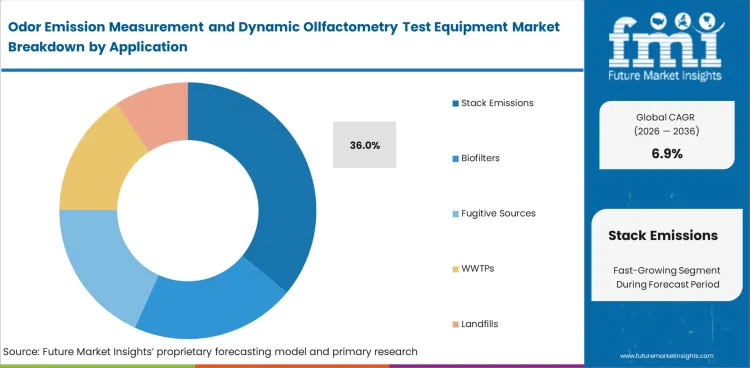
Source testing continues to win budget approval because it gives operators and consultants a firmer basis for action than broad ambient observation alone. Stack emissions are projected to contribute 36% of total market share in 2026, with that lead rooted in the clarity of source-based measurement when odor problems require defined responsibility and defensible follow-up. Users working in this application are usually trying to answer direct questions around emission points, treatment efficiency, and permit exposure. Broad fugitive-source work remains important, especially around waste and wastewater operations, yet channelled emissions often receive earlier attention because action planning becomes easier once a measured source point is established. Equipment used in stack-related work benefits from repeat project flow, method familiarity, and easier integration with mitigation assessment. Linked interest in emissions management tools supports that pattern because verification spending often follows measured source responsibility.
- Source clarity: Defined emission points help operators and consultants build a more defensible case for corrective action.
- Verification use: Measured source output gives engineering teams a firmer basis for treatment review than complaint-led narratives alone.
- Follow-up value: Repeated source testing can support before-and-after comparison when plants alter odor control practice.
Odor Emission Measurement and Dynamic Olfactometry Test Equipment Market Analysis by Component
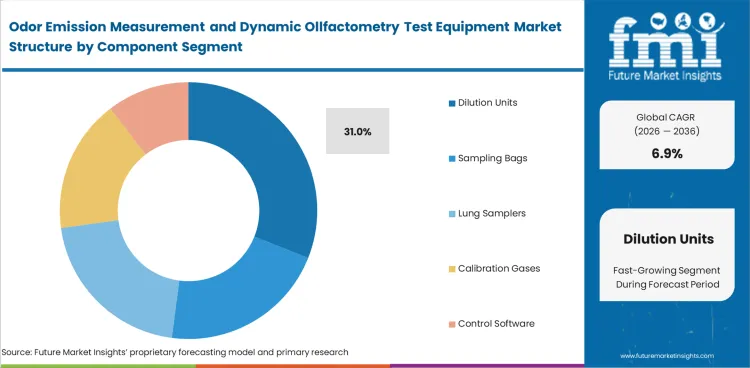
Result quality can weaken quickly even when the full instrument appears sound if the dilution core is inconsistent, poorly maintained, or difficult to validate. Dilution units are forecast to represent 31% share in 2026 for that reason. Users rarely treat them as a minor internal component. They sit at the center of whether the entire test chain remains credible. Component leadership here reflects technical consequence rather than simple replacement frequency. Sampling bags, calibration gases, software, and panel accessories remain necessary, yet dilution hardware influences comparability, repeatability, and system confidence more directly than any other element in the setup. Laboratories that postpone core-component renewal often find service time, recalibration effort, and reporting doubt rising together. Broader interest in pollution monitoring equipment does not replace that need because odor testing still depends on a distinct dilution and presentation chain.
- Dilution core: Consistent dilution performance protects comparability between sessions and lowers the risk of disputed results.
- Software tie-in: Component replacement decisions increasingly consider how easily control modules connect with logging and panel management tools.
- Sampling support: Accessory quality still matters, yet weak core dilution hardware can undermine even well-handled sampling practice.
Odor Emission Measurement and Dynamic Olfactometry Test Equipment Market Drivers, Restraints, and Opportunities
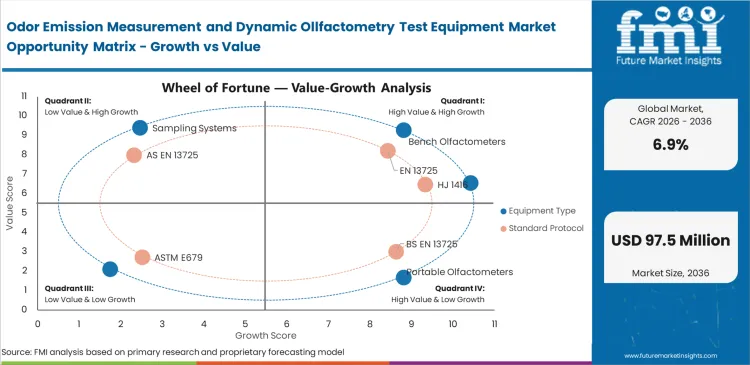
Compliance files now carry more weight in odor work than informal complaint management alone, and that is changing how laboratories, consultants, and plant environmental teams evaluate equipment timing. Systems are increasingly expected to support defensible source testing, clear panel control, and documentation that can stand up during permit review or dispute resolution. Spending therefore rises when equipment age begins to weaken reporting confidence, even if the installed unit remains operational. Replacement activity is also supported by method updates, wider odor scrutiny at wastewater and waste sites, and the need to connect treatment decisions with measured evidence rather than assumption.
Internal qualification burden remains the main brake on adoption. Laboratories do not replace olfactometry systems in the same way they replace routine bench instruments. Software migration, panel retraining, documentation continuity, and method consistency all require attention before a new setup is trusted for sensitive assignments. Smaller operators and occasional users often delay purchases for that reason, especially when legacy equipment still functions at a basic level. Service access can ease part of that burden, yet changeover still takes time because result continuity matters as much as purchase cost.
Opportunities in the Odor Emission Measurement and Dynamic Olfactometry Test Equipment Market
- Perimeter linkage: Interest in environmental sensors can create follow-on potential where operators want ambient trend data and laboratory-grade source confirmation to work together.
- Compliance pairing: Users working with continuous emission monitoring systems for other pollutants may widen odor-testing budgets when integrated reporting becomes easier across environmental programs.
- Utility expansion: Waste and municipal operators already investing in air quality monitoring systems can extend specialist testing coverage where source-based odor evidence is still missing from operating review.
Regional Analysis
Key Facts About Country
- With demand expected to grow at 8.3% CAGR through 2036, faster regulatory formalization and expanding testing capacity keep China at the front of this market.
- Rising environmental scrutiny and wastewater-linked testing needs position India among the stronger growth markets, with a projected 8% CAGR through 2036.
- Clear standards adoption and utility-driven testing programs support Australia’s steady expansion, With the market forecast to grow at 7.6% CAGR through 2036.
- With expansion estimated at 7.4% CAGR through 2036, established laboratory systems and emphasis on documentation discipline maintain Germany’s position as a leading European base.
- Permit-driven odor evaluation and consistent compliance activity keep the United Kingdom on a stable path, with demand projected to rise at 6.8% CAGR through 2036.
- Concentrated industrial activity and multi-party technical review sustain the demand in Netherlands, which is expected to expand at 6.6% CAGR through 2036.
- With demand projected at 5.9% CAGR through 2036, mature installed systems and selective upgrade cycles place the United States in a slower growth bracket.
Based on the regional analysis, the Odor Emission Measurement and Dynamic Olfactometry Test Equipment Market is segmented into North America, Latin America, Western Europe, Eastern Europe, East Asia, South Asia & Pacific, and Middle East & Africa across 40 plus countries.
.webp "Top Country Growth Comparison Odor Emission Measurement And Dynamic Ollfactometry Test Equipment Market Cagr (2026 2036)")
| Country | CAGR (2026 to 2036) |
|---|---|
| China | 8.3% |
| India | 8.0% |
| Australia | 7.6% |
| Germany | 7.4% |
| United Kingdom | 6.8% |
| Netherlands | 6.6% |
| United States | 5.9% |
Source: Future Market Insights (FMI) analysis, based on proprietary forecasting model and primary research
Europe Odor Emission Measurement and Dynamic Olfactometry Test Equipment Market Analysis
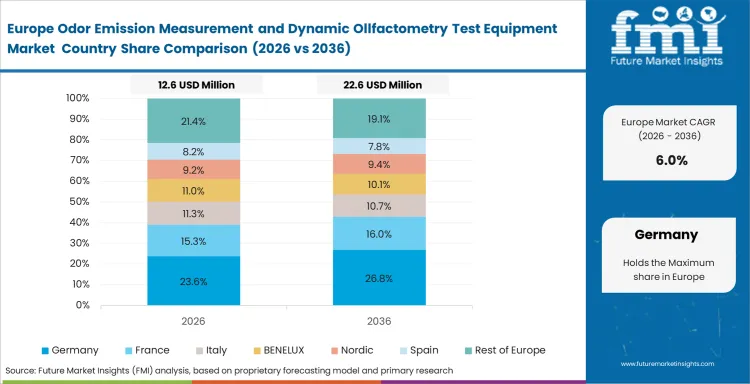
Europe industry outlook remains tied to established laboratory practice, a mature consulting base, and permit cultures that place real weight on documented odor evidence rather than informal odor narratives. Replacement activity in this region usually begins with audit readiness and method continuity, then extends into software, accessories, and panel-control upgrades once laboratories commit to renewal. Western Europe continues to serve as the clearest reference base for users seeking equipment that fits established olfactometric routines and multi-party technical review. Utilities, waste handlers, industrial operators, and consultants all influence equipment selection, yet specialist laboratories still guide final preference because they carry the reporting burden. Related needs across wastewater treatment chemicals and odor-intensive treatment operations keep Europe relevant, as measurement often comes before capital decisions on treatment changes.
- Germany: Accredited laboratory discipline gives Germany a strong base for replacement-led activity, and odor-testing practice in the country remains closely tied to method defensibility. Industry outlook in Germany is expected to advance at a CAGR of 7.4% from 2026 to 2036 because laboratories are not only adding capacity but also renewing installed systems when documentation standards tighten and cross-laboratory consistency becomes harder to maintain on older setups. Environmental labs and consultants usually favor equipment that supports repeat sessions, software continuity, and dependable service access. Need for odor measurement around sludge handling equipment operations adds further relevance where wastewater processing and solids management draw closer odor scrutiny. Germany’s position rests on method discipline and service expectations rather than scale alone.
- United Kingdom: Permit-led odor review remains a practical trigger for equipment renewal in the United Kingdom, where operators often need source evidence before mitigation choices are accepted internally or externally. Serviceability concerns and reporting quality therefore carry more weight than simple age-based replacement. Consultants and laboratory teams working around waste sites, utilities, and industrial emitters place strong emphasis on reporting clarity, panel management, and support response when new systems are evaluated, and that pattern leaves the country on a 6.8% CAGR path during the 2026 to 2036 forecast period. Odor questions around municipal sludge dewatering equipment and related handling activity keep specialist testing relevant. Reliable documentation continues to matter when cases become contentious and review standards tighten.
- Netherlands: Dense industrial activity and waste-processing exposure give the Netherlands a practical reason to maintain specialist odor-testing capability even though the country is smaller than several neighboring demand bases. Laboratories and consultancies often need systems that can move efficiently between repeat project work and permit-linked assignments without losing comparability. Buyers remain careful on capital timing, yet they also place high value on service continuity and method consistency because Dutch projects frequently involve technical review from multiple parties. Expansion in the Netherlands is forecast at a CAGR of 6.6% from 2026 to 2036. Need for odor evidence around water and wastewater treatment chemicals use environments supports steady replacement activity, and smaller scale does not reduce the need for defensible results.
FMI’s report includes Benelux and Nordic regions. Testing activity in those areas often supports cross-border consulting work, municipal utilities, waste handling, and industrial source review. Laboratories in these geographies frequently prioritize equipment compatibility with established European practice, which keeps replacement decisions tied closely to method continuity and service access.
Asia Pacific Odor Emission Measurement and Dynamic Olfactometry Test Equipment Market Analysis
Installed base expansion carries more weight in Asia Pacific than pure replacement cycles because several countries here are still building specialist odor-testing capability from a lower starting point. Laboratories and consultants across the region are balancing method adoption, staffing depth, service availability, and cost discipline at the same time. Result quality still sits at the center of the decision, yet equipment selection also depends on how quickly teams can train panelists, stabilize reporting routines, and keep systems running without long support delays. Asia Pacific offers the widest upside where compliance practice is becoming more formal and odor-intensive sectors such as wastewater, waste handling, composting, and biogas require more measured evidence. Broader investment across biogas operations add to that need because odor verification often sits alongside process review and community-impact assessment.
- China: Method formalization is advancing faster in China than in many comparable markets, giving laboratories and environmental service providers a stronger reason to invest in dedicated olfactometry systems instead of relying on limited legacy setups. Installed base is still widening, which gives suppliers room to serve both first-time users and laboratories upgrading into more dependable panel-control and dilution systems. Odor-sensitive activity across waste treatment, industrial operations, and municipal services supports repeat project flow, and that commercial setting is expected to keep China at a CAGR of 8.3% during the 2026 to 2036 forecast period. Additional need around food waste composting machines also supports specialist testing where treatment sites must balance operating performance with community tolerance. China’s pace reflects formalization and widening application depth working together.
- India: Wastewater expansion, urban service pressure, and wider environmental review are giving India a larger role in odor measurement than its installed base suggested a few years ago. Many users remain careful on spending, yet they still need systems that can support client reporting without excessive recalibration burden or weak documentation. Sector outlook in India indicates 8.0% CAGR from 2026 to 2036 because laboratories, consultants, and plant environmental teams continue to prefer equipment that combines stable dilution control with manageable service support. Specialist resources are not evenly distributed across the country, which makes execution quality especially important in system selection. Odor-check requirements around compost turning machines and organic waste operations also add relevance. India is rising from a smaller base, and that gives capable suppliers room to build position where support depth matches field needs.
- Australia: Standards adoption gives Australia a clearer route for specialist system selection, and that clarity helps laboratories justify investment when older setups are refreshed or method coverage is expanded. Distance still affects support timing, so service access and training remain important in buying decisions. Utilities, consultants, and environmental laboratories often look for systems that fit recognized practice and can support repeat source-testing work across landfill, wastewater, and industrial operations. Market outlook in Australia is projected to advance at a CAGR of 7.6% from 2026 to 2036. Spending linked with air pollution control review also keeps odor verification relevant where treatment effectiveness must be demonstrated. Australia’s appeal comes from clarity of use and method alignment rather than broad market size.
FMI’s report includes East Asia and South Asia & Pacific countries beyond those highlighted above. Several of these markets are still building laboratory depth, which means service coverage, training support, and accessory availability can matter almost as much as instrument performance at the point of purchase. Users who solve those execution issues early are likely to widen system use faster than peers relying on ad hoc testing practice.
North America Odor Emission Measurement and Dynamic Olfactometry Test Equipment Market Analysis
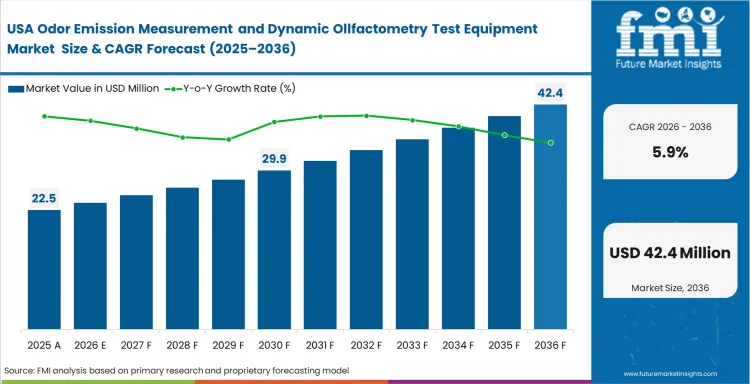
North America remains a meaningful demand base, though equipment choice often reflects a more mixed method environment than in Europe. Laboratories and consultants in this region weigh practical reporting needs, service response, and familiarity with existing operating routines carefully before installed systems are replaced. Valuation can still expand where odor work is recurrent and defensible source data is needed across waste, wastewater, and industrial assignments, yet replacement timing remains more selective than in the strongest European bases. Pace in North America is slower mainly because adoption is less concentrated within one dominant method tradition. Interest in adjacent tools such as FTIR gas analysers can support broader environmental testing budgets, yet dynamic olfactometry still competes for capital with other monitoring priorities.
-
United States: Consultant-led project work, municipal utility requirements, and industrial odor disputes all create room for specialist test equipment in the United States, yet buying patterns are spread across more varied use cases than in Europe. Laboratories and service providers need systems that can deliver dependable documentation without creating a large retraining burden for established teams. A mature installed base limits first-time buildout potential, which is why spending leans more toward targeted upgrades, accessory renewal, and carefully timed replacement. United States is forecast to register a CAGR of 5.9% from 2026 to 2036. Environmental programs tied to natural gas analyzers and other monitoring tools can compete for the same budget pool, so odor-testing investment tends to move faster where users can link it directly to a clear operating need.
FMI’s report includes Canada, Mexico, and other North American demand centers alongside the United States. Regional valuation often rises where utilities, waste operators, and industrial sites need defensible odor evidence, yet purchase timing can remain selective because laboratories continue to weigh replacement risk against ongoing use of serviceable installed systems.
Competitive Aligners for Market Players
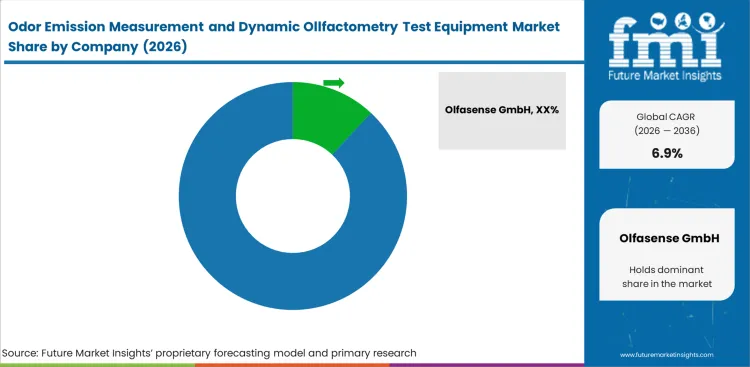
Competition in this category remains dispersed because laboratories and consultants are not choosing from a broad pool of general-purpose instrument vendors. Preference usually narrows to a small specialist group, accredited testing organizations with equipment capability, and suppliers that understand how odor results are documented and reviewed in practice. Olfasense GmbH, Scentroid, Odournet, St. Croix Sensory, LOD Srl, Silsoe Odours Ltd, and InterCinD / Lab Service Analytica S.r.l. all operate within that specialist space. Method fit, repeatability, software usability, service response, and confidence in review-stage performance do more to separate stronger suppliers from weaker ones than sheer scale.
Established suppliers hold an advantage when hardware knowledge is backed by dependable service support, training familiarity, and experience with specialist odor-testing routines. Laboratories replacing equipment rarely look for an instrument alone. Lower transition risk, steadier calibration practice, and fewer reporting surprises after installation usually matter more. Challenger brands can still build ground where laboratories are adding new capacity, where field-oriented portability carries more weight, or where price discipline is tighter. Wider entry remains difficult mainly because laboratories are cautious about taking method risk in sensitive assignments.
Laboratory leverage remains meaningful because full replacement can be delayed, upgrades can be staged over time, and spending can be split between core hardware and accessories instead of moving to a complete system at once. Long replacement cycles also limit the pace at which any one supplier can build dominant control. Competitive conditions through 2036 are therefore expected to remain balanced between specialist credibility and service execution. Suppliers that reduce changeover burden and keep reporting confidence intact are likely to be in a stronger position than those competing mainly on headline price.
Key Players in Odor Emission Measurement and Dynamic Olfactometry Test Equipment Market
- Olfasense GmbH
- Scentroid
- Odournet
- St. Croix Sensory, Inc.
- LOD Srl
- Silsoe Odours Ltd
- InterCinD / Lab Service Analytica S.r.l.
- TOXPRO SA
- Odotech Inc.
- Ecoma GmbH
Scope of the Report
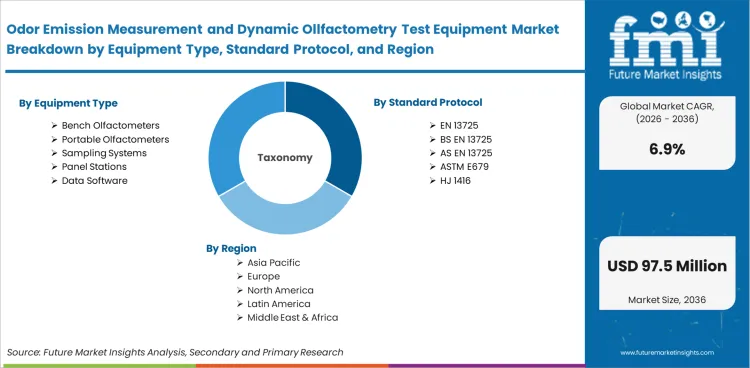
| Metric | Value |
|---|---|
| Quantitative Units | USD 46.8 million to USD 91.2 million, at a CAGR of 6.90% |
| Market Definition | Equipment and software used for source-based odor emission measurement through dynamic olfactometry. Coverage includes olfactometers, sampling systems, panel stations, and related components tied directly to reportable odor testing. |
| Equipment Type Segmentation | Bench Olfactometers, Portable Olfactometers, Sampling Systems, Panel Stations, Data Software |
| Standard Protocol Segmentation | EN 13725, BS EN 13725, AS EN 13725, ASTM E679, HJ 1416 |
| End User Segmentation | Environmental Labs, Industrial Plants, Consultancies, Utilities, Universities |
| Application Segmentation | Stack Emissions, Biofilters, Fugitive Sources, WWTPs, Landfills |
| Component Segmentation | Dilution Units, Sampling Bags, Lung Samplers, Calibration Gases, Control Software |
| Regions Covered | North America, Latin America, Western Europe, Eastern Europe, East Asia, South Asia & Pacific, Middle East & Africa |
| Countries Covered | China, India, Australia, Germany, United Kingdom, Netherlands, United States, and 40 plus countries |
| Key Companies Profiled | Olfasense GmbH, Scentroid, Odournet, St. Croix Sensory, Inc., LOD Srl, Silsoe Odours Ltd, InterCinD / Lab Service Analytica S.r.l., TOXPRO SA, Odotech Inc., Ecoma GmbH |
| Forecast Period | 2026 to 2036 |
| Approach | FMI combined specialist installed-base review, application mapping, and replacement-cycle assessment to size this market. Primary work centered on laboratory, consultant, utility, and plant-side interviews. Forecasts were checked against standards migration, buyer-use patterns, and supplier presence across core geographies. |
Source: Future Market Insights (FMI) analysis, based on proprietary forecasting model and primary research
Odor Emission Measurement and Dynamic Olfactometry Test Equipment Market Analysis by Segments
Equipment Type
- Bench Olfactometers
- Portable Olfactometers
- Sampling Systems
- Panel Stations
- Data Software
Standard Protocol
- EN 13725
- BS EN 13725
- AS EN 13725
- ASTM E679
- HJ 1416
End User
- Environmental Labs
- Industrial Plants
- Consultancies
- Utilities
- Universities
Application
- Stack Emissions
- Biofilters
- Fugitive Sources
- WWTPs
- Landfills
Component
- Dilution Units
- Sampling Bags
- Lung Samplers
- Calibration Gases
- Control Software
Region
- North America
- Western Europe
- South Asia & Pacific
- East Asia
- Latin America
- Eastern Europe
- Middle East & Africa
Bibliography
- Environment Agency. (2025, December 3). Odour management: comply with your environmental permit. GOV.UK.
- Standards Australia. (2025, June). AS EN 13725:2025 Stationary source emissions-Determination of odour concentration by dynamic olfactometry and odour emission rate. Standards Australia.
- Hessisches Landesamt für Naturschutz, Umwelt und Geologie. (2024, December). Annual Report Proficiency Tests 2024. HLNUG.
- World Association for Odour Management. (2025, June 9). Australia Fully Adopts the European Standard with AS EN 13725:2025. Olores.org.
- Ministry of Ecology and Environment of the People’s Republic of China. (2025, April 27). 生态环境部一周要闻(4.20-4.26). MEE.
This bibliography is provided for reader reference. The full FMI report contains the complete reference list with primary source documentation.
This Report Addresses
- Market intelligence to support decision-making across olfactometers, source sampling systems, panel stations, and control software used in specialist odor testing.
- Market size estimation and 10-year valuation forecasts from 2026 to 2036, supported by installed-base review, replacement timing, and application mapping.
- Opportunity mapping across Equipment Type, Standard Protocol, End User, Application, and Component with emphasis on laboratory replacement needs and permit-linked testing use.
- Segment and regional valuation outlook covering bench olfactometers, EN 13725, environmental labs, stack emissions, and dilution units across core odor-testing geographies.
- Competition assessment including method fit, service response, software usability, training burden, and reporting confidence.
- Product and capability tracking including dynamic olfactometry systems, source sampling hardware, panel-control tools, software modules, and dilution units.
- Market access analysis covering standards-led buying behavior, laboratory acceptance criteria, consultant use patterns, and permit-facing source-testing practice.
- Report delivery in PDF, Excel, PPT, and interactive dashboard formats for executive planning, laboratory investment review, and operating comparison.
Frequently Asked Questions
How large is the Odor Emission Measurement and Dynamic Olfactometry Test Equipment Market in 2026?
FMI estimates the market at USD 46.8 million in 2026. Size remains limited because this is a specialist testing category rather than a broad environmental instrumentation field.
What will the market be valued at by 2036?
Valuation is expected to reach USD 91.2 million by 2036. Expansion comes from replacement demand, wider laboratory use, and more regular source-testing activity.
What CAGR is projected for the market?
FMI projects a CAGR of 6.9% from 2026 to 2036. Pace remains steady because buyers usually adopt through qualification and replacement cycles rather than rapid one-time rollout.
Which Equipment Type segment leads the market?
Bench olfactometers lead Equipment Type and are expected to account for 42% share in 2026.
Which Standard Protocol segment leads the market?
EN 13725 leads the Standard Protocol mix and is anticipated to represent 58% of the market in 2026.
Which End User segment leads the market?
Environmental labs lead the End User mix and are likely to secure 38% share in 2026.
What supports market expansion at this pace?
Permit-linked odor work is becoming more measurement-led, which raises the value of reliable test hardware.
What is the main restraint in this market?
System changeover is the main restraint. Buyers must protect method continuity, train panels, align software records, and avoid disruption to ongoing assignments.
Which country records the fastest pace through 2036?
China leads with 8.3% CAGR. Faster method formalization and a smaller starting installed base give it more room to widen specialist testing capacity than mature markets.
Why does standards alignment matter so much in this market?
Standards alignment affects more than a laboratory’s wording. It shapes equipment choice, buyer confidence, panel routines, and whether results will be accepted across multiple reviewing parties.
What product change is influencing equipment buying most?
Core-system renewal is influencing buying more than accessory-only spend.
How is competition decided among suppliers?
Buyers usually compare method fit, repeatability, service response, and reporting usability rather than price alone.
Why does China outrank India in pace?
China combines faster formalization with broader industrial and municipal testing demand.
Why is India still one of the faster-rising countries?
India is building from a lower installed base, which gives more room for first-time adoption.
What explains Australia’s above-average outlook?
Australia benefits from clearer method adoption and a more straightforward route for buyers selecting recognized testing setups.
Why does Germany remain a leading European base?
Germany combines strong laboratory practice with a buyer preference for documentation discipline and repeatability.
What keeps the United Kingdom relevant in this category?
Permit-facing odor review keeps source evidence important in the United Kingdom.
Why does the Netherlands matter despite its smaller size?
Dutch demand is supported by concentrated industrial and utility activity plus multi-party technical review.
Preview the report firsthand - request a free sample
Get SampleGet the brochure for pricing and purchase details.
Get PDFTable of Content
- Executive Summary
- Global Market Outlook
- Demand-side Trends
- Supply-side Trends
- Technology Roadmap Analysis
- Analysis and Recommendations
- Market Overview
- Market Coverage / Taxonomy
- Market Definition / Scope / Limitations
- Research Methodology
- Chapter Orientation
- Analytical Lens and Working Hypotheses
- Market Structure, Signals, and Trend Drivers
- Benchmarking and Cross-market Comparability
- Market Sizing, Forecasting, and Opportunity Mapping
- Research Design and Evidence Framework
- Desk Research Programme (Secondary Evidence)
- Company Annual and Sustainability Reports
- Peer-reviewed Journals and Academic Literature
- Corporate Websites, Product Literature, and Technical Notes
- Earnings Decks and Investor Briefings
- Statutory Filings and Regulatory Disclosures
- Technical White Papers and Standards Notes
- Trade Journals, Industry Magazines, and Analyst Briefs
- Conference Proceedings, Webinars, and Seminar Materials
- Government Statistics Portals and Public Data Releases
- Press Releases and Reputable Media Coverage
- Specialist Newsletters and Curated Briefings
- Sector Databases and Reference Repositories
- FMI Internal Proprietary Databases and Historical Market Datasets
- Subscription Datasets and Paid Sources
- Social Channels, Communities, and Digital Listening Inputs
- Additional Desk Sources
- Expert Input and Fieldwork (Primary Evidence)
- Primary Modes
- Qualitative Interviews and Expert Elicitation
- Quantitative Surveys and Structured Data Capture
- Blended Approach
- Social and Community Interactions
- Primary Modes
- Stakeholder Universe Engaged
- C-suite Leaders
- Board Members
- Presidents and Vice Presidents
- R&D and Innovation Heads
- Technical Specialists
- Domain Subject-matter Experts
- Scientists
- Physicians and Other Healthcare Professionals
- Governance, Ethics, and Data Stewardship
- Research Ethics
- Data Integrity and Handling
- Desk Research Programme (Secondary Evidence)
- Tooling, Models, and Reference Databases
- Data Engineering and Model Build
- Data Acquisition and Ingestion
- Cleaning, Normalisation, and Verification
- Synthesis, Triangulation, and Analysis
- Quality Assurance and Audit Trail
- Market Background
- Market Dynamics
- Drivers
- Restraints
- Opportunity
- Trends
- Scenario Forecast
- Demand in Optimistic Scenario
- Demand in Likely Scenario
- Demand in Conservative Scenario
- Opportunity Map Analysis
- Product Life Cycle Analysis
- Supply Chain Analysis
- Investment Feasibility Matrix
- Value Chain Analysis
- Historical Market Size Value (USD Million) Analysis By Equipment Type , 2021 to 2025
- Current and Future Market Size Value (USD Million) Analysis and Forecast By Equipment Type , 2026 to 2036
- Bench Olfactometers
- Portable Olfactometers
- Sampling Systems
- Panel Stations
- Data Software
- Bench Olfactometers
- Y-o-Y Growth Trend Analysis By Equipment Type , 2021 to 2025
- Absolute $ Opportunity Analysis By Equipment Type , 2026 to 2036
- Market Dynamics
- Global Market Analysis 2021 to 2025 and Forecast 2026 to 2036, By Standard Protocol
- Introduction / Key Findings
- Historical Market Size Value (USD Million) Analysis By Standard Protocol, 2021 to 2025
- Current and Future Market Size Value (USD Million) Analysis and Forecast By Standard Protocol, 2026 to 2036
- EN 13725
- BS EN 13725
- AS EN 13725
- ASTM E679
- HJ 1416
- EN 13725
- Y-o-Y Growth Trend Analysis By Standard Protocol, 2021 to 2025
- Absolute $ Opportunity Analysis By Standard Protocol, 2026 to 2036
- Global Market Analysis 2021 to 2025 and Forecast 2026 to 2036, By End User
- Introduction / Key Findings
- Historical Market Size Value (USD Million) Analysis By End User, 2021 to 2025
- Current and Future Market Size Value (USD Million) Analysis and Forecast By End User, 2026 to 2036
- Environmental Labs
- Industrial Plants
- Consultancies
- Utilities
- Universities
- Environmental Labs
- Y-o-Y Growth Trend Analysis By End User, 2021 to 2025
- Absolute $ Opportunity Analysis By End User, 2026 to 2036
- Global Market Analysis 2021 to 2025 and Forecast 2026 to 2036, By Application
- Introduction / Key Findings
- Historical Market Size Value (USD Million) Analysis By Application, 2021 to 2025
- Current and Future Market Size Value (USD Million) Analysis and Forecast By Application, 2026 to 2036
- Stack Emissions
- Biofilters
- Fugitive Sources
- WWTPs
- Landfills
- Stack Emissions
- Y-o-Y Growth Trend Analysis By Application, 2021 to 2025
- Absolute $ Opportunity Analysis By Application, 2026 to 2036
- Global Market Analysis 2021 to 2025 and Forecast 2026 to 2036, By Component
- Introduction / Key Findings
- Historical Market Size Value (USD Million) Analysis By Component, 2021 to 2025
- Current and Future Market Size Value (USD Million) Analysis and Forecast By Component, 2026 to 2036
- Dilution Value (USD Million)s
- Sampling Bags
- Lung Samplers
- Calibration Gases
- Control Software
- Dilution Value (USD Million)s
- Y-o-Y Growth Trend Analysis By Component, 2021 to 2025
- Absolute $ Opportunity Analysis By Component, 2026 to 2036
- Global Market Analysis 2021 to 2025 and Forecast 2026 to 2036, By Region
- Introduction
- Historical Market Size Value (USD Million) Analysis By Region, 2021 to 2025
- Current Market Size Value (USD Million) Analysis and Forecast By Region, 2026 to 2036
- North America
- Latin America
- Western Europe
- Eastern Europe
- East Asia
- South Asia and Pacific
- Middle East & Africa
- Market Attractiveness Analysis By Region
- North America Market Analysis 2021 to 2025 and Forecast 2026 to 2036, By Country
- Historical Market Size Value (USD Million) Trend Analysis By Market Taxonomy, 2021 to 2025
- Market Size Value (USD Million) Forecast By Market Taxonomy, 2026 to 2036
- By Country
- USA
- Canada
- Mexico
- By Equipment Type
- By Standard Protocol
- By End User
- By Application
- By Component
- By Country
- Market Attractiveness Analysis
- By Country
- By Equipment Type
- By Standard Protocol
- By End User
- By Application
- By Component
- Key Takeaways
- Latin America Market Analysis 2021 to 2025 and Forecast 2026 to 2036, By Country
- Historical Market Size Value (USD Million) Trend Analysis By Market Taxonomy, 2021 to 2025
- Market Size Value (USD Million) Forecast By Market Taxonomy, 2026 to 2036
- By Country
- Brazil
- Chile
- Rest of Latin America
- By Equipment Type
- By Standard Protocol
- By End User
- By Application
- By Component
- By Country
- Market Attractiveness Analysis
- By Country
- By Equipment Type
- By Standard Protocol
- By End User
- By Application
- By Component
- Key Takeaways
- Western Europe Market Analysis 2021 to 2025 and Forecast 2026 to 2036, By Country
- Historical Market Size Value (USD Million) Trend Analysis By Market Taxonomy, 2021 to 2025
- Market Size Value (USD Million) Forecast By Market Taxonomy, 2026 to 2036
- By Country
- Germany
- UK
- Italy
- Spain
- France
- Nordic
- BENELUX
- Rest of Western Europe
- By Equipment Type
- By Standard Protocol
- By End User
- By Application
- By Component
- By Country
- Market Attractiveness Analysis
- By Country
- By Equipment Type
- By Standard Protocol
- By End User
- By Application
- By Component
- Key Takeaways
- Eastern Europe Market Analysis 2021 to 2025 and Forecast 2026 to 2036, By Country
- Historical Market Size Value (USD Million) Trend Analysis By Market Taxonomy, 2021 to 2025
- Market Size Value (USD Million) Forecast By Market Taxonomy, 2026 to 2036
- By Country
- Russia
- Poland
- Hungary
- Balkan & Baltic
- Rest of Eastern Europe
- By Equipment Type
- By Standard Protocol
- By End User
- By Application
- By Component
- By Country
- Market Attractiveness Analysis
- By Country
- By Equipment Type
- By Standard Protocol
- By End User
- By Application
- By Component
- Key Takeaways
- East Asia Market Analysis 2021 to 2025 and Forecast 2026 to 2036, By Country
- Historical Market Size Value (USD Million) Trend Analysis By Market Taxonomy, 2021 to 2025
- Market Size Value (USD Million) Forecast By Market Taxonomy, 2026 to 2036
- By Country
- China
- Japan
- South Korea
- By Equipment Type
- By Standard Protocol
- By End User
- By Application
- By Component
- By Country
- Market Attractiveness Analysis
- By Country
- By Equipment Type
- By Standard Protocol
- By End User
- By Application
- By Component
- Key Takeaways
- South Asia and Pacific Market Analysis 2021 to 2025 and Forecast 2026 to 2036, By Country
- Historical Market Size Value (USD Million) Trend Analysis By Market Taxonomy, 2021 to 2025
- Market Size Value (USD Million) Forecast By Market Taxonomy, 2026 to 2036
- By Country
- India
- ASEAN
- Australia & New Zealand
- Rest of South Asia and Pacific
- By Equipment Type
- By Standard Protocol
- By End User
- By Application
- By Component
- By Country
- Market Attractiveness Analysis
- By Country
- By Equipment Type
- By Standard Protocol
- By End User
- By Application
- By Component
- Key Takeaways
- Middle East & Africa Market Analysis 2021 to 2025 and Forecast 2026 to 2036, By Country
- Historical Market Size Value (USD Million) Trend Analysis By Market Taxonomy, 2021 to 2025
- Market Size Value (USD Million) Forecast By Market Taxonomy, 2026 to 2036
- By Country
- Kingdom of Saudi Arabia
- Other GCC Countries
- Turkiye
- South Africa
- Other African Union
- Rest of Middle East & Africa
- By Equipment Type
- By Standard Protocol
- By End User
- By Application
- By Component
- By Country
- Market Attractiveness Analysis
- By Country
- By Equipment Type
- By Standard Protocol
- By End User
- By Application
- By Component
- Key Takeaways
- Key Countries Market Analysis
- USA
- Pricing Analysis
- Market Share Analysis, 2025
- By Equipment Type
- By Standard Protocol
- By End User
- By Application
- By Component
- Canada
- Pricing Analysis
- Market Share Analysis, 2025
- By Equipment Type
- By Standard Protocol
- By End User
- By Application
- By Component
- Mexico
- Pricing Analysis
- Market Share Analysis, 2025
- By Equipment Type
- By Standard Protocol
- By End User
- By Application
- By Component
- Brazil
- Pricing Analysis
- Market Share Analysis, 2025
- By Equipment Type
- By Standard Protocol
- By End User
- By Application
- By Component
- Chile
- Pricing Analysis
- Market Share Analysis, 2025
- By Equipment Type
- By Standard Protocol
- By End User
- By Application
- By Component
- Germany
- Pricing Analysis
- Market Share Analysis, 2025
- By Equipment Type
- By Standard Protocol
- By End User
- By Application
- By Component
- UK
- Pricing Analysis
- Market Share Analysis, 2025
- By Equipment Type
- By Standard Protocol
- By End User
- By Application
- By Component
- Italy
- Pricing Analysis
- Market Share Analysis, 2025
- By Equipment Type
- By Standard Protocol
- By End User
- By Application
- By Component
- Spain
- Pricing Analysis
- Market Share Analysis, 2025
- By Equipment Type
- By Standard Protocol
- By End User
- By Application
- By Component
- France
- Pricing Analysis
- Market Share Analysis, 2025
- By Equipment Type
- By Standard Protocol
- By End User
- By Application
- By Component
- India
- Pricing Analysis
- Market Share Analysis, 2025
- By Equipment Type
- By Standard Protocol
- By End User
- By Application
- By Component
- ASEAN
- Pricing Analysis
- Market Share Analysis, 2025
- By Equipment Type
- By Standard Protocol
- By End User
- By Application
- By Component
- Australia & New Zealand
- Pricing Analysis
- Market Share Analysis, 2025
- By Equipment Type
- By Standard Protocol
- By End User
- By Application
- By Component
- China
- Pricing Analysis
- Market Share Analysis, 2025
- By Equipment Type
- By Standard Protocol
- By End User
- By Application
- By Component
- Japan
- Pricing Analysis
- Market Share Analysis, 2025
- By Equipment Type
- By Standard Protocol
- By End User
- By Application
- By Component
- South Korea
- Pricing Analysis
- Market Share Analysis, 2025
- By Equipment Type
- By Standard Protocol
- By End User
- By Application
- By Component
- Russia
- Pricing Analysis
- Market Share Analysis, 2025
- By Equipment Type
- By Standard Protocol
- By End User
- By Application
- By Component
- Poland
- Pricing Analysis
- Market Share Analysis, 2025
- By Equipment Type
- By Standard Protocol
- By End User
- By Application
- By Component
- Hungary
- Pricing Analysis
- Market Share Analysis, 2025
- By Equipment Type
- By Standard Protocol
- By End User
- By Application
- By Component
- Kingdom of Saudi Arabia
- Pricing Analysis
- Market Share Analysis, 2025
- By Equipment Type
- By Standard Protocol
- By End User
- By Application
- By Component
- Turkiye
- Pricing Analysis
- Market Share Analysis, 2025
- By Equipment Type
- By Standard Protocol
- By End User
- By Application
- By Component
- South Africa
- Pricing Analysis
- Market Share Analysis, 2025
- By Equipment Type
- By Standard Protocol
- By End User
- By Application
- By Component
- USA
- Market Structure Analysis
- Competition Dashboard
- Competition Benchmarking
- Market Share Analysis of Top Players
- By Regional
- By Equipment Type
- By Standard Protocol
- By End User
- By Application
- By Component
- Competition Analysis
- Competition Deep Dive
- Olfasense GmbH
- Overview
- Product Portfolio
- Profitability by Market Segments (Product/Age /Sales Channel/Region)
- Sales Footprint
- Strategy Overview
- Marketing Strategy
- Product Strategy
- Channel Strategy
- Scentroid
- Odournet
- St. Croix Sensory, Inc.
- LOD Srl
- Silsoe Odours Ltd
- InterCinD / Lab Service Analytica S.r.l.
- TOXPRO SA
- Odotech Inc.
- Ecoma GmbH
- Olfasense GmbH
- Competition Deep Dive
- Assumptions & Acronyms Used


