

- Industry Size (2026)
- USD 0.7 Bn
- Forecast (2036)
- USD 1.1 Bn
- CAGR (2026 to 2036)
- 5.4%
Water-Based Metal-Deco Beverage Can Inks Market Size, Market Forecast and Outlook By FMI
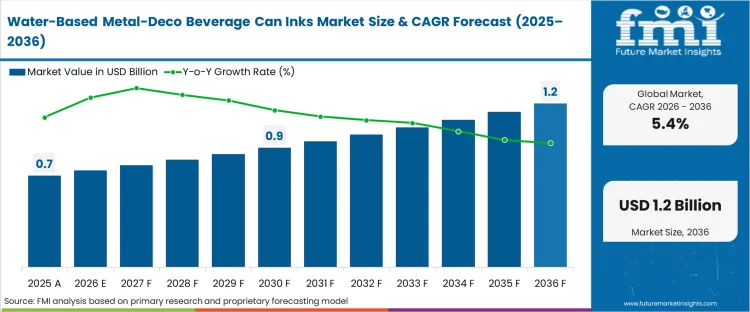
The water-based metal-deco beverage can inks market was valued at USD 0.6 billion in 2025. Sales are set to reach USD 0.7 billion in 2026 at a CAGR of 5.4% during the forecast period. Revenue expansion raises total valuation to USD 1.1 billion through 2036 as mandated VOC reduction schedules across North America and Europe filling lines force packaging engineers to phase out legacy solvent systems entirely.
Procurement directors at major beverage conglomerates face intense pressure from retail partners demanding verified Scope 3 emissions reductions on primary packaging. Delaying the transition toward VOC compliant inks for cans exposes brands to retail de-listing and impending carbon taxation across key Europe jurisdictions. Transitioning involves complex line qualification protocols, requiring complete revalidation of water based inks against high-speed abrasion tolerances. One non-obvious reality complicates this shift: aqueous formulas often require higher oven temperatures for rapid curing, partially offsetting the carbon benefits realized at the printing deck unless paired with modern heat-recovery infrastructure.
Greenfield can manufacturing facilities in Asia-Pacific trigger rapid adoption when they install aqueous-only curing lines as standard factory equipment. Complete phase-out of legacy solvent lines at tier-1 suppliers changes baseline economics, making eco friendly inks the default rather than a premium specialty. Facility-level standardization accelerates qualification cycles for new beverage SKUs globally, shifting the global beverage can demand forecast permanently toward low-emission production models.
Summary of Water-Based Metal-Deco Beverage Can Inks Market
- Water-Based Metal-Deco Beverage Can Inks Market Definition
- Aqueous pigment systems engineered for direct application on high-speed cylindrical aluminium or tinplate substrates, replacing volatile solvents to meet strict emission standards while surviving intense mechanical deformation during the aluminum can decoration process.
- Demand Drivers in the Market
- Regulatory phase-outs of legacy solvent systems compel facility managers to qualify sustainable packaging inks across all active production lines.
- Major beverage brands force procurement teams to reject packaging suppliers lacking verified low-emission printing infrastructure.
- Greenfield facility construction in emerging economies pushes plant engineers to install water-compatible curing ovens as baseline standard equipment.
- Key Segments Analyzed in the FMI Report
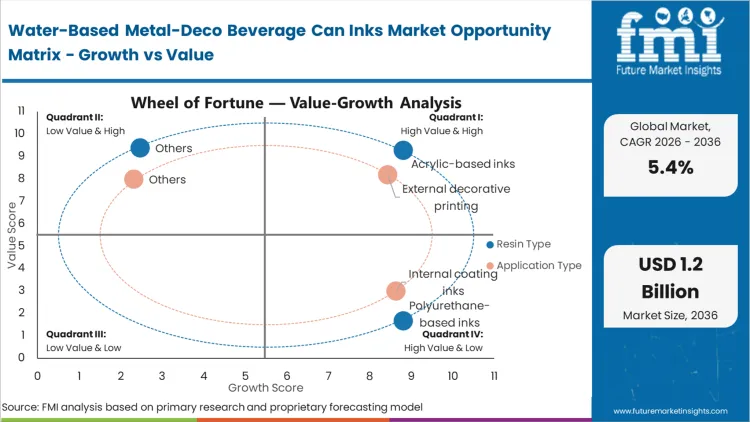
- Acrylic-based inks: The segment is projected to hold 48.2% share in 2026, driven by superior film-forming properties that achieve precise friction coefficients needed for rapid necking operations.
- External decorative printing: The segment is anticipated to lead application categories through 2036, commanding highest volume due to full-surface exterior branding requirements.
- India: India is set to register a CAGR of 7.4%, accelerated by localized capacity expansion in aluminium packaging bypassing legacy solvent setups entirely.
- Analyst Opinion at FMI
- Ismail Sutaria, Principal Analyst, Packaging, at FMI, points out that "Procurement teams model aqueous transition costs purely on price-per-kilogram volume metrics, treating the liquid as a direct swap. Plant operators understand the reality involves thermal economics, not just chemical prices when evaluating the UV vs water-based inks comparison. Aqueous systems require longer residence times or higher temperatures in curing ovens to evaporate water carriers effectively. Brands pushing to lower their overall packaging inks environmental impact often miss that lower VOCs at the printing deck can inadvertently spike natural gas consumption in the curing stage unless facilities simultaneously upgrade to advanced heat-recovery or hybrid UV systems."
- Strategic Implications / Executive Takeaways
- Plant managers face immediate requirements to re-profile oven temperatures across legacy equipment to handle higher latent heat of vaporization.
- Formulators must secure stable supplies of specialized amine solubilizers to prevent line stoppages during periods of chemical scarcity.
- Beverage brand managers risk significant launch delays if new label designs exceed the dot-gain tolerances of current aqueous printing plates.
- Methodology
- Primary Research: Chief chemists, plant operators, and sourcing directors at top packaging firms.
- Desk Research: ECHA compliance logs, Metal Packaging Europe bulletins, and industry association capacity records.
- Market-Sizing and Forecasting: Total aluminium can production volumes multiplied by standard ink weight ratios per unit.
- Data Validation and Update Cycle: Independent cross-referencing of global water borne inks trade flows against chemical supplier financial disclosures.
Water-Based Metal-Deco Beverage Can Inks Market Key Takeaways
| Metric | Details |
|---|---|
| Industry Size (2026) | USD 0.7 billion |
| Industry Value (2036) | USD 1.1 billion |
| CAGR (2026 to 2036) | 5.4% |
Source: Future Market Insights (FMI) analysis, based on proprietary forecasting model and primary research
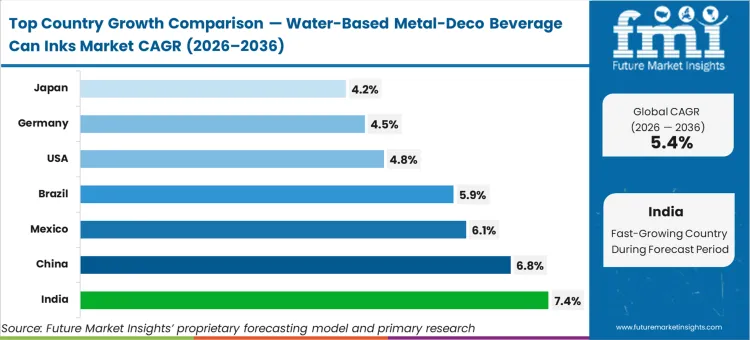
India leads at 7.4% as greenfield aluminium can plants bypass legacy solvent infrastructure entirely, driving significant India can packaging growth, while China tracks at 6.8% due to aggressive state-mandated emission controls on coastal manufacturing hubs. Mexico expands at 6.1% on the back of surging beer export volumes requiring compliant packaging. Brazil follows at 5.9% as domestic breweries upgrade filling speeds. United States capacity grows at 4.8% through forced substitution of aging print hardware. Germany advances at 4.5% under strict Europe chemical directives, leaving Japan to expand at 4.2% through incremental rheology improvements. Divergence across this range stems directly from whether regional capacity expands through new construction or retrofitting existing thermal ovens.
Definition
Water-based can inks are specialized aqueous pigment dispersions formulated specifically for high-speed application onto cylindrical aluminium or tinplate substrates. Their primary function centers on delivering visual branding and exterior protection while surviving extreme mechanical stress during the necking and flanging stages of container formation. Understanding exactly how are beverage cans printed involves recognizing that these aqueous systems replace volatile organic compounds with water and amine solubilizers to meet strict environmental emissions standards in high-volume packaging facilities.
Inclusions
Aqueous acrylic, polyurethane, and epoxy-modified dispersions formulated for exterior decoration of two-piece and three-piece beverage cans fall completely within scope. Formulations applied via high-speed offset ink decorators, overprint varnishes functioning as protective layers, and specialized base coats designed as printing inks for metal packaging are tracked under this analysis. Functional additives built into these aqueous platforms for slip control and abrasion resistance also contribute to overall volume metrics.
Exclusions
Solvent-borne coating formulas and UV-curable systems containing zero water content fall completely outside this tracking framework. Heavy-duty drum coatings sourced from general industrial inks suppliers, standard commercial printing supplies, and interior BPA free beverage linings designed solely for product contact without decorative function remain excluded. Analytical separation prevents overlap with general industrial coatings and architectural paint categories.
Water-Based Metal-Deco Beverage Can Inks Market Research Methodology
- Primary Research: Sourcing directors at tier-1 packaging conglomerates, plant managers overseeing high-speed printing lines, and chief chemists at resin synthesis firms.
- Desk Research: European Chemicals Agency (ECHA) VOC compliance filings, Metal Packaging Europe production bulletins, and Can Manufacturers Institute capacity expansion records.
- Market-Sizing and Forecasting: Global beverage can unit production volumes mapped against standard milligrams-per-can ink consumption ratios to build the beverage can inks size baseline.
- Data Validation and Update Cycle: Revenue triangulation against specialty ink resin shipment manifests and major chemical company divisional disclosures.
Segmental Analysis
Water-Based Metal-Deco Beverage Can Inks Market Analysis by Resin Type
Performance characteristics during mechanical deformation dictate resin selection at commercial printing facilities. Acrylic-based formulas dominate this category with 48.2% share in 2026, as FMI analysis indicates their specific cross-linking profile survives extreme necking operations without micro-fracturing, ensuring perfect ink adhesion on aluminum cans. Plant engineers at tier-1 can manufacturers specify acrylics because these polymers maintain precise slip coefficients required for 2000-can-per-minute transfer lines. Transitioning away from established acrylic baselines requires massive re-calibration of conveyor handling parameters, a disruption operations managers aggressively avoid. While buyers demand pure aqueous solutions for environmental reporting, hybrid formulas containing trace co-solvents actually deliver better overall life-cycle carbon metrics by allowing lower curing temperatures. Suppliers failing to perfect these hybrid rheology profiles face immediate disqualification during initial press trials.
- Slip coefficient validation: Tooling engineers calibrate high-speed conveyors based on exact surface friction generated by cured acrylic films. Altering resin chemistry forces complete mechanical re-tuning, causing unacceptable line downtime.
- Thermal energy penalty: Aqueous acrylics require higher latent heat for complete evaporation compared to legacy solvents. Operations managers face rising utility costs unless curing ovens undergo expensive heat-recovery retrofits.
- Micro-fracture resistance: Necking processes subject cured ink films to severe compression and stretching forces. Packaging technologists discard any formulation showing microscopic stress cracking during quality assurance testing.
Water-Based Metal-Deco Beverage Can Inks Market Analysis by Application Type
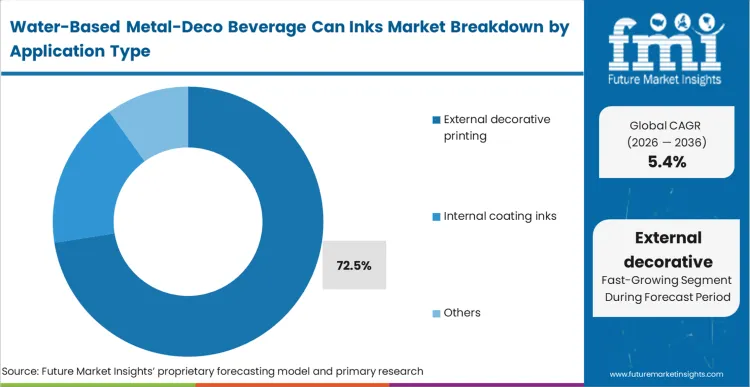
Brand visibility requirements dictate exterior surface coverage across all beverage categories, directly propelling metal deco inks growth. According to FMI's estimates, marketing directors at major beverage labels constantly push for higher opacity and sharper dot resolution on cans, directly testing the physical limits of aqueous pigment dispersion. Achieving solvent-like gloss levels using water-borne technology remains an ongoing operational challenge for press operators. External decorative printing captures a dominant 72.5% share in 2026, driven by continuous expansion in complex, multi-color branding demands. A crucial miscalculation often occurs in procurement: buyers evaluating the can printing cost per unit compare exterior ink costs per liter without factoring in the increased volume of overprint varnish required to protect aqueous pigments from downstream pasteurization damage. Press managers who fail to lay down sufficient protective layers experience catastrophic ink delamination during hot-fill processes.
- Gloss level parity: Marketing teams demand visual parity with legacy solvent prints. Formulation chemists struggle to match high-gloss expectations using pure aqueous systems, often requiring expensive specialty additives.
- Pasteurization survival: Hot-fill and retort sterilization processes subject exterior prints to boiling water and high pressure. Quality control directors reject batches if aqueous colors bleed or soften during thermal processing.
- Overprint varnish dependence: Aqueous pigments possess lower inherent scuff resistance than solvent counterparts. Procurement officers must authorize higher varnish consumption budgets to guarantee brand integrity during transit.
Water-Based Metal-Deco Beverage Can Inks Market Analysis by End-Use Beverage Type
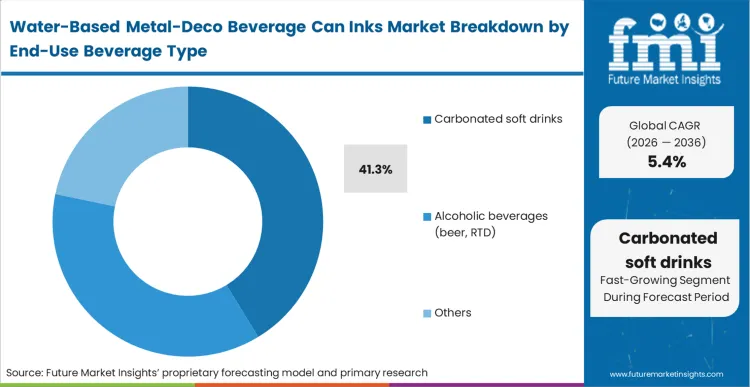
High-volume filling operations define consumption patterns across major beverage categories. Based on FMI's assessment, global procurement heads at top soda conglomerates leverage their immense volume requirements to force ink suppliers into absorbing raw material price volatility. Switching production to food safe inks for packaging on billions of units requires absolute batch-to-batch color consistency, a metric where water-based systems historically struggled against evaporation variables. A non-obvious practitioner reality centers on inventory shelf-life: aqueous formulas suffer from bacterial contamination risks during storage, requiring biocides that complicate food can coatings compliance in certain jurisdictions. Suppliers lacking robust antimicrobial stabilization protocols lose lucrative multi-year contracts when stored ink batches spoil before use. Carbonated soft drinks represent the largest application with 41.3% share in 2026, as massive global volumes dictate scale-driven purchasing.
- Color consistency mandates: Global soda brands enforce zero-tolerance delta-E color variation policies across all geographic filling locations. Press operators face extreme difficulty maintaining precise aqueous viscosity over long print runs.
- Biocide regulatory friction: Preventing bacterial degradation in water-based storage tanks requires chemical biocides. Regulatory affairs managers must navigate complex regional toxicity approvals to ensure inks remain legally compliant.
- Volume discount leverage: Soda conglomerates execute massive purchasing contracts based on scale economics. Tier-2 ink suppliers struggle to maintain profit margins when forced to match pricing structures dictated by volume leaders.
Water-Based Metal-Deco Beverage Can Inks Market Analysis by Printing Technology
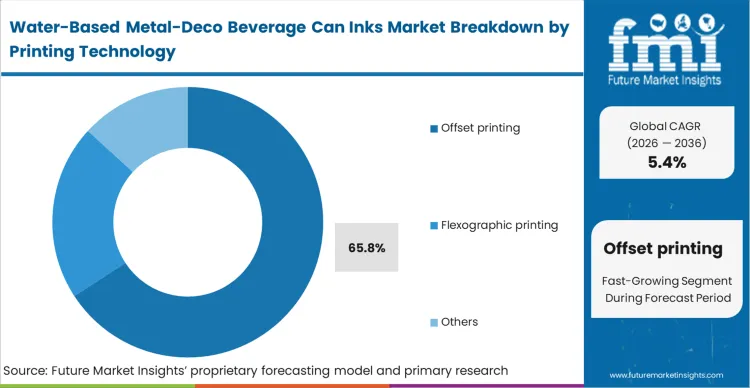
Equipment legacy heavily influences technological adoption curves across global production hubs. Offset printing maintains a 65.8% commanding share in 2026, primarily because existing mechanical infrastructure represents billions in sunken capital. In FMI's view, plant directors operate dry-offset decorators as the industry workhorse, relying heavily on specialized offset printing inks for cans to transfer complex images at blistering speeds through specialized blanket cylinders. Upgrading these massive machines to handle aqueous rheology requires replacing rubber blankets and modifying ink fountains, an intricate process maintenance teams execute during narrow shutdown windows. What generalists miss regarding digital printing for cans growth is that while digital excels at short-run personalization, direct-to-shape print heads still cannot match the sheer throughput velocity of rotary offset mechanics for flagship brands. Operations managers delaying necessary offset modifications to accommodate flexographic ink alternatives suffer significant yield drops during initial transition phases.
- Blanket swelling vulnerabilities: Aqueous chemistry interacts differently with traditional rubber transfer blankets than solvents do. Press maintenance crews must qualify new blanket materials to prevent dimensional distortion during long runs.
- Fountain roller calibration: Water evaporates rapidly from ink fountains under high-speed friction. Pressmen constantly monitor and adjust amine-water balances to prevent premature drying before substrate transfer.
- Digital throughput limitations: Short-run personalization campaigns utilize digital print heads effectively. Production directors restrict digital adoption to specialty SKUs because rotary offset remains unmatched for high-volume baseline output.
Water-Based Metal-Deco Beverage Can Inks Market Analysis by Curing Technology
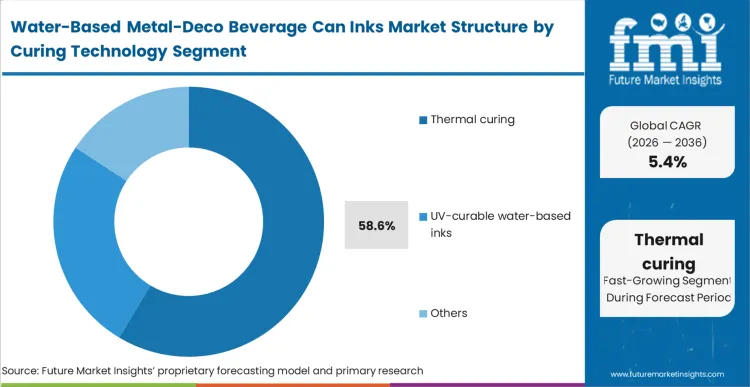
Thermal infrastructure dictates the baseline processing capacity for newly decorated aluminium containers. Thermal curing holds 58.6% share in 2026, as massive convection ovens remain standard fixtures inside packaging facilities worldwide. FMI analysts note that energy managers constantly battle the thermodynamics of evaporating water, which demands significantly more BTU input than flashing off volatile solvents. Lowering the carbon footprint of the ink chemistry inadvertently increases natural gas consumption in the curing stage unless facilities invest heavily in modern airflow designs. The practitioner reality complicating UV led curable inks adoption involves line-of-sight constraints specific to advanced ink curing technology for cans: UV lamps struggle to cure deep recesses near the can dome, restricting their use to specific straight-wall designs. Facilities failing to balance these thermal dynamics experience severe bottlenecks, piling up wet cans before they reach downstream spray stations.
- Evaporation energy penalties: Water requires massive energy input to achieve complete phase change inside convection ovens. Facility energy directors face spiked utility bills during initial transition periods away from solvent formulations.
- Line-of-sight constraints: Photoinitiators require direct light exposure to trigger polymerization. Engineering teams limit UV curing applications because complex can geometries block radiation from reaching specific bottom rim contours.
- Hybrid system economics: Combining thermal evaporation with terminal UV cross-linking solves multiple curing challenges. Capital expenditure committees hesitate to approve these expensive dual-system upgrades without guaranteed long-term volume contracts.
Water-Based Metal-Deco Beverage Can Inks Market Drivers, Restraints, and Opportunities
Strict water-based coatings regulations force plant operators to overhaul entire printing deck chemistries ahead of compliance deadlines. Europe and North America environmental agencies increasingly penalize legacy solvent emissions, creating severe financial liabilities for packaging conglomerates operating outdated thermal oxidizers. Purchasing directors can no longer negotiate delayed compliance timelines; they must secure reliable aqueous ink supplies to maintain uninterrupted factory output. Transitioning involves complex re-qualification of entire supply chains, replacing traditional solvents with specialized low migration ink solvents and amine solubilizers. Failure to lock in these critical raw materials leaves can manufacturers exposed to catastrophic production halts when local environmental inspectors mandate immediate emission reductions.
Latent heat of vaporization represents the fundamental physical friction slowing aqueous adoption across legacy packaging lines. Evaporating water demands significantly more thermal energy than flashing off industrial solvents, forcing existing convection ovens to operate at maximum capacity or drastically reduced line speeds. Plant engineers face a difficult operational compromise: accept slower throughput to ensure complete curing, or invest massive capital in upgraded high-efficiency oven infrastructure. Until equipment manufacturers design retrofit packages that adequately manage this thermal penalty without heavily impacting printing ink cost trends 2026, facility managers at older plants will resist fully abandoning their optimized solvent-based throughput rates.
Opportunities in the Water-Based Metal-Deco Beverage Can Inks Market
- Low-temperature curing formulation: Chemical R&D teams unlocking proprietary cross-linking mechanisms that cure at lower thermal thresholds capture massive interest from energy directors seeking to evaluate the best inks for high-speed printing while reducing natural gas consumption.
- Direct-to-shape hybrid digital integration: Formulators developing aqueous light changing packaging inks compatible with both rotary offset and secondary digital print heads enable brand managers to execute high-speed base decoration combined with late-stage localized personalization, defining the future of beverage can printing.
- Antimicrobial storage stabilization: Suppliers perfecting biocide-free stabilization techniques eliminate major regulatory hurdles for compliance officers, ensuring long-term shelf stability without triggering complex regional toxicity reviews during cross-border shipping.
Regional Analysis
.webp "Top Country Growth Comparison Water Based Metal Deco Beverage Can Inks Market Cagr (2026 2036)")
Based on regional analysis, water-based metal-deco beverage can inks market is segmented into North America, Latin America, Europe, Asia Pacific, and Middle East & Africa across 40 plus countries.
| Country | CAGR (2026 to 2036) |
|---|---|
| India | 7.4% |
| China | 6.8% |
| Mexico | 6.1% |
| Brazil | 5.9% |
| United States | 4.8% |
| Germany | 4.5% |
| Japan | 4.2% |
Source: Future Market Insights (FMI) analysis, based on proprietary forecasting model and primary research
Asia Pacific Water-Based Metal-Deco Beverage Can Inks Market Analysis
Greenfield capacity expansion defines the reality across Asian manufacturing hubs, where packaging conglomerates build entirely new facilities rather than retrofitting older plants. Unlike mature regions saddled with legacy solvent infrastructure, emerging markets install aqueous-compatible curing ovens and high-speed decorators as standard baseline equipment. According to FMI's estimates, this clean-slate approach eliminates the severe transitional downtime that plagues western operations. Plant directors capitalize on modern heat-recovery systems integrated directly into new build designs, bypassing the thermal energy penalties traditionally associated with water evaporation. This regional dynamic centers on aggressive volume scaling rather than incremental environmental compliance, driven by surging Asia beverage can growth and middle-class consumption patterns.
- India: Accelerated construction of advanced aluminium can manufacturing plants allows local operations directors to specify water-based chemistry from day one, avoiding retrofitting costs entirely. Sustained investment propels demand at 7.4% compound growth. Domestic suppliers capturing these initial greenfield equipment qualifications lock in highly lucrative, decade-long vendor relationships.
- China: Strict provincial volatile organic compound limits compel factory managers to strip legacy solvent infrastructure out of massive coastal packaging facilities. Revenue expansion hits 6.8% as compliance becomes non-negotiable. Exceeding these environmental mandates allows compliant tier-1 suppliers to aggressively consolidate share against smaller, undercapitalized competitors facing factory shutdowns.
- Japan: Highly saturated domestic beverage sectors rely on incremental formulation tweaks to boost ultra-high-speed press efficiency rather than raw capacity additions. Revenue advances at 4.2% as quality control directors demand absolute perfection in dot resolution. Achieving flawless print fidelity on complex tactile beverage packaging designs cements incumbent supplier dominance against foreign challengers.
North America Water-Based Metal-Deco Beverage Can Inks Market Analysis
Corporate sustainability pledges intersect sharply with aging mechanical infrastructure across major North America packaging networks. Major beverage brands demand immediate scope 3 emissions reductions, but operations managers struggle to squeeze aqueous chemistry through offset decorators installed decades ago. FMI observes that this tension forces procurement teams to negotiate complex shared-risk contracts with ink formulators, ensuring technical support remains on-site during painful line transitions. Modifying massive thermal oxidizers to handle higher water vapor loads requires significant capital expenditure, slowing the phase-out of hybrid semi-solvent systems. The transition relies heavily on advanced label adhesive systems and specialized amine chemistries to bridge the gap between outdated hardware and modern environmental requirements.
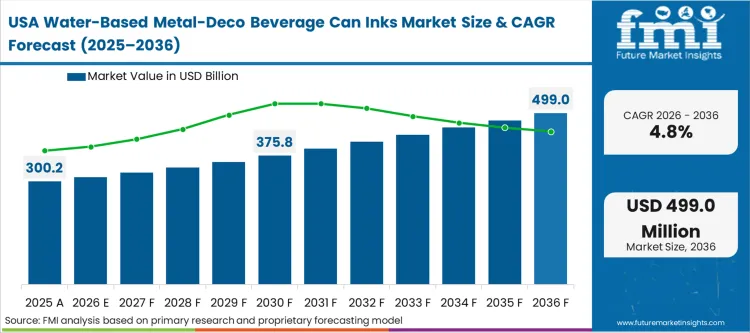
- United States: Forced substitution of aging print hardware combines with relentless retail pressure for sustainable packaging profiles, forcing compliance across massive multi-plant networks. Demand climbs at 4.8% as corporate mandates override localized factory resistance. Securing reliable local capacity from water based ink suppliers USA determines which facilities survive vendor consolidation audits.
FMI's report includes extensive coverage of Latin America and Western Europe dynamics, notably Mexico's 6.1% expansion fueled by surging beer packaging export demands and Germany's 4.5% trajectory shaped by strict continental chemical directives. Analyzing these specific regional mandates reveals that regulatory pressure consistently outpaces mechanical readiness, forcing constant operational compromises.
Competitive Aligners for Market Players
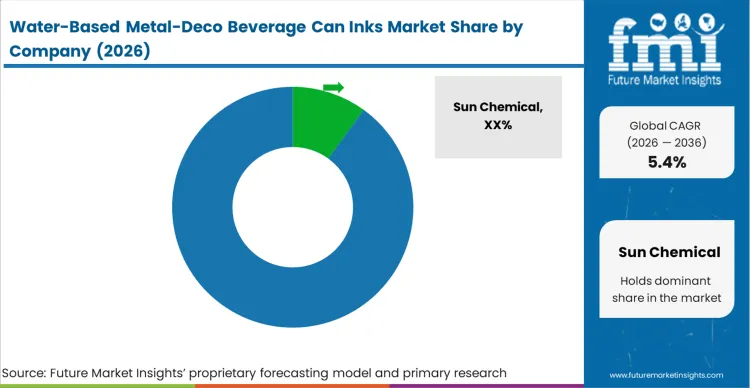
Chemical synthesis capabilities dictate competitive positioning far more than downstream distribution networks. Highly specialized resin architecture separates elite tier-1 suppliers appearing on any serious can ink manufacturers list from regional formulators attempting to enter the space. Operations managers at major beverage conglomerates refuse to qualify generic aqueous dispersions because microscopic variations in polymer cross-linking cause catastrophic jamming on 2000-can-per-minute transfer lines. Competing effectively requires mastering the specific rheological slip coefficients that allow aluminium substrates to slide perfectly through high-speed necking machinery without scratching the newly cured ink film. Buyers evaluate the top printing ink companies 2026 entirely on their ability to guarantee this flawless mechanical interaction across millions of consecutive units.
Incumbents defend their market share by leveraging massive proprietary libraries of specialized amine solubilizers and custom PFAS free easy open additives. Developing a stable water-based formula is relatively straightforward in a laboratory; keeping that formula stable inside a massive factory ink fountain under extreme shear stress requires decades of accumulated field data. FMI's analysis indicates that eco friendly can inks suppliers embed technical service technicians directly onto the factory floor during qualification trials, essentially becoming extensions of the buyer's maintenance team. Challengers struggle to replicate this deep integration, finding themselves locked out of lucrative multi-year contracts because they lack the manpower to babysit complex label adhesive and ink systems for high recyclability modifications during the critical transition weeks.
Large beverage can printing companies actively resist single-source dependency by forcing secondary suppliers through rigorous parallel qualification protocols. Procurement directors intentionally split massive regional contracts to maintain pricing leverage, despite the severe operational headaches caused by running different chemical systems on adjacent lines. Surviving this ruthless purchasing strategy requires suppliers to develop drop-in formulations that mimic the handling characteristics of established market leaders without infringing on complex patent portfolios. Companies that successfully engineer these high-performance analogs capture significant overflow volume when primary vendors encounter inevitable raw material shortages.
Key Players in Water-Based Metal-Deco Beverage Can Inks Market
- Sun Chemical
- INX International Ink Co.
- Toyo Ink SC Holdings
- Flint Group
- Siegwerk
- Huber Group
- DIC Corporation
Scope of the Report
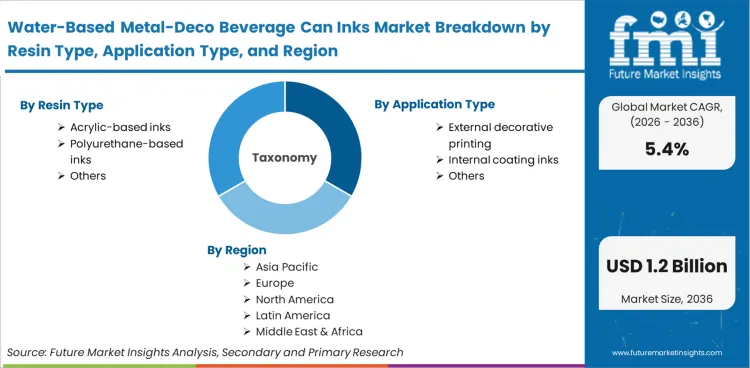
| Metric | Value |
|---|---|
| Quantitative Units | USD 0.7 billion to USD 1.1 billion, at a CAGR of 5.4% |
| Market Definition | Aqueous pigment systems engineered for direct application on high-speed cylindrical aluminium or tinplate substrates, replacing volatile solvents to meet strict emission standards while surviving intense mechanical deformation during container manufacturing. |
| Segmentation | Resin Type, Application Type, End-Use Beverage Type, Printing Technology, and Curing Technology |
| Regions Covered | North America, Latin America, Western Europe, Eastern Europe, East Asia, South Asia & Pacific, and Middle East & Africa |
| Countries Covered | United States, Germany, China, India, Brazil, Japan, Mexico |
| Key Companies Profiled | Sun Chemical, INX International Ink Co., Toyo Ink SC Holdings, Flint Group, Siegwerk, Huber Group, DIC Corporation |
| Forecast Period | 2026 to 2036 |
| Approach | Global beverage can unit production volumes mapped against standard milligrams-per-can ink consumption ratios, validated through chemical supplier disclosures. |
Source: Future Market Insights (FMI) analysis, based on proprietary forecasting model and primary research
Water-Based Metal-Deco Beverage Can Inks Market Analysis by Segments
Resin Type
- Acrylic-based inks
- Polyurethane-based inks
- Epoxy-modified inks
- Hybrid resin systems
Application Type
- External decorative printing
- Internal coating inks
- Specialty finishes (matte, gloss, tactile)
End-Use Beverage Type
- Carbonated soft drinks
- Alcoholic beverages (beer, RTD)
- Energy & sports drinks
- Functional beverages
Printing Technology
- Offset printing
- Flexographic printing
- Digital printing
Curing Technology
- Thermal curing
- UV-curable water-based inks
- Hybrid curing systems
Region
- North America
- United States
- Canada
- Europe
- Germany
- United Kingdom
- France
- Italy
- Spain
- Asia Pacific
- China
- Japan
- South Korea
- Taiwan
- Singapore
- Latin America
- Brazil
- Mexico
- Argentina
- Middle East & Africa
- GCC Countries
- South Africa
- Israel
- Rest of Middle East & Africa
Bibliography
- Tian, X., et al. (2024, April). Recent advancements in synthesis and modification of water-based acrylic emulsions for ink applications. Progress in Organic Coatings.
- Assis, R., et al. (2025, October). New developments and inkjet applications of UV-LED curable inks for metal decoration. Results in Engineering (Elsevier).
- Mandrić, V., et al. (2025, October). Advanced coating and printing materials for metal packaging applications. Applied Sciences.
- USA Patent and Trademark Office. (2024, March). Waterborne coating compositions for beverage cans and metal packaging.
- Evonik Industries AG. (2024, September). Additives and resins for coatings, inks, and metal packaging applications.
This bibliography is provided for reader reference. The full FMI report contains the complete reference list with primary source documentation.
This Report Addresses
- Specific thermal energy penalties incurred when switching older convection ovens to aqueous evaporation profiles.
- Exact mechanical slip coefficient requirements necessary for acrylic formulas to survive 2000-can-per-minute transfer lines.
- Strategic risks associated with biocide regulations and bacterial contamination in water-based storage tanks.
- Procurement strategies beverage brands use to force tier-1 suppliers into absorbing aqueous raw material premiums.
- Hidden operational costs of increased overprint varnish consumption required to protect water-borne pigment integrity.
- Greenfield capacity expansion dynamics allowing South Asian plants to bypass legacy solvent retrofitting entirely.
- Print head limitations restricting digital adoption against the sheer throughput velocity of rotary offset machinery.
- Formulation challenges surrounding high-gloss exterior decorative finishes matching legacy solvent visual standards.
Frequently Asked Questions
What was the baseline valuation for this specific packaging chemical segment?
Demand metrics established a foundation of USD 0.6 billion in 2025. This baseline reflects the total volume of aqueous pigment dispersions consumed across global two-piece and three-piece aluminium manufacturing hubs prior to the acceleration of recent strict regional volatile organic compound mandates.
What exact growth trajectory shapes operations through 2036?
Revenue advances at a 5.4% compound annual rate, pushing total valuation to USD 1.1 billion. Mandated reductions in solvent usage across Europe and North America filling lines force immediate substitution, creating sustained purchasing momentum as old thermal oxidizer systems face forced retirement.
Why do acrylic-based formulas dominate the resin category?
Specific polymer cross-linking allows acrylics to achieve the exact surface friction coefficients required by high-speed transfer lines. Tooling engineers refuse to qualify alternative resins because any deviation in surface slip causes catastrophic jamming when cans hit the necking and flanging machinery.
What restricts the immediate adoption of UV-curable water-based systems?
Photoinitiators require direct line-of-sight radiation exposure to polymerize effectively. Complex bottom rim contours and deep internal dome recesses on modern can geometries physically block UV light from reaching all coated surfaces, restricting these systems to simple straight-wall decorative applications.
Why does external decorative printing consume the highest volumes?
Beverage brands demand maximum exterior surface coverage for complex, multi-color marketing graphics. Securing adequate opacity and vibrant dot resolution requires thicker ink films, significantly driving up raw material consumption per unit compared to specialized tactile or matte finish applications.
What operational friction slows the transition away from solvent formulas?
Evaporating water requires massive latent heat input compared to flashing off volatile chemicals. Plant operators face severely bottlenecked throughput speeds unless they invest heavily in upgrading their existing convection ovens to handle the higher thermal demands of aqueous curing.
Why is India expanding faster than mature manufacturing hubs?
Greenfield factory construction dominates South Asian capacity additions. Operations directors install advanced water-compatible curing lines as standard baseline equipment during initial builds, completely bypassing the massive retrofitting costs and production downtime that plague older western packaging facilities.
How do procurement directors manage vendor lock-in risks?
Sourcing teams aggressively execute parallel qualification protocols, forcing secondary suppliers to match the exact rheological profiles of established market leaders. Splitting regional volume contracts ensures competitive pricing leverage, despite the mechanical difficulties of running multiple chemical systems simultaneously.
What hidden cost impacts aqueous implementation budgets?
Aqueous pigments possess lower inherent scuff resistance than legacy solvent counterparts during transit. Protecting brand graphics requires plant managers to authorize significantly higher consumption of overprint varnishes, an expense procurement teams often overlook during initial cost-per-liter comparisons.
Why do digital printing systems lag behind offset technologies here?
Direct-to-shape digital print heads excel at short-run regional personalization campaigns but fail to match mass-production velocity. Rotary dry-offset decorators transfer complex images at blistering speeds that remain unmatched, keeping digital relegated to specialized, low-volume product launches.
How does pasteurization affect aqueous ink selection?
Hot-fill processes subject exterior can prints to boiling water and high-pressure sterilization environments. Formulators must engineer pigment dispersions that resist softening or color bleeding under severe thermal stress to prevent immediate batch rejection by quality control directors.
What role do biocides play in modern supply chains?
Water-based storage tanks face significant risks of bacterial contamination during extended transit periods. Chemical suppliers utilize complex antimicrobial stabilization packages to ensure shelf life, forcing regulatory affairs managers to carefully navigate varying regional toxicity approvals across borders.
How do hybrid resin systems improve manufacturing efficiency?
Blending trace co-solvents with aqueous baselines lowers the required curing temperature inside convection ovens. Energy managers specify these hybrid profiles to reduce natural gas consumption and accelerate line speeds while still meeting broad environmental emission targets.
Why does Mexico show aggressive demand expansion?
Surging cross-border beer exports force domestic breweries to upgrade their packaging infrastructure rapidly. Complying with North America retail sustainability mandates requires localized can suppliers to adopt low-emission printing chemistry to secure lucrative cross-border volume contracts.
What mechanical stress must these formulations survive?
Aluminium substrates undergo extreme stretching and compression during the necking phase of container formation. Packaging technologists ruthlessly test cured ink films for microscopic stress fractures, immediately discarding any batch that cracks under severe physical deformation.
How do equipment maintenance schedules complicate transitions?
Aqueous chemistry interacts unpredictably with legacy rubber transfer blankets originally designed for solvent exposure. Press crews must replace and re-calibrate massive fountain rollers during narrow shutdown windows to prevent dimensional distortion from ruining complex multi-color print runs.
Why do Japan facilities trail China expansion rates?
Saturated domestic consumption forces Japan operators to focus entirely on incremental efficiency improvements rather than massive capacity additions. China managers, facing strict coastal emission mandates, aggressively strip out legacy infrastructure, creating faster artificial replacement cycles.
How do tier-1 chemical suppliers defend their dominant positions?
Incumbents embed specialized technical service engineers directly onto factory floors during the painful transition weeks. Resolving high-speed jamming issues in real-time creates immense loyalty, effectively locking out challengers who lack the manpower to provide continuous on-site troubleshooting.
What specific pressure do retail partners exert on beverage brands?
Major supermarket chains actively demand verified scope 3 emissions reductions across all primary packaging formats. Brand managers face credible threats of retail de-listing if they fail to force their tier-1 can suppliers into adopting verifiable low-VOC printing protocols immediately.
How does color consistency challenge global soda conglomerates?
Maintaining precise delta-E variations across billions of units proves incredibly difficult when water evaporation rates fluctuate inside ink fountains. Global procurement heads force suppliers to absorb raw material premiums to guarantee exact branding fidelity regardless of regional factory conditions.
Why is thermal curing still the baseline technology?
Decades of capital investment have entrenched massive convection ovens inside every major packaging facility. Scrapping this expensive hardware remains financially unviable for most operators, forcing formulators to adapt their aqueous chemistry to survive prolonged high-temperature exposure rather than demanding new equipment.
What determines successful drop-in analog formulations?
Challengers must engineer chemical systems that mimic the handling characteristics of established leaders without violating dense patent portfolios. Successfully matching exact slip coefficients allows these secondary vendors to capture emergency overflow volume when primary suppliers face raw material shortages.
Why water based inks replacing solvent inks on filling lines globally?
The core driver involves strict environmental enforcement targeting volatile organic compounds. Packaging engineers must eliminate solvent emissions to meet aggressive new carbon taxation thresholds and satisfy corporate can packaging sustainability trends without compromising high-speed manufacturing efficiency.
How do buyers evaluate the best printing inks for aluminum cans?
Procurement officers prioritize the ability to run 2000-can-per-minute decorator lines without jamming. The defining metric is no longer purely aesthetic color matching; it involves precise mechanical slip coefficients that allow high-speed necking and flanging machinery to operate continuously without scratching the cured exterior graphics.
Preview the report firsthand - request a free sample
Get SampleGet the brochure for pricing and purchase details.
Get PDFTable of Content
- Executive Summary
- Global Market Outlook
- Demand-side Trends
- Supply-side Trends
- Technology Roadmap Analysis
- Analysis and Recommendations
- Market Overview
- Market Coverage / Taxonomy
- Market Definition / Scope / Limitations
- Research Methodology
- Chapter Orientation
- Analytical Lens and Working Hypotheses
- Market Structure, Signals, and Trend Drivers
- Benchmarking and Cross-market Comparability
- Market Sizing, Forecasting, and Opportunity Mapping
- Research Design and Evidence Framework
- Desk Research Programme (Secondary Evidence)
- Company Annual and Sustainability Reports
- Peer-reviewed Journals and Academic Literature
- Corporate Websites, Product Literature, and Technical Notes
- Earnings Decks and Investor Briefings
- Statutory Filings and Regulatory Disclosures
- Technical White Papers and Standards Notes
- Trade Journals, Industry Magazines, and Analyst Briefs
- Conference Proceedings, Webinars, and Seminar Materials
- Government Statistics Portals and Public Data Releases
- Press Releases and Reputable Media Coverage
- Specialist Newsletters and Curated Briefings
- Sector Databases and Reference Repositories
- FMI Internal Proprietary Databases and Historical Market Datasets
- Subscription Datasets and Paid Sources
- Social Channels, Communities, and Digital Listening Inputs
- Additional Desk Sources
- Expert Input and Fieldwork (Primary Evidence)
- Primary Modes
- Qualitative Interviews and Expert Elicitation
- Quantitative Surveys and Structured Data Capture
- Blended Approach
- Why Primary Evidence is Used
- Field Techniques
- Interviews
- Surveys
- Focus Groups
- Observational and In-context Research
- Social and Community Interactions
- Stakeholder Universe Engaged
- C-suite Leaders
- Board Members
- Presidents and Vice Presidents
- R&D and Innovation Heads
- Technical Specialists
- Domain Subject-matter Experts
- Scientists
- Physicians and Other Healthcare Professionals
- Governance, Ethics, and Data Stewardship
- Research Ethics
- Data Integrity and Handling
- Primary Modes
- Tooling, Models, and Reference Databases
- Desk Research Programme (Secondary Evidence)
- Data Engineering and Model Build
- Data Acquisition and Ingestion
- Cleaning, Normalisation, and Verification
- Synthesis, Triangulation, and Analysis
- Quality Assurance and Audit Trail
- Market Background
- Market Dynamics
- Drivers
- Restraints
- Opportunity
- Trends
- Scenario Forecast
- Demand in Optimistic Scenario
- Demand in Likely Scenario
- Demand in Conservative Scenario
- Opportunity Map Analysis
- Product Life Cycle Analysis
- Supply Chain Analysis
- Investment Feasibility Matrix
- Value Chain Analysis
- PESTLE and Porter’s Analysis
- Regulatory Landscape
- Regional Parent Market Outlook
- Production and Consumption Statistics
- Import and Export Statistics
- Market Dynamics
- Global Market Analysis 2021 to 2025 and Forecast, 2026 to 2036
- Historical Market Size Value (USD Million) Analysis, 2021 to 2025
- Current and Future Market Size Value (USD Million) Projections, 2026 to 2036
- Y-o-Y Growth Trend Analysis
- Absolute $ Opportunity Analysis
- Global Market Pricing Analysis 2021 to 2025 and Forecast 2026 to 2036
- Global Market Analysis 2021 to 2025 and Forecast 2026 to 2036, By Resin Type
- Introduction / Key Findings
- Historical Market Size Value (USD Million) Analysis By Resin Type , 2021 to 2025
- Current and Future Market Size Value (USD Million) Analysis and Forecast By Resin Type , 2026 to 2036
- Acrylic-based inks
- Polyurethane-based inks
- Others
- Acrylic-based inks
- Y-o-Y Growth Trend Analysis By Resin Type , 2021 to 2025
- Absolute $ Opportunity Analysis By Resin Type , 2026 to 2036
- Global Market Analysis 2021 to 2025 and Forecast 2026 to 2036, By Application Type
- Introduction / Key Findings
- Historical Market Size Value (USD Million) Analysis By Application Type, 2021 to 2025
- Current and Future Market Size Value (USD Million) Analysis and Forecast By Application Type, 2026 to 2036
- External decorative printing
- Internal coating inks
- Others
- External decorative printing
- Y-o-Y Growth Trend Analysis By Application Type, 2021 to 2025
- Absolute $ Opportunity Analysis By Application Type, 2026 to 2036
- Global Market Analysis 2021 to 2025 and Forecast 2026 to 2036, By End-Use Beverage Type
- Introduction / Key Findings
- Historical Market Size Value (USD Million) Analysis By End-Use Beverage Type, 2021 to 2025
- Current and Future Market Size Value (USD Million) Analysis and Forecast By End-Use Beverage Type, 2026 to 2036
- Carbonated soft drinks
- Alcoholic beverages (beer, RTD)
- Others
- Carbonated soft drinks
- Y-o-Y Growth Trend Analysis By End-Use Beverage Type, 2021 to 2025
- Absolute $ Opportunity Analysis By End-Use Beverage Type, 2026 to 2036
- Global Market Analysis 2021 to 2025 and Forecast 2026 to 2036, By Printing Technology
- Introduction / Key Findings
- Historical Market Size Value (USD Million) Analysis By Printing Technology, 2021 to 2025
- Current and Future Market Size Value (USD Million) Analysis and Forecast By Printing Technology, 2026 to 2036
- Offset printing
- Flexographic printing
- Others
- Offset printing
- Y-o-Y Growth Trend Analysis By Printing Technology, 2021 to 2025
- Absolute $ Opportunity Analysis By Printing Technology, 2026 to 2036
- Global Market Analysis 2021 to 2025 and Forecast 2026 to 2036, By Curing Technology
- Introduction / Key Findings
- Historical Market Size Value (USD Million) Analysis By Curing Technology, 2021 to 2025
- Current and Future Market Size Value (USD Million) Analysis and Forecast By Curing Technology, 2026 to 2036
- Thermal curing
- UV-curable water-based inks
- Others
- Thermal curing
- Y-o-Y Growth Trend Analysis By Curing Technology, 2021 to 2025
- Absolute $ Opportunity Analysis By Curing Technology, 2026 to 2036
- Global Market Analysis 2021 to 2025 and Forecast 2026 to 2036, By Region
- Introduction
- Historical Market Size Value (USD Million) Analysis By Region, 2021 to 2025
- Current Market Size Value (USD Million) Analysis and Forecast By Region, 2026 to 2036
- North America
- Latin America
- Western Europe
- Eastern Europe
- East Asia
- South Asia and Pacific
- Middle East & Africa
- Market Attractiveness Analysis By Region
- North America Market Analysis 2021 to 2025 and Forecast 2026 to 2036, By Country
- Historical Market Size Value (USD Million) Trend Analysis By Market Taxonomy, 2021 to 2025
- Market Size Value (USD Million) Forecast By Market Taxonomy, 2026 to 2036
- By Country
- USA
- Canada
- Mexico
- By Resin Type
- By Application Type
- By End-Use Beverage Type
- By Printing Technology
- By Curing Technology
- By Country
- Market Attractiveness Analysis
- By Country
- By Resin Type
- By Application Type
- By End-Use Beverage Type
- By Printing Technology
- By Curing Technology
- Key Takeaways
- Latin America Market Analysis 2021 to 2025 and Forecast 2026 to 2036, By Country
- Historical Market Size Value (USD Million) Trend Analysis By Market Taxonomy, 2021 to 2025
- Market Size Value (USD Million) Forecast By Market Taxonomy, 2026 to 2036
- By Country
- Brazil
- Chile
- Rest of Latin America
- By Resin Type
- By Application Type
- By End-Use Beverage Type
- By Printing Technology
- By Curing Technology
- By Country
- Market Attractiveness Analysis
- By Country
- By Resin Type
- By Application Type
- By End-Use Beverage Type
- By Printing Technology
- By Curing Technology
- Key Takeaways
- Western Europe Market Analysis 2021 to 2025 and Forecast 2026 to 2036, By Country
- Historical Market Size Value (USD Million) Trend Analysis By Market Taxonomy, 2021 to 2025
- Market Size Value (USD Million) Forecast By Market Taxonomy, 2026 to 2036
- By Country
- Germany
- UK
- Italy
- Spain
- France
- Nordic
- BENELUX
- Rest of Western Europe
- By Resin Type
- By Application Type
- By End-Use Beverage Type
- By Printing Technology
- By Curing Technology
- By Country
- Market Attractiveness Analysis
- By Country
- By Resin Type
- By Application Type
- By End-Use Beverage Type
- By Printing Technology
- By Curing Technology
- Key Takeaways
- Eastern Europe Market Analysis 2021 to 2025 and Forecast 2026 to 2036, By Country
- Historical Market Size Value (USD Million) Trend Analysis By Market Taxonomy, 2021 to 2025
- Market Size Value (USD Million) Forecast By Market Taxonomy, 2026 to 2036
- By Country
- Russia
- Poland
- Hungary
- Balkan & Baltic
- Rest of Eastern Europe
- By Resin Type
- By Application Type
- By End-Use Beverage Type
- By Printing Technology
- By Curing Technology
- By Country
- Market Attractiveness Analysis
- By Country
- By Resin Type
- By Application Type
- By End-Use Beverage Type
- By Printing Technology
- By Curing Technology
- Key Takeaways
- East Asia Market Analysis 2021 to 2025 and Forecast 2026 to 2036, By Country
- Historical Market Size Value (USD Million) Trend Analysis By Market Taxonomy, 2021 to 2025
- Market Size Value (USD Million) Forecast By Market Taxonomy, 2026 to 2036
- By Country
- China
- Japan
- South Korea
- By Resin Type
- By Application Type
- By End-Use Beverage Type
- By Printing Technology
- By Curing Technology
- By Country
- Market Attractiveness Analysis
- By Country
- By Resin Type
- By Application Type
- By End-Use Beverage Type
- By Printing Technology
- By Curing Technology
- Key Takeaways
- South Asia and Pacific Market Analysis 2021 to 2025 and Forecast 2026 to 2036, By Country
- Historical Market Size Value (USD Million) Trend Analysis By Market Taxonomy, 2021 to 2025
- Market Size Value (USD Million) Forecast By Market Taxonomy, 2026 to 2036
- By Country
- India
- ASEAN
- Australia & New Zealand
- Rest of South Asia and Pacific
- By Resin Type
- By Application Type
- By End-Use Beverage Type
- By Printing Technology
- By Curing Technology
- By Country
- Market Attractiveness Analysis
- By Country
- By Resin Type
- By Application Type
- By End-Use Beverage Type
- By Printing Technology
- By Curing Technology
- Key Takeaways
- Middle East & Africa Market Analysis 2021 to 2025 and Forecast 2026 to 2036, By Country
- Historical Market Size Value (USD Million) Trend Analysis By Market Taxonomy, 2021 to 2025
- Market Size Value (USD Million) Forecast By Market Taxonomy, 2026 to 2036
- By Country
- Kingdom of Saudi Arabia
- Other GCC Countries
- Turkiye
- South Africa
- Other African Union
- Rest of Middle East & Africa
- By Resin Type
- By Application Type
- By End-Use Beverage Type
- By Printing Technology
- By Curing Technology
- By Country
- Market Attractiveness Analysis
- By Country
- By Resin Type
- By Application Type
- By End-Use Beverage Type
- By Printing Technology
- By Curing Technology
- Key Takeaways
- Key Countries Market Analysis
- USA
- Pricing Analysis
- Market Share Analysis, 2025
- By Resin Type
- By Application Type
- By End-Use Beverage Type
- By Printing Technology
- By Curing Technology
- Canada
- Pricing Analysis
- Market Share Analysis, 2025
- By Resin Type
- By Application Type
- By End-Use Beverage Type
- By Printing Technology
- By Curing Technology
- Mexico
- Pricing Analysis
- Market Share Analysis, 2025
- By Resin Type
- By Application Type
- By End-Use Beverage Type
- By Printing Technology
- By Curing Technology
- Brazil
- Pricing Analysis
- Market Share Analysis, 2025
- By Resin Type
- By Application Type
- By End-Use Beverage Type
- By Printing Technology
- By Curing Technology
- Chile
- Pricing Analysis
- Market Share Analysis, 2025
- By Resin Type
- By Application Type
- By End-Use Beverage Type
- By Printing Technology
- By Curing Technology
- Germany
- Pricing Analysis
- Market Share Analysis, 2025
- By Resin Type
- By Application Type
- By End-Use Beverage Type
- By Printing Technology
- By Curing Technology
- UK
- Pricing Analysis
- Market Share Analysis, 2025
- By Resin Type
- By Application Type
- By End-Use Beverage Type
- By Printing Technology
- By Curing Technology
- Italy
- Pricing Analysis
- Market Share Analysis, 2025
- By Resin Type
- By Application Type
- By End-Use Beverage Type
- By Printing Technology
- By Curing Technology
- Spain
- Pricing Analysis
- Market Share Analysis, 2025
- By Resin Type
- By Application Type
- By End-Use Beverage Type
- By Printing Technology
- By Curing Technology
- France
- Pricing Analysis
- Market Share Analysis, 2025
- By Resin Type
- By Application Type
- By End-Use Beverage Type
- By Printing Technology
- By Curing Technology
- India
- Pricing Analysis
- Market Share Analysis, 2025
- By Resin Type
- By Application Type
- By End-Use Beverage Type
- By Printing Technology
- By Curing Technology
- ASEAN
- Pricing Analysis
- Market Share Analysis, 2025
- By Resin Type
- By Application Type
- By End-Use Beverage Type
- By Printing Technology
- By Curing Technology
- Australia & New Zealand
- Pricing Analysis
- Market Share Analysis, 2025
- By Resin Type
- By Application Type
- By End-Use Beverage Type
- By Printing Technology
- By Curing Technology
- China
- Pricing Analysis
- Market Share Analysis, 2025
- By Resin Type
- By Application Type
- By End-Use Beverage Type
- By Printing Technology
- By Curing Technology
- Japan
- Pricing Analysis
- Market Share Analysis, 2025
- By Resin Type
- By Application Type
- By End-Use Beverage Type
- By Printing Technology
- By Curing Technology
- South Korea
- Pricing Analysis
- Market Share Analysis, 2025
- By Resin Type
- By Application Type
- By End-Use Beverage Type
- By Printing Technology
- By Curing Technology
- Russia
- Pricing Analysis
- Market Share Analysis, 2025
- By Resin Type
- By Application Type
- By End-Use Beverage Type
- By Printing Technology
- By Curing Technology
- Poland
- Pricing Analysis
- Market Share Analysis, 2025
- By Resin Type
- By Application Type
- By End-Use Beverage Type
- By Printing Technology
- By Curing Technology
- Hungary
- Pricing Analysis
- Market Share Analysis, 2025
- By Resin Type
- By Application Type
- By End-Use Beverage Type
- By Printing Technology
- By Curing Technology
- Kingdom of Saudi Arabia
- Pricing Analysis
- Market Share Analysis, 2025
- By Resin Type
- By Application Type
- By End-Use Beverage Type
- By Printing Technology
- By Curing Technology
- Turkiye
- Pricing Analysis
- Market Share Analysis, 2025
- By Resin Type
- By Application Type
- By End-Use Beverage Type
- By Printing Technology
- By Curing Technology
- South Africa
- Pricing Analysis
- Market Share Analysis, 2025
- By Resin Type
- By Application Type
- By End-Use Beverage Type
- By Printing Technology
- By Curing Technology
- USA
- Market Structure Analysis
- Competition Dashboard
- Competition Benchmarking
- Market Share Analysis of Top Players
- By Regional
- By Resin Type
- By Application Type
- By End-Use Beverage Type
- By Printing Technology
- By Curing Technology
- Competition Analysis
- Competition Deep Dive
- Sun Chemical
- Overview
- Product Portfolio
- Profitability by Market Segments (Product/Age /Sales Channel/Region)
- Sales Footprint
- Strategy Overview
- Marketing Strategy
- Product Strategy
- Channel Strategy
- INX International Ink Co.
- Toyo Ink SC Holdings
- Flint Group
- Siegwerk
- Huber Group
- DIC Corporation
- Sun Chemical
- Competition Deep Dive
- Assumptions & Acronyms Used


