

- Industry Size (2026)
- USD 280.0 Mn
- Forecast (2036)
- USD 638.9 Mn
- CAGR (2026 to 2036)
- 8.6%
Label, Adhesive and Ink Systems Market Forecast and Outlook 2026 to 2036
The label, adhesive and ink systems market is emerging as the silent architect of the circular economy for plastic packaging. The industry is currently valued at USD 280.0 million in 2026 and is projected to reach USD 638.9 million by 2036, growing at a robust CAGR of 8.6%. This specialized market comprises the auxiliary components, wash-off adhesives, de-inking primers, and floatable label substrates, that enable rigid and flexible packaging to be recycled without contamination. As brands face immense pressure to increase the quality of post-consumer resin (PCR), the demand for "recycling-friendly" label systems that separate cleanly from PET and HDPE flakes is skyrocketing.
The sector is primarily influenced by the rigorous purity standards required for food-grade recycled plastics packaging. In the USA and Germany, demand is surging for Roll-stock Labels & Shrink Sleeves equipped with Recyclable Adhesives that release during the caustic wash process, preventing gum-ups in recycling machinery. Simultaneously, in India, the expanding petrochemical sector is driving the domestic production of PP-Compatible Adhesives and inks that support the recycling of polyolefin films. The market is also witnessing a technological pivot toward Removable/Repulpable Adhesive Systems, which allow labels to be removed without leaving sticky residues that degrade the value of the recycled plastic.
Manufacturers are aggressively scaling production of Recyclable Inks that do not bleed or discolor the wash water, preserving the clarity of the recycled PET. Innovations in Laser-removable Adhesives are eliminating the need for chemical solvents entirely, offering a "dry" separation method that reduces water usage. Competition is intensifying as chemical giants partner with label converters to offer certified "circular portfolios," positioning these systems as the critical interface between packaging design and waste management infrastructure through 2036.
Quick Stats for Label, Adhesive and Ink Systems Market
- Label, Adhesive and Ink Systems Market Value (2026): USD 280.0 million
- Label, Adhesive and Ink Systems Market Forecast Value (2036): USD 638.9 million
- Label, Adhesive and Ink Systems Market Forecast CAGR: 8.6%
- Leading End-use in Label, Adhesive and Ink Systems Market: Beverage & FMCG (40%)
- Leading Packaging Format in Label, Adhesive and Ink Systems Market: Roll-stock Labels & Shrink Sleeves (45%)
- Leading Material in Label, Adhesive and Ink Systems Market: Recyclable Adhesives (PE/PP compatible) (50%)
- Leading Technology in Label, Adhesive and Ink Systems Market: Removable/Repulpable Adhesive Systems + Recyclable Inks (55%)
- Key Growth Countries in Label, Adhesive and Ink Systems Market: India, China, USA, Brazil, Germany
- Key Players in Label, Adhesive and Ink Systems Market: Avery Dennison, Henkel, Siegwerk, LINTEC, BASF, UFlex
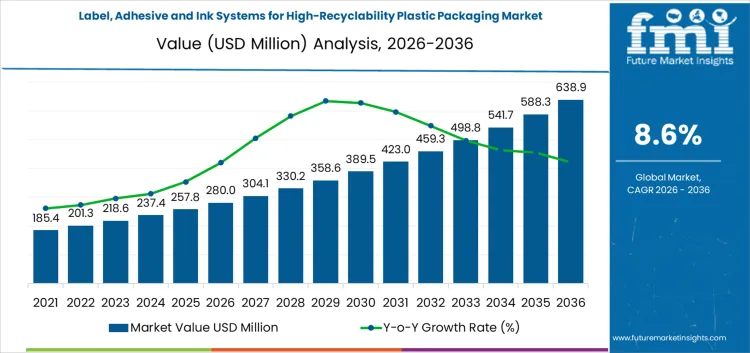
Label, Adhesive and Ink Systems Market Key Takeaways
| Metric | Value |
|---|---|
| Industry Size (2026) | USD 280.0 million |
| Industry Value (2036) | USD 638.9 million |
| CAGR (2026 to 2036) | 8.6% |
Why is the Demand for Label, Adhesive and Ink Systems Growing?
The primary catalyst for growth is the financial penalty associated with contaminated recyclates. Standard pressure-sensitive adhesives often remain on plastic flakes after shredding, causing "black specks" or structural weaknesses in the new recycled material. This lowers the value of the PCR and makes it unsuitable for food-contact applications. Brands are switching to advanced adhesive and ink systems to ensure their packaging yields high-quality recyclate, which helps them meet "Virgin Plastic Reduction" targets and avoid Extended Producer Responsibility (EPR) fines. Additionally, the rise of clear PET trends in the beverage industry necessitates label systems that wash off completely to maintain the polymer's transparency.
How Is the Label, Adhesive and Ink Systems Market Structured Across Key Segments?
The market is intricately segmented to address the specific chemical compatibility required for different polymer streams. It is primarily categorized by End-use with a focus on high-volume disposables like beverages. The Packaging Format segment distinguishes between traditional roll-stock and advanced in-mold labels while the Material segment differentiates between adhesive chemistries for specific plastics (PET vs. Polyolefins). Finally, the Technology segment highlights the innovation in separation mechanisms. Each segment plays a vital role where beverages drive wash-off demand and personal care drives aesthetic durability.
How Does the Beverage Sector Drive Adhesive Innovation?
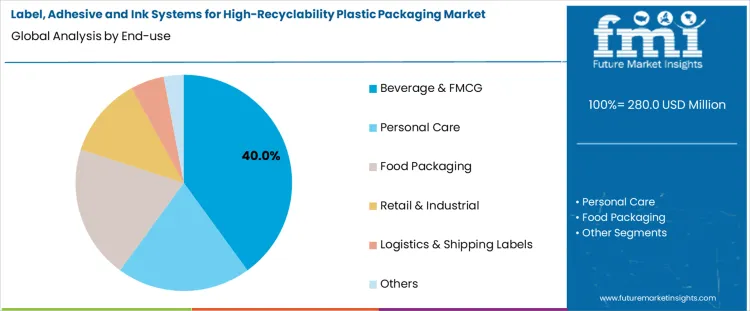
The Beverage & FMCG segment commands the dominant position and holds a substantial share of the market revenue. This leadership is driven by the global standardization of the PET bottle recycling process. Roll-stock Labels & Shrink Sleeves are ubiquitous in this sector. To ensure these bottles can be recycled into new bottles (bottle-to-bottle), manufacturers utilize Recyclable Adhesives that are density-modified. These adhesives lose their grip in the hot caustic bath of a recycling plant, allowing the label to float to the surface while the PET flakes sink, ensuring a clean separation.
Why Are Shrink Sleeves Evolving?
Shrink sleeves offer 360-degree branding but historically caused issues in sorting facilities by masking the underlying plastic type. The market is shifting toward "floatable" shrink sleeve materials paired with compatible inks. Manufacturers prioritize these systems because they allow brands to retain high-impact graphics without rendering the bottle unrecyclable. The ink systems used on these sleeves are designed to adhere to the sleeve substrate strongly, ensuring they do not bleed into the wash water and stain the clear PET flakes.
Which Material Chemistry is Essential for Polyolefins?
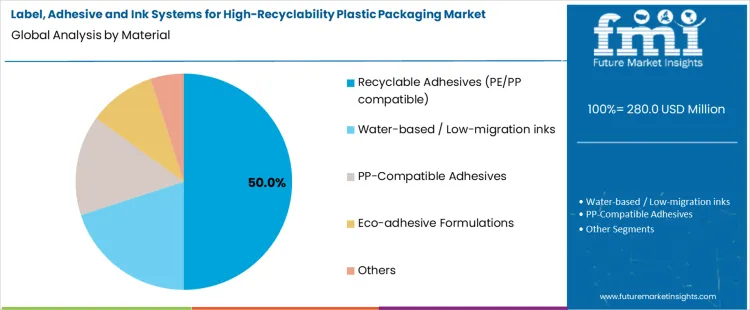
Recyclable Adhesives (PE/PP compatible) represent the leading material stream. While PET recycling relies on wash-off adhesives, Polyolefin (HDPE/PP) recycling often involves the label remaining with the package during extrusion. Therefore, the adhesive and label material must be chemically compatible with the bottle resin to avoid degrading the recycled plastic's properties. PP-Compatible Adhesives are formulated to melt and blend seamlessly with the rigid container material, creating a homogeneous recycled pellet suitable for non-food applications.
How Do Removable Technologies Support Reuse?
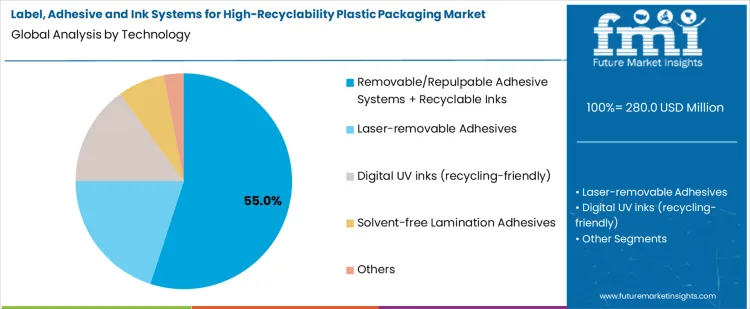
Removable/Repulpable Adhesive Systems represent the leading technology stream for the emerging "reuse" market. For glass and rigid plastic containers designed for refilling, the label must be removed entirely without leaving a sticky residue. Innovations in Laser-removable Adhesives allow for touchless label removal using laser heat, which degrades the adhesive bond instantly. This technology reduces the need for water and aggressive chemicals in the industrial cleaning process, supporting the sustainability of refillable packaging models.
What are the Key Dynamics in the Label, Adhesive and Ink Systems Market?
Can Digital Inks Survive the Recycling Process?
A major trend reshaping the landscape is the formulation of Recycling-Friendly Digital UV Inks. As brands move toward short-run, personalized packaging using digital printing, there is a risk that standard UV inks will contaminate the recycling stream. Manufacturers are developing new ink sets that are fully curable yet removable under recycling conditions. This trend is driven by the need to combine the marketing agility of digital printing with the circularity requirements of mass-market packaging.
Does the Cost of "Clean" Chemistries Limit Adoption?
The most significant restraint is the cost premium of engineered adhesives and inks. Wash-off adhesives can cost 20-30% more than standard hot-melts. Overcoming this financial barrier requires a holistic view of the packaging lifecycle. Brands are increasingly willing to pay this premium because it allows them to access high-quality PCR at a lower cost than virgin plastic (in some markets) or avoid steep plastic taxes. Furthermore, as production volumes for these specialty chemicals increase, economies of scale are gradually narrowing the price gap.
How Is Legislation Creating a "Pull" Market?
The emerging field of Certified Recyclable Components presents a frontier of opportunity. Organizations like APR (USA) and RecyClass (Europe) provide critical guidance and certification for label systems. Suppliers who achieve these certifications gain a massive competitive advantage, as brands mandate these approved materials in their RFPs. This creates a "pull" market where the compliance requirement drives the adoption of advanced adhesive and ink technologies, regardless of the immediate cost implication.
How Is the Label, Adhesive and Ink Systems Industry Expected to Evolve Across Major Nations?
The global landscape shows a divergent growth pattern. Robust expansion in industrializing Asian markets contrasts with a compliance-driven, circularity-focused market in Western nations. High-growth regions are characterizing their production to meet export standards. As nations like India and China modernize their petrochemical and recycling sectors, the adoption of compatible packaging components is accelerating.
| Country | CAGR (2026 to 2036) |
|---|---|
| India | 11.5% |
| China | 10.5% |
| USA | 8.6% |
| Brazil | 7.5% |
| Germany | 6.8% |
| Japan | 5.0% |
How Is US Manufacturing Data Supporting Label Demand?
Sales of label, adhesive, and ink systems in the USA are anticipated to expand at a CAGR of 8.6% over the forecast period. The country's robust manufacturing sector provides a strong foundation for label demand, as evidenced by the USA Census Bureau reporting that shipments of manufactured nondurable goods reached USD 300.3 billion in August 2025. This massive volume of nondurable goods, which includes high-turnover categories like food, beverage, and household chemicals, directly drives the need for sustainable labeling solutions. Avery Dennison and Henkel are leveraging this stable manufacturing base to deploy Recyclable Adhesives that allow US brands to align with the US Plastics Pact.
What Role Does China's Export Value Play?
Demand for label, adhesive, and ink systems in China is projected to grow at a CAGR of 10.5% through 2036. The need to meet international compliance standards is a primary driver, reflected in the National Bureau of Statistics of China reporting that the export delivery value of industrial enterprises reached 1,367.6 billion yuan in June 2025. This immense export volume necessitates packaging that meets the strict recycling standards of destination markets like the EU. Consequently, Chinese manufacturers are aggressively adopting Water-based / Low-migration inks and In-mold Labels to ensure their exported goods are not rejected due to packaging non-compliance.
How Is India's Petrochemical Vision Fueling Growth?
The label, adhesive, and ink systems market in India is forecast to rise at a CAGR of 11.5% between 2026 and 2036. Domestic material availability is a critical enabler, supported by the Department of Chemicals and Petrochemicals reporting that the production of major chemicals and petrochemicals reached 28,292 thousand MT in the period of April-September 2024. This burgeoning domestic capacity ensures a steady supply of raw materials for the Food Packaging segment, specifically for producing PP-Compatible Adhesives and films. Local players are using these resources to formulate indigenous eco-friendly label solutions for the organized retail sector.
Why Are German Producer Prices Significant?
The label, adhesive, and ink systems industry in Germany is expected to increase at a CAGR of 6.8%. Cost pressures are forcing a shift toward efficiency, as indicated by the Federal Statistical Office (Destatis) reporting that producer prices for industrial products fell by 2.3% in November 2025. This deflationary environment pushes manufacturers to adopt technologies that lower the total cost of ownership, such as Removable/Repulpable Adhesive Systems that reduce EPR fees. Siegwerk leads in providing recyclable ink systems that allow German brands to offer premium sustainable packaging despite tight margins.
How Is Brazil's Pharma Sector Influencing Labels?
Consumption of label, adhesive, and ink systems in Brazil is projected to grow at a CAGR of 7.5% through 2036. The pharmaceutical sector acts as a high-value anchor for this market, with the Brazilian Institute of Geography and Statistics (IBGE) reporting that pharmaceutical activity grew by 7.9% in July 2025. This growth fuels the Retail & Industrial segment, where secure, traceable, yet sustainable labeling is non-negotiable. UFlex provides Eco-adhesive Formulations for the Brazilian market, ensuring that the increasing volume of pharmaceutical packaging can be processed responsibly.
How Is Japan's Industrial Index Shaping the Market?
The label, adhesive, and ink systems market in Japan is expected to grow at a CAGR of 5.0%. Sustained industrial activity provides a steady demand base, with the Ministry of Economy, Trade and Industry (METI) reporting that the seasonally adjusted index of industrial production stood at 102.0 in November 2025. This consistent output supports the Logistics & Shipping Labels segment, where reliability is key. Japanese converters use highly specialized Laser-removable Adhesives to ensure that shipping crates and totes can be reused multiple times, aligning with Japan's emphasis on waste reduction and industrial efficiency.
What is the competitive landscape of demand for the label, adhesive and ink systems market globally?
How Are Companies Competing and Strengthening Their Positions in the Label, Adhesive and Ink Systems Market?
The competitive landscape in the label, adhesive, and ink systems market is increasingly characterized by strategic collaborations spanning the entire value chain. Key players, such as adhesive manufacturers like Henkel, are forging direct partnerships with label converters, exemplified by firms like CCL, as well as recyclers. These collaborations are critical for rigorously testing and certifying products, thereby enhancing product credibility and market acceptance.
Industry leaders are further fortifying their competitive positions by developing integrated "all-in-one" portfolios that encompass compatible inks, coatings, and adhesives tailored for specific plastic substrates such as polyethylene terephthalate (PET), high-density polyethylene (HDPE), and polypropylene (PP). This holistic approach not only streamlines the sourcing process for converters but also minimizes compatibility issues, thereby enhancing overall performance and user satisfaction.
In addition to product development, mergers and acquisitions are a prominent strategy in this sector, particularly targeting specialty chemical companies that possess unique de-bonding technologies. Such acquisitions allow major players to rapidly expand their technological capabilities and product offerings, positioning them favorably in a dynamic marketplace.
Leading companies are making substantial investments in global research and development centers. These investments are aimed at innovating adhesives that perform optimally under diverse climatic conditions and align with various recycling infrastructures. This focus on R&D is critical for ensuring that products meet evolving market demands and sustainability standards.
Key Players in the Label, Adhesive and Ink Systems Market
- Avery Dennison Corporation
- Henkel AG & Co. KGaA
- Siegwerk Druckfarben AG & Co. KGaA
- LINTEC Corporation
- BASF SE
- CCL Industries Inc.
- UFlex Ltd.
- Huhtamaki India
- Toyo Ink SC Holdings Co., Ltd.
- Flint Group
Scope of Report
| Items | Values |
|---|---|
| Quantitative Units | USD Million |
| End-use | Beverage & FMCG, Personal Care, Food Packaging, Retail & Industrial, Logistics & Shipping Labels |
| Packaging Format | Roll-stock Labels & Shrink Sleeves, In-mold Labels, Pressure Sensitive Labels, Thermal & Pressure Labels |
| Material | Recyclable Adhesives (PE/PP compatible), Water-based / Low-migration inks, PP-Compatible Adhesives, Eco-adhesive Formulations |
| Technology | Removable/Repulpable Adhesive Systems, Laser-removable Adhesives, Digital UV inks, Solvent-free Lamination Adhesives |
| Regions Covered | North America, Latin America, Europe, East Asia, South Asia & Oceania, Middle East & Africa |
| Countries Covered | United States, Canada, Germany, UK, France, Italy, China, Japan, South Korea, India, Brazil, Mexico, GCC Countries, South Africa |
| Key Companies Profiled | Avery Dennison, Henkel, Siegwerk, LINTEC, BASF, UFlex, and others. |
| Additional Attributes | Market share analysis, APR/EPBP compliance trends, regulatory impact analysis, material innovation, and competitive benchmarking. |
Label, Adhesive and Ink Systems Market by Segments
By End-use:
- Beverage & FMCG
- Personal Care
- Food Packaging
- Retail & Industrial
- Logistics & Shipping Labels
- Others
By Packaging Format:
- Roll-stock Labels & Shrink Sleeves
- In-mold Labels & Shrink Sleeves
- Pressure Sensitive Labels
- Thermal & Pressure Labels
- Others
By Material:
- Recyclable Adhesives (PE/PP compatible)
- Water-based / Low-migration inks
- PP-Compatible Adhesives
- Eco-adhesive Formulations
- Others
By Technology:
- Removable/Repulpable Adhesive Systems + Recyclable Inks
- Laser-removable Adhesives
- Digital UV inks (recycling-friendly)
- Solvent-free Lamination Adhesives
- Others
By Region:
- North America
- Latin America
- Europe
- East Asia
- South Asia & Oceania
- Middle East & Africa
Bibliography
- Ministry of Economy, Trade and Industry (Japan). (2025). Preliminary report on chemical materials and adhesives production indices, November 2025. Government of Japan.
- Federal Statistical Office (Germany). (2025). Producer price trends for chemical and printing materials, November 2025. Destatis.
- Department of Chemicals and Petrochemicals (India). (2025). Annual report 2024–25: Performance of chemical intermediates and polymer adhesives sectors. Government of India.
Frequently Asked Questions
How big is the label, adhesive and ink systems for high-recyclability plastic packaging market in 2026?
The global label, adhesive and ink systems for high-recyclability plastic packaging market is estimated to be valued at USD 280.0 million in 2026.
What will be the size of label, adhesive and ink systems for high-recyclability plastic packaging market in 2036?
The market size for the label, adhesive and ink systems for high-recyclability plastic packaging market is projected to reach USD 638.9 million by 2036.
How much will be the label, adhesive and ink systems for high-recyclability plastic packaging market growth between 2026 and 2036?
The label, adhesive and ink systems for high-recyclability plastic packaging market is expected to grow at a 8.6% CAGR between 2026 and 2036.
What are the key product types in the label, adhesive and ink systems for high-recyclability plastic packaging market?
The key product types in label, adhesive and ink systems for high-recyclability plastic packaging market are beverage & fmcg, personal care, food packaging, retail & industrial, logistics & shipping labels and others.
Which packaging format segment to contribute significant share in the label, adhesive and ink systems for high-recyclability plastic packaging market in 2026?
In terms of packaging format, roll-stock labels & shrink sleeves segment to command 45.0% share in the label, adhesive and ink systems for high-recyclability plastic packaging market in 2026.
Preview the report firsthand - request a free sample
Get SampleGet the brochure for pricing and purchase details.
Get PDFTable of Content
- Executive Summary
- Global Market Outlook
- Demand-side Trends
- Supply-side Trends
- Technology Roadmap Analysis
- Analysis and Recommendations
- Market Overview
- Market Coverage / Taxonomy
- Market Definition / Scope / Limitations
- Market Background
- Market Dynamics
- Drivers
- Restraints
- Opportunity
- Trends
- Scenario Forecast
- Demand in Optimistic Scenario
- Demand in Likely Scenario
- Demand in Conservative Scenario
- Opportunity Map Analysis
- Product Life Cycle Analysis
- Supply Chain Analysis
- Investment Feasibility Matrix
- Value Chain Analysis
- PESTLE and Porter’s Analysis
- Regulatory Landscape
- Regional Parent Market Outlook
- Production and Consumption Statistics
- Import and Export Statistics
- Market Dynamics
- Global Market Analysis 2021 to 2025 and Forecast, 2026 to 2036
- Historical Market Size Value (USD Million) Analysis, 2021 to 2025
- Current and Future Market Size Value (USD Million) Projections, 2026 to 2036
- Y-o-Y Growth Trend Analysis
- Absolute $ Opportunity Analysis
- Global Market Pricing Analysis 2021 to 2025 and Forecast 2026 to 2036
- Global Market Analysis 2021 to 2025 and Forecast 2026 to 2036, By End-use
- Introduction / Key Findings
- Historical Market Size Value (USD Million) Analysis By End-use , 2021 to 2025
- Current and Future Market Size Value (USD Million) Analysis and Forecast By End-use , 2026 to 2036
- Beverage & FMCG
- Personal Care
- Food Packaging
- Retail & Industrial
- Logistics & Shipping Labels
- Others
- Beverage & FMCG
- Y-o-Y Growth Trend Analysis By End-use , 2021 to 2025
- Absolute $ Opportunity Analysis By End-use , 2026 to 2036
- Global Market Analysis 2021 to 2025 and Forecast 2026 to 2036, By Packaging Format
- Introduction / Key Findings
- Historical Market Size Value (USD Million) Analysis By Packaging Format, 2021 to 2025
- Current and Future Market Size Value (USD Million) Analysis and Forecast By Packaging Format, 2026 to 2036
- Roll-stock Labels & Shrink Sleeves
- In-mold Labels & Shrink Sleeves
- Pressure Sensitive Labels
- Thermal & Pressure Labels
- Others
- Roll-stock Labels & Shrink Sleeves
- Y-o-Y Growth Trend Analysis By Packaging Format, 2021 to 2025
- Absolute $ Opportunity Analysis By Packaging Format, 2026 to 2036
- Global Market Analysis 2021 to 2025 and Forecast 2026 to 2036, By Material
- Introduction / Key Findings
- Historical Market Size Value (USD Million) Analysis By Material, 2021 to 2025
- Current and Future Market Size Value (USD Million) Analysis and Forecast By Material, 2026 to 2036
- Recyclable Adhesives (PE/PP compatible)
- Water-based / Low-migration inks
- PP-Compatible Adhesives
- Eco-adhesive Formulations
- Others
- Recyclable Adhesives (PE/PP compatible)
- Y-o-Y Growth Trend Analysis By Material, 2021 to 2025
- Absolute $ Opportunity Analysis By Material, 2026 to 2036
- Global Market Analysis 2021 to 2025 and Forecast 2026 to 2036, By Technology
- Introduction / Key Findings
- Historical Market Size Value (USD Million) Analysis By Technology, 2021 to 2025
- Current and Future Market Size Value (USD Million) Analysis and Forecast By Technology, 2026 to 2036
- Removable/Repulpable Adhesive Systems + Recyclable Inks
- Laser-removable Adhesives
- Digital UV inks (recycling-friendly)
- Solvent-free Lamination Adhesives
- Others
- Removable/Repulpable Adhesive Systems + Recyclable Inks
- Y-o-Y Growth Trend Analysis By Technology, 2021 to 2025
- Absolute $ Opportunity Analysis By Technology, 2026 to 2036
- Global Market Analysis 2021 to 2025 and Forecast 2026 to 2036, By Region
- Introduction
- Historical Market Size Value (USD Million) Analysis By Region, 2021 to 2025
- Current Market Size Value (USD Million) Analysis and Forecast By Region, 2026 to 2036
- North America
- Latin America
- Western Europe
- Eastern Europe
- East Asia
- South Asia and Pacific
- Middle East & Africa
- Market Attractiveness Analysis By Region
- North America Market Analysis 2021 to 2025 and Forecast 2026 to 2036, By Country
- Historical Market Size Value (USD Million) Trend Analysis By Market Taxonomy, 2021 to 2025
- Market Size Value (USD Million) Forecast By Market Taxonomy, 2026 to 2036
- By Country
- USA
- Canada
- Mexico
- By End-use
- By Packaging Format
- By Material
- By Technology
- By Country
- Market Attractiveness Analysis
- By Country
- By End-use
- By Packaging Format
- By Material
- By Technology
- Key Takeaways
- Latin America Market Analysis 2021 to 2025 and Forecast 2026 to 2036, By Country
- Historical Market Size Value (USD Million) Trend Analysis By Market Taxonomy, 2021 to 2025
- Market Size Value (USD Million) Forecast By Market Taxonomy, 2026 to 2036
- By Country
- Brazil
- Chile
- Rest of Latin America
- By End-use
- By Packaging Format
- By Material
- By Technology
- By Country
- Market Attractiveness Analysis
- By Country
- By End-use
- By Packaging Format
- By Material
- By Technology
- Key Takeaways
- Western Europe Market Analysis 2021 to 2025 and Forecast 2026 to 2036, By Country
- Historical Market Size Value (USD Million) Trend Analysis By Market Taxonomy, 2021 to 2025
- Market Size Value (USD Million) Forecast By Market Taxonomy, 2026 to 2036
- By Country
- Germany
- UK
- Italy
- Spain
- France
- Nordic
- BENELUX
- Rest of Western Europe
- By End-use
- By Packaging Format
- By Material
- By Technology
- By Country
- Market Attractiveness Analysis
- By Country
- By End-use
- By Packaging Format
- By Material
- By Technology
- Key Takeaways
- Eastern Europe Market Analysis 2021 to 2025 and Forecast 2026 to 2036, By Country
- Historical Market Size Value (USD Million) Trend Analysis By Market Taxonomy, 2021 to 2025
- Market Size Value (USD Million) Forecast By Market Taxonomy, 2026 to 2036
- By Country
- Russia
- Poland
- Hungary
- Balkan & Baltic
- Rest of Eastern Europe
- By End-use
- By Packaging Format
- By Material
- By Technology
- By Country
- Market Attractiveness Analysis
- By Country
- By End-use
- By Packaging Format
- By Material
- By Technology
- Key Takeaways
- East Asia Market Analysis 2021 to 2025 and Forecast 2026 to 2036, By Country
- Historical Market Size Value (USD Million) Trend Analysis By Market Taxonomy, 2021 to 2025
- Market Size Value (USD Million) Forecast By Market Taxonomy, 2026 to 2036
- By Country
- China
- Japan
- South Korea
- By End-use
- By Packaging Format
- By Material
- By Technology
- By Country
- Market Attractiveness Analysis
- By Country
- By End-use
- By Packaging Format
- By Material
- By Technology
- Key Takeaways
- South Asia and Pacific Market Analysis 2021 to 2025 and Forecast 2026 to 2036, By Country
- Historical Market Size Value (USD Million) Trend Analysis By Market Taxonomy, 2021 to 2025
- Market Size Value (USD Million) Forecast By Market Taxonomy, 2026 to 2036
- By Country
- India
- ASEAN
- Australia & New Zealand
- Rest of South Asia and Pacific
- By End-use
- By Packaging Format
- By Material
- By Technology
- By Country
- Market Attractiveness Analysis
- By Country
- By End-use
- By Packaging Format
- By Material
- By Technology
- Key Takeaways
- Middle East & Africa Market Analysis 2021 to 2025 and Forecast 2026 to 2036, By Country
- Historical Market Size Value (USD Million) Trend Analysis By Market Taxonomy, 2021 to 2025
- Market Size Value (USD Million) Forecast By Market Taxonomy, 2026 to 2036
- By Country
- Kingdom of Saudi Arabia
- Other GCC Countries
- Turkiye
- South Africa
- Other African Union
- Rest of Middle East & Africa
- By End-use
- By Packaging Format
- By Material
- By Technology
- By Country
- Market Attractiveness Analysis
- By Country
- By End-use
- By Packaging Format
- By Material
- By Technology
- Key Takeaways
- Key Countries Market Analysis
- USA
- Pricing Analysis
- Market Share Analysis, 2025
- By End-use
- By Packaging Format
- By Material
- By Technology
- Canada
- Pricing Analysis
- Market Share Analysis, 2025
- By End-use
- By Packaging Format
- By Material
- By Technology
- Mexico
- Pricing Analysis
- Market Share Analysis, 2025
- By End-use
- By Packaging Format
- By Material
- By Technology
- Brazil
- Pricing Analysis
- Market Share Analysis, 2025
- By End-use
- By Packaging Format
- By Material
- By Technology
- Chile
- Pricing Analysis
- Market Share Analysis, 2025
- By End-use
- By Packaging Format
- By Material
- By Technology
- Germany
- Pricing Analysis
- Market Share Analysis, 2025
- By End-use
- By Packaging Format
- By Material
- By Technology
- UK
- Pricing Analysis
- Market Share Analysis, 2025
- By End-use
- By Packaging Format
- By Material
- By Technology
- Italy
- Pricing Analysis
- Market Share Analysis, 2025
- By End-use
- By Packaging Format
- By Material
- By Technology
- Spain
- Pricing Analysis
- Market Share Analysis, 2025
- By End-use
- By Packaging Format
- By Material
- By Technology
- France
- Pricing Analysis
- Market Share Analysis, 2025
- By End-use
- By Packaging Format
- By Material
- By Technology
- India
- Pricing Analysis
- Market Share Analysis, 2025
- By End-use
- By Packaging Format
- By Material
- By Technology
- ASEAN
- Pricing Analysis
- Market Share Analysis, 2025
- By End-use
- By Packaging Format
- By Material
- By Technology
- Australia & New Zealand
- Pricing Analysis
- Market Share Analysis, 2025
- By End-use
- By Packaging Format
- By Material
- By Technology
- China
- Pricing Analysis
- Market Share Analysis, 2025
- By End-use
- By Packaging Format
- By Material
- By Technology
- Japan
- Pricing Analysis
- Market Share Analysis, 2025
- By End-use
- By Packaging Format
- By Material
- By Technology
- South Korea
- Pricing Analysis
- Market Share Analysis, 2025
- By End-use
- By Packaging Format
- By Material
- By Technology
- Russia
- Pricing Analysis
- Market Share Analysis, 2025
- By End-use
- By Packaging Format
- By Material
- By Technology
- Poland
- Pricing Analysis
- Market Share Analysis, 2025
- By End-use
- By Packaging Format
- By Material
- By Technology
- Hungary
- Pricing Analysis
- Market Share Analysis, 2025
- By End-use
- By Packaging Format
- By Material
- By Technology
- Kingdom of Saudi Arabia
- Pricing Analysis
- Market Share Analysis, 2025
- By End-use
- By Packaging Format
- By Material
- By Technology
- Turkiye
- Pricing Analysis
- Market Share Analysis, 2025
- By End-use
- By Packaging Format
- By Material
- By Technology
- South Africa
- Pricing Analysis
- Market Share Analysis, 2025
- By End-use
- By Packaging Format
- By Material
- By Technology
- USA
- Market Structure Analysis
- Competition Dashboard
- Competition Benchmarking
- Market Share Analysis of Top Players
- By Regional
- By End-use
- By Packaging Format
- By Material
- By Technology
- Competition Analysis
- Competition Deep Dive
- Avery Dennison
- Overview
- Product Portfolio
- Profitability by Market Segments (Product/Age /Sales Channel/Region)
- Sales Footprint
- Strategy Overview
- Marketing Strategy
- Product Strategy
- Channel Strategy
- LINTEC, BASF (adhesives), CCL
- Siegwerk, Shantou Label
- UFlex, Huhtamaki India
- Aplix, Henkel, Siegwerk
- Toyo Ink
- Avery Dennison
- Competition Deep Dive
- Assumptions & Acronyms Used
- Research Methodology


