

- Industry Size (2026)
- USD 597.8 Mn
- Forecast (2036)
- USD 1682.2 Mn
- CAGR (2026 to 2036)
- 10.9%
Clean-Label Emulsifier Systems for High-Protein Beverages Market Forecast and Outlook 2026 to 2036
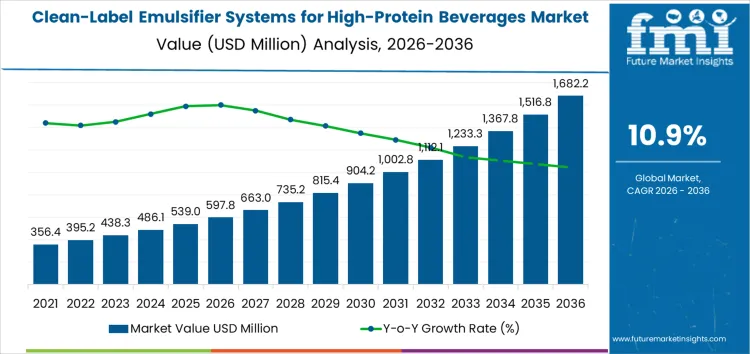
The clean-label emulsifier systems for high-protein beverages market is valued at USD 597.8 million in 2026 and is projected to reach USD 1,682.2 million by 2036, reflecting a CAGR of 10.9%. Performance over this period is defined by formulation discipline rather than expansion in beverage consumption alone. High-protein liquids operate within narrow stability tolerances, where protein load, fat phase, heat treatment, and shelf-life expectations interact continuously. Buyers allocate value toward emulsifier systems that reduce formulation failure, limit batch variability, and protect downstream processing efficiency. Cost structures favor suppliers able to deliver consistent dispersion performance using recognizable inputs, since reformulation cycles and line disruptions impose material operational penalties on beverage manufacturers.
Procurement behavior remains conservative and specification-driven. Beverage producers exhibit high aversion to ingredient switching once stability benchmarks are validated at scale, creating durable supplier relationships and elevated switching costs. Clean-label requirements add another constraint layer, narrowing acceptable options while increasing reliance on technical support and documentation depth. Margin concentration accrues to emulsifier systems that function across multiple protein bases and processing conditions without sensory trade-offs. Pricing control is sustained where suppliers demonstrate repeatable shelf-life performance under UHT, aseptic, and chilled formats. Growth quality between 2026 and 2036 reflects purchasing decisions anchored in risk reduction, compliance assurance, and processing predictability rather than experimentation or aggressive portfolio turnover.
Quick Stats for Clean-Label Emulsifier Systems for High-Protein Beverages Market
- Clean-Label Emulsifier Systems for High-Protein Beverages Market Value (2026): USD 597.8 million
- Clean-Label Emulsifier Systems for High-Protein Beverages Market Forecast Value (2036): USD 1,682.2 million
- Forecast CAGR (2026–2036): 10.9%
- Leading Application Segment in Global Demand: Dairy-Based High-Protein Beverages
- Fastest-Growing Countries: China, USA, Germany, France
- Key Players in Global Demand: Kerry, IFF, DSM-Firmenich, Tate & Lyle, ADM, Ingredion
Clean-Label Emulsifier Systems for High-Protein Beverages Market Key Takeaways
| Metric | Value |
|---|---|
| Market Value (2026) | USD 597.8 million |
| Market Forecast Value (2036) | USD 1,682.2 million |
| Forecast CAGR (2026-2036) | 10.9% |
Why is the Demand for Clean-Label Emulsifier Systems for High-Protein Beverages Market Growing?
Demand for clean-label emulsifier systems for high-protein beverages is growing globally due to increasing consumer expectations for transparency, ingredient simplicity, and improved sensory experience in functional beverages. High-protein beverages often face formulation challenges related to particle dispersion, mouthfeel, stability, and phase separation, which necessitate emulsifier systems that support uniform texture while avoiding synthetic or minimally acceptable additives. Clean-label trends encourage beverage developers to adopt emulsifiers derived from natural or recognizable sources, such as lecithins, saponins, and modified starches, which align with regulatory frameworks that emphasize ingredient clarity and consumer safety across multiple regions.
Growth in sports nutrition, weight management, and on-the-go wellness categories strengthens the need for stable protein-rich beverages that combine visual appeal with sensory smoothness under refrigerated and ambient storage. Advances in emulsifier technology improve compatibility with diverse protein bases, including dairy, pea, soy, and rice, while maintaining clarity, mouthfeel, and shelf life. Retail expansion through health food, mass market, specialty, and digital channels increases accessibility for consumers seeking clean-label, high-protein options. Beverage brands leverage formulation innovation and label positioning to differentiate products while meeting global demand for functional nutrition solutions with minimal processing and transparent ingredient credentials
How Is the Global Clean-Label Emulsifier Systems for High-Protein Beverages Market Structured?
The global clean-label emulsifier systems for high-protein beverages market is shaped by rising demand for minimally processed formulations that deliver stable texture, uniform dispersion, and consistent mouthfeel under thermal and mechanical stress. High-protein beverages present formulation challenges due to protein aggregation, phase separation, and sedimentation during processing, storage, and distribution. Clean-label emulsifier systems address these issues while avoiding synthetic surfactants, chemically modified ingredients, or regulatory-sensitive additives. Demand is strongly linked to growth in protein-fortified dairy alternatives, ready-to-drink nutrition beverages, and functional drinks positioned around transparency, ingredient simplicity, and label clarity.
Which Application Segment Accounts for the Largest Global Consumption?
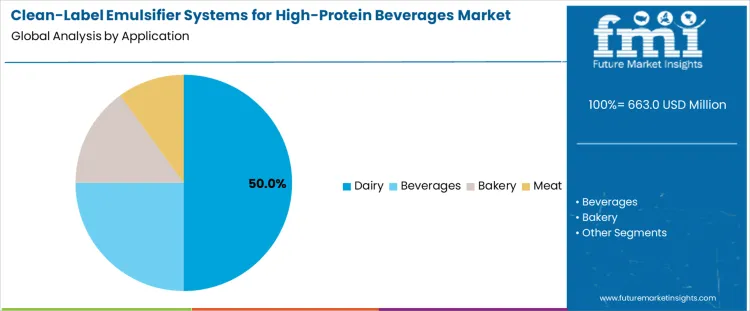
Dairy-based applications represent the largest share at 50.0%, driven by extensive use of clean-label emulsifiers in high-protein milk drinks, yogurt beverages, and dairy-alternative formulations that undergo pasteurization and homogenization. These emulsifier systems help stabilize fat–protein interactions, improve suspension stability, and maintain smooth texture across shelf life. Beverage applications account for 25.0% of demand, reflecting strong uptake in protein shakes, nutritional drinks, and meal-replacement beverages requiring clean-label compliance without compromising physical stability. Bakery applications hold a 15.0% share, where emulsifiers support protein dispersion and moisture management in drinkable batters and hybrid formulations. Meat applications account for 10.0%, primarily in liquid protein systems and functional beverage–meat crossover products used in sports and medical nutrition.
Key Takeaways:
- Dairy dominates due to high protein loading and heat processing
- Beverage segment relies on emulsification for shelf stability
- Bakery and meat applications reflect niche functional use
Which Source Type Leads Clean-Label Emulsifier System Formulations Globally?
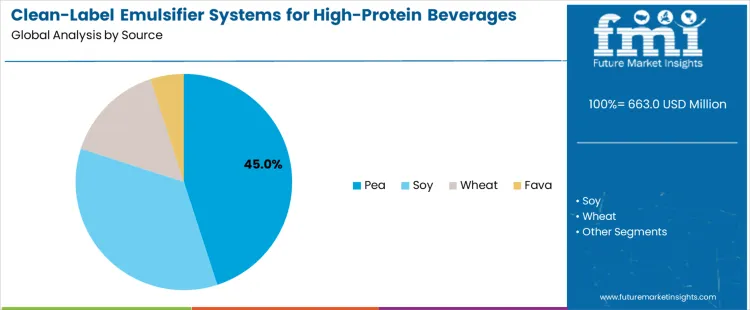
Pea-derived emulsifier systems lead with a 45.0% share, supported by strong consumer acceptance, allergen-friendly positioning, and effective emulsifying performance in high-protein liquid matrices. Pea-based systems offer balanced hydrophilic–lipophilic properties, enabling stable oil dispersion and protein compatibility without synthetic modification. Soy-based emulsifiers follow with a 35.0% share, benefiting from established supply chains, consistent functional performance, and cost efficiency in large-scale beverage production. Wheat-based systems account for 15.0%, mainly used in specific bakery-adjacent and cereal-based beverage applications where gluten-derived functionality is acceptable. Fava-based emulsifiers represent 5.0%, reflecting early-stage adoption driven by diversification efforts and interest in alternative legume sources.
Key Takeaways:
- Pea leads due to clean-label perception and functional versatility
- Soy remains important because of proven emulsification efficiency
- Wheat and fava serve targeted formulation strategies
Which Distribution Channel Controls the Majority of Global Sales?
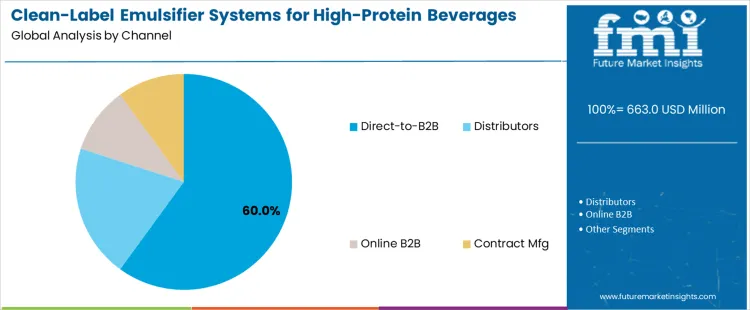
Direct-to-B2B channels account for 60.0% of global distribution, reflecting the technical complexity of clean-label emulsifier systems and the need for formulation-specific customization. Beverage manufacturers frequently collaborate with ingredient suppliers to fine-tune emulsifier performance based on protein type, fat composition, processing temperature, and shelf-life targets. Distributors represent 20.0% of sales, supporting standardized clean-label emulsifier offerings for regional processors and mid-scale brands. Online B2B platforms contribute 10.0%, primarily serving emerging beverage startups and pilot-scale developers seeking rapid access to compliant ingredients. Contract manufacturing also accounts for 10.0%, where emulsifier systems are integrated into customized ingredient blends or turnkey beverage bases.
Key Takeaways:
- Direct B2B dominates due to formulation and process specificity
- Distributors enable wider regional reach
- Online and contract models support innovation-stage demand
What are the Key Dynamics in the Clean-Label Emulsifier Systems for High-Protein Beverages Market?
Global demand rises as beverage formulators and functional drink manufacturers adopt clean-label emulsifier systems to stabilize high-protein beverages while meeting consumer expectations for minimal and recognizable ingredients. Clean-label emulsifiers support protein dispersion, prevent phase separation, and enhance mouthfeel in plant- and dairy-based high-protein drinks. Adoption aligns with increasing consumer focus on health and wellness, growth in sports nutrition and meal-replacement categories, and strict ingredient transparency demands across North America, Europe, Asia-Pacific, and Latin America. Usage spans ready-to-drink protein shakes, fortified milks, smoothies, and functional beverages positioned for active and health-conscious consumer segments.
How do consumer clean-label preferences and performance demands shape adoption?
Consumers increasingly scrutinize ingredient lists, preferring emulsifiers derived from natural sources such as lecithin, saponins, and modified starches that align with clean-label positioning. Beverage formulators balance performance requirements stable protein dispersion, smooth texture, and visual clarity with ingredient simplicity to support product claims and label transparency. Functional beverage brands emphasize clean label as a differentiator in competitive protein categories. Retailers align shelf placement and marketing with products that combine nutritional benefit and ingredient clarity. Performance criteria include resistance to heat and cold processing, maintenance of suspension over shelf life, and minimal impact on flavor and sensory profile.
How do formulation complexity, ingredient cost, and regulatory variation influence market scalability?
Clean-label emulsifier systems often require more sophisticated sourcing and formulation work to match the stabilization performance of synthetic alternatives, increasing development complexity and costs. Premium raw materials and limited supplier availability affect pricing and procurement planning for beverage producers. Regulatory frameworks governing ingredient definitions, labeling claims, and allowable processing aids vary across jurisdictions, influencing product positioning and compliance documentation for global distribution.
Integration with other stabilizers and nutrient systems requires careful formulation to avoid interactions that compromise texture or shelf stability. Long-term market growth depends on continued innovation in effective, consumer-acceptable emulsifier systems that align with clean-label expectations and harmonized regulatory standards supporting broad adoption in high-protein beverage formulations worldwide.
How Is Demand for Clean-Label Emulsifier Systems for High-Protein Beverages Evolving Globally?
Demand for clean-label emulsifier systems for high-protein beverages is increasing globally due to rapid growth of protein-enriched drinks, formulation complexity at high protein loads, and consumer scrutiny of ingredient transparency. China leads with a 13.2% CAGR, supported by expansion of functional dairy alternatives and sports nutrition beverages. USA follows at 12.4%, driven by ready-to-drink protein shake consumption and clean-label reformulation. Germany records 11.8%, reflecting regulatory discipline and preference for simplified ingredient decks. France posts 11.6%, supported by premium nutrition positioning and dairy innovation. Growth reflects shift from synthetic emulsifiers toward naturally derived systems ensuring stability, mouthfeel, and shelf life in protein-dense liquid formats.
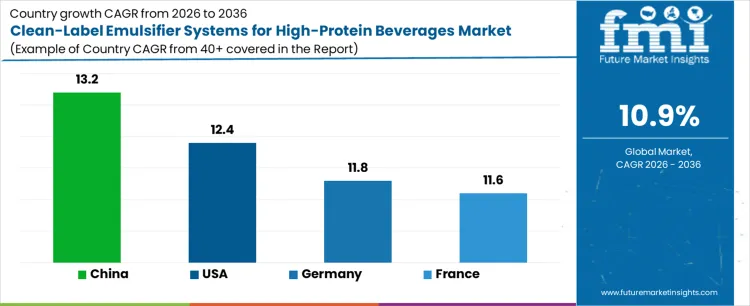
| Country | CAGR (%) |
|---|---|
| China | 13.2% |
| USA | 12.4% |
| Germany | 11.8% |
| France | 11.6% |
What is driving strong adoption of clean-label emulsifier systems in China’s high-protein beverage segment?
China demand is driven by rapid growth of functional beverages, meal replacements, and sports nutrition products. CAGR of 13.2% reflects increased use of clean-label emulsifier systems that stabilize high protein concentrations without synthetic additives. Manufacturers require solutions that prevent phase separation, sedimentation, and protein aggregation during storage. Consumer awareness around ingredient safety influences formulation decisions. Domestic brands invest in reformulation to meet clean-label expectations while maintaining processing efficiency. Ingredient suppliers expand availability of plant-based and fermentation-derived emulsifiers. Growth remains scale-driven and formulation-focused, aligned with functional beverage expansion and rising consumer trust requirements.
- Expansion of functional and protein beverage categories
- Demand for stability at high protein loadings
- Rising consumer scrutiny of ingredient transparency
- Scaling of natural and fermentation-derived emulsifiers
How is the USA sustaining demand growth for clean-label emulsifiers in protein beverages?
USA demand is shaped by popularity of ready-to-drink protein shakes, meal replacement beverages, and lifestyle nutrition products. CAGR of 12.4% reflects reformulation efforts to replace conventional emulsifiers with recognizable ingredients. Brands prioritize smooth texture, consistent dispersion, and shelf stability across chilled and ambient formats. Clean-label positioning influences retail acceptance and brand differentiation. Regulatory clarity supports adoption of plant-derived emulsifier systems. Ingredient suppliers develop application-specific solutions compatible with dairy and plant protein bases. Growth remains brand-led and compliance-aligned, supported by mature protein beverage consumption and clean ingredient expectations.
- Strong demand for ready-to-drink protein shakes
- Reformulation toward recognizable ingredient systems
- Emphasis on texture and shelf stability
- Availability of application-specific emulsifier solutions
What factors support steady adoption of clean-label emulsifier systems in Germany?
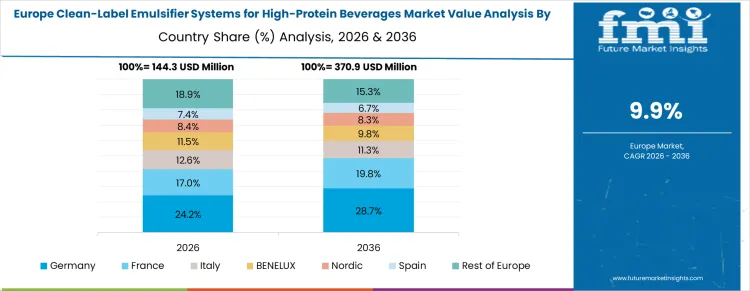
Germany demand reflects stringent regulatory expectations, strong clean-label culture, and advanced beverage processing standards. CAGR of 11.8% is supported by adoption of natural emulsifier systems in high-protein dairy drinks and plant-based alternatives. Manufacturers emphasize ingredient transparency, functional reliability, and compliance with labeling norms. High protein content increases formulation complexity, elevating need for effective emulsification. Research-driven product development supports use of lecithins, fibers, and protein-based emulsifiers. Growth remains quality-focused and regulation-aligned, supported by disciplined product development and consumer trust in clean-label claims.
- Strong clean-label and regulatory compliance culture
- Adoption across dairy and plant-based protein drinks
- Need for reliable emulsification at high protein levels
- Research-led ingredient selection and formulation
Why is France showing consistent growth in clean-label emulsifier adoption for protein beverages?
France demand reflects premium positioning of nutritional beverages and innovation within dairy-based protein drinks. CAGR of 11.6% is supported by use of clean-label emulsifier systems that enhance mouthfeel and stability without compromising ingredient simplicity. Brands emphasize sensory quality alongside nutritional value. Regulatory alignment encourages replacement of synthetic emulsifiers. Ingredient suppliers offer tailored solutions for milk and plant protein formulations. Consumer preference for natural sourcing reinforces adoption. Growth remains quality-driven and formulation-focused, supported by premium beverage development and clean-label expectations.
- Premium focus on nutrition and sensory quality
- Replacement of synthetic emulsifiers in formulations
- Use of tailored solutions for dairy protein drinks
- Consumer preference for natural ingredient sourcing
What is the competitive landscape of demand for clean-label emulsifier systems for high-protein beverages globally?
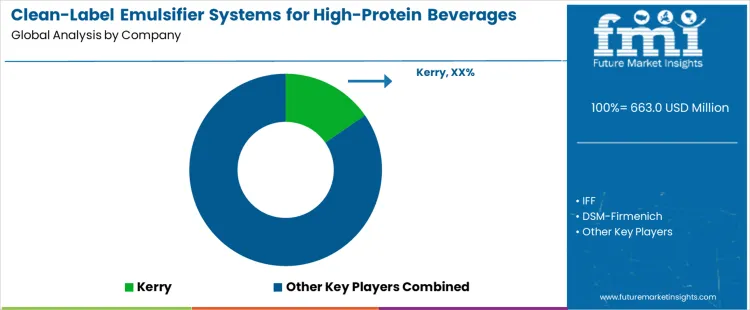
Demand for clean-label emulsifier systems for high-protein beverages is driven by growth of protein shakes, meal replacements, and fortified nutrition drinks with simplified ingredient statements. These beverages require emulsifiers that stabilize proteins, oils, and micronutrients while maintaining smooth mouthfeel and shelf stability under pasteurization and UHT conditions. Buyers evaluate emulsification efficiency, protein compatibility, thermal stability, sedimentation control, and impact on flavor release. Procurement teams prioritize suppliers offering recognizable ingredients, regulatory compliance across regions, and formulation support for dairy and plant-based protein systems. Trend in the global market reflects rising consumer scrutiny of additive labels, expansion of ready-to-drink protein formats, and demand for functional performance without synthetic emulsifiers.
Kerry holds leading positioning through clean-label emulsifier systems and functional ingredient blends tailored for high-protein beverage stabilization. IFF supports demand with emulsifier technologies and formulation expertise integrated into protein beverage applications. DSM-Firmenich contributes emulsification and nutrition science capabilities aligned with clean-label and performance requirements. Tate & Lyle supplies plant-based emulsifiers and texturizing systems supporting protein dispersion and stability. ADM participates through functional ingredients and emulsifier solutions serving global beverage manufacturers. Competitive differentiation depends on clean-label credibility, stability under processing stress, sensory performance, and ability to scale solutions for high-volume beverage production.
Key Players in the Clean-Label Emulsifier Systems for High-Protein Beverages Market
- Kerry
- IFF
- DSM-Firmenich
- Tate & Lyle
- ADM
- Ingredion
Scope of the Report
| Items | Values |
|---|---|
| Quantitative Units | USD million |
| Application | Dairy; Beverages; Bakery; Meat |
| Source | Pea; Soy; Wheat; Fava |
| Channel | Direct-to-B2B; Distributors; Online B2B; Contract Mfg |
| Regions Covered | Asia Pacific, Europe, North America, Latin America, Middle East & Africa |
| Countries Covered | China, USA, Germany, France, and 40+ countries |
| Key Companies Profiled | Kerry; IFF; DSM-Firmenich; Tate & Lyle; ADM; Ingredion |
| Additional Attributes | Dollar sales by application and source; adoption trends for clean-label emulsifier systems in high-protein beverage formulations; emulsion stability, protein dispersion, and mouthfeel performance metrics; compatibility with UHT, aseptic, and chilled beverage processing; label simplicity, allergen management, and sensory neutrality considerations; regulatory compliance and clean-label definitions influencing emulsifier system selection. |
Clean-Label Emulsifier Systems for High-Protein Beverages Market by Segment
Application:
- Dairy
- Beverages
- Bakery
- Meat
Source:
- Pea
- Soy
- Wheat
- Fava
Channel:
- Direct-to-B2B
- Distributors
- Online B2B
- Contract Mfg
Region:
- Asia Pacific
- China
- Japan
- South Korea
- India
- Australia & New Zealand
- ASEAN
- Rest of Asia Pacific
- Europe
- Germany
- United Kingdom
- France
- Italy
- Spain
- Nordic
- BENELUX
- Rest of Europe
- North America
- United States
- Canada
- Mexico
- Latin America
- Brazil
- Chile
- Rest of Latin America
- Middle East & Africa
- Kingdom of Saudi Arabia
- Other GCC Countries
- Turkey
- South Africa
- Other African Union
- Rest of Middle East & Africa
Frequently Asked Questions
How big is the clean-label emulsifier systems for high-protein beverages market in 2026?
The global clean-label emulsifier systems for high-protein beverages market is estimated to be valued at USD 597.8 million in 2026.
What will be the size of clean-label emulsifier systems for high-protein beverages market in 2036?
The market size for the clean-label emulsifier systems for high-protein beverages market is projected to reach USD 1,682.2 million by 2036.
How much will be the clean-label emulsifier systems for high-protein beverages market growth between 2026 and 2036?
The clean-label emulsifier systems for high-protein beverages market is expected to grow at a 10.9% CAGR between 2026 and 2036.
What are the key application types in the clean-label emulsifier systems for high-protein beverages market?
The key application types in clean-label emulsifier systems for high-protein beverages market are dairy, beverages, bakery and meat.
Which source segment will contribute significant share in the clean-label emulsifier systems for high-protein beverages market in 2026?
In terms of source, pea segment to command 45.0% share in the clean-label emulsifier systems for high-protein beverages market in 2026.
Preview the report firsthand - request a free sample
Get SampleGet the brochure for pricing and purchase details.
Get PDFTable of Content
- Executive Summary
- Global Market Outlook
- Demand-side Trends
- Supply-side Trends
- Technology Roadmap Analysis
- Analysis and Recommendations
- Market Overview
- Market Coverage / Taxonomy
- Market Definition / Scope / Limitations
- Market Background
- Market Dynamics
- Drivers
- Restraints
- Opportunity
- Trends
- Scenario Forecast
- Demand in Optimistic Scenario
- Demand in Likely Scenario
- Demand in Conservative Scenario
- Opportunity Map Analysis
- Product Life Cycle Analysis
- Supply Chain Analysis
- Investment Feasibility Matrix
- Value Chain Analysis
- PESTLE and Porter’s Analysis
- Regulatory Landscape
- Regional Parent Market Outlook
- Production and Consumption Statistics
- Import and Export Statistics
- Market Dynamics
- Global Market Analysis 2021 to 2025 and Forecast, 2026 to 2036
- Historical Market Size Value (USD Million) Analysis, 2021 to 2025
- Current and Future Market Size Value (USD Million) Projections, 2026 to 2036
- Y-o-Y Growth Trend Analysis
- Absolute $ Opportunity Analysis
- Global Market Pricing Analysis 2021 to 2025 and Forecast 2026 to 2036
- Global Market Analysis 2021 to 2025 and Forecast 2026 to 2036, By Application
- Introduction / Key Findings
- Historical Market Size Value (USD Million) Analysis By Application , 2021 to 2025
- Current and Future Market Size Value (USD Million) Analysis and Forecast By Application , 2026 to 2036
- Dairy
- Beverages
- Bakery
- Meat
- Dairy
- Y-o-Y Growth Trend Analysis By Application , 2021 to 2025
- Absolute $ Opportunity Analysis By Application , 2026 to 2036
- Global Market Analysis 2021 to 2025 and Forecast 2026 to 2036, By Source
- Introduction / Key Findings
- Historical Market Size Value (USD Million) Analysis By Source, 2021 to 2025
- Current and Future Market Size Value (USD Million) Analysis and Forecast By Source, 2026 to 2036
- Pea
- Soy
- Wheat
- Fava
- Pea
- Y-o-Y Growth Trend Analysis By Source, 2021 to 2025
- Absolute $ Opportunity Analysis By Source, 2026 to 2036
- Global Market Analysis 2021 to 2025 and Forecast 2026 to 2036, By Channel
- Introduction / Key Findings
- Historical Market Size Value (USD Million) Analysis By Channel, 2021 to 2025
- Current and Future Market Size Value (USD Million) Analysis and Forecast By Channel, 2026 to 2036
- Direct-to-B2B
- Distributors
- Online B2B
- Contract Mfg
- Direct-to-B2B
- Y-o-Y Growth Trend Analysis By Channel, 2021 to 2025
- Absolute $ Opportunity Analysis By Channel, 2026 to 2036
- Global Market Analysis 2021 to 2025 and Forecast 2026 to 2036, By Region
- Introduction
- Historical Market Size Value (USD Million) Analysis By Region, 2021 to 2025
- Current Market Size Value (USD Million) Analysis and Forecast By Region, 2026 to 2036
- North America
- Latin America
- Western Europe
- Eastern Europe
- East Asia
- South Asia and Pacific
- Middle East & Africa
- Market Attractiveness Analysis By Region
- North America Market Analysis 2021 to 2025 and Forecast 2026 to 2036, By Country
- Historical Market Size Value (USD Million) Trend Analysis By Market Taxonomy, 2021 to 2025
- Market Size Value (USD Million) Forecast By Market Taxonomy, 2026 to 2036
- By Country
- USA
- Canada
- Mexico
- By Application
- By Source
- By Channel
- By Country
- Market Attractiveness Analysis
- By Country
- By Application
- By Source
- By Channel
- Key Takeaways
- Latin America Market Analysis 2021 to 2025 and Forecast 2026 to 2036, By Country
- Historical Market Size Value (USD Million) Trend Analysis By Market Taxonomy, 2021 to 2025
- Market Size Value (USD Million) Forecast By Market Taxonomy, 2026 to 2036
- By Country
- Brazil
- Chile
- Rest of Latin America
- By Application
- By Source
- By Channel
- By Country
- Market Attractiveness Analysis
- By Country
- By Application
- By Source
- By Channel
- Key Takeaways
- Western Europe Market Analysis 2021 to 2025 and Forecast 2026 to 2036, By Country
- Historical Market Size Value (USD Million) Trend Analysis By Market Taxonomy, 2021 to 2025
- Market Size Value (USD Million) Forecast By Market Taxonomy, 2026 to 2036
- By Country
- Germany
- UK
- Italy
- Spain
- France
- Nordic
- BENELUX
- Rest of Western Europe
- By Application
- By Source
- By Channel
- By Country
- Market Attractiveness Analysis
- By Country
- By Application
- By Source
- By Channel
- Key Takeaways
- Eastern Europe Market Analysis 2021 to 2025 and Forecast 2026 to 2036, By Country
- Historical Market Size Value (USD Million) Trend Analysis By Market Taxonomy, 2021 to 2025
- Market Size Value (USD Million) Forecast By Market Taxonomy, 2026 to 2036
- By Country
- Russia
- Poland
- Hungary
- Balkan & Baltic
- Rest of Eastern Europe
- By Application
- By Source
- By Channel
- By Country
- Market Attractiveness Analysis
- By Country
- By Application
- By Source
- By Channel
- Key Takeaways
- East Asia Market Analysis 2021 to 2025 and Forecast 2026 to 2036, By Country
- Historical Market Size Value (USD Million) Trend Analysis By Market Taxonomy, 2021 to 2025
- Market Size Value (USD Million) Forecast By Market Taxonomy, 2026 to 2036
- By Country
- China
- Japan
- South Korea
- By Application
- By Source
- By Channel
- By Country
- Market Attractiveness Analysis
- By Country
- By Application
- By Source
- By Channel
- Key Takeaways
- South Asia and Pacific Market Analysis 2021 to 2025 and Forecast 2026 to 2036, By Country
- Historical Market Size Value (USD Million) Trend Analysis By Market Taxonomy, 2021 to 2025
- Market Size Value (USD Million) Forecast By Market Taxonomy, 2026 to 2036
- By Country
- India
- ASEAN
- Australia & New Zealand
- Rest of South Asia and Pacific
- By Application
- By Source
- By Channel
- By Country
- Market Attractiveness Analysis
- By Country
- By Application
- By Source
- By Channel
- Key Takeaways
- Middle East & Africa Market Analysis 2021 to 2025 and Forecast 2026 to 2036, By Country
- Historical Market Size Value (USD Million) Trend Analysis By Market Taxonomy, 2021 to 2025
- Market Size Value (USD Million) Forecast By Market Taxonomy, 2026 to 2036
- By Country
- Kingdom of Saudi Arabia
- Other GCC Countries
- Turkiye
- South Africa
- Other African Union
- Rest of Middle East & Africa
- By Application
- By Source
- By Channel
- By Country
- Market Attractiveness Analysis
- By Country
- By Application
- By Source
- By Channel
- Key Takeaways
- Key Countries Market Analysis
- USA
- Pricing Analysis
- Market Share Analysis, 2025
- By Application
- By Source
- By Channel
- Canada
- Pricing Analysis
- Market Share Analysis, 2025
- By Application
- By Source
- By Channel
- Mexico
- Pricing Analysis
- Market Share Analysis, 2025
- By Application
- By Source
- By Channel
- Brazil
- Pricing Analysis
- Market Share Analysis, 2025
- By Application
- By Source
- By Channel
- Chile
- Pricing Analysis
- Market Share Analysis, 2025
- By Application
- By Source
- By Channel
- Germany
- Pricing Analysis
- Market Share Analysis, 2025
- By Application
- By Source
- By Channel
- UK
- Pricing Analysis
- Market Share Analysis, 2025
- By Application
- By Source
- By Channel
- Italy
- Pricing Analysis
- Market Share Analysis, 2025
- By Application
- By Source
- By Channel
- Spain
- Pricing Analysis
- Market Share Analysis, 2025
- By Application
- By Source
- By Channel
- France
- Pricing Analysis
- Market Share Analysis, 2025
- By Application
- By Source
- By Channel
- India
- Pricing Analysis
- Market Share Analysis, 2025
- By Application
- By Source
- By Channel
- ASEAN
- Pricing Analysis
- Market Share Analysis, 2025
- By Application
- By Source
- By Channel
- Australia & New Zealand
- Pricing Analysis
- Market Share Analysis, 2025
- By Application
- By Source
- By Channel
- China
- Pricing Analysis
- Market Share Analysis, 2025
- By Application
- By Source
- By Channel
- Japan
- Pricing Analysis
- Market Share Analysis, 2025
- By Application
- By Source
- By Channel
- South Korea
- Pricing Analysis
- Market Share Analysis, 2025
- By Application
- By Source
- By Channel
- Russia
- Pricing Analysis
- Market Share Analysis, 2025
- By Application
- By Source
- By Channel
- Poland
- Pricing Analysis
- Market Share Analysis, 2025
- By Application
- By Source
- By Channel
- Hungary
- Pricing Analysis
- Market Share Analysis, 2025
- By Application
- By Source
- By Channel
- Kingdom of Saudi Arabia
- Pricing Analysis
- Market Share Analysis, 2025
- By Application
- By Source
- By Channel
- Turkiye
- Pricing Analysis
- Market Share Analysis, 2025
- By Application
- By Source
- By Channel
- South Africa
- Pricing Analysis
- Market Share Analysis, 2025
- By Application
- By Source
- By Channel
- USA
- Market Structure Analysis
- Competition Dashboard
- Competition Benchmarking
- Market Share Analysis of Top Players
- By Regional
- By Application
- By Source
- By Channel
- Competition Analysis
- Competition Deep Dive
- Kerry
- Overview
- Product Portfolio
- Profitability by Market Segments (Product/Age /Sales Channel/Region)
- Sales Footprint
- Strategy Overview
- Marketing Strategy
- Product Strategy
- Channel Strategy
- IFF
- DSM-Firmenich
- Tate & Lyle
- ADM
- Ingredion
- Kerry
- Competition Deep Dive
- Assumptions & Acronyms Used
- Research Methodology


