

- Market Size (2026)
- USD 1.90 Bn
- Forecast (2036)
- USD 9.00 Bn
- CAGR (2026 to 2036)
- 17.0%
Cannabis Concentrate Market Size, Market Forecast and Outlook By FMI
Summary of the Cannabis Concentrate Market
- Demand and Growth Drivers
- Demand is being significantly reshaped by the standardization of 510-thread vape hardware, which enables consumer reuse and ecosystem expansion across brands.
- A decisive shift toward premium product tiers, specifically live resin and solventless rosin, is occurring as consumers seek terpene-rich profiles, allowing manufacturers to command higher price premiums.
- Market growth is bolstered by continued state-level adult-use legalization and the subsequent expansion of licensed dispensary networks, which serve as the primary retail infrastructure for regulated products.
- Product and Segment View
- With a 38.4% market share, vape cartridges are now the most popular product due to consumer demand for discreet, powerful, and easy-to-use designs.
- Due to its excellent distribution economics and compatibility with core consumer usage patterns, distillate has a 42.3% market share in the concentrate-form category, demonstrating its leadership position in the industry.
- Geography and Competitive Outlook
- Asia-Pacific is the region with the greatest potential for absolute growth, while North America and Western Europe are still developed areas that prioritize premium positioning.
- Major international operators, including as Canopy Growth Corporation, The Cronos Group, Tilray Inc., and Aurora Cannabis Inc., are the main competitors. These companies are increasingly differentiating themselves through premium branding and format innovation rather than just unit cost.
- Analyst Opinion
- Nandini Roy Choudhury at FMI says, “The market is transitioning from a commodity-driven volume play to a premium-focused, technology-enabled ecosystem where hardware interoperability and safety certification determine long-term competitive viability.”
- Market evolution is heavily dictated by the adoption of standardized hardware, which creates a stable, cross-brand consumer ecosystem.
- The key force behind acceptance is still the quick growth of networks of authorized dispensaries, which shortens competitive timeframes and benefits manufacturers with substantial finance access.
- Because premium tiers fetch substantially higher price points than mass-market goods, investments in solventless extraction technologies are redefining margin structures as product innovation trends toward premiumization.
- Investments in third-party safety testing and hardware certification are becoming crucial obstacles to entry in regulated industries, making strategic growth more and more dependent on regulatory compliance.
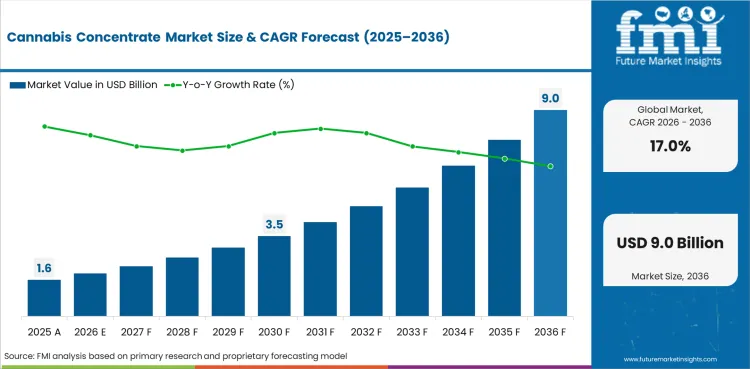
Key Takeaways, Market Size, and Forecast
| Metric | Value |
|---|---|
| Market Size (2025) | USD 1.60 Billion |
| Market Size (2036) | USD 9.00 Billion |
| CAGR (2026–2036) | 17.0% |
| Incremental Opportunity | USD 7.13 Billion |
| Leading Product | With A 38.4% Market Share, Vape Cartridges (38.4%) |
| Highlight | At 42.3%, distillate is in the top spot in the concentrate form category |
| Leading Product Type | Dispensaries |
| Dispensaries Share | 72.5% |
| Fastest-Growing Markets | The fastest-growing nations are China and India, with predicted CAGRs of 23.00% and 21.30%, respectively |
Cannabis Concentrate Market Definition
The cannabis concentrate market covers cannabis concentrates including distillate, live resin, rosin, shatter, wax, crumble, hash, and kief used in vape cartridges, dabbing applications, edibles manufacturing, and pre-roll infusion. Distribution spans licensed dispensaries, medical cannabis programs, and adult-use retail in legal state and provincial markets.
Cannabis Concentrate Market Inclusions
Market scope includes all commercially traded products in the cannabis concentrate market segmented by product (Vape Cartridges and peer options), concentrate form (Distillate and peer options), consumer type, and distribution channel (Dispensaries and peer channels). Revenue sizing spans the 2026 to 2036 forecast period.
Cannabis Concentrate Market Exclusions
The scope excludes CBD-only concentrates without THC content, hemp-derived non-psychoactive extracts, prescription cannabinoid pharmaceuticals, smokable flower cannabis, and cannabis beverages or edibles as finished consumer goods.
Cannabis Concentrate Market Research Methodology
- Primary Research: Manufacturers, distributors, and buyer accounts in the cannabis concentrate market in North America, Europe, and Asia-Pacific were interviewed by FMI analysts with procurement leads, category managers, and product development heads.
- Desk Research: To create verifiable baseline parameters, data was gathered from trade publications, industry association statistics, regulatory filings, and corporate annual reports.
- Market Sizing and Forecasting: Using region-specific growth rates and substitution curves to predict demand through 2036, baseline values are derived from a bottom-up aggregation of transaction volumes in the cannabis concentrate market.
- Data validation and update cycle: On a quarterly refresh schedule, projections are compared to manufacturer shipment disclosures, customer survey data, and regulatory filings.
Why is the Cannabis Concentrate Market Growing?
- Volume expansion is running on two parallel tracks: structural end-user demand in the adult-use and medical cannabis processed products sector and product innovation extending applications across adjacent use cases.
- Live Resin and Solventless Rosin Premium Tier Growth is generating reformulation and investment cycles, reshaping the margin pool across commodity and premium tiers.
- State-Level Adult-Use Legalization and Dispensary Network Growth is compressing timelines for competitive response, favouring scaled manufacturers with capital access over fragmented regional players.
The cannabis concentrate market is expanding steadily, shaped by structural demand in the adult-use and medical cannabis processed products sector, product and format innovation, and the competitive pressure on commodity players to reformulate for premium positioning. Demand is shaped by the 510-thread cartridge hardware standard that enables consumer reuse across vape batteries and brands. This interoperability has made vape cartridges the dominant concentrate delivery format, with new adult-use markets showing 40% to 55% of concentrate revenue captured by vape products.
A new growth layer is being added by the living resin and solventless rosin premium tier growth. Growth is a reflection of consumers' preference for solventless rosin concentrates and terpene-rich live resin. Processors are investing in fresh-frozen cannabis procurement, hydrocarbon extraction, and solventless press equipment because premium consumers are ready to pay $60 to $100 per gram for live resin as opposed to $20 to $35 for commodity distillate.
State-Level Adult-Use Legalization and Dispensary Network Growth represents both a growth catalyst and a margin pressure point. Adoption is expanded by continued state-level adult-use legalization in the Northeast and Mid-Atlantic US, full legalization in Canada, and adult-use pilots in Germany and Malta. Each new market adds regulated concentrate manufacturing, licensed dispensary distribution, and testing and packaging infrastructure that accelerates category growth.
Segmental Analysis
- In 2026, Vape Cartridges maintains a 38.4% product share, anchoring category sales through familiarity with the format and existing buyer connections.
- Recreational consumers at 58.7% and distillate at 42.3% demonstrate the predominance of core usage patterns as the main volume drivers.
- Dispensaries holds 72.5% share, though adjacent channels are compressing order lead times and expanding access to mid-size buyer accounts.
The cannabis concentrate market is segmented by product, concentrate form, consumer type, distribution channel, and geographic regions. By product, the market is divided into Vape Cartridges and peer categories. By concentrate form, the market is classified into Distillate and peer formats. By consumer type, the market is segmented into Recreational Consumers and related options.
Insights into the Vape Cartridges Segment
In 2026, vape cartridges are expected to dominate the industry with a 38.4% market share. Established customer preferences, competitive unit economics, and functional performance for the category's primary use cases are all reflected in its leadership. Premium sub-formats of vape cartridges are becoming more popular as consumers react to demands related to quality, bioavailability, or regulatory posture. Changing consumer preferences and reformulation in response to compliance demands are driving the fastest-growing subsegment. Vape cartridges are predicted to maintain the majority of product share through 2036 despite growing competition from related formats because other categories currently find it difficult to achieve the mix of price, performance, and supply reliability required by the core customer base.
Insights into the Distillate Segment
In 2026, distillate is predicted to account for 42.3% of the concentrate form market. Because it handles ease, distribution economics, and compatibility with the biggest customer categories in the cannabis concentrate market, this format is the industry leader. While traditional countries maintain replacement volume through consistent per-capita consumption and reformulation cycles, the distillate format's expansion in emerging markets like China, India, and Southeast Asia is compounding demand at above-average rates.
Cannabis Concentrate Market Drivers, Restraints, and Opportunities
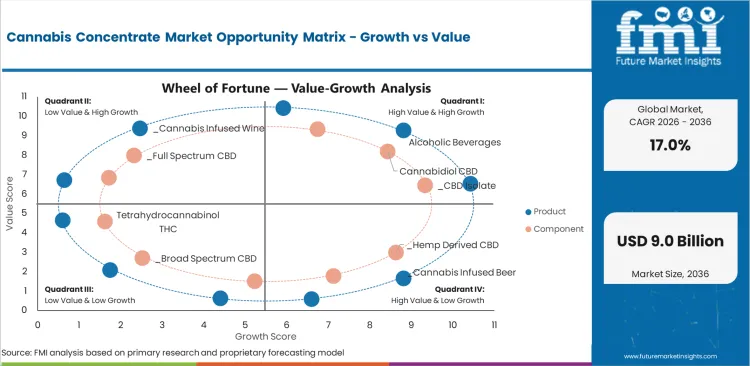
- Vape Category Expansion and Hardware Ecosystem Growth is creating incremental demand with higher-specification product designs and premium price points.
- Adult-Use Legalization and New State Market Opening is compelling reformulation investment, straining smaller manufacturers while favouring scaled operators.
- Vape Safety Regulation and Emissions Testing Requirements is closing the performance gap with legacy categories, shifting premium formats from niche positioning to mainstream specification.
The market for cannabis concentrate is growing gradually due to the expansion of the vape category, the rise of the hardware ecosystem, the expansion of the premium segment for live resin and solventless rosin, the legalization of adult use, and the opening of new state markets. In response, producers are creating commercial strategies and product types that satisfy changing customer and regulatory demands. There are substantial development prospects in specialist formats, emerging-market expansion, and premium-tier product innovation despite obstacles such raw material pricing instability, tooling investment requirements, and shifting regulatory frameworks.
Vape Category Expansion and Hardware Ecosystem Growth
The 510-thread cartridge hardware standard, which permits customer reuse across vape batteries and brands, shapes demand. Vape cartridges are now the most popular concentrate delivery method due to their interoperability; in new adult-use markets, vape goods account for 40% to 55% of concentrate sales.
Live Resin and Solventless Rosin Premium Segment Growth
Growth reflects consumer shift toward terpene-rich live resin and solventless rosin concentrates. Premium consumers are willing to pay $60 to $100 per gram for live resin versus $20 to $35 for commodity distillate, driving processors to invest in fresh-frozen cannabis sourcing, hydrocarbon extraction, and solventless press equipment.
Adult-Use Legalization and New State Market Opening
Adoption is expanded by continued state-level adult-use legalization in the Northeast and Mid-Atlantic US, full legalization in Canada, and adult-use pilots in Germany and Malta. Each new market adds regulated concentrate manufacturing, licensed dispensary distribution, and testing and packaging infrastructure that accelerates category growth.
Vape Safety Regulation and Emissions Testing Requirements
Following the 2019 EVALI events, state-level vape safety rules have gated growth, with California, Washington, and Oregon enforcing stringent criteria for heavy metal, pesticide, and additive testing. Processors are creating long-lasting competitive advantages by investing in hardware certification, third-party testing, and GMP manufacturing.
Analysis of Cannabis Concentrate Market By Key Countries
.webp "Top Country Growth Comparison Cannabis Concentrate Market Cagr (2026 2036)")
| Country | CAGR |
|---|---|
| China | 23.00% |
| India | 21.30% |
| Germany | 19.60% |
| Japan | 17.90% |
| United Kingdom | 16.20% |
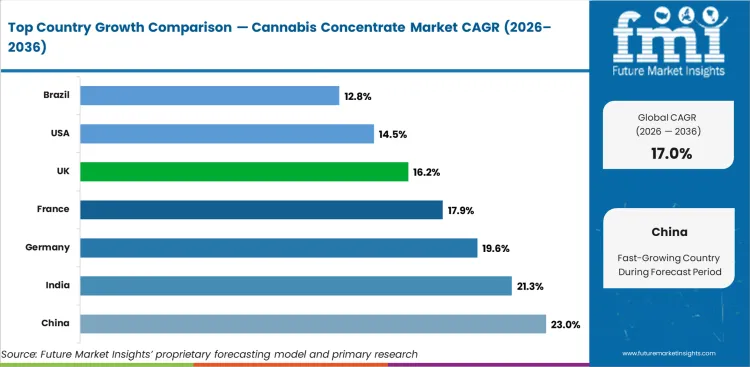
- Asia-Pacific has the strongest absolute growth due to growing consumer penetration and coordinated distribution development, whereas North America and Western Europe are mature regions where growth indicates format change and premium positioning rather than pure volume expansion.
- With a 23.00% CAGR, the United States leads the tracked country roster. This is due to the country's ongoing legalization of adult use at the state level, its dominance in the vape cartridge format, and the expansion of the premium live resin category.
- Due to the growth of organized retail, increased consumer knowledge, and regulatory compliance with international product standards, China and India are becoming rapidly expanding national markets.
- The GCC's hospitality, healthcare, and organized retail infrastructure investments have created the first demand base for certified and branded supply in the Middle East and Africa, which is still in its early stages.
The cannabis concentrate market is projected to grow globally at a CAGR of 17.0% from 2026 to 2036. Among the top markets, the China leads at 23.00%, followed by India at 21.30%, followed by Germany at 19.60%, followed by France at 17.90%, while United Kingdom posts 16.20%. The analysis spans over 30 countries, with the leading markets detailed below.
Demand Outlook for Cannabis Concentrate Market in United States
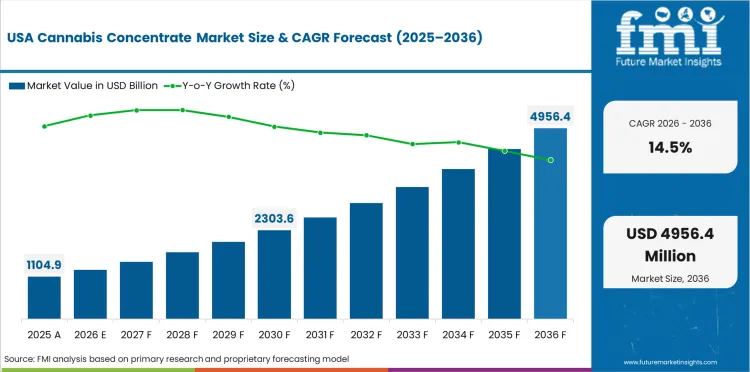
The United States is projected to grow at a CAGR of 14.50% through 2036, shaped by continued state-level adult-use legalization, dominant vape cartridge format penetration, and premium live resin segment growth. Curaleaf, Green Thumb Industries, and Trulieve lead the US multi-state operator segment, with Canopy Growth, Tilray, and Cronos Group competing in select state markets.
- Continued state-level adult-use legalization sustains recurring category demand.
- Leading national operators invest in premium format capacity and branded positioning.
- Direct-to-consumer and specialty retail channels expand alongside traditional distribution.
Future Outlook for Cannabis Concentrate Market in United Kingdom
The United Kingdom is projected to grow at a CAGR of 16.20% through 2036, with demand supported by restrictive cannabis regulatory framework limiting concentrates to prescription medical cannabis, small regulated patient base, and licensed producer imports for medical access. UK medical cannabis access is served by licensed importer and distributor networks supplying private clinics, with limited domestic concentrate production.
- Restrictive cannabis regulatory framework limiting concentrates to prescription medical cannabis sustains category volumes.
- Pharmacy and specialty retail chains concentrate branded distribution.
- E-commerce and DTC subscription platforms expand consumer reach.
Opportunity Analysis of Cannabis Concentrate Market in Germany
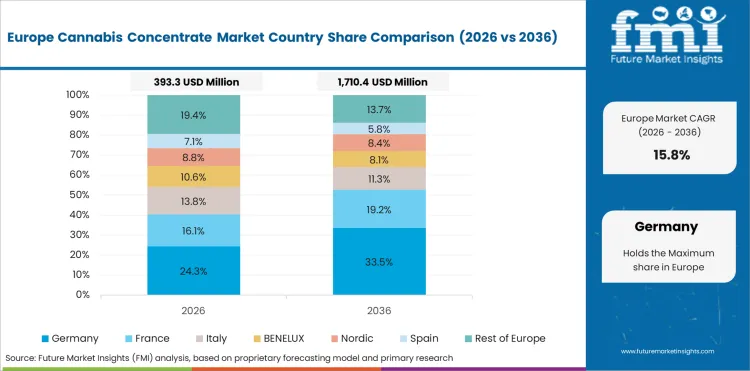
Germany demonstrates steady growth through 2036 as the country's buyer base responds to adult-use legalization pilot program, expanding medical cannabis patient base, and imported concentrate supply from Canadian and Dutch licensed producers. German medical cannabis distributors including Bionorica and Cansativa serve the domestic market, with imports from Tilray, Aurora Cannabis, and Bedrocan supplying medical and adult-use pilot channels.
- Adult-use legalization pilot program shapes category positioning.
- Leading local operators lead premium format innovation.
- Organized retail and pharmacy distribution anchor branded share.
In-depth Analysis of Cannabis Concentrate Market in Japan
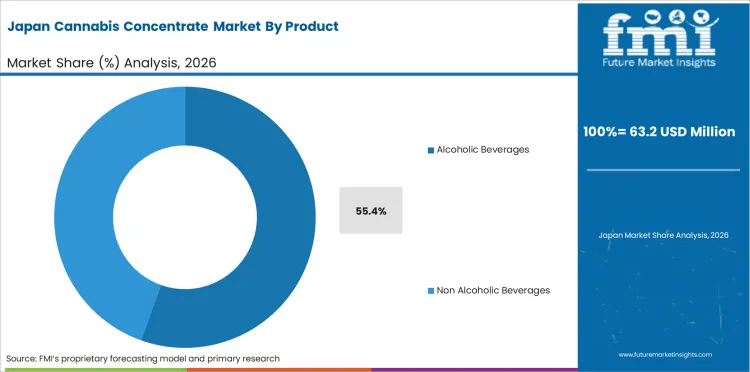
Japan is projected to grow at a CAGR of 17.90% through 2036, reflecting strict regulatory framework prohibiting THC concentrates, medical cannabis access limited to specific conditions, and emerging CBD-only concentrate category. Japan regulatory framework limits THC concentrate market activity, with imports of CBD-only concentrates serving specialty retail channels.
- Strict regulatory framework prohibiting THC concentrates generates consistent category demand.
- Premium positioning and convenience store distribution anchor national volumes.
- Format and packaging innovation aligns with consumer quality expectations.
Sales Analysis of Cannabis Concentrate Market in China
China is expected to demonstrate above-average growth through 2036, propelled by restrictive cannabis regulatory framework prohibiting THC concentrates, emerging CBD research and development activity under state oversight, and limited domestic market access. Domestic cannabis concentrate production is restricted to research and industrial hemp-derived CBD processing, with no regulated consumer THC concentrate market.
- Restrictive cannabis regulatory framework prohibiting THC concentrates generates rapid category demand growth.
- E-commerce platforms on Tmall and JD create large-scale direct consumer reach.
- Local manufacturers and foreign brands compete on quality, price, and premium positioning.
In-depth Analysis of Cannabis Concentrate Market in India
India demonstrates strong growth through 2036, supported by restrictive cannabis regulatory framework prohibiting THC concentrates, emerging hemp-derived CBD development, and early-stage medical cannabis research programs. Indian cannabis concentrate market is limited to research and industrial hemp-derived CBD applications under restrictive regulatory conditions.
- Restrictive cannabis regulatory framework prohibiting THC concentrates drives organized category demand.
- Transition from unbranded suppliers to certified operators reshapes competitive dynamics.
- E-commerce and organized-retail expansion accelerate branded penetration.
Competitive Landscape and Strategic Positioning
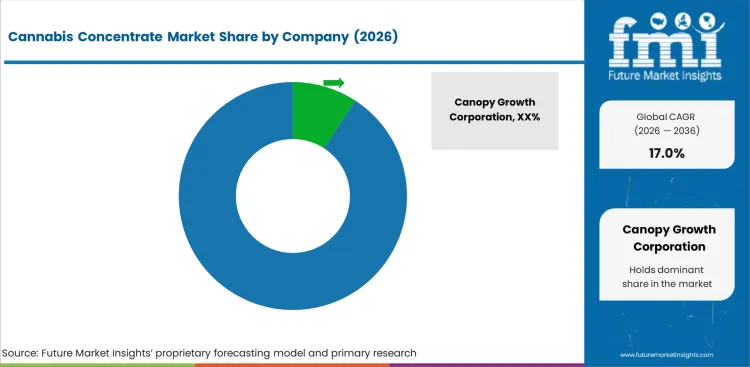
- The market for cannabis concentrate is dominated by the top four international operators, who have shifted their competitive differentiation from unit cost to format innovation, premium positioning, and buyer-account access.
- In markets where consumer preferences or regulatory requirements favor certified, locally produced, or specialty forms, regional experts are increasing market share.
- Targeting institutional and subscription buyer accounts, startups and SMEs are carving out niches in specialty and premium markets.
Specialized category operators and integrated manufacturers influence the cannabis concentrate market. Based on vertically integrated manufacturing, a large distribution network, and well-established buyer-account relationships, Canopy Growth Corporation has an anticipated sector-leading revenue share. The Cronos Group, which specializes in format and distribution innovation, runs production facilities in several different parts of the world. Through a specific section devoted to commercial accounts, Tilray Inc. provides the category. Aurora Cannabis Inc. supplies commodity and specialist goods for a variety of end-use applications by utilizing manufacturing scale. For institutional accounts, Hexo Corp. specializes in premium and specialist formats. Manufacturing capital needs, accreditation under relevant safety and regulatory standards, and established supply agreements with buyer procurement groups are examples of barriers to entrance. Building manufacturing capacity in high-growth Asian regions, increasing certified supply coverage, and creating premium formats that match commodity-tier performance are strategic initiatives.
Major Industry Players
Key global companies leading the cannabis concentrate market include:
- Canopy Growth Corporation, The Cronos Group, Tilray Inc, Aurora Cannabis Inc were identified as some of the star players in the cannabis concentrate market (global), given their strong production footprint, established buyer account relationships, and product portfolio spanning commodity and premium tiers.
- Hexo Corp, Other Companies have established strong regional positions by specializing in regional and premium formats, serving buyer accounts that prioritize certified supply, regional presence, or specialty product requirements across their respective markets.
- have distinguished themselves among startups and SMEs by securing footholds in specialized niche areas, underscoring their potential as emerging market leaders.
Competitive Benchmarking: Cannabis Concentrate Market
| Company | Product Breadth | Extraction Capability | State Licenses | Geographic Footprint |
|---|---|---|---|---|
| Canopy Growth Corporation | High | High | Medium | Global |
| The Cronos Group | High | High | Medium | Global |
| Tilray Inc | High | High | Medium | Global |
| Aurora Cannabis Inc | High | High | Medium | Global |
| Hexo Corp | Medium | High | Low | North America |
| Other Companies | Medium | Medium | Medium | Regional |
Source: Future Market Insights competitive analysis, 2026.
Key Developments in Cannabis Concentrate Market
- In 2024–2025, companies such as Canopy Growth Corporation and Curaleaf Holdings expanded concentrate offerings in response to growing demand for high-potency products like live resin, rosin, and vape formats.
- In 2024–2025, manufacturers increasingly adopted advanced and solventless extraction technologies to improve product quality, flavor retention, and consistency in premium cannabis concentrates
Key Players in the Cannabis Concentrate Market:
Major Global Players:
- Canopy Growth Corporation
- The Cronos Group
- Tilray Inc
- Aurora Cannabis Inc
- Hexo Corp
- Other Companies
Emerging Players/Startups
- Aurora Cannabis Inc
- Hexo Corp
- Other Companies
Scope of the report
| Metric | Value |
|---|---|
| Quantitative Units | USD 1.87 billion to USD 9.00 billion, at a CAGR of 17.0% |
| Market Definition | The cannabis concentrate market covers cannabis concentrates including distillate. |
| Regions Covered | North America, Latin America, Europe, East Asia, South Asia and Pacific, Middle East and Africa |
| Countries Covered | India, China, USA, UK, Germany, Japan, South Korea, Brazil, 30 plus countries |
| Key Companies Profiled | Canopy Growth Corporation, The Cronos Group, Tilray Inc, Aurora Cannabis Inc, Hexo Corp, Other Companies |
| Forecast Period | 2026 to 2036 |
| Approach | Hybrid bottom-up and top-down methodology starting with verified cannabis concentrate transaction data, projecting adoption velocity across segments and regions. |
Market Segmentation Analysis
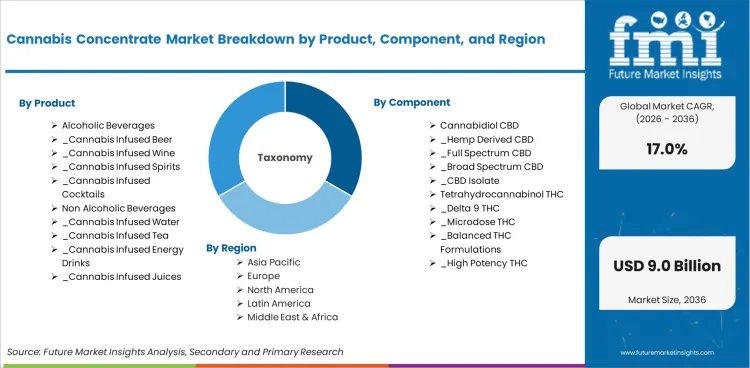
Cannabis Concentrate Market Market Segmented by Product:
- Alcoholic Beverages
- Cannabis Infused Beer
- Cannabis Infused Wine
- Cannabis Infused Spirits
- Cannabis Infused Cocktails
- Non Alcoholic Beverages
- Cannabis Infused Water
- Cannabis Infused Tea
- Cannabis Infused Energy Drinks
- Cannabis Infused Juices
Cannabis Concentrate Market Market Segmented by Component:
- Cannabidiol CBD
- Hemp Derived CBD
- Full Spectrum CBD
- Broad Spectrum CBD
- CBD Isolate
- Tetrahydrocannabinol THC
- Delta 9 THC
- Microdose THC
- Balanced THC Formulations
- High Potency THC
Cannabis Concentrate Market Market Segmented by Application:
- Recreational Consumption
- Social Drinking
- Relaxation Use
- Occasional Consumption
- Lifestyle Use
- Wellness And Health
- Stress Relief
- Sleep Support
- Mood Enhancement
- Functional Wellness
- Medical Use
- Pain Management
- Anxiety Relief
- Neurological Support
- Inflammation Control
- Sports And Recovery
- Post Workout Recovery
- Muscle Relaxation
- Hydration Support
- Performance Recovery
- Premium Lifestyle
- Low Calorie Drinks
- Organic Beverages
- Clean Label Products
- Craft Beverages
Cannabis Concentrate Market Market Segmented by Distribution Channel:
- Dispensaries
- Licensed Cannabis Stores
- Medical Dispensaries
- Recreational Stores
- Specialty Cannabis Retailers
- E Commerce
- Brand Websites
- Online Marketplaces
- Subscription Platforms
- Direct To Consumer
- Retail Stores
- Supermarkets
- Convenience Stores
- Liquor Stores
- Specialty Beverage Stores
- Bars And Restaurants
- Cannabis Cafes
- Bars
- Restaurants
- Hospitality Venues
- Wellness Stores
- Health Stores
- Organic Stores
- Pharmacies
- Nutrition Stores
Cannabis Concentrate Market Market Segmented by End Use:
- Individual Consumers
- Young Adults
- Working Professionals
- Health Conscious Consumers
- Occasional Users
- Hospitality Industry
- Bars
- Restaurants
- Hotels
- Lounges
- Medical Users
- Chronic Patients
- Therapeutic Users
- Prescription Based Users
- Rehabilitation Users
- Fitness And Wellness Users
- Gym Users
- Athletes
- Yoga Practitioners
- Recovery Users
- Specialty Consumers
- Premium Segment Consumers
- Organic Product Users
- Lifestyle Consumers
- Experimental Users
Cannabis Concentrate Market Market Segmented by Pricing Tier:
- Premium Price
- Craft Beverages
- Organic Certified Products
- High Potency Products
- Specialized Formulations
- Mid Price
- Standard Beverages
- Mass Market Products
- Balanced Formulations
- Regular Consumption Products
- Economy Price
- Low Cost Products
- Basic Formulations
- Bulk Products
- Private Label Products
Cannabis Concentrate Market Market by Region:
- North America
- USA
- Canada
- Mexico
- Latin America
- Brazil
- Chile
- Rest of Latin America
- Western Europe
- Germany
- UK
- Italy
- Spain
- France
- Nordic
- BENELUX
- Rest of Western Europe
- Eastern Europe
- Russia
- Poland
- Hungary
- Balkan & Baltic
- Rest of Eastern Europe
- East Asia
- China
- Japan
- South Korea
- South Asia and Pacific
- India
- ASEAN
- Australia & New Zealand
- Rest of South Asia and Pacific
- Middle East & Africa
- Kingdom of Saudi Arabia
- Other GCC Countries
- Turkiye
- South Africa
- Other African Union
- Rest of Middle East & Africa
Bibliography
- 1. U.S. Drug Enforcement Administration. (2024). Cannabis Rescheduling Proposed Rule. DEA.
- 2. Health Canada. (2024). Cannabis Market Data Report: Licensed Producers and Product Categories. Health Canada.
- 3. Washington State Liquor and Cannabis Board. (2024). Cannabis Market Report: Concentrate Category Sales. WSLCB.
- 4. Colorado Department of Revenue. (2024). Marijuana Enforcement Division Market Statistics. CDOR.
- 5. Centers for Disease Control and Prevention. (2023). Outbreak of Lung Injury Associated with E-Cigarette Use Update and Vape Safety Guidance. CDC.
This bibliography is provided for reader reference.
This Report Addresses
- Market sizing and revenue forecasting for cannabis concentrate products from 2026 to 2036.
- Segmentation analysis across product, concentrate form, consumer type, distribution channel, and region.
- Regional and country-level insights covering over 30 markets with comparative growth analysis.
- Regulatory analysis covering industry-relevant directives, safety and labeling rules, and regional compliance frameworks.
- Competitive landscape assessment covering market structure, vendor positioning, and recent developments.
- Investment opportunity mapping across the adult-use and medical cannabis processed products sector.
- Supply chain tracking from raw material sourcing to finished product distribution and end-use delivery.
- Data delivery in PDF and Excel formats with quarterly refresh access.
Frequently Asked Questions
How large is the demand for Cannabis Concentrate in the global market in 2026?
Demand for cannabis concentrate in the global market is estimated to be valued at USD 1.87 billion in 2026.
What will be the market size of Cannabis Concentrate by 2036?
Market size for cannabis concentrate is projected to reach USD 9.00 billion by 2036.
What is the expected demand growth for Cannabis Concentrate between 2026 and 2036?
Demand for cannabis concentrate is expected to grow at a CAGR of 17.0% between 2026 and 2036.
Which Product is poised to lead global sales by 2026?
Vape Cartridges accounts for 38.4% in 2026, reflecting established buyer preference and functional performance advantages.
How is Dispensary distribution driving Cannabis Concentrate adoption?
Dispensary represents 72.5% of distribution demand as operators and buyer accounts drive bulk procurement volumes.
What is driving demand in the United States?
The USA registers a 14.50% CAGR through 2036, propelled by continued state-level adult-use legalization, dominant vape cartridge format penetration, and premium live resin segment growth.
What does Cannabis Concentrate Market definition mean in this report?
The cannabis concentrate market covers cannabis concentrates including distillate.
How does FMI build and validate the Cannabis Concentrate forecast?
Forecasting models apply a hybrid bottom-up methodology starting with verified transaction data, cross-validated against industry sales statistics and manufacturer financial disclosures.
Preview the report firsthand - request a free sample
Get SampleGet the brochure for pricing and purchase details.
Get PDFTable of Content
- Executive Summary
- Global Market Outlook
- Demand-side Trends
- Supply-side Trends
- Technology Roadmap Analysis
- Analysis and Recommendations
- Market Overview
- Market Coverage / Taxonomy
- Market Definition / Scope / Limitations
- Research Methodology
- Chapter Orientation
- Analytical Lens and Working Hypotheses
- Market Structure, Signals, and Trend Drivers
- Benchmarking and Cross-market Comparability
- Market Sizing, Forecasting, and Opportunity Mapping
- Research Design and Evidence Framework
- Desk Research Programme (Secondary Evidence)
- Company Annual and Sustainability Reports
- Peer-reviewed Journals and Academic Literature
- Corporate Websites, Product Literature, and Technical Notes
- Earnings Decks and Investor Briefings
- Statutory Filings and Regulatory Disclosures
- Technical White Papers and Standards Notes
- Trade Journals, Industry Magazines, and Analyst Briefs
- Conference Proceedings, Webinars, and Seminar Materials
- Government Statistics Portals and Public Data Releases
- Press Releases and Reputable Media Coverage
- Specialist Newsletters and Curated Briefings
- Sector Databases and Reference Repositories
- FMI Internal Proprietary Databases and Historical Market Datasets
- Subscription Datasets and Paid Sources
- Social Channels, Communities, and Digital Listening Inputs
- Additional Desk Sources
- Expert Input and Fieldwork (Primary Evidence)
- Primary Modes
- Qualitative Interviews and Expert Elicitation
- Quantitative Surveys and Structured Data Capture
- Blended Approach
- Why Primary Evidence is Used
- Field Techniques
- Interviews
- Surveys
- Focus Groups
- Observational and In-context Research
- Social and Community Interactions
- Stakeholder Universe Engaged
- C-suite Leaders
- Board Members
- Presidents and Vice Presidents
- R&D and Innovation Heads
- Technical Specialists
- Domain Subject-matter Experts
- Scientists
- Physicians and Other Healthcare Professionals
- Governance, Ethics, and Data Stewardship
- Research Ethics
- Data Integrity and Handling
- Primary Modes
- Tooling, Models, and Reference Databases
- Desk Research Programme (Secondary Evidence)
- Data Engineering and Model Build
- Data Acquisition and Ingestion
- Cleaning, Normalisation, and Verification
- Synthesis, Triangulation, and Analysis
- Quality Assurance and Audit Trail
- Market Background
- Market Dynamics
- Drivers
- Restraints
- Opportunity
- Trends
- Scenario Forecast
- Demand in Optimistic Scenario
- Demand in Likely Scenario
- Demand in Conservative Scenario
- Opportunity Map Analysis
- Product Life Cycle Analysis
- Supply Chain Analysis
- Investment Feasibility Matrix
- Value Chain Analysis
- PESTLE and Porter’s Analysis
- Regulatory Landscape
- Regional Parent Market Outlook
- Production and Consumption Statistics
- Import and Export Statistics
- Market Dynamics
- Global Market Analysis 2021 to 2025 and Forecast, 2026 to 2036
- Historical Market Size Value (USD Million) Analysis, 2021 to 2025
- Current and Future Market Size Value (USD Million) Projections, 2026 to 2036
- Y-o-Y Growth Trend Analysis
- Absolute $ Opportunity Analysis
- Global Market Pricing Analysis 2021 to 2025 and Forecast 2026 to 2036
- Global Market Analysis 2021 to 2025 and Forecast 2026 to 2036, By Product
- Introduction / Key Findings
- Historical Market Size Value (USD Million) Analysis By Product , 2021 to 2025
- Current and Future Market Size Value (USD Million) Analysis and Forecast By Product , 2026 to 2036
- Alcoholic Beverages
- Cannabis Infused Beer
- Cannabis Infused Wine
- Cannabis Infused Spirits
- Cannabis Infused Cocktails
- Non Alcoholic Beverages
- Cannabis Infused Water
- Cannabis Infused Tea
- Cannabis Infused Energy Drinks
- Cannabis Infused Juices
- Alcoholic Beverages
- Y-o-Y Growth Trend Analysis By Product , 2021 to 2025
- Absolute $ Opportunity Analysis By Product , 2026 to 2036
- Global Market Analysis 2021 to 2025 and Forecast 2026 to 2036, By Component
- Introduction / Key Findings
- Historical Market Size Value (USD Million) Analysis By Component, 2021 to 2025
- Current and Future Market Size Value (USD Million) Analysis and Forecast By Component, 2026 to 2036
- Cannabidiol CBD
- Hemp Derived CBD
- Full Spectrum CBD
- Broad Spectrum CBD
- CBD Isolate
- Tetrahydrocannabinol THC
- Delta 9 THC
- Microdose THC
- Balanced THC Formulations
- High Potency THC
- Cannabidiol CBD
- Y-o-Y Growth Trend Analysis By Component, 2021 to 2025
- Absolute $ Opportunity Analysis By Component, 2026 to 2036
- Global Market Analysis 2021 to 2025 and Forecast 2026 to 2036, By Application
- Introduction / Key Findings
- Historical Market Size Value (USD Million) Analysis By Application, 2021 to 2025
- Current and Future Market Size Value (USD Million) Analysis and Forecast By Application, 2026 to 2036
- Recreational Consumption
- Social Drinking
- Relaxation Use
- Occasional Consumption
- Lifestyle Use
- Wellness And Health
- Stress Relief
- Sleep Support
- Mood Enhancement
- Functional Wellness
- Medical Use
- Pain Management
- Anxiety Relief
- Neurological Support
- Inflammation Control
- Sports And Recovery
- Post Workout Recovery
- Muscle Relaxation
- Hydration Support
- Performance Recovery
- Premium Lifestyle
- Low Calorie Drinks
- Organic Beverages
- Clean Label Products
- Craft Beverages
- Recreational Consumption
- Y-o-Y Growth Trend Analysis By Application, 2021 to 2025
- Absolute $ Opportunity Analysis By Application, 2026 to 2036
- Global Market Analysis 2021 to 2025 and Forecast 2026 to 2036, By Distribution Channel
- Introduction / Key Findings
- Historical Market Size Value (USD Million) Analysis By Distribution Channel, 2021 to 2025
- Current and Future Market Size Value (USD Million) Analysis and Forecast By Distribution Channel, 2026 to 2036
- Dispensaries
- Licensed Cannabis Stores
- Medical Dispensaries
- Recreational Stores
- Specialty Cannabis Retailers
- E Commerce
- Brand Websites
- Online Marketplaces
- Subscription Platforms
- Direct To Consumer
- Retail Stores
- Supermarkets
- Convenience Stores
- Liquor Stores
- Specialty Beverage Stores
- Bars And Restaurants
- Cannabis Cafes
- Bars
- Restaurants
- Hospitality Venues
- Wellness Stores
- Health Stores
- Organic Stores
- Pharmacies
- Nutrition Stores
- Dispensaries
- Y-o-Y Growth Trend Analysis By Distribution Channel, 2021 to 2025
- Absolute $ Opportunity Analysis By Distribution Channel, 2026 to 2036
- Global Market Analysis 2021 to 2025 and Forecast 2026 to 2036, By End Use
- Introduction / Key Findings
- Historical Market Size Value (USD Million) Analysis By End Use, 2021 to 2025
- Current and Future Market Size Value (USD Million) Analysis and Forecast By End Use, 2026 to 2036
- Individual Consumers
- Young Adults
- Working Professionals
- Health Conscious Consumers
- Occasional Users
- Hospitality Industry
- Bars
- Restaurants
- Hotels
- Lounges
- Medical Users
- Chronic Patients
- Therapeutic Users
- Prescription Based Users
- Rehabilitation Users
- Fitness And Wellness Users
- Gym Users
- Athletes
- Yoga Practitioners
- Recovery Users
- Specialty Consumers
- Premium Segment Consumers
- Organic Product Users
- Lifestyle Consumers
- Experimental Users
- Individual Consumers
- Y-o-Y Growth Trend Analysis By End Use, 2021 to 2025
- Absolute $ Opportunity Analysis By End Use, 2026 to 2036
- Global Market Analysis 2021 to 2025 and Forecast 2026 to 2036, By Pricing Tier
- Introduction / Key Findings
- Historical Market Size Value (USD Million) Analysis By Pricing Tier, 2021 to 2025
- Current and Future Market Size Value (USD Million) Analysis and Forecast By Pricing Tier, 2026 to 2036
- Premium Price
- Craft Beverages
- Organic Certified Products
- High Potency Products
- Specialized Formulations
- Mid Price
- Standard Beverages
- Mass Market Products
- Balanced Formulations
- Regular Consumption Products
- Economy Price
- Low Cost Products
- Basic Formulations
- Bulk Products
- Private Label Products
- Premium Price
- Y-o-Y Growth Trend Analysis By Pricing Tier, 2021 to 2025
- Absolute $ Opportunity Analysis By Pricing Tier, 2026 to 2036
- Global Market Analysis 2021 to 2025 and Forecast 2026 to 2036, By Region
- Introduction
- Historical Market Size Value (USD Million) Analysis By Region, 2021 to 2025
- Current Market Size Value (USD Million) Analysis and Forecast By Region, 2026 to 2036
- North America
- Latin America
- Western Europe
- Eastern Europe
- East Asia
- South Asia and Pacific
- Middle East & Africa
- Market Attractiveness Analysis By Region
- North America Market Analysis 2021 to 2025 and Forecast 2026 to 2036, By Country
- Historical Market Size Value (USD Million) Trend Analysis By Market Taxonomy, 2021 to 2025
- Market Size Value (USD Million) Forecast By Market Taxonomy, 2026 to 2036
- By Country
- USA
- Canada
- Mexico
- By Product
- By Component
- By Application
- By Distribution Channel
- By End Use
- By Pricing Tier
- By Country
- Market Attractiveness Analysis
- By Country
- By Product
- By Component
- By Application
- By Distribution Channel
- By End Use
- By Pricing Tier
- Key Takeaways
- Latin America Market Analysis 2021 to 2025 and Forecast 2026 to 2036, By Country
- Historical Market Size Value (USD Million) Trend Analysis By Market Taxonomy, 2021 to 2025
- Market Size Value (USD Million) Forecast By Market Taxonomy, 2026 to 2036
- By Country
- Brazil
- Chile
- Rest of Latin America
- By Product
- By Component
- By Application
- By Distribution Channel
- By End Use
- By Pricing Tier
- By Country
- Market Attractiveness Analysis
- By Country
- By Product
- By Component
- By Application
- By Distribution Channel
- By End Use
- By Pricing Tier
- Key Takeaways
- Western Europe Market Analysis 2021 to 2025 and Forecast 2026 to 2036, By Country
- Historical Market Size Value (USD Million) Trend Analysis By Market Taxonomy, 2021 to 2025
- Market Size Value (USD Million) Forecast By Market Taxonomy, 2026 to 2036
- By Country
- Germany
- UK
- Italy
- Spain
- France
- Nordic
- BENELUX
- Rest of Western Europe
- By Product
- By Component
- By Application
- By Distribution Channel
- By End Use
- By Pricing Tier
- By Country
- Market Attractiveness Analysis
- By Country
- By Product
- By Component
- By Application
- By Distribution Channel
- By End Use
- By Pricing Tier
- Key Takeaways
- Eastern Europe Market Analysis 2021 to 2025 and Forecast 2026 to 2036, By Country
- Historical Market Size Value (USD Million) Trend Analysis By Market Taxonomy, 2021 to 2025
- Market Size Value (USD Million) Forecast By Market Taxonomy, 2026 to 2036
- By Country
- Russia
- Poland
- Hungary
- Balkan & Baltic
- Rest of Eastern Europe
- By Product
- By Component
- By Application
- By Distribution Channel
- By End Use
- By Pricing Tier
- By Country
- Market Attractiveness Analysis
- By Country
- By Product
- By Component
- By Application
- By Distribution Channel
- By End Use
- By Pricing Tier
- Key Takeaways
- East Asia Market Analysis 2021 to 2025 and Forecast 2026 to 2036, By Country
- Historical Market Size Value (USD Million) Trend Analysis By Market Taxonomy, 2021 to 2025
- Market Size Value (USD Million) Forecast By Market Taxonomy, 2026 to 2036
- By Country
- China
- Japan
- South Korea
- By Product
- By Component
- By Application
- By Distribution Channel
- By End Use
- By Pricing Tier
- By Country
- Market Attractiveness Analysis
- By Country
- By Product
- By Component
- By Application
- By Distribution Channel
- By End Use
- By Pricing Tier
- Key Takeaways
- South Asia and Pacific Market Analysis 2021 to 2025 and Forecast 2026 to 2036, By Country
- Historical Market Size Value (USD Million) Trend Analysis By Market Taxonomy, 2021 to 2025
- Market Size Value (USD Million) Forecast By Market Taxonomy, 2026 to 2036
- By Country
- India
- ASEAN
- Australia & New Zealand
- Rest of South Asia and Pacific
- By Product
- By Component
- By Application
- By Distribution Channel
- By End Use
- By Pricing Tier
- By Country
- Market Attractiveness Analysis
- By Country
- By Product
- By Component
- By Application
- By Distribution Channel
- By End Use
- By Pricing Tier
- Key Takeaways
- Middle East & Africa Market Analysis 2021 to 2025 and Forecast 2026 to 2036, By Country
- Historical Market Size Value (USD Million) Trend Analysis By Market Taxonomy, 2021 to 2025
- Market Size Value (USD Million) Forecast By Market Taxonomy, 2026 to 2036
- By Country
- Kingdom of Saudi Arabia
- Other GCC Countries
- Turkiye
- South Africa
- Other African Union
- Rest of Middle East & Africa
- By Product
- By Component
- By Application
- By Distribution Channel
- By End Use
- By Pricing Tier
- By Country
- Market Attractiveness Analysis
- By Country
- By Product
- By Component
- By Application
- By Distribution Channel
- By End Use
- By Pricing Tier
- Key Takeaways
- Key Countries Market Analysis
- USA
- Pricing Analysis
- Market Share Analysis, 2025
- By Product
- By Component
- By Application
- By Distribution Channel
- By End Use
- By Pricing Tier
- Canada
- Pricing Analysis
- Market Share Analysis, 2025
- By Product
- By Component
- By Application
- By Distribution Channel
- By End Use
- By Pricing Tier
- Mexico
- Pricing Analysis
- Market Share Analysis, 2025
- By Product
- By Component
- By Application
- By Distribution Channel
- By End Use
- By Pricing Tier
- Brazil
- Pricing Analysis
- Market Share Analysis, 2025
- By Product
- By Component
- By Application
- By Distribution Channel
- By End Use
- By Pricing Tier
- Chile
- Pricing Analysis
- Market Share Analysis, 2025
- By Product
- By Component
- By Application
- By Distribution Channel
- By End Use
- By Pricing Tier
- Germany
- Pricing Analysis
- Market Share Analysis, 2025
- By Product
- By Component
- By Application
- By Distribution Channel
- By End Use
- By Pricing Tier
- UK
- Pricing Analysis
- Market Share Analysis, 2025
- By Product
- By Component
- By Application
- By Distribution Channel
- By End Use
- By Pricing Tier
- Italy
- Pricing Analysis
- Market Share Analysis, 2025
- By Product
- By Component
- By Application
- By Distribution Channel
- By End Use
- By Pricing Tier
- Spain
- Pricing Analysis
- Market Share Analysis, 2025
- By Product
- By Component
- By Application
- By Distribution Channel
- By End Use
- By Pricing Tier
- France
- Pricing Analysis
- Market Share Analysis, 2025
- By Product
- By Component
- By Application
- By Distribution Channel
- By End Use
- By Pricing Tier
- India
- Pricing Analysis
- Market Share Analysis, 2025
- By Product
- By Component
- By Application
- By Distribution Channel
- By End Use
- By Pricing Tier
- ASEAN
- Pricing Analysis
- Market Share Analysis, 2025
- By Product
- By Component
- By Application
- By Distribution Channel
- By End Use
- By Pricing Tier
- Australia & New Zealand
- Pricing Analysis
- Market Share Analysis, 2025
- By Product
- By Component
- By Application
- By Distribution Channel
- By End Use
- By Pricing Tier
- China
- Pricing Analysis
- Market Share Analysis, 2025
- By Product
- By Component
- By Application
- By Distribution Channel
- By End Use
- By Pricing Tier
- Japan
- Pricing Analysis
- Market Share Analysis, 2025
- By Product
- By Component
- By Application
- By Distribution Channel
- By End Use
- By Pricing Tier
- South Korea
- Pricing Analysis
- Market Share Analysis, 2025
- By Product
- By Component
- By Application
- By Distribution Channel
- By End Use
- By Pricing Tier
- Russia
- Pricing Analysis
- Market Share Analysis, 2025
- By Product
- By Component
- By Application
- By Distribution Channel
- By End Use
- By Pricing Tier
- Poland
- Pricing Analysis
- Market Share Analysis, 2025
- By Product
- By Component
- By Application
- By Distribution Channel
- By End Use
- By Pricing Tier
- Hungary
- Pricing Analysis
- Market Share Analysis, 2025
- By Product
- By Component
- By Application
- By Distribution Channel
- By End Use
- By Pricing Tier
- Kingdom of Saudi Arabia
- Pricing Analysis
- Market Share Analysis, 2025
- By Product
- By Component
- By Application
- By Distribution Channel
- By End Use
- By Pricing Tier
- Turkiye
- Pricing Analysis
- Market Share Analysis, 2025
- By Product
- By Component
- By Application
- By Distribution Channel
- By End Use
- By Pricing Tier
- South Africa
- Pricing Analysis
- Market Share Analysis, 2025
- By Product
- By Component
- By Application
- By Distribution Channel
- By End Use
- By Pricing Tier
- USA
- Market Structure Analysis
- Competition Dashboard
- Competition Benchmarking
- Market Share Analysis of Top Players
- By Regional
- By Product
- By Component
- By Application
- By Distribution Channel
- By End Use
- By Pricing Tier
- Competition Analysis
- Competition Deep Dive
- Canopy Growth Corporation
- Overview
- Product Portfolio
- Profitability by Market Segments (Product/Age /Sales Channel/Region)
- Sales Footprint
- Strategy Overview
- Marketing Strategy
- Product Strategy
- Channel Strategy
- The Cronos Group
- Tilray Inc
- Aurora Cannabis Inc
- Hexo Corp
- Other Companies
- Canopy Growth Corporation
- Competition Deep Dive
- Assumptions & Acronyms Used


