

- Industry Size (2026)
- USD 72.28 Bn
- Forecast (2036)
- USD 116.21 Bn
- CAGR (2026 to 2036)
- 4.9%
Water-Borne Inks and Paints Market Size, Market Forecast and Outlook By FMI
In 2025, the water-borne inks and paints market was valued at USD 68.90 billion. Based on Future Market Insights' analysis, demand for water-borne inks and paints is estimated to grow to USD 72.28 billion in 2026 and USD 116.21 billion by 2036. FMI projects a CAGR of 4.9% during the forecast period.
The absolute dollar growth over the forecast period is USD 47.31 billion. This reflects steady, incremental expansion rather than a structural surge. Growth is supported by tightening VOC regulations across packaging and construction coatings, but moderated by feedstock price volatility for acrylic resins and ongoing substitution pressure from high-solids and UV-curable systems in specific industrial applications.
Summary of Water-Borne Inks and Paints Market
- Market Definition
- The water-borne inks and paints market comprises pigment and resin-based coating and printing formulations that use water as the primary carrier to deliver color, surface protection, and reduced VOC emissions across industrial and packaging applications.
- Demand Drivers
- Packaging converters are shifting toward water-borne inks to comply with low-migration and VOC standards in food and beverage labeling.
- Construction contractors are adopting water-based architectural paints to meet regional air-quality norms and green building certification requirements.
- Automotive OEMs are specifying water-borne coatings in refinish and component applications to align with factory emission caps and worker exposure limits.
- Key Segments Analyzed
- By Resin Type: Acrylic resins are projected to lead with nearly 49% share in 2026 due to their adhesion, durability, and regulatory compliance profile.
- By Application: Packaging is expected to remain the dominant segment in 2026, supported by sustained demand for flexible and corrugated formats.
- By Geography: Asia Pacific is characterized by high-volume consumption, anchored by China and India’s industrial and construction sectors.
- Analyst Opinion at FMI
- Nikhil Kaitwade, principal consultant for Chemicals & Materials at Future Market Insights, opines, “In the decade ahead, CXOs navigating the water‑borne inks and paints landscape will increasingly discover that long‑term value creation hinges on three strategic levers: regulatory foresight, resin innovation, and packaging‑led demand transformation. Compliance is no longer a cost of doing business, it is a catalyst for product re‑engineering, portfolio modernization, and competitive differentiation. Resin selection has evolved from a technical choice to a boardroom‑level decision, directly shaping sustainability credibility, supply‑chain resilience, and margin stability.”
- Strategic Implications / Executive Takeaways
- Invest in acrylic and hybrid resin systems that balance compliance with performance in packaging and construction uses.
- Strengthen supplier contracts to manage feedstock price volatility for key raw materials such as acrylic monomers.
- Align product development with regional VOC thresholds to secure long-term procurement contracts from multinational buyers.
- Methodology
- Market size estimates were derived using a hybrid top-down and bottom-up modeling approach.
- Revenue data from leading manufacturers were cross-validated with trade statistics and regulatory disclosures.
- Forecast outputs were triangulated through primary interviews with formulators and procurement managers across end-use sectors.
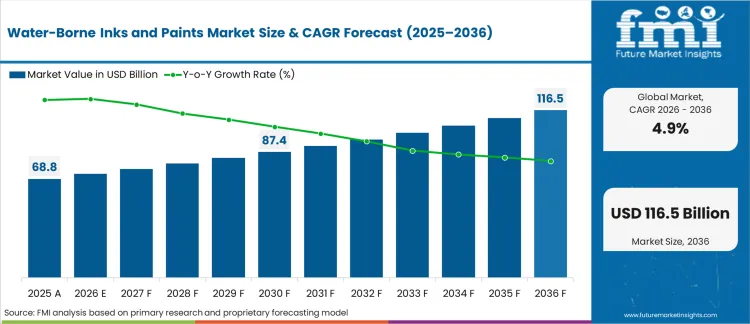
| Metric | Value |
|---|---|
| Estimated Value (2026E) | USD 72.28 billion |
| Forecast Value (2036F) | USD 116.21 billion |
| CAGR (2026 to 2036) | 4.9% |
Source: FMI analysis based on primary research and proprietary forecasting model
Downstream buyers in packaging, automotive, and construction are under pressure to meet Scope 3 emissions targets, which increases procurement preference for low-VOC, water-based formulations. When large suppliers embed sustainability into manufacturing and product design, it accelerates technology standardization and strengthens confidence among industrial users, supporting the market’s projected expansion.
Water-borne inks and paints are gaining traction in packaging and coatings for their low-VOC profile, recyclability compatibility, and defossilization potential, enabling brands to meet plastic-reduction targets without sacrificing print quality or performance. Articulating this sustainability push, Paul Pain (Head of Waterbased Technology, Siegwerk) notes: “Paper is not only already one of the most recycled packaging materials globally, but it also holds great potential to offer a viable substitution for plastic for several packaging uses. And with UniNATURE we concretely support the defossilization of fibre-based packaging by reducing the use of fossil based raw materials in inks. [1]” This quote is insertable as it connects water-based formulations to circular economy goals like bio-renewable content and plastic replacement in fibre packaging.
Axalta Coating Systems has sharpened its sustainability roadmap across water-borne and low-VOC technologies, particularly in refinish and industrial coatings. The company has expanded its portfolio of water-based systems that reduce solvent emissions while maintaining application performance for automotive OEM and packaging customers. The company has invested in energy efficiency upgrades, waste reduction programs, and digital process controls across manufacturing sites to reduce carbon intensity per unit of output.
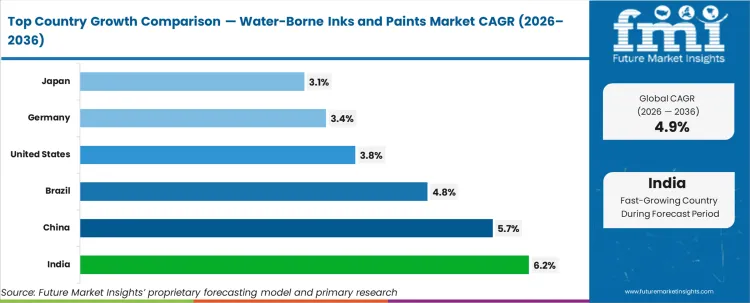
India is projected to expand at a CAGR of 6.2%, supported by rapid growth in flexible packaging and tightening state-level VOC compliance norms in decorative paints. China is expected to register a 5.7% CAGR, driven by industrial coatings demand and continued enforcement of national low-VOC standards across manufacturing clusters. Brazil is forecast to grow at a 4.8% CAGR, reflecting rising consumption of water-borne architectural coatings amid urban housing upgrades. The United States is anticipated to grow at a 3.5% CAGR, primarily generating replacement and reformulation demand rather than new volume expansion; growth remains constrained by high market penetration and substitution pressure from high-solids and powder coatings in industrial applications.
Segmental Analysis
Water-Borne Inks and Paints Market Analysis by Resin Type
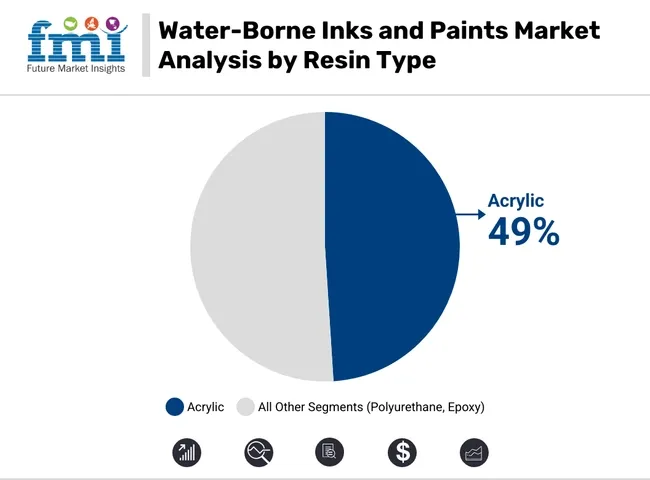
Acrylic resins will hold a 49% share in 2026. Acrylic systems lead due to their strong adhesion, weather resistance, and compatibility with low-VOC compliance requirements across packaging and architectural coatings. They address buyer needs for durability and regulatory conformity without compromising film performance.
- Capacity Expansion: BASF SE expanded its acrylic dispersion capacity in Europe in 2023 to support demand for water-based coatings [2]. This move improves regional supply reliability for formulators transitioning away from solvent systems.
- Technology Upgrade: Arkema S.A. broadened its waterborne coating resin portfolio in 2023 to meet evolving VOC thresholds in decorative and industrial applications [2].
- Supply Chain Shift: European industry reports in 2024 highlighted raw material cost pressures and freight disruptions, prompting coating producers to localize acrylic resin sourcing [3].
Water-Borne Inks and Paints Market Analysis by Application
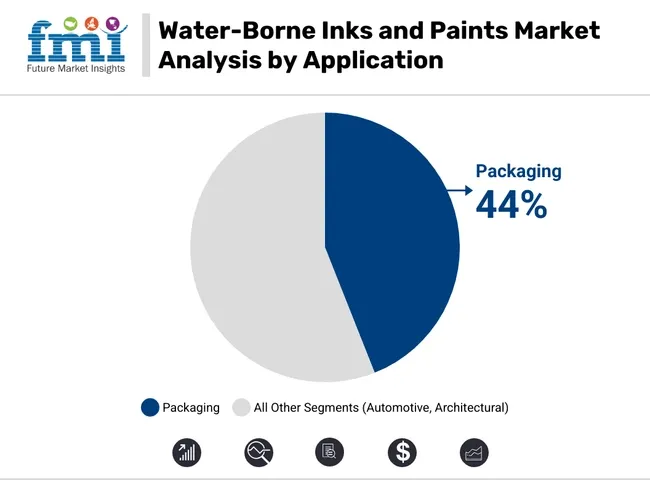
Based on FMI's water-borne inks and paints market report, packaging applications are estimated to hold a 39% share in 2026. Packaging dominates due to strict food-contact compliance standards and brand-owner commitments to reduce solvent emissions. Water-borne inks help converters control odor, migration, and workplace exposure during high-speed printing.
- Portfolio Expansion: Siegwerk Druckfarben AG & Co. KGaA expanded its water-based packaging ink offerings in 2023 to address low-migration and sustainable packaging needs [5].
- Strategic Investment: DIC Corporation reported investments in environmentally considerate ink technologies, including water-based systems, in its 2023 sustainability disclosures [7].
- Regulatory Pressure: The European Commission’s Industrial Emissions Directive update in 2023 reinforced stricter VOC controls, favoring water-borne inks in industrial and packaging operations [6].
Water-Borne Inks and Paints Market Drivers, Restraints, and Opportunities
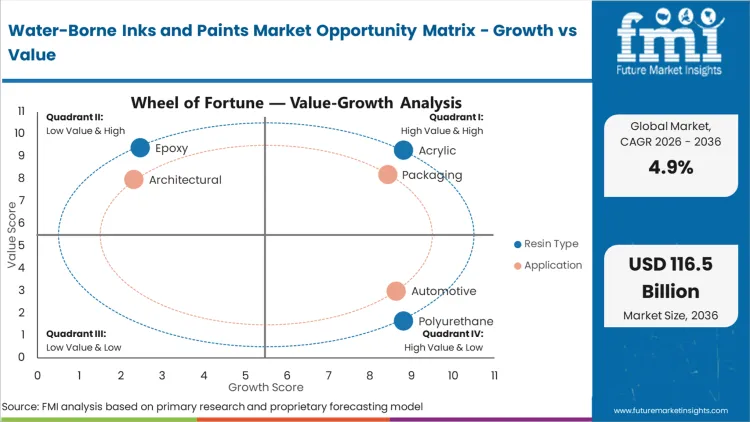
Future Market Insights analysis shows the water-borne inks and paints market has been built on a long-running compliance-and-performance trade-off. As VOC limits tightened across decorative paints and industrial coating operations, water-based systems scaled from being a good enough alternative into a mainstream specification for packaging converters, construction contractors, and OEM supply chains. That shift explains why the market sustains a large base value today, demand is anchored less by discretionary upgrades and more by routine repainting, packaging print cycles, and regulated emission control in production environments.
FMI analysts observe a clear transition phase in which solvent-borne volumes are under steady pressure in regulated applications, while water-borne systems gain share in packaging inks and architectural coatings. The tension is that next-generation water-borne formulations often require higher-performing binders and additives, lifting cost per kilogram even as some legacy solvent grades hold on in niche industrial uses. The market still expands because compliance-driven conversion and premiumization in regulated end uses outweigh slower growth in mature repaint cycles.
- VOC compliance push: In Europe, Directive 2004/42/EC (Decopaint Directive) continues to shape product reformulation and procurement, keeping water-borne paints favored in architectural applications where solvent limits are tightly policed. This regulatory baseline supports steady conversion rather than one-time spikes in demand.
- Packaging standardization: North American packaging printers are standardizing on water-based systems to reduce odor and workplace exposure while meeting brand-owner requirements for low-migration and safer handling. Once qualified on press, these inks tend to stay in supplier lists, which stabilizes repeat volumes.
- Feedstock cost volatility: Acrylic resin and additive pricing cycles remain a restraint, as formulators must manage margin when monomer and energy costs move sharply. This increases substitution pressure toward hybrid systems or optimized formulations that deliver compliance with lower-cost raw material baskets.
Regional Analysis
The water-borne inks and paints market is analyzed across North America, Latin America, Europe, East Asia, and South Asia. Geographic segmentation evaluates regional production hubs, regulatory compliance frameworks, and country-level growth trends shaping the global shift toward low-VOC formulations. The full report provides comparative market attractiveness analysis across these countries and regions.
.webp "Top Country Growth Comparison Water Borne Inks And Paints Market Cagr (2026 2036)")
| Country | CAGR (2026-2036) |
|---|---|
| India | 6.2% |
| China | 5.7% |
| Brazil | 4.8% |
| United States | 3.8% |
| Germany | 3.4% |
| Japan | 3.1% |
Source: Future Market Insights analysis, supported by a proprietary forecasting model and primary research
North America Market Analysis
North America is the compliance-led demand stabilizer, where water-borne systems scale through rule-driven reformulation and long-term supply agreements with packaging and construction buyers. Key players such as Sherwin-Williams, PPG, and RPM International compete through product performance, contractor channel reach, and regulatory-ready low-VOC portfolios that reduce rework risk for large accounts.
- United States: The United States market for water-borne inks and paints is likely to post a CAGR of 3.8% through 2036. Conversion is shaped by state and district VOC programs that continuously tighten architectural coating limits, with California’s AIR resources framework anchored by the CARB Suggested Control Measure (SCM) and local rule updates such as Sacramento Metro AQMD Rule 442 amendments (July 2024) aligning to stricter VOC categories. Packaging print demand supports water-borne ink qualification cycles, but growth is moderated by substitution in certain industrial niches where higher-solids chemistries compete on throughput. Regulatory compliance timetables also influence reformulation pacing, including federal VOC-related rules in adjacent coating categories that reinforce low-emission technology adoption and compliance planning.
FMI’s extensive report gets in-depth on the North American landscape by analyzing additional high-potential markets like Canada and Mexico. Canada represents a highly lucrative hub driven by stringent federal volatile organic compound (VOC) concentration limits for architectural coatings, heavily pushing contractors toward premium water-borne systems. Concurrently, Mexico is witnessing a rapid rise in demand as a nearshoring manufacturing hub, where export-oriented packaging and automotive assembly operations are aligning with stricter North American environmental standards.
Latin America Market Analysis
Latin America is the renovation-and-specification growth pocket, where water-borne adoption expands through construction repainting, public works, and gradual tightening of environmental compliance in industrial operations. Regional competition features AkzoNobel, BASF (raw material platform), and large domestic paint producers that differentiate on distribution reach and cost-optimized water-based formulations suited to climate and substrate variability.
- Brazil: Brazil is expected to see its water-borne inks and paints sector grow at a compound annual rate of 4.8% through 2036. Construction coatings and refurbishment activity support uptake, while compliance is increasingly tied to measurable VOC content, aided by ABNT NBR 16388, which defines test methods for determining VOC content in non-industrial building paints, improving comparability in procurement specifications. Operational constraints include cost sensitivity and uneven enforcement across regions, which can slow premium water-borne upgrades in price-led segments. Brazil’s waste and residue governance frameworks that explicitly categorize paint-related residues in national inventories, influencing handling and plant-level controls that favor lower-emission processes over time, also shape environmental compliance attention.
The FMI report goes in-depth to evaluate the wider Latin American ecosystem, highlighting that while Brazil anchors the region, countries like Argentina and Colombia remain highly lucrative hubs. Argentina is experiencing steady demand in its domestic architectural and packaging print sectors, while Colombia's expanding urban infrastructure and real estate developments are driving a noticeable shift toward eco-friendly, water-borne decorative paints.
East Asia Market Analysis
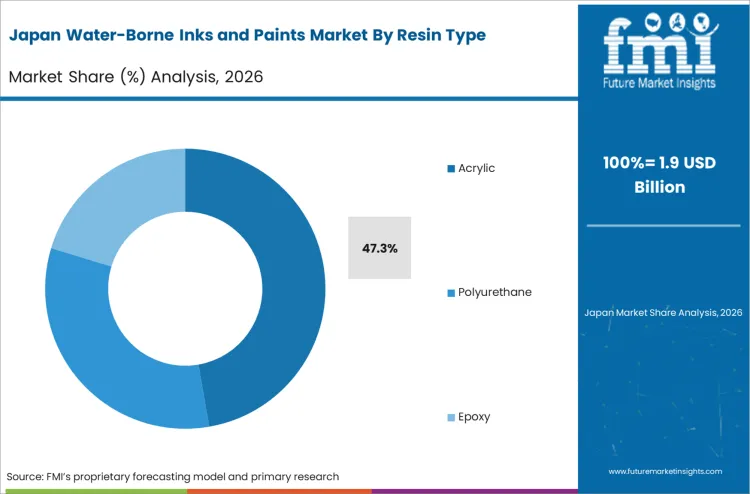
East Asia is the VOC-governance conversion engine, where policy-driven controls accelerate the shift toward lower-VOC inks and coatings across packaging, industrial coating lines, and manufacturing clusters. Players such as BASF, Nippon Paint Holdings, and major domestic formulators compete on compliant resin systems, local production footprints, and rapid reformulation capability tied to evolving standards.
- China: Demand for water-borne inks and paints in China is estimated to expand at a CAGR of 5.7% through 2036. Policy pressure is anchored by nationwide VOC governance actions, including the Ministry-led VOC Tackling Governance Plan (June 2020) that strengthened enforcement focus on high-emitting sectors, supporting a long-run pivot toward low-VOC coatings and inks. Standards have also formalized conversion, with GB 38507 setting VOC limits for printing inks, pushing packaging and printing supply chains toward compliant formulations. Capacity localization reinforces adoption, exemplified by BASF’s polymer dispersions expansion at Daya Bay, Guangdong (announced March 2023) to supply water-based coatings markets.
- Japan: FMI estimates the water-borne inks and paints market in Japan to expand at an annual growth rate of 3.1% through 2036. Japan represents a mature, highly specialized market where environmental stewardship and indoor air quality are paramount. Demand is heavily influenced by the Japan Paint Manufacturers Association (JPMA) voluntary VOC emission reduction standards, which push industrial and architectural formulations toward ultra-low emission profiles. The rapid aging of the population has also spiked demand for odor-free, water-borne architectural coatings in healthcare and residential facilities.
The comprehensive FMI report provides an in-depth analysis of the broader East Asian ecosystem, extending beyond China and Japan to identify highly lucrative opportunities in South Korea and Taiwan. South Korea's massive electronics and automotive manufacturing sectors are increasingly mandating water-borne industrial coatings to meet stringent corporate ESG targets. Meanwhile, Taiwan’s dominant packaging and export-manufacturing industries rely heavily on advanced water-borne inks to comply with international consumer goods packaging standards.
South Asia Market Analysis
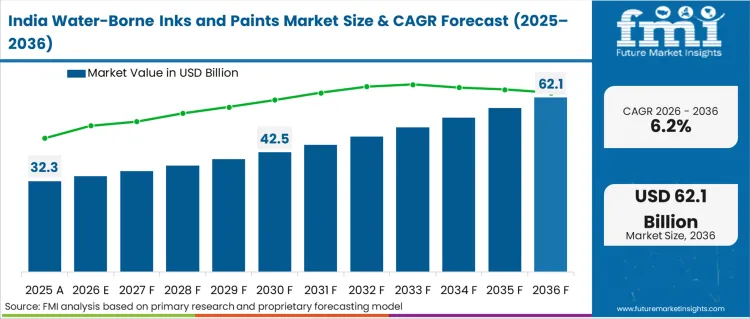
South Asia is the specification-upgrade market, where water-borne demand grows through standards tightening, urban construction activity, and formalization of quality norms in architectural coatings. Domestic paint leaders and multinational portfolios that win share through contractor training, faster-drying water-based systems, and compliance-aligned product specs for institutional procurement shape competitive positioning.
- India: The water-borne inks and paints landscape in India is set to achieve a CAGR of 6.2% through 2036. Standardization is advancing through quality and safety specifications for emulsion paints, including the draft revision of IS 15489 (November 2023), which explicitly introduces VOC-related requirements into the specification framework. Regulatory direction is also visible at the national level, with the Government of India noting that industrial emission standards for NOx and VOC have been revised/introduced for multiple sectors, including the paint industry (December 2024), reinforcing compliance-led reformulation and monitoring investments.
The FMI report goes in-depth to evaluate the wider South Asian ecosystem, highlighting that while India acts as the primary volume driver, neighboring hubs like Bangladesh and Sri Lanka remain highly lucrative. Bangladesh is witnessing a rapid rise in demand tied to its booming textile and apparel packaging export sector, which increasingly requires compliant water-borne inks. Sri Lanka is seeing steady growth in premium architectural water-borne paints, driven by its recovering hospitality and tourism construction sectors.
Europe Market Analysis
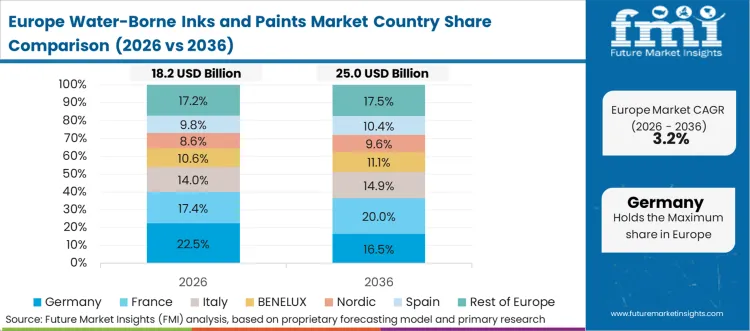
Europe operates as the global sustainability benchmark for the coatings industry, where the deepest penetration of water-borne technology is enforced by the stringent REACH framework and the Decopaint Directive. Major multinational suppliers aggressively compete through bio-based innovations and ultra-low VOC performance to secure high-value architectural and industrial contracts.
- Germany: Sales of water-borne inks and paints in Germany are on track to record a CAGR of 3.4% through 2036. As the industrial engine of Europe, Germany’s transition is heavily mandated by the Federal Immission Control Act (BImSchV) and the EU Ecolabel criteria, which essentially lock solvent-borne systems out of the architectural and public procurement sectors. The massive German automotive sector is also a major driver, utilizing highly advanced water-borne OEM basecoats to meet factory emission limits. While greenfield volume growth is modest, the strict, recurring maintenance cycles and intense focus on circular economy packaging ensure a high-value, stable market for water-borne inks and paints.
FMI’s report provides an in-depth look at the wider European market, analyzing lucrative hubs outside of Germany. The United Kingdom and France represent critical focus areas. The UK’s robust packaging and retail sectors drive consistent demand for water-borne flexographic and gravure inks, while France's stringent indoor air quality labeling regulations (Émissions dans l'air intérieur) force nearly all interior architectural paints into premium water-borne formulations.
Competitive Aligners for Market Players
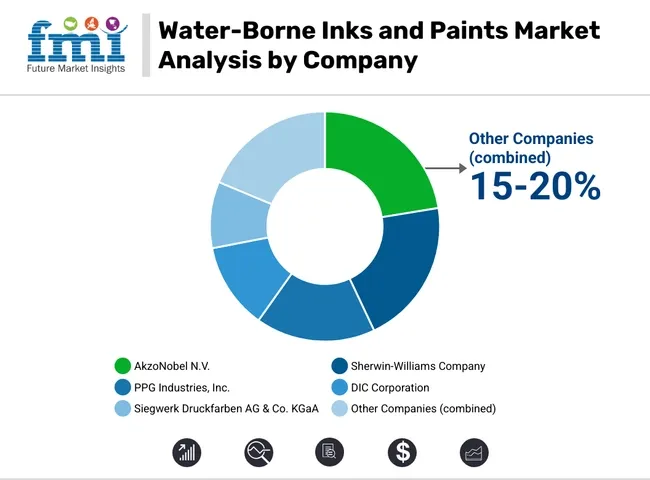
The competitive structure of the water-borne inks and paints market is best described as moderately consolidated at the top, with a long tail of regional formulators and niche ink makers. Global coatings brands and large ink manufacturers set performance benchmarks and shape qualification norms, but thousands of local producers compete on price, tinting capability, and distributor reach. The primary competitive variable is not just cost per liter, it is repeatable performance under low-VOC constraints, including drying behavior, rub resistance, adhesion, and print consistency at production speeds.
Structural advantages accrue to companies that control more of the value chain or can lock in customers through qualification cycles. Integrated resin platforms, captive R&D, and multi-plant manufacturing footprints help leading suppliers manage feedstock volatility and offer consistent batches across geographies. Companies with established contractor networks or converter technical service teams also win share because they reduce application failures and shorten the approval time for reformulated water-borne systems.
Buyer behavior tilts toward managed dependency rather than open-ended supplier loyalty. Large packaging converters and industrial coating users qualify two to three suppliers per application, then allocate volumes based on service response, lead times, and price index pass-through clauses. This raises switching costs for suppliers that are already qualified, but it also caps pricing power because buyers can re-balance volumes quickly when raw material costs fall or when alternate suppliers meet compliance and performance thresholds.
Recent developments
- PPG, waterborne plant start-up (Mar 2025): PPG started up a dedicated waterborne automotive coatings manufacturing plant in Samut Prakan, Thailand, expanding capacity for sustainably advantaged coating systems. [8]
- Siegwerk, circular coatings business unit (Apr 2024): Siegwerk established a global business unit focused on circular coatings to strengthen its position in functional, water-based coating solutions for sustainable packaging. [9]
- Arkema, waterborne PVDF coating technology (Oct 2024): Arkema highlighted its Kynar Aquatec waterborne PVDF technology, positioning it for applications that require durability with lower-emission coating processes. [10]
Key Players Profiled
- AkzoNobel N.V.
- Sherwin-Williams Company
- PPG Industries, Inc.
- DIC Corporation
- Siegwerk Druckfarben AG & Co. KGaA
- Kansai Paint Co., Ltd.
- Flint Group
- Toyo Ink SC Holdings Co., Ltd.
- RPM International Inc.
- Nippon Paint Holdings Co., Ltd.
- Tikkurila Oyj (AkzoNobel subsidiary)
- ALTANA AG
- BASF SE (dispersions & pigments)
- Hempel A/S
- Berger Paints India Ltd.
Scope of the Report
| Metric | Value |
|---|---|
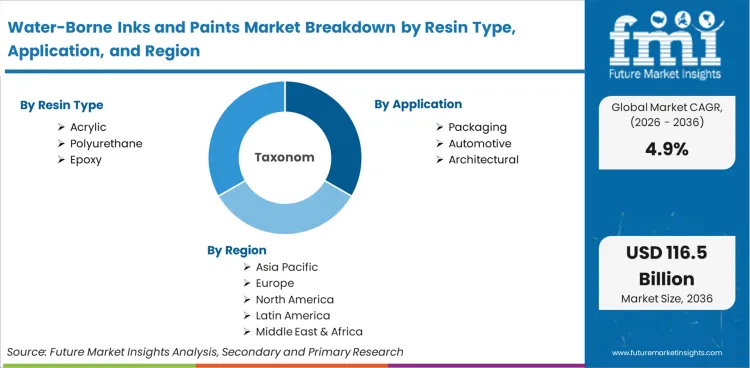
| Quantitative Units | USD 72.28 billion (2026) to USD 116.21 billion (2036), at a CAGR of 4.9%, with 2025 historic value of USD 68.90 billion |
| Market Definition | The water-borne inks and paints market comprises the global production, formulation, and distribution of water-based coating systems for architectural, packaging, automotive, and industrial applications. |
| Resin Type Segmentation | Acrylic, Polyurethane, Epoxy |
| Application Segmentation | Packaging, Automotive, Architectural |
| Regions Covered | North America, Latin America, Western Europe, Eastern Europe, East Asia, South Asia, Oceania, Middle East & Africa |
| Countries Covered | United States, Canada, Mexico, Brazil, Germany, France, United Kingdom, Italy, Spain, China, India, Japan, South Korea, Australia, and 40 plus countries |
| Key Companies Profiled | AkzoNobel, Sherwin-Williams, PPG, DIC, Siegwerk, Kansai Paint, Flint Group, Toyo Ink, RPM, Nippon Paint, Tikkurila, ALTANA, BASF, Hempel, Berger Paints |
| Forecast Period | 2026 to 2036 |
| Approach | Hybrid top-down and bottom-up market modeling validated through primary interviews with formulators, converters, and specifiers, supported by trade data benchmarking and end-use industry production analysis |
Water-Borne Inks and Paints Market Analysis by Segments
Resin Type
- Acrylic
- Polyurethane
- Epoxy
Application
- Packaging
- Automotive
- Architectural
Region
- North America
- Latin America
- Western Europe
- Eastern Europe
- East Asia
- South Asia
- Oceania
- Middle East & Africa
Bibliography
- [1] Siegwerk. (n.d.). Siegwerk unveils next generation of sustainable water-based inks for paper & board applications [Press release].
- [2] BASF SE. (2023, July). BASF expands production capacity for acrylic dispersions in Europe. BASF News Release.
- [3] European Chemical Industry Council (Cefic). (2024, February). Chemical industry trends report 2024: Supply chain and feedstock dynamics in Europe. Cefic Publications.
- [5] Siegwerk Druckfarben AG & Co. KGaA. (2023, September). Siegwerk strengthens sustainable packaging ink portfolio with water-based solutions. Siegwerk Press Release.
- [6] European Commission. (2023, January). Directive 2010/75/EU on industrial emissions (integrated pollution prevention and control)-consolidated version 2023 update. Official Journal of the European Union. https://eur-lex.europa.eu/legal-
- [7] DIC Corporation. (2023, April). DIC Group Sustainability Report 2023. DIC Corporation.
- [8] PPG Industries, Inc. (2025, March). PPG starts up waterborne automotive coatings plant in Thailand. PPG News Release.
- [9] Siegwerk Druckfarben AG & Co. KGaA. (2024, April). Siegwerk to strengthen its position as coating manufacturer by establishing global circular coatings business unit. Siegwerk Press Release.
- [10] Arkema S.A. (2024, October). Arkema advances sustainable building solutions with Kynar Aquatec waterborne PVDF technology. Arkema Press Release.
This Report Addresses
- Market intelligence to enable structured strategic decision-making across mature and emerging water-borne coatings markets.
- Market size estimation and 10-year revenue forecasts from 2026 to 2036, supported by validated packaging production and construction activity benchmarks.
- Growth opportunity mapping across resin types and applications with emphasis on food-safe packaging inks and green building architectural coatings.
- Segment and regional revenue forecasts covering packaging, architectural, and automotive applications.
- Competition strategy assessment including formulation capability, regulatory compliance benchmarking, and brand owner relationships.
- Regulatory impact analysis covering EPA VOC limits, EU food contact standards, and green building certification requirements.
- Market report delivery in PDF, Excel, PPT, and interactive dashboard formats for executive and operational use.
Frequently Asked Questions
How large was the water-borne inks and paints market in 2025?
In 2025, the water-borne inks and paints market was valued at USD 68.90 billion.
What will the market size be in the next year?
Based on Future Market Insights' analysis, demand for water-borne inks and paints is estimated to grow to USD 72.28 billion in 2026.
What is the projected market value by 2036?
The market is forecast to reach USD 116.21 billion by 2036.
What is the expected CAGR during the forecast period?
FMI projects a CAGR of 4.9% during the forecast period.
How much absolute growth is expected over the forecast period?
The market is set to expand from USD 68.90 billion in 2025 to USD 116.21 billion by 2036, reflecting substantial incremental growth over the period.
Which resin type is poised to lead the market?
Acrylic resins are expected to lead with a 49% share in 2026.
Which application segment will dominate demand?
Packaging is estimated to lead the application segment in 2026, supported by compliance-driven reformulation and high-volume print demand.
How significant is the 2026 market expansion compared to 2025?
The market is projected to increase from USD 68.90 billion in 2025 to USD 72.28 billion in 2026, indicating steady year-on-year expansion.
Is the growth outlook considered stable or volatile?
With a projected CAGR of 4.9% through 2036, the outlook reflects stable, compliance-led expansion rather than short-term volatility.
How large will the opportunity be for suppliers by 2036?
By 2036, the market is expected to reach USD 116.21 billion, offering significant long-term revenue potential for resin producers, ink formulators, and coating manufacturers.
Preview the report firsthand - request a free sample
Get SampleGet the brochure for pricing and purchase details.
Get PDFTable of Content
- Executive Summary
- Global Market Outlook
- Demand-side Trends
- Supply-side Trends
- Technology Roadmap Analysis
- Analysis and Recommendations
- Market Overview
- Market Coverage / Taxonomy
- Market Definition / Scope / Limitations
- Research Methodology
- Chapter Orientation
- Analytical Lens and Working Hypotheses
- Market Structure, Signals, and Trend Drivers
- Benchmarking and Cross-market Comparability
- Market Sizing, Forecasting, and Opportunity Mapping
- Research Design and Evidence Framework
- Desk Research Programme (Secondary Evidence)
- Company Annual and Sustainability Reports
- Peer-reviewed Journals and Academic Literature
- Corporate Websites, Product Literature, and Technical Notes
- Earnings Decks and Investor Briefings
- Statutory Filings and Regulatory Disclosures
- Technical White Papers and Standards Notes
- Trade Journals, Industry Magazines, and Analyst Briefs
- Conference Proceedings, Webinars, and Seminar Materials
- Government Statistics Portals and Public Data Releases
- Press Releases and Reputable Media Coverage
- Specialist Newsletters and Curated Briefings
- Sector Databases and Reference Repositories
- FMI Internal Proprietary Databases and Historical Market Datasets
- Subscription Datasets and Paid Sources
- Social Channels, Communities, and Digital Listening Inputs
- Additional Desk Sources
- Expert Input and Fieldwork (Primary Evidence)
- Primary Modes
- Qualitative Interviews and Expert Elicitation
- Quantitative Surveys and Structured Data Capture
- Blended Approach
- Why Primary Evidence is Used
- Field Techniques
- Interviews
- Surveys
- Focus Groups
- Observational and In-context Research
- Social and Community Interactions
- Stakeholder Universe Engaged
- C-suite Leaders
- Board Members
- Presidents and Vice Presidents
- R&D and Innovation Heads
- Technical Specialists
- Domain Subject-matter Experts
- Scientists
- Physicians and Other Healthcare Professionals
- Governance, Ethics, and Data Stewardship
- Research Ethics
- Data Integrity and Handling
- Primary Modes
- Tooling, Models, and Reference Databases
- Desk Research Programme (Secondary Evidence)
- Data Engineering and Model Build
- Data Acquisition and Ingestion
- Cleaning, Normalisation, and Verification
- Synthesis, Triangulation, and Analysis
- Quality Assurance and Audit Trail
- Market Background
- Market Dynamics
- Drivers
- Restraints
- Opportunity
- Trends
- Scenario Forecast
- Demand in Optimistic Scenario
- Demand in Likely Scenario
- Demand in Conservative Scenario
- Opportunity Map Analysis
- Product Life Cycle Analysis
- Supply Chain Analysis
- Investment Feasibility Matrix
- Value Chain Analysis
- PESTLE and Porter’s Analysis
- Regulatory Landscape
- Regional Parent Market Outlook
- Production and Consumption Statistics
- Import and Export Statistics
- Market Dynamics
- Global Market Analysis 2021 to 2025 and Forecast, 2026 to 2036
- Historical Market Size Value (USD Million) Analysis, 2021 to 2025
- Current and Future Market Size Value (USD Million) Projections, 2026 to 2036
- Y-o-Y Growth Trend Analysis
- Absolute $ Opportunity Analysis
- Global Market Pricing Analysis 2021 to 2025 and Forecast 2026 to 2036
- Global Market Analysis 2021 to 2025 and Forecast 2026 to 2036, By Resin Type
- Introduction / Key Findings
- Historical Market Size Value (USD Million) Analysis By Resin Type , 2021 to 2025
- Current and Future Market Size Value (USD Million) Analysis and Forecast By Resin Type , 2026 to 2036
- Acrylic
- Polyurethane
- Epoxy
- Acrylic
- Y-o-Y Growth Trend Analysis By Resin Type , 2021 to 2025
- Absolute $ Opportunity Analysis By Resin Type , 2026 to 2036
- Global Market Analysis 2021 to 2025 and Forecast 2026 to 2036, By Application
- Introduction / Key Findings
- Historical Market Size Value (USD Million) Analysis By Application, 2021 to 2025
- Current and Future Market Size Value (USD Million) Analysis and Forecast By Application, 2026 to 2036
- Packaging
- Automotive
- Architectural
- Packaging
- Y-o-Y Growth Trend Analysis By Application, 2021 to 2025
- Absolute $ Opportunity Analysis By Application, 2026 to 2036
- Global Market Analysis 2021 to 2025 and Forecast 2026 to 2036, By Region
- Introduction
- Historical Market Size Value (USD Million) Analysis By Region, 2021 to 2025
- Current Market Size Value (USD Million) Analysis and Forecast By Region, 2026 to 2036
- North America
- Latin America
- Western Europe
- Eastern Europe
- East Asia
- South Asia and Pacific
- Middle East & Africa
- Market Attractiveness Analysis By Region
- North America Market Analysis 2021 to 2025 and Forecast 2026 to 2036, By Country
- Historical Market Size Value (USD Million) Trend Analysis By Market Taxonomy, 2021 to 2025
- Market Size Value (USD Million) Forecast By Market Taxonomy, 2026 to 2036
- By Country
- USA
- Canada
- Mexico
- By Resin Type
- By Application
- By Country
- Market Attractiveness Analysis
- By Country
- By Resin Type
- By Application
- Key Takeaways
- Latin America Market Analysis 2021 to 2025 and Forecast 2026 to 2036, By Country
- Historical Market Size Value (USD Million) Trend Analysis By Market Taxonomy, 2021 to 2025
- Market Size Value (USD Million) Forecast By Market Taxonomy, 2026 to 2036
- By Country
- Brazil
- Chile
- Rest of Latin America
- By Resin Type
- By Application
- By Country
- Market Attractiveness Analysis
- By Country
- By Resin Type
- By Application
- Key Takeaways
- Western Europe Market Analysis 2021 to 2025 and Forecast 2026 to 2036, By Country
- Historical Market Size Value (USD Million) Trend Analysis By Market Taxonomy, 2021 to 2025
- Market Size Value (USD Million) Forecast By Market Taxonomy, 2026 to 2036
- By Country
- Germany
- UK
- Italy
- Spain
- France
- Nordic
- BENELUX
- Rest of Western Europe
- By Resin Type
- By Application
- By Country
- Market Attractiveness Analysis
- By Country
- By Resin Type
- By Application
- Key Takeaways
- Eastern Europe Market Analysis 2021 to 2025 and Forecast 2026 to 2036, By Country
- Historical Market Size Value (USD Million) Trend Analysis By Market Taxonomy, 2021 to 2025
- Market Size Value (USD Million) Forecast By Market Taxonomy, 2026 to 2036
- By Country
- Russia
- Poland
- Hungary
- Balkan & Baltic
- Rest of Eastern Europe
- By Resin Type
- By Application
- By Country
- Market Attractiveness Analysis
- By Country
- By Resin Type
- By Application
- Key Takeaways
- East Asia Market Analysis 2021 to 2025 and Forecast 2026 to 2036, By Country
- Historical Market Size Value (USD Million) Trend Analysis By Market Taxonomy, 2021 to 2025
- Market Size Value (USD Million) Forecast By Market Taxonomy, 2026 to 2036
- By Country
- China
- Japan
- South Korea
- By Resin Type
- By Application
- By Country
- Market Attractiveness Analysis
- By Country
- By Resin Type
- By Application
- Key Takeaways
- South Asia and Pacific Market Analysis 2021 to 2025 and Forecast 2026 to 2036, By Country
- Historical Market Size Value (USD Million) Trend Analysis By Market Taxonomy, 2021 to 2025
- Market Size Value (USD Million) Forecast By Market Taxonomy, 2026 to 2036
- By Country
- India
- ASEAN
- Australia & New Zealand
- Rest of South Asia and Pacific
- By Resin Type
- By Application
- By Country
- Market Attractiveness Analysis
- By Country
- By Resin Type
- By Application
- Key Takeaways
- Middle East & Africa Market Analysis 2021 to 2025 and Forecast 2026 to 2036, By Country
- Historical Market Size Value (USD Million) Trend Analysis By Market Taxonomy, 2021 to 2025
- Market Size Value (USD Million) Forecast By Market Taxonomy, 2026 to 2036
- By Country
- Kingdom of Saudi Arabia
- Other GCC Countries
- Turkiye
- South Africa
- Other African Union
- Rest of Middle East & Africa
- By Resin Type
- By Application
- By Country
- Market Attractiveness Analysis
- By Country
- By Resin Type
- By Application
- Key Takeaways
- Key Countries Market Analysis
- USA
- Pricing Analysis
- Market Share Analysis, 2025
- By Resin Type
- By Application
- Canada
- Pricing Analysis
- Market Share Analysis, 2025
- By Resin Type
- By Application
- Mexico
- Pricing Analysis
- Market Share Analysis, 2025
- By Resin Type
- By Application
- Brazil
- Pricing Analysis
- Market Share Analysis, 2025
- By Resin Type
- By Application
- Chile
- Pricing Analysis
- Market Share Analysis, 2025
- By Resin Type
- By Application
- Germany
- Pricing Analysis
- Market Share Analysis, 2025
- By Resin Type
- By Application
- UK
- Pricing Analysis
- Market Share Analysis, 2025
- By Resin Type
- By Application
- Italy
- Pricing Analysis
- Market Share Analysis, 2025
- By Resin Type
- By Application
- Spain
- Pricing Analysis
- Market Share Analysis, 2025
- By Resin Type
- By Application
- France
- Pricing Analysis
- Market Share Analysis, 2025
- By Resin Type
- By Application
- India
- Pricing Analysis
- Market Share Analysis, 2025
- By Resin Type
- By Application
- ASEAN
- Pricing Analysis
- Market Share Analysis, 2025
- By Resin Type
- By Application
- Australia & New Zealand
- Pricing Analysis
- Market Share Analysis, 2025
- By Resin Type
- By Application
- China
- Pricing Analysis
- Market Share Analysis, 2025
- By Resin Type
- By Application
- Japan
- Pricing Analysis
- Market Share Analysis, 2025
- By Resin Type
- By Application
- South Korea
- Pricing Analysis
- Market Share Analysis, 2025
- By Resin Type
- By Application
- Russia
- Pricing Analysis
- Market Share Analysis, 2025
- By Resin Type
- By Application
- Poland
- Pricing Analysis
- Market Share Analysis, 2025
- By Resin Type
- By Application
- Hungary
- Pricing Analysis
- Market Share Analysis, 2025
- By Resin Type
- By Application
- Kingdom of Saudi Arabia
- Pricing Analysis
- Market Share Analysis, 2025
- By Resin Type
- By Application
- Turkiye
- Pricing Analysis
- Market Share Analysis, 2025
- By Resin Type
- By Application
- South Africa
- Pricing Analysis
- Market Share Analysis, 2025
- By Resin Type
- By Application
- USA
- Market Structure Analysis
- Competition Dashboard
- Competition Benchmarking
- Market Share Analysis of Top Players
- By Regional
- By Resin Type
- By Application
- Competition Analysis
- Competition Deep Dive
- AkzoNobel N.V.
- Overview
- Product Portfolio
- Profitability by Market Segments (Product/Age /Sales Channel/Region)
- Sales Footprint
- Strategy Overview
- Marketing Strategy
- Product Strategy
- Channel Strategy
- Sherwin-Williams Company
- PPG Industries, Inc.
- DIC Corporation
- Siegwerk Druckfarben AG & Co. KGaA
- Kansai Paint Co., Ltd.
- AkzoNobel N.V.
- Competition Deep Dive
- Assumptions & Acronyms Used
" "
- Executive Summary
- Global Market Outlook
- Demand-side Trends
- Supply-side Trends
- Technology Roadmap Analysis
- Analysis and Recommendations
- Market Overview
- Market Coverage / Taxonomy
- Market Definition / Scope / Limitations
- Research Methodology
- Chapter Orientation
- Analytical Lens and Working Hypotheses
- Market Structure, Signals, and Trend Drivers
- Benchmarking and Cross-market Comparability
- Market Sizing, Forecasting, and Opportunity Mapping
- Research Design and Evidence Framework
- Desk Research Programme (Secondary Evidence)
- Company Annual and Sustainability Reports
- Peer-reviewed Journals and Academic Literature
- Corporate Websites, Product Literature, and Technical Notes
- Earnings Decks and Investor Briefings
- Statutory Filings and Regulatory Disclosures
- Technical White Papers and Standards Notes
- Trade Journals, Industry Magazines, and Analyst Briefs
- Conference Proceedings, Webinars, and Seminar Materials
- Government Statistics Portals and Public Data Releases
- Press Releases and Reputable Media Coverage
- Specialist Newsletters and Curated Briefings
- Sector Databases and Reference Repositories
- FMI Internal Proprietary Databases and Historical Market Datasets
- Subscription Datasets and Paid Sources
- Social Channels, Communities, and Digital Listening Inputs
- Additional Desk Sources
- Expert Input and Fieldwork (Primary Evidence)
- Primary Modes
- Qualitative Interviews and Expert Elicitation
- Quantitative Surveys and Structured Data Capture
- Blended Approach
- Why Primary Evidence is Used
- Field Techniques
- Interviews
- Surveys
- Focus Groups
- Observational and In-context Research
- Social and Community Interactions
- Stakeholder Universe Engaged
- C-suite Leaders
- Board Members
- Presidents and Vice Presidents
- R&D and Innovation Heads
- Technical Specialists
- Domain Subject-matter Experts
- Scientists
- Physicians and Other Healthcare Professionals
- Governance, Ethics, and Data Stewardship
- Research Ethics
- Data Integrity and Handling
- Primary Modes
- Tooling, Models, and Reference Databases
- Desk Research Programme (Secondary Evidence)
- Data Engineering and Model Build
- Data Acquisition and Ingestion
- Cleaning, Normalisation, and Verification
- Synthesis, Triangulation, and Analysis
- Quality Assurance and Audit Trail
- Market Background
- Market Dynamics
- Drivers
- Restraints
- Opportunity
- Trends
- Scenario Forecast
- Demand in Optimistic Scenario
- Demand in Likely Scenario
- Demand in Conservative Scenario
- Opportunity Map Analysis
- Product Life Cycle Analysis
- Supply Chain Analysis
- Investment Feasibility Matrix
- Value Chain Analysis
- PESTLE and Porter’s Analysis
- Regulatory Landscape
- Regional Parent Market Outlook
- Production and Consumption Statistics
- Import and Export Statistics
- Market Dynamics
- Global Market Analysis 2021 to 2025 and Forecast, 2026 to 2036
- Historical Market Size Value (USD Million) Analysis, 2021 to 2025
- Current and Future Market Size Value (USD Million) Projections, 2026 to 2036
- Y-o-Y Growth Trend Analysis
- Absolute $ Opportunity Analysis
- Global Market Pricing Analysis 2021 to 2025 and Forecast 2026 to 2036
- Global Market Analysis 2021 to 2025 and Forecast 2026 to 2036, By Resin Type
- Introduction / Key Findings
- Historical Market Size Value (USD Million) Analysis By Resin Type , 2021 to 2025
- Current and Future Market Size Value (USD Million) Analysis and Forecast By Resin Type , 2026 to 2036
- Acrylic
- Polyurethane
- Epoxy
- Acrylic
- Y-o-Y Growth Trend Analysis By Resin Type , 2021 to 2025
- Absolute $ Opportunity Analysis By Resin Type , 2026 to 2036
- Global Market Analysis 2021 to 2025 and Forecast 2026 to 2036, By Application
- Introduction / Key Findings
- Historical Market Size Value (USD Million) Analysis By Application, 2021 to 2025
- Current and Future Market Size Value (USD Million) Analysis and Forecast By Application, 2026 to 2036
- Packaging
- Automotive
- Architectural
- Packaging
- Y-o-Y Growth Trend Analysis By Application, 2021 to 2025
- Absolute $ Opportunity Analysis By Application, 2026 to 2036
- Global Market Analysis 2021 to 2025 and Forecast 2026 to 2036, By Region
- Introduction
- Historical Market Size Value (USD Million) Analysis By Region, 2021 to 2025
- Current Market Size Value (USD Million) Analysis and Forecast By Region, 2026 to 2036
- North America
- Latin America
- Western Europe
- Eastern Europe
- East Asia
- South Asia and Pacific
- Middle East & Africa
- Market Attractiveness Analysis By Region
- North America Market Analysis 2021 to 2025 and Forecast 2026 to 2036, By Country
- Historical Market Size Value (USD Million) Trend Analysis By Market Taxonomy, 2021 to 2025
- Market Size Value (USD Million) Forecast By Market Taxonomy, 2026 to 2036
- By Country
- USA
- Canada
- Mexico
- By Resin Type
- By Application
- By Country
- Market Attractiveness Analysis
- By Country
- By Resin Type
- By Application
- Key Takeaways
- Latin America Market Analysis 2021 to 2025 and Forecast 2026 to 2036, By Country
- Historical Market Size Value (USD Million) Trend Analysis By Market Taxonomy, 2021 to 2025
- Market Size Value (USD Million) Forecast By Market Taxonomy, 2026 to 2036
- By Country
- Brazil
- Chile
- Rest of Latin America
- By Resin Type
- By Application
- By Country
- Market Attractiveness Analysis
- By Country
- By Resin Type
- By Application
- Key Takeaways
- Western Europe Market Analysis 2021 to 2025 and Forecast 2026 to 2036, By Country
- Historical Market Size Value (USD Million) Trend Analysis By Market Taxonomy, 2021 to 2025
- Market Size Value (USD Million) Forecast By Market Taxonomy, 2026 to 2036
- By Country
- Germany
- UK
- Italy
- Spain
- France
- Nordic
- BENELUX
- Rest of Western Europe
- By Resin Type
- By Application
- By Country
- Market Attractiveness Analysis
- By Country
- By Resin Type
- By Application
- Key Takeaways
- Eastern Europe Market Analysis 2021 to 2025 and Forecast 2026 to 2036, By Country
- Historical Market Size Value (USD Million) Trend Analysis By Market Taxonomy, 2021 to 2025
- Market Size Value (USD Million) Forecast By Market Taxonomy, 2026 to 2036
- By Country
- Russia
- Poland
- Hungary
- Balkan & Baltic
- Rest of Eastern Europe
- By Resin Type
- By Application
- By Country
- Market Attractiveness Analysis
- By Country
- By Resin Type
- By Application
- Key Takeaways
- East Asia Market Analysis 2021 to 2025 and Forecast 2026 to 2036, By Country
- Historical Market Size Value (USD Million) Trend Analysis By Market Taxonomy, 2021 to 2025
- Market Size Value (USD Million) Forecast By Market Taxonomy, 2026 to 2036
- By Country
- China
- Japan
- South Korea
- By Resin Type
- By Application
- By Country
- Market Attractiveness Analysis
- By Country
- By Resin Type
- By Application
- Key Takeaways
- South Asia and Pacific Market Analysis 2021 to 2025 and Forecast 2026 to 2036, By Country
- Historical Market Size Value (USD Million) Trend Analysis By Market Taxonomy, 2021 to 2025
- Market Size Value (USD Million) Forecast By Market Taxonomy, 2026 to 2036
- By Country
- India
- ASEAN
- Australia & New Zealand
- Rest of South Asia and Pacific
- By Resin Type
- By Application
- By Country
- Market Attractiveness Analysis
- By Country
- By Resin Type
- By Application
- Key Takeaways
- Middle East & Africa Market Analysis 2021 to 2025 and Forecast 2026 to 2036, By Country
- Historical Market Size Value (USD Million) Trend Analysis By Market Taxonomy, 2021 to 2025
- Market Size Value (USD Million) Forecast By Market Taxonomy, 2026 to 2036
- By Country
- Kingdom of Saudi Arabia
- Other GCC Countries
- Turkiye
- South Africa
- Other African Union
- Rest of Middle East & Africa
- By Resin Type
- By Application
- By Country
- Market Attractiveness Analysis
- By Country
- By Resin Type
- By Application
- Key Takeaways
- Key Countries Market Analysis
- USA
- Pricing Analysis
- Market Share Analysis, 2025
- By Resin Type
- By Application
- Canada
- Pricing Analysis
- Market Share Analysis, 2025
- By Resin Type
- By Application
- Mexico
- Pricing Analysis
- Market Share Analysis, 2025
- By Resin Type
- By Application
- Brazil
- Pricing Analysis
- Market Share Analysis, 2025
- By Resin Type
- By Application
- Chile
- Pricing Analysis
- Market Share Analysis, 2025
- By Resin Type
- By Application
- Germany
- Pricing Analysis
- Market Share Analysis, 2025
- By Resin Type
- By Application
- UK
- Pricing Analysis
- Market Share Analysis, 2025
- By Resin Type
- By Application
- Italy
- Pricing Analysis
- Market Share Analysis, 2025
- By Resin Type
- By Application
- Spain
- Pricing Analysis
- Market Share Analysis, 2025
- By Resin Type
- By Application
- France
- Pricing Analysis
- Market Share Analysis, 2025
- By Resin Type
- By Application
- India
- Pricing Analysis
- Market Share Analysis, 2025
- By Resin Type
- By Application
- ASEAN
- Pricing Analysis
- Market Share Analysis, 2025
- By Resin Type
- By Application
- Australia & New Zealand
- Pricing Analysis
- Market Share Analysis, 2025
- By Resin Type
- By Application
- China
- Pricing Analysis
- Market Share Analysis, 2025
- By Resin Type
- By Application
- Japan
- Pricing Analysis
- Market Share Analysis, 2025
- By Resin Type
- By Application
- South Korea
- Pricing Analysis
- Market Share Analysis, 2025
- By Resin Type
- By Application
- Russia
- Pricing Analysis
- Market Share Analysis, 2025
- By Resin Type
- By Application
- Poland
- Pricing Analysis
- Market Share Analysis, 2025
- By Resin Type
- By Application
- Hungary
- Pricing Analysis
- Market Share Analysis, 2025
- By Resin Type
- By Application
- Kingdom of Saudi Arabia
- Pricing Analysis
- Market Share Analysis, 2025
- By Resin Type
- By Application
- Turkiye
- Pricing Analysis
- Market Share Analysis, 2025
- By Resin Type
- By Application
- South Africa
- Pricing Analysis
- Market Share Analysis, 2025
- By Resin Type
- By Application
- USA
- Market Structure Analysis
- Competition Dashboard
- Competition Benchmarking
- Market Share Analysis of Top Players
- By Regional
- By Resin Type
- By Application
- Competition Analysis
- Competition Deep Dive
- AkzoNobel N.V.
- Overview
- Product Portfolio
- Profitability by Market Segments (Product/Age /Sales Channel/Region)
- Sales Footprint
- Strategy Overview
- Marketing Strategy
- Product Strategy
- Channel Strategy
- Sherwin-Williams Company
- PPG Industries, Inc.
- DIC Corporation
- Siegwerk Druckfarben AG & Co. KGaA
- Kansai Paint Co., Ltd.
- AkzoNobel N.V.
- Competition Deep Dive
- Assumptions & Acronyms Used


