

- Industry Size (2026)
- USD 515.0 Mn
- Forecast (2036)
- USD 913.6 Mn
- CAGR (2026 to 2036)
- 5.90%
Low Migration Ink Solvents Market Size, Market Forecast and Outlook By FMI
The low migration ink solvents market was valued at USD 485.4 million in 2025 and is expected to reach USD 515.0 million in 2026, reflecting a 5.9% CAGR. By 2036, the market is projected to grow to USD 913.6 million, driven by increasingly stringent regulatory requirements on organoleptic performance for primary packaging in direct food‑contact applications.
Brands that delay adopting these upgraded solvent formulations face immediate product recalls and exclusion from European and North American retail shelves under strict food contact material laws. Practitioners recognize that the most critical bottleneck is not ink adhesion, but rather the solvent's behavior during high-speed curing on non-porous flexible substrates, where trapped residues trigger taste and odor changes even without physical chemical transfer. This necessitates investment in advanced printing ink systems natively designed for absolute sensory neutrality.
Summary of Low Migration Ink Solvents Market
- Low Migration Ink Solvents Market Definition
- The Low Migration Ink Solvents Market provides specialized, highly refined carrier fluids and monomers that prevent the chemical transfer of printing components into packaged consumables, ensuring absolute regulatory compliance and sensory neutrality.
- Demand Drivers in the Market
- Strict enforcement of the Swiss Ordinance (RS 817.023.21) forces primary packaging converters to eliminate standard volatile solvents from all food-contact printing operations.
- Heightened sensory testing requirements compel global FMCG brand owners to mandate high-molecular-weight solvent carriers to prevent organoleptic degradation.
- Zero-tolerance policies on cross-contamination drive global ink formulators to invest heavily in dedicated, GMP-certified production facilities.
- Key Segments Analyzed in the FMI Report
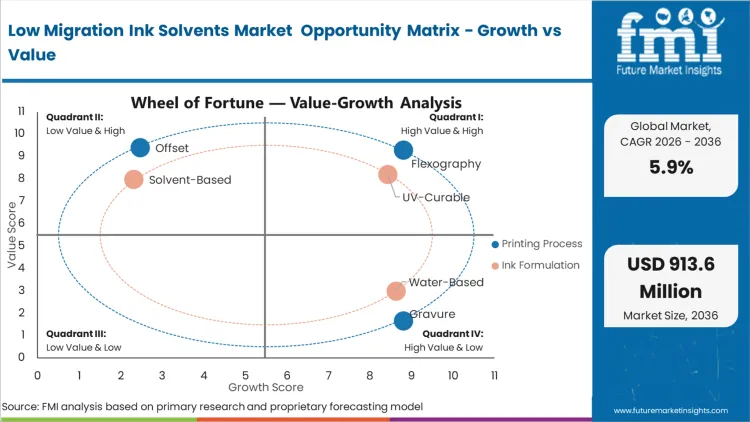
- Flexography: 55.1% share in 2026, driven by its unparalleled efficiency in high-volume, continuous web printing for flexible food and beverage packaging.
- UV-Curable: 48.5% share in 2026, as instantaneous curing mechanisms effectively lock monomers in place, preventing potential migration into the substrate.
- Food & Beverage: 43.1% share in 2026, representing the largest end-use segment due to the critical mass of packaged consumables requiring absolute chemical safety.
- China: 7.5% compound growth, anchored by strict implementation of the National Food Safety Standard across its expanding food export industry.
- Analyst Opinion at FMI
- Nikhil Kaitwade, Principal Consultant for Chemicals and Materials, opines, "The true bottleneck in packaging compliance is not ink adhesion, but the solvent's entrapment during high-speed curing on flexible films. Actors who fail to address sub-surface solvent retention will face immediate product recalls due to organoleptic failures, regardless of physical migration limits."
- Strategic Implications / Executive Takeaways
- Primary packaging converters must secure comprehensive GMP certification to retain Tier-1 FMCG food and beverage printing contracts before impending regulatory audits.
- Global ink formulators should invest in advanced polymeric solvent systems to achieve zero-migration thresholds without sacrificing press speeds.
- Brand owners must enforce strict compositional disclosure mandates across their supply chain or face catastrophic brand damage from regulatory non-compliance.
- Methodology
- Primary Research: FMI conducted detailed technical interviews with packaging engineers, regulatory compliance officers, and polymer chemists across 40 countries to validate chemical adoption timelines.
- Desk Research: Analysts aggregated public standards documentation from EFSA, FDA food contact substance notifications, and corporate sustainability launch sheets.
- Market-Sizing and Forecasting: The model applies a bottom-up methodology starting with global installed base metrics for food-grade printing presses and projecting the conversion rate to low-migration standards.
- Data Validation and Update Cycle: Segment forecasts undergo cross-validation against quarterly specialty chemical shipment volumes for printing applications.
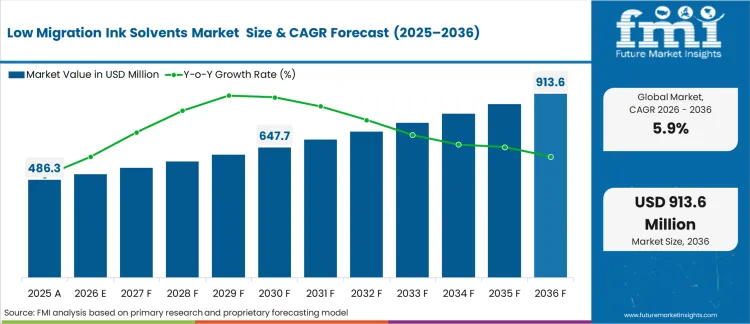
This structural requirement establishes a mandatory compliance baseline before widespread market adoption becomes self-sustaining. Major global brand owners are now mandating full compositional disclosure and GMP certification from primary packaging converters ahead of the impending European printing audit cycle. Facilities completing this certification unlock access to premium pharmaceutical and food-grade printing contracts.
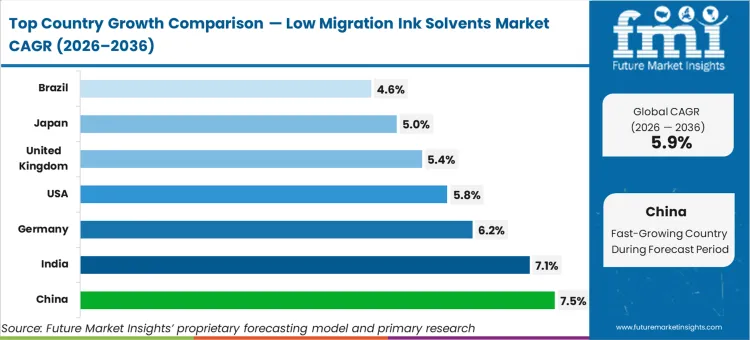
China advances at a 7.5% compound rate, driven by aggressive enforcement of its National Food Safety Standard (GB 4806.1-2016) across its massive domestic packaged food export sector. India tracks at 7.1% as domestic pharmaceutical manufacturing scales up its compliance with international packaging mandates. Germany expands at 6.2%, anchored by stringent European Food Safety Authority directives that continuously raise the bar for packaging safety. The United States follows at 5.8%, responding to strict FDA food contact substance notifications. The United Kingdom grows at 5.4%, driven by retail-led packaging safety initiatives. Japan records a 5.0% expansion, prioritizing high-purity packaging for its premium cosmetics sector. Brazil posts a 4.6% growth rate as regional food exporters align with global compliance requirements. This growth spread exists because distinct regional regulatory enforcement timelines dictate how quickly converters must abandon legacy ink systems.
Low Migration Ink Solvents Market Definition
The low migration ink solvents market encompasses high-purity carrier fluids, monomers, and specifically formulated solvent blends designed to ensure that printed packaging materials do not transfer chemical components into the packaged product. These solvents undergo specialized refining to eliminate volatile organic residues that could compromise the sensory properties or safety of food, pharmaceuticals, and cosmetics.
Low Migration Ink Solvents Market Inclusions
The market scope includes high-molecular-weight solvent carriers, specialized photoinitiator solvents, and polymeric carrier fluids utilized exclusively in low migration printing applications. Certified low-migration modifiers, specific aliphatic hydrocarbons, and high-purity specialized UV curable inks designed for absolute regulatory compliance fall within the defined boundaries. Formulations requiring GMP-certified production lines are fully incorporated.
Low Migration Ink Solvents Market Exclusions
Standard industrial printing solvents lacking specific food-contact compliance certifications are explicitly excluded. General-purpose volatile organic compounds used in commercial publication printing, standard textile inks, and architectural coatings fall outside the defined parameters. Base raw materials not specifically refined and marketed for low migration applications are omitted from the valuation.
Low Migration Ink Solvents Market Research Methodology
- Primary Research: FMI analysts engaged with packaging compliance directors, chief ink formulators, and FMCG regulatory affairs managers to map the specific decision gates triggering solvent formulation upgrades.
- Desk Research: The data collection phase aggregated compliance roadmaps from the European Food Safety Authority (EFSA), the Swiss Ordinance registries, and major global food and beverage packaging guidelines.
- Market-Sizing and Forecasting: The baseline value derives from a bottom-up aggregation of certified low-migration solvent shipments, applying region-specific regulatory enforcement curves to project the future adoption velocity.
- Data Validation and Update Cycle: Projections are rigorously tested against publicly reported capital expenditure guidance from leading packaging converters and global ink manufacturing conglomerates.
Low Migration Ink Solvents Market Key Takeaways
| Metric | Details |
|---|---|
| Industry Size (2026) | USD 515.0 million |
| Industry Value (2036) | USD 913.6 million |
| CAGR (2026-2036) | 5.9% |
Source: Future Market Insights (FMI) analysis, based on proprietary forecasting model and primary research
Segmental Analysis
Low Migration Ink Solvents Market Analysis by Printing Process
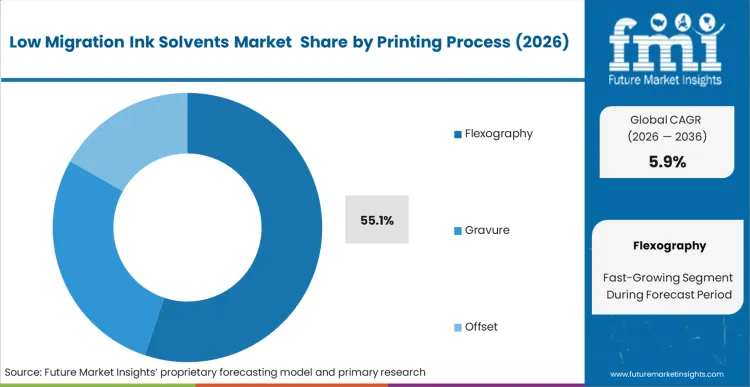
The widespread utilization of continuous web formats for flexible packaging forces primary converters to demand highly stable ink formulations. Flexography commands a dominant 55.1% share in 2026, reflecting the absolute requirement for rapid solvent evaporation during high-volume label and wrapper production. Ink formulators supplying these processes must precisely balance the carrier fluid's volatility to prevent premature drying on the printing plates while ensuring complete evacuation before the final rewind. This delicate equilibrium dictates the exact chemical makeup of the formulation. According to FMI's estimates, facilities transitioning to these optimized carriers significantly reduce their scrap rates related to set-off and blocking. Plant managers failing to validate their solvent evaporation curves risk significant organoleptic failures in the final packaged product, jeopardizing multi-million dollar contracts. Proper integration requires rigorous high speed flexographic integration protocols.
- Evaporation calibration: Precise balancing of high-molecular-weight carriers prevents premature drying on anilox rollers during extended production runs. Plant managers avoid costly press downtime by maintaining optimal fluid dynamics.
- Web-tension optimization: Consistent solvent behavior ensures that continuous flexible films do not deform under high-speed curing temperatures. Press operators achieve higher throughput without compromising the structural integrity of the packaging material.
- Set-off prevention: Rapid and complete evacuation of the solvent carrier guarantees that printed surfaces do not transfer residues to the unprinted side during rewinding. Quality assurance directors eliminate the primary cause of internal roll contamination.
Low Migration Ink Solvents Market Analysis by Ink Formulation
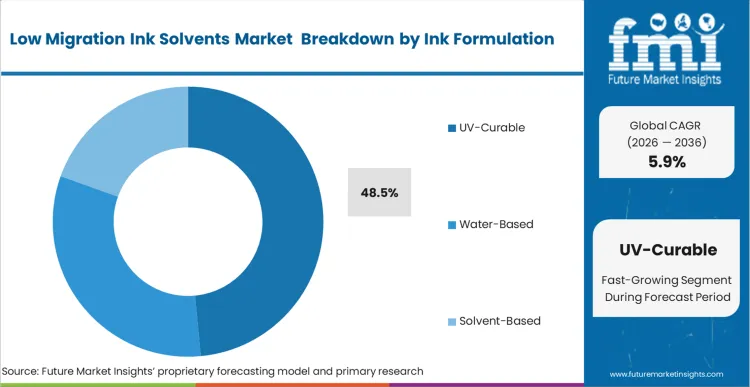
The fundamental transition from evaporative drying to localized photopolymerization drives the adoption of advanced ink architectures. UV-Curable formulations hold a 48.5% share in 2026, as the instantaneous transformation from liquid to solid effectively locks all chemical components into a cross-linked matrix. This structural mechanism physically prevents residual monomers from migrating through the packaging substrate. Based on FMI's assessment, the deployment of large-molecule photoinitiators that cannot easily penetrate flexible films forms the foundation of this segment's success. Formulation scientists must utilize specialized, high-purity monomers that react completely upon exposure to specific light wavelengths. Converters relying on outdated, low-molecular-weight photoinitiators face the immediate threat of unbound chemicals migrating into the packaged product, triggering regulatory intervention. Forward-looking facilities are also exploring water based ink transitions to further minimize chemical hazards.
- Photopolymerization locking: Instantaneous cross-linking traps chemical components within a solid matrix, preventing subsurface movement. Packaging converters guarantee absolute compliance with stringent European migration limits.
- Large-molecule synthesis: Utilizing high-molecular-weight photoinitiators significantly reduces the probability of chemical penetration through porous substrates. Ink formulation chemists eliminate the primary vector for regulatory failures.
- Wavelength calibration: Matching specific monomers to precise UV LED outputs ensures 100% cure rates across the entire printed surface. Press technicians prevent the presence of hazardous, unreacted chemical residues.
Low Migration Ink Solvents Market Analysis by End-Use Application
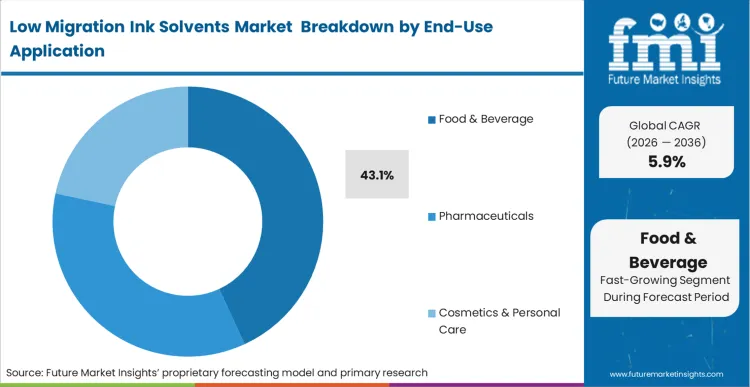
Global FMCG brands responding to intense consumer scrutiny mandate absolute chemical neutrality across their entire packaging portfolio. The Food & Beverage segment emerges as the dominant application area, representing 43.1% of the total market share in 2026. Rigid safety directives compel brand owners to specify high-purity solvent systems that guarantee zero organoleptic interference with the packaged product. As per FMI's projection, the sheer volume of continuously produced consumable goods requires massive quantities of certified, low-migration ink formulations to sustain production lines. Any deviation from these strict chemical profiles introduces unacceptable liability risks. Packaging converters failing to provide verifiable migration testing data for their food-grade outputs immediately lose their Tier-1 supplier status. Parallel requirements are reshaping sterile pharmaceutical packaging layers to ensure medicine efficacy.
- Organoleptic preservation: High-purity solvent carriers guarantee that no residual odors or tastes transfer into the consumable product. FMCG brand owners protect their product integrity and maintain consumer trust.
- Audit compliance: Comprehensive compositional documentation for all ink components satisfies rigorous regulatory inspections under the Swiss Ordinance. Compliance officers streamline the approval process for new packaging designs.
- Liability mitigation: Deploying certified low-migration formulations insulates brands from catastrophic health-related recalls and associated legal penalties. Corporate risk managers secure the primary packaging pipeline against contamination events.
Low Migration Ink Solvents Market Drivers, Restraints, and Opportunities
Strict enforcement of the European Food Safety Authority (EFSA) directives and the Swiss Ordinance (RS 817.023.21) forces primary packaging converters to eliminate standard volatile organic compounds from all direct and indirect food-contact printing operations. This regulatory mechanism requires converters to adopt high-molecular-weight, highly refined solvent systems that are physically incapable of migrating through flexible films. Asset owners upgrading their press operations face a strict mandate: deploy certified low-migration formulations or forfeit access to the lucrative FMCG supply chain. Facilities that fail to modernize their ink architectures face catastrophic product recalls and immediate exclusion from major retail markets.
The intricate chemical engineering required to balance rapid curing speeds with low migration properties creates significant operational friction for traditional ink formulators. Developing highly refined, large-molecule solvent carriers that perform efficiently on high-speed flexographic presses demands massive R&D expenditure and dedicated GMP-certified production lines to prevent cross-contamination. While novel polymeric carriers are emerging as a workaround, their inherently higher viscosity limits application speeds and requires costly press modifications, constraining rapid adoption among mid-tier converters.
Opportunities in the Low Migration Ink Solvents Market
- GMP Facility Expansion: Dedicated production lines physically isolate low-migration formulations from standard industrial inks to prevent trace contamination. Ink manufacturers utilizing these facilities secure exclusive contracts with highly regulated global brands.
- Digital Press Formulations: Specialized low-migration inkjet fluids enable converters to run highly customized, short-run packaging jobs without violating food safety standards. Print operators capture high-margin, localized marketing campaigns from major food conglomerates.
- Comprehensive Portfolio Certification: Aligning entire product lines with stringent global standards allows ink providers to offer seamless global compliance to multinational clients. Chemical suppliers leveraging certified packaging inks portfolios dominate the procurement shortlists of Tier-1 packaging converters.
Regional Analysis
Based on the regional analysis, the Low Migration Ink Solvents Market is segmented into North America, Latin America, Europe, East Asia, South Asia, Oceania, and Middle East & Africa across 40 plus countries.
.webp "Top Country Growth Comparison Low Migration Ink Solvents Market Cagr (2026 2036)")
| Country | CAGR (2026 to 2036) |
|---|---|
| China | 7.5% |
| India | 7.1% |
| Germany | 6.2% |
| United States | 5.8% |
| United Kingdom | 5.4% |
| Japan | 5.0% |
| Brazil | 4.6% |
Source: Future Market Insights (FMI) analysis, based on proprietary forecasting model and primary research
East Asia Low Migration Ink Solvents Market Analysis
Aggressive enforcement of national food safety protocols radically shifts the procurement landscape across East Asia. Government regulatory bodies updating domestic standards to align with rigorous international export requirements are forcing local packaging converters to abandon cheap, legacy solvent systems. This policy-led transformation necessitates substantial investments in advanced chemical architectures capable of meeting zero-tolerance contamination thresholds. In FMI's view, this top-down regulatory pressure rapidly scales the adoption of high-purity solvent formulations across the region's massive manufacturing base. Regional converters must adapt quickly to secure their positions within global supply chains, heavily driving the implementation of digital packaging presses.
- China: The implementation of the National Food Safety Standard (GB 4806.1-2016) compels Chinese packaging converters to deploy high-purity solvent systems across their massive export operations. This strict enforcement mechanism anchors a 7.5% compound rate through 2036. Global brand owners sourcing from China now mandate absolute compositional transparency to ensure their imported goods do not face rejection at European borders.
- Japan: Japan's premium cosmetics sector forces domestic ink formulators to utilize ultra-refined carrier fluids to guarantee absolute sensory neutrality. Expanding at 5.0% compound between 2026 and 2036, this precise qualification constraint drives the market. Packaging procurement leads must validate zero-odor profiles before authorizing series production for luxury personal care brands.
FMI's report includes extensive coverage of South Korea and Taiwan. The prevailing dynamic across these nations is the rapid localization of highly certified chemical production, allowing domestic ink manufacturers to directly compete with established European compliance leaders.
Europe Low Migration Ink Solvents Market Analysis
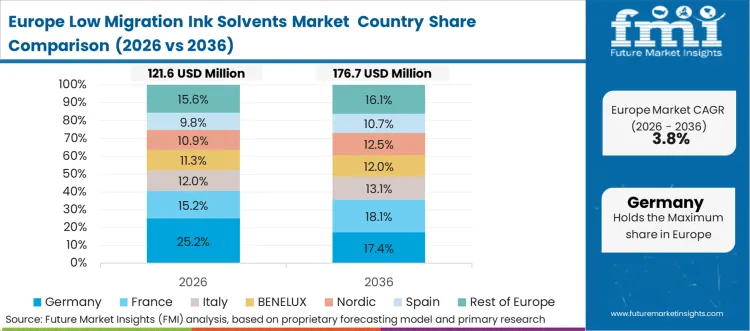
Stringent, continuously evolving directives from the European Food Safety Authority (EFSA) define the operational boundaries for the entire European packaging sector. Regulatory agencies explicitly mandate the use of positively listed chemical substances for any material in indirect or direct contact with food, establishing an exceptionally high barrier to entry for ink suppliers. According to FMI's estimates, this uncompromising policy framework forces packaging converters to utilize only GMP-certified low migration formulations, regardless of the underlying printing technology. Asset operators attempting to circumvent these standards face severe legal repercussions and immediate brand blacklisting.
- Germany: Germany's updated printing ordinances impose strict liability on primary packaging converters utilizing non-compliant solvent systems in food applications. Sustaining a 6.2% CAGR to 2036, this systemic qualification pressure drives continuous chemical upgrades. Ink formulation chemists must demonstrate absolute adherence to the Swiss Ordinance before their products are accepted into domestic production cycles.
- United Kingdom: Major UK supermarket chains enforce their own rigorous packaging safety initiatives, requiring suppliers to surpass baseline government regulations. Projected at 5.4% compound growth over the forecast period, this retail-led demand accelerates the shift toward ultra-safe solvent carriers. Quality assurance directors routinely audit Tier-2 packaging facilities to ensure complete eradication of standard volatile organic compounds.
FMI's report includes thorough investigation of France, Italy, and the Benelux region. A recurring structural pattern across these nations is the proactive phase-out of traditional free-radical photoinitiators, pushing the market heavily toward advanced polymeric solvent structures.
North America Low Migration Ink Solvents Market Analysis
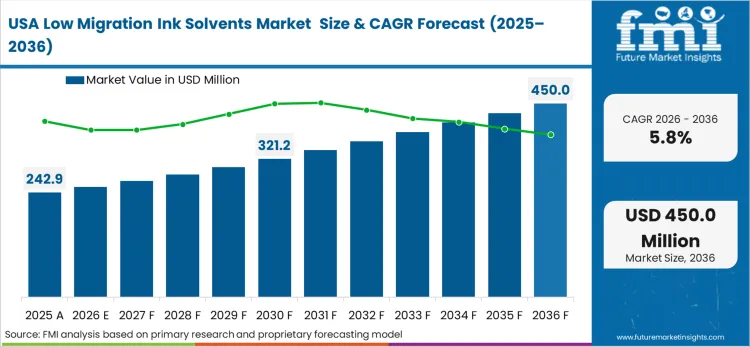
Strict adherence to FDA Food Contact Substance (FCS) notifications dictates the chemical architectures permitted within the North American packaging supply chain. Pharmaceutical and food manufacturing conglomerates enforce rigorous testing protocols to ensure zero chemical transfer into their products, effectively banning legacy evaporative solvents from sensitive applications. Based on FMI's assessment, this buyer behavior-led environment requires ink formulators to invest heavily in comprehensive toxicological testing before launching new solvent carrier platforms. Companies competing in this space must prove the absolute stability of their formulations under extreme supply chain conditions.
- United States: The United States FDA enforces strict pre-market approval processes for any chemical substance reasonably expected to migrate into food. Advancing at 5.8% compound between 2026 and 2036, this rigorous notification requirement forces formulators to exclusively utilize highly refined, inert solvent systems. Chief regulatory officers at major packaging firms must compile extensive migration modeling data before commercializing new flexible film designs.
FMI's report includes specific analysis of the Canadian and Mexican industrial markets. The defining dynamic in these countries involves the integration of cross-border FMCG supply chains, which requires standardized, highly certified ink protocols to coordinate continuous packaging operations across multiple regulatory jurisdictions.
South Asia Low Migration Ink Solvents Market Analysis
The rapid expansion of domestic pharmaceutical manufacturing and packaged food exports dictates a massive shift in procurement standards across South Asia. Industry leaders constructing new production facilities are bypassing legacy ink systems entirely, specifying internationally certified low-migration formulations from day one. FMI analysts opine that this infrastructure-led modernization strategy is fundamentally required to pass stringent audits from foreign regulatory bodies like the US FDA and the European Medicines Agency. Asset operators recognize that utilizing uncertified solvent systems critically endangers their ability to export high-margin consumable products to Western markets.
- India: India's pharmaceutical export sector operates under stringent international inspection frameworks requiring immutable proof of packaging safety. Tracking 7.1% annual growth to 2036, this compliance pressure forces domestic packaging converters to adopt advanced low-migration architectures. Supply chain directors must secure GMP-certified ink components to maintain their highly profitable contracts with global healthcare conglomerates.
FMI's report includes detailed analysis of the broader ASEAN region and Oceania. A primary trend shaping these nations is the aggressive capital investment by global printing press manufacturers to establish localized support hubs for advanced low-migration curing technologies.
Latin America Low Migration Ink Solvents Market Analysis
The consolidation of regional food and beverage production into massive, export-oriented conglomerates is transforming the Latin American packaging sector. Procurement teams within these unified entities demand standardized, highly certified material inputs to ensure their products clear strict border inspections in North America and Europe. Based on FMI's assessment, this economics-led consolidation empowers large buyers to dictate compliance terms to local ink suppliers, forcing rapid technological upgrades across the continent. Smaller packaging converters must either adopt these advanced low-migration solvent systems or face exclusion from the most lucrative export supply chains.
- Brazil: Brazil's massive agricultural and processed food export sector requires packaging materials that can withstand extended global shipping without chemical degradation. Anchored to a 4.6% annual expansion through the decade, this requirement drives the adoption of highly stable, large-molecule solvent carriers. Procurement specification leads actively disqualify local ink suppliers unable to provide comprehensive migration test data for their formulations.
FMI's report includes comprehensive evaluation of Argentina, Chile, and Mexico. A consistent structural condition across these markets is the increasing dominance of multinational FMCG brands, which enforce their own global packaging safety standards regardless of looser local regulations.
Competitive Aligners for Market Players
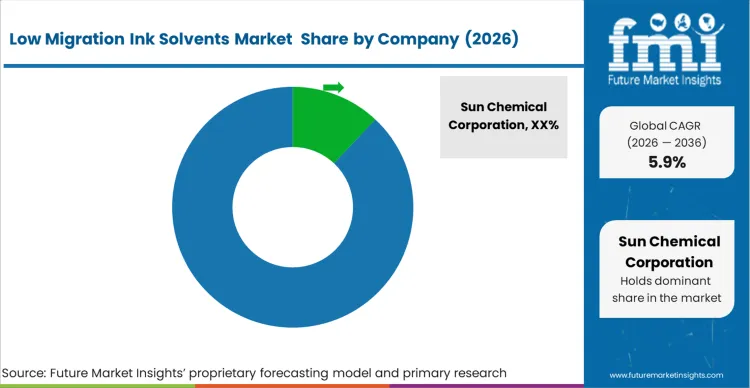
The low migration ink solvents sector exhibits a highly concentrated market structure. This consolidation exists because developing and validating high-purity, low-migration solvent systems requires immense capital investment in dedicated, GMP-certified production facilities to eliminate trace cross-contamination. Major industry leaders such as Sun Chemical Corporation, hubergroup Deutschland, and Siegwerk Druckfarben dominate the landscape by leveraging their massive global scale to amortize the high costs of continuous toxicological testing and regulatory compliance. Buyers utilize comprehensive compositional transparency and third-party migration certifications as the primary competitive variable to distinguish qualified from unqualified vendors during the tender process.
Companies holding proprietary green solvent extraction methods possess a distinct structural advantage in formulation purity. This capability allows them to reliably produce high-molecular-weight carriers that execute rapid curing without leaving volatile residues behind. For a challenger to replicate this advantage, they must construct entirely segregated manufacturing lines and navigate years of complex EFSA and FDA approval cycles for new chemical architectures. Consequently, smaller ink formulators are increasingly forced into niche, non-food applications, leaving the lucrative Tier-1 FMCG contracts to the dominant, highly certified multinationals.
To prevent vendor lock-in, massive FMCG brand owners actively promote open compliance frameworks and standardized testing protocols, allowing them to qualify multiple global ink suppliers simultaneously. This structural tension between the buyers' desire for supply chain redundancy and the dominant vendors' push for integrated, single-source ecosystems heavily limits pricing power even in this highly concentrated market. Moving toward 2036, the competitive trajectory points toward further consolidation, as the escalating costs of maintaining global regulatory compliance outpace the financial capabilities of regional independent ink manufacturers.
Key Players in Low Migration Ink Solvents Market
- Sun Chemical Corporation
- hubergroup Deutschland
- Siegwerk Druckfarben
- INX International Ink Co.
- Artience Co., Ltd.
- Agfa-Gevaert
- Flint Group
- ALTANA AG
Scope of the Report
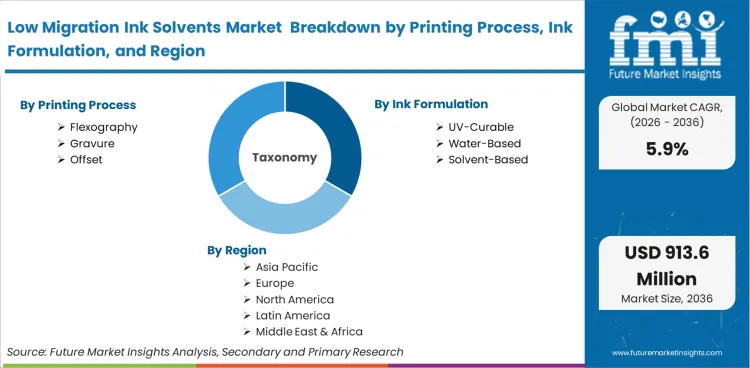
| Metric | Value |
|---|---|
| Quantitative Units | USD 515.0 million to USD 913.6 million, at a CAGR of 5.9% |
| Market Definition | The Low Migration Ink Solvents Market provides specialized, highly refined carrier fluids and monomers that prevent the chemical transfer of printing components into packaged consumables, ensuring absolute regulatory compliance and sensory neutrality. |
| Printing Process Segmentation | Flexography, Gravure, Offset, Digital |
| Ink Formulation Segmentation | UV-Curable, Water-Based, Solvent-Based |
| End-Use Application Segmentation | Food & Beverage, Pharmaceuticals, Cosmetics & Personal Care, Others |
| Regions Covered | North America, Latin America, Europe, East Asia, South Asia, Oceania, Middle East & Africa |
| Countries Covered | China, India, Germany, United States, United Kingdom, Japan, Brazil, and 40 plus countries |
| Key Companies Profiled | Sun Chemical Corporation, hubergroup Deutschland, Siegwerk Druckfarben, INX International Ink Co., Artience Co., Ltd., Agfa-Gevaert, Flint Group, ALTANA AG |
| Forecast Period | 2026 to 2036 |
| Approach | The baseline value derives from a bottom-up aggregation of certified low-migration solvent shipments, applying region-specific regulatory enforcement curves to project the future adoption velocity. Segment forecasts undergo cross-validation against quarterly specialty chemical shipment volumes. |
Source: Future Market Insights (FMI) analysis, based on proprietary forecasting model and primary research
Low Migration Ink Solvents Market Analysis by Segments
Printing Process:
- Flexography
- Gravure
- Offset
- Digital
Ink Formulation:
- UV-Curable
- Water-Based
- Solvent-Based
End-Use Application:
- Food & Beverage
- Pharmaceuticals
- Cosmetics & Personal Care
- Others
Region:
- North America
- United States
- Canada
- Mexico
- Latin America
- Brazil
- Argentina
- Chile
- Rest of Latin America
- Europe
- Germany
- United Kingdom
- France
- Italy
- Spain
- Benelux
- Rest of Europe
- East Asia
- China
- Japan
- South Korea
- South Asia
- India
- ASEAN
- Rest of South Asia
- Oceania
- Australia
- New Zealand
- Middle East & Africa
- Kingdom of Saudi Arabia
- United Arab Emirates
- South Africa
- Rest of Middle East & Africa
Bibliography
- European Food Safety Authority (EFSA). (2024, May 15). Guidance on the risk assessment of printing inks used in food contact materials. EFSA Journal.
- USA Food and Drug Administration. (2024, August 22). Inventory of Effective Food Contact Substance (FCS) Notifications. FDA Center for Food Safety and Applied Nutrition.
- Federal Food Safety and Veterinary Office (FSVO). (2024, January 05). Swiss Ordinance on Materials and Articles in Contact with Food (RS 817.023.21). Swiss Confederation.
- European Printing Ink Association (EuPIA). (2024, September 30). EuPIA Guideline on Printing Inks applied to the non-food contact surface of food packaging materials and articles. EuPIA Publications.
- China National Center for Food Safety Risk Assessment (CFSA). (2024, July 14). Implementation Guidelines for National Food Safety Standard GB 4806.1-2016. CFSA Official Documentation.
- Flexible Packaging Association (FPA). (2024, December 05). 2024 State of the Flexible Packaging Industry Report. FPA Market Intelligence.
This bibliography is provided for reader reference. The full FMI report contains the complete reference list with primary source documentation.
This Report Addresses
- Market intelligence to support strategic decision making across high-purity carrier fluids, specific aliphatic hydrocarbons, and advanced photoinitiator categories unique to this market
- Market size estimation and 10-year revenue forecasts from 2026 to 2036, supported by rigorous toxicological test volume tracking and packaging compliance audit metrics
- Growth opportunity mapping across specific printing process and ink formulation categories with emphasis on brand owners mandating full compositional disclosure from packaging converters
- Segment and regional revenue forecasts covering UV-curable and water-based formulations across stringent European and North American regulatory compliance channels
- Competition strategy assessment including GMP facility investment, testing protocol validation, and complex EFSA approval cycles
- Formulation capability development tracking including Swiss Ordinance compliance, FDA FCS notifications, and high-molecular-weight solvent carrier standards discussed in this article
- Market access analysis covering global FMCG Tier-1 supplier procurement pathways and mandatory compositional transparency programs
- Market report delivery in PDF, Excel, PPT, and interactive dashboard formats for executive strategy, compliance risk management, and operational benchmarking use
Frequently Asked Questions
How large is the low migration ink solvents market in 2026?
The market is estimated to reach USD 515.0 million in 2026 as global brand owners enforce strict GMP certification requirements on primary packaging converters.
What will it be valued at by 2036?
The market is projected to reach USD 913.6 million by 2036 as the transition to high-molecular-weight carriers eliminates legacy evaporative solvents entirely.
What CAGR is projected?
A CAGR of 5.90% is projected, structurally supported by the mandatory nature of food contact material laws across major global economies.
Which printing process segment leads?
Flexography commands a 55.1% share due to its unparalleled efficiency in continuous web printing for flexible food and beverage packaging lines.
Which ink formulation segment leads?
The UV-Curable segment leads because instantaneous cross-linking effectively locks chemical components into a solid matrix, preventing sub-surface migration.
Which end-use application segment leads?
Food & Beverage leads due to the sheer volume of continuously produced consumable goods requiring absolute chemical safety and sensory neutrality.
What drives rapid growth?
Strict enforcement of the Swiss Ordinance and heightened organoleptic testing requirements drive the rapid phase-out of traditional industrial solvents.
What is the primary restraint?
The intricate chemical engineering required to balance rapid curing speeds with low migration properties creates significant operational friction for formulators.
Which country grows fastest?
China advances at a 7.5% compound rate, driven by aggressive enforcement of its National Food Safety Standard across its massive food export sector.
What specific regulatory framework dictates compliance in Europe?
The European Food Safety Authority (EFSA) directives and the Swiss Ordinance explicitly mandate the use of positively listed chemical substances.
What specific technology shift is underway in ink architectures?
The industry is transitioning away from standard volatile organic compounds toward large-molecule photo initiators and natively stable polymeric solvent systems.
What specific competitive variable separates market leaders from challengers?
Possessing dedicated, GMP-certified production lines physically isolated from standard industrial ink manufacturing is the critical differentiator.
Why is India expanding so rapidly?
India is tracking 7.1% growth as its domestic pharmaceutical export sector scales up compliance to pass stringent US FDA and European Medicines Agency audits.
What forces United Kingdom packaging converters to upgrade?
Retail-led packaging safety initiatives enforced by major UK supermarket chains compel suppliers to surpass baseline government chemical regulations.
How does Germany maintain its strong market position?
Stringent national printing ordinances impose strict liability on packaging converters utilizing non-compliant systems, accelerating hardware and formulation replacement.
What compliance standard drives the United States market?
Strict adherence to FDA Food Contact Substance notifications forces pharmaceutical and food manufacturing conglomerates to enforce zero chemical transfer protocols.
Why does Japan require specialized solvent systems?
Japan's premium cosmetics sector mandates ultra-refined carrier fluids to guarantee absolute sensory neutrality in luxury personal care packaging.
How is Brazil integrated into the global compliance landscape?
Brazil's massive agricultural and processed food export sector must deploy advanced low-migration formulations to ensure products pass European and North American border inspections.
What is the role of GMP certification in this market?
GMP certification ensures that low-migration formulations are produced on dedicated lines, eliminating the risk of cross-contamination from legacy industrial inks.
What are organoleptic failures?
Organoleptic failures occur when trapped solvent residues trigger taste and odor changes in the packaged consumable, severely damaging brand reputation.
Why are UV-curable inks highly preferred?
UV-curable inks cure instantly upon light exposure, turning liquid monomers into a stable solid matrix that cannot migrate into the packaging substrate.
What is included in the scope of this market analysis?
The scope encompasses high-purity carrier fluids, specialized photoinitiator solvents, and polymeric carrier fluids utilized exclusively in certified low migration applications.
What products are explicitly excluded from this report?
General-purpose volatile organic compounds used in commercial publication printing and standard industrial solvent systems without food-contact certifications are excluded.
How does FMI cross-validate its market projections?
Projections undergo cross-validation against quarterly specialty chemical shipment volumes and publicly reported capital expenditure guidance from major global ink manufacturing conglomerates.
Preview the report firsthand - request a free sample
Get SampleGet the brochure for pricing and purchase details.
Get PDFTable of Content
- Executive Summary
- Global Market Outlook
- Demand-side Trends
- Supply-side Trends
- Technology Roadmap Analysis
- Analysis and Recommendations
- Market Overview
- Market Coverage / Taxonomy
- Market Definition / Scope / Limitations
- Research Methodology
- Chapter Orientation
- Analytical Lens and Working Hypotheses
- Market Structure, Signals, and Trend Drivers
- Benchmarking and Cross-market Comparability
- Market Sizing, Forecasting, and Opportunity Mapping
- Research Design and Evidence Framework
- Desk Research Programme (Secondary Evidence)
- Company Annual and Sustainability Reports
- Peer-reviewed Journals and Academic Literature
- Corporate Websites, Product Literature, and Technical Notes
- Earnings Decks and Investor Briefings
- Statutory Filings and Regulatory Disclosures
- Technical White Papers and Standards Notes
- Trade Journals, Industry Magazines, and Analyst Briefs
- Conference Proceedings, Webinars, and Seminar Materials
- Sector Databases and Reference Repositories
- FMI Internal Proprietary Databases and Historical Market Datasets
- Subscription Datasets and Paid Sources
- Social Channels, Communities, and Digital Listening Inputs
- Additional Desk Sources
- Expert Input and Fieldwork (Primary Evidence)
- Primary Modes
- Qualitative Interviews and Expert Elicitation
- Quantitative Surveys and Structured Data Capture
- Blended Approach
- Why Primary Evidence is Used
- Field Techniques
- Interviews
- Surveys
- Focus Groups
- Observational and In-context Research
- Social and Community Interactions
- Stakeholder Universe Engaged
- C-suite Leaders
- Board Members
- Presidents and Vice Presidents
- R&D and Innovation Heads
- Technical Specialists
- Domain Subject-matter Experts
- Scientists
- Physicians and Other Healthcare Professionals
- Governance, Ethics, and Data Stewardship
- Research Ethics
- Data Integrity and Handling
- Primary Modes
- Tooling, Models, and Reference Databases
- Desk Research Programme (Secondary Evidence)
- Data Engineering and Model Build
- Data Acquisition and Ingestion
- Cleaning, Normalisation, and Verification
- Synthesis, Triangulation, and Analysis
- Quality Assurance and Audit Trail
- Market Background
- Market Dynamics
- Drivers
- Restraints
- Opportunity
- Trends
- Scenario Forecast
- Demand in Optimistic Scenario
- Demand in Likely Scenario
- Demand in Conservative Scenario
- Opportunity Map Analysis
- Product Life Cycle Analysis
- Supply Chain Analysis
- Investment Feasibility Matrix
- Value Chain Analysis
- PESTLE and Porter’s Analysis
- Regulatory Landscape
- Regional Parent Market Outlook
- Production and Consumption Statistics
- Import and Export Statistics
- Market Dynamics
- Global Market Analysis 2021 to 2025 and Forecast, 2026 to 2036
- Historical Market Size Value (USD Million) Analysis, 2021 to 2025
- Current and Future Market Size Value (USD Million) Projections, 2026 to 2036
- Y-o-Y Growth Trend Analysis
- Absolute $ Opportunity Analysis
- Global Market Pricing Analysis 2021 to 2025 and Forecast 2026 to 2036
- Global Market Analysis 2021 to 2025 and Forecast 2026 to 2036, By Printing Process
- Introduction / Key Findings
- Historical Market Size Value (USD Million) Analysis By Printing Process , 2021 to 2025
- Current and Future Market Size Value (USD Million) Analysis and Forecast By Printing Process , 2026 to 2036
- Flexography
- Gravure
- Offset
- Flexography
- Y-o-Y Growth Trend Analysis By Printing Process , 2021 to 2025
- Absolute $ Opportunity Analysis By Printing Process , 2026 to 2036
- Global Market Analysis 2021 to 2025 and Forecast 2026 to 2036, By Ink Formulation
- Introduction / Key Findings
- Historical Market Size Value (USD Million) Analysis By Ink Formulation, 2021 to 2025
- Current and Future Market Size Value (USD Million) Analysis and Forecast By Ink Formulation, 2026 to 2036
- UV-Curable
- Water-Based
- Solvent-Based
- UV-Curable
- Y-o-Y Growth Trend Analysis By Ink Formulation, 2021 to 2025
- Absolute $ Opportunity Analysis By Ink Formulation, 2026 to 2036
- Global Market Analysis 2021 to 2025 and Forecast 2026 to 2036, By End-Use Application
- Introduction / Key Findings
- Historical Market Size Value (USD Million) Analysis By End-Use Application, 2021 to 2025
- Current and Future Market Size Value (USD Million) Analysis and Forecast By End-Use Application, 2026 to 2036
- Food & Beverage
- Pharmaceuticals
- Cosmetics & Personal Care
- Food & Beverage
- Y-o-Y Growth Trend Analysis By End-Use Application, 2021 to 2025
- Absolute $ Opportunity Analysis By End-Use Application, 2026 to 2036
- Global Market Analysis 2021 to 2025 and Forecast 2026 to 2036, By Region
- Introduction
- Historical Market Size Value (USD Million) Analysis By Region, 2021 to 2025
- Current Market Size Value (USD Million) Analysis and Forecast By Region, 2026 to 2036
- North America
- Latin America
- Western Europe
- Eastern Europe
- East Asia
- South Asia and Pacific
- Middle East & Africa
- Market Attractiveness Analysis By Region
- North America Market Analysis 2021 to 2025 and Forecast 2026 to 2036, By Country
- Historical Market Size Value (USD Million) Trend Analysis By Market Taxonomy, 2021 to 2025
- Market Size Value (USD Million) Forecast By Market Taxonomy, 2026 to 2036
- By Country
- USA
- Canada
- Mexico
- By Printing Process
- By Ink Formulation
- By End-Use Application
- By Country
- Market Attractiveness Analysis
- By Country
- By Printing Process
- By Ink Formulation
- By End-Use Application
- Key Takeaways
- Latin America Market Analysis 2021 to 2025 and Forecast 2026 to 2036, By Country
- Historical Market Size Value (USD Million) Trend Analysis By Market Taxonomy, 2021 to 2025
- Market Size Value (USD Million) Forecast By Market Taxonomy, 2026 to 2036
- By Country
- Brazil
- Chile
- Rest of Latin America
- By Printing Process
- By Ink Formulation
- By End-Use Application
- By Country
- Market Attractiveness Analysis
- By Country
- By Printing Process
- By Ink Formulation
- By End-Use Application
- Key Takeaways
- Western Europe Market Analysis 2021 to 2025 and Forecast 2026 to 2036, By Country
- Historical Market Size Value (USD Million) Trend Analysis By Market Taxonomy, 2021 to 2025
- Market Size Value (USD Million) Forecast By Market Taxonomy, 2026 to 2036
- By Country
- Germany
- UK
- Italy
- Spain
- France
- Nordic
- BENELUX
- Rest of Western Europe
- By Printing Process
- By Ink Formulation
- By End-Use Application
- By Country
- Market Attractiveness Analysis
- By Country
- By Printing Process
- By Ink Formulation
- By End-Use Application
- Key Takeaways
- Eastern Europe Market Analysis 2021 to 2025 and Forecast 2026 to 2036, By Country
- Historical Market Size Value (USD Million) Trend Analysis By Market Taxonomy, 2021 to 2025
- Market Size Value (USD Million) Forecast By Market Taxonomy, 2026 to 2036
- By Country
- Russia
- Poland
- Hungary
- Balkan & Baltic
- Rest of Eastern Europe
- By Printing Process
- By Ink Formulation
- By End-Use Application
- By Country
- Market Attractiveness Analysis
- By Country
- By Printing Process
- By Ink Formulation
- By End-Use Application
- Key Takeaways
- East Asia Market Analysis 2021 to 2025 and Forecast 2026 to 2036, By Country
- Historical Market Size Value (USD Million) Trend Analysis By Market Taxonomy, 2021 to 2025
- Market Size Value (USD Million) Forecast By Market Taxonomy, 2026 to 2036
- By Country
- China
- Japan
- South Korea
- By Printing Process
- By Ink Formulation
- By End-Use Application
- By Country
- Market Attractiveness Analysis
- By Country
- By Printing Process
- By Ink Formulation
- By End-Use Application
- Key Takeaways
- South Asia and Pacific Market Analysis 2021 to 2025 and Forecast 2026 to 2036, By Country
- Historical Market Size Value (USD Million) Trend Analysis By Market Taxonomy, 2021 to 2025
- Market Size Value (USD Million) Forecast By Market Taxonomy, 2026 to 2036
- By Country
- India
- ASEAN
- Australia & New Zealand
- Rest of South Asia and Pacific
- By Printing Process
- By Ink Formulation
- By End-Use Application
- By Country
- Market Attractiveness Analysis
- By Country
- By Printing Process
- By Ink Formulation
- By End-Use Application
- Key Takeaways
- Middle East & Africa Market Analysis 2021 to 2025 and Forecast 2026 to 2036, By Country
- Historical Market Size Value (USD Million) Trend Analysis By Market Taxonomy, 2021 to 2025
- Market Size Value (USD Million) Forecast By Market Taxonomy, 2026 to 2036
- By Country
- Kingdom of Saudi Arabia
- Other GCC Countries
- Turkiye
- South Africa
- Other African Union
- Rest of Middle East & Africa
- By Printing Process
- By Ink Formulation
- By End-Use Application
- By Country
- Market Attractiveness Analysis
- By Country
- By Printing Process
- By Ink Formulation
- By End-Use Application
- Key Takeaways
- Key Countries Market Analysis
- USA
- Pricing Analysis
- Market Share Analysis, 2025
- By Printing Process
- By Ink Formulation
- By End-Use Application
- Canada
- Pricing Analysis
- Market Share Analysis, 2025
- By Printing Process
- By Ink Formulation
- By End-Use Application
- Mexico
- Pricing Analysis
- Market Share Analysis, 2025
- By Printing Process
- By Ink Formulation
- By End-Use Application
- Brazil
- Pricing Analysis
- Market Share Analysis, 2025
- By Printing Process
- By Ink Formulation
- By End-Use Application
- Chile
- Pricing Analysis
- Market Share Analysis, 2025
- By Printing Process
- By Ink Formulation
- By End-Use Application
- Germany
- Pricing Analysis
- Market Share Analysis, 2025
- By Printing Process
- By Ink Formulation
- By End-Use Application
- UK
- Pricing Analysis
- Market Share Analysis, 2025
- By Printing Process
- By Ink Formulation
- By End-Use Application
- Italy
- Pricing Analysis
- Market Share Analysis, 2025
- By Printing Process
- By Ink Formulation
- By End-Use Application
- Spain
- Pricing Analysis
- Market Share Analysis, 2025
- By Printing Process
- By Ink Formulation
- By End-Use Application
- France
- Pricing Analysis
- Market Share Analysis, 2025
- By Printing Process
- By Ink Formulation
- By End-Use Application
- India
- Pricing Analysis
- Market Share Analysis, 2025
- By Printing Process
- By Ink Formulation
- By End-Use Application
- ASEAN
- Pricing Analysis
- Market Share Analysis, 2025
- By Printing Process
- By Ink Formulation
- By End-Use Application
- Australia & New Zealand
- Pricing Analysis
- Market Share Analysis, 2025
- By Printing Process
- By Ink Formulation
- By End-Use Application
- China
- Pricing Analysis
- Market Share Analysis, 2025
- By Printing Process
- By Ink Formulation
- By End-Use Application
- Japan
- Pricing Analysis
- Market Share Analysis, 2025
- By Printing Process
- By Ink Formulation
- By End-Use Application
- South Korea
- Pricing Analysis
- Market Share Analysis, 2025
- By Printing Process
- By Ink Formulation
- By End-Use Application
- Russia
- Pricing Analysis
- Market Share Analysis, 2025
- By Printing Process
- By Ink Formulation
- By End-Use Application
- Poland
- Pricing Analysis
- Market Share Analysis, 2025
- By Printing Process
- By Ink Formulation
- By End-Use Application
- Hungary
- Pricing Analysis
- Market Share Analysis, 2025
- By Printing Process
- By Ink Formulation
- By End-Use Application
- Kingdom of Saudi Arabia
- Pricing Analysis
- Market Share Analysis, 2025
- By Printing Process
- By Ink Formulation
- By End-Use Application
- Turkiye
- Pricing Analysis
- Market Share Analysis, 2025
- By Printing Process
- By Ink Formulation
- By End-Use Application
- South Africa
- Pricing Analysis
- Market Share Analysis, 2025
- By Printing Process
- By Ink Formulation
- By End-Use Application
- USA
- Market Structure Analysis
- Competition Dashboard
- Competition Benchmarking
- Market Share Analysis of Top Players
- By Regional
- By Printing Process
- By Ink Formulation
- By End-Use Application
- Competition Analysis
- Competition Deep Dive
- Sun Chemical Corporation
- Overview
- Product Portfolio
- Profitability by Market Segments (Product/Age /Sales Channel/Region)
- Sales Footprint
- Strategy Overview
- Marketing Strategy
- Product Strategy
- Channel Strategy
- hubergroup Deutschland
- Siegwerk Druckfarben
- INX International Ink Co.
- Artience Co., Ltd.
- Agfa-Gevaert
- Flint Group
- ALTANA AG
- Sun Chemical Corporation
- Competition Deep Dive
- Assumptions & Acronyms Used


