

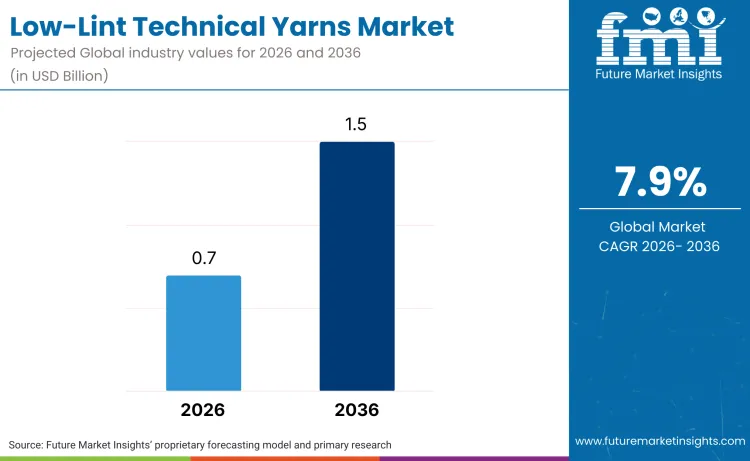
- Industry Size (2026)
- USD 0.7 Bn
- Forecast (2036)
- USD 1.5 Bn
- CAGR (2026 to 2036)
- 7.9%
Low-Lint Technical Yarns Market Forecast and Outlook 2026 to 2036
Future Market Insights expects the low-lint technical yarns market to total USD 0.7 billion in 2026, advancing to USD 1.5 billion by 2036, progressing at a CAGR of 7.9%. Market participants are transitioning away from volume-driven expansion toward precision-engineered, contamination-controlled fiber solutions, driven by escalating demand from semiconductor manufacturing, aerospace composites, advanced defense systems, and cleanroom-intensive industrial environments.
Leading manufacturers such as Teijin Frontier and Solstice Advanced Materials are realigning portfolios to prioritize low-particulate, high-tenacity yarns capable of meeting stringent purity thresholds alongside evolving ESG benchmarks. This structural pivot reflects a broader industry recognition that future competitiveness will hinge on functional specialization rather than commoditized capacity growth.
Global producers are actively divesting or de-emphasizing legacy assets to concentrate capital and R&D on high-margin technical yarn platforms. The late-2025 separation of Solstice Advanced Materials from its former parent underscores this trend, with strategic focus directed toward semiconductor fabrication, AI-driven chip production, and defense applications.
Innovation pathways in the low-lint yarn segment are increasingly converging performance and sustainability objectives. Teijin Frontier’s 2026 product roadmap highlights recycled polyester yarns engineered to replicate the tactile and mechanical properties of natural fibers, alongside dual-action cooling and moisture-management functionalities tailored for Spring/Summer 2026 applications. This signals a shift toward circular materials without compromise on industrial performance.
Producers such as Indorama Ventures are implementing disciplined transformation strategies focused on cash-flow resilience, asset rationalization, and downstream value capture. The company’s “IVL 2.0” program emphasizes footprint optimization and operational excellence, with plans to list downstream business units by 2026 to support long-term circular economy investments.
Reflecting this industry-wide recalibration toward efficiency, resilience, and sustainable value creation, Indorama Ventures’ leadership has articulated the strategic intent underpinning these shifts. As highlighted in the company’s official investor communication:
"Since we launched IVL 2.0 more than a year ago, we have consistently focused on disciplined self-help actions that are building resilience and helping us to emerge stronger and agile to pursue our growth objectives post weathering this historic downturn... more than 1 year into the 3-year strategy (2024-2026), leaders are building a leaner, more agile, and financially disciplined enterprise through a program of footprint optimization, operational excellence, innovation, and digital acceleration." - Aloke Lohia, Group CEO, Indorama Ventures
Summary of the Low-Lint Technical Yarns Market
What is the Outlook for the Low-Lint Technical Yarns Market?
The low-lint technical yarns market will expand from USD 0.7 billion in 2026 to USD 1.5 billion by 2036, advancing at a CAGR of 7.9%. Demand is increasingly anchored in semiconductor fabrication, life sciences, aerospace, and advanced electronics, where particulate control, repeatability, and audit-ready performance directly affect yield, safety, and regulatory compliance.
How do FMI Analysts Interpret the Structural Transition?
FMI analysts observe a clear move away from volume-led growth toward precision-engineered yarn platforms optimized for permanent lint suppression and process consistency. Competitive advantage is consolidating around suppliers that can deliver filament-level control, validated low-shedding behavior across repeated use cycles, and alignment with evolving sustainability and traceability mandates.
Which Material and Process Choices are Shaping Adoption?
Filament polyester and engineered blends remain central due to their low fibrillation, uniform surface behavior, and compatibility with contamination-sensitive finishing processes. Manufacturers are increasingly integrating advanced spinning methods, AI-enabled inspection, and mono-material or circular-ready designs to reduce lint formation while meeting recycling and ESG disclosure requirements.
Which Applications Anchor Demand Stability?
Cleanroom and controlled-environment applications form the core demand base. In semiconductor fabs, pharmaceutical manufacturing, and precision electronics, low-lint yarns are treated as enabling infrastructure rather than discretionary textile choices. Fixed service-life protocols and mandatory replacement cycles support predictable, recurring demand.
What Broader Forces are Influencing Market Direction?
Rising automation, tighter cleanroom classifications, and regulatory pressure on textile circularity are reshaping procurement behavior. Through 2026, suppliers that combine extreme cleanliness, traceability, and sustainability-ready designs at industrial scale are positioned to capture disproportionate value as technical yarns become embedded within advanced manufacturing ecosystems.
Low-Lint Technical Yarns Market Key Takeaways
| Metric | Value |
|---|---|
| Expected Value (2026E) | USD 0.7 billion |
| Forecast Value (2036F) | USD 1.5 billion |
| CAGR (2026-2036) | 7.9% |
Source: FMI analysis based on primary research and proprietary forecasting model
Why is the Low-Lint Technical Yarns Market Growing?
Three connected forces push the low-lint technical yarns market heading toward 2026: stricter purity demands, hard regulatory pressure on sustainability, and the rapid spread of automation in industrial production. These shifts are changing how low-lint yarns are viewed. They are no longer just background materials in technical textiles. They are becoming essential components in environments where even microscopic failure carries real cost.
The first and most immediate driver is the rise of ultra-purity requirements in industries like semiconductors, pharmaceuticals, and advanced electronics. As more facilities move toward ISO Class 5 cleanroom standards and below, controlling particulate contamination has become non-negotiable.
Industry compliance updates consistently show that people, not machines, are the biggest contamination risk. That reality is accelerating the move away from basic lab wear toward full-coverage garments made from high-tenacity, low-shedding filament yarns designed specifically to minimize lint generation under repeated use and laundering.
Sustainability has also shifted from a branding exercise to a structural requirement. Government programs in India and Europe are actively steering the market toward recycled and circular yarn systems, while pushing manufacturers to rethink yarn design itself and favor mono-material structures that are easier to recover and recycle without sacrificing performance.
This regulatory pressure is reinforced by the adoption of Industry 4.0 practices, where automation, AI-based quality control, and reduced human handling help suppress lint formation at the source. The result is a clear competitive signal. Through 2026, the strongest players will be those that can deliver low-lint yarns that combine extreme cleanliness, regulatory-ready circularity, and automation-driven consistency at industrial scale.
How is the Low-Lint Technical Yarns Market Segmented?
Why does Polyester Anchor Procurement Decisions in Low-Lint Technical Yarn Programs?
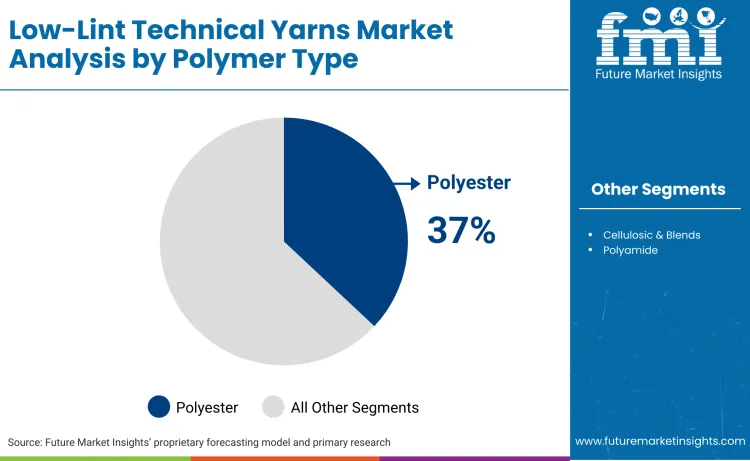
Polyester accounts for 37% of material demand in low-lint technical yarns, reflecting its alignment with process stability rather than raw material innovation. Buyers in contamination-sensitive environments prioritize yarn platforms that deliver consistent fiber integrity across spinning, weaving, and repeated use cycles.
Polyester’s low fibrillation tendency, controlled filament uniformity, and predictable surface behavior reduce particulate release during abrasion, laundering, and mechanical handling. This reliability positions polyester as the default polymer choice in specifications where lint thresholds are audited as part of supplier qualification rather than treated as secondary performance attributes.
Polyester’s dominance is also shaped by its compatibility with downstream finishing and conversion processes. Low-lint performance must be preserved after dyeing, coating, or heat setting, and polyester offers a wide operational window without compromising cleanliness standards. Supply chain maturity further strengthens its position. Global polyester filament capacity supports large-volume, repeat procurement, allowing buyers to lock in validated yarn constructions without triggering costly requalification.
Why do Cleanroom and Controlled Environments Drive Structural Demand for Low-Lint Yarns?
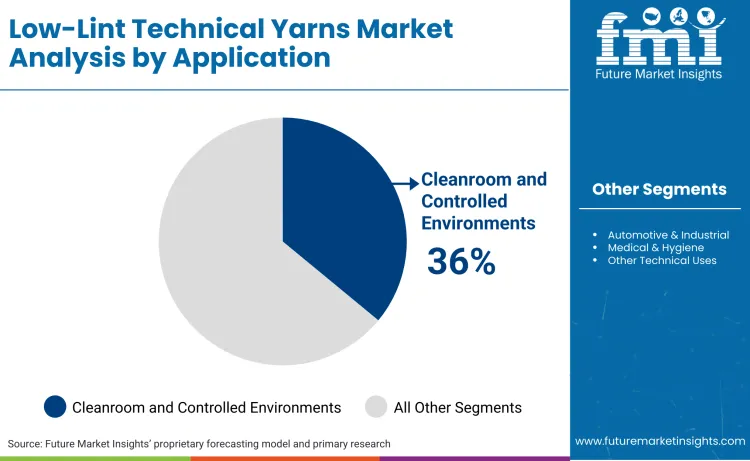
Cleanroom and controlled environment applications represent 36% of total demand, underscoring how low-lint yarn consumption is governed by regulatory exposure rather than discretionary textile usage. In semiconductor fabrication, pharmaceutical manufacturing, and precision electronics assembly, airborne particulate limits are tightly enforced. Textiles used in garments, wipes, and surface covers are evaluated as potential contamination vectors, making low-lint yarn selection a compliance-driven decision. Procurement teams favor yarn systems with documented lint suppression performance, repeatable test outcomes, and traceable production controls.
Growth is sustained by recurring replacement cycles rather than expansion into new use cases. Cleanroom garments and consumables follow fixed service-life protocols, leading to predictable, non-negotiable replenishment demand. Any deviation in yarn performance risks operational downtime, product loss, or regulatory non-compliance, elevating the importance of proven low-lint constructions. As clean manufacturing footprints expand globally, especially in electronics and life sciences, controlled environments continue to act as the primary volume anchor for low-lint technical yarn adoption.
What Drives the Market for Low-Lint Technical Yarns?
The global low-lint and technical yarns market is evolving from a conventional textile segment into a critical materials category embedded within advanced manufacturing supply chains. By 2026, performance evaluation has shifted away from traditional textile indicators toward particle shedding, fiber integrity, and end-to-end traceability. This transition reflects rising dependence from semiconductor fabrication, medical devices, aerospace systems, and electric vehicle manufacturing, where minor contamination can directly impact yield, safety, and regulatory compliance. In these applications, low-lint yarns function as enabling infrastructure rather than interchangeable inputs.
Growth in technical textiles is being driven by accelerated deployment of artificial intelligence computing, electrification, and precision manufacturing. Semiconductor fabrication has emerged as the primary demand engine. Expansion of sub-3nm and 2nm logic nodes is increasing global fabrication capacity while intensifying requirements for ISO Class 4 and 5 cleanroom environments. At these thresholds, microscopic lint release or filament instability can trigger yield loss, sustaining demand for ultra-low lint yarns used in cleanroom garments, wipes, and protective systems.
Regulatory enforcement in 2026 is reshaping sourcing and production economics. In the European Union, restrictions on the destruction of unsold textiles and the rollout of the Digital Product Passport are extending fiber-level traceability and recycling requirements into industrial textiles. In the United States, state-level EPR frameworks are accelerating investment in domestic recycling infrastructure capable of processing complex technical blends. India’s National Technical Textiles Mission is also influencing regional supply dynamics through targeted funding for specialty fiber development, with a focus on aramid and carbon yarn capacity through 2026 and 2027.
Manufacturing competitiveness is defined by process control rather than labor efficiency. AI-enabled inspection systems are becoming standard across advanced spinning operations, reducing filament defects that drive lint formation. Adoption of air-jet spinning and false-twist texturing continues to expand due to superior uniformity and lower hairiness.
Circularity strategies are shifting toward textile-to-textile recycling models aligned with durability and compliance thresholds. In 2026, manufacturers integrating digital quality control, advanced spinning technologies, and compliance-ready circular systems are positioned to capture disproportionate value as technical yarns become embedded in next-generation industrial platforms.
How is the Low-Lint Technical Yarns Market Evolving in Key Countries?
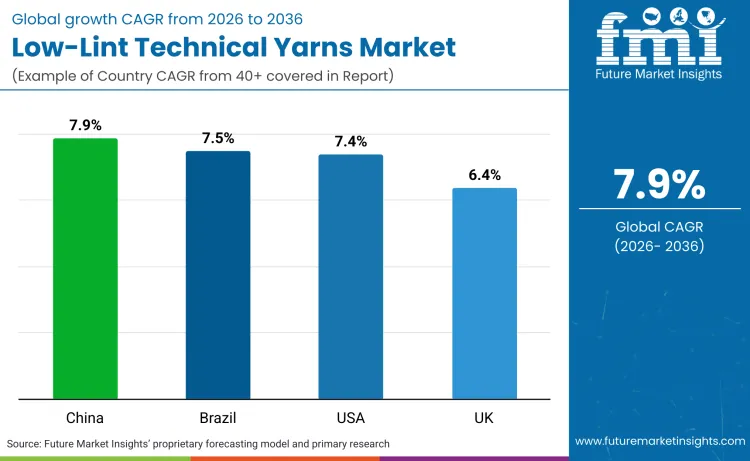
| Country | CAGR (2026-2036) |
|---|---|
| China | 7.9% |
| USA | 7.4% |
| UK | 6.4% |
| Brazil | 7.5% |
Source: FMI’s proprietary forecasting model and primary research
Why is China consolidating scale leadership while Upgrading Material Precision?
China is still the world’s biggest producer of low-lint and technical yarns, but the real story is how that production is changing. The pressure is no longer just about output volume, it’s about precision. Domestic growth in semiconductors, batteries, and electronics cleanrooms is forcing yarn producers to tighten control over lint, fiber purity, and consistency. At the same time, global buyers are pushing Chinese exporters to meet stricter cleanroom and contamination standards, leaving little room for legacy processes.
In major manufacturing zones like the Yangtze River Delta, new environmental and cleanliness requirements are pushing mills to install real-time particle monitoring and AI-based inspection. This isn’t cosmetic compliance, it’s about staying eligible for multinational supply chains. Government-backed programs are accelerating domestic capacity in carbon and conductive yarns. The goal is clear: reduce reliance on imported specialty materials while delivering tighter performance tolerances for industrial and electro-functional textiles.
How is Brazil leveraging industrial textiles to diversify beyond apparel exports?
Brazil’s low-lint yarn story is about industrial pragmatism. Growth is coming from sectors like automotive interiors, healthcare textiles, and filtration, where lint control improves durability, safety, and regulatory compliance. With access to raw materials and a strengthening domestic manufacturing base, Brazil is carving out a more resilient, localized technical textile ecosystem.
Public healthcare procurement and hospital expansion are driving demand for low-shedding, traceable yarns in medical and hygiene products, an area where performance matters more than fashion cycles. Government-supported industrial programs are helping manufacturers replace older spinning and finishing equipment, leading to more uniform yarns and lower lint levels that meet export requirements.
Can USA convert Regulatory Pressure into a Manufacturing Advantage?
In USA, low-lint yarn demand is being shaped less by price and more by accountability. Semiconductor fabs, aerospace plants, and medical device manufacturers all require materials that can be audited, traced, and certified. As reshoring gains momentum, buyers increasingly prefer domestic suppliers who can meet regulatory scrutiny without supply-chain risk.
Federal incentives are fueling new fabrication facilities, which in turn are increasing demand for cleanroom garments and wipes made from certified ultra-low lint yarns. Extended Producer Responsibility policies at the state level are pushing suppliers to invest in recycling systems and digital traceability, shifting competitive advantage toward vertically integrated domestic players.
Why is the UK positioning itself as a compliance-led niche supplier?
UK’s strength lies in serving regulated, high-value niches where documentation, contamination control, and repeatability matter more than scale. Pharmaceuticals, life sciences, and aerospace maintenance are the core demand drivers, and suppliers benefit from tight alignment with European compliance standards.
Stricter cleanroom and GMP requirements are increasing demand for certified low-lint yarns used in garments, wipes, and controlled-environment consumables. Suppliers are among the first to adopt systems aligned with European product passport requirements, strengthening their role as trusted cross-border technical textile partners.
How is the Competitive Landscape of the Low-Lint Technical Yarns Market?
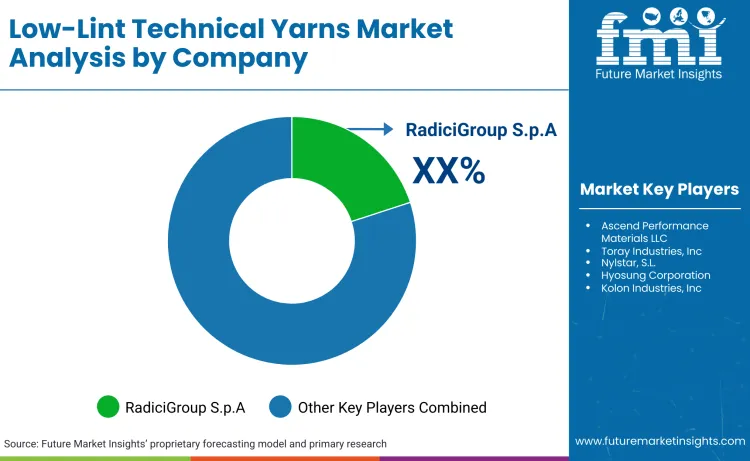
The low-lint technical yarn market is transitioning towards a qualification-first competitive regime. Participation is governed by permission to supply, earned through contamination control, traceability, and regulatory compliance. The result is a market that remains highly concentrated at the top, while becoming increasingly fragmented across application-specific niches.
Competitive pressure is most acute in ultra-clean, failure-intolerant environments, including semiconductor fabrication, advanced filtration, and chemical handling. In these settings, a single contamination event can trigger disproportionate downstream losses. Buyers therefore prioritize proven lint performance, long qualification histories, and long-term supply reliability over price. This has entrenched technology-centric incumbents and extended qualification cycles, effectively insulating the top tier from opportunistic entry despite rising demand.
Running alongside this purity-driven axis is a second competitive pressure rooted in sustainability-led procurement. Automotive OEMs, industrial manufacturers, and EU-regulated buyers increasingly require demonstrable recycled or bio-based content without compromising lint control. As a result, upstream feedstock control and circular integration have shifted from cost levers to core competitive assets, particularly outside the most purity-critical applications.
Toray Industries anchors the high-specification end of the market. Toray’s advantage lies not in volume, but in its ability to operate deep inside semiconductor and advanced electronics ecosystems, where contamination tolerances are measured in microns and supplier failure carries systemic risk.
This positioning was reinforced in 2025, when Toray formally designated electronic and semiconductor-related materials as a Core Growth Business under the final phase of Project AP-G 2025. The move signaled sustained capital allocation and R&D prioritization toward ultra-clean applications. In practice, Toray competes through system lock-in rather than spot sales, with qualification depth and switching costs that materially limit competitive
In 2024, RadiciGroup launched RENYCLE® recycled nylon, engineered specifically for high-performance technical applications where recycled content must coexist with strict mechanical and lint-control requirements. By integrating polymer recycling directly into its yarn platform, Radici maintains tighter impurity control than downstream recyclers, strengthening its position in EU markets where circularity is no longer optional.
Key Players Profiled
- RadiciGroup S.p.A.
- Ascend Performance Materials LLC
- Toray Industries, Inc
- Nylstar, S.L.
- Hyosung Corporation
- Unifi, Inc.
- Kolon Industries, Inc.
- Teijin Frontier Co., Ltd.
- Indorama Ventures Public Company Limited
Market Definition
The low-lint technical yarns market comprises filament yarn systems engineered to minimize fiber shedding and particulate release during use, laundering, and mechanical stress. These yarns are designed for deployment in contamination-sensitive environments where airborne particles pose operational, safety, or regulatory risk, making lint control a primary performance requirement rather than a secondary textile attribute.
This report includes low-lint filament yarns and engineered blends used in cleanroom garments, controlled-environment textiles, industrial and automotive applications, medical and hygiene products, and other technical uses requiring documented particulate control. Coverage spans polymer types, application-driven performance requirements, regulatory and sustainability influences, and regional adoption trends, with emphasis on compliance-led procurement and process consistency.
The report excludes finished garments, wipes, and consumables sold as end products, as well as conventional textile yarns without engineered low-lint functionality. It does not cover surface-applied lint-control treatments, disposable nonwoven materials, or decorative textiles where particulate shedding is not regulated. Military-specific contamination-control systems and non-textile cleanroom equipment are also excluded from the scope.
Scope of Report
| Items | Values |
|---|---|
| Quantitative Units (2026) | USD 1.5 billion |
| Polymer Type | Polyester, Cellulosic & Blends, Polyamide |
| Application | Electronics, Aerospace, Automotive Medical Devices Telecommunications |
| Regions Covered | North America, Western Europe, Eastern Europe, East Asia, South Asia & Pacific, Latin America, Middle East & Africa |
| Countries Covered | USA, UK, Brazil, China and 40+ Countries |
| Key Companies Profiled | RadiciGroup S.p.A., Ascend Performance Materials LLC, Toray Industries, Inc., Nylstar, S.L., Hyosung Corporation, Unifi, Inc., Kolon Industries, Inc., Teijin Frontier Co., Ltd., Indorama Ventures Public Company Limited |
Source: FMI’s proprietary forecasting model and primary research
Low-Lint Technical Yarns Market by Key Segments
Polymer Type:
- Polyester
- Cellulosic & Blends
- Polyamide
Application:
- Cleanroom & Controlled Environments
- Automotive & Industrial
- Medical & Hygiene
- Other Technical Uses
Region:
- North America
- Western Europe
- Eastern Europe
- East Asia
- South Asia & Pacific
- Latin America
- Middle East & Africa
Bibliography
- International Electrotechnical Commission. (2024). IEC 61340-5-1: Electrostatics-Protection of electronic devices from electrostatic phenomena (latest revision). IEC.
- International Energy Agency. (2024). Advanced manufacturing and materials requirements for semiconductor and clean technology supply chains. IEA.
- USA Department of Energy. (2024). Semiconductor manufacturing and cleanroom infrastructure: Materials and workforce implications. DOE.
- USA Food and Drug Administration. (2024). Guidance for industry: Aseptic processing and contamination control in pharmaceutical manufacturing. FDA.
- Semiconductor Equipment and Materials International. (2024). Contamination control roadmap for advanced semiconductor fabrication. SEMI.
- Ministry of Textiles, Government of India. (2025). National Technical Textiles Mission: Progress update on specialty and contamination-controlled fibers. Government of India.
Frequently Asked Questions
How large is the low-lint technical yarns market?
The market stands at around USD 0.7 billion in 2026, reflecting its increasing role in contamination-controlled and clean manufacturing environments.
What is the growth outlook for low-lint technical yarns over the next decade?
Demand is expected to expand steadily through 2036 as particulate control, traceability, and audit-ready performance become mandatory across advanced manufacturing sectors.
Which applications are driving demand for low-lint technical yarns?
Cleanroom and controlled-environment applications are the primary demand drivers, particularly in semiconductor fabrication, pharmaceuticals, precision electronics, and aerospace manufacturing.
How does regional demand differ across major markets?
East Asia leads adoption due to semiconductor and electronics manufacturing expansion, while North America and Europe are driven by regulatory scrutiny, reshoring of advanced manufacturing, and stricter cleanroom standards.
What factors are limiting faster adoption of low-lint yarn solutions?
Higher production costs, extended qualification cycles, and the need for validated contamination-control performance slow adoption, especially outside highly regulated or high-risk manufacturing environments.
Preview the report firsthand - request a free sample
Get SampleGet the brochure for pricing and purchase details.
Get PDFTable of Content
- Executive Summary
- Low-Lint Technical Yarns Market Introduction
- Market Definition
- Market Scope
- Market Taxonomy
- Research Methodology
- Study Framework
- Assumptions and Limitations
- Data Sources
- Market Estimation and Forecasting Approach
- Low-Lint Technical Yarns Market Dynamics
- Drivers
- Restraints
- Opportunities
- Trends
- Global Low-Lint Technical Yarns Market Analysis 2021 to 2025 and Forecast 2026 to 2036
- Global Low-Lint Technical Yarns Market Analysis by Polymer Type
- Global Low-Lint Technical Yarns Market Analysis by Application
- Global Low-Lint Technical Yarns Market Analysis by Region
- North America Low-Lint Technical Yarns Market Analysis
- United States
- Canada
- Western Europe Low-Lint Technical Yarns Market Analysis
- Germany
- United Kingdom
- France
- Italy
- Spain
- BENELUX
- Nordics
- Eastern Europe Low-Lint Technical Yarns Market Analysis
- Poland
- Russia
- Rest of Eastern Europe
- East Asia Low-Lint Technical Yarns Market Analysis
- China
- Japan
- South Korea
- South Asia & Pacific Low-Lint Technical Yarns Market Analysis
- India
- ASEAN
- Australia & New Zealand
- Latin America Low-Lint Technical Yarns Market Analysis
- Brazil
- Rest of Latin America
- Middle East & Africa Low-Lint Technical Yarns Market Analysis
- GCC
- South Africa
- Rest of Middle East & Africa
- Competitive Landscape Analysis
- Key Players Profiled
- Market Definition and Scope
- Market Segmentation Analysis
- Bibliography
- Frequently Asked Questions


