

- Industry Size (2026)
- USD 0.4 Bn
- Forecast (2036)
- USD 1.1 Bn
- CAGR (2026 to 2036)
- 10.6%
Moisture Sensing Yarns Market Forecast and Outlook 2026 to 2036
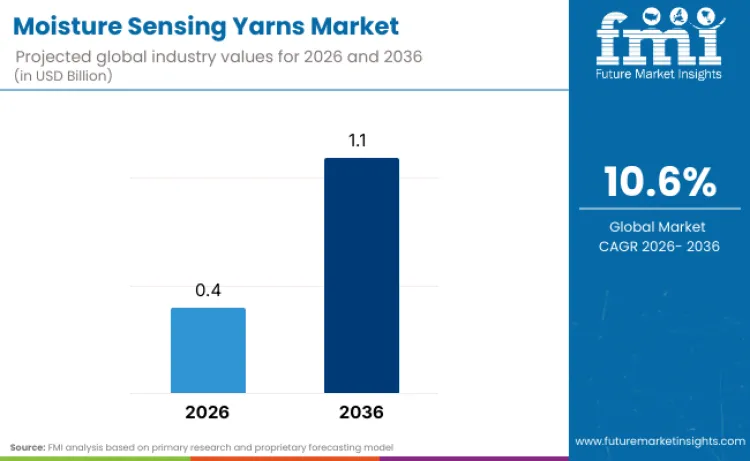
The global moisture sensing yarns market is valued at USD 0.4 billion in 2026 and is projected to reach USD 1.1 billion by 2036, expanding at a CAGR of 10.6%. Moisture sensing yarns are shifting from demonstration use toward procurement decisions where durability and integration reliability decide adoption. Buyers no longer question whether yarns can register moisture. The unresolved issue is whether sensing performance survives laundering, abrasion, repeated bending, and garment assembly without signal drift or connector failure.
Recent patent filings and qualification discussions show that wash resistance and interface stability now dominate technical review. Interconnect points between conductive yarns and external electronics remain the most common failure locations in wearable systems. Filings associated with Hexoskin place particular emphasis on connector geometry, strain relief, and contact stability, reflecting historical failure data from deployed garments rather than laboratory prototypes.
A separate change is emerging as moisture detection expands into response mechanisms. 2025 patent activity increasingly describes textiles that alter physical behavior once moisture is present. One group of products relies on fibre cross-section design and yarn structure to manage humidity through capillary action or swelling effects. These approaches support consumer and athletic applications where cost control and wash endurance outweigh active control precision.
Another group uses electrically assisted transport mechanisms that move moisture through electro-osmotic or low-voltage actuation. These architectures target clinical, protective, and tactical programs where moisture accumulation affects skin integrity, thermal regulation, or operational readiness.
Documented filings associate Myant with electrically assisted systems, while Teijin and Toray remain focused on passive structural solutions that prioritize manufacturability and long-term textile stability.
Verification requirements are tightening alongside this technical split. IPC-8911 establishes durability and sensing repeatability benchmarks relevant to wearable textile systems in the United States. EN 17666:2025 strengthens resistance measurement protocols for conductive tracks, including integrity expectations that directly affect moisture sensing yarn layouts.
Compliance with these frameworks favors suppliers capable of repeatable testing, controlled material variation, and documented failure analysis. As a result, sourcing increasingly concentrates around vertically integrated manufacturers with established qualification infrastructure.
An executive statement captures how value is being defined at the brand level. Calvin McDonald (CEO, Lululemon) states: “Guided by our ‘Made to Feel’ design philosophy, we engineer sensation using our proprietary fabrics and unique construction techniques to create products that differentiate our brand.” This matters because it frames moisture and microclimate performance as a fabric-platform engineering problem, which is where moisture sensing yarns compete most effectively.
Summary of the Moisture Sensing Yarns Market
How Is Commercial Demand for Moisture Sensing Yarns Taking Shape Through 2036?
Future Market Insights expects the moisture sensing yarns market to expand from USD 0.4 billion in 2026 to USD 1.1 billion by 2036, reflecting a 10.6% CAGR.
FMI Research Approach: Demand projections are built using bottom-up revenue modelling, cross-application adoption weighting, and procurement interviews focused on durability thresholds and wash-cycle retention expectations.
What Change in Buyer Logic Is Redefining How Moisture Sensing Yarns are Selected?
Buyer logic is shifting from cost per metre to cost of failure. Brands and institutions increasingly evaluate moisture sensing yarns based on lifecycle reliability, interconnect stability, and documented failure modes rather than incremental sensitivity gains. This mirrors procurement behaviour already established in other e-textile categories where durability evidence determines whether programs scale beyond pilots.
FMI Research Approach: Analyst interpretation draws on comparative mapping of passive and active sensing architectures, patent-level emphasis on interconnect durability, and qualification artefacts reviewed during sourcing cycles.
Which Geography Is Setting the Benchmark for Qualification-Led Adoption?
USA holds the largest share by value, anchored by qualification leadership under IPC-8911 and institutional sourcing pathways that normalize garment-integrated sensing. Defence-linked procurement and regulatory clarity around wearable monitoring accelerate adoption of moisture sensing yarns that can meet documented durability and verification requirements.
FMI Research Approach: Country-level assessment integrates standards adoption, defence sourcing constraints, and buyer interviews across sportswear, hygiene, and medical textile programs.
Where Does FMI See the Market Settling by the End of the Forecast Window?
By 2036, the moisture sensing yarns market is expected to reach USD 1.1 billion, with the largest value pools forming in sports apparel, hygiene textiles, and medical fabrics. In each case, moisture awareness becomes commercially relevant when it reduces returns, prevents adverse outcomes, or offsets labour and care costs.
FMI Research Approach: Market sizing reflects application-specific willingness-to-pay, repeat-purchase economics, and substitution analysis against labour-intensive moisture management practices.
How does FMI Frame the Commercial Boundary of the Moisture Sensing Yarns Market?
Moisture sensing yarns are functional yarn systems designed to detect or respond to moisture and humidity changes within textile structures, using resistive, capacitive, humidity-reactive, or hybrid mechanisms. These yarns enable moisture intelligence across performance apparel, hygiene products, and medical or wound-care textiles.
FMI Research Approach: Definition follows FMI’s functional-outcome framework, capturing yarn-level revenues where moisture sensing is specified, validated, and contract-relevant.
What Forces are Uniquely Steering This Market’s Direction at a Global Level?
Three forces stand out. Standards such as IPC-8911 and EN 17666:2025 are acting as industrial filters, shifting supplier selection toward qualification-ready platforms. The industry is separating into passive structural solutions and active electrically assisted systems, each with distinct cost and durability trade-offs. Moisture sensing is increasingly embedded into broader fabric-platform engineering strategies rather than treated as an add-on feature.
FMI Research Approach: Trend identification is grounded in standards review, patent-direction analysis, and supplier capability benchmarking across consumer, medical, and defence-adjacent textile programs.
Why is Moisture Sensing Transitioning from Comfort Feature to Risk-Management Input?
Moisture sensing justifies procurement when unmanaged moisture creates downstream cost or risk. In sportswear, this appears as comfort degradation and higher return rates. In hygiene products, it manifests as skin breakdown and inefficient change cycles. In medical textiles, moisture monitoring enables earlier intervention and labour reduction. As buyers adopt total cost-of-ownership logic, moisture sensing shifts from differentiation to infrastructure.
FMI Research Approach: Demand drivers are evaluated through failure-avoidance economics, buyer interviews, and outcome-based adoption analysis across apparel, hygiene, and healthcare settings.
Moisture Sensing Yarns Market Key Takeaways
| Metric | Value |
|---|---|
| Expected Value (2026E) | USD 0.4 billion |
| Forecast Value (2036F) | USD 1.1 billion |
| CAGR (2026-2036) | 10.6% |
Source: Future Market Insights (FMI) analysis, based on proprietary forecasting model and primary research
Why is Demand for Moisture Sensing Yarns Market Growing?
Demand for moisture sensing yarns is increasing because buyers now evaluate the technology through failure avoidance rather than comfort differentiation. In the 2026-2027 procurement cycle, sourcing teams are applying total cost of ownership calculations that prioritize labor reduction, prevention of adverse outcomes, and preservation of performance consistency that brands and institutions can monetize. Moisture sensing justifies procurement when it lowers return rates, reduces care interventions, or prevents degradation in wearability that affects user compliance.
Buyer evaluations show a clear shift away from unit garment cost toward failure-related expense. This logic is most visible in applications where unmanaged moisture contributes to skin breakdown, discomfort, or operational fatigue, turning moisture control into a risk-management input rather than a feature add-on.
A separate demand driver is the divergence between passive and active moisture architectures. Passive structural solutions, where performance is tied to fibre geometry and yarn integrity, routinely exceed 100 wash cycles in internal benchmarks. Active electronic solutions provide greater moisture transport capability but demonstrate lower wash-cycle retention in early-stage validation. This tradeoff now guides procurement decisions. Passive designs dominate high-volume consumer programs where durability and cost stability matter most. Active systems are selected where clinical return on investment or operational readiness justifies higher pricing and maintenance complexity.
Clinical and institutional adoption is also increasing as regulatory pathways become clearer. Hexoskin’s FDA 510(k) clearance for sensing garments is frequently referenced by buyers as proof that garment-based monitoring can meet regulatory and durability expectations. This precedent lowers adoption barriers for hospitals, research institutions, and occupational health programs, expanding demand for moisture sensing yarn architectures that can satisfy clinical wash, wear, and signal-retention requirements.
The trends observed here are reminiscent of developments encountered in remote patient monitoring and wearable sensing, where validated pathways reduce buyer friction and accelerate procurement cycles.
How is the Moisture Sensing Yarns Market Segmented?
Why do Resistive-based Architectures retain the lead despite Broader Sensing Options?
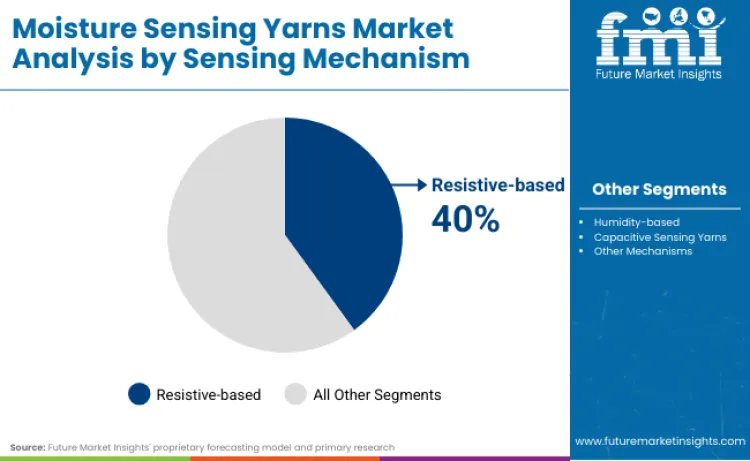
Resistive-based moisture sensing yarns hold a 40% share because they deliver the strongest manufacturability-to-reliability balance under textile-real constraints. They can be embedded as conductive pathways with simpler readout logic and lower calibration drift, which matters when durability testing shifts from lab demos to wash-cycle retention and mechanical cycling.
Standards-driven qualification raises the cost of complexity; resistive architectures often reach acceptable reliability with fewer integration penalties, accelerating their use in scalable apparel programs and hygiene formats.
Where do Humidity-responsive Yarns gain the Clearest Commercial Advantage?
Humidity-responsive yarns gain advantage where buyers want battery-free responsiveness and always-on functionality. Patent direction toward stimuli-responsive multi-layer yarns that change conformation under local humidity supports a path to dynamic breathability without electronics, aligning with premium athleisure and lifestyle performance positioning. This is strategically important because it avoids the thermal and electrical safety overhead that can slow active systems in consumer channels.
Why does Sports and Fitness Apparel lead Application Demand?
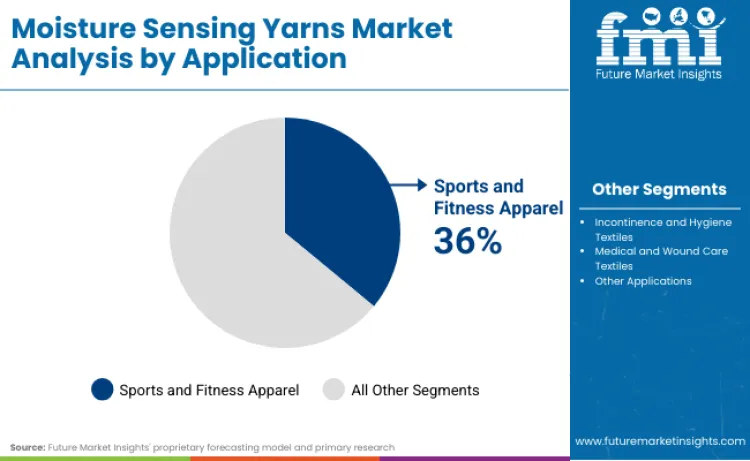
Sports and fitness apparel holds a 36% share because sweat is both frequent and measurable, allowing moisture sensing to translate into perceived product quality and repeat purchase behavior. Patents and product direction in elite athletics and outdoor apparel point to moisture sensing being bundled into broader comfort engineering systems, including active transport and responsive breathability. Leading brands commercialize performance platforms akin to patterns observed in smart clothing, where fabric systems are engineered as differentiation assets rather than accessory add-ons.
How do Incontinence and Hygiene Textiles convert Sensing into Measurable Downstream Savings?
Incontinence and hygiene textiles adopt moisture sensing where wetness detection can reduce skin irritation risk and improve change timing. The growth mechanism is operational: sensing becomes valuable when it reduces unnecessary changes or prevents delayed changes that increase complications.
This connects to the adoption logic seen for incontinence care products where product performance is increasingly tied to measurable skin integrity outcomes rather than absorbency alone.
What is pulling Medical and Wound Care Textiles into the Highest Willingness-to-Pay Lane?
Medical and wound care textiles pull moisture sensing into the highest value lane because moisture/exudate monitoring can reduce labor-intensive dressing changes and support earlier intervention.
The evidence set positions healthcare as moving toward intelligent wound management and cites institutional signals that garment-based sensing is shifting into validated deployment pathways. This strengthens the pull from advanced wound dressing and medical textiles ecosystems, where suppliers that can prove data fidelity and wash-cycle survival win repeat procurement.
Why do Sports and Healthcare Brands dominate End-User Adoption?
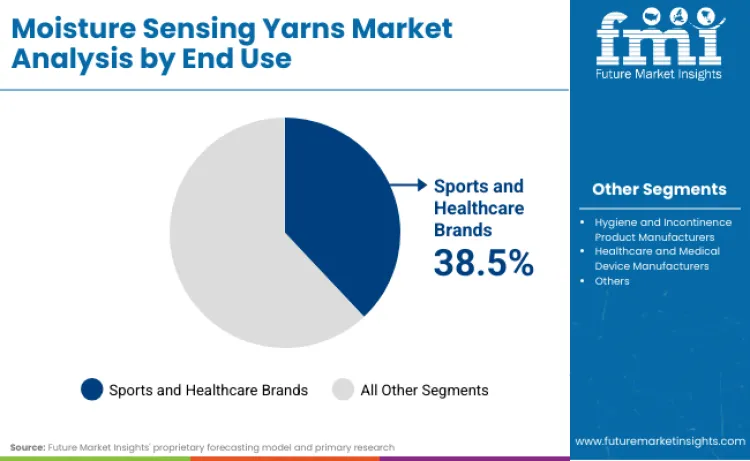
Sports and healthcare brands hold 38.5% share because they control specification authority and can fund qualification and testing regimes required under emerging standards. They also absorb the reputational and warranty risk of performance drift, which makes them more likely to demand documented durability and integration guidance. This is consistent with procurement behavior in conductive fibers and medical textiles, where platform-scale buyers require reproducibility across lots and seasons.
How are Standards and System Architectures Reshaping Industry Evolution of Moisture Sensing Yarns?
The most consequential industry change is that standards now function as a market access filter. IPC-8911 establishes an industry verification framework for durability and sensing accuracy of conductive yarns and wires for e-textiles, which changes supplier selection from claim-based to evidence-based procurement.
EN 17666:2025 strengthens electrical resistance measurement protocols for conductive tracks, tightening the durability expectations that moisture-sensing architectures must meet to remain viable in European supply chains. Suppliers lacking the capital to execute specialized testing infrastructure face de facto exclusion from tier-1 programs.
The second reshaping force is the market’s structural split into active and passive lanes. Myant-associated approaches emphasize electro-osmotic pumping at low voltage, converting moisture sensing into active removal systems that target medical and defense programs.
Toray and Teijin-associated approaches emphasize passive physics, capillary fiber design and conjugate yarn structures that deliver moisture movement and comfort stability without electronics. This split is not temporary. It creates two different operating models: passive scales through textile mills and brands; active scales through clinical validation, integration tooling, and higher ASPs tied to ROI.
A third reshaping force is durability economics concentrated at the interconnect. Patent focus on robust conductive patch interconnects and washable pathways indicates that long-term competitive advantage is moving into invisible engineering. This involves connector strategies, track integrity, and repeatability under wash and wear. This is the practical reason platform suppliers gain share: they reduce integration uncertainty, creating switching friction once adopted.
What is the Country-wise Profile of the Moisture Sensing Yarns Market?
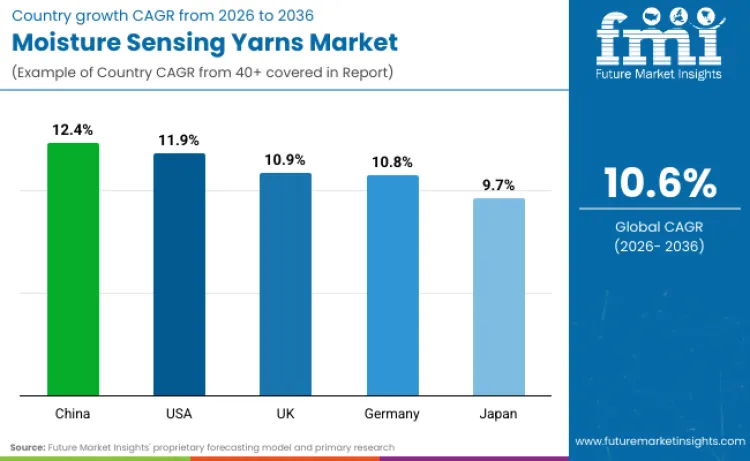
| Country | CAGR (2026-2036) |
|---|---|
| USA | 11.9% |
| China | 12.4% |
| Germany | 10.8% |
| UK | 10.9% |
| Japan | 9.7% |
Source: Future Market Insights’ proprietary forecasting model and primary research
What is pushing the USA into qualification-led adoption cycles?
Qualification pressure is reshaping how moisture-sensing yarn systems progress through USA procurement channels. Standards-led sourcing has tightened evaluation thresholds, particularly where durability, documentation, and traceability determine supplier eligibility. IPC-8911 is referenced as a verification framework that allows procurement teams to compare conductive yarn classes and test methods using consistent criteria, reducing ambiguity during bid evaluation.
Defense sourcing rules introduce a separate constraint. The Berry Amendment restricts Department of Defense procurement of covered textile items, including fibers and yarns, to USA-produced sources. This requirement forces localization decisions for military programs and alters supplier strategy toward compliant manufacturing pathways. Moisture-sensing textile systems can meet functional targets yet still fail procurement review when sourcing documentation does not satisfy domestic content requirements.
Active moisture-management garments also encounter elevated qualification friction. CPSC safety activity and related USA standards work emphasize thermal runaway risk and testing obligations for lithium battery systems, increasing compliance cost and extending validation timelines. In this environment, adoption momentum, estimated at an 11.9% CAGR, remains tied more closely to audit readiness than to end-market enthusiasm.
How is China converting industrial policy into scale manufacturing for moisture intelligence?
Industrial policy anchors China’s expansion in moisture-sensing textiles. Smart yarns and humidity-responsive fibers are positioned within broader manufacturing capability upgrading, linking textile innovation with automation, process control, and electronics-adjacent production infrastructure. This orientation emphasizes repeatability and throughput rather than fragmented pilot deployment.
Compliance pressure is rising in parallel. Draft updates associated with China RoHS catalog expansion and alignment with GB 26572-2025 increase documentation, material disclosure, and process-control requirements for equipment connected to textile manufacturing. These obligations tend to favor vertically integrated suppliers capable of sustaining audit-ready records across production stages.
Material selection constraints add another layer. Policy emphasis on lower-impact materials and carbon reduction affects polymer choice and restricted-substance compliance in smart textile development. As these constraints intersect with automation-led scale-up, they influence which moisture-sensing yarn architectures transition from pilot lines into stable production volumes. These combined forces support market expansion that tracks toward a 12.4% CAGR without relying on price-led competition.
Why does Germany’s growth concentrate in high-assurance technical textiles?
Demand in Germany concentrates around moisture-sensing yarn systems that integrate into tightly controlled industrial production environments. Medical, construction, and industrial textile applications dominate adoption, with supplier participation conditioned on certified processes, digital traceability, and data-backed quality assurance.
Federal innovation policy under High-Tech Strategy 2025 reinforces this structure by prioritizing industrial research ecosystems where repeatable production and verified performance metrics are mandatory. As digital quality certification requirements tighten, suppliers lacking cloud-connected quality systems face increasing difficulty clearing procurement reviews.
This environment restricts speculative entry and channels growth toward established industrial manufacturers and research-consortium pathways. Within these boundaries, market expansion progresses steadily, with Germany tracking a 10.8% CAGR driven by documentation rigor rather than experimental breadth.
What makes the UK a niche scale-up market rather than a pure volume play?
Funded validation pathways rather than broad manufacturing rollouts shape commercialization in the UK. Public programs accelerate lab-to-factory transitions under compressed timelines, requiring early demonstration of manufacturability, yield stability, and performance retention. This structure favors rapid qualification over gradual capacity expansion.
Supplier behavior mirrors this pattern. Heathcoat Fabrics’ DRYTEC moisture-management spacer fabrics are referenced in defense procurement contexts where integrated moisture control reduces operational burden in extreme environments. Procurement decisions in these cases prioritize reduced fatigue and performance degradation rather than comfort differentiation.
Healthcare adjacency adds another demand layer. Heathcoat’s high-absorbency viscose wound-care fabric launches in late 2025 support continued investment in high-assurance moisture-handling substrates where sensing functionality can be layered into clinically governed textile systems. These dynamics sustain growth, which is forecast to average 10.9% CAGR, without pushing the market toward mass-volume economics.
How is Japan’s consolidation and fiber engineering shaping premium adoption?
Moisture-sensing textile adoption in Japan is anchored in fiber engineering depth compared to cost competition. Advanced materials science, long-cycle performance control, and precision yarn construction guide supplier strategies in premium sports, outdoor, and technical apparel segments. Adoption is tied to lifespan stability rather than short-cycle feature refresh.
Teijin Frontier’s December 2025 launch of multifunctional comfort textiles integrates moisture-responsive behavior designed to regulate cooling based on sweat volume. By embedding performance within yarn and fabric construction, the approach reduces reliance on surface-applied treatments that degrade over time.
Capacity investment reinforces this direction. Expansion of conjugate yarn production enables premium brands to replace temporary chemical coatings with permanent structural moisture-management features. Consolidation further reshapes scale economics through the planned integration of Asahi Kasei Advance with Teijin Frontier, effective October 1, 2026. Together, these factors underpin Japan’s market trajectory, which advances at roughly 9.7% CAGR through premium-led adoption rather than volume scaling.
Competitive Landscape
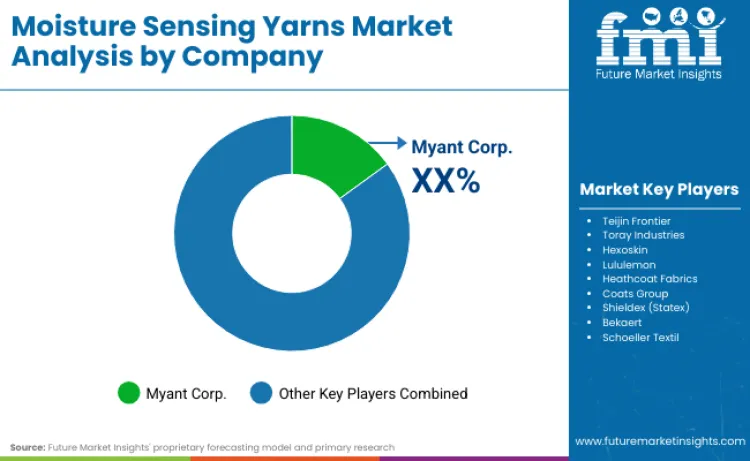
The moisture-sensing yarn market changed materially in 2026 as buyers moved away from experimental demonstrations and toward procurement structures that reward durability, documentation, and integration discipline.
Supplier differentiation is no longer centered on whether moisture can be detected. It now depends on whether sensing performance can be verified after laundering, mechanical cycling, and long-term use under standardized test conditions.
Commercial behavior increasingly separates into two operating models based on qualification capability. One group of suppliers focuses on utility-grade infrastructure where moisture sensing is treated as a reliability input rather than a feature.
These platforms emphasize repeatable signal behavior after extended wash exposure and mechanical stress, aligning closely with the durability requirements formalized in the July 2025 release of IPC-8911. As procurement teams adopt this framework, sourcing shifts toward suppliers that reduce warranty exposure and integration risk through documented test performance rather than prototype novelty.
Scale and certification capacity are becoming decisive advantages in this segment. The October 1, 2026 integration of Teijin Frontier and Asahi Kasei Advance illustrates how capital intensity and certification overhead are reshaping competitive structure. The combined platform concentrates testing capability, process control, and audit readiness in a way that smaller suppliers struggle to sustain independently.
Myant’s Skiin Osmotex platform, demonstrated publicly in 2025, exemplifies this approach through electro-osmotic moisture transport operating at low voltage. These systems target applications where unmanaged moisture creates immediate clinical or operational risk, allowing pricing to reflect outcome avoidance rather than material cost.
Regulated markets add an additional screening layer that further separates supplier classes. Clinical adoption increasingly requires convergence between textile engineering and medical validation. Hexoskin’s FDA 510(k) clearance in November 2025 established a reference pathway for garment-based monitoring systems, limiting participation in USA clinical trials to platforms capable of meeting regulatory durability and data integrity requirements. In defense applications, Heathcoat Fabrics’ DRYTEC spacer architecture demonstrates how three-dimensional textile structures are being used to manage moisture-driven thermal stress rather than surface wetness alone.
Competitive advantage is defined less by detection capability, and more by leadership in qualification capacity, system integration discipline, and ability to sustain verified performance in environments where moisture directly affects safety, health outcomes, or operational reliability.
“Moisture-sensing yarns are moving toward selection criteria defined by sustained in-use performance rather than detection capability alone. Procurement is increasingly favoring platforms that can document stability across laundering, fatigue, and long service cycles. This narrows supplier base toward certification-ready, well-capitalized players.”
Key Players in Moisture Sensing Yarns Market
- Myant Corp.
- Teijin Frontier
- Toray Industries
- Hexoskin
- Lululemon
- Heathcoat Fabrics
- Coats Group
- Shieldex (Statex)
- Bekaert
- Schoeller Textil
Market Definition
Moisture sensing yarns are functional yarn systems engineered to detect and/or respond to moisture or humidity changes within textile structures using resistive, capacitive, humidity-reactive, or hybrid mechanisms.
These yarns are integrated into fabrics via knitting, weaving, embroidery, or lamination to enable moisture intelligence across sports and fitness apparel, incontinence and hygiene textiles, medical and wound care textiles, and other applications where moisture presence affects comfort, safety, or clinical outcomes.
Scope of Report
| Attribute | Details |
|---|---|
| Quantitative Units | USD billion |
| Sensing Mechanism | Resistive-based, Humidity-based, Capacitive Sensing Yarns, Other Mechanisms |
| Application | Sports and Fitness Apparel, Incontinence and Hygiene Textiles, Medical and Wound Care Textiles, Other Applications |
| End User | ports and Healthcare Brands, Hygiene and Incontinence Product Manufacturers, Healthcare and Medical Device Manufacturers, Others |
| Regions | North America, Europe, East Asia, South Asia, Latin America, Middle East and Africa |
| Countries Covered | United States, United Kingdom, Germany, China, Japan, and Rest of World |
| Report Coverage | Market size and forecast, segment analysis, country-wise analysis, competitive landscape, strategic outlook |
Source: Future Market Insights-analysis driven by proprietary forecasting models and primary research
Moisture Sensing Yarns Market by Segments
By Sensing Mechanism
- Resistive-based
- Humidity-based
- Capacitive Sensing Yarns
- Other Mechanisms
By Application
- Sports and Fitness Apparel
- Incontinence and Hygiene Textiles
- Medical and Wound Care Textiles
- Other Applications
By End User
- Sports and Healthcare Brands
- Hygiene and Incontinence Product Manufacturers
- Healthcare and Medical Device Manufacturers
- Others
By Region
- North America
- Latin America
- Western Europe
- Eastern Europe
- East Asia
- South Asia & Pacific
- Middle East & Africa
Bibliography
- IPC. (2024). IPC-8911: Requirements for Conductive Yarns and Wires for E-Textiles. IPC Standards Committee.
- Ministry of Industry and Information Technology (MIIT). (2025). Smart Textile Industry Development Guidelines (humidity-responsive fibers; smart yarn industrialization). People’s Republic of China.
- Federal Ministry of Education and Research (BMBF). (2025). High-Tech Strategy 2025 funding pact priorities relevant to Industry 4.0 textiles. Germany.
- Innovate UK. (2024-2025). Textile innovation funding programs relevant to technical textile scale-up. United Kingdom.
Frequently Asked Questions
What is the current global market size for moisture sensing yarns?
Moisture sensing yarns demand is valued at USD 0.4 billion in 2026, supported by growing specification in performance apparel, hygiene textiles, and medical monitoring fabrics.
What is the projected CAGR for the moisture sensing yarns market?
The market is projected to expand at a 10.6% CAGR from 2026 to 2036.
Which sensing mechanism segment currently dominates the market?
Resistive-based sensing leads with a 40% share, supported by manufacturability advantages and lower calibration and qualification burden under tightening durability expectations.
Which application segment holds the largest share today?
Sports and fitness apparel leads with 36% share, driven by outcomes priced on comfort stability and repeat-use performance where moisture intelligence protects premium positioning.
Who are the leading suppliers?
Myant Corp., Teijin Frontier, Toray Industries, Hexoskin, Lululemon, Heathcoat Fabrics, Coats Group, Shieldex (Statex), Bekaert, and Schoeller Textil.
Preview the report firsthand - request a free sample
Get SampleGet the brochure for pricing and purchase details.
Get PDFTable of Content
- Executive Summary
- Global Market Outlook
- Demand-side Adoption Signals
- Supply-side Capability Shifts
- Technology and System Architecture Split
- Strategic Recommendations
- Market Overview
- Market Definition
- Market Scope and Coverage
- Inclusions and Exclusions
- Market Size Snapshot (2026) and Forecast (2036)
- Key Drivers, Restraints, and Trends
- Market Analysis and Forecast 2021 to 2036
- Historical Market Size Value (USD Billion), 2021 to 2025
- Market Forecast Value (USD Billion), 2026 to 2036
- Y-o-Y Growth Trend Analysis, 2021 to 2036
- Absolute Dollar Opportunity Analysis, 2026 to 2036
- Market Background and System Context
- Moisture Sensing in Wearable and Technical Textiles
- Performance Benchmarks: Wash, Abrasion, Bending, Signal Drift
- Interconnect Reliability and Failure-mode Hotspots
- Patent and Innovation Direction
- Why Demand for Moisture Sensing Yarns is Growing?
- Shift from Comfort Feature to Failure-avoidance Economics
- Total Cost of Ownership Adoption Logic
- Passive Versus Active Architecture Divergence
- Clinical and Institutional Validation Signals
- Global Market Pricing Analysis 2021 to 2036
- Pricing Assumptions and Reference Points
- Historical Pricing Trend Analysis
- Forward Pricing Sensitivity and Outlook
- Global Market Analysis 2021 to 2025 and Forecast 2026 to 2036, By Sensing Mechanism
- Introduction and Key Findings
- Historical Market Size Value Analysis, 2021 to 2025
- Market Forecast and Opportunity Analysis, 2026 to 2036
- Resistive-based
- Humidity-based
- Capacitive Sensing Yarns
- Other Mechanisms
- Y-o-Y Growth Trend Analysis
- Absolute Dollar Opportunity Analysis
- Global Market Analysis 2021 to 2025 and Forecast 2026 to 2036, By Application
- Introduction and Key Findings
- Historical Market Size Value Analysis, 2021 to 2025
- Market Forecast and Opportunity Analysis, 2026 to 2036
- Sports and Fitness Apparel
- Incontinence and Hygiene Textiles
- Medical and Wound Care Textiles
- Other Applications
- Y-o-Y Growth Trend Analysis
- Absolute Dollar Opportunity Analysis
- Global Market Analysis 2021 to 2025 and Forecast 2026 to 2036, By End User
- Introduction and Key Findings
- Historical Market Size Value Analysis, 2021 to 2025
- Market Forecast and Opportunity Analysis, 2026 to 2036
- Sports and Healthcare Brands
- Hygiene and Incontinence Product Manufacturers
- Healthcare and Medical Device Manufacturers
- Others
- Y-o-Y Growth Trend Analysis
- Absolute Dollar Opportunity Analysis
- Global Market Analysis 2021 to 2025 and Forecast 2026 to 2036, By Region
- Introduction
- Historical Market Size Value Analysis, 2021 to 2025
- Market Forecast by Region, 2026 to 2036
- North America
- Latin America
- Western Europe
- Eastern Europe
- East Asia
- South Asia and Pacific
- Middle East and Africa
- Market Attractiveness Analysis
- North America Market Analysis 2021 to 2025 and Forecast 2026 to 2036
- Historical Trend Analysis
- Market Forecast
- Key Takeaways
- Latin America Market Analysis 2021 to 2025 and Forecast 2026 to 2036
- Historical Trend Analysis
- Market Forecast
- Key Takeaways
- Western Europe Market Analysis 2021 to 2025 and Forecast 2026 to 2036
- Historical Trend Analysis
- Market Forecast
- Key Takeaways
- Eastern Europe Market Analysis 2021 to 2025 and Forecast 2026 to 2036
- Historical Trend Analysis
- Market Forecast
- Key Takeaways
- East Asia Market Analysis 2021 to 2025 and Forecast 2026 to 2036
- Historical Trend Analysis
- Market Forecast
- Key Takeaways
- South Asia and Pacific Market Analysis 2021 to 2025 and Forecast 2026 to 2036
- Historical Trend Analysis
- Market Forecast
- Key Takeaways
- Middle East and Africa Market Analysis 2021 to 2025 and Forecast 2026 to 2036
- Historical Trend Analysis
- Market Forecast
- Key Takeaways
- Country-wise Analysis
- USA
- China
- Germany
- UK
- Japan
- Competition Outlook
- Competitive Landscape and Positioning
- Qualification-ready Platforms Versus Pilot-first Offerings
- Standards-driven Supplier Filtering
- Recent Developments
- Company Profiles
- Myant Corp.
- Teijin Frontier
- Toray Industries
- Hexoskin
- Lululemon
- Heathcoat Fabrics
- Coats Group
- Shieldex (Statex)
- Bekaert
- Schoeller Textil
- Assumptions and Acronyms
- Assumptions
- Acronyms
- Research Methodology
- Chapter Orientation
- Analytical Framework
- Market Sizing and Forecasting Approach
- Validation and Data Sources
- Appendix
- Scope of Report
- Bibliography
- Frequently Asked Questions


