

- Industry Size (2026)
- USD 610 Mn
- Forecast (2036)
- USD 1003.1 Mn
- CAGR (2026 to 2036)
- 5.1%
Moisture Permeability Testers Market Size, Market Forecast and Outlook By FMI
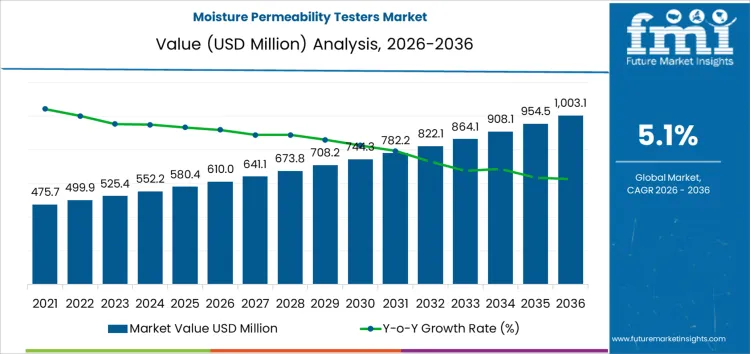
In 2026, the moisture permeability testers market is likely to be valued at USD 610.0 million and is projected to reach USD 1,003.1 million by 2036, implying a CAGR of 5.1%. These instruments are used where barrier performance must be quantified rather than inferred, notably in packaging for pharmaceuticals, medical devices, food, and specialty chemicals. Their role sits inside quality assurance and regulatory compliance workflows, where documented transmission rates determine shelf life claims and material selection. Demand therefore concentrates in regions with large regulated packaging and materials testing bases. Equipment choice depends on test method compatibility, repeatability, and audit acceptance rather than on laboratory throughput alone.
Summary of Moisture Permeability Testers Market
- Market Snapshot
- The Moisture Permeability Testers Market is valued at USD 610.0 million in 2026.
- The Moisture Permeability Testers Market is projected treach USD 1,003.1 million by 2036.
- The market is expected texpand at a CAGR of 5.1% during 2026 t2036.
- Demand and Growth Drivers
- Demand is driven by stricter regulatory compliance and quality assurance requirements in packaging, pharmaceuticals, and medical devices.
- Growth is supported by increasing testing intensity per production line due ttighter barrier specifications.
- Adoption rises as moisture permeability testing becomes integrated introutine quality control beyond product development.
- Product and Segment View
- Cup method moisture permeability testers account for approximately 45% of total demand due talignment with standard test protocols.
- Packaging materials testing represents around 42% of total application demand driven by mandatory moisture barrier validation.
- Automatic and continuous systems are adopted primarily in high-volume laboratories requiring consistent throughput.
- Geography and Competitive Outlook
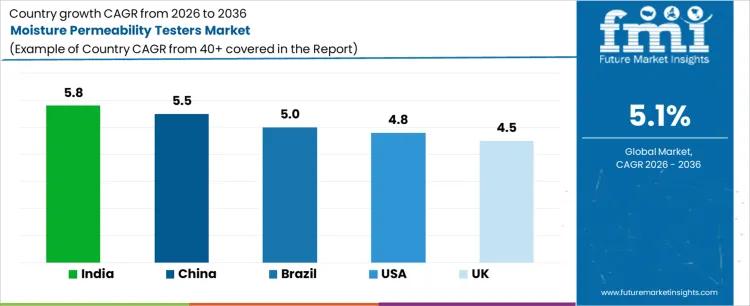
- India leads country-level growth with a CAGR of 5.8%, followed by China at 5.5% and Brazil at 5.0%.
- The United States market grows at 4.8% CAGR, while the United Kingdom records 4.5% CAGR.
- Key companies include Mocon Inc., TexTest AG, Labthink Instruments, TQC Sheen, KJ LCB Scientific, and Hangzhou Qima Test Equipment.
Laboratory organization and certification scope shape purchasing patterns more than headline instrument specifications. Once a test method and platform are embedded in validation protocols and customer reporting formats, substitution becomes costly due to requalification and method transfer requirements.
Utilization rates are driven by the number of qualified materials and customers served, not by occasional product launches. Large packaging groups and contract test laboratories standardize platforms to maintain comparability across sites, while smaller labs invest selectively. The market grows through tighter barrier specifications and broader compliance testing, not through expansion of general purpose laboratory instrumentation.
Quick Stats for Moisture Permeability Testers Market
- Moisture Permeability Testers Market Value (2026): USD 610.0 million
- Moisture Permeability Testers Market Forecast Value (2036): USD 1,003.1 million
- Moisture Permeability Testers Market Forecast CAGR 2026 to 2036: 5.1%
- Leading Type in Moisture Permeability Testers Market: Cup method moisture permeability testers
- Key Growth Regions in Moisture Permeability Testers Market: Asia Pacific, North America, Europe
- Top Players in Moisture Permeability Testers Market: Mocon Inc., TexTest AG, Labthink Instruments, TQC Sheen, KJ LCB Scientific, Hangzhou Qima Test Equipment
What is the Growth Forecast for the Moisture Permeability Testers Market through 2036?
The moisture permeability testers industry is closely linked to rising regulatory pressure, stricter quality assurance requirements, and increasing material performance expectations across packaging, pharmaceuticals, medical devices, and advanced materials. In the early phase, demand is mainly driven by flexible packaging producers, pharmaceutical blister pack manufacturers, and research laboratories where moisture barrier performance is a critical parameter for product safety, shelf life, and compliance.
As adoption expands, moisture testing moves beyond product development and certification and becomes increasingly integrated into routine quality control operations, particularly in food, beverage, and healthcare packaging. Growth at this stage is supported by wider use of standardized test methods and stronger audit and compliance requirements in regulated industries. Purchasing decisions are increasingly driven by accuracy, repeatability, and alignment with international testing standards rather than throughput alone.
Over the long term, expansion is shaped more by application diversification than by simple capacity additions. Advanced multilayer films, coated papers, technical textiles, and high-performance industrial materials require more frequent and more precise permeability verification. Demand also strengthens from medical packaging and sterile barrier systems, where shelf-life validation and moisture ingress control are essential. Procurement trends increasingly favor automated instruments with digital integration to support traceability and data integrity. Overall growth is driven by tighter oversight, rising testing intensity per production line, and increasing material complexity, with buyers prioritizing measurement precision, standard compliance, and long-term reliability over initial equipment cost.
Moisture Permeability Testers Market Key Takeaways
| Metric | Value |
|---|---|
| Market Value (2026) | USD 610 million |
| Forecast Value (2036) | USD 1,003.1 million |
| Forecast CAGR 2026 to 2036 | 5.1% |
How Is the Moisture Permeability Testers Market Enhancing Material Performance Evaluation?
Moisture permeability testers are increasingly adopted to measure water vapor transmission in textiles, films, coatings, and packaging materials, ensuring product reliability and quality. Historically, material testing relied on empirical methods or indirect estimation, which often produced inconsistent or non-reproducible results. Modern testers integrate controlled environmental chambers, precision sensors, and automated data acquisition to provide accurate, repeatable measurements under standardized conditions.
Textile manufacturers, packaging producers, and research laboratories prioritize testing accuracy, repeatability, and compliance with international standards. Early adoption focused on high-performance fabrics and sensitive packaging materials, while current demand spans apparel, industrial films, medical packaging, and building materials, driven by performance requirements, regulatory compliance, and consumer safety considerations. Sensor sensitivity, environmental control precision, and testing throughput influence supplier selection.
Ensuring accurate material characterization and supporting product development is driving market adoption. Compared with manual or less-controlled methods, modern moisture permeability testers offer precise, standardized, and reproducible results that inform design and quality assurance decisions.
Cost structures depend on chamber design, sensor technology, and software integration, concentrating margins among suppliers providing reliable, high-accuracy testing systems. Manufacturers and laboratories adopt these instruments to optimize material selection, verify product performance, and maintain regulatory compliance. Looking ahead, moisture permeability testers are expected to become essential in R&D and quality control processes, enabling precise material evaluation, improved product durability, and performance consistency across textiles, packaging, and specialty materials.
What Factors Are Shaping Segment-Wise Demand for Moisture Permeability Testers in 2026?
The Moisture Permeability Testers Market in 2026 is structured around test standard compliance and laboratory workflow integration rather than by instrument throughput alone. By product type, demand in the Moisture Permeability Testers Market is distributed across cup method moisture permeability testers, automatic and continuous moisture testers, gravimetric moisture permeability testers, and dynamic moisture permeability systems. By application, demand in the Moisture Permeability Testers Market is concentrated in packaging materials testing, textile and apparel testing, pharmaceutical packaging evaluation, and construction material analysis. These segments reflect differences in regulatory exposure, sample volume, and tolerance for test cycle duration.
How Do Standardization Requirements and Validation Practices Shape Product Type Demand in the Moisture Permeability Testers Market?
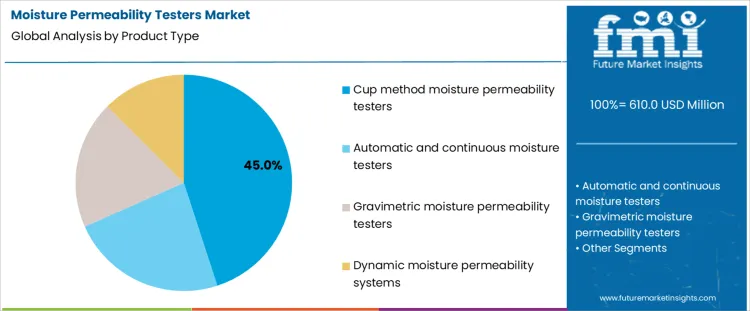
Cup method moisture permeability testers account for approximately 45% of demand in the Moisture Permeability Testers Market because they align closely with long established international test standards and reference methods. Many quality control and compliance laboratories are required to report moisture transmission rates using methods that are directly traceable to recognized protocols. In the Moisture Permeability Testers Market, this creates structural inertia in equipment selection, as changing test methodology often requires revalidation of historical data, retraining of staff, and revision of customer or regulatory documentation.
Automatic and continuous systems offer higher throughput, but their adoption is concentrated in facilities with large and stable testing volumes. Gravimetric and dynamic systems address specific material classes or environmental simulation requirements, but their complexity and longer setup times limit universal deployment. The product structure of the Moisture Permeability Testers Market is therefore shaped more by audit acceptance and data continuity than by pure measurement speed or automation level.
Why Does Packaging Materials Testing Represent the Largest Application Segment in the Moisture Permeability Testers Market?
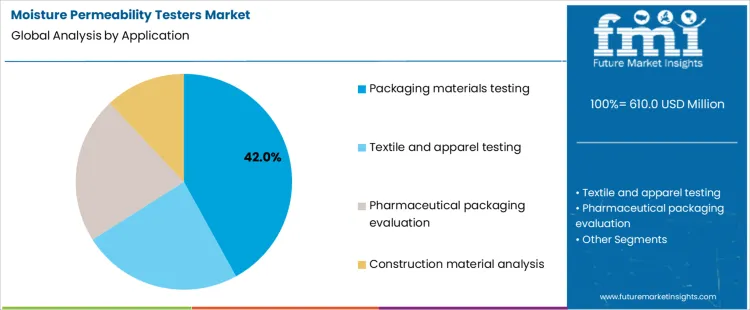
Packaging materials testing accounts for approximately 42% of demand in the Moisture Permeability Testers Market because moisture barrier performance directly affects product shelf life, safety, and regulatory compliance across food, beverage, and consumer goods industries. In many packaging programs, moisture transmission rate is a mandatory specification rather than a design optimization parameter. This creates continuous, routine testing demand across both development and production quality control environments.
Textile and apparel testing involves significant sample volumes but is often seasonal and specification driven. Pharmaceutical packaging evaluation requires highly controlled testing, but the number of materials under qualification is limited by strict change management processes. Construction material testing involves large specimens and longer test cycles, which reduces annual instrument utilization rates. In contrast, packaging operations generate a steady flow of new materials, supplier changes, and production batch validations. This sustained testing intensity explains why packaging materials testing remains the dominant application segment within the Moisture Permeability Testers Market.
How Are the Key Dynamics Reshaping the Moisture Permeability Testers Market?
The Moisture Permeability Testers Market is shaped less by laboratory fashion and more by how industries manage failure risk, shelf life, and compliance proof. These instruments sit quietly behind packaging, membranes, medical devices, and technical textiles, yet they influence whether products survive transport, storage, and use. Demand does not come from routine lab upgrades. It appears when organizations tighten specifications, face disputes, or need defensible data for customers and regulators. Utilization varies widely depending on whether testing is embedded in daily decisions or treated as a formality. The market moves with governance habits, not with general equipment replacement cycles.
Why the Moisture Permeability Testers Market Is Specification Driven?
Many products only fail months after shipping. When that happens, attention turns to barrier performance. Packaging leaks, blister packs degrade, or membranes lose function, and suddenly permeability data becomes central. In these moments, companies realize that supplier certificates are not enough and in house measurement is needed. Once specifications start referencing internal test results, the instrument becomes part of release decisions rather than a background lab tool. This shifts it from occasional use to operational infrastructure. Demand therefore grows through tighter specs, customer audits, and warranty disputes, not through curiosity about better lab instruments.
Why the Moisture Permeability Testers Market Suffers from Underutilization?
In many labs the machine exists, but the process does not. Tests take time, sample preparation is slow, and production teams often push to ship before results are ready. If management does not enforce data driven release gates, the tester becomes symbolic. Staff revert to visual checks or supplier declarations. Over time, the instrument is seen as non-essential, even though failures still occur. This creates a paradox: the need is real, but daily discipline is missing. The limitation is not technical. It is whether organizations are willing to let measured data delay shipments.
Why the Moisture Permeability Testers Market Follows Regulatory Culture?
Some sectors treat measurement as legal armor. Medical devices, pharmaceuticals, and high risk food packaging require documented proof of barrier performance. In these environments, testers are not optional tools but part of compliance infrastructure. In less regulated sectors, the same risks exist but are tolerated until a problem becomes visible. As more industries adopt audit driven and documentation heavy quality systems, permeability testing becomes institutionalized rather than occasional. The market therefore follows how seriously sectors treat documentation and traceability, not how much material they produce or how many labs they operate.
What is the Demand for Moisture Permeability Testers by Country?
| Country | CAGR (%) |
|---|---|
| USA | 4.8% |
| UK | 4.5% |
| China | 5.5% |
| India | 5.8% |
| Brazil | 5.0% |
Demand for moisture permeability testers is rising as manufacturers and quality control laboratories adopt precise testing equipment to measure material barrier properties, ensure product performance, and comply with industry standards. India leads with a 5.8% CAGR, driven by growth in packaging, textile, and material testing sectors. China follows at 5.5%, supported by expanding industrial production and quality assurance processes. Brazil records 5.0% growth, shaped by adoption in manufacturing and packaging industries. The USA grows at 4.8%, influenced by replacement demand and regulatory compliance. The UK shows 4.5% CAGR, reflecting steady adoption of moisture testing equipment across industrial and research applications.
What is shaping procurement of Moisture Permeability Testers in the United States?
United States is recording a CAGR of 4.8%, with demand coming from packaging laboratories, pharmaceutical quality units, and materials testing centers using moisture permeability testers. Usage focuses on shelf life evaluation, barrier material validation, and compliance documentation for regulated products. Equipment selection emphasizes measurement repeatability, calibration stability, and compatibility with laboratory information systems. Contract testing laboratories account for a steady share of installations.
Packaging producers use these systems to qualify films, laminates, and coated papers before production release. Pharmaceutical manufacturers apply them during stability studies and process validation. Service coverage and certification support influence vendor choice. Installation activity concentrates around major manufacturing and research hubs. Budget planning follows laboratory expansion and accreditation schedules. Utilization rates depend on test protocol frequency and product development pipelines rather than short term volume swings.
Which factors guide laboratory adoption of Moisture Permeability Testers in the United Kingdom?
United Kingdom is recording a CAGR of 4.5%, with usage centered on packaging research centers, food testing laboratories, and pharmaceutical quality control units using moisture permeability testers. Laboratories rely on these systems for barrier performance verification and regulatory submission data. Equipment evaluation focuses on accuracy, documentation features, and audit readiness. University laboratories and contract research organizations contribute to baseline demand.
Packaging converters use these systems during material qualification and supplier assessment programs. Procurement reviews include service response, training support, and spare availability. Installation activity remains concentrated in regional science and manufacturing clusters. Capital spending aligns with laboratory upgrades and accreditation renewals. Testing volume reflects product development cycles and regulatory review schedules. System utilization benefits from long term testing programs and recurring quality assurance requirements across multiple regulated product categories.
How are manufacturing laboratories in China expanding use of Moisture Permeability Testers?
China is recording a CAGR of 5.5%, supported by growth in packaging production, pharmaceutical manufacturing, and materials research using moisture permeability testers. Large factories integrate these systems into quality control and process validation laboratories. Domestic instrument suppliers expand local manufacturing and service networks. Usage concentrates on film packaging, medical device materials, and coated paper products. Engineering teams focus on throughput stability and consistent test conditions. Export oriented producers rely on these systems for compliance documentation. Procurement teams conduct extended equipment trials before approval. Installation activity clusters around coastal and central industrial zones. Research institutes use these testers for material development projects. Budget allocation follows plant expansion and laboratory modernization programs. Utilization levels remain linked to quality audit cycles and product qualification workloads rather than routine production testing alone.
What supports rising installation of Moisture Permeability Testers across India?
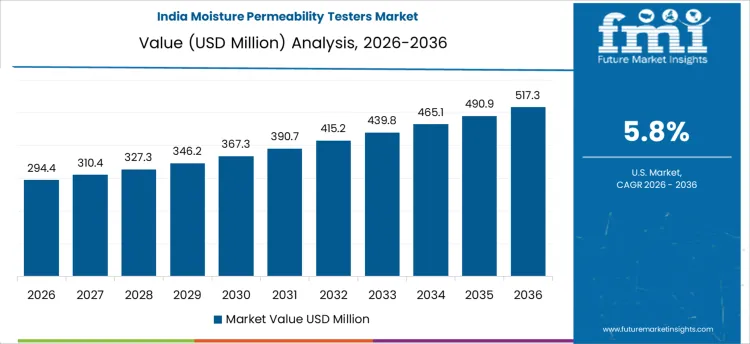
India is recording a CAGR of 5.8%, with demand rising from pharmaceutical plants, packaging converters, and independent testing laboratories using moisture permeability testers. Expansion of regulated manufacturing increases the need for documented barrier testing. Laboratories use these systems for material approval, stability studies, and supplier verification programs. Procurement priorities include operating simplicity, service access, and local technical support. Import instruments serve high specification laboratories and export focused producers. Domestic distributors strengthen installation and training capability. Usage spreads across major pharmaceutical and packaging hubs. Capital investment decisions link to capacity additions and certification requirements. Testing volume reflects growth in packaged foods, medicines, and consumer goods. Equipment deployment follows phased laboratory development programs rather than one-time large scale procurement projects.
Which forces influence demand for Moisture Permeability Testers in Brazil?
Brazil is recording a CAGR of 5%, with demand coming from packaging producers, pharmaceutical manufacturers, and materials testing laboratories using moisture permeability testers. Usage focuses on shelf life studies, packaging validation, and regulatory documentation. Equipment choice emphasizes durability, measurement stability, and manageable maintenance requirements. Import dependence shapes pricing and delivery planning. Local service partners handle installation, calibration, and operator training. Testing activity concentrates in major industrial and healthcare manufacturing regions. Contract laboratories support smaller producers without in house testing capacity. Procurement planning aligns with laboratory expansion and compliance audit schedules. Budget holders favor systems with predictable operating cost and long service intervals. Adoption progresses through targeted laboratory upgrades rather than broad replacement of existing analytical equipment across facilities.
How Are Manufacturers Addressing Precision and Versatility in the Moisture Permeability Testers Market?
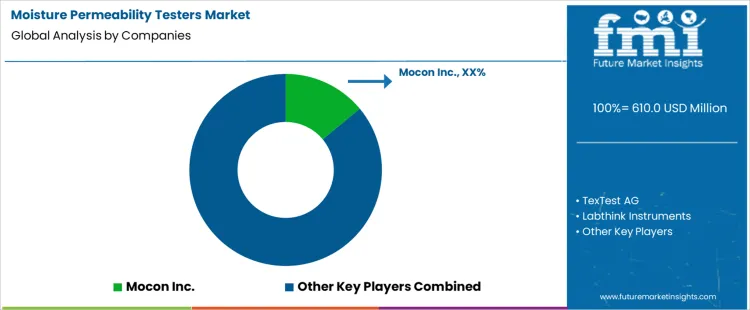
Product providers in the moisture permeability testers market differ in measurement accuracy, test standard coverage, and adaptability to varied material types. Mocon Inc. supplies systems engineered for precise water vapor transmission rate (WVTR) analysis, with control software that supports ASTM and ISO methods used across packaging and barrier material testing. TexTest AG offers instrumentation optimized for film and sheet substrates, emphasizing stable humidity and temperature regulation during long duration tests. Labthink Instruments delivers testers that support multiple permeability standards and integrate with data acquisition systems, aiding quality assurance labs. TQC Sheen provides solutions with user friendly interfaces and versatility for both rigid and flexible materials, supporting rapid test setup.
KJ LCB Scientific supplies moisture permeability testers tailored for research and industrial environments, with attention to robust mechanical design and consistent repeatability. Hangzhou Qima Test Equipment offers competitive test systems that balance performance with accessible pricing, often paired with regional support and calibration services.
Other regional and specialty suppliers contribute instruments focused on specific sectors such as pharmaceuticals, food packaging, or textiles where environmental barrier properties are critical. Competitive differentiation arises from measurement precision, environmental control stability, software analytics, and compliance with internationally recognized test methods. Suppliers that combine documented performance data, calibration support, and versatile test protocols maintain relevance as manufacturers prioritize consistent barrier assessment to meet regulatory and quality standards.
Key Players in the Moisture Permeability Testers Market
- Mocon Inc.
- TexTest AG
- Labthink Instruments
- TQC Sheen
- KJ LCB Scientific
- Hangzhou Qima Test Equipment
Scope of the Report
| Items | Values |
|---|---|
| Quantitative Units (2026) | USD million |
| Product Type | Cup method moisture permeability testers, Automatic and continuous moisture testers, Gravimetric moisture permeability testers, Dynamic moisture permeability systems |
| Application | Packaging materials testing, Textile and apparel testing, Pharmaceutical packaging evaluation, Construction material analysis |
| Region | Asia Pacific, Europe, North America, Latin America, Middle East & Africa |
| Countries Covered | China, Japan, South Korea, India, Australia & New Zealand, ASEAN, Germany, United Kingdom, France, Italy, Spain, Nordic, BENELUX, United States, Canada, Mexico, Brazil, Chile, Saudi Arabia, Turkey, South Africa, and other regional markets |
| Key Companies Profiled | Mocon Inc., TexTest AG, Labthink Instruments, TQC Sheen, KJ LCB Scientific, Hangzhou Qima Test Equipment |
| Additional Attributes | Dollar sales by product type and application; demand led by packaging materials testing and cup method systems; growth driven by tighter barrier specifications and regulatory compliance; adoption tied to audit acceptance, data continuity, and standardized test methods; purchasing shaped by accuracy, repeatability, and long-term reliability rather than laboratory throughput. |
Moisture Permeability Testers Market Segmentation
Product Type:
- Cup method moisture permeability testers
- Automatic and continuous moisture testers
- Gravimetric moisture permeability testers
- Dynamic moisture permeability systems
Application:
- Packaging materials testing
- Textile and apparel testing
- Pharmaceutical packaging evaluation
- Construction material analysis
Region:
- Asia Pacific
- China
- Japan
- South Korea
- India
- Australia & New Zealand
- ASEAN
- Rest of Asia Pacific
- Europe
- Germany
- United Kingdom
- France
- Italy
- Spain
- Nordic
- BENELUX
- Rest of Europe
- North America
- United States
- Canada
- Mexico
- Latin America
- Brazil
- Chile
- Rest of Latin America
- Middle East & Africa
- Kingdom of Saudi Arabia
- Other GCC Countries
- Turkey
- South Africa
- Other African Union
- Rest of Middle East & Africa
Bibliography
- United States Food and Drug Administration. (2024). Container closure systems for packaging human drugs and biologics: Guidance for industry. FDA.
- National Institute of Standards and Technology. (2024). NIST materials measurement laboratory program overview. U.S. Department of Commerce.
- International Organization for Standardization. (2024). ISO 15106-3:2024 Plastics — Film and sheeting — Determination of water vapour transmission rate — Part 3: Electrolytic detection sensor method. ISO.
Frequently Asked Questions
How big is the moisture permeability testers market in 2026?
The global moisture permeability testers market is estimated to be valued at USD 610.0 million in 2026.
What will be the size of moisture permeability testers market in 2036?
The market size for the moisture permeability testers market is projected to reach USD 1,003.1 million by 2036.
How much will be the moisture permeability testers market growth between 2026 and 2036?
The moisture permeability testers market is expected to grow at a 5.1% CAGR between 2026 and 2036.
What are the key product types in the moisture permeability testers market?
The key product types in moisture permeability testers market are cup method moisture permeability testers, automatic and continuous moisture testers, gravimetric moisture permeability testers and dynamic moisture permeability systems.
Which application segment to contribute significant share in the moisture permeability testers market in 2026?
In terms of application, packaging materials testing segment to command 42.0% share in the moisture permeability testers market in 2026.
Preview the report firsthand - request a free sample
Get SampleGet the brochure for pricing and purchase details.
Get PDFTable of Content
- Executive Summary
- Global Market Outlook
- Demand-side Trends
- Supply-side Trends
- Technology Roadmap Analysis
- Analysis and Recommendations
- Market Overview
- Market Coverage / Taxonomy
- Market Definition / Scope / Limitations
- Market Background
- Market Dynamics
- Drivers
- Restraints
- Opportunity
- Trends
- Scenario Forecast
- Demand in Optimistic Scenario
- Demand in Likely Scenario
- Demand in Conservative Scenario
- Opportunity Map Analysis
- Product Life Cycle Analysis
- Supply Chain Analysis
- Investment Feasibility Matrix
- Value Chain Analysis
- PESTLE and Porter’s Analysis
- Regulatory Landscape
- Regional Parent Market Outlook
- Production and Consumption Statistics
- Import and Export Statistics
- Market Dynamics
- Global Market Analysis 2021 to 2025 and Forecast, 2026 to 2036
- Historical Market Size Value (USD Million) Analysis, 2021 to 2025
- Current and Future Market Size Value (USD Million) Projections, 2026 to 2036
- Y-o-Y Growth Trend Analysis
- Absolute $ Opportunity Analysis
- Global Market Pricing Analysis 2021 to 2025 and Forecast 2026 to 2036
- Global Market Analysis 2021 to 2025 and Forecast 2026 to 2036, By Product Type
- Introduction / Key Findings
- Historical Market Size Value (USD Million) Analysis By Product Type , 2021 to 2025
- Current and Future Market Size Value (USD Million) Analysis and Forecast By Product Type , 2026 to 2036
- Cup method moisture permeability testers
- Automatic and continuous moisture testers
- Gravimetric moisture permeability testers
- Dynamic moisture permeability systems
- Cup method moisture permeability testers
- Y-o-Y Growth Trend Analysis By Product Type , 2021 to 2025
- Absolute $ Opportunity Analysis By Product Type , 2026 to 2036
- Global Market Analysis 2021 to 2025 and Forecast 2026 to 2036, By Application
- Introduction / Key Findings
- Historical Market Size Value (USD Million) Analysis By Application, 2021 to 2025
- Current and Future Market Size Value (USD Million) Analysis and Forecast By Application, 2026 to 2036
- Packaging materials testing
- Textile and apparel testing
- Pharmaceutical packaging evaluation
- Construction material analysis
- Packaging materials testing
- Y-o-Y Growth Trend Analysis By Application, 2021 to 2025
- Absolute $ Opportunity Analysis By Application, 2026 to 2036
- Global Market Analysis 2021 to 2025 and Forecast 2026 to 2036, By Region
- Introduction
- Historical Market Size Value (USD Million) Analysis By Region, 2021 to 2025
- Current Market Size Value (USD Million) Analysis and Forecast By Region, 2026 to 2036
- North America
- Latin America
- Western Europe
- Eastern Europe
- East Asia
- South Asia and Pacific
- Middle East & Africa
- Market Attractiveness Analysis By Region
- North America Market Analysis 2021 to 2025 and Forecast 2026 to 2036, By Country
- Historical Market Size Value (USD Million) Trend Analysis By Market Taxonomy, 2021 to 2025
- Market Size Value (USD Million) Forecast By Market Taxonomy, 2026 to 2036
- By Country
- USA
- Canada
- Mexico
- By Product Type
- By Application
- By Country
- Market Attractiveness Analysis
- By Country
- By Product Type
- By Application
- Key Takeaways
- Latin America Market Analysis 2021 to 2025 and Forecast 2026 to 2036, By Country
- Historical Market Size Value (USD Million) Trend Analysis By Market Taxonomy, 2021 to 2025
- Market Size Value (USD Million) Forecast By Market Taxonomy, 2026 to 2036
- By Country
- Brazil
- Chile
- Rest of Latin America
- By Product Type
- By Application
- By Country
- Market Attractiveness Analysis
- By Country
- By Product Type
- By Application
- Key Takeaways
- Western Europe Market Analysis 2021 to 2025 and Forecast 2026 to 2036, By Country
- Historical Market Size Value (USD Million) Trend Analysis By Market Taxonomy, 2021 to 2025
- Market Size Value (USD Million) Forecast By Market Taxonomy, 2026 to 2036
- By Country
- Germany
- UK
- Italy
- Spain
- France
- Nordic
- BENELUX
- Rest of Western Europe
- By Product Type
- By Application
- By Country
- Market Attractiveness Analysis
- By Country
- By Product Type
- By Application
- Key Takeaways
- Eastern Europe Market Analysis 2021 to 2025 and Forecast 2026 to 2036, By Country
- Historical Market Size Value (USD Million) Trend Analysis By Market Taxonomy, 2021 to 2025
- Market Size Value (USD Million) Forecast By Market Taxonomy, 2026 to 2036
- By Country
- Russia
- Poland
- Hungary
- Balkan & Baltic
- Rest of Eastern Europe
- By Product Type
- By Application
- By Country
- Market Attractiveness Analysis
- By Country
- By Product Type
- By Application
- Key Takeaways
- East Asia Market Analysis 2021 to 2025 and Forecast 2026 to 2036, By Country
- Historical Market Size Value (USD Million) Trend Analysis By Market Taxonomy, 2021 to 2025
- Market Size Value (USD Million) Forecast By Market Taxonomy, 2026 to 2036
- By Country
- China
- Japan
- South Korea
- By Product Type
- By Application
- By Country
- Market Attractiveness Analysis
- By Country
- By Product Type
- By Application
- Key Takeaways
- South Asia and Pacific Market Analysis 2021 to 2025 and Forecast 2026 to 2036, By Country
- Historical Market Size Value (USD Million) Trend Analysis By Market Taxonomy, 2021 to 2025
- Market Size Value (USD Million) Forecast By Market Taxonomy, 2026 to 2036
- By Country
- India
- ASEAN
- Australia & New Zealand
- Rest of South Asia and Pacific
- By Product Type
- By Application
- By Country
- Market Attractiveness Analysis
- By Country
- By Product Type
- By Application
- Key Takeaways
- Middle East & Africa Market Analysis 2021 to 2025 and Forecast 2026 to 2036, By Country
- Historical Market Size Value (USD Million) Trend Analysis By Market Taxonomy, 2021 to 2025
- Market Size Value (USD Million) Forecast By Market Taxonomy, 2026 to 2036
- By Country
- Kingdom of Saudi Arabia
- Other GCC Countries
- Turkiye
- South Africa
- Other African Union
- Rest of Middle East & Africa
- By Product Type
- By Application
- By Country
- Market Attractiveness Analysis
- By Country
- By Product Type
- By Application
- Key Takeaways
- Key Countries Market Analysis
- USA
- Pricing Analysis
- Market Share Analysis, 2025
- By Product Type
- By Application
- Canada
- Pricing Analysis
- Market Share Analysis, 2025
- By Product Type
- By Application
- Mexico
- Pricing Analysis
- Market Share Analysis, 2025
- By Product Type
- By Application
- Brazil
- Pricing Analysis
- Market Share Analysis, 2025
- By Product Type
- By Application
- Chile
- Pricing Analysis
- Market Share Analysis, 2025
- By Product Type
- By Application
- Germany
- Pricing Analysis
- Market Share Analysis, 2025
- By Product Type
- By Application
- UK
- Pricing Analysis
- Market Share Analysis, 2025
- By Product Type
- By Application
- Italy
- Pricing Analysis
- Market Share Analysis, 2025
- By Product Type
- By Application
- Spain
- Pricing Analysis
- Market Share Analysis, 2025
- By Product Type
- By Application
- France
- Pricing Analysis
- Market Share Analysis, 2025
- By Product Type
- By Application
- India
- Pricing Analysis
- Market Share Analysis, 2025
- By Product Type
- By Application
- ASEAN
- Pricing Analysis
- Market Share Analysis, 2025
- By Product Type
- By Application
- Australia & New Zealand
- Pricing Analysis
- Market Share Analysis, 2025
- By Product Type
- By Application
- China
- Pricing Analysis
- Market Share Analysis, 2025
- By Product Type
- By Application
- Japan
- Pricing Analysis
- Market Share Analysis, 2025
- By Product Type
- By Application
- South Korea
- Pricing Analysis
- Market Share Analysis, 2025
- By Product Type
- By Application
- Russia
- Pricing Analysis
- Market Share Analysis, 2025
- By Product Type
- By Application
- Poland
- Pricing Analysis
- Market Share Analysis, 2025
- By Product Type
- By Application
- Hungary
- Pricing Analysis
- Market Share Analysis, 2025
- By Product Type
- By Application
- Kingdom of Saudi Arabia
- Pricing Analysis
- Market Share Analysis, 2025
- By Product Type
- By Application
- Turkiye
- Pricing Analysis
- Market Share Analysis, 2025
- By Product Type
- By Application
- South Africa
- Pricing Analysis
- Market Share Analysis, 2025
- By Product Type
- By Application
- USA
- Market Structure Analysis
- Competition Dashboard
- Competition Benchmarking
- Market Share Analysis of Top Players
- By Regional
- By Product Type
- By Application
- Competition Analysis
- Competition Deep Dive
- Mocon Inc.
- Overview
- Product Portfolio
- Profitability by Market Segments (Product/Age /Sales Channel/Region)
- Sales Footprint
- Strategy Overview
- Marketing Strategy
- Product Strategy
- Channel Strategy
- TexTest AG
- Labthink Instruments
- TQC Sheen
- KJ LCB Scientific
- Hangzhou Qima Test Equipment
- Mocon Inc.
- Competition Deep Dive
- Assumptions & Acronyms Used
- Research Methodology


