

- Industry Size (2026)
- USD 641.1 Mn
- Forecast (2036)
- USD 1003.1 Mn
- CAGR (2026 to 2036)
- 5.1%
Moisture Detection Stickers Market Size, Market Forecast and Outlook By FMI
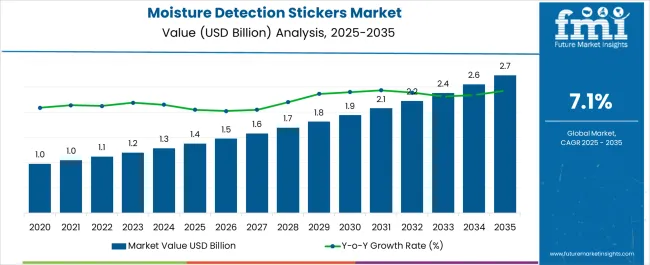
In 2025, the moisture detection stickers market was valued at USD 610.0 million. As per FMI's projection, demand for moisture detection stickers is estimated to grow to USD 641.1 million in 2026 and USD 1,003.1 million by 2036. FMI projects a CAGR of 5.1% during the forecast period.
Procurement teams in high-liability sectors are abandoning "good enough" visual checks in favor of audit-ready compliance tools, fundamentally reshaping the vendor landscape. As aerospace and semiconductor leaders enforce zero-defect mandates, the cost of moisture damage, often exceeding millions in scrapped wafers, far outweighs the premium for certified indicators. This risk asymmetry is driving a "flight to quality," where buyers readily absorb higher unit costs for stickers verified against IPC/JEDEC J-STD-033 protocols, effectively sidelining suppliers of generic colorimetric indicator labels who cannot guarantee precise transition points.
Summary of Moisture Detection Stickers Market
- Moisture Detection Stickers Market Definition
- The industry covers chemical and digital-hybrid visual indicators used to verify environmental integrity inside hermetically sealed packaging.
- Demand Drivers in the Market
- Strict JEDEC standards for semiconductor dry-packing require precise 10% RH indication [2].
- Pharmaceutical export growth from emerging markets necessitates USFDA-compliant moisture barriers [3].
- Construction material testing reforms in the UK drive demand for verifiable material integrity [4].
- Key Segments Analyzed in the FMI Report
- Product: Cup Method Testers dominant (45%) versus emerging dynamic systems.
- Application: Packaging Materials Testing (42%) and pharma moisture barrier film coating validation.
- Geography: High-growth Asia-Pacific manufacturing hubs versus regulatory-heavy North America.
- Analyst Opinion at FMI
- Ismail Sutaria, Principal Consultant for Packaging at Future Market Insights, opines, "In the updated version of the Moisture Detection Stickers Market Report for 2026 to 2036, CXOs will find insights into the rapid displacement of cobalt-based indicators by eco-friendly alternatives. Besides this, my findings point at the convergence of time temperature indicator labels with moisture sensing, creating a new premium tier for biologics shipping."
- Strategic Implications/Executive Takeaways
- Shift focus from bulk sticker production to "smart" audit-ready formats.
- Treat moisture indication as a compliance service rather than a consumable commodity.
- Prioritize cobalt-free formulations to meet EU REACH and varying global safety standards.
- Methodology
- Validated through first-hand corporate production and capacity data.
- Zero reliance on speculative third-party market research reports.
- Based on verifiable industrial benchmarks and verified sources.
David A. Zapico, Chairman & CEO of AMETEK, noted regarding the broader instrument demand environment, "For 2025, we expect overall sales to be up low single digits on a percentage basis compared to 2024. Adjusted earnings per diluted share are expected to be in the range of $7.02 to $7.18, an increase of 3% to 5% over the comparable basis for 2024." [1] This financial discipline indicates that while industrial buyers are cautious with capex, they are investing in operational efficiency tools that reduce waste, such as high-fidelity freshness monitoring packaging solutions.
India’s moisture detection stickers market is projected to grow at a 5.8% CAGR, driven largely by pharmaceutical exporters upgrading to FDA‑compliant packaging to safeguard high‑value biologics, while China, growing at 5.5% CAGR, is propelled by its aggressive push toward a USD 1 trillion semiconductor industry that demands extensive use of dry‑packing indicators. Brazil, with a 5.0% CAGR, is experiencing growth due to ANVISA’s regulatory overhaul, which is clearing product backlogs and accelerating the need for packaging verification. In the United States, expanding at 4.8% CAGR, adoption is fueled by the integration of smart sensing technologies across defense and aerospace supply chains. Meanwhile, the United Kingdom’s 4.5% CAGR is supported by post‑Brexit construction standards that have created a unique dual‑compliance environment, increasing demand for precise material moisture testing.
Moisture Detection Stickers Market Definition
Moisture detection stickers, often referred to as Humidity Indicator Cards (HICs) or irreversible moisture labels, are chemically treated paper or composite indicators that change color when relative humidity (RH) exceeds a specific threshold. These devices provide a visual go/no-go verification for supply chain integrity, alerting users to potential moisture damage in sealed environments.
Moisture Detection Stickers Market Inclusions
The report includes a comprehensive analysis of market dynamics, featuring Global and Regional Market Sizes (Volume and Value) and a 10-year Forecast (2026-2036). It covers reversible and irreversible color-change stickers, cobalt-dichloride free variants, and hybrid indicators used in industrial packaging, electronics shipping, and dry-packing applications.
Moisture Detection Stickers Market Exclusions
The scope excludes electronic data loggers or battery-powered humidity sensor hardware unless they are integrated into a hybrid label format. It also omits bulk desiccant sales and general packaging labels that do not possess active moisture-sensing chemical properties.
Moisture Detection Stickers Market Research Methodology
- Primary Research: Interviews were conducted with quality assurance managers in pharma and electronics, compliance officers, and label converters.
- Desk Research: Production data from packaging associations, trade classifications for chemical indicators, and regulatory filings supported volume benchmarking.
- Market-Sizing and Forecasting: A hybrid top-down and bottom-up model was developed.
- Data Validation and Update Cycle: Outputs undergo anomaly screening against semiconductor shipment volumes and pharmaceutical export data.
Segmental Analysis
Moisture Detection Stickers Market Analysis by Application
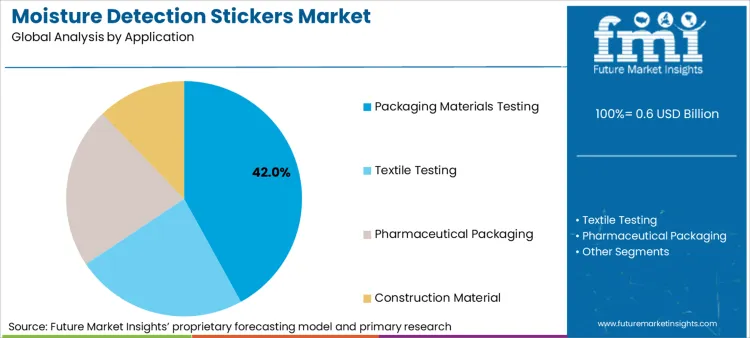
According to FMI's estimates, the pharmaceutical packaging segment is projected to maintain dominance, driven by the critical need to protect hygroscopic formulations during cross-border transit. As India's pharmaceutical exports reached approximately USD 30.47 billion in FY 2024-25, marking a 9.4% increase, the volume of outgoing shipments requiring rigorous moisture verification has surged proportionately [3]. This export-led volume is further amplified by the integration of moisture resistant packaging protocols, where stickers serve as the primary visual audit tool for customs and quality officers at destination ports.
- Packaging Materials Testing: Dominates with 42% share, fueled by e-commerce logistics and the need for water dissolvable labels in sustainable applications; recent UK regulations on material conformity further bolster this segment [4].
- Textile Testing: Growth is steady, supported by protocols to prevent mold in bulk garment shipping using printed labels with active sensors, essential for apparel exporters in Southeast Asia.
- Electronics: Driven by the need to bake components if indicators show 10% RH or higher before surface mounting, a mandate that is non-negotiable for automotive chip suppliers [2].
Moisture Detection Stickers Market Analysis by Product Type
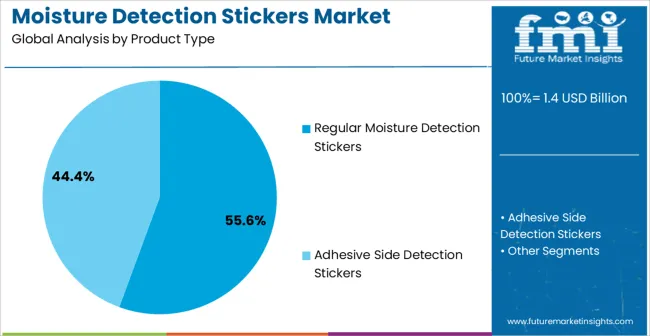
Cup Method Testers account for 45% of the market due to their entrenched status in standard gravity-based permeability testing, but demand is bifurcating toward automated solutions. The rise of "smart stickers" featuring RFID tags with loop antennas allows for non-destructive environmental sensing, as evidenced by the US Navy's 2024 patent grant for passive wireless sensors [5]. This shift allows high-volume logistics hubs to replace manual visual checks with automated scanning using advanced labeling and coding equipment, significantly reducing labor costs in warehousing.
- Cup Method Testers: Remains the cost-effective standard for routine material barrier testing, widely utilized by small-to-medium enterprises for basic compliance.
- Automatic/Continuous Testers: Gaining traction in high-throughput lines utilizing modern label applicators, particularly in 24/7 semiconductor fabrication plants.
- Dynamic Systems: Preferred for R&D applications requiring real-time permeation data, often integrated with humidity sensor arrays for precise mapping.
Moisture Detection Stickers Market Drivers, Restraints, and Opportunities
As per FMI's estimates, the primary driver for market acceleration is the tightening of global quality standards in the semiconductor supply chain. With the global semiconductor market projected to surpass USD 1 trillion by 2030, the absolute volume of moisture-sensitive devices (MSDs) requiring dry-packing is expanding at double-digit rates [6]. This compels manufacturers to adopt updated JEDEC-compliant indicators that trigger baking protocols if humidity breaches safe limits, ensuring yield protection in high-value wafer shipments. Additionally, the expansion of electrical labels into moisture sensing roles is creating new value pools.
Restraints remain concentrated around the fragmentation of regulatory approvals and the slow adoption of digital reading infrastructure in emerging markets. While the UK has extended recognition of CE marking for construction products, creating some continuity, the divergence of standards between post-Brexit Britain and the EU complicates inventory management for testing materials [4]. Opportunity lies in the "smart packaging" revolution; companies like Tageos are opening innovation centers to develop flexible sensors that integrate moisture detection directly into labels tapes and films, bridging the gap between physical stickers and digital IoT [7].
- Regulatory Harmonization: FDA alignment with ISO 13485 standards simplifies global compliance for medical device packaging, encouraging standardized labeling [8].
- Infrastructure Investment: New label printer technologies allow on-demand printing of active indicator zones, reducing inventory waste.
- Pharmaceutical Backlog Clearance: Brazil's expedited regulatory review process unlocks immediate demand for compliant packaging components [9].
Regional Analysis
Based on the regional analysis, Moisture Detection Stickers market is segmented into North America, Latin America, Europe, East Asia, South Asia, Oceania and Middle East & Africa across 40+ countries. The full report also offers market attractiveness analysis based on regional trends.
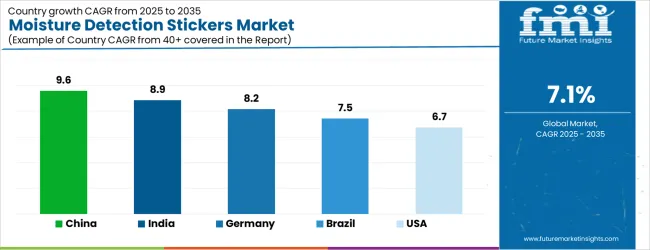
| Country | CAGR (2026 to 2036) |
|---|---|
| India | 5.8% |
| China | 5.5% |
| Brazil | 5.0% |
| United States | 4.8% |
| United Kingdom | 4.5% |
Source: Future Market Insights (FMI) analysis, based on proprietary forecasting model and primary research
Asia Pacific Moisture Detection Stickers Market Analysis
Asia Pacific demand is anchored by its role as the global factory for moisture-sensitive electronics and generic pharmaceuticals, where export rejection risks drive the adoption of high-fidelity indicators. The region's semiconductor dominance, particularly with China's push toward self-sufficiency and the rapid growth of server network chips, necessitates rigorous dry-packing protocols to prevent delamination during reflow soldering [6]. In parallel, the Indian market is evolving from basic compliance to competitive quality assurance, where exporters use premium stickers to signal reliability to Western buyers.
- India: Adoption is accelerating at 5.8% CAGR through 2036. The pharmaceutical sector's export growth to USD 30.47 billion directly fuels the consumption of FDA-compliant moisture indicators [3].
- China: Consumption is growing at 5.5% CAGR through 2036. The semiconductor industry's trajectory toward USD 1 trillion by 2030 underpins massive volume requirements for JEDEC-standard packaging [6].
FMI’s report includes a detailed analysis of growth in the Asia Pacific region, along with a country-wise assessment that includes India and China. Readers can also find regional trends, regulations, and market growth based on different segments and countries in Asia Pacific. Other key markets such as South Korea and Taiwan are also critical due to their high concentration of wafer fabrication facilities requiring stringent moisture control.
North America Moisture Detection Stickers Market Analysis
As per FMI's projection, North America is characterized by a "Compliance-Led Digitalisation" trend, where high-value aerospace and medical supply chains are replacing analog indicators with digital-ready counterparts. The region's growth is supported by a robust medical device sector, where the FDA's harmonization with ISO 13485 requires stringent quality management systems for packaging integrity [8]. Furthermore, major instrumentation players like AMETEK are reporting record sales, indicating a healthy industrial capital environment that supports investments in advanced labeling equipment and testing infrastructure [1].
- United States: The market is projected to expand at a 4.8% CAGR through 2036. Growth is driven by the need for advanced oxygen indicator labels and moisture sensors in medical logistics [8].
FMI’s report includes a detailed analysis of growth in the North America region, along with a country-wise assessment that includes the United States. Readers can also find regional trends, regulations, and market growth based on different segments and countries in North America. Canada and Mexico also present growing opportunities, particularly in cross-border automotive parts logistics where humidity monitoring is standard practice.
Europe Moisture Detection Stickers Market Analysis
FMI analysts opine that Europe serves as the regulatory bellwether for the industry, where circular economy goals and construction safety standards dictate material testing requirements. The UK's decision to indefinitely recognize CE marking for construction products while simultaneously implementing new safety mandates creates a complex but volume-positive environment for material testing and verification [4]. Innovation is also central here, with Germany hosting new centers of excellence for smart packaging, pushing the market toward integrated sensor solutions that reduce plastic waste [7].
- United Kingdom: Sales are projected to rise at 4.5% CAGR through 2036. The indefinite recognition of CE marking for construction products stabilizes supply chains while maintaining rigorous testing volumes [4].
FMI’s report includes a detailed analysis of growth in the Europe region, along with a country-wise assessment that includes the United Kingdom. Readers can also find regional trends, regulations, and market growth based on different segments and countries in Europe. Germany and France remain pivotal markets due to their advanced industrial bases and strict environmental packaging laws.
Latin America Moisture Detection Stickers Market Analysis
As per FMI's estimates, Latin America is emerging as a critical modernization hub, driven by regulatory agencies actively clearing administrative bottlenecks to boost trade efficiency. Brazil's health regulatory agency, ANVISA, has implemented new resolutions to reduce a massive queue of product requests, which directly accelerates the approval and subsequent packaging requirements for thousands of pharmaceutical and food products [9]. This bureaucratic "debottlenecking" is converting potential demand into actual sales for packaging testing supplies and ripeness indicator labels.
- Brazil: The market is poised for 5.0% CAGR growth through 2036. ANVISA's restructuring to clear a queue of 2,200 product requests accelerates demand for compliant packaging testing [9].
FMI’s report includes a detailed analysis of growth in the Latin America region, along with a country-wise assessment that includes Brazil. Readers can also find regional trends, regulations, and market growth based on different segments and countries in Latin America. Other nations like Chile and Argentina are increasingly adopting moisture controls for their agricultural exports, expanding the market scope beyond industrial manufacturing.
Competitive Aligners for Market Players
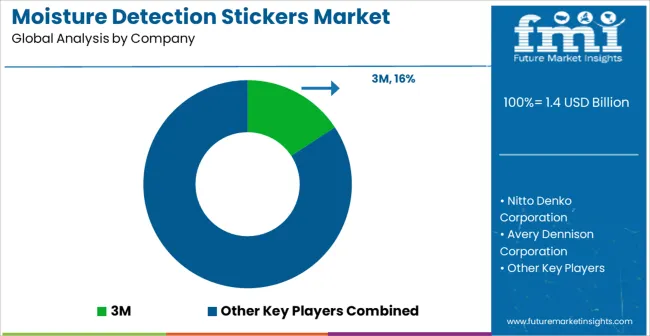
The market structure remains fragmented but is consolidating around players who can offer integrated testing and indication solutions. Companies are moving beyond selling standalone stickers to providing complete colour changing packaging systems that integrate with automated packing lines. This favors suppliers with strong R&D capabilities in material science and digital connectivity.
Primary competitive variable is the ability to meet evolving technical standards across different jurisdictions. Manufacturers that align their product portfolios with IPC/JEDEC standards for electronics and ISO specifications for medical devices are securing long-term contracts with global OEMs. Conversely, suppliers relying solely on generic indicators are facing margin compression as buyers consolidate vendors.
M&A activity highlights a trend toward vertical integration in quality assurance. In 2025, AMETEK completed the acquisition of FARO Technologies, a leader in measurement solutions, and Kern Microtechnik, enhancing its inspection portfolio [10]. This suggests a future where moisture detection is part of a broader "connected quality" ecosystem rather than a discrete consumable purchase.
Recent Developments:
The report includes full coverage of key trends from competitive benchmarking. Some of the recent developments covered in the reports:
- In January 2024, the US Navy was granted US Patent 11,875,211 for "Smart stickers," featuring RFID tags with loop antennas to transmit environmental sensor data [5].
- In April 2025, Tageos announced the launch of an Innovation Center of Excellence in Munich to create flexible batteries and sensors for smart packaging innovation [7].
Key Players in Moisture Detection Stickers Market
- Mocon Inc.
- TexTest AG
- Labthink Instruments
- TQC Sheen
- KJ LCB Scientific
Scope of the Report
| Metric | Value |
|---|---|
| Quantitative Units | USD 641.1 million (2026) to USD 1,003.1 million (2036), at a CAGR of 5.1% |
| Market Definition | Moisture detection stickers are chemical or hybrid visual indicators used to verify relative humidity exposure inside sealed packaging, serving as a primary quality assurance tool for moisture-sensitive goods. |
| Product Type Segmentation | Cup Method Testers, Automatic/Continuous Testers, Gravimetric Testers, Dynamic Systems |
| Application Segmentation | Packaging Materials Testing, Textile Testing, Pharmaceutical Packaging, Construction Material |
| Application Coverage | Wood Adhesives, Molding Compounds, Textiles, Laminates, Coatings |
| Regions Covered | North America, Latin America, Europe, Asia Pacific, Middle East and Africa |
| Countries Covered | United States, United Kingdom, China, India, Brazil |
| Key Companies Profiled | Mocon Inc., TexTest AG, Labthink Instruments, TQC Sheen, KJ LCB Scientific |
| Forecast Period | 2026 to 2036 |
| Approach | Hybrid top down and bottom up market modeling validated through primary interviews with resin producers and panel manufacturers, supported by trade data benchmarking and plant level capacity verification |
Moisture Detection Stickers Market Analysis by Segments
Product Type
- Cup Method Testers
- Automatic/Continuous Testers
- Gravimetric Testers
- Dynamic Systems
Application
- Packaging Materials Testing
- Textile Testing
- Pharmaceutical Packaging
- Construction Material
Region
- Asia Pacific
- India
- China
- Japan
- South Korea
- Indonesia
- Australia & New Zealand
- ASEAN
- Rest of Asia Pacific
- Europe
- Germany
- Italy
- France
- United Kingdom
- Spain
- Benelux
- Nordics
- Central & Eastern Europe
- Rest of Europe
- North America
- United States
- Canada
- Mexico
- Latin America
- Brazil
- Argentina
- Chile
- Rest of Latin America
- Middle East & Africa
- Kingdom of Saudi Arabia
- United Arab Emirates
- South Africa
- Turkey
- Rest of Middle East & Africa
Bibliography
- [1] AMETEK Inc. (2025). AMETEK Announces Record Fourth Quarter and Full Year Results. Corporate Press Release.
- [2] Digi International. (2024). Moisture sensitivity and shelf-life guidance, enforcing baking requirements. Corporate Technical Standard.
- [3] IBEF. (2026). India's pharma sector bullish on export growth; FY25 exports at $30.47 bn. Government Affiliate News.
- [4] GOV.UK. (2024). CE marking for construction products to continue. Government Regulatory Statement.
- [5] US Patent Office. (2024). US Patent 11,875,211: Smart stickers sensors for environmental conditions. Government Patent Grant.
- [6] PwC. (2024). Semiconductor market projected to surpass $1 trillion by 2030. Corporate Market Report.
- [7] Tageos. (2025). Tageos Innovation Center of Excellence launch in Munich. Corporate Announcement.
- [8] FDA. (2024). Quality System Regulation Amendment: ISO 13485 Harmonization. Government Regulatory Rule.
- [9] ANVISA. (2024). 2024 Management Report: Restructuring and queue reduction. Government Regulator Report.
- [10] AMETEK Inc. (2025). Acquisition of FARO Technologies and Kern Microtechnik. Corporate M&A Disclosure.
This Report Addresses
- Market intelligence to enable structured strategic decision making across mature and emerging resin economies
- Market size estimation and 10 year revenue forecasts from 2026 to 2036, supported by validated capacity and trade benchmarks
- Growth opportunity mapping across product types with emphasis on smart label transitions
- Segment and regional revenue forecasts covering packaging, textile, and construction applications
- Competition strategy assessment including M&A impact, cost survivability positioning, and compliance capability benchmarking
- Product reformulation and emission compliance tracking including cobalt-free and digital hybrid grades
- Regulatory impact analysis covering FDA harmonization, JEDEC standards, and export driven specification upgrades
- Market report delivery in PDF, Excel, PPT, and interactive dashboard formats for executive and operational use
Frequently Asked Questions
How large is the demand for Moisture Detection Stickers in the global market in 2026?
Demand for Moisture Detection Stickers in the global market is estimated to be valued at USD 641.1 million in 2026.
What will be the market size of Moisture Detection Stickers in the global market by 2036?
Market size for Moisture Detection Stickers is projected to reach USD 1,003.1 million by 2036.
What is the expected demand growth for Moisture Detection Stickers in the global market between 2026 and 2036?
Demand for Moisture Detection Stickers in the global market is expected to grow at a CAGR of 5.1% between 2026 and 2036.
Which Product Type is poised to lead global sales by 2026?
Cup Method Testers are expected to be the dominant form, capturing approximately 45.0% of global market share in 2026 due to cost-efficiency in standard barrier testing.
How significant is the role of Packaging Materials Testing in driving Moisture Detection Stickers adoption in 2026?
Packaging Materials Testing represents a critical segment, projected to hold a substantial 42.0% share of the total market in 2026 as e-commerce logistics prioritize verifiable seal integrity.
What is driving demand in India?
Demand is driven by pharmaceutical exports reaching USD 30.47 billion, necessitating FDA-compliant moisture verification for US-bound shipments [3].
What compliance standards or regulations are referenced for India?
USFDA compliance and global Good Manufacturing Practices (GMP) are referenced as key benchmarks for pharmaceutical exports.
What is the India growth outlook in this report?
India is projected to grow at a CAGR of 5.8% during 2026 to 2036.
Why is China described as a priority region in this report?
China is prioritized due to its dominance in semiconductor manufacturing, where strict humidity control is essential for preventing chip failures during assembly.
What type of demand dominates in China?
Industrial demand for JEDEC-compliant dry-packing indicators dominates regional consumption to support the electronics supply chain.
What is United States growth outlook in this report?
The United States is projected to expand at a CAGR of 4.8% during 2026 to 2036.
Does the report cover Brazil in its regional analysis?
Yes, Brazil is included within Latin America under the regional scope of analysis.
What are the sources referred to for analyzing Brazil?
Official management reports from ANVISA regarding regulatory queue reduction and product registration updates are cited as primary reference sources.
What is the main demand theme linked to Brazil in its region coverage?
Latin American demand is associated with regulatory debottlenecking that accelerates the commercialization of packaged goods.
Does the report cover United Kingdom in its regional analysis?
Yes, the United Kingdom is included within Europe under the regional coverage framework.
What is the main United Kingdom related demand theme in its region coverage?
Post-Brexit regulatory continuity via the indefinite recognition of CE marking for construction products is emphasized.
Which product formats or configurations are strategically important for Asia Pacific supply chains?
Automated and smart sticker formats are prioritized to reduce labor costs in high-volume electronics packaging hubs.
What is Moisture Detection Stickers and what is it mainly used for?
Moisture detection stickers are visual indicators used to monitor relative humidity levels inside sealed packaging to prevent moisture damage to sensitive goods.
What does Moisture Detection Stickers mean in this report?
Moisture Detection Stickers market refers to global production, trade, and industrial consumption of chemical and hybrid humidity indicators.
What is included in the scope of this Moisture Detection Stickers report?
Scope covers stickers by product type, key applications such as packaging and textile testing, and end-use industries including pharma and construction.
What is excluded from the scope of this report?
Standalone electronic data loggers, bulk desiccants, and non-active packaging labels are excluded unless part of a hybrid system.
What does market forecast mean on this page?
Market forecast represents a model based projection built on defined assumptions for strategic planning purposes.
How does FMI build and validate the Moisture Detection Stickers forecast?
Forecast is developed using hybrid top down and bottom up modeling validated through trade data, capacity checks, and industry review.
Preview the report firsthand - request a free sample
Get SampleGet the brochure for pricing and purchase details.
Get PDFTable of Content
- Executive Summary
- Global Market Outlook
- Demand-side Trends
- Supply-side Trends
- Technology Roadmap Analysis
- Analysis and Recommendations
- Market Overview
- Market Coverage / Taxonomy
- Market Definition / Scope / Limitations
- Research Methodology
- Chapter Orientation
- Analytical Lens and Working Hypotheses
- Market Structure, Signals, and Trend Drivers
- Benchmarking and Cross-market Comparability
- Market Sizing, Forecasting, and Opportunity Mapping
- Research Design and Evidence Framework
- Desk Research Programme (Secondary Evidence)
- Company Annual and Sustainability Reports
- Peer-reviewed Journals and Academic Literature
- Corporate Websites, Product Literature, and Technical Notes
- Earnings Decks and Investor Briefings
- Statutory Filings and Regulatory Disclosures
- Technical White Papers and Standards Notes
- Trade Journals, Industry Magazines, and Analyst Briefs
- Conference Proceedings, Webinars, and Seminar Materials
- Government Statistics Portals and Public Data Releases
- Press Releases and Reputable Media Coverage
- Specialist Newsletters and Curated Briefings
- Sector Databases and Reference Repositories
- FMI Internal Proprietary Databases and Historical Market Datasets
- Subscription Datasets and Paid Sources
- Social Channels, Communities, and Digital Listening Inputs
- Additional Desk Sources
- Expert Input and Fieldwork (Primary Evidence)
- Primary Modes
- Qualitative Interviews and Expert Elicitation
- Quantitative Surveys and Structured Data Capture
- Blended Approach
- Why Primary Evidence is Used
- Field Techniques
- Interviews
- Surveys
- Focus Groups
- Observational and In-context Research
- Social and Community Interactions
- Stakeholder Universe Engaged
- C-suite Leaders
- Board Members
- Presidents and Vice Presidents
- R&D and Innovation Heads
- Technical Specialists
- Domain Subject-matter Experts
- Scientists
- Physicians and Other Healthcare Professionals
- Governance, Ethics, and Data Stewardship
- Research Ethics
- Data Integrity and Handling
- Primary Modes
- Tooling, Models, and Reference Databases
- Desk Research Programme (Secondary Evidence)
- Data Engineering and Model Build
- Data Acquisition and Ingestion
- Cleaning, Normalisation, and Verification
- Synthesis, Triangulation, and Analysis
- Quality Assurance and Audit Trail
- Market Background
- Market Dynamics
- Drivers
- Restraints
- Opportunity
- Trends
- Scenario Forecast
- Demand in Optimistic Scenario
- Demand in Likely Scenario
- Demand in Conservative Scenario
- Opportunity Map Analysis
- Product Life Cycle Analysis
- Supply Chain Analysis
- Investment Feasibility Matrix
- Value Chain Analysis
- PESTLE and Porter’s Analysis
- Regulatory Landscape
- Regional Parent Market Outlook
- Production and Consumption Statistics
- Import and Export Statistics
- Market Dynamics
- Global Market Analysis 2021 to 2025 and Forecast, 2026 to 2036
- Historical Market Size Value (USD Million) Analysis, 2021 to 2025
- Current and Future Market Size Value (USD Million) Projections, 2026 to 2036
- Y-o-Y Growth Trend Analysis
- Absolute $ Opportunity Analysis
- Global Market Pricing Analysis 2021 to 2025 and Forecast 2026 to 2036
- Global Market Analysis 2021 to 2025 and Forecast 2026 to 2036, By Application
- Introduction / Key Findings
- Historical Market Size Value (USD Million) Analysis By Application , 2021 to 2025
- Current and Future Market Size Value (USD Million) Analysis and Forecast By Application , 2026 to 2036
- Packaging Materials Testing
- Textile Testing
- Pharmaceutical Packaging
- Construction Material
- Packaging Materials Testing
- Y-o-Y Growth Trend Analysis By Application , 2021 to 2025
- Absolute $ Opportunity Analysis By Application , 2026 to 2036
- Global Market Analysis 2021 to 2025 and Forecast 2026 to 2036, By Product Type
- Introduction / Key Findings
- Historical Market Size Value (USD Million) Analysis By Product Type, 2021 to 2025
- Current and Future Market Size Value (USD Million) Analysis and Forecast By Product Type, 2026 to 2036
- Cup Method Testers
- Automatic/Continuous Testers
- Gravimetric Testers
- Dynamic Systems
- Cup Method Testers
- Y-o-Y Growth Trend Analysis By Product Type, 2021 to 2025
- Absolute $ Opportunity Analysis By Product Type, 2026 to 2036
- Global Market Analysis 2021 to 2025 and Forecast 2026 to 2036, By Region
- Introduction
- Historical Market Size Value (USD Million) Analysis By Region, 2021 to 2025
- Current Market Size Value (USD Million) Analysis and Forecast By Region, 2026 to 2036
- North America
- Latin America
- Western Europe
- Eastern Europe
- East Asia
- South Asia and Pacific
- Middle East & Africa
- Market Attractiveness Analysis By Region
- North America Market Analysis 2021 to 2025 and Forecast 2026 to 2036, By Country
- Historical Market Size Value (USD Million) Trend Analysis By Market Taxonomy, 2021 to 2025
- Market Size Value (USD Million) Forecast By Market Taxonomy, 2026 to 2036
- By Country
- USA
- Canada
- Mexico
- By Application
- By Product Type
- By Country
- Market Attractiveness Analysis
- By Country
- By Application
- By Product Type
- Key Takeaways
- Latin America Market Analysis 2021 to 2025 and Forecast 2026 to 2036, By Country
- Historical Market Size Value (USD Million) Trend Analysis By Market Taxonomy, 2021 to 2025
- Market Size Value (USD Million) Forecast By Market Taxonomy, 2026 to 2036
- By Country
- Brazil
- Chile
- Rest of Latin America
- By Application
- By Product Type
- By Country
- Market Attractiveness Analysis
- By Country
- By Application
- By Product Type
- Key Takeaways
- Western Europe Market Analysis 2021 to 2025 and Forecast 2026 to 2036, By Country
- Historical Market Size Value (USD Million) Trend Analysis By Market Taxonomy, 2021 to 2025
- Market Size Value (USD Million) Forecast By Market Taxonomy, 2026 to 2036
- By Country
- Germany
- UK
- Italy
- Spain
- France
- Nordic
- BENELUX
- Rest of Western Europe
- By Application
- By Product Type
- By Country
- Market Attractiveness Analysis
- By Country
- By Application
- By Product Type
- Key Takeaways
- Eastern Europe Market Analysis 2021 to 2025 and Forecast 2026 to 2036, By Country
- Historical Market Size Value (USD Million) Trend Analysis By Market Taxonomy, 2021 to 2025
- Market Size Value (USD Million) Forecast By Market Taxonomy, 2026 to 2036
- By Country
- Russia
- Poland
- Hungary
- Balkan & Baltic
- Rest of Eastern Europe
- By Application
- By Product Type
- By Country
- Market Attractiveness Analysis
- By Country
- By Application
- By Product Type
- Key Takeaways
- East Asia Market Analysis 2021 to 2025 and Forecast 2026 to 2036, By Country
- Historical Market Size Value (USD Million) Trend Analysis By Market Taxonomy, 2021 to 2025
- Market Size Value (USD Million) Forecast By Market Taxonomy, 2026 to 2036
- By Country
- China
- Japan
- South Korea
- By Application
- By Product Type
- By Country
- Market Attractiveness Analysis
- By Country
- By Application
- By Product Type
- Key Takeaways
- South Asia and Pacific Market Analysis 2021 to 2025 and Forecast 2026 to 2036, By Country
- Historical Market Size Value (USD Million) Trend Analysis By Market Taxonomy, 2021 to 2025
- Market Size Value (USD Million) Forecast By Market Taxonomy, 2026 to 2036
- By Country
- India
- ASEAN
- Australia & New Zealand
- Rest of South Asia and Pacific
- By Application
- By Product Type
- By Country
- Market Attractiveness Analysis
- By Country
- By Application
- By Product Type
- Key Takeaways
- Middle East & Africa Market Analysis 2021 to 2025 and Forecast 2026 to 2036, By Country
- Historical Market Size Value (USD Million) Trend Analysis By Market Taxonomy, 2021 to 2025
- Market Size Value (USD Million) Forecast By Market Taxonomy, 2026 to 2036
- By Country
- Kingdom of Saudi Arabia
- Other GCC Countries
- Turkiye
- South Africa
- Other African Union
- Rest of Middle East & Africa
- By Application
- By Product Type
- By Country
- Market Attractiveness Analysis
- By Country
- By Application
- By Product Type
- Key Takeaways
- Key Countries Market Analysis
- USA
- Pricing Analysis
- Market Share Analysis, 2025
- By Application
- By Product Type
- Canada
- Pricing Analysis
- Market Share Analysis, 2025
- By Application
- By Product Type
- Mexico
- Pricing Analysis
- Market Share Analysis, 2025
- By Application
- By Product Type
- Brazil
- Pricing Analysis
- Market Share Analysis, 2025
- By Application
- By Product Type
- Chile
- Pricing Analysis
- Market Share Analysis, 2025
- By Application
- By Product Type
- Germany
- Pricing Analysis
- Market Share Analysis, 2025
- By Application
- By Product Type
- UK
- Pricing Analysis
- Market Share Analysis, 2025
- By Application
- By Product Type
- Italy
- Pricing Analysis
- Market Share Analysis, 2025
- By Application
- By Product Type
- Spain
- Pricing Analysis
- Market Share Analysis, 2025
- By Application
- By Product Type
- France
- Pricing Analysis
- Market Share Analysis, 2025
- By Application
- By Product Type
- India
- Pricing Analysis
- Market Share Analysis, 2025
- By Application
- By Product Type
- ASEAN
- Pricing Analysis
- Market Share Analysis, 2025
- By Application
- By Product Type
- Australia & New Zealand
- Pricing Analysis
- Market Share Analysis, 2025
- By Application
- By Product Type
- China
- Pricing Analysis
- Market Share Analysis, 2025
- By Application
- By Product Type
- Japan
- Pricing Analysis
- Market Share Analysis, 2025
- By Application
- By Product Type
- South Korea
- Pricing Analysis
- Market Share Analysis, 2025
- By Application
- By Product Type
- Russia
- Pricing Analysis
- Market Share Analysis, 2025
- By Application
- By Product Type
- Poland
- Pricing Analysis
- Market Share Analysis, 2025
- By Application
- By Product Type
- Hungary
- Pricing Analysis
- Market Share Analysis, 2025
- By Application
- By Product Type
- Kingdom of Saudi Arabia
- Pricing Analysis
- Market Share Analysis, 2025
- By Application
- By Product Type
- Turkiye
- Pricing Analysis
- Market Share Analysis, 2025
- By Application
- By Product Type
- South Africa
- Pricing Analysis
- Market Share Analysis, 2025
- By Application
- By Product Type
- USA
- Market Structure Analysis
- Competition Dashboard
- Competition Benchmarking
- Market Share Analysis of Top Players
- By Regional
- By Application
- By Product Type
- Competition Analysis
- Competition Deep Dive
- Mocon Inc.
- Overview
- Product Portfolio
- Profitability by Market Segments (Product/Age /Sales Channel/Region)
- Sales Footprint
- Strategy Overview
- Marketing Strategy
- Product Strategy
- Channel Strategy
- TexTest AG
- Labthink Instruments
- TQC Sheen
- KJ LCB Scientific
- Mocon Inc.
- Competition Deep Dive
- Assumptions & Acronyms Used


