

- Industry Size (2026)
- USD 250.8 Mn
- Forecast (2036)
- USD 923.4 Mn
- CAGR (2026 to 2036)
- 13.9%
Haptic Feedback Yarns Market Forecast and Outlook 2026 to 2036
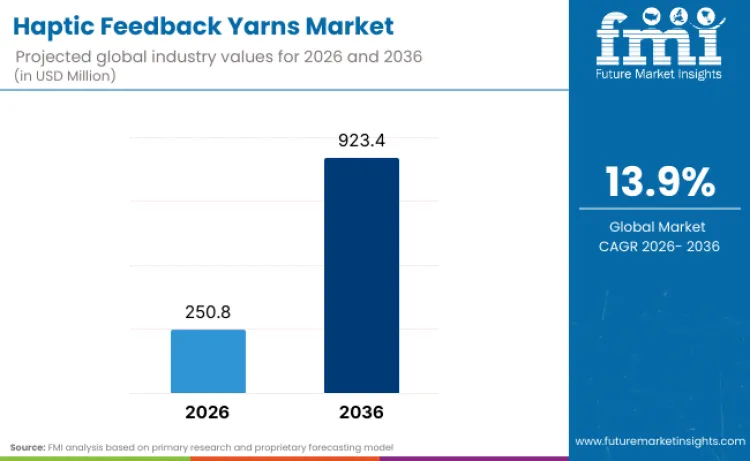
The global haptic feedback yarns space is valued at USD 250.8 million in 2026 and is projected to reach USD 923.4 million by 2036, reflecting a 13.9% CAGR. Expansion is not coming from cosmetic textile integrations or incremental refinements to vibration motors. Demand is forming around ways of delivering tactile feedback directly within wearable architectures, where haptic functionality is treated as part of the garment structure rather than an attached device.
Haptic systems are shifting from discrete hardware modules toward yarn- and fabric-level integration. This reflects practical advantages of textiles, including distributed contact across the body and sustained wear without added bulk or stiffness. Adoption concentrates in applications where tactile feedback carries a functional burden rather than a cosmetic one, including immersive XR peripherals, training garments, and rehabilitation wearables that depend on repeatable, body-mapped cues.
Design behavior among developers and OEMs reflects repeated exposure to failure during wear, washing, and assembly. Early wearable haptic designs commonly used stitched or bonded motor modules that showed performance loss after bending, moisture exposure, and wash cycles. These configurations introduced interface failure points between rigid components and flexible substrates. Current development programmes prioritize yarn-level or fabric-integrated actuation to reduce these failure points and simplify garment assembly under production conditions.
Similar patterns appeared earlier in smart textile programmes, particularly once durability testing moved beyond lab conditions. In those cases, sensing functions migrated from attached components into fibre-based constructions to maintain performance under repeated mechanical and environmental stress. Haptic integration is following a comparable path, shaped by the need for stable output under flexing, abrasion, and laundering rather than short-term demonstration performance.
Software toolchains and system-level integration practices are supporting wider deployment. As haptic content becomes easier to design and deploy alongside audio-visual systems, textile-based haptics are treated as reusable interfaces across multiple wearable formats. This reduces integration effort and allows consistent actuation platforms to be carried across different garment designs.
From FMI’s perspective, expansion is constrained less by concept availability and more by execution reliability under textile conditions. Suppliers that demonstrate consistent tactile performance after flexing, abrasion, and laundering, supported by controlled manufacturing processes, are better positioned for scale deployment.
Designs that cannot maintain performance under real textile use conditions are likely to remain limited to pilot-stage projects. Supplier selection increasingly prioritizes reliability, integration discipline, and textile-scale manufacturability, with haptic feedback yarns specified as functional components within next-generation wearable platforms.
Summary of the Haptic Feedback Yarns Market
How Is the Haptic Feedback Yarns Market Expected to Scale Through 2036?
Future Market Insights projects the haptic feedback yarns market to expand at a 13.9% CAGR between 2026 and 2036, increasing from USD 250.8 million in 2026 to USD 923.4 million by 2036.
FMI Research Approach: Projections are based on bottom-up revenue estimation, primary interviews with smart-textile integrators and wearable OEMs, and scenario modelling tied to XR accessory penetration and training system procurement cycles.
How are FMI Analysts Interpreting the Structural Shift in Haptic Feedback Yarns?
FMI analysts observe a clear transition from discrete vibration modules toward fibre-native actuation architectures. Early designs relying on stitched or bonded motors face scaling penalties from rigid interfaces and assembly complexity.
FMI Research Approach: Insights draw on comparative analysis of pilot deployments versus scaled production lines, procurement behaviour across XR and training wearables, and integration constraint mapping across knitting, embroidery, and garment assembly workflows.
Where is Ecosystem Density Most Strongly Concentrating Market Share?
China holds the largest share due to dense overlap between textile manufacturing, consumer electronics assembly, and high-volume wearable production. This ecosystem shortens iteration cycles and supports faster refinement of yarn-based actuation platforms compared with regions reliant on modular hardware integration.
FMI Research Approach: Country-level assessment integrates manufacturing ecosystem density, peripheral device output, and supplier proximity to downstream wearable OEMs.
What Market Size Does FMI Anticipate at the End of the Forecast Period?
By 2036, the haptic feedback yarns market is expected to reach USD 923.4 million, supported by scaled adoption in XR accessories and outcome-priced training and rehabilitation wearables where tactile feedback improves immersion, task accuracy, and adherence.
FMI Research Approach: Market sizing reflects application-level value capture, integration economics, and willingness to pay for durability-validated tactile interfaces rather than unit shipment growth alone.
How does FMI Define the Commercial Scope of Haptic Feedback Yarns?
Haptic feedback yarns are functional textile yarn systems designed to generate tactile output through vibration, deformation, pressure modulation, or spatially mapped stimulation when activated by electrical or related stimuli.
FMI Research Approach: Definition follows FMI’s functional-integration framework, capturing yarn-level revenues where tactile output is delivered through textile structures rather than attached hardware.
What Distinct Global Forces Are Shaping This Market’s Direction?
Interface migration into textiles, where garments act as sensing-and-response platforms. The rising importance of deformation-tolerant conductive infrastructure that supports repeated motion. Premiumisation around immersion and training outcomes, which increases the value of spatially mapped tactile feedback over simple vibration. These three trends shape demand in this industry.
FMI Research Approach: Trend identification is grounded in cross-category benchmarking against interactive textiles, conductive fibre systems, and immersive wearable ecosystems.
Why is Demand for Haptic Feedback Yarns Accelerating across Wearable Categories?
Demand is accelerating because textile-integrated haptics unlock interaction modes that rigid devices cannot efficiently deliver. Textiles distribute sensation across larger surface areas with lower mass, enable non-visual guidance in training and rehabilitation, and integrate into garments without restricting movement, supporting long-duration wear.
FMI Research Approach: Demand drivers are assessed through application-level outcome analysis, buyer interviews, and evaluation of failure points in rigid-module haptic systems under real garment use.
Haptic Feedback Yarns Market Key Takeaways
| Metrics | Value |
|---|---|
| Market Value (2026E) | USD 250.8 million |
| Market Value (2036F) | USD 923.4 million |
| CAGR (2026-2036) | 13.9% |
Source: Future Market Insights analysis, supported by a proprietary forecasting model and primary research
Why is the Haptic Feedback Yarns Market Expanding?
Haptic feedback yarns demand is driven by system-level economics and procurement realities. XR accessory monetisation pushes early scale. Haptics increases perceived immersion, improving accessory attach rates and retention in ecosystems already expanding across wearable computing devices. As XR peripherals multiply, textile-based haptics gains relevance as an interface layer that can be deployed across gloves, sleeves, vests, and straps.
Training and simulation procurement provides a second growth lane. Training budgets support higher BOM where tactile cues reduce mistakes and shorten instruction cycles. These buyers prioritise repeatability and ruggedness, which raises the value of yarn architectures with stable output after repeated flex and cleaning.
Rehabilitation and medical feedback demand is rising as feedback improves adherence and measurable outcomes. This strengthens interest in wearable therapeutic systems adjacent to medical wearable devices, where comfort, skin-contact acceptability, and durability define adoption.
Actuation economics shape technology selection. Fibre-native actuation improves manufacturability by reducing component count and assembly steps. Embedded motor approaches remain relevant in early iterations, yet face scaling penalties from rigid interfaces and higher defect risk under garment stress.
How is the Haptic Feedback Yarns Market Segmented?
Why do Electroactive Polymer-based Yarns hold a Dominant Share?
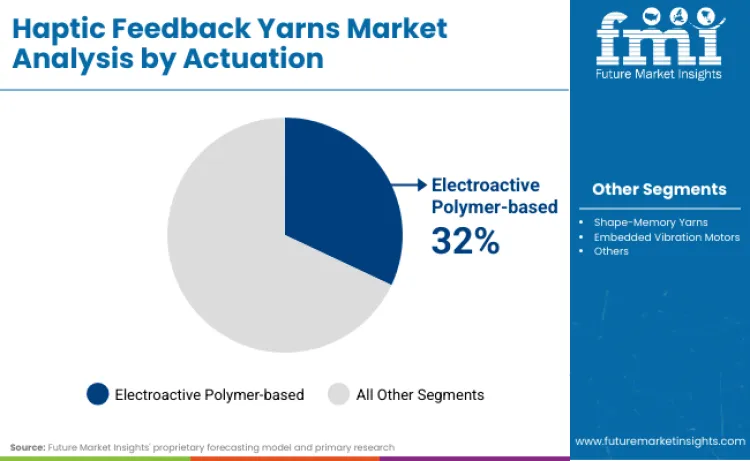
Electroactive polymer-based yarns hold a 32% share because they fit the wearable constraint set: conformability, low bulk, and distributed tactile mapping potential. EAP architectures reduce reliance on rigid housings and discrete mounting points, lowering the number of failure-prone interfaces. This improves survivability under bending, seam stress, and repeated wear.
EAP leadership also reflects integration logic. When actuation is material-native, designers can place tactile zones using textile geometry rather than hardware placement. This reduces engineering time and supports more repeatable manufacturing routines. The same integration discipline underpins scaling behaviour in smart fabrics, where performance depends on textile construction choices as much as on raw material capability.
How will Immersive Gaming and AR/VR Wearables lead by Application?
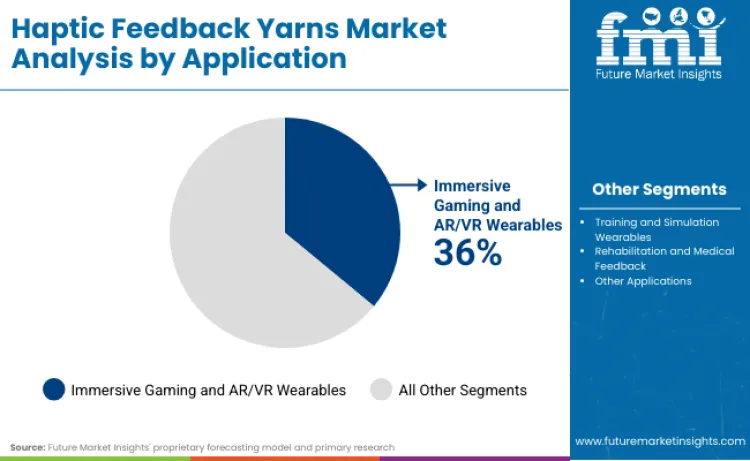
Capturing a 36% share in 2026, immersive gaming and AR/VR wearables will be the dominant application segment. XR ecosystems reward features that raise realism, spatial awareness, and task engagement. Textile haptics provides a scalable form factor for multi-point feedback in gloves, sleeves, and vests, enabling richer interaction than single-point vibration modules.
This segment also benefits from ecosystem readiness. Peripheral adoption is already normalised in immersive setups, reducing behavioural friction. Demand aligns with broader technological patterns witnessed in virtual reality (VR), where accessory ecosystems expand as platform content libraries mature.
Why is Signal Standardisation and SDK-first Integration Rewriting Adoption Risk?
The largest hidden cost in haptic textiles is integration, not yarn purchase price. OEMs absorb engineering time to map signals, calibrate output zones, manage power constraints, and maintain performance through garment lifecycle stress. Any reduction in software friction changes procurement behaviour.
Standardised haptic media handling increases confidence that investments will scale across platforms rather than remain trapped inside single-device ecosystems. SDK-first approaches lower adoption friction further by enabling developers to author tactile effects without rebuilding the entire control layer for each integration.
FMI expects suppliers that provide integration tooling, validated calibration routines, and clear failure-mode documentation convert product trials into repeatable purchase programs. This is consistent with scaling patterns observed in IoT wearables, where ecosystems reward hardware that reduces developer workload and increases reliability.
How is Public Scale-up Infrastructure Changing Prototype-to-Production Probability?
Public scale-up mechanisms reduce the time and capital required to reach manufacturing readiness. Access to specialised equipment and expert support improves process repeatability and endurance testing discipline, shifting textile haptics from fragile prototypes toward qualification-grade products.
FMI expects these mechanisms to accelerate regional capability clustering, with suppliers locating near test infrastructure, advanced textile lines, and downstream OEM engineering teams.
Why is Materials Portfolio Repositioning Creating a Higher-margin Lane for Haptic Yarns?
Textile and materials leaders are reallocating effort from commodity segments toward speciality platforms where functionality can command pricing power. Haptic yarns benefit from this repositioning because they require tight process control and sustained R&D, conditions that commodity yarn economics do not support.
What is the Country-wise Profile of the Haptic Feedback Market?
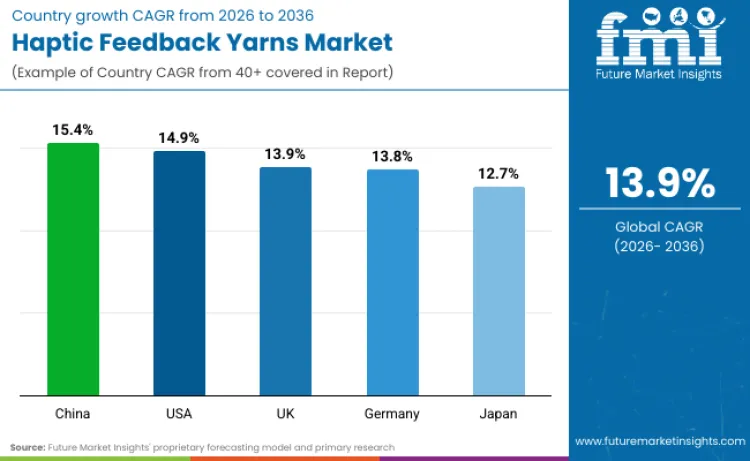
| Country | CAGR (2026-2036) |
|---|---|
| USA | 14.9% |
| UK | 13.9% |
| China | 15.4% |
| Germany | 13.8% |
| Japan | 12.7% |
Source: Future Market Insights’ proprietary forecasting model and primary research
Will the USA’s qualification culture and XR ecosystem density convert pilots into scaled procurement?
Two demand engines that favour qualification-ready suppliers support USA growth at a 14.9% CAGR. XR and gaming accessory ecosystems create commercial pull where tactile features raise perceived immersion and justify premium peripheral pricing. Adoption scales when haptic garments integrate cleanly with platform software and maintain output consistency across sessions. This strengthens relevance for suppliers positioned near the consumer ecosystem expansion visible across gaming peripherals.
Industrial training and simulation programs favour tactile guidance that reduces mistake rates and shortens time-to-competency. These buyers impose endurance expectations closer to industrial PPE than consumer apparel. Procurement evaluates stability under flex, abrasion, sweat exposure, and cleaning cycles, then demands process documentation and change control to prevent performance drift across lots.
As per FMI’s study, the USA becomes a price-setting market for qualification discipline. Suppliers that secure early design wins in training and XR ecosystems create defensible installed bases because integration recalibration costs discourage switching once programs scale.
Will UK rehabilitation economics and standards-led procurement sustain without widening product liability exposure?
UK’s expansion at a 13.9% CAGR is shaped by the interaction of healthcare adoption logic and traceability expectations. Rehabilitation and assistive wearables create demand where tactile feedback improves adherence and patient engagement. Buyers evaluate whether haptic cues improve measurable outcomes, not whether the technology is novel.
UK’s adoption pathway rewards suppliers that can quantify performance retention and provide integration guidance aligned with product safety norms. This matters because textile haptics introduces new failure modes: output drift, hot spots, connector fatigue, and skin-contact discomfort. These issues translate into returns and liability risk in healthcare-adjacent channels.
FMI expects commercial success to concentrate in products where tactile cues reduce clinician time, improve patient compliance, or enable remote guidance. This aligns with adoption patterns surrounding rehabilitation robots, where technology wins when it reduces burden and improves outcomes rather than adding complexity.
Will China’s ecosystem density and manufacturing scale sustain the fastest trajectory while reducing interface failure rates?
China leads at a 15.4% CAGR because it combines high-volume textile production with electronics assembly capability and dense consumer device ecosystems. This compresses iteration cycles and reduces cost per design loop, which matters in haptics where tuning, calibration, and durability refinement determine user acceptance.
Scale economics favour architectures that reduce assembly steps and minimise rigid interfaces. Fibre-level actuation and textile-geometry-defined tactile zoning create advantages because they move complexity upstream into yarn and fabric design, then simplify final assembly. Embedded motor approaches remain relevant for fast product launches, yet face higher defect risk under garment flex and impact.
China’s winning suppliers will be those that industrialise repeatable actuator yarn behaviour and provide integration toolchains that reduce downstream engineering time. Market pull also aligns with broader device ecosystem scaling visible across smart wearables, yet the constraint remains durability under real use, which becomes the decisive differentiator at volume.
Will Germany’s engineering-first buyer base drive expansion through industrial safety and automotive interface programs?
Germany grows at a 13.8% CAGR because adoption is anchored in engineered use cases where tactile feedback reduces cognitive load and improves safety. Industrial wearables that deliver non-visual alerts, guidance cues, or hazard notifications fit Germany’s safety culture and process discipline.
Automotive interiors represent a second lane. Tactile cues integrated into seats, steering interfaces, and contact surfaces can improve user experience without adding visible UI clutter. Yet automotive buyers require long-life endurance under heat, vibration, and mechanical stress.
Procurement prioritises measurable durability, repeatable output under thermal cycling, and defined maintenance or replacement pathways. Germany is likely to reward suppliers that treat haptic textiles as engineered systems rather than apparel features. Adoption logic mirrors industrial scaling patterns in industrial wearables, where reliability and integration discipline determine scale.
Will Japan’s precision materials strategy stimulate growth through premium interface design rather than mass-market volume?
Japan expands at a 12.7% CAGR with a premium-led adoption pathway. Demand concentrates where tactile nuance, comfort, and product finish quality justify higher BOM, including premium XR peripherals, specialised training wearables, and refined rehabilitation interfaces.
Japan’s advantage sits in process control and materials engineering. Haptic yarn architectures benefit when performance variance is tightly managed because tactile perception amplifies small inconsistencies. Output drift, uneven zoning, or stiffness changes degrade user acceptance faster than in many sensing-only smart textile products.
Japan will likely sustain growth by owning the high-fidelity end of the haptic textile spectrum rather than chasing lowest-cost volume. This premium pathway connects with adjacent growth narratives in augmented reality (AR), where experience quality and ecosystem differentiation support higher-value peripherals.
How is the Competitive Landscape in Haptic Feedback Yarns Evolving?
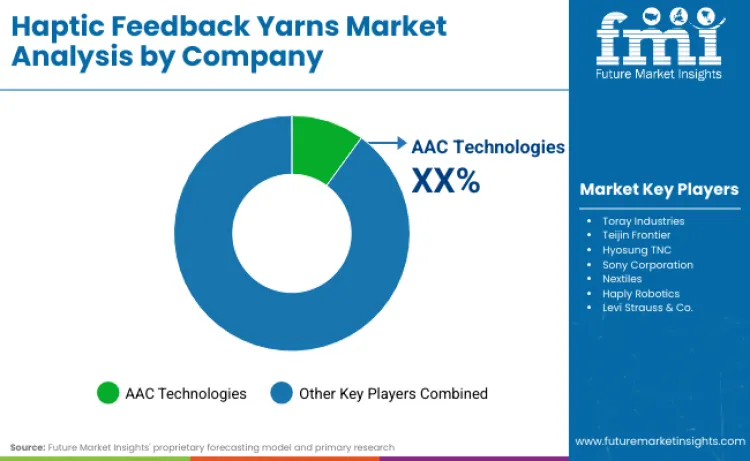
Competitive positioning in haptic feedback yarns has shifted away from headline vibration strength or prototype novelty. Supplier differentiation now centers on execution reliability, integration control, and performance under real textile use conditions.
Blueprint inputs indicate reduced reliance on add-on haptic modules in favor of fibre-level actuation approaches. Advantage is increasingly tied to yarn mechanics, textile architecture, and lifecycle performance rather than motor miniaturisation. Attention has moved toward how actuation survives bending, abrasion, perspiration exposure, laundering, and garment assembly.
Documented failure modes, calibration retention, and lot-to-lot stability shorten OEM validation cycles and reduce downstream warranty exposure. Performance claims unsupported by endurance data carry limited credibility. Procurement decisions depend on whether tactile output remains consistent after textiles are processed, worn, cleaned, and reassembled into finished garments. Qualification evidence at the textile and garment level has become a primary filter during supplier selection.
Blueprint findings point toward architectures with intrinsic textile-level intelligence. Suppliers embedding actuation into yarns or fabric geometries avoid failure points created by bonded modules and rigid housings. Advantage emerges from textile constructions where actuation, conductivity, and mechanical compliance are engineered together rather than layered through post-processing.
Software-facing documentation and integration tooling now form part of the deliverable. Suppliers providing calibration routines, interface specifications, and developer-ready guidance operate closer to platform providers than discrete component suppliers. Validated systems create switching friction once adopted.
Key Developments
- At CES 2025, AAC presented an expanded range of sensory technologies that reinforce its leadership in haptic actuation and integrated interactive experiences, including XR, intelligent vehicles, and consumer electronics, building on earlier CES 2024 innovations in haptic-acoustic combos and linear actuators. These developments emphasize integration of haptic actuation across multiple form factors rather than isolated component demos.
- In November 2025, Levi Strauss announced a major partnership with Microsoft to build an AI-driven digital orchestration platform to modernise workflows and incorporate advanced analytics across its global operations. This digital integration strategy underscores the company’s broader pivot into tech-enabled apparel experiences and could influence how smart textiles such as haptic or sensor-integrated garments are conceived from both user-experience and supply-chain perspectives.
Key Players in Haptic Feedback Yarns Market
- AAC Technologies
- Toray Industries
- Teijin Frontier
- Hyosung TNC
- Sony Corporation
- Nextiles
- Haply Robotics
- Levi Strauss & Co.
Market Definition
Haptic feedback yarns are functional yarn systems engineered to deliver tactile output through deformation, vibration, pressure modulation, or spatially mapped stimulation when driven by electrical or other stimuli. These yarns are integrated into fabrics via knitting, weaving, embroidery, or lamination to create wearable and surface-based interfaces used in immersive wearables, training and simulation garments, rehabilitation feedback devices, and other feedback-driven textile applications.
Scope of Report
| Attribute | Details |
|---|---|
| Market Value (2026) | USD 250.8 million |
| Market Forecast Value (2036) | USD 923.4 million |
| CAGR (2026-2036) | 13.9% |
| Base Year | 2025 |
| Forecast Period | 2026-2036 |
| Historical Period | 2021-2025 |
| Quantitative Units | USD million |
| Actuation Covered | Electroactive Polymer-based, Shape-Memory Yarns, Embedded Vibration Motors, Others |
| Application Covered | Immersive Gaming and AR/VR Wearables, Training and Simulation Wearables, Rehabilitation and Medical Feedback, Other Applications |
| Regions Covered | North America, Europe, East Asia, South Asia, Latin America, Middle East and Africa |
| Countries Covered | United States, United Kingdom, Germany, China, Japan, and Rest of World |
| Report Coverage | Market size and forecast, segment analysis, country-wise analysis, competitive landscape, strategic outlook |
Haptic Feedback Yarns Market by Segments
By Actuation
- Electroactive Polymer-based
- Shape-Memory Yarns
- Embedded Vibration Motors
- Others
By Application
- Immersive Gaming and AR/VR Wearables
- Training and Simulation Wearables
- Rehabilitation and Medical Feedback
- Other Applications
By Region
- North America
- Latin America
- Western Europe
- Eastern Europe
- East Asia
- South Asia & Pacific
- Middle East & Africa
Bibliography
- Internet Engineering Task Force. (2025). RFC 9695: The “haptics” Top-Level Media Type. RFC Editor.
- Advanced Functional Fabrics of America (AFFOA). (2025). PAFF 3.0 programme materials and scale-up resources.
- Press Information Bureau, Government of India. (2025). Tex-RAMPS approval and scheme communication.
- IEEE. (2021-2025). Haptics, wearable interfaces, and tactile perception research in peer-reviewed proceedings and journals.
- National Institutes of Health (NIH). (2020-2025). Rehabilitation, wearable feedback systems, and patient adherence evidence base.
- National Institute of Standards and Technology (NIST). (2020-2025). Guidance relevant to measurement repeatability and test methods for functional materials and devices.
Frequently Asked Questions
What is the current global market size for haptic feedback yarns?
Haptic feedback yarns demand is valued at USD 250.8 million in 2026, supported by increasing use of tactile output in immersive wearables, training systems, and feedback-driven medical garments.
What is the projected CAGR for the haptic feedback yarns market?
The market is projected to expand at a 13.9% CAGR from 2026 to 2036, driven by XR peripheral scaling and the shift toward textile-integrated interface layers.
Which actuation segment currently dominates the market?
Electroactive polymer-based yarns lead with 32% share, supported by fibre-native actuation that reduces rigid interfaces and improves durability under garment stress.
Which application segment holds the largest share today?
Immersive gaming and AR/VR wearables lead with 36% share, driven by monetisation of tactile fidelity and ecosystem readiness for haptic peripherals.
Who are the leading suppliers?
AAC Technologies, Toray Industries, Teijin Frontier, Hyosung TNC, Sony Corporation, Nextiles, Haply Robotics, and Levi Strauss & Co.
Preview the report firsthand - request a free sample
Get SampleGet the brochure for pricing and purchase details.
Get PDFTable of Content
- Executive Summary
- Global Market Outlook
- Demand-side Adoption Signals
- Supply-side Capability Shifts
- Technology and Integration Roadmap
- Strategic Recommendations
- Market Overview
- Market Definition
- Market Scope and Coverage
- Inclusions and Exclusions
- Market Size Snapshot (2026) and Forecast (2036)
- Key Drivers, Restraints, and Trends
- Market Analysis and Forecast 2021 to 2036
- Historical Market Size Value (USD Million), 2021 to 2025
- Market Forecast Value (USD Million), 2026 to 2036
- Y-o-Y Growth Trend Analysis, 2021 to 2036
- Absolute Dollar Opportunity Analysis, 2026 to 2036
- Market Background and System Context
- Interface Migration from Modules to Textile-native Actuation
- Wearable Integration Pathways (Knitting, Embroidery, Lamination, Assembly)
- Performance Benchmarks (Flex, Abrasion, Laundering, Moisture Exposure)
- Failure-mode Hotspots (Rigid Interfaces, Bond-lines, Connector Fatigue)
- Software Toolchains and System-level Integration Practices
- Why is the Haptic Feedback Yarns Market Expanding?
- XR Peripheral Scaling and Accessory Monetisation
- Training and Simulation Procurement Cycles
- Rehabilitation and Therapeutic Feedback Adoption
- Actuation Economics and Manufacturability Incentives
- Global Market Pricing Analysis 2021 to 2036
- Pricing Assumptions and Reference Points
- Historical Pricing Trend Analysis
- Pricing Sensitivity and Forward Outlook
- Global Market Analysis 2021 to 2025 and Forecast 2026 to 2036, By Actuation Type
- Introduction and Key Findings
- Historical Market Size Value Analysis, 2021 to 2025
- Market Forecast and Opportunity Analysis, 2026 to 2036
- Electroactive Polymer-based Yarns
- Shape-memory Yarns
- Embedded Vibration Motors
- Others
- Y-o-Y Growth Trend Analysis
- Absolute Dollar Opportunity Analysis
- Global Market Analysis 2021 to 2025 and Forecast 2026 to 2036, By Application
- Introduction and Key Findings
- Historical Market Size Value Analysis, 2021 to 2025
- Market Forecast and Opportunity Analysis, 2026 to 2036
- Immersive Gaming and AR/VR Wearables
- Training and Simulation Wearables
- Rehabilitation and Medical Feedback
- Other Applications
- Y-o-Y Growth Trend Analysis
- Absolute Dollar Opportunity Analysis
- Global Market Analysis 2021 to 2025 and Forecast 2026 to 2036, By Region
- Introduction
- Historical Market Size Value Analysis, 2021 to 2025
- Market Forecast by Region, 2026 to 2036
- North America
- Latin America
- Western Europe
- Eastern Europe
- East Asia
- South Asia and Pacific
- Middle East and Africa
- Market Attractiveness Analysis
- North America Market Analysis 2021 to 2025 and Forecast 2026 to 2036
- Historical Trend Analysis
- Market Forecast
- Key Takeaways
- Latin America Market Analysis 2021 to 2025 and Forecast 2026 to 2036
- Historical Trend Analysis
- Market Forecast
- Key Takeaways
- Western Europe Market Analysis 2021 to 2025 and Forecast 2026 to 2036
- Historical Trend Analysis
- Market Forecast
- Key Takeaways
- Eastern Europe Market Analysis 2021 to 2025 and Forecast 2026 to 2036
- Historical Trend Analysis
- Market Forecast
- Key Takeaways
- East Asia Market Analysis 2021 to 2025 and Forecast 2026 to 2036
- Historical Trend Analysis
- Market Forecast
- Key Takeaways
- South Asia and Pacific Market Analysis 2021 to 2025 and Forecast 2026 to 2036
- Historical Trend Analysis
- Market Forecast
- Key Takeaways
- Middle East and Africa Market Analysis 2021 to 2025 and Forecast 2026 to 2036
- Historical Trend Analysis
- Market Forecast
- Key Takeaways
- Country-wise Analysis
- USA
- UK
- China
- Germany
- Japan
- Competition Outlook
- Competitive Landscape and Positioning
- Qualification-ready Platforms Versus Pilot-first Offerings
- Integration Discipline and Documentation as a Supplier Filter
- Recent Developments
- Company Profiles
- AAC Technologies
- Toray Industries
- Teijin Frontier
- Hyosung TNC
- Sony Corporation
- Nextiles
- Haply Robotics
- Levi Strauss & Co.
- Assumptions and Acronyms
- Assumptions
- Acronyms
- Research Methodology
- Chapter Orientation
- Analytical Framework
- Market Sizing and Forecasting Approach
- Validation and Data Sources
- Appendix
- Scope of Report
- Bibliography
- Frequently Asked Questions


