

- Industry Size (2026)
- USD 0.5 Bn
- Forecast (2036)
- USD 1.1 Bn
- CAGR (2026 to 2036)
- 8.2%
Chemical-Splash Resistant Coated Technical Textile Yarns Market Forecast and Outlook 2026 to 2036
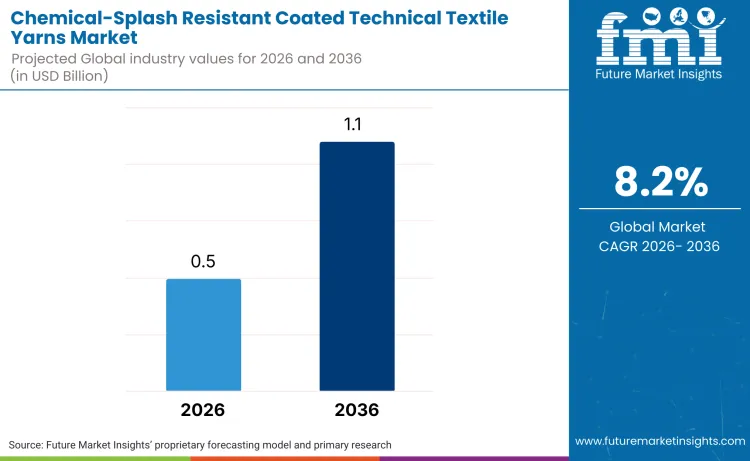
The chemical-splash resistant coated technical textile yarns market is projected to attain a USD 0.5 billion valuation in 2026. As per FMI’s analysis, demand is likely to advance at an 8.2% CAGR to reach USD 1.1 billion by 2036. The lead-up to 2026 is redefining the global landscape for chemical-splash resistant coated technical textile yarns, as evolving safety standards and application-specific requirements drive market realignment. This shift reflects a wider change across the technical textiles sector, where the focus is moving away from standard, general-purpose protection and toward high-performance yarn systems designed for specific applications.
This evolution is shaped by stricter regulations, faster progress in material innovation, and changing patterns of regional demand. Across Europe and North America, tighter occupational safety and environmental standards are prompting manufacturers to move beyond legacy fluorochemical coatings and adopt PFAS-free and low-VOC alternatives. These regulatory changes are doing more than redefining compliance requirements. They are influencing how materials are selected, how coatings are engineered, and how long-term product strategies are developed across the value chain.
Advances in material science are enabling a new generation of coated yarns that offer stronger chemical resistance, better thermal stability, and improved wearer comfort. Industry leaders such as DuPont and Toray Industries are using nanotechnology, bio-based polymers, and hybrid coating structures to create yarns that can withstand harsh chemical exposure while remaining breathable and mechanically flexible. These capabilities are becoming increasingly important in applications where materials must perform reliably under high temperatures without compromising safety or durability.
Asia-Pacific plays a central role in global production, supported by large-scale manufacturing capacity and well-integrated supply chains. However, demand is increasingly strengthening in USA and Europe, where industries such as manufacturing, automotive, and healthcare are placing greater emphasis on specialized chemical-splash personal protective equipment. This shift is encouraging suppliers to focus on differentiated, high-performance yarns that meet more demanding application requirements.
Strategic changes within the industry further reflect this transition. Corporate moves such as Honeywell’s decision to spin off its protective fiber business into Solstice Advanced Materials point to a growing preference for focused, innovation-led organizations that can respond more quickly to regulatory changes and evolving customer needs. Together, these trends are expected to support steady long-term growth, driven by rising demand for lightweight, durable, and chemically inert technical textile yarns.
Summary of the Chemical-Splash Resistant Coated Technical Textile Yarns Market
What is Growth Outlook for Chemical-Splash Resistant Coated Technical Textile Yarns Market as per Future Market Insights Projection?
Future Market Insights projects the chemical-splash resistant coated technical textile yarns market to expand at a CAGR of 8.2% from 2026 to 2036, increasing from USD 0.5 billion in 2026 to USD 1.1 billion by 2036.
FMI Research Approach: FMI proprietary forecasting model integrating occupational safety expenditure, regulatory compliance cycles, and coated technical textile adoption rates.
How do FMI Analysts Perceive Chemical-Splash Resistant Coated Technical Textile Yarns Market to Evolve?
FMI analysts perceive the market evolving toward regulation-driven performance specialization, where chemical resistance is treated as a baseline requirement and differentiation is increasingly defined by PFAS-free chemistry, durability under repeated exposure, and compliance traceability rather than volume expansion.
FMI Research Approach: Assessment of regulatory enforcement trajectories under EU REACH, national PFAS bans, and USA chemical disclosure frameworks.
Which Country Holds Largest Share in Global Chemical-Splash Resistant Coated Technical Textile Yarns Market?
China holds a leading share in the global chemical-splash resistant coated technical textile yarns market, supported by vertically integrated manufacturing ecosystems, scale-efficient coating infrastructure, and rapid iteration capabilities for high-specification synthetic yarn systems.
FMI Research Approach: FMI country-level production and demand modeling based on technical textile capacity, automation adoption, and export orientation.
How big will Chemical-Splash Resistant Coated Technical Textile Yarns Market be by 2036?
The global chemical-splash resistant coated technical textile yarns market is projected to reach USD 1.1 billion by 2036.
FMI Research Approach: Long-term revenue modeling aligned with industrial PPE replacement cycles, regulatory upgrade mandates, and material substitution trends.
What is Definition of Chemical-Splash Resistant Coated Technical Textile Yarns Market?
The chemical-splash resistant coated technical textile yarns market comprises synthetic yarn systems engineered with functional coatings that provide resistance to liquid chemical exposure in protective apparel and industrial applications, including chemical protective clothing, containment products, and specialized technical uses.
FMI Research Approach: FMI market taxonomy with defined inclusion and exclusion criteria across coating systems, base yarns, and end-use applications.
What are some Globally Unique Trends Shaping Chemical-Splash Resistant Coated Technical Textile Yarns Market?
Trends include the accelerated phase-out of PFAS-based coatings, growing adoption of PU and TPU coating systems, and rising demand for traceable, certified, and repeat-use-reliable protective yarns across regulated industrial environments.
FMI Research Approach:
Synthesis of regulatory updates, occupational safety enforcement patterns, and material innovation pipelines across major regions.
Chemical-Splash Resistant Coated Technical Textile Yarns Market Key Takeaways
| Metric | Value |
|---|---|
| Expected Value (2026E) | USD 0.5 billion |
| Forecast Value (2036F) | USD 1.1 billion |
| CAGR (2026-2036) | 8.2% |
Source: Future Market Insights analysis, supported by a proprietary forecasting model and primary research
Why is Demand for Chemical-Splash Resistant Coated Technical Textile Yarns Growing?
One of the most significant forces behind this shift is the accelerated regulatory phase-out of PFAS. These chemistries have long been central to liquid-repellent textile coatings, but are now facing strict limitations across major economies. Regulatory enforcement under EU REACH, along with national measures such as France’s Decree No. 2025-1376, has led to bans on intentionally added PFAS in most textile applications, with only narrow exemptions for critical protective use cases. New reporting obligations under USA’s EPA’s TSCA framework, coming into effect from 2026, are increasing compliance exposure for PFAS-based systems and accelerating the industry’s transition toward fluorine-free coating technologies.
Alongside chemical regulation, occupational safety oversight is becoming more demanding in both scope and execution. Regulators are moving beyond basic availability of protective equipment and placing greater emphasis on verified performance, documentation, and traceability.
In USA, OSHA’s evolving enforcement focus and updates to the Hazard Communication Standard, fully reflected in 2026 compliance cycles, require clearer labeling, stronger hazard disclosure, and evidence that protective materials retain effectiveness under repeated chemical exposure. This shift is raising expectations for chemical-splash resistant yarns that deliver consistent performance over time, rather than short-term repellency alone.
These regulatory pressures are reshaping how manufacturers approach product design, testing, and commercialization. Buyers in regulated industrial sectors are increasingly prioritizing coated yarn systems that can demonstrate durability, repeat-use reliability, and compliance readiness across multiple jurisdictions. As a result, coating formulations and fiber systems are evaluated not only on initial performance metrics, but also on how well they withstand prolonged exposure, laundering, and operational stress without degradation of protective properties.
Collectively, these developments are increasing the complexity and cost of participation in the chemical-splash resistant technical textile market. Competitive advantage is no longer driven solely by scale or pricing, but by the ability to navigate regulatory requirements while maintaining dependable technical performance. Manufacturers with strong regulatory insight, adaptable coating platforms, and well-documented performance credentials are expected to be better positioned as the market continues to evolve through 2026 and beyond
What is the Segment Profile of the Chemical-Splash Resistant Coated Technical Textile Yarns Market?
Why do PU/TPU Coated Yarns Lead Coating System Adoption?
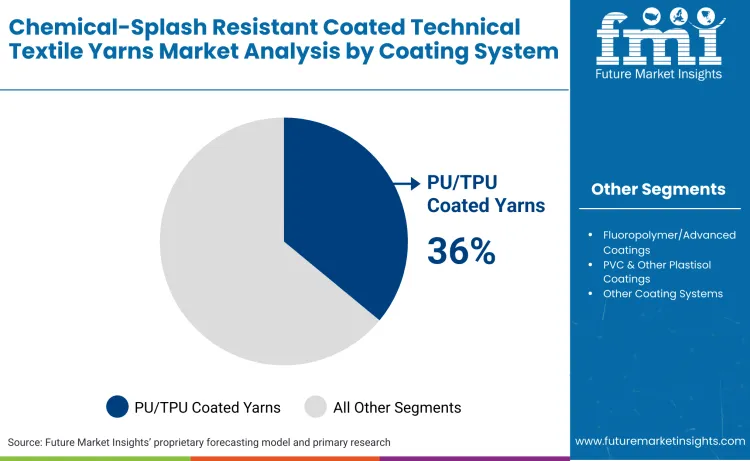
PU and TPU coatings account for 36% share because they strike a workable balance between chemical resistance, flexibility, and process stability. These coatings perform consistently under repeated flexing and folding, which matters in garments and technical assemblies exposed to movement rather than static loads. Manufacturers also favour PU/TPU systems because they integrate cleanly into existing coating lines, reducing variability during curing and lamination.
Another advantage lies in compliance familiarity. PU and TPU coatings have a long track record across chemical splash protection standards, making them easier to qualify and requalify across programs. Alternatives such as PVC plastisols or fluoropolymer systems offer niche performance benefits, but they often introduce cost, stiffness, or processing complexity.
Why does Polyester Dominate Base Yarn Selection?
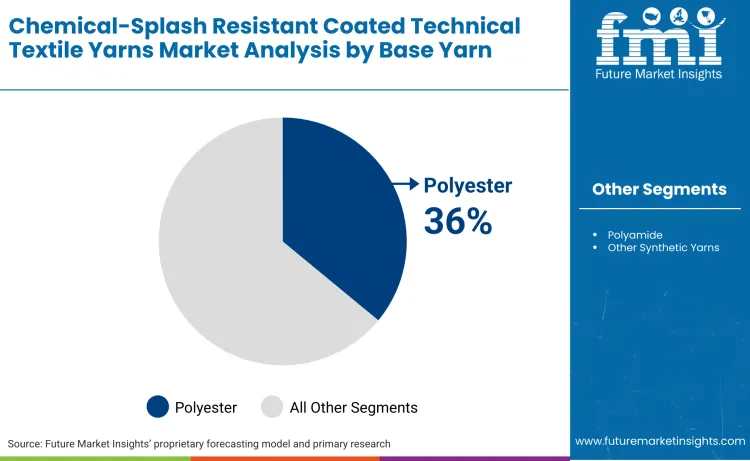
Polyester holds 36% of base yarn usage due to its dimensional stability and predictable behaviour during coating. Chemical-splash resistant applications require yarns that maintain tensile integrity and surface uniformity under thermal and chemical exposure. Polyester provides that stability while remaining cost-efficient at industrial volumes.
Dominance is reinforced by supply depth. Polyester yarns are available globally in consistent specifications, allowing manufacturers to maintain tight quality control across multiple production sites. While polyamide offers higher toughness in certain use cases, it can introduce moisture sensitivity and cost volatility.
Why is Chemical Protective Clothing the Largest Application Segment?
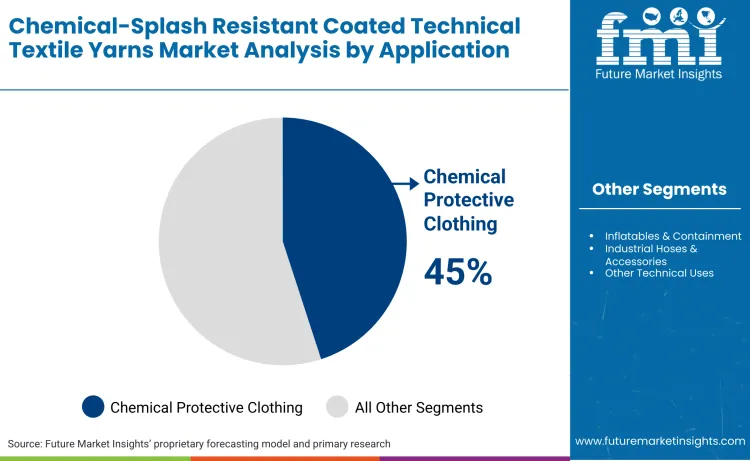
Chemical protective clothing accounts for 45% of total application demand because it sits directly at the intersection of regulation, liability, and workforce safety. Unlike hoses or containment products, garments are subject to frequent inspection, replacement cycles, and certification audits. That creates recurring demand for coated yarns that meet splash resistance requirements without compromising comfort or mobility.
This segment is driven by institutional purchasing rather than discretionary spending. Industrial employers, emergency responders, and regulated facilities operate under defined PPE replacement schedules, which stabilises ordering patterns.
What Drivers, Restraints, Challenges and Opportunities await the Chemical-Splash Resistant Coated Technical Textile Yarns Market?
The global market for chemical-splash resistant coated technical textile yarns is entering a more regulated and performance-oriented phase. Growth is increasingly shaped by compliance requirements, material reliability, and sustainability alignment rather than volume expansion. By 2026, chemical resistance is widely treated as a baseline specification in protective textile applications, particularly across chemical processing, energy, pharmaceuticals, and hazardous logistics.
Demand momentum is supported by stricter enforcement of workplace safety standards and mandatory upgrades in protective apparel. Synthetic yarns remain dominant due to their tensile strength, durability, and compatibility with PU and TPU coating systems that deliver consistent chemical barrier performance. Buyers are prioritizing certified and traceable yarns that reduce downstream compliance complexity and improve audit readiness across supply chains.
Cost and complexity continue to limit rapid capacity expansion. Chemical-splash resistant yarn production requires precision coating equipment, controlled curing environments, and skilled technical labor, resulting in higher capital intensity compared with conventional yarns. Volatility in petrochemical-derived coating inputs further pressures margins, particularly for suppliers without secured long-term procurement contracts.
Sustainability is emerging as a central value driver. Demand for PFAS-free, water-based, and low-toxicity coating systems is accelerating, especially in Europe and North America, where regulatory scrutiny and procurement standards are tightening. Public investment in advanced materials research, including AI-enabled formulation development, is shortening innovation cycles and enabling faster substitution of legacy chemistries. Localization incentives in Asia are also encouraging new capacity in coated yarn and finishing operations.
Regulatory risk remains a defining challenge. Heightened oversight of PFAS substances is increasing compliance costs and forcing portfolio realignment, while trade disruptions and diverging chemical regulations across regions are adding operational complexity. In this environment, competitive positioning is shifting toward suppliers capable of delivering certified, sustainable, and traceable coating solutions at scale, a transition already reflected in portfolio adjustments by players such as Covestro and Archroma.
How is the Chemical-Splash Resistant Coated Technical Textile Yarns Market Profiled in Major Countries?
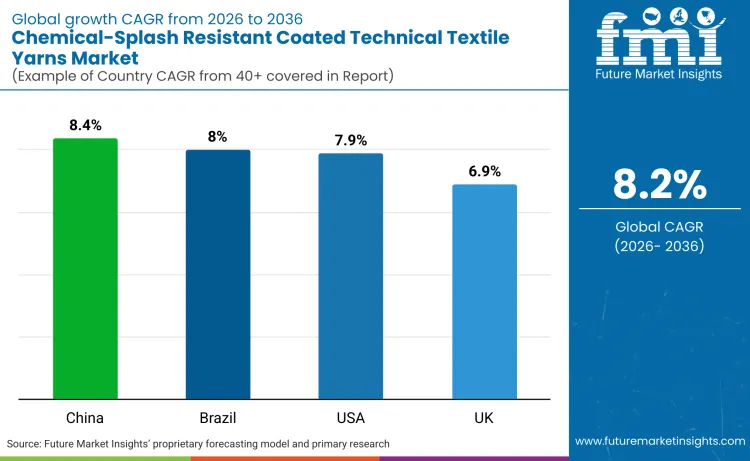
| Country | CAGR (2026-2036) |
|---|---|
| China | 8.4% |
| Brazil | 8.0% |
| USA | 7.9% |
| UK | 6.9% |
Source: FMI analysis based on primary research and proprietary forecasting model
China: How is scale being Re-Engineered into Technological Control?
China remains the central production anchor for technical textiles, but its growth logic has shifted decisively away from capacity expansion. Rising labor costs, environmental scrutiny, and geopolitical exposure are forcing manufacturers to restructure around automation, digital process control, and vertical integration. State industrial policy continues to prioritize advanced materials, clean production, and self-sufficiency, encouraging firms to internalize polymer sourcing, spinning, coating, and finishing within tightly controlled production ecosystems.
At the operational level, competitive advantage is increasingly defined by speed of iteration rather than unit cost. AI-enabled inspection, defect prediction, and material simulation are shortening development cycles for protective and functional yarns. This is positioning China less as a low-cost supplier and more as a rapid-response manufacturing system capable of scaling compliant, high-specification materials at industrial speed. As a result, global buyers continue to rely on China for complex synthetic yarn systems despite ongoing diversification efforts.
Brazil: Can nearshoring momentum translate into durable specialization?
Brazil’s technical textiles sector is benefiting from structural supply-chain realignment rather than domestic demand expansion alone. As North American and European buyers seek alternatives to Asia, Brazil’s raw material availability, industrial base, and geographic proximity are elevating its role within regional sourcing strategies. This shift is encouraging local manufacturers to move beyond commodity outputs toward functional and treated yarns suitable for industrial safety, infrastructure, and resource extraction applications.
Strategically, the market is orienting toward circular inputs and value-added finishing rather than scale competition. Recycled synthetics and sustainably sourced natural fibers are increasingly being adapted for technical use, supported by stricter safety requirements in mining, energy, and chemical processing. While Brazil remains a secondary global supplier, its competitive position is strengthening through specialization in sustainable and nearshored technical materials.
USA: Is regulation reshaping demand more than innovation?
In USA, regulatory pressure has become the dominant market organizer. Chemical disclosure mandates and updated hazard communication rules are forcing manufacturers and buyers to reassess legacy material choices, particularly in chemical-resistant and protective applications. This environment is shifting procurement priorities away from performance alone toward traceability, documentation depth, and long-term compliance risk management.
Growth is concentrating in high-margin protective segments where suppliers can bundle material performance with verification, testing data, and digital safety integration. Smart PPE and system-level safety solutions are gaining traction, while commoditized yarn segments face margin compression and import competition. USA’s landscape is defined by compliance economics rather than production efficiency.
UK: Can niche innovation offset structural constraints?
The UK technical textiles market is evolving as a specialist innovation hub rather than a scale competitor. Post-Brexit regulatory autonomy is allowing selective flexibility for critical applications, particularly in defense, aerospace, filtration, and medical textiles. This has preserved demand for high-complexity materials that require close coordination between R&D, certification bodies, and end users.
Growth remains constrained by structural factors. Limited availability of skilled technicians capable of operating advanced weaving systems and material-discovery platforms is restricting expansion. The UK’s competitive position is thus anchored in low-volume, high-specification outputs, with export performance dependent on maintaining technological differentiation rather than expanding capacity.
How does Competition Appear in the Chemical-Splash Resistant Coated Technical Textile Yarns Market?
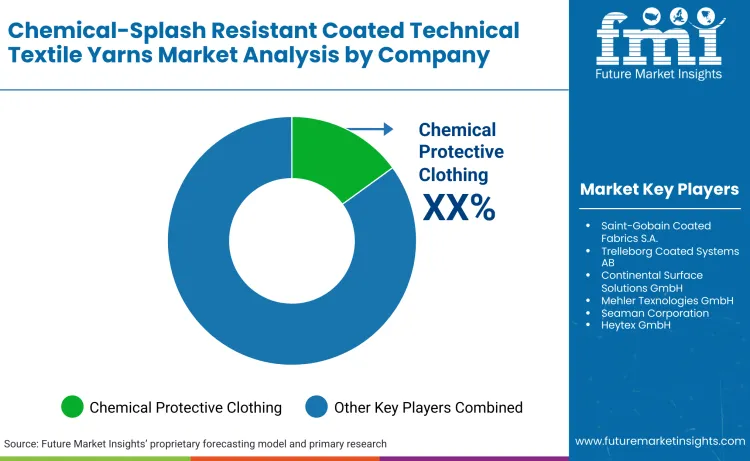
From a practical product-performance perspective, Saint-Gobain Coated Fabrics and MehlerHeytex are solving the ASTM F739 permeation challenge in very different ways. Those differences become clear once performance is evaluated in real operating environments rather than only through headline breakthrough times.
Saint-Gobain’s Gen-II Chemfab® barrier fabrics are engineered around a single objective: maximizing permeation resistance. Even after moving away from legacy PFAS systems, ASTM F739 testing through late 2025 consistently shows breakthrough times exceeding 480 minutes against highly aggressive inorganic acids and strong alkalis. Equally important is post-breakthrough behavior.
Permeation rates remain extremely low and stable, giving safety managers confidence that any loss of protection occurs gradually and predictably rather than abruptly. In practice, this makes Saint-Gobain the preferred option for tightly controlled, high-risk environments such as semiconductor wet processing, aerospace chemical handling, and fixed industrial containment, where exposure windows are clearly defined and materials are removed well before performance limits are approached.
MehlerHeytex follows a more operationally flexible design philosophy. Its latest industrial liner and tarpaulin fabrics do not prioritize maximum breakthrough time as the primary metric. Under ASTM F739 protocols, breakthrough against strong acids and chlorinated solvents typically occurs earlier, often within the 180 to 300 minute range. The strategic distinction emerges after breakthrough.
From a risk-management standpoint, the contrast is clear. Saint-Gobain optimizes for absolute resistance and regulatory defensibility, offering buyers a clear performance ceiling and minimal ambiguity in compliance narratives. MehlerHeytex prioritizes operational resilience, trading peak ASTM F739 values for coatings that maintain functionality across repeated exposure cycles.
Key Players Profiled
- Serge Ferrari Group S.A.
- Saint-Gobain Coated Fabrics S.A.
- Trelleborg Coated Systems AB
- Continental Surface Solutions GmbH
- Mehler Texnologies GmbH
- Seaman Corporation
- Heytex GmbH
- Spradling International, Inc.
- Cooley Group
- Morbern Inc.
Market Definition
The chemical-splash resistant coated technical textile yarns market comprises synthetic technical yarn systems engineered with functional coating layers that provide resistance to liquid chemical splash exposure. These yarns are designed to act as protective barriers in applications where accidental contact with acids, alkalis, solvents, or industrial chemicals can create safety and compliance risks. Performance is defined by chemical barrier integrity, durability under repeated exposure, and fitness for regulated protective textile use cases.
This report includes coated yarn systems used across chemical protective clothing, containment and inflatable structures, industrial hoses and accessories, and other technical uses where liquid chemical splash resistance is a required functional attribute. Coverage spans key coating systems such as PU/TPU coated yarns, fluoropolymer or advanced coating architectures, PVC and other plastisol coatings, and other protective coating formats. The scope also includes base yarn choices such as polyester, polyamide, and other synthetic yarns, alongside adoption dynamics tied to compliance expectations, coating durability, and material substitution away from restricted chemistries.
This report excludes finished protective apparel and end products, for example, completed suits, gloves, aprons, or finished containment articles, sold as final goods rather than yarn inputs. It also excludes uncoated yarns, untreated textile fibers, and textile finishing chemistries applied only at fabric stage without a coated-yarn architecture. Protection categories outside chemical splash resistance, such as fire-only or ballistic-only protection without a chemical-splash performance requirement, and non-textile chemical protection hardware are also excluded.
Scope of Report
| Items | Values |
|---|---|
| Quantitative Units (2026) | USD 0.5 billion |
| Coating System | PU/TPU Coated Yarns, Fluoropolymer/Advanced Coatings, PVC & Other Plastisol Coatings, Other Coating Systems |
| Base Yarn | Polyester, Polyamide, Other Synthetic Yarns |
| Application | Chemical Protective Clothing, Inflatables & Containment Industrial Hoses & Accessories, Other Technical Uses |
| Regions Covered | North America, Western Europe, Eastern Europe, East Asia, South Asia & Pacific, Latin America, Middle East & Africa |
| Countries Covered | USA, China, Brazil, UK and 40+ Countries |
| Key Companies Profiled | Serge Ferrari Group S.A., Saint-Gobain Coated Fabrics S.A., Trelleborg Coated Systems AB, Continental Surface Solutions GmbH, Mehler Texnologies GmbH, Seaman Corporation, Heytex GmbH, Spradling International, Inc., Cooley Group, Morbern Inc. |
Chemical-Splash Resistant Coated Technical Textile Yarns Market by Key Segments
Coating System:
- PU/TPU Coated Yarns
- Fluoropolymer/Advanced Coatings
- PVC & Other Plastisol Coatings
- Other Coating Systems
Base Yarn:
- Polyester
- Polyamide
- Other Synthetic Yarns
Application:
- Chemical Protective Clothing
- Inflatables & Containment
- Industrial Hoses & Accessories
- Other Technical Uses
Region:
- North America
- Western Europe
- Eastern Europe
- East Asia
- South Asia & Pacific
- Latin America
- Middle East & Africa
Bibliography
- European Chemicals Agency. (2024). PFAS restriction proposal: Implications for polymers, coatings, and textile applications. ECHA.
- USA Environmental Protection Agency. (2024). TSCA reporting and recordkeeping requirements for per- and polyfluoroalkyl substances. EPA.
- USA Department of Labor, Occupational Safety and Health Administration. (2024). Hazard communication standard: Updated compliance guidance for chemical protective equipment. OSHA.
- American Society for Testing and Materials. (2024). ASTM F739-24: Standard test method for permeation of liquids and gases through protective clothing materials. ASTM International.
- International Labour Organization. (2024). Occupational safety and health in chemical handling and processing industries. ILO.
- European Centre for Occupational Safety and Health. (2025). Chemical exposure prevention and protective textiles in industrial workplaces. EU-OSHA.
Frequently Asked Questions
How large is the chemical-splash resistant coated technical textile yarns market?
The market is valued at USD 0.5 billion in 2026, reflecting its growing role in regulated industrial safety and chemical protection applications.
What is the growth outlook for this market over the next decade?
Demand is expected to expand steadily through 2036 as chemical safety regulations tighten and industries move toward application-specific, compliance-ready protective yarn systems.
Which applications are driving demand for chemical-splash resistant coated yarns?
Chemical protective clothing is the primary demand driver, supported by recurring replacement cycles in industrial manufacturing, energy, pharmaceuticals, and hazardous material handling.
How does regional demand vary across major markets?
China leads production due to scale and integrated coating capacity, while growth in North America and Europe is driven by PFAS restrictions, chemical disclosure rules, and stricter occupational safety enforcement.
What factors are constraining faster market adoption?
Higher production costs, complex coating processes, and evolving regulatory requirements around PFAS and chemical permeation testing increase entry barriers and slow adoption in cost-sensitive segments.
Preview the report firsthand - request a free sample
Get SampleGet the brochure for pricing and purchase details.
Get PDFTable of Content
- Executive Summary
- Chemical-Splash Resistant Coated Technical Textile Yarns Market Introduction
- Market Definition
- Market Scope
- Market Taxonomy
- Research Methodology
- Study Framework
- Assumptions and Limitations
- Data Sources
- Market Estimation and Forecasting Approach
- Chemical-Splash Resistant Coated Technical Textile Yarns Market Dynamics
- Drivers
- Restraints
- Opportunities
- Trends
- Global Chemical-Splash Resistant Coated Technical Textile Yarns Market Analysis 2021 to 2025 and Forecast 2026 to 2036
- Global Chemical-Splash Resistant Coated Technical Textile Yarns Market Analysis by Coating System
- Global Chemical-Splash Resistant Coated Technical Textile Yarns Market Analysis by Base Yarn
- Global Chemical-Splash Resistant Coated Technical Textile Yarns Market Analysis by Application
- Global Chemical-Splash Resistant Coated Technical Textile Yarns Market Analysis by Region
- North America Chemical-Splash Resistant Coated Technical Textile Yarns Market Analysis
- United States
- Canada
- Western Europe Chemical-Splash Resistant Coated Technical Textile Yarns Market Analysis
- Germany
- United Kingdom
- France
- Italy
- Spain
- BENELUX
- Nordics
- Eastern Europe Chemical-Splash Resistant Coated Technical Textile Yarns Market Analysis
- Poland
- Russia
- Rest of Eastern Europe
- East Asia Chemical-Splash Resistant Coated Technical Textile Yarns Market Analysis
- China
- Japan
- South Korea
- South Asia & Pacific Chemical-Splash Resistant Coated Technical Textile Yarns Market Analysis
- India
- ASEAN
- Australia & New Zealand
- Latin America Chemical-Splash Resistant Coated Technical Textile Yarns Market Analysis
- Brazil
- Rest of Latin America
- Middle East & Africa Chemical-Splash Resistant Coated Technical Textile Yarns Market Analysis
- GCC
- South Africa
- Rest of Middle East & Africa
- Competitive Landscape Analysis
- Key Players Profiled
- Market Definition and Scope
- Market Segmentation Analysis
- Bibliography
- Frequently Asked Questions


