

- Industry Size (2026)
- USD 690 Mn
- Forecast (2036)
- USD 1540 Mn
- CAGR (2026 to 2036)
- 8.4%
Geotextiles & Technical Textiles with Reduced Microplastic Release Market Forecast and Outlook 2026 to 2036
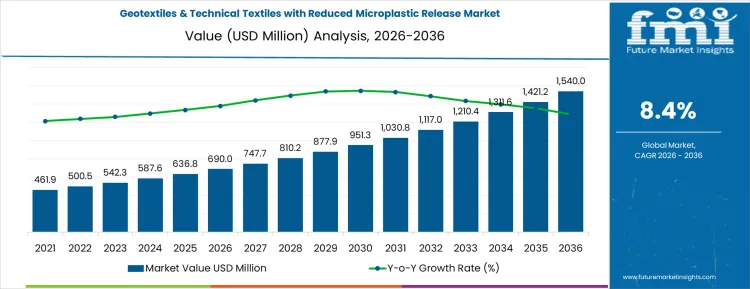
The geotextiles and technical textiles with reduced microplastic release market is valued at USD 690 million in 2026 and is projected to reach USD 1,540 million by 2036, reflecting a CAGR of 8.4%. Early growth from 2026 to 2031, rising from approximately USD 487 million to USD 995 million, is driven by adoption in infrastructure, civil engineering, and industrial applications. Innovations in polymer blends, surface coatings, and fiber finishing reduce microplastic shedding, encouraging uptake across geosynthetic products, erosion control mats, and high-performance industrial textiles.
Between 2031 and 2036, market expansion accelerates from roughly USD 1,068 million to USD 1,540 million. Growth contribution is reinforced by regulatory mandates targeting microplastic mitigation, increasing use in road construction, landscaping, and filtration applications, and ongoing development of durable, low-shedding fibers. Enhanced sustainability standards, demand from environmentally conscious developers, and integration of recycled polymers support structural adoption. The market trajectory indicates consistent value accumulation, driven by technological innovation and broader acceptance of microplastic-reduction textiles across industrial and commercial sectors over the forecast period.
Quick Stats of the Geotextiles and Technical Textiles with Reduced Microplastic Release Market
- Geotextiles and Technical Textiles with Reduced Microplastic Release Market Value (2026): USD 690 million
- Geotextiles and Technical Textiles with Reduced Microplastic Release Market Forecast Value (2036): USD 1,540 million
- Geotextiles and Technical Textiles with Reduced Microplastic Release Market Forecast CAGR (2026-2036): 8.4%
- Leading Product Format in Geotextiles and Technical Textiles with Reduced Microplastic Release Market: Nonwoven geotextile rolls (45%)
- Key Growth Regions in Geotextiles and Technical Textiles with Reduced Microplastic Release Market: India, China, USA, Brazil, Germany
- Top Players in Geotextiles and Technical Textiles with Reduced Microplastic Release Market: TenCate, Huesker, NAUE, Berry Global, Hengli, Sintex, Garware Technical Fibres, Local converters, Toray Industries
What is the Growth Forecast for the Geotextiles & Technical Textiles with Reduced Microplastic Release Market through 2036?
From 2026 to 2031, the geotextiles and technical textiles market with reduced microplastic release grows from USD 690 million to approximately USD 995 million, representing the early adoption curve. Growth during this phase is driven by selective deployment in civil engineering, erosion control, filtration, and industrial textile applications where reduced microplastic discharge is critical for regulatory compliance and environmental standards. Uptake is concentrated among early-adopting projects and premium applications, with annual value additions increasing steadily as fiber formulations, textile processing methods, and durability performance are validated across pilot installations.
Between 2031 and 2036, the market expands from roughly USD 995 million to USD 1,540 million, illustrating the late adoption curve characterized by broader commercial deployment. Growth accelerates as reduced-microplastic geotextiles and technical textiles become standardized in large-scale infrastructure projects, industrial filtration systems, and construction applications. Annual additions widen due to higher unit penetration, repeat procurement, and portfolio-wide implementation. Early growth relied on selective pilot programs, while later expansion is driven by structural adoption, integration into regulatory-compliant designs, and sustained demand across global geotextile and technical textile applications.
Geotextiles and Technical Textiles with Reduced Microplastic Release Market Key Takeaways
| Metric | Value |
|---|---|
| Market Value (2026) | USD 690 million |
| Forecast Value (2036) | USD 1,540 million |
| Forecast CAGR (2026-2036) | 8.4% |
What Is Driving the Demand for the Geotextiles and Technical Textiles with Reduced Microplastic Release Market?
Initial demand for geotextiles and technical textiles with reduced microplastic release grew from broader use of synthetic fibres in infrastructure, industrial, and environmental applications where durability and performance had priority over microplastic concerns. Conventional synthetic textiles were valued for strength, filtration, and reinforcement functions, forming a significant part of technical textiles used in construction, erosion control, and soil stabilization. The wider technical textile market, valued at hundreds of billions of dollars, has expanded steadily as engineered materials met functional requirements across sectors such as agriculture, automotive and buildtech. Performance and cost-efficiency drove uptake rather than environmental considerations linked to microplastic shedding from textiles.
Future demand for geotextiles and technical textiles engineered to reduce microplastic release will be shaped by environmental policy frameworks, material innovations, and end-of-life performance criteria. Regulatory attention on microplastic pollution is increasing, with research identifying textile fibre shedding as a significant source of microplastic discharge, prompting industry interest in low-shedding fibre compositions and surface treatments that limit fibre release during use and degradation. Material scientists are developing yarns and fabrics with structural modifications, improved bonding, and surface finishes that reduce microfibre loss. Demand will be reinforced by sustainability criteria embedded in public procurement, infrastructure standards, and corporate environmental commitments.
What Factors Are Affecting the Demand for Geotextiles and Technical Textiles with Reduced Microplastic Release Market in Terms of End Use Application and Product Format and Type?
Demand for geotextiles and technical textiles with reduced microplastic release is segmented by end use application and product format and type across infrastructure and environmental protection projects. Road and civil engineering applications account for about 30% of total demand, making this the leading end use segment. Coastal protection and erosion control, infrastructure and landfill projects, rural road development, and geomembrane reinforcement represent additional applications without disclosed share splits. These segments differ in exposure duration, mechanical stress, and regulatory scrutiny related to material degradation. Product format and type determine durability, filtration behavior, and installation methods. Together, these segments explain demand formation shaped by project lifespan, environmental compliance requirements, and construction standards rather than short term material substitution trends.
What Drives Demand by End Use Application in the Geotextiles and Technical Textiles with Reduced Microplastic Release Market?
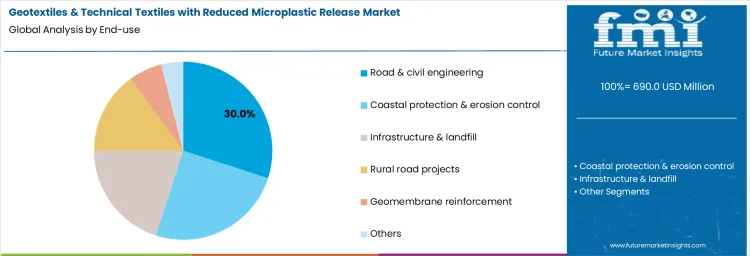
Road and civil engineering leads demand with a 30% share due to extensive use of geotextiles for soil stabilization, drainage, and load distribution. These projects require materials that retain structural integrity under repeated stress while limiting fibre release. Coastal protection and erosion control applications adopt reduced release textiles to withstand wave action and long term environmental exposure. Infrastructure and landfill projects rely on geotextiles for separation and containment functions. Rural road projects use geotextiles to improve subgrade performance in low traffic areas. Adoption intensity aligns with project duration and regulatory oversight. End use demand therefore reflects exposure risk and lifecycle requirements rather than construction volume alone.
Application driven demand remains stable because infrastructure projects follow long planning cycles. Road authorities specify materials based on performance history and compliance records. Coastal projects prioritize durability to avoid frequent replacement. Landfill operators adopt cautiously to meet containment standards. Rural road projects focus on cost control and reliability. These patterns limit short term volatility. End use segmentation highlights structural dependence on technical textiles within civil works. Demand therefore aligns with infrastructure investment planning and environmental compliance rather than rapid shifts in construction practices.
How Does Product Format and Type Shape Demand for Geotextiles and Technical Textiles with Reduced Microplastic Release Market?
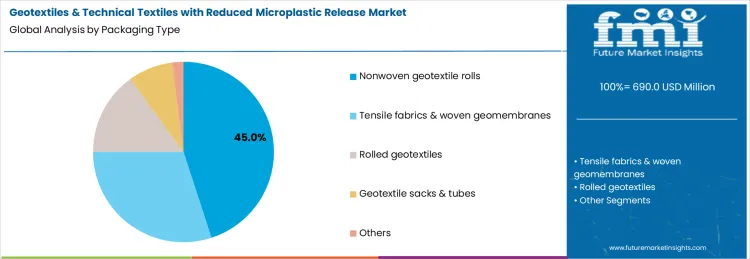
Nonwoven geotextile rolls account for about 45% of total demand, making them the leading product format. Their dominance reflects ease of installation and suitability for large surface coverage. Tensile fabrics and woven geomembranes are used where strength and reinforcement are required. Rolled geotextiles support infrastructure and landfill applications with standardized installation needs. Geotextile sacks and tubes serve erosion control and containment functions in localized areas. Other formats address specialized reinforcement requirements. Product format selection depends on load conditions, installation method, and exposure environment. Demand follows engineering specifications rather than material novelty across civil construction projects.
Nonwoven rolls maintain leadership due to predictable performance and compatibility with existing installation practices. Woven and tensile fabrics address high stress applications. Rolled formats simplify logistics and deployment. Sacks and tubes enable targeted erosion control. Project owners favor formats with established performance data to reduce risk. Major format changes are avoided due to specification and approval constraints. This stabilizes demand. Product format and type therefore reinforce reliance on proven geotextile structures while enabling reduced microplastic release through material engineering refinements.
How Are Geotextiles and Technical Textiles with Reduced Microplastic Release Being Applied Across Infrastructure and Industrial Projects?
Use appears in civil engineering, landscaping, and industrial applications where fibre loss into the environment poses regulatory or operational concerns. Road construction and erosion control projects adopt engineered geotextiles designed to retain fibres during installation and long-term exposure. Industrial filtration and drainage systems use technical textiles with minimized shedding to maintain system integrity and reduce microplastic discharge. Agricultural covers and sediment control fabrics incorporate low-shedding fibres to prevent environmental contamination. These applications reflect operational and environmental priorities rather than aesthetic or marketing considerations, with adoption driven by regulatory compliance and long-term performance.
What Operational and Material Conditions Support Adoption of Reduced Microplastic Geotextiles and Technical Textiles?
Selection aligns with environments requiring durable, high-strength fabrics that maintain structural function while limiting fibre loss. Manufacturers optimize polymer composition, filament bonding, and fabric finishing to reduce shedding under mechanical stress and UV exposure. Installation teams favor textiles compatible with standard anchoring, cutting, and joining methods without compromising integrity. Project managers adopt materials that meet civil and environmental standards for erosion control, filtration efficiency, and stormwater management. These conditions arise from operational reliability, compliance requirements, and environmental stewardship priorities within infrastructure and industrial workflows.
Which Practical Considerations Limit Wider Use of Reduced Microplastic Geotextiles and Technical Textiles?
Production costs for low-shedding fibres are higher than conventional materials, influencing adoption in budget-sensitive projects. Material selection may limit available tensile strengths or thicknesses. Validation of reduced microplastic release requires testing under project-specific stress conditions. Availability of certified low-shedding textiles may be regionally limited. Installation procedures may require minor adjustments to prevent premature fibre release. These factors lead to selective deployment where environmental performance, regulatory compliance, and long-term durability outweigh additional cost and operational adaptation.
What is the Demand for Geotextiles and Technical Textiles with Reduced Microplastic Release by Country?
| Country | CAGR (%) |
|---|---|
| Germany | 7.0% |
| USA | 7.8% |
| China | 10.5% |
| India | 11.2% |
| Brazil | 8.0% |
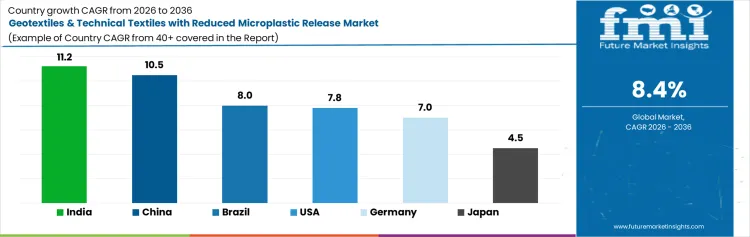
The demand for geotextiles and technical textiles with reduced microplastic release varies across countries, driven by environmental regulations, construction industry adoption, and sustainable textile initiatives. India leads with an 11.2% CAGR, supported by growing infrastructure projects, rising demand for environmentally friendly geotextiles, and awareness of microplastic mitigation. China follows at 10.5%, driven by large scale construction, civil engineering applications, and adoption of technical textiles with reduced environmental impact. The USA grows at 7.8%, reflecting steady adoption in construction, erosion control, and landscaping projects. Brazil records 8.0%, shaped by infrastructure development and environmental compliance. Germany posts 7.0%, supported by regulatory standards and mature technical textile markets.
How Is Low-Microplastic Geotextile Adoption Driving Growth in Germany?
In Germany, revenue from the Geotextiles & Technical Textiles with Reduced Microplastic Release Market is expanding at a CAGR of 7.00% through 2035, driven by adoption of low-shedding geotextiles and technical fabrics in civil engineering, construction, and industrial applications. Manufacturers are integrating fibres and yarns engineered to minimize microplastic release while maintaining mechanical performance. Demand is concentrated in infrastructure projects, landscaping, and soil stabilization applications. Domestic suppliers provide high-quality, durable geotextiles and technical fabrics compatible with standard installation and fabrication processes. Regulatory standards, environmental compliance, and recurring project requirements are sustaining predictable procurement nationwide.
- Civil engineering, construction, and landscaping projects adopt low-microplastic geotextiles
- Fibres and yarns engineered to minimize microplastic release anchor demand
- Domestic suppliers provide durable and high-quality geotextiles
- Regulatory compliance and recurring project requirements sustain procurement
How Are Infrastructure Projects Supporting Growth in the United States?
The United States is experiencing growth in the Geotextiles & Technical Textiles Market at a CAGR of 7.80% through 2035, supported by increasing infrastructure projects and environmental standards targeting microplastic reduction. Manufacturers are integrating low-shedding geotextiles for roads, embankments, erosion control, and landscaping applications. Demand is concentrated in civil engineering, construction, and industrial projects. Domestic suppliers provide geotextiles with engineered fibre blends that reduce microplastic release and maintain mechanical strength. High project volumes, regulatory compliance, and recurring replacement cycles are sustaining predictable procurement nationwide.
- Infrastructure, erosion control, and landscaping projects drive low-microplastic geotextile adoption
- Engineered fibre blends maintain performance while minimizing microplastic release
- Domestic suppliers provide high-quality, durable technical textiles
- Recurring replacement and project cycles sustain procurement
How Is Industrial and Construction Expansion Accelerating Adoption in China?
In China, revenue from the Geotextiles & Technical Textiles with Reduced Microplastic Release Market is growing at a CAGR of 10.50% through 2035, driven by expansion of construction, civil engineering, and industrial applications. Manufacturers are adopting low-shedding geotextiles for infrastructure projects, erosion control, and landscaping. Demand is strong across urban development, industrial parks, and environmental protection initiatives. Domestic suppliers are scaling production of durable, low-microplastic technical fabrics compatible with installation and fabrication standards. High construction volumes and structured procurement practices are sustaining rapid adoption nationwide.
- Construction, civil engineering, and landscaping projects drive low-microplastic geotextile adoption
- Low-shedding fibres maintain performance and reduce environmental impact
- Domestic suppliers scale production of durable technical fabrics
- High project volumes sustain consistent adoption
How Is Organized Industrial Textile Manufacturing Supporting Growth in India?
India is witnessing strong expansion in the Geotextiles & Technical Textiles with Reduced Microplastic Release Market at a CAGR of 11.20% through 2035, supported by growth in infrastructure development, construction, and industrial textile manufacturing. Manufacturers are integrating low-microplastic geotextiles for roads, embankments, and landscaping projects to comply with environmental regulations and improve sustainability. Demand is rising across urban development, civil engineering, and industrial applications. Domestic suppliers provide cost-aligned geotextiles and technical fabrics engineered for low microplastic release. Expanding infrastructure projects and organized manufacturing networks are sustaining robust procurement nationwide.
- Infrastructure, road construction, and landscaping projects increase demand for low-microplastic geotextiles
- Technical fabrics engineered to reduce microplastic release anchor demand
- Domestic suppliers provide cost-aligned, durable fabrics
- Urban development and project expansion sustain procurement growth
How Are Construction and Industrial Applications Supporting Adoption in Brazil?
Brazil is seeing steady growth in the Geotextiles & Technical Textiles with Reduced Microplastic Release Market at a CAGR of 8.00% through 2035, supported by rising adoption in civil engineering, industrial, and environmental projects. Manufacturers are using low-shedding geotextiles for roads, embankments, soil stabilization, and landscaping to improve sustainability and comply with environmental guidelines. Demand is concentrated in infrastructure and industrial construction applications. Domestic suppliers are expanding production of durable, low-microplastic geotextiles and technical fabrics. Growth in civil engineering projects and industrial construction is sustaining recurring procurement across operations nationwide.
- Roads, embankments, and landscaping projects drive low-microplastic geotextile adoption
- Low-shedding fabrics improve sustainability and regulatory compliance
- Domestic suppliers expand production of durable technical textiles
- Industrial and civil construction growth sustain recurring procurement
Which Companies Are Shaping Competition in The Geotextiles and Technical Textiles with Reduced Microplastic Release Market Across Infrastructure and Industrial Uses?
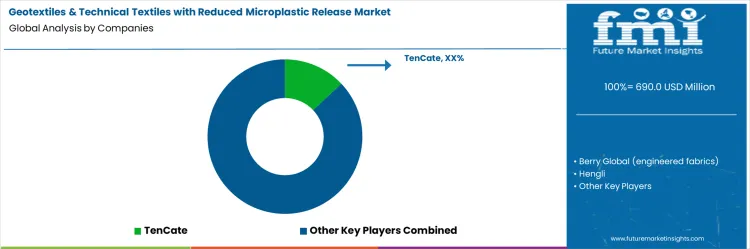
Competition in the Geotextiles and Technical Textiles with Reduced Microplastic Release Market is driven by manufacturers focused on fibre stability and controlled material loss under mechanical stress. TenCate, Huesker, and NAUE influence this space through geosynthetic products engineered for soil stabilization, drainage, and reinforcement where long service life matters. Berry Global participates through engineered nonwoven fabrics supplied into civil engineering and industrial applications. Hengli and Sintex contribute through large scale polymer and textile production, supplying technical fabrics adapted for infrastructure projects. Garware Technical Fibres holds a strong position in ropes, nets, and industrial textiles designed to limit fibre abrasion during use. Competitive differentiation reflects yarn construction, bonding methods, and resistance to environmental degradation rather than visual or branding factors.
Regional production depth and material science capabilities shape secondary dynamics. Toray Industries supports the market through advanced polymer materials and fibre technologies supplied into downstream technical textile manufacturing. Local converters play a significant role by adapting fabric weight, structure, and coatings to meet project specific specifications and regional standards. These participants often operate under engineering procurement frameworks where performance validation and compliance drive supplier selection. Competitive positioning depends on durability testing results, installation performance, and predictable behavior under load and exposure. Entry barriers are shaped by certification requirements, long project cycles, and customer reliance on proven material performance rather than rapid innovation turnover or design variation.
Key Players in the Geotextiles and Technical Textiles with Reduced Microplastic Release Market
- TenCate
- Huesker
- NAUE
- Berry Global (engineered fabrics)
- Hengli, Sintex
- Garware Technical Fibres
- Local converters
- Toray Industries
Scope of the Report
| Items | Values |
|---|---|
| Quantitative Units (2026) | USD million |
| End-use / Application | Road & civil engineering; Coastal protection & erosion control; Infrastructure & landfill; Rural road projects; Geomembrane reinforcement; Others |
| Product Format / Type | Nonwoven geotextile rolls; Tensile fabrics & woven geomembranes; Rolled geotextiles; Geotextile sacks & tubes; Others |
| Material | Modified PP & PET; High-tenacity PP/PE; Cost-optimised PP blends; Local PP blends; Others |
| Technology | Anti-shed finishing + thermal bonding; Stabilised polymer formulations; Additive dispersion technologies; Abrasion-resistant coatings; Others |
| Region | Asia Pacific; Europe; North America; Latin America; Middle East & Africa |
| Countries Covered | China; Japan; South Korea; India; Australia & New Zealand; ASEAN; Germany; United Kingdom; France; Italy; Spain; Nordic; BENELUX; United States; Canada; Mexico; Brazil; Chile; Kingdom of Saudi Arabia; Other GCC Countries; Turkey; South Africa; Other African Union; Rest of Asia Pacific; Rest of Europe; Rest of Latin America; Rest of Middle East & Africa |
| Key Companies Profiled | TenCate; Huesker; NAUE; Berry Global (engineered fabrics); Hengli; Sintex; Garware Technical Fibres; Local converters; Toray Industries |
| Additional Attributes | Dollar by sales across end-use applications, product formats, materials, and technologies; Nonwoven geotextile rolls lead due to ease of installation and large surface coverage; Tensile fabrics and woven geomembranes are applied for high-stress civil and industrial uses; Anti-shed finishing and stabilised polymer formulations improve fibre retention; Adoption is driven by regulatory compliance, microplastic mitigation, and long-term project durability; Repeat procurement occurs in infrastructure and civil engineering cycles; Domestic and regional suppliers provide durable, low-microplastic geotextiles and technical fabrics; Market growth is supported by road construction, erosion control, landfill, and industrial textile projects requiring engineered, low-shedding materials. |
Geotextiles and Technical Textiles with Reduced Microplastic Release Market Segmentation
End-use / Application:
- Road & civil engineering
- Coastal protection & erosion control
- Infrastructure & landfill
- Rural road projects
- Geomembrane reinforcement
- Others
Product Format / Type:
- Nonwoven geotextile rolls
- Tensile fabrics & woven geomembranes
- Rolled geotextiles
- Geotextile sacks & tubes
- Others
Material:
- Modified PP & PET
- High-tenacity PP/PE
- Cost-optimised PP blends
- Local PP blends
- Others
Technology:
- Anti-shed finishing + thermal bonding
- Stabilised polymer formulations
- Additive dispersion technologies
- Abrasion-resistant coatings
- Others
Region:
- Asia Pacific
- China
- Japan
- South Korea
- India
- Australia & New Zealand
- ASEAN
- Rest of Asia Pacific
- Europe
- Germany
- United Kingdom
- France
- Italy
- Spain
- Nordic
- BENELUX
- Rest of Europe
- North America
- United States
- Canada
- Mexico
- Latin America
- Brazil
- Chile
- Rest of Latin America
- Middle East & Africa
- Kingdom of Saudi Arabia
- Other GCC Countries
- Turkey
- South Africa
- Other African Union
- Rest of Middle East & Africa
Frequently Asked Questions
How big is the geotextiles & technical textiles with reduced microplastic release market in 2026?
The global geotextiles & technical textiles with reduced microplastic release market is estimated to be valued at USD 690.0 million in 2026.
What will be the size of geotextiles & technical textiles with reduced microplastic release market in 2036?
The market size for the geotextiles & technical textiles with reduced microplastic release market is projected to reach USD 1,540.0 million by 2036.
How much will be the geotextiles & technical textiles with reduced microplastic release market growth between 2026 and 2036?
The geotextiles & technical textiles with reduced microplastic release market is expected to grow at a 8.4% CAGR between 2026 and 2036.
What are the key product types in the geotextiles & technical textiles with reduced microplastic release market?
The key product types in geotextiles & technical textiles with reduced microplastic release market are road & civil engineering, coastal protection & erosion control, infrastructure & landfill, rural road projects, geomembrane reinforcement and others.
Which packaging type segment to contribute significant share in the geotextiles & technical textiles with reduced microplastic release market in 2026?
In terms of packaging type, nonwoven geotextile rolls segment to command 45.0% share in the geotextiles & technical textiles with reduced microplastic release market in 2026.
Preview the report firsthand - request a free sample
Get SampleGet the brochure for pricing and purchase details.
Get PDFTable of Content
- Executive Summary
- Global Market Outlook
- Demand-side Trends
- Supply-side Trends
- Technology Roadmap Analysis
- Analysis and Recommendations
- Market Overview
- Market Coverage / Taxonomy
- Market Definition / Scope / Limitations
- Market Background
- Market Dynamics
- Drivers
- Restraints
- Opportunity
- Trends
- Scenario Forecast
- Demand in Optimistic Scenario
- Demand in Likely Scenario
- Demand in Conservative Scenario
- Opportunity Map Analysis
- Product Life Cycle Analysis
- Supply Chain Analysis
- Investment Feasibility Matrix
- Value Chain Analysis
- PESTLE and Porter’s Analysis
- Regulatory Landscape
- Regional Parent Market Outlook
- Production and Consumption Statistics
- Import and Export Statistics
- Market Dynamics
- Global Market Analysis 2021 to 2025 and Forecast, 2026 to 2036
- Historical Market Size Value (USD Million) Analysis, 2021 to 2025
- Current and Future Market Size Value (USD Million) Projections, 2026 to 2036
- Y-o-Y Growth Trend Analysis
- Absolute $ Opportunity Analysis
- Global Market Pricing Analysis 2021 to 2025 and Forecast 2026 to 2036
- Global Market Analysis 2021 to 2025 and Forecast 2026 to 2036, By End-use
- Introduction / Key Findings
- Historical Market Size Value (USD Million) Analysis By End-use , 2021 to 2025
- Current and Future Market Size Value (USD Million) Analysis and Forecast By End-use , 2026 to 2036
- Road & civil engineering
- Coastal protection & erosion control
- Infrastructure & landfill
- Rural road projects
- Geomembrane reinforcement
- Others
- Y-o-Y Growth Trend Analysis By End-use , 2021 to 2025
- Absolute $ Opportunity Analysis By End-use , 2026 to 2036
- Global Market Analysis 2021 to 2025 and Forecast 2026 to 2036, By Packaging Type
- Introduction / Key Findings
- Historical Market Size Value (USD Million) Analysis By Packaging Type, 2021 to 2025
- Current and Future Market Size Value (USD Million) Analysis and Forecast By Packaging Type, 2026 to 2036
- Nonwoven geotextile rolls
- Tensile fabrics & woven geomembranes
- Rolled geotextiles
- Geotextile sacks & tubes
- Others
- Y-o-Y Growth Trend Analysis By Packaging Type, 2021 to 2025
- Absolute $ Opportunity Analysis By Packaging Type, 2026 to 2036
- Global Market Analysis 2021 to 2025 and Forecast 2026 to 2036, By Material
- Introduction / Key Findings
- Historical Market Size Value (USD Million) Analysis By Material, 2021 to 2025
- Current and Future Market Size Value (USD Million) Analysis and Forecast By Material, 2026 to 2036
- Modified PP & PET
- High-tenacity PP/PE
- Cost-optimised PP blends
- Local PP blends
- Others
- Y-o-Y Growth Trend Analysis By Material, 2021 to 2025
- Absolute $ Opportunity Analysis By Material, 2026 to 2036
- Global Market Analysis 2021 to 2025 and Forecast 2026 to 2036, By Technology
- Introduction / Key Findings
- Historical Market Size Value (USD Million) Analysis By Technology, 2021 to 2025
- Current and Future Market Size Value (USD Million) Analysis and Forecast By Technology, 2026 to 2036
- Anti-shed finishing + thermal bonding
- Stabilised polymer formulations
- Additive dispersion technologies
- Abrasion-resistant coatings
- Others
- Y-o-Y Growth Trend Analysis By Technology, 2021 to 2025
- Absolute $ Opportunity Analysis By Technology, 2026 to 2036
- Global Market Analysis 2021 to 2025 and Forecast 2026 to 2036, By Region
- Introduction
- Historical Market Size Value (USD Million) Analysis By Region, 2021 to 2025
- Current Market Size Value (USD Million) Analysis and Forecast By Region, 2026 to 2036
- North America
- Latin America
- Western Europe
- Eastern Europe
- East Asia
- South Asia and Pacific
- Middle East & Africa
- Market Attractiveness Analysis By Region
- North America Market Analysis 2021 to 2025 and Forecast 2026 to 2036, By Country
- Historical Market Size Value (USD Million) Trend Analysis By Market Taxonomy, 2021 to 2025
- Market Size Value (USD Million) Forecast By Market Taxonomy, 2026 to 2036
- By Country
- USA
- Canada
- Mexico
- By End-use
- By Packaging Type
- By Material
- By Technology
- By Country
- Market Attractiveness Analysis
- By Country
- By End-use
- By Packaging Type
- By Material
- By Technology
- Key Takeaways
- Latin America Market Analysis 2021 to 2025 and Forecast 2026 to 2036, By Country
- Historical Market Size Value (USD Million) Trend Analysis By Market Taxonomy, 2021 to 2025
- Market Size Value (USD Million) Forecast By Market Taxonomy, 2026 to 2036
- By Country
- Brazil
- Chile
- Rest of Latin America
- By End-use
- By Packaging Type
- By Material
- By Technology
- By Country
- Market Attractiveness Analysis
- By Country
- By End-use
- By Packaging Type
- By Material
- By Technology
- Key Takeaways
- Western Europe Market Analysis 2021 to 2025 and Forecast 2026 to 2036, By Country
- Historical Market Size Value (USD Million) Trend Analysis By Market Taxonomy, 2021 to 2025
- Market Size Value (USD Million) Forecast By Market Taxonomy, 2026 to 2036
- By Country
- Germany
- UK
- Italy
- Spain
- France
- Nordic
- BENELUX
- Rest of Western Europe
- By End-use
- By Packaging Type
- By Material
- By Technology
- By Country
- Market Attractiveness Analysis
- By Country
- By End-use
- By Packaging Type
- By Material
- By Technology
- Key Takeaways
- Eastern Europe Market Analysis 2021 to 2025 and Forecast 2026 to 2036, By Country
- Historical Market Size Value (USD Million) Trend Analysis By Market Taxonomy, 2021 to 2025
- Market Size Value (USD Million) Forecast By Market Taxonomy, 2026 to 2036
- By Country
- Russia
- Poland
- Hungary
- Balkan & Baltic
- Rest of Eastern Europe
- By End-use
- By Packaging Type
- By Material
- By Technology
- By Country
- Market Attractiveness Analysis
- By Country
- By End-use
- By Packaging Type
- By Material
- By Technology
- Key Takeaways
- East Asia Market Analysis 2021 to 2025 and Forecast 2026 to 2036, By Country
- Historical Market Size Value (USD Million) Trend Analysis By Market Taxonomy, 2021 to 2025
- Market Size Value (USD Million) Forecast By Market Taxonomy, 2026 to 2036
- By Country
- China
- Japan
- South Korea
- By End-use
- By Packaging Type
- By Material
- By Technology
- By Country
- Market Attractiveness Analysis
- By Country
- By End-use
- By Packaging Type
- By Material
- By Technology
- Key Takeaways
- South Asia and Pacific Market Analysis 2021 to 2025 and Forecast 2026 to 2036, By Country
- Historical Market Size Value (USD Million) Trend Analysis By Market Taxonomy, 2021 to 2025
- Market Size Value (USD Million) Forecast By Market Taxonomy, 2026 to 2036
- By Country
- India
- ASEAN
- Australia & New Zealand
- Rest of South Asia and Pacific
- By End-use
- By Packaging Type
- By Material
- By Technology
- By Country
- Market Attractiveness Analysis
- By Country
- By End-use
- By Packaging Type
- By Material
- By Technology
- Key Takeaways
- Middle East & Africa Market Analysis 2021 to 2025 and Forecast 2026 to 2036, By Country
- Historical Market Size Value (USD Million) Trend Analysis By Market Taxonomy, 2021 to 2025
- Market Size Value (USD Million) Forecast By Market Taxonomy, 2026 to 2036
- By Country
- Kingdom of Saudi Arabia
- Other GCC Countries
- Turkiye
- South Africa
- Other African Union
- Rest of Middle East & Africa
- By End-use
- By Packaging Type
- By Material
- By Technology
- By Country
- Market Attractiveness Analysis
- By Country
- By End-use
- By Packaging Type
- By Material
- By Technology
- Key Takeaways
- Key Countries Market Analysis
- USA
- Pricing Analysis
- Market Share Analysis, 2025
- By End-use
- By Packaging Type
- By Material
- By Technology
- Canada
- Pricing Analysis
- Market Share Analysis, 2025
- By End-use
- By Packaging Type
- By Material
- By Technology
- Mexico
- Pricing Analysis
- Market Share Analysis, 2025
- By End-use
- By Packaging Type
- By Material
- By Technology
- Brazil
- Pricing Analysis
- Market Share Analysis, 2025
- By End-use
- By Packaging Type
- By Material
- By Technology
- Chile
- Pricing Analysis
- Market Share Analysis, 2025
- By End-use
- By Packaging Type
- By Material
- By Technology
- Germany
- Pricing Analysis
- Market Share Analysis, 2025
- By End-use
- By Packaging Type
- By Material
- By Technology
- UK
- Pricing Analysis
- Market Share Analysis, 2025
- By End-use
- By Packaging Type
- By Material
- By Technology
- Italy
- Pricing Analysis
- Market Share Analysis, 2025
- By End-use
- By Packaging Type
- By Material
- By Technology
- Spain
- Pricing Analysis
- Market Share Analysis, 2025
- By End-use
- By Packaging Type
- By Material
- By Technology
- France
- Pricing Analysis
- Market Share Analysis, 2025
- By End-use
- By Packaging Type
- By Material
- By Technology
- India
- Pricing Analysis
- Market Share Analysis, 2025
- By End-use
- By Packaging Type
- By Material
- By Technology
- ASEAN
- Pricing Analysis
- Market Share Analysis, 2025
- By End-use
- By Packaging Type
- By Material
- By Technology
- Australia & New Zealand
- Pricing Analysis
- Market Share Analysis, 2025
- By End-use
- By Packaging Type
- By Material
- By Technology
- China
- Pricing Analysis
- Market Share Analysis, 2025
- By End-use
- By Packaging Type
- By Material
- By Technology
- Japan
- Pricing Analysis
- Market Share Analysis, 2025
- By End-use
- By Packaging Type
- By Material
- By Technology
- South Korea
- Pricing Analysis
- Market Share Analysis, 2025
- By End-use
- By Packaging Type
- By Material
- By Technology
- Russia
- Pricing Analysis
- Market Share Analysis, 2025
- By End-use
- By Packaging Type
- By Material
- By Technology
- Poland
- Pricing Analysis
- Market Share Analysis, 2025
- By End-use
- By Packaging Type
- By Material
- By Technology
- Hungary
- Pricing Analysis
- Market Share Analysis, 2025
- By End-use
- By Packaging Type
- By Material
- By Technology
- Kingdom of Saudi Arabia
- Pricing Analysis
- Market Share Analysis, 2025
- By End-use
- By Packaging Type
- By Material
- By Technology
- Turkiye
- Pricing Analysis
- Market Share Analysis, 2025
- By End-use
- By Packaging Type
- By Material
- By Technology
- South Africa
- Pricing Analysis
- Market Share Analysis, 2025
- By End-use
- By Packaging Type
- By Material
- By Technology
- USA
- Market Structure Analysis
- Competition Dashboard
- Competition Benchmarking
- Market Share Analysis of Top Players
- By Regional
- By End-use
- By Packaging Type
- By Material
- By Technology
- Competition Analysis
- Competition Deep Dive
- TenCate
- Overview
- Product Portfolio
- Profitability by Market Segments (Product/Age /Sales Channel/Region)
- Sales Footprint
- Strategy Overview
- Marketing Strategy
- Product Strategy
- Channel Strategy
- Berry Global (engineered fabrics)
- Hengli
- Garware Technical Fibres
- Local converters
- Toray Industries
- Huesker
- NAUE
- Sintex
- TenCate
- Competition Deep Dive
- Assumptions & Acronyms Used
- Research Methodology


