

- Industry Size (2026)
- USD 168.3 Mn
- Forecast (2036)
- USD 279.4 Mn
- CAGR (2026 to 2036)
- 5.2%
Reduced Crosslink Softgel Market Forecast and Outlook 2026 to 2036
The reduced crosslink softgel market is expected to grow from USD 168.3 million in 2026 to USD 279.4 million by 2036, reflecting a compound annual growth rate (CAGR) of 5.2%. Reduced crosslink softgels, used primarily in the pharmaceutical and nutraceutical industries, offer improved bioavailability and absorption of active ingredients compared to traditional softgels. As consumers and healthcare providers continue to seek more efficient drug delivery systems and supplements that offer higher absorption rates, the demand for reduced crosslink softgels is expected to increase.
The market’s growth is driven by advancements in softgel technology, including the development of softgels that offer better stability, dissolution properties, and controlled release mechanisms. Furthermore, the increasing global demand for dietary supplements and pharmaceuticals, combined with an aging population that requires improved drug formulations, will further boost the market. As the benefits of reduced crosslink softgels become more widely recognized, their adoption is expected to continue growing in both over-the-counter supplements and prescription drug markets.
Quick Stats for Reduced Crosslink Softgel Market
- Reduced Crosslink Softgel Market Value (2026): USD 168.3 million
- Reduced Crosslink Softgel Market Forecast Value (2036): USD 279.4 million
- Reduced Crosslink Softgel Market Global Forecast CAGR (2026-2036): 5.2%
- Top Application by Share in Reduced Crosslink Softgel Market: Nutraceutical Delivery (52%)
- Key Growth Regions in Reduced Crosslink Softgel Market: India, China, USA, UK, Germany
- Top Players in Reduced Crosslink Softgel Market: Capsugel/Lonza, Aesica/Recipharm, Catalent, Others
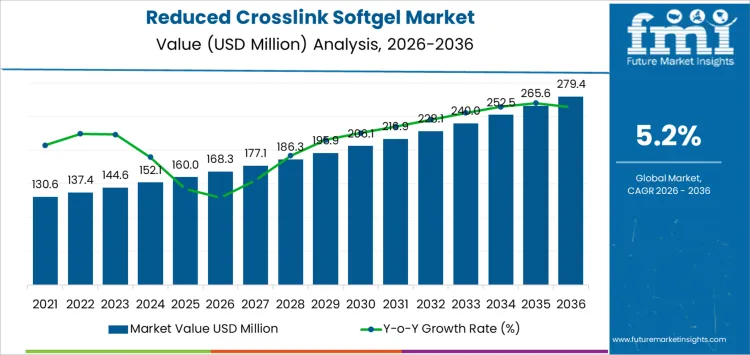
What is the Growth Forecast for the Reduced Crosslink Softgel Market through 2036?
The market growth curve for reduced crosslink softgels shows steady, gradual increases in the early years, followed by a more noticeable acceleration in the later stages of the forecast period. Starting at USD 168.3 million in 2026, the market grows to USD 177.1 million in 2027 and USD 186.3 million in 2028, reflecting the initial adoption and increasing use of advanced softgel formulations.
From 2028 to 2030, the market sees continued growth, reaching USD 196 million in 2029 and USD 206.2 million in 2030. The adoption of reduced crosslink softgels continues to rise as more pharmaceutical and nutraceutical companies incorporate these technologies to enhance product efficacy. Between 2030 and 2035, the market experiences a stronger acceleration, with the value reaching USD 216.9 million in 2031, USD 228.2 million in 2032, and USD 240 million in 2033.
By 2035, the market is projected to reach USD 252.5 million, and by 2036, it will reach USD 279.4 million. The growth curve shows consistent and predictable increases, with the pace of growth gradually accelerating as the technology matures and adoption becomes more widespread. The analysis highlights how the market will continue to grow steadily, with greater adoption of reduced crosslink softgels in both the pharmaceutical and nutraceutical sectors as their benefits for enhanced absorption and bioavailability are increasingly recognized.
Reduced Crosslink Softgel Marke Key Takeaways
| Metric | Value |
|---|---|
| Industry Sales Value (2026) | USD 168.3 million |
| Industry Forecast Value (2036) | USD 279.4 million |
| Industry Forecast CAGR (2026-2036) | 5.2% |
What Is Driving the Demand for the Reduced Crosslink Softgel Market Globally?
The global demand for reduced crosslink softgels is driven by rising consumer interest in gentle, digestible, and easily absorbed dietary supplements, nutraceuticals, and pharmaceutical products. Softgel capsules are widely used to deliver oils, fat soluble vitamins, omega 3s, botanical extracts, and specialized formulations that benefit from protection in a lipid matrix. Reduced crosslink softgels are designed with modified polymer networks that allow improved release profiles, softer texture, and less rigid encapsulation compared with heavily crosslinked gels. This can enhance ingredient bioavailability while reducing the likelihood of digestive discomfort, making these softgels attractive to consumers with sensitive digestion, older adults, and those seeking clean label or user friendly dosage forms. Manufacturers are incorporating reduced crosslink technologies to differentiate products on claims of improved dissolution, gentler mouthfeel, and efficient nutrient delivery, especially in rapidly growing categories such as health and wellness, immunity support, and personalized nutrition.
Future demand for reduced crosslink softgels is expected to grow as consumer preferences continue shifting toward performance oriented and consumer centric dosage forms. Advances in formulation science and polymer technology will support more tailored release characteristics, enabling softgels that match specific ingredient profiles and health outcomes. E commerce and direct to consumer channels will facilitate broader market access for innovative softgel products, encouraging brands to experiment with reduced crosslink formats as part of product portfolios. Regulatory environments that support safe but flexible formulation practices will influence how widely these softgels are adopted in nutraceutical and pharmaceutical markets. Adoption will also depend on manufacturers’ ability to maintain production quality, manage costs relative to traditional softgels, and meet consumer expectations for simplicity and effectiveness. As demand for digestive comfort, enhanced nutrient delivery, and premium supplement experiences grows globally, the reduced crosslink softgel segment is likely to expand across wellness and therapeutic categories.
What Are the Key Segments in Reduced Crosslink Softgel Market?
The reduced crosslink softgel market is segmented by product type and application. Softgel shells low-crosslink lead the product type segment with 50% of the market share, offering flexibility and improved bioavailability for encapsulated substances. Nutraceutical delivery dominates the application segment with 52%, reflecting the growing demand for softgel capsules in dietary supplements and functional foods. The market is expanding as the preference for bioavailable and easy-to-consume supplements continues to rise among health-conscious consumers.
Which Product Type Drives Reduced Crosslink Softgel Market Demand Globally?
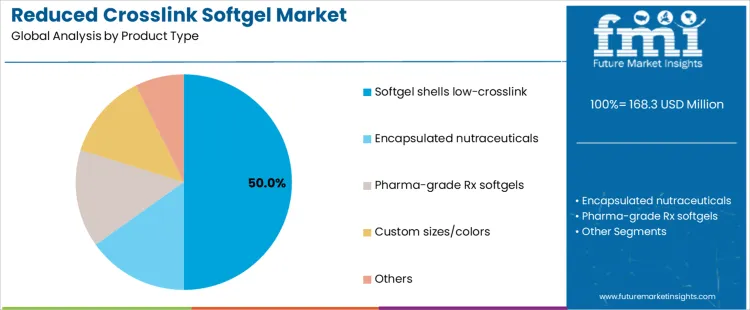
Softgel shells low-crosslink account for 50% of the market share. These softgel capsules feature a lower degree of crosslinking, which results in softer, more flexible shells. This is particularly beneficial in improving the dissolution rate and bioavailability of the active ingredients inside the capsules, making them an ideal choice for the nutraceutical and pharmaceutical industries. Low-crosslink softgel shells also provide enhanced stability and are easier to manufacture, reducing production costs while maintaining product integrity. Their flexibility in encapsulating a wide variety of active ingredients, including oils, proteins, and vitamins, is a significant factor driving the demand for reduced crosslink softgels. As consumers increasingly demand supplements with improved absorption and faster effects, softgel capsules with lower crosslinking are becoming a preferred choice for manufacturers, fueling the growth of this segment.
Which Application Drives Reduced Crosslink Softgel Market Demand Globally?
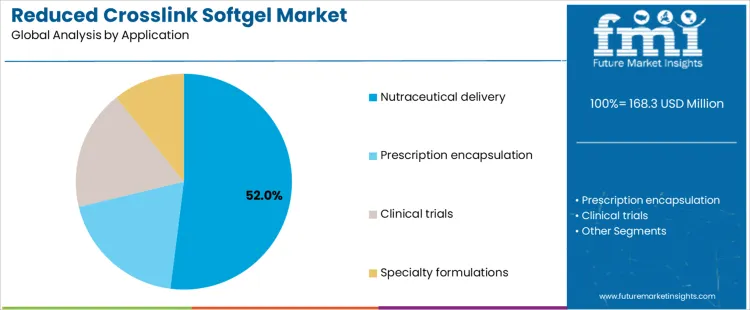
Nutraceutical delivery leads the application segment with 52% of the market share. The nutraceutical market, encompassing dietary supplements, functional foods, and vitamins, is a major driver of demand for reduced crosslink softgels. These capsules offer a convenient and efficient delivery mechanism for a wide range of nutrients and bioactive ingredients. Their ability to mask unpleasant tastes and odors while offering high bioavailability makes softgels a popular choice for consumers. With the increasing consumer preference for easy-to-consume, effective nutritional supplements, the demand for softgel capsules in the nutraceutical industry is expected to continue growing. Additionally, as consumers become more health-conscious, the need for nutraceutical products that deliver faster results with better absorption is driving the adoption of reduced crosslink softgels. Other applications, such as prescription encapsulation, clinical trials, and specialty formulations, also contribute to market growth, but nutraceutical delivery remains the dominant application.
What are the Key Dynamics of the Global Reduced Crosslink Softgel Market?
The global reduced crosslink softgel market is expanding as pharmaceutical and nutraceutical manufacturers focus on products that offer improved bioavailability, gentler disintegration and consumer preference for enhanced digestibility. Reduced crosslink softgels contain polymers with fewer chemical bonds to allow controlled release and softer textures that support ingestion comfort. Growth is supported by rising demand for tailored dosage forms in nutritional supplement, pain management and specialty drug segments. Market expansion reflects broader interest in formulation technologies that balance stability with efficiency, appealing to patients, caregivers and formulators in diverse regions across the world.
What are the Key Drivers for the Global Reduced Crosslink Softgel Market?
One key driver is rising demand for dosage forms that support better absorption and tolerance, which encourages use of reduced crosslink formulations in both pharmaceutical and nutraceutical products. Manufacturers are seeking ways to differentiate offerings through innovation in softgel technology that enhances delivery of active ingredients. Growth of dietary supplements and functional ingredient segments worldwide supports adoption of advanced softgel systems. Healthcare professionals are recommending easier to swallow formulations to improve patient compliance. Advances in encapsulation chemistry and manufacturing control techniques enable consistent quality, supporting broader industry use of reduced crosslink softgel offerings.
What are the Restraints for the Global Reduced Crosslink Softgel Market?
One restraint is the higher cost associated with developing and manufacturing reduced crosslink softgel systems compared to conventional forms. Specialized materials, processing control and quality assurance can increase production expenses, which may slow adoption among cost sensitive producers. Regulatory requirements for novel content and release profiles vary by region and require extensive documentation to meet safety and performance criteria. Limitations in raw material supply or variability in polymer quality can affect consistency of softgel performance. Some manufacturers may lack expertise or infrastructure to implement advanced formulation techniques, which can restrict market penetration in certain areas.
What is the Key Trends in the Global Reduced Crosslink Softgel Market?
A key trend is innovation in polymer selection and formulation strategies that balance reduced crosslink content with mechanical strength and shelf stability. Companies are exploring natural and biodegradable excipients to appeal to sustainability and clean label priorities. Use of predictive modelling and analytical tools in formulation design improves control over release characteristics and softgel properties. Partnerships between ingredient suppliers and contract manufacturers help drive custom solutions tailored to specific active compounds. Interest is rising in softgel combinations that support multi ingredient products, nutrient synergy and targeted health benefits. Expansion of global distribution channels and digital health platforms is increasing visibility and access to advanced softgel products for end users globally.
What is the Country-Wise Outlook for the Reduced Crosslink Softgel Market?
The Reduced Crosslink Softgel market is experiencing steady growth, driven by increasing demand for softgel capsules in the pharmaceutical, nutraceutical, and dietary supplement sectors. Reduced crosslink softgels offer enhanced bioavailability and better absorption, making them an attractive option for both manufacturers and consumers. Countries such as India, China, and the USA are leading the market growth due to the rising demand for oral drug delivery systems and the increasing preference for more efficient, user-friendly supplements. The market is also benefiting from advancements in capsule technology and growing consumer awareness about the benefits of softgel products. As more consumers turn to dietary supplements for health benefits, the demand for reduced crosslink softgels is expected to increase significantly.
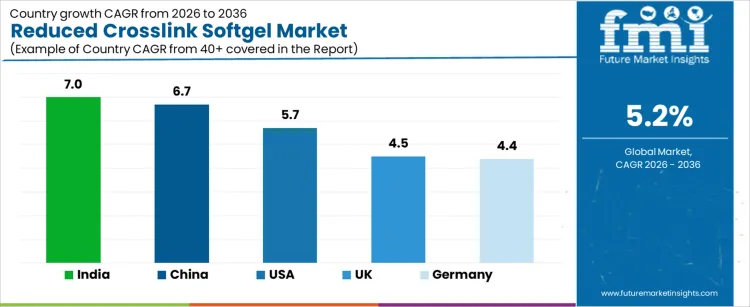
| Country | CAGR (2026–2036) |
|---|---|
| India | 7% |
| China | 6.7% |
| USA | 5.7% |
| UK | 4.5% |
| Germany | 4.4% |
What is Driving the Growth of the Reduced Crosslink Softgel Market in India?
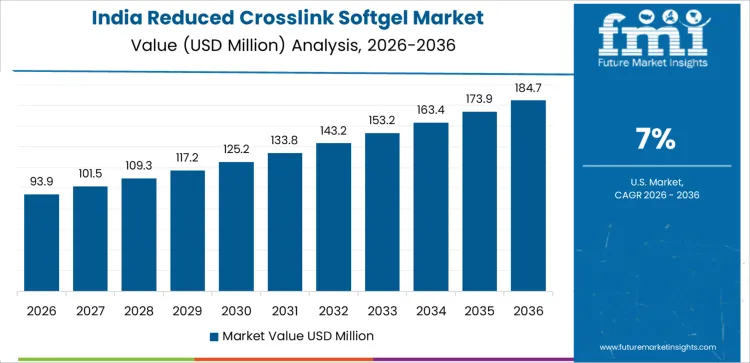
India’s Reduced Crosslink Softgel market is projected to grow at a CAGR of 7%. The country’s rapidly expanding pharmaceutical and nutraceutical industries are driving the demand for softgel products, particularly those with improved bioavailability. With India’s large population and increasing awareness about health and wellness, there is a growing preference for effective and easily consumed supplements. Reduced crosslink softgels, which provide better absorption and more efficient delivery of active ingredients, are gaining traction. As the Indian market for dietary supplements continues to grow, coupled with advancements in softgel manufacturing technologies, the demand for reduced crosslink softgels is expected to rise significantly.
What is Contributing to the Growth of the Reduced Crosslink Softgel Market in China?
China’s Reduced Crosslink Softgel market is expected to grow at a CAGR of 6.7%. The country’s rapidly developing healthcare and supplement sectors, along with increasing consumer awareness about health and wellness, are key factors driving the adoption of reduced crosslink softgels. As the demand for more effective, bioavailable drug delivery systems grows, softgel products, particularly those with enhanced absorption, are becoming increasingly popular. China’s large and aging population, coupled with rising healthcare investments and greater access to supplements, is fueling the market’s growth. Additionally, advancements in softgel production technology and the increasing availability of reduced crosslink softgels are contributing to their wider adoption in the country.
What is Driving the Reduced Crosslink Softgel Market Growth in the USA?
The USA’s Reduced Crosslink Softgel market is projected to grow at a CAGR of 5.7%. As one of the largest markets for dietary supplements and pharmaceuticals, the USA is witnessing increasing demand for effective oral delivery systems. Reduced crosslink softgels, known for their enhanced bioavailability and faster absorption rates, are gaining popularity due to their convenience and effectiveness. With the growing focus on wellness, personalized medicine, and the increasing consumption of nutraceuticals, the demand for softgel products that offer superior bioavailability is expected to rise. Additionally, advancements in formulation technologies and the growing preference for non-liquid oral supplements are further driving the adoption of reduced crosslink softgels in the USA.
What is Influencing the Growth of the Reduced Crosslink Softgel Market in the UK?
The UK’s Reduced Crosslink Softgel market is projected to grow at a CAGR of 4.5%. As the market for dietary supplements continues to expand, driven by an increasing focus on health and wellness, softgel products are becoming more popular due to their ease of use and better absorption. Reduced crosslink softgels offer consumers a more efficient way to ingest active ingredients, which is contributing to their rising adoption. As the UK healthcare sector embraces more advanced supplement delivery systems, the demand for reduced crosslink softgels is expected to increase, though at a slower pace compared to other regions. The continued growth of the nutraceutical sector, coupled with increasing consumer awareness of supplement efficacy, is expected to support market growth in the UK.
What is Contributing to the Growth of the Reduced Crosslink Softgel Market in Germany?
Germany’s Reduced Crosslink Softgel market is expected to grow at a CAGR of 4.4%. The country’s strong pharmaceutical and nutraceutical industries, along with the increasing consumer interest in effective dietary supplements, are driving the adoption of reduced crosslink softgels. As German consumers become more health-conscious and seek supplements with better bioavailability, softgels are becoming the preferred choice due to their superior absorption compared to traditional tablets or capsules. Germany’s healthcare sector, known for its emphasis on quality and innovation, is expected to continue adopting advanced supplement delivery systems, including reduced crosslink softgels, further contributing to the market’s growth in the region.
What is the Competitive Landscape for the Reduced Crosslink Softgel Market?
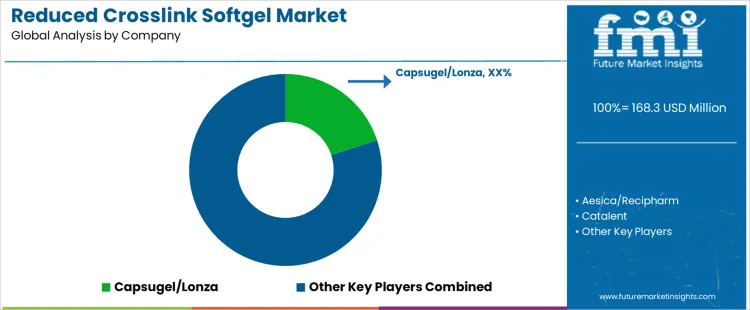
Demand for reduced crosslink softgels is rising as nutraceutical, pharmaceutical and wellness companies seek improved delivery formats with enhanced bioavailability, softer mouthfeel and better dissolution profiles. Reduced crosslinking in softgel shells can improve flexibility and digestibility while maintaining structural integrity during handling and shelf life. Consumers increasingly favour softgels for ease of swallowing and perceived efficacy, especially for omega-3s, fat soluble vitamins, botanical extracts and specialty supplements. Quality, consistency and regulatory compliance are key buying drivers as brands aim to meet stringent safety standards across global markets in North America, Europe and Asia Pacific. Formulators also value softgel systems that support efficient fill processes, minimal leakage and predictable performance in finished products.
Capsugel/Lonza is widely recognised as a leading provider in this segment with extensive expertise in softgel technologies and material science that supports reduced crosslink formulations at commercial scale. Other significant competitors include Aesica/Recipharm and Catalent, each offering contract development and manufacturing services focused on advanced softgel production. Competition among these firms centers on formulation support, shell material innovation, manufacturing reliability, speed to market and ability to customise processes for specific actives and dosage forms. Service quality, global footprint and compliance with evolving regulatory frameworks also influence customer choice. Companies that combine strong process know how, flexible production capabilities and robust quality systems are best positioned to meet growing demand as softgel formats continue to expand across health, wellness and therapeutic applications.
Key Players of the Reduced Crosslink Softgel Market
- Capsugel/Lonza
- Aesica/Recipharm
- Catalent
- Others
Scope of the Report
| Items | Values |
|---|---|
| Quantitative Units (2026) | USD Million |
| Product Type | Softgel Shells Low-Crosslink, Encapsulated Nutraceuticals, Pharma-Grade Rx Softgels, Custom Sizes/Colors, Others |
| Application | Nutraceutical Delivery, Prescription Encapsulation, Clinical Trials, Specialty Formulations |
| End User | Nutraceutical Manufacturers, Pharma Manufacturers, CDMOs, Research Labs |
| Companies | Capsugel/Lonza, Aesica/Recipharm, Catalent |
| Regions Covered | North America, Latin America, Western Europe, Eastern Europe, South Asia and Pacific, East Asia, Middle East & Africa |
| Countries Covered | United States, Canada, Mexico, Brazil, Argentina, Germany, France, United Kingdom, Italy, Spain, Netherlands, China, India, Japan, South Korea, ANZ, GCC Countries, South Africa |
| Additional Attributes | Dollar by sales by product type, application, end-user, and region. Includes market trends in reduced crosslink softgel formulations, performance in nutraceutical delivery, prescription encapsulation, and specialty formulations, cost-effectiveness, sustainability practices, regulatory compliance, market share and competitive positioning of key companies, and the role of reduced crosslink softgels in improving drug delivery, reducing formulation complexity, and enhancing stability in pharmaceutical and nutraceutical industries. |
Reduced Crosslink Softgel Market Segmentation
Product Type
- Softgel shells low-crosslink
- Encapsulated nutraceuticals
- Pharma-grade Rx softgels
- Custom sizes/colors
- Others
Application
- Nutraceutical delivery
- Prescription encapsulation
- Clinical trials
- Specialty formulations
End User
- Nutraceutical manufacturers
- Pharma manufacturers
- CDMOs
- Research labs
Region
- Asia Pacific
- China
- Japan
- South Korea
- India
- Australia & New Zealand
- ASEAN
- Rest of Asia Pacific
- Europe
- Germany
- United Kingdom
- France
- Italy
- Spain
- Nordic
- BENELUX
- Rest of Europe
- North America
- United States
- Canada
- Mexico
- Latin America
- Brazil
- Chile
- Rest of Latin America
- Middle East & Africa
- Kingdom of Saudi Arabia
- Other GCC Countries
- Turkey
- South Africa
- Other African Union
- Rest of Middle East & Africa
Frequently Asked Questions
How big is the reduced crosslink softgel market in 2026?
The global reduced crosslink softgel market is estimated to be valued at USD 168.3 million in 2026.
What will be the size of reduced crosslink softgel market in 2036?
The market size for the reduced crosslink softgel market is projected to reach USD 279.4 million by 2036.
How much will be the reduced crosslink softgel market growth between 2026 and 2036?
The reduced crosslink softgel market is expected to grow at a 5.2% CAGR between 2026 and 2036.
What are the key product types in the reduced crosslink softgel market?
The key product types in reduced crosslink softgel market are softgel shells low-crosslink, encapsulated nutraceuticals, pharma-grade rx softgels, custom sizes/colors and others.
Which application segment to contribute significant share in the reduced crosslink softgel market in 2026?
In terms of application, nutraceutical delivery segment to command 52.0% share in the reduced crosslink softgel market in 2026.
Preview the report firsthand - request a free sample
Get SampleGet the brochure for pricing and purchase details.
Get PDFTable of Content
- Executive Summary
- Global Market Outlook
- Demand-side Trends
- Supply-side Trends
- Technology Roadmap Analysis
- Analysis and Recommendations
- Market Overview
- Market Coverage / Taxonomy
- Market Definition / Scope / Limitations
- Market Background
- Market Dynamics
- Drivers
- Restraints
- Opportunity
- Trends
- Scenario Forecast
- Demand in Optimistic Scenario
- Demand in Likely Scenario
- Demand in Conservative Scenario
- Opportunity Map Analysis
- Product Life Cycle Analysis
- Supply Chain Analysis
- Investment Feasibility Matrix
- Value Chain Analysis
- PESTLE and Porter’s Analysis
- Regulatory Landscape
- Regional Parent Market Outlook
- Production and Consumption Statistics
- Import and Export Statistics
- Market Dynamics
- Global Market Analysis 2021 to 2025 and Forecast, 2026 to 2036
- Historical Market Size Value (USD Million) Analysis, 2021 to 2025
- Current and Future Market Size Value (USD Million) Projections, 2026 to 2036
- Y-o-Y Growth Trend Analysis
- Absolute $ Opportunity Analysis
- Global Market Pricing Analysis 2021 to 2025 and Forecast 2026 to 2036
- Global Market Analysis 2021 to 2025 and Forecast 2026 to 2036, By Product Type
- Introduction / Key Findings
- Historical Market Size Value (USD Million) Analysis By Product Type , 2021 to 2025
- Current and Future Market Size Value (USD Million) Analysis and Forecast By Product Type , 2026 to 2036
- Softgel shells low-crosslink
- Encapsulated nutraceuticals
- Pharma-grade Rx softgels
- Custom sizes/colors
- Others
- Y-o-Y Growth Trend Analysis By Product Type , 2021 to 2025
- Absolute $ Opportunity Analysis By Product Type , 2026 to 2036
- Global Market Analysis 2021 to 2025 and Forecast 2026 to 2036, By Application
- Introduction / Key Findings
- Historical Market Size Value (USD Million) Analysis By Application, 2021 to 2025
- Current and Future Market Size Value (USD Million) Analysis and Forecast By Application, 2026 to 2036
- Nutraceutical delivery
- Prescription encapsulation
- Clinical trials
- Specialty formulations
- Y-o-Y Growth Trend Analysis By Application, 2021 to 2025
- Absolute $ Opportunity Analysis By Application, 2026 to 2036
- Global Market Analysis 2021 to 2025 and Forecast 2026 to 2036, By End User
- Introduction / Key Findings
- Historical Market Size Value (USD Million) Analysis By End User, 2021 to 2025
- Current and Future Market Size Value (USD Million) Analysis and Forecast By End User, 2026 to 2036
- Nutraceutical manufacturers
- Pharma manufacturers
- CDMOs
- Research labs
- Y-o-Y Growth Trend Analysis By End User, 2021 to 2025
- Absolute $ Opportunity Analysis By End User, 2026 to 2036
- Global Market Analysis 2021 to 2025 and Forecast 2026 to 2036, By Region
- Introduction
- Historical Market Size Value (USD Million) Analysis By Region, 2021 to 2025
- Current Market Size Value (USD Million) Analysis and Forecast By Region, 2026 to 2036
- North America
- Latin America
- Western Europe
- Eastern Europe
- East Asia
- South Asia and Pacific
- Middle East & Africa
- Market Attractiveness Analysis By Region
- North America Market Analysis 2021 to 2025 and Forecast 2026 to 2036, By Country
- Historical Market Size Value (USD Million) Trend Analysis By Market Taxonomy, 2021 to 2025
- Market Size Value (USD Million) Forecast By Market Taxonomy, 2026 to 2036
- By Country
- USA
- Canada
- Mexico
- By Product Type
- By Application
- By End User
- By Country
- Market Attractiveness Analysis
- By Country
- By Product Type
- By Application
- By End User
- Key Takeaways
- Latin America Market Analysis 2021 to 2025 and Forecast 2026 to 2036, By Country
- Historical Market Size Value (USD Million) Trend Analysis By Market Taxonomy, 2021 to 2025
- Market Size Value (USD Million) Forecast By Market Taxonomy, 2026 to 2036
- By Country
- Brazil
- Chile
- Rest of Latin America
- By Product Type
- By Application
- By End User
- By Country
- Market Attractiveness Analysis
- By Country
- By Product Type
- By Application
- By End User
- Key Takeaways
- Western Europe Market Analysis 2021 to 2025 and Forecast 2026 to 2036, By Country
- Historical Market Size Value (USD Million) Trend Analysis By Market Taxonomy, 2021 to 2025
- Market Size Value (USD Million) Forecast By Market Taxonomy, 2026 to 2036
- By Country
- Germany
- UK
- Italy
- Spain
- France
- Nordic
- BENELUX
- Rest of Western Europe
- By Product Type
- By Application
- By End User
- By Country
- Market Attractiveness Analysis
- By Country
- By Product Type
- By Application
- By End User
- Key Takeaways
- Eastern Europe Market Analysis 2021 to 2025 and Forecast 2026 to 2036, By Country
- Historical Market Size Value (USD Million) Trend Analysis By Market Taxonomy, 2021 to 2025
- Market Size Value (USD Million) Forecast By Market Taxonomy, 2026 to 2036
- By Country
- Russia
- Poland
- Hungary
- Balkan & Baltic
- Rest of Eastern Europe
- By Product Type
- By Application
- By End User
- By Country
- Market Attractiveness Analysis
- By Country
- By Product Type
- By Application
- By End User
- Key Takeaways
- East Asia Market Analysis 2021 to 2025 and Forecast 2026 to 2036, By Country
- Historical Market Size Value (USD Million) Trend Analysis By Market Taxonomy, 2021 to 2025
- Market Size Value (USD Million) Forecast By Market Taxonomy, 2026 to 2036
- By Country
- China
- Japan
- South Korea
- By Product Type
- By Application
- By End User
- By Country
- Market Attractiveness Analysis
- By Country
- By Product Type
- By Application
- By End User
- Key Takeaways
- South Asia and Pacific Market Analysis 2021 to 2025 and Forecast 2026 to 2036, By Country
- Historical Market Size Value (USD Million) Trend Analysis By Market Taxonomy, 2021 to 2025
- Market Size Value (USD Million) Forecast By Market Taxonomy, 2026 to 2036
- By Country
- India
- ASEAN
- Australia & New Zealand
- Rest of South Asia and Pacific
- By Product Type
- By Application
- By End User
- By Country
- Market Attractiveness Analysis
- By Country
- By Product Type
- By Application
- By End User
- Key Takeaways
- Middle East & Africa Market Analysis 2021 to 2025 and Forecast 2026 to 2036, By Country
- Historical Market Size Value (USD Million) Trend Analysis By Market Taxonomy, 2021 to 2025
- Market Size Value (USD Million) Forecast By Market Taxonomy, 2026 to 2036
- By Country
- Kingdom of Saudi Arabia
- Other GCC Countries
- Turkiye
- South Africa
- Other African Union
- Rest of Middle East & Africa
- By Product Type
- By Application
- By End User
- By Country
- Market Attractiveness Analysis
- By Country
- By Product Type
- By Application
- By End User
- Key Takeaways
- Key Countries Market Analysis
- USA
- Pricing Analysis
- Market Share Analysis, 2025
- By Product Type
- By Application
- By End User
- Canada
- Pricing Analysis
- Market Share Analysis, 2025
- By Product Type
- By Application
- By End User
- Mexico
- Pricing Analysis
- Market Share Analysis, 2025
- By Product Type
- By Application
- By End User
- Brazil
- Pricing Analysis
- Market Share Analysis, 2025
- By Product Type
- By Application
- By End User
- Chile
- Pricing Analysis
- Market Share Analysis, 2025
- By Product Type
- By Application
- By End User
- Germany
- Pricing Analysis
- Market Share Analysis, 2025
- By Product Type
- By Application
- By End User
- UK
- Pricing Analysis
- Market Share Analysis, 2025
- By Product Type
- By Application
- By End User
- Italy
- Pricing Analysis
- Market Share Analysis, 2025
- By Product Type
- By Application
- By End User
- Spain
- Pricing Analysis
- Market Share Analysis, 2025
- By Product Type
- By Application
- By End User
- France
- Pricing Analysis
- Market Share Analysis, 2025
- By Product Type
- By Application
- By End User
- India
- Pricing Analysis
- Market Share Analysis, 2025
- By Product Type
- By Application
- By End User
- ASEAN
- Pricing Analysis
- Market Share Analysis, 2025
- By Product Type
- By Application
- By End User
- Australia & New Zealand
- Pricing Analysis
- Market Share Analysis, 2025
- By Product Type
- By Application
- By End User
- China
- Pricing Analysis
- Market Share Analysis, 2025
- By Product Type
- By Application
- By End User
- Japan
- Pricing Analysis
- Market Share Analysis, 2025
- By Product Type
- By Application
- By End User
- South Korea
- Pricing Analysis
- Market Share Analysis, 2025
- By Product Type
- By Application
- By End User
- Russia
- Pricing Analysis
- Market Share Analysis, 2025
- By Product Type
- By Application
- By End User
- Poland
- Pricing Analysis
- Market Share Analysis, 2025
- By Product Type
- By Application
- By End User
- Hungary
- Pricing Analysis
- Market Share Analysis, 2025
- By Product Type
- By Application
- By End User
- Kingdom of Saudi Arabia
- Pricing Analysis
- Market Share Analysis, 2025
- By Product Type
- By Application
- By End User
- Turkiye
- Pricing Analysis
- Market Share Analysis, 2025
- By Product Type
- By Application
- By End User
- South Africa
- Pricing Analysis
- Market Share Analysis, 2025
- By Product Type
- By Application
- By End User
- USA
- Market Structure Analysis
- Competition Dashboard
- Competition Benchmarking
- Market Share Analysis of Top Players
- By Regional
- By Product Type
- By Application
- By End User
- Competition Analysis
- Competition Deep Dive
- Capsugel/Lonza
- Overview
- Product Portfolio
- Profitability by Market Segments (Product/Age /Sales Channel/Region)
- Sales Footprint
- Strategy Overview
- Marketing Strategy
- Product Strategy
- Channel Strategy
- Aesica/Recipharm
- Catalent
- Others
- Capsugel/Lonza
- Competition Deep Dive
- Assumptions & Acronyms Used
- Research Methodology


