

- Market Size (2026)
- USD 3.91 Bn
- Forecast (2036)
- USD 5.46 Bn
- CAGR (2026 to 2036)
- 3.4%
Insulin Aspart Market Size, Market Forecast and Outlook by FMI
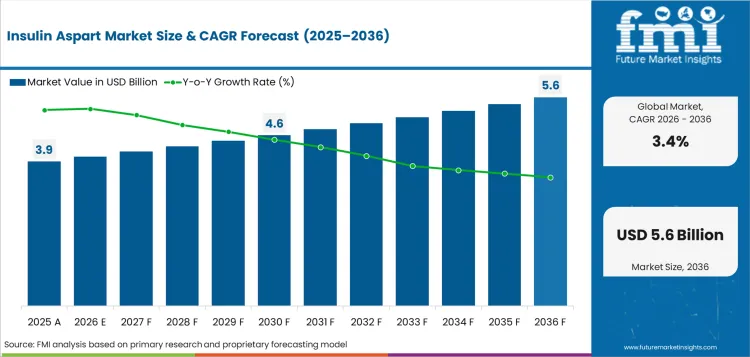
The insulin aspart market is estimated at USD 3.78 billion in 2025. Industry value is forecast to reach USD 3.91 billion in 2026 and USD 5.46 billion by 2036 at 3.4% CAGR. Standard insulin aspart is projected to account for 62.0% of product-type demand in 2026. Prefilled pens are estimated to represent 57.0% of delivery-format demand in 2026.
Summary of the Insulin Aspart Market
- Demand and Growth Drivers
- Mealtime glucose control keeps insulin aspart relevant across patients who need rapid post-meal glucose lowering.
- Pump and hybrid closed-loop therapy support demand because these systems rely on rapid-acting insulin delivery.
- Biosimilar approvals are expected to increase access and price competition in the United States.
- The International Diabetes Federation reports that 589 million adults aged 20 to 79 were living with diabetes in 2024, with the number projected to reach 853 million by 2050.
- Product and Segment View
- Standard insulin aspart is projected to account for 62.0% share in 2026, as NovoLog and NovoRapid have long clinical use.
- Prefilled pens are estimated to represent 57.0% share in 2026, as self-administration convenience shapes repeat therapy.
- Type 1 diabetes is expected to hold 51.0% share in 2026, since intensive insulin therapy keeps rapid-acting analogues central to care.
- Geography and Competitive Outlook
- India is projected to record 5.8% CAGR by 2036 as diabetes prevalence and formal insulin access expand together.
- China is expected to expand at 5.2% CAGR by 2036 as chronic diabetes care channels deepen.
- Novo Nordisk, Sanofi and Biocon Biologics hold the clearest supplier positions through reference insulin aspart and biosimilar entry.
- FDA approved Merilog as the first rapid-acting insulin biosimilar in February 2025, followed by Kirsty as an interchangeable insulin aspart biosimilar in July 2025.
- Analyst Opinion
- Sabyasachi Ghosh, Principal Consultant at FMI, observes, insulin aspart is moving from a branded analogue story to an access and switching story. Buyers still need fast mealtime control, but payers now have more room to press for lower-cost options. The strongest demand pool will stay in type 1 diabetes and pump-linked therapy. Suppliers should watch pen availability, cold-chain reliability and real switching behavior in the United States through 2036.
- Insulin Aspart Market Value Analysis
- Repeat prescription use supports stable revenue because insulin aspart is used as part of daily diabetes management.
- Biosimilar approvals are expected to reduce price pressure risk for payers but limit branded value expansion.
- Pump therapy and hybrid closed-loop care support rapid-acting insulin demand in advanced type 1 diabetes treatment.
- Emerging-market growth depends on affordability, specialist access and reliable pharmacy supply.
Key Takeaways, Market Size, and Forecast
- The insulin aspart market value is estimated at USD 3.78 billion in 2025.
- Global insulin aspart market is projected to reach USD 5.46 billion by 2036 as rapid-acting insulin remains central to mealtime glucose control.
- The market is expected to expand at 3.4% CAGR from 2026 to 2036 across type 1 diabetes, insulin-treated type 2 diabetes and pump-linked therapy.
- The market is projected to create an incremental opportunity of USD 1.55 billion between 2026 and 2036.
- Standard insulin aspart is expected to account for 62.0% share in 2026 due to broad physician familiarity and established payer coverage.
- Prefilled pens are estimated to represent 57.0% share in 2026 as patients prefer simpler daily dosing formats.
- India at 5.8% CAGR and China at 5.2% CAGR are expected to record the fastest country-level pace by 2036.
Insulin Aspart Market Definition
The sector covers rapid-acting insulin aspart products used to improve glycemic control in people with diabetes. Included products cover standard insulin aspart, faster-acting insulin aspart and biosimilar insulin aspart. The scope includes products sold in prefilled pens, vials, cartridges and pump-compatible formats.
Long-acting insulin, human regular insulin, premixed insulin products not defined primarily by insulin aspart and non-insulin diabetes drugs fall outside this study.
Insulin Aspart Market Inclusions
The study includes standard insulin aspart, faster-acting insulin aspart, biosimilar insulin aspart, prefilled pens, vials, cartridges, pump reservoir use, type 1 diabetes, insulin-treated type 2 diabetes, gestational diabetes, retail pharmacy sales, hospital pharmacy sales, online pharmacy sales and global geography.
Market scope covers commercially traded insulin aspart products by product type, including standard and biosimilar insulin aspart; delivery format, including prefilled pens and vials; indication, including type 1 diabetes and type 2 diabetes; and sales channel, including retail pharmacies, hospital pharmacies and online pharmacies.
Revenue scope covers 2026 to 2036. The key stakeholders include insulin manufacturers, biosimilar developers, endocrinologists, diabetes educators, hospital formulary teams, pharmacy chains, diabetes clinics, distributors, payers and regulatory bodies.
Insulin Aspart Market Exclusions
The study excludes insulin glargine, insulin degludec, insulin lispro, human regular insulin, GLP-1 drugs, SGLT2 inhibitors, DPP-4 inhibitors, metformin and insulin delivery devices sold without insulin.
Insulin Aspart Market Research Methodology
- Primary Research: FMI analysts reviewed endocrinologists, diabetes educators, pharmacy buyers and hospital formulary teams. Interviews focused on rapid-acting insulin use, device preference, payer switching and biosimilar acceptance.
- Desk Research: The desk review used FDA approvals, EMA product information, WHO insulin access guidance and company annual reports. Diabetes prevalence data supported country-level demand checks.
- Market Sizing and Forecasting: The forecast combined treated diabetes pools with rapid-acting insulin analogue penetration and average realized price. Segment shares were checked against delivery format use and product availability.
- Data Validation: Final values were checked against diabetes prevalence, insulin sales movement, biosimilar approval timing and country access patterns.
Why is the Insulin Aspart Market Growing?
- Rapid-acting insulin remains essential where patients need mealtime glucose control.
- Type 1 diabetes management supports repeat insulin aspart use through intensive insulin therapy.
- Pump and hybrid closed-loop systems depend on rapid insulin action for automated delivery.
- Biosimilar insulin aspart creates new access routes for payers seeking lower-cost rapid insulin.
- Prefilled pens support repeat use because self-administration convenience matters in chronic therapy.
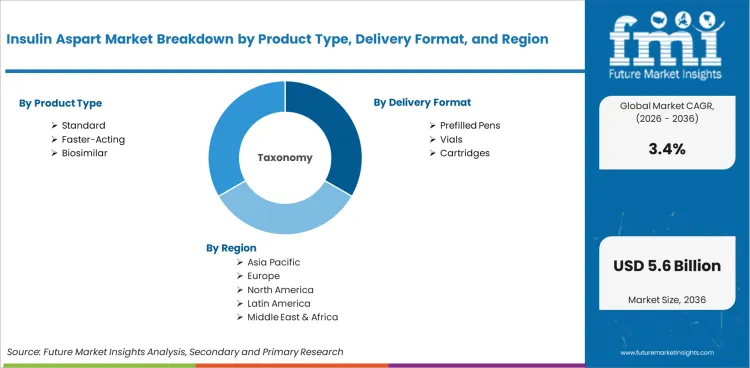
The insulin aspart market is segmented by product type into standard insulin aspart, faster-acting insulin aspart and biosimilar insulin aspart. By delivery format, the market is divided into prefilled pens, vials, cartridges and pump reservoirs.
Based on indication, the market is segmented into type 1 diabetes, type 2 diabetes and gestational diabetes. By distribution channel, the market is categorized into retail pharmacies, hospital pharmacies and online pharmacies.
FDA describes Merilog as a rapid-acting human insulin analogue used to lower mealtime blood sugar spikes in adults and pediatric patients with diabetes. Insulin aspart remains tied to daily glucose control rather than occasional treatment. The approval of Merilog as the first rapid-acting insulin biosimilar also changes the buyer conversation from brand familiarity to access and substitution.
Insulin Aspart Market Analysis by Product Type
- Standard insulin aspart is expected to account for 62.0% share in 2026 as established products retain broad physician familiarity and payer coverage.
- Faster-acting insulin aspart gains use where clinicians value earlier absorption and more flexible mealtime dosing.
Insights into Biosimilar Insulin Aspart Segment
- Biosimilar insulin aspart is expected to gain share after FDA approval of Merilog and Kirsty in 2025.
- Payers are likely to test biosimilar switching first where formulary control is strong and patients use standard rapid-acting insulin.
Insulin Aspart Market Analysis by Delivery Format
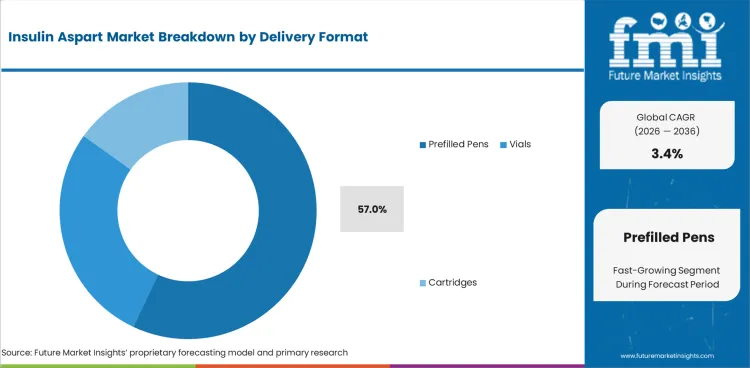
- Prefilled pens are estimated to represent 57.0% share in 2026 as patients and caregivers prefer simpler dosing over vial-based handling.
- Pen demand is shaped by chronic self-use, pharmacy availability and the need to reduce administration errors.
Insights into Vials Segment
- Vials continue to serve hospitals, some pump users and cost-sensitive accounts where price per unit remains a key decision point.
- Biosimilar vial supply can gain traction where institutions review rapid-acting insulin through tender or formulary cost checks.
Insulin Aspart Market Analysis by Indication
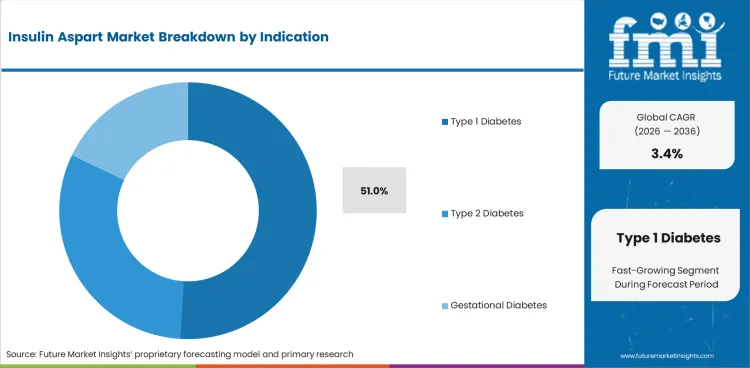
- Type 1 diabetes is projected to hold 51.0% share in 2026 because intensive insulin therapy requires rapid-acting insulin across daily meals.
- Insulin-treated type 2 diabetes creates a larger patient pool but has lower rapid-acting analogue intensity per patient.
Insights into Type 2 Diabetes Segment
- Type 2 diabetes use expands when patients move beyond basal insulin and need mealtime control.
- GLP-1 and SGLT2 use can delay insulin intensification, which limits rapid-acting insulin value growth in some mature markets.
Insulin Aspart Market Analysis by Distribution Channel
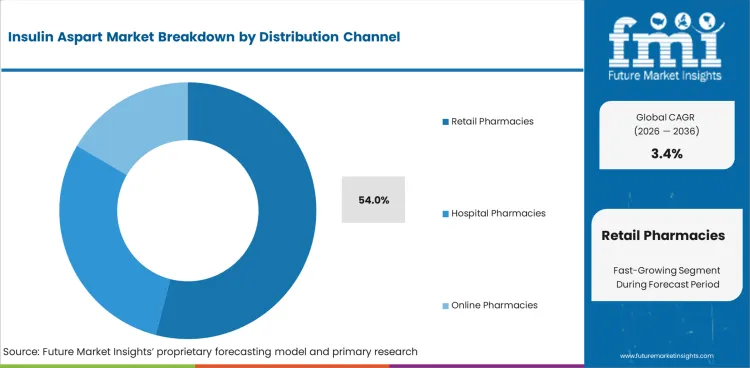
- Retail pharmacies are expected to hold 54.0% share in 2026 as chronic refill behavior keeps outpatient channels ahead.
- Hospital pharmacies remain important for initiation, emergency care and formulary-driven biosimilar adoption.
Insights into Online Pharmacies Segment
- Online pharmacies serve refill convenience but remain dependent on cold-chain handling and prescription verification.
- Growth is strongest where diabetes patients already use digital refill systems and insurer-linked pharmacy networks.
Insulin Aspart Market Drivers, Restraints, and Opportunities
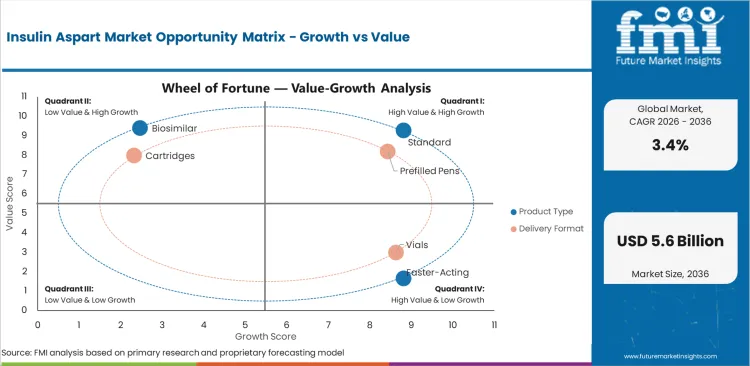
- Diabetes prevalence sustains the treatment pool as 589 million adults were living with diabetes in 2024.
- Biosimilar approvals will sustain switching pressure as rapid-acting insulin aspart alternatives enter the US market.
- Pump therapy creates demand for rapid insulin formats that support automated or semi-automated dosing.
- Price pressure is expected to limit value growth as payers push lower-cost alternatives.
- WHO access work creates opportunity for quality-assured analogue insulin in lower-income markets.
Biosimilar Switching Pressure
Biosimilar entry is expected to affect insulin aspart beyond normal brand competition through 2036. FDA approved Merilog as biosimilar to NovoLog in February 2025. FDA approval for Kirsty followed in July 2025 and described the product as biosimilar to and interchangeable with US NovoLog. These approvals give payers a clearer substitution path in rapid-acting insulin. Branded suppliers will need stronger device support and payer evidence to protect volume.
Pump-Compatible Rapid Insulin Use
Pump and hybrid closed-loop therapy create a clearer equipment path for insulin aspart in type 1 diabetes. NHS England describes hybrid closed-loop systems as technology that links continuous glucose monitoring with insulin pumps and automatically adjusts insulin delivery. These systems need rapid-acting insulin rather than long-acting basal-only therapy. Insulin aspart suppliers benefit where device-led diabetes care expands. The commercial issue is that pump-linked use favors reliability and availability as much as brand preference.
Affordability and Access Pressure
Access remains the main restraint in lower-income markets and some high-income settings. WHO states that about 15% of people with diabetes require insulin, but only about half are treated with insulin. This gap limits the real market below the theoretical disease burden. WHO’s 2026 expansion of the insulin master file procedure to insulin analogues is meant to help more quality-assured analogue insulin products enter markets and improve access.
Regional Analysis
.webp "Top Country Growth Comparison Insulin Aspart Market Cagr (2026 2036)")
| Country | CAGR 2026 to 2036 |
|---|---|
| India | 5.8% |
| China | 5.2% |
| South Korea | 4.1% |
| United States | 2.8% |
| United Kingdom | 2.5% |
| Germany | 2.2% |
| Japan | 1.9% |
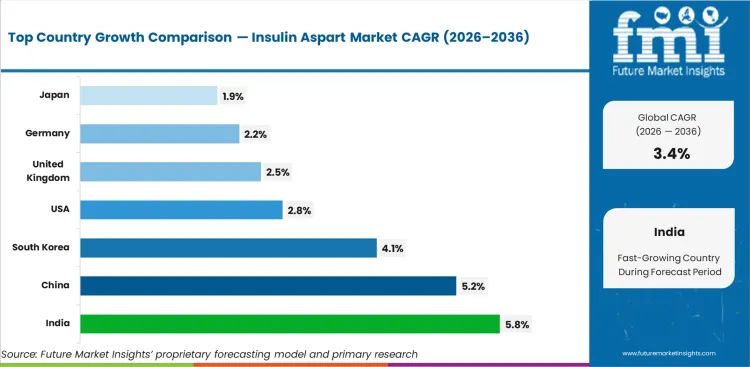
Source: Future Market Insights analysis based on diabetes treatment demand and public regulatory source checks in 2026.
Analysis of Insulin Aspart Market by Key Countries
- India is expected to grow at 5.8% CAGR by 2036, led by diabetes prevalence and wider formal insulin access.
- China is projected to follow at 5.2% CAGR by 2036 as chronic diabetes care channels expand.
- South Korea demand is projected at 4.1% CAGR by 2036 as advanced diabetes care supports analogue insulin use.
- United States demand is expected to advance at 2.8% CAGR by 2036 as biosimilar competition limits value growth.
- United Kingdom is forecast at 2.5% CAGR by 2036 through NHS-driven diabetes care and pump therapy.
- Germany at 2.2% CAGR and Japan at 1.9% CAGR expand through mature diabetes care rather than fast patient-volume growth.
Country growth differs with disease burden and payer pressure. India and China lead because large diabetes populations are still moving into formal chronic-care pathways. The United States remains a high-value market but grows slower as biosimilars and affordability pressure affect pricing. Germany, Japan and the United Kingdom maintain steadier demand through mature insulin use and stronger payer control.
Demand Outlook for Insulin Aspart Market in India
Demand for insulin aspart in India is projected to rise at 5.8% CAGR by 2036, reflected by a large diabetes pool and wider formal treatment access. India’s Press Information Bureau cited the ICMR-INDIAB study and stated in November 2024 that India had 10.1 crore people with diabetes. This disease pool supports long-term insulin demand. Adoption of insulin aspart will depend on affordability, endocrinologist access and reliable pharmacy supply.
- Mumbai and Bengaluru support early analogue insulin use through private diabetes clinics and organized pharmacies.
- Tier-2 city demand depends on cold-chain reach and patient affordability.
- Biosimilar rapid-acting insulin can gain share if pricing reduces the gap with human insulin.
Demand Outlook for Insulin Aspart Market in China
The sector in China is expected to expand at 5.2% CAGR by 2036, driven by a large diabetes population and broader chronic-care management. Urban hospitals and pharmacy channels support insulin analogue use in patients who need mealtime control. Local biologics capability may increase price competition over the forecast period. China follows India as treatment access and diabetes diagnosis support larger rapid-acting insulin demand.
- Shanghai and Guangdong support premium insulin use through advanced diabetes care networks.
- Local insulin producers influence price competition in analogue categories.
- Chronic disease management policy supports wider treatment continuity.
Demand Outlook for Insulin Aspart Market in South Korea
Demand for insulin aspart in South Korea is expected to advance at 4.1% CAGR by 2036, as specialist-led diabetes care supports use of rapid-acting analogues. The market is smaller than China and India but has stronger clinical infrastructure. Growth is expected to come from faster-acting formats, pump-linked therapy and premium outpatient care.
- Seoul tertiary hospitals support analogue insulin use in complex diabetes care.
- National reimbursement decisions influence biosimilar switching pace.
- Digital diabetes tools can support demand for rapid insulin in pump-linked care.
Demand Outlook for Insulin Aspart Market in the United States
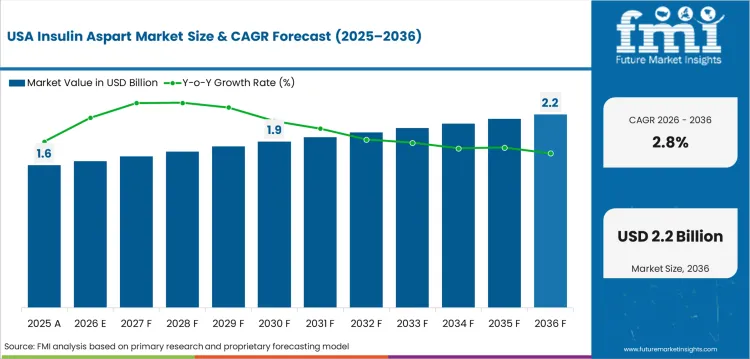
Sales of insulin aspart in the United States are projected to increase at 2.8% CAGR by 2036 as mature insulin use faces biosimilar and payer pressure. CDC reported in May 2024 that 40.1 million people in the United States had diabetes, equal to about one in every eight people. The disease burden supports rapid-acting insulin demand. Value growth remains restrained because FDA-approved biosimilars create new formulary options.
- FDA approval of Merilog creates the first rapid-acting insulin aspart biosimilar option.
- Kirsty approval gives payers an interchangeable biosimilar pathway for NovoLog.
- Pharmacy benefit managers will influence switching through formulary placement and patient cost design.
Demand Outlook for Insulin Aspart Market in the United Kingdom
The sector in the United Kingdom is expected to expand at 2.5% CAGR by 2036 since NHS diabetes care supports stable rapid-acting insulin use. Type 1 diabetes and hybrid closed-loop therapy keep insulin aspart relevant in intensive insulin treatment. Growth stays measured as procurement discipline and generic-style biosimilar review limit value expansion.
- NHS England’s hybrid closed-loop rollout supports rapid insulin use in type 1 diabetes.
- Hospital trusts review insulin options through cost and clinical suitability.
- Retail and community pharmacy access supports repeat outpatient refills.
Demand Outlook for Insulin Aspart Market in Germany
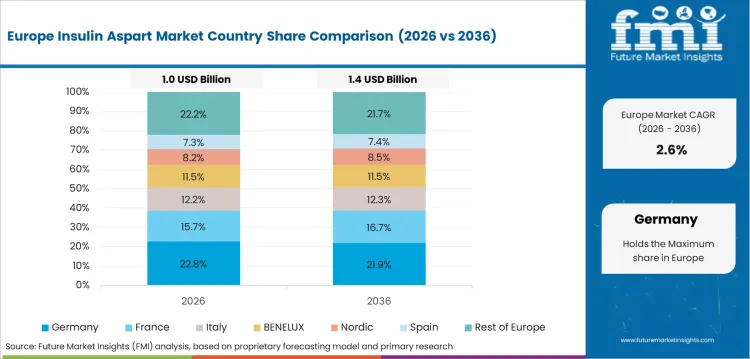
Insulin aspart demand in Germany is projected to record 2.2% CAGR by 2036 as mature diabetes care and strict reimbursement shape product choice. The country has stable analogue insulin use but strong cost controls. Biosimilar acceptance may support switching in cost-sensitive channels. Growth stays measured because insulin access is already broad.
- Statutory health insurance pressure supports lower-cost analogue alternatives.
- Diabetes specialist networks sustain rapid-acting insulin use in intensive care pathways.
- Biosimilar experience in Germany supports payer-led substitution where savings are clear.
Demand Outlook for Insulin Aspart Market in Japan
The sector in Japan is expected to expand at 1.9% CAGR by 2036 due to mature diabetes care and slower patient-volume expansion. Demand remains stable in insulin-treated patients and older adults. Growth is limited by mature analogue penetration and national price controls. Suppliers need device reliability and continuity of supply to defend accounts.
- Tokyo and Osaka diabetes centers support advanced insulin therapy.
- National reimbursement revisions can pressure branded insulin value.
- Aging patients support stable insulin demand but not fast value expansion.
Competitive Landscape
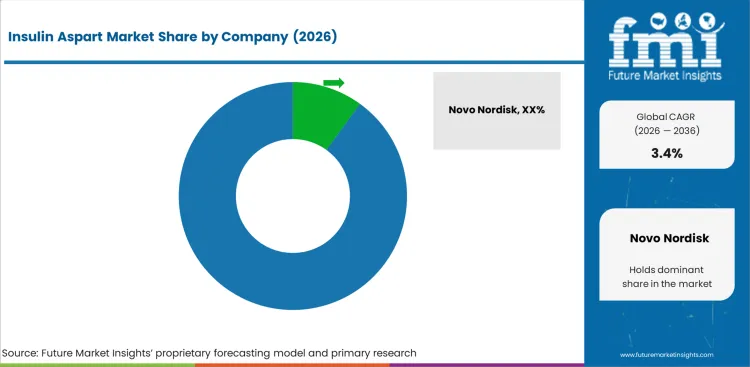
- Novo Nordisk holds the strongest reference-product position through NovoLog, NovoRapid and Fiasp.
- Sanofi entered the USA insulin aspart biosimilar market through Merilog.
- Biocon Biologics strengthened competition with Kirsty, the FDA-approved interchangeable insulin aspart biosimilar.
- Device format and payer access are becoming more important than brand history alone.
- Cold-chain reliability and pharmacy availability remain essential for biosimilar uptake.
Competition in insulin aspart is defined by reference-product strength and biosimilar switching. Novo Nordisk retains a large position through long-standing insulin aspart brands. Sanofi and Biocon Biologics now create direct pressure in the United States through approved biosimilar products. The next competitive phase will be shaped by formulary inclusion, patient cost and confidence in switching.
Novo Nordisk’s wider insulin franchise shows the pressure facing legacy insulin suppliers. The company reported insulin sales of DKK 53.14 billion in 2025, down 4% in Danish kroner and down 1% at constant exchange rates. These figures illustrate that diabetes prevalence can rise while insulin value growth remains under pressure. Suppliers need to defend share through access, devices and proven supply reliability.
Key Companies in the Insulin Aspart Market
- Novo Nordisk
- Sanofi
- Biocon Biologics
- Viatris
Regional Insulin Producers
- Gan & Lee Pharmaceuticals
- Tonghua Dongbao
- Wockhardt
Competitive Benchmarking: Insulin Aspart Market
| Company | Rapid-Acting Portfolio Depth | Biosimilar Position | Device Format Strength | Geographic Footprint |
|---|---|---|---|---|
| Novo Nordisk | High | Reference leader | High | Global |
| Sanofi | Medium | Strong | High | Global |
| Biocon Biologics | Medium | Strong | Medium | Global |
| Viatris | Medium | Medium | Medium | Global |
| Gan & Lee Pharmaceuticals | Medium | Moderate | Medium | China-led |
| Tonghua Dongbao | Medium | Moderate | Medium | China-led |
| Wockhardt | Low to Medium | Moderate | Low to Medium | Emerging markets |
Source: Future Market Insights competitive analysis, 2026. Ratings reflect relative positioning based on rapid-acting insulin portfolio depth, biosimilar approval position and delivery-format strength.
Key Developments in Insulin Aspart Market
- In February 2025, FDA approved Merilog as the first rapid-acting insulin biosimilar product for treatment of diabetes.
- In July 2025, FDA approved Kirsty as biosimilar to and interchangeable with US NovoLog.
- In March 2026, WHO expanded the insulin master file procedure to insulin analogues to improve access to quality-assured analogue insulin products.
- In 2025, Novo Nordisk reported insulin sales of DKK 53.14 billion, down 4% in Danish kroner.
- In 2025, IDF reported 589 million adults living with diabetes and projected 853 million by 2050.
Report Scope and Coverage
| Parameter | Details |
|---|---|
| Quantitative Units | USD 3.91 billion in 2026 to USD 5.46 billion in 2036, at a CAGR of 3.4% |
| Market Definition | Rapid-acting insulin aspart products used for glycemic control in diabetes. |
| Regions Covered | North America, Latin America, Europe, East Asia, South Asia and Pacific, Middle East and Africa |
| Countries Covered | India, China, South Korea, United States, United Kingdom, Germany, Japan and 30+ countries |
| Key Companies Profiled | Novo Nordisk, Sanofi, Biocon Biologics, Viatris, Gan & Lee Pharmaceuticals, Tonghua Dongbao and Wockhardt |
| Forecast Period | 2026 to 2036 |
| Approach | Hybrid bottom-up and top-down methodology based on treated diabetes pools, insulin analogue penetration, product format share and country access patterns |
Insulin Aspart Market by Segments
Insulin Aspart Market Segmented by Product Type:
- Standard Insulin Aspart
- Faster-Acting Insulin Aspart
- Biosimilar Insulin Aspart
Insulin Aspart Market Segmented by Delivery Format:
- Prefilled Pens
- Vials
- Cartridges
- Pump Reservoirs
Insulin Aspart Market Segmented by Indication:
- Type 1 Diabetes
- Type 2 Diabetes
- Gestational Diabetes
Insulin Aspart Market Segmented by Distribution Channel:
- Retail Pharmacies
- Hospital Pharmacies
- Online Pharmacies
Insulin Aspart Market by Region:
- North America
- United States
- Canada
- Mexico
- Latin America
- Brazil
- Chile
- Rest of Latin America
- Western Europe
- Germany
- UK
- France
- Italy
- Spain
- BENELUX
- Nordic
- Rest of Western Europe
- Eastern Europe
- Russia
- Poland
- Hungary
- Balkan and Baltic
- Rest of Eastern Europe
- East Asia
- China
- Japan
- South Korea
- South Asia and Pacific
- India
- ASEAN
- Australia and New Zealand
- Rest of South Asia and Pacific
- Middle East and Africa
- Kingdom of Saudi Arabia
- Other GCC Countries
- Turkiye
- South Africa
- Other African Union
- Rest of Middle East and Africa
Research Sources and Bibliography
- USA Food and Drug Administration. 2025. FDA approves first rapid-acting insulin biosimilar product for treatment of diabetes.
- USA Food and Drug Administration. 2025. Kirsty approval letter and prescribing information.
- World Health Organization Prequalification. 2026. Expansion of the insulin master file procedure to insulin analogues.
- World Health Organization Prequalification. Insulin and insulin analogues master file.
- International Diabetes Federation. IDF Diabetes Atlas 2025 and diabetes facts and figures.
- Centers for Disease Control and Prevention. 2024. Diabetes statistics in the United States.
- European Medicines Agency. Fiasp and NovoRapid product information.
- Novo Nordisk. 2025. Annual Report and insulin sales disclosure.
- Biocon Biologics. 2025. FDA approval of Kirsty.
This Report Answers
- How large is the insulin aspart market in 2026 and how much incremental value is expected by 2036?
- What factors are shaping demand for standard insulin aspart, faster-acting insulin aspart and biosimilar insulin aspart?
- Which delivery formats are expected to lead adoption across pens, vials, cartridges and pump reservoirs?
- How are biosimilar approvals changing the competitive structure of the insulin aspart market?
- Which countries are forecast to grow faster than the global average and why?
- How are payer pressure, formulary switching and affordability concerns affecting value growth?
- Which companies are best positioned across reference products, biosimilars and regional insulin supply?
Frequently Asked Questions
What is the current value of the insulin aspart market?
The insulin aspart market is estimated at USD 3.91 billion in 2026.
What is the projected value of the insulin aspart market by 2036?
The market is forecast to reach USD 5.46 billion by 2036.
What CAGR is expected for the insulin aspart market?
The market is projected to expand at 3.4% CAGR from 2026 to 2036.
Which product type is expected to lead the insulin aspart market?
Standard insulin aspart is expected to lead with 62.0% share in 2026.
Which delivery format is expected to lead the market?
Prefilled pens are projected to lead with 57.0% share in 2026.
Which country is expected to grow fastest?
India is projected to grow fastest at 5.8% CAGR by 2036.
What is the main competitive shift in this market?
The main competitive shift is biosimilar entry after FDA approvals for Merilog and Kirsty in 2025.
Preview the report firsthand - request a free sample
Get SampleGet the brochure for pricing and purchase details.
Get PDFTable of Content
- Executive Summary
- Global Market Outlook
- Demand-side Trends
- Supply-side Trends
- Technology Roadmap Analysis
- Analysis and Recommendations
- Market Overview
- Market Coverage / Taxonomy
- Market Definition / Scope / Limitations
- Research Methodology
- Chapter Orientation
- Analytical Lens and Working Hypotheses
- Market Structure, Signals, and Trend Drivers
- Benchmarking and Cross-market Comparability
- Market Sizing, Forecasting, and Opportunity Mapping
- Research Design and Evidence Framework
- Desk Research Programme (Secondary Evidence)
- Company Annual and Sustainability Reports
- Peer-reviewed Journals and Academic Literature
- Corporate Websites, Product Literature, and Technical Notes
- Earnings Decks and Investor Briefings
- Statutory Filings and Regulatory Disclosures
- Technical White Papers and Standards Notes
- Trade Journals, Industry Magazines, and Analyst Briefs
- Conference Proceedings, Webinars, and Seminar Materials
- Government Statistics Portals and Public Data Releases
- Press Releases and Reputable Media Coverage
- Specialist Newsletters and Curated Briefings
- Sector Databases and Reference Repositories
- FMI Internal Proprietary Databases and Historical Market Datasets
- Subscription Datasets and Paid Sources
- Social Channels, Communities, and Digital Listening Inputs
- Additional Desk Sources
- Expert Input and Fieldwork (Primary Evidence)
- Primary Modes
- Qualitative Interviews and Expert Elicitation
- Quantitative Surveys and Structured Data Capture
- Blended Approach
- Why Primary Evidence is Used
- Field Techniques
- Interviews
- Surveys
- Focus Groups
- Observational and In-context Research
- Social and Community Interactions
- Stakeholder Universe Engaged
- C-suite Leaders
- Board Members
- Presidents and Vice Presidents
- R&D and Innovation Heads
- Technical Specialists
- Domain Subject-matter Experts
- Scientists
- Physicians and Other Healthcare Professionals
- Governance, Ethics, and Data Stewardship
- Research Ethics
- Data Integrity and Handling
- Primary Modes
- Tooling, Models, and Reference Databases
- Desk Research Programme (Secondary Evidence)
- Data Engineering and Model Build
- Data Acquisition and Ingestion
- Cleaning, Normalisation, and Verification
- Synthesis, Triangulation, and Analysis
- Quality Assurance and Audit Trail
- Market Background
- Market Dynamics
- Drivers
- Restraints
- Opportunity
- Trends
- Scenario Forecast
- Demand in Optimistic Scenario
- Demand in Likely Scenario
- Demand in Conservative Scenario
- Opportunity Map Analysis
- Product Life Cycle Analysis
- Supply Chain Analysis
- Investment Feasibility Matrix
- Value Chain Analysis
- PESTLE and Porter’s Analysis
- Regulatory Landscape
- Regional Parent Market Outlook
- Production and Consumption Statistics
- Import and Export Statistics
- Market Dynamics
- Global Market Analysis 2021 to 2025 and Forecast, 2026 to 2036
- Historical Market Size Value (USD Million) Analysis, 2021 to 2025
- Current and Future Market Size Value (USD Million) Projections, 2026 to 2036
- Y-o-Y Growth Trend Analysis
- Absolute $ Opportunity Analysis
- Global Market Pricing Analysis 2021 to 2025 and Forecast 2026 to 2036
- Global Market Analysis 2021 to 2025 and Forecast 2026 to 2036, By Product Type
- Introduction / Key Findings
- Historical Market Size Value (USD Million) Analysis By Product Type , 2021 to 2025
- Current and Future Market Size Value (USD Million) Analysis and Forecast By Product Type , 2026 to 2036
- Standard
- Faster-Acting
- Biosimilar
- Standard
- Y-o-Y Growth Trend Analysis By Product Type , 2021 to 2025
- Absolute $ Opportunity Analysis By Product Type , 2026 to 2036
- Global Market Analysis 2021 to 2025 and Forecast 2026 to 2036, By Delivery Format
- Introduction / Key Findings
- Historical Market Size Value (USD Million) Analysis By Delivery Format, 2021 to 2025
- Current and Future Market Size Value (USD Million) Analysis and Forecast By Delivery Format, 2026 to 2036
- Prefilled Pens
- Vials
- Cartridges
- Prefilled Pens
- Y-o-Y Growth Trend Analysis By Delivery Format, 2021 to 2025
- Absolute $ Opportunity Analysis By Delivery Format, 2026 to 2036
- Global Market Analysis 2021 to 2025 and Forecast 2026 to 2036, By Indication
- Introduction / Key Findings
- Historical Market Size Value (USD Million) Analysis By Indication, 2021 to 2025
- Current and Future Market Size Value (USD Million) Analysis and Forecast By Indication, 2026 to 2036
- Type 1 Diabetes
- Type 2 Diabetes
- Gestational Diabetes
- Type 1 Diabetes
- Y-o-Y Growth Trend Analysis By Indication, 2021 to 2025
- Absolute $ Opportunity Analysis By Indication, 2026 to 2036
- Global Market Analysis 2021 to 2025 and Forecast 2026 to 2036, By Distribution Channel
- Introduction / Key Findings
- Historical Market Size Value (USD Million) Analysis By Distribution Channel, 2021 to 2025
- Current and Future Market Size Value (USD Million) Analysis and Forecast By Distribution Channel, 2026 to 2036
- Retail Pharmacies
- Hospital Pharmacies
- Online Pharmacies
- Retail Pharmacies
- Y-o-Y Growth Trend Analysis By Distribution Channel, 2021 to 2025
- Absolute $ Opportunity Analysis By Distribution Channel, 2026 to 2036
- Global Market Analysis 2021 to 2025 and Forecast 2026 to 2036, By Region
- Introduction
- Historical Market Size Value (USD Million) Analysis By Region, 2021 to 2025
- Current Market Size Value (USD Million) Analysis and Forecast By Region, 2026 to 2036
- North America
- Latin America
- Western Europe
- Eastern Europe
- East Asia
- South Asia and Pacific
- Middle East & Africa
- Market Attractiveness Analysis By Region
- North America Market Analysis 2021 to 2025 and Forecast 2026 to 2036, By Country
- Historical Market Size Value (USD Million) Trend Analysis By Market Taxonomy, 2021 to 2025
- Market Size Value (USD Million) Forecast By Market Taxonomy, 2026 to 2036
- By Country
- USA
- Canada
- Mexico
- By Product Type
- By Delivery Format
- By Indication
- By Distribution Channel
- By Country
- Market Attractiveness Analysis
- By Country
- By Product Type
- By Delivery Format
- By Indication
- By Distribution Channel
- Key Takeaways
- Latin America Market Analysis 2021 to 2025 and Forecast 2026 to 2036, By Country
- Historical Market Size Value (USD Million) Trend Analysis By Market Taxonomy, 2021 to 2025
- Market Size Value (USD Million) Forecast By Market Taxonomy, 2026 to 2036
- By Country
- Brazil
- Chile
- Rest of Latin America
- By Product Type
- By Delivery Format
- By Indication
- By Distribution Channel
- By Country
- Market Attractiveness Analysis
- By Country
- By Product Type
- By Delivery Format
- By Indication
- By Distribution Channel
- Key Takeaways
- Western Europe Market Analysis 2021 to 2025 and Forecast 2026 to 2036, By Country
- Historical Market Size Value (USD Million) Trend Analysis By Market Taxonomy, 2021 to 2025
- Market Size Value (USD Million) Forecast By Market Taxonomy, 2026 to 2036
- By Country
- Germany
- UK
- Italy
- Spain
- France
- Nordic
- BENELUX
- Rest of Western Europe
- By Product Type
- By Delivery Format
- By Indication
- By Distribution Channel
- By Country
- Market Attractiveness Analysis
- By Country
- By Product Type
- By Delivery Format
- By Indication
- By Distribution Channel
- Key Takeaways
- Eastern Europe Market Analysis 2021 to 2025 and Forecast 2026 to 2036, By Country
- Historical Market Size Value (USD Million) Trend Analysis By Market Taxonomy, 2021 to 2025
- Market Size Value (USD Million) Forecast By Market Taxonomy, 2026 to 2036
- By Country
- Russia
- Poland
- Hungary
- Balkan & Baltic
- Rest of Eastern Europe
- By Product Type
- By Delivery Format
- By Indication
- By Distribution Channel
- By Country
- Market Attractiveness Analysis
- By Country
- By Product Type
- By Delivery Format
- By Indication
- By Distribution Channel
- Key Takeaways
- East Asia Market Analysis 2021 to 2025 and Forecast 2026 to 2036, By Country
- Historical Market Size Value (USD Million) Trend Analysis By Market Taxonomy, 2021 to 2025
- Market Size Value (USD Million) Forecast By Market Taxonomy, 2026 to 2036
- By Country
- China
- Japan
- South Korea
- By Product Type
- By Delivery Format
- By Indication
- By Distribution Channel
- By Country
- Market Attractiveness Analysis
- By Country
- By Product Type
- By Delivery Format
- By Indication
- By Distribution Channel
- Key Takeaways
- South Asia and Pacific Market Analysis 2021 to 2025 and Forecast 2026 to 2036, By Country
- Historical Market Size Value (USD Million) Trend Analysis By Market Taxonomy, 2021 to 2025
- Market Size Value (USD Million) Forecast By Market Taxonomy, 2026 to 2036
- By Country
- India
- ASEAN
- Australia & New Zealand
- Rest of South Asia and Pacific
- By Product Type
- By Delivery Format
- By Indication
- By Distribution Channel
- By Country
- Market Attractiveness Analysis
- By Country
- By Product Type
- By Delivery Format
- By Indication
- By Distribution Channel
- Key Takeaways
- Middle East & Africa Market Analysis 2021 to 2025 and Forecast 2026 to 2036, By Country
- Historical Market Size Value (USD Million) Trend Analysis By Market Taxonomy, 2021 to 2025
- Market Size Value (USD Million) Forecast By Market Taxonomy, 2026 to 2036
- By Country
- Kingdom of Saudi Arabia
- Other GCC Countries
- Turkiye
- South Africa
- Other African Union
- Rest of Middle East & Africa
- By Product Type
- By Delivery Format
- By Indication
- By Distribution Channel
- By Country
- Market Attractiveness Analysis
- By Country
- By Product Type
- By Delivery Format
- By Indication
- By Distribution Channel
- Key Takeaways
- Key Countries Market Analysis
- USA
- Pricing Analysis
- Market Share Analysis, 2025
- By Product Type
- By Delivery Format
- By Indication
- By Distribution Channel
- Canada
- Pricing Analysis
- Market Share Analysis, 2025
- By Product Type
- By Delivery Format
- By Indication
- By Distribution Channel
- Mexico
- Pricing Analysis
- Market Share Analysis, 2025
- By Product Type
- By Delivery Format
- By Indication
- By Distribution Channel
- Brazil
- Pricing Analysis
- Market Share Analysis, 2025
- By Product Type
- By Delivery Format
- By Indication
- By Distribution Channel
- Chile
- Pricing Analysis
- Market Share Analysis, 2025
- By Product Type
- By Delivery Format
- By Indication
- By Distribution Channel
- Germany
- Pricing Analysis
- Market Share Analysis, 2025
- By Product Type
- By Delivery Format
- By Indication
- By Distribution Channel
- UK
- Pricing Analysis
- Market Share Analysis, 2025
- By Product Type
- By Delivery Format
- By Indication
- By Distribution Channel
- Italy
- Pricing Analysis
- Market Share Analysis, 2025
- By Product Type
- By Delivery Format
- By Indication
- By Distribution Channel
- Spain
- Pricing Analysis
- Market Share Analysis, 2025
- By Product Type
- By Delivery Format
- By Indication
- By Distribution Channel
- France
- Pricing Analysis
- Market Share Analysis, 2025
- By Product Type
- By Delivery Format
- By Indication
- By Distribution Channel
- India
- Pricing Analysis
- Market Share Analysis, 2025
- By Product Type
- By Delivery Format
- By Indication
- By Distribution Channel
- ASEAN
- Pricing Analysis
- Market Share Analysis, 2025
- By Product Type
- By Delivery Format
- By Indication
- By Distribution Channel
- Australia & New Zealand
- Pricing Analysis
- Market Share Analysis, 2025
- By Product Type
- By Delivery Format
- By Indication
- By Distribution Channel
- China
- Pricing Analysis
- Market Share Analysis, 2025
- By Product Type
- By Delivery Format
- By Indication
- By Distribution Channel
- Japan
- Pricing Analysis
- Market Share Analysis, 2025
- By Product Type
- By Delivery Format
- By Indication
- By Distribution Channel
- South Korea
- Pricing Analysis
- Market Share Analysis, 2025
- By Product Type
- By Delivery Format
- By Indication
- By Distribution Channel
- Russia
- Pricing Analysis
- Market Share Analysis, 2025
- By Product Type
- By Delivery Format
- By Indication
- By Distribution Channel
- Poland
- Pricing Analysis
- Market Share Analysis, 2025
- By Product Type
- By Delivery Format
- By Indication
- By Distribution Channel
- Hungary
- Pricing Analysis
- Market Share Analysis, 2025
- By Product Type
- By Delivery Format
- By Indication
- By Distribution Channel
- Kingdom of Saudi Arabia
- Pricing Analysis
- Market Share Analysis, 2025
- By Product Type
- By Delivery Format
- By Indication
- By Distribution Channel
- Turkiye
- Pricing Analysis
- Market Share Analysis, 2025
- By Product Type
- By Delivery Format
- By Indication
- By Distribution Channel
- South Africa
- Pricing Analysis
- Market Share Analysis, 2025
- By Product Type
- By Delivery Format
- By Indication
- By Distribution Channel
- USA
- Market Structure Analysis
- Competition Dashboard
- Competition Benchmarking
- Market Share Analysis of Top Players
- By Regional
- By Product Type
- By Delivery Format
- By Indication
- By Distribution Channel
- Competition Analysis
- Competition Deep Dive
- Novo Nordisk
- Overview
- Product Portfolio
- Profitability by Market Segments (Product/Age /Sales Channel/Region)
- Sales Footprint
- Strategy Overview
- Marketing Strategy
- Product Strategy
- Channel Strategy
- Sanofi
- Biocon Biologics
- Viatris
- Gan & Lee Pharmaceuticals
- Novo Nordisk
- Competition Deep Dive
- Assumptions & Acronyms Used


