

- Market Size (2026)
- USD 212 Mn
- Forecast (2036)
- USD 454 Mn
- CAGR (2026 to 2036)
- 7.9%
Microplastics Particle Size and Shape Characterization Systems Market Size, Forecast, and Outlook By FMI
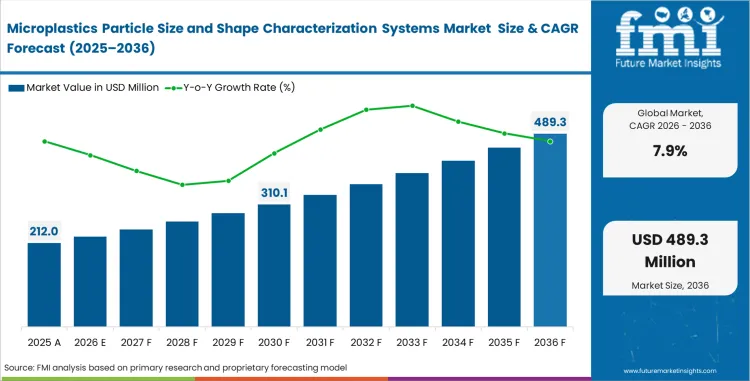
Microplastics particle size and shape characterization systems market was valued at USD 197 million in 2025. Industry is poised to garner a valuation of USD 212 million in 2026 at a CAGR of 7.9% during the forecast period. By 2036, total valuation is expected to advance to USD 454 million as laboratories place greater emphasis on repeatable particle identification, morphology assessment, and image-led interpretation that can support routine analytical work.
Summary of Microplastics Particle Size and Shape Characterization Systems Market
- The market is forecast to reach USD 454 million by 2036.
- The market is expected to grow at a CAGR of 7.9% from 2026 to 2036.
- The market was estimated at USD 197 million in 2025.
- The market value is expected to rise to USD 212 million in 2026.
- The forecast period represents an incremental opportunity of USD 241.5 million.
- Laboratory managers are giving more weight to systems that can turn difficult samples into usable particle-level datasets without building a workflow that depends too heavily on manual review.
- Micro-FTIR remains the leading technology, automated imaging continues to anchor measurement-mode demand, and environmental labs stay at the center of end-use adoption.
- India is identified as the fastest-growing country through 2036.
Key Takeaways, Market Size, and Forecast
- Microplastics Particle Size and Shape Characterization Systems Market is projected to grow from USD 212 million in 2026 to USD 454 million by 2036, at a CAGR of 7.9%.
- The microplastics particle size and shape characterization systems market was valued at USD 197 million in 2025.
- By 2036, the Microplastics Particle Size and Shape Characterization Systems Market is expected to be worth USD 454 million.
- From 2026 to 2036, the market is anticipated to expand at a CAGR of 7.9%.
- The market is predicted to create an incremental opportunity of USD 241.5 million between 2026 and 2036.
- In 2026, Micro-FTIR is expected to account for 34.0% of the technology segment.
- India (9.3%) and China (8.8%) are projected to be two of the fastest growing markets.
Microplastics Particle Size and Shape Characterization Systems Market key takeaways
| Parameter | Details |
|---|---|
| Market value (2026) | USD 212 million |
| Forecast value (2036) | USD 454 million |
| CAGR (2026 to 2036) | 7.9% |
| Estimated market value (2025) | USD 197 million |
| Incremental opportunity | USD 241.5 million |
| Leading technology | Micro-FTIR |
| Leading measurement mode | Automated Imaging |
| Leading end use | Environmental Labs |
| Leading technology share (2026) | 34.0% |
| Leading measurement mode share (2026) | 38.0% |
| Leading end-use share (2026) | 41.0% |
Source: Future Market Insights, 2026
Laboratory managers are no longer evaluating microplastics capability as a narrow research add-on. Greater attention now goes to whether a system can turn a difficult sample into a usable dataset without creating a workflow that depends too heavily on manual review. Need is rising in settings where particle count consistency, shape interpretation, and polymer confirmation must work together in one reporting chain. Platforms removing operator burden from particle search and review are gaining stronger acceptance because routine use matters more than isolated analytical performance.
Method maturity is becoming just as important as instrument capability. Once sample preparation, image review, and reporting logic are aligned inside a defined workflow, platform adoption becomes easier across a wider lab network. Value then extends beyond initial installation because software, libraries, and confirmatory tools can be integrated with less friction. Category expansion is therefore moving ahead on the back of workflow readiness rather than on technical novelty alone.
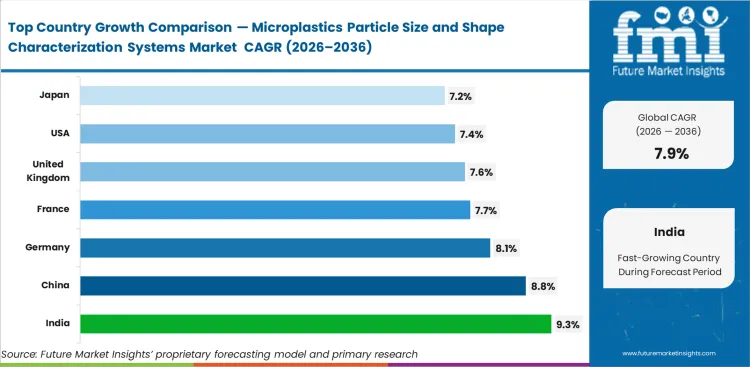
India is projected to post 9.3% CAGR through 2036, followed by China at 8.8%, Germany at 8.1%, France at 7.7%, the United Kingdom at 7.6%, the United States at 7.4%, and Japan at 7.2%. Faster expansion across India and China reflects laboratory capacity build-out and broader environmental testing activity, while Western Europe benefits from more disciplined method adoption and stronger analytical budgets. United States industry outlook remains steady because replacement cycles and installed-base upgrades carry more weight there than first-time purchases.
Microplastics Particle Size and Shape Characterization Systems Market definition
Microplastics particle size and shape characterization systems are analytical platforms used to detect, identify, measure, and interpret microplastic particles at particle level across environmental and industrial sample matrices, where size, morphology, count, and polymer confirmation need to work together inside a usable reporting workflow.
Microplastics Particle Size and Shape Characterization Systems Market inclusions
Market scope includes all commercially traded systems segmented by technology, measurement mode, end use, sample matrix, and region. Coverage includes micro-FTIR, Raman, optical imaging, pyrolysis-GC/MS, hybrid workflows, and related software used for particle-level characterization across water, wastewater, food, air, and sediment matrices. Revenue sizing spans the 2026 to 2036 forecast period.
Microplastics Particle Size and Shape Characterization Systems Market exclusions
The scope excludes broad environmental testing equipment, bulk removal chemicals, generic water meters, and laboratory services that do not involve dedicated particle size-and-shape characterization hardware or software.
Microplastics Particle Size and Shape Characterization Systems Market research methodology
Primary research: FMI analysts conducted interviews with laboratory directors, application specialists, testing managers, and channel partners active in particle-characterization workflows to understand workflow readiness, review burden, and reporting priorities.
Desk research: Data collection aggregated microplastics analysis references, application materials, company information, and method documentation to establish verifiable baseline parameters.
Market sizing and forecasting: Baseline values reflect analytical-use demand, applying segment leadership, workflow practicality, and country adoption patterns to project demand through 2036.
Data validation and update cycle: Projections reflect end-use intensity, method discipline, and comparative country growth patterns.
Segmental Analysis
Key Facts About Segments
- Micro-FTIR is expected to account for 34.0% share in 2026.
- Routine water-focused work keeps this technology in front because it offers a workable balance between particle identification, image-led screening, and familiarity inside labs already comfortable with infrared workflows.
- Automated Imaging is likely to contribute 38.0% share in 2026.
- Operator time has become a clearer capacity limit in microplastics analysis, and this measurement mode helps laboratories standardize particle detection and classification with less dependence on prolonged manual review.
- Environmental Labs are anticipated to represent 41.0% share in 2026.
- Breadth of sample exposure, method development work, and the need to compare results across projects keep this end-use group ahead of narrower testing environments.
Microplastics Particle Size and Shape Characterization Systems Market Analysis by Technology
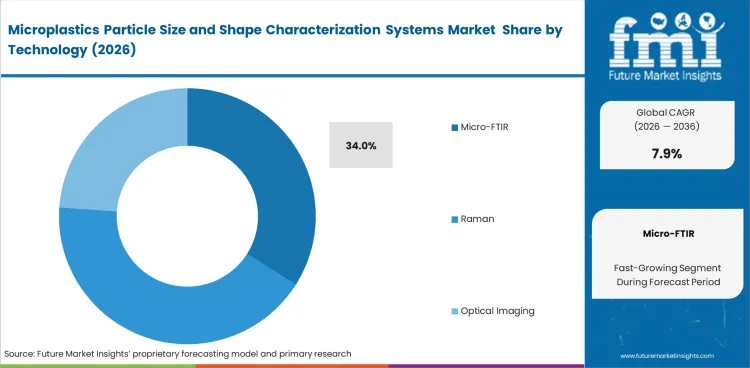
Routine microplastics interpretation depends on more than polymer confirmation. Lab teams need a platform that can locate particles at usable speed, convert images into analyzable objects, and maintain repeatability across samples that rarely arrive in clean condition. Micro-FTIR is expected to account for 34% share in 2026 because it fits that requirement better than many competing routes in day-to-day water-focused work. Its advantage comes from a workable balance between particle identification, image-led screening, and method familiarity inside analytical labs already comfortable with infrared workflows. Raman remains important where smaller particles and fine discrimination matter, yet throughput and workflow burden can become harder to manage at scale. Pyrolysis-GC/MS adds value as a confirmatory route, although it does not replace particle-level size and shape interpretation. Delayed selection often leaves laboratories with a technically sound tool that still demands too much manual intervention during reporting.
- Workflow fit: Micro-FTIR supports a usable balance between particle search, identification, and review. Lab teams can move from raw sample to report with fewer handoffs.
- Method continuity: Existing familiarity with infrared interpretation lowers training pressure in many analytical settings. Adoption becomes easier when teams do not need to rebuild every step from the ground up.
- Review burden: Systems chosen without enough attention to image handling often slow final interpretation. Reporting time then absorbs gains made during measurement.
Microplastics Particle Size and Shape Characterization Systems Market Analysis by Measurement Mode
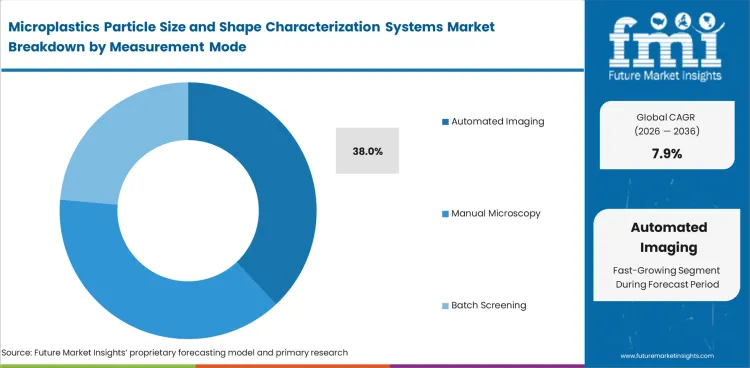
Automated Imaging is anticipated to emerge with 38% market share in 2026 as laboratories look for a more consistent route through particle detection and classification. Operator time has become one of the clearest limits on microplastics analysis capacity. Manual microscopy still has a place in confirmatory work, but routine screening becomes difficult once sample queues lengthen and reporting deadlines tighten. Buying interest now centers on how much review work can be standardized rather than how impressive a single image may appear in isolation. Batch screening and confirmatory analysis remain necessary in certain workflows, yet they do not solve the same capacity problem. Automated imaging matters because it reduces dependence on prolonged visual search and makes software-led particle selection more practical. Labs continuing to rely too heavily on manual review often find that instrument capacity is not the real limit; analyst time is.
- Capacity control: Automated imaging helps labs process larger sample volumes without expanding staff at the same pace. Queue pressure becomes easier to manage.
- Decision consistency: Software-led particle selection reduces variation between operators. Internal review becomes more defensible when repeatability improves.
- Labor deployment: Manual workflows can consume senior analyst time on repetitive tasks. Higher automation frees skilled staff for confirmation and interpretation.
Microplastics Particle Size and Shape Characterization Systems Market Analysis by End Use
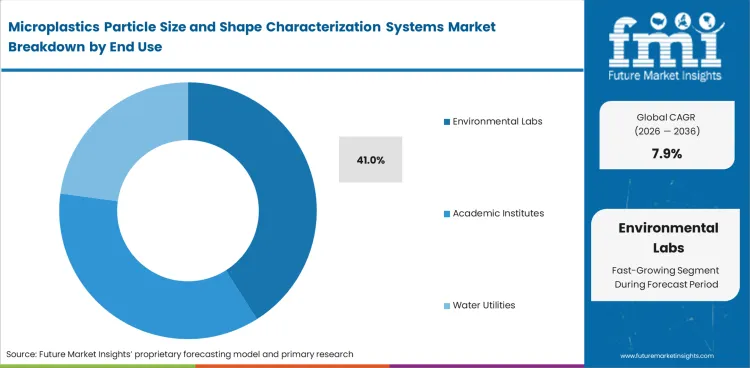
Public and research-driven testing still sets the pace for much of this category. Environmental Labs are expected to make up 41% of total market share in 2026 because they handle a broad mix of water, sediment, wastewater, and exploratory contamination studies where microplastics work is still evolving into routine practice. Need here is not limited to one matrix or one reporting style. System interest in this end-use group is supported by breadth of sample exposure, method development activity, and the need to compare results across projects without rebuilding the workflow each time. Academic institutes remain influential in early method use, while contract labs add flexibility where external testing volume rises. Water utilities and food labs are becoming more relevant, yet environmental labs still absorb the largest share because they sit closest to method exploration and ongoing monitoring activity. A weak fit in this end-use channel can slow reference building for the entire category.
- Sample diversity: Environmental labs handle varied matrices that test a system’s flexibility. Equipment chosen for only one clean sample type often underperforms here.
- Method refinement: Research-heavy use keeps this segment close to protocol development and workflow adjustment. Supplier support matters more in such settings.
- Reference depth: Results generated in environmental labs often influence wider lab adoption. Strong performance here supports broader confidence across the category.
Microplastics Particle Size and Shape Characterization Systems Market Analysis by Sample Matrix
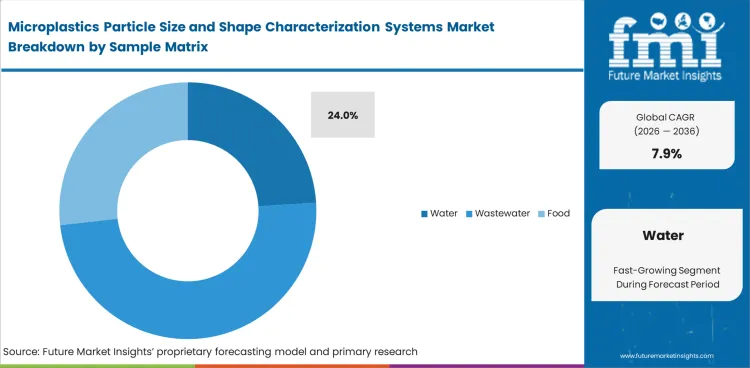
Particle characterization gains commercial weight fastest in matrices where interpretation discipline is under the most scrutiny. Water is projected to secure 46% share in 2026, and its lead comes from the volume of work tied to drinking water, wastewater, and environmental sampling rather than from one narrow testing niche. Sample preparation can still be demanding, yet water-based workflows are easier to standardize than many food or sediment cases where background interference is harder to control. Suppliers gain more traction when they can show filtration, particle detection, and reporting steps remain manageable across water samples with different particulate burdens. Wastewater brings complexity, while food and air analysis widen the opportunity set over time. Water remains the anchor because it gives laboratories a clearer starting point for method discipline, validation routines, and instrument justification. Poor performance in this matrix usually weakens confidence in broader deployment.
- Method anchor: Water offers a more practical route for standardized workflow building. Validation work is easier to defend when sample handling is more consistent.
- Adoption base: Drinking water and wastewater testing expand the installed base for particle-characterization systems. Broader category acceptance often starts here.
- Transfer value: Systems proven in water workflows have a stronger chance of moving into harder matrices later. Early credibility matters.
Microplastics Particle Size and Shape Characterization Systems Market Drivers, Restraints, and Opportunities
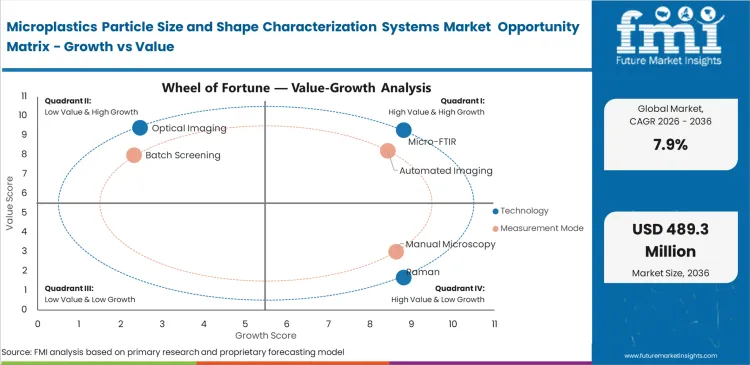
Method leads are under rising pressure to make microplastics analysis repeatable enough for routine reporting. Capital allocation is therefore inclining toward platforms that bring particle search, classification, and morphology review into one usable workflow. Need is strongest where manual interpretation has begun to limit throughput or weaken consistency across analysts. Laboratories already investing in adjacent analytical capabilities can also extend into microplastics work through familiar evaluation routes, particularly across water analysis instrumentation. A clearer reporting chain is lifting category acceptance.
Qualification cycles still slow wider uptake. Instrument purchase alone does not resolve sample preparation issues, spectral review burden, or the internal question of workflow ownership once a system is installed. Budget approval can also stall where end users see microplastics analysis as technically relevant but not yet central to routine lab output. Software helps, training helps, and application support helps, yet none of them fully replaces method confidence inside the lab. Similar buying logic is visible across molecular spectroscopy, where workflow confidence matters as much as core instrument capability.
Opportunities in the Microplastics Particle Size and Shape Characterization Systems Market
Market headroom is widening as laboratories look for systems that reduce analyst burden without weakening particle-level interpretation. Suppliers can improve acceptance by tightening software usability, shortening review time, and making multi-step workflows easier to run inside routine lab settings. Category relevance is also rising alongside neighboring areas such as optical imaging, where image-led interpretation already carries operational value. Wider adoption is most likely where a platform can prove routine usability, not just technical capability.
- Water-lab expansion: Drinking water and wastewater programs create a practical route for category penetration. Suppliers simplifying routine reporting for such labs can build earlier acceptance.
- Software-led interpretation: Better particle review tools can raise value without changing the full instrument platform. Application teams capture more interest when reporting steps become less labor-intensive.
- Hybrid workflows: Systems working smoothly with adjacent confirmatory tools can appeal to labs seeking broader analytical confidence without replacing their existing setup.
Regional Analysis
Key Facts About Country
- India is identified as the fastest-growing market among the countries highlighted, with microplastics particle size and shape characterization systems expected to expand at a CAGR of 9.3% through 2036.
- Laboratory capacity build-out and broader environmental testing activity keep China close behind, and the market there is estimated to rise at 8.8% CAGR during the forecast period.
- Strong analytical budgets and more disciplined method adoption support Germany, where growth is projected to reach 8.1% CAGR over the study period.
- Environmental testing priorities and laboratory modernization place France at an anticipated 7.7% CAGR by 2036.
- Workflow clarity and internal resource discipline keep the United Kingdom on a similar path, with the market likely to post 7.6% CAGR during the assessment period.
- Installed-base upgrades carry more weight than first-time purchases in the United States, where demand is forecast to advance at 7.4% CAGR through 2036.
- Mature analytical capability leaves Japan at the most moderate pace among the countries analyzed, with the market expected to grow at 7.2% CAGR over the forecast period.
Based on the regional analysis, Microplastics Particle Size and Shape Characterization Systems Market is segmented into North America, Latin America, Western Europe, Eastern Europe, East Asia, South Asia and Pacific, and Middle East and Africa across 40 plus countries.
.webp "Top Country Growth Comparison Microplastics Particle Size And Shape Characterization Systems Market Cagr (2026 2036)")
| Country | CAGR (2026 to 2036) |
|---|---|
| India | 9.3% |
| China | 8.8% |
| Germany | 8.1% |
| France | 7.7% |
| United Kingdom | 7.6% |
| United States | 7.4% |
| Japan | 7.2% |
Source: Future Market Insights analysis and primary research
North America Microplastics Particle Size and Shape Characterization Systems Market Analysis
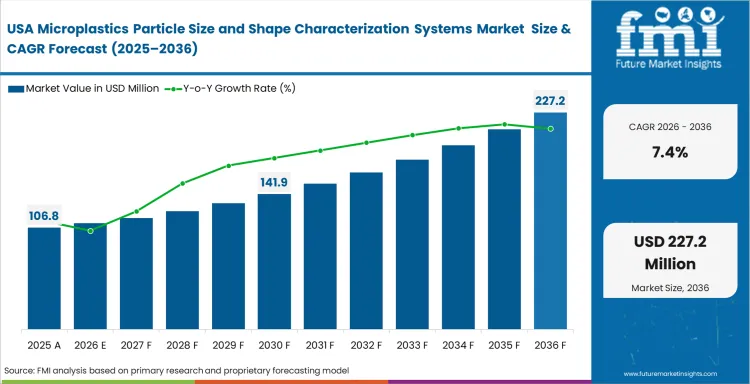
Installed analytical capacity keeps North America commercially important, yet adoption here depends less on first-time instrument buying and more on whether a platform fits existing laboratory routines without adding review burden. End users in this region usually compare microplastics capability against current microscopy and spectroscopy assets before committing fresh capital. Evaluation therefore leans on software usability, reporting consistency, and how smoothly particle characterization can be added to established analytical practice. Similar buying behavior is visible across adjacent water analysis instrumentation, where workflow clarity often carries as much weight as core instrument capability. Replacement discipline also matters. Systems that reduce manual interpretation time and shorten internal validation work are better placed to gain acceptance across this region.
- United States: Large installed analytical capacity keeps the United States central to regional valuation. Laboratory managers here usually weigh new microplastics systems against tools already in place, so adoption depends on whether a platform adds practical workflow value rather than technical novelty alone. Industry outlook in the United States points to 7.4% CAGR through 2036. The speed stays measured because many facilities can delay a dedicated purchase until sample load, reporting burden, or internal method discipline clearly justify it. Suppliers with stronger application support and cleaner software flow usually convert interest more effectively in this market.
FMI's report includes Canada and Mexico within North America. Public research activity, environmental sample diversity, and university-linked analytical work keep both countries relevant, though installed-base economics still lean toward the United States as the primary regional anchor.
Western Europe Microplastics Particle Size and Shape Characterization Systems Market Analysis
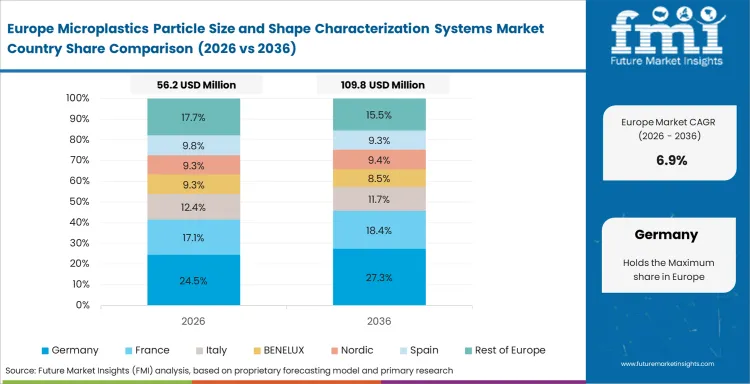
Method discipline shapes Western Europe more strongly than simple capacity expansion. Laboratories across this region place greater weight on comparability, repeatability, and reporting quality, so category adoption often depends on how well a platform performs in routine analytical use rather than on broad capability claims. Decision cycles can therefore be deliberate. End users want confidence that sample preparation, image review, and polymer interpretation will remain manageable once systems move beyond research demonstration and into regular testing flow. Such conditions support suppliers that can combine technical credibility with operational clarity across multiple matrices, much like adjacent molecular spectroscopy categories where method discipline directly affects equipment preference.
- Germany: Germany is expected to record 8.1% CAGR in this market during the forecast period. The country stays commercially important because analytical labs here place unusual emphasis on reproducibility, method discipline, and instrument reliability before wider rollout begins. Category adoption is rarely impulsive; internal acceptance usually depends on whether particle finding, morphology interpretation, and reporting logic hold up under routine use across varied sample types. Rate remains solid because installed capability is already strong, yet room still exists for deeper use of dedicated microplastics workflows. End users here usually reward platforms that reduce interpretation friction without compromising technical confidence.
- France: Environmental testing priorities and laboratory modernization keep France on a positive trend in this category. Buyers often focus on how well software, sample preparation, and interpretation steps fit together in practical use, since routine usability matters more than isolated instrument performance once systems enter working laboratories. A CAGR of 7.7% is anticipated for the French market through 2036. Momentum is supported by a testing environment where public laboratories, research programs, and broader environmental assessment work continue to raise interest in more dependable particle-level interpretation. Commercial traction improves when suppliers make day-to-day operation easier rather than simply widening the technical feature set.
- United Kingdom: Research intensity and public-lab relevance continue to support category advancement in the United Kingdom. End users here are often careful about training burden, review time, and method continuity, which means a system must fit routine analytical practice before it gains broader acceptance. Through 2036, the United Kingdom market is likely to post 7.6% CAGR. Pace sits close to France because both countries benefit from similar analytical discipline, though buyer decisions in the United Kingdom often place extra attention on workflow clarity and internal resource efficiency. Stronger adoption usually follows when advanced capability becomes easier to use in everyday testing rather than specialist-only work.
FMI's report includes Benelux and Nordic countries within Western Europe. Analytical depth across those countries supports continued interest in advanced spectroscopy and imaging tools, and category acceptance improves where laboratories can justify microplastics capability through consistent reporting needs rather than exploratory use alone.
Asia Pacific Microplastics Particle Size and Shape Characterization Systems Market Analysis
Capacity build-out gives Asia Pacific a different commercial profile from North America and Western Europe. Many facilities across this region are still expanding advanced analytical capability, so microplastics characterization can enter as part of broader laboratory modernization rather than depending only on replacement cycles. Service reach, training depth, and workflow simplicity therefore matter heavily. Buyers want systems that can be installed, learned, and used without stretching internal technical teams too far. Category traction also benefits from a wider mix of public research, environmental testing, and industrial analytical expansion, giving suppliers more than one route into the regional market. Closely related fields such as optical imaging and particle counter also reinforce interest in image-led and particle-focused analytical workflows.
- India: Laboratory expansion keeps India at the top of the core country set. Many facilities are still building advanced analytical capability, so microplastics characterization can be evaluated as part of broader modernization rather than as a narrow replacement decision. Industry outlook in India points to 9.3% CAGR through 2036. Pace stays ahead of other countries because installed capacity remains lower, leaving more room for first-time adoption across environmental and research settings. Category acceptance also benefits when suppliers offer stronger training support and workflows that do not overload internal teams. Wider market advancement in India depends on making sophisticated analysis operationally manageable, not only technically impressive.
- China: China is forecast to register 8.8% CAGR in this market over the study period. Manufacturing depth, broader analytical infrastructure, and scale of laboratory activity give China a strong platform for category expansion. End users here often judge new systems through a practical lens, focusing on throughput, software handling, and how efficiently a workflow can move from sample preparation to interpretable output. Rate stays above many mature countries because first-time installations still contribute alongside upgrades and application expansion. Commercial opportunity remains strongest where suppliers can support larger test volumes without creating bottlenecks in review, interpretation, or internal method setup.
- Japan: Mature analytical capability gives Japan a different profile from India and China. Buyers here already understand the demands of advanced particle analysis, so evaluation tends to be careful and disciplined, with attention placed on workflow fit, reporting quality, and compatibility with existing laboratory practice. Adoption in Japan is anticipated to move ahead at a CAGR of 7.2% during the assessment period. Lower percentage pace does not signal weak relevance. It reflects a market where replacement logic, method refinement, and careful qualification carry more weight than broad first-purchase expansion. Suppliers usually perform better when they can show dependable routine operation rather than pushing novelty-led positioning.
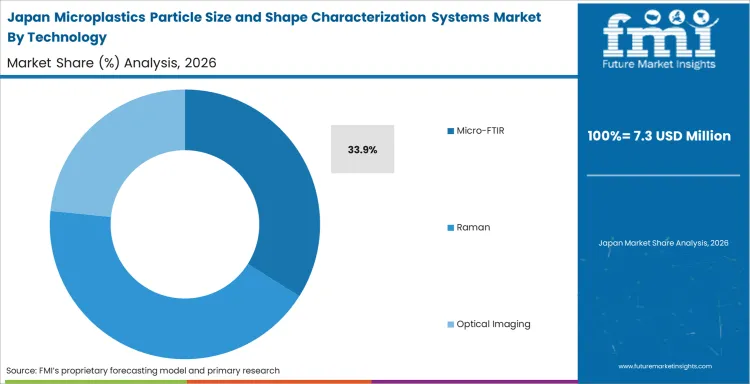
FMI's report includes South Korea, Australia, and Southeast Asian countries within Asia Pacific. Regional opportunity remains broad, though supplier success depends on local training depth, service responsiveness, and the ability to support laboratories that are modernizing at different speeds across the region.
Competitive Aligners for Market Players
Category competition is shaped by workflow confidence rather than by instrument branding alone. Agilent Technologies, Bruker Corporation, Thermo Fisher Scientific, HORIBA, Shimadzu Corporation, Oxford Instruments, and Renishaw operate from strong analytical pedigrees, but vendor selection in this category usually comes down to image handling, spectral interpretation, software usability, and application support. Labs do not judge a platform only by whether it can detect a particle. Equal attention goes to whether routine analysts can run the system, review outputs, and issue defensible reports without turning every sample into a specialist project.
Incumbent strength comes from broad installed bases in spectroscopy and microscopy, deeper channel support, and better ability to connect microplastics workflows with adjacent analytical platforms. Agilent, Bruker, Thermo Fisher Scientific, and Shimadzu benefit from product breadth and familiarity across laboratory settings, while HORIBA, Oxford Instruments, and Renishaw carry weight where technical users value particle-level analytical depth. A challenger can still win, yet usually only by removing a clear workflow burden, tightening application support, or fitting an unmet niche more cleanly than broad portfolio suppliers. Competitive advantage is easier to build where service quality and workflow clarity matter more than catalog width.
Large laboratories will keep this category from becoming overly concentrated by 2036. Many end users prefer options reducing lock-in around software, service, or a single analytical route, while suppliers prefer deeper attachment through workflow integration. Tension between those priorities keeps competition active across microscopy, spectroscopy, and software-led interpretation. Broader adoption is likely to favor vendors making routine use easier rather than those focusing only on technical edge cases. Ease of deployment, interpretability of results, and support after installation will remain central to vendor selection.
Key Players in Microplastics Particle Size and Shape Characterization Systems Market
- Agilent Technologies
- Bruker Corporation
- Thermo Fisher Scientific
- HORIBA
- Shimadzu Corporation
- Oxford Instruments
- Renishaw
Scope of the Report
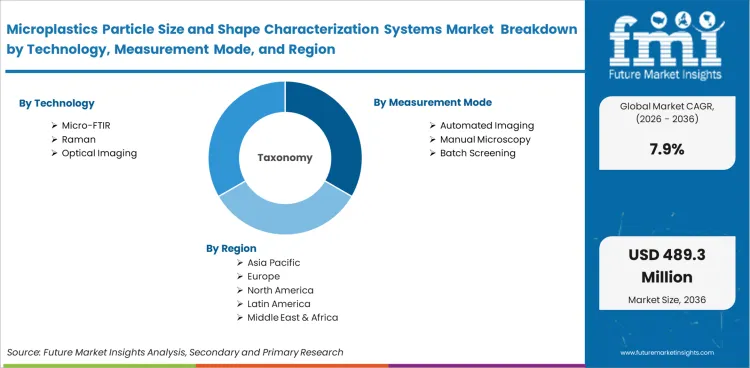
| Metric | Value |
|---|---|
| Quantitative Units | USD 212 million to USD 454 million, at a CAGR of 7.9% |
| Market Definition | Microplastics Particle Size and Shape Characterization Systems Market covers platforms used to detect, identify, measure, and interpret microplastic particles at particle level across environmental and industrial sample matrices. Scope is limited to characterization systems rather than general water testing tools. |
| Technology Segmentation | Micro-FTIR, Raman, Optical Imaging, Pyrolysis-GC/MS, Hybrid Workflows |
| Measurement Mode Segmentation | Automated Imaging, Manual Microscopy, Batch Screening, Confirmatory Analysis |
| End Use Segmentation | Environmental Labs, Academic Institutes, Water Utilities, Food Labs, Contract Labs |
| Sample Matrix Segmentation | Water, Wastewater, Food, Air, Sediment |
| Regions Covered | North America, Latin America, Western Europe, Eastern Europe, East Asia, South Asia and Pacific, Middle East and Africa |
| Countries Covered | United States, Germany, United Kingdom, France, Japan, China, India, and 40 plus countries |
| Key Companies Profiled | Agilent Technologies, Bruker Corporation, Thermo Fisher Scientific, HORIBA, Shimadzu Corporation, Oxford Instruments, Renishaw |
| Forecast Period | 2026 to 2036 |
| Approach | Analysts interviewed laboratory directors, application specialists, testing managers, and channel partners active in particle-characterization workflows. Baseline assessment used category relevance inside analytical instrumentation, end-use intensity, and installed capability by geography. Forecasts were checked against portfolio exposure, workflow practicality, and adjacent instrumentation demand patterns. |
Source: Future Market Insights analysis and primary research
Microplastics Particle Size and Shape Characterization Systems Market Analysis by Segments
Technology:
- Micro-FTIR
- Raman
- Optical Imaging
- Pyrolysis-GC/MS
- Hybrid Workflows
Measurement Mode:
- Automated Imaging
- Manual Microscopy
- Batch Screening
- Confirmatory Analysis
End Use:
- Environmental Labs
- Academic Institutes
- Water Utilities
- Food Labs
- Contract Labs
Sample Matrix:
- Water
- Wastewater
- Food
- Air
- Sediment
Region:
- North America
- United States
- Canada
- Mexico
- Latin America
- Brazil
- Argentina
- Rest of Latin America
- Western Europe
- Germany
- United Kingdom
- France
- Benelux
- Nordics
- Rest of Western Europe
- Eastern Europe
- Poland
- Russia
- Rest of Eastern Europe
- East Asia
- China
- Japan
- South Korea
- South Asia and Pacific
- India
- Australia
- Southeast Asia
- Rest of South Asia and Pacific
- Middle East and Africa
- GCC Countries
- South Africa
- Rest of Middle East and Africa
Bibliography
- International Organization for Standardization. (2025, February). ISO 16094-2:2025 Water quality, Analysis of microplastics in water, Part 2: Vibrational spectroscopy methods for waters with low content of suspended solids including drinking water. ISO.
- European Commission, Joint Research Centre. (2025, June 6). New breakthrough for monitoring microplastics to protect our health and environment. European Commission.
- National Oceanic and Atmospheric Administration. (2024, March 20). Laboratory methods for the analysis of microplastics in the marine environment. NOAA Marine Debris Program.
- USA. Environmental Protection Agency. (2026, April 2). EPA takes bold action to ensure drinking water is safe from microplastics, pharmaceuticals, and other contaminants. EPA.
- Agilent Technologies. (2025). 8700 LDIR Chemical Imaging System. Agilent.
This bibliography is provided for reader reference. The full report contains the complete reference list with primary source documentation.
This Report Addresses
- Market intelligence to support strategic decision making across micro-FTIR, Raman, optical imaging, pyrolysis-GC/MS, and hybrid particle-characterization workflows
- Market size estimation and 10-year revenue forecasts from 2026 to 2036, supported by installed analytical capability mapping and end-use adoption assessment
- Growth opportunity mapping across technology, measurement mode, end use, sample matrix, and regional valuation with emphasis on workflow standardization in routine lab use
- Segment and regional revenue forecasts covering environmental labs, water utilities, food labs, and contract labs across laboratory qualification and reporting conditions
- Competition strategy assessment including software usability, application support, image handling, spectral interpretation, and installed-base familiarity
- Product and capability tracking including microscopy-led detection, vibrational spectroscopy, automated particle review, confirmatory analysis, and sample-matrix compatibility
- Market access analysis covering drinking water testing, wastewater interpretation, environmental research workflows, and particle-level reporting requirements
- Market report delivery in PDF, Excel, PPT, and interactive dashboard formats for executive strategy, category planning, and operational benchmarking use
Frequently Asked Questions
How large is the market in 2026?
Industry valuation is estimated at USD 212 million in 2026, reflecting a niche but steadily expanding analytical category.
What will the market be worth by 2036?
Valuation is projected to reach USD 454 million by 2036 as routine laboratory adoption continues expanding.
What CAGR is projected from 2026 to 2036?
The market is forecast to advance at a CAGR of 7.9% during the 2026 to 2036 period.
Which technology segment leads?
Micro-FTIR leads technology demand and is expected to account for 34% share in 2026.
Which measurement mode leads?
Automated Imaging is projected to represent 38% share in 2026 due to stronger workflow efficiency.
Which end-use segment leads?
Environmental Labs lead end use and are expected to secure 41% market share in 2026.
Which sample matrix holds the largest share?
Water leads sample matrix demand and is projected to contribute 46% share in 2026.
What is pushing category expansion?
Routine labs need more repeatable particle interpretation with less manual review and better reporting consistency.
What is the main restraint?
Method confidence slows adoption when sample preparation, review burden, and workflow ownership remain unresolved.
Which country advances fastest through 2036?
India leads with 9.3% CAGR through 2036, ahead of China because first-time adoption room remains wider.
Why do water-related applications matter so much?
Water workflows provide a clearer path to standardized methods, validation routines, and instrument justification.
Why do software and image handling matter in vendor selection?
Daily value depends on review speed, reporting consistency, and how easily analysts can interpret results.
How does Micro-FTIR differ from Pyrolysis-GC/MS here?
Micro-FTIR supports particle-level interpretation, while Pyrolysis-GC/MS mainly supports polymer confirmation within broader workflows.
Why does Automated Imaging advance faster than Manual Microscopy?
Automated Imaging reduces analyst burden and handles larger sample queues more efficiently than manual review.
How is this market different from broad water analysis instrumentation?
It focuses on particle-level microplastic characterization rather than general contaminant detection across water testing.
Why do Environmental Labs remain the largest end-use group?
They handle varied matrices and ongoing method work, making them the earliest adoption base.
What makes Water the anchor sample matrix?
Water samples offer a more practical route for repeatable filtration, detection, and reporting workflows.
Which countries are covered in the core outlook?
Core outlook covers India, China, Germany, France, the United Kingdom, the United States, and Japan.
How does the United States compare with India and China?
United States expansion is steadier, while India and China benefit more from first-time installations.
Why is Germany important within Western Europe?
Germany combines analytical familiarity with disciplined method evaluation, supporting stronger category acceptance.
Why does Japan trail Germany and China in percentage terms?
Japan is a mature analytical base, so upgrades matter more than broad first-purchase activity.
What do vendors compete on most?
Competition centers on workflow usability, software quality, image handling, and post-installation application support.
Who are the key companies in this market?
Key companies include Agilent, Bruker, Thermo Fisher, HORIBA, Shimadzu, Oxford Instruments, and Renishaw.
What is the main practitioner insight in this category?
Routine workflow control often matters more than headline instrument capability in real laboratory use.
Preview the report firsthand - request a free sample
Get SampleGet the brochure for pricing and purchase details.
Get PDFTable of Content
- Executive Summary
- Global Market Outlook
- Demand-side Trends
- Supply-side Trends
- Technology Roadmap Analysis
- Analysis and Recommendations
- Market Overview
- Market Coverage / Taxonomy
- Market Definition / Scope / Limitations
- Research Methodology
- Chapter Orientation
- Analytical Framework
- Market Structure, Signals, and Trend Drivers
- Benchmarking and Cross-market Comparability
- Market Sizing, Forecasting, and Opportunity Mapping
- Research Design and Evidence Framework
- Desk Research Programme (Secondary Evidence)
- Company Annual and Sustainability Reports
- Peer-reviewed Journals and Academic Literature
- Corporate Websites, Product Literature, and Technical Notes
- Earnings Decks and Investor Briefings
- Statutory Filings and Regulatory Disclosures
- Technical White Papers and Standards Notes
- Trade Journals, Industry Magazines, and Analyst Briefs
- Conference Proceedings, Webinars, and Seminar Materials
- Government Statistics Portals and Public Data Releases
- Press Releases and Reputable Media Coverage
- Why Primary Evidence is Used
- Field Techniques
- Interviews
- Surveys
- Focus Groups
- Observational and In-context Research
- Social and Community Interactions
- Stakeholder Universe Engaged
- C-suite Leaders
- Board Members
- Presidents and Vice Presidents
- R&D and Innovation Heads
- Technical Specialists
- Domain Subject-matter Experts
- Scientists
- Physicians and Other Healthcare Professionals
- Governance, Ethics, and Data Stewardship
- Research Ethics
- Data Integrity and Handling
- Research Methods and Reference Sources
- Desk Research Programme (Secondary Evidence)
- Market Data Analysis and Forecast Development
- Data Collection
- Data Review and Validation
- Global Market Analysis 2021 to 2025 and Forecast, 2026 to 2036
- Historical Market Size Value (USD Million) Analysis, 2021 to 2025
- Current and Future Market Size Value (USD Million) Projections, 2026 to 2036
- Y-o-Y Growth Trend Analysis
- Absolute $ Opportunity Analysis
- Global Market Pricing Analysis 2021 to 2025 and Forecast 2026 to 2036
- Global Market Analysis 2021 to 2025 and Forecast 2026 to 2036, By Technology
- Introduction / Key Findings
- Historical Market Size Value (USD Million) Analysis By Technology , 2021 to 2025
- Current and Future Market Size Value (USD Million) Analysis and Forecast By Technology , 2026 to 2036
- Micro-FTIR
- Raman
- Optical Imaging
- Micro-FTIR
- Y-o-Y Growth Trend Analysis By Technology , 2021 to 2025
- Absolute $ Opportunity Analysis By Technology , 2026 to 2036
- Global Market Analysis 2021 to 2025 and Forecast 2026 to 2036, By Measurement Mode
- Introduction / Key Findings
- Historical Market Size Value (USD Million) Analysis By Measurement Mode, 2021 to 2025
- Current and Future Market Size Value (USD Million) Analysis and Forecast By Measurement Mode, 2026 to 2036
- Automated Imaging
- Manual Microscopy
- Batch Screening
- Automated Imaging
- Y-o-Y Growth Trend Analysis By Measurement Mode, 2021 to 2025
- Absolute $ Opportunity Analysis By Measurement Mode, 2026 to 2036
- Global Market Analysis 2021 to 2025 and Forecast 2026 to 2036, By End Use
- Introduction / Key Findings
- Historical Market Size Value (USD Million) Analysis By End Use, 2021 to 2025
- Current and Future Market Size Value (USD Million) Analysis and Forecast By End Use, 2026 to 2036
- Environmental Labs
- Academic Institutes
- Water Utilities
- Environmental Labs
- Y-o-Y Growth Trend Analysis By End Use, 2021 to 2025
- Absolute $ Opportunity Analysis By End Use, 2026 to 2036
- Global Market Analysis 2021 to 2025 and Forecast 2026 to 2036, By Sample Matrix
- Introduction / Key Findings
- Historical Market Size Value (USD Million) Analysis By Sample Matrix, 2021 to 2025
- Current and Future Market Size Value (USD Million) Analysis and Forecast By Sample Matrix, 2026 to 2036
- Water
- Wastewater
- Food
- Water
- Y-o-Y Growth Trend Analysis By Sample Matrix, 2021 to 2025
- Absolute $ Opportunity Analysis By Sample Matrix, 2026 to 2036
- Global Market Analysis 2021 to 2025 and Forecast 2026 to 2036, By Region
- Introduction
- Historical Market Size Value (USD Million) Analysis By Region, 2021 to 2025
- Current Market Size Value (USD Million) Analysis and Forecast By Region, 2026 to 2036
- North America
- Latin America
- Western Europe
- Eastern Europe
- East Asia
- South Asia and Pacific
- Middle East & Africa
- Market Attractiveness Analysis By Region
- North America Market Analysis 2021 to 2025 and Forecast 2026 to 2036, By Country
- Historical Market Size Value (USD Million) Trend Analysis By Market Taxonomy, 2021 to 2025
- Market Size Value (USD Million) Forecast By Market Taxonomy, 2026 to 2036
- By Country
- USA
- Canada
- Mexico
- By Technology
- By Measurement Mode
- By End Use
- By Sample Matrix
- By Country
- Market Attractiveness Analysis
- By Country
- By Technology
- By Measurement Mode
- By End Use
- By Sample Matrix
- Key Takeaways
- Latin America Market Analysis 2021 to 2025 and Forecast 2026 to 2036, By Country
- Historical Market Size Value (USD Million) Trend Analysis By Market Taxonomy, 2021 to 2025
- Market Size Value (USD Million) Forecast By Market Taxonomy, 2026 to 2036
- By Country
- Brazil
- Chile
- Rest of Latin America
- By Technology
- By Measurement Mode
- By End Use
- By Sample Matrix
- By Country
- Market Attractiveness Analysis
- By Country
- By Technology
- By Measurement Mode
- By End Use
- By Sample Matrix
- Key Takeaways
- Western Europe Market Analysis 2021 to 2025 and Forecast 2026 to 2036, By Country
- Historical Market Size Value (USD Million) Trend Analysis By Market Taxonomy, 2021 to 2025
- Market Size Value (USD Million) Forecast By Market Taxonomy, 2026 to 2036
- By Country
- Germany
- UK
- Italy
- Spain
- France
- Nordic
- BENELUX
- Rest of Western Europe
- By Technology
- By Measurement Mode
- By End Use
- By Sample Matrix
- By Country
- Market Attractiveness Analysis
- By Country
- By Technology
- By Measurement Mode
- By End Use
- By Sample Matrix
- Key Takeaways
- Eastern Europe Market Analysis 2021 to 2025 and Forecast 2026 to 2036, By Country
- Historical Market Size Value (USD Million) Trend Analysis By Market Taxonomy, 2021 to 2025
- Market Size Value (USD Million) Forecast By Market Taxonomy, 2026 to 2036
- By Country
- Russia
- Poland
- Hungary
- Balkan & Baltic
- Rest of Eastern Europe
- By Technology
- By Measurement Mode
- By End Use
- By Sample Matrix
- By Country
- Market Attractiveness Analysis
- By Country
- By Technology
- By Measurement Mode
- By End Use
- By Sample Matrix
- Key Takeaways
- East Asia Market Analysis 2021 to 2025 and Forecast 2026 to 2036, By Country
- Historical Market Size Value (USD Million) Trend Analysis By Market Taxonomy, 2021 to 2025
- Market Size Value (USD Million) Forecast By Market Taxonomy, 2026 to 2036
- By Country
- China
- Japan
- South Korea
- By Technology
- By Measurement Mode
- By End Use
- By Sample Matrix
- By Country
- Market Attractiveness Analysis
- By Country
- By Technology
- By Measurement Mode
- By End Use
- By Sample Matrix
- Key Takeaways
- South Asia and Pacific Market Analysis 2021 to 2025 and Forecast 2026 to 2036, By Country
- Historical Market Size Value (USD Million) Trend Analysis By Market Taxonomy, 2021 to 2025
- Market Size Value (USD Million) Forecast By Market Taxonomy, 2026 to 2036
- By Country
- India
- ASEAN
- Australia & New Zealand
- Rest of South Asia and Pacific
- By Technology
- By Measurement Mode
- By End Use
- By Sample Matrix
- By Country
- Market Attractiveness Analysis
- By Country
- By Technology
- By Measurement Mode
- By End Use
- By Sample Matrix
- Key Takeaways
- Middle East & Africa Market Analysis 2021 to 2025 and Forecast 2026 to 2036, By Country
- Historical Market Size Value (USD Million) Trend Analysis By Market Taxonomy, 2021 to 2025
- Market Size Value (USD Million) Forecast By Market Taxonomy, 2026 to 2036
- By Country
- Kingdom of Saudi Arabia
- Other GCC Countries
- Turkiye
- South Africa
- Other African Union
- Rest of Middle East & Africa
- By Technology
- By Measurement Mode
- By End Use
- By Sample Matrix
- By Country
- Market Attractiveness Analysis
- By Country
- By Technology
- By Measurement Mode
- By End Use
- By Sample Matrix
- Key Takeaways
- Key Countries Market Analysis
- USA
- Pricing Analysis
- Market Share Analysis, 2025
- By Technology
- By Measurement Mode
- By End Use
- By Sample Matrix
- Canada
- Pricing Analysis
- Market Share Analysis, 2025
- By Technology
- By Measurement Mode
- By End Use
- By Sample Matrix
- Mexico
- Pricing Analysis
- Market Share Analysis, 2025
- By Technology
- By Measurement Mode
- By End Use
- By Sample Matrix
- Brazil
- Pricing Analysis
- Market Share Analysis, 2025
- By Technology
- By Measurement Mode
- By End Use
- By Sample Matrix
- Chile
- Pricing Analysis
- Market Share Analysis, 2025
- By Technology
- By Measurement Mode
- By End Use
- By Sample Matrix
- Germany
- Pricing Analysis
- Market Share Analysis, 2025
- By Technology
- By Measurement Mode
- By End Use
- By Sample Matrix
- UK
- Pricing Analysis
- Market Share Analysis, 2025
- By Technology
- By Measurement Mode
- By End Use
- By Sample Matrix
- Italy
- Pricing Analysis
- Market Share Analysis, 2025
- By Technology
- By Measurement Mode
- By End Use
- By Sample Matrix
- Spain
- Pricing Analysis
- Market Share Analysis, 2025
- By Technology
- By Measurement Mode
- By End Use
- By Sample Matrix
- France
- Pricing Analysis
- Market Share Analysis, 2025
- By Technology
- By Measurement Mode
- By End Use
- By Sample Matrix
- India
- Pricing Analysis
- Market Share Analysis, 2025
- By Technology
- By Measurement Mode
- By End Use
- By Sample Matrix
- ASEAN
- Pricing Analysis
- Market Share Analysis, 2025
- By Technology
- By Measurement Mode
- By End Use
- By Sample Matrix
- Australia & New Zealand
- Pricing Analysis
- Market Share Analysis, 2025
- By Technology
- By Measurement Mode
- By End Use
- By Sample Matrix
- China
- Pricing Analysis
- Market Share Analysis, 2025
- By Technology
- By Measurement Mode
- By End Use
- By Sample Matrix
- Japan
- Pricing Analysis
- Market Share Analysis, 2025
- By Technology
- By Measurement Mode
- By End Use
- By Sample Matrix
- South Korea
- Pricing Analysis
- Market Share Analysis, 2025
- By Technology
- By Measurement Mode
- By End Use
- By Sample Matrix
- Russia
- Pricing Analysis
- Market Share Analysis, 2025
- By Technology
- By Measurement Mode
- By End Use
- By Sample Matrix
- Poland
- Pricing Analysis
- Market Share Analysis, 2025
- By Technology
- By Measurement Mode
- By End Use
- By Sample Matrix
- Hungary
- Pricing Analysis
- Market Share Analysis, 2025
- By Technology
- By Measurement Mode
- By End Use
- By Sample Matrix
- Kingdom of Saudi Arabia
- Pricing Analysis
- Market Share Analysis, 2025
- By Technology
- By Measurement Mode
- By End Use
- By Sample Matrix
- Turkiye
- Pricing Analysis
- Market Share Analysis, 2025
- By Technology
- By Measurement Mode
- By End Use
- By Sample Matrix
- South Africa
- Pricing Analysis
- Market Share Analysis, 2025
- By Technology
- By Measurement Mode
- By End Use
- By Sample Matrix
- USA
- Market Structure Analysis
- Competition Dashboard
- Competition Benchmarking
- Market Share Analysis of Top Players
- By Regional
- By Technology
- By Measurement Mode
- By End Use
- By Sample Matrix
- Competition Analysis
- Competition Deep Dive
- Competition Deep Dive
- Assumptions & Acronyms Used


