

- Industry Size (2026)
- USD 445.6 Mn
- Forecast (2036)
- USD 804.4 Mn
- CAGR (2026 to 2036)
- 6.1%
Drop Shape Analyzer Market Forecast and Outlook 2026 to 2036
The drop shape analyzer market is on course to expand from USD 445.6 million in 2026 to USD 805.6 million in 2036 at a CAGR of 6.1%. Key segments shaping the market include application areas such as coatings, electronics, medical devices, and academia, where surface and interfacial property measurements are essential for product performance, adhesion, and reliability. Within measurement types, contact angle dominates with a 40% share, reflecting its critical role in assessing wettability and adhesion across diverse materials. Other measurement types such as surface free energy and interfacial tension contribute to analysis depth in research and production settings. In applications, coatings hold the largest share at 30%, driven by the need for precise wetting and adhesion data to optimize performance in automotive, construction, and electronics sectors.
Quick Stats for Drop Shape Analyzer Market
- Drop Shape Analyzer Market Value (2026): USD 445.6 million
- Drop Shape Analyzer Market Forecast Value (2036): USD 805.6 million
- Drop Shape Analyzer Market Forecast CAGR: 6.1%
- Leading Measurement Focus in Drop Shape Analyzer Market: Contact angle (40% share)
- Key Growth Region in Drop Shape Analyzer Market: Asia Pacific
- Key Players in Drop Shape Analyzer Market: KRUSS, DataPhysics, Biolin Scientific (Attension), ramé-hart, Kyowa Interface Science
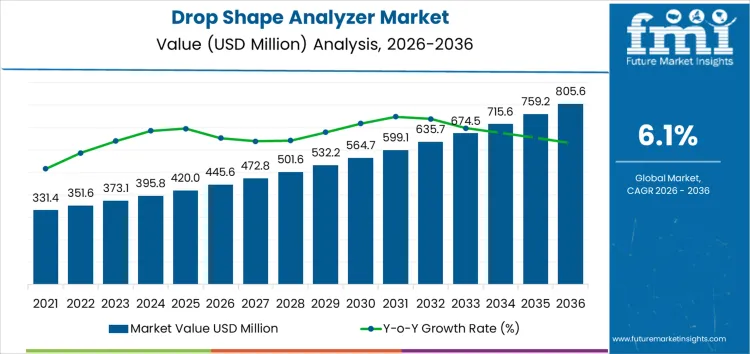
Key trends in the market include advancements in imaging and software technologies that enable real‑time analysis, enhanced data interpretation, and improved automation, making instruments more efficient for both research and quality control settings. There is a growing trend toward integration with digital systems and laboratory data platforms, improving reporting, comparability, and compliance with stringent regulatory standards. Another important trend is the development of user‑friendly interfaces and high‑throughput capabilities, allowing broader adoption beyond specialized labs. While high equipment cost and skilled operator requirements remain constraints, the continuous focus on precise surface characterization for formulation optimization and performance enhancement across industries is expected to sustain demand for drop shape analyzers throughout the forecast period.
Drop Shape Analyzer Market Key Takeaways
| Metric | Value |
|---|---|
| Industry Value (2026) | USD 445.6 million |
| Forecast Value (2036) | USD 805.6 million |
| Forecast CAGR (2026 to 2036) | 6.1% |
How is the Global Drop Shape Analyzer Market is Evolving?
The global drop shape analyzer market is expanding as industries and research sectors increasingly rely on precise measurements of liquid behavior and surface properties. Drop shape analyzers provide essential insights into surface tension, contact angles, wetting behavior, and interfacial dynamics by capturing the shape of liquid droplets on solid surfaces or within other liquids. These measurements are crucial for industries such as coatings, pharmaceuticals, cosmetics, detergents, and agrochemicals, where understanding liquid interactions with surfaces can impact product performance, stability, and efficiency.
The increasing need for accurate formulation development and quality assurance is driving the market for drop shape analyzers. These instruments are used to fine tune surfactant systems, improve the stability of emulsions, and design hydrophobic or hydrophilic surfaces that align with specific product requirements. Recent advancements in optical technologies, image processing software, and automation have enhanced the capabilities of these devices, making them more user friendly and efficient in both research and industrial environments. Furthermore, integration with digital systems has improved data analysis, reporting, and adherence to regulatory standards.
Drop shape analyzer market is set to grow as industries continue to innovate and prioritize the importance of surface and interfacial properties in product development. Despite challenges such as high upfront costs and the need for specialized knowledge to operate these instruments, the demand for in depth surface science in product design and quality control will continue to drive the growth of the drop shape analyzer market.
What is the Segment-Wise Analysis for the Global Drop Shape Analyzer Market?
The global drop shape analyzer market is segmented by application and measurement type. Coatings lead the market with a 30% share, driven by the importance of contact angle measurements for evaluating wetting and adhesion properties in coating materials. Electronics, medical devices, and academia also contribute significantly to the market, using surface free energy, pendant drop measurements, and other techniques for material analysis and research applications. In terms of measurement type, contact angle holds the largest share at 40%, due to its key role in assessing surface properties across multiple sectors, such as coatings, electronics, and medical devices.
How Do Coatings Hold the Largest Share in the Global Drop Shape Analyzer Market?
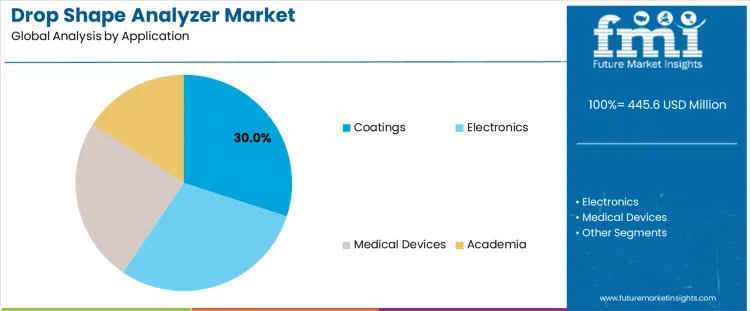
Coatings hold a 30% share in the global drop shape analyzer market due to the crucial role contact angle measurements play in evaluating wetting and adhesion properties of coating materials. Accurate contact angle data is essential for ensuring that coating materials adhere effectively to surfaces, optimizing both performance and durability. The rising demand for high-quality coatings in industries like automotive, construction, and consumer electronics continues to drive the need for reliable drop shape analyzers. As these industries prioritize enhanced performance and durability in their products, the reliance on drop shape analyzers to assess coating properties strengthens the position of coatings in the market. This growth reinforces the demand for precise surface analysis tools in the coatings sector.
How Does Contact Angle Hold the Largest Share in the Global Drop Shape Analyzer Market?
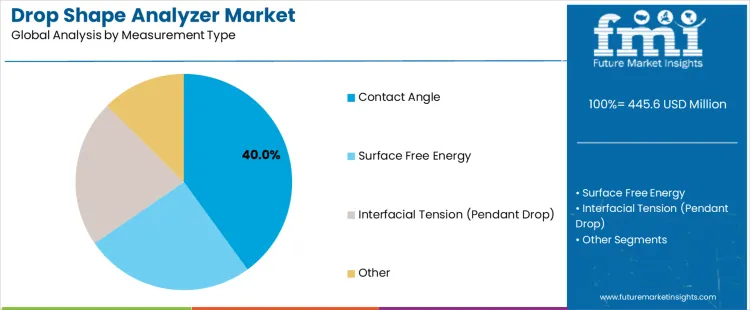
Contact angle holds the largest share at 40% in the global drop shape analyzer market due to its critical role in assessing surface properties across various applications. Accurate contact angle measurements are fundamental for evaluating wetting, adhesion, and surface interactions in materials across sectors like coatings, electronics, and medical devices. The increasing demand for high-performance products, including coatings with superior adhesion, electronic components with better durability, and medical devices with optimized surface properties, contributes to the widespread use of contact angle measurements. As the need for precise surface property analysis grows across industries, contact angle measurement continues to dominate the drop shape analyzer market, driving its widespread adoption and application.
What Are the Key Dynamics for the Drop Shape Analyzer Market?
The drop shape analyzer market is shaped by increasing demand for precise surface characterization across various industries, including pharmaceuticals, coatings, automotive, and electronics. As products become more performance‑driven, the need for accurate data on wetting, adhesion, and surface tension properties grows. Technological advancements in imaging and software for real‑time analysis are driving innovation in the market. Stringent quality and regulatory standards, particularly in drug formulation and coating applications, are propelling the adoption of drop shape analyzers for reliable and reproducible surface property testing.
What Are the Key Drivers for the Drop Shape Analyzer Market?
The drop shape analyzer market is driven by rising demand for surface and interfacial property characterization across multiple industries. In pharmaceuticals, accurate wetting data improves drug formulation and delivery. In coatings, adhesives, and automotive sectors, contact angle measurements inform surface treatment and adhesion optimization. Growth in advanced materials research and nanotechnology increases the need for precise surface tension and energy analysis. Rising regulatory scrutiny on product consistency and performance compels manufacturers to adopt robust analytical tools.
What Are the Main Restraints Impacting the Drop Shape Analyzer Market?
The drop shape analyzer market faces restraints related to equipment cost and required expertise. High precision instruments with advanced optics and software can be expensive, limiting adoption by small labs and cost constrained organizations. Operating and interpreting data from drop shape analysis often requires trained personnel, posing a barrier for facilities without specialized analytical expertise. Competition from alternative or simpler surface measurement methods such as Wilhelmy plate or pendant drop techniques can also slow uptake in less demanding applications. Variability in test conditions and sample preparation can affect reproducibility, challenging standardization across labs.
What is the Growth Outlook for the Drop Shape Analyzer Market by Country?
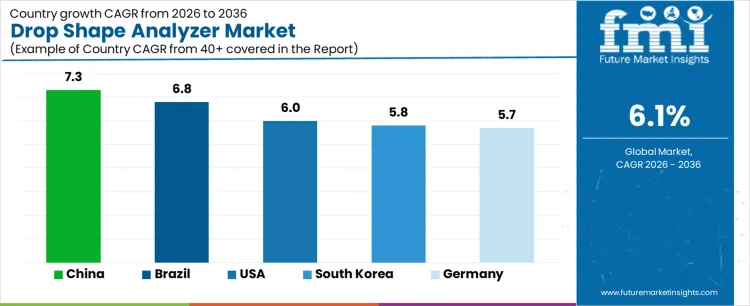
| Country | CAGR (%) |
|---|---|
| USA | 6% |
| South Korea | 5.8% |
| Germany | 5.7% |
| China | 7.3% |
| Brazil | 6.8% |
The drop shape analyzer market is expanding steadily, with China leading at a 7.3% CAGR, driven by the country’s rapid industrialization, particularly in materials science and surface chemistry. Brazil follows with 6.8%, supported by increasing demand for precise surface property analysis in industries like chemicals and pharmaceuticals. The USA’s market grows at 6%, backed by its strong research and development sector, where drop shape analyzers are crucial for product innovation and quality control. South Korea’s market grows at 5.8%, supported by technological advancements in materials testing. Germany’s market grows at 5.7%, driven by its strong industrial base and focus on quality control.
Why is China Leading in the Drop Shape Analyzer Market?
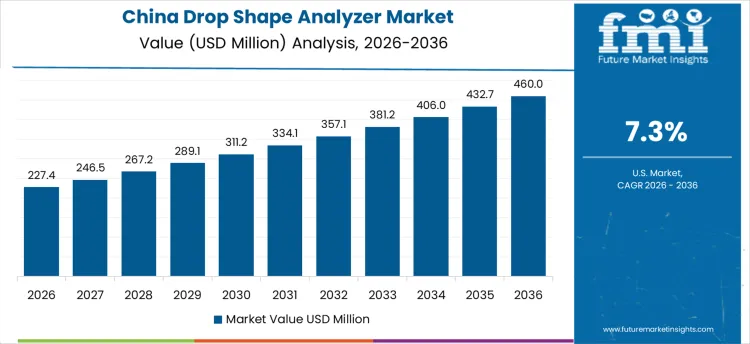
China’s drop shape analyzer market is growing at 7.3%, driven by rapid industrialization and increasing research activities in materials science and surface chemistry. The country’s manufacturing and chemical industries are growing, requiring precise tools like drop shape analyzers for assessing surface properties and optimizing material performance. With China’s expanding high-tech industries, including electronics, coatings, and pharmaceuticals, the need for advanced surface testing equipment is rising. Drop shape analyzers are essential for studying contact angles, surface tension, and wettability, which are critical for product development and quality control. China’s commitment to technological advancement and innovation in research and manufacturing is fueling demand for these analyzers.
What is Driving the Growth of the Drop Shape Analyzer Market in Brazil?
Brazil’s drop shape analyzer market is growing at 6.8%, driven by the increasing demand for precise surface property analysis in industries such as chemicals, pharmaceuticals, and manufacturing. Drop shape analyzers play a key role in evaluating material wettability, surface tension, and contact angles, which are crucial for product development, quality control, and process optimization. As Brazil’s industrial sectors continue to grow, there is an increased need for these devices to improve material properties and ensure consistency in production. The growing research base in surface chemistry and material science in Brazil is further propelling the demand for drop shape analyzers. As Brazilian industries modernize and align with global quality standards, the market for drop shape analyzers is expected to continue expanding steadily.
How is the Drop Shape Analyzer Market Expanding in the USA?
The USA’s drop shape analyzer market is growing at 6%, driven by the need for precise surface characterization in industries like chemicals, automotive, and pharmaceuticals. Drop shape analyzers are used to study the wettability, surface tension, and contact angles of various materials, crucial for product development, quality control, and optimizing manufacturing processes. As industries in the USA continue to focus on improving material performance and enhancing product quality, the demand for these analyzers rises. Furthermore, the growing emphasis on research and innovation in material science and surface chemistry is contributing to the market’s growth. As the USA’s industries prioritize high-quality production and efficient manufacturing processes, the drop shape analyzer market is expected to continue its steady growth, fueled by technological advancements and increasing demand for precision testing equipment.
What is Contributing to the Growth of the Drop Shape Analyzer Market in South Korea?
South Korea’s drop shape analyzer market is growing at 5.8%, supported by technological advancements in materials science, particularly in electronics, coatings, and chemical industries. South Korea’s focus on innovation in product development and the increasing need for precise surface analysis in various industrial applications are fueling demand for drop shape analyzers. These analyzers are essential in studying surface properties such as wettability, surface tension, and contact angles, which play a significant role in optimizing material performance. As South Korea continues to lead in high-tech industries, the market for drop shape analyzers is expected to grow, driven by advancements in manufacturing technologies and the increasing adoption of surface analysis tools in research and production processes.
What is Driving the Growth of the Drop Shape Analyzer Market in Germany?
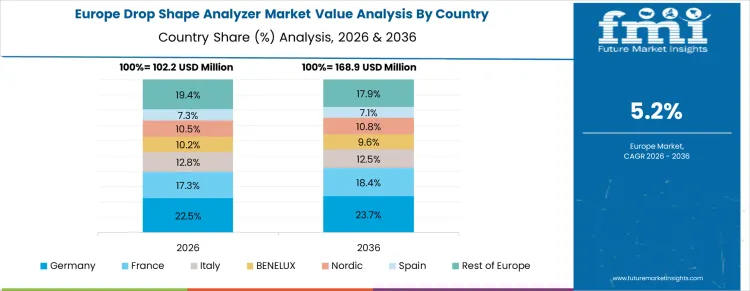
Germany’s drop shape analyzer market is growing at 5.7%, driven by the country’s strong industrial base and demand for high-quality testing equipment in materials science and surface chemistry. As a leader in sectors such as automotive, chemicals, and manufacturing, Germany requires reliable and precise instruments to evaluate surface properties and optimize material performance. Drop shape analyzers are used to study contact angles, surface tension, and wettability, which are critical for product development, quality control, and optimizing manufacturing processes. Germany’s commitment to maintaining high standards of quality and innovation in production processes is fueling the adoption of drop shape analyzers. With increasing focus on research and technological advancement, the demand for these analyzers in Germany is expected to continue growing steadily.
Who Are the Key Competitors in the Drop Shape Analyzer Market?
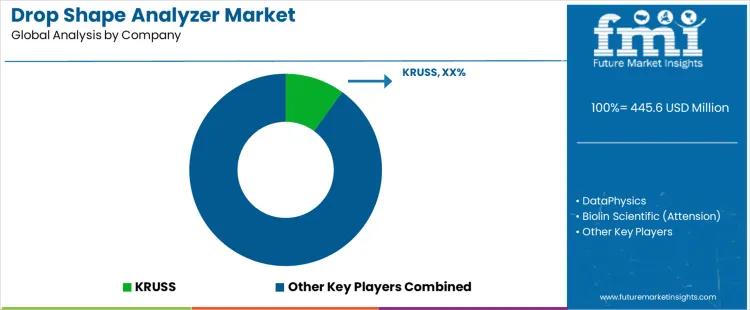
In the drop shape analyzer market KRUSS, DataPhysics, Biolin Scientific (Attension), ramé‑hart, Kyowa Interface Science, SEO (Surface Electro Optics), First Ten Angstroms, Holmarc, Anton Paar, and Chell Instruments compete with product brochures that highlight precision contact angle, surface energy, and wetting characterization for coatings, materials science, and formulation R&D. KRUSS brochures present high‑resolution imaging systems with automated drop detection and advanced analysis software. Technical charts and clear interface previews are used to support selection for quality control and research workflows. DataPhysics materials focus on versatile analyzers with robust measurement repeatability, accompanied by concise guides on setup and application notes for polymers, surfactants, and solids.
Biolin Scientific (Attension) collateral showcases dynamic and static contact angle analyzers with intuitive software and detailed performance tables, helping users interpret complex interfacial data. ramé‑hart product briefs emphasize precision and customization options, with simple diagrams illustrating typical workflows. Kyowa Interface Science literature highlights sensitive optical systems described with stable measurement outputs and ergonomic design features. SEO (Surface Electro Optics) brochures present systems with high‑speed cameras and analysis algorithms, offering performance summaries that aid comparative evaluation.
First Ten Angstroms and Holmarc materials focus on reliable performance in compact platforms suited to limited lab space, with product sheets that include key specifications and sample results. Anton Paar collateral highlights modular additions and strong support documentation geared toward multi‑parameter surface characterization. Chell Instruments brochures describe rugged analyzers with clear user guidance for both academic and industrial settings.
Key Players in Drop Shape Analyzer Market
- KRUSS
- DataPhysics
- Biolin Scientific (Attension)
- rame-hart
- Kyowa Interface Science
- SEO (Surface Electro Optics)
- First Ten Angstroms
- Holmarc
- Anton Paar
- Chell Instruments
Scope of Report
| Items | Values |
|---|---|
| Quantitative Unit (2026) | USD million |
| Application | Coatings, Electronics, Medical Devices, Academia |
| Measurement Type | Contact Angle, Surface Free Energy, Interfacial Tension (Pendant Drop), Other |
| Throughput | Manual, Semi-Automated, Automated High-Throughput, Other |
| Regions Covered | Asia Pacific, Europe, North America, Latin America, Middle East & Africa |
| Countries Covered | USA, China, Japan, South Korea, India, Australia & New Zealand, ASEAN, Germany, UK, France, Italy, Spain, Nordic, BENELUX, Brazil, Chile, Mexico, Saudi Arabia, Other GCC Countries, Turkey, South Africa, Other African Union |
| Key Companies Profiled | KRUSS, DataPhysics, Biolin Scientific (Attension), Rame-Hart, Kyowa Interface Science, SEO (Surface Electro Optics), First Ten Angstroms, Holmarc, Anton Paar, Chell Instruments |
| Additional Attributes | Dollar sales by application, measurement type, throughput, and region; regional CAGR and growth outlook. |
Drop Shape Analyzer Market by Key Segments
By Application:
- Coatings
- Electronics
- Medical Devices
- Academia
By Measurement Type:
- Contact Angle
- Surface Free Energy
- Interfacial Tension (Pendant Drop)
- Other
By Throughput:
- Manual
- Semi-Automated
- Automated High-Throughput
- Other
By Region:
- Asia Pacific
- China
- Japan
- South Korea
- India
- Australia & New Zealand
- ASEAN
- Rest of Asia Pacific
- Europe
- Germany
- United Kingdom
- France
- Italy
- Spain
- Nordic
- BENELUX
- Rest of Europe
- North America
- United States
- Canada
- Mexico
- Latin America
- Brazil
- Chile
- Rest of Latin America
- Middle East & Africa
- Kingdom of Saudi Arabia
- Other GCC Countries
- Turkey
- South Africa
- Other African Union
- Rest of Middle East & Africa
Bibliography
- KRUSS. (2023). High-resolution drop shape analyzers for precise contact angle and surface property measurement. KRUSS GmbH.
- DataPhysics. (2023). Versatile drop shape analyzers with robust repeatability for surface and interfacial property characterization. DataPhysics Instruments GmbH.
- Biolin Scientific (Attension). (2023). Dynamic and static contact angle analyzers with intuitive software for interfacial data analysis. Biolin Scientific AB.
- ramé-hart. (2023). Precision contact angle and surface free energy measurement systems for research and industrial applications. ramé-hart, Inc.
Frequently Asked Questions
How big is the drop shape analyzer market in 2026?
The global drop shape analyzer market is estimated to be valued at USD 445.6 million in 2026.
What will be the size of drop shape analyzer market in 2036?
The market size for the drop shape analyzer market is projected to reach USD 805.6 million by 2036.
How much will be the drop shape analyzer market growth between 2026 and 2036?
The drop shape analyzer market is expected to grow at a 6.1% CAGR between 2026 and 2036.
What are the key product types in the drop shape analyzer market?
The key product types in drop shape analyzer market are coatings, electronics, medical devices and academia.
Which measurement type segment to contribute significant share in the drop shape analyzer market in 2026?
In terms of measurement type, contact angle segment to command 40.0% share in the drop shape analyzer market in 2026.
Preview the report firsthand - request a free sample
Get SampleGet the brochure for pricing and purchase details.
Get PDFTable of Content
- Executive Summary
- Global Market Outlook
- Demand-side Trends
- Supply-side Trends
- Technology Roadmap Analysis
- Analysis and Recommendations
- Market Overview
- Market Coverage / Taxonomy
- Market Definition / Scope / Limitations
- Market Background
- Market Dynamics
- Drivers
- Restraints
- Opportunity
- Trends
- Scenario Forecast
- Demand in Optimistic Scenario
- Demand in Likely Scenario
- Demand in Conservative Scenario
- Opportunity Map Analysis
- Product Life Cycle Analysis
- Supply Chain Analysis
- Investment Feasibility Matrix
- Value Chain Analysis
- PESTLE and Porter’s Analysis
- Regulatory Landscape
- Regional Parent Market Outlook
- Production and Consumption Statistics
- Import and Export Statistics
- Market Dynamics
- Global Market Analysis 2021 to 2025 and Forecast, 2026 to 2036
- Historical Market Size Value (USD Million) Analysis, 2021 to 2025
- Current and Future Market Size Value (USD Million) Projections, 2026 to 2036
- Y-o-Y Growth Trend Analysis
- Absolute $ Opportunity Analysis
- Global Market Pricing Analysis 2021 to 2025 and Forecast 2026 to 2036
- Global Market Analysis 2021 to 2025 and Forecast 2026 to 2036, By Application
- Introduction / Key Findings
- Historical Market Size Value (USD Million) Analysis By Application , 2021 to 2025
- Current and Future Market Size Value (USD Million) Analysis and Forecast By Application , 2026 to 2036
- Coatings
- Electronics
- Medical Devices
- Academia
- Coatings
- Y-o-Y Growth Trend Analysis By Application , 2021 to 2025
- Absolute $ Opportunity Analysis By Application , 2026 to 2036
- Global Market Analysis 2021 to 2025 and Forecast 2026 to 2036, By Measurement Type
- Introduction / Key Findings
- Historical Market Size Value (USD Million) Analysis By Measurement Type, 2021 to 2025
- Current and Future Market Size Value (USD Million) Analysis and Forecast By Measurement Type, 2026 to 2036
- Contact Angle
- Surface Free Energy
- Interfacial Tension (Pendant Drop)
- Other
- Contact Angle
- Y-o-Y Growth Trend Analysis By Measurement Type, 2021 to 2025
- Absolute $ Opportunity Analysis By Measurement Type, 2026 to 2036
- Global Market Analysis 2021 to 2025 and Forecast 2026 to 2036, By Throughput
- Introduction / Key Findings
- Historical Market Size Value (USD Million) Analysis By Throughput, 2021 to 2025
- Current and Future Market Size Value (USD Million) Analysis and Forecast By Throughput, 2026 to 2036
- Manual
- Semi-Automated
- Automated High-Throughput
- Other
- Manual
- Y-o-Y Growth Trend Analysis By Throughput, 2021 to 2025
- Absolute $ Opportunity Analysis By Throughput, 2026 to 2036
- Global Market Analysis 2021 to 2025 and Forecast 2026 to 2036, By Region
- Introduction
- Historical Market Size Value (USD Million) Analysis By Region, 2021 to 2025
- Current Market Size Value (USD Million) Analysis and Forecast By Region, 2026 to 2036
- North America
- Latin America
- Western Europe
- Eastern Europe
- East Asia
- South Asia and Pacific
- Middle East & Africa
- Market Attractiveness Analysis By Region
- North America Market Analysis 2021 to 2025 and Forecast 2026 to 2036, By Country
- Historical Market Size Value (USD Million) Trend Analysis By Market Taxonomy, 2021 to 2025
- Market Size Value (USD Million) Forecast By Market Taxonomy, 2026 to 2036
- By Country
- USA
- Canada
- Mexico
- By Application
- By Measurement Type
- By Throughput
- By Country
- Market Attractiveness Analysis
- By Country
- By Application
- By Measurement Type
- By Throughput
- Key Takeaways
- Latin America Market Analysis 2021 to 2025 and Forecast 2026 to 2036, By Country
- Historical Market Size Value (USD Million) Trend Analysis By Market Taxonomy, 2021 to 2025
- Market Size Value (USD Million) Forecast By Market Taxonomy, 2026 to 2036
- By Country
- Brazil
- Chile
- Rest of Latin America
- By Application
- By Measurement Type
- By Throughput
- By Country
- Market Attractiveness Analysis
- By Country
- By Application
- By Measurement Type
- By Throughput
- Key Takeaways
- Western Europe Market Analysis 2021 to 2025 and Forecast 2026 to 2036, By Country
- Historical Market Size Value (USD Million) Trend Analysis By Market Taxonomy, 2021 to 2025
- Market Size Value (USD Million) Forecast By Market Taxonomy, 2026 to 2036
- By Country
- Germany
- UK
- Italy
- Spain
- France
- Nordic
- BENELUX
- Rest of Western Europe
- By Application
- By Measurement Type
- By Throughput
- By Country
- Market Attractiveness Analysis
- By Country
- By Application
- By Measurement Type
- By Throughput
- Key Takeaways
- Eastern Europe Market Analysis 2021 to 2025 and Forecast 2026 to 2036, By Country
- Historical Market Size Value (USD Million) Trend Analysis By Market Taxonomy, 2021 to 2025
- Market Size Value (USD Million) Forecast By Market Taxonomy, 2026 to 2036
- By Country
- Russia
- Poland
- Hungary
- Balkan & Baltic
- Rest of Eastern Europe
- By Application
- By Measurement Type
- By Throughput
- By Country
- Market Attractiveness Analysis
- By Country
- By Application
- By Measurement Type
- By Throughput
- Key Takeaways
- East Asia Market Analysis 2021 to 2025 and Forecast 2026 to 2036, By Country
- Historical Market Size Value (USD Million) Trend Analysis By Market Taxonomy, 2021 to 2025
- Market Size Value (USD Million) Forecast By Market Taxonomy, 2026 to 2036
- By Country
- China
- Japan
- South Korea
- By Application
- By Measurement Type
- By Throughput
- By Country
- Market Attractiveness Analysis
- By Country
- By Application
- By Measurement Type
- By Throughput
- Key Takeaways
- South Asia and Pacific Market Analysis 2021 to 2025 and Forecast 2026 to 2036, By Country
- Historical Market Size Value (USD Million) Trend Analysis By Market Taxonomy, 2021 to 2025
- Market Size Value (USD Million) Forecast By Market Taxonomy, 2026 to 2036
- By Country
- India
- ASEAN
- Australia & New Zealand
- Rest of South Asia and Pacific
- By Application
- By Measurement Type
- By Throughput
- By Country
- Market Attractiveness Analysis
- By Country
- By Application
- By Measurement Type
- By Throughput
- Key Takeaways
- Middle East & Africa Market Analysis 2021 to 2025 and Forecast 2026 to 2036, By Country
- Historical Market Size Value (USD Million) Trend Analysis By Market Taxonomy, 2021 to 2025
- Market Size Value (USD Million) Forecast By Market Taxonomy, 2026 to 2036
- By Country
- Kingdom of Saudi Arabia
- Other GCC Countries
- Turkiye
- South Africa
- Other African Union
- Rest of Middle East & Africa
- By Application
- By Measurement Type
- By Throughput
- By Country
- Market Attractiveness Analysis
- By Country
- By Application
- By Measurement Type
- By Throughput
- Key Takeaways
- Key Countries Market Analysis
- USA
- Pricing Analysis
- Market Share Analysis, 2025
- By Application
- By Measurement Type
- By Throughput
- Canada
- Pricing Analysis
- Market Share Analysis, 2025
- By Application
- By Measurement Type
- By Throughput
- Mexico
- Pricing Analysis
- Market Share Analysis, 2025
- By Application
- By Measurement Type
- By Throughput
- Brazil
- Pricing Analysis
- Market Share Analysis, 2025
- By Application
- By Measurement Type
- By Throughput
- Chile
- Pricing Analysis
- Market Share Analysis, 2025
- By Application
- By Measurement Type
- By Throughput
- Germany
- Pricing Analysis
- Market Share Analysis, 2025
- By Application
- By Measurement Type
- By Throughput
- UK
- Pricing Analysis
- Market Share Analysis, 2025
- By Application
- By Measurement Type
- By Throughput
- Italy
- Pricing Analysis
- Market Share Analysis, 2025
- By Application
- By Measurement Type
- By Throughput
- Spain
- Pricing Analysis
- Market Share Analysis, 2025
- By Application
- By Measurement Type
- By Throughput
- France
- Pricing Analysis
- Market Share Analysis, 2025
- By Application
- By Measurement Type
- By Throughput
- India
- Pricing Analysis
- Market Share Analysis, 2025
- By Application
- By Measurement Type
- By Throughput
- ASEAN
- Pricing Analysis
- Market Share Analysis, 2025
- By Application
- By Measurement Type
- By Throughput
- Australia & New Zealand
- Pricing Analysis
- Market Share Analysis, 2025
- By Application
- By Measurement Type
- By Throughput
- China
- Pricing Analysis
- Market Share Analysis, 2025
- By Application
- By Measurement Type
- By Throughput
- Japan
- Pricing Analysis
- Market Share Analysis, 2025
- By Application
- By Measurement Type
- By Throughput
- South Korea
- Pricing Analysis
- Market Share Analysis, 2025
- By Application
- By Measurement Type
- By Throughput
- Russia
- Pricing Analysis
- Market Share Analysis, 2025
- By Application
- By Measurement Type
- By Throughput
- Poland
- Pricing Analysis
- Market Share Analysis, 2025
- By Application
- By Measurement Type
- By Throughput
- Hungary
- Pricing Analysis
- Market Share Analysis, 2025
- By Application
- By Measurement Type
- By Throughput
- Kingdom of Saudi Arabia
- Pricing Analysis
- Market Share Analysis, 2025
- By Application
- By Measurement Type
- By Throughput
- Turkiye
- Pricing Analysis
- Market Share Analysis, 2025
- By Application
- By Measurement Type
- By Throughput
- South Africa
- Pricing Analysis
- Market Share Analysis, 2025
- By Application
- By Measurement Type
- By Throughput
- USA
- Market Structure Analysis
- Competition Dashboard
- Competition Benchmarking
- Market Share Analysis of Top Players
- By Regional
- By Application
- By Measurement Type
- By Throughput
- Competition Analysis
- Competition Deep Dive
- KRUSS
- Overview
- Product Portfolio
- Profitability by Market Segments (Product/Age /Sales Channel/Region)
- Sales Footprint
- Strategy Overview
- Marketing Strategy
- Product Strategy
- Channel Strategy
- DataPhysics
- Biolin Scientific (Attension)
- rame-hart
- Kyowa Interface Science
- SEO (Surface Electro Optics)
- First Ten Angstroms
- Holmarc
- Anton Paar
- Chell Instruments
- KRUSS
- Competition Deep Dive
- Assumptions & Acronyms Used
- Research Methodology


