

- Industry Size (2026)
- USD 314 Mn
- Forecast (2036)
- USD 1174.3 Mn
- CAGR (2026 to 2036)
- 14.1%
Microplastic-Free Seed Treatment Polymer Market Forecast and Outlook 2026 to 2036
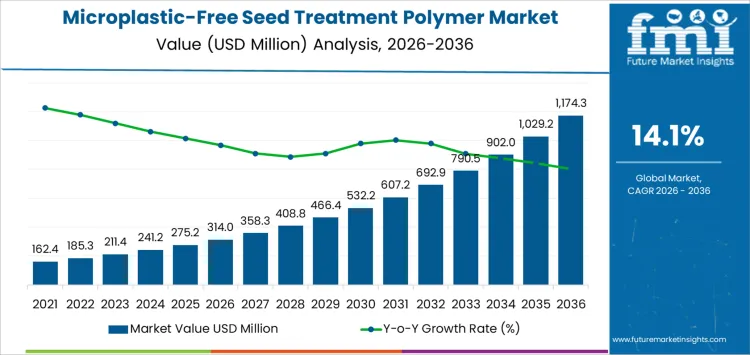
The global microplastic-free seed treatment polymer market is set to grow from USD 314 million in 2026 to USD 1,174.3 million by 2036, with a CAGR of 14.1%. Biodegradable natural polymers lead the market with a 38% share due to their eco-friendly properties and ability to degrade without leaving harmful residues, aligning with the increasing focus on sustainability. In terms of functional roles, film coating and binding hold the largest share at 46%, as they are essential for seed protection, improving germination rates, and ensuring even coverage of active ingredients. Other key polymer types include bio-based synthetic polymers, starch & cellulose derivatives, and protein-based polymers, while active ingredient delivery and moisture regulation are also gaining prominence in seed treatment solutions.
Quick Stats for Microplastic-Free Seed Treatment Polymer Market
- Microplastic-Free Seed Treatment Polymer Market Value (2026): USD 314 million
- Microplastic-Free Seed Treatment Polymer Market Forecast Value (2036): USD 1,174.3 million
- Microplastic-Free Seed Treatment Polymer Market Forecast CAGR: 14.1%
- Leading Polymer Type in Microplastic-Free Seed Treatment Polymer Market: Biodegradable Natural Polymers (38%)
- Key Growth Regions in Microplastic-Free Seed Treatment Polymer Market: North America, Europe, Asia Pacific
- Key Players in Microplastic-Free Seed Treatment Polymer Market: BASF SE, Bayer CropScience, Clariant AG, Croda International, Solvay SA
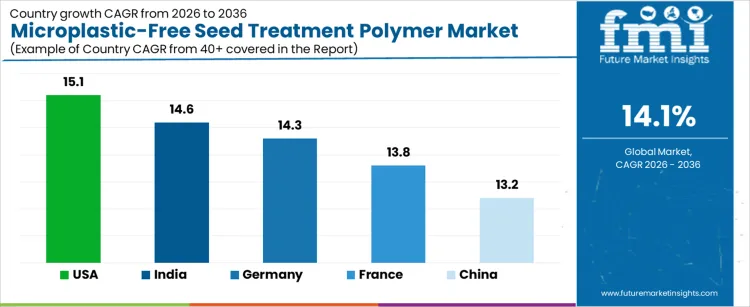
The USA leads with a 15.1% CAGR, driven by strong demand for sustainable farming practices and regulatory pressure to minimize environmental impact. Germany follows closely at 14.3%, supported by stringent environmental regulations and a focus on reducing plastic use in agriculture. India’s market grows at 14.6%, reflecting the country’s growing agricultural base and emphasis on eco-friendly solutions. Other regions such as China (13.2%) and France (13.8%) are also contributing significantly to the market’s expansion as they adopt greener farming technologies. The increasing adoption of biodegradable seed treatment polymers, supported by regulatory incentives and growing consumer awareness, is expected to drive continued growth in both developed and emerging markets.
Microplastic‑Free Seed Treatment Polymer Market Key Takeaways
| Metric | Value |
|---|---|
| Industry Value (2026) | USD 314 million |
| Forecast Value (2036) | USD 1,174.3 million |
| Forecast CAGR (2026–2036) | 14.1% |
How is the Global Microplastic‑Free Seed Treatment Polymer Sector Advancing?
The global microplastic‑free seed treatment polymer market is growing rapidly as agricultural producers and regulators prioritize sustainability and environmental safety in crop protection practices. Seed treatment polymers are used to coat seeds with protective films that improve handling, enhance germination, and deliver active ingredients such as nutrients or pesticides more effectively. Traditional seed coatings have often relied on polymers that can contribute to microplastic pollution in soil and water systems when they degrade. Microplastic‑free polymers are engineered from biodegradable or bio‑based materials that break down harmlessly, reducing the long‑term environmental footprint associated with conventional coatings.
Demand for microplastic‑free seed treatment polymers is rising alongside broader trends toward reducing plastic pollution and adopting greener agricultural inputs. These polymers support the application of crop protection agents while aligning with regulatory restrictions on microplastic use and filling a growing market need for eco‑responsible agriculture solutions. Advances in polymer chemistry are enhancing product performance, enabling coatings that not only deliver biological benefits but also support seedling vigor and stress tolerance without leaving persistent residues in the environment.
The market is expected to expand significantly as growers seeking sustainable alternatives adopt these polymers across a wide range of crops including cereals, oilseeds, and specialty crops. Continued research and development aimed at improving biodegradability, formulation compatibility with active ingredients, and cost competitiveness will further support adoption. Challenges such as proving performance parity with traditional polymers, ensuring consistent field results across diverse soils and climates, and educating growers on the benefits and use of microplastic‑free options may influence the pace of market growth. Nonetheless, the increasing emphasis on environmentally safe agricultural practices and regulatory pressure to limit microplastic pollution will continue to drive demand for microplastic‑free seed treatment polymers globally.
What Is the Segment-Wise Analysis for the Global Microplastic-Free Seed Treatment Polymer Market?
The global microplastic-free seed treatment polymer market is segmented by polymer type and functional role. Biodegradable natural polymers lead the market with a 38% share, as they are increasingly favored for their eco-friendly properties and ability to break down in the environment without leaving harmful residues. Other significant polymer types include bio-based synthetic polymers, starch & cellulose derivatives, and protein-based polymers. In terms of functional roles, film coating & binding hold the largest share at 46%, followed by active ingredient delivery, dust reduction & flowability, and moisture regulation.
How Do Biodegradable Natural Polymers Lead the Global Microplastic-Free Seed Treatment Polymer Market?
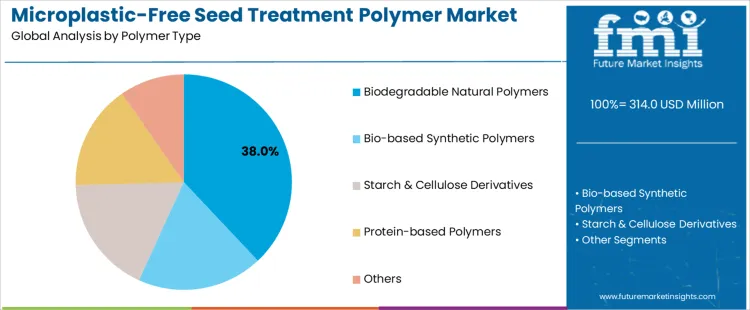
Biodegradable natural polymers lead the global microplastic-free seed treatment polymer market with a 38% share due to their eco-friendly characteristics and ability to break down naturally in the environment. These polymers are increasingly used in seed treatments because they provide a sustainable and responsible alternative to conventional synthetic polymers, which contribute to long-term plastic pollution. Biodegradable natural polymers offer effective seed coating and binding solutions while being safe for the environment. As the agricultural sector focuses more on sustainability and reducing microplastic contamination, the demand for biodegradable products has increased, solidifying biodegradable natural polymers as the dominant choice for seed treatment applications.
Why Does Film Coating & Binding Hold the Largest Market Share in the Global Seed Treatment Polymer Market?
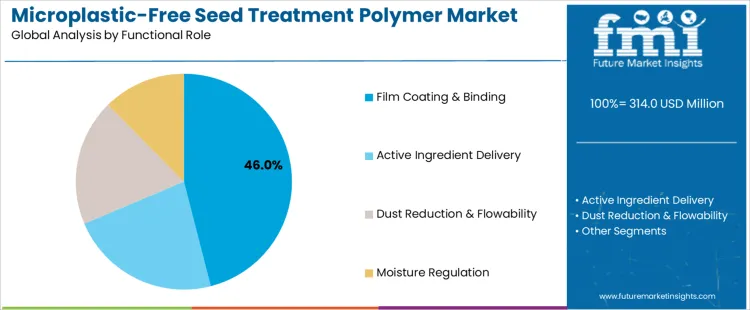
Film coating & binding hold the largest share of 46% in the global microplastic-free seed treatment polymer market due to their essential function in seed protection and treatment effectiveness. Film coatings provide an even layer of protection around seeds, enhancing germination rates, reducing environmental stressors, and ensuring uniform coverage of active ingredients. Binding ensures that treatment products stay intact on the seed during handling and planting, improving storage and transport efficiency. As demand for more effective and sustainable seed treatment methods grows, the increased focus on reliable, eco-friendly solutions has strengthened the dominance of film coating & binding polymers in the market.
What Is Shaping the Microplastic Free Seed Treatment Polymer Market?
The microplastic free seed treatment polymer market is shaped by rising environmental concerns over microplastic pollution and regulatory pressure to reduce plastic waste in agriculture. Conventional seed coatings often use polymers that break down into microplastics, leading to soil and water contamination. As awareness grows about the ecological impact of microplastics on soil health, biodiversity, and food safety, growers and seed companies are shifting toward biodegradable and microplastic free polymer technologies. This transition is being supported by sustainability commitments from agribusinesses and tightening regulations on agricultural plastic use.
What Challenges Are Limiting Adoption of Microplastic Free Seed Treatment Polymers?
Adoption barriers include cost perceptions and performance uncertainties. Biodegradable and microplastic free polymers can carry higher upfront prices compared with traditional synthetic options, which may deter cost sensitive growers or seed processors. Some users may question whether eco friendly polymers provide equivalent handling, adhesion, and active distribution under diverse field conditions. Variation in regulatory standards and certification requirements across regions can also complicate product acceptance. Limited awareness and agronomic guidance on optimal application practices for new polymers can slow broader market adoption.
What Key Trends Are Shaping the Microplastic Free Seed Treatment Polymer Market?
Key trends include the development of next generation, bio based polymer systems that enhance seed performance while fully degrading into non toxic byproducts. There is increasing integration of multifunctional coatings that combine microplastic free polymers with bio stimulants, micronutrients, or pest protectants to improve seed vigor and early growth. Partnerships between seed companies, polymer scientists, and sustainability organizations are accelerating commercialization and education. Regulatory incentives and procurement policies favoring microplastic reduction are also shaping demand. Additionally, digital tools that track environmental impact and polymer biodegradation rates are helping growers make data informed decisions.
What is the Growth Outlook for the Microplastic-Free Seed Treatment Polymer Market by Country?
| Country | CAGR (%) |
|---|---|
| USA | 15.1% |
| Germany | 14.3% |
| France | 13.8% |
| China | 13.2% |
| India | 14.6% |
The microplastic-free seed treatment polymer market is expanding rapidly, with the USA leading at a 15.1% CAGR, driven by increasing awareness about sustainability and eco-friendly agricultural practices. Germany follows closely with 14.3%, supported by strong environmental regulations and a growing focus on reducing chemical use in farming. France’s market grows at 13.8%, driven by rising demand for safer, more sustainable seed treatments. China’s market grows at 13.2%, fueled by the need to adopt greener farming solutions in its vast agricultural sector. India’s market shows a 14.6% growth rate, as the country’s agricultural sector increasingly turns to sustainable, microplastic-free alternatives for seed treatment.
Why is the USA Leading in the Microplastic-Free Seed Treatment Polymer Market?
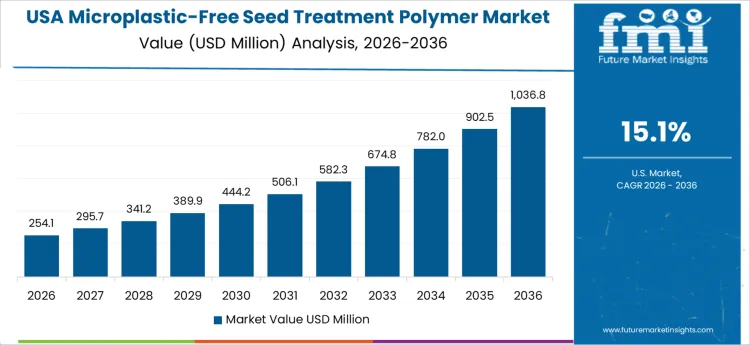
The USA’s microplastic-free seed treatment polymer market is growing at 15.1%, driven by strong consumer demand for sustainable and environmentally responsible farming practices. As concerns about the harmful effects of microplastics on ecosystems and food safety grow, farmers in the USA are increasingly turning to eco-friendly alternatives for seed treatment. These polymers help protect seeds while being safe for the environment and reducing plastic contamination in the soil. With increasing pressure from regulatory bodies to adopt greener solutions, and the rise of organic farming practices, the market for microplastic-free seed treatment polymers is gaining momentum. The USA’s large agricultural industry, along with government incentives for sustainable practices, is further accelerating the adoption of these polymers, ensuring continued growth in the market.
What is Driving the Growth of the Microplastic-Free Seed Treatment Polymer Market in Germany?
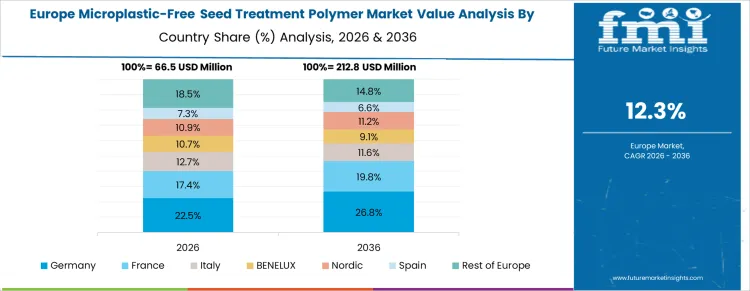
Germany’s microplastic-free seed treatment polymer market is growing at 14.3%, driven by the country’s strong environmental regulations and commitment to sustainability in agriculture. As the demand for eco-friendly farming practices rises, German farmers are increasingly adopting seed treatment polymers that are free from microplastics, which pose environmental risks. Germany is known for its emphasis on sustainability and organic farming, and the adoption of microplastic-free seed treatments aligns with the country’s push for greener agricultural solutions. With stringent regulations on pesticide use and growing concerns about soil and water contamination, the demand for safer, environmentally friendly seed treatment options is rising. As Germany continues to prioritize sustainability in agriculture, the market for microplastic-free seed treatment polymers is expected to expand.
How is the Microplastic-Free Seed Treatment Polymer Market Expanding in France?
France’s microplastic-free seed treatment polymer market is growing at 13.8%, driven by the country’s increasing focus on sustainable agricultural practices and environmental conservation. With growing concerns over the environmental impact of microplastics, French farmers are adopting seed treatment polymers that reduce plastic contamination while maintaining seed protection. The French agricultural sector, which is a leader in organic farming, is moving toward more sustainable farming solutions. The government’s initiatives to reduce the use of harmful chemicals and the rising demand for organic and eco-friendly products are contributing to the growth of microplastic-free seed treatment polymers. As the demand for environmentally responsible farming solutions continues to rise, the market for these polymers is expected to continue its growth trajectory in France.
What is Contributing to the Growth of the Microplastic-Free Seed Treatment Polymer Market in China?
China’s microplastic-free seed treatment polymer market is growing at 13.2%, supported by the country’s need for more sustainable farming practices. As one of the world’s largest agricultural producers, China is increasingly facing the environmental impact of microplastic contamination in its farming systems. Farmers are turning to alternative seed treatment polymers that offer the same level of seed protection without contributing to microplastic pollution. The Chinese government’s efforts to promote green agriculture and reduce chemical pesticide usage are also contributing to market growth. With a growing demand for cleaner, safer agricultural practices, the market for microplastic-free seed treatment polymers in China is expected to continue expanding, helping the country transition to eco-friendlier farming solutions.
What is Driving the Growth of the Microplastic-Free Seed Treatment Polymer Market in India?
India’s microplastic-free seed treatment polymer market is growing at 14.6%, driven by the country’s expanding agricultural sector and the need for more sustainable farming solutions. With India’s large agricultural base, there is increasing pressure to reduce environmental pollution caused by plastic residues in the soil. Farmers are turning to microplastic-free seed treatment polymers as a safer and more sustainable alternative to traditional seed coatings that contain harmful plastics. The rise of organic farming practices and government incentives to adopt eco-friendly farming methods are contributing to the adoption of these polymers. As India continues to prioritize sustainability in agriculture and reduce its environmental footprint, the demand for microplastic-free seed treatment solutions is expected to grow steadily.
How Are Companies Competing in the Microplastic‑Free Seed Treatment Polymer Market?
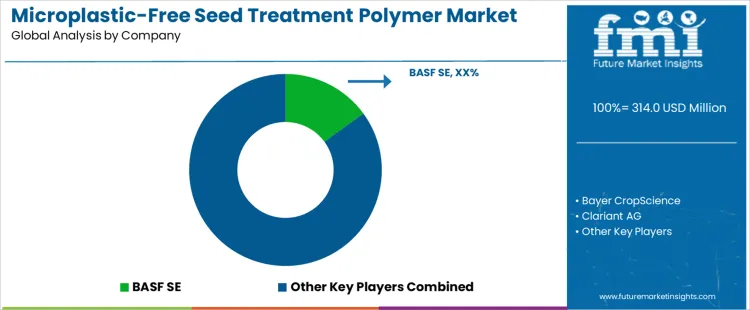
In the microplastic‑free seed treatment polymer market BASF SE, Bayer CropScience, Clariant AG, Croda International, and Solvay SA are positioned with product brochures that emphasize sustainable polymer technologies and seed performance benefits. BASF SE materials present biodegradable polymer matrices described with data on seed flowability, adhesion, and environmental acceptability. Technical summaries are provided with crop‑specific application guidance. Brochures from Bayer CropScience highlight innovative seed coating polymers that support improved seedling emergence while eliminating microplastic residues. Performance data is shown to support confidence in formulation stability and compatibility with fungicides and micronutrients.
Clariant AG collateral focuses on specialty polymer chemistries engineered for rapid breakdown in soil with minimal ecological impact. Visual aids and application notes are used to illustrate enhanced seed protection and reduced environmental load. Croda International brochures present bio‑based polymer systems marketed for seed treatment that promote uniform coating and controlled release of actives. Product briefs emphasize natural feedstocks and documented degradability in diverse soil conditions. Solvay SA materials describe advanced polymer platforms designed for seed enhancement while meeting emerging regulatory criteria for microplastic avoidance. Short performance charts and handling recommendations are included to assist agronomists and technical advisors.
Key Players in Microplastic-Free Seed Treatment Polymer Market
- BASF SE
- Bayer CropScience
- Clariant AG
- Croda International
- Solvay SA
Scope of Report
| Items | Values |
|---|---|
| Quantitative Units (2026) | USD million |
| Polymer Type | Biodegradable Natural Polymers, Bio-based Synthetic Polymers, Starch & Cellulose Derivatives, Protein-based Polymers, Others |
| Functional Role | Film Coating & Binding, Active Ingredient Delivery, Dust Reduction & Flowability, Moisture Regulation |
| Regions Covered | Asia Pacific, Europe, North America, Latin America, Middle East & Africa |
| Countries Covered | USA, China, Japan, South Korea, India, Australia & New Zealand, ASEAN, Germany, UK, France, Italy, Spain, Nordic, BENELUX, Brazil, Chile, Mexico, Saudi Arabia, Other GCC Countries, Turkey, South Africa, Other African Union |
| Key Companies Profiled | BASF SE, Bayer CropScience, Clariant AG, Croda International, Solvay SA |
| Additional Attributes | Dollar sales by polymer type, functional role, and region; regional CAGR and growth outlook; distribution channels including agricultural suppliers, seed treatment manufacturers, and service providers; innovation trends in microplastic-free seed treatment polymers; competitive positioning of global vs regional suppliers. |
Microplastic-Free Seed Treatment Polymer Market by Segments
Polymer Type
- Biodegradable Natural Polymers
- Bio-based Synthetic Polymers
- Starch & Cellulose Derivatives
- Protein-based Polymers
- Others
Functional Role
- Film Coating & Binding
- Active Ingredient Delivery
- Dust Reduction & Flowability
- Moisture Regulation
Region:
- Asia Pacific
- China
- Japan
- South Korea
- India
- Australia & New Zealand
- ASEAN
- Rest of Asia Pacific
- Europe
- Germany
- United Kingdom
- France
- Italy
- Spain
- Nordic
- BENELUX
- Rest of Europe
- North America
- United States
- Canada
- Mexico
- Latin America
- Brazil
- Chile
- Rest of Latin America
- Middle East & Africa
- Kingdom of Saudi Arabia
- Other GCC Countries
- Turkey
- South Africa
- Other African Union
- Rest of Middle East & Africa
Frequently Asked Questions
How big is the microplastic-free seed treatment polymer market in 2026?
The global microplastic-free seed treatment polymer market is estimated to be valued at USD 314.0 million in 2026.
What will be the size of microplastic-free seed treatment polymer market in 2036?
The market size for the microplastic-free seed treatment polymer market is projected to reach USD 1,174.3 million by 2036.
How much will be the microplastic-free seed treatment polymer market growth between 2026 and 2036?
The microplastic-free seed treatment polymer market is expected to grow at a 14.1% CAGR between 2026 and 2036.
What are the key product types in the microplastic-free seed treatment polymer market?
The key product types in microplastic-free seed treatment polymer market are biodegradable natural polymers, bio-based synthetic polymers, starch & cellulose derivatives, protein-based polymers and others.
Which functional role segment to contribute significant share in the microplastic-free seed treatment polymer market in 2026?
In terms of functional role, film coating & binding segment to command 46.0% share in the microplastic-free seed treatment polymer market in 2026.
Preview the report firsthand - request a free sample
Get SampleGet the brochure for pricing and purchase details.
Get PDFTable of Content
- Executive Summary
- Global Market Outlook
- Demand-side Trends
- Supply-side Trends
- Technology Roadmap Analysis
- Analysis and Recommendations
- Market Overview
- Market Coverage / Taxonomy
- Market Definition / Scope / Limitations
- Market Background
- Market Dynamics
- Drivers
- Restraints
- Opportunity
- Trends
- Scenario Forecast
- Demand in Optimistic Scenario
- Demand in Likely Scenario
- Demand in Conservative Scenario
- Opportunity Map Analysis
- Product Life Cycle Analysis
- Supply Chain Analysis
- Investment Feasibility Matrix
- Value Chain Analysis
- PESTLE and Porter’s Analysis
- Regulatory Landscape
- Regional Parent Market Outlook
- Production and Consumption Statistics
- Import and Export Statistics
- Market Dynamics
- Global Market Analysis 2021 to 2025 and Forecast, 2026 to 2036
- Historical Market Size Value (USD Million) Analysis, 2021 to 2025
- Current and Future Market Size Value (USD Million) Projections, 2026 to 2036
- Y-o-Y Growth Trend Analysis
- Absolute $ Opportunity Analysis
- Global Market Pricing Analysis 2021 to 2025 and Forecast 2026 to 2036
- Global Market Analysis 2021 to 2025 and Forecast 2026 to 2036, By Polymer Type
- Introduction / Key Findings
- Historical Market Size Value (USD Million) Analysis By Polymer Type , 2021 to 2025
- Current and Future Market Size Value (USD Million) Analysis and Forecast By Polymer Type , 2026 to 2036
- Biodegradable Natural Polymers
- Bio-based Synthetic Polymers
- Starch & Cellulose Derivatives
- Protein-based Polymers
- Others
- Y-o-Y Growth Trend Analysis By Polymer Type , 2021 to 2025
- Absolute $ Opportunity Analysis By Polymer Type , 2026 to 2036
- Global Market Analysis 2021 to 2025 and Forecast 2026 to 2036, By Functional Role
- Introduction / Key Findings
- Historical Market Size Value (USD Million) Analysis By Functional Role, 2021 to 2025
- Current and Future Market Size Value (USD Million) Analysis and Forecast By Functional Role, 2026 to 2036
- Film Coating & Binding
- Active Ingredient Delivery
- Dust Reduction & Flowability
- Moisture Regulation
- Y-o-Y Growth Trend Analysis By Functional Role, 2021 to 2025
- Absolute $ Opportunity Analysis By Functional Role, 2026 to 2036
- Global Market Analysis 2021 to 2025 and Forecast 2026 to 2036, By Region
- Introduction
- Historical Market Size Value (USD Million) Analysis By Region, 2021 to 2025
- Current Market Size Value (USD Million) Analysis and Forecast By Region, 2026 to 2036
- North America
- Latin America
- Western Europe
- Eastern Europe
- East Asia
- South Asia and Pacific
- Middle East & Africa
- Market Attractiveness Analysis By Region
- North America Market Analysis 2021 to 2025 and Forecast 2026 to 2036, By Country
- Historical Market Size Value (USD Million) Trend Analysis By Market Taxonomy, 2021 to 2025
- Market Size Value (USD Million) Forecast By Market Taxonomy, 2026 to 2036
- By Country
- USA
- Canada
- Mexico
- By Polymer Type
- By Functional Role
- By Country
- Market Attractiveness Analysis
- By Country
- By Polymer Type
- By Functional Role
- Key Takeaways
- Latin America Market Analysis 2021 to 2025 and Forecast 2026 to 2036, By Country
- Historical Market Size Value (USD Million) Trend Analysis By Market Taxonomy, 2021 to 2025
- Market Size Value (USD Million) Forecast By Market Taxonomy, 2026 to 2036
- By Country
- Brazil
- Chile
- Rest of Latin America
- By Polymer Type
- By Functional Role
- By Country
- Market Attractiveness Analysis
- By Country
- By Polymer Type
- By Functional Role
- Key Takeaways
- Western Europe Market Analysis 2021 to 2025 and Forecast 2026 to 2036, By Country
- Historical Market Size Value (USD Million) Trend Analysis By Market Taxonomy, 2021 to 2025
- Market Size Value (USD Million) Forecast By Market Taxonomy, 2026 to 2036
- By Country
- Germany
- UK
- Italy
- Spain
- France
- Nordic
- BENELUX
- Rest of Western Europe
- By Polymer Type
- By Functional Role
- By Country
- Market Attractiveness Analysis
- By Country
- By Polymer Type
- By Functional Role
- Key Takeaways
- Eastern Europe Market Analysis 2021 to 2025 and Forecast 2026 to 2036, By Country
- Historical Market Size Value (USD Million) Trend Analysis By Market Taxonomy, 2021 to 2025
- Market Size Value (USD Million) Forecast By Market Taxonomy, 2026 to 2036
- By Country
- Russia
- Poland
- Hungary
- Balkan & Baltic
- Rest of Eastern Europe
- By Polymer Type
- By Functional Role
- By Country
- Market Attractiveness Analysis
- By Country
- By Polymer Type
- By Functional Role
- Key Takeaways
- East Asia Market Analysis 2021 to 2025 and Forecast 2026 to 2036, By Country
- Historical Market Size Value (USD Million) Trend Analysis By Market Taxonomy, 2021 to 2025
- Market Size Value (USD Million) Forecast By Market Taxonomy, 2026 to 2036
- By Country
- China
- Japan
- South Korea
- By Polymer Type
- By Functional Role
- By Country
- Market Attractiveness Analysis
- By Country
- By Polymer Type
- By Functional Role
- Key Takeaways
- South Asia and Pacific Market Analysis 2021 to 2025 and Forecast 2026 to 2036, By Country
- Historical Market Size Value (USD Million) Trend Analysis By Market Taxonomy, 2021 to 2025
- Market Size Value (USD Million) Forecast By Market Taxonomy, 2026 to 2036
- By Country
- India
- ASEAN
- Australia & New Zealand
- Rest of South Asia and Pacific
- By Polymer Type
- By Functional Role
- By Country
- Market Attractiveness Analysis
- By Country
- By Polymer Type
- By Functional Role
- Key Takeaways
- Middle East & Africa Market Analysis 2021 to 2025 and Forecast 2026 to 2036, By Country
- Historical Market Size Value (USD Million) Trend Analysis By Market Taxonomy, 2021 to 2025
- Market Size Value (USD Million) Forecast By Market Taxonomy, 2026 to 2036
- By Country
- Kingdom of Saudi Arabia
- Other GCC Countries
- Turkiye
- South Africa
- Other African Union
- Rest of Middle East & Africa
- By Polymer Type
- By Functional Role
- By Country
- Market Attractiveness Analysis
- By Country
- By Polymer Type
- By Functional Role
- Key Takeaways
- Key Countries Market Analysis
- USA
- Pricing Analysis
- Market Share Analysis, 2025
- By Polymer Type
- By Functional Role
- Canada
- Pricing Analysis
- Market Share Analysis, 2025
- By Polymer Type
- By Functional Role
- Mexico
- Pricing Analysis
- Market Share Analysis, 2025
- By Polymer Type
- By Functional Role
- Brazil
- Pricing Analysis
- Market Share Analysis, 2025
- By Polymer Type
- By Functional Role
- Chile
- Pricing Analysis
- Market Share Analysis, 2025
- By Polymer Type
- By Functional Role
- Germany
- Pricing Analysis
- Market Share Analysis, 2025
- By Polymer Type
- By Functional Role
- UK
- Pricing Analysis
- Market Share Analysis, 2025
- By Polymer Type
- By Functional Role
- Italy
- Pricing Analysis
- Market Share Analysis, 2025
- By Polymer Type
- By Functional Role
- Spain
- Pricing Analysis
- Market Share Analysis, 2025
- By Polymer Type
- By Functional Role
- France
- Pricing Analysis
- Market Share Analysis, 2025
- By Polymer Type
- By Functional Role
- India
- Pricing Analysis
- Market Share Analysis, 2025
- By Polymer Type
- By Functional Role
- ASEAN
- Pricing Analysis
- Market Share Analysis, 2025
- By Polymer Type
- By Functional Role
- Australia & New Zealand
- Pricing Analysis
- Market Share Analysis, 2025
- By Polymer Type
- By Functional Role
- China
- Pricing Analysis
- Market Share Analysis, 2025
- By Polymer Type
- By Functional Role
- Japan
- Pricing Analysis
- Market Share Analysis, 2025
- By Polymer Type
- By Functional Role
- South Korea
- Pricing Analysis
- Market Share Analysis, 2025
- By Polymer Type
- By Functional Role
- Russia
- Pricing Analysis
- Market Share Analysis, 2025
- By Polymer Type
- By Functional Role
- Poland
- Pricing Analysis
- Market Share Analysis, 2025
- By Polymer Type
- By Functional Role
- Hungary
- Pricing Analysis
- Market Share Analysis, 2025
- By Polymer Type
- By Functional Role
- Kingdom of Saudi Arabia
- Pricing Analysis
- Market Share Analysis, 2025
- By Polymer Type
- By Functional Role
- Turkiye
- Pricing Analysis
- Market Share Analysis, 2025
- By Polymer Type
- By Functional Role
- South Africa
- Pricing Analysis
- Market Share Analysis, 2025
- By Polymer Type
- By Functional Role
- USA
- Market Structure Analysis
- Competition Dashboard
- Competition Benchmarking
- Market Share Analysis of Top Players
- By Regional
- By Polymer Type
- By Functional Role
- Competition Analysis
- Competition Deep Dive
- BASF SE
- Overview
- Product Portfolio
- Profitability by Market Segments (Product/Age /Sales Channel/Region)
- Sales Footprint
- Strategy Overview
- Marketing Strategy
- Product Strategy
- Channel Strategy
- Bayer CropScience
- Clariant AG
- Croda International
- Solvay SA
- BASF SE
- Competition Deep Dive
- Assumptions & Acronyms Used
- Research Methodology


