

- Industry Size (2026)
- USD 781.7 Mn
- Forecast (2036)
- USD 1767.4 Mn
- CAGR (2026 to 2036)
- 8.5%
Erosion Control Polymers and Soil Binders Market Forecast and Outlook 2026 to 2036
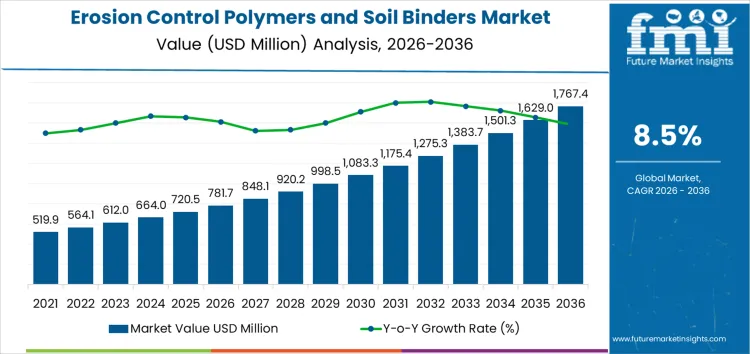
The erosion control polymers and soil binders market is projected to experience steady growth from 2026 to 2036. In 2026, the market value is expected to be USD 781.7 million, with consistent growth anticipated, reaching USD 1,767.4 million by 2036. The compound annual growth rate (CAGR) for the market is forecasted at 8.5%, driven by increasing demand for effective solutions to prevent soil erosion and enhance soil stability, particularly in agriculture, construction, and land reclamation. Erosion control polymers and soil binders are essential in improving soil retention, reducing erosion, and supporting vegetation growth, making them valuable in a wide range of applications.
The market's growth is supported by the increasing focus on environmental protection, land restoration, and sustainable agriculture practices. As the global need for land reclamation and soil conservation rises, the demand for these products will continue to grow. Additionally, technological advancements in polymer formulations and binders will drive market expansion. Over the forecast period, the market is expected to grow steadily, with continuous product innovation and an increasing emphasis on eco-friendly and effective erosion control solutions.
Quick Stats of the Erosion Control Polymers and Soil Binders Market
- Erosion Control Polymers and Soil Binders Market Value (2026): USD 781.7 million
- Erosion Control Polymers and Soil Binders Market Forecast Value (2036): USD 1,767.4 million
- Erosion Control Polymers and Soil Binders Market Global Forecast CAGR (2026 to 2036): 8.5%
- Erosion Control Polymers and Soil Binders Market Leading Segment: End-User Sector (Government & Municipal Bodies) 32%
- Key Growth Regions in Erosion Control Polymers and Soil Binders Market: India
- Top Players in Erosion Control Polymers and Soil Binders Market: Soilworks, BASF SE, Dow Inc., Global Road Technology (GRT), Applied Polymer Systems (APS)
What is the Growth Forecast for the Erosion Control Polymers and Soil Binders Market through 2036?
The growth forecast for the erosion control polymers and soil binders market indicates consistent expansion, with a projected CAGR of 8.5%. Starting at USD 781.7 million in 2026, the market will gradually increase, reaching USD 848.1 million in 2027, USD 926 million in 2028, and USD 998.4 million in 2029. By 2030, the market value is projected to rise to USD 1,083.8 million, continuing its upward trend throughout the forecast period.
From 2031 to 2036, the market will experience continued growth, reaching USD 1,175.9 million in 2031, USD 1,276.8 million in 2032, and USD 1,385.4 million in 2033. By 2034, the market is projected to reach USD 1,503.2 million, followed by USD 1,628 million in 2035, and finally USD 1,767.4 million by 2036. The market will exhibit steady growth, supported by both product adoption and innovations in formulation.
Erosion Control Polymers and Soil Binders Market Key Takeaways
| Metric | Value |
|---|---|
| Industry Sales Value (2026) | USD 781.7 million |
| Industry Forecast Value (2036) | USD 1,767.4 million |
| Industry Forecast CAGR (2026 to 2036) | 8.5% |
What Is Driving the Demand for the Erosion Control Polymers and Soil Binders Market Globally?
The global demand for erosion control polymers and soil binders is being driven by increasing recognition of soil degradation risks, regulatory mandates on land and water protection, and growth in infrastructure and land development activities. Erosion control polymers and soil binders are used to stabilise exposed soils, reduce particulate runoff, and enhance surface cohesion in applications such as highway embankments, construction sites, agricultural terraces, and coastal protection works. Rapid expansion of urban development and major civil infrastructure projects across Asia Pacific, the Middle East, Africa and Latin America has created large areas of exposed earth that require effective stabilisation to prevent sediment transport into waterways and to protect air quality. Environmental legislation in many regions now requires implementation of best management practices for erosion and sediment control, including mandatory soil stabilisation measures during and after construction, which reinforces the need for erosion control products. In agricultural landscapes, pressure to reduce nutrient loss, maintain productivity on sloping terrain, and preserve topsoil integrity under changing climatic conditions further supports uptake of polymers and binders that help retain soil structure. Heightened awareness of the economic and ecological costs of erosion such as damaged infrastructure, degraded water quality, and reduced agricultural yields also motivates public and private stakeholders to invest in soil stabilisation solutions.
Future demand for erosion control polymers and soil binders is expected to grow as sustainable land management, climate resilience and environmental compliance continue to shape project planning and execution worldwide. Advances in polymer chemistry and soil science are producing stabilisers that deliver rapid soil cohesion, enhanced moisture retention, and longevity under variable weather conditions, which broadens their application across diverse environments and soil types. Growth in climate adaptation initiatives such as slopes and embankments prone to extreme rainfall, wildfire recovery zones, and shoreline protection will reinforce adoption because effective soil binders help reduce landslide risk and sediment loss under stress. Regulatory frameworks that tighten erosion and sediment control requirements, particularly near sensitive ecosystems, will sustain demand in construction and land use sectors where permit compliance is tied to environmental outcomes. Integration of erosion control products with geosynthetics, revegetation strategies, and water quality systems will advance holistic site stabilisation approaches and encourage specification by engineers and landscapers. As sustainability and infrastructure resilience become more central to public policy and procurement, the erosion control polymers and soil binders market is anticipated to expand steadily across global markets, reflecting both regulatory drivers and investment in land stewardship practices.
What are the Leading Segments in the Global Erosion Control Polymers and Soil Binders Market?
The global erosion control polymers and soil binders market is segmented by application area and end-user sector. Among application areas, road & infrastructure embankments lead the market, capturing 30% of the share, followed by mining & quarry reclamation, construction & earthworks, agriculture & land restoration, and shoreline & slope protection. Road & infrastructure embankments are the largest application area due to the need for soil stabilization in infrastructure projects. On the end-user sector side, government & municipal bodies dominate the market, holding 32% of the share, followed by construction contractors, mining & energy companies, agricultural landowners, and environmental restoration firms. Government and municipal bodies are the largest users of erosion control products, primarily due to their role in large-scale public infrastructure projects.
What Drives the Growth of Road & Infrastructure Embankments in the Erosion Control Polymers and Soil Binders Market?

Road & infrastructure embankments are the leading application area in the erosion control polymers and soil binders market, holding 30% of the share. This growth is driven by the significant need for soil stabilization in road and infrastructure projects to prevent erosion and maintain structural integrity. Embankments, which are critical in road construction and civil engineering projects, require effective erosion control to avoid soil degradation, reduce maintenance costs, and improve safety. The increasing focus on sustainable infrastructure, combined with the need for long-term soil protection, is driving the demand for erosion control polymers and soil binders in this segment. As government and municipal projects expand, the need for effective and environmentally friendly erosion control solutions for embankments will continue to grow, reinforcing this segment's dominance in the market.
What is Driving the Demand for Government & Municipal Bodies in the Erosion Control Polymers and Soil Binders Market?
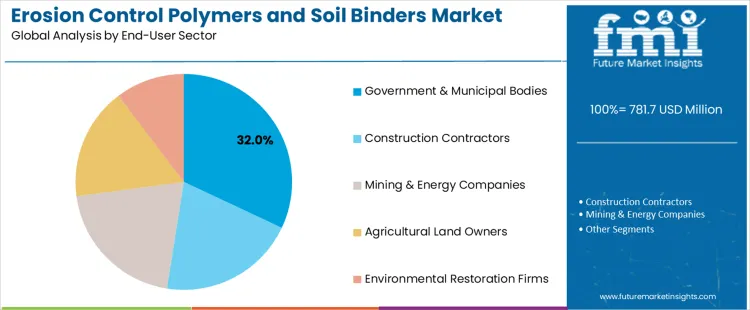
Government & municipal bodies are the leading end-user sector in the erosion control polymers and soil binders market, holding 32% of the share. This is due to their responsibility for managing large-scale infrastructure projects, including road construction, flood control systems, and environmental restoration efforts, which require effective erosion control solutions. Municipalities and government agencies often oversee the development and maintenance of public works, such as highways, embankments, and public parks, which necessitate soil stabilization to ensure long-term durability and safety. The growing emphasis on sustainable construction practices, environmental regulations, and the need to protect natural resources further drive the adoption of erosion control polymers and soil binders in this sector. As governments continue to prioritize infrastructure development and environmental conservation, the demand for these solutions is expected to remain strong, ensuring that government & municipal bodies maintain their position as a dominant sector in the market.
What are the Key Dynamics in the Global Erosion Control Polymers and Soil Binders Market?
The global erosion control polymers and soil binders market is expanding as infrastructure, agriculture, mining and construction sectors adopt advanced solutions to stabilise soil, reduce sediment loss, and protect water quality. These polymer-based products improve soil cohesion and resist erosion from wind and water, supporting slope protection, road shoulders, embankments and reclamation projects. Growth reflects rising investment in sustainable land management, regulatory emphasis on sediment control, and greater awareness of environmental impact from surface disturbance. Adoption spans public works, industrial sites and agricultural landscapes where erosion mitigation is integral to performance and compliance.
What are the Key Drivers for the Global Erosion Control Polymers and Soil Binders Market?
One key driver is stricter environmental regulation that mandates effective erosion and sediment control to protect waterways, wetlands and ecosystems during and after construction. Project owners and contractors adopt polymers and soil binders to achieve compliance with stormwater permits and best management practices. Growing infrastructure development, urban expansion and climate-related intensification of rainfall events increase demand for reliable soil stabilisation solutions. Advances in polymer chemistry improve performance, longevity and ease of application, making these products more attractive than traditional mechanical controls. Increased emphasis on sustainable site design and reduced maintenance liability further supports market uptake.
What are the Restraints for the Global Erosion Control Polymers and Soil Binders Market?
A restraint is cost sensitivity in price-competitive markets, as high-performance polymers and binders may be more expensive than conventional erosion control materials such as mulches or geotextiles. Budget limitations on smaller projects can slow adoption despite long-term benefits. Performance can vary with soil type, climate and application technique, requiring technical expertise and field testing to optimise results. Some stakeholders may lack awareness of product benefits compared with traditional methods, affecting specification by engineers and contractors. Variability in regional standards and enforcement can also influence how readily these technologies are integrated into project planning.
What are the Key Trends in the Global Erosion Control Polymers and Soil Binders Market?
A key trend is development of greener, bio-based polymers and formulations that align with sustainability goals and reduce ecological footprint while maintaining or improving soil adhesion and erosion resistance. Manufacturers are introducing products that enhance water retention, seed germination and vegetation establishment to support holistic landscape restoration. Integration of soil binders with digital planning tools and modelling supports more precise specification and deployment based on site conditions. Growth in turnkey erosion control services that bundle material, application and monitoring is emerging to help project owners achieve outcomes with less operational burden. Collaboration across engineering firms, regulators and suppliers is driving broader acceptance of polymer-based erosion control solutions.
What is the Country-Wise Analysis of the Erosion Control Polymers and Soil Binders Market?
The erosion control polymers and soil binders market is expected to grow steadily, driven by the increasing demand for sustainable solutions in the construction, agriculture, and environmental sectors. These products are used to prevent soil erosion, improve soil stability, and promote vegetation growth in various applications such as construction sites, agriculture, land reclamation, and infrastructure development. High-growth markets like India and China are experiencing strong demand due to rapid industrialization, urbanization, and large-scale infrastructure projects. Developed markets such as the United States, Australia, and Brazil are also experiencing steady growth, supported by growing environmental concerns, government regulations, and the need for sustainable land management practices in the face of climate change.
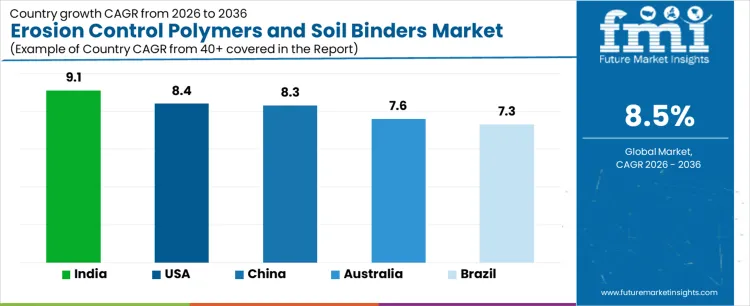
| Country | CAGR (2026 to 2036) |
|---|---|
| India | 9.1% |
| United States | 8.4% |
| China | 8.3% |
| Australia | 7.6% |
| Brazil | 7.3% |
What is the Growth Outlook for the Erosion Control Polymers and Soil Binders Market in India?
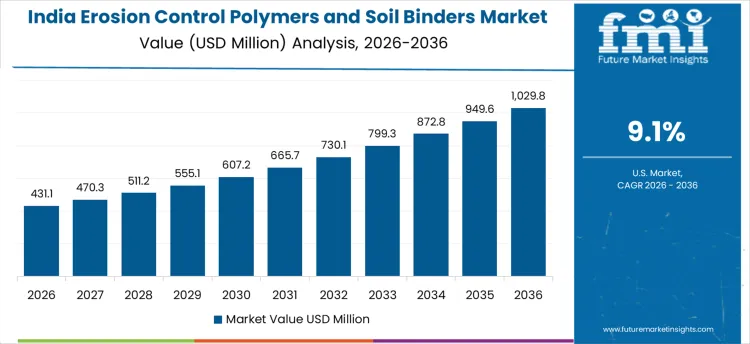
The erosion control polymers and soil binders market in India is expected to grow at the highest rate, with a projected CAGR of 9.1%. India’s rapid industrialization, large-scale infrastructure development, and increasing agricultural activity are key factors driving the demand for these products. With the growing focus on sustainable construction and agricultural practices, there is a rising need for solutions that help prevent soil erosion and improve land productivity. The Indian government’s increasing investment in infrastructure projects, coupled with the need for better land reclamation and soil conservation techniques, is further boosting the market. Additionally, India’s agricultural sector, which heavily relies on effective soil management, is a key driver of demand for erosion control polymers and soil binders, supporting significant market growth.
What is the Market Outlook for the Erosion Control Polymers and Soil Binders Market in the United States?
The erosion control polymers and soil binders market in the United States is projected to grow steadily, with a projected CAGR of 8.4%. In the U.S., the demand for these products is driven by the growing focus on environmental protection, land reclamation, and sustainable construction practices. The U.S. government’s regulatory frameworks, which emphasize soil conservation and erosion control, are creating a favorable environment for the adoption of these products in sectors such as agriculture, construction, and land development. The increasing awareness of the need to mitigate the impact of soil erosion and promote sustainable land management practices in the face of climate change is also contributing to market growth. With rising urbanization and infrastructure projects, the U.S. market for erosion control polymers and soil binders is expected to continue expanding steadily.
What is the Growth Forecast for the Erosion Control Polymers and Soil Binders Market in China?
The erosion control polymers and soil binders market in China is expected to grow steadily, with a projected CAGR of 8.3%. China’s rapid urbanization, large-scale infrastructure development, and focus on sustainable agricultural practices are key drivers of the demand for these products. As the country continues to develop and industrialize, managing soil erosion and improving land quality have become increasingly important to support both urban and rural development. Government policies promoting sustainable land management and environmental protection are expected to continue driving the adoption of erosion control polymers and soil binders. Moreover, with increasing challenges related to soil degradation and water conservation, China’s market for these products is poised to grow steadily as industries and farmers adopt more sustainable practices.
What is the Market Outlook for the Erosion Control Polymers and Soil Binders Market in Australia?
The erosion control polymers and soil binders market in Australia is projected to grow at a moderate pace, with a projected CAGR of 7.6%. Australia’s agricultural and construction industries are increasingly adopting erosion control solutions to address soil degradation and improve land productivity. With a growing focus on sustainable land management and environmental conservation, there is a rising demand for products that help prevent soil erosion, especially in agricultural areas prone to degradation. The Australian government’s emphasis on soil conservation and sustainable land use practices is further fueling market growth. Additionally, with the country’s ongoing efforts to address the impacts of climate change, the demand for soil binders and erosion control polymers is expected to continue to grow steadily in the coming years, particularly in sectors like mining, construction, and agriculture.
What are the Growth Prospects for the Erosion Control Polymers and Soil Binders Market in Brazil?
The erosion control polymers and soil binders market in Brazil is expected to grow steadily, with a projected CAGR of 7.3%. Brazil’s large agricultural sector, combined with an increasing focus on sustainable farming practices, is a key driver of demand for these products. The country’s rapid urbanization and infrastructure development also contribute to the need for effective soil erosion control solutions. With the Brazilian government placing increasing emphasis on land conservation and sustainable land management practices, the adoption of erosion control polymers and soil binders is expected to rise. Furthermore, Brazil’s large-scale land reclamation projects and growing awareness of the importance of environmental sustainability are expected to further support market growth in the coming years. The combination of agricultural expansion and infrastructure development is likely to continue driving steady demand for erosion control products in Brazil.
What is the Competitive Landscape for the Erosion Control Polymers and Soil Binders Market?
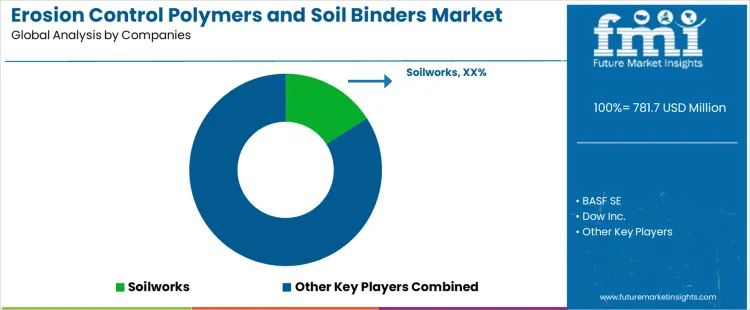
The erosion control polymers and soil binders market is expanding as industries increasingly focus on preventing soil erosion, improving land stability, and protecting natural resources in construction, mining, and agricultural applications. Soilworks leads the market with its innovative erosion control polymers and soil binders, offering high-performance solutions that stabilize soil, control dust, and prevent erosion. Their focus on sustainability, environmental protection, and product effectiveness has positioned them as a dominant player in the market. BASF SE, Dow Inc., and Global Road Technology (GRT) are significant competitors, each providing specialized products designed to address erosion control and soil stabilization needs. BASF SE offers advanced formulations that deliver long-lasting soil protection while focusing on eco-friendly solutions, while Dow Inc. provides high-quality polymers designed for soil stabilization and erosion prevention across various sectors. Global Road Technology (GRT) focuses on delivering cost-effective, sustainable solutions tailored to large-scale infrastructure projects.
Applied Polymer Systems (APS) further contributes to the competitive landscape with its specialized erosion control and soil binder products, which provide effective solutions for managing soil stability in both urban and natural environments. APS focuses on providing reliable, high-performance soil binders for road construction, mining, and other industries where erosion control is critical. These companies compete by focusing on product innovation, sustainability, and the ability to meet the growing demand for soil stabilization solutions that support land conservation, reduce environmental degradation, and improve infrastructure resilience. The market for erosion control polymers and soil binders is expected to continue growing, driven by increased environmental awareness and the need for effective, sustainable land management solutions.
Key Players of the Erosion Control Polymers and Soil Binders Market
- Soilworks
- BASF SE
- Dow Inc.
- Global Road Technology (GRT)
- Applied Polymer Systems (APS)
Scope of the Report
| Items | Values |
|---|---|
| Quantitative Units (2026) | USD Million |
| Polymer / Binder Type | Synthetic Polymer Soil Stabilizers, Bio-Based Soil Binders (Lignin, Guar, Starch), Acrylic & Vinyl Acetate Copolymers, Mineral & Enzymatic Soil Binders, Other Specialty Erosion Control Agents |
| Application Area | Road & Infrastructure Embankments, Mining & Quarry Reclamation, Construction & Earthworks, Agriculture & Land Restoration, Shoreline & Slope Protection |
| End-User Sector | Government & Municipal Bodies, Construction Contractors, Mining & Energy Companies, Agricultural Land Owners, Environmental Restoration Firms |
| Companies | Soilworks, BASF SE, Dow Inc., Global Road Technology (GRT), Applied Polymer Systems (APS) |
| Regions Covered | North America, Latin America, Western Europe, Eastern Europe, South Asia and Pacific, East Asia, Middle East & Africa |
| Countries Covered | United States, Canada, Mexico, Brazil, Argentina, Germany, France, United Kingdom, Italy, Spain, Netherlands, China, India, Japan, South Korea, ANZ, GCC Countries, South Africa |
| Additional Attributes | Dollar by sales by polymer/binder type, application area, end-user sector, and region. Includes market trends in erosion control polymers and soil binders, focusing on synthetic, bio-based, and acrylic copolymers. Highlights the role of soil stabilization, land restoration, and shoreline protection in infrastructure, agriculture, and environmental restoration. Focus on sustainability, cost-effectiveness, regulatory compliance, market share, and competitive positioning of key companies in the erosion control and soil binder market. |
Erosion Control Polymers and Soil Binders Market Segmentation
Polymer / Binder Type
- Synthetic Polymer Soil Stabilizers
- Bio-Based Soil Binders (Lignin, Guar, Starch)
- Acrylic & Vinyl Acetate Copolymers
- Mineral & Enzymatic Soil Binders
- Other Specialty Erosion Control Agents
Application Area
- Road & Infrastructure Embankments
- Mining & Quarry Reclamation
- Construction & Earthworks
- Agriculture & Land Restoration
- Shoreline & Slope Protection
End-User Sector
- Government & Municipal Bodies
- Construction Contractors
- Mining & Energy Companies
- Agricultural Land Owners
- Environmental Restoration Firms
Region
- Asia Pacific
- China
- Japan
- South Korea
- India
- Australia & New Zealand
- ASEAN
- Rest of Asia Pacific
- Europe
- Germany
- United Kingdom
- France
- Italy
- Spain
- Nordic
- BENELUX
- Rest of Europe
- North America
- United States
- Canada
- Mexico
- Latin America
- Brazil
- Chile
- Rest of Latin America
- Middle East & Africa
- Kingdom of Saudi Arabia
- Other GCC Countries
- Turkey
- South Africa
- Other African Union
- Rest of Middle East & Africa
Frequently Asked Questions
How big is the erosion control polymers and soil binders market in 2026?
The global erosion control polymers and soil binders market is estimated to be valued at USD 781.7 million in 2026.
What will be the size of erosion control polymers and soil binders market in 2036?
The market size for the erosion control polymers and soil binders market is projected to reach USD 1,767.4 million by 2036.
How much will be the erosion control polymers and soil binders market growth between 2026 and 2036?
The erosion control polymers and soil binders market is expected to grow at a 8.5% CAGR between 2026 and 2036.
What are the key product types in the erosion control polymers and soil binders market?
The key product types in erosion control polymers and soil binders market are synthetic polymer soil stabilizers, bio-based soil binders (lignin, guar, starch), acrylic & vinyl acetate copolymers, mineral & enzymatic soil binders and other specialty erosion control agents.
Which application area segment to contribute significant share in the erosion control polymers and soil binders market in 2026?
In terms of application area, road & infrastructure embankments segment to command 30.0% share in the erosion control polymers and soil binders market in 2026.
Preview the report firsthand - request a free sample
Get SampleGet the brochure for pricing and purchase details.
Get PDFTable of Content
- Executive Summary
- Global Market Outlook
- Demand-side Trends
- Supply-side Trends
- Technology Roadmap Analysis
- Analysis and Recommendations
- Market Overview
- Market Coverage / Taxonomy
- Market Definition / Scope / Limitations
- Market Background
- Market Dynamics
- Drivers
- Restraints
- Opportunity
- Trends
- Scenario Forecast
- Demand in Optimistic Scenario
- Demand in Likely Scenario
- Demand in Conservative Scenario
- Opportunity Map Analysis
- Product Life Cycle Analysis
- Supply Chain Analysis
- Investment Feasibility Matrix
- Value Chain Analysis
- PESTLE and Porter’s Analysis
- Regulatory Landscape
- Regional Parent Market Outlook
- Production and Consumption Statistics
- Import and Export Statistics
- Market Dynamics
- Global Market Analysis 2021 to 2025 and Forecast, 2026 to 2036
- Historical Market Size Value (USD Million) Analysis, 2021 to 2025
- Current and Future Market Size Value (USD Million) Projections, 2026 to 2036
- Y-o-Y Growth Trend Analysis
- Absolute $ Opportunity Analysis
- Global Market Pricing Analysis 2021 to 2025 and Forecast 2026 to 2036
- Global Market Analysis 2021 to 2025 and Forecast 2026 to 2036, By Polymer or Binder Type
- Introduction / Key Findings
- Historical Market Size Value (USD Million) Analysis By Polymer or Binder Type , 2021 to 2025
- Current and Future Market Size Value (USD Million) Analysis and Forecast By Polymer or Binder Type , 2026 to 2036
- Synthetic Polymer Soil Stabilizers
- Bio-Based Soil Binders (Lignin, Guar, Starch)
- Acrylic & Vinyl Acetate Copolymers
- Mineral & Enzymatic Soil Binders
- Other Specialty Erosion Control Agents
- Synthetic Polymer Soil Stabilizers
- Y-o-Y Growth Trend Analysis By Polymer or Binder Type , 2021 to 2025
- Absolute $ Opportunity Analysis By Polymer or Binder Type , 2026 to 2036
- Global Market Analysis 2021 to 2025 and Forecast 2026 to 2036, By Application Area
- Introduction / Key Findings
- Historical Market Size Value (USD Million) Analysis By Application Area, 2021 to 2025
- Current and Future Market Size Value (USD Million) Analysis and Forecast By Application Area, 2026 to 2036
- Road & Infrastructure Embankments
- Mining & Quarry Reclamation
- Construction & Earthworks
- Agriculture & Land Restoration
- Shoreline & Slope Protection
- Road & Infrastructure Embankments
- Y-o-Y Growth Trend Analysis By Application Area, 2021 to 2025
- Absolute $ Opportunity Analysis By Application Area, 2026 to 2036
- Global Market Analysis 2021 to 2025 and Forecast 2026 to 2036, By End-User Sector
- Introduction / Key Findings
- Historical Market Size Value (USD Million) Analysis By End-User Sector, 2021 to 2025
- Current and Future Market Size Value (USD Million) Analysis and Forecast By End-User Sector, 2026 to 2036
- Government & Municipal Bodies
- Construction Contractors
- Mining & Energy Companies
- Agricultural Land Owners
- Environmental Restoration Firms
- Government & Municipal Bodies
- Y-o-Y Growth Trend Analysis By End-User Sector, 2021 to 2025
- Absolute $ Opportunity Analysis By End-User Sector, 2026 to 2036
- Global Market Analysis 2021 to 2025 and Forecast 2026 to 2036, By Region
- Introduction
- Historical Market Size Value (USD Million) Analysis By Region, 2021 to 2025
- Current Market Size Value (USD Million) Analysis and Forecast By Region, 2026 to 2036
- North America
- Latin America
- Western Europe
- Eastern Europe
- East Asia
- South Asia and Pacific
- Middle East & Africa
- Market Attractiveness Analysis By Region
- North America Market Analysis 2021 to 2025 and Forecast 2026 to 2036, By Country
- Historical Market Size Value (USD Million) Trend Analysis By Market Taxonomy, 2021 to 2025
- Market Size Value (USD Million) Forecast By Market Taxonomy, 2026 to 2036
- By Country
- USA
- Canada
- Mexico
- By Polymer or Binder Type
- By Application Area
- By End-User Sector
- By Country
- Market Attractiveness Analysis
- By Country
- By Polymer or Binder Type
- By Application Area
- By End-User Sector
- Key Takeaways
- Latin America Market Analysis 2021 to 2025 and Forecast 2026 to 2036, By Country
- Historical Market Size Value (USD Million) Trend Analysis By Market Taxonomy, 2021 to 2025
- Market Size Value (USD Million) Forecast By Market Taxonomy, 2026 to 2036
- By Country
- Brazil
- Chile
- Rest of Latin America
- By Polymer or Binder Type
- By Application Area
- By End-User Sector
- By Country
- Market Attractiveness Analysis
- By Country
- By Polymer or Binder Type
- By Application Area
- By End-User Sector
- Key Takeaways
- Western Europe Market Analysis 2021 to 2025 and Forecast 2026 to 2036, By Country
- Historical Market Size Value (USD Million) Trend Analysis By Market Taxonomy, 2021 to 2025
- Market Size Value (USD Million) Forecast By Market Taxonomy, 2026 to 2036
- By Country
- Germany
- UK
- Italy
- Spain
- France
- Nordic
- BENELUX
- Rest of Western Europe
- By Polymer or Binder Type
- By Application Area
- By End-User Sector
- By Country
- Market Attractiveness Analysis
- By Country
- By Polymer or Binder Type
- By Application Area
- By End-User Sector
- Key Takeaways
- Eastern Europe Market Analysis 2021 to 2025 and Forecast 2026 to 2036, By Country
- Historical Market Size Value (USD Million) Trend Analysis By Market Taxonomy, 2021 to 2025
- Market Size Value (USD Million) Forecast By Market Taxonomy, 2026 to 2036
- By Country
- Russia
- Poland
- Hungary
- Balkan & Baltic
- Rest of Eastern Europe
- By Polymer or Binder Type
- By Application Area
- By End-User Sector
- By Country
- Market Attractiveness Analysis
- By Country
- By Polymer or Binder Type
- By Application Area
- By End-User Sector
- Key Takeaways
- East Asia Market Analysis 2021 to 2025 and Forecast 2026 to 2036, By Country
- Historical Market Size Value (USD Million) Trend Analysis By Market Taxonomy, 2021 to 2025
- Market Size Value (USD Million) Forecast By Market Taxonomy, 2026 to 2036
- By Country
- China
- Japan
- South Korea
- By Polymer or Binder Type
- By Application Area
- By End-User Sector
- By Country
- Market Attractiveness Analysis
- By Country
- By Polymer or Binder Type
- By Application Area
- By End-User Sector
- Key Takeaways
- South Asia and Pacific Market Analysis 2021 to 2025 and Forecast 2026 to 2036, By Country
- Historical Market Size Value (USD Million) Trend Analysis By Market Taxonomy, 2021 to 2025
- Market Size Value (USD Million) Forecast By Market Taxonomy, 2026 to 2036
- By Country
- India
- ASEAN
- Australia & New Zealand
- Rest of South Asia and Pacific
- By Polymer or Binder Type
- By Application Area
- By End-User Sector
- By Country
- Market Attractiveness Analysis
- By Country
- By Polymer or Binder Type
- By Application Area
- By End-User Sector
- Key Takeaways
- Middle East & Africa Market Analysis 2021 to 2025 and Forecast 2026 to 2036, By Country
- Historical Market Size Value (USD Million) Trend Analysis By Market Taxonomy, 2021 to 2025
- Market Size Value (USD Million) Forecast By Market Taxonomy, 2026 to 2036
- By Country
- Kingdom of Saudi Arabia
- Other GCC Countries
- Turkiye
- South Africa
- Other African Union
- Rest of Middle East & Africa
- By Polymer or Binder Type
- By Application Area
- By End-User Sector
- By Country
- Market Attractiveness Analysis
- By Country
- By Polymer or Binder Type
- By Application Area
- By End-User Sector
- Key Takeaways
- Key Countries Market Analysis
- USA
- Pricing Analysis
- Market Share Analysis, 2025
- By Polymer or Binder Type
- By Application Area
- By End-User Sector
- Canada
- Pricing Analysis
- Market Share Analysis, 2025
- By Polymer or Binder Type
- By Application Area
- By End-User Sector
- Mexico
- Pricing Analysis
- Market Share Analysis, 2025
- By Polymer or Binder Type
- By Application Area
- By End-User Sector
- Brazil
- Pricing Analysis
- Market Share Analysis, 2025
- By Polymer or Binder Type
- By Application Area
- By End-User Sector
- Chile
- Pricing Analysis
- Market Share Analysis, 2025
- By Polymer or Binder Type
- By Application Area
- By End-User Sector
- Germany
- Pricing Analysis
- Market Share Analysis, 2025
- By Polymer or Binder Type
- By Application Area
- By End-User Sector
- UK
- Pricing Analysis
- Market Share Analysis, 2025
- By Polymer or Binder Type
- By Application Area
- By End-User Sector
- Italy
- Pricing Analysis
- Market Share Analysis, 2025
- By Polymer or Binder Type
- By Application Area
- By End-User Sector
- Spain
- Pricing Analysis
- Market Share Analysis, 2025
- By Polymer or Binder Type
- By Application Area
- By End-User Sector
- France
- Pricing Analysis
- Market Share Analysis, 2025
- By Polymer or Binder Type
- By Application Area
- By End-User Sector
- India
- Pricing Analysis
- Market Share Analysis, 2025
- By Polymer or Binder Type
- By Application Area
- By End-User Sector
- ASEAN
- Pricing Analysis
- Market Share Analysis, 2025
- By Polymer or Binder Type
- By Application Area
- By End-User Sector
- Australia & New Zealand
- Pricing Analysis
- Market Share Analysis, 2025
- By Polymer or Binder Type
- By Application Area
- By End-User Sector
- China
- Pricing Analysis
- Market Share Analysis, 2025
- By Polymer or Binder Type
- By Application Area
- By End-User Sector
- Japan
- Pricing Analysis
- Market Share Analysis, 2025
- By Polymer or Binder Type
- By Application Area
- By End-User Sector
- South Korea
- Pricing Analysis
- Market Share Analysis, 2025
- By Polymer or Binder Type
- By Application Area
- By End-User Sector
- Russia
- Pricing Analysis
- Market Share Analysis, 2025
- By Polymer or Binder Type
- By Application Area
- By End-User Sector
- Poland
- Pricing Analysis
- Market Share Analysis, 2025
- By Polymer or Binder Type
- By Application Area
- By End-User Sector
- Hungary
- Pricing Analysis
- Market Share Analysis, 2025
- By Polymer or Binder Type
- By Application Area
- By End-User Sector
- Kingdom of Saudi Arabia
- Pricing Analysis
- Market Share Analysis, 2025
- By Polymer or Binder Type
- By Application Area
- By End-User Sector
- Turkiye
- Pricing Analysis
- Market Share Analysis, 2025
- By Polymer or Binder Type
- By Application Area
- By End-User Sector
- South Africa
- Pricing Analysis
- Market Share Analysis, 2025
- By Polymer or Binder Type
- By Application Area
- By End-User Sector
- USA
- Market Structure Analysis
- Competition Dashboard
- Competition Benchmarking
- Market Share Analysis of Top Players
- By Regional
- By Polymer or Binder Type
- By Application Area
- By End-User Sector
- Competition Analysis
- Competition Deep Dive
- Soilworks
- Overview
- Product Portfolio
- Profitability by Market Segments (Product/Age /Sales Channel/Region)
- Sales Footprint
- Strategy Overview
- Marketing Strategy
- Product Strategy
- Channel Strategy
- BASF SE
- Dow Inc.
- Global Road Technology (GRT)
- Applied Polymer Systems (APS)
- Soilworks
- Competition Deep Dive
- Assumptions & Acronyms Used
- Research Methodology


