

- Industry Size (2026)
- USD 0.8 Bn
- Forecast (2036)
- USD 1.6 Bn
- CAGR (2026 to 2036)
- 7.2%
Arc-Flash Resistant Technical Yarn Systems Market Forecast and Outlook 2026 to 2036
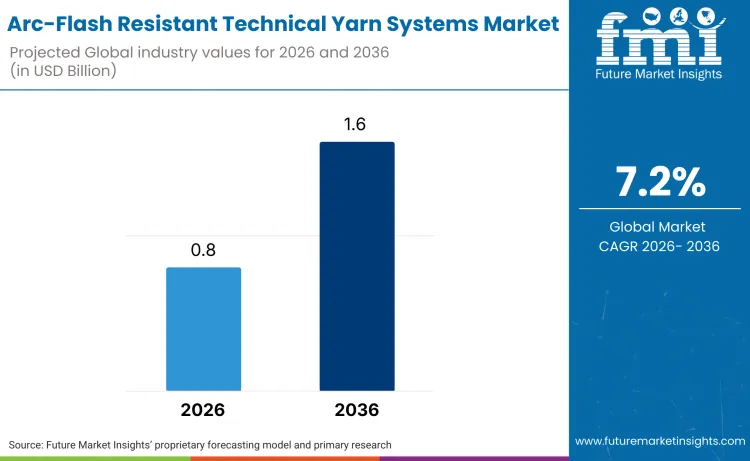
The arc-flash resistant technical yarn systems market is projected to total USD 0.8 billion in 2026, with an expected increase at a 7.2% CAGR from 2026 to 2036. Future Market Insights forecasts demand for arc-flash resistant technical yarn systems to reach USD 1.6 billion by 2036.
Procurement behaviour in arc-flash resistant technical yarn systems is being reshaped by stricter safety enforcement rather than incremental material upgrades. End users across power generation, utilities, heavy manufacturing, and infrastructure are responding to rising electrical exposure risks and tighter compliance thresholds by narrowing specifications toward yarn platforms that deliver certified multi-hazard protection without restricting movement, trapping heat, or losing performance over repeated use.
This shift is reshaping how capital and capability are organised across the advanced materials value chain. Large industrial groups are carving out high-performance fiber operations into more focused structures, allowing capital to be deployed directly against arc-rating performance, flame resistance, and mechanical strength rather than diluted across broader portfolios.
Honeywell’s October 2024 decision to separate its Advanced Materials business reflects this logic, repositioning specialty fibers as core growth assets rather than supporting units. Capacity planning is becoming more demand-anchored, with production tied closely to infrastructure-driven safety requirements. Teijin Frontier’s expansion of high-performance yarn production in Southeast Asia reflects this alignment with rising global demand for certified electrical safety apparel.
Vimal Kapur, Chairman and CEO of Honeywell, echoes this industry-wide emphasis on structural agility to meet specialized safety demands, who noted in the company’s January 2026 earnings report that such realignments are critical for future growth:
"2026 will be an exciting year as we move forward the final stages of our portfolio simplification. This positions each business with the right strategic focus, organizational agility, and tailored capital allocation strategies needed to grow faster and drive incremental value for all stakeholders." - Source: Honeywell Reports Fourth Quarter 2025 Results; Issues 2026 Outlook
Competitive differentiation is shifting away from single-property flame resistance toward yarn systems engineered for layered protection. Buyers are specifying arc-flash resistance, cut protection, and tensile performance within lighter constructions to reduce wearer fatigue and improve adherence during extended duty cycles. This preference is accelerating a move from fabric-level modification toward yarn-level engineering as the primary driver of protection consistency and garment reliability.
Regulatory and materials compliance pressures are reinforcing this direction. Producers are redesigning arc-flash and flame-resistant yarn systems to avoid PFAS and halogenated chemistries, anticipating state-level restrictions and evolving certification thresholds. Milliken & Company’s late-2024 commercial rollout of a non-PFAS, non-halogenated protective system illustrates how regulatory readiness is becoming a qualification filter alongside arc ratings and supply continuity.
Leadership in arc-flash resistant technical yarn systems is now being defined by execution discipline, integrated system design, and regulatory foresight rather than isolated material innovation.
Summary of the Arc-Flash Resistant Technical Yarn Systems Market
How large is this market expected to become by 2036?
Future Market Insights estimates the arc-flash resistant technical yarn systems market at USD 0.8 billion in 2026, reaching USD 1.6 billion by 2036, expanding at a 7.2% CAGR. Growth is increasingly embedded into baseline safety spending rather than driven by one-off compliance upgrades.
FMI Research Approach: Forecasts derived from infrastructure investment tracking, utility safety budgets, and replacement-cycle modelling for certified PPE systems.
What fundamental shift is redefining demand dynamics?
FMI identifies a transition from episodic PPE refresh cycles to continuous, specification-driven adoption. As electrical hazards become quantifiable and persist across decentralized grids, yarn-level arc-flash protection is being treated as a permanent risk-management input rather than a discretionary enhancement.
FMI Research Approach: Buyer behaviour assessment based on incident-energy disclosure practices and changes in safety audit frameworks.
Why is yarn-level engineering gaining priority over fabric treatments?
Procurement is moving upstream because yarn-level engineering offers more predictable arc performance, durability, and multi-hazard integration across the garment lifecycle. Fabric-level treatments are viewed as vulnerable to performance drift under repeated laundering and extended duty cycles.
FMI Research Approach: Evaluation of certification failures, requalification costs, and lifecycle performance consistency across protection layers.
Which material class is setting the performance benchmark in 2026?
Aramid-based yarn systems (~38% share) continue to define the benchmark due to their non-melting behaviour, high strength-to-weight ratio, and stability at temperatures exceeding 500 °C. These properties align with expanding regulatory coverage that mandates inherent thermal protection for a broader industrial workforce.
FMI Research Approach: Material benchmarking using arc-thermal performance thresholds, polymer behaviour under fault conditions, and compliance longevity.
Where is most demand concentrated by application?
Protective garments (around 50% of demand) remain the primary channel for adoption. This segment is driving lighter, multi-hazard constructions that maintain high arc ratings while reducing wearer fatigue, especially in utilities and renewable-energy maintenance roles.
FMI Research Approach: Application sizing based on garment weight targets, arc-rating classes, and duty-cycle exposure profiles.
Which end-use sector is exerting the strongest influence on specifications?
Utilities and power (~44% share) dominate specification setting. Ongoing grid upgrades, renewable integration, and stricter arc-flash labelling under updated electrical codes are pushing utilities toward long-term supply agreements tied to certified yarn-system performance rather than unit pricing.
FMI Research Approach: End-use modelling linked to grid capital expenditure, safety code revisions, and contract duration trends.
What constraints and opportunities are shaping supplier strategies?
High capital intensity and complex polymer chemistry continue to limit rapid capacity expansion, while cost premiums versus treated alternatives slow adoption in price-sensitive regions. At the same time, opportunities are emerging around integrated safety yarn systems, including sensor-enabled and non-PFAS architectures, which allow suppliers to move beyond commodity positioning.
FMI Research Approach: Margin-sensitivity analysis combined with technology road-mapping and regulatory foresight.
Which geography is driving structurally resilient demand growth?
The United States is emerging as the most structurally resilient growth market, supported by tightening enforcement of NFPA 70E and OSHA electrical safety provisions. These frameworks are institutionalising periodic reassessment of arc-flash risk, creating recurring demand for certified technical yarn systems rather than intermittent upgrades.
FMI Research Approach: Country-level forecasting based on enforcement intensity, installed electrical infrastructure, and PPE replacement mandates.
Arc-Flash Resistant Technical Yarn Systems Market Key Takeaways
| Metric | Value |
|---|---|
| Expected Value (2026E) | USD 0.8 billion |
| Forecast Value (2036F) | USD 1.6 billion |
| CAGR (2026-2036) | 7.2% |
Source: Future Market Insights analysis, supported by a proprietary forecasting model and primary research
Why is the Arc-Flash Resistant Technical Yarn Systems Market Growing?
The expansion of the arc-flash resistant technical yarn systems market is being driven by a fundamental change in how electrical risk is created and managed. The rapid integration of renewable energy is reshaping power systems around decentralized generation, inverter-heavy infrastructure, and high-capacity energy storage.
These environments are increasingly dominated by direct current fault scenarios, which behave differently from conventional alternating current faults and are more difficult to interrupt once initiated. As a result, maintenance and service activities are being carried out in conditions with higher and more sustained incident energy exposure than legacy grid designs anticipated.
This shift is exposing gaps in traditional electrical safety assumptions. Protection strategies that were developed around short-duration fault events are being reassessed as operators encounter longer-lasting arc conditions at routine access points. FMI analysis indicates that this change in fault behavior is translating into a broader reassessment of electrical safety controls, with arc-flash protection becoming a core design consideration rather than a secondary safeguard.
Regulatory frameworks are reinforcing this transition by formalizing how arc-flash risk must be identified, documented, and managed. Electrical safety standards are moving away from general hazard communication toward equipment-specific disclosure of incident energy levels. This change requires organizations to align protective measures with quantified risk values and to revisit those assessments on defined schedules.
The 2026 update to the National Electrical Code accelerates this process by expanding mandatory arc-flash labeling and linking it to documented evaluation timelines. FMI views this as a structural demand driver, as compliance is no longer static and forces periodic reassessment of workforce protection strategies.
Beyond established power markets, adoption is amplified by rapid electrification in emerging industrial regions. In Asia-Pacific, infrastructure expansion is increasingly paired with the adoption of international electrical safety standards.
Rather than treating arc-flash protection as an incremental upgrade, operators are embedding it into broader risk-management frameworks at the project planning stage. Analysis suggests this is making demand more resilient, as arc-flash protection becomes a standardized requirement across multi-site operations rather than a discretionary safety enhancement.
How is Arc-Flash Resistant Technical Yarn Systems Market Segmented?
Why are Aramid-Based Yarns Dominating Material Selection?
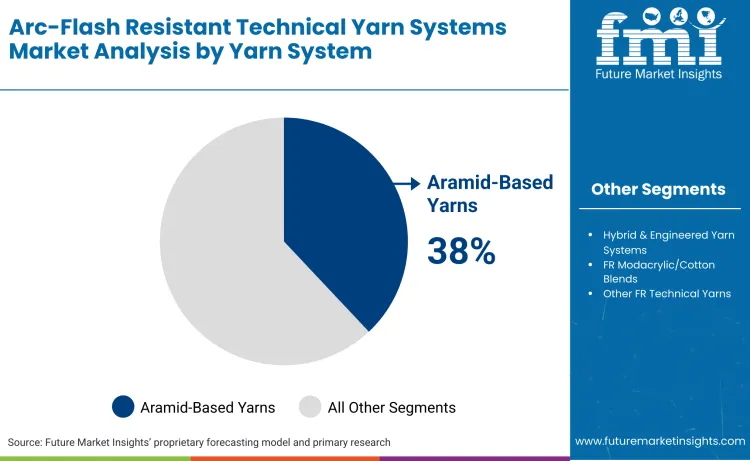
Aramid-based yarns hold a 38% share because they offer non-melting thermal stability and a high strength-to-weight ratio that alternatives cannot match in high-voltage environments. Their position is being reinforced by regulatory expansion that is increasing the number of workers who must wear certified arc-flash and heat-protective PPE. Updated 2025 guidance from the OSHA extends enhanced protection requirements to an estimated 600,000 additional industrial workers, pushing procurement toward inherently flame-resistant fiber systems.
Regulatory scrutiny is shifting buyer preference away from treated fabrics and toward fiber-level engineering, where materials are expected to tolerate temperatures above 500 °C without losing structural integrity. Aramid systems meet this requirement at the polymer level, reducing compliance risk across repeated laundering and extended service life. Investment in capacity expansion and material traceability is reinforcing adoption, including alignment with Digital Product Passport requirements under the EU Ecodesign for Sustainable Products Regulation, which favors auditable, regulation-resilient yarn platforms.
How is the Protective Garments Segment Influencing Innovation?
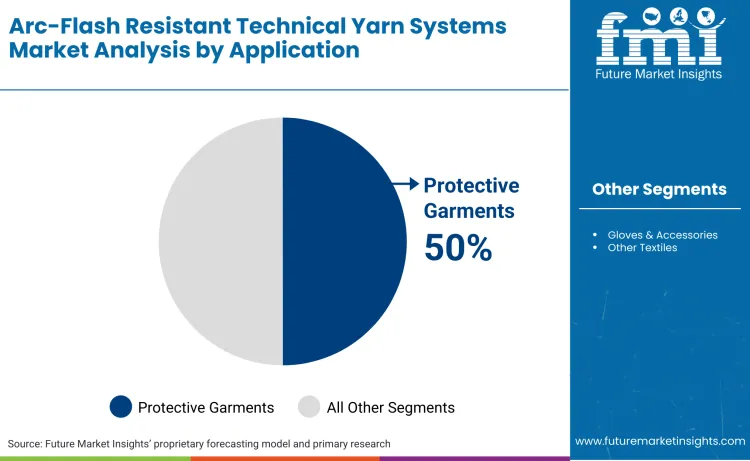
Protective garments account for about 50% of total demand and remain the primary channel through which technical yarn innovation reaches end users. This segment is driving development of multi-hazard garment systems that combine arc-flash resistance with cut and chemical protection, particularly for electrification and renewable energy workwear. Current designs focus on reducing garment weight while preserving 40 Cal performance, using hybrid yarn architectures that pair high-tenacity filaments with flame-resistant spun yarns.
Growth in decentralized energy assets has increased exposure to DC-arc hazards, intensifying safety requirements in field operations. This demand concentration is pushing manufacturers toward non-PFAS and non-halogenated yarn systems that maintain protective performance through repeated industrial laundering. Innovation is centered on inherent fiber compliance rather than surface treatments or additive finishes.
What Role do Utilities & Power Play in End-Use Demand?
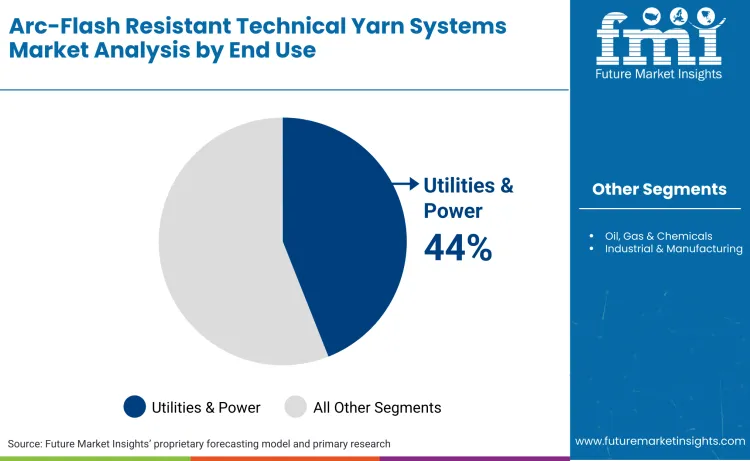
Utilities and power applications represent 44% of end-use demand due to sustained energized work across aging grids and renewable integration projects. Procurement strategies in this sector emphasize long-term supply agreements linked to certified performance rather than unit pricing. Revisions to the 2026 National Electrical Code are reinforcing this shift by tightening arc-flash labeling requirements, requiring PPE arc ratings to align precisely with calculated incident energy levels.
This demand profile is driving localization of supply chains and expansion of high-tenacity, flame-resistant yarn capacity, particularly across Asia-Pacific manufacturing hubs. As infrastructure upgrades accelerate through 2026 and beyond, utilities are treating technical yarn systems as risk-management assets rather than interchangeable inputs, strengthening their influence over material specifications and supplier selection.
Which Drivers, Restraints, Opportunities, and Trends Influence the Arc-Flash Resistant Technical Yarn Systems Landscape?
Rapid expansion of decentralized renewable energy infrastructure is reshaping electrical risk exposure across industrial operations. Utility-scale solar and wind installations are expected to account for a large share of new power capacity through 2026, supported by USA utility capital expenditure that reached USD 250 billion in 2025 and continues to rise.
These systems operate in high-voltage direct-current environments where arc behavior differs sharply from conventional alternating-current faults. Procurement practices are shifting away from generic flame-resistant materials toward yarn systems engineered to tolerate the elevated incident energy associated with inverter-dense grids and battery storage installations.
High capital intensity and complex polymer chemistry constrain broader adoption of inherent high-performance fibers. Producing advanced yarns such as para-aramids requires energy-intensive processes and specialized precursors including para-phenylenediamine, resulting in average prices near USD 20,748 per ton in 2025.
Cost premiums of 40% to 60% over treated alternatives remain difficult to absorb in price-sensitive regions. Recycling limitations add another structural constraint, as multi-material technical composites demand significant energy input during reprocessing, creating tension with sustainability requirements imposed by large industrial buyers.
Material innovation is increasingly intersecting with connected safety technologies. Producers are experimenting with conductive filaments and embedded sensors integrated directly into arc-rated yarn architectures to track heat stress, heart rate, and environmental exposure in real time.
Location awareness and fall detection woven into the textile structure allow yarn suppliers to move beyond commodity inputs toward integrated safety platforms. This capability carries particular relevance for oil, gas, and mining operations, where immediate physiological and situational visibility can reduce injury severity and improve emergency response effectiveness.
A persistent threat lies in the growing availability of low-cost protective textiles manufactured under weak regulatory oversight. High-risk industries typically rely on stringent certifications such as NFPA 2112 and EN ISO 11612, yet grey-channel yarns claiming flame resistance without validated arc-thermal performance testing continue to enter supply chains.
In India and other manufacturing hubs, pressure from elevated power tariffs and fiber input volatility is encouraging some garment producers to substitute lower-grade blended materials. Such substitutions undermine price discipline for premium yarn systems and introduce serious safety risks when garments fail under high-energy arc exposure due to inconsistent yarn-level engineering.
How will the Arc-Flash Resistant Technical Yarn Systems Market evolve in Key Countries?
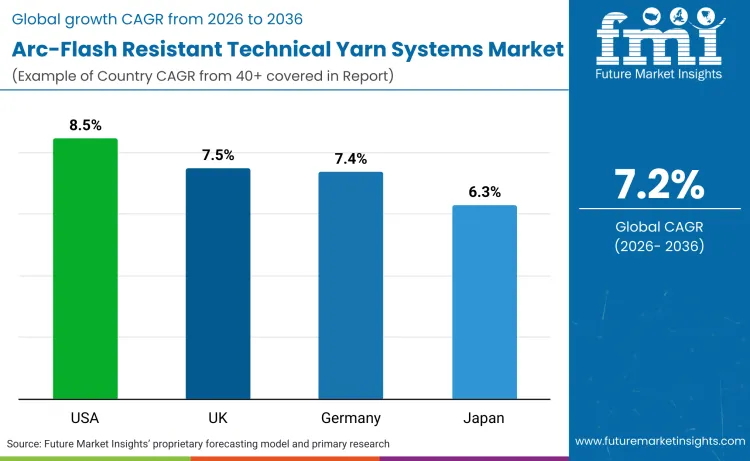
| Country | CAGR (2026-2036) |
|---|---|
| USA | 8.5% |
| UK | 7.5% |
| Germany | 7.4% |
| Japan | 6.3% |
Source: FMI analysis based on primary research and proprietary forecasting model
USA: Why Is the Growth Trajectory Outpacing Other Developed Economies?
USA is projected to expand at an 8.5% CAGR, with momentum rooted in the institutionalization of recurring demand rather than episodic compliance upgrades. This acceleration is being shaped by the NFPA 70E (2024 Edition) and its scheduled 2026 revision cycle, which mandate granular incident energy calculations and strict alignment with PPE Categories 1-4. Together, these requirements are transforming procurement behavior into a structured replacement economy for arc-rated technical yarns.
As enforcement under OSHA 29 CFR 1910.269 tightens across power generation and transmission activities, utility operators are systematically phasing out basic treated fabrics. Preference is shifting toward high-performance aramid and hybrid yarn systems that can deliver certified thermal protection across the full garment lifecycle, reducing requalification risk and long-term compliance costs.
UK: How Does the Safety & Metrology Act 2025 Shape Demand?
Growth in the UK is tracking at a 7.5% CAGR, anchored in a tightening regulatory perimeter following the Product Regulation and Metrology Act 2025, which received Royal Assent in July 2025. The Act establishes the legal basis for the UK to either align with or diverge from EU product safety regimes, including PPE Regulation 2016/425, while significantly strengthening domestic enforcement authority.
The rollout of secondary legislation from 2026 is expected to intensify market surveillance and raise admissibility thresholds for imported technical yarns. By closing regulatory gaps in online and direct-to-industrial sales channels, authorities are effectively filtering out sub-compliant materials, ensuring that only yarns meeting stringent British and European thermal performance standards remain eligible for industrial supply chains.
Germany: Does the Energiewende Continue to Anchor Expansion?
Germany is advancing at a 7.4% CAGR, reflecting the operational consequences of the Energiewende entering a mature integration phase in late 2025. With close to two-thirds of electricity generation now sourced from renewables, attention has shifted from capacity build-out to grid stabilization and smart-inverter deployment.
These decentralized energy architectures introduce elevated DC-arc and multi-hazard exposure, particularly in offshore wind and hydrogen electrolysis operations. Procurement decisions increasingly reflect a safety-first culture, with utilities specifying advanced technical yarns that combine arc protection with chemical resistance to support maintenance work in complex, high-risk energy environments.
Japan: What Role Does the GX Strategy Play in Sustained Growth?
Japan’s outlook reflects a 6.3% CAGR, closely linked to the Green Transformation (GX) 2040 Vision, which mobilizes JPY 150 trillion in public-private investment. From April 2026 onward, the introduction of the mandatory GX-ETS for large emitters is accelerating structural modernization across utilities and materials manufacturing.
As carbon-pricing mechanisms drive plant upgrades, worker safety frameworks are being upgraded in parallel. A distinguishing feature of this transition is the early adoption of Digital Product Passports for high-tenacity yarns, enabling traceability, safety verification, and circularity alignment. Arc-rated apparel deployed in emerging green industrial zones is evaluated not only on thermal performance, but also on lifecycle transparency and regulatory readiness.
How is the Competitive Ecosystem in the Arc-Flash Resistant Technical Yarn Systems Market?
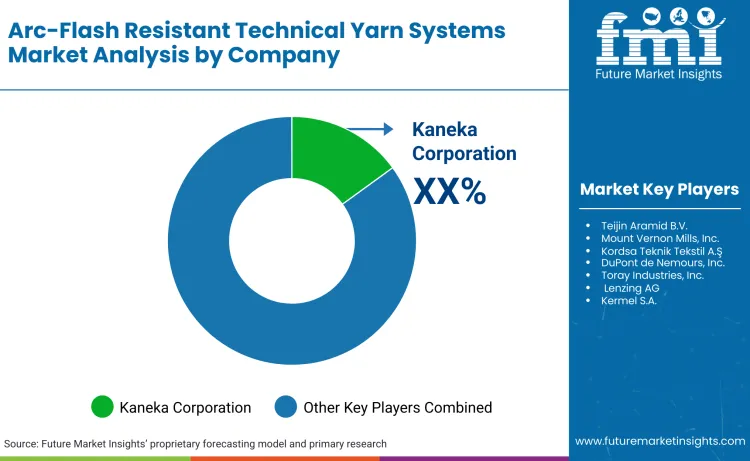
The competitive landscape for arc-flash resistant technical yarn systems is shifting from fiber-led rivalry toward system-level competition. Differentiation increasingly rests on qualification continuity, supply reliability, and portfolio direction rather than arc performance alone. Prior to 2025, positioning was driven by operational strength and geographic reach, with leading suppliers focused on maximizing existing assets and protecting supply chains from logistics disruption.
Kordsa expanded its regional manufacturing footprint in 2023 through scaled operations in Indonesia. This improved proximity to APAC industrial hubs, reduced freight exposure, and aligned output with localized demand for heavy-duty technical textiles used in electrical and industrial protection programs.
Kaneka Corporation relied on its Material Solutions portfolio through 2023 to 2024, including modacrylic-based flame-retardant fibers, as a stable earnings base. The focus remained on cost discipline and selective movement into higher-value protective applications to offset weaker demand in construction-linked end uses during this period.
Lenzing AG tightened cost control and clarified brand hierarchy through 2024. Premium fiber platforms were reinforced to support expansion beyond apparel-led demand into industrial and protective textile systems, establishing the basis for later portfolio repositioning.
Sustainability-linked portfolio decisions are shaping competitive positioning from 2026. Lenzing’s move to secure majority control of TreeToTextile in 2026 reflects a long-term bet on next-generation cellulosic fibers as blend components in arc-rated systems where comfort, moisture management, and regulatory alignment influence procurement decisions. Kaneka redirected capital allocation in 2025 to 2026 toward leading-edge businesses, concentrating investment in high-margin performance fibers and thermally stable polymer technologies with lower exposure to commoditization risk.
Mount Vernon Mills strengthened its competitive position during 2024 to 2025 through renewed investment in USA-based weaving capacity, targeting government and infrastructure programs where origin transparency, audit readiness, and delivery assurance support pricing power.
Leadership in arc-flash resistant yarn systems is consolidating around suppliers that combine repeatable compliance performance, deliberate material innovation, and structurally resilient supply models. Competition based solely on arc-rating benchmarks is no longer sufficient.
Key Players Profiled
- Kaneka Corporation
- Teijin Aramid B.V.
- Mount Vernon Mills, Inc.
- Kordsa Teknik Tekstil A.Ş.
- DuPont de Nemours, Inc.
- Toray Industries, Inc.
- Lenzing AG
- Kermel S.A.
- TenCate Protective Fabrics USA, Inc.
- Hyosung TNC Corporation
Scope of Report
| Items | Values |
|---|---|
| Quantitative Units (2026) | USD 0.8 billion |
| Yarn System | Aramid-Based Yarns, Hybrid & Engineered Yarn Systems, FR Modacrylic/Cotton Blends, Other FR Technical Yarns |
| Application | Protective Garments, Gloves & Accessories, Other Textiles |
| End Use | Utilities & Power, Oil, Gas & Chemicals, Industrial & Manufacturing |
| Regions Covered | North America, Western Europe, Eastern Europe, East Asia, South Asia & Pacific, Latin America, Middle East & Africa |
| Countries Covered | USA, UK, Germany, Japan and 40+ Countries |
| Key Companies Profiled | Kaneka Corporation, Teijin Aramid B.V., Mount Vernon Mills, Inc., Kordsa Teknik Tekstil A.Ş., DuPont de Nemours, Inc., Toray Industries, Inc., Lenzing AG, Kermel S.A., TenCate Protective Fabrics USA, Inc., Hyosung TNC Corporation |
Source: Future Market Insights analysis, supported by a proprietary forecasting model and primary research
Arc-Flash Resistant Technical Yarn Systems Market Key Segments
By Yarn System
- Aramid-Based Yarns
- Hybrid & Engineered Yarn Systems
- FR Modacrylic/Cotton Blends
- Other FR Technical Yarns
By Application
- Protective Garments
- Gloves & Accessories
- Other Textiles
By End Use
- Utilities & Power
- Oil, Gas & Chemicals
- Industrial & Manufacturing
By Region
- North America
- Western Europe
- Eastern Europe
- East Asia
- South Asia & Pacific
- Latin America
- Middle East & Africa
Bibliography
- National Fire Protection Association. (2024). NFPA 70E®: Standard for electrical safety in the workplace (2024 ed.). NFPA.
- International Electrotechnical Commission. (2024). IEC 61482-2: Live working - Protective clothing against the thermal hazards of an electric arc. IEC.
- UK Health and Safety Executive. (2024). Electricity at work: Safe working practices. HSE.
- Honeywell International Inc. (2026). Honeywell reports fourth quarter 2025 results and issues 2026 outlook. Honeywell Investor Relations.
Frequently Asked Questions
What is the current global size of the arc-flash resistant technical yarn systems market?
The market is estimated at USD 0.8 billion in 2026, reflecting rising baseline spend on certified electrical-safety PPE across utilities and industrial employers.
What is the 10-year growth trajectory for arc-flash resistant technical yarn systems?
Demand is forecast to reach USD 1.6 billion by 2036, expanding at a 7.2% CAGR (2026–2036) as arc-risk disclosure and compliance cycles institutionalise recurring replacement demand.
Which end uses and applications are driving demand most directly?
Protective garments account for the largest adoption channel (about 50%), while utilities and power set most specifications (about 44% share). Growth also comes from oil and gas, heavy manufacturing, and infrastructure maintenance where incident-energy risk is quantifiable.
How does demand differ across regions for this market?
The United States is the most structurally resilient growth engine as enforcement and reassessment cycles tighten. Europe is driven by grid modernisation and multi-hazard maintenance needs, while Asia-Pacific demand rises with electrification and the uptake of international safety frameworks.
What are the main constraints and risks shaping adoption?
Key constraints include high capital intensity, cost premiums versus treated alternatives, and limited recyclability of multi-material systems. A major market risk is sub-compliant grey-channel protective textiles, which can undercut pricing while increasing failure risk in high-energy exposure environments.
Preview the report firsthand - request a free sample
Get SampleGet the brochure for pricing and purchase details.
Get PDFTable of Content
- Executive Summary
- Arc-Flash Resistant Technical Yarn Systems Market Forecast and Outlook (2026-2036)
- Arc-Flash Resistant Technical Yarn Systems Market Key Takeaways
- Why is the Arc-Flash Resistant Technical Yarn Systems Market Growing?
- How is the Arc-Flash Resistant Technical Yarn Systems Market Segmented?
- By Yarn System
- By Application
- By End Use
- By Region
- Which Drivers, Restraints, Opportunities, and Trends Influence the Arc-Flash Resistant Technical Yarn Systems Landscape?
- How will the Arc-Flash Resistant Technical Yarn Systems Market Evolve in Key Countries?
- United States
- United Kingdom
- Germany
- Japan
- How is the Competitive Ecosystem in the Arc-Flash Resistant Technical Yarn Systems Market?
- Market Structure Analysis
- Strategic Positioning of Leading Players
- Recent Strategic and Capacity Developments
- Key Players Profiled
- Market Definition
- Scope of Report
- Arc-Flash Resistant Technical Yarn Systems Market Key Segments
- By Yarn System
- By Application
- By End Use
- By Region
- Bibliography
- Frequently Asked Questions


