

- Industry Size (2026)
- USD 1.0 Bn
- Forecast (2036)
- USD 2.2 Bn
- CAGR (2026 to 2036)
- 8.2%
Cut-Resistant High-Tenacity Blended Yarns Market Outlook and Forecast (2026-2036)
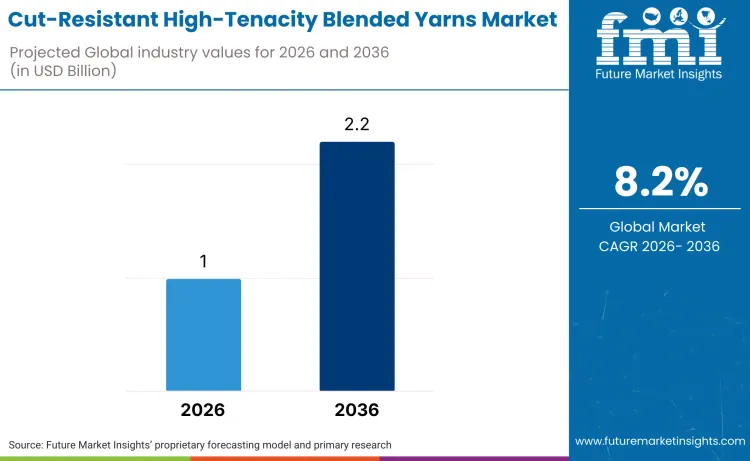
The global cut-resistant high-tenacity blend yarns market will likely reach USD 1.0 billion in 2026, and further to USD 2.2 billion by 2036, advancing at a CAGR of 8.2%. It is entering a period of structural change as the industry moves toward 2026. Competitive advantage is no longer driven by scale or volume growth.
Trends are shaped by profit quality, deep application-specific expertise, and the growing push toward sustainable industrial materials. These shifts reflect broader trends across advanced materials markets, where tighter regulation, higher customer risk exposure, and sustainability requirements are influencing both investment decisions and innovation priorities.
Major multinational producers such as DuPont and Honeywell have responded by simplifying their business portfolios and exiting lower-margin chemical segments. This repositioning has allowed them to concentrate resources on high-performance applications such as advanced PPE, tactical apparel, and fiber-reinforced systems. In these segments, customer risk tolerance supports premium pricing and long-term supply agreements. As a result, innovation speed and close customer collaboration have become critical drivers of margin stability.
In Asia-Pacific, competitive strategy centers on capacity growth paired with regulatory alignment. Kolon Industries has expanded aramid production to meet tightening Euro 7 emission standards, particularly in applications where aramid pulp reduces brake pad particulate emissions. Teijin and Toray are using disciplined pricing strategies and recycled aramid programs to address sustainability-driven demand. Circular initiatives, including recycled Twaron, are gaining traction across automotive, industrial, and defense markets.
Looking beyond 2026, differentiation is expected to depend more heavily on the adoption of Physical AI, smart manufacturing, and digitally optimized production systems. These technologies are being used to lower carbon intensity and operating costs while maintaining the core mechanical advantages of aramid and blended yarns. These materials, which offer strength levels several times greater than steel by weight, remain essential for electric vehicles, aerospace platforms, and next-generation industrial uses.
This strategic shift points to a market moving toward higher margins, faster innovation cycles, and more flexible operating models. As articulated by DuPont leadership, this direction closely reflects the broader evolution of the sector:
"DuPont is entering a new chapter as a more simplified, agile and high-performing multi-industrial company. As a leading advanced solutions provider with differentiated technologies, a strong innovation engine and deep customer relationships in attractive end-markets with strong secular trends, we are well positioned to drive profitable growth." - Lori Koch, CEO of DuPont, September 18, 2025
Summary of Cut-Resistant High-Tenacity Blended Yarns Market
What Is the Outlook for the Cut-Resistant High-Tenacity Blended Yarns Market?
The cut-resistant high-tenacity blended yarns market will total USD 1.0 billion in 2026, and advance to USD 2.2 billion by 2036 at a CAGR of 8.2%. It is entering a structurally mature phase where growth is increasingly shaped by regulatory enforcement, margin discipline, and application-specific performance requirements rather than volume-led expansion.
How Do FMI Analysts Interpret the Ongoing Structural Shift?
FMI analysts observe a transition from scale-centric competition toward profit quality, customer intimacy, and engineered differentiation. Leading producers are simplifying portfolios, exiting lower-margin chemical segments, and reallocating capital toward high-risk, high-performance end uses such as advanced PPE, automotive systems, and industrial reinforcement, where pricing power and long-term contracts are more sustainable.
Which Material Strategies Are Shaping Competitive Positioning?
High-tenacity blended yarns that combine HPPE or aramid reinforcements with comfort and processability fibers remain central to adoption. These blends enable manufacturers to meet stringent cut-resistance thresholds while preserving dexterity and wearability, which are critical for gloves and repetitive-use applications. Sustainability-linked blends, including recycled aramid and bio-based components, are gaining traction as regulatory disclosure requirements tighten.
Which Application Anchors Demand Stability?
Industrial gloves represent the most consistent demand base due to universal task-level mandates, high replacement frequency, and clear alignment with EN 388 and ANSI/ISEA cut-rating systems. This clarity accelerates institutional procurement and supports faster adoption of advanced blended yarn systems compared with discretionary protective garments.
What Broader Forces are Influencing Market Direction?
Beyond safety regulation, electrification of transport, tighter emission standards, and circular economy frameworks are reshaping material demand. High-tenacity fibers are increasingly embedded in automotive, EV, and industrial systems, while digital manufacturing and automation are emerging as longer-term differentiators that lower carbon intensity and improve operating efficiency.
Cut-Resistant High-Tenacity Blended Yarns Market Key Takeaways
| Metrics | Values |
|---|---|
| Expected Value (2026E) | USD 1.0 billion |
| Projected Value (2036F) | USD 2.2 billion |
| CAGR (2026-2036) | 8.2% |
Source: Future Market Insights (FMI) analysis, based on proprietary forecasting model and primary research
Why is the Cut-Resistant High-Tenacity Blended Yarns Market Growing?
Regulatory bodies across major economies are transitioning from voluntary safety frameworks to mandatory compliance regimes, creating sustained and non-discretionary demand for high-performance yarns in personal protective equipment (PPE) and industrial textiles.
In the European Union, Regulation (EU) 2016/425 continues to act as a cornerstone for PPE compliance. As the market aligns with the third edition of the PPE Guidelines in 2026, enforcement around CE marking, traceability, and conformity assessments has intensified. Protective gloves are now required to demonstrate verified compliance with EN 388 mechanical risk standards, accelerating the adoption of cut-resistant blended yarns over traditional materials.
In the United States, the Occupational Safety and Health Administration’s (OSHA) 2026 enforcement agenda has heightened scrutiny across high-hazard industries such as construction and manufacturing. This shift has led to stricter oversight of hand protection selection, compelling employers to transition from basic leather gloves toward engineered yarn solutions that meet defined ANSI/ISEA cut-resistance levels.
China’s State Administration for Market Regulation has introduced updated National GB Standards effective in 2026. These revisions impose more stringent safety requirements related to textile dust exposure and hazardous chemical handling, driving demand for specialized protective apparel manufactured using high-tenacity blended yarns.
Sustainability considerations have moved beyond voluntary commitments to become embedded within regulatory and reporting frameworks. This transition is reshaping material sourcing strategies across the technical textile value chain.
The implementation of the EU’s Corporate Sustainability Reporting Directive (CSRD) for 2026 reporting cycles requires manufacturers to disclose material circularity and Scope 3 emissions. Demand is therefore increasing for recycled and bio-based high-tenacity fibers, including recycled aramid variants and alternative high-performance blends designed to reduce lifecycle environmental impact.
Parallel to regulatory pressure, research institutions and industry stakeholders are accelerating innovation in bio-based fiber technologies. Recent developments highlight the use of cellulose- and lignin-derived raw materials as substitutes for petroleum-based polyacrylonitrile (PAN), offering improved environmental profiles while maintaining competitive mechanical performance.
How is the Cut-Resistant High-Tenacity Blended Yarns Market Segmented?
Why is HPPE/UHMWPE the preferred reinforcement fiber in blended cut-resistant yarn systems?
HPPE dominates reinforcement selection because it achieves high cut resistance at very low linear density, allowing yarn developers to meet protection thresholds without compromising flexibility or wearer comfort. This balance is critical in applications where repetitive hand motion and long duty cycles penalize heavier or stiffer reinforcements.
Evidence from comparative textile performance studies shows that UHMWPE-based yarns consistently deliver strong cut resistance outcomes when knitted or braided, while maintaining acceptable elongation and handle characteristics. These properties make HPPE the most reliable “first-choice” reinforcement when designing blended yarn systems intended to pass standardized cut tests without excessive material loading.
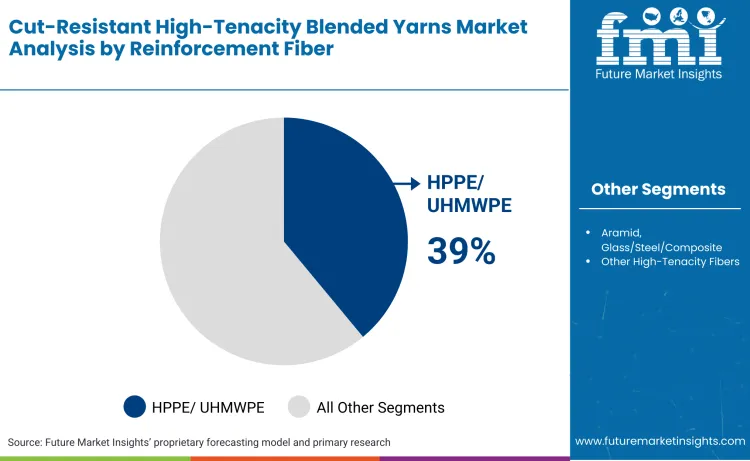
Procurement frameworks further reinforce adoption. Cut-resistant products are increasingly specified against measurable performance thresholds under ASTM F2992 and ISO 13997 test methodologies. HPPE fibers provide predictable compliance against these benchmarks, reducing formulation risk for yarn producers and downstream PPE manufacturers. As a result, HPPE-reinforced blends account for 39% of reinforcement fiber usage, reflecting both technical suitability and procurement confidence.
Why do Industrial Gloves remain the Primary Application for High-Tenacity Blended Yarns?
Industrial gloves represent the most consistent demand center because hands remain the most frequently exposed body part to cut and abrasion hazards across manufacturing, fabrication, logistics, automotive handling, and glass processing operations. Unlike garments or sleeves, gloves are universally mandated at task level, making them the fastest category for safety upgrades to be institutionalized.
Occupational injury surveillance data repeatedly highlights hand lacerations as a leading cause of recordable incidents, driving employers to formalize glove programs rather than rely on discretionary PPE use. This has shifted purchasing behavior toward standardized, cut-rated gloves that can be audited, replaced frequently, and scaled across facilities with minimal operational disruption.
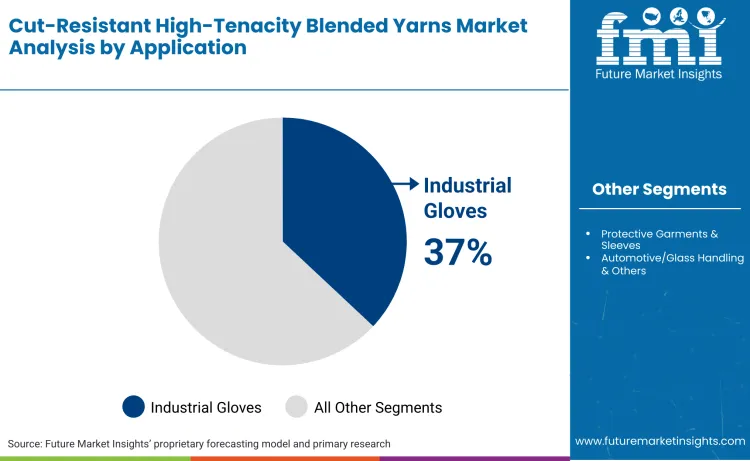
Regulatory and standards alignment further strengthens this position. Industrial gloves are directly mapped to EN 388 mechanical risk ratings and ANSI/ISEA 105 cut classifications, translating yarn-level performance into clear procurement categories. This clarity accelerates adoption of advanced blended yarns in glove manufacturing, resulting in industrial gloves accounting for 37% of application demand within the segment.
What influences the Cut-Resistant High-Tenacity Blended Yarns Market?
The global market for cut-resistant, high-tenacity blended yarns is clearly moving into a decisive new phase. What drives this shift isn’t a single factor, but the combined pressure of tighter safety regulation, the material demands of electric vehicle manufacturing, and rising expectations around traceability and sustainability. Winning in this market is no longer about being the lowest-cost supplier. It’s about being compliance-ready, technically credible, and transparent across the value chain.
Safety regulation continues to do much of the heavy lifting on the demand side. In North America and Europe, stricter enforcement of occupational safety standards is accelerating the move away from traditional leather gloves toward engineered yarn solutions. Updates to EN 388 and tougher OSHA scrutiny around glove performance, fit, and material verification are turning what used to be optional PPE upgrades into mandatory purchasing decisions. End users are increasingly locked into high-dexterity yarn blends that can reliably deliver A4 to A9 cut protection without sacrificing comfort or productivity.
Rapid electrification of the automotive sector is reinforcing demand in a more structural way. High-tenacity fibers are becoming embedded in EV platforms, particularly where lightweight reinforcement, dust-free braking, and thermal stability are required to meet evolving durability and emission standards such as Euro 7. Recent capacity expansion moves by leading fiber producers underline the fact that aramid-based materials are no longer niche inputs, but core components across automotive and adjacent industrial applications.
Cost remains a meaningful barrier, especially outside mature economies. Producing para-aramid and other high-modulus fibers still involves energy-intensive, solvent-based spinning processes, keeping prices well above those of conventional synthetics. In emerging markets across South and Southeast Asia, where buyers remain extremely price-sensitive, this cost gap continues to limit broader adoption despite growing awareness of performance benefits.
Operational complexity is also rising as regulatory regimes fragment rather than converge. New certification and conformity requirements are forcing suppliers to navigate country-specific testing, documentation, and labelling processes. For exporters serving multiple regions, this slows down product launches and adds cost, often stretching commercialization timelines in ways that directly affect competitiveness.
Analysis of the Cut-Resistant High-Tenacity Blended Yarns Market by Key Countries
| Country | CAGR (2026-2036) |
|---|---|
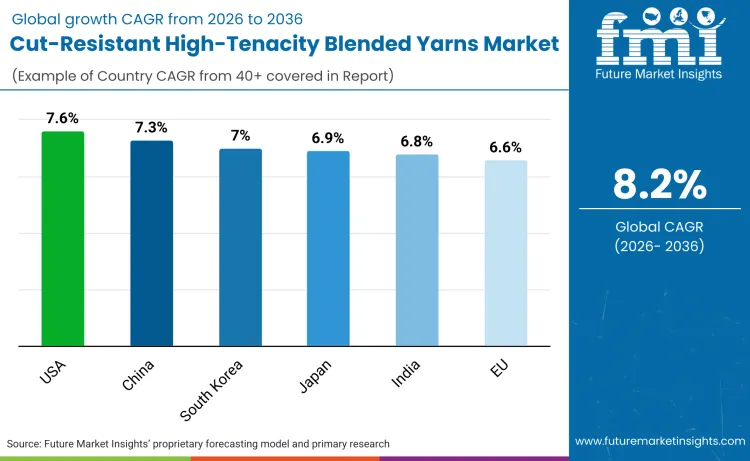
| USA | 7.6% |
| China | 7.3% |
| India | 6.8% |
| EU | 6.6% |
| Japan | 6.9% |
| South Korea | 7.0% |
Source: FMI’s proprietary forecasting model and primary research
How is USA Using Regulation to Shape PPE Fiber Demand While Restructuring Industry Focus?
USA’s market is being reshaped primarily through regulatory enforcement and corporate realignment. The OSHA Final Rule issued in January 2025 introduces a mandatory requirement that PPE must properly fit all construction workers. This has materially increased demand for ergonomic, gender-inclusive blended yarns, pushing suppliers toward more differentiated fiber engineering rather than one-size-fits-all solutions.
Strict enforcement of 29 CFR 1926.95 obligates employers to provide PPE at no cost, which constrains the adoption of premium fibers in low-margin construction segments. This cost pressure limits how quickly advanced materials can penetrate commoditized PPE categories.
The announced 2026 separation of Honeywell’s Advanced Materials business signals a broader industry shift: large conglomerates are narrowing focus toward automation-linked, high-growth specialty markets, reinforcing a bifurcation between compliance-driven PPE demand and innovation-driven advanced fiber platforms.
How is China Leveraging Automation and Self-Sufficiency to Redefine High-Tenacity Yarn Production?
China’s trajectory is defined by state-directed automation and domestic capability building. Under the 14th Five-Year Plan, the target of achieving 50% textile manufacturing automation by 2026 is forcing yarn producers to develop materials compatible with robotic handling, consistent tension control, and automated weaving systems.
However, this push coincides with raw material price volatility and rising labor costs, particularly in traditional hubs such as Guangdong, eroding the cost advantages of legacy textile models. These pressures accelerate consolidation and investment in higher-value fiber technologies.
Critically, the evolution of the Made in China 2025 framework emphasizes breakthroughs in high-tenacity core technologies, notably UHMWPE. This signals a long-term strategy to reduce dependence on imported performance fibers and secure domestic supply chains for defense, industrial, and advanced manufacturing applications.
How are India’s Quality Mandates Reshaping Access to Its High-Performance Textile Market?
India’s market dynamics are being driven by regulatory standardization rather than automation. Mandatory BIS certification through Quality Control Orders (QCOs), effective September 2025, makes national quality standards legally binding for all high-density textile imports, fundamentally altering market entry requirements.
While this framework strengthens consumer safety and environmental protection, compliance gaps among SMEs remain a structural challenge. Many smaller producers struggle to meet the technical documentation and testing requirements needed for BIS ISI Mark certification, especially for complex blended high-performance yarns.
At a policy level, India’s approach uses QCOs as a protective and developmental tool raising baseline quality while incentivizing domestic capability in technical textiles though near-term supply constraints are likely as the industry adjusts.
How is the European Union Converting PPE Compliance into a Digital and Circularity Advantage?
The EU is transforming PPE regulation into a systemic market filter. Full enforcement of Regulation (EU) 2016/425 by February 2026 requires all PPE placed on the market to meet Annex II health and safety standards, with Category II and III products subject to Module B EU type-examination by a Notified Body.
This introduces verification complexity and longer time-to-market, disproportionately impacting suppliers without established conformity assessment pathways. However, it also raises barriers to entry, favoring firms with strong regulatory infrastructure.
Beyond safety, the EU is embedding digital circularity into fiber markets through Product Passports and traceability requirements under evolving ESG directives. For high-tenacity fibers, compliance now extends beyond performance to include lifecycle transparency, recycled content tracking, and end-of-life accountability.
How Is Japan Aligning Circular Economy Goals With Advanced Fiber Recycling R&D?
Japan’s strategy blends sustainability policy with deep-tech experimentation. METI’s Circular Economy Roadmap aims to reduce fashion loss by 25% by 2030, driving accelerated R&D investment in recycled para-aramid fibers by 2026 an area historically constrained by recyclability challenges.
Structural constraints remain, particularly an aging and shrinking manufacturing workforce, which limits the scalability of domestic high-tenacity yarn spinning despite strong technical know-how.
To offset labor constraints, Japan is advancing chemical recycling pathways, including large-scale 2026 testing of depolymerization catalysts for industrial apparel and automotive plastics. This positions the country as a technology licensor and process innovator rather than a volume producer.
How is South Korea Pivoting from Commodity Synthetics to Defense and Automotive-Grade Specialty Fibers?
South Korea’s fiber industry is undergoing a deliberate structural pivot. MOTIE’s January 2026 Innovation Plan targets “super-gap” technology leadership in advanced materials, reinforcing state backing for high-performance fiber R&D.
This transition is underscored by petrochemical downsizing, with 3.7 million tons of traditional synthetic output cut as firms redirect capital toward specialty fibers. The shift reflects declining margins in commodity plastics and stronger global demand for functional materials.
Strategically, companies such as Kolon and Hyosung are doubling aramid pulp capacity to serve ballistic protection and automotive applications, particularly to meet Euro 7 brake-dust regulations. This specialization positions South Korea as a critical supplier to regulated, high-performance end markets rather than mass-volume textiles.
Competitive Landscape
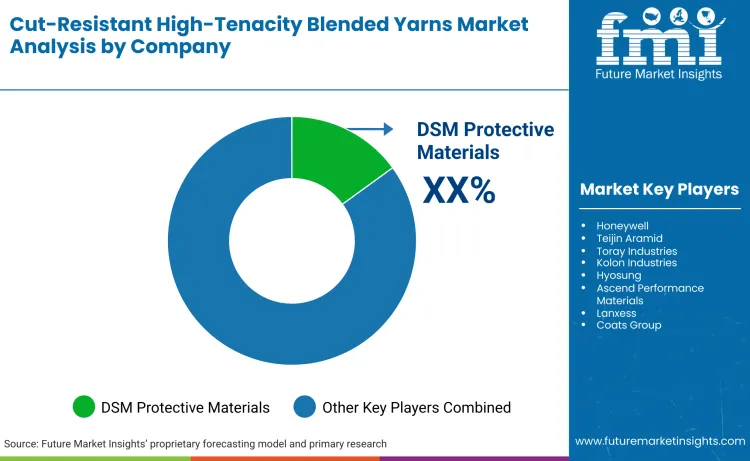
The global aramid and advanced materials market is starting to split down two very different paths. On one side, Western incumbents are pulling back, streamlining portfolios, shedding capital-heavy fiber assets, and sharpening their focus on profitability. On the other, Asian manufacturers are leaning in, adding capacity and betting big on long-term demand from automotive, EVs, and regulation-driven applications. This isn’t a simple story of winners expanding and losers retreating. It’s a reshuffling of risk, capital, and ambition across the value chain, where scale and profitability increasingly pull in opposite directions.
For Western players, recent moves make the strategy clear: simplify, specialize, and protect margins. DuPont’s decision to divest its aramid business in 2025, followed by Honeywell’s 2026 spin-off of Solstice Advanced Materials, reflects a broader desire to separate advanced fibers from diversified industrial portfolios. These businesses are capital-intensive, cyclical, and increasingly competitive.
By stepping away, Western incumbents are aiming to unlock clearer valuations and redirect capital toward areas with faster growth and less commodity exposure—think electronics, automation, and high-value specialty solutions. Market share matters less here than earnings quality and disciplined returns on invested capital.
Asian manufacturers, by contrast, are playing a scale game, and playing it confidently. Companies like Kolon Industries and Teijin are expanding capacity ahead of demand curves shaped by regulation and technology shifts. Kolon’s decision to double aramid pulp capacity ahead of Euro 7 emissions standards, and Teijin’s continued push around high-modulus aramids for EV and 5G infrastructure, show a clear intent: become indispensable to high-volume, high-spec end markets. By aligning investments with long-term structural transitions, these players are positioning themselves to capture demand as performance requirements rise and supply options narrow.
Key Players Profiled
- DSM Protective Materials
- Honeywell
- Teijin Aramid
- Toray Industries
- Kolon Industries
- Hyosung
- Ascend Performance Materials
- Lanxess
- Coats Group
- Globus Grou
Market Definition
The cut-resistant high-tenacity blended yarns market comprises engineered yarn systems designed to provide resistance against cuts, abrasion, and mechanical hazards in occupational and industrial environments. These yarns are produced by blending high-performance reinforcement fibers such as HPPE or aramid with complementary fibers to achieve a balance of protection, flexibility, and durability. Demand is driven by mandatory safety compliance, with performance validated through standardized mechanical risk testing.
This report includes high-tenacity blended yarns used in personal protective equipment and industrial textiles, particularly for applications requiring certified cut resistance. Coverage spans reinforcement fiber types, blend architectures, and application-driven performance requirements across industrial gloves, protective garments, sleeves, and selected automotive or handling uses. The scope also incorporates regulatory influences, sustainability-driven material strategies, and adoption patterns across major regions and end-use industries.
The report excludes finished PPE products such as gloves or garments sold as end items, as well as monofilament or single-fiber yarns without engineered cut-resistant functionality. It does not cover low-tenacity commodity yarns, non-certified decorative or comfort textiles, or protective materials used exclusively in military armor, ballistic systems, or non-textile mechanical protection products.
Scope of Report
| Items | Values |
|---|---|
| Quantitative Units (2026) | USD 1.0 billion |
| Reinforcement Fiber | HPPE/Ultra-High-Molecular-Weight PE, Aramid, Glass/Steel/Composite, Other High-Tenacity Fibers |
| Application | Industrial Gloves, Protective Garments & Sleeves, Automotive/Glass Handling & Others |
| Regions Covered | North America, Western Europe, Eastern Europe, East Asia, South Asia & Pacific, Latin America, Middle East & Africa |
| Countries Covered | USA, China, EU Japan and 40+ Countries |
| Key Companies Profiled | DSM Protective Materials, Honeywell, Teijin Aramid, Toray Industries, Kolon Industries, Hyosung, Ascend Performance Materials, Lanxess, Coats Group, Globus Group |
Source: FMI analysis based on primary research and proprietary forecasting model
Cut-Resistant High-Tenacity Blended Yarns Market Key Segments
Reinforcement Fiber
- HPPE/Ultra-High-Molecular-Weight PE
- Aramid, Glass/Steel/Composite
- Other High-Tenacity Fibers
Application
- Industrial Gloves
- Protective Garments & Sleeves
- Automotive/Glass Handling & Others
Region
- North America
- Western Europe
- Eastern Europe
- East Asia
- South Asia & Pacific
- Latin America
- Middle East & Africa
Bibliography
- International Safety Equipment Association. (2024). ANSI/ISEA 105-2024: American national standard for hand protection classification. ISEA.
- U.S. Department of Labor, Occupational Safety and Health Administration. (2024, December 11). Department of Labor finalizes rule on proper fit of personal protective equipment in construction. OSHA.
- European Commission. (2024). Ecodesign for Sustainable Products Regulation (ESPR): Framework for sustainable product requirements. European Commission.
- Jiang, F. (2024). Structural design and performance of cut-resistant fabrics. Polymers.
- Enhancing the performance of cut-resistant gloves with [study on glove performance and testing methods]. (2025). Textile Research Journal
Frequently Asked Questions
How large is the cut-resistant high-tenacity blended yarns market?
The market stands at around USD 1.0 billion in 2026, reflecting its growing role in regulated PPE and industrial safety applications.
What is the long-term growth outlook for this market?
Demand is expected to expand steadily through 2036 as cut-protection requirements become more tightly specified and enforcement of glove and PPE standards intensifies across major industrial regions.
Which applications are driving demand for cut-resistant blended yarns?
Industrial gloves are the primary demand driver due to mandatory hand protection, high replacement frequency, and clear alignment with standardized cut-rating systems. Additional demand comes from protective sleeves, garments, and selected industrial handling applications.
How does demand differ across regions?
North America and Europe are driven by strict enforcement of occupational safety standards, while Asia-Pacific growth is supported by expanding manufacturing activity, automation, and alignment with international cut-resistance testing frameworks.
What factors are limiting faster adoption of advanced blended yarns?
Higher material costs, complex qualification requirements, and fragmented certification regimes across regions continue to slow adoption, particularly in price-sensitive markets despite clear performance advantages.
Preview the report firsthand - request a free sample
Get SampleGet the brochure for pricing and purchase details.
Get PDFTable of Content
- Executive Summary
- Cut-Resistant High-Tenacity Blended Yarns Market Introduction
- Market Definition
- Market Scope
- Market Taxonomy
- Research Methodology
- Study Framework
- Assumptions and Limitations
- Data Sources
- Market Estimation and Forecasting Approach
- Cut-Resistant High-Tenacity Blended Yarns Market Dynamics
- Drivers
- Restraints
- Opportunities
- Trends
- Global Cut-Resistant High-Tenacity Blended Yarns Market Analysis 2021 to 2025 and Forecast 2026 to 2036
- Global Cut-Resistant High-Tenacity Blended Yarns Market Analysis by Reinforcement Fiber
- Global Cut-Resistant High-Tenacity Blended Yarns Market Analysis by Application
- Global Cut-Resistant High-Tenacity Blended Yarns Market Analysis by Region
- North America Cut-Resistant High-Tenacity Blended Yarns Market Analysis
- United States
- Canada
- Western Europe Cut-Resistant High-Tenacity Blended Yarns Market Analysis
- Germany
- United Kingdom
- France
- Italy
- Spain
- BENELUX
- Nordics
- Eastern Europe Cut-Resistant High-Tenacity Blended Yarns Market Analysis
- Poland
- Russia
- Rest of Eastern Europe
- East Asia Cut-Resistant High-Tenacity Blended Yarns Market Analysis
- China
- Japan
- South Korea
- South Asia & Pacific Cut-Resistant High-Tenacity Blended Yarns Market Analysis
- India
- ASEAN
- Australia & New Zealand
- Latin America Cut-Resistant High-Tenacity Blended Yarns Market Analysis
- Brazil
- Rest of Latin America
- Middle East & Africa Cut-Resistant High-Tenacity Blended Yarns Market Analysis
- GCC
- South Africa
- Rest of Middle East & Africa
- Competitive Landscape Analysis
- Key Players Profiled
- Market Definition and Scope
- Market Segmentation Analysis
- Bibliography
- Frequently Asked Questions


