

- Industry Size (2026)
- USD 1.5 Bn
- Forecast (2036)
- USD 3.0 Bn
- CAGR (2026 to 2036)
- 7.2%
Anti-Static Carbon Core Filament Yarns Market Forecast and Outlook 2026 to 2036
The global anti-static carbon core filament yarn market is expected to total USD 1.5 billion in 2026, expected to further incline to USD 3.0 billion by 2036, advancing at a CAGR of 7.2%. Demand is undergoing a decisive phase of structural realignment, transitioning from a specialized industrial niche into a core material platform for the pure-play automation era of 2026. This evolution is being accelerated by large-scale corporate portfolio simplification and intensifying regulatory pressure, where sustainability has shifted from a compliance requirement to a primary competitive lever.
The competitive landscape in 2026 is characterized by incumbent exits and specialist-led expansion. Major Western conglomerates are divesting diversified chemical and materials assets to concentrate on high-value critical control points. This is evidenced by Honeywell’s separation into standalone automation and aerospace entities and its 2025 spin-off of Solstice Advanced Materials, moves that mirror a broader industry trend toward focused, high-margin innovation.
This strategic narrowing enables deeper R&D investment in end-use segments such as semiconductor cleanroom infrastructure and EV battery housings, where the asymmetric financial and operational risks associated with electrostatic discharge (ESD) justify premium pricing for advanced carbon core filament systems.
Sustainability has emerged as a structural market mandate rather than an optional value proposition. The 2025 launch of Teijin’s Tenax Next™ has established a new performance benchmark, delivering a 35% reduction in CO₂ emissions while preserving the electrical conductivity required for anti-static applications.
This innovation aligns closely with the 2026 rollout of EU Digital Product Passports, which mandate full material traceability and lifecycle transparency across high-tenacity yarn supply chains. Producers unable to document carbon intensity, recyclability, and sourcing integrity are increasingly exposed to regulatory and commercial risk.
Asian manufacturers are scaling aggressively to capitalize on regulatory convergence. Kolon Industries’ expansion of aramid pulp capacity positions the company to capture demand linked to Euro 7 compliance, underscoring that market leadership is now defined by the ability to solve complex regulatory challenges at industrial scale.
From an innovation and strategy perspective, the market has moved beyond incremental performance gains toward systemic optimization. This shift is captured by Jörg Friedrich, CTO of Teijin Carbon Europe, who emphasizes the convergence of performance, circularity, and process efficiency:
“With Tenax Next™ we’re driving the evolution of carbon fiber technology. We’ve developed a new generation of materials that meet the growing demand for sustainable solutions. This is just the beginning-delivering top-tier performance while advancing circularity and optimizing production processes.” - Jörg Friedrich, CTO, Teijin Carbon Europe (March 3, 2025)
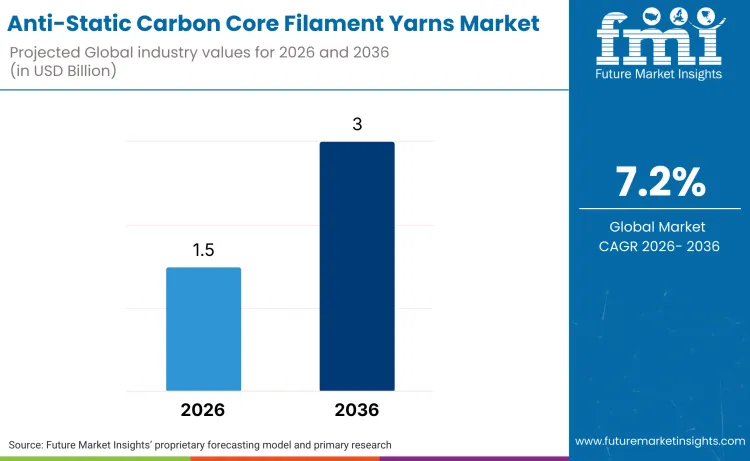
Summary of the Anti-Static Carbon Core Filament Yarns Market
What is the Outlook for the Anti-Static Carbon Core Filament Yarns Market?
The market is transitioning from a niche functional input into a compliance-critical material platform as electrostatic risk management becomes enforceable across automation-driven industries. Demand is shaped by regulatory exposure, yield protection, and auditability rather than discretionary performance upgrades, particularly in electronics, cleanroom infrastructure, and electrified mobility systems.
How do FMI Analysts Interpret the Structural Shift Underway?
FMI analysts identify a decisive move away from surface-treated or coated antistatic solutions toward intrinsically conductive carbon-core architectures. This shift reflects buyer preference for permanent conductivity, wash-fast performance, and resistivity stability that can be validated over long operating lifecycles. Competitive advantage is consolidating around suppliers with electro-functional precision, qualification depth, and regulatory alignment.
Which Material Strategies are Defining Supplier Positioning?
Carbon-core filament yarns remain central due to their predictable charge dissipation and compatibility with existing industrial specifications. Suppliers integrating recycled feedstocks, lower-carbon production routes, and documented lifecycle data are gaining traction as sustainability transitions from a reporting obligation to a market-access condition, especially under EU Digital Product Passport and Ecodesign frameworks.
Which End-Use Segments Anchor Demand Stability?
Electronics and semiconductor manufacturing form the most stable demand base, where electrostatic control is embedded into process risk management rather than treated as a textile attribute. Once qualified, anti-static yarn platforms tend to remain locked into production environments for extended periods, reinforcing recurring demand and long-term supply agreements.
What Broader Forces are Influencing Market Direction?
Beyond ESD control, tightening automotive non-exhaust emission rules, cleanroom expansion linked to advanced semiconductor nodes, and regional industrial policy are reshaping procurement behavior. These forces are pushing the market toward higher barriers to entry, stronger pricing discipline, and greater emphasis on traceability and regionalized supply chains.
Anti-Static Carbon Core Filament Yarn Market Key Takeaways
| Metric | Value |
|---|---|
| Expected Value (2026E) | USD 1.5 billion |
| Projected Valued (2036F) | USD 3.0 billion |
| CAGR (2026-2036) | 7.2% |
Source: FMI analysis based on primary research and proprietary forecasting model
What is pushing the Anti-Static Carbon Core Filament Yarns Market Forward?
The global market for anti-static carbon core filament yarns is entering a structurally accelerated growth phase in 2026, driven by the convergence of regulatory enforcement, industrial technology shifts, and sustainability mandates. Unlike earlier demand cycles that were shaped by optional performance enhancements, anti-static functionality is rapidly becoming a baseline compliance requirement across several high-value industrial sectors, fundamentally altering procurement behavior and material selection criteria.
A primary catalyst is the implementation of Euro 7 automotive regulations in November 2026, which introduce binding limits on non-exhaust emissions such as brake and tire particulates. These rules are compelling OEMs and Tier-1 suppliers to redesign friction systems to reduce dust generation and static-induced particle adhesion.
Carbon-core and aramid-blended yarns are increasingly embedded in conductive braking components to meet these thresholds, shifting material substitution from discretionary innovation to mandatory adoption across the European automotive value chain.
Simultaneously, the semiconductor industry is reinforcing demand as manufacturing processes move toward 2nm and sub-5nm nodes. Cleanroom expansion programs from 2026 onward are designed around stricter electrostatic discharge control standards, where even minor voltage events can undermine yields.
Embedded carbon filament yarns are therefore gaining strategic importance as permanent ESD solutions in cleanroom garments, flooring, and technical textiles, offering durability and compliance stability that align with the risk-averse procurement models of semiconductor fabs.
Sustainability regulation forms the fourth structural pillar, led by the EU’s Ecodesign for Sustainable Products Regulation and the rollout of the Digital Product Passport for textiles beginning in 2026. Market access is increasingly contingent on verified lifecycle data, including carbon intensity, material provenance, and recyclability, extending transparency requirements to conductive yarns.
Industrial policy support across India and the Asia-Pacific region is accelerating localized investment in high-value technical fibers, positioning regional producers to meet both export-driven compliance requirements and rising domestic demand, and collectively transforming anti-static carbon core filament yarns into a compliance-led, high-growth materials segment beyond 2026.
What is the Segment Profile of the Anti-Static Carbon Core Filament Yarns Market?
Why is Conductive Carbon Fiber the Primary Volume Driver in the Anti-Static Carbon Core Filament Yarns Market?
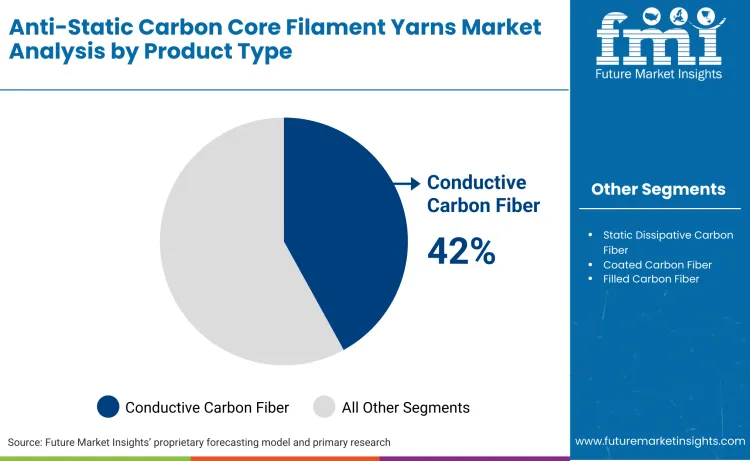
Conductive carbon fiber makes up 42% of total demand because it works reliably at scale, not because it promises headline-grabbing performance gains. In antistatic textile programs, procurement teams are judged on repeatability. What matters most is whether charge dissipation behaves the same way across every batch, loom, and garment run. Carbon fiber delivers that predictability, reducing variability during knitting, weaving, and final assembly.
Its position is reinforced by how deeply it is embedded in existing specifications. Many industrial antistatic standards were written around conductive carbon fiber years ago, and replacing it would mean restarting qualification and audit cycles. Those revalidation costs are rarely justified when current systems already meet compliance targets.
Why does Electronics Dominate End-Use Demand for Anti-Static Carbon Core Filament Yarns?
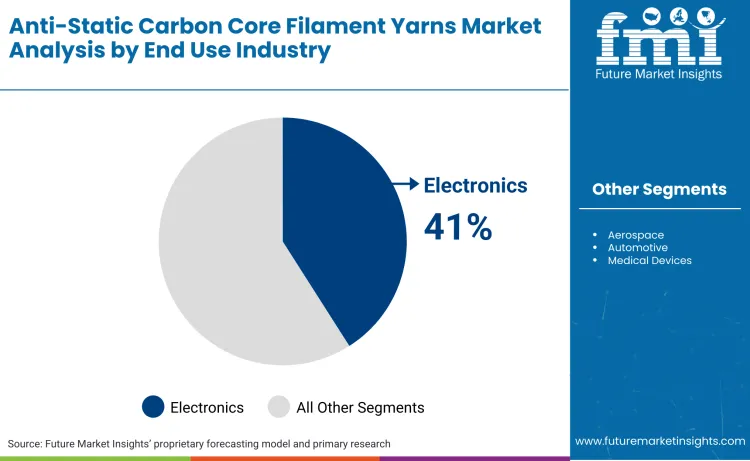
Electronics accounts for 41% of end-use consumption because electrostatic control is treated as a production safeguard, not an optional improvement. As components become more sensitive and tolerances tighten, even minor ESD events translate directly into yield loss and warranty risk. Antistatic textiles are now part of the process control layer inside electronics manufacturing environments.
Sourcing behavior in this sector is driven by audits and traceability. Manufacturers look for yarn systems with a long compliance record across garments, cleanroom textiles, and handling materials. Once a yarn platform is qualified, it tends to stay in place for years, supported by recurring production schedules.
What Influences the Anti-Static Carbon Core Filament Yarns Market?
In Europe, tightening environmental frameworks are accelerating material substitution toward traceable, lower-emission fibers, with procurement decisions increasingly linked to lifecycle carbon metrics. This shift was highlighted by the March 2025 launch of Tenax™ Next by Teijin, which integrates recycled feedstock and verified emissions reductions into carbon filament production, strengthening supplier positioning in sustainability-gated automotive, aerospace, and industrial applications.
The supply of secondary carbon fiber is beginning to improve as recycling moves beyond pilot initiatives toward industrial collaboration. The Toray-Veolia joint venture, targeting recovery of approximately 1,200 tons of carbon fiber annually from retired aircraft, illustrates how aerospace end-of-life streams are being converted into scalable, high-quality recycled feedstock. This development supports OEM efforts to meet circularity and emissions targets while maintaining the performance consistency required for safety-critical applications.
Despite these advances, structural cost pressures continue to constrain market expansion. Carbon-core and conductive filament manufacturing remains highly energy-intensive, exposing producers to electricity price volatility in Europe and North America and limiting aggressive capacity additions. The persistent price premium of specialty conductive fibers further restricts adoption to applications where failure risk, contamination costs, or regulatory exposure outweigh material expense, such as aerospace structures, semiconductor cleanrooms, and high-reliability industrial systems.
Competitive advantage is increasingly concentrated around verified sustainability, traceability, and localization rather than scale alone. EU digital product and materials traceability frameworks are enabling suppliers to substantiate carbon-reduction claims and defend pricing premiums through long-term supply agreements.
Policy-driven localization across Asia is reshaping competitive dynamics by incentivizing domestic fiber production and increasing compliance friction for foreign suppliers. Success through 2027 will depend on integrating circular feedstocks, validating sustainability credentials, selectively localizing production, and maintaining cost discipline in a more regulated global market.
Analysis of the Anti-Static Carbon Core Filament Yarns Market by Key Countries
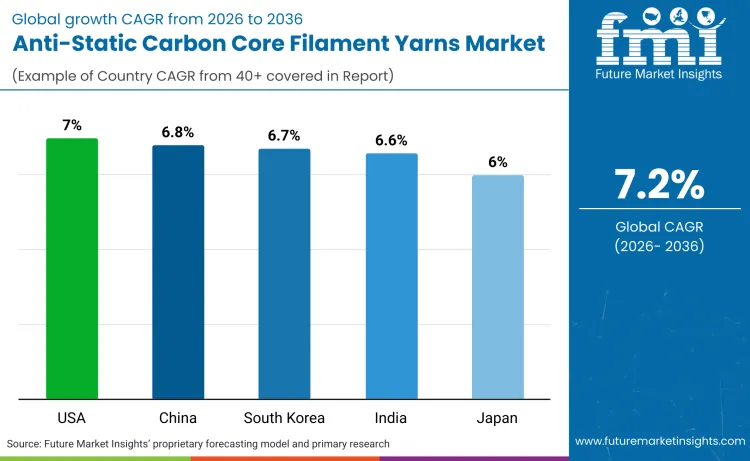
| Country | CAGR (2026-2036) |
|---|---|
| USA | 7.0% |
| China | 6.8% |
| Japan | 6.0% |
| India | 6.6% |
| South Korea | 6.7% |
Source: Future Market Insights analysis, supported by a proprietary forecasting model and primary research
How is USA reconfiguring its High-Performance Fiber Industry around Capital Discipline and Strategic Focus?
Rising at a 7.0% CAGR, USA’s high-performance fiber sector is not shrinking so much as re-sorting itself. Major incumbents are increasingly separating mature fiber assets from faster-moving innovation platforms, reflecting a sharper focus on capital efficiency. The divestment of Kevlar® and Nomex® by DuPont illustrates this shift: aramids remain strategically essential, but they are now viewed as stable, cash-generating businesses rather than growth engines within diversified conglomerates.
A similar logic underpins Honeywell’s decision to spin out its Advanced Materials business. The emphasis is moving toward stand-alone platforms with clear end-market alignment, where pricing discipline, IP depth, and long-term contracts matter more than incremental capacity additions. This is likely to drive consolidation and sharper specialization across aramids, specialty nylons, and industrial fibers.
Why is China Elevating High-Performance Fibers to a Strategic Industrial Priority Under the 15th Five-Year Plan?
China’s approach to high-performance fibers has entered a new phase. A CAGR of 6.8% is expected for the industry in China. Rather than simply expanding capacity, policy under the 15th Five-Year Plan positions advanced fibers as strategic enablers of national manufacturing strength, particularly in aerospace, defense, and energy systems. Aramids and carbon fibers are no longer treated as export commodities but as foundational inputs for industrial self-reliance.
This shift is already changing competitive behavior. While producers historically pushed volume into global markets, the current emphasis is on quality parity, domestic substitution, and ecosystem control, from precursor chemistry to downstream composites. The likely outcome is less aggressive exporting at the premium end, combined with intense competition in mid-tier grades. China’s strategy will reshape trade flows by anchoring more high-performance fiber demand within its own industrial base.
Is Japan Transitioning its High-Performance Fiber Sector from Volume Leadership to Return Optimization?
Japan’s high-performance fiber industry is behaving like a mature, self-aware ecosystem. Rather than chasing scale, leading players are tightening their focus on returns, application specificity, and downstream value capture. Toray Industries’ push into carbon fiber composites under Project AP-G 2025 reflects this shift, prioritizing aerospace and advanced industrial uses over upstream volume growth. The market in Japan is expected to incline at a 6.0% CAGR.
At the same time, Teijin Group’s restructuring of its aramid portfolio highlights a broader recalibration toward profit quality and demand resilience, including applications tied to fiber-optic and 5G infrastructure. Collectively, these moves reinforce Japan’s role as a high-specification, innovation-driven supplier, rather than a volume competitor in global fiber markets.
How is India Laying the Groundwork for Strategic Self-Reliance in High-Performance Fibers?
With an expected CAGR of 6.6%, India is approaching high-performance fibers from the demand side inward. Policy initiatives such as the National Fibre Scheme in the Union Budget 2026 to 2027 signal a clear intent to reduce reliance on imported man-made and technical fibers, reframing fibers as strategic industrial inputs rather than extensions of the apparel sector.
Corporate alignment is emerging gradually. Reliance Industries Limited’s investments in advanced carbon materials, tied to its broader energy platform, point to early ecosystem formation. While India remains behind East Asia technologically, the combination of fiscal incentives, captive demand from infrastructure and energy storage, and large domestic balance sheets suggests a slow but durable substitution pathway, not a rapid bid for global leadership.
Why is South Korea Strengthening Its Role as a Scaled and Policy-Aligned Aramid Producer?
South Korea occupies a distinct position in this landscape: scaled, export-oriented, and tightly aligned with industrial policy. It will likely expand at a 6.7% CAGR. High utilization at Kolon Industries’ para-aramid facilities reflects steady demand from defense, cable reinforcement, and industrial safety markets, validating its scale-first strategy.
Government backing through advanced materials clusters further supports South Korea’s ambition to secure supply chains and expand export credibility. This coordinated approach reduces dependence on Japanese imports while appealing to Western OEMs seeking diversified, geopolitically stable sourcing. Over time, South Korea is likely to cement its position as a cost-competitive, reliable supplier of high-tenacity fibers, particularly in aramids.
Competitive Landscape
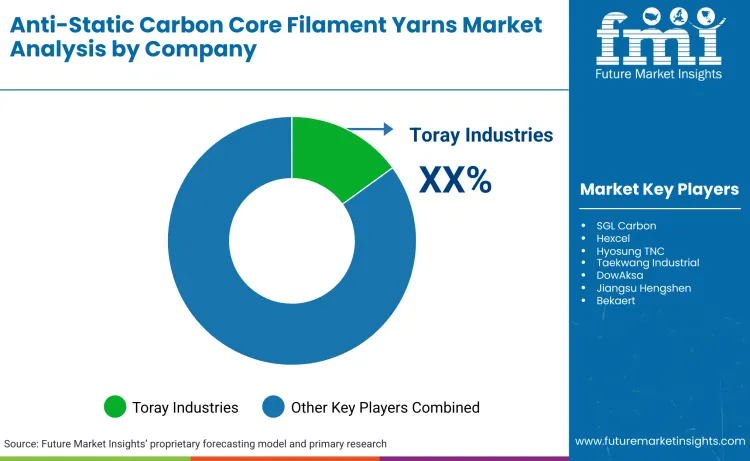
The global anti-static carbon core filament yarns market is decisively shifting away from surface-treated antistatic fibers toward intrinsically conductive, carbon-core architectures. End-use sectors, cleanrooms, aerospace, semiconductors, and electrified mobility are driving this transition where electrical performance must remain stable under washing, thermal cycling, and mechanical stress.
As coated yarns increasingly fail qualification and durability tests, permanent conductivity, wash-fast behavior, and resistivity stability have become baseline requirements rather than differentiators. This change is redefining competitive advantage across the value chain. Differentiation is moving away from downstream textile finishing and toward materials science expertise, co-extrusion capability, and control of proprietary carbon-core technologies.
Tier-1 suppliers are divesting commodity antistatic fiber businesses and reallocating capital toward patented, high-margin conductive filament platforms aligned with electronics and automation markets. The resulting market structure is more concentrated, with higher barriers to entry, fewer qualified suppliers, and rising pricing power for companies with proven OEM qualification histories and co-development partnerships.
Regionalization is shaping the next phase of competition. In Europe and Japan, low-carbon, traceable, and circular conductive filament solutions are becoming mandatory for participation in advanced procurement programs. Rapid capacity expansion in India and East Asia, supported by subsidies and localization mandates, is altering global supply dynamics and pressuring Western exporters. By 2026, leadership in the anti-static carbon core filament yarns market will depend on the ability to combine electro-functional precision, verifiable carbon reduction, and resilient regional supply chains.
Key Players Profiled
- Toray Industries
- SGL Carbon
- Hexcel
- Hyosung TNC
- Taekwang Industrial
- DowAksa
- Jiangsu Hengshen
- Bekaert
- Acelon Chemicals & Fiber
- Arrow Technical Textiles
Market Definition
The anti-static carbon core filament yarns market comprises filament yarn systems engineered with integrated carbon or conductive cores to dissipate electrostatic charge in industrial, electronic, and high-risk operating environments. These yarns deliver permanent, intrinsic conductivity that remains stable under mechanical stress, laundering, and thermal cycling, making them suitable for applications where electrostatic discharge poses yield, safety, or compliance risks.
This report includes intrinsically conductive and static-dissipative carbon core filament yarns used in electronics manufacturing, cleanroom textiles, automotive systems, aerospace components, medical devices, and telecommunications infrastructure. Coverage spans product types, end-use industries, regulatory and sustainability influences, and regional adoption patterns, with emphasis on compliance-driven procurement and lifecycle performance requirements.
The report excludes finished antistatic garments, flooring systems, mats, and surface-applied coatings sold as end products. It does not cover temporary or topical antistatic treatments, non-carbon conductive additives used solely in plastics, or decorative conductive textiles without certified electrostatic performance. Military-specific electromagnetic shielding materials and non-textile ESD hardware are also excluded from the scope.
Scope of Report
| Items | Values |
|---|---|
| Quantitative Units (2026) | USD 1.5 billion |
| Product Type | Conductive Carbon Fiber, Static Dissipative Carbon Fiber, Coated Carbon Fiber, Filled Carbon Fiber |
| End Use Industry | Electronics, Aerospace, Automotive Medical Devices Telecommunications |
| Regions Covered | North America, Western Europe, Eastern Europe, East Asia, South Asia & Pacific, Latin America, Middle East & Africa |
| Countries Covered | USA, China, Japan, India and 40+ Countries |
| Key Companies Profiled | Toray Industries, SGL Carbon, Hexcel, Hyosung TNC, Taekwang Industrial, DowAksa, Jiangsu Hengshen, Bekaert, Acelon Chemicals & Fiber, Arrow Technical Textiles |
Source: Future Market Insights analysis, supported by a proprietary forecasting model and primary research
Anti-Static Carbon Core Filament Yarns Market by Key Segments
Product Type
- Conductive Carbon Fiber
- Static Dissipative Carbon Fiber
- Coated Carbon Fiber
- Filled Carbon Fiber
End Use Industry
- Electronics
- Aerospace
- Automotive
- Medical Devices
- Telecommunications
Region
- North America
- Western Europe
- Eastern Europe
- East Asia
- South Asia & Pacific
- Latin America
- Middle East & Africa
Bibliography
- International Electrotechnical Commission. (2024). IEC 61340-5-1: Electrostatics - Protection of electronic devices from electrostatic phenomena (latest revision). IEC.
- European Chemicals Agency. (2024). Substances and materials of concern in industrial and polymer applications under EU sustainability frameworks. ECHA.
- International Energy Agency. (2024). The role of advanced materials in low-carbon industrial systems. IEA.
- Organisation for Economic Co-operation and Development. (2024). Industrial decarbonisation and materials traceability in advanced manufacturing. OECD.
- European Automobile Manufacturers’ Association. (2025). Euro 7 regulation: Technical implications for materials and non-exhaust emissions control. ACEA.
- World Economic Forum. (2024). Advanced materials and electrified manufacturing: Risk, resilience, and sustainability. WEF.
Frequently Asked Questions
How large is the anti-static carbon core filament yarns market?
The market is valued at around USD 1.5 billion in 2026, reflecting its growing role as a compliance-critical material across automation-driven and high-risk industrial environments.
What is the long-term growth outlook for this market?
Demand is expected to grow steadily through 2036 as electrostatic risk management becomes enforceable across electronics, automotive, aerospace, and cleanroom applications.
Which end-use industries are driving demand for carbon core anti-static yarns?
Electronics and semiconductor manufacturing anchor demand, where electrostatic discharge control is integral to yield protection. Additional demand comes from automotive systems, aerospace components, medical devices, and telecommunications infrastructure.
How does regional demand differ across major markets?
East Asia leads adoption due to semiconductor expansion and industrial policy support, while Europe is driven by traceability and sustainability regulation. North America shows stable demand tied to automation, aerospace, and advanced manufacturing.
What factors are limiting faster market penetration?
High production costs, energy-intensive manufacturing, and strict qualification requirements restrict adoption to applications where electrostatic failure carries high financial or compliance risk.
Preview the report firsthand - request a free sample
Get SampleGet the brochure for pricing and purchase details.
Get PDFTable of Content
- Executive Summary
- Anti-Static Carbon Core Filament Yarns Market Introduction
- Market Definition
- Market Scope
- Market Taxonomy
- Research Methodology
- Study Framework
- Assumptions and Limitations
- Data Sources
- Market Estimation and Forecasting Approach
- Anti-Static Carbon Core Filament Yarns Market Dynamics
- Drivers
- Restraints
- Opportunities
- Trends
- Global Anti-Static Carbon Core Filament Yarns Market Analysis 2021 to 2025 and Forecast 2026 to 2036
- Global Anti-Static Carbon Core Filament Yarns Market Analysis by Product Type
- Global Anti-Static Carbon Core Filament Yarns Market Analysis by End Use Industry
- Global Anti-Static Carbon Core Filament Yarns Market Analysis by Region
- North America Anti-Static Carbon Core Filament Yarns Market Analysis
- United States
- Canada
- Western Europe Anti-Static Carbon Core Filament Yarns Market Analysis
- Germany
- United Kingdom
- France
- Italy
- Spain
- BENELUX
- Nordics
- Eastern Europe Anti-Static Carbon Core Filament Yarns Market Analysis
- Poland
- Russia
- Rest of Eastern Europe
- East Asia Anti-Static Carbon Core Filament Yarns Market Analysis
- China
- Japan
- South Korea
- South Asia & Pacific Anti-Static Carbon Core Filament Yarns Market Analysis
- India
- ASEAN
- Australia & New Zealand
- Latin America Anti-Static Carbon Core Filament Yarns Market Analysis
- Brazil
- Rest of Latin America
- Middle East & Africa Anti-Static Carbon Core Filament Yarns Market Analysis
- GCC
- South Africa
- Rest of Middle East & Africa
- Competitive Landscape Analysis
- Key Players Profiled
- Market Definition and Scope
- Market Segmentation Analysis
- Bibliography
- Frequently Asked Questions


