

- Market Size (2026)
- USD 385.0 Mn
- Forecast (2036)
- USD 2845.0 Mn
- CAGR (2026 to 2036)
- 22.1%
Carbon-Aware Cloud Workload Scheduling Market Size, Market Forecast and Outlook By FMI
Summary of the Carbon-Aware Cloud Workload Scheduling Market
- Demand and Growth Drivers
- Buyers are shifting from broad sustainability intent toward auditable systems that can prove performance, claims, or operating impact.
- Kubernetes carbon-aware schedulers are expected to hold 35.0% share in 2026 as buyers prefer deployable systems with measurable workflow value.
- API-based carbon signal services is expected to hold 37.0% share as customers look for repeatable implementation rather than one-time pilots.
- Technology and Segment View
- Carbon-Aware Kubernetes Scheduling leads early demand because it connects directly with the main operational bottleneck in carbon-aware cloud workload scheduling.
- Cloud Region Shifting is gaining use where buyers need cleaner data, better control, and easier integration with existing systems.
- Adoption is stronger in applications where compliance, cost control, uptime, or claim integrity can be measured.
- Geography and Competitive Outlook
- United States and United Kingdom are forecast to remain important demand centers through 2036.
- Suppliers compete on integration depth, proof records, customer qualification, and service support.
- Relevant companies include Microsoft, Google Cloud, Electricity Maps, WattTime, Cirrus Nexus, Compute Gardener.
- FMI Analyst Opinion
- "The market will scale through qualified use cases, not broad claims. Suppliers that can prove repeatable value, fit into buyer workflows, and document outcomes will convert pilots into recurring demand."
- Carbon-Aware Cloud Workload Scheduling Market Value Analysis
- The market is moving from exploratory pilots toward purchase programs tied to operations, compliance, and measurable resource or productivity gains.
- Microsoft Sustainable Software material describes carbon-aware Kubernetes scheduling using a scheduler, carbon intensity data, and a weighting algorithm.
- Forecast growth is strongest where customers need audit-ready data, controlled implementation, and supplier accountability.
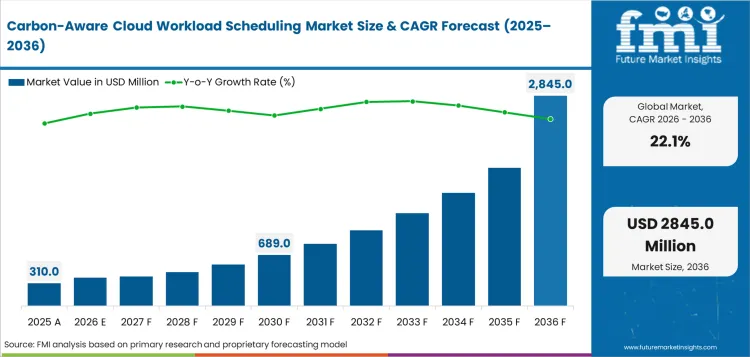
Key Takeaways, Market Size, and Forecast
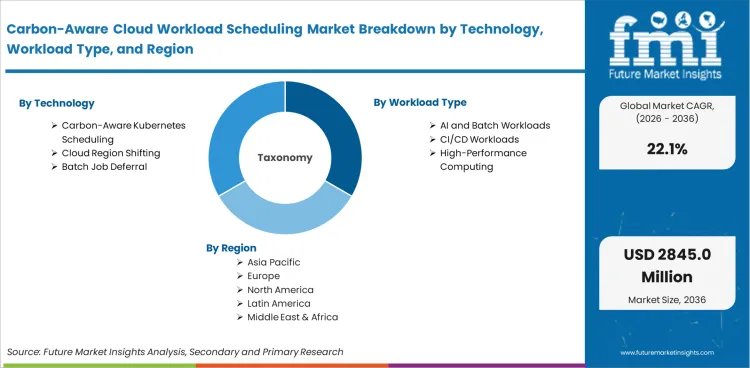
- The carbon-aware cloud workload scheduling market was valued at USD 310.0 million in 2025.
- The market is expected to reach USD 385.0 million in 2026.
- By 2036, the market is projected to be worth USD 2,845.0 million.
- From 2026 to 2036, the market is forecast to expand at 22.1% CAGR.
- The market is projected to create an incremental opportunity of USD 2,460.0 million between 2026 and 2036.
- Kubernetes carbon-aware schedulers are expected to account for 35.0% share in 2026.
- AI and batch workloads are projected to hold 44.0% share in 2026.
- API-based carbon signal services is expected to account for 37.0% share in 2026.
- India at 24.1% CAGR and Singapore at 23.2% CAGR are the faster expanding country markets.
The carbon-aware cloud workload scheduling market is gaining demand because buyers need a practical way to manage a narrow but important operating problem. The category is not a broad replacement market. It grows where a specific process creates cost, compliance, uptime, quality, or reporting pressure.
The strongest opportunity sits with suppliers that can fit into existing procurement and operating workflows. Buyers want clear scope, repeatable implementation, measurable outcomes, and support after deployment. Vendors that only sell a broad technology story will face slower conversion.
Carbon-Aware Cloud Workload Scheduling Market Definition
The carbon-aware cloud workload scheduling market covers products, platforms, systems, and managed services that help enterprises deploy, operate, or verify carbon-aware cloud workload scheduling. Scope includes carbon-aware kubernetes scheduling, cloud region shifting, batch job deferral, carbon intensity apis, cost-and-carbon optimization, integration services, implementation support, monitoring tools, and service contracts tied to production use.
Revenue includes software subscriptions, hardware-enabled systems where relevant, managed services, implementation fees, data services, maintenance, and support. The market excludes unrelated general equipment, advisory-only work with no implementation, and broad enterprise software that does not serve this use case directly.
Carbon-Aware Cloud Workload Scheduling Market Inclusions
Market scope includes carbon-aware kubernetes scheduling, cloud region shifting, batch job deferral, carbon intensity apis, cost-and-carbon optimization, buyer implementation, monitoring, data exchange, compliance support, and operational integration. End use includes production, logistics, sustainability, technology, healthcare, energy, and industrial workflows where the title-specific application creates measurable value.
Carbon-Aware Cloud Workload Scheduling Market Exclusions
The scope excludes generic software, equipment, or consulting that does not directly support carbon-aware cloud workload scheduling. It also excludes one-off internal projects where no commercial platform, system, or service revenue is created.
Carbon-Aware Cloud Workload Scheduling Market Research Methodology
- Primary Research: FMI reviewed buyer workflows, supplier positioning, implementation barriers, procurement behavior, and adoption patterns across target sectors.
- Desk Research: The study used public material from regulators, standards bodies, technology suppliers, company documentation, and sector sources.
- Market sizing and forecasting: Market size was estimated using addressable installed base, adoption readiness, pricing structure, buyer urgency, and conversion from pilots to recurring programs.
- Data validation: Forecast checks compared country demand, segment fit, supplier maturity, integration burden, and buyer willingness to pay.
Why is the Carbon-Aware Cloud Workload Scheduling Market Growing?
- Buyers need clearer proof before they expand adoption.
- Operating teams want solutions that reduce manual work and make decisions easier.
- Compliance, uptime, sustainability, and cost control are turning niche tools into budgeted programs.
The carbon-aware cloud workload scheduling market is growing because buyers need specific systems that make an operational risk easier to manage. The demand case is strongest when the solution produces data, reduces downtime, improves traceability, or gives managers a clearer way to act.
Adoption is still selective. Buyers will not scale a new system if it creates data gaps, disrupts production, or needs heavy manual reconciliation. This keeps service support and integration quality central to the market.
Market Segmentation Analysis
- Kubernetes carbon-aware schedulers are projected to account for 35.0% share in 2026.
- AI and batch workloads are expected to represent 44.0% share in 2026.
- API-based carbon signal services is forecast to hold 37.0% share in 2026.
- Customers are expected to prioritize vendors that combine domain knowledge with practical deployment support.
The market is divided by technology, application, service model, end use, buyer type, and region. Segmentation shows where the market converts fastest and where supplier qualification still takes time.
Insights into the Kubernetes carbon-aware schedulers Segment
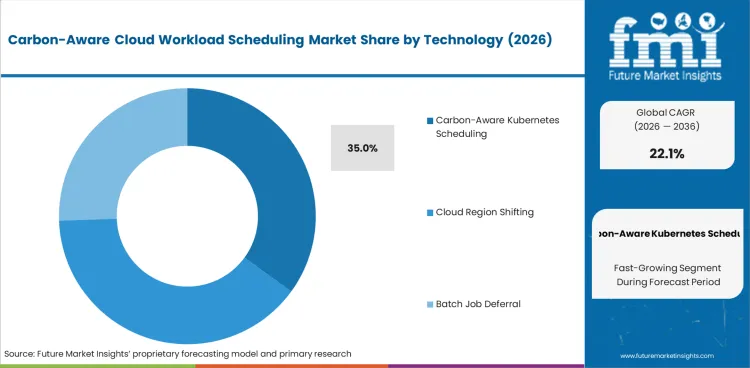
- Kubernetes carbon-aware schedulers are projected to account for 35.0% share in 2026. The segment leads because it connects directly with the buyer's main operational problem and can be measured during implementation.
- Suppliers in this segment gain advantage when they reduce manual work, create clearer records, and fit into existing systems. Buyers will prefer solutions that can be audited, repeated, and scaled across sites or business units.
Insights into the AI and batch workloads Segment
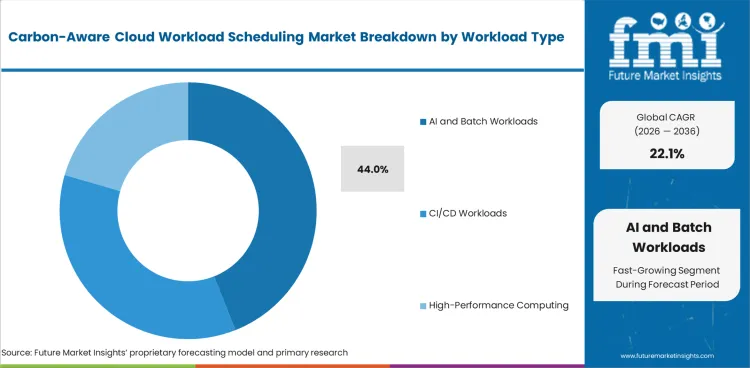
- AI and batch workloads are expected to represent 44.0% share in 2026. This segment grows because it has a clear use case and stronger willingness to pay.
- The segment will remain attractive where the cost of weak control is high. Adoption depends on data quality, service reliability, and proof that the system can work in normal operating conditions.
Insights into the API-based carbon signal services Segment
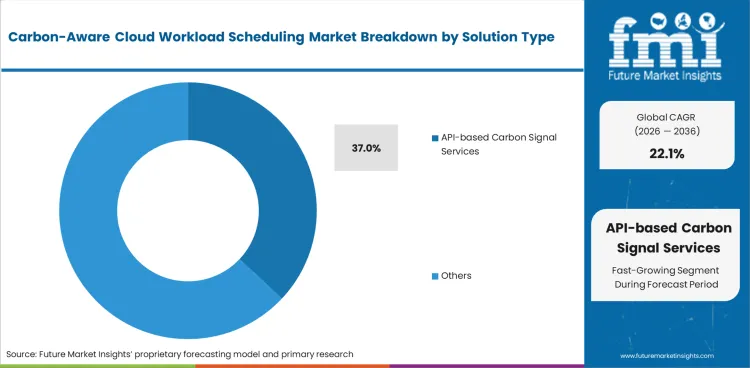
- API-based carbon signal services is forecast to hold 37.0% share in 2026. Customers prefer this model because it lowers implementation friction and gives them a clearer route from trial to production.
- The segment benefits from buyer need for support, documentation, training, and workflow integration. This is where suppliers can build recurring revenue instead of staying locked in pilot projects.
Carbon-Aware Cloud Workload Scheduling Market Drivers, Restraints, and Opportunities
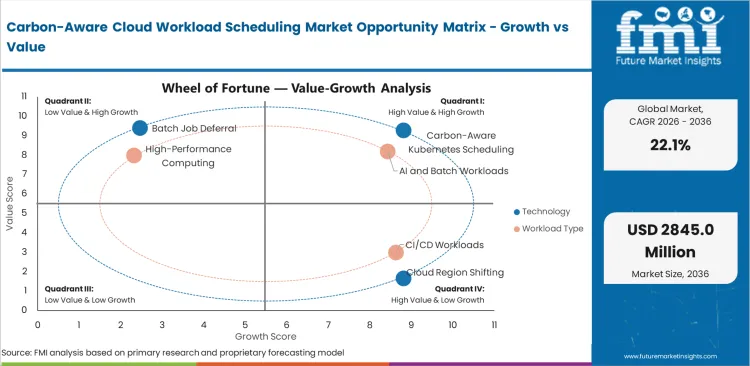
- Stronger audit and performance expectations are moving buyers toward measurable systems.
- Integration difficulty remains the main restraint.
- Managed services create a route for faster adoption in complex buyer environments.
Proof Requirements Are Moving Buyers Toward Traceable Systems
The main driver is the need for proof. Buyers want records that can stand up to internal review, supplier audits, customer questions, or operational analysis. Carbon-aware scheduling routes or delays workloads based on electricity carbon intensity when workload flexibility permits.
Integration Burden Slows Faster Adoption
The biggest restraint is integration burden. Many buyers already run complex systems and cannot add a new tool that creates more manual work. Vendors must connect with ERP, quality, fleet, laboratory, procurement, data, or cloud systems depending on the use case.
Service-Led Deployment Creates the Main Opportunity
The strongest opportunity sits in service-led deployment. Buyers want a partner that can help scope the process, configure the system, validate outputs, and train users. This creates room for recurring services and stronger account expansion.
Analysis of Carbon-Aware Cloud Workload Scheduling Market by Key Countries
.webp "Top Country Growth Comparison Carbon Aware Cloud Workload Scheduling Market Cagr (2026 2036)")
| Country | CAGR |
|---|---|
| United States | 21.4% |
| United Kingdom | 20.2% |
| Germany | 19.8% |
| India | 24.1% |
| Singapore | 23.2% |
| Netherlands | 21.9% |
Source: Future Market Insights, 2026.
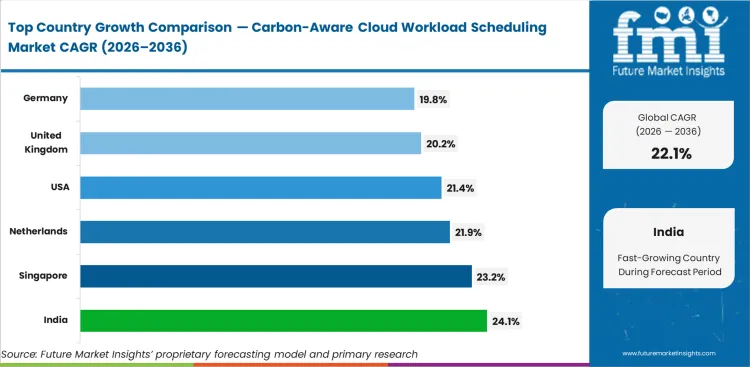
Carbon-Aware Cloud Workload Scheduling Market CAGR Analysis by Country
- United States is expected to grow at 21.4% CAGR through 2036 as adoption expands across qualified enterprise and industrial use cases.
- United Kingdom is expected to grow at 20.2% CAGR through 2036 as adoption expands across qualified enterprise and industrial use cases.
- Germany is expected to grow at 19.8% CAGR through 2036 as adoption expands across qualified enterprise and industrial use cases.
- India is expected to grow at 24.1% CAGR through 2036 as adoption expands across qualified enterprise and industrial use cases.
- Singapore is expected to grow at 23.2% CAGR through 2036 as adoption expands across qualified enterprise and industrial use cases.
- Netherlands is expected to grow at 21.9% CAGR through 2036 as adoption expands across qualified enterprise and industrial use cases.
Demand Outlook for Carbon-Aware Cloud Workload Scheduling Market in United States
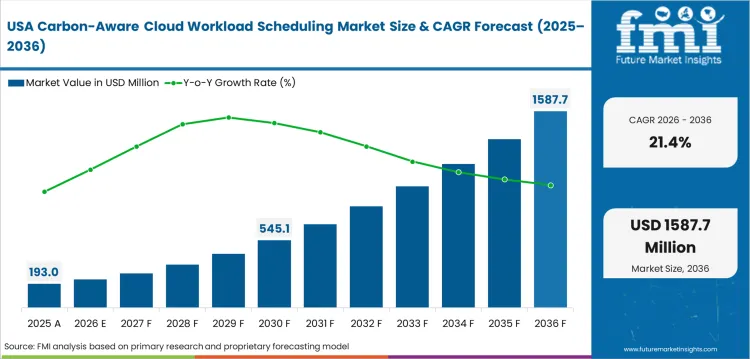
United States is projected to grow at 21.4% CAGR through 2036. Demand is expected to expand where buyers have stronger compliance pressure, larger operating scale, and clearer budget ownership.
- Early demand will come from customers that already feel cost, risk, audit, or uptime pressure.
- Suppliers need local implementation partners and integration support.
- Market conversion will depend on proof of value across repeat deployments.
Demand Outlook for Carbon-Aware Cloud Workload Scheduling Market in United Kingdom
United Kingdom is projected to grow at 20.2% CAGR through 2036. Demand is expected to expand where buyers have stronger compliance pressure, larger operating scale, and clearer budget ownership.
- Early demand will come from customers that already feel cost, risk, audit, or uptime pressure.
- Suppliers need local implementation partners and integration support.
- Market conversion will depend on proof of value across repeat deployments.
Demand Outlook for Carbon-Aware Cloud Workload Scheduling Market in Germany
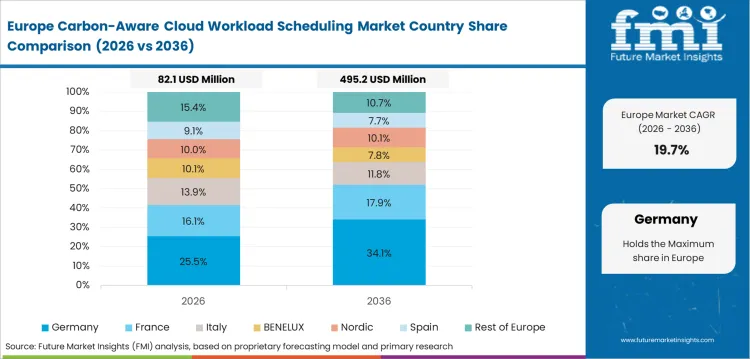
Germany is projected to grow at 19.8% CAGR through 2036. Demand is expected to expand where buyers have stronger compliance pressure, larger operating scale, and clearer budget ownership.
- Early demand will come from customers that already feel cost, risk, audit, or uptime pressure.
- Suppliers need local implementation partners and integration support.
- Market conversion will depend on proof of value across repeat deployments.
Demand Outlook for Carbon-Aware Cloud Workload Scheduling Market in India
India is projected to grow at 24.1% CAGR through 2036. Demand is expected to expand where buyers have stronger compliance pressure, larger operating scale, and clearer budget ownership.
- Early demand will come from customers that already feel cost, risk, audit, or uptime pressure.
- Suppliers need local implementation partners and integration support.
- Market conversion will depend on proof of value across repeat deployments.
Demand Outlook for Carbon-Aware Cloud Workload Scheduling Market in Singapore
Singapore is projected to grow at 23.2% CAGR through 2036. Demand is expected to expand where buyers have stronger compliance pressure, larger operating scale, and clearer budget ownership.
- Early demand will come from customers that already feel cost, risk, audit, or uptime pressure.
- Suppliers need local implementation partners and integration support.
- Market conversion will depend on proof of value across repeat deployments.
Demand Outlook for Carbon-Aware Cloud Workload Scheduling Market in Netherlands
Netherlands is projected to grow at 21.9% CAGR through 2036. Demand is expected to expand where buyers have stronger compliance pressure, larger operating scale, and clearer budget ownership.
- Early demand will come from customers that already feel cost, risk, audit, or uptime pressure.
- Suppliers need local implementation partners and integration support.
- Market conversion will depend on proof of value across repeat deployments.
Competitive Landscape and Strategic Positioning
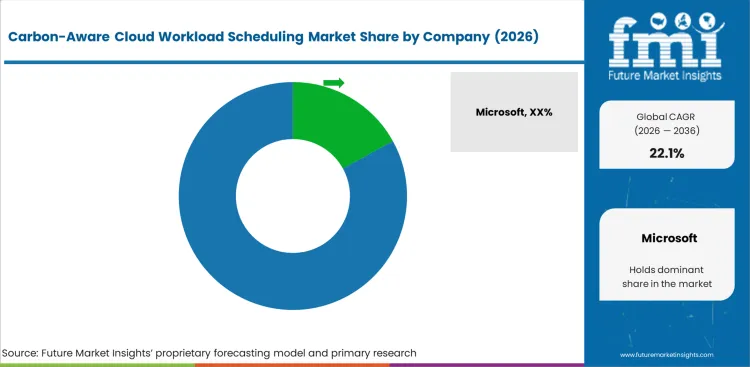
- The market is fragmented across platform vendors, domain specialists, system integrators, and managed service providers.
- Suppliers compete on workflow fit, data quality, integration depth, and proof records.
- Buyer trust depends on deployment support and credible performance documentation.
Competition is shifting from feature comparison to implementation quality. Buyers want vendors that understand the domain, connect with existing systems, and create records that teams can use. Supplier claims need to be backed by usable data and repeatable field performance.
Key Companies in the Carbon-Aware Cloud Workload Scheduling Market
- Microsoft
- Google Cloud
- Electricity Maps
- WattTime
- Cirrus Nexus
- Compute Gardener
- Carbon Aware Cloud
- Green Software Foundation
- FlexiDAO
- IBM
Competitive Benchmarking: Carbon-Aware Cloud Workload Scheduling Market
| Company | Primary Position | Strategic Strength |
|---|---|---|
| Microsoft | Cloud and enterprise platform | Carbon signal integration and workload scheduling capability |
| Google Cloud | Cloud and enterprise platform | Carbon signal integration and workload scheduling capability |
| Electricity Maps | Specialist technology supplier | Carbon signal integration and workload scheduling capability |
| WattTime | Specialist technology supplier | Carbon signal integration and workload scheduling capability |
| Cirrus Nexus | Specialist technology supplier | Carbon signal integration and workload scheduling capability |
| Compute Gardener | Specialist technology supplier | Carbon signal integration and workload scheduling capability |
| Carbon Aware Cloud | Specialist technology supplier | Carbon signal integration and workload scheduling capability |
Key Players in the Carbon-Aware Cloud Workload Scheduling Market
- Key players are expected to compete through qualified deployments, customer proof, integration support, and account expansion. Vendors that turn pilots into recurring programs will be better placed than suppliers that only sell standalone tools.
- The next phase of competition will focus on verified performance. Buyers will ask which workflows can be supported, what data is produced, who validates it, and whether the system can scale across sites.
Report Scope and Coverage
| Attribute | Details |
|---|---|
| Estimated Market Size in 2026 | USD 385.0 million |
| Projected Market Size in 2036 | USD 2,845.0 million |
| Value-based CAGR | 22.1% from 2026 to 2036 |
| Forecast Period | 2026 to 2036 |
| Historical Reference | 2021 to 2025 |
| Quantitative Units | USD million, CAGR, share percentage |
| Key Technology Segments | Carbon-Aware Kubernetes Scheduling, Cloud Region Shifting, Batch Job Deferral, Carbon Intensity APIs, Cost-and-Carbon Optimization |
| Key Countries Covered | United States, United Kingdom, Germany, India, Singapore, Netherlands |
| Key Companies Covered | Microsoft, Google Cloud, Electricity Maps, WattTime, Cirrus Nexus, Compute Gardener, Carbon Aware Cloud, Green Software Foundation, FlexiDAO, IBM |
Carbon-Aware Cloud Workload Scheduling Market by Segments
Carbon-Aware Cloud Workload Scheduling Market Segmented by Technology:
- Carbon-Aware Kubernetes Scheduling
- Cloud Region Shifting
- Batch Job Deferral
- Carbon Intensity APIs
- Cost-and-Carbon Optimization
Carbon-Aware Cloud Workload Scheduling Market Segmented by Workload Type:
- AI training jobs
- Batch analytics
- Serverless functions
- CI/CD workloads
- High-performance computing
Carbon-Aware Cloud Workload Scheduling Market Segmented by Deployment:
- Public cloud
- Hybrid cloud
- Private cloud
- Multi-cloud
- Edge data centers
Carbon-Aware Cloud Workload Scheduling Market Segmented by Buyer Type:
- Cloud platform teams
- Sustainability teams
- FinOps teams
- AI infrastructure teams
- Managed service providers
Carbon-Aware Cloud Workload Scheduling Market by Region:
- North America
- Latin America
- Western Europe
- Eastern Europe
- East Asia
- South Asia and Pacific
- Middle East and Africa
This Report Answers
- What is the current size of the carbon-aware cloud workload scheduling market?
- What CAGR is expected for the carbon-aware cloud workload scheduling market from 2026 to 2036?
- Which segment leads demand in 2026?
- Which countries are expected to grow fastest?
- Which companies are active in the market?
- What restraints limit broader adoption?
- What service model creates the strongest recurring revenue?
Frequently Asked Questions
What is the size of the carbon-aware cloud workload scheduling market in 2026?
The carbon-aware cloud workload scheduling market is expected to reach USD 385.0 million in 2026.
What is the projected value of the carbon-aware cloud workload scheduling market by 2036?
The market is forecast to reach USD 2,845.0 million by 2036.
What is the CAGR for the carbon-aware cloud workload scheduling market?
The market is projected to expand at 22.1% CAGR from 2026 to 2036.
Which segment leads the market?
Kubernetes carbon-aware schedulers are expected to lead with 35.0% share in 2026.
Which countries are expected to grow fastest?
India, Singapore are expected to grow fastest through 2036.
Why is adoption still selective?
Adoption is selective because buyers need proof, integration, user training, and reliable records before scaling deployment.
Preview the report firsthand - request a free sample
Get SampleGet the brochure for pricing and purchase details.
Get PDFTable of Content
- Executive Summary
- Global Market Outlook
- Demand-side Trends
- Supply-side Trends
- Technology Roadmap Analysis
- Analysis and Recommendations
- Market Overview
- Market Coverage / Taxonomy
- Market Definition / Scope / Limitations
- Research Methodology
- Chapter Orientation
- Analytical Lens and Working Hypotheses
- Market Structure, Signals, and Trend Drivers
- Benchmarking and Cross-market Comparability
- Market Sizing, Forecasting, and Opportunity Mapping
- Research Design and Evidence Framework
- Desk Research Programme (Secondary Evidence)
- Company Annual and Sustainability Reports
- Peer-reviewed Journals and Academic Literature
- Corporate Websites, Product Literature, and Technical Notes
- Earnings Decks and Investor Briefings
- Statutory Filings and Regulatory Disclosures
- Technical White Papers and Standards Notes
- Trade Journals, Industry Magazines, and Analyst Briefs
- Conference Proceedings, Webinars, and Seminar Materials
- Government Statistics Portals and Public Data Releases
- Press Releases and Reputable Media Coverage
- Specialist Newsletters and Curated Briefings
- Sector Databases and Reference Repositories
- FMI Internal Proprietary Databases and Historical Market Datasets
- Subscription Datasets and Paid Sources
- Social Channels, Communities, and Digital Listening Inputs
- Additional Desk Sources
- Expert Input and Fieldwork (Primary Evidence)
- Primary Modes
- Qualitative Interviews and Expert Elicitation
- Quantitative Surveys and Structured Data Capture
- Blended Approach
- Why Primary Evidence is Used
- Field Techniques
- Interviews
- Surveys
- Focus Groups
- Observational and In-context Research
- Social and Community Interactions
- Stakeholder Universe Engaged
- C-suite Leaders
- Board Members
- Presidents and Vice Presidents
- R&D and Innovation Heads
- Technical Specialists
- Domain Subject-matter Experts
- Scientists
- Physicians and Other Healthcare Professionals
- Governance, Ethics, and Data Stewardship
- Research Ethics
- Data Integrity and Handling
- Primary Modes
- Tooling, Models, and Reference Databases
- Desk Research Programme (Secondary Evidence)
- Data Engineering and Model Build
- Data Acquisition and Ingestion
- Cleaning, Normalisation, and Verification
- Synthesis, Triangulation, and Analysis
- Quality Assurance and Audit Trail
- Market Background
- Market Dynamics
- Drivers
- Restraints
- Opportunity
- Trends
- Scenario Forecast
- Demand in Optimistic Scenario
- Demand in Likely Scenario
- Demand in Conservative Scenario
- Opportunity Map Analysis
- Product Life Cycle Analysis
- Supply Chain Analysis
- Investment Feasibility Matrix
- Value Chain Analysis
- PESTLE and Porter’s Analysis
- Regulatory Landscape
- Regional Parent Market Outlook
- Production and Consumption Statistics
- Import and Export Statistics
- Market Dynamics
- Global Market Analysis 2021 to 2025 and Forecast, 2026 to 2036
- Historical Market Size Value (USD Million) Analysis, 2021 to 2025
- Current and Future Market Size Value (USD Million) Projections, 2026 to 2036
- Y-o-Y Growth Trend Analysis
- Absolute $ Opportunity Analysis
- Global Market Pricing Analysis 2021 to 2025 and Forecast 2026 to 2036
- Global Market Analysis 2021 to 2025 and Forecast 2026 to 2036, By Technology
- Introduction / Key Findings
- Historical Market Size Value (USD Million) Analysis By Technology , 2021 to 2025
- Current and Future Market Size Value (USD Million) Analysis and Forecast By Technology , 2026 to 2036
- Carbon-Aware Kubernetes Scheduling
- Cloud Region Shifting
- Batch Job Deferral
- Carbon-Aware Kubernetes Scheduling
- Y-o-Y Growth Trend Analysis By Technology , 2021 to 2025
- Absolute $ Opportunity Analysis By Technology , 2026 to 2036
- Global Market Analysis 2021 to 2025 and Forecast 2026 to 2036, By Workload Type
- Introduction / Key Findings
- Historical Market Size Value (USD Million) Analysis By Workload Type, 2021 to 2025
- Current and Future Market Size Value (USD Million) Analysis and Forecast By Workload Type, 2026 to 2036
- AI and Batch Workloads
- CI/CD Workloads
- High-Performance Computing
- AI and Batch Workloads
- Y-o-Y Growth Trend Analysis By Workload Type, 2021 to 2025
- Absolute $ Opportunity Analysis By Workload Type, 2026 to 2036
- Global Market Analysis 2021 to 2025 and Forecast 2026 to 2036, By Solution Type
- Introduction / Key Findings
- Historical Market Size Value (USD Million) Analysis By Solution Type, 2021 to 2025
- Current and Future Market Size Value (USD Million) Analysis and Forecast By Solution Type, 2026 to 2036
- API-based Carbon Signal Services
- Others
- API-based Carbon Signal Services
- Y-o-Y Growth Trend Analysis By Solution Type, 2021 to 2025
- Absolute $ Opportunity Analysis By Solution Type, 2026 to 2036
- Global Market Analysis 2021 to 2025 and Forecast 2026 to 2036, By Region
- Introduction
- Historical Market Size Value (USD Million) Analysis By Region, 2021 to 2025
- Current Market Size Value (USD Million) Analysis and Forecast By Region, 2026 to 2036
- North America
- Latin America
- Western Europe
- Eastern Europe
- East Asia
- South Asia and Pacific
- Middle East & Africa
- Market Attractiveness Analysis By Region
- North America Market Analysis 2021 to 2025 and Forecast 2026 to 2036, By Country
- Historical Market Size Value (USD Million) Trend Analysis By Market Taxonomy, 2021 to 2025
- Market Size Value (USD Million) Forecast By Market Taxonomy, 2026 to 2036
- By Country
- USA
- Canada
- Mexico
- By Technology
- By Workload Type
- By Solution Type
- By Country
- Market Attractiveness Analysis
- By Country
- By Technology
- By Workload Type
- By Solution Type
- Key Takeaways
- Latin America Market Analysis 2021 to 2025 and Forecast 2026 to 2036, By Country
- Historical Market Size Value (USD Million) Trend Analysis By Market Taxonomy, 2021 to 2025
- Market Size Value (USD Million) Forecast By Market Taxonomy, 2026 to 2036
- By Country
- Brazil
- Chile
- Rest of Latin America
- By Technology
- By Workload Type
- By Solution Type
- By Country
- Market Attractiveness Analysis
- By Country
- By Technology
- By Workload Type
- By Solution Type
- Key Takeaways
- Western Europe Market Analysis 2021 to 2025 and Forecast 2026 to 2036, By Country
- Historical Market Size Value (USD Million) Trend Analysis By Market Taxonomy, 2021 to 2025
- Market Size Value (USD Million) Forecast By Market Taxonomy, 2026 to 2036
- By Country
- Germany
- UK
- Italy
- Spain
- France
- Nordic
- BENELUX
- Rest of Western Europe
- By Technology
- By Workload Type
- By Solution Type
- By Country
- Market Attractiveness Analysis
- By Country
- By Technology
- By Workload Type
- By Solution Type
- Key Takeaways
- Eastern Europe Market Analysis 2021 to 2025 and Forecast 2026 to 2036, By Country
- Historical Market Size Value (USD Million) Trend Analysis By Market Taxonomy, 2021 to 2025
- Market Size Value (USD Million) Forecast By Market Taxonomy, 2026 to 2036
- By Country
- Russia
- Poland
- Hungary
- Balkan & Baltic
- Rest of Eastern Europe
- By Technology
- By Workload Type
- By Solution Type
- By Country
- Market Attractiveness Analysis
- By Country
- By Technology
- By Workload Type
- By Solution Type
- Key Takeaways
- East Asia Market Analysis 2021 to 2025 and Forecast 2026 to 2036, By Country
- Historical Market Size Value (USD Million) Trend Analysis By Market Taxonomy, 2021 to 2025
- Market Size Value (USD Million) Forecast By Market Taxonomy, 2026 to 2036
- By Country
- China
- Japan
- South Korea
- By Technology
- By Workload Type
- By Solution Type
- By Country
- Market Attractiveness Analysis
- By Country
- By Technology
- By Workload Type
- By Solution Type
- Key Takeaways
- South Asia and Pacific Market Analysis 2021 to 2025 and Forecast 2026 to 2036, By Country
- Historical Market Size Value (USD Million) Trend Analysis By Market Taxonomy, 2021 to 2025
- Market Size Value (USD Million) Forecast By Market Taxonomy, 2026 to 2036
- By Country
- India
- ASEAN
- Australia & New Zealand
- Rest of South Asia and Pacific
- By Technology
- By Workload Type
- By Solution Type
- By Country
- Market Attractiveness Analysis
- By Country
- By Technology
- By Workload Type
- By Solution Type
- Key Takeaways
- Middle East & Africa Market Analysis 2021 to 2025 and Forecast 2026 to 2036, By Country
- Historical Market Size Value (USD Million) Trend Analysis By Market Taxonomy, 2021 to 2025
- Market Size Value (USD Million) Forecast By Market Taxonomy, 2026 to 2036
- By Country
- Kingdom of Saudi Arabia
- Other GCC Countries
- Turkiye
- South Africa
- Other African Union
- Rest of Middle East & Africa
- By Technology
- By Workload Type
- By Solution Type
- By Country
- Market Attractiveness Analysis
- By Country
- By Technology
- By Workload Type
- By Solution Type
- Key Takeaways
- Key Countries Market Analysis
- USA
- Pricing Analysis
- Market Share Analysis, 2025
- By Technology
- By Workload Type
- By Solution Type
- Canada
- Pricing Analysis
- Market Share Analysis, 2025
- By Technology
- By Workload Type
- By Solution Type
- Mexico
- Pricing Analysis
- Market Share Analysis, 2025
- By Technology
- By Workload Type
- By Solution Type
- Brazil
- Pricing Analysis
- Market Share Analysis, 2025
- By Technology
- By Workload Type
- By Solution Type
- Chile
- Pricing Analysis
- Market Share Analysis, 2025
- By Technology
- By Workload Type
- By Solution Type
- Germany
- Pricing Analysis
- Market Share Analysis, 2025
- By Technology
- By Workload Type
- By Solution Type
- UK
- Pricing Analysis
- Market Share Analysis, 2025
- By Technology
- By Workload Type
- By Solution Type
- Italy
- Pricing Analysis
- Market Share Analysis, 2025
- By Technology
- By Workload Type
- By Solution Type
- Spain
- Pricing Analysis
- Market Share Analysis, 2025
- By Technology
- By Workload Type
- By Solution Type
- France
- Pricing Analysis
- Market Share Analysis, 2025
- By Technology
- By Workload Type
- By Solution Type
- India
- Pricing Analysis
- Market Share Analysis, 2025
- By Technology
- By Workload Type
- By Solution Type
- ASEAN
- Pricing Analysis
- Market Share Analysis, 2025
- By Technology
- By Workload Type
- By Solution Type
- Australia & New Zealand
- Pricing Analysis
- Market Share Analysis, 2025
- By Technology
- By Workload Type
- By Solution Type
- China
- Pricing Analysis
- Market Share Analysis, 2025
- By Technology
- By Workload Type
- By Solution Type
- Japan
- Pricing Analysis
- Market Share Analysis, 2025
- By Technology
- By Workload Type
- By Solution Type
- South Korea
- Pricing Analysis
- Market Share Analysis, 2025
- By Technology
- By Workload Type
- By Solution Type
- Russia
- Pricing Analysis
- Market Share Analysis, 2025
- By Technology
- By Workload Type
- By Solution Type
- Poland
- Pricing Analysis
- Market Share Analysis, 2025
- By Technology
- By Workload Type
- By Solution Type
- Hungary
- Pricing Analysis
- Market Share Analysis, 2025
- By Technology
- By Workload Type
- By Solution Type
- Kingdom of Saudi Arabia
- Pricing Analysis
- Market Share Analysis, 2025
- By Technology
- By Workload Type
- By Solution Type
- Turkiye
- Pricing Analysis
- Market Share Analysis, 2025
- By Technology
- By Workload Type
- By Solution Type
- South Africa
- Pricing Analysis
- Market Share Analysis, 2025
- By Technology
- By Workload Type
- By Solution Type
- USA
- Market Structure Analysis
- Competition Dashboard
- Competition Benchmarking
- Market Share Analysis of Top Players
- By Regional
- By Technology
- By Workload Type
- By Solution Type
- Competition Analysis
- Competition Deep Dive
- Microsoft
- Overview
- Product Portfolio
- Profitability by Market Segments (Product/Age /Sales Channel/Region)
- Sales Footprint
- Strategy Overview
- Marketing Strategy
- Product Strategy
- Channel Strategy
- Google Cloud
- Electricity Maps
- WattTime
- Cirrus Nexus
- Compute Gardener
- Carbon Aware Cloud
- Microsoft
- Competition Deep Dive
- Assumptions & Acronyms Used


