

- Market Size (2026)
- USD 256.6 Mn
- Forecast (2036)
- USD 811.4 Mn
- CAGR (2026 to 2036)
- 12.2%
How big is Grid-Aware AI Workload Scheduling Software Market in 2026?
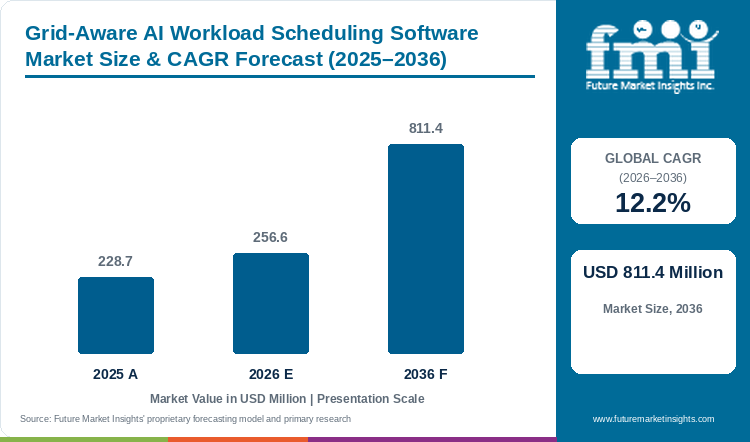
The market was valued at USD 228.7 Million in 2025 and is expected to reach USD 256.6 Million in 2026, with growth at a 12.2% CAGR from 2026 to 2036 taking its value to USD 811.4 Million by 2036.
Grid-aware scheduling connects the job queue with the electrical headroom an installation is permitted to use, allowing operators to consider which work can wait and which service commitments must remain protected. Nonurgent training may offer a usable window that customer-facing inference does not, so the software needs deadlines and authority to act as well as electricity data. Results need to be measured at the relevant site boundary because GPU consumption represents only part of facility demand, with useful completion distinguished from an obligation merely postponed. Local enforcement also needs to retain a known limit if a central service or data feed becomes unavailable. French projects still depend on grid and siting approvals, while staged UAE campuses may have less released electrical capacity than installed compute could use. The forecast measures qualifying scheduling software and excludes electricity sales, compute hardware and general products without this function. [5]
Key Market Trends & Insights
- Monitoring & telemetry holds 27.0% of platform function in 2026, connecting GPU and rack measurements with job priority and actual facility headroom before policy acts.
- SaaS / public cloud holds 38.0% of deployment model in 2026, allowing common administration of workload policies across several clusters with local enforcement still defined.
- 251–500 kW holds 32.0% of AI rack density in 2026, concentrating rack demand within the electrical allowance that the facility is permitted to use.
- Hyperscale AI data centers account for 46.0% of data center type in 2026, with workload priorities determining which jobs can move within a shared electrical limit.
Regional Highlights
- South Korea has the highest profiled CAGR at 13.7% during 2026–2036.
- The next two profiled growth rates are USA at 13.3% and UAE at 13.0% over the same period.
Market Size & Forecast
| Metric | Value |
|---|---|
| 2025 market value | USD 228.7 Million |
| 2026 market estimate | USD 256.6 Million |
| 2036 market forecast | USD 811.4 Million |
| Forecast CAGR, 2026–2036 | 12.2% |
The market covers software used to monitor, plan or control AI workload placement against electrical and grid-related constraints. Compute hardware, electricity sales and general-purpose software without the specified scheduling capability are excluded.
Grid-aware scheduling treats data-center power limits as an input to workload admission, not merely as a facility-design assumption.
Infrastructure readiness and acceptance
| Documented operating context | Source |
|---|---|
| NVIDIA described Mission Control’s AI-factory provisioning, telemetry and recovery functions in March 2025. | [1] |
| NVIDIA announced its acquisition of SchedMD in December 2025 and said Slurm would remain open source. | [2] |
| Red Hat’s May 2025 technical article describes Kueue-based workload admission and GPU resource allocation in OpenShift AI. | [3] |
| The IEA’s 2025 Energy and AI report examines electricity demand and supply constraints associated with AI infrastructure. | [4] |
Analyst Perspective
A scheduling trial needs to show useful work completed within the real electrical allowance while preserving deadlines and recovery commitments. Trustworthy site measurements, local enforcement and a reversible policy let the operator identify the flexibility it can use before extending control across more jobs or locations.
- Sudip Saha, Principal Analyst at Future Market Insights
How is the grid-aware AI workload scheduling software market segmented?
Platform Function covers Monitoring & telemetry, Planning & simulation, Optimization & control, Fault / reliability analytics and Reporting & governance. Deployment Model covers SaaS / public cloud, Private cloud, On-premise and Hybrid deployment. AI Rack Density covers 251–500 kW, 100–250 kW, Below 100 kW and Above 500 kW. Data Center Type covers Hyperscale AI data centers, Colocation AI facilities, Enterprise private AI and HPC & research centers. Commercial Model covers Direct enterprise contract, System integrator / EPC-led, Subscription / license and Managed-service contract.
The connection to data-center infrastructure management is important when the scheduler needs trustworthy site headroom and maintenance-state information.
Why does Monitoring & telemetry lead platform function demand?
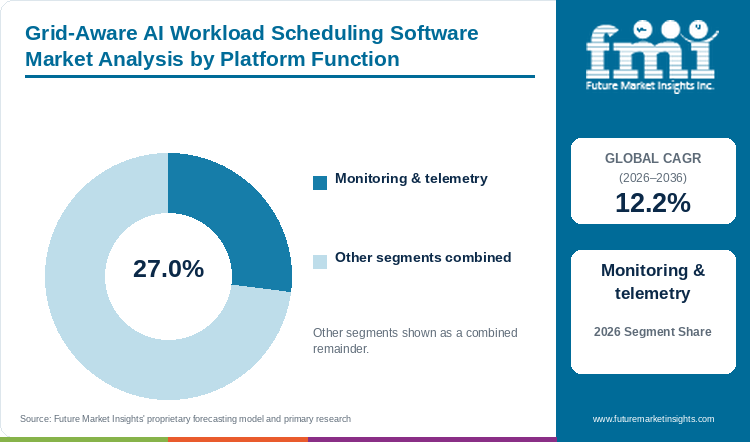
Monitoring & telemetry: 27.0% of platform function in 2026.
Telemetry connects the queue to a physical limit through measurements associated with the correct rack or facility boundary and delivered in time to guide a decision. Application priorities then establish which responses the operator permits, making this information useful even before automated dispatch begins. For closed-loop use, the data need to reach admission or execution policy and remain traceable afterward, allowing the owner to connect a scheduling change with both facility demand and the work completed.
- The Monitoring & telemetry segment accounts for 27.0% of platform function in 2026.
- Metering at the relevant site boundary helps distinguish a real reduction in facility demand from a change visible only in GPU statistics.
Why does SaaS / public cloud lead deployment model demand?
SaaS / public cloud: 38.0% of deployment model in 2026.
A hosted platform can administer common policies across several clusters, reducing the need for a separate management system at every site. The electrical limit remains binding during connectivity loss, however, so local enforcement and permission boundaries need to be designed alongside central administration. Buyers must establish which telemetry can leave the installation and which commands the service may issue, preserving a known scheduling policy when the hosted connection is unavailable.
- The SaaS / public cloud segment accounts for 38.0% of deployment model in 2026.
- Loss of the hosted service should not leave a site without an enforceable power limit or a known local scheduling policy.
What are the drivers, restraints, and opportunities in the grid-aware AI workload scheduling software market?
Grid limits become a workload-planning input
A delayed connection or contractual import ceiling can leave an operator with less usable power than its installed compute could consume. Sequencing flexible jobs offers a way to work within that limit. The scheduler can protect priority services while assigning nonurgent work to available windows. This is a practical response only where the customer has permission to alter the schedule. Buyers should measure the additional work completed or the peak excursions avoided under the same electrical allowance. Those results provide a firmer basis for purchase than a theoretical ability to move every workload.
Service commitments restrict dispatch flexibility
Job and facility systems need consistent identifiers and an agreed power boundary before scheduling can connect their different views of the installation. Distributed training also requires dependable checkpoint and restart behavior, while deadlines and recovery commitments limit the work that can move. Suppliers need to state which site loads the software governs so a useful peak-control result remains within its actual authority.
Queue-aware power policies can improve usable capacity
A focused pilot can begin with nonurgent retraining or test jobs whose timing is already flexible. The operator can then compare dispatch changes with measured site demand and completed work. This makes the effect easier to evaluate than a broad optimization exercise across all services. Vendors can support policy design and integration around that defined use. Expansion should follow evidence that the controls preserve deadlines and restart correctly. Utility incentives may strengthen the case where applicable but the customer first needs a dependable way to exercise the workload flexibility it actually owns.
Evidence from AI infrastructure commissioning can establish the operating limits that a scheduler should respect before it is allowed to influence production workloads.
Which country and market CAGRs are profiled for grid-aware AI workload scheduling software?
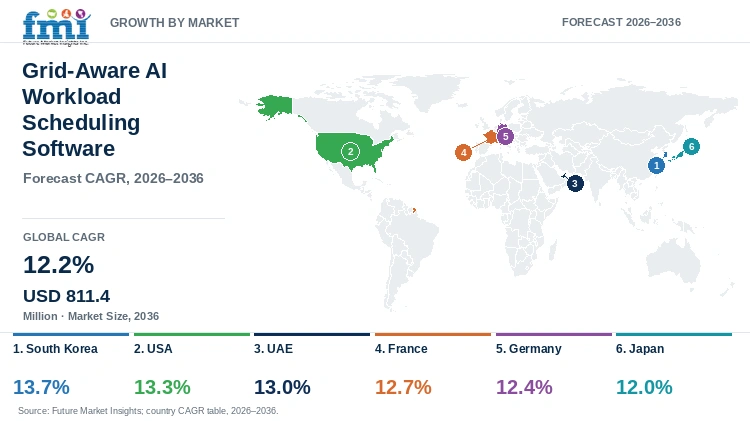
| Country | CAGR |
|---|---|
| South Korea | 13.7% |
| USA | 13.3% |
| UAE | 13.0% |
| France | 12.7% |
| Germany | 12.4% |
| Japan | 12.0% |
Country-wise Analysis
South Korea
- Local feeder and facility limits need to reach job-admission policy in South Korean AI operations, with reliability planning providing context rather than an instruction to shift every task. Flexible training windows offer a different opportunity from immediate-response services, and the operator must have authority over the queue. South Korea has the fastest profiled forecast, at a 13.7% CAGR from 2026 to 2036, within those practical scheduling choices.
USA
- Interconnection uncertainty can give American operators reason to stagger flexible GPU work while protecting priority inference, provided a pilot demonstrates the effect at the site meter. Utility signals, restart behavior and rollback need to be tested together so demand control does not compromise a service commitment. The USA’s 13.3% CAGR forecast for 2026 to 2036 accompanies this use of constrained feeder capacity.
UAE
- Staged UAE campuses may have computing equipment ready before the corresponding electrical capacity is released, creating a scheduling opportunity within a known boundary. Buyers need to compare completed work under that permitted load with the existing policy, while tenant priorities and protection retain explicit authority. The UAE is forecast to grow at a 13.0% CAGR from 2026 to 2036 as software addresses the flexibility that operators can actually use.
France
- French projects need transmission approval even where workload flexibility may inform site planning, after which a scheduler must respect the connection limit alongside data location and deadlines. Flexible batch work may move in time while latency-sensitive services stay fixed, making permission to act distinct from observing electricity conditions. France’s forecast is a 12.7% CAGR from 2026 to 2036 within these connection and service requirements.
Germany
- German buyers need metering that distinguishes a scheduling effect from cooling improvements or utility demand response, with integration into energy management helping explain the result. A record of jobs that may be delayed and commitments that remain binding connects each action to the constraint being managed. This operating evidence accompanies Germany’s 12.4% CAGR forecast for 2026 to 2036.
Japan
- Regional electricity availability in Japan has to be considered with network performance and the location of AI users, which can leave fewer placement choices than a global demonstration suggests. Owners and platform teams need to agree who can authorize a move across the sites and execution windows actually available. Japan is forecast to grow at a 12.0% CAGR from 2026 to 2036, with data-transfer cost and completion deadlines shaping the usable flexibility.
Who are the notable companies in the grid-aware AI workload scheduling software market?
NVIDIA, including SchedMD; Red Hat; Hewlett Packard Enterprise; IBM; Siemens Digital Industries Software
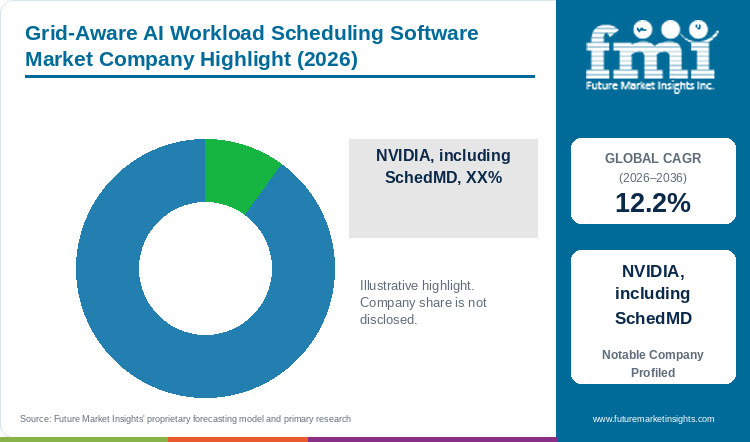
Workload-platform vendors can control queues without owning the facility interface. Infrastructure suppliers may provide a reliable site limit without deciding which jobs can be delayed. Buyers need those responsibilities to meet in a workable scheduling policy. Neither capability alone establishes a complete grid-aware deployment.
Competitive Benchmarking: Grid-Aware AI Workload Scheduling Software Market
| Participant | Commercial focus | Buyer qualification priority |
|---|---|---|
| NVIDIA, including SchedMD | AI workload and cluster management | Scheduler integration and recovery controls |
| Red Hat | Kubernetes and OpenShift AI platforms | Admission policy and operational consistency |
| Hewlett Packard Enterprise | Hybrid infrastructure operations | Workload-to-infrastructure visibility |
| IBM | Enterprise workload orchestration | Priority rules and queue governance |
| Siemens Digital Industries Software | HPC workload-management software | Policy integration and deployment support |
Key Developments in the Grid-Aware AI Workload Scheduling Software Market
- NVIDIA described Mission Control’s AI-factory provisioning, telemetry and recovery functions in March 2025. [1]
- NVIDIA announced its acquisition of SchedMD in December 2025 and said Slurm would remain open source. [2]
Key Players in the Grid-Aware AI Workload Scheduling Software Market
- NVIDIA, including SchedMD
- Red Hat
- Hewlett Packard Enterprise
- IBM
- Siemens Digital Industries Software
Grid-Aware AI Workload Scheduling Software Market - Report Scope
| Coverage field | Report scope |
|---|---|
| Market breakdown | Platform Function; Deployment Model; AI Rack Density; Data Center Type; Commercial Model; Region |
| Quantitative unit | USD Million |
| Market definition | The market covers software used to monitor, plan or control AI workload placement against electrical and grid-related constraints. Compute hardware, electricity sales and general-purpose software without the specified scheduling capability are excluded. |
| Regions covered | North America; Latin America; Western Europe; Eastern Europe; East Asia; South Asia and Pacific; Middle East and Africa |
| Countries / markets profiled | South Korea; USA; UAE; France; Germany; Japan |
| Key companies profiled | NVIDIA, including SchedMD; Red Hat; Hewlett Packard Enterprise; IBM; Siemens Digital Industries Software |
| Base year / forecast period | 2026 / 2026–2036 |
| Estimate coverage | 2025 and 2026 market estimates; 2036 forecast; segment shares and country / market CAGRs. |
Grid-Aware AI Workload Scheduling Software Market - Research Methodology
| Method | Application |
|---|---|
| Market definition | The analysis follows the stated product or service boundary and distinguishes direct category revenue from adjacent activities. |
| Secondary research | Official technical, regulatory, research and company publications provide the documented operating context and recent developments cited in this report. |
| Forecast and segmentation | Market estimates, segment shares and geographic forecasts are presented as analytical estimates within the stated commercial scope. |
| Competitive assessment | Participants are compared by their relevant products or services, commercial role and buyer qualification requirements. |
| Interpretation | The assessment considers purchasing conditions and the scope of the documented product, service or performance claim. |
Grid-Aware AI Workload Scheduling Software Market by Segments
Platform Function
- Monitoring & telemetry
- Planning & simulation
- Optimization & control
- Fault / reliability analytics
- Reporting & governance
Deployment Model
- SaaS / public cloud
- Private cloud
- On-premise
- Hybrid deployment
AI Rack Density
- 251-500 kW
- 100-250 kW
- Below 100 kW
- Above 500 kW
Data Center Type
- Hyperscale AI data centers
- Colocation AI facilities
- Enterprise private AI
- HPC & research centers
Commercial Model
- Direct enterprise contract
- System integrator / EPC-led
- Subscription / license
- Managed-service contract
Grid-Aware AI Workload Scheduling Software Market by Region
- North America
- United States
- Canada
- Latin America
- Brazil
- Mexico
- Argentina
- Chile
- Western Europe
- Germany
- France
- United Kingdom
- Italy
- Spain
- Benelux
- Nordics
- Eastern Europe
- Poland
- Czech Republic
- Romania
- Hungary
- East Asia
- China
- Japan
- South Korea
- South Asia and Pacific
- India
- ASEAN
- Australia and New Zealand
- Middle East and Africa
- GCC Countries
- South Africa
- Türkiye
- Israel
Research Sources and Bibliography
- [1] NVIDIA. (2025, March 25). Automating AI Factories with NVIDIA Mission Control.
- [2] NVIDIA. (2025, December 15). NVIDIA Acquires Open-Source Workload Management Provider SchedMD.
- [3] Red Hat. (2025, May 22). Improve GPU utilization with Kueue in OpenShift AI.
- [4] International Energy Agency. (2025, April 10). Energy and AI.
- [5] Future Market Insights. (2026). Grid-Aware AI Workload Scheduling Software Market: Global industry analysis and opportunity assessment, 2026–2036.
This Report Answers
- How large is the grid-aware AI workload scheduling software market in 2026?
- What value and CAGR are forecast through 2036?
- Which platform function segment leads in 2026?
- Which deployment model segment has the largest share?
- Which profiled country or market has the fastest forecast growth?
- Which participants are covered in the competitive assessment?
Frequently Asked Questions
How large is the grid-aware AI workload scheduling software market in 2026?
The market was valued at USD 228.7 Million in 2025 and is expected to reach USD 256.6 Million in 2026.
What value and CAGR are forecast through 2036?
The market is projected to reach USD 811.4 Million by 2036, with a 12.2% CAGR during 2026–2036.
Which platform function segment leads in 2026?
The Monitoring & telemetry segment accounts for 27.0% of platform function in 2026.
Which deployment model segment has the largest share?
The SaaS / public cloud segment accounts for 38.0% of deployment model in 2026.
Which profiled country or market has the fastest forecast growth?
South Korea has the highest profiled CAGR at 13.7% during 2026–2036.
Which participants are covered in the competitive assessment?
The assessment covers NVIDIA, including SchedMD, Red Hat, Hewlett Packard Enterprise, IBM and Siemens Digital Industries Software.
Preview the report firsthand - request a free sample
Get SampleGet the brochure for pricing and purchase details.
Get PDFTable of Content
- Key Takeaways
- Market Size and CAGR
- Top Growth Driver
- Fastest Growing Segment
- Leading Region
- Key Companies
- Emerging Opportunities
- Executive Summary
- Global Market Outlook
- Demand-side Trends
- Supply-side Trends
- Technology Roadmap Analysis
- Analysis and Recommendations
- Analyst Perspective (What is happening? Why now? What should investors know?)
- Key Questions Answered
- How large is the market?
- What is the CAGR?
- What are key trends?
- Which region dominates?
- Who are the leaders?
- Market Overview
- Market Coverage / Taxonomy
- Market Definition / Scope / Limitations
- Research Methodology
- Chapter Orientation
- Analytical Lens and Working Hypotheses
- Market Structure, Signals, and Trend Drivers
- Benchmarking and Cross-market Comparability
- Market Sizing, Forecasting, and Opportunity Mapping
- Research Design and Evidence Framework
- Desk Research Programme (Secondary Evidence)
- Expert Input and Fieldwork (Primary Evidence)
- Tooling, Models, and Reference Databases
- Data Engineering and Model Build
- Quality Assurance and Audit Trail
- Market Background
- Market Dynamics (Drivers, Restraints, Opportunity, Trends)
- Scenario Forecast (Optimistic, Likely, Conservative)
- Impact Analysis
- AI Impact
- Sustainability Impact
- Regulatory Impact
- Technology Impact
- Consumer / Buyer Analysis
- Purchase Drivers
- Adoption Barriers
- Buyer Journey
- Opportunity Map Analysis
- Product Life Cycle Analysis
- Supply Chain Analysis
- Investment Feasibility Matrix
- Value Chain Analysis
- PESTLE and Porter's Analysis
- Regulatory Landscape
- Regional Parent Market Outlook
- Production and Consumption Statistics
- Import and Export Statistics
- Global Market Analysis and Forecast, 2021 to 2036
- Historical Market Size Value (USD Million) Analysis, 2021 to 2025
- Current and Future Market Size Value (USD Million) Projections, 2026 to 2036
- Y-o-Y Growth Trend Analysis
- Absolute $ Opportunity Analysis
- Global Market Pricing Analysis, 2021 to 2036
- Global Market Analysis and Forecast, By Platform Function, 2021 to 2036
- Introduction / Key Findings
- Historical Market Size Value (USD Million) Analysis By Platform Function, 2021 to 2025
- Current and Future Market Size Value (USD Million) Analysis and Forecast By Platform Function, 2026 to 2036
- Monitoring & telemetry
- Planning & simulation
- Optimization & control
- Fault / reliability analytics
- Reporting & governance
- Y-o-Y Growth Trend Analysis By Platform Function, 2021 to 2025
- Absolute $ Opportunity Analysis By Platform Function, 2026 to 2036
- Global Market Analysis and Forecast, By Deployment Model, 2021 to 2036
- Introduction / Key Findings
- Historical Market Size Value (USD Million) Analysis By Deployment Model, 2021 to 2025
- Current and Future Market Size Value (USD Million) Analysis and Forecast By Deployment Model, 2026 to 2036
- SaaS / public cloud
- Private cloud
- On-premise
- Hybrid deployment
- Y-o-Y Growth Trend Analysis By Deployment Model, 2021 to 2025
- Absolute $ Opportunity Analysis By Deployment Model, 2026 to 2036
- Global Market Analysis and Forecast, By AI Rack Density, 2021 to 2036
- Introduction / Key Findings
- Historical Market Size Value (USD Million) Analysis By AI Rack Density, 2021 to 2025
- Current and Future Market Size Value (USD Million) Analysis and Forecast By AI Rack Density, 2026 to 2036
- 251–500 kW
- 100–250 kW
- Below 100 kW
- Above 500 kW
- Y-o-Y Growth Trend Analysis By AI Rack Density, 2021 to 2025
- Absolute $ Opportunity Analysis By AI Rack Density, 2026 to 2036
- Global Market Analysis and Forecast, By Data Center Type, 2021 to 2036
- Introduction / Key Findings
- Historical Market Size Value (USD Million) Analysis By Data Center Type, 2021 to 2025
- Current and Future Market Size Value (USD Million) Analysis and Forecast By Data Center Type, 2026 to 2036
- Hyperscale AI data centers
- Colocation AI facilities
- Enterprise private AI
- HPC & research centers
- Y-o-Y Growth Trend Analysis By Data Center Type, 2021 to 2025
- Absolute $ Opportunity Analysis By Data Center Type, 2026 to 2036
- Global Market Analysis and Forecast, By Commercial Model, 2021 to 2036
- Introduction / Key Findings
- Historical Market Size Value (USD Million) Analysis By Commercial Model, 2021 to 2025
- Current and Future Market Size Value (USD Million) Analysis and Forecast By Commercial Model, 2026 to 2036
- Direct enterprise contract
- System integrator / EPC-led
- Subscription / license
- Managed-service contract
- Y-o-Y Growth Trend Analysis By Commercial Model, 2021 to 2025
- Absolute $ Opportunity Analysis By Commercial Model, 2026 to 2036
- Global Market Analysis and Forecast, By Region, 2021 to 2036
- Introduction
- Historical Market Size Value (USD Million) Analysis By Region, 2021 to 2025
- Current Market Size Value (USD Million) Analysis and Forecast By Region, 2026 to 2036
- North America
- Latin America
- Western Europe
- Eastern Europe
- East Asia
- South Asia and Pacific
- Middle East and Africa
- Market Attractiveness Analysis By Region
- North America Market Analysis and Forecast, By Country, 2021 to 2036
- Historical Market Size Value (USD Million) Trend Analysis By Market Taxonomy, 2021 to 2025
- Market Size Value (USD Million) Forecast By Market Taxonomy, 2026 to 2036
- By Country
- United States
- Canada
- By Platform Function
- By Deployment Model
- By AI Rack Density
- By Data Center Type
- By Commercial Model
- By Country
- Market Attractiveness Analysis
- By Country
- By Platform Function
- By Deployment Model
- By AI Rack Density
- By Data Center Type
- By Commercial Model
- Key Takeaways
- Latin America Market Analysis and Forecast, By Country
- Historical Market Size Value (USD Million) Trend Analysis By Market Taxonomy, 2021 to 2025
- Market Size Value (USD Million) Forecast By Market Taxonomy, 2026 to 2036
- By Country
- Brazil
- Mexico
- Argentina
- Chile
- By Platform Function
- By Deployment Model
- By AI Rack Density
- By Data Center Type
- By Commercial Model
- By Country
- Market Attractiveness Analysis
- By Country
- By Platform Function
- By Deployment Model
- By AI Rack Density
- By Data Center Type
- By Commercial Model
- Key Takeaways
- Western Europe Market Analysis and Forecast, By Country
- Historical Market Size Value (USD Million) Trend Analysis By Market Taxonomy, 2021 to 2025
- Market Size Value (USD Million) Forecast By Market Taxonomy, 2026 to 2036
- By Country
- Germany
- France
- United Kingdom
- Italy
- Spain
- Benelux
- Nordics
- By Platform Function
- By Deployment Model
- By AI Rack Density
- By Data Center Type
- By Commercial Model
- By Country
- Market Attractiveness Analysis
- By Country
- By Platform Function
- By Deployment Model
- By AI Rack Density
- By Data Center Type
- By Commercial Model
- Key Takeaways
- Eastern Europe Market Analysis and Forecast, By Country
- Historical Market Size Value (USD Million) Trend Analysis By Market Taxonomy, 2021 to 2025
- Market Size Value (USD Million) Forecast By Market Taxonomy, 2026 to 2036
- By Country
- Poland
- Czech Republic
- Romania
- Hungary
- By Platform Function
- By Deployment Model
- By AI Rack Density
- By Data Center Type
- By Commercial Model
- By Country
- Market Attractiveness Analysis
- By Country
- By Platform Function
- By Deployment Model
- By AI Rack Density
- By Data Center Type
- By Commercial Model
- Key Takeaways
- East Asia Market Analysis and Forecast, By Country
- Historical Market Size Value (USD Million) Trend Analysis By Market Taxonomy, 2021 to 2025
- Market Size Value (USD Million) Forecast By Market Taxonomy, 2026 to 2036
- By Country
- China
- Japan
- South Korea
- By Platform Function
- By Deployment Model
- By AI Rack Density
- By Data Center Type
- By Commercial Model
- By Country
- Market Attractiveness Analysis
- By Country
- By Platform Function
- By Deployment Model
- By AI Rack Density
- By Data Center Type
- By Commercial Model
- Key Takeaways
- South Asia and Pacific Market Analysis and Forecast, By Country
- Historical Market Size Value (USD Million) Trend Analysis By Market Taxonomy, 2021 to 2025
- Market Size Value (USD Million) Forecast By Market Taxonomy, 2026 to 2036
- By Country
- India
- ASEAN
- Australia and New Zealand
- By Platform Function
- By Deployment Model
- By AI Rack Density
- By Data Center Type
- By Commercial Model
- By Country
- Market Attractiveness Analysis
- By Country
- By Platform Function
- By Deployment Model
- By AI Rack Density
- By Data Center Type
- By Commercial Model
- Key Takeaways
- Middle East and Africa Market Analysis and Forecast, By Country
- Historical Market Size Value (USD Million) Trend Analysis By Market Taxonomy, 2021 to 2025
- Market Size Value (USD Million) Forecast By Market Taxonomy, 2026 to 2036
- By Country
- GCC Countries
- South Africa
- Türkiye
- Israel
- By Platform Function
- By Deployment Model
- By AI Rack Density
- By Data Center Type
- By Commercial Model
- By Country
- Market Attractiveness Analysis
- By Country
- By Platform Function
- By Deployment Model
- By AI Rack Density
- By Data Center Type
- By Commercial Model
- Key Takeaways
- Key Countries Market Analysis
- United States
- Pricing Analysis
- Market Share Analysis, 2025
- By Platform Function
- By Deployment Model
- By AI Rack Density
- By Data Center Type
- By Commercial Model
- Canada
- Pricing Analysis
- Market Share Analysis, 2025
- By Platform Function
- By Deployment Model
- By AI Rack Density
- By Data Center Type
- By Commercial Model
- Mexico
- Pricing Analysis
- Market Share Analysis, 2025
- By Platform Function
- By Deployment Model
- By AI Rack Density
- By Data Center Type
- By Commercial Model
- Brazil
- Pricing Analysis
- Market Share Analysis, 2025
- By Platform Function
- By Deployment Model
- By AI Rack Density
- By Data Center Type
- By Commercial Model
- Chile
- Pricing Analysis
- Market Share Analysis, 2025
- By Platform Function
- By Deployment Model
- By AI Rack Density
- By Data Center Type
- By Commercial Model
- Germany
- Pricing Analysis
- Market Share Analysis, 2025
- By Platform Function
- By Deployment Model
- By AI Rack Density
- By Data Center Type
- By Commercial Model
- United Kingdom
- Pricing Analysis
- Market Share Analysis, 2025
- By Platform Function
- By Deployment Model
- By AI Rack Density
- By Data Center Type
- By Commercial Model
- Italy
- Pricing Analysis
- Market Share Analysis, 2025
- By Platform Function
- By Deployment Model
- By AI Rack Density
- By Data Center Type
- By Commercial Model
- Spain
- Pricing Analysis
- Market Share Analysis, 2025
- By Platform Function
- By Deployment Model
- By AI Rack Density
- By Data Center Type
- By Commercial Model
- France
- Pricing Analysis
- Market Share Analysis, 2025
- By Platform Function
- By Deployment Model
- By AI Rack Density
- By Data Center Type
- By Commercial Model
- India
- Pricing Analysis
- Market Share Analysis, 2025
- By Platform Function
- By Deployment Model
- By AI Rack Density
- By Data Center Type
- By Commercial Model
- ASEAN
- Pricing Analysis
- Market Share Analysis, 2025
- By Platform Function
- By Deployment Model
- By AI Rack Density
- By Data Center Type
- By Commercial Model
- Australia and New Zealand
- Pricing Analysis
- Market Share Analysis, 2025
- By Platform Function
- By Deployment Model
- By AI Rack Density
- By Data Center Type
- By Commercial Model
- China
- Pricing Analysis
- Market Share Analysis, 2025
- By Platform Function
- By Deployment Model
- By AI Rack Density
- By Data Center Type
- By Commercial Model
- Japan
- Pricing Analysis
- Market Share Analysis, 2025
- By Platform Function
- By Deployment Model
- By AI Rack Density
- By Data Center Type
- By Commercial Model
- South Korea
- Pricing Analysis
- Market Share Analysis, 2025
- By Platform Function
- By Deployment Model
- By AI Rack Density
- By Data Center Type
- By Commercial Model
- Poland
- Pricing Analysis
- Market Share Analysis, 2025
- By Platform Function
- By Deployment Model
- By AI Rack Density
- By Data Center Type
- By Commercial Model
- Hungary
- Pricing Analysis
- Market Share Analysis, 2025
- By Platform Function
- By Deployment Model
- By AI Rack Density
- By Data Center Type
- By Commercial Model
- Türkiye
- Pricing Analysis
- Market Share Analysis, 2025
- By Platform Function
- By Deployment Model
- By AI Rack Density
- By Data Center Type
- By Commercial Model
- South Africa
- Pricing Analysis
- Market Share Analysis, 2025
- By Platform Function
- By Deployment Model
- By AI Rack Density
- By Data Center Type
- By Commercial Model
- UAE
- Pricing Analysis
- Market Share Analysis, 2025
- By Platform Function
- By Deployment Model
- By AI Rack Density
- By Data Center Type
- By Commercial Model
- United States
- Market Structure Analysis
- Competition Dashboard
- Competition Benchmarking
- Market Share Analysis of Top Players
- By Regional
- By Platform Function
- By Deployment Model
- By AI Rack Density
- By Data Center Type
- By Commercial Model
- Emerging Startups
- Innovation Benchmarking
- Competition Analysis
- Competition Deep Dive
- NVIDIA, including SchedMD
- Overview
- Product Portfolio
- Profitability by Market Segments
- Sales Footprint
- Strategy Overview
- Marketing Strategy
- Product Strategy
- Channel Strategy
- Red Hat
- Hewlett Packard Enterprise
- IBM
- Siemens Digital Industries Software
- NVIDIA, including SchedMD
- Case Studies
- Success Stories
- Recent Developments
- Competition Deep Dive
- Assumptions & Acronyms Used


