

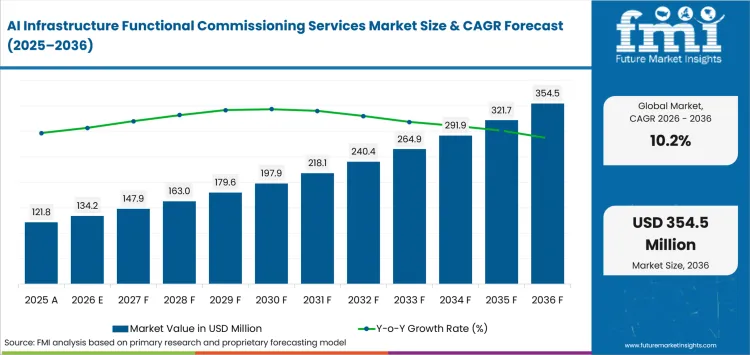
- Market Size (2026)
- USD 134.2 Mn
- Forecast (2036)
- USD 354.5 Mn
- CAGR (2026 to 2036)
- 10.2%
How big is AI Infrastructure Functional Commissioning Services Market in 2026?
USD 134.2 million in 2026 and USD 354.5 million by 2036 at a 10.2% CAGR.
Demand for AI infrastructure functional commissioning services is projected to rise from USD 134.2 million in 2026 to USD 354.5 million by 2036 at a 10.2% CAGR. Dense AI halls place liquid cooling infrastructure inside the same acceptance sequence as protection and controls. Data center power management must reconcile those dependencies before operators release expensive compute. In June 2026, ASHRAE joined NEMA and PNNL to publish guidance spanning design through commissioning and ongoing operation. Lifecycle guidance raises the value of witnessed system behavior over isolated equipment startup.
Site power readiness determines how much protection logic teams can test under realistic load. In April 2025, the USA Department of Energy identified 16 federal sites with energy infrastructure suitable for faster AI data-center development. Similar project pipelines still reach commissioning at different stages of utility readiness. Data center switchgear must be energized before many protection sequences can be proved under load. Defined partial-energization and retest gates preserve acceptance quality when final utility capacity becomes available.
Key Takeaways
- Higher AI rack densities increase demand for integrated functional proof because power and thermal failures now propagate through shared controls and protection logic.
- By service scope, commissioning & acceptance is estimated to hold 27.0% in 2026 owing to the formal evidence required before operational handover.
- New AI hall build is projected to represent 36.0% of project stage in 2026 because greenfield halls introduce the widest first-time interface set.
- The 251-500 kW band is anticipated to capture 32.0% of AI rack density in 2026 as coordinated electrical and thermal validation becomes routine.
- Late energization and changing control interfaces can compress realistic test windows, forcing staged acceptance and later retesting before final compute release.
- Some of the key players in this market include Vertiv, Schneider Electric, Eaton, Siemens, Johnson Controls, ABB, Jacobs, and Exyte.
Analyst Perspective
"Commissioning offers should be judged by how well the team traces rack requirements into testable power, cooling and control sequences before site execution. Commercial value is earned when the same evidence shortens deficiency closure and supports later capacity changes without reopening basic acceptance questions."
- Sudip saha, Principal Consultant, Future Market Insights
How is the AI infrastructure functional commissioning services market segmented?
Service scope; project stage; AI rack density; data center type; commercial model; region.
Service scope: commissioning & acceptance, design & engineering, performance validation, retrofit & migration, managed support. Project stage: new AI hall build, rack/pod deployment, capacity expansion, legacy conversion, ongoing operations. AI rack density: below 100 kW, 100-250 kW, 251-500 kW, above 500 kW. Data center type: hyperscale AI data centers, colocation AI facilities, enterprise private AI, HPC & research centers. Commercial model: direct enterprise contract, system integrator / EPC-led, subscription / license, managed-service contract.
Why does 251-500 kW lead the AI rack density category?
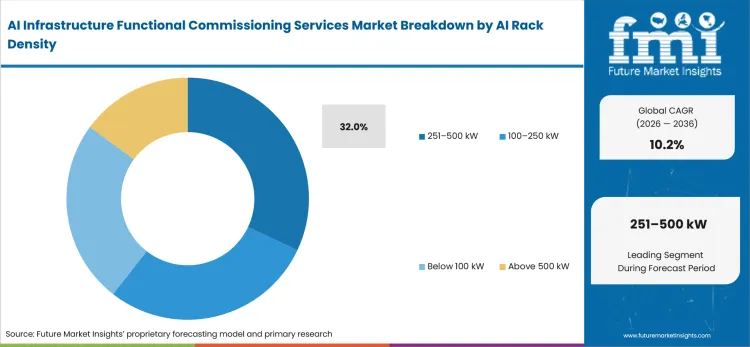
The 251-500 kW range moves commissioning beyond isolated nameplate checks because busway loading and coolant response must be proved under the same sequence. Schneider Electric's March 2026 NVIDIA reference design validated power and cooling for rack-scale AI systems with digital simulation before physical deployment.
- By AI rack density, 251-500 kW is anticipated to capture 32.0% in 2026 given its broad use of coordinated electrical and thermal acceptance.
- Power quality monitoring warrants closer review because rapid load changes expose upstream protection settings and controls timing. The band supports repeatable methods without forcing every project into an extreme-density custom test plan.
Why does commissioning & acceptance lead the service scope category?
Commissioning & acceptance begins once installed infrastructure must prove that power and cooling respond correctly under the owner's defined operating sequences. Vertiv's June 2026 SmartRun announcement gave electrical digital twins a direct operational role from simulation into commissioning and lifecycle assurance.
- By service scope, commissioning & acceptance is estimated to hold 27.0% in 2026 because handover depends on witnessed evidence for integrated sequences.
- Teams can reuse modeled dependencies during factory acceptance testing and onsite retesting after deficiencies close. Reusing modeled dependencies reduces disputes over whether a failed sequence belongs to equipment setup, controls integration or facility operation.
Why does new AI hall build lead the project stage category?
New AI halls concentrate first-time electrical and thermal interfaces before any stable operating baseline exists. Johnson Controls published gigawatt-scale thermal reference designs in February 2026 that map the thermal chain from chip cooling to heat rejection.
- New AI hall build is projected to hold 36.0% of project stage in 2026 owing to the broad initial test scope for newly integrated infrastructure.
- Design-stage commissioning can align coolant loops with LV/MV power distribution before field changes become expensive. Greenfield programs therefore place more value on early test planning and repeatable acceptance evidence before major equipment reaches site.
Why do hyperscale AI data centers lead the data center type category?
Hyperscale programs repeat similar infrastructure blocks while holding tight time-to-capacity targets during phased campus delivery. The IEA estimated in April 2025 that cooling uses about 7% of electricity in efficient hyperscale data centers versus more than 30% in less-efficient enterprise facilities.
- Hyperscale AI data centers are estimated to hold 46.0% of data center type in 2026 because repeated blocks increase the value of consistent acceptance criteria.
- Standardized designs still require proof that critical power and cooling behave like the reference unit at every phase. A defect found early can prevent the same integration fault from being replicated throughout a campus program.
What are the drivers, restraints and opportunities in the AI Infrastructure Functional Commissioning Services Market?
Higher AI rack density increases system-level acceptance work, while power-access delays compress test windows and digital validation moves defect discovery earlier.
- Driver: Larger AI power blocks require electrical, thermal and control functions to be proved under shared operating sequences before production handover.
- Restraint: Grid connection delays and late equipment interfaces reduce the time available for realistic full-load testing before scheduled compute deployment.
- Opportunity: Virtual commissioning and reusable digital baselines can shift interface checks earlier and support targeted recommissioning after material capacity changes.
Dense Power Blocks Expand Integrated Acceptance
Higher power concentration forces teams to test more interfaces together before an AI hall carries production compute. The USA Department of Energy noted in April 2025 that data-center designs range from 10 MW to 1 GW. Data center power systems at that scale place protection logic and cooling response inside the same go-live decision, so commissioning firms translate rack requirements into repeatable facility-level tests.
Grid Bottlenecks Compress Realistic Test Windows
Commissioning schedules lose realistic load-testing time when energization arrives after the planned test window closes. In April 2026 the IEA recorded a 17% rise in data-center electricity demand during 2025 while grid connections and equipment supply delayed projects. Late power availability can force temporary loads or partial acceptance before final retesting, so teams need explicit retest triggers protecting evidence quality for protection sequences and thermal response.
Virtual Commissioning Moves Defect Discovery Earlier
Digital validation gives engineering teams a second place to find interface conflicts before physical equipment is fully installed. Jacobs released an AI data-center digital twin in March 2026 that simulates compute, power and cooling during virtual commissioning. Liquid-cooled edge infrastructure can apply the same principle in distributed deployments, allowing service teams to reuse the model as a baseline for later migrations and capacity changes.
Which country CAGRs are profiled in the AI Infrastructure Functional Commissioning Services Market?
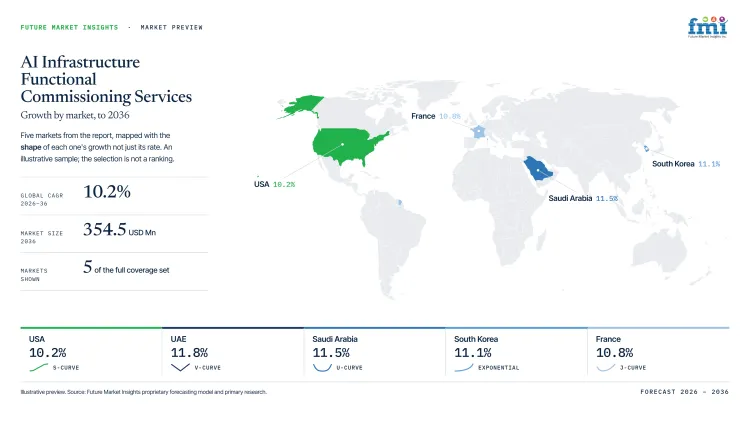
| Country | CAGR |
|---|---|
| UAE | 11.8% |
| Saudi Arabia | 11.5% |
| South Korea | 11.1% |
| France | 10.8% |
| USA | 10.2% |
How do country-level CAGRs compare in the AI Infrastructure Functional Commissioning Services Market?
Five country forecasts span 1.6 percentage points from UAE to USA. UAE and Saudi Arabia form the upper growth band while South Korea and France occupy the middle. USA matches the global 10.2% forecast at the lower end. Power readiness explains much of the separation between these country forecasts.
- UAE advances at notable pace because Abu Dhabi concentrates government AI workloads inside shared infrastructure.
- Saudi Arabia follows as rapid capacity expansion increases demand for repeatable acceptance procedures.
- South Korea links compute procurement directly to infrastructure readiness before national GPU deployment.
- France pairs a strong site pipeline with formal grid-connection sequencing before commissioning.
- USA depends on staged energization for new halls and installed-base expansion work.
Comparable CAGRs can therefore mask different project-readiness conditions for near-term service conversion. The full report provides country-level CAGR analysis across North America, Latin America, Europe, East Asia, South Asia, Oceania and the Middle East and Africa.
Country-wise Analysis
- AI infrastructure functional commissioning services demand in UAE is forecast to rise at 11.8% CAGR through 2036, owing to shared sovereign infrastructure that requires witnessed failover behavior for redundant power and chilled-water cooling. Abu Dhabi’s October 2025 unified government data-center launch placed 19 MW of AI-ready capacity inside one operating environment serving more than 40 government entities. Service continuity is the local constraint because live government workloads cannot be treated like an empty greenfield hall, so entrants must align resilience tests with migration schedules and controlled maintenance windows while preserving auditable handover evidence for later capacity changes and staged service migrations.
- Saudi Arabia’s April 2026 ministry update put 2025 operating data-center capacity above 440 MW and counted more than 60 facilities developed by over 20 companies. That buildout is pushing several projects into parallel delivery and makes local staffing depth valuable when commissioning windows overlap, while repeatable test records reduce remobilization between campuses during phased handovers under compressed energization schedules. Saudi Arabia is estimated to post 11.5% CAGR over the forecast period, given rapid capacity additions that enlarge acceptance workloads but expose a shortage of high-density field teams able to mobilize on concurrent campuses at the same time without weakening evidence consistency.
- AI infrastructure functional commissioning services demand in South Korea is forecast to rise at 11.1% CAGR over the forecast period, because compute procurement is tied directly to operational readiness for public GPU capacity. MSIT’s May 2025 GPU program required selected cloud service providers to prepare data-center power systems and network capacity before phased deployment of 10,000 advanced GPUs. That coordination gives developers a clear deployment route but synchronized facility upgrades must finish before accelerators arrive, so commissioning firms need readiness audits and defined retest windows that prevent late power or cooling changes from delaying usable compute during phased campus turnover.
- French AI data-center projects now move through site selection and grid coordination before commissioning teams can protect realistic load-test dates for high-density halls. The Ministry of Economy documented in May 2025 that 28 additional potential data-center sites had been identified beyond 35 earlier sites while four initial locations received an accelerated RTE connection procedure, making grid timing the practical gate between the announced pipeline and a commissioning schedule. France is estimated to grow at 10.8% CAGR through 2036, reflecting a strong site pipeline whose commercial conversion depends on actual connection milestones and available field windows instead of nominal construction dates or early investor schedules.
- AI infrastructure functional commissioning services demand in USA is forecast to expand at 10.2% CAGR through 2036, aided by project models that give developers more control over energization timing for completed halls. NNSA’s July 2026 selection of Amentum for negotiations on a proposed Savannah River project paired a 1-gigawatt data center with about 2 gigawatts of on-site generation. Dedicated generation can protect realistic integrated testing windows but it also introduces more protection and controls interfaces, so providers need source-to-rack acceptance procedures that prove staged operating scenarios without overstating readiness before leases or power assets are finalized and fully available locally.
Who are the notable companies in the AI Infrastructure Functional Commissioning Services Market?
Vertiv, Schneider Electric, Eaton, Siemens, Johnson Controls, ABB, Jacobs, and Exyte are the notable companies serving this market.
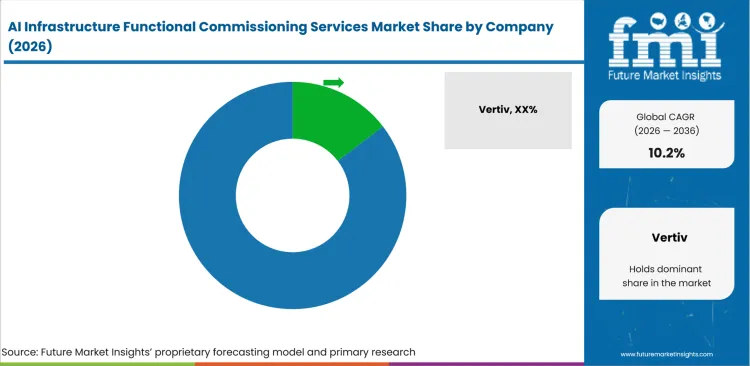
Competition splits between infrastructure manufacturers with service organizations and engineering firms managing integrated delivery. Vertiv and Schneider Electric cover power and thermal validation for dense AI halls. Eaton and Siemens focus on prefabricated electrical architecture and model-based deployment. Johnson Controls emphasizes thermal systems while ABB covers source-to-rack electrification. Jacobs and Exyte compete from the engineering side where schedule control and multisystem handoffs determine test readiness. Commissioning depth and evidence continuity raise entry barriers for firms lacking integrated site experience.
- Integrated infrastructure validation: Vertiv, Schneider Electric, Siemens and ABB document coordinated power or thermal workflows with model-based support.
- Thermal and power platform depth: Eaton and Johnson Controls cover liquid cooling and high-density electrical delivery within common acceptance planning.
- Engineering-led delivery: Jacobs and Exyte integrate commissioning with EPCM programs where schedule control and multisystem handoffs determine test readiness.
Competitive Benchmarking: AI Infrastructure Functional Commissioning Services Market
| Company | Cross-Domain Validation | Model-Based Precheck | Field Assurance | Geographic Reach |
|---|---|---|---|---|
| Vertiv | High | High | High | Global; 130+ countries |
| Schneider Electric | High | High | Medium | Global; major data-center regions |
| Eaton | Medium | High | Medium | Global; 180 countries |
| Siemens | Medium | High | Medium | Global; major data-center regions |
| Johnson Controls | Medium | Medium | High | Global; multi-region field services |
| ABB | High | High | Medium | Global; 100 countries |
| Jacobs | High | High | High | Global; multi-region EPCM delivery |
| Exyte | High | Medium | High | Europe, Asia and United States |
Scoring basis: High cross-domain validation requires documented power and thermal integration while Medium covers narrower evidence. High model-based precheck requires simulation tied to deployment while Medium covers structured digital design. High field assurance requires documented commissioning plus lifecycle service while Medium covers narrower service scope. Low records a documented limitation and never substitutes for missing evidence.
Key Developments in the AI Infrastructure Functional Commissioning Services Market
- In July 2026, Vertiv expanded manufacturing and integrated testing at its Tognana campus in Italy for AI-ready data-center cooling systems with customer-witness testing under high-density operating conditions.
- In June 2026, Siemens and partners released an NVIDIA Vera Rubin-aligned electrical and controls reference architecture with factory-tested power skids intended to shorten commissioning cycles.
- In March 2026, Eaton completed its acquisition of Boyd Thermal and brought liquid cooling into its existing grid-to-chip data-center power portfolio.
Key Players in the AI Infrastructure Functional Commissioning Services Market
Converged Critical Infrastructure
- Vertiv
- Schneider Electric
Power and Modular Delivery
- Eaton
- Siemens
Thermal and Electrical Infrastructure
- Johnson Controls
- ABB
Engineering-Led Delivery
- Jacobs
- Exyte
AI Infrastructure Functional Commissioning Services Market - Report Scope
| Coverage field | Report scope |
|---|---|
| Market breakdown | By service scope, project stage, AI rack density, data center type, commercial model and region. |
| Quantitative Units | USD million. |
| Market Definition | Functional commissioning and acceptance services that verify integrated AI data-center power, cooling, controls and protection behavior before or after operational handover. |
| Regions Covered | North America, Latin America, Europe, East Asia, South Asia and Pacific, and Middle East and Africa. |
| Countries Covered | UAE, Saudi Arabia, South Korea, France, USA, and 20+ countries included in the full report. |
| Key Companies Profiled | Vertiv, Schneider Electric, Eaton, Siemens, Johnson Controls, ABB, Jacobs, and Exyte. |
| Forecast Period | 2026 to 2036. |
| Approach | Primary and secondary research with market triangulation. |
AI Infrastructure Functional Commissioning Services Market - Research Methodology
| Method | Approach |
|---|---|
| Primary Research | FMI analysts gathered input from manufacturers, service providers, technology developers, distributors, end users, procurement teams, and subject-matter experts. Interviews examined purchasing decisions, product or service evaluation, adoption barriers, approval requirements, pricing considerations, and expectations for technical or commercial support. Respondents were also asked what evidence is required before a trial, pilot, or initial order develops into regular purchasing. |
| Desk Research | Desk research covered government statistics, regulatory publications, trade data, industry associations, technical literature, standards, company filings, product information, and official corporate announcements. Sources were reviewed for relevance, publication date, geographic coverage, and consistency with the defined market scope. Claims relating to performance, applications, approvals, capacity, investment, and commercial activity were retained only when supported by credible public evidence. |
| Market Sizing and Forecasting | The market model combined the baseline value with historical performance, segment structure, pricing and volume indicators, adoption levels, company participation, and country-level demand conditions. Forecast assumptions considered economic activity, investment trends, regulatory developments, technology adoption, purchasing cycles, supply availability, and barriers to wider market use. Segment and regional estimates were reconciled before the final market total was calculated. |
| Data Validation | Estimates were checked against multiple independent indicators, including public data, company activity, trade patterns, industry developments, and findings from primary interviews. Validation also tested whether products, services, applications, and company revenues fell within the defined market boundaries. Adjacent categories, unsupported claims, overlapping revenues, and activities without direct market relevance were excluded to reduce double counting and maintain consistency across segments and countries. |
AI Infrastructure Functional Commissioning Services Market by Segments
AI Infrastructure Functional Commissioning Services Market segmented by Service Scope:
- Commissioning & acceptance
- Design & engineering
- Performance validation
- Retrofit & migration
- Managed support
AI Infrastructure Functional Commissioning Services Market segmented by Project Stage:
- New AI hall build
- Rack/pod deployment
- Capacity expansion
- Legacy conversion
- Ongoing operations
AI Infrastructure Functional Commissioning Services Market segmented by AI Rack Density:
- 251-500 kW
- 100-250 kW
- Below 100 kW
- Above 500 kW
AI Infrastructure Functional Commissioning Services Market segmented by Data Center Type:
- Hyperscale AI data centers
- Colocation AI facilities
- Enterprise private AI
- HPC & research centers
AI Infrastructure Functional Commissioning Services Market segmented by Commercial Model:
- Direct enterprise contract
- System integrator / EPC-led
- Subscription / license
- Managed-service contract
AI Infrastructure Functional Commissioning Services Market by Region:
- North America
- United States
- Canada
- Latin America
- Brazil
- Mexico
- Chile
- Rest of Latin America
- Western Europe
- Germany
- United Kingdom
- Italy
- Spain
- France
- Nordics
- Benelux
- Rest of Western Europe
- Eastern Europe
- Russia
- Poland
- Hungary
- Balkan and Baltic States
- Rest of Eastern Europe
- East Asia
- China
- Japan
- South Korea
- South Asia and Pacific
- India
- ASEAN
- Australia and New Zealand
- Rest of South Asia and Pacific
- Middle East and Africa
- Kingdom of Saudi Arabia
- Other GCC Countries
- Türkiye
- South Africa
- Other African Union Countries
- Rest of Middle East and Africa
Research Sources and Bibliography
- ASHRAE, NEMA and Pacific Northwest National Laboratory. (2026, June 10). ASHRAE, NEMA and PNNL Release AI Data Center Energy Performance Framework to Guide Next-Generation Design and Operation.
- USA Department of Energy. (2025, April 3). DOE Identifies 16 Federal Sites Across the Country for Data Center and AI Infrastructure Development.
- Vertiv. (2026, June 1). Vertiv introduces Vertiv™ SmartRun digital twin.
- Johnson Controls. (2026, February 2). Johnson Controls launches series of thermal management reference design guides for gigawatt-scale AI data centers.
- Schneider Electric. (2026, March 16). Schneider Electric teams with NVIDIA to develop validated blueprints to design, simulate, build, operate and maintain gigawatt-scale AI Factories.
- International Energy Agency. (2025, April 10). Energy demand from AI.
- USA Department of Energy, Office of Nuclear Energy. (2025, April 8). Advantages and Challenges of Nuclear-Powered Data Centers.
- International Energy Agency. (2026, April 16). Data centre electricity use surged in 2025, even with tightening bottlenecks driving a scramble for solutions.
- Jacobs. (2026, March 16). Jacobs releases digital twin solution for AI data centers.
- Department of Government Enablement, Abu Dhabi. (2025, October 17). Department of Government Enablement and e& Partner to Launch Abu Dhabi Unified Government Data Centre to Power 40+ Government Entities.
- Ministry of Communications and Information Technology, Saudi Arabia. (2026, April 28). Saudi Arabia Strengthens Its Global Position in Artificial Intelligence Through Data Center Growth and Accelerated Smart Manufacturing.
- Ministry of Science and ICT, Republic of Korea. (2025, May 14). Government Unveils Plan to Secure 10,000 Advanced GPUs and Launch CSP Recruitment.
- Ministry of Economy, Finance and Industrial and Digital Sovereignty, France. (2025, May 21). IA : des investissements records annoncés lors du Sommet Choose France 2025.
- USA Department of Energy, National Nuclear Security Administration. (2026, July 20). NNSA Selects Amentum for AI Data Center and Energy Project at Savannah River Site.
- Schneider Electric. (2025, September 18). Schneider Electric Announces New Reference Designs, Featuring Integrated Power Management and Liquid Cooling Controls, Supporting NVIDIA Mission Control and NVIDIA GB300 NVL72.
- Eaton. (2025, September 15). Eaton accelerates transformation of building and data center infrastructure with Autodesk to deliver AI-powered digital energy twin and software tools.
- Eaton. (2025, July 15). Eaton accelerates the transformation of data center infrastructure in the AI era with NVIDIA.
- Johnson Controls. (2026, May 13). Johnson Controls expands its investment in workforce development with dedicated data center training institute to support AI-driven growth.
- ABB. (2026, June 1). ABB Expands Collaboration with NVIDIA through Integration of DSX Blueprint for AI Infrastructure.
- Jacobs. (2026, January 8). Jacobs appointed engineering, procurement and construction management lead for Hut 8 AI data center.
- Exyte. (2026, June 11). Exyte secures three major AI-driven data center projects near Frankfurt - supporting 400 jobs in Germany.
- Schneider Electric. (2025, May 14). Transforming Data Center Services: AI-Driven Condition-Based Maintenance.
- ABB. (2025, December 11). ABB and Ark Data Centres power UK’s first AI data centre.
- Exyte. (2025, August 28). Exyte and JGC launch “Nixyte” - New EPC brand for high-tech industries in Southeast Asia.
- Vertiv. (2026, July 21). Vertiv expands manufacturing and testing capacity at Tognana campus near Padua.
- Siemens. (2026, June 1). Siemens and partners develop reference architecture purpose-built for NVIDIA AI data centers.
- Eaton. (2026, March 12). Eaton completes acquisition of leading liquid-cooling solutions provider Boyd Thermal, creating an industry-leading grid-to-chip solution for data centers.
- Siemens. (2025, November 19). Siemens and Delta power solutions cut data center deployment time, costs, and carbon emissions.
- ABB. (2025, November 10). ABB and VoltaGrid partner to deliver stable data center power to support AI growth.
- Eaton. (2026, January 28). Eaton expands modular data center offering for rapid deployment of AI factories from grid to chip.
- Vertiv. (2026, January 22). Vertiv announces new AI-powered predictive maintenance service for modern data centers and AI factories.
- Schneider Electric. (2026, July 23). Schneider Electric and AMD release first Helios platform reference design to accelerate AI Factory deployment.
- Siemens. (2026, July 1). Siemens to invest €300 million in Germany to build electrical backbone of tomorrow’s industries.
- Johnson Controls. (2026, May 13). Johnson Controls completes acquisition of Alloy Enterprises.
- Jacobs. (2026, May 12). Jacobs awarded EPCM contract to deliver second Hut 8 AI data center in Texas.
- Trane Technologies. (2026, March 3). Trane Technologies Completes Acquisition of LiquidStack.
- ABB. (2026, April 21). New 34.5kV HiPerGuard UPS: direct grid connection cuts AI data center power costs.
This bibliography is provided for reader reference and is not exhaustive. The full report contains the complete reference list and detailed citations
This Report Answers
- What are the 2026 and 2036 values for AI infrastructure functional commissioning services?
- Which operating pressures raise commissioning demand in dense AI halls?
- Why does commissioning & acceptance lead service scope in 2026?
- Why do new AI hall builds lead project stage in 2026?
- How does 251-500 kW density change electrical and thermal acceptance work?
- Why do UAE and USA show different CAGRs through 2036?
- Which companies document AI infrastructure commissioning capabilities?
- Which constraints delay full-load commissioning before compute deployment?
Frequently Asked Questions
How big is the AI Infrastructure Functional Commissioning Services Market in 2026?
The AI infrastructure functional commissioning services market is valued at USD 134.2 million in 2026 and is projected to reach USD 354.5 million by 2036. Dense AI halls require integrated power and thermal acceptance before operators release expensive production workloads.
What is the CAGR of the AI Infrastructure Functional Commissioning Services Market from 2026 to 2036?
The AI infrastructure functional commissioning services market is projected to grow at a CAGR of 10.2% between 2026 and 2036. Larger AI power blocks require system-level readiness testing before owners release production compute into service.
Which service scope leads the AI Infrastructure Functional Commissioning Services Market?
The commissioning & acceptance segment is expected to hold 27.0% of the AI infrastructure functional commissioning services market in 2026, attributable to final handover evidence requirements. Commissioning teams verify integrated operating sequences and witnessed failure responses before owners release production compute.
Which countries are projected to record the highest growth in the AI Infrastructure Functional Commissioning Services Market?
UAE is projected to grow at 11.8% CAGR, followed by Saudi Arabia at 11.5% and South Korea at 11.1% through 2036. Concentrated AI programs require repeatable commissioning capacity and local field execution before compute enters service.
Which companies are active in the AI Infrastructure Functional Commissioning Services Market?
Key companies operating in the AI infrastructure functional commissioning services market include Vertiv, Schneider Electric, Eaton, Siemens, Johnson Controls, ABB, Jacobs, and Exyte. Field commissioning depth and model-based validation distinguish engineering-led delivery from equipment-centered offers in this market.
Preview the report firsthand - request a free sample
Get SampleGet the brochure for pricing and purchase details.
Get PDFTable of Content
- Key Takeaways
- Market Size and CAGR
- Top Growth Driver
- Fastest Growing Segment
- Leading Region
- Key Companies
- Emerging Opportunities
- Executive Summary
- Global Market Outlook
- Demand-side Trends
- Supply-side Trends
- Technology Roadmap Analysis
- Analysis and Recommendations
- Analyst Perspective (What is happening? Why now? What should investors know?)
- Key Questions Answered
- How large is the market?
- What is the CAGR?
- What are key trends?
- Which region dominates?
- Who are the leaders?
- Market Overview
- Market Coverage / Taxonomy
- Market Definition / Scope / Limitations
- Research Methodology
- Chapter Orientation
- Analytical Lens and Working Hypotheses
- Market Structure, Signals, and Trend Drivers
- Benchmarking and Cross-market Comparability
- Market Sizing, Forecasting, and Opportunity Mapping
- Research Design and Evidence Framework
- Desk Research Programme (Secondary Evidence)
- Expert Input and Fieldwork (Primary Evidence)
- Tooling, Models, and Reference Databases
- Data Engineering and Model Build
- Quality Assurance and Audit Trail
- Market Background
- Market Dynamics (Drivers, Restraints, Opportunity, Trends)
- Scenario Forecast (Optimistic, Likely, Conservative)
- Impact Analysis
- AI Impact
- Sustainability Impact
- Regulatory Impact
- Technology Impact
- Consumer / Buyer Analysis
- Purchase Drivers
- Adoption Barriers
- Buyer Journey
- Opportunity Map Analysis
- Product Life Cycle Analysis
- Supply Chain Analysis
- Investment Feasibility Matrix
- Value Chain Analysis
- PESTLE and Porter's Analysis
- Regulatory Landscape
- Regional Parent Market Outlook
- Production and Consumption Statistics
- Import and Export Statistics
- Global Market Analysis and Forecast, 2021 to 2036
- Historical Market Size Value (USD Million) Analysis, 2021 to 2025
- Current and Future Market Size Value (USD Million) Projections, 2026 to 2036
- Y-o-Y Growth Trend Analysis
- Absolute $ Opportunity Analysis
- Global Market Pricing Analysis, 2021 to 2036
- Global Market Analysis and Forecast, By Service Scope, 2021 to 2036
- Introduction / Key Findings
- Historical Market Size Value (USD Million) Analysis By Service Scope, 2021 to 2025
- Current and Future Market Size Value (USD Million) Analysis and Forecast By Service Scope, 2026 to 2036
- Commissioning & acceptance
- Design & engineering
- Performance validation
- Retrofit & migration
- Managed support
- Commissioning & acceptance
- Y-o-Y Growth Trend Analysis By Service Scope, 2021 to 2025
- Absolute $ Opportunity Analysis By Service Scope, 2026 to 2036
- Global Market Analysis and Forecast, By Project Stage, 2021 to 2036
- Introduction / Key Findings
- Historical Market Size Value (USD Million) Analysis By Project Stage, 2021 to 2025
- Current and Future Market Size Value (USD Million) Analysis and Forecast By Project Stage, 2026 to 2036
- New AI hall build
- Rack/pod deployment
- Capacity expansion
- Legacy conversion
- Ongoing operations
- New AI hall build
- Y-o-Y Growth Trend Analysis By Project Stage, 2021 to 2025
- Absolute $ Opportunity Analysis By Project Stage, 2026 to 2036
- Global Market Analysis and Forecast, By AI Rack Density, 2021 to 2036
- Introduction / Key Findings
- Historical Market Size Value (USD Million) Analysis By AI Rack Density, 2021 to 2025
- Current and Future Market Size Value (USD Million) Analysis and Forecast By AI Rack Density, 2026 to 2036
- 251-500 kW
- 100-250 kW
- Below 100 kW
- Above 500 kW
- 251-500 kW
- Y-o-Y Growth Trend Analysis By AI Rack Density, 2021 to 2025
- Absolute $ Opportunity Analysis By AI Rack Density, 2026 to 2036
- Global Market Analysis and Forecast, By Data Center Type, 2021 to 2036
- Introduction / Key Findings
- Historical Market Size Value (USD Million) Analysis By Data Center Type, 2021 to 2025
- Current and Future Market Size Value (USD Million) Analysis and Forecast By Data Center Type, 2026 to 2036
- Hyperscale AI data centers
- Colocation AI facilities
- Enterprise private AI
- HPC & research centers
- Hyperscale AI data centers
- Y-o-Y Growth Trend Analysis By Data Center Type, 2021 to 2025
- Absolute $ Opportunity Analysis By Data Center Type, 2026 to 2036
- Global Market Analysis and Forecast, By Commercial Model, 2021 to 2036
- Introduction / Key Findings
- Historical Market Size Value (USD Million) Analysis By Commercial Model, 2021 to 2025
- Current and Future Market Size Value (USD Million) Analysis and Forecast By Commercial Model, 2026 to 2036
- Direct enterprise contract
- System integrator / EPC-led
- Subscription / license
- Managed-service contract
- Direct enterprise contract
- Y-o-Y Growth Trend Analysis By Commercial Model, 2021 to 2025
- Absolute $ Opportunity Analysis By Commercial Model, 2026 to 2036
- Global Market Analysis and Forecast, By Region, 2021 to 2036
- Introduction
- Historical Market Size Value (USD Million) Analysis By Region, 2021 to 2025
- Current Market Size Value (USD Million) Analysis and Forecast By Region, 2026 to 2036
- North America
- Latin America
- Western Europe
- Eastern Europe
- East Asia
- South Asia and Pacific
- Middle East & Africa
- Market Attractiveness Analysis By Region
- North America Market Analysis and Forecast, By Country, 2021 to 2036
- Historical Market Size Value (USD Million) Trend Analysis By Market Taxonomy, 2021 to 2025
- Market Size Value (USD Million) Forecast By Market Taxonomy, 2026 to 2036
- By Country
- USA
- Canada
- By Service Scope
- By Project Stage
- By AI Rack Density
- By Data Center Type
- By Commercial Model
- By Country
- Market Attractiveness Analysis
- By Country
- By Service Scope
- By Project Stage
- By AI Rack Density
- By Data Center Type
- By Commercial Model
- Key Takeaways
- Latin America Market Analysis and Forecast, By Country
- Historical Market Size Value (USD Million) Trend Analysis By Market Taxonomy, 2021 to 2025
- Market Size Value (USD Million) Forecast By Market Taxonomy, 2026 to 2036
- By Country
- Brazil
- Mexico
- Chile
- Rest of Latin America
- By Service Scope
- By Project Stage
- By AI Rack Density
- By Data Center Type
- By Commercial Model
- By Country
- Market Attractiveness Analysis
- By Country
- By Service Scope
- By Project Stage
- By AI Rack Density
- By Data Center Type
- By Commercial Model
- Key Takeaways
- Western Europe Market Analysis and Forecast, By Country
- Historical Market Size Value (USD Million) Trend Analysis By Market Taxonomy, 2021 to 2025
- Market Size Value (USD Million) Forecast By Market Taxonomy, 2026 to 2036
- By Country
- Germany
- UK
- Italy
- Spain
- France
- Nordic
- BENELUX
- Rest of Western Europe
- By Service Scope
- By Project Stage
- By AI Rack Density
- By Data Center Type
- By Commercial Model
- By Country
- Market Attractiveness Analysis
- By Country
- By Service Scope
- By Project Stage
- By AI Rack Density
- By Data Center Type
- By Commercial Model
- Key Takeaways
- Eastern Europe Market Analysis and Forecast, By Country
- Historical Market Size Value (USD Million) Trend Analysis By Market Taxonomy, 2021 to 2025
- Market Size Value (USD Million) Forecast By Market Taxonomy, 2026 to 2036
- By Country
- Russia
- Poland
- Hungary
- Balkan & Baltic
- Rest of Eastern Europe
- By Service Scope
- By Project Stage
- By AI Rack Density
- By Data Center Type
- By Commercial Model
- By Country
- Market Attractiveness Analysis
- By Country
- By Service Scope
- By Project Stage
- By AI Rack Density
- By Data Center Type
- By Commercial Model
- Key Takeaways
- East Asia Market Analysis and Forecast, By Country
- Historical Market Size Value (USD Million) Trend Analysis By Market Taxonomy, 2021 to 2025
- Market Size Value (USD Million) Forecast By Market Taxonomy, 2026 to 2036
- By Country
- China
- Japan
- South Korea
- By Service Scope
- By Project Stage
- By AI Rack Density
- By Data Center Type
- By Commercial Model
- By Country
- Market Attractiveness Analysis
- By Country
- By Service Scope
- By Project Stage
- By AI Rack Density
- By Data Center Type
- By Commercial Model
- Key Takeaways
- South Asia and Pacific Market Analysis and Forecast, By Country
- Historical Market Size Value (USD Million) Trend Analysis By Market Taxonomy, 2021 to 2025
- Market Size Value (USD Million) Forecast By Market Taxonomy, 2026 to 2036
- By Country
- India
- ASEAN
- Australia & New Zealand
- Rest of South Asia and Pacific
- By Service Scope
- By Project Stage
- By AI Rack Density
- By Data Center Type
- By Commercial Model
- By Country
- Market Attractiveness Analysis
- By Country
- By Service Scope
- By Project Stage
- By AI Rack Density
- By Data Center Type
- By Commercial Model
- Key Takeaways
- Middle East & Africa Market Analysis and Forecast, By Country
- Historical Market Size Value (USD Million) Trend Analysis By Market Taxonomy, 2021 to 2025
- Market Size Value (USD Million) Forecast By Market Taxonomy, 2026 to 2036
- By Country
- Kingdom of Saudi Arabia
- Other GCC Countries
- Türkiye
- South Africa
- Other African Union
- Rest of Middle East & Africa
- By Service Scope
- By Project Stage
- By AI Rack Density
- By Data Center Type
- By Commercial Model
- By Country
- Market Attractiveness Analysis
- By Country
- By Service Scope
- By Project Stage
- By AI Rack Density
- By Data Center Type
- By Commercial Model
- Key Takeaways
- Key Countries Market Analysis
- USA
- Pricing Analysis
- Market Share Analysis, 2025
- By Service Scope
- By Project Stage
- By AI Rack Density
- By Data Center Type
- By Commercial Model
- Canada
- Pricing Analysis
- Market Share Analysis, 2025
- By Service Scope
- By Project Stage
- By AI Rack Density
- By Data Center Type
- By Commercial Model
- Mexico
- Pricing Analysis
- Market Share Analysis, 2025
- By Service Scope
- By Project Stage
- By AI Rack Density
- By Data Center Type
- By Commercial Model
- Brazil
- Pricing Analysis
- Market Share Analysis, 2025
- By Service Scope
- By Project Stage
- By AI Rack Density
- By Data Center Type
- By Commercial Model
- Chile
- Pricing Analysis
- Market Share Analysis, 2025
- By Service Scope
- By Project Stage
- By AI Rack Density
- By Data Center Type
- By Commercial Model
- Germany
- Pricing Analysis
- Market Share Analysis, 2025
- By Service Scope
- By Project Stage
- By AI Rack Density
- By Data Center Type
- By Commercial Model
- UK
- Pricing Analysis
- Market Share Analysis, 2025
- By Service Scope
- By Project Stage
- By AI Rack Density
- By Data Center Type
- By Commercial Model
- Italy
- Pricing Analysis
- Market Share Analysis, 2025
- By Service Scope
- By Project Stage
- By AI Rack Density
- By Data Center Type
- By Commercial Model
- Spain
- Pricing Analysis
- Market Share Analysis, 2025
- By Service Scope
- By Project Stage
- By AI Rack Density
- By Data Center Type
- By Commercial Model
- France
- Pricing Analysis
- Market Share Analysis, 2025
- By Service Scope
- By Project Stage
- By AI Rack Density
- By Data Center Type
- By Commercial Model
- India
- Pricing Analysis
- Market Share Analysis, 2025
- By Service Scope
- By Project Stage
- By AI Rack Density
- By Data Center Type
- By Commercial Model
- ASEAN
- Pricing Analysis
- Market Share Analysis, 2025
- By Service Scope
- By Project Stage
- By AI Rack Density
- By Data Center Type
- By Commercial Model
- Australia & New Zealand
- Pricing Analysis
- Market Share Analysis, 2025
- By Service Scope
- By Project Stage
- By AI Rack Density
- By Data Center Type
- By Commercial Model
- China
- Pricing Analysis
- Market Share Analysis, 2025
- By Service Scope
- By Project Stage
- By AI Rack Density
- By Data Center Type
- By Commercial Model
- Japan
- Pricing Analysis
- Market Share Analysis, 2025
- By Service Scope
- By Project Stage
- By AI Rack Density
- By Data Center Type
- By Commercial Model
- South Korea
- Pricing Analysis
- Market Share Analysis, 2025
- By Service Scope
- By Project Stage
- By AI Rack Density
- By Data Center Type
- By Commercial Model
- Russia
- Pricing Analysis
- Market Share Analysis, 2025
- By Service Scope
- By Project Stage
- By AI Rack Density
- By Data Center Type
- By Commercial Model
- Poland
- Pricing Analysis
- Market Share Analysis, 2025
- By Service Scope
- By Project Stage
- By AI Rack Density
- By Data Center Type
- By Commercial Model
- Hungary
- Pricing Analysis
- Market Share Analysis, 2025
- By Service Scope
- By Project Stage
- By AI Rack Density
- By Data Center Type
- By Commercial Model
- Kingdom of Saudi Arabia
- Pricing Analysis
- Market Share Analysis, 2025
- By Service Scope
- By Project Stage
- By AI Rack Density
- By Data Center Type
- By Commercial Model
- Türkiye
- Pricing Analysis
- Market Share Analysis, 2025
- By Service Scope
- By Project Stage
- By AI Rack Density
- By Data Center Type
- By Commercial Model
- South Africa
- Pricing Analysis
- Market Share Analysis, 2025
- By Service Scope
- By Project Stage
- By AI Rack Density
- By Data Center Type
- By Commercial Model
- USA
- Market Structure Analysis
- Competition Dashboard
- Competition Benchmarking
- Market Share Analysis of Top Players
- By Regional
- By Service Scope
- By Project Stage
- By AI Rack Density
- By Data Center Type
- By Commercial Model
- Emerging Startups
- Innovation Benchmarking
- Competition Analysis
- Competition Deep Dive
- Vertiv
- Overview
- Product Portfolio
- Profitability by Market Segments
- Sales Footprint
- Strategy Overview
- Marketing Strategy
- Product Strategy
- Channel Strategy
- Schneider Electric
- Eaton
- Siemens
- Vertiv
- Case Studies
- Success Stories
- Recent Developments
- Competition Deep Dive
- Assumptions & Acronyms Used


