

- Market Size (2026)
- USD 204.4 Mn
- Forecast (2036)
- USD 483.9 Mn
- CAGR (2026 to 2036)
- 9.0%
How big is AI Campus Fiber Capacity Planning Software Market in 2026?
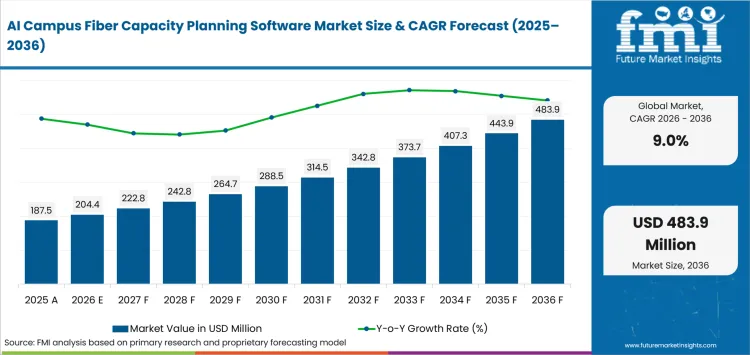
USD 204.4 million in 2026 and USD 483.9 million by 2036 at a 9.0% CAGR.
Demand for AI campus fiber capacity planning software is projected to expand at 9.0% CAGR between 2026 and 2036, increasing valuation from USD 204.4 million in 2026 to USD 483.9 million by 2036. GPU expansion increases optical path counts and forces network teams to reserve capacity before installation. The IEA estimated in April 2025 that global data-center electricity use could reach about 945 TWh by 2030. Faster infrastructure buildout makes data center infrastructure management more dependent on fiber-route and upgrade-headroom models before physical paths are committed.
Power availability can change the order of AI-campus construction and separate planned compute halls from their original network routes. Lawrence Berkeley National Laboratory's June 2026 update estimates that data centers could account for 11.8% of USA electricity use by 2030. Site changes therefore increase the value of capacity models that engineers can revise without discarding approved route assumptions. Fiber planning also becomes part of data center planning earlier in the project instead of a late cabling exercise.
Key Takeaways
- AI campus construction raises demand for software that maps fiber routes, optical headroom and change history before network capacity is committed.
- In 2026, 800G is estimated to account for 38.0% of the link speed category owing to its current role in dense AI scale-out fabrics.
- Topology & path optimization is projected to represent 26.0% of the software function category in 2026 as route structure determines later margin and capacity checks.
- Inter-rack / scale-out is anticipated to hold 36.0% of the deployment location category in 2026 because each rack expansion changes fiber-path demand.
- Incomplete as-built records and disconnected field-test data can slow purchasing because engineering teams cannot validate software recommendations against installed links.
- Some of the key players in this market include Corning, EXFO, VIAVI Solutions, FNT Software, Fluke Networks, CommScope, AFL, and Panduit.
Analyst Perspective
"AI-campus fiber planning earns budget when the network model stays aligned with field evidence after each rack, trunk and speed change. Engineering teams should compare topology depth, data ingestion and change control before visualization features or license price."
- Sudip saha, Principal Consultant, Future Market Insights
How is the AI campus fiber capacity planning software market segmented?
The market is segmented by link speed, software function, deployment location, data center type, route to market and region.
Market taxonomy covers link speed, software function, deployment location, data center type, route to market and region. Link speeds include 400G, 800G, 1.6T and 3.2T and above. Software functions cover topology, margin, fault, power-budget and capacity work. Deployment covers rack, fabric and campus / DCI planning. Data-center types include hyperscale, colocation, enterprise and sovereign compute. Routes to market include OEMs, integrators, fiber/cabling specialists and test-service providers.
Why are hyperscale AI data centers important within the data center type category?
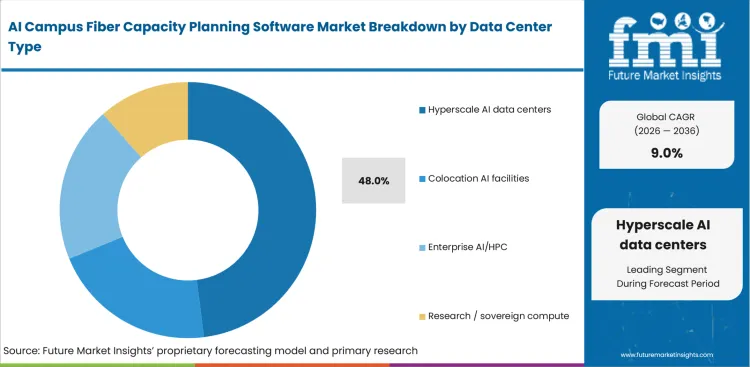
Hyperscale campuses place a high cost on planning errors because one route decision can affect thousands of links and several construction phases. The IEA reported in April 2026 that global data-center electricity demand rose 17% during 2025. Large sites therefore need network records that can absorb construction changes without losing approved topology assumptions. Campus changes also require optical communication systems to preserve capacity between halls.
- Hyperscale AI data centers represent 48.0% in 2026 because multi-phase sites place the highest value on repeatable capacity control.
- Operators need software that records available paths and planned headroom before each construction phase reaches commissioning.
What makes 800G central to the link speed category?
800G is the current planning point for large AI fabrics because operators deploy it in dense Ethernet networks. In July 2025, Panduit secured US Conec certification for MMC products and described the connector format as optimized for 800G and beyond. Higher connector density changes how planners count ports, reserved fibers and patching space. Planning teams also bring optical transceivers into the same capacity decision as the physical route that carries each link.
- By link speed, 800G is estimated to hold 38.0% in 2026 owing to current use in dense AI fabrics.
- Planning software must preserve 800G path, port and reach assumptions for later 1.6T upgrades.
Why does topology & path optimization lead the software function category?
Path decisions determine which fibers are committed before later optical-margin checks can approve a link. NVIDIA introduced Spectrum-XGS in August 2025 for networking between distributed data centers and described behavior that adjusts to distance. Facility separation therefore enters the topology model before engineers begin link-margin validation or reserve final port capacity. Network teams need one route record for rack, hall and DCI relationships while network automation handles configuration changes after capacity is assigned.
- Topology & path optimization accounts for 26.0% in 2026 because route structure defines later optical-capacity checks.
- Engineering teams adopt these tools to compare alternate paths before assigning fibers, ports and redundancy.
How does inter-rack / scale-out shape the deployment location category?
Inter-rack expansion produces repeated east-west path changes as GPU clusters grow by rack and hall. Corning launched GlassWorks AI in March 2025 with network planning, design and deployment support for dense AI data-center connectivity. The launch places fiber-route design beside the capacity decisions made before installation. The same constraint makes high-speed interconnects more sensitive to trunk and panel space consumed during each expansion phase.
- Inter-rack / scale-out is forecast to represent 36.0% in 2026 because rack additions repeatedly change path demand.
- Capacity tools gain adoption by exposing reserved fibers and alternate routes before installation consumes expansion space.
What are the drivers, restraints and opportunities in the AI Campus Fiber Capacity Planning Software Market?
Dense AI optical fabrics increase the value of model-based planning, fragmented records slow adoption, and the shift toward 1.6T expands the planning horizon.
- Driver: Higher optical density raises the cost of route mistakes and makes reserved fiber capacity a design control instead of a documentation task.
- Restraint: Software recommendations lose credibility where topology records and commissioning results do not describe the installed network consistently.
- Opportunity: Platforms that preserve one capacity model from 800G deployment into 1.6T upgrades can attach to a longer engineering workflow.
Higher Fiber Density Raises the Cost of Route Errors
AI fabrics place more physical links inside each compute block, so route conflicts appear earlier in the build sequence. In May 2025, Corning disclosed a Broadcom collaboration for optical components supporting a 51.2 Tb/s co-packaged Ethernet switch used in large AI clusters. Denser switching raises the cost of reserving the wrong trunks or panels and gives planning software a clear role before construction closes preferred fiber routes.
Weak As-Built Data Slows Software Approval
Capacity software is credible only if its records describe the installed network rather than the original design alone. FNT Software deepened its DC Smarter partnership in April 2025 and integrated data-center digital-twin information with FNT Command. The integration addresses stale rack, cable and device records, but engineering teams still need disciplined field updates before automated capacity recommendations enter normal change control.
The 1.6T Transition Extends the Planning Horizon
The 1.6T transition extends capacity planning beyond the first approved 800G design and makes upgrade headroom a current engineering question. EXFO introduced a 1.6T test solution in April 2025 for AI-driven data centers, giving operators a validation route before broad deployment. Planning vendors can model port density, optical reach and reserved fibers earlier, especially if fiber optic infrastructure records can absorb verified test results.
Which country CAGRs are profiled in the AI Campus Fiber Capacity Planning Software Market?
| Country | CAGR |
|---|---|
| Japan | 10.5% |
| South Korea | 10.2% |
| France | 9.8% |
| UAE | 9.5% |
| USA | 9.2% |
| Germany | 8.9% |
How do country-level CAGRs compare in the AI Campus Fiber Capacity Planning Software Market?
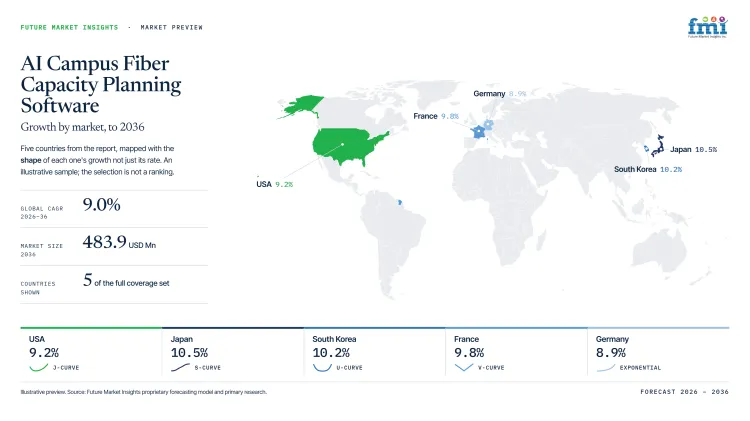
The six profiled countries span a 1.6 percentage-point range between Japan at 10.5% and Germany at 8.9%. Japan and South Korea form the upper band above 10.0%. France and the UAE form a middle band at 9.8% and 9.5%. USA and Germany sit in a lower but still strong band at 9.2% and 8.9%.
- Japan's concentrated metro capacity makes route reuse visible early.
- South Korea's shared projects require consistent records between organizations.
- France's distributed projects raise inter-hall and DCI planning needs.
- UAE rapid contractor handoffs favor one persistent route model.
- USA multivendor campuses reward normalized asset and test records.
- Germany german buyers tend to emphasize interoperability and data control when AI infrastructure serves industrial workloads.
Comparable CAGRs still produce different entry conditions because existing infrastructure and project delivery models differ. The full report provides country-level CAGR analysis across North America, Latin America, Europe, East Asia, South Asia, Oceania and the Middle East and Africa.
Country-wise Analysis
- Japan's largest AI and cloud builds remain concentrated near Tokyo and Osaka, where power availability can change site timing before construction starts. Demand is projected to grow at 10.5% CAGR over the forecast period, aided by closer national coordination between electricity and telecom planning. In February 2025, Prime Minister Ishiba directed ministers to integrate electricity and communications infrastructure to speed data-center development. Local-language records and established engineering conventions can lengthen onboarding for a new planning platform. Japanese integrators can reduce that friction by translating legacy cable and route data into the shared model before operators approve routine commercial use nationwide.
- South Korea is building AI compute through public-private programs that require sponsors and network operators to share one infrastructure baseline before procurement. The Ministry of Science and ICT announced the National AI Computing Center plan in January 2025, including expedited power-system impact assessment among its support measures. Demand is forecast to advance at 10.2% CAGR through 2036, tied to consortium projects that need auditable route and headroom scenarios. Governance reviews and power approvals can delay contractor decisions during early site planning and infrastructure commitment. Platforms with clear change histories fit projects where several contractors must review the same model without rebuilding it at each approval gate.
- France is advancing AI-campus projects under grid and construction schedules that are being fixed in parallel, so network routes may change before site milestones settle. A January 2026 government update identified 63 data-center sites, including five fast-track projects representing more than 700 MW. Faster project handling gives planners a larger pipeline of staged hall and DCI decisions, but confirmed connection dates can still reorder construction packages. Sales are estimated to expand at 9.8% CAGR during the assessment period, supported by that project pipeline. Planning platforms need route revisions that preserve approved capacity records and contractor handoffs as construction packages move on different schedules.
- UAE deployments are concentrated in large greenfield campuses, where route reservations must anticipate later compute blocks before physical cabling limits available choices. The UAE is anticipated to record 9.5% CAGR between 2026 and 2036, propelled by compressed build schedules and repeated headroom decisions. Abu Dhabi Media Office disclosed Stargate UAE in May 2025 as a 1-gigawatt compute cluster inside a 5-gigawatt AI campus. The first 200 MW is planned for 2026, giving network planners a near-term milestone for route and capacity decisions. Planning platforms face a clear operating test: preserve master-route assumptions while several contractors execute successive campus phases at speed.
- USA operators extend dense live campuses while adding new AI halls, so planning often begins with occupied fiber routes instead of a clean design model. The USA Energy Information Administration reported in March 2026 that data-center expansion had become a major source of electricity-demand growth. Repeated site additions keep competing for power and construction windows during active campus expansion programs. The market is projected to post 9.2% CAGR by 2036, given continuing hyperscale and colocation expansion. Software adoption depends on reliable test-data ingestion because separate engineering teams must reconcile field changes during commissioning and later production work at operational scale.
- German buyers tend to emphasize interoperability and data control when AI infrastructure serves industrial workloads. Sales of AI campus fiber capacity planning software in Germany are forecast to expand at 8.9% CAGR from 2026 to 2036. The Federal Government stated in June 2025 that an Industrial AI Cloud with at least 10,000 GPUs was planned within nine months. The announcement also stressed security standards and data sovereignty. Energy economics and project approvals can still slow new data-center capacity. Suppliers need to offer transparent assumptions and deployment options that fit sovereign or on-premise operating requirements without isolating the planning model from multivendor test data.
Who are the notable companies in the AI Campus Fiber Capacity Planning Software Market?
Corning, EXFO, VIAVI Solutions, FNT Software, Fluke Networks, CommScope, AFL, and Panduit are notable companies serving this market.
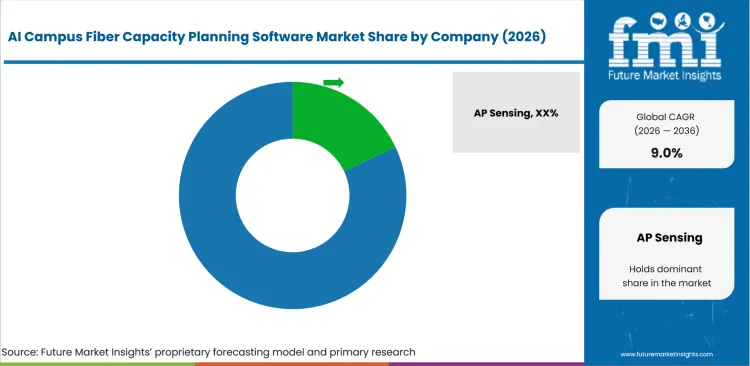
Competition spans physical fiber design, infrastructure documentation, test-result management and operational fault intelligence. Corning, CommScope and Panduit concentrate on physical topology and structured cabling inside dense AI data centers. FNT Software maintains infrastructure records that track cable capacity and planned changes. EXFO, VIAVI Solutions, Fluke Networks and AFL provide fiber optic test equipment that can refresh capacity assumptions. Entry barriers depend on trusted integration with installed records instead of company size alone.
- Corning, CommScope and Panduit: high-density fiber architecture, route design support and cable-management records for AI data centers.
- FNT Software: digital infrastructure documentation, cabling records, capacity status and change visibility within data-center operations.
- EXFO, VIAVI Solutions, Fluke Networks and AFL: optical certification, troubleshooting and test-data workflows that verify installed network condition.
Competitive Benchmarking: AI Campus Fiber Capacity Planning Software Market
| Company | Topology & Route Planning | Test-data Integration | Operational Change Visibility | Geographic Reach |
|---|---|---|---|---|
| Corning | High | Medium | Medium | Global |
| EXFO | Medium | High | High | Global |
| VIAVI Solutions | Medium | High | High | Global |
| FNT Software | High | Medium | High | Europe, North America and international |
| Fluke Networks | Low | High | Medium | Global |
| CommScope | High | Low | Medium | Global |
| AFL | Medium | High | High | Global |
| Panduit | High | Medium | Medium | Global |
Scoring basis: High topology & route planning requires three documented design or mapping functions, Medium requires two and Low one. High test-data integration requires three test, reporting or exchange functions, Medium two and Low one. High operational change visibility requires three monitoring, reconciliation or workflow functions, Medium two and Low one. Geographic reach records the regions where official company evidence shows active commercial operations and service coverage.
Key Developments in the AI Campus Fiber Capacity Planning Software Market
- In May 2026, Corning and NVIDIA announced a multiyear partnership that will increase Corning USA optical-connectivity capacity tenfold and fiber production by more than 50%. The added manufacturing base raises the volume of physical fiber infrastructure that campus planners must allocate before route commitments are fixed.
- In June 2026, AFL introduced the FOCIS Flex3 inspection platform and FlowScout Quad OLTS for high-density fiber certification. Faster multifiber validation gives capacity models a cleaner field record for reconciling planned routes with commissioned links.
- In March 2026, VIAVI Solutions launched the TestCenter D2 1.6T Appliance for hyperscale and cloud AI environments. The product gives engineering teams a current validation point for 1.6T assumptions before those speeds become a broad production baseline.
Key Players in the AI Campus Fiber Capacity Planning Software Market
Fiber Topology and Infrastructure Planning
- Corning
- CommScope
- Panduit
- FNT Software
Test-data and Capacity Validation
- EXFO
- VIAVI Solutions
- Fluke Networks
- AFL
AI Campus Fiber Capacity Planning Software Market - Report Scope
| Coverage field | Report scope |
|---|---|
| Market breakdown | By link speed, software function, deployment location, data center type, route to market and region. |
| Quantitative Units | USD million. |
| Market Definition | Software licenses, subscriptions and software-led planning or analytics services whose primary purpose is to model AI-campus fiber topology, optical path capacity, link margin, power budget, fault location or upgrade headroom. Physical fiber, connectivity hardware, transceivers, switches, test-instrument hardware and general-purpose DCIM/NMS revenue are excluded. |
| Regions Covered | North America, Latin America, Western Europe, Eastern Europe, East Asia, South Asia and Pacific, and Middle East and Africa. |
| Countries Covered | Japan, South Korea, France, UAE, USA, and 25+ countries included in the full report. |
| Key Companies Profiled | Corning, EXFO, VIAVI Solutions, FNT Software, Fluke Networks, CommScope, AFL, and Panduit. |
| Forecast Period | 2026 to 2036. |
| Approach | Primary and secondary research with market triangulation. |
AI Campus Fiber Capacity Planning Software Market - Research Methodology
| Method | Approach |
|---|---|
| Primary Research | FMI analysts gathered input from manufacturers, service providers, technology developers, distributors, end users, procurement teams, and subject-matter experts. Interviews examined purchasing decisions, product or service evaluation, adoption barriers, approval requirements, pricing considerations, and expectations for technical or commercial support. Respondents were also asked what evidence is required before a trial, pilot, or initial order develops into regular purchasing. |
| Desk Research | Desk research covered government statistics, regulatory publications, trade data, industry associations, technical literature, standards, company filings, product information, and official corporate announcements. Sources were reviewed for relevance, publication date, geographic coverage, and consistency with the defined market scope. Claims relating to performance, applications, approvals, capacity, investment, and commercial activity were retained only when supported by credible public evidence. |
| Market Sizing and Forecasting | The market model combined the baseline value with historical performance, segment structure, pricing and volume indicators, adoption levels, company participation, and country-level demand conditions. Forecast assumptions considered economic activity, investment trends, regulatory developments, technology adoption, purchasing cycles, supply availability, and barriers to wider market use. Segment and regional estimates were reconciled before the final market total was calculated. |
| Data Validation | Estimates were checked against multiple independent indicators, including public data, company activity, trade patterns, industry developments, and findings from primary interviews. Validation also tested whether products, services, applications, and company revenues fell within the defined market boundaries. Adjacent categories, unsupported claims, overlapping revenues, and activities without direct market relevance were excluded to reduce double counting and maintain consistency across segments and countries. |
AI Campus Fiber Capacity Planning Software Market by Segments
AI Campus Fiber Capacity Planning Software Market segmented by Link Speed:
- 800G
- 400G
- 1.6T
- 3.2T and above
AI Campus Fiber Capacity Planning Software Market segmented by Software Function:
- Topology & path optimization
- Link-margin analytics
- Fault localization
- Power-budget automation
- Capacity planning
AI Campus Fiber Capacity Planning Software Market segmented by Deployment Location:
- Inter-rack / scale-out
- Intra-rack / scale-up
- Spine-leaf fabric
- Campus / DCI
AI Campus Fiber Capacity Planning Software Market segmented by Data Center Type:
- Hyperscale AI data centers
- Colocation AI facilities
- Enterprise AI/HPC
- Research / sovereign compute
AI Campus Fiber Capacity Planning Software Market segmented by Route to Market:
- OEM direct
- Network system integrators
- Fiber/cabling specialists
- Test & managed-service providers
AI Campus Fiber Capacity Planning Software Market by Region:
- North America
- United States
- Canada
- Latin America
- Brazil
- Mexico
- Argentina
- Chile
- Rest of Latin America
- Western Europe
- Germany
- France
- United Kingdom
- Italy
- Spain
- Benelux
- Nordics
- Rest of Western Europe
- Eastern Europe
- Poland
- Czech Republic
- Romania
- Hungary
- Rest of Eastern Europe
- East Asia
- China
- Japan
- South Korea
- South Asia and Pacific
- India
- ASEAN
- Australia and New Zealand
- Rest of South Asia and Pacific
- Middle East and Africa
- Kingdom of Saudi Arabia
- Other GCC Countries
- UAE
- Türkiye
- South Africa
- Other African Union Countries
- Rest of Middle East and Africa
Research Sources and Bibliography
- International Energy Agency. (2025, April 10). Energy and AI: Energy demand from AI.
- Smith, S. J., Hubbard, A., Newkirk, A., Ganeshalingam, M., Holecek, B., Sartor, D. A., Mills, M., & Shehabi, A. (2026, June). United States Data Center Energy Usage Report: 2025 Update. Lawrence Berkeley National Laboratory.
- NVIDIA. (2025, August 22). NVIDIA Introduces Spectrum-XGS Ethernet to Connect Distributed Data Centers Into Giga-Scale AI Super-Factories.
- Corning Incorporated. (2025, March 27). Corning Launches GlassWorks AI Solutions, a One-Stop Shop for AI Data Center Infrastructure Needs.
- International Energy Agency. (2026, April 16). Data centre electricity use surged in 2025, even with tightening bottlenecks driving a scramble for solutions.
- CommScope. (2025, March 12). CommScope Announces Propel XFrame Solution for Data Centers.
- FNT Software. (2025, April 28). AI-Powered Data Center Operations: FNT Software & DC Smarter Deepen Partnership.
- EXFO. (2025, April 1). EXFO showcases industry’s first lab to fabrication 1.6T TEST solution.
- Prime Minister's Office of Japan. (2025, February 20). Meeting on Digital Administrative and Fiscal Reform.
- Ministry of Science and ICT, Republic of Korea. (2025, January 22). National AI Computing Center Establishment Plan Announced.
- Ministry for the Economy, Finance and Industrial and Digital Sovereignty, France. (2026, January 30). Rencontres des centres de données : la dynamique des projets d’infrastructures numériques se confirme.
- Abu Dhabi Media Office. (2025, May 22). Global tech alliance launches Stargate UAE.
- USA Energy Information Administration. (2026, March 12). Fossil generation could rise with faster-than-expected growth in data center power demand.
- Corning Incorporated. (2026, May 6). NVIDIA and Corning Announce Long-Term Partnership To Strengthen USA Manufacturing for AI Infrastructure.
- VIAVI Solutions. (2026, March 12). VIAVI Launches TestCenter D2 1.6T Appliance to Accelerate AI Infrastructure Rollouts Across Hyperscale and Cloud Data Center Environments.
- FNT Software. (2025, September 22). FNT Launches Infrastructure Health and Monitoring Feature for the FNT Command Platform.
- Fluke Networks. (2025, May). Release Notes for LinkWare PC v11.7 Build 19.
- AFL. (2026, June 18). AFL Introduces the FOCIS Flex3 and FlowScout Quad OLTS to Improve Fiber Inspection and Certification Workflows.
- Panduit. (2025, July 15). Panduit Announces Certification to offer MMC Products.
- FNT Software. (2025, February 26). FNT Software Achieves Key Certification to Accelerate Digital Transformation in the Telecom Industry.
- Fluke Networks. (2025, September 9). Important News for Versiv Owners Regarding Version 6.14 Software.
- AFL. (2025, July 16). AFL Launches DENALI: Peak Performance for Optical Fiber Networks.
- AFL. (2026, January 15). AFL Introduces Next-Generation OTDR Solutions for Data Center and Broadband Network Testing.
- Panduit. (2026, January 19). Panduit Releases RapidID Pro and Pro+: On-the-Go Label Printing and Central Server.
- VIAVI Solutions. (2026, February 24). VIAVI Speeds Multifiber Certification with Optical Loss Test Set for Testing Up to 24 Fibers Simultaneously.
- EXFO. (2025, February 3). EXFO responds to AI-driven usage demands on fiber-dense data centers with innovative test solution.
- Corning Incorporated. (2025, September 29). Corning and GlobalFoundries Collaborate To Deliver Detachable Fibre Connector Solutions on GF Fotonix to Scale Next-Generation Optical Connectivity.
- CommScope. (2026, May 28). CommScope to Unveil New High-Density, Ultra-Low Loss FastSelfClean Fiber-Optic Connector Technology.
- Panduit. (2026, January 28). Panduit Launches OmniSplice: High-Performing Fusion-Spliced Fiber Optic Connectors.
- Corning. (2025, May 13). Corning Collaborates with Broadcom To Accelerate AI Data Center Processing Capacity.
- FNT Software. (2025, May 9). FNT Software Announces Enhanced Version of its Flagship Data Center Infrastructure Management Platform.
- AFL. (2025, April 1). AFL Achieves ISO/IEC 17025:2017 Accreditation for Duncan, S.C. Facility.
This Report Answers
- How large is the AI Campus Fiber Capacity Planning Software Market in 2026 and 2036?
- Why does AI-campus fiber density increase demand for capacity-planning software?
- Why does 800G account for 38.0% of the link speed category in 2026?
- How does topology & path optimization affect later optical-capacity decisions?
- Why does inter-rack / scale-out hold 36.0% of the deployment location category in 2026?
- How do the five profiled country CAGRs compare from 2026 to 2036?
- Which companies participate in fiber planning, test-data management and operational validation?
- What limits adoption where as-built and commissioning records are incomplete?
Frequently Asked Questions
How big is the AI Campus Fiber Capacity Planning Software Market in 2026?
The AI campus fiber capacity planning software market is valued at USD 204.4 million in 2026 and is projected to reach USD 483.9 million by 2036. Denser AI fabrics require teams to reserve fiber routes and upgrade headroom earlier.
What is the CAGR of the AI Campus Fiber Capacity Planning Software Market from 2026 to 2036?
The AI campus fiber capacity planning software market is projected to grow at a CAGR of 9.0% between 2026 and 2036. Larger GPU fabrics and repeated campus expansions increase the need for controlled capacity records.
Which link speed leads the AI Campus Fiber Capacity Planning Software Market?
The 800G segment is expected to hold 38.0% of the link speed category in 2026, attributable to its role in dense AI scale-out networks. Planning teams use 800G as the current baseline for route and port allocation.
Which data center type leads the AI Campus Fiber Capacity Planning Software Market?
The hyperscale AI data centers segment is expected to hold 48.0% of the data center type category in 2026, driven by phased campus expansion. Large sites need route models that preserve approved capacity as new halls enter construction.
Which countries are projected to record the highest growth in the AI Campus Fiber Capacity Planning Software Market?
Japan is projected to grow at 10.5% CAGR, followed by South Korea at 10.2% and France at 9.8% through 2036. National AI-compute programs and large campus pipelines increase network-planning work in these markets.
Which companies are active in the AI Campus Fiber Capacity Planning Software Market?
Key companies operating in the market include Corning, EXFO, VIAVI Solutions, FNT Software, Fluke Networks, CommScope, AFL, and Panduit. Their positions span physical topology, infrastructure documentation, optical validation and installed-state records.
Preview the report firsthand - request a free sample
Get SampleGet the brochure for pricing and purchase details.
Get PDFTable of Content
- Key Takeaways
- Market Size and CAGR
- Top Growth Driver
- Fastest Growing Segment
- Leading Region
- Key Companies
- Emerging Opportunities
- Executive Summary
- Global Market Outlook
- Demand-side Trends
- Supply-side Trends
- Technology Roadmap Analysis
- Analysis and Recommendations
- Analyst Perspective (What is happening? Why now? What should investors know?)
- Key Questions Answered
- How large is the market?
- What is the CAGR?
- What are key trends?
- Which region dominates?
- Who are the leaders?
- Market Overview
- Market Coverage / Taxonomy
- Market Definition / Scope / Limitations
- Research Methodology
- Chapter Orientation
- Analytical Lens and Working Hypotheses
- Market Structure, Signals, and Trend Drivers
- Benchmarking and Cross-market Comparability
- Market Sizing, Forecasting, and Opportunity Mapping
- Research Design and Evidence Framework
- Desk Research Programme (Secondary Evidence)
- Expert Input and Fieldwork (Primary Evidence)
- Tooling, Models, and Reference Databases
- Data Engineering and Model Build
- Quality Assurance and Audit Trail
- Market Background
- Market Dynamics (Drivers, Restraints, Opportunity, Trends)
- Scenario Forecast (Optimistic, Likely, Conservative)
- Impact Analysis
- AI Impact
- Sustainability Impact
- Regulatory Impact
- Technology Impact
- Consumer / Buyer Analysis
- Purchase Drivers
- Adoption Barriers
- Buyer Journey
- Opportunity Map Analysis
- Product Life Cycle Analysis
- Supply Chain Analysis
- Investment Feasibility Matrix
- Value Chain Analysis
- PESTLE and Porter's Analysis
- Regulatory Landscape
- Regional Parent Market Outlook
- Production and Consumption Statistics
- Import and Export Statistics
- Global Market Analysis and Forecast, 2021 to 2036
- Historical Market Size Value (USD Million) Analysis, 2021 to 2025
- Current and Future Market Size Value (USD Million) Projections, 2026 to 2036
- Y-o-Y Growth Trend Analysis
- Absolute $ Opportunity Analysis
- Global Market Pricing Analysis, 2021 to 2036
- Global Market Analysis and Forecast, By Link Speed, 2021 to 2036
- Introduction / Key Findings
- Historical Market Size Value (USD Million) Analysis By Link Speed, 2021 to 2025
- Current and Future Market Size Value (USD Million) Analysis and Forecast By Link Speed, 2026 to 2036
- 800G
- 400G
- 1.6T
- 3.2T and above
- 800G
- Y-o-Y Growth Trend Analysis By Link Speed, 2021 to 2025
- Absolute $ Opportunity Analysis By Link Speed, 2026 to 2036
- Global Market Analysis and Forecast, By Software Function, 2021 to 2036
- Introduction / Key Findings
- Historical Market Size Value (USD Million) Analysis By Software Function, 2021 to 2025
- Current and Future Market Size Value (USD Million) Analysis and Forecast By Software Function, 2026 to 2036
- Topology & path optimization
- Link-margin analytics
- Fault localization
- Power-budget automation
- Capacity planning
- Topology & path optimization
- Y-o-Y Growth Trend Analysis By Software Function, 2021 to 2025
- Absolute $ Opportunity Analysis By Software Function, 2026 to 2036
- Global Market Analysis and Forecast, By Deployment Location, 2021 to 2036
- Introduction / Key Findings
- Historical Market Size Value (USD Million) Analysis By Deployment Location, 2021 to 2025
- Current and Future Market Size Value (USD Million) Analysis and Forecast By Deployment Location, 2026 to 2036
- Inter-rack / scale-out
- Intra-rack / scale-up
- Spine-leaf fabric
- Campus / DCI
- Inter-rack / scale-out
- Y-o-Y Growth Trend Analysis By Deployment Location, 2021 to 2025
- Absolute $ Opportunity Analysis By Deployment Location, 2026 to 2036
- Global Market Analysis and Forecast, By Data Center Type, 2021 to 2036
- Introduction / Key Findings
- Historical Market Size Value (USD Million) Analysis By Data Center Type, 2021 to 2025
- Current and Future Market Size Value (USD Million) Analysis and Forecast By Data Center Type, 2026 to 2036
- Hyperscale AI data centers
- Colocation AI facilities
- Enterprise AI/HPC
- Research / sovereign compute
- Hyperscale AI data centers
- Y-o-Y Growth Trend Analysis By Data Center Type, 2021 to 2025
- Absolute $ Opportunity Analysis By Data Center Type, 2026 to 2036
- Global Market Analysis and Forecast, By Route to Market, 2021 to 2036
- Introduction / Key Findings
- Historical Market Size Value (USD Million) Analysis By Route to Market, 2021 to 2025
- Current and Future Market Size Value (USD Million) Analysis and Forecast By Route to Market, 2026 to 2036
- OEM direct
- Network system integrators
- Fiber/cabling specialists
- Test & managed-service providers
- OEM direct
- Y-o-Y Growth Trend Analysis By Route to Market, 2021 to 2025
- Absolute $ Opportunity Analysis By Route to Market, 2026 to 2036
- Global Market Analysis and Forecast, By Region, 2021 to 2036
- Introduction
- Historical Market Size Value (USD Million) Analysis By Region, 2021 to 2025
- Current Market Size Value (USD Million) Analysis and Forecast By Region, 2026 to 2036
- North America
- Latin America
- Western Europe
- Eastern Europe
- East Asia
- South Asia and Pacific
- Middle East & Africa
- Market Attractiveness Analysis By Region
- North America Market Analysis and Forecast, By Country, 2021 to 2036
- Historical Market Size Value (USD Million) Trend Analysis By Market Taxonomy, 2021 to 2025
- Market Size Value (USD Million) Forecast By Market Taxonomy, 2026 to 2036
- By Country
- USA
- Canada
- By Link Speed
- By Software Function
- By Deployment Location
- By Data Center Type
- By Route to Market
- By Country
- Market Attractiveness Analysis
- By Country
- By Link Speed
- By Software Function
- By Deployment Location
- By Data Center Type
- By Route to Market
- Key Takeaways
- Latin America Market Analysis and Forecast, By Country
- Historical Market Size Value (USD Million) Trend Analysis By Market Taxonomy, 2021 to 2025
- Market Size Value (USD Million) Forecast By Market Taxonomy, 2026 to 2036
- By Country
- Brazil
- Mexico
- Chile
- Rest of Latin America
- By Link Speed
- By Software Function
- By Deployment Location
- By Data Center Type
- By Route to Market
- By Country
- Market Attractiveness Analysis
- By Country
- By Link Speed
- By Software Function
- By Deployment Location
- By Data Center Type
- By Route to Market
- Key Takeaways
- Western Europe Market Analysis and Forecast, By Country
- Historical Market Size Value (USD Million) Trend Analysis By Market Taxonomy, 2021 to 2025
- Market Size Value (USD Million) Forecast By Market Taxonomy, 2026 to 2036
- By Country
- Germany
- UK
- Italy
- Spain
- France
- Nordic
- BENELUX
- Rest of Western Europe
- By Link Speed
- By Software Function
- By Deployment Location
- By Data Center Type
- By Route to Market
- By Country
- Market Attractiveness Analysis
- By Country
- By Link Speed
- By Software Function
- By Deployment Location
- By Data Center Type
- By Route to Market
- Key Takeaways
- Eastern Europe Market Analysis and Forecast, By Country
- Historical Market Size Value (USD Million) Trend Analysis By Market Taxonomy, 2021 to 2025
- Market Size Value (USD Million) Forecast By Market Taxonomy, 2026 to 2036
- By Country
- Russia
- Poland
- Hungary
- Balkan & Baltic
- Rest of Eastern Europe
- By Link Speed
- By Software Function
- By Deployment Location
- By Data Center Type
- By Route to Market
- By Country
- Market Attractiveness Analysis
- By Country
- By Link Speed
- By Software Function
- By Deployment Location
- By Data Center Type
- By Route to Market
- Key Takeaways
- East Asia Market Analysis and Forecast, By Country
- Historical Market Size Value (USD Million) Trend Analysis By Market Taxonomy, 2021 to 2025
- Market Size Value (USD Million) Forecast By Market Taxonomy, 2026 to 2036
- By Country
- China
- Japan
- South Korea
- By Link Speed
- By Software Function
- By Deployment Location
- By Data Center Type
- By Route to Market
- By Country
- Market Attractiveness Analysis
- By Country
- By Link Speed
- By Software Function
- By Deployment Location
- By Data Center Type
- By Route to Market
- Key Takeaways
- South Asia and Pacific Market Analysis and Forecast, By Country
- Historical Market Size Value (USD Million) Trend Analysis By Market Taxonomy, 2021 to 2025
- Market Size Value (USD Million) Forecast By Market Taxonomy, 2026 to 2036
- By Country
- India
- ASEAN
- Australia & New Zealand
- Rest of South Asia and Pacific
- By Link Speed
- By Software Function
- By Deployment Location
- By Data Center Type
- By Route to Market
- By Country
- Market Attractiveness Analysis
- By Country
- By Link Speed
- By Software Function
- By Deployment Location
- By Data Center Type
- By Route to Market
- Key Takeaways
- Middle East & Africa Market Analysis and Forecast, By Country
- Historical Market Size Value (USD Million) Trend Analysis By Market Taxonomy, 2021 to 2025
- Market Size Value (USD Million) Forecast By Market Taxonomy, 2026 to 2036
- By Country
- Kingdom of Saudi Arabia
- Other GCC Countries
- Türkiye
- South Africa
- Other African Union
- Rest of Middle East & Africa
- By Link Speed
- By Software Function
- By Deployment Location
- By Data Center Type
- By Route to Market
- By Country
- Market Attractiveness Analysis
- By Country
- By Link Speed
- By Software Function
- By Deployment Location
- By Data Center Type
- By Route to Market
- Key Takeaways
- Key Countries Market Analysis
- USA
- Pricing Analysis
- Market Share Analysis, 2025
- By Link Speed
- By Software Function
- By Deployment Location
- By Data Center Type
- By Route to Market
- Canada
- Pricing Analysis
- Market Share Analysis, 2025
- By Link Speed
- By Software Function
- By Deployment Location
- By Data Center Type
- By Route to Market
- Mexico
- Pricing Analysis
- Market Share Analysis, 2025
- By Link Speed
- By Software Function
- By Deployment Location
- By Data Center Type
- By Route to Market
- Brazil
- Pricing Analysis
- Market Share Analysis, 2025
- By Link Speed
- By Software Function
- By Deployment Location
- By Data Center Type
- By Route to Market
- Chile
- Pricing Analysis
- Market Share Analysis, 2025
- By Link Speed
- By Software Function
- By Deployment Location
- By Data Center Type
- By Route to Market
- Germany
- Pricing Analysis
- Market Share Analysis, 2025
- By Link Speed
- By Software Function
- By Deployment Location
- By Data Center Type
- By Route to Market
- UK
- Pricing Analysis
- Market Share Analysis, 2025
- By Link Speed
- By Software Function
- By Deployment Location
- By Data Center Type
- By Route to Market
- Italy
- Pricing Analysis
- Market Share Analysis, 2025
- By Link Speed
- By Software Function
- By Deployment Location
- By Data Center Type
- By Route to Market
- Spain
- Pricing Analysis
- Market Share Analysis, 2025
- By Link Speed
- By Software Function
- By Deployment Location
- By Data Center Type
- By Route to Market
- France
- Pricing Analysis
- Market Share Analysis, 2025
- By Link Speed
- By Software Function
- By Deployment Location
- By Data Center Type
- By Route to Market
- India
- Pricing Analysis
- Market Share Analysis, 2025
- By Link Speed
- By Software Function
- By Deployment Location
- By Data Center Type
- By Route to Market
- ASEAN
- Pricing Analysis
- Market Share Analysis, 2025
- By Link Speed
- By Software Function
- By Deployment Location
- By Data Center Type
- By Route to Market
- Australia & New Zealand
- Pricing Analysis
- Market Share Analysis, 2025
- By Link Speed
- By Software Function
- By Deployment Location
- By Data Center Type
- By Route to Market
- China
- Pricing Analysis
- Market Share Analysis, 2025
- By Link Speed
- By Software Function
- By Deployment Location
- By Data Center Type
- By Route to Market
- Japan
- Pricing Analysis
- Market Share Analysis, 2025
- By Link Speed
- By Software Function
- By Deployment Location
- By Data Center Type
- By Route to Market
- South Korea
- Pricing Analysis
- Market Share Analysis, 2025
- By Link Speed
- By Software Function
- By Deployment Location
- By Data Center Type
- By Route to Market
- Russia
- Pricing Analysis
- Market Share Analysis, 2025
- By Link Speed
- By Software Function
- By Deployment Location
- By Data Center Type
- By Route to Market
- Poland
- Pricing Analysis
- Market Share Analysis, 2025
- By Link Speed
- By Software Function
- By Deployment Location
- By Data Center Type
- By Route to Market
- Hungary
- Pricing Analysis
- Market Share Analysis, 2025
- By Link Speed
- By Software Function
- By Deployment Location
- By Data Center Type
- By Route to Market
- Kingdom of Saudi Arabia
- Pricing Analysis
- Market Share Analysis, 2025
- By Link Speed
- By Software Function
- By Deployment Location
- By Data Center Type
- By Route to Market
- Türkiye
- Pricing Analysis
- Market Share Analysis, 2025
- By Link Speed
- By Software Function
- By Deployment Location
- By Data Center Type
- By Route to Market
- South Africa
- Pricing Analysis
- Market Share Analysis, 2025
- By Link Speed
- By Software Function
- By Deployment Location
- By Data Center Type
- By Route to Market
- USA
- Market Structure Analysis
- Competition Dashboard
- Competition Benchmarking
- Market Share Analysis of Top Players
- By Regional
- By Link Speed
- By Software Function
- By Deployment Location
- By Data Center Type
- By Route to Market
- Emerging Startups
- Innovation Benchmarking
- Competition Analysis
- Competition Deep Dive
- AP Sensing
- Overview
- Product Portfolio
- Profitability by Market Segments
- Sales Footprint
- Strategy Overview
- Marketing Strategy
- Product Strategy
- Channel Strategy
- EXFO
- Corning
- VIAVI Solutions
- AP Sensing
- Case Studies
- Success Stories
- Recent Developments
- Competition Deep Dive
- Assumptions & Acronyms Used


