

- Market Size (2026)
- USD 359.2 Mn
- Forecast (2036)
- USD 1331.8 Mn
- CAGR (2026 to 2036)
- 14.0%
How big is AI Hall Mixed-Density Capacity Planning Software Market in 2026?
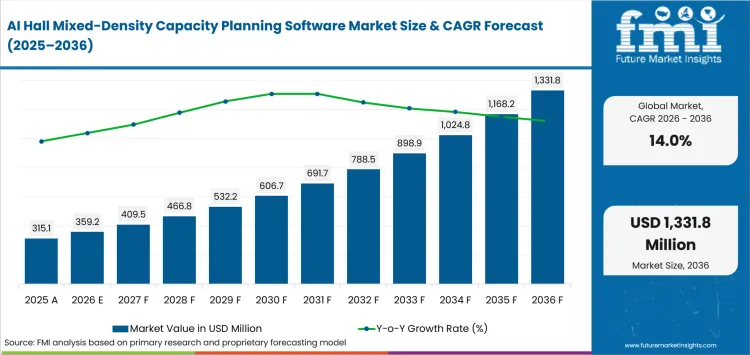
USD 359.2 million in 2026 and USD 1,331.8 million by 2036 at a 14.0% CAGR.
Demand for AI hall mixed-density capacity planning software is projected to expand at 14.0% CAGR through 2036. Valuation is projected to rise from USD 359.2 million in 2026 to USD 1,331.8 million by 2036. GPU deployments consume power and cooling headroom faster than periodic facility reviews can absorb new loads. The International Energy Agency documented a 17% rise in global data-center electricity demand during 2025 with AI-focused facilities growing faster. Operators therefore pair live data center power records with rack and cooling models to approve compute placement against current headroom.
UAE is forecast at 15.1% CAGR compared with 14.2% in USA since concentrated campuses compress capacity decisions into each phase. The US Department of Energy selected four federal sites in July 2025 for AI data-center and energy projects. The federal process resolves site rights and power availability ahead of equipment commitments on site. Capacity-planning software gains relevance as infrastructure services reconcile local grid conditions with phased rack deployment.
Key Takeaways
- Higher AI rack densities raise the cost of capacity errors as each placement decision consumes scarcer electrical and thermal headroom.
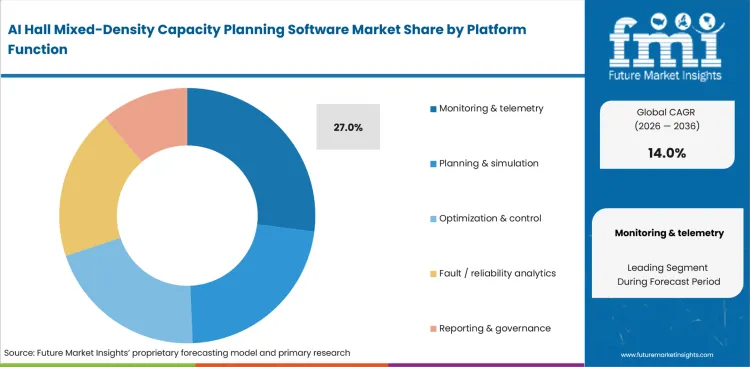
- Based on platform function, monitoring & telemetry is projected to account for 27.0% in 2026 due to higher-order capacity decisions depending on trustworthy current measurements.
- By deployment model, SaaS / public cloud is estimated to hold 38.0% in 2026 owing to centralized administration reducing version drift between sites.
- The 251-500 kW segment is likely to capture 32.0% share in 2026 attributable to mixed-density halls requiring dedicated power and cooling assumptions.
- Incomplete telemetry slows wider adoption since engineering teams cannot approve automated placement decisions against conflicting asset or circuit records.
- Some of the key players in this market include Sunbird Software, FNT Software, Nlyte Software, Schneider Electric, Siemens, Cadence Design Systems, Inc., Eaton, and EkkoSense.
Analyst Perspective
"Operators should compare capacity-planning platforms against how fast a rack change updates electrical headroom and cooling availability for placement approval. The strongest commercial case appears when engineering teams can defend the same capacity decision from live telemetry to commissioning without rebuilding the model."
- Sudip saha, Principal Consultant, Future Market Insights
How is the AI Hall Mixed-Density Capacity Planning Software Market segmented?
Segmentation covers platform function, deployment model, AI rack density, data center type, and commercial model.
Platform function covers monitoring & telemetry, planning & simulation, optimization & control, fault / reliability analytics, and reporting & governance. Deployment model analysis includes SaaS / public cloud, private cloud, on-premise, and hybrid deployment as separate categories. AI rack density covers below 100 kW, 100-250 kW, 251-500 kW, and above 500 kW. Data center type includes hyperscale AI, colocation AI, enterprise private AI, and HPC & research centers. Commercial model analysis covers direct enterprise, system integrator / EPC-led, subscription / license, and managed-service contracts as separate categories.
Why does Monitoring & Telemetry lead the Platform Function category?
Mixed-density planning depends on a current infrastructure record since placement logic breaks once rack power or environmental readings become stale. FNT Software launched Infrastructure Health and Monitoring in September 2025 with real-time status plus resource utilization and environmental data. The release turns data center infrastructure management into a live capacity input instead of a periodic inventory check.
- Based on platform function, monitoring & telemetry is projected to account for 27.0% in 2026 due to higher-order capacity decisions depending on trustworthy current measurements.
- Operators use monitoring data to reconcile facility telemetry with asset records prior to reserving rack space or cooling headroom for AI deployments.
Why does SaaS / public cloud lead the Deployment Model category?
Regional operators use a shared planning environment when expansion programs require consistent capacity assumptions at multiple facilities. SaaS administration reduces version drift without requiring each site to rebuild its application stack.
- By deployment model, SaaS / public cloud is estimated to hold 38.0% in 2026 owing to centralized administration reducing version drift between sites.
- Schneider Electric documented IT Advisor digital-twin improvements in February 2026 and outlined a new 3D engine with deeper server integration. That release path gives distributed teams a common data center automation layer while security-sensitive sites can retain private deployment.
Why does 251-500 kW lead the AI Rack Density category?
At 251-500 kW, a rack's electrical and thermal behavior departs from room averages, forcing engineers to map constraints at the rack level. Busway loading and coolant distribution require separate planning assumptions for this density band.
- The 251-500 kW segment is likely to capture 32.0% share in 2026 attributable to mixed-density halls requiring dedicated power and cooling assumptions. NVIDIA stated in May 2025 that its 800 VDC architecture supports racks from 100 kW to more than 1 MW, making direct-to-chip cooling a direct placement constraint.
- Teams reserve service clearances and floor loading through density-aware scenarios instead of applying a single watts-per-rack average across the hall.
Why do Hyperscale AI data centers lead the Data Center type category?
Hyperscale campuses concentrate GPU deployments into large power blocks, so a placement error can strand megawatts ahead of the next commissioning phase. South Korea’s Ministry of Science and ICT announced in May 2025 that the government planned to secure 10,000 advanced GPUs by year-end.
- By data center type, hyperscale AI data centers are forecast to represent 46.0% in 2026 driven by concentrated compute programs that require multi-constraint planning.
- Operators need scenarios that align utility intake with rack placement and cooling readiness while each GPU block moves through approval. The sequencing pressure also raises demand for AI liquid cooling planning inside new hyperscale rooms.
What are the drivers, restraints and opportunities in the AI Hall Mixed-Density Capacity Planning Software Market?
Higher AI rack densities raise capacity-error costs, incomplete infrastructure records limit model trust, and executable digital twins extend planning into operating decisions.
- Driver: AI power density makes each rack placement a material decision about scarce electrical and cooling capacity.
- Restraint: Fragmented telemetry and inconsistent asset records prevent engineers from trusting automated placement outputs without reconciliation.
- Opportunity: Physics-aware digital twins can test proposed loads against facility limits prior to hardware purchasing commitments.
AI Density Raises Capacity-Error Costs
An incorrect capacity reservation becomes expensive once unusable electrical headroom delays rack activation inside an existing hall. In January 2025 the US Department of Energy warned that large-load growth can create resource-adequacy risks and stranded utility investment. That constraint increases demand for power management platforms that test usable headroom prior to new rack commitments or avoidable infrastructure expansion.
Data Gaps Limit Placement Trust
Planning accuracy deteriorates if asset records disagree with power or cooling telemetry, so engineering teams cannot audit the model supporting a placement decision. Sunbird Software released dcTrack 9.2.3 in April 2025 with bidirectional synchronization for ServiceNow and Cisco ACI to reduce record conflicts. Until rack inventory and facility measurements reconcile under one record, teams limit automation and treat power quality monitoring as a validation input.
Digital Twins Extend Planning Into Operations
Physics-aware scenario planning becomes more valuable once engineers can test a proposed load without changing the operating hall. Siemens launched Digital Twin Composer in January 2026 to link simulation with real-time engineering data and test physical changes virtually. The workflow extends liquid cooling systems analysis into operational planning and keeps approved scenarios useful during later capacity changes and equipment refreshes.
Which country CAGRs are profiled in the AI Hall Mixed-Density Capacity Planning Software Market?
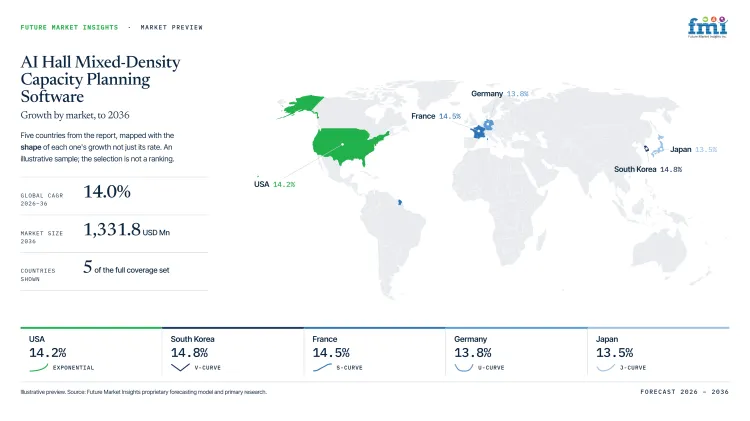
| Country | CAGR |
|---|---|
| South Korea | 14.8% |
| France | 14.5% |
| USA | 14.2% |
| Germany | 13.8% |
| Japan | 13.5% |
How do country-level CAGRs compare in the AI Hall Mixed-Density Capacity Planning Software Market?
South Korea and France form the upper group, with rates of 14.8% and 14.5%, followed by the USA at 14.2%. Germany and Japan sit at the lower end at 13.8% and 13.5%, respectively. The 1.3-percentage-point range reflects differences in project concentration, grid readiness, and infrastructure deployment timelines rather than current revenue scale in each country.
- South Korea couples national GPU procurement with direct power and site support that shifts capacity planning toward viable locations.
- France uses the DCFLEX program to test flexible data-center loads against transmission needs as larger connection queues advance.
- USA distributes expansion among utility territories with different interconnection schedules and permitting paths that complicate common site assumptions.
- Germany faces tariff uncertainty around connection capacity and time-related local network signals that can change preferred expansion sequences.
- Japan's expanding digital infrastructure is driving data-center development, while grid capacity and power availability shape site selection and deployment schedules.
Comparable CAGRs therefore mask materially different commissioning routes and infrastructure constraints for companies entering each profiled country. The full report provides country-level CAGR analysis across North America, Latin America, Europe, East Asia, South Asia, Oceania and the Middle East and Africa.
Country-wise Analysis
- At the GPU-allocation stage, South Korean programs compare sites as metropolitan power limits can change deployment timing. In February 2025 the Ministry of Science and ICT set a goal to secure 18,000 advanced GPUs by mid-2026 and support electricity supply plus site allocation. Demand for AI hall mixed-density capacity planning software in South Korea is forecast to rise at 14.8% CAGR through 2036 given direct public support for viable locations. That coordination helps developers test alternative power envelopes while hardware commitments remain reversible during procurement. Public funding does not remove local connection constraints, so power-system impact reviews remain a caveat to the growth outlook.
- At transmission-connected French sites, capacity planning increasingly includes flexible-load scenarios while operators finalize large AI deployments with fixed commissioning dates. Sales of AI hall mixed-density capacity planning software in France are forecast to expand at 14.5% CAGR through 2036 tied to grid-integration work around high-demand facilities. RTE documented the DCFLEX program with Data4 and Schneider Electric in June 2025 after more than 6 GW of data-center connection projects had already been agreed on the French network. Flexible-load testing gives software providers a local entry route, yet connection requirements remain a structural constraint that keeps grid events beside rack and cooling plans.
- Utility-by-utility interconnection schedules make US capacity planning less uniform than the size of the national project pipeline might imply. Developers can reuse planning logic between sites, although each utility territory still imposes different power and permitting conditions. AI hall mixed-density capacity planning software demand in USA is projected to record 14.2% CAGR through 2036 since new capacity must be reconciled with power availability. The Department of Energy identified 16 federal sites in April 2025 with existing energy infrastructure and rapid-build potential, widening the range of environments that software must model. As those projects advance, platforms that preserve comparable scenarios without hiding local constraints should reduce repeated engineering review between sites.
- Possible network-tariff reform makes load timing part of German capacity planning instead of treating connection capacity as a fixed operating cost. The Bundesnetzagentur opened a tariff discussion in May 2025 covering standing charges, ordered connection capacity and time-related price signals. A different price signal can change the sequence for hall expansion and equipment activation, making tariff uncertainty the main local friction. Demand for AI hall mixed-density capacity planning software in Germany is estimated to expand at 13.8% CAGR through 2036, reflecting the need for hourly power scenarios ahead of capital approval. Platforms that expose tariff-sensitive phasing can distinguish planning value from basic capacity inventory during investment reviews.
- Japan's data-center expansion increasingly depends on matching new AI capacity with available grid infrastructure and suitable power supply. Japan's Ministry of Economy, Trade and Industry has been advancing measures to support data-center development alongside power-system planning as AI-related electricity demand grows. Demand for AI hall mixed-density capacity planning software in Japan is forecast to rise at 13.5% CAGR through 2036 as developers evaluate power availability, grid connections, and phased capacity additions. Coordinated planning allows operators to compare alternative deployment scenarios before committing to large-scale infrastructure, while regional grid constraints remain a key consideration for project timing.
Who are the notable companies in the AI Hall Mixed-Density Capacity Planning Software Market?
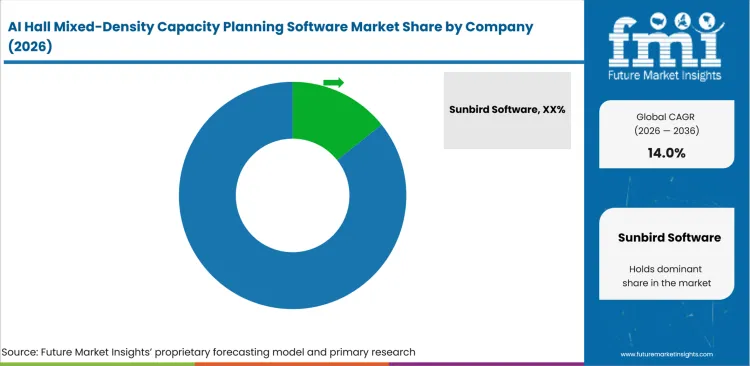
Sunbird Software, FNT Software, Nlyte Software, Schneider Electric, Siemens, Cadence Design Systems, Inc., Eaton, and EkkoSense are the notable companies serving this market.
The field spans operational DCIM and multiphysics simulation plus power-system twins and thermal capacity intelligence. Entry barriers arise from trusted telemetry connectors and current equipment models that engineering teams can audit. Providers serving liquid-cooled edge facilities face smaller rooms yet must reconcile power and thermal headroom during placement approval.
- Operational capacity intelligence: Sunbird Software, FNT Software, and Nlyte Software concentrate on live infrastructure records and data-center planning workflows.
- Digital-twin and simulation platforms: Schneider Electric, Siemens, Cadence Design Systems, Inc., and Eaton model electrical or thermal conditions during deployment decisions.
- Thermal capacity intelligence: EkkoSense evaluates rack power and cooling availability alongside high-density placement constraints inside operating data centers.
Competitive Benchmarking: AI Hall Mixed-Density Capacity Planning Software Market
| Company | Operational Data Coverage | Scenario Modeling Depth | AI-Density Evidence | Geographic Reach |
|---|---|---|---|---|
| Sunbird Software | High | Medium | Medium | Global |
| FNT Software | High | Medium | Medium | Europe, North America and Asia |
| Nlyte Software | High | Medium | Medium | North America, Europe and international |
| Schneider Electric | High | High | High | Global |
| Siemens | Medium | High | High | Global |
| Cadence Design Systems, Inc. | Medium | High | High | Global |
| Eaton | Medium | High | High | Global |
| EkkoSense | High | Medium | High | International |
Scoring basis: High operational coverage requires evidence for three live infrastructure domains while Medium covers two and Low covers one. High scenario depth requires coupled physical what-if modeling while Medium covers narrower capacity scenarios and Low lacks facility-level simulation. High AI-density evidence directly addresses 2025+ AI power or cooling conditions while Medium covers current data-center constraints and Low documents a narrower scope that excludes higher-density planning.
Key Developments in the AI Hall Mixed-Density Capacity Planning Software Market
- In November 2025, Nlyte Software launched Version 16 with real-time power and cooling dashboards plus space and inventory metrics for facility decisions.
- In September 2025, Eaton announced a collaboration with Autodesk to deliver Brightlayer Digital Energy Twin functions that simulate facility energy use ahead of infrastructure changes.
- In September 2025, Cadence Design Systems, Inc. expanded its Reality Digital Twin Platform library with an NVIDIA DGX SuperPOD GB200 model for AI data-center deployment and operations.
Key Players in the AI Hall Mixed-Density Capacity Planning Software Market
Operational DCIM and Capacity Intelligence
- Sunbird Software
- FNT Software
- Nlyte Software
Digital-Twin and Infrastructure Simulation
- Schneider Electric
- Siemens
- Cadence Design Systems, Inc.
- Eaton
Thermal Capacity Intelligence
- EkkoSense
AI Hall Mixed-Density Capacity Planning Software Market - Report Scope
| Coverage field | Report scope |
|---|---|
| Market breakdown | By platform function, deployment model, AI rack density, data center type, commercial model and region. |
| Quantitative Units | USD million. |
| Market Definition | Software revenue for monitoring, modeling, planning, simulating, optimizing, or governing usable capacity inside mixed-density AI data halls. Physical infrastructure, compute hardware, construction, cloud-compute revenue, colocation rent, and unrelated enterprise software are excluded. |
| Regions Covered | North America, Latin America, Europe, East Asia, South Asia and Pacific and Middle East and Africa. |
| Countries Covered | UAE, South Korea, France, USA, Germany, and 20+ countries included in the full report. |
| Key Companies Profiled | Sunbird Software, FNT Software, Nlyte Software, Schneider Electric, Siemens, Cadence Design Systems, Inc., Eaton, and EkkoSense. |
| Forecast Period | 2026 to 2036. |
| Approach | Primary and secondary research with market triangulation. |
AI Hall Mixed-Density Capacity Planning Software Market - Research Methodology
| Method | Approach |
|---|---|
| Primary Research | FMI analysts gathered input from manufacturers, service providers, technology developers, distributors, end users, procurement teams, and subject-matter experts. Interviews examined purchasing decisions, product or service evaluation, adoption barriers, approval requirements, pricing considerations, and expectations for technical or commercial support. Respondents were also asked what evidence is required before a trial, pilot, or initial order develops into regular purchasing. |
| Desk Research | Desk research covered government statistics, regulatory publications, trade data, industry associations, technical literature, standards, company filings, product information, and official corporate announcements. Sources were reviewed for relevance, publication date, geographic coverage, and consistency with the defined market scope. Claims relating to performance, applications, approvals, capacity, investment, and commercial activity were retained only when supported by credible public evidence. |
| Market Sizing and Forecasting | The market model combined the baseline value with historical performance, segment structure, pricing and volume indicators, adoption levels, company participation, and country-level demand conditions. Forecast assumptions considered economic activity, investment trends, regulatory developments, technology adoption, purchasing cycles, supply availability, and barriers to wider market use. Segment and regional estimates were reconciled before the final market total was calculated. |
| Data Validation | Estimates were checked against multiple independent indicators, including public data, company activity, trade patterns, industry developments, and findings from primary interviews. Validation also tested whether products, services, applications, and company revenues fell within the defined market boundaries. Adjacent categories, unsupported claims, overlapping revenues, and activities without direct market relevance were excluded to reduce double counting and maintain consistency across segments and countries. |
AI Hall Mixed-Density Capacity Planning Software Market by Segments
AI Hall Mixed-Density Capacity Planning Software Market segmented by Platform Function:
- Monitoring & telemetry
- Planning & simulation
- Optimization & control
- Fault / reliability analytics
- Reporting & governance
AI Hall Mixed-Density Capacity Planning Software Market segmented by Deployment Model:
- SaaS / public cloud
- Private cloud
- On-premise
- Hybrid deployment
AI Hall Mixed-Density Capacity Planning Software Market segmented by AI Rack Density:
- 251-500 kW
- 100-250 kW
- Below 100 kW
- Above 500 kW
AI Hall Mixed-Density Capacity Planning Software Market segmented by Data Center Type:
- Hyperscale AI data centers
- Colocation AI facilities
- Enterprise private AI
- HPC & research centers
AI Hall Mixed-Density Capacity Planning Software Market segmented by Commercial Model:
- Direct enterprise contract
- System integrator / EPC-led
- Subscription / license
- Managed-service contract
AI Hall Mixed-Density Capacity Planning Software Market by Region:
- North America
- United States
- Canada
- Latin America
- Brazil
- Mexico
- Chile
- Rest of Latin America
- Western Europe
- Germany
- United Kingdom
- Italy
- Spain
- France
- Nordics
- Benelux
- Rest of Western Europe
- Eastern Europe
- Russia
- Poland
- Hungary
- Balkan and Baltic States
- Rest of Eastern Europe
- East Asia
- China
- Japan
- South Korea
- South Asia and Pacific
- India
- ASEAN
- Australia and New Zealand
- Rest of South Asia and Pacific
- Middle East and Africa
- Kingdom of Saudi Arabia
- Other GCC Countries
- Türkiye
- South Africa
- Other African Union Countries
- Rest of Middle East and Africa
Research Sources and Bibliography
- International Energy Agency (2026, April 16). Data centre electricity use surged in 2025, even with tightening bottlenecks driving a scramble for solutions.
- USA Department of Energy (2025, July 24). DOE Announces Site Selection for AI Data Center and Energy Infrastructure Development on Federal Lands.
- FNT Software (2025, September 22). FNT Launches Infrastructure Health and Monitoring Feature for the FNT Command Platform.
- Schneider Electric (2026, February 18). EcoStruxure IT solutions deliver on vision: Reflecting on 2025 and looking ahead to 2026.
- NVIDIA (2025, May 20). NVIDIA 800 VDC Architecture Will Power the Next Generation of AI Factories.
- Ministry of Science and ICT, Republic of Korea (2025, May 14). Government Unveils Plan to Secure 10,000 Advanced GPUs and Launch CSP Recruitment.
- USA Department of Energy (2025, January 17). Electricity Rate Designs for Large Loads: Evolving Practices and Opportunities.
- Sunbird Software (2025, April 25). Sunbird dcTrack Release 9.2.3 Available Now.
- Siemens AG (2026, January 6). Siemens unveils technologies to accelerate the industrial AI revolution at CES 2026.
- Abu Dhabi Media Office (2025, May 22). Global tech alliance launches 'Stargate UAE'.
- Ministry of Science and ICT, Republic of Korea (2025, February 20). Korea to Expand AI Computing Infrastructure to Strengthen National AI Capabilities and Achieve Global Leadership.
- RTE (2025, June 16). Lancement du 1er démonstrateur européen dédié à l’interaction entre data centers et système électrique.
- USA Department of Energy (2025, April 3). DOE Identifies 16 Federal Sites Across the Country for Data Center and AI Infrastructure Development.
- Bundesnetzagentur (2025, May 12). Bundesnetzagentur publishes discussion paper on setting electricity network tariffs.
- Sunbird Software (2025, December 2). Sunbird dcTrack Release 9.3 Available Now.
- Schneider Electric (2025, March 18). ETAP and Schneider Electric Unveil World’s First Digital Twin to Simulate AI Factory Power Requirements from Grid to Chip Level Using NVIDIA Omniverse.
- Siemens AG (2025, December 9). Siemens and nVent to release joint reference architecture purpose-built for NVIDIA AI data centers.
- Cadence Design Systems, Inc. (2025, May 7). Cadence Unveils Millennium M2000 Supercomputer with NVIDIA Blackwell Systems to Transform AI-Driven Silicon, Systems and Drug Design.
- FNT Software (2025, May 9). FNT Software Announces Enhanced Version of its Flagship Data Center Infrastructure Management Platform.
- Nlyte Software (2026, February 26). Nlyte 16.0.300 Release: Enhancements, Integrations, and Fixes.
- Eaton (2025, October 13). Eaton unveils next-generation architecture to advance 800 VDC power infrastructure for AI factories.
- Milburn, P. (2025, August 19). New levels of data center capacity management released.
- Nlyte Software (2025, November 19). Nlyte Software Announces Launch of Nlyte Software Version 16, Delivering Next-Generation Data Center Infrastructure Management.
- Eaton (2025, September 15). Eaton accelerates transformation of building and data center infrastructure with Autodesk to deliver AI-powered digital energy twin and software tools.
- Cadence Design Systems, Inc. (2025, September 10). Cadence Expands Digital Twin Platform Library with NVIDIA DGX SuperPOD Model to Accelerate AI Data Center Deployment and Operations.
- Siemens AG (2026, June 1). Siemens and partners develop reference architecture purpose-built for NVIDIA AI data centers.
- Schneider Electric (2026, March 16). Schneider Electric teams with NVIDIA to develop validated blueprints to design, simulate, build, operate and maintain gigawatt-scale AI Factories.
- Jacobs (2026, March 16). Jacobs releases digital twin solution for AI data centers.
- AKCP (2026, April 29). AKCP Unveils Quicklime DCIM featuring sensorCFD AI, Capacity AI, Video AI, Configuration AI, Asset AI, at OCP EMEA Summit.
- Mitsubishi Heavy Industries (2025, July 29). Mitsubishi Heavy Industries Concludes Agreement with Modius to Provide DCIM Solutions for Data Centers Worldwide.
- Vertiv (2026, June 1). Vertiv introduces Vertiv™ SmartRun digital twin.
- EkkoSense (2025, May 22). EkkoSoft Critical 9.0 unlocks next level data center capacity, power management and cooling optimization performance.
- DC Smarter (2025, May 26). Managing IT with a Digital Twin: Three New Features in DC Vision Make Infrastructure Management Even More Efficient.
This bibliography is provided for reader reference and is not exhaustive. The full report contains the complete reference list and detailed citations.
This Report Answers
- What are the 2026 and 2036 market values?
- Which AI infrastructure conditions raise software demand?
- Why does monitoring & telemetry lead platform function?
- Why does SaaS / public cloud lead deployment model?
- Why does 251-500 kW lead AI rack density?
- Why do country CAGRs differ among profiled markets?
- How do the eight companies differ competitively?
- Which infrastructure data gaps limit broader adoption?
Frequently Asked Questions
How big is the AI hall mixed-density capacity planning software market in 2026?
The AI hall mixed-density capacity planning software market is valued at USD 359.2 million in 2026 and is projected to reach USD 1,331.8 million by 2036. Higher AI rack densities raise the cost of power and cooling placement errors during deployment.
What is the CAGR of the AI hall mixed-density capacity planning software market from 2026 to 2036?
The AI hall mixed-density capacity planning software market is projected to grow at a CAGR of 14.0% between 2026 and 2036. Expansion follows rising AI compute density and stronger demand for live capacity views prior to GPU infrastructure commitment.
Which platform function leads the AI hall mixed-density capacity planning software market?
The monitoring & telemetry segment is expected to hold 27.0% of the AI hall mixed-density capacity planning software market in 2026, driven by live rack and facility measurements. Current measurements let engineering teams test placements against actual electrical and cooling headroom during deployment.
Which countries are projected to record the highest growth in the AI hall mixed-density capacity planning software market?
UAE is projected to grow at 15.1% CAGR in the AI hall mixed-density capacity planning software market through 2036. South Korea follows at 14.8% and France at 14.5% as large AI projects tighten site and power planning.
Which companies are active in the AI hall mixed-density capacity planning software market?
Key companies operating in the AI hall mixed-density capacity planning software market include Sunbird Software, FNT Software, Nlyte Software, Schneider Electric, Siemens, Cadence Design Systems, Inc., Eaton, and EkkoSense. Their documented roles cover live capacity records and digital-twin simulation for rack placement and infrastructure planning.
Preview the report firsthand - request a free sample
Get SampleGet the brochure for pricing and purchase details.
Get PDFTable of Content
- Key Takeaways
- Market Size and CAGR
- Top Growth Driver
- Fastest Growing Segment
- Leading Region
- Key Companies
- Emerging Opportunities
- Executive Summary
- Global Market Outlook
- Demand-side Trends
- Supply-side Trends
- Technology Roadmap Analysis
- Analysis and Recommendations
- Analyst Perspective (What is happening? Why now? What should investors know?)
- Key Questions Answered
- How large is the market?
- What is the CAGR?
- What are key trends?
- Which region dominates?
- Who are the leaders?
- Market Overview
- Market Coverage / Taxonomy
- Market Definition / Scope / Limitations
- Research Methodology
- Chapter Orientation
- Analytical Lens and Working Hypotheses
- Market Structure, Signals, and Trend Drivers
- Benchmarking and Cross-market Comparability
- Market Sizing, Forecasting, and Opportunity Mapping
- Research Design and Evidence Framework
- Desk Research Programme (Secondary Evidence)
- Expert Input and Fieldwork (Primary Evidence)
- Tooling, Models, and Reference Databases
- Data Engineering and Model Build
- Quality Assurance and Audit Trail
- Market Background
- Market Dynamics (Drivers, Restraints, Opportunity, Trends)
- Scenario Forecast (Optimistic, Likely, Conservative)
- Impact Analysis
- AI Impact
- Sustainability Impact
- Regulatory Impact
- Technology Impact
- Consumer / Buyer Analysis
- Purchase Drivers
- Adoption Barriers
- Buyer Journey
- Opportunity Map Analysis
- Product Life Cycle Analysis
- Supply Chain Analysis
- Investment Feasibility Matrix
- Value Chain Analysis
- PESTLE and Porter's Analysis
- Regulatory Landscape
- Regional Parent Market Outlook
- Production and Consumption Statistics
- Import and Export Statistics
- Global Market Analysis and Forecast, 2021 to 2036
- Historical Market Size Value (USD Million) Analysis, 2021 to 2025
- Current and Future Market Size Value (USD Million) Projections, 2026 to 2036
- Y-o-Y Growth Trend Analysis
- Absolute $ Opportunity Analysis
- Global Market Pricing Analysis, 2021 to 2036
- Global Market Analysis and Forecast, By Platform Function, 2021 to 2036
- Introduction / Key Findings
- Historical Market Size Value (USD Million) Analysis By Platform Function, 2021 to 2025
- Current and Future Market Size Value (USD Million) Analysis and Forecast By Platform Function, 2026 to 2036
- Monitoring & telemetry
- Planning & simulation
- Optimization & control
- Fault / reliability analytics
- Reporting & governance
- Monitoring & telemetry
- Y-o-Y Growth Trend Analysis By Platform Function, 2021 to 2025
- Absolute $ Opportunity Analysis By Platform Function, 2026 to 2036
- Global Market Analysis and Forecast, By Deployment Model, 2021 to 2036
- Introduction / Key Findings
- Historical Market Size Value (USD Million) Analysis By Deployment Model, 2021 to 2025
- Current and Future Market Size Value (USD Million) Analysis and Forecast By Deployment Model, 2026 to 2036
- SaaS / public cloud
- Private cloud
- On-premise
- Hybrid deployment
- SaaS / public cloud
- Y-o-Y Growth Trend Analysis By Deployment Model, 2021 to 2025
- Absolute $ Opportunity Analysis By Deployment Model, 2026 to 2036
- Global Market Analysis and Forecast, By AI Rack Density, 2021 to 2036
- Introduction / Key Findings
- Historical Market Size Value (USD Million) Analysis By AI Rack Density, 2021 to 2025
- Current and Future Market Size Value (USD Million) Analysis and Forecast By AI Rack Density, 2026 to 2036
- 251-500 kW
- 100-250 kW
- Below 100 kW
- Above 500 kW
- 251-500 kW
- Y-o-Y Growth Trend Analysis By AI Rack Density, 2021 to 2025
- Absolute $ Opportunity Analysis By AI Rack Density, 2026 to 2036
- Global Market Analysis and Forecast, By Data Center Type, 2021 to 2036
- Introduction / Key Findings
- Historical Market Size Value (USD Million) Analysis By Data Center Type, 2021 to 2025
- Current and Future Market Size Value (USD Million) Analysis and Forecast By Data Center Type, 2026 to 2036
- Hyperscale AI data centers
- Colocation AI facilities
- Enterprise private AI
- HPC & research centers
- Hyperscale AI data centers
- Y-o-Y Growth Trend Analysis By Data Center Type, 2021 to 2025
- Absolute $ Opportunity Analysis By Data Center Type, 2026 to 2036
- Global Market Analysis and Forecast, By Commercial Model, 2021 to 2036
- Introduction / Key Findings
- Historical Market Size Value (USD Million) Analysis By Commercial Model, 2021 to 2025
- Current and Future Market Size Value (USD Million) Analysis and Forecast By Commercial Model, 2026 to 2036
- Direct enterprise contract
- System integrator / EPC-led
- Subscription / license
- Managed-service contract
- Direct enterprise contract
- Y-o-Y Growth Trend Analysis By Commercial Model, 2021 to 2025
- Absolute $ Opportunity Analysis By Commercial Model, 2026 to 2036
- Global Market Analysis and Forecast, By Region, 2021 to 2036
- Introduction
- Historical Market Size Value (USD Million) Analysis By Region, 2021 to 2025
- Current Market Size Value (USD Million) Analysis and Forecast By Region, 2026 to 2036
- North America
- Latin America
- Western Europe
- Eastern Europe
- East Asia
- South Asia and Pacific
- Middle East & Africa
- Market Attractiveness Analysis By Region
- North America Market Analysis and Forecast, By Country, 2021 to 2036
- Historical Market Size Value (USD Million) Trend Analysis By Market Taxonomy, 2021 to 2025
- Market Size Value (USD Million) Forecast By Market Taxonomy, 2026 to 2036
- By Country
- USA
- Canada
- By Platform Function
- By Deployment Model
- By AI Rack Density
- By Data Center Type
- By Commercial Model
- By Country
- Market Attractiveness Analysis
- By Country
- By Platform Function
- By Deployment Model
- By AI Rack Density
- By Data Center Type
- By Commercial Model
- Key Takeaways
- Latin America Market Analysis and Forecast, By Country
- Historical Market Size Value (USD Million) Trend Analysis By Market Taxonomy, 2021 to 2025
- Market Size Value (USD Million) Forecast By Market Taxonomy, 2026 to 2036
- By Country
- Brazil
- Mexico
- Chile
- Rest of Latin America
- By Platform Function
- By Deployment Model
- By AI Rack Density
- By Data Center Type
- By Commercial Model
- By Country
- Market Attractiveness Analysis
- By Country
- By Platform Function
- By Deployment Model
- By AI Rack Density
- By Data Center Type
- By Commercial Model
- Key Takeaways
- Western Europe Market Analysis and Forecast, By Country
- Historical Market Size Value (USD Million) Trend Analysis By Market Taxonomy, 2021 to 2025
- Market Size Value (USD Million) Forecast By Market Taxonomy, 2026 to 2036
- By Country
- Germany
- UK
- Italy
- Spain
- France
- Nordic
- BENELUX
- Rest of Western Europe
- By Platform Function
- By Deployment Model
- By AI Rack Density
- By Data Center Type
- By Commercial Model
- By Country
- Market Attractiveness Analysis
- By Country
- By Platform Function
- By Deployment Model
- By AI Rack Density
- By Data Center Type
- By Commercial Model
- Key Takeaways
- Eastern Europe Market Analysis and Forecast, By Country
- Historical Market Size Value (USD Million) Trend Analysis By Market Taxonomy, 2021 to 2025
- Market Size Value (USD Million) Forecast By Market Taxonomy, 2026 to 2036
- By Country
- Russia
- Poland
- Hungary
- Balkan & Baltic
- Rest of Eastern Europe
- By Platform Function
- By Deployment Model
- By AI Rack Density
- By Data Center Type
- By Commercial Model
- By Country
- Market Attractiveness Analysis
- By Country
- By Platform Function
- By Deployment Model
- By AI Rack Density
- By Data Center Type
- By Commercial Model
- Key Takeaways
- East Asia Market Analysis and Forecast, By Country
- Historical Market Size Value (USD Million) Trend Analysis By Market Taxonomy, 2021 to 2025
- Market Size Value (USD Million) Forecast By Market Taxonomy, 2026 to 2036
- By Country
- China
- Japan
- South Korea
- By Platform Function
- By Deployment Model
- By AI Rack Density
- By Data Center Type
- By Commercial Model
- By Country
- Market Attractiveness Analysis
- By Country
- By Platform Function
- By Deployment Model
- By AI Rack Density
- By Data Center Type
- By Commercial Model
- Key Takeaways
- South Asia and Pacific Market Analysis and Forecast, By Country
- Historical Market Size Value (USD Million) Trend Analysis By Market Taxonomy, 2021 to 2025
- Market Size Value (USD Million) Forecast By Market Taxonomy, 2026 to 2036
- By Country
- India
- ASEAN
- Australia & New Zealand
- Rest of South Asia and Pacific
- By Platform Function
- By Deployment Model
- By AI Rack Density
- By Data Center Type
- By Commercial Model
- By Country
- Market Attractiveness Analysis
- By Country
- By Platform Function
- By Deployment Model
- By AI Rack Density
- By Data Center Type
- By Commercial Model
- Key Takeaways
- Middle East & Africa Market Analysis and Forecast, By Country
- Historical Market Size Value (USD Million) Trend Analysis By Market Taxonomy, 2021 to 2025
- Market Size Value (USD Million) Forecast By Market Taxonomy, 2026 to 2036
- By Country
- Kingdom of Saudi Arabia
- Other GCC Countries
- Türkiye
- South Africa
- Other African Union
- Rest of Middle East & Africa
- By Platform Function
- By Deployment Model
- By AI Rack Density
- By Data Center Type
- By Commercial Model
- By Country
- Market Attractiveness Analysis
- By Country
- By Platform Function
- By Deployment Model
- By AI Rack Density
- By Data Center Type
- By Commercial Model
- Key Takeaways
- Key Countries Market Analysis
- USA
- Pricing Analysis
- Market Share Analysis, 2025
- By Platform Function
- By Deployment Model
- By AI Rack Density
- By Data Center Type
- By Commercial Model
- Canada
- Pricing Analysis
- Market Share Analysis, 2025
- By Platform Function
- By Deployment Model
- By AI Rack Density
- By Data Center Type
- By Commercial Model
- Mexico
- Pricing Analysis
- Market Share Analysis, 2025
- By Platform Function
- By Deployment Model
- By AI Rack Density
- By Data Center Type
- By Commercial Model
- Brazil
- Pricing Analysis
- Market Share Analysis, 2025
- By Platform Function
- By Deployment Model
- By AI Rack Density
- By Data Center Type
- By Commercial Model
- Chile
- Pricing Analysis
- Market Share Analysis, 2025
- By Platform Function
- By Deployment Model
- By AI Rack Density
- By Data Center Type
- By Commercial Model
- Germany
- Pricing Analysis
- Market Share Analysis, 2025
- By Platform Function
- By Deployment Model
- By AI Rack Density
- By Data Center Type
- By Commercial Model
- UK
- Pricing Analysis
- Market Share Analysis, 2025
- By Platform Function
- By Deployment Model
- By AI Rack Density
- By Data Center Type
- By Commercial Model
- Italy
- Pricing Analysis
- Market Share Analysis, 2025
- By Platform Function
- By Deployment Model
- By AI Rack Density
- By Data Center Type
- By Commercial Model
- Spain
- Pricing Analysis
- Market Share Analysis, 2025
- By Platform Function
- By Deployment Model
- By AI Rack Density
- By Data Center Type
- By Commercial Model
- France
- Pricing Analysis
- Market Share Analysis, 2025
- By Platform Function
- By Deployment Model
- By AI Rack Density
- By Data Center Type
- By Commercial Model
- India
- Pricing Analysis
- Market Share Analysis, 2025
- By Platform Function
- By Deployment Model
- By AI Rack Density
- By Data Center Type
- By Commercial Model
- ASEAN
- Pricing Analysis
- Market Share Analysis, 2025
- By Platform Function
- By Deployment Model
- By AI Rack Density
- By Data Center Type
- By Commercial Model
- Australia & New Zealand
- Pricing Analysis
- Market Share Analysis, 2025
- By Platform Function
- By Deployment Model
- By AI Rack Density
- By Data Center Type
- By Commercial Model
- China
- Pricing Analysis
- Market Share Analysis, 2025
- By Platform Function
- By Deployment Model
- By AI Rack Density
- By Data Center Type
- By Commercial Model
- Japan
- Pricing Analysis
- Market Share Analysis, 2025
- By Platform Function
- By Deployment Model
- By AI Rack Density
- By Data Center Type
- By Commercial Model
- South Korea
- Pricing Analysis
- Market Share Analysis, 2025
- By Platform Function
- By Deployment Model
- By AI Rack Density
- By Data Center Type
- By Commercial Model
- Russia
- Pricing Analysis
- Market Share Analysis, 2025
- By Platform Function
- By Deployment Model
- By AI Rack Density
- By Data Center Type
- By Commercial Model
- Poland
- Pricing Analysis
- Market Share Analysis, 2025
- By Platform Function
- By Deployment Model
- By AI Rack Density
- By Data Center Type
- By Commercial Model
- Hungary
- Pricing Analysis
- Market Share Analysis, 2025
- By Platform Function
- By Deployment Model
- By AI Rack Density
- By Data Center Type
- By Commercial Model
- Kingdom of Saudi Arabia
- Pricing Analysis
- Market Share Analysis, 2025
- By Platform Function
- By Deployment Model
- By AI Rack Density
- By Data Center Type
- By Commercial Model
- Türkiye
- Pricing Analysis
- Market Share Analysis, 2025
- By Platform Function
- By Deployment Model
- By AI Rack Density
- By Data Center Type
- By Commercial Model
- South Africa
- Pricing Analysis
- Market Share Analysis, 2025
- By Platform Function
- By Deployment Model
- By AI Rack Density
- By Data Center Type
- By Commercial Model
- USA
- Market Structure Analysis
- Competition Dashboard
- Competition Benchmarking
- Market Share Analysis of Top Players
- By Regional
- By Platform Function
- By Deployment Model
- By AI Rack Density
- By Data Center Type
- By Commercial Model
- Emerging Startups
- Innovation Benchmarking
- Competition Analysis
- Competition Deep Dive
- Sunbird Software
- Overview
- Product Portfolio
- Profitability by Market Segments
- Sales Footprint
- Strategy Overview
- Marketing Strategy
- Product Strategy
- Channel Strategy
- Schneider Electric
- Device42
- Siemens
- Sunbird Software
- Case Studies
- Success Stories
- Recent Developments
- Competition Deep Dive
- Assumptions & Acronyms Used


