

- Market Size (2026)
- USD 361.0 Mn
- Forecast (2036)
- USD 1247.2 Mn
- CAGR (2026 to 2036)
- 13.2%
How big is AI Data Center Electrical-Thermal Capacity Planning Software Market in 2026?
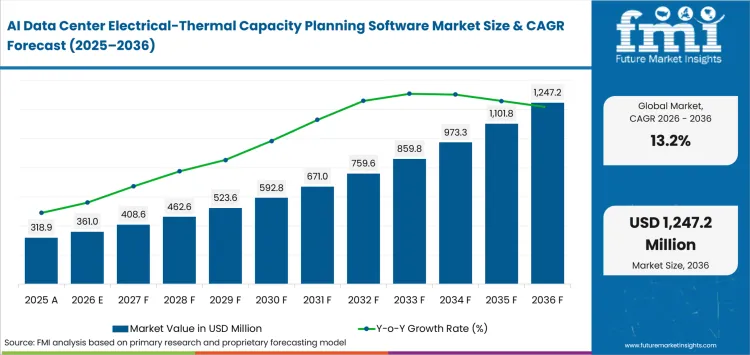
USD 361.0 Million in 2026 and USD 1,247.2 Million by 2036 at a 13.2% CAGR.
AI Data Center Electrical-Thermal Capacity Planning Software revenue is projected to rise from USD 361.0 million in 2026 to USD 1,247.2 million by 2036 at a 13.2% CAGR. The International Energy Agency reported in April 2025 that data centers used about 415 TWh of electricity in 2024, equal to roughly 1.5% of global electricity consumption. The AI Data Center Energy Performance Framework released by ASHRAE, NEMA, and Pacific Northwest National Laboratory in June 2026 recommends real-time monitoring, digital twins, and integrated power-thermal design for AI facilities. These conditions move software selection closer to the engineering approval path for each GPU deployment. Hyperscale and colocation operators increasingly need a trusted view of usable power, cooling margin, and planned rack demand before they commit scarce capacity.
Adoption conditions differ by country even when the planning workflow is similar. US operators face rapid load growth and a mix of greenfield and brownfield facilities. South Korea is expanding national AI compute while addressing electricity supply and data-center siting. Japan is coordinating power and telecommunications infrastructure through its Watt-Bit Collaboration policy. France has large data-center connection requests but long utilization ramp-ups, Germany adds formal energy-efficiency requirements, and the UAE is developing greenfield AI campuses at gigawatt scale. Across these settings, demand converts to software spending when planners can reconcile live electrical and thermal signals with an accurate infrastructure model.
Key Takeaways
- Market mechanism: dense AI deployments create a recurring need to determine usable power and cooling headroom before racks are placed, energized, commissioned, or expanded.
- Platform Function: Monitoring & telemetry is projected to account for 27.0% of the market in 2026.
- Deployment Model: SaaS / public cloud is projected to account for 38.0% of the market in 2026.
- AI Rack Density: 251-500 kW is projected to account for 32.0% of the market in 2026.
- Data Center Type: Hyperscale AI data centers are projected to account for 46.0% of the market in 2026.
- Commercial Model: Direct enterprise contract is projected to account for 42.0% of the market in 2026.
- Constraint and opportunity: fragmented asset records and inconsistent telemetry can reduce trust in modeled capacity, while continuously calibrated digital twins can extend software from monitoring into design, placement, commissioning, and operational optimization.
- Companies profiled: Sunbird Software, Siemens, Schneider Electric, and Device42.
Analyst Perspective
“The commercial test for this software category is whether an operator can turn live facility data into a capacity decision that engineering teams trust. AI racks concentrate power and heat so quickly that floor-space availability is no longer enough. Platforms that keep electrical topology, cooling relationships, and telemetry synchronized can move from dashboard budgets into placement, commissioning, and infrastructure planning through 2036.”
- Sudip saha, Principal Consultant, Future Market Insights
How is the AI Data Center Electrical-Thermal Capacity Planning Software Market segmented?
The market is segmented by Platform Function, Deployment Model, AI Rack Density, Data Center Type, Commercial Model, and Region.
The market is segmented by Platform Function into Monitoring & Telemetry, Planning & Simulation, Optimization & Control, Fault/Reliability Analytics, and Reporting & Governance; by Deployment Model into SaaS/Public Cloud, Private Cloud, On-Premise, and Hybrid Deployment; by AI Rack Density into 251-500 kW, 100-250 kW, Below 100 kW, and Above 500 kW; by Data Center Type into Hyperscale AI Data Centers, Colocation AI Facilities, Enterprise Private AI, and HPC & Research Centers; and by Commercial Model into Direct Enterprise Contract, System Integrator/EPC-Led, Subscription/License, and Managed-Service Contract.
Why does 251-500 kW lead the AI Rack Density category?
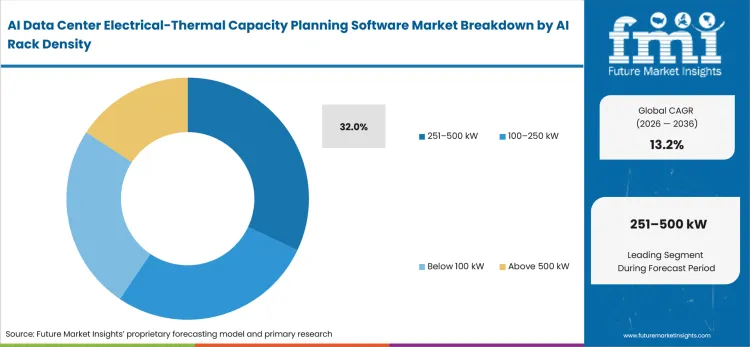
The 251-500 kW band sits where electrical distribution and heat rejection become explicit rack-placement constraints rather than background facility assumptions. Capacity teams must confirm upstream breaker margin, liquid-cooling paths, local thermal conditions, and redundancy before committing expensive GPU equipment. ASHRAE’s 2026 framework notes that AI rack densities are rising rapidly and that power and cooling should be designed as a unified system. At these densities, a site can retain nominal floor space while lacking deployable electrical or thermal headroom, which increases the value of a shared planning model.
- 251-500 kW is projected to hold a 32.0% share in 2026 because the band concentrates the electrical and thermal coordination problem addressed by this software category.
- Sunbird Software expanded this operating context in July 2026 by adding coolant distribution units, manifolds, and impact analysis to dcTrack, showing how liquid cooling is becoming a direct capacity-planning variable rather than a separate mechanical consideration.
Why does Monitoring & telemetry lead the Platform Function category?
Monitoring & telemetry holds a central role because capacity decisions depend on what is actually happening inside the facility, not on static design assumptions. AI workloads can shift power demand and thermal conditions quickly, so operators need current readings before approving additional rack capacity or changing cooling settings. ASHRAE guidance published in June 2026 recommends real-time monitoring of power and cooling systems, supported by digital twins for testing operating scenarios. This makes telemetry the baseline for later functions such as optimization, reliability analysis and capacity planning.
- Monitoring & telemetry is projected to account for 27.0% of the market in 2026, supported by the need for current power and thermal data before capacity decisions are made.
Why does SaaS / public cloud lead the Deployment Model category?
SaaS / public cloud fits organizations that need one planning layer across several facilities without maintaining a separate application stack at each site. The model can shorten software rollout, centralize updates, and expose multi-site capacity to distributed operations teams. Schneider Electric currently offers EcoStruxure IT Advisor with cloud-hosted and on-premises subscription options, and positions the platform around a live data-center digital twin that combines asset, power, cooling, and environmental data. Private cloud and on-premise deployment remain important where data residency or operational isolation is stricter, so cloud leadership reflects deployment convenience rather than a universal fit for every buyer.
- SaaS / public cloud is projected to hold a 38.0% share in 2026, supported by centralized deployment and multi-site planning requirements.
- Cloud delivery can reduce application-management overhead while preserving a shared capacity model across multiple facilities, provided security and integration controls meet the operator’s requirements.
Why do Hyperscale AI data centers lead the Data Center Type category?
Hyperscale AI data centers create repeated capacity decisions across large build programs and therefore reward software that can standardize planning assumptions. The planning unit extends beyond one rack because utility capacity, electrical topology, cooling architecture, commissioning sequence, and compute demand must be synchronized across halls or campuses. Operators also need to compare deployment scenarios before construction is complete. Siemens announced a NVIDIA DSX Vera Rubin-aligned data-center reference architecture in June 2026 with integrated management across power, cooling, and compute, illustrating the scale at which software is moving into AI-factory engineering workflows.
- Hyperscale AI data centers are projected to hold a 46.0% share in 2026 because high deployment volume magnifies the cost of unusable or poorly allocated electrical and thermal capacity.
- At hyperscale, the planning workflow increasingly intersects with data center power design because site energization, hall phasing, and rack release must be aligned with available electrical infrastructure.
Why does Direct enterprise contract lead the Commercial Model category?
Direct enterprise contracts fit projects where capacity software must connect to site controls and become part of an engineering decision process. Buyers often need vendor support for data mapping, topology setup, security review, integrations, scenario configuration, and operational handoff. A direct relationship can also simplify accountability when the platform supports several sites or new AI halls. Schneider Electric and ETAP illustrated this integration depth in March 2025 with an AI-factory digital twin that combines electrical infrastructure with mechanical, thermal, networking, and real-time operating inputs. System integrators remain influential in construction-led programs, while subscription and managed-service models can fit narrower requirements.
- Direct enterprise contract is projected to hold a 42.0% share in 2026 because integration-heavy deployments often require direct technical support and clear accountability for planning accuracy.
- The commercial advantage is most useful where the software becomes part of an approval workflow for rack placement, commissioning, or capital deployment rather than remaining a standalone visualization tool.
What are the drivers, restraints and opportunities in the AI Data Center Electrical-Thermal Capacity Planning Software Market?
Dense AI racks drive demand for joint power-cooling planning, fragmented infrastructure records can slow adoption, and continuously calibrated digital twins create the main expansion path.
- Driver: dense AI compute turns electrical and thermal headroom into a joint deployment constraint.
- Restraint: fragmented facility records and inconsistent telemetry can undermine confidence in modeled capacity.
- Opportunity: continuously calibrated digital twins can extend software from monitoring into design, placement, commissioning, and operational optimization.
Power and cooling now have to be approved as one capacity decision. The International Energy Agency reported in April 2025 that AI is increasing deployment of high-performance servers and raising data-center power density, while ASHRAE’s 2026 framework treats electrical and thermal design as closely linked. In practice, available floor space does not mean a rack is ready for deployment. Operators need software that can combine actual load, cooling conditions and planned demand before releasing capacity, making these platforms increasingly relevant to power management workflows.
The main restraint is confidence in the underlying model. Brownfield data centers often carry inconsistent information across DCIM, BMS, EPMS and other operational systems. If telemetry tags do not align with the electrical chain or cooling topology, scenario results become difficult to trust. This can keep the software confined to monitoring until asset records, connectors and model updates are reliable enough to support rack-placement or capital decisions.
A larger opportunity is emerging around continuously updated digital twins. Schneider Electric and ETAP demonstrated a grid-to-chip AI-factory digital twin in March 2025, while Siemens introduced physics-AI modeling for real-time prediction of busway thermal behavior in March 2026. Platforms that combine engineering models with live electrical and thermal data can support design, commissioning and capacity release, while also extending into ongoing optimization and cooling control.
Which country CAGRs are profiled in the AI Data Center Electrical-Thermal Capacity Planning Software Market?
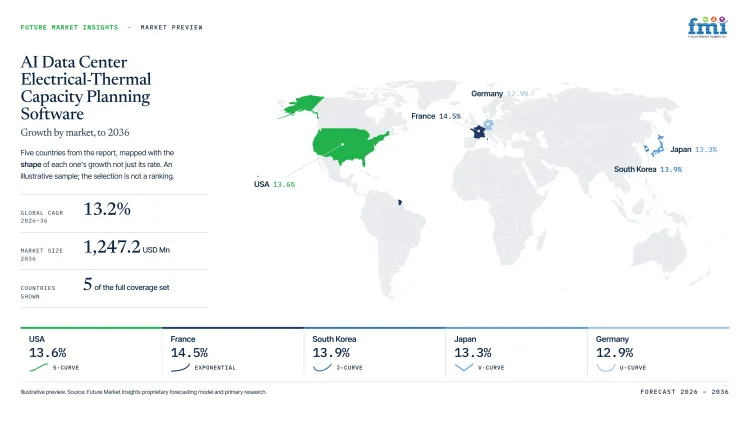
| Country | CAGR, 2026-2036 |
|---|---|
| USA | 13.6% |
| South Korea | 13.9% |
| Japan | 13.3% |
| France | 14.5% |
| Germany | 12.9% |
| UAE | 14.2% |
How do country-level CAGRs compare in the AI Data Center Electrical-Thermal Capacity Planning Software Market?
France and the UAE are projected to post the stronger growth rates among the profiled countries, at 14.5% and 14.2% CAGR, respectively. South Korea follows at 13.9%, ahead of the USA at 13.6%, Japan at 13.3%, and Germany at 12.9%. The gap between France and Germany is 1.6 percentage points, reflecting differences in AI infrastructure expansion, available power and the balance between new-build and existing data-center capacity.
- France: Large data-center connection pipelines create demand for software that can match compute deployment with power and cooling capacity as facilities are commissioned.
- UAE: Greenfield AI campuses allow power, cooling and compute capacity to be planned together from the outset, supporting more integrated capacity-planning workflows.
- South Korea: Expansion of national AI-compute infrastructure increases the need to coordinate site development with electricity availability before additional capacity is deployed.
- USA: A mature data-center base creates demand across new construction and brownfield upgrades, particularly where operators need to distinguish nominal capacity from capacity that can actually support dense AI racks.
- Japan: The Watt-Bit Collaboration encourages closer coordination between electricity and telecommunications infrastructure, making capacity planning more important before new data-center loads are committed.
- Germany: Energy-efficiency requirements increase the value of reliable operating data that can support capacity planning alongside compliance and facility-management workflows.
Country-wise Analysis
- USA: Demand in the USA is projected to expand at 13.6% from 2026 to 2036. The IEA reported in 2025 that the USA represented a major share of global data-center electricity use and projected a substantial increase in US data-center electricity consumption through 2030. The commercial issue is not simply more megawatts. Operators must decide when site power, upstream distribution, cooling, and rack-level capacity are simultaneously ready. Vendors that can reconcile live facility signals with brownfield asset models are positioned to support phased AI deployment across existing and new facilities.
- South Korea: Demand in South Korea is projected to expand at 13.9% from 2026 to 2036. The Ministry of Science and ICT announced in February 2025 a plan to expand national AI computing infrastructure, including procurement of high-performance GPUs and use of resources such as the Gwangju AI Data Center, while also addressing facility location and power-supply conditions. That policy direction increases the value of software that connects compute expansion with site-level electrical and thermal headroom. Suppliers should support staged capacity release as new infrastructure and power availability come online.
- Japan: Demand in Japan is projected to expand at 13.3% from 2026 to 2036. METI and MIC published Watt-Bit Collaboration Report 1.0 in June 2025 to promote coordinated development of electricity and telecommunications infrastructure as data-center and AI demand grows. Different lead times for grid, telecom, and facility construction create a planning problem before racks are installed. Software can add value by comparing site options, phasing compute deployments, and keeping electrical and thermal assumptions visible across infrastructure teams.
- France: Demand in France is projected to expand at 14.5% from 2026 to 2036. RTE reported that dedicated transmission-connected data-center connection capacity totaled 770 MW at the end of December 2025, while average utilization of subscribed connection power for those facilities was about 22%. The long ramp-up between connection and actual load creates room for software that distinguishes reserved capacity from energized, coolable, and deployable capacity. Suppliers can support phased rack placement and help operators avoid treating connection size as immediately usable compute headroom.
- Germany: Demand in Germany is projected to expand at 12.9% from 2026 to 2036. Germany’s Energy Efficiency Act establishes data-center efficiency, reused-energy, and energy-management requirements, including requirements that apply to facilities beginning operation from July 2026. These obligations increase the operational value of traceable power and cooling data. Vendors that connect capacity planning with auditable energy records can reduce duplicate data maintenance and make engineering, efficiency, and deployment decisions work from the same infrastructure model.
- UAE: Demand in the UAE is projected to expand at 14.2% from 2026 to 2036. Abu Dhabi announced Stargate UAE in May 2025 as a 1 GW compute cluster inside the planned 5 GW UAE-US AI Campus, with the first 200 MW AI cluster expected to go live in 2026. Greenfield scale gives operators an opportunity to establish digital capacity models before successive compute phases are installed. Suppliers should support campus-to-rack planning, liquid-cooling topology, commissioning, and model updates as GPU generations and site loads evolve.
Who are the notable companies in the AI Data Center Electrical-Thermal Capacity Planning Software Market?
Sunbird Software, Siemens, Schneider Electric, and Device42.
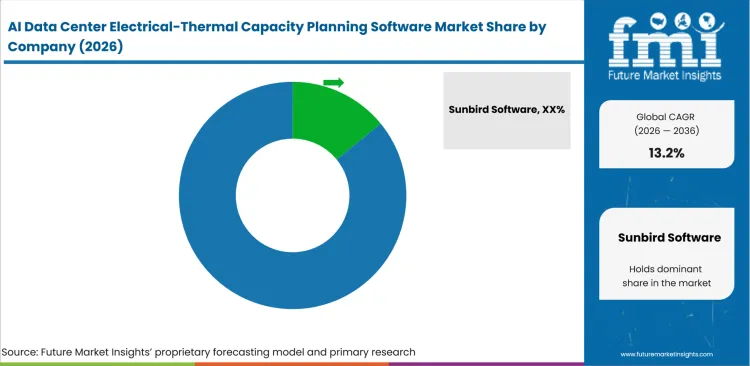
Competition is organized around the depth of infrastructure context each platform can bring into a capacity decision. Siemens and Schneider Electric can connect planning software to broad electrical, controls, and thermal portfolios, which is useful where software is embedded in an AI-factory engineering program. Sunbird Software competes from a specialist DCIM position with capacity, power, environmental, and liquid-cooling modeling. Device42 approaches the problem through infrastructure discovery, asset relationships, real-time power and environmental monitoring, and what-if capacity planning. Buyers therefore compare model accuracy, integration depth, high-density readiness, and deployment fit rather than software breadth alone.
- Integrated power-thermal engineering and digital-twin platforms: Siemens and Schneider Electric.
- DCIM capacity-planning specialist: Sunbird Software.
- Discovery-linked infrastructure visibility and capacity planning:
Competitive Benchmarking: AI Data Center Electrical-Thermal Capacity Planning Software Market
Scoring basis: Electrical-Thermal Telemetry reflects the breadth of live power, cooling, and environmental visibility that can feed an operating model. Scenario & Digital Twin Planning reflects the depth of what-if analysis, simulation, or explicit digital-twin workflows used for capacity decisions. AI Density / Liquid Cooling Readiness reflects support for high-density AI infrastructure, dynamic electrical behavior, or liquid-cooling topology. High indicates broad capability within the category, while Medium indicates a narrower but commercially relevant fit.
| Company | Electrical-Thermal Telemetry | Scenario & Digital Twin Planning | AI Density / Liquid Cooling Readiness | Market-Relevant Position |
|---|---|---|---|---|
| Sunbird Software | High | Medium | High | Specialist DCIM capacity planning with liquid-cooling topology and impact analysis |
| Siemens | High | High | High | Power and controls engineering with digital twins and AI-infrastructure reference architectures |
| Schneider Electric | High | High | High | DCIM plus ETAP electrical digital twin and grid-to-chip AI-factory planning |
| Device42 | High | Medium | Medium | Infrastructure discovery, power and thermal monitoring, and what-if capacity planning |
The benchmark shows two competitive routes. Siemens and Schneider Electric bring a wider engineering stack around power, controls, simulation, and digital twins. Sunbird Software and Device42 bring more specialized infrastructure operations context. Through 2036, the commercial distinction will depend on how quickly each platform can turn an accurate asset model and live telemetry into a trusted capacity-release decision for dense AI racks.
Key Developments in the AI Data Center Electrical-Thermal Capacity Planning Software Market
- In March 2025, Schneider Electric and ETAP unveiled an AI-factory digital twin using NVIDIA Omniverse technologies. The platform brings electrical infrastructure together with mechanical, thermal and networking inputs to simulate AI-factory operations and support power-system planning from grid to chip.
- In March 2026, Siemens expanded its data-center ecosystem through a collaboration with PhysicsX. AI models trained on Siemens’ multi-physics simulation data can predict thermal behavior in complex busway systems in real time, reducing simulation time and supporting faster design decisions for AI power infrastructure.
- In June 2026, Siemens, NVIDIA and Fluence developed an NVIDIA DSX Vera Rubin-aligned reference architecture for AI data centers. The design covers electrical distribution and controls from the utility connection to the rack, with centralized management spanning power, cooling and compute infrastructure.
Key Players in the AI Data Center Electrical-Thermal Capacity Planning Software Market
Integrated Power-Thermal Digital Twin Platforms
- Siemens
- Schneider Electric
DCIM Capacity Planning Specialists
- Sunbird Software
Discovery-Linked Infrastructure Visibility
- Device42
AI Data Center Electrical-Thermal Capacity Planning Software Market - Report Scope
| Coverage field | Report scope |
|---|---|
| Market breakdown | Platform Function, Deployment Model, AI Rack Density, Data Center Type, Commercial Model |
| Quantitative Units | USD Million |
| Market Definition | Revenue from software sold for monitoring, planning, simulation, optimization, reliability analysis, or governance of electrical and thermal capacity for AI data centers within the stated segmentation universe. Electrical equipment, cooling hardware, servers, construction revenue, downstream compute services, and adjacent software without this named capacity-planning function are excluded. |
| Regions Covered | North America; Latin America; Western Europe; Eastern Europe; East Asia; South Asia and Pacific; Middle East and Africa |
| Profiled Country CAGRs | USA, South Korea, Japan, France, Germany, UAE |
| Key Companies Profiled | Sunbird Software, Siemens, Schneider Electric, Device42 |
| Forecast Period | 2026 to 2036 |
| Approach | Hybrid bottom-up and top-down assessment of software deployment, buyer demand, vendor activity, infrastructure build-out, and country operating conditions within the defined revenue boundary. |
AI Data Center Electrical-Thermal Capacity Planning Software Market - Research Methodology
| Method | Approach |
|---|---|
| Primary Research | Interviews and discussions with data-center operators, capacity planners, electrical and mechanical engineers, software vendors, system integrators, procurement teams, and subject-matter specialists are used to assess buying criteria, deployment models, integration needs, renewal logic, and the practical boundary between monitoring and capacity-planning software. |
| Desk Research | Government and regulator publications, energy-system data, standards and professional guidance, company filings, current product documentation, and dated first-party announcements are used to assess market scope, operating conditions, company capabilities, and recent developments. |
| Market Sizing and Forecasting | The assessment reconciles software revenue boundaries with segment mix, deployment patterns, buyer categories, vendor activity, and country operating conditions. Forecast assumptions consider AI infrastructure build-out, rack-density progression, liquid-cooling adoption, grid constraints, deployment preferences, and the pace at which telemetry is converted into planning workflows. |
| Data Validation | The methodology cross-checks quantitative and qualitative conclusions across different research inputs and excludes double counting of electrical hardware, cooling equipment, construction revenue, compute services, and adjacent software whose primary function falls outside electrical-thermal capacity planning. |
AI Data Center Electrical-Thermal Capacity Planning Software Market by Segments
AI Data Center Electrical-Thermal Capacity Planning Software Market segmented by Platform Function:
- Monitoring & telemetry
- Planning & simulation
- Optimization & control
- Fault / reliability analytics
- Reporting & governance
AI Data Center Electrical-Thermal Capacity Planning Software Market segmented by Deployment Model:
- SaaS / public cloud
- Private cloud
- On-premise
- Hybrid deployment
AI Data Center Electrical-Thermal Capacity Planning Software Market segmented by AI Rack Density:
- 251-500 kW
- 100-250 kW
- Below 100 kW
- Above 500 kW
AI Data Center Electrical-Thermal Capacity Planning Software Market segmented by Data Center Type:
- Hyperscale AI data centers
- Colocation AI facilities
- Enterprise private AI
- HPC & research centers
AI Data Center Electrical-Thermal Capacity Planning Software Market segmented by Commercial Model:
- Direct enterprise contract
- System integrator / EPC-led
- Subscription / license
- Managed-service contract
AI Data Center Electrical-Thermal Capacity Planning Software Market by Region:
- North America
- United States
- Canada
- Latin America
- Brazil
- Mexico
- Argentina
- Chile
- Western Europe
- Germany
- France
- United Kingdom
- Italy
- Spain
- Benelux
- Nordics
- Eastern Europe
- Poland
- Czech Republic
- Romania
- Hungary
- East Asia
- China
- Japan
- South Korea
- South Asia and Pacific
- India
- ASEAN
- Australia and New Zealand
- Middle East and Africa
- GCC Countries
- South Africa
- Türkiye
- Israel
Research Sources and Bibliography
- International Energy Agency (2025, April 10). Energy and AI.
- ASHRAE, NEMA and Pacific Northwest National Laboratory (2026, June 10). AI Data Center Energy Performance Framework.
- Ministry of Science and ICT, Republic of Korea (2025, February 20). Korea to Expand AI Computing Infrastructure to Strengthen National AI Capabilities and Achieve Global Leadership.
- Ministry of Economy, Trade and Industry, Japan and Ministry of Internal Affairs and Communications (2025, June 12). Report 1.0 of the Public-Private Advisory Council on Watt-Bit Collaboration.
- RTE (2026). Annual Electricity Review 2025 - Consumption.
- Federal Ministry of Justice, Germany (2023, November 13). Energy Efficiency Act (EnEfG).
- Abu Dhabi Media Office (2025, May 22). Global tech alliance launches 'Stargate UAE'.
- Schneider Electric and ETAP (2025, March 18). ETAP and Schneider Electric Unveil World’s First Digital Twin to Simulate AI Factory Power Requirements from Grid to Chip Level Using NVIDIA Omniverse.
- Schneider Electric (2026). EcoStruxure IT Advisor.
- Siemens (2026, March 18). Siemens expands data center partner ecosystem to scale next-generation AI infrastructure.
- Siemens (2026, June 1). Siemens and partners develop reference architecture purpose-built for NVIDIA AI data centers.
- Sunbird Software (2026, July 6). Now Available: dcTrack 9.3.5.
- Device42 (2026). Data Center Capacity Planning.
These sources support the public operating context, company capability descriptions, and dated developments used in this analysis.
This Report Answers
- What operating problems are increasing demand for electrical-thermal capacity planning software in AI data centers?
- How do telemetry quality and infrastructure-model accuracy affect rack-placement decisions?
- Why does Monitoring & telemetry lead the Platform Function category?
- How does SaaS / public cloud change multi-site capacity-planning workflows?
- Why is the 251-500 kW rack-density band commercially important for capacity-planning platforms?
- How do hyperscale AI facilities change the scope of electrical and thermal planning?
- Why do direct enterprise contracts suit integration-heavy planning deployments?
- How do grid, regulation, and greenfield build-out shape adoption in the profiled countries?
- How do Sunbird Software, Siemens, Schneider Electric, and Device42 differ by market-relevant capability?
- What should buyers evaluate in digital twins, liquid-cooling models, connectors, and auditability before selecting a platform?
Frequently Asked Questions
What is the AI Data Center Electrical-Thermal Capacity Planning Software Market size in 2026 and 2036?
The market is valued at USD 361.0 Million in 2026 and is projected to reach USD 1,247.2 Million by 2036.
What is the forecast CAGR for the AI Data Center Electrical-Thermal Capacity Planning Software Market?
The market is projected to expand at a 13.2% CAGR from 2026 to 2036.
Which Platform Function leads the market in 2026?
Monitoring & telemetry is projected to lead Platform Function with a 27.0% share in 2026.
What is the incremental market opportunity from 2026 to 2036?
The market is projected to add approximately USD 886.2 Million between 2026 and 2036.
Which companies are active in the AI Data Center Electrical-Thermal Capacity Planning Software Market?
Sunbird Software, Siemens, Schneider Electric, and Device42 are profiled in the market.
What is the main adoption restraint?
The main restraint is weak trust in capacity models when asset records, electrical topology, cooling relationships, and live telemetry do not reconcile.
Why are digital twins important in this market?
Digital twins allow operators to test rack placement, power, cooling, and infrastructure changes before deployment and can be recalibrated as live loads and facility conditions change.
Preview the report firsthand - request a free sample
Get SampleGet the brochure for pricing and purchase details.
Get PDFTable of Content
- Key Takeaways
- Market Size and CAGR
- Top Growth Driver
- Fastest Growing Segment
- Leading Region
- Key Companies
- Emerging Opportunities
- Executive Summary
- Global Market Outlook
- Demand-side Trends
- Supply-side Trends
- Technology Roadmap Analysis
- Analysis and Recommendations
- Analyst Perspective (What is happening? Why now? What should investors know?)
- Key Questions Answered
- How large is the market?
- What is the CAGR?
- What are key trends?
- Which region dominates?
- Who are the leaders?
- Market Overview
- Market Coverage / Taxonomy
- Market Definition / Scope / Limitations
- Research Methodology
- Chapter Orientation
- Analytical Lens and Working Hypotheses
- Market Structure, Signals, and Trend Drivers
- Benchmarking and Cross-market Comparability
- Market Sizing, Forecasting, and Opportunity Mapping
- Research Design and Evidence Framework
- Desk Research Programme (Secondary Evidence)
- Expert Input and Fieldwork (Primary Evidence)
- Tooling, Models, and Reference Databases
- Data Engineering and Model Build
- Quality Assurance and Audit Trail
- Market Background
- Market Dynamics (Drivers, Restraints, Opportunity, Trends)
- Scenario Forecast (Optimistic, Likely, Conservative)
- Impact Analysis
- AI Impact
- Sustainability Impact
- Regulatory Impact
- Technology Impact
- Consumer / Buyer Analysis
- Purchase Drivers
- Adoption Barriers
- Buyer Journey
- Opportunity Map Analysis
- Product Life Cycle Analysis
- Supply Chain Analysis
- Investment Feasibility Matrix
- Value Chain Analysis
- PESTLE and Porter's Analysis
- Regulatory Landscape
- Regional Parent Market Outlook
- Production and Consumption Statistics
- Import and Export Statistics
- Global Market Analysis and Forecast, 2021 to 2036
- Historical Market Size Value (USD Million) Analysis, 2021 to 2025
- Current and Future Market Size Value (USD Million) Projections, 2026 to 2036
- Y-o-Y Growth Trend Analysis
- Absolute $ Opportunity Analysis
- Global Market Pricing Analysis, 2021 to 2036
- Global Market Analysis and Forecast, By Platform Function, 2021 to 2036
- Introduction / Key Findings
- Historical Market Size Value (USD Million) Analysis By Platform Function, 2021 to 2025
- Current and Future Market Size Value (USD Million) Analysis and Forecast By Platform Function, 2026 to 2036
- Monitoring & telemetry
- Planning & simulation
- Optimization & control
- Fault / reliability analytics
- Reporting & governance
- Monitoring & telemetry
- Y-o-Y Growth Trend Analysis By Platform Function, 2021 to 2025
- Absolute $ Opportunity Analysis By Platform Function, 2026 to 2036
- Global Market Analysis and Forecast, By Deployment Model, 2021 to 2036
- Introduction / Key Findings
- Historical Market Size Value (USD Million) Analysis By Deployment Model, 2021 to 2025
- Current and Future Market Size Value (USD Million) Analysis and Forecast By Deployment Model, 2026 to 2036
- SaaS / public cloud
- Private cloud
- On-premise
- Hybrid deployment
- SaaS / public cloud
- Y-o-Y Growth Trend Analysis By Deployment Model, 2021 to 2025
- Absolute $ Opportunity Analysis By Deployment Model, 2026 to 2036
- Global Market Analysis and Forecast, By AI Rack Density, 2021 to 2036
- Introduction / Key Findings
- Historical Market Size Value (USD Million) Analysis By AI Rack Density, 2021 to 2025
- Current and Future Market Size Value (USD Million) Analysis and Forecast By AI Rack Density, 2026 to 2036
- 251–500 kW
- 100–250 kW
- Below 100 kW
- Above 500 kW
- 251–500 kW
- Y-o-Y Growth Trend Analysis By AI Rack Density, 2021 to 2025
- Absolute $ Opportunity Analysis By AI Rack Density, 2026 to 2036
- Global Market Analysis and Forecast, By Data Center Type, 2021 to 2036
- Introduction / Key Findings
- Historical Market Size Value (USD Million) Analysis By Data Center Type, 2021 to 2025
- Current and Future Market Size Value (USD Million) Analysis and Forecast By Data Center Type, 2026 to 2036
- Hyperscale AI data centers
- Colocation AI facilities
- Enterprise private AI
- HPC & research centers
- Hyperscale AI data centers
- Y-o-Y Growth Trend Analysis By Data Center Type, 2021 to 2025
- Absolute $ Opportunity Analysis By Data Center Type, 2026 to 2036
- Global Market Analysis and Forecast, By Commercial Model, 2021 to 2036
- Introduction / Key Findings
- Historical Market Size Value (USD Million) Analysis By Commercial Model, 2021 to 2025
- Current and Future Market Size Value (USD Million) Analysis and Forecast By Commercial Model, 2026 to 2036
- Direct enterprise contract
- System integrator / EPC-led
- Subscription / license
- Managed-service contract
- Direct enterprise contract
- Y-o-Y Growth Trend Analysis By Commercial Model, 2021 to 2025
- Absolute $ Opportunity Analysis By Commercial Model, 2026 to 2036
- Global Market Analysis and Forecast, By Region, 2021 to 2036
- Introduction
- Historical Market Size Value (USD Million) Analysis By Region, 2021 to 2025
- Current Market Size Value (USD Million) Analysis and Forecast By Region, 2026 to 2036
- North America
- Latin America
- Western Europe
- Eastern Europe
- East Asia
- South Asia and Pacific
- Middle East & Africa
- Market Attractiveness Analysis By Region
- North America Market Analysis and Forecast, By Country, 2021 to 2036
- Historical Market Size Value (USD Million) Trend Analysis By Market Taxonomy, 2021 to 2025
- Market Size Value (USD Million) Forecast By Market Taxonomy, 2026 to 2036
- By Country
- USA
- Canada
- By Platform Function
- By Deployment Model
- By AI Rack Density
- By Data Center Type
- By Commercial Model
- By Country
- Market Attractiveness Analysis
- By Country
- By Platform Function
- By Deployment Model
- By AI Rack Density
- By Data Center Type
- By Commercial Model
- Key Takeaways
- Latin America Market Analysis and Forecast, By Country
- Historical Market Size Value (USD Million) Trend Analysis By Market Taxonomy, 2021 to 2025
- Market Size Value (USD Million) Forecast By Market Taxonomy, 2026 to 2036
- By Country
- Brazil
- Mexico
- Chile
- Rest of Latin America
- By Platform Function
- By Deployment Model
- By AI Rack Density
- By Data Center Type
- By Commercial Model
- By Country
- Market Attractiveness Analysis
- By Country
- By Platform Function
- By Deployment Model
- By AI Rack Density
- By Data Center Type
- By Commercial Model
- Key Takeaways
- Western Europe Market Analysis and Forecast, By Country
- Historical Market Size Value (USD Million) Trend Analysis By Market Taxonomy, 2021 to 2025
- Market Size Value (USD Million) Forecast By Market Taxonomy, 2026 to 2036
- By Country
- Germany
- UK
- Italy
- Spain
- France
- Nordic
- BENELUX
- Rest of Western Europe
- By Platform Function
- By Deployment Model
- By AI Rack Density
- By Data Center Type
- By Commercial Model
- By Country
- Market Attractiveness Analysis
- By Country
- By Platform Function
- By Deployment Model
- By AI Rack Density
- By Data Center Type
- By Commercial Model
- Key Takeaways
- Eastern Europe Market Analysis and Forecast, By Country
- Historical Market Size Value (USD Million) Trend Analysis By Market Taxonomy, 2021 to 2025
- Market Size Value (USD Million) Forecast By Market Taxonomy, 2026 to 2036
- By Country
- Russia
- Poland
- Hungary
- Balkan & Baltic
- Rest of Eastern Europe
- By Platform Function
- By Deployment Model
- By AI Rack Density
- By Data Center Type
- By Commercial Model
- By Country
- Market Attractiveness Analysis
- By Country
- By Platform Function
- By Deployment Model
- By AI Rack Density
- By Data Center Type
- By Commercial Model
- Key Takeaways
- East Asia Market Analysis and Forecast, By Country
- Historical Market Size Value (USD Million) Trend Analysis By Market Taxonomy, 2021 to 2025
- Market Size Value (USD Million) Forecast By Market Taxonomy, 2026 to 2036
- By Country
- China
- Japan
- South Korea
- By Platform Function
- By Deployment Model
- By AI Rack Density
- By Data Center Type
- By Commercial Model
- By Country
- Market Attractiveness Analysis
- By Country
- By Platform Function
- By Deployment Model
- By AI Rack Density
- By Data Center Type
- By Commercial Model
- Key Takeaways
- South Asia and Pacific Market Analysis and Forecast, By Country
- Historical Market Size Value (USD Million) Trend Analysis By Market Taxonomy, 2021 to 2025
- Market Size Value (USD Million) Forecast By Market Taxonomy, 2026 to 2036
- By Country
- India
- ASEAN
- Australia & New Zealand
- Rest of South Asia and Pacific
- By Platform Function
- By Deployment Model
- By AI Rack Density
- By Data Center Type
- By Commercial Model
- By Country
- Market Attractiveness Analysis
- By Country
- By Platform Function
- By Deployment Model
- By AI Rack Density
- By Data Center Type
- By Commercial Model
- Key Takeaways
- Middle East & Africa Market Analysis and Forecast, By Country
- Historical Market Size Value (USD Million) Trend Analysis By Market Taxonomy, 2021 to 2025
- Market Size Value (USD Million) Forecast By Market Taxonomy, 2026 to 2036
- By Country
- Kingdom of Saudi Arabia
- Other GCC Countries
- Türkiye
- South Africa
- Other African Union
- Rest of Middle East & Africa
- By Platform Function
- By Deployment Model
- By AI Rack Density
- By Data Center Type
- By Commercial Model
- By Country
- Market Attractiveness Analysis
- By Country
- By Platform Function
- By Deployment Model
- By AI Rack Density
- By Data Center Type
- By Commercial Model
- Key Takeaways
- Key Countries Market Analysis
- USA
- Pricing Analysis
- Market Share Analysis, 2025
- By Platform Function
- By Deployment Model
- By AI Rack Density
- By Data Center Type
- By Commercial Model
- Canada
- Pricing Analysis
- Market Share Analysis, 2025
- By Platform Function
- By Deployment Model
- By AI Rack Density
- By Data Center Type
- By Commercial Model
- Mexico
- Pricing Analysis
- Market Share Analysis, 2025
- By Platform Function
- By Deployment Model
- By AI Rack Density
- By Data Center Type
- By Commercial Model
- Brazil
- Pricing Analysis
- Market Share Analysis, 2025
- By Platform Function
- By Deployment Model
- By AI Rack Density
- By Data Center Type
- By Commercial Model
- Chile
- Pricing Analysis
- Market Share Analysis, 2025
- By Platform Function
- By Deployment Model
- By AI Rack Density
- By Data Center Type
- By Commercial Model
- Germany
- Pricing Analysis
- Market Share Analysis, 2025
- By Platform Function
- By Deployment Model
- By AI Rack Density
- By Data Center Type
- By Commercial Model
- UK
- Pricing Analysis
- Market Share Analysis, 2025
- By Platform Function
- By Deployment Model
- By AI Rack Density
- By Data Center Type
- By Commercial Model
- Italy
- Pricing Analysis
- Market Share Analysis, 2025
- By Platform Function
- By Deployment Model
- By AI Rack Density
- By Data Center Type
- By Commercial Model
- Spain
- Pricing Analysis
- Market Share Analysis, 2025
- By Platform Function
- By Deployment Model
- By AI Rack Density
- By Data Center Type
- By Commercial Model
- France
- Pricing Analysis
- Market Share Analysis, 2025
- By Platform Function
- By Deployment Model
- By AI Rack Density
- By Data Center Type
- By Commercial Model
- India
- Pricing Analysis
- Market Share Analysis, 2025
- By Platform Function
- By Deployment Model
- By AI Rack Density
- By Data Center Type
- By Commercial Model
- ASEAN
- Pricing Analysis
- Market Share Analysis, 2025
- By Platform Function
- By Deployment Model
- By AI Rack Density
- By Data Center Type
- By Commercial Model
- Australia & New Zealand
- Pricing Analysis
- Market Share Analysis, 2025
- By Platform Function
- By Deployment Model
- By AI Rack Density
- By Data Center Type
- By Commercial Model
- China
- Pricing Analysis
- Market Share Analysis, 2025
- By Platform Function
- By Deployment Model
- By AI Rack Density
- By Data Center Type
- By Commercial Model
- Japan
- Pricing Analysis
- Market Share Analysis, 2025
- By Platform Function
- By Deployment Model
- By AI Rack Density
- By Data Center Type
- By Commercial Model
- South Korea
- Pricing Analysis
- Market Share Analysis, 2025
- By Platform Function
- By Deployment Model
- By AI Rack Density
- By Data Center Type
- By Commercial Model
- Russia
- Pricing Analysis
- Market Share Analysis, 2025
- By Platform Function
- By Deployment Model
- By AI Rack Density
- By Data Center Type
- By Commercial Model
- Poland
- Pricing Analysis
- Market Share Analysis, 2025
- By Platform Function
- By Deployment Model
- By AI Rack Density
- By Data Center Type
- By Commercial Model
- Hungary
- Pricing Analysis
- Market Share Analysis, 2025
- By Platform Function
- By Deployment Model
- By AI Rack Density
- By Data Center Type
- By Commercial Model
- Kingdom of Saudi Arabia
- Pricing Analysis
- Market Share Analysis, 2025
- By Platform Function
- By Deployment Model
- By AI Rack Density
- By Data Center Type
- By Commercial Model
- Türkiye
- Pricing Analysis
- Market Share Analysis, 2025
- By Platform Function
- By Deployment Model
- By AI Rack Density
- By Data Center Type
- By Commercial Model
- South Africa
- Pricing Analysis
- Market Share Analysis, 2025
- By Platform Function
- By Deployment Model
- By AI Rack Density
- By Data Center Type
- By Commercial Model
- USA
- Market Structure Analysis
- Competition Dashboard
- Competition Benchmarking
- Market Share Analysis of Top Players
- By Regional
- By Platform Function
- By Deployment Model
- By AI Rack Density
- By Data Center Type
- By Commercial Model
- Emerging Startups
- Innovation Benchmarking
- Competition Analysis
- Competition Deep Dive
- Sunbird Software
- Overview
- Product Portfolio
- Profitability by Market Segments
- Sales Footprint
- Strategy Overview
- Marketing Strategy
- Product Strategy
- Channel Strategy
- Siemens
- Schneider Electric
- Device42
- Sunbird Software
- Case Studies
- Success Stories
- Recent Developments
- Competition Deep Dive
- Assumptions & Acronyms Used


