

- Market Size (2026)
- USD 205.3 Mn
- Forecast (2036)
- USD 598.9 Mn
- CAGR (2026 to 2036)
- 11.3%
How big is AI Cluster Coherent Link Optimization Software Market in 2026?
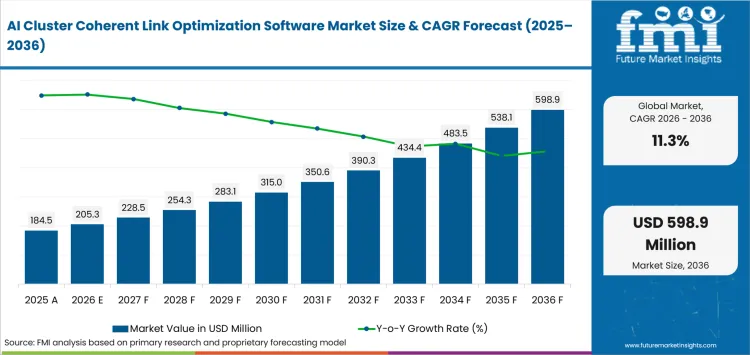
USD 205.3 million in 2026 and USD 598.9 million by 2036 at an 11.3% CAGR.
AI cluster coherent link optimization software demand is expected to push market value to rise from USD 205.3 million in 2026 to USD 598.9 million by 2036 at an 11.3% CAGR. Link counts rise faster than manual assurance capacity once 800G scale-out fabrics become routine in large GPU deployments. Ciena’s March 2025 survey of 1,303 data-center decision makers found 53% expected AI workloads to place the greatest demand on data-center interconnect infrastructure within two to three years. Expected DCI pressure raises recurring demand for software that localizes link faults without wasting accelerator time.
Country opportunity diverges according to how quickly new compute campuses obtain sites and grid access. France’s industry ministry said in May 2025 that 28 additional data-center locations had been identified beyond 35 announced in February. The identified pipeline gives French integrators more project-level qualification windows than markets relying mainly on incremental facility expansion. AI infrastructure commissioning still converts into software revenue once telemetry compatibility and change-control performance are proven.
Key Takeaways
- AI cluster growth increases the number of optical paths that operators must correlate with workload topology so faults do not consume accelerator time.
- In 2026, 800G is expected to lead the link speed category with 38.0% share due to production AI fabrics already using that rate at scale.
- By software function, topology & path optimization is estimated to hold 26.0% in 2026 owing to the need for route context beside link-health measurements.
- Inter-rack - scale-out is projected to hold 36.0% share in 2026 attributable to shared accelerator traffic exposing failures to larger workload groups.
- Multi-vendor telemetry semantics and strict change approval can delay closed-loop deployment even once operators accept continuous link monitoring.
- Some of the key players in this market include EXFO Inc., VIAVI Solutions Inc., Keysight Technologies, Inc., Anritsu Corporation, Ciena Corporation, Nokia Corporation, Cisco Systems, Inc., and Arista Networks, Inc.
Analyst Perspective
"Coherent-link optimization becomes commercially useful once optical measurements reach the same topology context used to protect GPU jobs during faults. Evaluation should therefore weight fault-isolation speed, telemetry normalization and change-control safety ahead of dashboard breadth or raw test coverage."
- Sudip saha, Principal Consultant, Future Market Insights
How is the AI Cluster Coherent Link Optimization Software Market segmented?
The market is segmented by Link Speed, Software Function, Deployment Location, Data Center Type, Route to Market and Region.
Link speed covers 800G, 400G, 1.6T, and 3.2T and above. Software function includes topology & path optimization, link-margin analytics, fault localization, power-budget automation, and capacity planning. Deployment location covers inter-rack - scale-out, intra-rack - scale-up, spine-leaf fabric, and campus / DCI. Data center type includes hyperscale AI, colocation AI, enterprise AI/HPC, and research / sovereign compute. Route to market covers OEM direct, network system integrators, fiber/cabling specialists, and test & managed-service providers.
What supports Hyperscale AI data centers in the Data Center Type category?
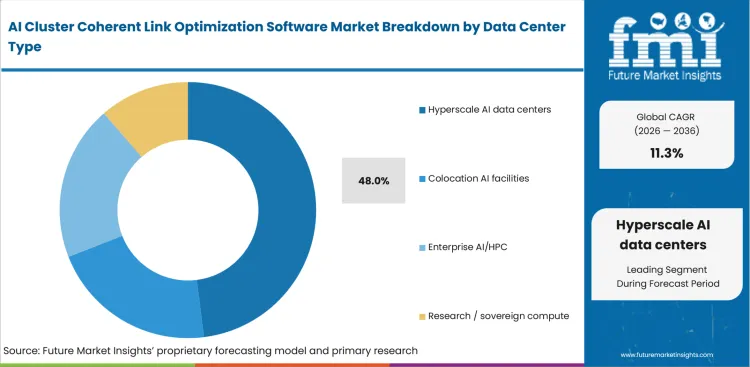
Hyperscale operators concentrate port counts and accelerator value inside repeated network blocks, so manual inspection becomes slower than the economic cost of degraded connectivity. Their operating model also raises demand for fiber latency testing that stays useful beyond construction and initial site handover.
- By data center type, hyperscale AI data centers are forecast to represent 48.0% in 2026 due to dense fabrics that justify persistent assurance software.
- EXFO introduced a 3.2T-capacity tester in March 2026 with two independent 1.6T OSFP ports for AI infrastructure. The release extends hyperscale validation beyond conventional 800G limits and supplies higher-rate evidence for persistent assurance software.
What makes 800G central to the Link Speed category?
Large GPU fabrics already expose enough 800G ports to make continuous correlation economically useful before 1.6T becomes the default production rate. Software at this tier must interpret pluggable optical modules beside switch and topology data instead of treating each lane as an isolated test record.
- By link speed, 800G is estimated to hold 38.0% in 2026 owing to its deployment volume and demanding optical-margin requirements in current AI fabrics.
- NVIDIA stated in March 2025 that Blackwell Ultra scale-out networking provides 800 Gb/s of data throughput per GPU through ConnectX-8 SuperNICs, giving optimization software a production-scale 800G operating base.
Why does Topology & path optimization lead the Software Function category?
A link alarm has limited value until software identifies which accelerator job and alternate route are exposed to the impairment. Topology-aware control therefore uses network processing units with switch telemetry that already describes traffic placement inside AI fabrics and the routes available during congestion.
- Topology & path optimization is likely to capture 26.0% share in 2026 attributable to route context that turns optical measurements into prioritized operational decisions.
- Arista announced in March 2025 that CloudVision added AI job observability with topology mapping and Cluster Load Balancing. The release places job context and traffic paths inside routine fabric troubleshooting and congestion response.
How does Inter-rack - scale-out shape the Deployment Location category?
Scale-out links join large accelerator groups and expose repeated leaf-spine paths to congestion plus physical-layer degradation. A degraded connection can therefore affect more compute than a short local cable, increasing the need to correlate optical transmitters with fabric position.
- Inter-rack - scale-out is projected to hold 36.0% share in 2026 owing to shared workload paths that make link prioritization commercially consequential.
- Cisco said in February 2025 that its expanded NVIDIA work would pair Spectrum-X with Cisco Silicon One and common management, including telemetry plus adaptive routing for AI workloads. The shared management path gives optimization software live route context during congestion events and link-failure diagnosis.
What are the drivers, restraints and opportunities in the AI Cluster Coherent Link Optimization Software Market?
Rapid scale-out raises demand for link-aware assurance, fragmented telemetry delays closed-loop control and automated interconnect validation opens a route to recurring software revenue.
- Driver: Higher port counts and faster scale-out links increase the operational cost of identifying optical faults with manual records and isolated instruments.
- Restraint: Multi-vendor control models and inconsistent telemetry semantics make operators cautious about software that can change production fabric behavior.
- Opportunity: Software that unifies test results with topology and workload context can turn commissioning data into persistent fault and capacity decisions.
One significant driver is the growing consequence of one impaired optical path inside synchronized accelerator jobs that depend on tightly timed scale-out communication. NVIDIA disclosed in March 2025 that each DGX GB300 system carries 72 ConnectX-8 SuperNICs with networking speeds up to 800 Gb/s. At that density, repeated fabric expansion turns telecom equipment validation into an ongoing software task that must isolate multiplying fault paths quickly.
The restraint appears if measurements from different devices do not map cleanly into one control model or preserve consistent alarm meaning. Anritsu demonstrated OpenROADM-compliant multi-vendor DCI testing in April 2025 with vendor-independent YANG control and orchestration. Integrated photonics testing therefore requires stable semantics for production recommendations to pass operator review without duplicate interpretation by separate engineering teams during deployment approval.
The opportunity lies in keeping validation data useful beyond installation instead of leaving it inside commissioning records. Keysight launched ITS software in March 2025 to organize and automate 200GE-to-1600GE interconnect validation for repeated laboratory and field workflows. Photonics test systems can extend those records into ongoing link-margin and fault workflows if software preserves device identity plus topology context during operations.
Which country CAGRs are profiled in the AI Cluster Coherent Link Optimization Software Market?
| Country | CAGR |
|---|---|
| South Korea | 12.8% |
| Japan | 12.2% |
| France | 11.9% |
| USA | 11.6% |
| Germany | 11.2% |
How do country-level CAGRs compare in the AI Cluster Coherent Link Optimization Software Market?
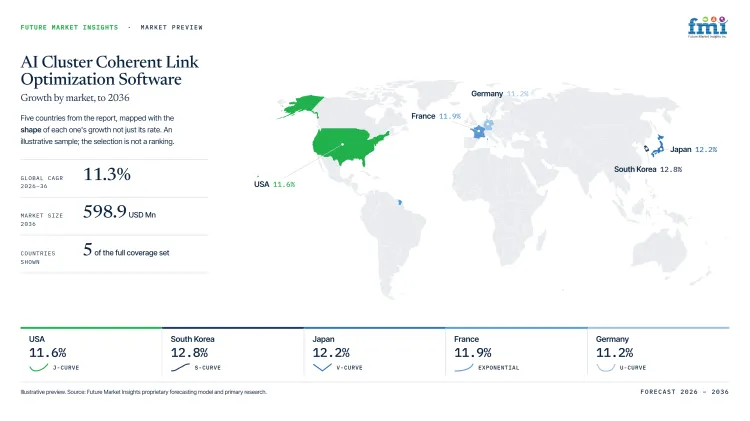
The countries span a 1.6-point range, led by South Korea at 12.8% and followed by Japan at 12.2%, France at 11.9%, the USA at 11.6%, and Germany at 11.2%. South Korea forms the clear upper tier, while Japan, France, and the USA occupy the middle range. Germany records the lowest growth rate among the five markets.
- South Korea relies on sovereign compute programs, making engineering access and technical partnerships critical for market entry.
- Japan conducts qualification through research facilities and technical groups, often requiring repeated acceptance cycles.
- France distributes project qualification across multiple integrators, reducing reliance on a single project owner.
- The USA benefits from a diverse operator base, creating demand for broad channel coverage and multiple project relationships.
- Germany supports market entry through distributed industrial and research projects that involve multiple technical and integration partners.
Similar CAGRs therefore mask different account concentration and qualification routes in each country. The full report provides country-level CAGR analysis across North America, Latin America, Europe, East Asia, South Asia, Oceania and the Middle East and Africa.
Country-wise Analysis
- South Korea is building AI capacity through coordinated public compute procurement, concentrating network qualification within a limited group of large facilities supported by domestic integrators. South Korea is forecast to expand at 12.8% CAGR through 2036, supported by planned GPU additions that allow operators to align link-assurance software with major capacity increases. Power availability and site allocation can affect commissioning schedules, giving local integrators an advantage in embedding multi-vendor acceptance testing before wider direct-sales expansion.
- Japan relies heavily on shared research-compute facilities where multiple technical groups operate within common infrastructure and schedules. Japan is projected to advance at 12.2% CAGR through 2036, supported by dense public research infrastructure and recurring high-performance computing upgrades. Formal change procedures can extend software-to-production timelines, increasing demand for fault recommendations that preserve evidence trails and make network actions easier to audit and approve.
- France is preparing multiple data-center projects where integrators can gain early visibility into campus scale and commissioning schedules. France is forecast to grow at 11.9% CAGR through 2036, as planned campus development concentrates link-assurance demand into defined construction and deployment phases. Grid connection sequencing can affect service dates, making early integration planning important for software vendors seeking to attach recurring assurance services to new facilities.
- The USA has a broad AI infrastructure base spanning hyperscalers, neoclouds, and enterprise AI operators that use different network architectures and change-control policies. The USA is anticipated to grow at 11.6% CAGR through 2036, supported by continued large-campus construction and a wide range of addressable operators. Fragmented technical environments increase integration requirements, favoring companies with remote diagnostics and broad OEM compatibility.
- Germany is developing AI and high-performance computing capacity across data centers, research institutions, and industrial users, creating demand across multiple technical environments. Germany is projected to expand at 11.2% CAGR through 2036, supported by continued investment in digital infrastructure and compute capacity. Diverse deployment requirements can increase qualification complexity, making local integration expertise and compatibility across different network environments important for software providers.
Who are the notable companies in the AI Cluster Coherent Link Optimization Software Market?
EXFO Inc., VIAVI Solutions Inc., Keysight Technologies, Inc., Anritsu Corporation, Ciena Corporation, Nokia Corporation, Cisco Systems, Inc., and Arista Networks, Inc. are the notable companies serving this market.
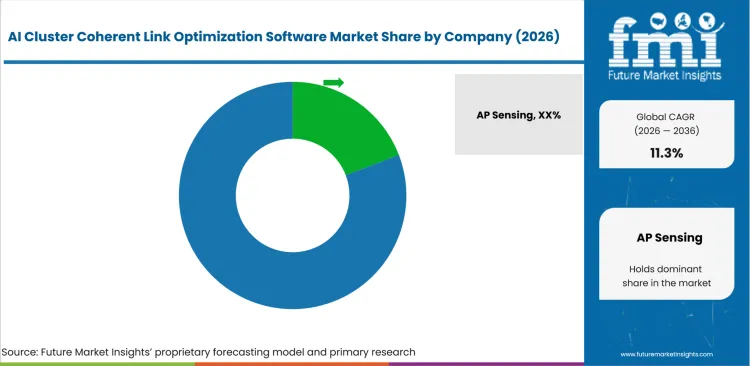
The competitive field separates into test-and-assurance specialists, optical-network control vendors and AI-fabric operating platforms that reach buyers from different control points. Entry barriers depend on proven telemetry handling plus direct access to production control points that govern network change approval. Network actions must respect facility operating states, which makes adjacent AI power orchestration another integration burden.
- EXFO Inc., VIAVI Solutions Inc., Keysight Technologies, Inc., and Anritsu Corporation compete through high-speed validation data plus network test automation that feeds link-health decisions.
- Ciena Corporation and Nokia Corporation bring optical-network control plus coherent transport expertise that links measured condition with programmable network operations.
- Cisco Systems, Inc. and Arista Networks, Inc. compete closest to workload-aware path control through AI-fabric telemetry, routing and congestion-management software.
Competitive Benchmarking: AI Cluster Coherent Link Optimization Software Market
| Company | Operational Telemetry & Analytics | AI Fabric Path Control | Coherent Link Integration | Geographic Reach |
|---|---|---|---|---|
| EXFO Inc. | High | Medium | High | North America / Europe / Asia-Pacific |
| VIAVI Solutions Inc. | High | Medium | High | North America / Europe / Asia-Pacific |
| Keysight Technologies, Inc. | High | Medium | High | North America / Europe / Asia-Pacific |
| Anritsu Corporation | Medium | Low | High | Asia-Pacific / North America / Europe |
| Ciena Corporation | High | Medium | High | North America / Europe / Asia-Pacific |
| Nokia Corporation | High | High | High | Europe / North America / Asia-Pacific |
| Cisco Systems, Inc. | High | High | Medium | North America / Europe / Asia-Pacific |
| Arista Networks, Inc. | High | High | Medium | North America / Europe / Asia-Pacific |
Scoring basis: High telemetry requires persistent multi-layer analytics or automated validation while Medium covers narrower monitoring and Low covers local measurement. High path control requires topology-aware routing or load balancing while Medium covers narrower automation and Low covers verification without path control. High coherent integration requires 800G or 1.6T optical evidence while Medium covers narrower high-speed AI Ethernet integration and Low covers no documented coherent integration.
Key Developments in the AI Cluster Coherent Link Optimization Software Market
- In February 2026, Ciena Corporation launched Vesta 200 6.4T CPX with a single-wavelength optical engine for 200G-per-lane AI scale-out and scale-up interconnects.
- In September 2025, VIAVI Solutions Inc. expanded its ONE LabPro platform with the ONE-1600ER module, enabling comprehensive testing and validation of next-generation 1.6Tb optical components for AI-driven infrastructure.
- In April 2025, EXFO Inc. introduced the BA-1600 1.6T validation system for design, transceiver manufacturing and continuing high-speed validation from laboratory to production environments.
Key Players in the AI Cluster Coherent Link Optimization Software Market
High-Speed Test and Assurance Platforms
- EXFO Inc.
- VIAVI Solutions Inc.
- Keysight Technologies, Inc.
- Anritsu Corporation
Optical Network Control Platforms
- Ciena Corporation
- Nokia Corporation
AI Fabric Operating Platforms
- Cisco Systems, Inc.
- Arista Networks, Inc.
AI Cluster Coherent Link Optimization Software Market - Report Scope
| Coverage field | Report scope |
|---|---|
| Market breakdown | By link speed, software function, deployment location, data center type, route to market and region. |
| Quantitative Units | USD million. |
| Market Definition | Software licenses, subscriptions, support and directly attributable services used to optimize or assure coherent optical links inside AI clusters. |
| Regions Covered | North America, Latin America, Europe, East Asia, South Asia and Pacific, and Middle East and Africa. |
| Countries Covered | South Korea, UAE, Japan, France, USA, and 20+ countries included in the full report. |
| Key Companies Profiled | EXFO Inc., VIAVI Solutions Inc., Keysight Technologies, Inc., Anritsu Corporation, Ciena Corporation, Nokia Corporation, Cisco Systems, Inc., and Arista Networks, Inc. |
| Forecast Period | 2026 to 2036. |
| Approach | Primary and secondary research with market triangulation. |
AI Cluster Coherent Link Optimization Software Market - Research Methodology
| Method | Approach |
|---|---|
| Primary Research | FMI analysts gathered input from manufacturers, service providers, technology developers, distributors, end users, procurement teams, and subject-matter experts. Interviews examined purchasing decisions, product or service evaluation, adoption barriers, approval requirements, pricing considerations, and expectations for technical or commercial support. Respondents were also asked what evidence is required before a trial, pilot, or initial order develops into regular purchasing. |
| Desk Research | Desk research covered government statistics, regulatory publications, trade data, industry associations, technical literature, standards, company filings, product information, and official corporate announcements. Sources were reviewed for relevance, publication date, geographic coverage, and consistency with the defined market scope. Claims relating to performance, applications, approvals, capacity, investment, and commercial activity were retained only when supported by credible public evidence. |
| Market Sizing and Forecasting | The market model combined the baseline value with historical performance, segment structure, pricing and volume indicators, adoption levels, company participation, and country-level demand conditions. Forecast assumptions considered economic activity, investment trends, regulatory developments, technology adoption, purchasing cycles, supply availability, and barriers to wider market use. Segment and regional estimates were reconciled before the final market total was calculated. |
| Data Validation | Estimates were checked against multiple independent indicators, including public data, company activity, trade patterns, industry developments, and findings from primary interviews. Validation also tested whether products, services, applications, and company revenues fell within the defined market boundaries. Adjacent categories, unsupported claims, overlapping revenues, and activities without direct market relevance were excluded to reduce double counting and maintain consistency across segments and countries. |
AI Cluster Coherent Link Optimization Software Market by Segments
Link Speed
- 800G
- 400G
- 1.6T
- 3.2T and above
Software Function
- Topology & path optimization
- Link-margin analytics
- Fault localization
- Power-budget automation
- Capacity planning
Deployment Location
- Inter-rack - scale-out
- Intra-rack - scale-up
- Spine-leaf fabric
- Campus / DCI
Data Center Type
- Hyperscale AI data centers
- Colocation AI facilities
- Enterprise AI/HPC
- Research / sovereign compute
Route to Market
- OEM direct
- Network system integrators
- Fiber/cabling specialists
- Test & managed-service providers
By Region:
- North America
- United States
- Canada
- Latin America
- Brazil
- Mexico
- Argentina
- Chile
- Western Europe
- Germany
- France
- United Kingdom
- Italy
- Spain
- Benelux
- Nordics
- Eastern Europe
- Poland
- Czech Republic
- Romania
- Hungary
- East Asia
- China
- Japan
- South Korea
- South Asia and Pacific
- India
- ASEAN
- Australia and New Zealand
- Middle East and Africa
- GCC Countries
- South Africa
- Türkiye
- Israel
Research Sources and Bibliography
- Ciena Corporation. (2025, March 17). Ciena Global Survey Explores Networking Needs for AI Era.
- Direction générale des Entreprises. (2025, May 20). Sommet Choose France 2025.
- NVIDIA Corporation. (2025, March 18). NVIDIA Blackwell Ultra AI Factory Platform Paves Way for Age of AI Reasoning.
- Arista Networks, Inc. (2025, March 12). Arista Introduces Intelligent Innovations for AI Networking.
- Cisco Systems, Inc. (2025, February 25). Cisco Expands Partnership with NVIDIA to Accelerate AI Adoption in the Enterprise.
- EXFO Inc. (2026, March 16). EXFO’s Industry-leading Innovations Supporting AI Infrastructure from Chip to System to Data Center Exhibited at OFC 2026.
- NVIDIA Corporation. (2025, March 18). NVIDIA Blackwell Ultra DGX SuperPOD Delivers Out-of-the-Box AI Supercomputer for Enterprises to Build AI Factories.
- Anritsu Corporation. (2025, April 2). OFC 2025: Anritsu, in Collaboration with the University of Texas at Dallas, Exhibits OpenROADM MSA-Compliant Data Center Interconnection Control and Communication Quality Monitoring.
- Keysight Technologies, Inc. (2025, March 26). Keysight Debuts 1.6T Platform and First-of-its-Kind Software to Automate Validation of Network Interconnect Performance.
- Ministry of Science and ICT. (2025, February 20). Korea to Expand AI Computing Infrastructure to Strengthen National AI Capabilities and Achieve Global Leadership.
- Abu Dhabi Media Office. (2025, May 22). Global Tech Alliance Launches Stargate UAE.
- National Institute of Advanced Industrial Science and Technology. (2025, June 10). ABCI 3.0 and ABCI-Q Rank Among the Top Supercomputers.
- The White House. (2025, July 23). Fact Sheet: President Donald J. Trump Accelerates Federal Permitting of Data Center Infrastructure.
- Ciena Corporation. (2026, February 25). Ciena Unveils the Industry’s Highest-Density, Lowest-Power Pluggable Optical Engine to Meet Data Center AI Demands.
- VIAVI Solutions Inc. (2025, September 25). VIAVI Expands ONE LabPro ONE-1600 1.6Tb Testing and Validation Platform.
- EXFO Inc. (2025, April 1). EXFO Showcases Industry’s First Lab to Fabrication 1.6T TEST Solution.
- Nokia Corporation. (2025, February 28). Nokia Completes Acquisition of Infinera to Create Innovation Powerhouse in Optical Networks, with the Scale to Power the Data Center Revolution.
- Ciena Corporation. (2025, September 22). Ciena to Acquire Nubis Communications to Expand its Inside the Data Center Strategy and Further Address Growing AI Workloads.
- Arista Networks, Inc. (2025, October 29). Arista Networks Unveils Next Generation Data and AI Centers.
- Anritsu Company. (2025, October 28). Anritsu Breaks Bandwidth Barrier with World’s First 145 GHz O/E Calibration Module, Accelerating 1.6T Data Center Evolution.
- EXFO Inc. (2025, September 30). Advanced OTDR part of comprehensive hollow core fiber-capable EXFO test solutions portfolio ensuring reliable high speed, low latency interconnect.
- VIAVI Solutions Inc. (2025, April 1). VIAVI Announces Enhancements to ONE LabPro 1.6Tb/s Test Platform.
- Keysight Technologies, Inc. (2025, September 15). Keysight to Demonstrate New Solutions that Support AI Infrastructure and Optical Innovations at ECOC 2025.
- Anritsu Company. (2026, March 16). Anritsu and Semtech Validate 224G/448G Driver Amplifiers at OFC 2026.
- Ciena Corporation. (2026, March 10). Ciena Solidifies AI Networking Leadership, Unveils New Innovations for High-Speed Connectivity.
- Nokia Corporation. (2026, May 21). Nokia Launches AI Networking Lab to Drive Co-Innovation with Partners and Accelerate Next Era of AI-Native Data Center Networking.
- Cisco Systems, Inc. (2025, June 10). Cisco Powers AI-Ready Data Centers, From Hyperscale to Enterprise.
- Cisco Systems, Inc. (2026, February 10). Cisco Announces New Silicon One G300, Advanced Systems and Optics to Power and Scale AI Data Centers for the Agentic Era.
- Arista Networks, Inc. (2026, June 9). Arista Introduces Next-Generation 1.6Terabit Portfolio for AI Fabrics.
This bibliography is provided for reader reference and is not exhaustive. The full report contains the complete reference list and detailed citations.
This Report Answers
- How large is the AI cluster coherent link optimization software market in 2026 and what is its projected 2036 value?
- Why do 800G scale-out fabrics increase demand for persistent link-health and topology analytics?
- Which software functions receive the strongest demand in synchronized accelerator workloads?
- How do inter-rack deployments change the economics of optical fault localization?
- Which telemetry constraints delay closed-loop optimization inside production AI fabrics?
- How do South Korea, the UAE, Japan, France and the USA compare by forecast CAGR?
- Which companies provide validation and AI-fabric operating capabilities in this market?
- How are companies benchmarked for telemetry analytics and coherent-link integration?
- Which 2025 and 2026 company actions changed the competitive field for high-speed AI interconnect assurance?
Frequently Asked Questions
How big is the AI Cluster Coherent Link Optimization Software Market in 2026?
The ai cluster coherent link optimization software market is valued at USD 205.3 million in 2026 and is projected to reach USD 598.9 million by 2036. Growth follows rising optical-link counts inside large AI scale-out fabrics where manual assurance becomes increasingly costly for operators.
What is the CAGR of the AI Cluster Coherent Link Optimization Software Market from 2026 to 2036?
The ai cluster coherent link optimization software market is projected to grow at a CAGR of 11.3% between 2026 and 2036. Expansion follows higher link rates plus continued demand for topology-aware fault localization after initial data-center commissioning and production handover.
Which link speed leads the AI Cluster Coherent Link Optimization Software Market?
The 800G segment is expected to hold 38.0% of the ai cluster coherent link optimization software market in 2026, supported by current production deployment at scale. Software vendors therefore have a large installed base for link-margin analytics and fault localization today.
Which data center type leads the AI Cluster Coherent Link Optimization Software Market?
Hyperscale AI data centers are expected to hold 48.0% of the data center type category in 2026, attributable to dense port counts and high accelerator utilization. Persistent assurance software therefore has a stronger economic case after commissioning inside these large repeated network blocks.
Which countries are projected to record the highest growth in the AI Cluster Coherent Link Optimization Software Market?
South Korea is projected to grow at 12.8% CAGR, followed by the UAE at 12.5% and Japan at 12.2% through 2036. Large compute programs concentrate qualification opportunities for link-assurance software within these three high-growth national markets.
Which companies are active in the AI Cluster Coherent Link Optimization Software Market?
Key companies operating in the market include EXFO Inc., VIAVI Solutions Inc., Keysight Technologies, Inc., Anritsu Corporation, Ciena Corporation, Nokia Corporation, Cisco Systems, Inc., and Arista Networks, Inc. The eight companies compete through validation software, optical control and workload-aware fabric operations that influence network decisions.
Preview the report firsthand - request a free sample
Get SampleGet the brochure for pricing and purchase details.
Get PDFTable of Content
- Key Takeaways
- Market Size and CAGR
- Top Growth Driver
- Fastest Growing Segment
- Leading Region
- Key Companies
- Emerging Opportunities
- Executive Summary
- Global Market Outlook
- Demand-side Trends
- Supply-side Trends
- Technology Roadmap Analysis
- Analysis and Recommendations
- Analyst Perspective (What is happening? Why now? What should investors know?)
- Key Questions Answered
- How large is the market?
- What is the CAGR?
- What are key trends?
- Which region dominates?
- Who are the leaders?
- Market Overview
- Market Coverage / Taxonomy
- Market Definition / Scope / Limitations
- Research Methodology
- Chapter Orientation
- Analytical Lens and Working Hypotheses
- Market Structure, Signals, and Trend Drivers
- Benchmarking and Cross-market Comparability
- Market Sizing, Forecasting, and Opportunity Mapping
- Research Design and Evidence Framework
- Desk Research Programme (Secondary Evidence)
- Expert Input and Fieldwork (Primary Evidence)
- Tooling, Models, and Reference Databases
- Data Engineering and Model Build
- Quality Assurance and Audit Trail
- Market Background
- Market Dynamics (Drivers, Restraints, Opportunity, Trends)
- Scenario Forecast (Optimistic, Likely, Conservative)
- Impact Analysis
- AI Impact
- Sustainability Impact
- Regulatory Impact
- Technology Impact
- Consumer / Buyer Analysis
- Purchase Drivers
- Adoption Barriers
- Buyer Journey
- Opportunity Map Analysis
- Product Life Cycle Analysis
- Supply Chain Analysis
- Investment Feasibility Matrix
- Value Chain Analysis
- PESTLE and Porter's Analysis
- Regulatory Landscape
- Regional Parent Market Outlook
- Production and Consumption Statistics
- Import and Export Statistics
- Global Market Analysis and Forecast, 2021 to 2036
- Historical Market Size Value (USD Million) Analysis, 2021 to 2025
- Current and Future Market Size Value (USD Million) Projections, 2026 to 2036
- Y-o-Y Growth Trend Analysis
- Absolute $ Opportunity Analysis
- Global Market Pricing Analysis, 2021 to 2036
- Global Market Analysis and Forecast, By Link Speed, 2021 to 2036
- Introduction / Key Findings
- Historical Market Size Value (USD Million) Analysis By Link Speed, 2021 to 2025
- Current and Future Market Size Value (USD Million) Analysis and Forecast By Link Speed, 2026 to 2036
- 800G
- 400G
- 1.6T
- 3.2T and above
- 800G
- Y-o-Y Growth Trend Analysis By Link Speed, 2021 to 2025
- Absolute $ Opportunity Analysis By Link Speed, 2026 to 2036
- Global Market Analysis and Forecast, By Software Function, 2021 to 2036
- Introduction / Key Findings
- Historical Market Size Value (USD Million) Analysis By Software Function, 2021 to 2025
- Current and Future Market Size Value (USD Million) Analysis and Forecast By Software Function, 2026 to 2036
- Topology & path optimization
- Link-margin analytics
- Fault localization
- Power-budget automation
- Capacity planning
- Topology & path optimization
- Y-o-Y Growth Trend Analysis By Software Function, 2021 to 2025
- Absolute $ Opportunity Analysis By Software Function, 2026 to 2036
- Global Market Analysis and Forecast, By Deployment Location, 2021 to 2036
- Introduction / Key Findings
- Historical Market Size Value (USD Million) Analysis By Deployment Location, 2021 to 2025
- Current and Future Market Size Value (USD Million) Analysis and Forecast By Deployment Location, 2026 to 2036
- Inter-rack / scale-out
- Intra-rack / scale-up
- Spine-leaf fabric
- Campus / DCI
- Inter-rack / scale-out
- Y-o-Y Growth Trend Analysis By Deployment Location, 2021 to 2025
- Absolute $ Opportunity Analysis By Deployment Location, 2026 to 2036
- Global Market Analysis and Forecast, By Data Center Type, 2021 to 2036
- Introduction / Key Findings
- Historical Market Size Value (USD Million) Analysis By Data Center Type, 2021 to 2025
- Current and Future Market Size Value (USD Million) Analysis and Forecast By Data Center Type, 2026 to 2036
- Hyperscale AI data centers
- Colocation AI facilities
- Enterprise AI/HPC
- Research / sovereign compute
- Hyperscale AI data centers
- Y-o-Y Growth Trend Analysis By Data Center Type, 2021 to 2025
- Absolute $ Opportunity Analysis By Data Center Type, 2026 to 2036
- Global Market Analysis and Forecast, By Route to Market, 2021 to 2036
- Introduction / Key Findings
- Historical Market Size Value (USD Million) Analysis By Route to Market, 2021 to 2025
- Current and Future Market Size Value (USD Million) Analysis and Forecast By Route to Market, 2026 to 2036
- OEM direct
- Network system integrators
- Fiber/cabling specialists
- Test & managed-service providers
- OEM direct
- Y-o-Y Growth Trend Analysis By Route to Market, 2021 to 2025
- Absolute $ Opportunity Analysis By Route to Market, 2026 to 2036
- Global Market Analysis and Forecast, By Region, 2021 to 2036
- Introduction
- Historical Market Size Value (USD Million) Analysis By Region, 2021 to 2025
- Current Market Size Value (USD Million) Analysis and Forecast By Region, 2026 to 2036
- North America
- Latin America
- Western Europe
- Eastern Europe
- East Asia
- South Asia and Pacific
- Middle East & Africa
- Market Attractiveness Analysis By Region
- North America Market Analysis and Forecast, By Country, 2021 to 2036
- Historical Market Size Value (USD Million) Trend Analysis By Market Taxonomy, 2021 to 2025
- Market Size Value (USD Million) Forecast By Market Taxonomy, 2026 to 2036
- By Country
- USA
- Canada
- By Link Speed
- By Software Function
- By Deployment Location
- By Data Center Type
- By Route to Market
- By Country
- Market Attractiveness Analysis
- By Country
- By Link Speed
- By Software Function
- By Deployment Location
- By Data Center Type
- By Route to Market
- Key Takeaways
- Latin America Market Analysis and Forecast, By Country
- Historical Market Size Value (USD Million) Trend Analysis By Market Taxonomy, 2021 to 2025
- Market Size Value (USD Million) Forecast By Market Taxonomy, 2026 to 2036
- By Country
- Brazil
- Mexico
- Chile
- Rest of Latin America
- By Link Speed
- By Software Function
- By Deployment Location
- By Data Center Type
- By Route to Market
- By Country
- Market Attractiveness Analysis
- By Country
- By Link Speed
- By Software Function
- By Deployment Location
- By Data Center Type
- By Route to Market
- Key Takeaways
- Western Europe Market Analysis and Forecast, By Country
- Historical Market Size Value (USD Million) Trend Analysis By Market Taxonomy, 2021 to 2025
- Market Size Value (USD Million) Forecast By Market Taxonomy, 2026 to 2036
- By Country
- Germany
- UK
- Italy
- Spain
- France
- Nordic
- BENELUX
- Rest of Western Europe
- By Link Speed
- By Software Function
- By Deployment Location
- By Data Center Type
- By Route to Market
- By Country
- Market Attractiveness Analysis
- By Country
- By Link Speed
- By Software Function
- By Deployment Location
- By Data Center Type
- By Route to Market
- Key Takeaways
- Eastern Europe Market Analysis and Forecast, By Country
- Historical Market Size Value (USD Million) Trend Analysis By Market Taxonomy, 2021 to 2025
- Market Size Value (USD Million) Forecast By Market Taxonomy, 2026 to 2036
- By Country
- Russia
- Poland
- Hungary
- Balkan & Baltic
- Rest of Eastern Europe
- By Link Speed
- By Software Function
- By Deployment Location
- By Data Center Type
- By Route to Market
- By Country
- Market Attractiveness Analysis
- By Country
- By Link Speed
- By Software Function
- By Deployment Location
- By Data Center Type
- By Route to Market
- Key Takeaways
- East Asia Market Analysis and Forecast, By Country
- Historical Market Size Value (USD Million) Trend Analysis By Market Taxonomy, 2021 to 2025
- Market Size Value (USD Million) Forecast By Market Taxonomy, 2026 to 2036
- By Country
- China
- Japan
- South Korea
- By Link Speed
- By Software Function
- By Deployment Location
- By Data Center Type
- By Route to Market
- By Country
- Market Attractiveness Analysis
- By Country
- By Link Speed
- By Software Function
- By Deployment Location
- By Data Center Type
- By Route to Market
- Key Takeaways
- South Asia and Pacific Market Analysis and Forecast, By Country
- Historical Market Size Value (USD Million) Trend Analysis By Market Taxonomy, 2021 to 2025
- Market Size Value (USD Million) Forecast By Market Taxonomy, 2026 to 2036
- By Country
- India
- ASEAN
- Australia & New Zealand
- Rest of South Asia and Pacific
- By Link Speed
- By Software Function
- By Deployment Location
- By Data Center Type
- By Route to Market
- By Country
- Market Attractiveness Analysis
- By Country
- By Link Speed
- By Software Function
- By Deployment Location
- By Data Center Type
- By Route to Market
- Key Takeaways
- Middle East & Africa Market Analysis and Forecast, By Country
- Historical Market Size Value (USD Million) Trend Analysis By Market Taxonomy, 2021 to 2025
- Market Size Value (USD Million) Forecast By Market Taxonomy, 2026 to 2036
- By Country
- Kingdom of Saudi Arabia
- Other GCC Countries
- Türkiye
- South Africa
- Other African Union
- Rest of Middle East & Africa
- By Link Speed
- By Software Function
- By Deployment Location
- By Data Center Type
- By Route to Market
- By Country
- Market Attractiveness Analysis
- By Country
- By Link Speed
- By Software Function
- By Deployment Location
- By Data Center Type
- By Route to Market
- Key Takeaways
- Key Countries Market Analysis
- USA
- Pricing Analysis
- Market Share Analysis, 2025
- By Link Speed
- By Software Function
- By Deployment Location
- By Data Center Type
- By Route to Market
- Canada
- Pricing Analysis
- Market Share Analysis, 2025
- By Link Speed
- By Software Function
- By Deployment Location
- By Data Center Type
- By Route to Market
- Mexico
- Pricing Analysis
- Market Share Analysis, 2025
- By Link Speed
- By Software Function
- By Deployment Location
- By Data Center Type
- By Route to Market
- Brazil
- Pricing Analysis
- Market Share Analysis, 2025
- By Link Speed
- By Software Function
- By Deployment Location
- By Data Center Type
- By Route to Market
- Chile
- Pricing Analysis
- Market Share Analysis, 2025
- By Link Speed
- By Software Function
- By Deployment Location
- By Data Center Type
- By Route to Market
- Germany
- Pricing Analysis
- Market Share Analysis, 2025
- By Link Speed
- By Software Function
- By Deployment Location
- By Data Center Type
- By Route to Market
- UK
- Pricing Analysis
- Market Share Analysis, 2025
- By Link Speed
- By Software Function
- By Deployment Location
- By Data Center Type
- By Route to Market
- Italy
- Pricing Analysis
- Market Share Analysis, 2025
- By Link Speed
- By Software Function
- By Deployment Location
- By Data Center Type
- By Route to Market
- Spain
- Pricing Analysis
- Market Share Analysis, 2025
- By Link Speed
- By Software Function
- By Deployment Location
- By Data Center Type
- By Route to Market
- France
- Pricing Analysis
- Market Share Analysis, 2025
- By Link Speed
- By Software Function
- By Deployment Location
- By Data Center Type
- By Route to Market
- India
- Pricing Analysis
- Market Share Analysis, 2025
- By Link Speed
- By Software Function
- By Deployment Location
- By Data Center Type
- By Route to Market
- ASEAN
- Pricing Analysis
- Market Share Analysis, 2025
- By Link Speed
- By Software Function
- By Deployment Location
- By Data Center Type
- By Route to Market
- Australia & New Zealand
- Pricing Analysis
- Market Share Analysis, 2025
- By Link Speed
- By Software Function
- By Deployment Location
- By Data Center Type
- By Route to Market
- China
- Pricing Analysis
- Market Share Analysis, 2025
- By Link Speed
- By Software Function
- By Deployment Location
- By Data Center Type
- By Route to Market
- Japan
- Pricing Analysis
- Market Share Analysis, 2025
- By Link Speed
- By Software Function
- By Deployment Location
- By Data Center Type
- By Route to Market
- South Korea
- Pricing Analysis
- Market Share Analysis, 2025
- By Link Speed
- By Software Function
- By Deployment Location
- By Data Center Type
- By Route to Market
- Russia
- Pricing Analysis
- Market Share Analysis, 2025
- By Link Speed
- By Software Function
- By Deployment Location
- By Data Center Type
- By Route to Market
- Poland
- Pricing Analysis
- Market Share Analysis, 2025
- By Link Speed
- By Software Function
- By Deployment Location
- By Data Center Type
- By Route to Market
- Hungary
- Pricing Analysis
- Market Share Analysis, 2025
- By Link Speed
- By Software Function
- By Deployment Location
- By Data Center Type
- By Route to Market
- Kingdom of Saudi Arabia
- Pricing Analysis
- Market Share Analysis, 2025
- By Link Speed
- By Software Function
- By Deployment Location
- By Data Center Type
- By Route to Market
- Türkiye
- Pricing Analysis
- Market Share Analysis, 2025
- By Link Speed
- By Software Function
- By Deployment Location
- By Data Center Type
- By Route to Market
- South Africa
- Pricing Analysis
- Market Share Analysis, 2025
- By Link Speed
- By Software Function
- By Deployment Location
- By Data Center Type
- By Route to Market
- USA
- Market Structure Analysis
- Competition Dashboard
- Competition Benchmarking
- Market Share Analysis of Top Players
- By Regional
- By Link Speed
- By Software Function
- By Deployment Location
- By Data Center Type
- By Route to Market
- Emerging Startups
- Innovation Benchmarking
- Competition Analysis
- Competition Deep Dive
- AP Sensing
- Overview
- Product Portfolio
- Profitability by Market Segments
- Sales Footprint
- Strategy Overview
- Marketing Strategy
- Product Strategy
- Channel Strategy
- EXFO
- Corning
- VIAVI Solutions
- AP Sensing
- Case Studies
- Success Stories
- Recent Developments
- Competition Deep Dive
- Assumptions & Acronyms Used


