

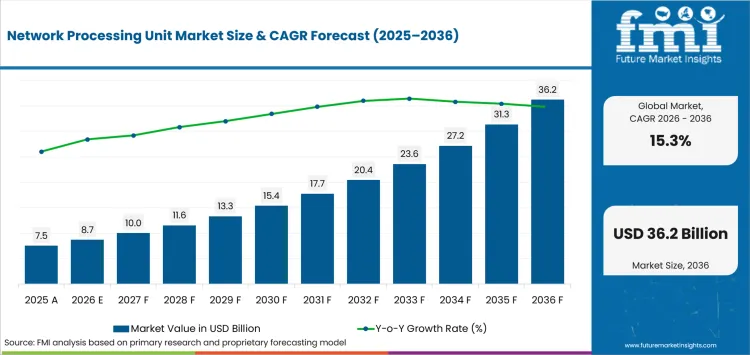
- Market Size (2026)
- USD 8.7 Bn
- Forecast (2036)
- USD 36.2 Bn
- CAGR (2026 to 2036)
- 15.3%
How big is Network Processing Unit Market in 2026?
USD 8.7 billion in 2026 and USD 36.2 billion by 2036 at a 15.3% CAGR.
Demand for network processing units is projected to expand at 15.3% CAGR between 2026 and 2036, increasing valuation from USD 8.7 billion in 2026 to USD 36.2 billion by 2036. AI infrastructure makes network efficiency a facility capacity issue as packet movement consumes power beside accelerated workloads. The International Energy Agency projected global data center electricity consumption near 945 TWh by 2030 in April 2025. Facility planners therefore compare packet offload with power budgets and server utilization across each data center platform.
Network processors handle virtual switching and encryption beside the server interface so host CPUs remain available for applications. The offload model aligns qualification with the data center accelerator roadmap across congestion control and security. Software portability remains a principal friction across processor families with different compilers and orchestration hooks.
Key Takeaways of Network Processing Unit Market
- AI and cloud fabrics raise dedicated packet processing value by preserving host compute during sustained east-west traffic.
- Standalone NPUs are projected to represent 46.0% share in 2026 due to independent qualification across several platform generations.
- Data centers are estimated to account for 39.0% share in 2026 owing to concentrated traffic and infrastructure services.
- Routing and switching is forecast to capture 33.0% share in 2026 driven by continuous forwarding across every network tier.
- Programmable architecture is anticipated to hold 44.0% share in 2026 attributable to protocol changes across longer hardware lifecycles.
- Software migration and thermal redesign can delay production approval despite stronger throughput from replacement processor platforms.
- NVIDIA and Broadcom compete alongside Intel and Marvell across cloud infrastructure while AMD and Cisco support programmable offload and Qualcomm and NXP concentrate on access systems.
Analyst Perspective
"Network processing units secure repeat design wins through software that exposes packet behavior as clearly as the silicon delivers line-rate throughput. Portable pipelines and congestion-tested latency deserve equal weight as migration costs can erase the compute savings promised by faster offload hardware."
- Sudip saha, Principal Consultant, Future Market Insights
How is the Network Processing Unit Market segmented?
The network processing unit industry is segmented by product type, deployment, application, end user, architecture and region.
The network processing unit market is organized by product type, deployment, application, end user, architecture and region to separate distinct design and qualification routes. Product type covers standalone, programmable, fixed-function and integrated NPUs alongside SoC, SmartNIC and embedded formats. Deployment and application categories separate data centers, telecom networks and edge environments from routing, security, cloud and industrial workloads. End users include cloud providers, telecom operators, enterprises and public institutions while architecture distinguishes programmable, ASIC-based, dedicated, hybrid and integrated processing.
Why do standalone NPUs lead demand within the product type category?
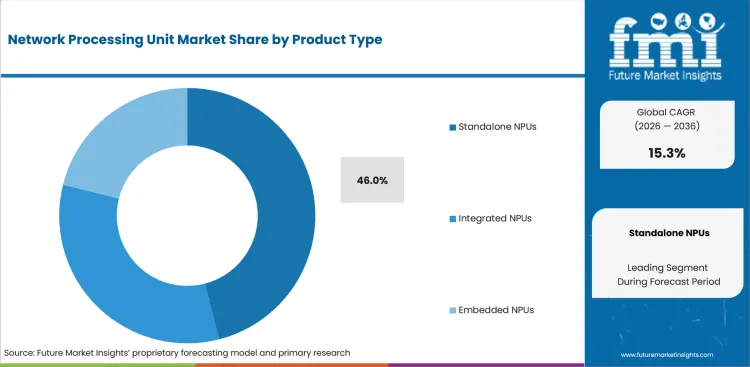
Standalone NPUs separate packet handling from host compute and give system engineers a distinct component for performance testing across several platform generations.
- The standalone NPU is likely to capture 46.0% share in 2026 attributable to independent qualification across server and network platform roadmaps.
- Cloud architects compare sustained packet rate and software integration under representative traffic during fleet approval. Intel and Google expanded their custom IPU collaboration in April 2026 to offload networking, storage and security from host CPUs. Multigeneration co-development reduces repeated integration work and gives standalone processors a practical route into large production fleets at scale.
Why do data centers lead demand within the deployment category?
Data centers concentrate storage flows and virtual networks around every server interface as accelerator utilization becomes sensitive to congestion. The Ultra Ethernet Consortium published Specification 1.0.3 in July 2026 as its current implementation reference across the networking stack.
- By deployment, data centers are estimated to hold 39.0% in 2026 owing to repeated infrastructure services across dense cloud and AI computing fleets.
- Cloud operators need interoperable transport to extend an offload design across several switch and NIC manufacturers. Common behavior across interfaces lowers test duplication and supports broader production qualification without rebuilding congestion control for each hardware combination.
Why does routing and switching lead demand within the application category?
Routing and switching processors parse headers and manage queues across carrier, cloud and enterprise networks with wider design coverage than specialized offload functions.
- In 2026, routing and switching is expected to lead the application category with 33.0% share because continuous forwarding requirements span every network tier. Broadcom began shipping its 102.4 Tbps Tomahawk 6 switch in June 2025 for scale-up and scale-out AI networks.
- System designers test throughput per watt and congestion behavior under realistic traffic as a fabric bottleneck reduces connected accelerator utilization. The ethernet switch refresh gives packet processors a direct design route into dense AI fabrics that require predictable forwarding.
Why does programmable architecture lead demand within the architecture category?
Programmable architectures let network teams revise parsing, match-action logic and telemetry without replacing hardware platforms during long server and switch lifecycles.
- By architecture, programmable architecture is forecast to represent 44.0% in 2026 driven by protocol changes and evolving security policies across long hardware lifecycles.
- Engineering teams require stable compilers and orchestration hooks for production commitments spanning one processor family. Portable interfaces reduce migration work across the software-defined networking market as policies change during hardware lifecycles. The P4 Language Consortium published P4_16 version 1.2.5 in October 2024 for programming network-device data planes. Defined data-plane behavior gives engineering teams a consistent validation target across several compatible hardware implementations.
What are the drivers, restraints and opportunities in the Network Processing Unit Market?
Dedicated offload protects accelerator utilization while software migration slows qualification and open interfaces reduce integration work across cloud and edge systems.
- Driver: Dedicated packet engines preserve host capacity and maintain infrastructure services during intensive accelerator workloads at scale.
- Restraint: Different software development kits and telemetry models require repeated integration testing across processor families and operating environments.
- Opportunity: Shared programming interfaces let infrastructure teams qualify common packet behavior across several cloud and distributed edge platforms.
AI clusters lose useful compute as host CPUs spend cycles on virtual switching or encryption. Dedicated packet engines return those cycles to applications and protect accelerator utilization across network equipment built for dense fabrics.
Processor qualification depends on software drivers and orchestration hooks as much as sustained packet throughput. New stacks require repeated functional and security testing as thermal limits can force board or cooling changes.
Open specifications give infrastructure teams a common description of packet behavior across several silicon providers. Common interfaces reduce custom integration and help multi-access edge computing systems retain predictable remote management.
Which country CAGRs are profiled in the Network Processing Unit Market?
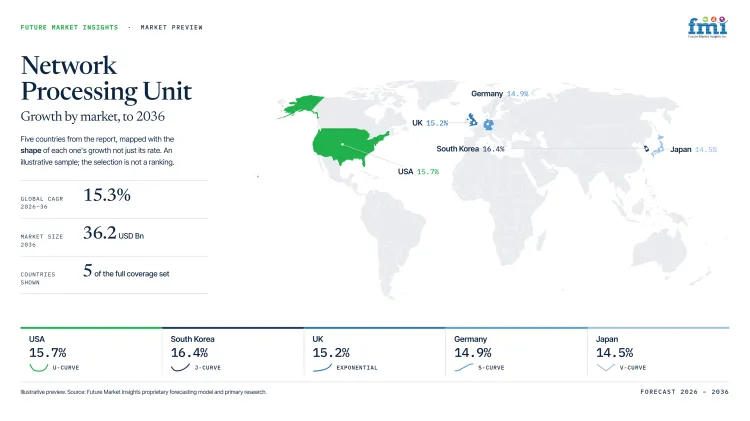
| Country | CAGR |
|---|---|
| United States | 15.7% |
| United Kingdom | 15.2% |
| Germany | 14.9% |
| Japan | 14.5% |
| South Korea | 16.4% |
How do country-level CAGRs compare in the Network Processing Unit Market?
The displayed range spans 1.9 percentage points and forms three practical bands through the forecast period.
Forecast rates describe momentum and do not represent revenue rankings across the five profiled markets.
- South Korea and the United States form an upper band as AI programs accelerate processor qualification.
- A 0.6 percentage-point gap separates the United States from the United Kingdom across displayed rates.
- The United Kingdom and Germany remain closely grouped despite different power access and computing conditions.
- Germany remains 0.4 percentage point above Japan as edge programs support more frequent platform qualification.
- Japan completes the range through coordinated power and telecommunications planning that extends equipment approval cycles.
Comparable CAGRs can produce different entry conditions due to infrastructure readiness and technical support networks. Full report coverage includes North America, Latin America, Europe, East Asia, South Asia and Pacific, and Middle East and Africa.
Country-wise Analysis
- United States cloud providers operate large engineering fleets that combine network function virtualization stacks with direct support from domestic semiconductor teams. In September 2025, AWS made R8gn instances generally available in Northern Virginia and Oregon with sixth-generation Nitro Cards supporting 600 Gbps network bandwidth. Adoption of network processing units in the United States is estimated to expand at 15.7% CAGR through 2036, supported by hyperscale engineering capacity and multiyear platform purchasing. Regional cloud availability shortens production validation although software migration and carrier-grade reliability checks delay commitments across national operator networks and public cloud facilities with distinct security requirements and purchasing models.
- United Kingdom AI Growth Zone proposals require secured power and reliable connectivity for major data center construction across sites needing planning support and water access. The United Kingdom is estimated to post 15.2% CAGR over the forecast period, shaped by planned AI clusters and established cloud operations. The Department for Science, Innovation and Technology required applicants to demonstrate at least 500 MW of power capacity by 2030 in June 2025. Formal site screening clarifies infrastructure readiness for processor deployments although grid congestion and planning timelines delay equipment orders across designated regional clusters and surrounding service areas during phased regional construction.
- Germany combines a large edge node base with semiconductor expertise across regulated cloud and industrial networks that depend on specialized regional integration teams and long lifecycle support. The European Commission estimated 1,948 German edge nodes during 2025 in its June 2026 Digital Decade country report. Network processing unit sales in Germany are forecast to expand at 14.9% CAGR by 2036, aided by distributed computing programs and established engineering capacity. Regional edge security deployments support recurring qualification although high-capacity connectivity gaps and longer service distances raise commissioning costs and extend fault-resolution times across several federal states and operating locations nationwide.
- Japanese data center planning coordinates electricity and telecommunications capacity across regional sites that rely on domestic equipment manufacturers, established maintenance networks and controlled qualification practices. Japan's network processing unit outlook is anticipated to advance at 14.5% CAGR over the assessment period, reinforced by local engineering expertise and long support cycles. METI published its Watt-Bit Collaboration report in June 2025 to align power infrastructure with telecommunications development across future regional data center sites. Coordinated planning improves site selection and network readiness although electricity constraints and conservative qualification delay volume commitments beyond established metropolitan facilities and regional support centers serving secondary markets.
- South Korea combines dense 5G coverage with government-backed AI computing expansion and a domestic semiconductor ecosystem that supports rapid platform testing and local design assistance. The Ministry of Science and ICT stated in February 2025 that the country aimed to secure 18,000 advanced GPUs by the first half of 2026. In South Korea, network processing unit demand is predicted to advance at 16.4% CAGR through 2036, driven by local engineering resources and expanding AI clusters. Domestic testing shortens initial validation although power availability and software integration constrain wider deployment beyond Seoul and established semiconductor development corridors during broader national expansion.
Who are the notable companies in the Network Processing Unit Market?
NVIDIA Corporation, Broadcom Inc., Intel Corporation, Marvell Technology, Inc., Advanced Micro Devices, Inc., Cisco Systems, Inc., Qualcomm Technologies, Inc. and NXP Semiconductors N.V. are the notable companies shaping this market.
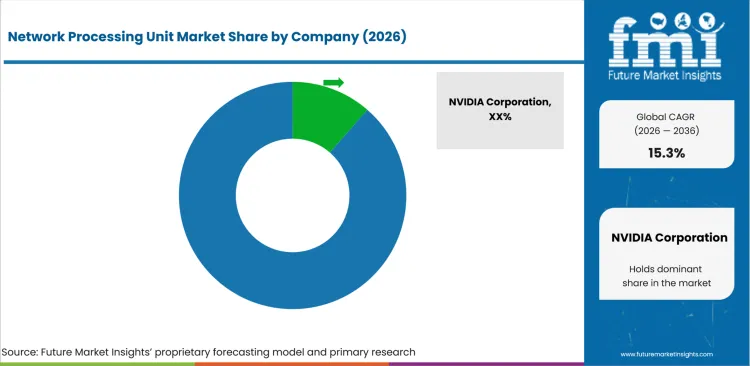
The advanced-silicon layer remains moderately concentrated while deployment architectures fragment competition across cloud, telecom and embedded systems. Entry barriers remain high as leading-edge development requires capital, mature toolchains and access to large qualification environments.
- NVIDIA and Intel compete with AMD through programmable offload across cloud and AI server fleets using cloud network monitoring.
- Broadcom and Marvell compete with Cisco through routing silicon supporting network traffic analytics across data center and carrier fabrics.
- Qualcomm and NXP integrate packet acceleration into access gateways and embedded systems with tighter thermal limits.
Competitive Benchmarking: Network Processing Unit Market
| Company | Programmable Packet Processing | Infrastructure Offload | Cloud and Telecom Coverage | Geographic Reach |
|---|---|---|---|---|
| NVIDIA Corporation | High | High | Medium | Global |
| Broadcom Inc. | Low | Low | High | Global |
| Intel Corporation | High | High | Medium | Global |
| Marvell Technology, Inc. | High | High | High | Global |
| Advanced Micro Devices, Inc. | High | High | Medium | Global |
| Cisco Systems, Inc. | High | Low | High | Global |
| Qualcomm Technologies, Inc. | Low | Low | Low | Global |
| NXP Semiconductors N.V. | Medium | Medium | Medium | Global |
Key Developments in the Network Processing Unit Market
- In September 2025, AMD joined IBM in deploying Pensando Pollara AI NICs and Ortano DPUs within a dedicated Zyphra training cluster on IBM Cloud.
- In February 2026, Cisco introduced Silicon One G300 and related systems for programmable 102.4 Tbps networking across large AI data center clusters.
- In January 2026, NVIDIA announced BlueField-4 for AI-native storage infrastructure that shares context securely across accelerated computing clusters.
- In August 2025, Broadcom began shipping Jericho4 for lossless encrypted routing across distributed AI fabrics spanning multiple data centers.
Network Processing Unit Market - Report Scope
| Coverage field | Report scope |
|---|---|
| Market breakdown | By product type, deployment, application, end user, architecture and region. |
| Quantitative Units | Revenue in USD billion and CAGR in %. |
| Market Definition | The market covers processors whose primary commercial function is programmable or fixed packet handling across cloud, telecom, enterprise, edge and industrial network systems. |
| Regions Covered | North America, Latin America, Europe, East Asia, South Asia and Pacific and Middle East and Africa. |
| Countries Covered | United States, United Kingdom, Germany, Japan, South Korea and more than 30 additional countries in the full report. |
| Key Companies Profiled | NVIDIA Corporation, Broadcom Inc., Intel Corporation, Marvell Technology, Inc., Advanced Micro Devices, Inc., Cisco Systems, Inc., Qualcomm Technologies, Inc. and NXP Semiconductors N.V. |
| Forecast Period | 2026 to 2036. |
| Approach | Primary and secondary research with market triangulation. |
Network Processing Unit Market - Research Methodology
| Method | Approach |
|---|---|
| Primary Research | FMI analysts gathered input from manufacturers, service providers, technology developers, distributors, end users, procurement teams, and subject-matter experts. Interviews examined purchasing decisions, product or service evaluation, adoption barriers, approval requirements, pricing considerations, and expectations for technical or commercial support. Respondents were also asked what evidence is required before a trial, pilot, or initial order develops into regular purchasing. |
| Desk Research | Desk research covered government statistics, regulatory publications, trade data, industry associations, technical literature, standards, company filings, product information, and official corporate announcements. Sources were reviewed for relevance, publication date, geographic coverage, and consistency with the defined market scope. Claims relating to performance, applications, approvals, capacity, investment, and commercial activity were retained only when supported by credible public evidence. |
| Market Sizing and Forecasting | The market model combined the baseline value with historical performance, segment structure, pricing and volume indicators, adoption levels, company participation, and country-level demand conditions. Forecast assumptions considered economic activity, investment trends, regulatory developments, technology adoption, purchasing cycles, supply availability, and barriers to wider market use. Segment and regional estimates were reconciled before the final market total was calculated. |
| Data Validation | Estimates were checked against multiple independent indicators, including public data, company activity, trade patterns, industry developments, and findings from primary interviews. Validation also tested whether products, services, applications, and company revenues fell within the defined market boundaries. Adjacent categories, unsupported claims, overlapping revenues, and activities without direct market relevance were excluded to reduce double counting and maintain consistency across segments and countries. |
Network Processing Unit Market by Segments
Network Processing Unit Market segmented by Product Type
- Standalone NPUs
- Programmable NPUs
- Fixed-Function NPUs
- Integrated NPUs
- System-on-Chip (SoC)
- SmartNIC Integration
- Embedded NPUs
- Network Appliances
- Edge Devices
Network Processing Unit Market segmented by Deployment
- Data Centers
- Hyperscale Data Centers
- Enterprise Data Centers
- Telecommunication Networks
- 5G Infrastructure
- Core Networks
- Enterprise Networks
- Campus Networks
- Secure Gateways
- Others
- Edge Computing
- Industrial Networking
Network Processing Unit Market segmented by Application
- Routing & Switching
- Core Routers
- Ethernet Switches
- Network Security
- Firewalls
- Intrusion Prevention
- Cloud Networking
- SmartNICs
- Network Virtualization
- 5G & Telecom Infrastructure
- Baseband Processing
- Packet Acceleration
- Others
- Content Delivery Networks
- Industrial Ethernet
Network Processing Unit Market segmented by End User
- Cloud Service Providers
- Hyperscalers
- Public Cloud Providers
- Telecommunication Operators
- Mobile Network Operators
- ISPs
- Enterprise
- BFSI
- Manufacturing
- Others
- Government
- Healthcare
- Education
Network Processing Unit Market segmented by Architecture
- Programmable Architecture
- P4-Based Processing
- Multi-Core Packet Processing
- ASIC-Based Architecture
- High-Speed Packet Forwarding
- Dedicated Processing
- Hybrid Architecture
- CPU-NPU Integration
- AI-Assisted Networking
Network Processing Unit Market by Region:
- North America
- United States
- Canada
- Latin America
- Brazil
- Chile
- Mexico
- Rest of Latin America
- Western Europe
- Germany
- United Kingdom
- Italy
- Spain
- France
- Nordics
- Benelux
- Rest of Western Europe
- Eastern Europe
- Russia
- Poland
- Hungary
- Balkan and Baltic States
- Rest of Eastern Europe
- East Asia
- China
- Japan
- South Korea
- South Asia and Pacific
- India
- ASEAN
- Australia and New Zealand
- Rest of South Asia and Pacific
- Middle East and Africa
- Kingdom of Saudi Arabia
- Other GCC Countries
- Türkiye
- South Africa
- Other African Union Countries
- Rest of Middle East and Africa
Research Sources and Bibliography
- International Energy Agency. (2025, April 10). Energy and AI.
- Amazon Web Services. (2025, September 15). Now generally available: Amazon EC2 R8gn instances.
- Department for Science, Innovation and Technology. (2025, June 13). AI Growth Zones: open for applications.
- European Commission. (2026, June 17). Germany's 2026 Digital Decade Country Report.
- Ministry of Economy, Trade and Industry. (2025, June 12). Report 1.0 of the Public-Private Advisory Council on Watt-Bit Collaboration Published.
- Ministry of Science and ICT. (2025, February 20). Korea to Expand AI Computing Infrastructure to Strengthen National AI Capabilities and Achieve Global Leadership.
- Intel Corporation. (2026, April 9). Intel, Google Deepen Collaboration to Advance AI Infrastructure.
- Ultra Ethernet Consortium. (2026, July 16). Specification History.
- Broadcom Inc. (2025, June 3). Broadcom Ships Tomahawk 6: World’s First 102.4 Tbps Switch.
- P4 Language Consortium. (2024, October 11). P4_16 Language Specification, version 1.2.5.
- Advanced Micro Devices, Inc. (2025, September 30). IBM and AMD Collaborate with Zyphra on Next Generation AI Infrastructure.
- Cisco Systems, Inc. (2026, February 10). Cisco Announces New Silicon One G300, Advanced Systems and Optics to Power and Scale AI Data Centers for the Agentic Era.
- NVIDIA Corporation. (2026, January 5). NVIDIA BlueField-4 Powers New Class of AI-Native Storage Infrastructure for the Next Frontier of AI.
- Broadcom Inc. (2025, August 4). Broadcom Ships Jericho4, Enabling Distributed AI Computing Across Data Centers.
- Qualcomm Technologies, Inc. (2026, March 2). Qualcomm Debuts AI-Native Wi‑Fi 8 Portfolio Unifying Client and Network Connectivity for AI Era Performance.
- Marvell Technology, Inc. (2025, March 12). 10-K: Annual report [Section 13 and 15(d), not S-K Item 405].
- NXP Semiconductors N.V. (n.d.). Layerscape® LX2160A, LX2120A, LX2080A Processors.
This bibliography is provided for reader reference and is not exhaustive. The full report contains the complete reference list and detailed citations.
This Report Answers
- How large is the Network Processing Unit Market in 2026 and 2036?
- Which infrastructure conditions support commercial demand for network processing units across major deployments?
- Why do standalone NPUs hold the largest product type share?
- How does data center deployment shape commercial processor qualification and platform selection?
- Why does routing and switching remain the largest network processing application?
- How do country growth routes differ across the profiled markets?
- Which companies serve the Network Processing Unit Market across major deployment categories?
- Which technical and commercial factors currently limit network processing unit adoption?
- How should engineering teams compare programmable network processor platforms during qualification?
Frequently Asked Questions
How big is the Network Processing Unit Market in 2026?
The network processing unit market is valued at USD 8.7 billion in 2026 and is forecast to reach USD 36.2 billion by 2036. Growth is supported by AI infrastructure that makes network efficiency a facility capacity issue as packet movement consumes power beside accelerated workloads.
What is the CAGR of the Network Processing Unit Market from 2026 to 2036?
The network processing unit market grows at a CAGR of 15.3% between 2026 and 2036, supported by dedicated packet engines that preserve host capacity and maintain infrastructure services during intensive accelerator workloads across cloud and AI data center fleets.
Which product type leads the Network Processing Unit Market?
Standalone NPUs account for 46.0% of the network processing unit market by product type in 2026, driven by independent qualification across server and network platform roadmaps that gives system engineers a distinct component for performance testing.
How much will the Network Processing Unit Market add between 2026 and 2036?
The network processing unit market is set to add USD 27.5 billion between 2026 and 2036, growing from USD 8.7 billion to USD 36.2 billion as dedicated packet processing extends across data center, telecom and edge deployment platforms worldwide.
Who are the leading companies in the Network Processing Unit Market?
Eight companies lead the network processing unit market consistently, including NVIDIA Corporation, Broadcom Inc., Intel Corporation, Marvell Technology, Inc., Advanced Micro Devices, Inc., Cisco Systems, Inc., Qualcomm Technologies, Inc. and NXP Semiconductors N.V., competing through programmable packet processing, infrastructure offload and cloud and telecom coverage worldwide.
Preview the report firsthand - request a free sample
Get SampleGet the brochure for pricing and purchase details.
Get PDFTable of Content
- Key Takeaways
- Market Size and CAGR
- Top Growth Driver
- Fastest Growing Segment
- Leading Region
- Key Companies
- Emerging Opportunities
- Executive Summary
- Global Market Outlook
- Demand-side Trends
- Supply-side Trends
- Technology Roadmap Analysis
- Analysis and Recommendations
- Analyst Perspective (What is happening? Why now? What should investors know?)
- Key Questions Answered
- How large is the market?
- What is the CAGR?
- What are key trends?
- Which region dominates?
- Who are the leaders?
- Market Overview
- Market Coverage / Taxonomy
- Market Definition / Scope / Limitations
- Research Methodology
- Chapter Orientation
- Analytical Lens and Working Hypotheses
- Market Structure, Signals, and Trend Drivers
- Benchmarking and Cross-market Comparability
- Market Sizing, Forecasting, and Opportunity Mapping
- Research Design and Evidence Framework
- Desk Research Programme (Secondary Evidence)
- Expert Input and Fieldwork (Primary Evidence)
- Tooling, Models, and Reference Databases
- Data Engineering and Model Build
- Quality Assurance and Audit Trail
- Market Background
- Market Dynamics (Drivers, Restraints, Opportunity, Trends)
- Scenario Forecast (Optimistic, Likely, Conservative)
- Impact Analysis
- AI Impact
- Sustainability Impact
- Regulatory Impact
- Technology Impact
- Consumer / Buyer Analysis
- Purchase Drivers
- Adoption Barriers
- Buyer Journey
- Opportunity Map Analysis
- Product Life Cycle Analysis
- Supply Chain Analysis
- Investment Feasibility Matrix
- Value Chain Analysis
- PESTLE and Porter's Analysis
- Regulatory Landscape
- Regional Parent Market Outlook
- Production and Consumption Statistics
- Import and Export Statistics
- Global Market Analysis and Forecast, 2021 to 2036
- Historical Market Size Value (USD Billion) Analysis, 2021 to 2025
- Current and Future Market Size Value (USD Billion) Projections, 2026 to 2036
- Y-o-Y Growth Trend Analysis
- Absolute $ Opportunity Analysis
- Global Market Pricing Analysis, 2021 to 2036
- Global Market Analysis and Forecast, By Product Type, 2021 to 2036
- Introduction / Key Findings
- Historical Market Size Value (USD Billion) Analysis By Product Type, 2021 to 2025
- Current and Future Market Size Value (USD Billion) Analysis and Forecast By Product Type, 2026 to 2036
- Standalone NPUs
- Programmable NPUs
- Fixed-Function NPUs
- Integrated NPUs
- System-on-Chip (SoC)
- SmartNIC Integration
- Embedded NPUs
- Network Appliances
- Edge Devices
- Standalone NPUs
- Y-o-Y Growth Trend Analysis By Product Type, 2021 to 2025
- Absolute $ Opportunity Analysis By Product Type, 2026 to 2036
- Global Market Analysis and Forecast, By Deployment, 2021 to 2036
- Introduction / Key Findings
- Historical Market Size Value (USD Billion) Analysis By Deployment, 2021 to 2025
- Current and Future Market Size Value (USD Billion) Analysis and Forecast By Deployment, 2026 to 2036
- Data Centers
- Hyperscale Data Centers
- Enterprise Data Centers
- Telecommunication Networks
- 5G Infrastructure
- Core Networks
- Enterprise Networks
- Campus Networks
- Secure Gateways
- Others
- Edge Computing
- Industrial Networking
- Data Centers
- Y-o-Y Growth Trend Analysis By Deployment, 2021 to 2025
- Absolute $ Opportunity Analysis By Deployment, 2026 to 2036
- Global Market Analysis and Forecast, By Application, 2021 to 2036
- Introduction / Key Findings
- Historical Market Size Value (USD Billion) Analysis By Application, 2021 to 2025
- Current and Future Market Size Value (USD Billion) Analysis and Forecast By Application, 2026 to 2036
- Routing & Switching
- Core Routers
- Ethernet Switches
- Network Security
- Firewalls
- Intrusion Prevention
- Cloud Networking
- SmartNICs
- Network Virtualization
- 5G & Telecom Infrastructure
- Baseband Processing
- Packet Acceleration
- Others
- Content Delivery Networks
- Industrial Ethernet
- Routing & Switching
- Y-o-Y Growth Trend Analysis By Application, 2021 to 2025
- Absolute $ Opportunity Analysis By Application, 2026 to 2036
- Global Market Analysis and Forecast, By End User, 2021 to 2036
- Introduction / Key Findings
- Historical Market Size Value (USD Billion) Analysis By End User, 2021 to 2025
- Current and Future Market Size Value (USD Billion) Analysis and Forecast By End User, 2026 to 2036
- Cloud Service Providers
- Hyperscalers
- Public Cloud Providers
- Telecommunication Operators
- Mobile Network Operators
- ISPs
- Enterprise
- BFSI
- Manufacturing
- Others
- Government
- Healthcare
- Education
- Cloud Service Providers
- Y-o-Y Growth Trend Analysis By End User, 2021 to 2025
- Absolute $ Opportunity Analysis By End User, 2026 to 2036
- Global Market Analysis and Forecast, By Architecture, 2021 to 2036
- Introduction / Key Findings
- Historical Market Size Value (USD Billion) Analysis By Architecture, 2021 to 2025
- Current and Future Market Size Value (USD Billion) Analysis and Forecast By Architecture, 2026 to 2036
- Programmable Architecture
- P4-Based Processing
- Multi-Core Packet Processing
- ASIC-Based Architecture
- High-Speed Packet Forwarding
- Dedicated Processing
- Hybrid Architecture
- CPU-NPU Integration
- AI-Assisted Networking
- Programmable Architecture
- Y-o-Y Growth Trend Analysis By Architecture, 2021 to 2025
- Absolute $ Opportunity Analysis By Architecture, 2026 to 2036
- Global Market Analysis and Forecast, By Region, 2021 to 2036
- Introduction
- Historical Market Size Value (USD Billion) Analysis By Region, 2021 to 2025
- Current Market Size Value (USD Billion) Analysis and Forecast By Region, 2026 to 2036
- North America
- Latin America
- Western Europe
- Eastern Europe
- East Asia
- South Asia and Pacific
- Middle East & Africa
- Market Attractiveness Analysis By Region
- North America Market Analysis and Forecast, By Country, 2021 to 2036
- Historical Market Size Value (USD Billion) Trend Analysis By Market Taxonomy, 2021 to 2025
- Market Size Value (USD Billion) Forecast By Market Taxonomy, 2026 to 2036
- By Country
- USA
- Canada
- By Product Type
- By Deployment
- By Application
- By End User
- By Architecture
- By Country
- Market Attractiveness Analysis
- By Country
- By Product Type
- By Deployment
- By Application
- By End User
- By Architecture
- Key Takeaways
- Latin America Market Analysis and Forecast, By Country
- Historical Market Size Value (USD Billion) Trend Analysis By Market Taxonomy, 2021 to 2025
- Market Size Value (USD Billion) Forecast By Market Taxonomy, 2026 to 2036
- By Country
- Brazil
- Mexico
- Chile
- Rest of Latin America
- By Product Type
- By Deployment
- By Application
- By End User
- By Architecture
- By Country
- Market Attractiveness Analysis
- By Country
- By Product Type
- By Deployment
- By Application
- By End User
- By Architecture
- Key Takeaways
- Western Europe Market Analysis and Forecast, By Country
- Historical Market Size Value (USD Billion) Trend Analysis By Market Taxonomy, 2021 to 2025
- Market Size Value (USD Billion) Forecast By Market Taxonomy, 2026 to 2036
- By Country
- Germany
- UK
- Italy
- Spain
- France
- Nordic
- BENELUX
- Rest of Western Europe
- By Product Type
- By Deployment
- By Application
- By End User
- By Architecture
- By Country
- Market Attractiveness Analysis
- By Country
- By Product Type
- By Deployment
- By Application
- By End User
- By Architecture
- Key Takeaways
- Eastern Europe Market Analysis and Forecast, By Country
- Historical Market Size Value (USD Billion) Trend Analysis By Market Taxonomy, 2021 to 2025
- Market Size Value (USD Billion) Forecast By Market Taxonomy, 2026 to 2036
- By Country
- Russia
- Poland
- Hungary
- Balkan & Baltic
- Rest of Eastern Europe
- By Product Type
- By Deployment
- By Application
- By End User
- By Architecture
- By Country
- Market Attractiveness Analysis
- By Country
- By Product Type
- By Deployment
- By Application
- By End User
- By Architecture
- Key Takeaways
- East Asia Market Analysis and Forecast, By Country
- Historical Market Size Value (USD Billion) Trend Analysis By Market Taxonomy, 2021 to 2025
- Market Size Value (USD Billion) Forecast By Market Taxonomy, 2026 to 2036
- By Country
- China
- Japan
- South Korea
- By Product Type
- By Deployment
- By Application
- By End User
- By Architecture
- By Country
- Market Attractiveness Analysis
- By Country
- By Product Type
- By Deployment
- By Application
- By End User
- By Architecture
- Key Takeaways
- South Asia and Pacific Market Analysis and Forecast, By Country
- Historical Market Size Value (USD Billion) Trend Analysis By Market Taxonomy, 2021 to 2025
- Market Size Value (USD Billion) Forecast By Market Taxonomy, 2026 to 2036
- By Country
- India
- ASEAN
- Australia & New Zealand
- Rest of South Asia and Pacific
- By Product Type
- By Deployment
- By Application
- By End User
- By Architecture
- By Country
- Market Attractiveness Analysis
- By Country
- By Product Type
- By Deployment
- By Application
- By End User
- By Architecture
- Key Takeaways
- Middle East & Africa Market Analysis and Forecast, By Country
- Historical Market Size Value (USD Billion) Trend Analysis By Market Taxonomy, 2021 to 2025
- Market Size Value (USD Billion) Forecast By Market Taxonomy, 2026 to 2036
- By Country
- Kingdom of Saudi Arabia
- Other GCC Countries
- Türkiye
- South Africa
- Other African Union
- Rest of Middle East & Africa
- By Product Type
- By Deployment
- By Application
- By End User
- By Architecture
- By Country
- Market Attractiveness Analysis
- By Country
- By Product Type
- By Deployment
- By Application
- By End User
- By Architecture
- Key Takeaways
- Key Countries Market Analysis
- USA
- Pricing Analysis
- Market Share Analysis, 2025
- By Product Type
- By Deployment
- By Application
- By End User
- By Architecture
- Canada
- Pricing Analysis
- Market Share Analysis, 2025
- By Product Type
- By Deployment
- By Application
- By End User
- By Architecture
- Mexico
- Pricing Analysis
- Market Share Analysis, 2025
- By Product Type
- By Deployment
- By Application
- By End User
- By Architecture
- Brazil
- Pricing Analysis
- Market Share Analysis, 2025
- By Product Type
- By Deployment
- By Application
- By End User
- By Architecture
- Chile
- Pricing Analysis
- Market Share Analysis, 2025
- By Product Type
- By Deployment
- By Application
- By End User
- By Architecture
- Germany
- Pricing Analysis
- Market Share Analysis, 2025
- By Product Type
- By Deployment
- By Application
- By End User
- By Architecture
- UK
- Pricing Analysis
- Market Share Analysis, 2025
- By Product Type
- By Deployment
- By Application
- By End User
- By Architecture
- Italy
- Pricing Analysis
- Market Share Analysis, 2025
- By Product Type
- By Deployment
- By Application
- By End User
- By Architecture
- Spain
- Pricing Analysis
- Market Share Analysis, 2025
- By Product Type
- By Deployment
- By Application
- By End User
- By Architecture
- France
- Pricing Analysis
- Market Share Analysis, 2025
- By Product Type
- By Deployment
- By Application
- By End User
- By Architecture
- India
- Pricing Analysis
- Market Share Analysis, 2025
- By Product Type
- By Deployment
- By Application
- By End User
- By Architecture
- ASEAN
- Pricing Analysis
- Market Share Analysis, 2025
- By Product Type
- By Deployment
- By Application
- By End User
- By Architecture
- Australia & New Zealand
- Pricing Analysis
- Market Share Analysis, 2025
- By Product Type
- By Deployment
- By Application
- By End User
- By Architecture
- China
- Pricing Analysis
- Market Share Analysis, 2025
- By Product Type
- By Deployment
- By Application
- By End User
- By Architecture
- Japan
- Pricing Analysis
- Market Share Analysis, 2025
- By Product Type
- By Deployment
- By Application
- By End User
- By Architecture
- South Korea
- Pricing Analysis
- Market Share Analysis, 2025
- By Product Type
- By Deployment
- By Application
- By End User
- By Architecture
- Russia
- Pricing Analysis
- Market Share Analysis, 2025
- By Product Type
- By Deployment
- By Application
- By End User
- By Architecture
- Poland
- Pricing Analysis
- Market Share Analysis, 2025
- By Product Type
- By Deployment
- By Application
- By End User
- By Architecture
- Hungary
- Pricing Analysis
- Market Share Analysis, 2025
- By Product Type
- By Deployment
- By Application
- By End User
- By Architecture
- Kingdom of Saudi Arabia
- Pricing Analysis
- Market Share Analysis, 2025
- By Product Type
- By Deployment
- By Application
- By End User
- By Architecture
- Türkiye
- Pricing Analysis
- Market Share Analysis, 2025
- By Product Type
- By Deployment
- By Application
- By End User
- By Architecture
- South Africa
- Pricing Analysis
- Market Share Analysis, 2025
- By Product Type
- By Deployment
- By Application
- By End User
- By Architecture
- USA
- Market Structure Analysis
- Competition Dashboard
- Competition Benchmarking
- Market Share Analysis of Top Players
- By Regional
- By Product Type
- By Deployment
- By Application
- By End User
- By Architecture
- Emerging Startups
- Innovation Benchmarking
- Competition Analysis
- Competition Deep Dive
- NVIDIA Corporation
- Overview
- Product Portfolio
- Profitability by Market Segments
- Sales Footprint
- Strategy Overview
- Marketing Strategy
- Product Strategy
- Channel Strategy
- Broadcom Inc.
- Intel Corporation
- Marvell Technology, Inc.
- Advanced Micro Devices, Inc.
- Cisco Systems, Inc.
- Qualcomm Technologies, Inc.
- NXP Semiconductors N.V.
- NVIDIA Corporation
- Case Studies
- Success Stories
- Recent Developments
- Competition Deep Dive
- Assumptions & Acronyms Used


