

- Industry Size (2026)
- USD 6.71 Bn
- Forecast (2036)
- USD 14.75 Bn
- CAGR (2026 to 2036)
- 8.20%
Optical Transmitter Market Size, Market Forecast and Outlook By FMI
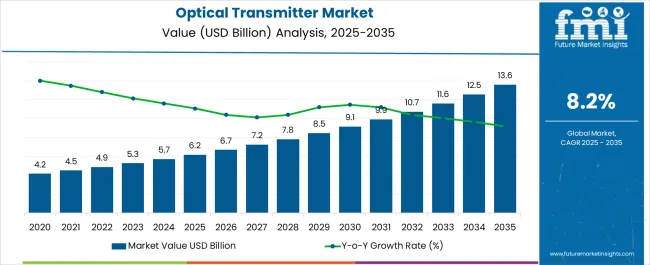
In 2025, the optical transmitter market was valued at USD 6.20 billion. Based on Future Market Insights' analysis, demand is estimated to grow to USD 6.71 billion in 2026 and USD 14.75 billion by 2036. FMI projects a CAGR of 8.20% during the forecast period.
The market is set to add approximately USD 8.04 billion in absolute terms between 2026 and 2036. 400G and 800G coherent optical transceiver deployment in data center interconnect (DCI) and telecom metro/long-haul networks is the primary growth catalyst, with external modulation commanding the majority share because coherent transmission requires the spectral purity and modulation bandwidth that direct modulation cannot achieve at these data rates.
Summary of Optical Transmitter Market
- Optical Transmitter Market Definition
- Optical transmitters are electro-optic modules that convert electrical data signals into modulated optical signals for transmission over fiber optic networks, utilizing direct modulation of laser diodes or external Mach-Zehnder and electro-absorption modulators for telecom, broadband, enterprise, aerospace, and marine fiber communication applications.
- Demand Drivers in the Market
- 400G and 800G coherent optical transceiver deployment for data center interconnect and telecom metro networks requires externally modulated transmitters with Mach-Zehnder modulator bandwidth exceeding 60 GHz, driving procurement of indium phosphide (InP) and silicon photonic transmitter modules.
- 5G fronthaul and backhaul fiber deployment demands high-volume 25G and 50G direct-modulation transmitter production for cost-sensitive access network links where external modulation cost premiums are not justified.
- Submarine cable system capacity upgrades to 20+ Tbps per fiber pair require externally modulated transmitters with ultra-narrow linewidth laser sources operating at sub-100 kHz spectral width for long-haul transoceanic coherent transmission.
- Key Segments Analyzed in the FMI Report
- External Modulation modulation technique: 61.3% share in 2026, reflecting its structural position as the primary category across established procurement channels.
- Telecom industry: 29.3% share in 2026, reflecting its structural position as the primary category across established procurement channels.
- China: 11.10% compound growth through 2036, indicating concentrated demand acceleration.
- Analyst Opinion at FMI
- Sudip saha, Principal Consultant for Technology analysts observe that The optical transmitter market is a fiber optic component category where coherent transmission adoption at 400G and 800G data rates is shifting the technology mix toward external modulation. FMI analysts observe that external modulation commands 61.3% share because coherent detection systems, which now dominate metro and long-haul networks, require the modulation format flexibility (DP-QPSK, DP-16QAM) that only external modulators can generate. Telecom at 29.3% industry share leads because carrier network capacity upgrades generate the highest per-unit transmitter pricing, while broadband and DCI applications provide volume demand at lower price points. China leads at 11.1% CAGR because domestic optical component manufacturers (Accelink, HiSilicon Optoelectronics) are scaling 400G coherent transmitter production for both China Telecom/Unicom/Mobile network upgrades and export to global telecom equipment vendors.
- Strategic Implications / Executive Takeaways
- Optical transmitter manufacturers must achieve 800G ZR/ZR+ pluggable module form factor qualification to capture the DCI segment migrating from proprietary line-side optics to standardized QSFP-DD800 and OSFP modules.
- Telecom equipment vendors should dual-source coherent transmitter modules from both established suppliers (Lumentum, II-VI/Coherent) and Chinese manufacturers (Accelink) to manage supply allocation risk during capacity upgrade peak periods.
- Silicon photonics transmitter developers should target the high-volume 100G/200G per-lane direct-detect segment where integrated photonic manufacturing costs provide a structural advantage over discrete InP component assembly.
Optical Transmitter Market Key Takeaways
| Metric | Details |
|---|---|
| Industry Size (2026) | USD 6.71 Billion |
| Industry Value (2036) | USD 14.75 Billion |
| CAGR (2026 to 2036) | 8.20% |
Source: Future Market Insights, 2026
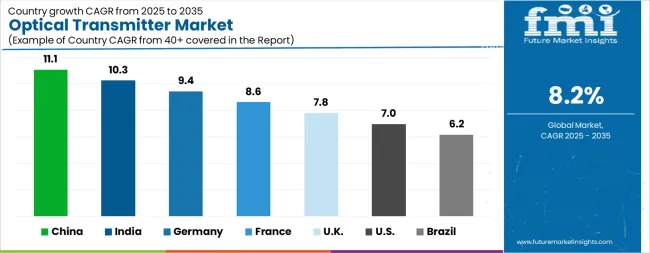
As per FMI, country-level growth rates through 2036 are projected as follows: China at 11.10%, India at 10.30%, Germany at 9.40%, France at 8.60%, UK at 7.80%, USA at 7.00%, Brazil at 6.20%. China records the fastest expansion driven by concentrated industry investment.
Optical Transmitter Market Definition
The optical transmitter market encompasses electro-optic conversion modules that generate modulated optical signals for fiber network transmission. External modulation platforms use Mach-Zehnder interferometers or electro-absorption modulators to impart data onto continuous-wave laser carriers, while direct modulation platforms modulate the laser drive current directly. As per FMI, the market is transitioning toward higher-order modulation formats (DP-16QAM, DP-64QAM) enabled by external modulation, driven by 400G and 800G coherent transceiver deployment across telecom and data center networks.
Optical Transmitter Market Inclusions
Market scope covers externally modulated and directly modulated optical transmitter modules used in telecom core and metro networks, broadband FTTH/FTTB deployments, data center interconnects, aerospace fiber links, and marine communication systems.
Optical Transmitter Market Exclusions
Optical receivers and photodetectors, optical amplifiers (EDFA, SOA), passive optical splitters and couplers, and complete optical networking equipment (switches, routers) are excluded.
Optical Transmitter Market Research Methodology
- Primary Research: Analysts conducted structured interviews with procurement managers, product engineers, and distribution channel operators to map purchase decision triggers and specification requirements across key verticals.
- Desk Research: Data collection aggregated regulatory filings, industry standards documentation, patent registries, trade body publications, and company annual reports across all target geographies.
- Market-Sizing and Forecasting: Baseline values derive from a bottom-up aggregation of product shipment volumes and average selling prices, validated against publicly disclosed revenue figures from leading suppliers.
- Data Validation and Update Cycle: Projections are cross-referenced against quarterly earnings data, import-export trade statistics, and industry association production reports to maintain forecast integrity.
Why is the Optical Transmitter Market Growing?
The optical transmitter market is showing consistent growth, supported by the expanding demand for high-speed data transmission across telecommunications, data centers, and enterprise networks. The increasing reliance on fiber optic infrastructure to support next-generation connectivity requirements, including 5G rollouts and cloud computing, is driving widespread adoption. Optical transmitters are being favored due to their ability to deliver high bandwidth, low latency, and long-distance transmission efficiency, making them essential in meeting the surge in global data traffic.
Advances in modulation techniques, integration of photonic components, and continuous improvements in signal integrity are enhancing overall performance, ensuring compatibility with modern high-capacity networks. Government investments in digital infrastructure and global efforts toward network modernization are further supporting the market’s expansion.
Additionally, the rising importance of energy-efficient and compact optical components in reducing operational costs for service providers is influencing procurement strategies With continuous technological innovation and the shift toward high-performance communication systems, the optical transmitter market is expected to expand steadily, offering strong long-term growth prospects across industries and regions.
Segmental Analysis
The optical transmitter market is segmented by modulation technique, industry, and geographic regions. By modulation technique, optical transmitter market is divided into External Modulation and Direct Or (Internal) Modulation. In terms of industry, optical transmitter market is classified into Telecom, Broadband Service Providers, Entertainment Industry, Aerospace, Marine, and Households. Regionally, the optical transmitter industry is classified into North America, Latin America, Western Europe, Eastern Europe, Balkan & Baltic Countries, Russia & Belarus, Central Asia, East Asia, South Asia & Pacific, and the Middle East & Africa.
Insights into the External Modulation Technique Segment
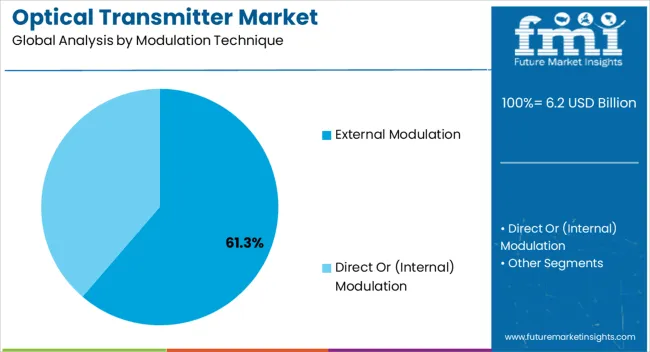
The external modulation technique segment is projected to account for 61.3% of the optical transmitter market revenue share in 2026, positioning it as the leading modulation technique. Its dominance is being driven by superior performance in delivering high-speed, long-distance data transmission while minimizing signal degradation. External modulation enables better control of signal quality, providing lower chirp and improved dispersion tolerance, which are critical for dense wavelength-division multiplexing and high-capacity fiber networks.
This segment is benefitting from the increasing deployment of high-bandwidth communication systems in telecom and data centers, where demand for efficient and reliable transmission is intensifying. Continuous innovation in external modulators, such as lithium niobate and silicon photonics-based devices, is further enhancing system performance and scalability.
The ability to meet the requirements of modern ultra-fast networks, along with reduced susceptibility to noise and distortion, is reinforcing the preference for external modulation As operators upgrade infrastructure to support 5G, cloud services, and large-scale digitalization, the external modulation segment is expected to maintain its leadership, backed by its proven reliability and scalability.
Insights into the Telecom End-Use Industry Segment
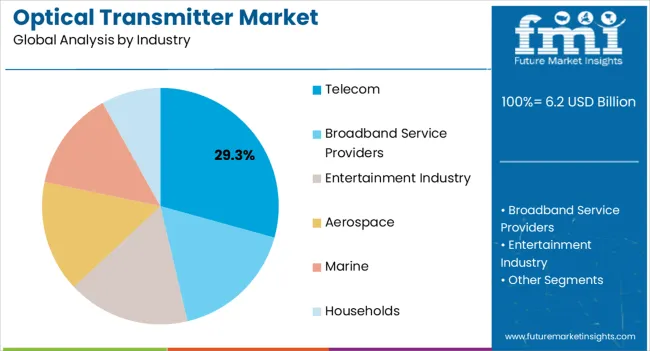
The telecom end-use industry segment is anticipated to hold 29.3% of the optical transmitter market revenue share in 2026, making it the largest end-use segment. This leadership is being supported by the exponential growth in global data traffic, driven by the rapid adoption of mobile devices, streaming services, and cloud-based applications. Telecom operators are investing heavily in upgrading fiber optic networks to ensure high-speed, low-latency connectivity for both consumer and enterprise applications.
Optical transmitters play a crucial role in enabling the transmission of large volumes of data across metropolitan and long-haul networks with minimal signal loss. Rising demand for 5G deployment, expansion of broadband infrastructure, and government initiatives to improve connectivity in underserved regions are also accelerating adoption.
The segment is benefitting from the integration of advanced modulation formats and energy-efficient designs that optimize network performance and reduce operating costs As telecommunications infrastructure evolves to accommodate higher capacities and reliability standards, the use of optical transmitters in this sector is expected to remain a key growth driver, reinforcing its dominant position in the overall market.
Market Overview
Optical Transmitter Market Overview
This is attributed to the need for consumer electronics, fiber-optic networks, and high-speed communication systems, which are all on the rise. This is driving the market's expansion. Additionally, the market for optical transmitters is anticipated to expand as a result of the rising need for data centers and cloud storage options.
The market is expanding as a result of rising bandwidth and data center demand, as well as greater high-speed internet use. Additionally, the demand for optical transmitters is being driven by the rising need for 4G/LTE and 5G network technologies, as optical transmitters are crucial elements of these networks.
Since optical transmitters are utilized to transport data over both short and long distances, the need for high-speed internet has grown. Employment of cloud services in different end-use industries supports the overall optical transmitter market share.
Analysis of Optical Transmitter Market By Key Countries
.webp "Top Country Growth Comparison Optical Transmitter Market Cagr (2026 2036)")
| Country | CAGR |
|---|---|
| China | 11.1% |
| India | 10.3% |
| Germany | 9.4% |
| France | 8.6% |
| UK | 7.8% |
| USA | 7.0% |
| Brazil | 6.2% |
Source: FMI analysis based on primary research and proprietary forecasting model
Country-wise Analysis
The Optical Transmitter Market is expected to register a CAGR of 8.2% during the forecast period, exhibiting varied country level momentum. China leads with the highest CAGR of 11.1%, followed by India at 10.3%. Developed markets such as Germany, France, and the UK continue to expand steadily, while the USA is likely to grow at consistent rates. Brazil posts the lowest CAGR at 6.2%, yet still underscores a broadly positive trajectory for the global Optical Transmitter Market. In 2024, Germany held a dominant revenue in the Western Europe market and is expected to grow with a CAGR of 9.4%. The USA Optical Transmitter Market is estimated to be valued at USD 2.2 billion in 2026 and is anticipated to reach a valuation of USD 4.2 billion by 2036. Sales are projected to rise at a CAGR of 7.0% over the forecast period between 2026 and 2036. While Japan and South Korea markets are estimated to be valued at USD 279.8 million and USD 162.8 million respectively in 2026.
Key Players in the Optical Transmitter Market
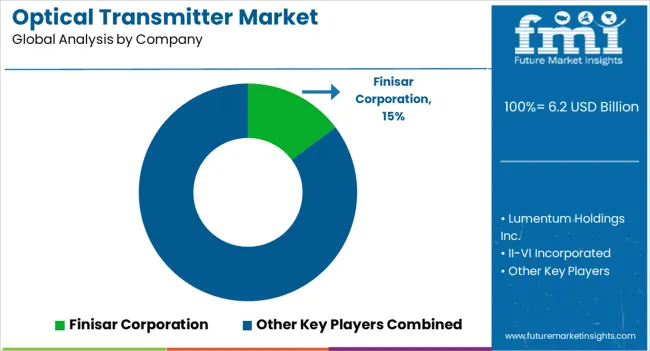
- Finisar Corporation
- Lumentum Holdings Inc.
- II-VI Incorporated
- Sumitomo Electric Industries, Ltd.
- Fujitsu Optical Components Limited
- Broadcom Inc.
- Oclaro, Inc.
- NeoPhotonics Corporation
- Accelink Technologies Co., Ltd.
- Mitsubishi Electric Corporation
- Huawei Technologies Co., Ltd.
- Ciena Corporation
- Cisco Systems, Inc.
Scope of the Report
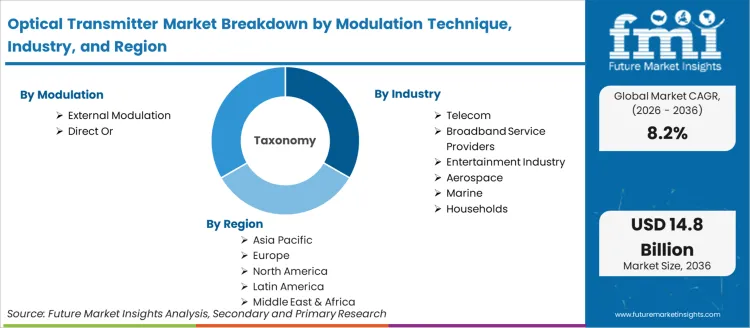
| Metric | Value |
|---|---|
| Quantitative Units | USD 6.71 Bn to USD 14.75 Bn, at a CAGR of 8.20% |
| Market Definition | Optical transmitters are electro-optic modules that convert electrical data signals into modulated optical signals for transmission over fiber optic networks, utilizing direct modulation of laser diodes or external Mach-Zehnder and electro-absorption modulators for telecom, broadband, enterprise, aerospace, and marine fiber communication applications. |
| Modulation Technique Segmentation | External Modulation, Direct Modulation |
| Industry Segmentation | Telecom, Broadband Service Providers, Entertainment Industry, Aerospace, Marine, Households |
| Regions Covered | North America, Latin America, Europe, East Asia, South Asia, Oceania, Middle East & Africa |
| Countries Covered | China, India, Germany, France, UK, USA, Brazil, and 40 plus countries |
| Key Companies Profiled | Finisar Corporation, Lumentum Holdings Inc., II-VI Incorporated, Sumitomo Electric Industries, Ltd., Fujitsu Optical Components Limited, Broadcom Inc., Oclaro, Inc., NeoPhotonics Corporation, Accelink Technologies Co., Ltd., Mitsubishi Electric Corporation, Huawei Technologies Co., Ltd., Ciena Corporation, Cisco Systems, Inc. |
| Forecast Period | 2026 to 2036 |
| Approach | Hybrid bottom-up and top-down modeling validated against primary research inputs and publicly available industry data. |
Optical Transmitter Market by Segments
Modulation Technique:
- External Modulation
- Direct Or (Internal) Modulation
Industry:
- Telecom
- Broadband Service Providers
- Entertainment Industry
- Aerospace
- Marine
- Households
Region:
- North America
- USA
- Canada
- Mexico
- Latin America
- Brazil
- Chile
- Rest of Latin America
- Western Europe
- Germany
- UK
- Italy
- Spain
- France
- Nordic
- BENELUX
- Rest of Western Europe
- Eastern Europe
- Russia
- Poland
- Hungary
- Balkan & Baltic
- Rest of Eastern Europe
- East Asia
- China
- Japan
- South Korea
- South Asia and Pacific
- India
- ASEAN
- Australia & New Zealand
- Rest of South Asia and Pacific
- Middle East & Africa
- Kingdom of Saudi Arabia
- Other GCC Countries
- Turkiye
- South Africa
- Other African Union
- Rest of Middle East & Africa
Bibliography
- [1] International Telecommunication Union. (2024). ITU-T G.698.2: Amplified Multichannel DWDM Applications. ITU.
- [2] Lumentum Holdings. (2024). Annual Report 2024: Optical Communications Division. Lumentum.
- [3] Optical Internetworking Forum. (2024). OIF 400ZR Implementation Agreement. OIF.
- [4] Ciena Corporation. (2024). Annual Report 2024: Networking Platforms Division. Ciena.
- [5] GSMA. (2024). 5G Network Infrastructure: Fiber Fronthaul and Backhaul Requirements. GSMA.
This bibliography is provided for reader reference. The full FMI report contains the complete reference list with primary research documentation.
Frequently Asked Questions
How large is the demand for Optical Transmitter in the global market in 2026?
Demand for Optical Transmitter in the global market is estimated to be valued at USD 6.71 billion in 2026.
What will be the market size of Optical Transmitter by 2036?
Market size for Optical Transmitter is projected to reach USD 14.75 billion by 2036.
What is the expected demand growth between 2026 and 2036?
Demand is expected to grow at a CAGR of 8.20% between 2026 and 2036.
Which Modulation Technique is poised to lead by 2026?
External Modulation accounts for 61.3% in 2026.
How significant is Telecom in driving adoption?
Telecom represents 29.3% of segment share in 2026.
What country records the fastest growth?
China is projected to grow at a CAGR of 11.10% during 2026 to 2036.
What is the projected growth for India?
India is projected to expand at a CAGR of 10.30% during 2026 to 2036.
What is included in the scope of this report?
Market scope covers externally modulated and directly modulated optical transmitter modules used in telecom core and metro networks, broadband FTTH/FTTB deployments, data center interconnects, aerospace fiber links, and marine communication systems.
Preview the report firsthand - request a free sample
Get SampleGet the brochure for pricing and purchase details.
Get PDFTable of Content
- Executive Summary
- Global Market Outlook
- Demand-side Trends
- Supply-side Trends
- Technology Roadmap Analysis
- Analysis and Recommendations
- Market Overview
- Market Coverage / Taxonomy
- Market Definition / Scope / Limitations
- Research Methodology
- Chapter Orientation
- Analytical Lens and Working Hypotheses
- Market Structure, Signals, and Trend Drivers
- Benchmarking and Cross-market Comparability
- Market Sizing, Forecasting, and Opportunity Mapping
- Research Design and Evidence Framework
- Desk Research Programme (Secondary Evidence)
- Company Annual and Sustainability Reports
- Peer-reviewed Journals and Academic Literature
- Corporate Websites, Product Literature, and Technical Notes
- Earnings Decks and Investor Briefings
- Statutory Filings and Regulatory Disclosures
- Technical White Papers and Standards Notes
- Trade Journals, Industry Magazines, and Analyst Briefs
- Conference Proceedings, Webinars, and Seminar Materials
- Government Statistics Portals and Public Data Releases
- Press Releases and Reputable Media Coverage
- Specialist Newsletters and Curated Briefings
- Sector Databases and Reference Repositories
- FMI Internal Proprietary Databases and Historical Market Datasets
- Subscription Datasets and Paid Sources
- Social Channels, Communities, and Digital Listening Inputs
- Additional Desk Sources
- Expert Input and Fieldwork (Primary Evidence)
- Primary Modes
- Qualitative Interviews and Expert Elicitation
- Quantitative Surveys and Structured Data Capture
- Blended Approach
- Why Primary Evidence is Used
- Field Techniques
- Interviews
- Surveys
- Focus Groups
- Observational and In-context Research
- Social and Community Interactions
- Stakeholder Universe Engaged
- C-suite Leaders
- Board Members
- Presidents and Vice Presidents
- R&D and Innovation Heads
- Technical Specialists
- Domain Subject-matter Experts
- Scientists
- Physicians and Other Healthcare Professionals
- Governance, Ethics, and Data Stewardship
- Research Ethics
- Data Integrity and Handling
- Primary Modes
- Tooling, Models, and Reference Databases
- Desk Research Programme (Secondary Evidence)
- Data Engineering and Model Build
- Data Acquisition and Ingestion
- Cleaning, Normalisation, and Verification
- Synthesis, Triangulation, and Analysis
- Quality Assurance and Audit Trail
- Market Background
- Market Dynamics
- Drivers
- Restraints
- Opportunity
- Trends
- Scenario Forecast
- Demand in Optimistic Scenario
- Demand in Likely Scenario
- Demand in Conservative Scenario
- Opportunity Map Analysis
- Product Life Cycle Analysis
- Supply Chain Analysis
- Investment Feasibility Matrix
- Value Chain Analysis
- PESTLE and Porter’s Analysis
- Regulatory Landscape
- Regional Parent Market Outlook
- Production and Consumption Statistics
- Import and Export Statistics
- Market Dynamics
- Global Market Analysis 2021 to 2025 and Forecast, 2026 to 2036
- Historical Market Size Value (USD Million) Analysis, 2021 to 2025
- Current and Future Market Size Value (USD Million) Projections, 2026 to 2036
- Y-o-Y Growth Trend Analysis
- Absolute $ Opportunity Analysis
- Global Market Pricing Analysis 2021 to 2025 and Forecast 2026 to 2036
- Global Market Analysis 2021 to 2025 and Forecast 2026 to 2036, By Modulation Technique
- Introduction / Key Findings
- Historical Market Size Value (USD Million) Analysis By Modulation Technique , 2021 to 2025
- Current and Future Market Size Value (USD Million) Analysis and Forecast By Modulation Technique , 2026 to 2036
- External Modulation
- Direct Or
- External Modulation
- Y-o-Y Growth Trend Analysis By Modulation Technique , 2021 to 2025
- Absolute $ Opportunity Analysis By Modulation Technique , 2026 to 2036
- Global Market Analysis 2021 to 2025 and Forecast 2026 to 2036, By Industry
- Introduction / Key Findings
- Historical Market Size Value (USD Million) Analysis By Industry, 2021 to 2025
- Current and Future Market Size Value (USD Million) Analysis and Forecast By Industry, 2026 to 2036
- Telecom
- Broadband Service Providers
- Entertainment Industry
- Aerospace
- Marine
- Households
- Telecom
- Y-o-Y Growth Trend Analysis By Industry, 2021 to 2025
- Absolute $ Opportunity Analysis By Industry, 2026 to 2036
- Global Market Analysis 2021 to 2025 and Forecast 2026 to 2036, By Region
- Introduction
- Historical Market Size Value (USD Million) Analysis By Region, 2021 to 2025
- Current Market Size Value (USD Million) Analysis and Forecast By Region, 2026 to 2036
- North America
- Latin America
- Western Europe
- Eastern Europe
- East Asia
- South Asia and Pacific
- Middle East & Africa
- Market Attractiveness Analysis By Region
- North America Market Analysis 2021 to 2025 and Forecast 2026 to 2036, By Country
- Historical Market Size Value (USD Million) Trend Analysis By Market Taxonomy, 2021 to 2025
- Market Size Value (USD Million) Forecast By Market Taxonomy, 2026 to 2036
- By Country
- USA
- Canada
- Mexico
- By Modulation Technique
- By Industry
- By Country
- Market Attractiveness Analysis
- By Country
- By Modulation Technique
- By Industry
- Key Takeaways
- Latin America Market Analysis 2021 to 2025 and Forecast 2026 to 2036, By Country
- Historical Market Size Value (USD Million) Trend Analysis By Market Taxonomy, 2021 to 2025
- Market Size Value (USD Million) Forecast By Market Taxonomy, 2026 to 2036
- By Country
- Brazil
- Chile
- Rest of Latin America
- By Modulation Technique
- By Industry
- By Country
- Market Attractiveness Analysis
- By Country
- By Modulation Technique
- By Industry
- Key Takeaways
- Western Europe Market Analysis 2021 to 2025 and Forecast 2026 to 2036, By Country
- Historical Market Size Value (USD Million) Trend Analysis By Market Taxonomy, 2021 to 2025
- Market Size Value (USD Million) Forecast By Market Taxonomy, 2026 to 2036
- By Country
- Germany
- UK
- Italy
- Spain
- France
- Nordic
- BENELUX
- Rest of Western Europe
- By Modulation Technique
- By Industry
- By Country
- Market Attractiveness Analysis
- By Country
- By Modulation Technique
- By Industry
- Key Takeaways
- Eastern Europe Market Analysis 2021 to 2025 and Forecast 2026 to 2036, By Country
- Historical Market Size Value (USD Million) Trend Analysis By Market Taxonomy, 2021 to 2025
- Market Size Value (USD Million) Forecast By Market Taxonomy, 2026 to 2036
- By Country
- Russia
- Poland
- Hungary
- Balkan & Baltic
- Rest of Eastern Europe
- By Modulation Technique
- By Industry
- By Country
- Market Attractiveness Analysis
- By Country
- By Modulation Technique
- By Industry
- Key Takeaways
- East Asia Market Analysis 2021 to 2025 and Forecast 2026 to 2036, By Country
- Historical Market Size Value (USD Million) Trend Analysis By Market Taxonomy, 2021 to 2025
- Market Size Value (USD Million) Forecast By Market Taxonomy, 2026 to 2036
- By Country
- China
- Japan
- South Korea
- By Modulation Technique
- By Industry
- By Country
- Market Attractiveness Analysis
- By Country
- By Modulation Technique
- By Industry
- Key Takeaways
- South Asia and Pacific Market Analysis 2021 to 2025 and Forecast 2026 to 2036, By Country
- Historical Market Size Value (USD Million) Trend Analysis By Market Taxonomy, 2021 to 2025
- Market Size Value (USD Million) Forecast By Market Taxonomy, 2026 to 2036
- By Country
- India
- ASEAN
- Australia & New Zealand
- Rest of South Asia and Pacific
- By Modulation Technique
- By Industry
- By Country
- Market Attractiveness Analysis
- By Country
- By Modulation Technique
- By Industry
- Key Takeaways
- Middle East & Africa Market Analysis 2021 to 2025 and Forecast 2026 to 2036, By Country
- Historical Market Size Value (USD Million) Trend Analysis By Market Taxonomy, 2021 to 2025
- Market Size Value (USD Million) Forecast By Market Taxonomy, 2026 to 2036
- By Country
- Kingdom of Saudi Arabia
- Other GCC Countries
- Turkiye
- South Africa
- Other African Union
- Rest of Middle East & Africa
- By Modulation Technique
- By Industry
- By Country
- Market Attractiveness Analysis
- By Country
- By Modulation Technique
- By Industry
- Key Takeaways
- Key Countries Market Analysis
- USA
- Pricing Analysis
- Market Share Analysis, 2025
- By Modulation Technique
- By Industry
- Canada
- Pricing Analysis
- Market Share Analysis, 2025
- By Modulation Technique
- By Industry
- Mexico
- Pricing Analysis
- Market Share Analysis, 2025
- By Modulation Technique
- By Industry
- Brazil
- Pricing Analysis
- Market Share Analysis, 2025
- By Modulation Technique
- By Industry
- Chile
- Pricing Analysis
- Market Share Analysis, 2025
- By Modulation Technique
- By Industry
- Germany
- Pricing Analysis
- Market Share Analysis, 2025
- By Modulation Technique
- By Industry
- UK
- Pricing Analysis
- Market Share Analysis, 2025
- By Modulation Technique
- By Industry
- Italy
- Pricing Analysis
- Market Share Analysis, 2025
- By Modulation Technique
- By Industry
- Spain
- Pricing Analysis
- Market Share Analysis, 2025
- By Modulation Technique
- By Industry
- France
- Pricing Analysis
- Market Share Analysis, 2025
- By Modulation Technique
- By Industry
- India
- Pricing Analysis
- Market Share Analysis, 2025
- By Modulation Technique
- By Industry
- ASEAN
- Pricing Analysis
- Market Share Analysis, 2025
- By Modulation Technique
- By Industry
- Australia & New Zealand
- Pricing Analysis
- Market Share Analysis, 2025
- By Modulation Technique
- By Industry
- China
- Pricing Analysis
- Market Share Analysis, 2025
- By Modulation Technique
- By Industry
- Japan
- Pricing Analysis
- Market Share Analysis, 2025
- By Modulation Technique
- By Industry
- South Korea
- Pricing Analysis
- Market Share Analysis, 2025
- By Modulation Technique
- By Industry
- Russia
- Pricing Analysis
- Market Share Analysis, 2025
- By Modulation Technique
- By Industry
- Poland
- Pricing Analysis
- Market Share Analysis, 2025
- By Modulation Technique
- By Industry
- Hungary
- Pricing Analysis
- Market Share Analysis, 2025
- By Modulation Technique
- By Industry
- Kingdom of Saudi Arabia
- Pricing Analysis
- Market Share Analysis, 2025
- By Modulation Technique
- By Industry
- Turkiye
- Pricing Analysis
- Market Share Analysis, 2025
- By Modulation Technique
- By Industry
- South Africa
- Pricing Analysis
- Market Share Analysis, 2025
- By Modulation Technique
- By Industry
- USA
- Market Structure Analysis
- Competition Dashboard
- Competition Benchmarking
- Market Share Analysis of Top Players
- By Regional
- By Modulation Technique
- By Industry
- Competition Analysis
- Competition Deep Dive
- Finisar Corporation
- Overview
- Product Portfolio
- Profitability by Market Segments (Product/Age /Sales Channel/Region)
- Sales Footprint
- Strategy Overview
- Marketing Strategy
- Product Strategy
- Channel Strategy
- Lumentum Holdings Inc.
- II-VI Incorporated
- Sumitomo Electric Industries, Ltd.
- Fujitsu Optical Components Limited
- Broadcom Inc.
- Oclaro, Inc.
- NeoPhotonics Corporation
- Accelink Technologies Co., Ltd.
- Mitsubishi Electric Corporation
- Huawei Technologies Co., Ltd.
- Ciena Corporation
- Cisco Systems, Inc.
- Finisar Corporation
- Competition Deep Dive
- Assumptions & Acronyms Used


