

- Industry Size (2026)
- USD 2.62 Bn
- Forecast (2036)
- USD 4.74 Bn
- CAGR (2026 to 2036)
- 6.10%
Optically Clear Resin Market Size, Market Forecast and Outlook By FMI
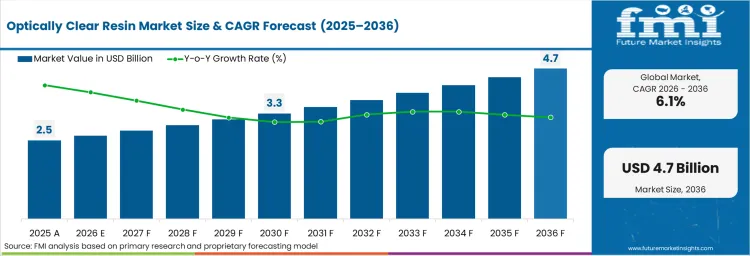
In 2025, the optically clear resin market was valued at USD 2.47 billion. Based on Future Market Insights' analysis, demand is estimated to grow to USD 2.62 billion in 2026 and USD 4.74 billion by 2036. FMI projects a CAGR of 6.10% during the forecast period.
The market is set to add approximately USD 2.12 billion in absolute terms between 2026 and 2036. Display panel lamination for smartphones, tablets, automotive infotainment, and wearable devices is the primary volume driver, with optically clear adhesive (OCA) and optically clear resin (OCR) demand growing proportionally with display panel production volumes. Automotive HUD (head-up display) and ADAS camera lens bonding applications create a secondary premium segment requiring automotive-grade temperature and UV stability specifications.
Summary of Optically Clear Resin Market
- Optically Clear Resin Market Definition
- Optically clear resins are transparent polymer materials with light transmittance exceeding 90% and haze below 1%, formulated as adhesives, encapsulants, coatings, and molding compounds for display lamination, optical lens bonding, LED encapsulation, automotive glazing, and medical device optics in consumer electronics, automotive, medical, and industrial applications.
- Demand Drivers in the Market
- Smartphone and tablet display panel lamination using optically clear adhesives (OCA) generates the highest consumption volume, with each display assembly requiring OCA film or liquid OCR to bond cover glass to touch sensor and display module layers without visible air gaps.
- Automotive head-up display (HUD) and ADAS camera module assembly requires optically clear encapsulants and bonding resins with operating temperature ranges from minus 40 to plus 105 degrees Celsius, creating an automotive-grade specification tier within the broader OCR market.
- LED encapsulation using optically clear silicone resins for high-brightness automotive, general illumination, and display backlight applications generates steady demand from LED packaging manufacturers requiring UV-stable, high-refractive-index encapsulant materials.
- Key Segments Analyzed in the FMI Report
- Acrylic product type: 28.5% share in 2026, reflecting its structural position as the primary category across established procurement channels.
- Consumer Electronics end use: 35.1% share in 2026, reflecting its structural position as the primary category across established procurement channels.
- India: 8.50% compound growth through 2036, indicating concentrated demand acceleration.
- Analyst Opinion at FMI
- Nikhil Kaitwade, Principal Consultant for Chemicals and Materials, opines, The optically clear resin market is a specialty materials category where display industry production volumes determine the demand trajectory. FMI analysts observe that acrylic resins command 28.5% product type share because acrylic-based optically clear adhesives provide the optical clarity, adhesion strength, and reworkability combination required for high-volume display panel lamination. Consumer electronics at 35.1% end-use share leads because smartphone and tablet display assembly consumes the largest OCA/OCR volume per unit. India leads at 8.5% CAGR because domestic smartphone manufacturing expansion under the Production Linked Incentive (PLI) scheme is creating local display module assembly demand that requires optically clear resin procurement within the country.
- Strategic Implications / Executive Takeaways
- OCR manufacturers must develop automotive-grade optically clear resins passing SAE J2527 weathering and AEC-Q200 reliability testing to qualify for HUD and ADAS camera module bonding applications in next-generation vehicle platforms.
- Display module assembly operations should evaluate liquid optically clear resin (LOCA) application for curved and flexible display lamination where pre-cut OCA film cannot conform to non-planar bonding surfaces.
- LED packaging manufacturers should specify high-refractive-index (RI above 1.55) optically clear silicone encapsulants to maximize light extraction efficiency from high-brightness LED chips serving automotive and general illumination applications.
Optically Clear Resin Market Key Takeaways
| Metric | Details |
|---|---|
| Industry Size (2026) | USD 2.62 Billion |
| Industry Value (2036) | USD 4.74 Billion |
| CAGR (2026 to 2036) | 6.10% |
Source: Future Market Insights, 2026
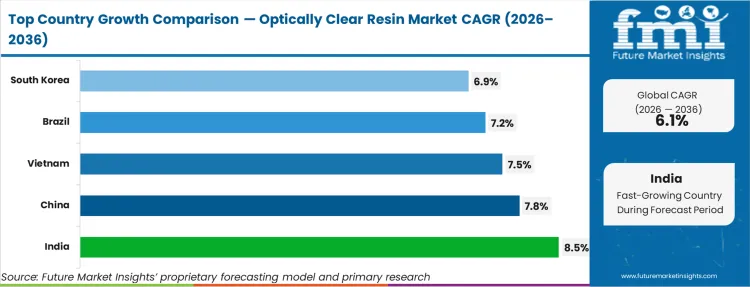
As per FMI, country-level growth rates through 2036 are projected as follows: India at 8.50%, China at 7.80%, Vietnam at 7.50%, Brazil at 7.20%, South Korea at 6.90%. India records the fastest expansion driven by concentrated industry investment.
Optically Clear Resin Market Definition
The optically clear resin market encompasses transparent polymer materials engineered for optical-grade light transmission in bonding, encapsulation, coating, and molding applications. Product chemistries span acrylics (OCA/LOCA for display lamination), polyurethanes (flexible optical bonding), silicones (LED and sensor encapsulation), epoxies (structural optical bonding), and polyvinyl acetate formulations. Based on FMI's analysis, the market is driven by display panel production volumes that determine OCA/OCR consumption, with automotive optical component assembly and LED encapsulation providing diversified demand channels requiring increasingly stringent thermal stability and UV resistance specifications.
Optically Clear Resin Market Inclusions
Market scope covers acrylic, polyvinyl acetate, polyurethane, silicone, and epoxy optically clear resins supplied as adhesives, encapsulants, coatings, and molding compounds for consumer electronics display assembly, automotive optical components, medical device optics, and industrial optical applications.
Optically Clear Resin Market Exclusions
Standard non-optical-grade adhesives and resins with light transmittance below 90%, optical glass and crystalline materials, and optical fiber preform materials are excluded.
Optically Clear Resin Market Research Methodology
- Primary Research: Analysts conducted structured interviews with procurement managers, product engineers, and distribution channel operators to map purchase decision triggers and specification requirements across key verticals.
- Desk Research: Data collection aggregated regulatory filings, industry standards documentation, patent registries, trade body publications, and company annual reports across all target geographies.
- Market-Sizing and Forecasting: Baseline values derive from a bottom-up aggregation of product shipment volumes and average selling prices, validated against publicly disclosed revenue figures from leading suppliers.
- Data Validation and Update Cycle: Projections are cross-referenced against quarterly earnings data, import-export trade statistics, and industry association production reports to maintain forecast integrity.
Key Industry Highlights
Growth in Automotive Head-up Displays Fueling Demand for Optically Clear Resins in Advanced Vehicles
One of the main factors influencing the need for optically clear resins in the automobile industry is the increasing integration of advanced displays in contemporary vehicles. High optical clarity is crucial for ensuring the best possible user experience with head-up displays (HUDs), digital dashboards, and infotainment systems that are becoming standard equipment in both passenger, and commercial vehicles.
For these applications, optically clear resins offer the transparency, robustness, and environmental resistance needed, guaranteeing that outside influences like heat, and light reflection won't compromise display performance.
In electric, and autonomous vehicles, where cutting-edge display technologies are essential to both vehicle functioning, and user interaction, this trend is especially noticeable. Autonomous driving systems rely heavily on HUDs, and other display interfaces to communicate vital information, enhancing safety, and navigation.
As automakers continue to innovate in these areas, the demand for materials that ensure clear, high-definition displays has surged. Optically clear resins, known for their adhesive properties, and ability to bond layers of glass or plastic without compromising optical clarity, are now critical in enhancing display technology in these next-generation vehicles.
The increasing trend toward larger or curved, or even flexible display integrations in vehicle interiors gives a fillip to the demand for certain types of optically clear resins. These displays should work seamlessly in all sorts of environmental conditions-such as high temperatures, and UV exposure-which demands the use of more UV-resistant, and durable resins.
In the automotive industry, the increasing demand for driver safety, comfort, and information-entertainment will further the development of optically clear resins in vehicle display technology, which one may expect to, in turn, influence overall growth in this market.
Increasing Adoption of Consumer Electronics Drives Growing Demand for Optically Clear Resins
The rapid expansion of the consumer electronics market, in turn, has boosted demand for optically clear resins significantly, from the growing adoption of smartphones, tablets, and wearable devices. In modern devices, these resins play an important role in clarity for high-definition displays while making the touchscreens durable and reliable.
As consumers demand more advanced display technologies with high resolutions, and sleek designs, optically clear resins are being widely used to bond display components, enhancing both performance, and user experience in a variety of devices.
In particular, smartphones, and tablets, which dominate the consumer electronics sector, rely heavily on optically clear resins for laminating displays to touch sensors, and glass covers. These materials offer superior light transmission, and transparency, making them indispensable in producing the crisp, bright visuals that users expect from high-end devices.
Also, the growing trend of foldable smartphones, and flexible displays is further pushing manufacturers to innovate with advanced resin formulations that provide flexibility without sacrificing optical clarity.
The emergent trends, in turn, create an increasingly high demand for optically clear resins within the industry of consumer electronics, as it keeps changing with the development of virtual, and augmented reality devices, smartwatches, and other wearables. Most of these developing technologies require clear visual output, and precise touch sensitivity, which can only be possible by the use of high-quality bonding materials.
Stringent Environmental Regulations Creating Challenges for Optically Clear Resin Manufacturers
Increasing environmental sustainability has led to tight legislation controlling the use of VOCs, and chemicals within the manufacturing process. These legislations have been quite critical for the industries involved in the production of optically clear resins as most conventional resin formulations comprise high levels of VOCs.
Compliance with such ecological standards prompts producers to invest money in research, and development to produce an analogue that has less harmful emissions. The shift alone can greatly increase the cost of production, making manufacturers strike a balance between environmental responsibility, and profitability.
As global environmental policies evolve, manufacturers are expected to continuously adapt to stricter regulations. This creates uncertainty in the market, as companies must anticipate future regulatory changes, and invest proactively in sustainable technologies.
While some manufacturers are successfully navigating this shift by developing bio-based or low-emission optically clear resins, the transition remains challenging for many in the industry. The long-term impact of these regulations on production efficiency, costs, and market dynamics is still unfolding, as companies work to meet both regulatory, and consumer demands for eco-friendly products.
Flexible, and Foldable Displays Presenting New Opportunities for Optically Clear Resins
The optically clear resin (OCR) market is undergoing a revolution due to the increasing popularity of flexible, and foldable displays in consumer electronics. These displays ask for creative bonding methods that provide both flexibility, and clarity. Although foldable tablets, smartphones, and wearables have opened up new design possibilities, they also present particular difficulties for producers.
Even though they have outstanding optical qualities, traditional OCRs are frequently too rigid for the constant bending, and folding that these devices require. Because of this, there is a rising market for resins that can tolerate mechanical stress without sacrificing the display's aesthetic appeal, opening the door for new formulations that are designed to meet this need.
The growing popularity of flexible, and foldable display technology presents a chance for producers of optically clear resin to establish themselves as important suppliers in this developing industry. Businesses are already investigating cutting-edge resin compositions that provide excellent flexibility, and adherence with very high transparency.
This is especially important for gadgets that have screens that are OLED or AMOLED, which are renowned for their high-resolution images. In order to support the robustness, and lifespan of next-generation electronics, firms are pursuing innovation in the resin market to ensure that these displays retain their integrity after multiple bending cycles.
2021 to 2025 Global Optically Clear Resin Sales Analysis Compared to Demand Forecast from 2026 to 2036
The global optically clear resin market experienced a 3.2% CAGR during the period from 2021 to 2025. The worth of the market would accordingly increase from USD 2,086.7 million in 2021 to USD 2,345.2 million by 2025, reflecting steady positive growth of the industry in the period under consideration.
This pandemic continued to affect negatively, particularly in 2020 and at the beginning of 2021, the manufacturing operation and supply chain activities involving temporary slowdowns of industries like automotive and consumer electronics-major sectors responsible for the demand of optically clear resins.
Looking ahead, demand for optically clear resins is expected to progress at a much faster rate in 2026 to 2036 owing to the advancement in flexible and foldable display technology across consumer electronics and automotive applications. Further, electric and autonomous vehicles expansion and innovations in medical devices and industrial applications drive the market.
Market Concentration
The Tier 1 companies are the leading companies with revenues above USD 55 million per year. Currently, companies in this tier capture an enormous share of 40 to 45% globally. These leading companies have high production capacity, and a wide product portfolio.
They maintain a great deal of manufacturing experience, with wide geographical reach, and a strong consumer base. The companies manufacture and supply a variety of products, and use the latest technology to meet the set regulatory standards.
Some of the well-known firms in Tier 1: BASF SE Covestro AG Mitsubishi Chemical Holdings Corporation SABIC Eastman Chemical Company 3M Company Henkel AG & Co. KGaA Huntsman Corporation Dupont de Nemours, Inc. Solvay S.A.
Also, Tier 2 and 3 companies are those which are medium-sized or other small-scale players generating less than USD 55 million revenues, are present in a few regions, and have a strong impact on local economies. These firms are distinguished by robust presence overseas, and in-depth industry expertise.
These businesses are notably focused on meeting local demand. Noteworthy entities in Tier 2, and 3 include: DSM Engineering Plastics, LG Chem Ltd., Teijin Limited. Wanhua Chemical Group Co., Ltd., Zymergen Inc., Shin-Etsu Chemical Co., Ltd., and Asahi Glass Co., Ltd. (AGC Inc.), and other medium, and small scale players.
Country-wise Insights
The section below covers assessments of optically clear resin sales across key countries. Countries from East Asia, and North America, are anticipated to exhibit promising double-digit growth over the forecast period. All the below-listed countries are collectively set to reflect a CAGR of around 7.5% through the forecast period.
.webp "Top Country Growth Comparison Optically Clear Resin Market Cagr (2026 2036)")
| Countries | Value CAGR |
|---|---|
| India | 8.5% |
| China | 7.8% |
| Vietnam | 7.5% |
| Brazil | 7.2% |
| South Korea | 6.9% |
Source: FMI analysis based on primary research and proprietary forecasting model
Growth of Optically Clear Resin Market in India Due to Automotive Industry Expansion
India is anticipated to grow at a CAGR of 8.5% from 2026 to 2036, with sales projected to reach USD 415.3 million by the end of 2036.
The spectacular growth of the market for an optically clear resin is driven by the growth of the automobile industry in India. Greater emphasis by the automakers on enhancing both the esthetics, and functionality of the vehicles has also driven up the demand for high-value, optically clear resins.
These resins are applied to various automobile parts that require strength with clarity, such as headlights, interior displays, and coverings. The trend toward more streamlined, and svelte current car designs have increased demand for these kinds of cutting-edge materials.
The increased use of multimedia, and advanced driver-assistance systems (ADAS) in cars is driving demand for optically clear resins in addition to cosmetic benefits. The optimal functioning of sensors, and display panels, which are essential to ADAS, and high-tech interfaces, is ensured in large part by these resins.
High-performance optically clear resins will become more, and more necessary as Indian automakers, and suppliers continue to incorporate increasingly complex electronics into their cars.
Surge in Optically Clear Resin Demand in China Driven by Electronics Industry Growth
China is anticipated to experience a CAGR of 7.8% from 2026 to 2036, with sales expected to hit USD 1,253.3 million by 2036.
The rapid growth of the optically clear resin market in China is partly explained by its rapidly growing electronics sector. As the country continues to maintain a position as one of the major centers for the manufacturing of electronics on a global scale, so does the demand for such resins.
These resins are found indispensable in constructing quality screens for smartphones, tablets, and other electronic devices, where durability, and clarity have become crucial. Consumer interest in sleek, high-resolution devices is increasing, boosting demand for high-performance optical materials that would cover sensitive screens, and improve display performance.
Advances in electronic technology continue to spur the development of innovative products that depend on new forms of display technology. The excellent optical clarity provided by the resins makes them indispensable in the production of high-performance displays, touchscreens, OLED panels, and other related electronic parts. These specialty resins will rise further as the electronics industry in China grows, and diversifies.
Upsurge in Brazil's Optically Clear Resin Market Driven by Industrial Applications
During the forecast period, Brazil’s optically clear resin industry is expected to grow steadily at a CAGR of 7.2%, and reach a total value of USD 142.1 million by 2036.
Due mainly to its growing industrial applications, the optically clear resin industry in Brazil is rising significantly. Optically transparent resins are becoming more, and more in demand as Brazil's industrial sector develops.
These resins are essential for many industrial uses, including transparent barriers, protective coatings, and electronic component encapsulants. They are suitable for extending the life, and performance of industrial items due to their excellent optical clarity, and robustness, which is fueling the market's expansion.
The need for optically clear resin is further fueled by an increase in production activity in a number of industries, including consumer electronics, automotive, and aerospace. Resins are utilized in various sectors to make strong, transparent parts that adhere to strict performance requirements.
As Brazilian industries advance technologically, and strive for higher-quality products, the need for advanced materials like optically clear resins becomes more pronounced, driving their increased usage.
Category-wise Insights
This section outlines the growth trajectories of the key segments within the industry. Regarding product type, the acrylic category is expected to lead, and account for approximately 28.5% of the market in 2026. In terms of end use, the consumer electronics segment is anticipated to capture a value share of 35.1% in 2026.
Rising Optically Clear Resin Market with Acrylics Resins Emerging as a Primary Driver for its Growth
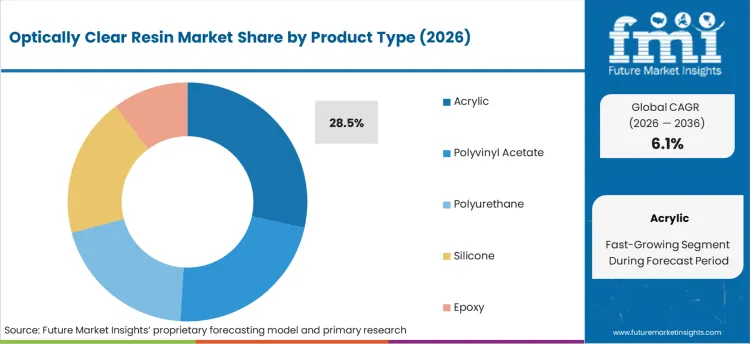
| Segment | Acrylic (Product Type) |
|---|---|
| Value Share (2026) | 28.5% |
The rising growth trend in the global optically clear resin market is mainly due to the increasing demand for acrylic resins. Acrylics show excellent optical clarity, weather resistance, and ease of processability, hence they’re suitable in wide application areas. Their applications in the manufacture of transparent parts, protective coatings, and value displays that enhance functional, and aesthetic properties of products lead to their wide acceptance in various sectors.
Because clarity, and durability are crucial, acrylic optically clear resins are especially prized in the electronics, and automotive industries. These resins are utilized in the electronics sector for screens, and touch panels, where their capacity to produce bright, clear displays is essential.
Similarly, in the automotive sector, acrylics are employed in headlight lenses, and interior components, where their impact resistance, and optical properties improve both performance, and safety. The versatility of acrylic resins in these high-demand applications contributes significantly to the overall market growth.
Boost in Global Optically Clear Resin Market Due to Consumer Electronics Applications
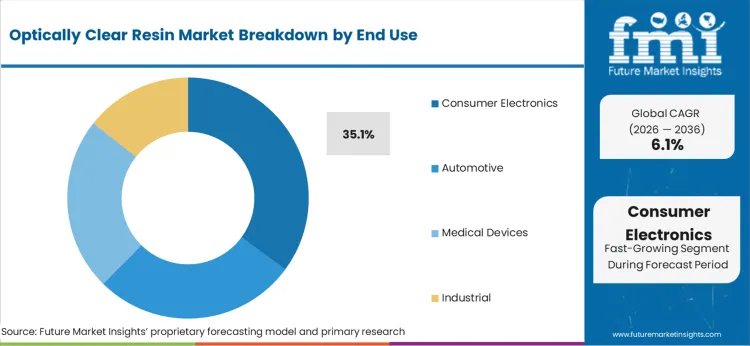
| Segment | Consumer Electronics (End Use) |
|---|---|
| Value Share (2026) | 35.1% |
The consumer electronics industry is the main driver of the substantial increase observed in the global market for optically clear resin. The need for optically clear resins is rising along with the need for high-quality electronics such as wearables, tablets, and smartphones. These resins are essential in touch interfaces, and high-definition displays due to their clarity, improving the operation of gadgets by ensuring a better visual display.
Other factors include the rapid growth of consumer electronics technologies that have created more demand in the market. Advanced touch panels, curved screens, and high-resolution displays are some of the features in manufacturing that require optically transparent resins. Maintaining functionality, and the lifecycle of modern electronic devices requires transparency, and good resistance to impact, some of the key factors these resins provide.
Competitive Landscape
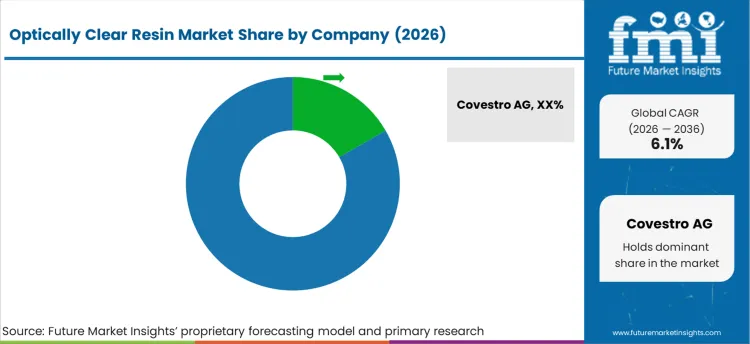
The section provides comprehensive assessments, and insights that highlight current opportunities, and emerging trends for companies in developed, and developing countries. It analyzes advancements in manufacturing, and identifies the latest trends poised to drive new applications in the market.
A few key players in the optically clear resin industry are actively enhancing capabilities, and resources to cater to the growing demand for the compound across diverse applications. Leading companies also leverage partnership, and joint venture strategies to co-develop innovative products, and bolster resource base.
Significant players are further introducing new products to address the increasing need for cutting-edge solutions in various end-use sectors. Geographic expansion is another important strategy that is being embraced by reputed companies. Start-ups are likely to emerge in the sector through 2036, hence making it more competitive.
Scope of the Report
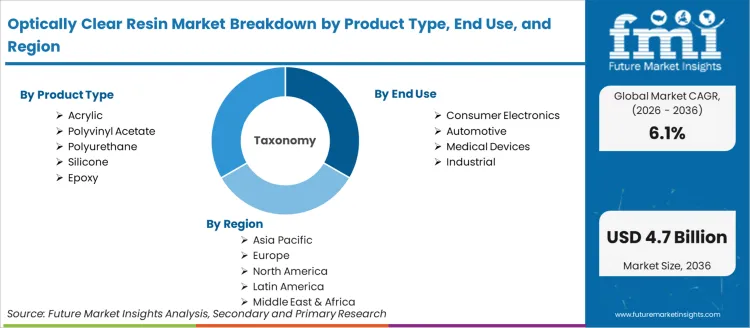
| Metric | Value |
|---|---|
| Quantitative Units | USD 2.62 Bn to USD 4.74 Bn, at a CAGR of 6.10% |
| Market Definition | Optically clear resins are transparent polymer materials with light transmittance exceeding 90% and haze below 1%, formulated as adhesives, encapsulants, coatings, and molding compounds for display lamination, optical lens bonding, LED encapsulation, automotive glazing, and medical device optics in consumer electronics, automotive, medical, and industrial applications. |
| Product Type Segmentation | Acrylic, Polyvinyl Acetate, Polyurethane, Silicone, Epoxy |
| End Use Segmentation | Consumer Electronics, Automotive, Medical Devices, Industrial |
| Regions Covered | North America, Latin America, Europe, East Asia, South Asia, Oceania, Middle East & Africa |
| Countries Covered | India, China, Vietnam, Brazil, South Korea, and 40 plus countries |
| Key Companies Profiled | Covestro AG, BASF SE, Mitsubishi Chemical Holdings Corporation, SABIC, Eastman Chemical Company, 3M Company, Henkel AG & Co. KGaA, Huntsman Corporation, Momentive Performance Materials Inc., DSM Engineering Plastics, LG Chem Ltd., Teijin Limited, Dupont de Nemours, Inc., Solvay S.A., Toray Industries, Inc., Wanhua Chemical Group Co., Ltd., Shin-Etsu Chemical Co., Ltd., AGC Inc. |
| Forecast Period | 2026 to 2036 |
| Approach | Hybrid bottom-up and top-down modeling validated against primary research inputs and publicly available industry data. |
Key Segments of Optically Clear Resin Industry
By Product Type:
In terms of Product Type, the industry is divided into Acrylic, Polyvinyl Acetate (PVA), Polyurethane (PU), Silicone, and Epoxy.
By End Use:
In terms of Application, the industry is divided into Consumer Electronics, Automotive, Medical Devices, and Industrial.
- The Consumer Electronics segment is further divided into Smartphones & Tablets, Television, Laptop & Computer Devices, Wearable Devices, and Others.
- The Automotive segment is further divided into Passenger Vehicles, Light Commercial Vehicles, Heavy Commercial Vehicles, and Electric Vehicles.
By Region:
Key countries of North America, Latin America, Western Europe, Eastern Europe, East Asia, South Asia, Middle East, and Africa (MEA), have been covered in the report.
Bibliography
- [1] Society for Information Display. (2024). SID Display Week: Optical Bonding and Lamination Technology Proceedings. SID.
- [2] Henkel AG & Co. KGaA. (2024). Loctite Product Portfolio: Optically Clear Adhesives for Display Assembly. Henkel.
- [3] SAE International. (2024). SAE J2527: Performance Requirements for Automotive Windshield and HUD Optical Materials. SAE.
- [4] International Electrotechnical Commission. (2024). IEC 62717: LED Modules for General Lighting, Performance Requirements. IEC.
- [5] Ministry of Electronics and IT, India. (2024). Production Linked Incentive Scheme: Display Module Assembly Progress Report. MeitY.
This bibliography is provided for reader reference. The full FMI report contains the complete reference list with primary research documentation.
Frequently Asked Questions
How large is the demand for Optically Clear Resin in the global market in 2026?
Demand for Optically Clear Resin in the global market is estimated to be valued at USD 2.62 billion in 2026.
What will be the market size of Optically Clear Resin by 2036?
Market size for Optically Clear Resin is projected to reach USD 4.74 billion by 2036.
What is the expected demand growth between 2026 and 2036?
Demand is expected to grow at a CAGR of 6.10% between 2026 and 2036.
Which Product Type is poised to lead by 2026?
Acrylic accounts for 28.5% in 2026.
How significant is Consumer Electronics in driving adoption?
Consumer Electronics represents 35.1% of segment share in 2026.
What country records the fastest growth?
India is projected to grow at a CAGR of 8.50% during 2026 to 2036.
What is the projected growth for China?
China is projected to expand at a CAGR of 7.80% during 2026 to 2036.
What is included in the scope of this report?
Market scope covers acrylic, polyvinyl acetate, polyurethane, silicone, and epoxy optically clear resins supplied as adhesives, encapsulants, coatings, and molding compounds for consumer electronics display assembly, automotive optical components, medical device optics, and industrial optical applications.
Preview the report firsthand - request a free sample
Get SampleGet the brochure for pricing and purchase details.
Get PDFTable of Content
- Executive Summary
- Global Market Outlook
- Demand-side Trends
- Supply-side Trends
- Technology Roadmap Analysis
- Analysis and Recommendations
- Market Overview
- Market Coverage / Taxonomy
- Market Definition / Scope / Limitations
- Research Methodology
- Chapter Orientation
- Analytical Lens and Working Hypotheses
- Market Structure, Signals, and Trend Drivers
- Benchmarking and Cross-market Comparability
- Market Sizing, Forecasting, and Opportunity Mapping
- Research Design and Evidence Framework
- Desk Research Programme (Secondary Evidence)
- Company Annual and Sustainability Reports
- Peer-reviewed Journals and Academic Literature
- Corporate Websites, Product Literature, and Technical Notes
- Earnings Decks and Investor Briefings
- Statutory Filings and Regulatory Disclosures
- Technical White Papers and Standards Notes
- Trade Journals, Industry Magazines, and Analyst Briefs
- Conference Proceedings, Webinars, and Seminar Materials
- Government Statistics Portals and Public Data Releases
- Press Releases and Reputable Media Coverage
- Specialist Newsletters and Curated Briefings
- Sector Databases and Reference Repositories
- FMI Internal Proprietary Databases and Historical Market Datasets
- Subscription Datasets and Paid Sources
- Social Channels, Communities, and Digital Listening Inputs
- Additional Desk Sources
- Expert Input and Fieldwork (Primary Evidence)
- Primary Modes
- Qualitative Interviews and Expert Elicitation
- Quantitative Surveys and Structured Data Capture
- Blended Approach
- Why Primary Evidence is Used
- Field Techniques
- Interviews
- Surveys
- Focus Groups
- Observational and In-context Research
- Social and Community Interactions
- Stakeholder Universe Engaged
- C-suite Leaders
- Board Members
- Presidents and Vice Presidents
- R&D and Innovation Heads
- Technical Specialists
- Domain Subject-matter Experts
- Scientists
- Physicians and Other Healthcare Professionals
- Governance, Ethics, and Data Stewardship
- Research Ethics
- Data Integrity and Handling
- Primary Modes
- Tooling, Models, and Reference Databases
- Desk Research Programme (Secondary Evidence)
- Data Engineering and Model Build
- Data Acquisition and Ingestion
- Cleaning, Normalisation, and Verification
- Synthesis, Triangulation, and Analysis
- Quality Assurance and Audit Trail
- Market Background
- Market Dynamics
- Drivers
- Restraints
- Opportunity
- Trends
- Scenario Forecast
- Demand in Optimistic Scenario
- Demand in Likely Scenario
- Demand in Conservative Scenario
- Opportunity Map Analysis
- Product Life Cycle Analysis
- Supply Chain Analysis
- Investment Feasibility Matrix
- Value Chain Analysis
- PESTLE and Porter’s Analysis
- Regulatory Landscape
- Regional Parent Market Outlook
- Production and Consumption Statistics
- Import and Export Statistics
- Market Dynamics
- Global Market Analysis 2021 to 2025 and Forecast, 2026 to 2036
- Historical Market Size Value (USD Million) Analysis, 2021 to 2025
- Current and Future Market Size Value (USD Million) Projections, 2026 to 2036
- Y-o-Y Growth Trend Analysis
- Absolute $ Opportunity Analysis
- Global Market Pricing Analysis 2021 to 2025 and Forecast 2026 to 2036
- Global Market Analysis 2021 to 2025 and Forecast 2026 to 2036, By Product Type
- Introduction / Key Findings
- Historical Market Size Value (USD Million) Analysis By Product Type , 2021 to 2025
- Current and Future Market Size Value (USD Million) Analysis and Forecast By Product Type , 2026 to 2036
- Acrylic
- Polyvinyl Acetate
- Polyurethane
- Silicone
- Epoxy
- Acrylic
- Y-o-Y Growth Trend Analysis By Product Type , 2021 to 2025
- Absolute $ Opportunity Analysis By Product Type , 2026 to 2036
- Global Market Analysis 2021 to 2025 and Forecast 2026 to 2036, By End Use
- Introduction / Key Findings
- Historical Market Size Value (USD Million) Analysis By End Use, 2021 to 2025
- Current and Future Market Size Value (USD Million) Analysis and Forecast By End Use, 2026 to 2036
- Consumer Electronics
- Automotive
- Medical Devices
- Industrial
- Consumer Electronics
- Y-o-Y Growth Trend Analysis By End Use, 2021 to 2025
- Absolute $ Opportunity Analysis By End Use, 2026 to 2036
- Global Market Analysis 2021 to 2025 and Forecast 2026 to 2036, By Region
- Introduction
- Historical Market Size Value (USD Million) Analysis By Region, 2021 to 2025
- Current Market Size Value (USD Million) Analysis and Forecast By Region, 2026 to 2036
- North America
- Latin America
- Western Europe
- Eastern Europe
- East Asia
- South Asia and Pacific
- Middle East & Africa
- Market Attractiveness Analysis By Region
- North America Market Analysis 2021 to 2025 and Forecast 2026 to 2036, By Country
- Historical Market Size Value (USD Million) Trend Analysis By Market Taxonomy, 2021 to 2025
- Market Size Value (USD Million) Forecast By Market Taxonomy, 2026 to 2036
- By Country
- USA
- Canada
- Mexico
- By Product Type
- By End Use
- By Country
- Market Attractiveness Analysis
- By Country
- By Product Type
- By End Use
- Key Takeaways
- Latin America Market Analysis 2021 to 2025 and Forecast 2026 to 2036, By Country
- Historical Market Size Value (USD Million) Trend Analysis By Market Taxonomy, 2021 to 2025
- Market Size Value (USD Million) Forecast By Market Taxonomy, 2026 to 2036
- By Country
- Brazil
- Chile
- Rest of Latin America
- By Product Type
- By End Use
- By Country
- Market Attractiveness Analysis
- By Country
- By Product Type
- By End Use
- Key Takeaways
- Western Europe Market Analysis 2021 to 2025 and Forecast 2026 to 2036, By Country
- Historical Market Size Value (USD Million) Trend Analysis By Market Taxonomy, 2021 to 2025
- Market Size Value (USD Million) Forecast By Market Taxonomy, 2026 to 2036
- By Country
- Germany
- UK
- Italy
- Spain
- France
- Nordic
- BENELUX
- Rest of Western Europe
- By Product Type
- By End Use
- By Country
- Market Attractiveness Analysis
- By Country
- By Product Type
- By End Use
- Key Takeaways
- Eastern Europe Market Analysis 2021 to 2025 and Forecast 2026 to 2036, By Country
- Historical Market Size Value (USD Million) Trend Analysis By Market Taxonomy, 2021 to 2025
- Market Size Value (USD Million) Forecast By Market Taxonomy, 2026 to 2036
- By Country
- Russia
- Poland
- Hungary
- Balkan & Baltic
- Rest of Eastern Europe
- By Product Type
- By End Use
- By Country
- Market Attractiveness Analysis
- By Country
- By Product Type
- By End Use
- Key Takeaways
- East Asia Market Analysis 2021 to 2025 and Forecast 2026 to 2036, By Country
- Historical Market Size Value (USD Million) Trend Analysis By Market Taxonomy, 2021 to 2025
- Market Size Value (USD Million) Forecast By Market Taxonomy, 2026 to 2036
- By Country
- China
- Japan
- South Korea
- By Product Type
- By End Use
- By Country
- Market Attractiveness Analysis
- By Country
- By Product Type
- By End Use
- Key Takeaways
- South Asia and Pacific Market Analysis 2021 to 2025 and Forecast 2026 to 2036, By Country
- Historical Market Size Value (USD Million) Trend Analysis By Market Taxonomy, 2021 to 2025
- Market Size Value (USD Million) Forecast By Market Taxonomy, 2026 to 2036
- By Country
- India
- ASEAN
- Australia & New Zealand
- Rest of South Asia and Pacific
- By Product Type
- By End Use
- By Country
- Market Attractiveness Analysis
- By Country
- By Product Type
- By End Use
- Key Takeaways
- Middle East & Africa Market Analysis 2021 to 2025 and Forecast 2026 to 2036, By Country
- Historical Market Size Value (USD Million) Trend Analysis By Market Taxonomy, 2021 to 2025
- Market Size Value (USD Million) Forecast By Market Taxonomy, 2026 to 2036
- By Country
- Kingdom of Saudi Arabia
- Other GCC Countries
- Turkiye
- South Africa
- Other African Union
- Rest of Middle East & Africa
- By Product Type
- By End Use
- By Country
- Market Attractiveness Analysis
- By Country
- By Product Type
- By End Use
- Key Takeaways
- Key Countries Market Analysis
- USA
- Pricing Analysis
- Market Share Analysis, 2025
- By Product Type
- By End Use
- Canada
- Pricing Analysis
- Market Share Analysis, 2025
- By Product Type
- By End Use
- Mexico
- Pricing Analysis
- Market Share Analysis, 2025
- By Product Type
- By End Use
- Brazil
- Pricing Analysis
- Market Share Analysis, 2025
- By Product Type
- By End Use
- Chile
- Pricing Analysis
- Market Share Analysis, 2025
- By Product Type
- By End Use
- Germany
- Pricing Analysis
- Market Share Analysis, 2025
- By Product Type
- By End Use
- UK
- Pricing Analysis
- Market Share Analysis, 2025
- By Product Type
- By End Use
- Italy
- Pricing Analysis
- Market Share Analysis, 2025
- By Product Type
- By End Use
- Spain
- Pricing Analysis
- Market Share Analysis, 2025
- By Product Type
- By End Use
- France
- Pricing Analysis
- Market Share Analysis, 2025
- By Product Type
- By End Use
- India
- Pricing Analysis
- Market Share Analysis, 2025
- By Product Type
- By End Use
- ASEAN
- Pricing Analysis
- Market Share Analysis, 2025
- By Product Type
- By End Use
- Australia & New Zealand
- Pricing Analysis
- Market Share Analysis, 2025
- By Product Type
- By End Use
- China
- Pricing Analysis
- Market Share Analysis, 2025
- By Product Type
- By End Use
- Japan
- Pricing Analysis
- Market Share Analysis, 2025
- By Product Type
- By End Use
- South Korea
- Pricing Analysis
- Market Share Analysis, 2025
- By Product Type
- By End Use
- Russia
- Pricing Analysis
- Market Share Analysis, 2025
- By Product Type
- By End Use
- Poland
- Pricing Analysis
- Market Share Analysis, 2025
- By Product Type
- By End Use
- Hungary
- Pricing Analysis
- Market Share Analysis, 2025
- By Product Type
- By End Use
- Kingdom of Saudi Arabia
- Pricing Analysis
- Market Share Analysis, 2025
- By Product Type
- By End Use
- Turkiye
- Pricing Analysis
- Market Share Analysis, 2025
- By Product Type
- By End Use
- South Africa
- Pricing Analysis
- Market Share Analysis, 2025
- By Product Type
- By End Use
- USA
- Market Structure Analysis
- Competition Dashboard
- Competition Benchmarking
- Market Share Analysis of Top Players
- By Regional
- By Product Type
- By End Use
- Competition Analysis
- Competition Deep Dive
- Covestro AG
- Overview
- Product Portfolio
- Profitability by Market Segments (Product/Age /Sales Channel/Region)
- Sales Footprint
- Strategy Overview
- Marketing Strategy
- Product Strategy
- Channel Strategy
- BASF SE
- Mitsubishi Chemical Holdings Corporation
- SABIC
- Eastman Chemical Company
- 3M Company
- Henkel AG & Co. KGaA
- Huntsman Corporation
- Momentive Performance Materials Inc.
- DSM Engineering Plastics
- LG Chem Ltd.
- Teijin Limited
- Royal DSM
- Dupont de Nemours, Inc.
- Solvay S.A.
- Toray Industries, Inc.
- Wanhua Chemical Group Co., Ltd.
- Zymergen Inc.
- Shin-Etsu Chemical Co., Ltd.
- Asahi Glass Co., Ltd. (AGC Inc.)
- Covestro AG
- Competition Deep Dive
- Assumptions & Acronyms Used


