

- Industry Size (2026)
- USD 140.0 Mn
- Forecast (2036)
- USD 265.0 Mn
- CAGR (2026 to 2036)
- 6.6%
Clear Floor Tiles Market Forecast and Outlook 2026 to 2036
The clear floor tiles market is likely to be valued at USD 140.0 million in 2026 and is forecasted to reach USD 265.3 million by 2036, expanding at a CAGR of 6.6%. Value formation is tied to specification-led demand in commercial interiors, data centers, public infrastructure, and premium architectural projects rather than broad-based flooring replacement. Clear floor tiles are selected for defined use cases where visibility of underfloor services, lighting elements, or architectural features is required without sacrificing load-bearing performance. Demand scales with project density, functional transparency requirements, and compliance with structural and safety standards governing pedestrian flooring systems.
Adoption behavior is shaped by installation complexity, structural certification requirements, and lifecycle maintenance considerations rather than volume-driven construction activity. Each deployment is typically engineered to match raised access floor systems, pedestal layouts, and load class tolerances, which limits standardization and favors project-specific procurement. Optical durability, scratch resistance, and long-term clarity retention influence replacement cycles, particularly in high-footfall environments. Cost intensity remains elevated due to tempered or laminated glass construction, precision framing, and specialist installation expertise. Replacement demand emerges primarily through refurbishment of technical floors, commercial interiors, and public spaces where visibility requirements evolve, rather than through failure of existing opaque flooring. Growth persistence reflects sustained use of transparent flooring as a functional design element in controlled environments, not expansion into mass residential flooring applications.
Quick Stats for Clear Floor Tiles Market
- Clear Floor Tiles Market Value (2026): USD 140.0 million
- Clear Floor Tiles Market Forecast Value (2036): USD 265.3 million
- Clear Floor Tiles Market Forecast CAGR 2026 to 2036: 6.6%
- Leading Product Type by Demand Share: Transparent Raised Floor Panels
- Fastest-Growing Countries: India, China, United Arab Emirates, Saudi Arabia, Singapore
- Top Players in Global Demand: Tate (Kingspan), Lindner Group, Nesite, MERO-TSK, Polygroup, CBI Europe, Unitile, ASM Modular Systems, Lenzlinger
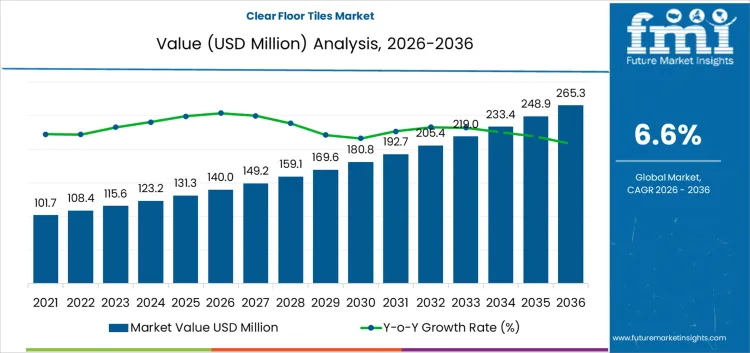
Clear Floor Tiles Market Key Takeaways
| Metric | Value |
|---|---|
| Market Value (2026) | USD 140.0 million |
| Market Forecast Value (2036) | USD 265.3 million |
| Forecast CAGR 2026 to 2036 | 6.6% |
Why is the Demand for Clear Floor Tiles Growing?
Demand for clear floor tiles is increasing as commercial and residential designers seek flooring solutions that enhance aesthetics while supporting functional visibility of underlying elements. Clear floor tiles provide transparent or translucent surfaces that allow viewing of architectural features, artwork, or integrated lighting beneath walking surfaces without compromising structural capacity. Architects specify these tiles in spaces such as museums, retail showrooms, office lobbies, and exhibition centers where visual openness and spatial depth contribute to design objectives. Procurement teams evaluate material strength, slip resistance, optical clarity, and durability to ensure performance under anticipated foot traffic and load conditions.
Building owners and facility managers emphasize ease of maintenance, stain resistance, and long term visual integrity because flooring represents a high use surface critical to occupant safety and property condition. Growth in experiential retail environments and curated interior designs reinforces uptake of clear floor tiles that support creative expression and brand differentiation. Advances in engineered glass and polymer composite formulations improve impact resistance and reduce glare while maintaining uniform clarity across large tile formats. Integration with subfloor lighting and interactive display systems further expands application scope in commercial settings. Contractors coordinate tile selection with substrate preparation standards and leveling systems to ensure seamless installation. These design driven and performance based considerations are contributing to sustained demand for clear floor tiles across evolving architectural applications.
How Are the Segments Classified in the Clear Floor Tiles Market?
Demand for clear floor tiles is shaped by infrastructure visibility requirements, safety compliance, and space optimization across technical and architectural environments. Transparent flooring supports inspection of underfloor services while maintaining load-bearing performance. Adoption aligns with expansion of data-intensive facilities, control environments, and modern commercial interiors. Product selection prioritizes structural integrity, optical clarity, and integration with raised flooring systems. Segment classification reflects differentiation by panel construction, functional application setting, and load-bearing capability. Structure highlights how visibility needs, operational context, and structural performance expectations influence specification priorities and installation density across clear flooring deployments.
Which Product Type Represents the Largest Share of Demand?
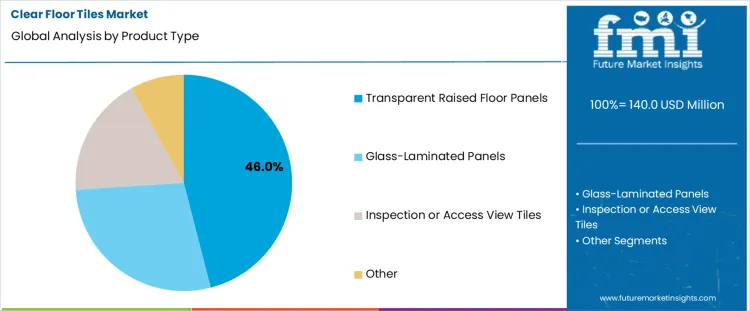
Transparent raised floor panels hold 46.0%, representing the largest share among product types due to compatibility with modular access flooring systems. These panels enable continuous visibility of cables, airflow paths, and service layouts without disrupting floor uniformity. Structural design supports standard pedestal and stringer configurations used in technical floors. Optical transparency assists inspection and maintenance planning. Glass-laminated panels provide enhanced aesthetics and layered strength with higher weight considerations. Inspection or access view tiles support localized visibility needs with lower deployment density. Product type segmentation reflects preference for system-compatible panels delivering visibility, strength, and operational continuity.
Key Points
- Raised panels integrate seamlessly with modular access floors.
- Continuous visibility supports maintenance and planning tasks.
- Other panel types address aesthetics or localized inspection needs.
Which Application Accounts for the Highest Share of Demand?
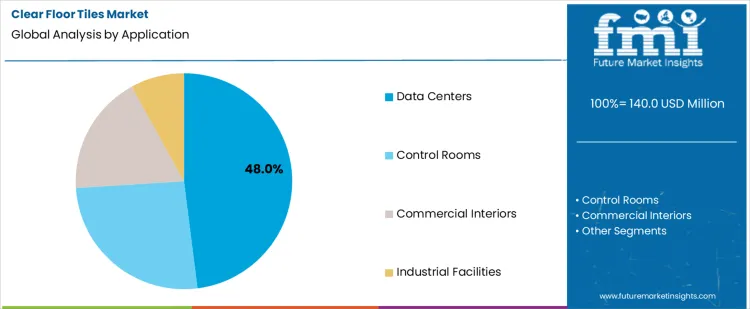
Data centers hold 48.0%, representing the largest share among application areas due to infrastructure density and inspection frequency. Clear tiles allow monitoring of cable routing, airflow distribution, and underfloor congestion without tile removal. Operational continuity benefits from reduced access disruption during inspections. Visibility supports thermal management assessment and fault identification. Control rooms require selective transparency for wiring oversight with lower floor coverage. Commercial interiors apply clear tiles for design and experiential value. Industrial facilities use limited installations for safety monitoring. Application segmentation reflects concentration where infrastructure visibility directly supports uptime and operational efficiency.
Key Points
- Data centers require frequent underfloor inspection.
- Visibility supports airflow and cable management oversight.
- Other applications emphasize control or aesthetic use cases.
Which Load Rating Category Drives the Largest Share of Demand?
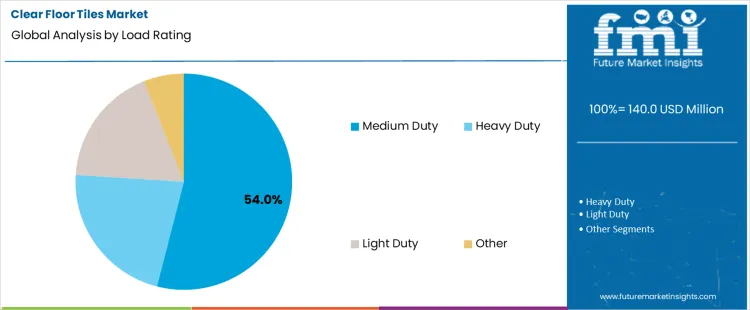
Medium duty ratings hold 54.0%, representing the largest share among load categories due to balanced strength and versatility. This rating supports equipment loads typical of data centers and control rooms without excessive structural reinforcement. Weight distribution performance aligns with raised floor standards for technical spaces. Installation remains flexible across varied layouts. Heavy duty tiles serve areas with concentrated equipment loads requiring reinforced support. Light duty tiles address low-traffic or decorative installations. Load rating segmentation reflects preference for solutions meeting common operational loads while maintaining optical clarity and system compatibility.
Key Points
- Medium duty tiles balance strength and flexibility.
- Compatibility suits common technical floor load profiles.
- Other ratings serve specialized load or design requirements.
What are the Key Dynamics in the Clear Floor Tiles Market?
Demand for clear floor tiles reflects architectural and functional need for light transmission, visual access, and protected display beneath walking surfaces. Adoption spans commercial interiors, museums, retail spaces, transit facilities, and specialized residential applications. Global scope aligns with design-driven construction and renovation activity. Usage centers on tempered glass and transparent polymer tiles engineered for load bearing, slip resistance, and long-term optical clarity.
How do architectural design requirements and functional visibility shape adoption?
Architects specify clear floor tiles to introduce daylight penetration into lower levels and enclosed spaces. Demand increases where visual connection to underlying structures, exhibits, or utilities adds spatial value. Retail and museum environments use transparent tiles to showcase artifacts, lighting features, or branded elements without compromising pedestrian flow. Structural performance requirements drive use of laminated glass and reinforced polymer systems capable of handling concentrated loads. Slip resistance and surface treatment influence acceptance in public circulation zones. Integration with steel or aluminum framing supports modular installation. Adoption reflects project-specific design intent tied to aesthetics, visibility, and controlled transparency rather than broad flooring substitution.
How does structural compliance, cost intensity, and maintenance exposure influence market scalability?
Clear floor tiles require strict compliance with building load codes and safety standards, increasing engineering and certification burden. Demand sensitivity rises where structural glass and custom framing elevate installed cost. Installation precision affects load distribution and long-term performance. Surface scratching, abrasion, and staining affect optical clarity, increasing maintenance expectations. Cleaning protocols remain more demanding than opaque flooring alternatives. Replacement complexity increases in damaged panels due to structural integration. Limited installer expertise restricts geographic availability. Custom sizing and project-led procurement constrain standardization, limiting scalable volume deployment across conventional flooring applications.
How Is Demand for Clear Floor Tiles Evolving Globally?
Demand for clear floor tiles is expanding globally due to architectural design integration, commercial interior upgrades, and durability requirements in high-footfall spaces. Adoption aligns with retail, hospitality, public infrastructure, and premium residential projects requiring visual openness and load-bearing transparency. Material advancements improve scratch resistance, slip control, and structural performance. Replacement demand arises where legacy flooring undergoes refurbishment. Growth rates in India at 9.2%, China at 8.6%, UAE at 7.8%, Saudi Arabia at 7.4%, and Singapore at 7.1% indicate sustained expansion driven by construction activity intensity, design-led specifications, and lifecycle renovation rather than speculative real estate growth.
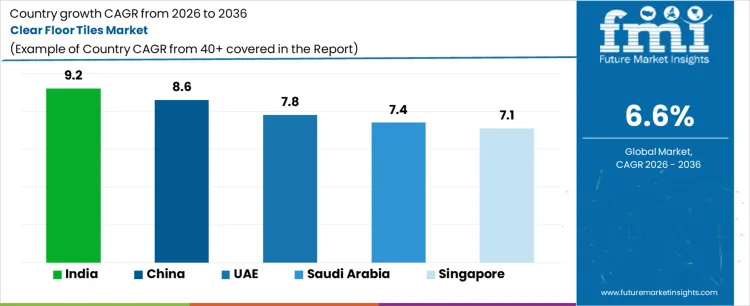
| Country | CAGR (%) |
|---|---|
| India | 9.2% |
| China | 8.6% |
| UAE | 7.8% |
| Saudi Arabia | 7.4% |
| Singapore | 7.1% |
What Is Driving Strong Growth of Clear Floor Tile Demand in India?
Clear floor tile demand in India is growing at a CAGR of 9.2%, supported by commercial construction and premium interior design adoption. Retail complexes and airports specify transparent flooring for visual continuity and lighting optimization. Hospitality projects adopt clear tiles for decorative walkways and feature zones. Infrastructure upgrades increase use in museums and public buildings. Local manufacturers improve load-bearing and safety certifications to meet project requirements. Demand growth reflects project-led specification and renovation cycles rather than mass residential flooring substitution.
- Commercial and airport infrastructure interior upgrades
- Hospitality and public space design integration
- Focus on lighting efficiency and visual openness
- Improvement in domestic safety-rated tile supply
Why Is China Sustaining Expansion in Clear Floor Tile Demand?
China is expanding at a CAGR of 8.6%, driven by large-scale commercial developments and architectural innovation. Shopping malls and exhibition centers integrate transparent flooring for experiential layouts. Urban redevelopment projects adopt clear tiles to enhance spatial perception. Manufacturing scale supports customization in thickness and surface treatment. Fire and load compliance requirements shape specification choices. Demand growth reflects commercial design intensity and redevelopment activity rather than new residential construction volume.
- Large commercial and exhibition space development
- Urban redevelopment emphasizing architectural features
- High customization capability from domestic producers
- Compliance-driven specification for safety and load
How Is the UAE Shaping Demand for Clear Floor Tiles?
Clear floor tile demand in United Arab Emirates is growing at a CAGR of 7.8%, influenced by premium commercial and hospitality construction. Hotels, malls, and cultural venues specify transparent flooring for visual impact. High-end residential developments adopt clear tiles in feature areas. Harsh climate conditions increase emphasis on material durability and UV resistance. Strong reliance on imported specialty tiles supports consistent demand. Growth reflects design-driven specification and tourism-linked infrastructure rather than broad construction volume expansion.
- Premium hospitality and retail project specifications
- Feature-area use in high-end residential buildings
- Emphasis on UV and wear resistance
- Dependence on imported specialty flooring products
What Factors Are Supporting Clear Floor Tile Demand in Saudi Arabia?
Saudi Arabia is expanding at a CAGR of 7.4%, shaped by public infrastructure and commercial development programs. Museums, convention centers, and civic buildings integrate transparent flooring for architectural emphasis. Retail and hospitality projects adopt clear tiles in high-visibility zones. Project specifications prioritize load-bearing certification and safety performance. Government-led construction programs sustain procurement volumes. Demand growth reflects institutional construction activity and design standards rather than private residential demand.
- Public infrastructure and civic building projects
- Retail and hospitality architectural specifications
- Strict load and safety certification requirements
- Government-backed construction program support
Why Is Singapore Showing Consistent Growth in Clear Floor Tile Demand?
Clear floor tile demand in Singapore is growing at a CAGR of 7.1%, supported by urban redevelopment and premium interior renovation. Space optimization priorities favor transparent flooring to enhance visual depth. Commercial offices and retail spaces adopt clear tiles during refurbishment cycles. Strict building codes influence material quality and installation precision. Limited new construction shifts demand toward replacement and upgrade projects. Growth remains steady, reflecting renovation-led demand and architectural detailing rather than expansion in built area.
- Urban redevelopment and interior refurbishment focus
- Space optimization through visual transparency
- Strict building and installation standards
- Renovation-driven replacement demand
What is the competitive landscape of demand for the clear floor tiles market globally?
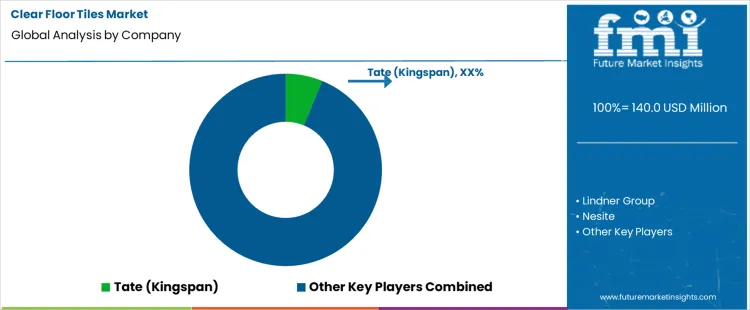
Demand for clear floor tiles centers on architectural transparency, functional access flooring, and aesthetic integration in commercial, retail, and exhibition environments. Buyers evaluate tile transparency, load-bearing capacity, slip resistance, structural support frames, and compatibility with underfloor lighting and cabling systems. Procurement teams prioritize suppliers with consistent quality, adherence to building codes, fire safety standards, and ability to support large-scale specification and installation projects. Trend in the global market reflects growth of raised access floor solutions that combine visibility, utility access, and design flexibility in modern office and retail spaces.
Tate (Kingspan) holds leading positioning through engineered clear and specialty floor tile systems with proven performance and broad distribution channels. Lindner Group supports demand with modular flooring and transparent floor components tailored for commercial interiors requiring durability and design impact. Nesite contributes architectural floor solutions including transparent and illuminated tiles used in high-visibility applications. MERO-TSK participates with structural flooring systems and clear tile options integrated into building service access frameworks. Polygroup supplies raised access floor panels including specialty transparent designs with load-rated performance for data centers and corporate buildings. Competitive differentiation depends on tile optical clarity, structural performance, compatibility with underfloor systems, installation support, and ability to meet diverse regulatory and aesthetic requirements.
Key Players in the Clear Floor Tiles Market
- Tate (Kingspan)
- Lindner Group
- Nesite
- MERO-TSK
- Polygroup
- CBI Europe
- Unitile
- ASM Modular Systems
- Lenzlinger
- Regional Specialists
Scope of the Report
| Items | Values |
|---|---|
| Quantitative Units | USD million |
| Product Type | Transparent Raised Floor Panels; Glass-Laminated Panels; Inspection or Access View Tiles; Other |
| Application | Data Centers; Control Rooms; Commercial Interiors; Industrial Facilities |
| Load Rating | Medium Duty; Heavy Duty; Light Duty; Other |
| Sales Channel | Raised Floor OEMs; Contractors or EPC; Distributors; Other |
| Regions Covered | Asia Pacific, Europe, North America, Latin America, Middle East & Africa |
| Countries Covered | India, China, UAE, Saudi Arabia, Singapore, and 40+ countries |
| Key Companies Profiled | Tate; Kingspan; Lindner Group; Nesite; MERO-TSK; Polygroup; CBI Europe; Unitile; ASM Modular Systems; Lenzlinger; Regional Specialists |
| Additional Attributes | Dollar sales by product type and application; adoption trends for transparent and glass-laminated panels in data center monitoring and secure control environments; load-bearing capacity, impact resistance, and slip performance metrics; fire performance, light transmission, and optical clarity considerations; integration compatibility with pedestal systems, airflow management, and cable routing; installation tolerances, maintenance access, and panel replacement cycles; procurement dynamics across OEM-led specifications and EPC-driven projects; compliance with building codes, data center standards, and safety regulations influencing clear floor tile specification. |
Clear Floor Tiles Market by Segment
Product Type:
- Transparent Raised Floor Panels
- Glass-Laminated Panels
- Inspection or Access View Tiles
- Other
Application:
- Data Centers
- Control Rooms
- Commercial Interiors
- Industrial Facilities
Load Rating:
- Medium Duty
- Heavy Duty
- Light Duty
- Other
Sales Channel:
- Raised Floor OEMs
- Contractors or EPC
- Distributors
- Other
Region:
- Asia Pacific
- China
- Japan
- South Korea
- India
- Australia & New Zealand
- ASEAN
- Rest of Asia Pacific
- Europe
- Germany
- United Kingdom
- France
- Italy
- Spain
- Nordic
- BENELUX
- Rest of Europe
- North America
- United States
- Canada
- Mexico
- Latin America
- Brazil
- Chile
- Rest of Latin America
- Middle East & Africa
- Kingdom of Saudi Arabia
- Other GCC Countries
- Turkey
- South Africa
- Other African Union
- Rest of Middle East & Africa
Bibliography
- International Organization for Standardization. (2023). ISO 10140-5: Acoustics and structural performance of floor elements, including transparent and composite floor systems, revised applicability guidance. International Organization for Standardization.
- International Organization for Standardization. (2024). ISO 14122-2: Permanent means of access to machinery and buildings-Working platforms and walkways, updated interpretation for transparent and glass floor panels. International Organization for Standardization.
- European Committee for Standardization. (2023). EN 12825: Raised access floors-Performance requirements and test methods, reaffirmed with applicability to transparent and glass-based panels. CEN.
- ASTM International. (2024). ASTM E2757: Standard guide for load-bearing and slip resistance evaluation of glass and transparent flooring systems. ASTM International.
- International Building Code Council. (2024). International Building Code (IBC): Floor construction, walking surface safety, and structural glass provisions applicable to transparent flooring installations. ICC.
- National Fire Protection Association. (2023). NFPA 13 and NFPA 101: Fire safety and life safety considerations for floor assemblies, including transparent and specialty floor panels. National Fire Protection Association.
Frequently Asked Questions
How big is the clear floor tiles market in 2026?
The global clear floor tiles market is estimated to be valued at USD 140.0 million in 2026.
What will be the size of clear floor tiles market in 2036?
The market size for the clear floor tiles market is projected to reach USD 265.3 million by 2036.
How much will be the clear floor tiles market growth between 2026 and 2036?
The clear floor tiles market is expected to grow at a 6.6% CAGR between 2026 and 2036.
What are the key product types in the clear floor tiles market?
The key product types in clear floor tiles market are transparent raised floor panels, glass-laminated panels, inspection or access view tiles and other.
Which application segment to contribute significant share in the clear floor tiles market in 2026?
In terms of application, data centers segment to command 48.0% share in the clear floor tiles market in 2026.
Preview the report firsthand - request a free sample
Get SampleGet the brochure for pricing and purchase details.
Get PDFTable of Content
- Executive Summary
- Global Market Outlook
- Demand-side Trends
- Supply-side Trends
- Technology Roadmap Analysis
- Analysis and Recommendations
- Market Overview
- Market Coverage / Taxonomy
- Market Definition / Scope / Limitations
- Market Background
- Market Dynamics
- Drivers
- Restraints
- Opportunity
- Trends
- Scenario Forecast
- Demand in Optimistic Scenario
- Demand in Likely Scenario
- Demand in Conservative Scenario
- Opportunity Map Analysis
- Product Life Cycle Analysis
- Supply Chain Analysis
- Investment Feasibility Matrix
- Value Chain Analysis
- PESTLE and Porter’s Analysis
- Regulatory Landscape
- Regional Parent Market Outlook
- Production and Consumption Statistics
- Import and Export Statistics
- Market Dynamics
- Global Market Analysis 2021 to 2025 and Forecast, 2026 to 2036
- Historical Market Size Value (USD Million) Analysis, 2021 to 2025
- Current and Future Market Size Value (USD Million) Projections, 2026 to 2036
- Y-o-Y Growth Trend Analysis
- Absolute $ Opportunity Analysis
- Global Market Pricing Analysis 2021 to 2025 and Forecast 2026 to 2036
- Global Market Analysis 2021 to 2025 and Forecast 2026 to 2036, By Product Type
- Introduction / Key Findings
- Historical Market Size Value (USD Million) Analysis By Product Type , 2021 to 2025
- Current and Future Market Size Value (USD Million) Analysis and Forecast By Product Type , 2026 to 2036
- Transparent Raised Floor Panels
- Glass-Laminated Panels
- Inspection or Access View Tiles
- Other
- Transparent Raised Floor Panels
- Y-o-Y Growth Trend Analysis By Product Type , 2021 to 2025
- Absolute $ Opportunity Analysis By Product Type , 2026 to 2036
- Global Market Analysis 2021 to 2025 and Forecast 2026 to 2036, By Application
- Introduction / Key Findings
- Historical Market Size Value (USD Million) Analysis By Application, 2021 to 2025
- Current and Future Market Size Value (USD Million) Analysis and Forecast By Application, 2026 to 2036
- Data Centers
- Control Rooms
- Commercial Interiors
- Industrial Facilities
- Data Centers
- Y-o-Y Growth Trend Analysis By Application, 2021 to 2025
- Absolute $ Opportunity Analysis By Application, 2026 to 2036
- Global Market Analysis 2021 to 2025 and Forecast 2026 to 2036, By Load Rating
- Introduction / Key Findings
- Historical Market Size Value (USD Million) Analysis By Load Rating, 2021 to 2025
- Current and Future Market Size Value (USD Million) Analysis and Forecast By Load Rating, 2026 to 2036
- Medium Duty
- Heavy Duty
- Light Duty
- Other
- Medium Duty
- Y-o-Y Growth Trend Analysis By Load Rating, 2021 to 2025
- Absolute $ Opportunity Analysis By Load Rating, 2026 to 2036
- Global Market Analysis 2021 to 2025 and Forecast 2026 to 2036, By Sales Channel
- Introduction / Key Findings
- Historical Market Size Value (USD Million) Analysis By Sales Channel, 2021 to 2025
- Current and Future Market Size Value (USD Million) Analysis and Forecast By Sales Channel, 2026 to 2036
- Raised Floor OEMs
- Contractors or EPC
- Distributors
- Other
- Raised Floor OEMs
- Y-o-Y Growth Trend Analysis By Sales Channel, 2021 to 2025
- Absolute $ Opportunity Analysis By Sales Channel, 2026 to 2036
- Global Market Analysis 2021 to 2025 and Forecast 2026 to 2036, By Region
- Introduction
- Historical Market Size Value (USD Million) Analysis By Region, 2021 to 2025
- Current Market Size Value (USD Million) Analysis and Forecast By Region, 2026 to 2036
- North America
- Latin America
- Western Europe
- Eastern Europe
- East Asia
- South Asia and Pacific
- Middle East & Africa
- Market Attractiveness Analysis By Region
- North America Market Analysis 2021 to 2025 and Forecast 2026 to 2036, By Country
- Historical Market Size Value (USD Million) Trend Analysis By Market Taxonomy, 2021 to 2025
- Market Size Value (USD Million) Forecast By Market Taxonomy, 2026 to 2036
- By Country
- USA
- Canada
- Mexico
- By Product Type
- By Application
- By Load Rating
- By Sales Channel
- By Country
- Market Attractiveness Analysis
- By Country
- By Product Type
- By Application
- By Load Rating
- By Sales Channel
- Key Takeaways
- Latin America Market Analysis 2021 to 2025 and Forecast 2026 to 2036, By Country
- Historical Market Size Value (USD Million) Trend Analysis By Market Taxonomy, 2021 to 2025
- Market Size Value (USD Million) Forecast By Market Taxonomy, 2026 to 2036
- By Country
- Brazil
- Chile
- Rest of Latin America
- By Product Type
- By Application
- By Load Rating
- By Sales Channel
- By Country
- Market Attractiveness Analysis
- By Country
- By Product Type
- By Application
- By Load Rating
- By Sales Channel
- Key Takeaways
- Western Europe Market Analysis 2021 to 2025 and Forecast 2026 to 2036, By Country
- Historical Market Size Value (USD Million) Trend Analysis By Market Taxonomy, 2021 to 2025
- Market Size Value (USD Million) Forecast By Market Taxonomy, 2026 to 2036
- By Country
- Germany
- UK
- Italy
- Spain
- France
- Nordic
- BENELUX
- Rest of Western Europe
- By Product Type
- By Application
- By Load Rating
- By Sales Channel
- By Country
- Market Attractiveness Analysis
- By Country
- By Product Type
- By Application
- By Load Rating
- By Sales Channel
- Key Takeaways
- Eastern Europe Market Analysis 2021 to 2025 and Forecast 2026 to 2036, By Country
- Historical Market Size Value (USD Million) Trend Analysis By Market Taxonomy, 2021 to 2025
- Market Size Value (USD Million) Forecast By Market Taxonomy, 2026 to 2036
- By Country
- Russia
- Poland
- Hungary
- Balkan & Baltic
- Rest of Eastern Europe
- By Product Type
- By Application
- By Load Rating
- By Sales Channel
- By Country
- Market Attractiveness Analysis
- By Country
- By Product Type
- By Application
- By Load Rating
- By Sales Channel
- Key Takeaways
- East Asia Market Analysis 2021 to 2025 and Forecast 2026 to 2036, By Country
- Historical Market Size Value (USD Million) Trend Analysis By Market Taxonomy, 2021 to 2025
- Market Size Value (USD Million) Forecast By Market Taxonomy, 2026 to 2036
- By Country
- China
- Japan
- South Korea
- By Product Type
- By Application
- By Load Rating
- By Sales Channel
- By Country
- Market Attractiveness Analysis
- By Country
- By Product Type
- By Application
- By Load Rating
- By Sales Channel
- Key Takeaways
- South Asia and Pacific Market Analysis 2021 to 2025 and Forecast 2026 to 2036, By Country
- Historical Market Size Value (USD Million) Trend Analysis By Market Taxonomy, 2021 to 2025
- Market Size Value (USD Million) Forecast By Market Taxonomy, 2026 to 2036
- By Country
- India
- ASEAN
- Australia & New Zealand
- Rest of South Asia and Pacific
- By Product Type
- By Application
- By Load Rating
- By Sales Channel
- By Country
- Market Attractiveness Analysis
- By Country
- By Product Type
- By Application
- By Load Rating
- By Sales Channel
- Key Takeaways
- Middle East & Africa Market Analysis 2021 to 2025 and Forecast 2026 to 2036, By Country
- Historical Market Size Value (USD Million) Trend Analysis By Market Taxonomy, 2021 to 2025
- Market Size Value (USD Million) Forecast By Market Taxonomy, 2026 to 2036
- By Country
- Kingdom of Saudi Arabia
- Other GCC Countries
- Turkiye
- South Africa
- Other African Union
- Rest of Middle East & Africa
- By Product Type
- By Application
- By Load Rating
- By Sales Channel
- By Country
- Market Attractiveness Analysis
- By Country
- By Product Type
- By Application
- By Load Rating
- By Sales Channel
- Key Takeaways
- Key Countries Market Analysis
- USA
- Pricing Analysis
- Market Share Analysis, 2025
- By Product Type
- By Application
- By Load Rating
- By Sales Channel
- Canada
- Pricing Analysis
- Market Share Analysis, 2025
- By Product Type
- By Application
- By Load Rating
- By Sales Channel
- Mexico
- Pricing Analysis
- Market Share Analysis, 2025
- By Product Type
- By Application
- By Load Rating
- By Sales Channel
- Brazil
- Pricing Analysis
- Market Share Analysis, 2025
- By Product Type
- By Application
- By Load Rating
- By Sales Channel
- Chile
- Pricing Analysis
- Market Share Analysis, 2025
- By Product Type
- By Application
- By Load Rating
- By Sales Channel
- Germany
- Pricing Analysis
- Market Share Analysis, 2025
- By Product Type
- By Application
- By Load Rating
- By Sales Channel
- UK
- Pricing Analysis
- Market Share Analysis, 2025
- By Product Type
- By Application
- By Load Rating
- By Sales Channel
- Italy
- Pricing Analysis
- Market Share Analysis, 2025
- By Product Type
- By Application
- By Load Rating
- By Sales Channel
- Spain
- Pricing Analysis
- Market Share Analysis, 2025
- By Product Type
- By Application
- By Load Rating
- By Sales Channel
- France
- Pricing Analysis
- Market Share Analysis, 2025
- By Product Type
- By Application
- By Load Rating
- By Sales Channel
- India
- Pricing Analysis
- Market Share Analysis, 2025
- By Product Type
- By Application
- By Load Rating
- By Sales Channel
- ASEAN
- Pricing Analysis
- Market Share Analysis, 2025
- By Product Type
- By Application
- By Load Rating
- By Sales Channel
- Australia & New Zealand
- Pricing Analysis
- Market Share Analysis, 2025
- By Product Type
- By Application
- By Load Rating
- By Sales Channel
- China
- Pricing Analysis
- Market Share Analysis, 2025
- By Product Type
- By Application
- By Load Rating
- By Sales Channel
- Japan
- Pricing Analysis
- Market Share Analysis, 2025
- By Product Type
- By Application
- By Load Rating
- By Sales Channel
- South Korea
- Pricing Analysis
- Market Share Analysis, 2025
- By Product Type
- By Application
- By Load Rating
- By Sales Channel
- Russia
- Pricing Analysis
- Market Share Analysis, 2025
- By Product Type
- By Application
- By Load Rating
- By Sales Channel
- Poland
- Pricing Analysis
- Market Share Analysis, 2025
- By Product Type
- By Application
- By Load Rating
- By Sales Channel
- Hungary
- Pricing Analysis
- Market Share Analysis, 2025
- By Product Type
- By Application
- By Load Rating
- By Sales Channel
- Kingdom of Saudi Arabia
- Pricing Analysis
- Market Share Analysis, 2025
- By Product Type
- By Application
- By Load Rating
- By Sales Channel
- Turkiye
- Pricing Analysis
- Market Share Analysis, 2025
- By Product Type
- By Application
- By Load Rating
- By Sales Channel
- South Africa
- Pricing Analysis
- Market Share Analysis, 2025
- By Product Type
- By Application
- By Load Rating
- By Sales Channel
- USA
- Market Structure Analysis
- Competition Dashboard
- Competition Benchmarking
- Market Share Analysis of Top Players
- By Regional
- By Product Type
- By Application
- By Load Rating
- By Sales Channel
- Competition Analysis
- Competition Deep Dive
- Tate (Kingspan)
- Overview
- Product Portfolio
- Profitability by Market Segments (Product/Age /Sales Channel/Region)
- Sales Footprint
- Strategy Overview
- Marketing Strategy
- Product Strategy
- Channel Strategy
- Lindner Group
- Nesite
- MERO-TSK
- Polygroup
- CBI Europe
- Value (USD Million)ile
- ASM Modular Systems
- Lenzlinger
- Regional Specialists
- Tate (Kingspan)
- Competition Deep Dive
- Assumptions & Acronyms Used
- Research Methodology


