

- Market Size (2026)
- USD 217.9 Mn
- Forecast (2036)
- USD 449.0 Mn
- CAGR (2026 to 2036)
- 7.5%
How big is AI Data Center Grid Capacity Intelligence Platforms Market in 2026?
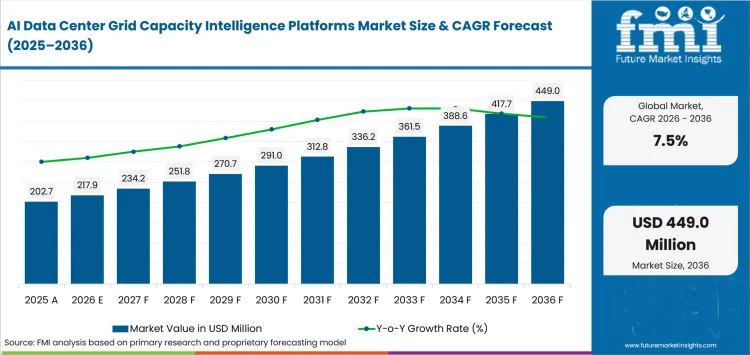
USD 217.9 million in 2026 and USD 449.0 million by 2036 at a 7.5% CAGR.
Demand for AI data center grid capacity intelligence platforms is projected to expand at 7.5% CAGR between 2026 and 2036. Valuation is expected to rise from USD 217.9 million to USD 449.0 million as developers test usable power before committing compute capital. The Electric Power Research Institute estimated in February 2026 that USA data centers could consume 9% to 17% of national electricity by 2030. This range makes load forecasting and capacity validation an earlier engineering decision.
Country conditions separate the purchase cases because connection rules determine how quickly software findings influence project timing. Ireland requires earlier capacity screening than greenfield Gulf projects that can phase generation and network design with campus construction. The Central Statistics Office reported in July 2026 that data centres consumed 23% of Ireland's metered electricity during 2025. Concentrated electricity use raises the value of analysis that survives utility review before developers commit major electrical capital.
Key Takeaways
- AI data-center load growth makes capacity intelligence part of site selection because grid access increasingly determines usable compute delivery schedules.
- By software function, asset health - predictive maintenance is estimated to hold 26.0% in 2026 owing to uptime exposure from high-density electrical assets.
- Based on electrical layer, medium-voltage distribution is projected to account for 31.0% in 2026 due to its control point between utility supply and downstream power systems.
- In 2026, the 51-150 MW segment is expected to lead power capacity with 31.0% share because phased projects still face material interconnection decisions.
- Utility validation and incomplete model interoperability slow deployment because an analytical result has little value unless grid engineers can reproduce its assumptions.
- Some of the key players in this market include GridCARE, Schneider Electric, Jacobs, Siemens, GE Vernova, Eaton, Vertiv, and Hitachi Energy.
Analyst Perspective
"Platform evaluation should begin with the power decision a model can change before a developer commits scarce interconnection or electrical capacity. Commercial value rises if the same model remains credible during utility studies, commissioning, and live operation."
- Sudip saha, Principal Consultant, Future Market Insights
How is the AI Data Center Grid Capacity Intelligence Platforms Market segmented?
Software function, electrical layer, power capacity, facility type, and route to market.
Software function covers asset health - predictive maintenance, capacity & load planning, dynamic load management, energy / cost optimization, and compliance & reporting. Electrical layer includes medium-voltage distribution, low-voltage distribution, rack / row-level, and substation / grid interface. Power capacity spans below 10 MW, 10-50 MW, 51-150 MW, and above 150 MW. Facility type covers hyperscale AI, colocation, enterprise / private cloud, and HPC / research. Route to market includes OEM direct, electrical EPC / contractor, system integrator, and distributor / service partner.
How does 51-150 MW shape demand within the Power capacity category?
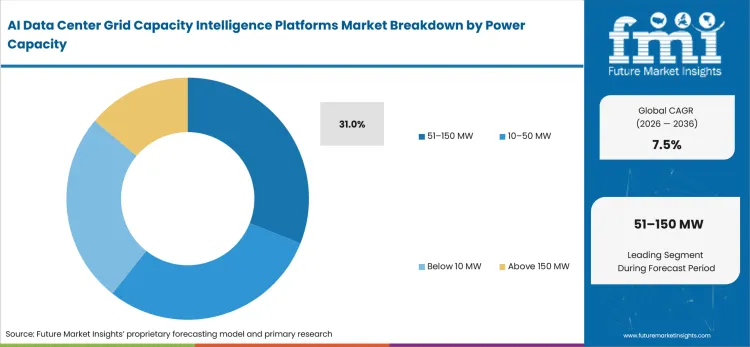
Projects between 51 MW and 150 MW are large enough for network constraints to alter site economics before developers finalize power architecture. Their scale leaves room for phased energization and flexible resources that change delivery timing.
- The 51-150 MW segment is set to lead the power capacity category with 31.0% share in 2026 due to grid studies and practical phasing options.
- Portland General Electric and GridCARE completed a Hillsboro planning project in October 2025 that identified more than 80 MW of incremental 2026 data-center capacity. Their hourly modeling used batteries and onsite resources, giving power management systems a direct role in validating earlier interconnection.
What makes Asset Health - predictive maintenance central to the Software function category?
High-density AI halls place more financial exposure on breakers and transformers because a short electrical interruption can idle expensive compute. Data center power quality analysis becomes more useful once condition signals influence maintenance timing before a failure interrupts energized capacity.
- Asset health - predictive maintenance is projected to hold 26.0% share in 2026 owing to its direct link between electrical condition and uptime protection.
- Hitachi Energy launched HMAX Energy in March 2026 for critical energy infrastructure including data centers. The suite uses AI-based planning and failure prevention to shift maintenance decisions toward individual asset condition.
Why does Medium-voltage distribution lead the Electrical layer category?
Medium-voltage equipment concentrates site-wide power decisions before electricity divides into lower-voltage branches serving compute halls. Engineers test feeder loading and protection coordination at this layer because one constrained path can affect several rooms and modular UPS systems downstream.
- In 2026, medium-voltage distribution is expected to lead the electrical layer category with 31.0% share because it governs redundancy and usable facility capacity.
- AI-ready facilities are pulling medium-voltage design closer to compute architecture. Siemens and Reinhausen announced an August 2026 solid-state transformer that accepts grid voltage up to 36 kV and feeds 800 VDC architectures. Data center power planning must therefore follow changing conversion stages.
How does 51-150 MW shape demand within the Power capacity category?
Projects between 51 MW and 150 MW are large enough for network constraints to alter site economics before developers finalize power architecture. Their scale leaves room for phased energization and flexible resources that change delivery timing.
- The 51-150 MW segment is set to lead the power capacity category with 31.0% share in 2026 due to grid studies and practical phasing options.
- Portland General Electric and GridCARE completed a Hillsboro planning project in October 2025 that identified more than 80 MW of incremental 2026 data-center capacity. Their hourly modeling used batteries and onsite resources, giving power management systems a direct role in validating earlier interconnection.
What supports Hyperscale AI demand within the Facility type category?
Hyperscale AI campuses concentrate connection requests and high rack densities inside data center infrastructure that expands faster than transmission construction. Owners therefore need simulation before electrical designs harden because a small planning error can strand costly compute capacity.
- By facility type, hyperscale AI is forecast to represent 44.0% in 2026 driven by repeated power-capacity decisions during design and phased commissioning.
- Jacobs released its Data Center Digital Twin in March 2026 for gigawatt-scale AI facilities. The model simulates compute and power with liquid cooling systems before construction decisions become expensive to reverse. Digital twin technology therefore has direct relevance to electrical phasing instead of visualization.
What are the drivers, restraints and opportunities in the AI Data Center Grid Capacity Intelligence Platforms Market?
AI load growth raises the need for earlier capacity decisions, utility-grade modeling slows adoption, and flexible-load intelligence can release usable grid headroom.
- Driver: Utilities and developers need earlier load forecasts because AI projects can reach the interconnection queue before conventional grid plans absorb their scale.
- Restraint: Platform adoption slows if grid operators cannot reproduce facility assumptions or exchange the operational data required for reliability studies.
- Opportunity: Flexibility analysis can shorten time-to-power by testing batteries and controllable computing loads against hours that constrain existing network capacity.
Large computational loads are arriving faster than many grid-planning cycles were designed to absorb. NERC stated in its 2026 Large Loads Action Plan that AI data centers present less predictable electrical behavior than conventional loads and require new interconnection studies. That planning burden raises demand for software that can test credible load scenarios before utilities commit network upgrades or developers lock site designs.
The harder commercial step is converting a model output into evidence accepted by the grid operator responsible for reliability. NERC told FERC in April 2025 that large-load integration requires information sharing and accurate modeling alongside operational coordination. A platform can identify a plausible capacity route but lose purchasing value if its assumptions cannot transfer into the utility study used for approval.
Existing network assets provide a revenue route if software can identify underused capacity and the flexible resources that avoid a binding constraint. EPRI's September 2025 DCFlex program document set a three-year schedule through 2027 for testing grid-interactive data-center operating models. Data center power management vendors gain a stronger recurring use case once verified flexibility informs both connection planning and post-energization operations.
Which country CAGRs are profiled in the AI Data Center Grid Capacity Intelligence Platforms Market?
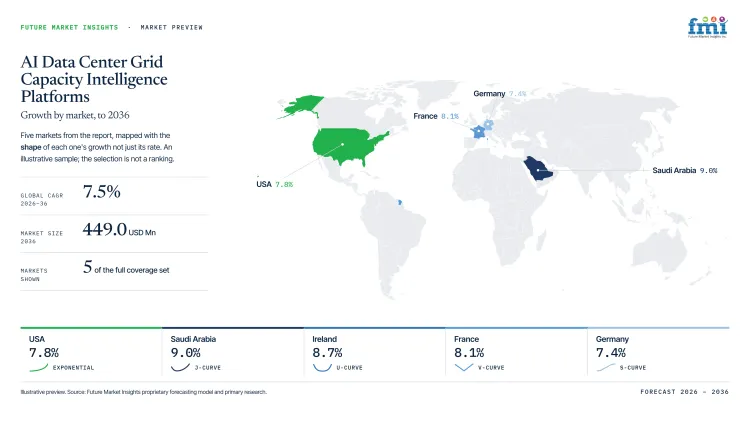
| Country | CAGR |
|---|---|
| Saudi Arabia | 9.0% |
| Ireland | 8.7% |
| France | 8.1% |
| USA | 7.8% |
| Germany | 7.4% |
How do country-level CAGRs compare in the AI Data Center Grid Capacity Intelligence Platforms Market?
The 1.2 percentage-point range forms a compact growth band without a clear split between fast and slow markets. Saudi Arabia and Ireland occupy the upper end, with UAE and France close behind. USA stays within the same band because all five markets face power constraints at different stages of project development.
- Saudi projects favor sites where network expansion can accompany new utility infrastructure.
- Irish cluster density makes spare network capacity scarcer near existing data-center nodes.
- French project pipelines concentrate near transmission corridors with earlier high-voltage access.
- USA market fragmentation raises the value of reusable study models between utility service areas.
- Germany’s market fragmentation raises the value of reusable study models between utility service areas.
Similar CAGRs still produce different sales cycles and approval paths. The full report provides country-level CAGR analysis across North America, Latin America, Europe, East Asia, South Asia, Oceania and the Middle East and Africa.
Country-wise Analysis
- Saudi data-center developers are advancing greenfield campuses where substation design and medium-voltage equipment must be sequenced with each high-density compute block before commissioning. Saudi Vision 2030's 2024 annual report recorded national data-center capacity at 290.5 MW after 42% year-on-year growth. Saudi Arabia is estimated to post 9.0% CAGR over the forecast period, shaped by capacity expansion that brings power modeling into site design earlier. Rapid construction can outrun equipment delivery and grid reinforcement during parallel campus builds before all substations are ready. Providers therefore need capacity scenarios that stay usable during phased energization and repeated commissioning checks for each newly powered block.
- Irish developers now face a connection process that tests project location and associated generation or storage before grid access becomes bankable for new capacity. Adoption of AI data center grid capacity intelligence platforms in Ireland is estimated to expand at 8.7% CAGR through 2036, reinforced by connection obligations. The Commission for Regulation of Utilities required new data centers in December 2025 to match import capacity with generation or storage and source at least 80% additional Irish renewable electricity. Projects at constrained nodes still depend on renewable delivery schedules, which can delay technically sound campuses even after capacity modeling supports the connection case and financing timetable.
- French transmission planners are managing a dense queue of industrial and digital projects that narrows the locations available for new large loads near major network corridors. RTE reported in March 2026 that more than 200 industrial or data-center projects had secured grid access representing 33 GW of combined demand. Locational screening therefore becomes a commercial requirement before developers treat modeled capacity as deliverable power under site-specific connection conditions for new campuses. France is estimated to post 8.1% CAGR over the forecast period, influenced by connection reforms that favor platforms able to translate campus load profiles into RTE planning workflows.
- United States data-center projects span six regional grid markets, so identical capacity models can face different interconnection rules and cost-allocation tests before investment approval. FERC ordered all six regional operators in June 2026 to justify or reform tariff provisions governing data centers and other large loads within their jurisdictions. AI data center grid capacity intelligence platform demand in USA is predicted to advance at 7.8% CAGR through 2036, tied to those evolving study rules. Regional differences still prevent a single national workflow and require platforms to preserve core assumptions while adapting evidence to each utility territory and regional market design.
- Germany’s data-center projects span multiple transmission and distribution grid areas, so identical capacity models can face different interconnection procedures, grid-connection requirements, and cost-allocation considerations before investment approval. Germany’s evolving grid-planning and connection framework creates regional differences in how large AI data-center loads are assessed and connected. AI data center grid capacity intelligence platform demand in Germany is predicted to advance at 7.4% CAGR through 2036, tied to those evolving grid-connection and capacity-planning requirements. Regional differences still prevent a single national workflow and require platforms to preserve core assumptions while adapting evidence to each utility territory and grid area.
Who are the notable companies in the AI Data Center Grid Capacity Intelligence Platforms Market?
GridCARE, Schneider Electric, Jacobs, Siemens, GE Vernova, Eaton, Vertiv, and Hitachi Energy are the notable companies serving this market.
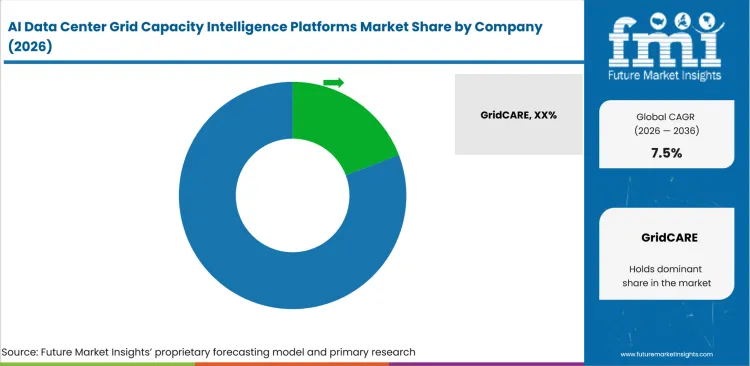
Competition depends on the electrical decision each platform can influence. GridCARE focuses on grid-capacity activation and Siemens extends software into flexible connections. Schneider Electric and Jacobs model facility power, whereas GE Vernova concentrates on grid operations. Eaton supplies grid-to-chip electrical infrastructure, while Vertiv and Hitachi Energy extend facility modeling and asset intelligence. Firms selling datacenter infrastructure services face a higher entry barrier once utilities require traceable power-system assumptions before accepting a study.
- GridCARE, Siemens, and GE Vernova cover grid-capacity software with documented network-planning or utility operating applications.
- Schneider Electric and Jacobs cover facility digital-twin roles with published simulation workflows for AI data-center power systems.
- Eaton, Vertiv, and Hitachi Energy tie electrical assets to monitoring or modeled performance through data center UPS and power-control architectures.
Competitive Benchmarking: AI Data Center Grid Capacity Intelligence Platforms Market
| Company | Grid Capacity Planning | Facility Electrical Modeling | Operational Power Intelligence | Geographic Reach |
|---|---|---|---|---|
| GridCARE | High | Medium | Medium | North America |
| Schneider Electric | High | High | High | Global |
| Jacobs | Low | High | Medium | Global |
| Siemens | High | High | High | Global |
| GE Vernova | High | Low | High | Global |
| Eaton | Medium | Medium | Medium | Global |
| Vertiv | Low | High | Medium | Global |
| Hitachi Energy | High | Medium | High | Global |
Scoring basis: High grid-capacity planning requires utility-grade network analysis tied to load or interconnection decisions. High facility modeling requires detailed electrical simulation or digital-twin coverage. High operational intelligence requires live asset or grid analytics. Medium reflects partial coverage, while Low identifies a narrower documented role.
Source basis: Ratings use official 2025-2026 company announcements, filings, current certification records, and documented utility or data-center deployments. Low denotes a narrower verified function rather than missing evidence.
Key Developments in the AI Data Center Grid Capacity Intelligence Platforms Market
- In March 2026, GridCARE and National Grid announced a New York collaboration using AI-driven grid simulations to identify capacity for large-load customers.
- In November 2025, Siemens launched Gridscale X Flexibility Manager to predict grid constraints and accelerate flexible connections for data centers and distributed resources.
- In March 2025, Schneider Electric and ETAP unveiled an AI Factory electrical digital twin that models grid-to-chip power requirements with NVIDIA Omniverse.
Key Players in the AI Data Center Grid Capacity Intelligence Platforms Market
Grid Capacity and Utility Planning Platforms
- GridCARE
- Siemens
- GE Vernova
Facility Electrical Modeling and Engineering Platforms
- Schneider Electric
- Jacobs
Power Infrastructure and Operational Intelligence Platforms
- Eaton
- Vertiv
- Hitachi Energy
AI Data Center Grid Capacity Intelligence Platforms Market - Report Scope
| Coverage field | Report scope |
|---|---|
| Market breakdown | By software function, electrical layer, power capacity, facility type, route to market, and region. |
| Quantitative Units | USD Million. |
| Market Definition | Revenue includes software licenses, subscriptions, platform access, and software-led analytics used to assess, monitor, forecast, or improve grid and data-center electrical capacity. Electrical hardware, electricity sales, standalone EPC revenue, and unrelated facility software are excluded. |
| Regions Covered | North America, Latin America, Europe, East Asia, South Asia and Pacific, and Middle East and Africa. |
| Countries Covered | Saudi Arabia, Ireland, UAE, France, USA, and 20+ countries included in the full report. |
| Key Companies Profiled | GridCARE, Schneider Electric, Jacobs, Siemens, GE Vernova, Eaton, Vertiv, Hitachi Energy. |
| Forecast Period | 2026 to 2036. |
| Approach | Primary and secondary research with market triangulation. |
AI Data Center Grid Capacity Intelligence Platforms Market - Research Methodology
| Method | Approach |
|---|---|
| Primary Research | FMI analysts gathered input from manufacturers, service providers, technology developers, distributors, end users, procurement teams, and subject-matter experts. Interviews examined purchasing decisions, product or service evaluation, adoption barriers, approval requirements, pricing considerations, and expectations for technical or commercial support. Respondents were also asked what evidence is required before a trial, pilot, or initial order develops into regular purchasing. |
| Desk Research | Desk research covered government statistics, regulatory publications, trade data, industry associations, technical literature, standards, company filings, product information, and official corporate announcements. Sources were reviewed for relevance, publication date, geographic coverage, and consistency with the defined market scope. Claims relating to performance, applications, approvals, capacity, investment, and commercial activity were retained only when supported by credible public evidence. |
| Market Sizing and Forecasting | The market model combined the baseline value with historical performance, segment structure, pricing and volume indicators, adoption levels, company participation, and country-level demand conditions. Forecast assumptions considered economic activity, investment trends, regulatory developments, technology adoption, purchasing cycles, supply availability, and barriers to wider market use. Segment and regional estimates were reconciled before the final market total was calculated. |
| Data Validation | Estimates were checked against multiple independent indicators, including public data, company activity, trade patterns, industry developments, and findings from primary interviews. Validation also tested whether products, services, applications, and company revenues fell within the defined market boundaries. Adjacent categories, unsupported claims, overlapping revenues, and activities without direct market relevance were excluded to reduce double counting and maintain consistency across segments and countries. |
AI Data Center Grid Capacity Intelligence Platforms Market by Segments
AI Data Center Grid Capacity Intelligence Platforms Market segmented by Software Function:
- Asset health - predictive maintenance
- Capacity & load planning
- Dynamic load management
- Energy / cost optimization
- Compliance & reporting
AI Data Center Grid Capacity Intelligence Platforms Market segmented by Electrical Layer:
- Medium-voltage distribution
- Low-voltage distribution
- Rack / row-level
- Substation / grid interface
AI Data Center Grid Capacity Intelligence Platforms Market segmented by Power Capacity:
- 51-150 MW
- 10-50 MW
- Below 10 MW
- Above 150 MW
AI Data Center Grid Capacity Intelligence Platforms Market segmented by Facility Type:
- Hyperscale AI
- Colocation
- Enterprise / private cloud
- HPC / research
AI Data Center Grid Capacity Intelligence Platforms Market segmented by Route to Market:
- OEM direct
- Electrical EPC / contractor
- System integrator
- Distributor / service partner
AI Data Center Grid Capacity Intelligence Platforms Market by Region:
- North America
- United States
- Canada
- Latin America
- Brazil
- Mexico
- Argentina
- Chile
- Western Europe
- Germany
- France
- United Kingdom
- Italy
- Spain
- Benelux
- Nordics
- Eastern Europe
- Poland
- Czech Republic
- Romania
- Hungary
- East Asia
- China
- Japan
- South Korea
- South Asia and Pacific
- India
- ASEAN
- Australia and New Zealand
- Middle East and Africa
- GCC Countries
- South Africa
- Türkiye
- Israel
Research Sources and Bibliography
- Electric Power Research Institute (2026, February 25). Powering Intelligence 2026: Executive Summary.
- Central Statistics Office Ireland (2026, July 7). Data Centres Metered Electricity Consumption 2025.
- Hitachi Energy (2026, March 23). Hitachi launches HMAX Energy, a pioneering AI-powered service and solution suite for critical energy infrastructure.
- Siemens (2026, August 14). Siemens and Reinhausen are developing power solutions for AI data centers.
- GridCARE (2025, October 8). Portland General Electric and GridCARE Accelerate Hundreds of Megawatts of Data Center Power in Leading USA Market.
- Jacobs (2026, March 16). Jacobs releases digital twin solution for AI data centers.
- North American Electric Reliability Corporation (2026). Large Loads Action Plan.
- North American Electric Reliability Corporation (2025, April 16). Lauby Briefs FERC on NERC Actions to Address Reliability Impacts from Large Load Integration.
- Electric Power Research Institute (2025, September). DCFlex: Data Center Flexible Load Initiative.
- Saudi Vision 2030 (2025, April 25). Vision 2030 Annual Report 2024.
- Commission for Regulation of Utilities (2025, December 12). The CRU Publishes its Decision on New Electricity Connection Policy for Data Centres.
- Abu Dhabi Media Office (2025, May 22). Global tech alliance launches 'Stargate UAE'.
- RTE (2026, March 10). Résultats annuels 2025 : une activité en croissance pour moderniser le réseau et renforcer la souveraineté énergétique de la France.
- Federal Energy Regulatory Commission (2026, June 18). FERC Launches Aggressive Targeted Action to Speed Large Load Integration.
- GridCARE (2026, March 25). GridCARE and National Grid Collaborate to Unlock Grid Capacity for Infrastructure.
- Siemens (2025, November 20). Siemens unveils flexibility software to increase electricity grid capacity, moving towards autonomous grid management.
- Schneider Electric (2025, March 18). ETAP and Schneider Electric Unveil Worlds First Digital Twin to Simulate AI Factory Power Requirements from Grid to Chip Level Using NVIDIA Omniverse.
- GridCARE (2025, May 27). GridCARE Launches with a Mission to Eliminate AI's Biggest Bottleneck: Immediate Access to Power.
- Schneider Electric (2026, February 3). Schneider Electric and ETAP Launch Physics-Based Digital Twin to Bridge Design and Operations for Utilities and Critical Infrastructure.
- Jacobs (2026, January 8). Jacobs appointed engineering, procurement and construction management lead for Hut 8 AI data center.
- Siemens (2026, March 18). Siemens expands data center partner ecosystem to scale next-generation AI infrastructure.
- GE Vernova (2026, August 24). GE Vernova introduces medium-voltage UPS to help accelerate the buildout of AI factories and energy-intensive industries.
- Schneider Electric (2025, March 22). ISO 9001 Certificate Netherlands B.V..
- Vertiv Corporation (2026, April 9). CERTIFICATE.
- Schneider Electric (2026, June 15). Schneider Electric and Hon Hai Technology Group (Foxconn) announce strategic collaboration to accelerate next-generation AI data centers.
- Jacobs (2026, May 12). Jacobs awarded EPCM contract to deliver second Hut 8 AI data center in Texas.
- Siemens (2026, June 1). Siemens and partners develop reference architecture purpose-built for NVIDIA AI data centers.
- GE Vernova (2026, June 9). GE Vernova Introduces GridOS for Transmission and New AI Whitepapers at Orchestrate 2026.
- Eaton (2026, March 16). Eaton collaborates with NVIDIA to unveil the Eaton Beam Rubin DSX platform to address the nearly $7 trillion data center buildout market from grid to chip.
- Vertiv (2026, June 1). Vertiv introduces Vertiv™ SmartRun digital twin.
- Hitachi Energy (2026, January 12). RT-One and Hitachi Energy announce collaboration to enable Latin America’s largest AI Data center platform.
- Neara (2025, March 17). Osmose and Neara Announce Strategic Partnership to Strengthen Utility Infrastructure.
This bibliography is provided for reader reference and is not exhaustive. The full report contains the complete reference list and detailed citations
This Report Answers
- What is the AI data center grid capacity intelligence platforms market size in 2026 and what is it forecast to reach by 2036?
- Which grid and data-center power conditions are increasing demand for capacity intelligence platforms?
- Why does asset health - predictive maintenance lead the software function category?
- How does medium-voltage distribution influence electrical capacity intelligence requirements?
- Why does the 51-150 MW power capacity segment hold the leading position?
- How do country growth rates differ among Saudi Arabia, Ireland, UAE, France, and USA?
- Which eight companies are profiled in the competitive benchmark?
- How do model validation and utility study requirements limit deployment?
- What should data-center infrastructure teams evaluate before selecting a platform?
Frequently Asked Questions
How big is the AI data center grid capacity intelligence platforms market in 2026?
The AI data center grid capacity intelligence platforms market is valued at USD 217.9 million in 2026 and is projected to reach USD 449.0 million by 2036. Growth follows earlier power-capacity screening as AI developers face tighter grid constraints.
What is the CAGR of the AI data center grid capacity intelligence platforms market from 2026 to 2036?
The AI data center grid capacity intelligence platforms market is projected to grow at a CAGR of 7.5% between 2026 and 2036. Expansion follows rising AI electricity demand and earlier utility scrutiny of large-load connection assumptions.
Which software function leads the AI data center grid capacity intelligence platforms market?
The asset health - predictive maintenance segment is expected to hold 26.0% of the AI data center grid capacity intelligence platforms market in 2026, driven by outage risk in high-density electrical systems. Condition-based analysis ties equipment state to uptime decisions before failure causes compute downtime.
Which countries are projected to record the highest growth in the AI data center grid capacity intelligence platforms market?
Saudi Arabia is projected to grow at 9.0% CAGR followed by Ireland at 8.7% and UAE at 8.4% through 2036. Their growth routes differ because new campus construction and constrained connection processes require different capacity-analysis workflows.
Which companies are active in the AI data center grid capacity intelligence platforms market?
Key companies operating in the market include GridCARE, Schneider Electric, Jacobs, Siemens, GE Vernova, Eaton, Vertiv, and Hitachi Energy. Their competitive positions span grid-capacity planning, facility electrical modeling, and operational power intelligence tied to utility or data-center decisions.
Preview the report firsthand - request a free sample
Get SampleGet the brochure for pricing and purchase details.
Get PDFTable of Content
- Key Takeaways
- Market Size and CAGR
- Top Growth Driver
- Fastest Growing Segment
- Leading Region
- Key Companies
- Emerging Opportunities
- Executive Summary
- Global Market Outlook
- Demand-side Trends
- Supply-side Trends
- Technology Roadmap Analysis
- Analysis and Recommendations
- Analyst Perspective (What is happening? Why now? What should investors know?)
- Key Questions Answered
- How large is the market?
- What is the CAGR?
- What are key trends?
- Which region dominates?
- Who are the leaders?
- Market Overview
- Market Coverage / Taxonomy
- Market Definition / Scope / Limitations
- Research Methodology
- Chapter Orientation
- Analytical Lens and Working Hypotheses
- Market Structure, Signals, and Trend Drivers
- Benchmarking and Cross-market Comparability
- Market Sizing, Forecasting, and Opportunity Mapping
- Research Design and Evidence Framework
- Desk Research Programme (Secondary Evidence)
- Expert Input and Fieldwork (Primary Evidence)
- Tooling, Models, and Reference Databases
- Data Engineering and Model Build
- Quality Assurance and Audit Trail
- Market Background
- Market Dynamics (Drivers, Restraints, Opportunity, Trends)
- Scenario Forecast (Optimistic, Likely, Conservative)
- Impact Analysis
- AI Impact
- Sustainability Impact
- Regulatory Impact
- Technology Impact
- Consumer / Buyer Analysis
- Purchase Drivers
- Adoption Barriers
- Buyer Journey
- Opportunity Map Analysis
- Product Life Cycle Analysis
- Supply Chain Analysis
- Investment Feasibility Matrix
- Value Chain Analysis
- PESTLE and Porter's Analysis
- Regulatory Landscape
- Regional Parent Market Outlook
- Production and Consumption Statistics
- Import and Export Statistics
- Global Market Analysis and Forecast, 2021 to 2036
- Historical Market Size Value (USD Million) Analysis, 2021 to 2025
- Current and Future Market Size Value (USD Million) Projections, 2026 to 2036
- Y-o-Y Growth Trend Analysis
- Absolute $ Opportunity Analysis
- Global Market Pricing Analysis, 2021 to 2036
- Global Market Analysis and Forecast, By Software Function, 2021 to 2036
- Introduction / Key Findings
- Historical Market Size Value (USD Million) Analysis By Software Function, 2021 to 2025
- Current and Future Market Size Value (USD Million) Analysis and Forecast By Software Function, 2026 to 2036
- Asset health / predictive maintenance
- Capacity & load planning
- Dynamic load management
- Energy / cost optimization
- Compliance & reporting
- Asset health / predictive maintenance
- Y-o-Y Growth Trend Analysis By Software Function, 2021 to 2025
- Absolute $ Opportunity Analysis By Software Function, 2026 to 2036
- Global Market Analysis and Forecast, By Electrical Layer, 2021 to 2036
- Introduction / Key Findings
- Historical Market Size Value (USD Million) Analysis By Electrical Layer, 2021 to 2025
- Current and Future Market Size Value (USD Million) Analysis and Forecast By Electrical Layer, 2026 to 2036
- Medium-voltage distribution
- Low-voltage distribution
- Rack / row-level
- Substation / grid interface
- Medium-voltage distribution
- Y-o-Y Growth Trend Analysis By Electrical Layer, 2021 to 2025
- Absolute $ Opportunity Analysis By Electrical Layer, 2026 to 2036
- Global Market Analysis and Forecast, By Power Capacity, 2021 to 2036
- Introduction / Key Findings
- Historical Market Size Value (USD Million) Analysis By Power Capacity, 2021 to 2025
- Current and Future Market Size Value (USD Million) Analysis and Forecast By Power Capacity, 2026 to 2036
- 51-150 MW
- 10-50 MW
- Below 10 MW
- Above 150 MW
- 51-150 MW
- Y-o-Y Growth Trend Analysis By Power Capacity, 2021 to 2025
- Absolute $ Opportunity Analysis By Power Capacity, 2026 to 2036
- Global Market Analysis and Forecast, By Facility Type, 2021 to 2036
- Introduction / Key Findings
- Historical Market Size Value (USD Million) Analysis By Facility Type, 2021 to 2025
- Current and Future Market Size Value (USD Million) Analysis and Forecast By Facility Type, 2026 to 2036
- Hyperscale AI
- Colocation
- Enterprise / private cloud
- HPC / research
- Hyperscale AI
- Y-o-Y Growth Trend Analysis By Facility Type, 2021 to 2025
- Absolute $ Opportunity Analysis By Facility Type, 2026 to 2036
- Global Market Analysis and Forecast, By Route to Market, 2021 to 2036
- Introduction / Key Findings
- Historical Market Size Value (USD Million) Analysis By Route to Market, 2021 to 2025
- Current and Future Market Size Value (USD Million) Analysis and Forecast By Route to Market, 2026 to 2036
- OEM direct
- Electrical EPC / contractor
- System integrator
- Distributor / service partner
- OEM direct
- Y-o-Y Growth Trend Analysis By Route to Market, 2021 to 2025
- Absolute $ Opportunity Analysis By Route to Market, 2026 to 2036
- Global Market Analysis and Forecast, By Region, 2021 to 2036
- Introduction
- Historical Market Size Value (USD Million) Analysis By Region, 2021 to 2025
- Current Market Size Value (USD Million) Analysis and Forecast By Region, 2026 to 2036
- North America
- Latin America
- Western Europe
- Eastern Europe
- East Asia
- South Asia and Pacific
- Middle East & Africa
- Market Attractiveness Analysis By Region
- North America Market Analysis and Forecast, By Country, 2021 to 2036
- Historical Market Size Value (USD Million) Trend Analysis By Market Taxonomy, 2021 to 2025
- Market Size Value (USD Million) Forecast By Market Taxonomy, 2026 to 2036
- By Country
- USA
- Canada
- By Software Function
- By Electrical Layer
- By Power Capacity
- By Facility Type
- By Route to Market
- By Country
- Market Attractiveness Analysis
- By Country
- By Software Function
- By Electrical Layer
- By Power Capacity
- By Facility Type
- By Route to Market
- Key Takeaways
- Latin America Market Analysis and Forecast, By Country
- Historical Market Size Value (USD Million) Trend Analysis By Market Taxonomy, 2021 to 2025
- Market Size Value (USD Million) Forecast By Market Taxonomy, 2026 to 2036
- By Country
- Brazil
- Mexico
- Chile
- Rest of Latin America
- By Software Function
- By Electrical Layer
- By Power Capacity
- By Facility Type
- By Route to Market
- By Country
- Market Attractiveness Analysis
- By Country
- By Software Function
- By Electrical Layer
- By Power Capacity
- By Facility Type
- By Route to Market
- Key Takeaways
- Western Europe Market Analysis and Forecast, By Country
- Historical Market Size Value (USD Million) Trend Analysis By Market Taxonomy, 2021 to 2025
- Market Size Value (USD Million) Forecast By Market Taxonomy, 2026 to 2036
- By Country
- Germany
- UK
- Italy
- Spain
- France
- Nordic
- BENELUX
- Rest of Western Europe
- By Software Function
- By Electrical Layer
- By Power Capacity
- By Facility Type
- By Route to Market
- By Country
- Market Attractiveness Analysis
- By Country
- By Software Function
- By Electrical Layer
- By Power Capacity
- By Facility Type
- By Route to Market
- Key Takeaways
- Eastern Europe Market Analysis and Forecast, By Country
- Historical Market Size Value (USD Million) Trend Analysis By Market Taxonomy, 2021 to 2025
- Market Size Value (USD Million) Forecast By Market Taxonomy, 2026 to 2036
- By Country
- Russia
- Poland
- Hungary
- Balkan & Baltic
- Rest of Eastern Europe
- By Software Function
- By Electrical Layer
- By Power Capacity
- By Facility Type
- By Route to Market
- By Country
- Market Attractiveness Analysis
- By Country
- By Software Function
- By Electrical Layer
- By Power Capacity
- By Facility Type
- By Route to Market
- Key Takeaways
- East Asia Market Analysis and Forecast, By Country
- Historical Market Size Value (USD Million) Trend Analysis By Market Taxonomy, 2021 to 2025
- Market Size Value (USD Million) Forecast By Market Taxonomy, 2026 to 2036
- By Country
- China
- Japan
- South Korea
- By Software Function
- By Electrical Layer
- By Power Capacity
- By Facility Type
- By Route to Market
- By Country
- Market Attractiveness Analysis
- By Country
- By Software Function
- By Electrical Layer
- By Power Capacity
- By Facility Type
- By Route to Market
- Key Takeaways
- South Asia and Pacific Market Analysis and Forecast, By Country
- Historical Market Size Value (USD Million) Trend Analysis By Market Taxonomy, 2021 to 2025
- Market Size Value (USD Million) Forecast By Market Taxonomy, 2026 to 2036
- By Country
- India
- ASEAN
- Australia & New Zealand
- Rest of South Asia and Pacific
- By Software Function
- By Electrical Layer
- By Power Capacity
- By Facility Type
- By Route to Market
- By Country
- Market Attractiveness Analysis
- By Country
- By Software Function
- By Electrical Layer
- By Power Capacity
- By Facility Type
- By Route to Market
- Key Takeaways
- Middle East & Africa Market Analysis and Forecast, By Country
- Historical Market Size Value (USD Million) Trend Analysis By Market Taxonomy, 2021 to 2025
- Market Size Value (USD Million) Forecast By Market Taxonomy, 2026 to 2036
- By Country
- Kingdom of Saudi Arabia
- Other GCC Countries
- Türkiye
- South Africa
- Other African Union
- Rest of Middle East & Africa
- By Software Function
- By Electrical Layer
- By Power Capacity
- By Facility Type
- By Route to Market
- By Country
- Market Attractiveness Analysis
- By Country
- By Software Function
- By Electrical Layer
- By Power Capacity
- By Facility Type
- By Route to Market
- Key Takeaways
- Key Countries Market Analysis
- USA
- Pricing Analysis
- Market Share Analysis, 2025
- By Software Function
- By Electrical Layer
- By Power Capacity
- By Facility Type
- By Route to Market
- Canada
- Pricing Analysis
- Market Share Analysis, 2025
- By Software Function
- By Electrical Layer
- By Power Capacity
- By Facility Type
- By Route to Market
- Mexico
- Pricing Analysis
- Market Share Analysis, 2025
- By Software Function
- By Electrical Layer
- By Power Capacity
- By Facility Type
- By Route to Market
- Brazil
- Pricing Analysis
- Market Share Analysis, 2025
- By Software Function
- By Electrical Layer
- By Power Capacity
- By Facility Type
- By Route to Market
- Chile
- Pricing Analysis
- Market Share Analysis, 2025
- By Software Function
- By Electrical Layer
- By Power Capacity
- By Facility Type
- By Route to Market
- Germany
- Pricing Analysis
- Market Share Analysis, 2025
- By Software Function
- By Electrical Layer
- By Power Capacity
- By Facility Type
- By Route to Market
- UK
- Pricing Analysis
- Market Share Analysis, 2025
- By Software Function
- By Electrical Layer
- By Power Capacity
- By Facility Type
- By Route to Market
- Italy
- Pricing Analysis
- Market Share Analysis, 2025
- By Software Function
- By Electrical Layer
- By Power Capacity
- By Facility Type
- By Route to Market
- Spain
- Pricing Analysis
- Market Share Analysis, 2025
- By Software Function
- By Electrical Layer
- By Power Capacity
- By Facility Type
- By Route to Market
- France
- Pricing Analysis
- Market Share Analysis, 2025
- By Software Function
- By Electrical Layer
- By Power Capacity
- By Facility Type
- By Route to Market
- India
- Pricing Analysis
- Market Share Analysis, 2025
- By Software Function
- By Electrical Layer
- By Power Capacity
- By Facility Type
- By Route to Market
- ASEAN
- Pricing Analysis
- Market Share Analysis, 2025
- By Software Function
- By Electrical Layer
- By Power Capacity
- By Facility Type
- By Route to Market
- Australia & New Zealand
- Pricing Analysis
- Market Share Analysis, 2025
- By Software Function
- By Electrical Layer
- By Power Capacity
- By Facility Type
- By Route to Market
- China
- Pricing Analysis
- Market Share Analysis, 2025
- By Software Function
- By Electrical Layer
- By Power Capacity
- By Facility Type
- By Route to Market
- Japan
- Pricing Analysis
- Market Share Analysis, 2025
- By Software Function
- By Electrical Layer
- By Power Capacity
- By Facility Type
- By Route to Market
- South Korea
- Pricing Analysis
- Market Share Analysis, 2025
- By Software Function
- By Electrical Layer
- By Power Capacity
- By Facility Type
- By Route to Market
- Russia
- Pricing Analysis
- Market Share Analysis, 2025
- By Software Function
- By Electrical Layer
- By Power Capacity
- By Facility Type
- By Route to Market
- Poland
- Pricing Analysis
- Market Share Analysis, 2025
- By Software Function
- By Electrical Layer
- By Power Capacity
- By Facility Type
- By Route to Market
- Hungary
- Pricing Analysis
- Market Share Analysis, 2025
- By Software Function
- By Electrical Layer
- By Power Capacity
- By Facility Type
- By Route to Market
- Kingdom of Saudi Arabia
- Pricing Analysis
- Market Share Analysis, 2025
- By Software Function
- By Electrical Layer
- By Power Capacity
- By Facility Type
- By Route to Market
- Türkiye
- Pricing Analysis
- Market Share Analysis, 2025
- By Software Function
- By Electrical Layer
- By Power Capacity
- By Facility Type
- By Route to Market
- South Africa
- Pricing Analysis
- Market Share Analysis, 2025
- By Software Function
- By Electrical Layer
- By Power Capacity
- By Facility Type
- By Route to Market
- USA
- Market Structure Analysis
- Competition Dashboard
- Competition Benchmarking
- Market Share Analysis of Top Players
- By Regional
- By Software Function
- By Electrical Layer
- By Power Capacity
- By Facility Type
- By Route to Market
- Emerging Startups
- Innovation Benchmarking
- Competition Analysis
- Competition Deep Dive
- GridCARE
- Overview
- Product Portfolio
- Profitability by Market Segments
- Sales Footprint
- Strategy Overview
- Marketing Strategy
- Product Strategy
- Channel Strategy
- Schneider Electric
- Jacobs
- Kevala
- GridCARE
- Case Studies
- Success Stories
- Recent Developments
- Competition Deep Dive
- Assumptions & Acronyms Used


