

- Market Size (2026)
- USD 417.7 Mn
- Forecast (2036)
- USD 1368.6 Mn
- CAGR (2026 to 2036)
- 12.6%
How big is AI Cluster Optical Health Telemetry Platforms Market in 2026?
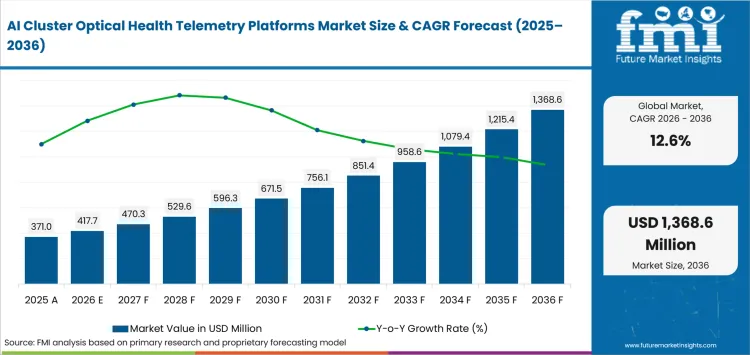
USD 417.7 Million in 2026 and USD 1368.6 Million by 2036 at a 12.6% CAGR.
AI Cluster Optical Health Telemetry Platforms revenue is projected to rise from USD 417.7 million in 2026 to USD 1368.6 million by 2036 at a 12.6% CAGR. Spending rises as AI operators move from periodic fiber qualification toward continuous link-health visibility across larger scale-out fabrics. The USA Department of Energy reported in December 2024 that data centers usage of electricity could reach 12.0% by 2028. That expansion does not define optical telemetry revenue by itself. It does increase the number and criticality of high-speed links that network teams must commission and maintain. Corning and VIAVI Solutions expanded AI-data-center connectivity and 800G assurance capabilities in 2025, reinforcing the operational need to connect optical condition with fault and path context before degraded links interrupt costly compute jobs.
Japan, South Korea, France and the UAE are expanding AI infrastructure through different routes. Japan’s June 2025 Watt-Bit initiative links telecom planning more closely with power availability, while South Korea has coupled GPU expansion with support for electricity supply and suitable sites. France used its February 2025 AI summit to announce more than EUR 109 billion in infrastructure investment, and the UAE followed in May with plans for a 1-gigawatt Stargate cluster within a 5-gigawatt AI campus. As these facilities move from announcement to deployment, the number of high-speed optical links that need continuous monitoring will rise. For telemetry vendors, the harder part will be turning signals from mixed optics and switches into clear fault and path-level decisions that fit existing network operations.
Key Takeaways
- 800G accounts for 38.0% of Link Speed demand in 2026. Its position reflects the shift of AI clusters toward higher-capacity fabrics where small changes in optical performance can have a greater effect on network stability.
- Topology & path optimization holds 26.0% of Software Function demand in 2026. Optical-health data becomes more useful when operators can see which route is affected and how that route connects to active workloads.
- Inter-rack / scale-out represents 36.0% of Deployment Location demand in 2026. As clusters spread across more racks, the number of optical links between compute and switching layers rises quickly, making continuous visibility more valuable.
- Hyperscale AI data centers account for 48.0% of Data Center Type demand in 2026. Large facilities have enough links and operational complexity to justify continuous monitoring instead of relying mainly on manual fault investigation.
- OEM direct captures 39.0% of Route to Market demand in 2026. Buyers often prefer suppliers that can provide validated device compatibility and maintain telemetry support as firmware or network configurations change.
- Mixed module standards still make deployment harder because telemetry platforms must interpret signals consistently across different optics and equipment. This creates room for systems that can move beyond alerting and help operators identify problems before they disrupt cluster performance.
- AP Sensing, EXFO, Corning and VIAVI Solutions are among the notable companies profiled in the market.
Analyst Perspective
"AI-cluster optical telemetry moves the value of optical test earlier in the operating cycle. The commercial advantage will come from platforms that correlate margin, BER or FEC behavior and physical path condition with the topology carrying GPU workloads. Interoperability across 400G, 800G and 1.6T environments will matter more than dashboard breadth alone."
- Sudip saha, Principal Consultant, Future Market Insights
How is the AI Cluster Optical Health Telemetry Platforms Market segmented?
The market is assessed by Link Speed, Software Function, Deployment Location, Data Center Type, Route to Market and Region.
The market is segmented by Link Speed into 800G, 400G, 1.6T, and 3.2T and above; by Software Function into Topology & Path Optimization, Link-Margin Analytics, Fault Localization, Power-Budget Automation, and Capacity Planning; by Deployment Location into Inter-Rack/Scale-Out, Intra-Rack/Scale-Up, Spine-Leaf Fabric, and Campus/DCI; by Data Center Type into Hyperscale AI Data Centers, Colocation AI Facilities, Enterprise AI/HPC, and Research/Sovereign Compute; and by Route to Market into OEM Direct, Network System Integrators, Fiber/Cabling Specialists, and Test & Managed-Service Providers.
Why do Hyperscale AI data centers lead the Data Center Type category?
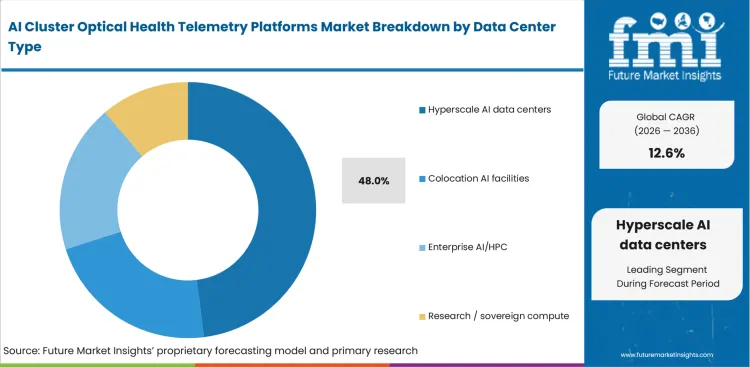
Hyperscale AI facilities concentrate large clusters and dense optical connectivity in environments where a localized network fault can affect expensive compute capacity. Automation economics improve when the same telemetry layer can watch many links and prioritize intervention. The operating estate includes high volumes of pluggable modules plus fiber paths and switch ports that change as clusters are expanded or reconfigured. AP Sensing positions its distributed fiber sensing software as a connected asset platform for continuous real-time infrastructure insights. That capability is adjacent to transceiver-level health, but it demonstrates the persistent-observation model that large facilities increasingly apply across critical infrastructure. Optical telemetry platforms bring that operating principle to the network fabric.
- Hyperscale AI data centers account for 48.0% of the Data Center Type category in 2026 because scale strengthens the economics of automated monitoring and fault prioritization.
- Continuous sensing and centralized analytics are already used across hyperscale infrastructure. The market opportunity for optical telemetry is to extend persistent visibility into the link layer and connect physical degradation with fabric-level service impact.
Why does 800G lead the Link Speed category?
800G sits at the current commercial transition between established 400G estates and emerging 1.6T designs. AI operators deploying 800G add more high-speed lanes and stricter optical budgets to already complex fabrics. Telemetry becomes useful when it can distinguish normal variation from degrading receive power, error behavior or module health before the link hard-fails. The operating context also overlaps with the broader optical transceivers ecosystem, where speed migration increases the number of device states and optical parameters that must be validated. VIAVI Solutions added an 800G module to its OneAdvisor 800 field platform in March 2025, while EXFO expanded 1.6T validation capability in April 2025. These actions show assurance tooling advancing alongside production AI link speeds.
- 800G accounts for 38.0% of the Link Speed category in 2026 because it combines broad current deployment relevance with demanding assurance requirements.
- VIAVI Solutions announced in March 2025 that OneAdvisor 800 gained an 800G transport module for field testing, while EXFO launched a 1.6T validation system in April 2025. These developments show diagnostic workflows progressing from current 800G operations toward the next link generation.
Why does Topology & path optimization lead the Software Function category?
Optical telemetry creates more value when a weak link is placed in the context of the route that carries a distributed workload. A raw power reading or error counter tells an operator that conditions changed. Topology context shows which GPUs, racks or interconnect paths are exposed and which alternate routes may be available. This makes telemetry complementary to coherent link software that manages path quality across high-capacity AI networks. NVIDIA stated in August 2025 that Spectrum-XGS combines end-to-end telemetry with distance-aware congestion control and precision latency management across distributed AI data centers. The announcement does not establish market share, but it illustrates why fabric-aware telemetry is moving closer to routing and path decisions as AI networks scale.
- Topology & path optimization accounts for 26.0% of the Software Function category in 2026 because it links physical optical condition to an actionable network decision.
- NVIDIA announced Spectrum-XGS in August 2025 with end-to-end telemetry and network controls for distributed AI data centers, demonstrating the strategic value of correlating health signals with network paths.
Why does Inter-rack / scale-out lead the Deployment Location category?
Inter-rack scale-out fabrics expose many optical paths between compute nodes and network tiers. Each rack addition can expand the set of fibers, transceivers and switch ports that operations teams must observe. This creates a different monitoring problem from a contained scale-up domain. Corning launched GlassWorks AI in March 2025 with high-density connectivity plus planning, design and deployment support, showing how fiber connectivity becomes a topology-management issue as rack density rises. Higher interconnect density raises the cost of manual fault isolation because a degraded path can sit among thousands of otherwise healthy links. Platforms therefore gain value by narrowing the suspect path before hands-on testing begins.
- Inter-rack / scale-out accounts for 36.0% of the Deployment Location category in 2026 because optical link counts grow rapidly as AI compute expands across racks.
- Corning launched GlassWorks AI in March 2025 with dense data-center fiber connectivity and deployment support. Its Contour Flow Cable is designed to increase fiber density without proportionally expanding cable diameter, illustrating the physical-path complexity that telemetry platforms must map.
Why does OEM direct lead the Route to Market category?
Optical health software must understand the switch, transceiver and fabric configuration that produces the telemetry. Direct OEM routes shorten the path to supported APIs, tested thresholds and software lifecycle coordination. This matters when buyers expect the platform to progress from observation to automated fault or path actions. Even where operators retain independent test equipment, OEM alignment can reduce the work needed to normalize module data and maintain validated baselines across firmware changes. Corning launched GlassWorks AI in March 2025 with high-density connectivity plus network planning, design and deployment support, illustrating how AI data-center buyers increasingly favor integrated infrastructure and engineering support rather than isolated components. Integrators and specialists remain important where estates are multi-vendor or heavily brownfield.
- OEM direct accounts for 39.0% of the Route to Market category in 2026 because buyers value validated integration with the fabric and optical architecture.
- The advantage of the direct route is operational supportability: device data, thresholds, configuration changes and software releases can be coordinated with fewer handoffs than in a fragmented multi-party deployment.
What are the drivers, restraints, and opportunities in the AI Cluster Optical Health Telemetry Platforms Market?
Dense AI scale-out fabrics increase demand for continuous optical visibility, mixed module and telemetry interfaces slow integration, and fabric-aware automation opens the next revenue pool.
- Driver: Larger AI fabrics make manual and siloed optical troubleshooting less economical.
- Restraint: Mixed module standards, vendor extensions and changing optical architectures increase normalization and validation work.
- Opportunity: Correlating optical condition with topology and workload impact can move platforms from monitoring toward preventive operations.
Dense AI fabrics make optical faults more expensive to diagnose. As fiber counts rise, operators have more links that can suffer from signal loss, contamination, routing issues or transceiver degradation. Telemetry platforms help narrow the problem before a technician starts physical testing by showing which link is deteriorating and how much of the cluster may be affected. Their value comes from reducing fault-isolation time and limiting avoidable loss of compute capacity.
Integration remains difficult because optical environments are only partly standardized. OIF’s CMIS Revision 5.4, published in May 2026, advances host-to-module management, but operators still run mixed estates of 400G, 800G and emerging 1.6T optics across different switch generations. A telemetry platform must read common signals consistently while retaining device-specific diagnostics. Coverage gaps across modules or unreliable baselines can therefore slow procurement.
The stronger opportunity lies in using optical telemetry before a link fails. NVIDIA’s Spectrum-XGS, announced in August 2025, combines end-to-end telemetry with network controls for distributed AI data centers. This points toward platforms that can connect optical margin and BER or FEC behavior with topology, identify a weakening path and recommend an operational response. Vendors that can do this inside the buyer’s existing NOC and orchestration environment are likely to have a clearer commercial role.
Which country CAGRs are profiled in the AI Cluster Optical Health Telemetry Platforms Market?
| Country | CAGR |
|---|---|
| USA | 13.4% |
| Japan | 13.8% |
| South Korea | 14.1% |
| France | 12.5% |
| Germany | 12.8% |
| UAE | 13.1% |
How do country-level CAGRs compare in the AI Cluster Optical Health Telemetry Platforms Market?
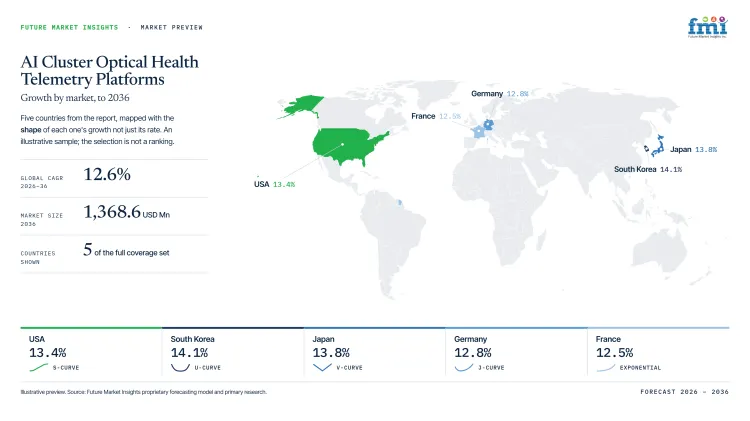
The countries span a 1.6 percentage-point range from South Korea at 14.1% to France at 12.5% CAGR between 2026 and 2036. South Korea leads at 14.1%, followed by Japan at 13.8%. USA follows at 13.4%, UAE is forecast at 13.1%, Germany at 12.8% and France at 12.5%. These figures describe forecast expansion rates and do not establish the absolute revenue ranking among countries.
- USA: A broad hyperscale and colocation estate supports recurring demand, while power-connection constraints and brownfield heterogeneity increase the value of device coverage and workflow integration.
- Japan: Watt-Bit coordination between electricity and telecom infrastructure encourages data-center planning that links site growth with network capacity and operational efficiency.
- South Korea: Accelerated GPU procurement and public support for electricity supply and site allocation strengthen the near-term pipeline for new AI clusters and associated network assurance.
- France: Large AI infrastructure commitments expand the addressable estate, although actual platform demand depends on the pace at which announced projects are energized and commissioned.
- Germany: Energy-efficiency and continuous measurement duties for data centers increase operational discipline, favoring telemetry that integrates into established monitoring rather than creating parallel consoles.
- UAE: Large greenfield AI campuses allow optical-health monitoring to be considered during architecture design, supporting scale-out visibility and secure OEM integration from the outset.
The wider regional assessment covers North America, Latin America, Western Europe, Eastern Europe, East Asia, South Asia and Pacific, and Middle East and Africa. Supplier prioritization should combine CAGR with installed base, project timing, architecture mix and the difficulty of instrumenting each local operating environment.
Country-wise Analysis
- USA: Demand is forecast to grow at 13.4% CAGR from 2026 to 2036. The USA already operates a large and power-intensive data-center base, with the Department of Energy estimating data centers used about 4.4% of national electricity in 2023. For telemetry vendors, the opportunity sits in helping operators manage mixed-generation infrastructure without disrupting established NOC workflows.
- Japan: The market is projected to expand at 13.8% CAGR through 2036. Japan’s June 2025 Watt-Bit initiative brings electricity and telecom planning closer together as AI infrastructure expands. That creates demand for platforms that can support capacity planning while fitting into local carrier and data-center operating environments.
- South Korea: Demand is expected to rise at 14.1% CAGR from 2026 to 2036. The country’s push to secure 18,000 high-performance GPUs by the first half of 2026 is being supported by measures around power supply and site availability. This gives telemetry suppliers a clearer route into new 800G and emerging 1.6T deployments.
- France: Sales are forecast to increase at 12.5% CAGR through 2036. More than EUR 109 billion in AI infrastructure investment was announced during the February 2025 AI Action Summit. As these projects move into operation, suppliers will need solutions that can scale from initial network acceptance to continuous optical-health monitoring.
- Germany: Demand is projected to grow at 12.8% CAGR from 2026 to 2036. Germany’s Energy Efficiency Act is raising operating and measurement requirements for data centers, increasing pressure to integrate monitoring more closely into existing infrastructure. Optical telemetry platforms that work within current operational systems should face fewer adoption barriers.
- UAE: Adoption is forecast to rise at 13.1% CAGR through 2036. Stargate UAE, announced in May 2025, is planned as a 1-gigawatt compute cluster within a 5-gigawatt UAE-US AI campus. Projects of this scale increase the need for continuous visibility across dense optical networks, particularly where secure integration and OEM interoperability are important.
Who are the notable companies in the AI Cluster Optical Health Telemetry Platforms Market?
AP Sensing, EXFO, Corning and VIAVI Solutions are the notable companies profiled in this market.
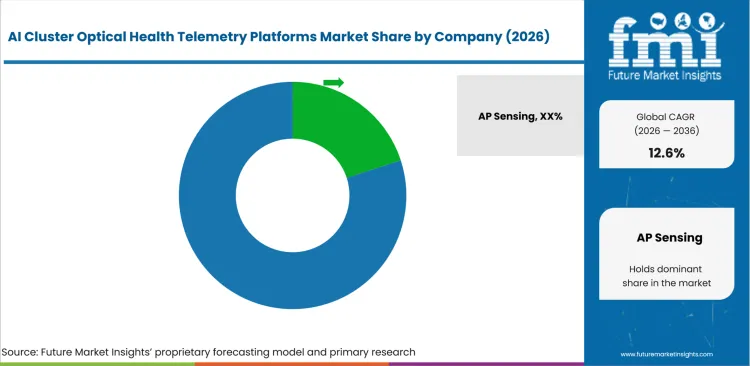
EXFO and VIAVI Solutions are positioned closest to the diagnostic side of the market, with capabilities covering high-speed optical validation, BER testing and assurance workflows at 800G and beyond. Corning approaches the market from the infrastructure side, where fiber architecture and deployment choices determine link density and physical routing. AP Sensing adds another layer through distributed fiber sensing and continuous asset monitoring. This means buyers are often comparing companies with different roles in the optical-health stack rather than choosing between directly interchangeable platforms.
- High-speed optical diagnostics and assurance: EXFO and VIAVI Solutions focus on link validation, BER analysis and high-speed testing that can support ongoing health monitoring.
- Fiber infrastructure and design integration: Corning contributes the cabling architecture, planning and deployment layer that defines the physical network being monitored.
- Distributed fiber sensing and asset telemetry: AP Sensing provides continuous sensing and analytics across fiber infrastructure, adding physical-path visibility to broader monitoring workflows.
Competitive Benchmarking: AI Cluster Optical Health Telemetry Platforms Market
The competitive benchmark reflects where each company participates in the optical-health workflow. EXFO and VIAVI Solutions are stronger in high-speed diagnostics, Corning in fiber infrastructure, and AP Sensing in continuous distributed sensing. The comparison focuses on operating role and documented capabilities rather than market share.
| Company | Observable Role | High-Speed Coverage | Continuous Monitoring | AI/Data-Center Relevance |
|---|---|---|---|---|
| AP Sensing | Distributed fiber sensing and asset analytics | Not positioned as BER tester | Continuous DFOS plus software analytics | Critical fiber infrastructure and data-center asset monitoring |
| EXFO | BER, optical and transceiver validation | 400G, 800G and 1.6T validation workflows | Test and assurance ecosystem | AI/data-center interconnect validation and manufacturing |
| Corning | Fiber architecture and deployment | Infrastructure and cabling rather than BER testing | Physical-layer inventory and design context | GlassWorks AI high-density data-center connectivity |
| VIAVI Solutions | Field and lab network assurance | 800G field testing plus broader high-speed portfolio | Monitoring and assurance workflows | Data-center interconnect and high-speed cloud networks |
Key Developments in the AI Cluster Optical Health Telemetry Platforms Market
- In March 2026, AP Sensing contributed its Distributed Fiber Optic Sensing technology to Germany’s Netz33 infrastructure project. The technology is intended to continuously monitor the physical fiber network and detect disturbances or unauthorized activity along fiber routes.
- In April 2025, EXFO introduced the BA-1600 Bit Analyzer for 1.6T testing and validation. The system supports 1.6T devices and provides BER testing alongside FEC analysis for high-speed AI and data-center interconnect environments.
- In March 2025, Corning launched GlassWorks AI solutions for AI data-center infrastructure. The portfolio combines high-density fiber connectivity with network planning, design and deployment support. It also introduced the Contour Flow Cable, which allows higher fiber density within existing cable diameters.
- In March 2025, VIAVI Solutions introduced an 800G transport module for its OneAdvisor 800 field-testing platform. The module supports network installation, turn-up and troubleshooting at speeds up to 800G, extending VIAVI’s field-assurance capabilities for high-capacity data-center and transport networks.
Key Players in the AI Cluster Optical Health Telemetry Platforms Market
High-Speed Optical Diagnostics and Assurance
- EXFO
- VIAVI Solutions
Fiber Infrastructure and Design Integration
- Corning
Distributed Fiber Sensing and Asset Telemetry
- AP Sensing
AI Cluster Optical Health Telemetry Platforms Market - Report Scope
| Coverage field | Report scope |
|---|---|
| Market breakdown | Link Speed, Software Function, Deployment Location, Data Center Type and Route to Market |
| Quantitative Units | USD Million |
| Market Definition | Revenue includes software licenses, subscriptions and directly tied software-enabled services used to monitor, analyze or optimize optical health across AI-cluster network links. It excludes transceiver, switch, fiber/cabling and finished AI system revenue, and excludes standalone test hardware when sold without the telemetry-platform function. |
| Regions Covered | North America; Latin America; Western Europe; Eastern Europe; East Asia; South Asia and Pacific; Middle East and Africa |
| Countries Covered | USA, Japan, South Korea, France, Germany, UAE and additional countries in the full report |
| Key Companies Profiled | AP Sensing, EXFO, Corning, VIAVI Solutions |
| Forecast Period | 2026 to 2036 |
| Approach | FMI applies hybrid bottom-up and top-down sizing using addressable deployments, platform function, pricing, adoption patterns and the defined revenue boundary. |
AI Cluster Optical Health Telemetry Platforms Market - Research Methodology
| Method component | Application to this market |
|---|---|
| Primary Research | Structured discussions with network equipment vendors, test and assurance suppliers, AI data-center operators, integrators and technical specialists. |
| Desk Research | Company filings and product documentation, government programs, standards bodies, technical documentation and infrastructure announcements. |
| Market Sizing and Forecasting | Deployment volumes, software and service penetration, link-speed migration, cluster buildout, monitoring intensity and route-to-market patterns are reconciled within the defined revenue boundary. |
| Data Validation | Primary and secondary inputs are triangulated across market boundary, country, segment and company-role assumptions before the forecast is finalized. |
AI Cluster Optical Health Telemetry Platforms Market by Segments
AI Cluster Optical Health Telemetry Platforms Market segmented by Link Speed:
- 800G
- 400G
- 1.6T
- 3.2T and above
AI Cluster Optical Health Telemetry Platforms Market segmented by Software Function:
- Topology & path optimization
- Link-margin analytics
- Fault localization
- Power-budget automation
- Capacity planning
AI Cluster Optical Health Telemetry Platforms Market segmented by Deployment Location:
- Inter-rack / scale-out
- Intra-rack / scale-up
- Spine-leaf fabric
- Campus / DCI
AI Cluster Optical Health Telemetry Platforms Market segmented by Data Center Type:
- Hyperscale AI data centers
- Colocation AI facilities
- Enterprise AI/HPC
- Research / sovereign compute
AI Cluster Optical Health Telemetry Platforms Market segmented by Route to Market:
- OEM direct
- Network system integrators
- Fiber/cabling specialists
- Test & managed-service providers
AI Cluster Optical Health Telemetry Platforms Market by Region:
- North America
- United States
- Canada
- Latin America
- Brazil
- Mexico
- Argentina
- Chile
- Western Europe
- Germany
- France
- United Kingdom
- Italy
- Spain
- Benelux
- Nordics
- Eastern Europe
- Poland
- Czech Republic
- Romania
- Hungary
- East Asia
- China
- Japan
- South Korea
- South Asia and Pacific
- India
- ASEAN
- Australia and New Zealand
- Middle East and Africa
- GCC Countries
- South Africa
- Türkiye
- Israel
Research Sources and Bibliography
- USA Department of Energy. (2024, December 20). DOE Releases New Report Evaluating Increase in Electricity Demand from Data Centers.
- Ministry of Economy, Trade and Industry, Japan. (2025, June 12). Report 1.0 of the Public-Private Advisory Council on Watt-Bit Collaboration Published.
- Ministry of Science and ICT, Republic of Korea. (2025, February 20). Korea to Expand AI Computing Infrastructure to Strengthen National AI Capabilities and Achieve Global Leadership.
- Élysée. (2025, February 11). Make France an AI powerhouse.
- Federal Ministry of Justice / Federal Office of Justice, Germany. (2023; accessed August 26, 2026). Energy Efficiency Act (EnEfG), Sections 11-12.
- Abu Dhabi Media Office. (2025, May 22). Global tech alliance launches Stargate UAE.
- OIF. (2026, May). Common Management Interface Specification (CMIS) Revision 5.4.
- NVIDIA. (2025, August 22). NVIDIA Introduces Spectrum-XGS Ethernet to Connect Distributed Data Centers Into Giga-Scale AI Super-Factories.
- Corning Incorporated. (2025, March 27). Corning Launches GlassWorks AI Solutions, a One-Stop Shop for AI Data Center Infrastructure Needs.
- VIAVI Solutions. (2025, March 18). VIAVI Adds 800G Module to the OneAdvisor 800 Family of Field Testers.
- EXFO. (2025, April 1). EXFO showcases industry’s first lab-to-fabric 1.6T test solution.
- AP Sensing. (2026, March 6). AP Sensing Contributes Fiber Optic Sensing Technology to Germany’s Netz33 Infrastructure Project.
- AP Sensing. (n.d.; accessed August 26, 2026). Software Solutions: Connected Asset Platform.
This bibliography is provided for reader reference and is not exhaustive. The full report contains the complete source list and detailed evidence used for market analysis.
This Report Answers
- How does denser AI scale-out networking change optical monitoring requirements?
- Why is 800G a central operating point for current telemetry platforms?
- How does topology context turn raw optical measurements into network decisions?
- What interoperability issues can slow deployment across mixed optics and switch estates?
- How do country infrastructure programs change platform adoption conditions?
- How do EXFO, VIAVI Solutions, Corning and AP Sensing occupy different layers of the optical-health workflow?
- What capabilities matter when selecting an AI-cluster optical health telemetry platform?
- How are 2025 and 2026 product developments shifting competitive positioning?
Frequently Asked Questions
How big is the AI Cluster Optical Health Telemetry Platforms Market in 2026?
The market is valued at USD 417.7 Million in 2026.
What is the forecast CAGR and 2036 value?
The market is forecast to expand at 12.6% CAGR from 2026 to 2036, reaching USD 1,368.6 Million by 2036.
Which Link Speed category leads in 2026?
800G leads the Link Speed category with a 38.0% share in 2026.
How much incremental market value is expected between 2026 and 2036?
The forecast implies USD 950.9 Million of incremental market value between 2026 and 2036.
Which companies are active in the AI Cluster Optical Health Telemetry Platforms Market?
The profiled companies are AP Sensing, EXFO, Corning and VIAVI Solutions, spanning distributed sensing, high-speed diagnostics and fiber infrastructure roles.
Preview the report firsthand - request a free sample
Get SampleGet the brochure for pricing and purchase details.
Get PDFTable of Content
- Key Takeaways
- Market Size and CAGR
- Top Growth Driver
- Fastest Growing Segment
- Leading Region
- Key Companies
- Emerging Opportunities
- Executive Summary
- Global Market Outlook
- Demand-side Trends
- Supply-side Trends
- Technology Roadmap Analysis
- Analysis and Recommendations
- Analyst Perspective (What is happening? Why now? What should investors know?)
- Key Questions Answered
- How large is the market?
- What is the CAGR?
- What are key trends?
- Which region dominates?
- Who are the leaders?
- Market Overview
- Market Coverage / Taxonomy
- Market Definition / Scope / Limitations
- Research Methodology
- Chapter Orientation
- Analytical Lens and Working Hypotheses
- Market Structure, Signals, and Trend Drivers
- Benchmarking and Cross-market Comparability
- Market Sizing, Forecasting, and Opportunity Mapping
- Research Design and Evidence Framework
- Desk Research Programme (Secondary Evidence)
- Expert Input and Fieldwork (Primary Evidence)
- Tooling, Models, and Reference Databases
- Data Engineering and Model Build
- Quality Assurance and Audit Trail
- Market Background
- Market Dynamics (Drivers, Restraints, Opportunity, Trends)
- Scenario Forecast (Optimistic, Likely, Conservative)
- Impact Analysis
- AI Impact
- Sustainability Impact
- Regulatory Impact
- Technology Impact
- Consumer / Buyer Analysis
- Purchase Drivers
- Adoption Barriers
- Buyer Journey
- Opportunity Map Analysis
- Product Life Cycle Analysis
- Supply Chain Analysis
- Investment Feasibility Matrix
- Value Chain Analysis
- PESTLE and Porter's Analysis
- Regulatory Landscape
- Regional Parent Market Outlook
- Production and Consumption Statistics
- Import and Export Statistics
- Global Market Analysis and Forecast, 2021 to 2036
- Historical Market Size Value (USD Million) Analysis, 2021 to 2025
- Current and Future Market Size Value (USD Million) Projections, 2026 to 2036
- Y-o-Y Growth Trend Analysis
- Absolute $ Opportunity Analysis
- Global Market Pricing Analysis, 2021 to 2036
- Global Market Analysis and Forecast, By Link Speed, 2021 to 2036
- Introduction / Key Findings
- Historical Market Size Value (USD Million) Analysis By Link Speed, 2021 to 2025
- Current and Future Market Size Value (USD Million) Analysis and Forecast By Link Speed, 2026 to 2036
- 800G
- 400G
- 1.6T
- 3.2T and above
- 800G
- Y-o-Y Growth Trend Analysis By Link Speed, 2021 to 2025
- Absolute $ Opportunity Analysis By Link Speed, 2026 to 2036
- Global Market Analysis and Forecast, By Software Function, 2021 to 2036
- Introduction / Key Findings
- Historical Market Size Value (USD Million) Analysis By Software Function, 2021 to 2025
- Current and Future Market Size Value (USD Million) Analysis and Forecast By Software Function, 2026 to 2036
- Topology & path optimization
- Link-margin analytics
- Fault localization
- Power-budget automation
- Capacity planning
- Topology & path optimization
- Y-o-Y Growth Trend Analysis By Software Function, 2021 to 2025
- Absolute $ Opportunity Analysis By Software Function, 2026 to 2036
- Global Market Analysis and Forecast, By Deployment Location, 2021 to 2036
- Introduction / Key Findings
- Historical Market Size Value (USD Million) Analysis By Deployment Location, 2021 to 2025
- Current and Future Market Size Value (USD Million) Analysis and Forecast By Deployment Location, 2026 to 2036
- Inter-rack / scale-out
- Intra-rack / scale-up
- Spine-leaf fabric
- Campus / DCI
- Inter-rack / scale-out
- Y-o-Y Growth Trend Analysis By Deployment Location, 2021 to 2025
- Absolute $ Opportunity Analysis By Deployment Location, 2026 to 2036
- Global Market Analysis and Forecast, By Data Center Type, 2021 to 2036
- Introduction / Key Findings
- Historical Market Size Value (USD Million) Analysis By Data Center Type, 2021 to 2025
- Current and Future Market Size Value (USD Million) Analysis and Forecast By Data Center Type, 2026 to 2036
- Hyperscale AI data centers
- Colocation AI facilities
- Enterprise AI/HPC
- Research / sovereign compute
- Hyperscale AI data centers
- Y-o-Y Growth Trend Analysis By Data Center Type, 2021 to 2025
- Absolute $ Opportunity Analysis By Data Center Type, 2026 to 2036
- Global Market Analysis and Forecast, By Route to Market, 2021 to 2036
- Introduction / Key Findings
- Historical Market Size Value (USD Million) Analysis By Route to Market, 2021 to 2025
- Current and Future Market Size Value (USD Million) Analysis and Forecast By Route to Market, 2026 to 2036
- OEM direct
- Network system integrators
- Fiber/cabling specialists
- Test & managed-service providers
- OEM direct
- Y-o-Y Growth Trend Analysis By Route to Market, 2021 to 2025
- Absolute $ Opportunity Analysis By Route to Market, 2026 to 2036
- Global Market Analysis and Forecast, By Region, 2021 to 2036
- Introduction
- Historical Market Size Value (USD Million) Analysis By Region, 2021 to 2025
- Current Market Size Value (USD Million) Analysis and Forecast By Region, 2026 to 2036
- North America
- Latin America
- Western Europe
- Eastern Europe
- East Asia
- South Asia and Pacific
- Middle East & Africa
- Market Attractiveness Analysis By Region
- North America Market Analysis and Forecast, By Country, 2021 to 2036
- Historical Market Size Value (USD Million) Trend Analysis By Market Taxonomy, 2021 to 2025
- Market Size Value (USD Million) Forecast By Market Taxonomy, 2026 to 2036
- By Country
- USA
- Canada
- By Link Speed
- By Software Function
- By Deployment Location
- By Data Center Type
- By Route to Market
- By Country
- Market Attractiveness Analysis
- By Country
- By Link Speed
- By Software Function
- By Deployment Location
- By Data Center Type
- By Route to Market
- Key Takeaways
- Latin America Market Analysis and Forecast, By Country
- Historical Market Size Value (USD Million) Trend Analysis By Market Taxonomy, 2021 to 2025
- Market Size Value (USD Million) Forecast By Market Taxonomy, 2026 to 2036
- By Country
- Brazil
- Mexico
- Chile
- Rest of Latin America
- By Link Speed
- By Software Function
- By Deployment Location
- By Data Center Type
- By Route to Market
- By Country
- Market Attractiveness Analysis
- By Country
- By Link Speed
- By Software Function
- By Deployment Location
- By Data Center Type
- By Route to Market
- Key Takeaways
- Western Europe Market Analysis and Forecast, By Country
- Historical Market Size Value (USD Million) Trend Analysis By Market Taxonomy, 2021 to 2025
- Market Size Value (USD Million) Forecast By Market Taxonomy, 2026 to 2036
- By Country
- Germany
- UK
- Italy
- Spain
- France
- Nordic
- BENELUX
- Rest of Western Europe
- By Link Speed
- By Software Function
- By Deployment Location
- By Data Center Type
- By Route to Market
- By Country
- Market Attractiveness Analysis
- By Country
- By Link Speed
- By Software Function
- By Deployment Location
- By Data Center Type
- By Route to Market
- Key Takeaways
- Eastern Europe Market Analysis and Forecast, By Country
- Historical Market Size Value (USD Million) Trend Analysis By Market Taxonomy, 2021 to 2025
- Market Size Value (USD Million) Forecast By Market Taxonomy, 2026 to 2036
- By Country
- Russia
- Poland
- Hungary
- Balkan & Baltic
- Rest of Eastern Europe
- By Link Speed
- By Software Function
- By Deployment Location
- By Data Center Type
- By Route to Market
- By Country
- Market Attractiveness Analysis
- By Country
- By Link Speed
- By Software Function
- By Deployment Location
- By Data Center Type
- By Route to Market
- Key Takeaways
- East Asia Market Analysis and Forecast, By Country
- Historical Market Size Value (USD Million) Trend Analysis By Market Taxonomy, 2021 to 2025
- Market Size Value (USD Million) Forecast By Market Taxonomy, 2026 to 2036
- By Country
- China
- Japan
- South Korea
- By Link Speed
- By Software Function
- By Deployment Location
- By Data Center Type
- By Route to Market
- By Country
- Market Attractiveness Analysis
- By Country
- By Link Speed
- By Software Function
- By Deployment Location
- By Data Center Type
- By Route to Market
- Key Takeaways
- South Asia and Pacific Market Analysis and Forecast, By Country
- Historical Market Size Value (USD Million) Trend Analysis By Market Taxonomy, 2021 to 2025
- Market Size Value (USD Million) Forecast By Market Taxonomy, 2026 to 2036
- By Country
- India
- ASEAN
- Australia & New Zealand
- Rest of South Asia and Pacific
- By Link Speed
- By Software Function
- By Deployment Location
- By Data Center Type
- By Route to Market
- By Country
- Market Attractiveness Analysis
- By Country
- By Link Speed
- By Software Function
- By Deployment Location
- By Data Center Type
- By Route to Market
- Key Takeaways
- Middle East & Africa Market Analysis and Forecast, By Country
- Historical Market Size Value (USD Million) Trend Analysis By Market Taxonomy, 2021 to 2025
- Market Size Value (USD Million) Forecast By Market Taxonomy, 2026 to 2036
- By Country
- Kingdom of Saudi Arabia
- Other GCC Countries
- Türkiye
- South Africa
- Other African Union
- Rest of Middle East & Africa
- By Link Speed
- By Software Function
- By Deployment Location
- By Data Center Type
- By Route to Market
- By Country
- Market Attractiveness Analysis
- By Country
- By Link Speed
- By Software Function
- By Deployment Location
- By Data Center Type
- By Route to Market
- Key Takeaways
- Key Countries Market Analysis
- USA
- Pricing Analysis
- Market Share Analysis, 2025
- By Link Speed
- By Software Function
- By Deployment Location
- By Data Center Type
- By Route to Market
- Canada
- Pricing Analysis
- Market Share Analysis, 2025
- By Link Speed
- By Software Function
- By Deployment Location
- By Data Center Type
- By Route to Market
- Mexico
- Pricing Analysis
- Market Share Analysis, 2025
- By Link Speed
- By Software Function
- By Deployment Location
- By Data Center Type
- By Route to Market
- Brazil
- Pricing Analysis
- Market Share Analysis, 2025
- By Link Speed
- By Software Function
- By Deployment Location
- By Data Center Type
- By Route to Market
- Chile
- Pricing Analysis
- Market Share Analysis, 2025
- By Link Speed
- By Software Function
- By Deployment Location
- By Data Center Type
- By Route to Market
- Germany
- Pricing Analysis
- Market Share Analysis, 2025
- By Link Speed
- By Software Function
- By Deployment Location
- By Data Center Type
- By Route to Market
- UK
- Pricing Analysis
- Market Share Analysis, 2025
- By Link Speed
- By Software Function
- By Deployment Location
- By Data Center Type
- By Route to Market
- Italy
- Pricing Analysis
- Market Share Analysis, 2025
- By Link Speed
- By Software Function
- By Deployment Location
- By Data Center Type
- By Route to Market
- Spain
- Pricing Analysis
- Market Share Analysis, 2025
- By Link Speed
- By Software Function
- By Deployment Location
- By Data Center Type
- By Route to Market
- France
- Pricing Analysis
- Market Share Analysis, 2025
- By Link Speed
- By Software Function
- By Deployment Location
- By Data Center Type
- By Route to Market
- India
- Pricing Analysis
- Market Share Analysis, 2025
- By Link Speed
- By Software Function
- By Deployment Location
- By Data Center Type
- By Route to Market
- ASEAN
- Pricing Analysis
- Market Share Analysis, 2025
- By Link Speed
- By Software Function
- By Deployment Location
- By Data Center Type
- By Route to Market
- Australia & New Zealand
- Pricing Analysis
- Market Share Analysis, 2025
- By Link Speed
- By Software Function
- By Deployment Location
- By Data Center Type
- By Route to Market
- China
- Pricing Analysis
- Market Share Analysis, 2025
- By Link Speed
- By Software Function
- By Deployment Location
- By Data Center Type
- By Route to Market
- Japan
- Pricing Analysis
- Market Share Analysis, 2025
- By Link Speed
- By Software Function
- By Deployment Location
- By Data Center Type
- By Route to Market
- South Korea
- Pricing Analysis
- Market Share Analysis, 2025
- By Link Speed
- By Software Function
- By Deployment Location
- By Data Center Type
- By Route to Market
- Russia
- Pricing Analysis
- Market Share Analysis, 2025
- By Link Speed
- By Software Function
- By Deployment Location
- By Data Center Type
- By Route to Market
- Poland
- Pricing Analysis
- Market Share Analysis, 2025
- By Link Speed
- By Software Function
- By Deployment Location
- By Data Center Type
- By Route to Market
- Hungary
- Pricing Analysis
- Market Share Analysis, 2025
- By Link Speed
- By Software Function
- By Deployment Location
- By Data Center Type
- By Route to Market
- Kingdom of Saudi Arabia
- Pricing Analysis
- Market Share Analysis, 2025
- By Link Speed
- By Software Function
- By Deployment Location
- By Data Center Type
- By Route to Market
- Türkiye
- Pricing Analysis
- Market Share Analysis, 2025
- By Link Speed
- By Software Function
- By Deployment Location
- By Data Center Type
- By Route to Market
- South Africa
- Pricing Analysis
- Market Share Analysis, 2025
- By Link Speed
- By Software Function
- By Deployment Location
- By Data Center Type
- By Route to Market
- USA
- Market Structure Analysis
- Competition Dashboard
- Competition Benchmarking
- Market Share Analysis of Top Players
- By Regional
- By Link Speed
- By Software Function
- By Deployment Location
- By Data Center Type
- By Route to Market
- Emerging Startups
- Innovation Benchmarking
- Competition Analysis
- Competition Deep Dive
- AP Sensing
- Overview
- Product Portfolio
- Profitability by Market Segments
- Sales Footprint
- Strategy Overview
- Marketing Strategy
- Product Strategy
- Channel Strategy
- EXFO
- Corning
- VIAVI Solutions
- AP Sensing
- Case Studies
- Success Stories
- Recent Developments
- Competition Deep Dive
- Assumptions & Acronyms Used


