

- Market Size (2026)
- USD 200.2 Mn
- Forecast (2036)
- USD 729.2 Mn
- CAGR (2026 to 2036)
- 13.8%
How big is AI Cluster Energy Attribution Platforms Market in 2026?
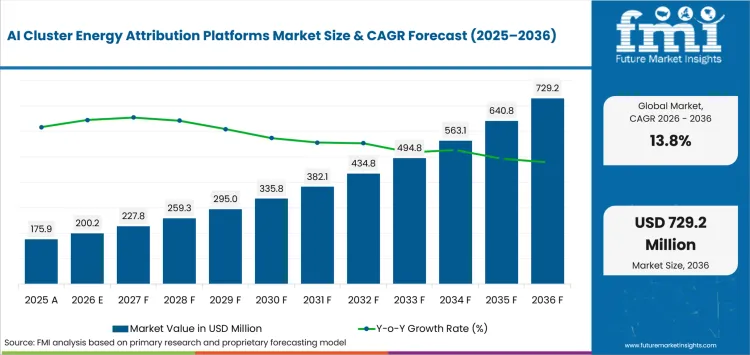
USD 200.2 million in 2026 and USD 729.2 million by 2036 at a 13.8% CAGR.
Demand in the AI cluster energy attribution platforms market is projected to increase value from USD 200.2 million in 2026 to USD 729.2 million by 2036 at 13.8% CAGR. Electricity availability now limits how quickly large GPU clusters can be added at many facilities. The IEA reported in April 2026 that global data-center electricity demand rose 17% during 2025. Rising electricity use raises the value of data center power records that can be assigned to racks or workloads before capacity is committed. Platforms that map BMS and EPMS signals to compute context give operators a defensible basis for capacity planning.
Country conditions change the conversion path from energy pressure to software spending. Lawrence Berkeley National Laboratory estimated in June 2026 that USA data centers could account for 11.8% of national electricity use by 2030. France and Germany pair capacity expansion with stronger energy-performance rules for large facilities. South Korea and Japan are building AI capacity under tighter power management planning. Attribution outputs must reconcile facility signals with rack or workload identifiers so local security and reporting requirements can accept the platform as an operating record.
Key Takeaways
- Electricity constraints are turning cluster-level energy allocation into an operating requirement as capacity planning increasingly depends on workload-specific power visibility.
- Monitoring & telemetry is set to lead the platform function with 27.0% share in 2026 due to its role as the trusted measurement layer for later attribution workflows.
- By deployment model, SaaS / public cloud is estimated to hold 38.0% in 2026 owing to centralized administration that reduces site-by-site software overhead.
- In 2026, 251-500 kW is expected to lead AI rack density with 32.0% share because operators are deploying beyond 200 kW-class rack architectures.
- Brownfield instrumentation gaps and inconsistent IT/OT identifiers lengthen integration by forcing every attributed energy value to remain traceable to its meter and asset hierarchy.
- Some of the key players in this market include Schneider Electric, AVEVA, Jacobs, Ansys, Siemens, Eaton, Phaidra, and Vertiv.
Analyst Perspective
"AI infrastructure owners should test rack-to-meter reconciliation and workload lineage before comparing license price. The platform earns wider scope once operators reuse the same attributed energy record for capacity release, cooling control and internal chargeback."
- Sudip saha, Principal Consultant, Future Market Insights
How is the AI Cluster Energy Attribution Platforms Market segmented?
Market segmentation covers platform function, deployment model, AI rack density, data center type and commercial model.
Functions include monitoring & telemetry, planning & simulation, optimization & control, fault / reliability analytics and reporting & governance. Deployment spans SaaS / public cloud, private cloud, on-premise and hybrid deployment. Rack bands are 251-500 kW, 100-250 kW, below 100 kW and above 500 kW. Data center types include hyperscale AI data centers, colocation AI facilities, enterprise private AI, HPC & research centers. Commercial models are direct enterprise contract, system integrator / EPC-led, subscription / license, managed-service contract.
How do AI infrastructure operators evaluate 251-500 kW within the AI rack density category?
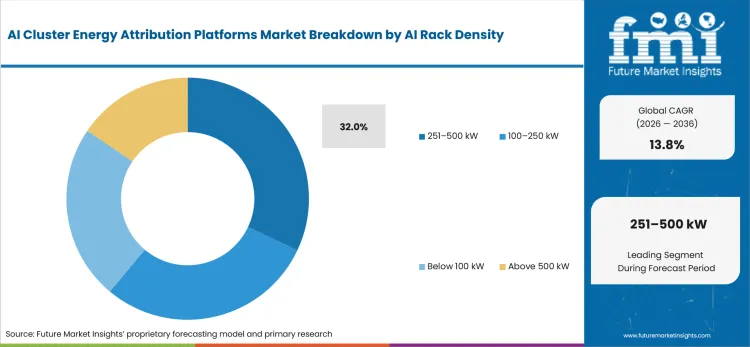
The 251-500 kW band covers the near-term step beyond current high-density racks without assuming immediate megawatt-class deployment. NVIDIA stated in May 2025 that 54 VDC distribution begins reaching physical limits above 200 kW, pushing rack power budgeting toward higher-voltage architectures for the next deployment cycle.
- The 251-500 kW segment is likely to capture 32.0% share in 2026 attributable to finer power allocation needs as rack-level electrical concentration rises.
- AI-factory designs in the 251-500 kW band require closer coordination between power distribution and liquid cooling as larger 800 VDC architectures become commercially routine in dense compute facilities.
What makes Monitoring & telemetry central to the Platform function category?
Monitoring & telemetry forms the measurement layer that assigns electrical use and power-quality monitoring records to racks or workload groups so planning tools can trust the result. AVEVA documented that operating model in March 2026 through PI System aggregation of BMS and EPMS telemetry within its NVIDIA Omniverse DSX work.
- Based on platform function, monitoring & telemetry is projected to account for 27.0% in 2026 due to traceable measurements that must precede simulation and control decisions.
- Hyperscale operators use monitoring & telemetry to reconcile rapid workload changes with facility measurements before scarce electrical capacity is reassigned between active compute clusters.
What supports demand for SaaS / public cloud within the Deployment Model category?
Multi-site AI estates favor centrally managed software since engineering teams need shared data models without deploying a new stack at every facility. The hosted model becomes harder to qualify if infrastructure management records contain sensitive operational data or local residency rules limit processing locations during cross-site engineering and validation.
- By deployment model, SaaS / public cloud is forecast to represent 38.0% in 2026 driven by centralized administration that reduces site-by-site software overhead.
- In May 2026, AVEVA expanded CONNECT integrations and introduced Customer-Hosted SaaS for distributed operations requiring private-network access plus strict data-sovereignty and enterprise security controls.
What role do Hyperscale AI data centers play within the Data center type category?
Hyperscale AI data centers concentrate many clusters behind shared electrical and data center liquid cooling systems, so attribution errors can distort both capacity and cost decisions. Jacobs released a gigawatt-scale data center digital twin in March 2026 that models compute with power and cooling from planning through operations.
- Hyperscale AI data centers are projected to hold 46.0% share in 2026 owing to the high cost of weak energy lineage at campus scale.
- Large campuses are expected to adopt hyperscale-focused platforms as owners use one model for design validation plus post-commissioning capacity and operating decisions in AI facilities.
What are the drivers, restraints and opportunities in the AI Cluster Energy Attribution Platforms Market?
Higher AI rack power raises demand for workload-level energy attribution, fragmented facility and compute identifiers slow validation and closed-loop control offers a path beyond monitoring.
- Driver: Fast-changing GPU loads make rack-to-workload energy visibility necessary for capacity allocation and power-system protection at high-density campuses.
- Restraint: Inconsistent meter, rack and scheduler identifiers can delay confidence as operators must trace each allocation back to a physical asset hierarchy.
- Opportunity: Platforms that feed trusted attribution into digital twins can extend from measurement into scenario planning, cooling control and reliability analysis.
AI Load Volatility Raises the Value of Granular Attribution
AI training clusters produce synchronized load changes that facility averages cannot identify at rack or workload level. The USA Department of Energy noted in May 2026 that conventional phasor measurements can miss higher-frequency oscillations produced by synchronized AI chips. Attribution platforms become commercially useful once they assign the event to compute groups and feed the result into data center energy storage dispatch or capacity decisions.
Identifier and Measurement Gaps Delay Validation
Different OT and IT identifiers increase integration friction by describing the same physical load with incompatible measurement conventions. The European Commission's July 2025 technical assessment found data-quality and completeness issues in the EU data-center reporting scheme and proposed improvements to reported information. Platform developers need meter-to-rack lineage so attributed values can support billing or governance despite brownfield sensor gaps and local security controls.
Closed-Loop Control Extends the Revenue Route
Control becomes an additional revenue route once operators trust the attribution model enough to act on its output. Salute announced a March 2026 partnership with Phaidra that integrates AI-driven controls with direct-to-chip liquid-cooling operations for high-density AI facilities. Platform developers can extend the same AI data-center cooling data layer into simulation and optimization once operating teams accept the attribution record.
Which country CAGRs are profiled in the AI Cluster Energy Attribution Platforms Market?
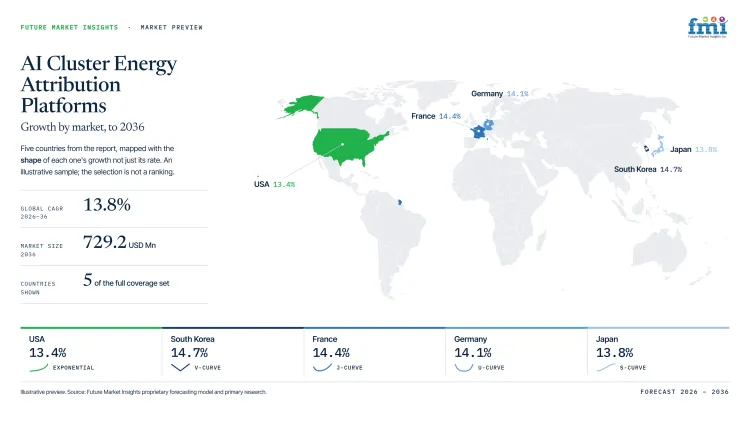
| Country | CAGR |
|---|---|
| South Korea | 14.7% |
| France | 14.4% |
| Germany | 14.1% |
| Japan | 13.8% |
| USA | 13.4% |
How do country-level CAGRs compare in the AI Cluster Energy Attribution Platforms Market?
The five countries span 1.3 percentage points from South Korea at 14.7% to USA at 13.4%. South Korea and France form the upper group as national AI programs meet constrained grid planning. Germany and Japan occupy the regulated middle band and USA records the lowest CAGR despite its larger installed base.
- National compute centers mix public and private workloads behind shared GPU estates.
- Low-carbon electricity shifts French attribution priorities toward capacity efficiency at new campuses.
- Frankfurt's colocation density raises retrofit pressure on legacy meter hierarchies from pre-AI rack designs.
- Metropolitan land constraints push Japanese operators toward capacity gains inside existing sites.
- USA hyperscaler fleets make cross-campus allocation consistency a separate software qualification test.
Forecast pace therefore does not indicate absolute contract value or addressable-site count. The full report provides country-level CAGR analysis across North America, Latin America, Europe, East Asia, South Asia, Oceania and the Middle East and Africa.
Country-wise Analysis
- South Korea is concentrating public AI capacity in national projects after the Ministry of Science and ICT set an 18,000-GPU target for first-half 2026 in February 2025. Adoption of AI cluster energy attribution platforms in South Korea is estimated to expand at 14.7% CAGR through 2036, because public-private compute programs require auditable power allocation as capacity scales. Seoul-region power constraints and data-governance requirements lengthen integration schedules, so platform developers need local engineering teams that map facility telemetry to cluster identifiers and preserve security controls during commissioning for sovereign research workloads and large commercial AI campuses with dense accelerator clusters.
- French AI data-center projects enter software planning through a national site pipeline, and grid connection timing determines the start of detailed electrical design. The Economy Ministry reported in January 2026 that project sponsors had secured 26 of 63 identified data-center sites, giving attribution developers a defined set of projects for early pre-commissioning engagement with campus engineering teams. AI cluster energy attribution platform sales in France are forecast to expand at 14.4% CAGR by 2036, tied to accelerated capacity planning despite long interconnection schedules that require early decisions on meter architecture and workload mapping before construction designs become difficult to change.
- German data-center operators plan against energy-efficiency rules and limited grid access, which increases the value of software that reconciles electrical performance with capacity use. Germany is estimated to post 14.1% CAGR over the forecast period, given the need to document efficient operation and manage scarce grid-connection capacity for large AI facilities. In June 2026, the Federal Ministry for Economic Affairs and Energy said a cabinet-backed draft would extend new-data-center PUE compliance transition from two years to four, but integration teams still need meter lineage that can coexist with existing black-start orchestration and energy controls during major operational changes and equipment upgrades.
- A tighter Japanese efficiency regime now puts IT-versus-facility energy separation into commissioning for new campuses and metropolitan retrofit sites with mixed electrical architectures. The Agency for Natural Resources and Energy stated in May 2026 that data centers opening from fiscal 2029 must reach PUE 1.3 or lower after their initial two-year period. The Japan AI cluster energy attribution platforms sector is projected to record 13.8% CAGR during the assessment period, reflecting demand for local integration coverage even though brownfield BMS interfaces and conservative change control can extend validation until attributed values enter routine operating and energy-performance records used by facility teams.
- USA AI campuses increasingly treat utility interconnection and on-site power availability as design constraints ahead of rack deployment, especially in regions with hyperscale projects competing against other large loads. In USA, AI cluster energy attribution platform demand is predicted to advance at 13.4% CAGR through 2036, since large fleets need one attribution model that survives different utility territories and site architectures. The Department of Energy's November 2025 update put potential new data-center demand at 130 GW by 2028, but long transmission queues and uneven brownfield instrumentation require site-specific integration so campus allocation results can support capital and operating decisions.
Who are the notable companies in the AI Cluster Energy Attribution Platforms Market?
Schneider Electric, AVEVA, Jacobs, Ansys, Siemens, Eaton, Phaidra, and Vertiv are the notable companies serving this market.
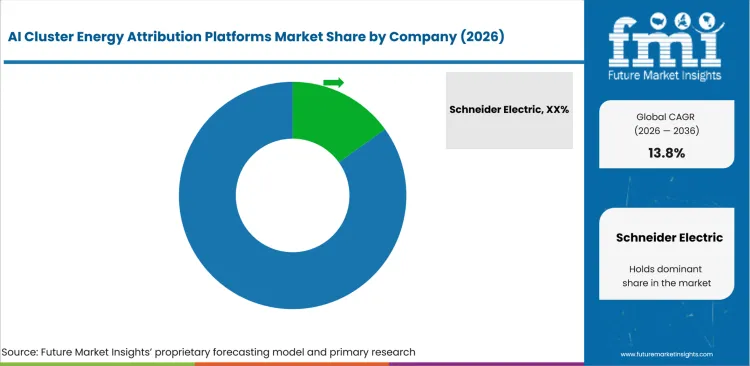
Competition is fragmented between energy-management groups, industrial software companies, engineering firms, simulation specialists and AI-control companies. Entry barriers depend on proving meter-to-workload lineage inside live AI infrastructure instead of company scale alone. Qualification becomes harder if companies cannot support maintenance digital workflows that keep asset mappings current through electrical or cooling equipment changes.
- Schneider Electric, AVEVA and Jacobs span energy modeling, operational telemetry and lifecycle engineering for AI-factory planning and operating workflows.
- Ansys, Siemens and Eaton cover physics-based simulation, electrical digital twins and power-quality analysis for high-density AI infrastructure.
- Phaidra and Vertiv focus on closed-loop infrastructure control and digitally validated deployment models for power-intensive AI facilities.
Competitive Benchmarking: AI Cluster Energy Attribution Platforms Market
| Company | Telemetry & Data-Lineage Integration | AI-factory Planning & Digital Twins | Energy / Reliability Optimization | Geographic Reach |
|---|---|---|---|---|
| Schneider Electric | High | High | High | Global |
| AVEVA | High | High | Medium | Global |
| Jacobs | Medium | High | Medium | Global |
| Ansys | Low | High | Medium | Global |
| Siemens | High | High | High | Global |
| Eaton | High | Medium | High | Global |
| Phaidra | High | Medium | High | North America, Europe and selected international deployments |
| Vertiv | Medium | High | High | Global |
Scoring basis: High telemetry integration requires documented OT or electrical data ingestion plus rack, asset or compute-context mapping. Medium indicates one documented integration path and Low identifies a documented narrower measurement role. High planning depth requires an AI-data-center digital twin spanning several infrastructure domains. Medium covers one simulation or design domain and Low identifies a documented narrower modeling role. High energy / reliability optimization requires active control or anomaly-response capability and Medium covers decision support with Low reserved for documented monitoring-only functions.
Key Developments in the AI Cluster Energy Attribution Platforms Market
- In July 2026, Vertiv deployed integrated power, liquid cooling and rack infrastructure for the Naval Postgraduate School's NVIDIA DGX GB300 environment.
- In June 2026, Siemens released a UL-aligned NVIDIA DSX Vera Rubin reference architecture covering utility connection, power distribution and centralized management for a 100 MW IT load.
- In September 2025, Eaton introduced an edge-based solution for detecting AI-driven power bursts and sudden load spikes in data centers, supporting improved resilience of data-center and grid infrastructure.
Key Players in the AI Cluster Energy Attribution Platforms Market
Energy and Operational Intelligence
- Schneider Electric
- AVEVA
- Jacobs
Engineering, Simulation and Digital-Twin Delivery
- Ansys
- Siemens
- Eaton
Power Quality and AI Infrastructure Control
- Phaidra
- Vertiv
AI Cluster Energy Attribution Platforms Market - Report Scope
| Coverage field | Report scope |
|---|---|
| Market breakdown | By platform function, deployment model, AI rack density, data center type, commercial model and region. |
| Quantitative Units | USD Million. |
| Market Definition | Software platforms and directly attached software-enabled services that measure, normalize, model, allocate, simulate, optimize or govern electricity use for AI compute clusters at workload, rack, row, cluster or facility-interface level. |
| Regions Covered | North America, Latin America, Western Europe, Eastern Europe, East Asia, South Asia and Pacific and Middle East and Africa. |
| Countries Covered | South Korea, France, Germany, Japan, USA, and 25+ additional countries included in the full report. |
| Key Companies Profiled | Schneider Electric, AVEVA, Jacobs, Ansys, Siemens, Eaton, Phaidra, and Vertiv. |
| Forecast Period | 2026 to 2036. |
| Approach | Primary and secondary research with market triangulation and direct scope validation. |
AI Cluster Energy Attribution Platforms Market - Research Methodology
| Method | Approach |
|---|---|
| Primary Research | FMI analysts gathered input from manufacturers, service providers, technology developers, distributors, end users, procurement teams, and subject-matter experts. Interviews examined purchasing decisions, product or service evaluation, adoption barriers, approval requirements, pricing considerations, and expectations for technical or commercial support. Respondents were also asked what evidence is required before a trial, pilot, or initial order develops into regular purchasing. |
| Desk Research | Desk research covered government statistics, regulatory publications, trade data, industry associations, technical literature, standards, company filings, product information, and official corporate announcements. Sources were reviewed for relevance, publication date, geographic coverage, and consistency with the defined market scope. Claims relating to performance, applications, approvals, capacity, investment, and commercial activity were retained only when supported by credible public evidence. |
| Market Sizing and Forecasting | The market model combined the baseline value with historical performance, segment structure, pricing and volume indicators, adoption levels, company participation, and country-level demand conditions. Forecast assumptions considered economic activity, investment trends, regulatory developments, technology adoption, purchasing cycles, supply availability, and barriers to wider market use. Segment and regional estimates were reconciled before the final market total was calculated. |
| Data Validation | Estimates were checked against multiple independent indicators, including public data, company activity, trade patterns, industry developments, and findings from primary interviews. Validation also tested whether products, services, applications, and company revenues fell within the defined market boundaries. Adjacent categories, unsupported claims, overlapping revenues, and activities without direct market relevance were excluded to reduce double counting and maintain consistency across segments and countries. |
AI Cluster Energy Attribution Platforms Market by Segments
AI Cluster Energy Attribution Platforms Market segmented by Platform Function:
- Monitoring & telemetry
- Planning & simulation
- Optimization & control
- Fault / reliability analytics
- Reporting & governance
AI Cluster Energy Attribution Platforms Market segmented by Deployment Model:
- SaaS / public cloud
- Private cloud
- On-premise
- Hybrid deployment
AI Cluster Energy Attribution Platforms Market segmented by AI Rack Density:
- 251-500 kW
- 100-250 kW
- Below 100 kW
- Above 500 kW
AI Cluster Energy Attribution Platforms Market segmented by Data Center Type:
- Hyperscale AI data centers
- Colocation AI facilities
- Enterprise private AI
- HPC & research centers
AI Cluster Energy Attribution Platforms Market segmented by Commercial Model:
- Direct enterprise contract
- System integrator / EPC-led
- Subscription / license
- Managed-service contract
AI Cluster Energy Attribution Platforms Market by Region:
- North America
- United States
- Canada
- Latin America
- Brazil
- Mexico
- Argentina
- Chile
- Western Europe
- Germany
- France
- United Kingdom
- Italy
- Spain
- Benelux
- Nordics
- Eastern Europe
- Poland
- Czech Republic
- Romania
- Hungary
- East Asia
- China
- Japan
- South Korea
- South Asia and Pacific
- India
- ASEAN
- Australia and New Zealand
- Middle East and Africa
- GCC Countries
- South Africa
- Türkiye
- Israel
Research Sources and Bibliography
- International Energy Agency. (2026, April 16). Data centre electricity use surged in 2025, even with tightening bottlenecks driving a scramble for solutions.
- Lawrence Berkeley National Laboratory. (2026, June). United States Data Center Energy Usage Report: 2025 Update.
- USA Department of Energy, Office of Electricity. (2026, May 28). Monitoring Oscillations from Large Data Centers.
- Directorate-General for Energy, European Commission. (2025, July 8). Assessment of the energy performance and sustainability of data centres in EU.
- Salute. (2026, March 12). Salute and Phaidra Partner to Deliver Industry-First Solution that Eliminates Key Obstacles to Scaling AI Computing.
- AVEVA. (2026, March 16). AVEVA develops a new lifecycle digital twin architecture that delivers industrial intelligence for gigawatt-scale AI Factories accelerated by NVIDIA.
- AVEVA. (2026, May 20). AVEVA announces new capabilities to embed AI across industrial organizations and data infrastructure at AVEVA World 2026.
- NVIDIA. (2025, May 20). NVIDIA 800 VDC Architecture Will Power the Next Generation of AI Factories.
- Jacobs. (2026, March 16). Jacobs releases digital twin solution for AI data centers.
- Ministry of Science and ICT, Republic of Korea. (2025, February 20). Korea to Expand AI Computing Infrastructure to Strengthen National AI Capabilities and Achieve Global Leadership.
- French Ministry of the Economy, Finance and Industrial and Digital Sovereignty. (2026, January 30). Rencontres des centres de données : la dynamique des projets d’infrastructures numériques se confirme.
- Federal Ministry for Economic Affairs and Energy, Germany. (2026, June 24). Vereinfachungen umgesetzt und Bürokratie reduziert - Bundeskabinett beschließt Energieeffizienzgesetz.
- Agency for Natural Resources and Energy, Japan. (2026, May 20).
- USA Department of Energy, Integrated Energy Systems Office. (2025, November 13). Smart Transmission Tools Modernize America’s Power Grid.
- Vertiv. (2026, July 23). Vertiv infrastructure helps bring NVIDIA AI computing capability to the Naval Postgraduate School.
- Siemens. (2026, June 1). Siemens and partners develop reference architecture purpose-built for NVIDIA AI data centers.
- Eaton. (2025, September 9). Eaton delivers edge-based innovation to help mitigate the impact of AI power bursting on both data centers and the grid.
- Schneider Electric. (2025, March 18). ETAP and Schneider Electric unveil digital twin to simulate AI Factory power requirements from grid to chip level using NVIDIA Omniverse.
- AVEVA. (2025, November 18). Schneider Electric, AVEVA, and ETAP join Alliance for OpenUSD to advance digital twins and 3D modeling for industries.
- Jacobs. (2026, May 12). Jacobs awarded EPCM contract to deliver second Hut 8 AI data center in Texas.
- Ansys. (2025, August 12). Ansys Announces Agreement to Offer Access to NVIDIA Omniverse Technology from within Simulation Solutions.
- Siemens. (2026, March 16). Engineering the AI Factory with Siemens and NVIDIA.
- Eaton. (2025, September 15). Eaton accelerates transformation of building and data center infrastructure with Autodesk to deliver AI-powered digital energy twin and software tools.
- Phaidra. (2026, March 16). Phaidra, CoreWeave and Applied Digital pioneer NVIDIA Max-Q AI factories with agentic liquid cooling management.
- Vertiv. (2026, June 1). Vertiv introduces Vertiv SmartRun digital twin.
- Schneider Electric. (2026, March 16). Schneider Electric teams with NVIDIA to develop validated blueprints to design, simulate, build, operate and maintain gigawatt-scale AI Factories.
- AVEVA. (2026, June 4). AVEVA Expands CONNECT in India with New AI Capabilities to Accelerate Industrial Intelligence.
- Phaidra. (2026, March 4). Phaidra launches AI platform to operate AI factories at scale.
- Vertiv. (2026, February 26). Vertiv industrializes AI deployment with digitally orchestrated infrastructure, collaborates with Hut 8 to scale.
- Eaton. (2025, October 13). Eaton unveils next-generation architecture to advance 800 VDC power infrastructure for AI factories.
This Report Answers
- What is the size of the AI cluster energy attribution platforms market in 2026 and what value is forecast for 2036?
- Which electricity and rack-density conditions are increasing demand for cluster-level energy attribution?
- Why does monitoring & telemetry hold the leading position within platform function?
- How does SaaS / public cloud influence enterprise deployment and cross-site use?
- Why does the 251-500 kW segment lead the AI rack density category?
- How do country growth rates differ among South Korea, France, Germany, Japan and USA?
- Which companies participate in telemetry, digital twins, power-quality analytics and AI infrastructure control?
- What integration and validation frictions can slow platform adoption?
- What should AI-infrastructure owners evaluate before selecting an energy-attribution platform?
Frequently Asked Questions
How big is the AI Cluster Energy Attribution Platforms Market in 2026?
The AI cluster energy attribution platforms market is valued at USD 200.2 million in 2026 and is projected to reach USD 729.2 million by 2036. Growth follows rising AI electricity intensity and stronger demand for workload-level power accountability.
What is the CAGR of the AI Cluster Energy Attribution Platforms Market from 2026 to 2036?
The AI cluster energy attribution platforms market is projected to grow at a CAGR of 13.8% between 2026 and 2036. Expansion is supported by higher rack density plus the need to reconcile facility energy records with compute activity.
Which platform function leads the AI Cluster Energy Attribution Platforms Market?
The monitoring & telemetry segment is expected to hold 27.0% of the AI cluster energy attribution platforms market in 2026, driven by traceable measurement requirements ahead of simulation or control. Its records assign facility energy use to racks or workloads early enough for teams to trust downstream planning outputs.
Which deployment model leads the AI Cluster Energy Attribution Platforms Market?
The SaaS / public cloud segment is expected to hold 38.0% of the AI cluster energy attribution platforms market in 2026, attributable to centralized administration for distributed engineering teams. Customer-hosted variants address security and data-sovereignty requirements that restrict some public-cloud deployments.
Which companies are active in the AI Cluster Energy Attribution Platforms Market?
Key companies operating in the AI cluster energy attribution platforms market include Schneider Electric, AVEVA, Jacobs, Ansys, Siemens, Eaton, Phaidra, and Vertiv. These companies compete through electrical modeling, operational telemetry, digital twins, power-quality analytics and closed-loop infrastructure control.
Preview the report firsthand - request a free sample
Get SampleGet the brochure for pricing and purchase details.
Get PDFTable of Content
- Key Takeaways
- Market Size and CAGR
- Top Growth Driver
- Fastest Growing Segment
- Leading Region
- Key Companies
- Emerging Opportunities
- Executive Summary
- Global Market Outlook
- Demand-side Trends
- Supply-side Trends
- Technology Roadmap Analysis
- Analysis and Recommendations
- Analyst Perspective (What is happening? Why now? What should investors know?)
- Key Questions Answered
- How large is the market?
- What is the CAGR?
- What are key trends?
- Which region dominates?
- Who are the leaders?
- Market Overview
- Market Coverage / Taxonomy
- Market Definition / Scope / Limitations
- Research Methodology
- Chapter Orientation
- Analytical Lens and Working Hypotheses
- Market Structure, Signals, and Trend Drivers
- Benchmarking and Cross-market Comparability
- Market Sizing, Forecasting, and Opportunity Mapping
- Research Design and Evidence Framework
- Desk Research Programme (Secondary Evidence)
- Expert Input and Fieldwork (Primary Evidence)
- Tooling, Models, and Reference Databases
- Data Engineering and Model Build
- Quality Assurance and Audit Trail
- Market Background
- Market Dynamics (Drivers, Restraints, Opportunity, Trends)
- Scenario Forecast (Optimistic, Likely, Conservative)
- Impact Analysis
- AI Impact
- Sustainability Impact
- Regulatory Impact
- Technology Impact
- Consumer / Buyer Analysis
- Purchase Drivers
- Adoption Barriers
- Buyer Journey
- Opportunity Map Analysis
- Product Life Cycle Analysis
- Supply Chain Analysis
- Investment Feasibility Matrix
- Value Chain Analysis
- PESTLE and Porter's Analysis
- Regulatory Landscape
- Regional Parent Market Outlook
- Production and Consumption Statistics
- Import and Export Statistics
- Global Market Analysis and Forecast, 2021 to 2036
- Historical Market Size Value (USD Million) Analysis, 2021 to 2025
- Current and Future Market Size Value (USD Million) Projections, 2026 to 2036
- Y-o-Y Growth Trend Analysis
- Absolute $ Opportunity Analysis
- Global Market Pricing Analysis, 2021 to 2036
- Global Market Analysis and Forecast, By Platform Function, 2021 to 2036
- Introduction / Key Findings
- Historical Market Size Value (USD Million) Analysis By Platform Function, 2021 to 2025
- Current and Future Market Size Value (USD Million) Analysis and Forecast By Platform Function, 2026 to 2036
- Monitoring & telemetry
- Planning & simulation
- Optimization & control
- Fault / reliability analytics
- Reporting & governance
- Monitoring & telemetry
- Y-o-Y Growth Trend Analysis By Platform Function, 2021 to 2025
- Absolute $ Opportunity Analysis By Platform Function, 2026 to 2036
- Global Market Analysis and Forecast, By Deployment Model, 2021 to 2036
- Introduction / Key Findings
- Historical Market Size Value (USD Million) Analysis By Deployment Model, 2021 to 2025
- Current and Future Market Size Value (USD Million) Analysis and Forecast By Deployment Model, 2026 to 2036
- SaaS / public cloud
- Private cloud
- On-premise
- Hybrid deployment
- SaaS / public cloud
- Y-o-Y Growth Trend Analysis By Deployment Model, 2021 to 2025
- Absolute $ Opportunity Analysis By Deployment Model, 2026 to 2036
- Global Market Analysis and Forecast, By AI Rack Density, 2021 to 2036
- Introduction / Key Findings
- Historical Market Size Value (USD Million) Analysis By AI Rack Density, 2021 to 2025
- Current and Future Market Size Value (USD Million) Analysis and Forecast By AI Rack Density, 2026 to 2036
- 251-500 kW
- 100-250 kW
- Below 100 kW
- Above 500 kW
- 251-500 kW
- Y-o-Y Growth Trend Analysis By AI Rack Density, 2021 to 2025
- Absolute $ Opportunity Analysis By AI Rack Density, 2026 to 2036
- Global Market Analysis and Forecast, By Data Center Type, 2021 to 2036
- Introduction / Key Findings
- Historical Market Size Value (USD Million) Analysis By Data Center Type, 2021 to 2025
- Current and Future Market Size Value (USD Million) Analysis and Forecast By Data Center Type, 2026 to 2036
- Hyperscale AI data centers
- Colocation AI facilities
- Enterprise private AI
- HPC & research centers
- Hyperscale AI data centers
- Y-o-Y Growth Trend Analysis By Data Center Type, 2021 to 2025
- Absolute $ Opportunity Analysis By Data Center Type, 2026 to 2036
- Global Market Analysis and Forecast, By Commercial Model, 2021 to 2036
- Introduction / Key Findings
- Historical Market Size Value (USD Million) Analysis By Commercial Model, 2021 to 2025
- Current and Future Market Size Value (USD Million) Analysis and Forecast By Commercial Model, 2026 to 2036
- Direct enterprise contract
- System integrator / EPC-led
- Subscription / license
- Managed-service contract
- Direct enterprise contract
- Y-o-Y Growth Trend Analysis By Commercial Model, 2021 to 2025
- Absolute $ Opportunity Analysis By Commercial Model, 2026 to 2036
- Global Market Analysis and Forecast, By Region, 2021 to 2036
- Introduction
- Historical Market Size Value (USD Million) Analysis By Region, 2021 to 2025
- Current Market Size Value (USD Million) Analysis and Forecast By Region, 2026 to 2036
- North America
- Latin America
- Western Europe
- Eastern Europe
- East Asia
- South Asia and Pacific
- Middle East & Africa
- Market Attractiveness Analysis By Region
- North America Market Analysis and Forecast, By Country, 2021 to 2036
- Historical Market Size Value (USD Million) Trend Analysis By Market Taxonomy, 2021 to 2025
- Market Size Value (USD Million) Forecast By Market Taxonomy, 2026 to 2036
- By Country
- USA
- Canada
- By Platform Function
- By Deployment Model
- By AI Rack Density
- By Data Center Type
- By Commercial Model
- By Country
- Market Attractiveness Analysis
- By Country
- By Platform Function
- By Deployment Model
- By AI Rack Density
- By Data Center Type
- By Commercial Model
- Key Takeaways
- Latin America Market Analysis and Forecast, By Country
- Historical Market Size Value (USD Million) Trend Analysis By Market Taxonomy, 2021 to 2025
- Market Size Value (USD Million) Forecast By Market Taxonomy, 2026 to 2036
- By Country
- Brazil
- Mexico
- Chile
- Rest of Latin America
- By Platform Function
- By Deployment Model
- By AI Rack Density
- By Data Center Type
- By Commercial Model
- By Country
- Market Attractiveness Analysis
- By Country
- By Platform Function
- By Deployment Model
- By AI Rack Density
- By Data Center Type
- By Commercial Model
- Key Takeaways
- Western Europe Market Analysis and Forecast, By Country
- Historical Market Size Value (USD Million) Trend Analysis By Market Taxonomy, 2021 to 2025
- Market Size Value (USD Million) Forecast By Market Taxonomy, 2026 to 2036
- By Country
- Germany
- UK
- Italy
- Spain
- France
- Nordic
- BENELUX
- Rest of Western Europe
- By Platform Function
- By Deployment Model
- By AI Rack Density
- By Data Center Type
- By Commercial Model
- By Country
- Market Attractiveness Analysis
- By Country
- By Platform Function
- By Deployment Model
- By AI Rack Density
- By Data Center Type
- By Commercial Model
- Key Takeaways
- Eastern Europe Market Analysis and Forecast, By Country
- Historical Market Size Value (USD Million) Trend Analysis By Market Taxonomy, 2021 to 2025
- Market Size Value (USD Million) Forecast By Market Taxonomy, 2026 to 2036
- By Country
- Russia
- Poland
- Hungary
- Balkan & Baltic
- Rest of Eastern Europe
- By Platform Function
- By Deployment Model
- By AI Rack Density
- By Data Center Type
- By Commercial Model
- By Country
- Market Attractiveness Analysis
- By Country
- By Platform Function
- By Deployment Model
- By AI Rack Density
- By Data Center Type
- By Commercial Model
- Key Takeaways
- East Asia Market Analysis and Forecast, By Country
- Historical Market Size Value (USD Million) Trend Analysis By Market Taxonomy, 2021 to 2025
- Market Size Value (USD Million) Forecast By Market Taxonomy, 2026 to 2036
- By Country
- China
- Japan
- South Korea
- By Platform Function
- By Deployment Model
- By AI Rack Density
- By Data Center Type
- By Commercial Model
- By Country
- Market Attractiveness Analysis
- By Country
- By Platform Function
- By Deployment Model
- By AI Rack Density
- By Data Center Type
- By Commercial Model
- Key Takeaways
- South Asia and Pacific Market Analysis and Forecast, By Country
- Historical Market Size Value (USD Million) Trend Analysis By Market Taxonomy, 2021 to 2025
- Market Size Value (USD Million) Forecast By Market Taxonomy, 2026 to 2036
- By Country
- India
- ASEAN
- Australia & New Zealand
- Rest of South Asia and Pacific
- By Platform Function
- By Deployment Model
- By AI Rack Density
- By Data Center Type
- By Commercial Model
- By Country
- Market Attractiveness Analysis
- By Country
- By Platform Function
- By Deployment Model
- By AI Rack Density
- By Data Center Type
- By Commercial Model
- Key Takeaways
- Middle East & Africa Market Analysis and Forecast, By Country
- Historical Market Size Value (USD Million) Trend Analysis By Market Taxonomy, 2021 to 2025
- Market Size Value (USD Million) Forecast By Market Taxonomy, 2026 to 2036
- By Country
- Kingdom of Saudi Arabia
- Other GCC Countries
- Türkiye
- South Africa
- Other African Union
- Rest of Middle East & Africa
- By Platform Function
- By Deployment Model
- By AI Rack Density
- By Data Center Type
- By Commercial Model
- By Country
- Market Attractiveness Analysis
- By Country
- By Platform Function
- By Deployment Model
- By AI Rack Density
- By Data Center Type
- By Commercial Model
- Key Takeaways
- Key Countries Market Analysis
- USA
- Pricing Analysis
- Market Share Analysis, 2025
- By Platform Function
- By Deployment Model
- By AI Rack Density
- By Data Center Type
- By Commercial Model
- Canada
- Pricing Analysis
- Market Share Analysis, 2025
- By Platform Function
- By Deployment Model
- By AI Rack Density
- By Data Center Type
- By Commercial Model
- Mexico
- Pricing Analysis
- Market Share Analysis, 2025
- By Platform Function
- By Deployment Model
- By AI Rack Density
- By Data Center Type
- By Commercial Model
- Brazil
- Pricing Analysis
- Market Share Analysis, 2025
- By Platform Function
- By Deployment Model
- By AI Rack Density
- By Data Center Type
- By Commercial Model
- Chile
- Pricing Analysis
- Market Share Analysis, 2025
- By Platform Function
- By Deployment Model
- By AI Rack Density
- By Data Center Type
- By Commercial Model
- Germany
- Pricing Analysis
- Market Share Analysis, 2025
- By Platform Function
- By Deployment Model
- By AI Rack Density
- By Data Center Type
- By Commercial Model
- UK
- Pricing Analysis
- Market Share Analysis, 2025
- By Platform Function
- By Deployment Model
- By AI Rack Density
- By Data Center Type
- By Commercial Model
- Italy
- Pricing Analysis
- Market Share Analysis, 2025
- By Platform Function
- By Deployment Model
- By AI Rack Density
- By Data Center Type
- By Commercial Model
- Spain
- Pricing Analysis
- Market Share Analysis, 2025
- By Platform Function
- By Deployment Model
- By AI Rack Density
- By Data Center Type
- By Commercial Model
- France
- Pricing Analysis
- Market Share Analysis, 2025
- By Platform Function
- By Deployment Model
- By AI Rack Density
- By Data Center Type
- By Commercial Model
- India
- Pricing Analysis
- Market Share Analysis, 2025
- By Platform Function
- By Deployment Model
- By AI Rack Density
- By Data Center Type
- By Commercial Model
- ASEAN
- Pricing Analysis
- Market Share Analysis, 2025
- By Platform Function
- By Deployment Model
- By AI Rack Density
- By Data Center Type
- By Commercial Model
- Australia & New Zealand
- Pricing Analysis
- Market Share Analysis, 2025
- By Platform Function
- By Deployment Model
- By AI Rack Density
- By Data Center Type
- By Commercial Model
- China
- Pricing Analysis
- Market Share Analysis, 2025
- By Platform Function
- By Deployment Model
- By AI Rack Density
- By Data Center Type
- By Commercial Model
- Japan
- Pricing Analysis
- Market Share Analysis, 2025
- By Platform Function
- By Deployment Model
- By AI Rack Density
- By Data Center Type
- By Commercial Model
- South Korea
- Pricing Analysis
- Market Share Analysis, 2025
- By Platform Function
- By Deployment Model
- By AI Rack Density
- By Data Center Type
- By Commercial Model
- Russia
- Pricing Analysis
- Market Share Analysis, 2025
- By Platform Function
- By Deployment Model
- By AI Rack Density
- By Data Center Type
- By Commercial Model
- Poland
- Pricing Analysis
- Market Share Analysis, 2025
- By Platform Function
- By Deployment Model
- By AI Rack Density
- By Data Center Type
- By Commercial Model
- Hungary
- Pricing Analysis
- Market Share Analysis, 2025
- By Platform Function
- By Deployment Model
- By AI Rack Density
- By Data Center Type
- By Commercial Model
- Kingdom of Saudi Arabia
- Pricing Analysis
- Market Share Analysis, 2025
- By Platform Function
- By Deployment Model
- By AI Rack Density
- By Data Center Type
- By Commercial Model
- Türkiye
- Pricing Analysis
- Market Share Analysis, 2025
- By Platform Function
- By Deployment Model
- By AI Rack Density
- By Data Center Type
- By Commercial Model
- South Africa
- Pricing Analysis
- Market Share Analysis, 2025
- By Platform Function
- By Deployment Model
- By AI Rack Density
- By Data Center Type
- By Commercial Model
- USA
- Market Structure Analysis
- Competition Dashboard
- Competition Benchmarking
- Market Share Analysis of Top Players
- By Regional
- By Platform Function
- By Deployment Model
- By AI Rack Density
- By Data Center Type
- By Commercial Model
- Emerging Startups
- Innovation Benchmarking
- Competition Analysis
- Competition Deep Dive
- Schneider Electric
- Overview
- Product Portfolio
- Profitability by Market Segments
- Sales Footprint
- Strategy Overview
- Marketing Strategy
- Product Strategy
- Channel Strategy
- AVEVA
- Jacobs
- Ansys
- Schneider Electric
- Case Studies
- Success Stories
- Recent Developments
- Competition Deep Dive
- Assumptions & Acronyms Used


