

- Market Size (2026)
- USD 315.6 Mn
- Forecast (2036)
- USD 1169.9 Mn
- CAGR (2026 to 2036)
- 14.0%
How big is AI Rack Maintenance Digital Workflows Market in 2026?
USD 315.6 Million in 2026 and USD 1,169.9 Million by 2036 at a 14.0% CAGR.
AI rack maintenance digital workflows are projected to expand from USD 315.6 Million in 2026 to USD 1,169.9 Million by 2036. The 14.0% CAGR reflects a harder maintenance problem because rising rack load ties compute availability to data-center power behavior. Berkeley Lab estimated in June 2026 that USA data centers could consume 11.8% of national electricity by 2030. Higher facility loads increase the cost of delayed fault isolation, so operators pay for software that turns rack telemetry into governed maintenance work.
Country conditions change the path from operating need to a signed workflow contract because power access and facility governance differ materially. The IEA documented in April 2026 that data-center electricity demand rose 17% during 2025 while grid connections and equipment supply tightened. Germany therefore places greater weight on auditable energy records while Japan and South Korea require software that fits power-planning constraints. France and Saudi Arabia offer earlier greenfield insertion points, although local approval and service coverage still govern deployment speed.
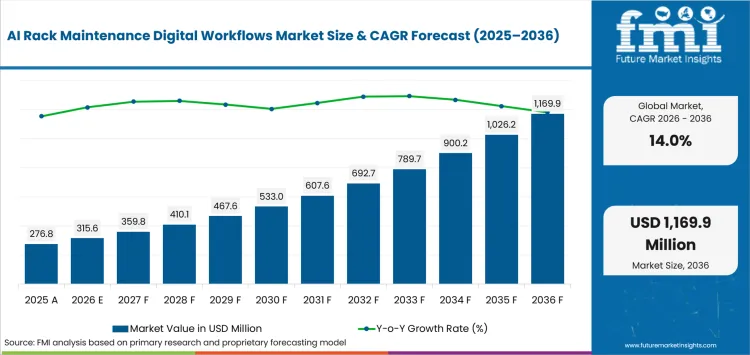
Key Takeaways
- AI rack density increases demand for continuous condition data as power and thermal faults now propagate quickly into compute availability.
- Based on platform function, monitoring & telemetry is projected to account for 27.0% in 2026 due to the need for a trusted history of rack conditions.
- By deployment model, SaaS - public cloud is estimated to hold 38.0% in 2026 owing to centralized software administration for distributed maintenance teams.
- In 2026, the 251-500 kW band is expected to lead AI rack density with 32.0% share because power and cooling dependencies enter routine maintenance.
- OT access controls and inconsistent asset records delay adoption since automation cannot outrun security review or unresolved equipment identities.
- Some of the key players in this market include Schneider Electric, Siemens, Vertiv, Sunbird Software, Freshworks Inc. (Device42), FNT Software, Hyperview, and Eaton.
Analyst Perspective
"Maintenance software should be judged by whether it preserves rack state and power dependencies between detection and technician action. The strongest offers reduce diagnosis time without weakening OT access control or forcing teams to rebuild asset records for every site."
- Sudip saha, Principal Consultant, Future Market Insights
How is the AI rack maintenance digital workflows market segmented?
Segments cover platform function, deployment model, AI rack density, data center type and commercial model.
Platform function: monitoring & telemetry, planning & simulation, optimization & control, fault / reliability analytics, reporting & governance. Deployment model: SaaS - public cloud, private cloud, on-premise, hybrid deployment. AI rack density: 251-500 kW, 100-250 kW, below 100 kW, above 500 kW. Data center type: hyperscale AI, colocation AI, enterprise private AI, HPC & research centers. Commercial model: direct enterprise contract, system integrator / EPC-led, subscription / license, managed-service contract.
What makes the 251-500 kW band central to the AI rack density category?
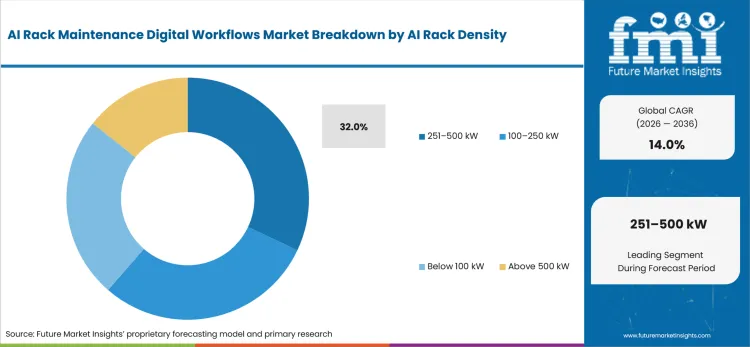
The 251-500 kW band requires electrical and liquid-cooling dependencies to be checked during routine rack work. Schneider Electric’s July 2026 Helios reference design reached 246 kW per rack with real-time monitoring and predictive maintenance.
- In 2026, the 251-500 kW band is expected to lead AI rack density with 32.0% share because power and cooling dependencies enter routine maintenance.
- Near-threshold designs make AI datacenter liquid cooling equipment a visible dependency during isolation and return to service. Digital workflows must preserve upstream power paths so technicians do not treat the rack as an independent asset during formal maintenance approval.
Why does monitoring & telemetry lead the platform function category?
Monitoring & telemetry gives maintenance teams a synchronized electrical and environmental record before a rack alarm becomes scheduled work. Eaton’s September 2025 firmware release extended edge analytics to detect AI power bursts inside data-center power distribution systems.
- Based on platform function, monitoring & telemetry is projected to account for 27.0% in 2026 due to the need for a trusted history of rack conditions.
- Technicians use data center liquid cooling telemetry to check CDU conditions during isolation planning for high-density equipment. Rack cooling manifolds belong in the same operating record because leak status changes safe maintenance sequencing and incident response.
Why does SaaS - public cloud lead the deployment model category?
SaaS - public cloud suits engineering groups that need one maintained application layer for several facilities without running a separate software stack at every site.
- By deployment model, SaaS - public cloud is estimated to hold 38.0% in 2026 owing to centralized software administration for distributed maintenance teams.
- Multi-site service teams need one live asset map so automation can schedule maintenance consistently. Freshworks stated in May 2026 that Device42 discovery was natively embedded in Freshservice with live asset views for cloud, on-premise and hybrid environments. That architecture keeps AI predictive maintenance service records comparable while local OT access rules remain under site control.
Why do hyperscale AI data centers lead the data center type category?
Hyperscale AI data centers standardize maintenance procedures as inconsistent asset records become costly when faults span large rack fleets and several halls.
- By data center type, hyperscale AI data centers are forecast to represent 46.0% in 2026 driven by the need for repeatable multi-site maintenance procedures.
- Large campuses need data center switchgear status tied to rack work during planned isolation. Siemens disclosed in June 2026 a 136 MW reference facility with 100 MW of IT load and Tier III concurrent maintainability. Liquid-cooled edge infrastructure uses smaller sites, but technicians still need shared power-path records as maintenance changes enter enterprise service systems.
What are the drivers, restraints and opportunities in the AI Rack Maintenance Digital Workflows Market?
Higher rack density increases maintenance demand while OT access controls delay integration, and predictive workflows offer the clearest path from telemetry to scheduled action.
- Driver: Higher rack power and cooling density raises the cost of late fault isolation during routine maintenance windows.
- Restraint: OT security controls and incomplete asset records extend integration work before software can trigger governed maintenance actions.
- Opportunity: Predictive models can rank maintenance work by operational consequence once trusted telemetry and simulation share the same asset context.
High-Density Racks Increase the Cost of Delayed Diagnosis
Higher rack power density raises the cost of late diagnosis as electrical and cooling faults can affect compute availability within a routine service window. Schneider Electric’s September 2025 reference designs paired data center power management with liquid-cooling controls for NVIDIA racks up to 142 kW. Maintenance teams therefore need one operating record that shows both dependencies during isolation and return-to-service decisions.
OT Access Controls Extend Integration Work
OT access approval delays software implementation whenever a maintenance platform lacks trusted equipment identity or ownership data. Joint August 2025 guidance hosted by Australia’s Cyber Security Centre requires OT inventories to preserve asset relationships and life-cycle records for maintenance work. Missing identities or unclear change authority slow integration while software is linked to automatic transfer switches and governed maintenance actions.
Predictive Workflows Convert Detection into Scheduled Action
Predictive maintenance earns budget once telemetry and simulation can rank work by operational consequence instead of producing another isolated alarm. Siemens stated in March 2026 that PhysicsX models can predict thermal behavior in data-center power systems in real time. Equipment maintenance solutions can route that ranked condition into service activity while human approval stays in place for safety-sensitive interventions around energized infrastructure.
Which country CAGRs are profiled in the AI Rack Maintenance Digital Workflows Market?
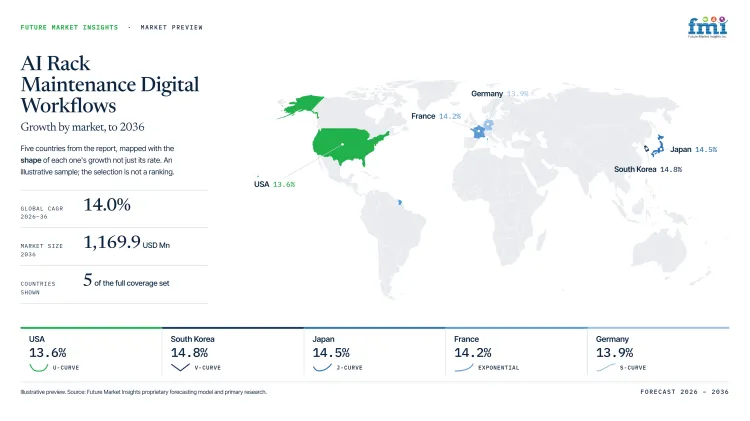
| Country | CAGR |
|---|---|
| Saudi Arabia | 15.2% |
| South Korea | 14.8% |
| Japan | 14.5% |
| France | 14.2% |
| Germany | 13.9% |
How do country-level CAGRs compare in the AI Rack Maintenance Digital Workflows Market?
The five profiled CAGRs span 1.3 percentage points from Germany at 13.9% to Saudi Arabia at 15.2%. Saudi Arabia and South Korea form the upper band as AI build cycles intensify power planning. Japan and France occupy the middle while Germany follows under heavier energy-reporting obligations during commercial entry planning.
- Saudi Arabia pairs rapid commissioning with requirements that favor repeatable maintenance procedures.
- South Korea requires power-aware deployment since AI loads enter national electricity forecasts.
- Japan depends on power coordination as data centers raise national peak-demand forecasts.
- France gains design-stage access to greenfield campuses but grid connections delay handoff.
- Germany carries reporting duties which raise the value of auditable rack telemetry.
Power access and reporting duties change deployment work, so comparable CAGRs produce different sales cycles.
The full report provides country-level CAGR analysis across North America, Latin America, Europe, East Asia, South Asia, Oceania and the Middle East and Africa.
Country-wise Analysis
- Saudi data-center operators are commissioning larger AI capacity while local service teams must keep asset naming consistent between new facilities and existing provider estates during rapid expansion. MCIT documented in April 2026 that operating capacity rose from 68 MW in 2021 to more than 440 MW in 2025 nationally. Demand for AI rack maintenance digital workflows is forecast to rise at 15.2% CAGR through 2036 owing to rapid commercial fleet expansion. The installed base gives integrators a direct route into repeatable maintenance procedures, but service distance and sector rules make engineering coverage more valuable than remote software during high-risk rack interventions.
- South Korean data-center projects enter power review early as concentrated AI loads compete for grid capacity during approval of new high-density halls. The 11th Basic Plan finalized by MOTIE in February 2025 explicitly included AI-driven data-center growth inside the national electricity-demand outlook. Grid concentration and siting approvals therefore remain a practical deployment constraint for large campus projects. In South Korea, demand for AI rack maintenance digital workflows is predicted to advance at 14.8% CAGR through 2036 tied to rapid infrastructure growth and stricter power planning. Companies with distributed deployment models can serve constrained sites more effectively when local engineers understand utility coordination and operating approval requirements.
- Japan’s data-center operators plan rack deployment around coordinated electricity capacity because dense computing loads can outgrow available infrastructure in major metropolitan clusters around Tokyo and Osaka. Adoption of AI rack maintenance digital workflows is estimated to expand at 14.5% CAGR through 2036 attributable to reliability requirements that favor approved electrical and cooling intervention sequences. OCCTO reported in August 2026 that data centers and semiconductor factories are lifting national peak-demand forecasts through 2035. Local engineering support is the main adoption enabler, yet constrained sites limit how quickly operators can standardize one workflow between facilities with different local power and communications conditions.
- French greenfield AI campuses give workflow companies an earlier insertion point because maintenance requirements can enter electrical and cooling design packages during early operating-procedure design. France’s economy ministry stated in May 2025 that four planned Paris-region data-center projects represent 584 MW of capacity. The evidence gives integrators a visible pipeline for design-stage workflow specification during final commissioning preparation inside active projects. Demand for AI rack maintenance digital workflows in France is forecast to rise at 14.2% CAGR over the forecast period driven by greenfield build activity. Grid connection timing can still delay operating handoff, so companies that stay involved from design review into commissioning have a practical advantage.
- German data-center operators must treat energy data as an auditable operating record, which raises the standard for telemetry quality inside maintenance software. Germany is estimated to post 13.9% CAGR over the forecast period given formal efficiency reporting and strong demand for private deployment paths in sensitive facilities. Umweltbundesamt documented in May 2025 that covered operators must enter annual energy-use and efficiency data in a central register. The reporting route gives telemetry integration a direct commercial purpose, but validation work increases when rack records do not map cleanly into facility reporting. Compared with France, Germany rewards vendors that can prove data lineage during final selection of expanded automation.
Who are the notable companies in the AI Rack Maintenance Digital Workflows Market?
Schneider Electric, Siemens, Vertiv, Sunbird Software, Freshworks Inc. (Device42), FNT Software, Hyperview and Eaton are the notable companies serving this market.
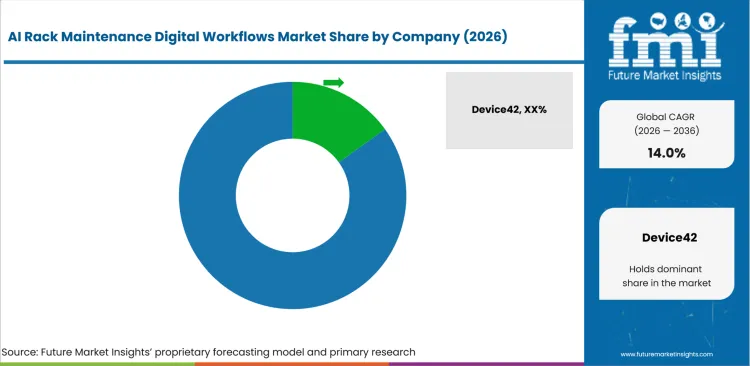
Competition divides between facility engineering platforms, rack-centric DCIM, infrastructure discovery and power-management specialists. Schneider Electric, Siemens and Vertiv enter from electrical or thermal infrastructure while Eaton brings power quality monitoring and electrical analytics. Sunbird Software, FNT Software and Hyperview compete closer to rack records plus operating models while Freshworks Inc. carries Device42 discovery into service workflows. Entry barriers center on trusted asset normalization and protected OT integration, with value proven only when live data reaches an approved maintenance action.
- Integrated facility platforms: Schneider Electric, Siemens, Vertiv and Eaton pair power or thermal infrastructure with monitoring, simulation and services.
- Rack operations platforms: Sunbird Software, FNT Software and Hyperview emphasize asset records, capacity planning, digital twins and operational integration.
- Infrastructure discovery: Freshworks Inc. uses Device42 to map hybrid infrastructure relationships into Freshservice workflows for service and change management.
Competitive Benchmarking: AI Rack Maintenance Digital Workflows Market
| Company | Rack Data Coverage | Planning & Twin Depth | Maintenance Workflow Depth | Geographic Reach |
|---|---|---|---|---|
| Schneider Electric | High | High | High | Global |
| Siemens | Medium | High | High | Global |
| Vertiv | High | High | High | Global |
| Sunbird Software | High | Medium | High | Worldwide |
| Freshworks Inc. (Device42) | Medium | Medium | High | Global |
| FNT Software | High | High | High | Europe, North America and Asia |
| Hyperview | High | High | Medium | North America and international |
| Eaton | High | High | High | Global |
Scoring basis: High rack-data coverage requires live asset records plus power or thermal conditions while Medium indicates narrower rack-state depth. High planning depth requires a live digital twin or scenario model tied to operating data while Medium covers capacity modeling. High workflow depth requires predictive or bidirectional maintenance integration while Medium identifies one documented action path. Ratings use official 2025-2026 company announcements and corporate disclosures matched to each rated capability.
Key Developments in the AI Rack Maintenance Digital Workflows Market
- In April 2025, Sunbird Software released dcTrack 9.2.3 with UniversalConnector G2 for bidirectional synchronization with ServiceNow and other infrastructure platforms.
- In January 2026, Vertiv launched Next Predict as a managed predictive-maintenance service spanning power and cooling systems in modern data centers.
- In September 2025, Eaton announced a collaboration with Autodesk that brought digital energy twin functions into building and data-center electrical workflows.
Key Players in the AI Rack Maintenance Digital Workflows Market
Integrated Facility Digital Platforms
- Schneider Electric
- Siemens
- Vertiv
Rack and Service Workflow Software
- Sunbird Software
- Freshworks Inc. (Device42)
- FNT Software
- Hyperview
Power Analytics and Digital Energy Twin Platforms
- Eaton
AI Rack Maintenance Digital Workflows Market - Report Scope
| Coverage field | Report scope |
|---|---|
| Market breakdown | By platform function, deployment model, AI rack density, data center type, commercial model and region. |
| Quantitative Units | USD Million. |
| Market Definition | Digital software workflows that collect, contextualize, simulate or act on AI rack condition data for maintenance planning and execution. |
| Regions Covered | North America, Latin America, Western Europe, Eastern Europe, East Asia, South Asia and Pacific and Middle East and Africa. |
| Countries Covered | Saudi Arabia, South Korea, Japan, France, Germany and 25+ additional countries included in the full report. |
| Key Companies Profiled | Schneider Electric, Siemens, Vertiv, Sunbird Software, Freshworks Inc. (Device42), FNT Software, Hyperview, Eaton. |
| Forecast Period | 2026 to 2036. |
| Approach | Primary and secondary research with market triangulation and country-level operating checks. |
AI Rack Maintenance Digital Workflows Market - Research Methodology
| Method | Approach |
|---|---|
| Primary Research | FMI analysts gathered input from manufacturers, service providers, technology developers, distributors, end users, procurement teams, and subject-matter experts. Interviews examined purchasing decisions, product or service evaluation, adoption barriers, approval requirements, pricing considerations, and expectations for technical or commercial support. Respondents were also asked what evidence is required before a trial, pilot, or initial order develops into regular purchasing. |
| Desk Research | Desk research covered government statistics, regulatory publications, trade data, industry associations, technical literature, standards, company filings, product information, and official corporate announcements. Sources were reviewed for relevance, publication date, geographic coverage, and consistency with the defined market scope. Claims relating to performance, applications, approvals, capacity, investment, and commercial activity were retained only when supported by credible public evidence. |
| Market Sizing and Forecasting | The market model combined the baseline value with historical performance, segment structure, pricing and volume indicators, adoption levels, company participation, and country-level demand conditions. Forecast assumptions considered economic activity, investment trends, regulatory developments, technology adoption, purchasing cycles, supply availability, and barriers to wider market use. Segment and regional estimates were reconciled before the final market total was calculated. |
| Data Validation | Estimates were checked against multiple independent indicators, including public data, company activity, trade patterns, industry developments, and findings from primary interviews. Validation also tested whether products, services, applications, and company revenues fell within the defined market boundaries. Adjacent categories, unsupported claims, overlapping revenues, and activities without direct market relevance were excluded to reduce double counting and maintain consistency across segments and countries. |
AI Rack Maintenance Digital Workflows Market by Segments
AI Rack Maintenance Digital Workflows Market segmented by Platform Function:
- Monitoring & telemetry
- Planning & simulation
- Optimization & control
- Fault / reliability analytics
- Reporting & governance
AI Rack Maintenance Digital Workflows Market segmented by Deployment Model:
- SaaS - public cloud
- Private cloud
- On-premise
- Hybrid deployment
AI Rack Maintenance Digital Workflows Market segmented by AI Rack Density:
- 251-500 kW
- 100-250 kW
- Below 100 kW
- Above 500 kW
AI Rack Maintenance Digital Workflows Market segmented by Data Center Type:
- Hyperscale AI data centers
- Colocation AI facilities
- Enterprise private AI
- HPC & research centers
AI Rack Maintenance Digital Workflows Market segmented by Commercial Model:
- Direct enterprise contract
- System integrator / EPC-led
- Subscription / license
- Managed-service contract
AI Rack Maintenance Digital Workflows Market by Region:
- North America
- United States
- Canada
- Latin America
- Brazil
- Mexico
- Argentina
- Chile
- Western Europe
- Germany
- France
- United Kingdom
- Italy
- Spain
- Benelux
- Nordics
- Eastern Europe
- Poland
- Czech Republic
- Romania
- Hungary
- East Asia
- China
- Japan
- South Korea
- South Asia and Pacific
- India
- ASEAN
- Australia and New Zealand
- Middle East and Africa
- GCC Countries
- South Africa
- Türkiye
- Israel
Research Sources and Bibliography
- Smith, S. J., Hubbard, A., Newkirk, A., Ganeshalingam, M., Holecek, B., Sartor, D. A., Mills, M., & Shehabi, A. (2026, June). United States Data Center Energy Usage Report: 2025 Update.
- International Energy Agency. (2026, April 16). Data centre electricity use surged in 2025, even with tightening bottlenecks driving a scramble for solutions.
- Eaton. (2025, September 9). Eaton delivers edge-based innovation to help mitigate the impact of AI power bursting on both data centers and the grid.
- Freshworks. (2026, May 13). Build the Future of AI-First Service.
- Schneider Electric. (2026, July 23). Schneider Electric and AMD release first Helios platform reference design to accelerate AI Factory deployment.
- Siemens. (2026, June 1). Siemens and partners develop reference architecture purpose-built for NVIDIA AI data centers.
- Schneider Electric. (2025, September 18). Schneider Electric Announces New Reference Designs, Featuring Integrated Power Management and Liquid Cooling Controls, Supporting NVIDIA Mission Control and NVIDIA GB300 NVL72.
- Australian Cyber Security Centre. (2025, August 14). Foundations for OT cybersecurity: Asset inventory guidance for owners and operators.
- Siemens. (2026, March 18). Siemens expands data center partner ecosystem to scale next-generation AI infrastructure.
- Umweltbundesamt. (2025, May). Aufbau eines Registers für Rechenzentren in Deutschland und Entwicklung eines Bewertungssystems für energieeffiziente Rechenzentren.
- Ministère de l’Économie, des Finances et de la Souveraineté industrielle, énergétique et numérique. (2025, May 21). IA : des investissements records annoncés lors du Sommet Choose France 2025.
- Organization for Cross-regional Coordination of Transmission Operators. (2026, August 6). Aggregation of Electricity Supply Plans for Fiscal Year 2026.
- Ministry of Trade, Industry and Energy, Republic of Korea. (2025, February 21).
- Ministry of Communications and Information Technology, Saudi Arabia. (2026, April 28). Saudi Arabia Strengthens Its Global Position in Artificial Intelligence Through Data Center Growth and Accelerated Smart Manufacturing.
- Sunbird Software. (2025, April 25). Sunbird dcTrack Release 9.2.3 Available Now.
- Vertiv. (2026, January 22). Vertiv announces new AI-powered predictive maintenance service for modern data centers and AI factories.
- Eaton. (2025, September 15). Eaton accelerates transformation of building and data center infrastructure with Autodesk to deliver AI-powered digital energy twin and software tools.
- Schneider Electric. (2025, March 18). ETAP and Schneider Electric Unveil World’s First Digital Twin to Simulate AI Factory Power Requirements from Grid to Chip Level Using NVIDIA Omniverse.
- Vertiv. (2025, April 22). iGenius Launches One of the World’s Largest Sovereign AI Data Centers Leveraging Vertiv Infrastructure, NVIDIA Accelerated Computing and Omniverse.
- FNT Software. (2025, April 28). AI-Powered Data Center Operations: FNT Software & DC Smarter Deepen Partnership.
- Siemens. (2026, January 6). Siemens unveils Digital Twin Composer.
- Sunbird Software. (2026, July 6). Now Available: dcTrack 9.3.5.
- Freshworks. (2025, February 5). Freshservice gets an ITAM boost with Device42.
- FNT Software. (2025, February 13). FNT Software Partners with Netcon Americas to Enhance IT, Data Center and Telecommunications Infrastructure Management.
- Smart Spatial. (2025, January 16). Smart Spatial and Hyperview Unite to Take Data Centers to the Next Level.
- Eaton. (2025, July 15). Eaton accelerates the transformation of data center infrastructure in the AI era with NVIDIA.
- Schneider Electric. (2026, March 16). Schneider Electric teams with NVIDIA to develop validated blueprints to design, simulate, build, operate and maintain gigawatt-scale AI Factories.
- Siemens. (2025, November 19). Siemens and Delta power solutions cut data center deployment time, costs, and carbon emissions.
- Vertiv. (2026, June 1). Vertiv Introduces First Converged Physical Infrastructure Digital Twin for NVIDIA Omniverse DSX.
- Sunbird Software. (2025, December 2). Introducing dcTrack 9.3.
This bibliography is provided for reader reference and is not exhaustive. The full report contains the complete reference list and detailed citations.
This Report Answers
- How large is the global Distributed Energy Resource Management System (DERMS) market in 2026?
- What CAGR is projected for the market through 2036?
- Why does the monitoring & telemetry segment hold the largest share of the market?
- Why does SaaS-based public cloud deployment account for the leading market share?
- Why does the 251-500 kW capacity band represent the largest segment in the market?
- How do market growth rates and adoption trends compare across key countries and regions?
- Which companies demonstrate proven capabilities in DERMS workflow orchestration, monitoring, and grid management?
- What technical, integration, cybersecurity, and operational challenges slow the deployment of OT-based workflows?
Frequently Asked Questions
How big is the AI Rack Maintenance Digital Workflows Market in 2026?
The AI rack maintenance digital workflows market is valued at USD 315.6 Million in 2026 and is projected to reach USD 1,169.9 Million by 2036. Higher rack density makes live condition data more useful during maintenance planning.
What is the CAGR of the AI Rack Maintenance Digital Workflows Market from 2026 to 2036?
The AI rack maintenance digital workflows market is projected to grow at a CAGR of 14.0% between 2026 and 2036. Higher rack loads increase the need for coordinated telemetry during maintenance work.
Which platform function leads the AI Rack Maintenance Digital Workflows Market?
The monitoring & telemetry segment is expected to hold 27.0% of the AI rack maintenance digital workflows market in 2026, driven by trusted rack-state data. Fault analysis and maintenance planning both depend on that trusted operating record.
Which data center type leads the AI Rack Maintenance Digital Workflows Market?
The hyperscale AI data centers segment is expected to hold 46.0% of the AI rack maintenance digital workflows market in 2026, supported by large rack fleets. Fleet scale rewards repeatable telemetry and consistent maintenance procedures between operating sites.
Which countries are projected to record the highest growth in the AI Rack Maintenance Digital Workflows Market?
Saudi Arabia is projected to grow at 15.2% CAGR, followed by South Korea at 14.8% and Japan at 14.5% through 2036. Faster AI infrastructure build cycles increase power-planning needs in all three countries.
Which companies are active in the AI Rack Maintenance Digital Workflows Market?
Key companies operating in the AI rack maintenance digital workflows market include Schneider Electric, Siemens, Vertiv, Sunbird Software, Freshworks Inc. (Device42), FNT Software, Hyperview, and Eaton. They span rack telemetry and digital twins with asset discovery plus integration.
Preview the report firsthand - request a free sample
Get SampleGet the brochure for pricing and purchase details.
Get PDFTable of Content
- Key Takeaways
- Market Size and CAGR
- Top Growth Driver
- Fastest Growing Segment
- Leading Region
- Key Companies
- Emerging Opportunities
- Executive Summary
- Global Market Outlook
- Demand-side Trends
- Supply-side Trends
- Technology Roadmap Analysis
- Analysis and Recommendations
- Analyst Perspective (What is happening? Why now? What should investors know?)
- Key Questions Answered
- How large is the market?
- What is the CAGR?
- What are key trends?
- Which region dominates?
- Who are the leaders?
- Market Overview
- Market Coverage / Taxonomy
- Market Definition / Scope / Limitations
- Research Methodology
- Chapter Orientation
- Analytical Lens and Working Hypotheses
- Market Structure, Signals, and Trend Drivers
- Benchmarking and Cross-market Comparability
- Market Sizing, Forecasting, and Opportunity Mapping
- Research Design and Evidence Framework
- Desk Research Programme (Secondary Evidence)
- Expert Input and Fieldwork (Primary Evidence)
- Tooling, Models, and Reference Databases
- Data Engineering and Model Build
- Quality Assurance and Audit Trail
- Market Background
- Market Dynamics (Drivers, Restraints, Opportunity, Trends)
- Scenario Forecast (Optimistic, Likely, Conservative)
- Impact Analysis
- AI Impact
- Sustainability Impact
- Regulatory Impact
- Technology Impact
- Consumer / Buyer Analysis
- Purchase Drivers
- Adoption Barriers
- Buyer Journey
- Opportunity Map Analysis
- Product Life Cycle Analysis
- Supply Chain Analysis
- Investment Feasibility Matrix
- Value Chain Analysis
- PESTLE and Porter's Analysis
- Regulatory Landscape
- Regional Parent Market Outlook
- Production and Consumption Statistics
- Import and Export Statistics
- Global Market Analysis and Forecast, 2021 to 2036
- Historical Market Size Value (USD Million) Analysis, 2021 to 2025
- Current and Future Market Size Value (USD Million) Projections, 2026 to 2036
- Y-o-Y Growth Trend Analysis
- Absolute $ Opportunity Analysis
- Global Market Pricing Analysis, 2021 to 2036
- Global Market Analysis and Forecast, By Platform Function, 2021 to 2036
- Introduction / Key Findings
- Historical Market Size Value (USD Million) Analysis By Platform Function, 2021 to 2025
- Current and Future Market Size Value (USD Million) Analysis and Forecast By Platform Function, 2026 to 2036
- Monitoring & telemetry
- Planning & simulation
- Optimization & control
- Fault / reliability analytics
- Reporting & governance
- Monitoring & telemetry
- Y-o-Y Growth Trend Analysis By Platform Function, 2021 to 2025
- Absolute $ Opportunity Analysis By Platform Function, 2026 to 2036
- Global Market Analysis and Forecast, By Deployment Model, 2021 to 2036
- Introduction / Key Findings
- Historical Market Size Value (USD Million) Analysis By Deployment Model, 2021 to 2025
- Current and Future Market Size Value (USD Million) Analysis and Forecast By Deployment Model, 2026 to 2036
- SaaS / public cloud
- Private cloud
- On-premise
- Hybrid deployment
- SaaS / public cloud
- Y-o-Y Growth Trend Analysis By Deployment Model, 2021 to 2025
- Absolute $ Opportunity Analysis By Deployment Model, 2026 to 2036
- Global Market Analysis and Forecast, By AI Rack Density, 2021 to 2036
- Introduction / Key Findings
- Historical Market Size Value (USD Million) Analysis By AI Rack Density, 2021 to 2025
- Current and Future Market Size Value (USD Million) Analysis and Forecast By AI Rack Density, 2026 to 2036
- 251-500 kW
- 100-250 kW
- Below 100 kW
- Above 500 kW
- 251-500 kW
- Y-o-Y Growth Trend Analysis By AI Rack Density, 2021 to 2025
- Absolute $ Opportunity Analysis By AI Rack Density, 2026 to 2036
- Global Market Analysis and Forecast, By Data Center Type, 2021 to 2036
- Introduction / Key Findings
- Historical Market Size Value (USD Million) Analysis By Data Center Type, 2021 to 2025
- Current and Future Market Size Value (USD Million) Analysis and Forecast By Data Center Type, 2026 to 2036
- Hyperscale AI data centers
- Colocation AI facilities
- Enterprise private AI
- HPC & research centers
- Hyperscale AI data centers
- Y-o-Y Growth Trend Analysis By Data Center Type, 2021 to 2025
- Absolute $ Opportunity Analysis By Data Center Type, 2026 to 2036
- Global Market Analysis and Forecast, By Commercial Model, 2021 to 2036
- Introduction / Key Findings
- Historical Market Size Value (USD Million) Analysis By Commercial Model, 2021 to 2025
- Current and Future Market Size Value (USD Million) Analysis and Forecast By Commercial Model, 2026 to 2036
- Direct enterprise contract
- System integrator / EPC-led
- Subscription / license
- Managed-service contract
- Direct enterprise contract
- Y-o-Y Growth Trend Analysis By Commercial Model, 2021 to 2025
- Absolute $ Opportunity Analysis By Commercial Model, 2026 to 2036
- Global Market Analysis and Forecast, By Region, 2021 to 2036
- Introduction
- Historical Market Size Value (USD Million) Analysis By Region, 2021 to 2025
- Current Market Size Value (USD Million) Analysis and Forecast By Region, 2026 to 2036
- North America
- Latin America
- Western Europe
- Eastern Europe
- East Asia
- South Asia and Pacific
- Middle East & Africa
- Market Attractiveness Analysis By Region
- North America Market Analysis and Forecast, By Country, 2021 to 2036
- Historical Market Size Value (USD Million) Trend Analysis By Market Taxonomy, 2021 to 2025
- Market Size Value (USD Million) Forecast By Market Taxonomy, 2026 to 2036
- By Country
- USA
- Canada
- By Platform Function
- By Deployment Model
- By AI Rack Density
- By Data Center Type
- By Commercial Model
- By Country
- Market Attractiveness Analysis
- By Country
- By Platform Function
- By Deployment Model
- By AI Rack Density
- By Data Center Type
- By Commercial Model
- Key Takeaways
- Latin America Market Analysis and Forecast, By Country
- Historical Market Size Value (USD Million) Trend Analysis By Market Taxonomy, 2021 to 2025
- Market Size Value (USD Million) Forecast By Market Taxonomy, 2026 to 2036
- By Country
- Brazil
- Mexico
- Chile
- Rest of Latin America
- By Platform Function
- By Deployment Model
- By AI Rack Density
- By Data Center Type
- By Commercial Model
- By Country
- Market Attractiveness Analysis
- By Country
- By Platform Function
- By Deployment Model
- By AI Rack Density
- By Data Center Type
- By Commercial Model
- Key Takeaways
- Western Europe Market Analysis and Forecast, By Country
- Historical Market Size Value (USD Million) Trend Analysis By Market Taxonomy, 2021 to 2025
- Market Size Value (USD Million) Forecast By Market Taxonomy, 2026 to 2036
- By Country
- Germany
- UK
- Italy
- Spain
- France
- Nordic
- BENELUX
- Rest of Western Europe
- By Platform Function
- By Deployment Model
- By AI Rack Density
- By Data Center Type
- By Commercial Model
- By Country
- Market Attractiveness Analysis
- By Country
- By Platform Function
- By Deployment Model
- By AI Rack Density
- By Data Center Type
- By Commercial Model
- Key Takeaways
- Eastern Europe Market Analysis and Forecast, By Country
- Historical Market Size Value (USD Million) Trend Analysis By Market Taxonomy, 2021 to 2025
- Market Size Value (USD Million) Forecast By Market Taxonomy, 2026 to 2036
- By Country
- Russia
- Poland
- Hungary
- Balkan & Baltic
- Rest of Eastern Europe
- By Platform Function
- By Deployment Model
- By AI Rack Density
- By Data Center Type
- By Commercial Model
- By Country
- Market Attractiveness Analysis
- By Country
- By Platform Function
- By Deployment Model
- By AI Rack Density
- By Data Center Type
- By Commercial Model
- Key Takeaways
- East Asia Market Analysis and Forecast, By Country
- Historical Market Size Value (USD Million) Trend Analysis By Market Taxonomy, 2021 to 2025
- Market Size Value (USD Million) Forecast By Market Taxonomy, 2026 to 2036
- By Country
- China
- Japan
- South Korea
- By Platform Function
- By Deployment Model
- By AI Rack Density
- By Data Center Type
- By Commercial Model
- By Country
- Market Attractiveness Analysis
- By Country
- By Platform Function
- By Deployment Model
- By AI Rack Density
- By Data Center Type
- By Commercial Model
- Key Takeaways
- South Asia and Pacific Market Analysis and Forecast, By Country
- Historical Market Size Value (USD Million) Trend Analysis By Market Taxonomy, 2021 to 2025
- Market Size Value (USD Million) Forecast By Market Taxonomy, 2026 to 2036
- By Country
- India
- ASEAN
- Australia & New Zealand
- Rest of South Asia and Pacific
- By Platform Function
- By Deployment Model
- By AI Rack Density
- By Data Center Type
- By Commercial Model
- By Country
- Market Attractiveness Analysis
- By Country
- By Platform Function
- By Deployment Model
- By AI Rack Density
- By Data Center Type
- By Commercial Model
- Key Takeaways
- Middle East & Africa Market Analysis and Forecast, By Country
- Historical Market Size Value (USD Million) Trend Analysis By Market Taxonomy, 2021 to 2025
- Market Size Value (USD Million) Forecast By Market Taxonomy, 2026 to 2036
- By Country
- Kingdom of Saudi Arabia
- Other GCC Countries
- Türkiye
- South Africa
- Other African Union
- Rest of Middle East & Africa
- By Platform Function
- By Deployment Model
- By AI Rack Density
- By Data Center Type
- By Commercial Model
- By Country
- Market Attractiveness Analysis
- By Country
- By Platform Function
- By Deployment Model
- By AI Rack Density
- By Data Center Type
- By Commercial Model
- Key Takeaways
- Key Countries Market Analysis
- USA
- Pricing Analysis
- Market Share Analysis, 2025
- By Platform Function
- By Deployment Model
- By AI Rack Density
- By Data Center Type
- By Commercial Model
- Canada
- Pricing Analysis
- Market Share Analysis, 2025
- By Platform Function
- By Deployment Model
- By AI Rack Density
- By Data Center Type
- By Commercial Model
- Mexico
- Pricing Analysis
- Market Share Analysis, 2025
- By Platform Function
- By Deployment Model
- By AI Rack Density
- By Data Center Type
- By Commercial Model
- Brazil
- Pricing Analysis
- Market Share Analysis, 2025
- By Platform Function
- By Deployment Model
- By AI Rack Density
- By Data Center Type
- By Commercial Model
- Chile
- Pricing Analysis
- Market Share Analysis, 2025
- By Platform Function
- By Deployment Model
- By AI Rack Density
- By Data Center Type
- By Commercial Model
- Germany
- Pricing Analysis
- Market Share Analysis, 2025
- By Platform Function
- By Deployment Model
- By AI Rack Density
- By Data Center Type
- By Commercial Model
- UK
- Pricing Analysis
- Market Share Analysis, 2025
- By Platform Function
- By Deployment Model
- By AI Rack Density
- By Data Center Type
- By Commercial Model
- Italy
- Pricing Analysis
- Market Share Analysis, 2025
- By Platform Function
- By Deployment Model
- By AI Rack Density
- By Data Center Type
- By Commercial Model
- Spain
- Pricing Analysis
- Market Share Analysis, 2025
- By Platform Function
- By Deployment Model
- By AI Rack Density
- By Data Center Type
- By Commercial Model
- France
- Pricing Analysis
- Market Share Analysis, 2025
- By Platform Function
- By Deployment Model
- By AI Rack Density
- By Data Center Type
- By Commercial Model
- India
- Pricing Analysis
- Market Share Analysis, 2025
- By Platform Function
- By Deployment Model
- By AI Rack Density
- By Data Center Type
- By Commercial Model
- ASEAN
- Pricing Analysis
- Market Share Analysis, 2025
- By Platform Function
- By Deployment Model
- By AI Rack Density
- By Data Center Type
- By Commercial Model
- Australia & New Zealand
- Pricing Analysis
- Market Share Analysis, 2025
- By Platform Function
- By Deployment Model
- By AI Rack Density
- By Data Center Type
- By Commercial Model
- China
- Pricing Analysis
- Market Share Analysis, 2025
- By Platform Function
- By Deployment Model
- By AI Rack Density
- By Data Center Type
- By Commercial Model
- Japan
- Pricing Analysis
- Market Share Analysis, 2025
- By Platform Function
- By Deployment Model
- By AI Rack Density
- By Data Center Type
- By Commercial Model
- South Korea
- Pricing Analysis
- Market Share Analysis, 2025
- By Platform Function
- By Deployment Model
- By AI Rack Density
- By Data Center Type
- By Commercial Model
- Russia
- Pricing Analysis
- Market Share Analysis, 2025
- By Platform Function
- By Deployment Model
- By AI Rack Density
- By Data Center Type
- By Commercial Model
- Poland
- Pricing Analysis
- Market Share Analysis, 2025
- By Platform Function
- By Deployment Model
- By AI Rack Density
- By Data Center Type
- By Commercial Model
- Hungary
- Pricing Analysis
- Market Share Analysis, 2025
- By Platform Function
- By Deployment Model
- By AI Rack Density
- By Data Center Type
- By Commercial Model
- Kingdom of Saudi Arabia
- Pricing Analysis
- Market Share Analysis, 2025
- By Platform Function
- By Deployment Model
- By AI Rack Density
- By Data Center Type
- By Commercial Model
- Türkiye
- Pricing Analysis
- Market Share Analysis, 2025
- By Platform Function
- By Deployment Model
- By AI Rack Density
- By Data Center Type
- By Commercial Model
- South Africa
- Pricing Analysis
- Market Share Analysis, 2025
- By Platform Function
- By Deployment Model
- By AI Rack Density
- By Data Center Type
- By Commercial Model
- USA
- Market Structure Analysis
- Competition Dashboard
- Competition Benchmarking
- Market Share Analysis of Top Players
- By Regional
- By Platform Function
- By Deployment Model
- By AI Rack Density
- By Data Center Type
- By Commercial Model
- Emerging Startups
- Innovation Benchmarking
- Competition Analysis
- Competition Deep Dive
- Device42
- Overview
- Product Portfolio
- Profitability by Market Segments
- Sales Footprint
- Strategy Overview
- Marketing Strategy
- Product Strategy
- Channel Strategy
- Siemens
- Sunbird Software
- Schneider Electric
- Device42
- Case Studies
- Success Stories
- Recent Developments
- Competition Deep Dive
- Assumptions & Acronyms Used


