

- Market Size (2026)
- USD 696.7 Mn
- Forecast (2036)
- USD 2144.6 Mn
- CAGR (2026 to 2036)
- 11.9%
How big is AI Data Center Localized Hotspot Cooling Systems Market in 2026?
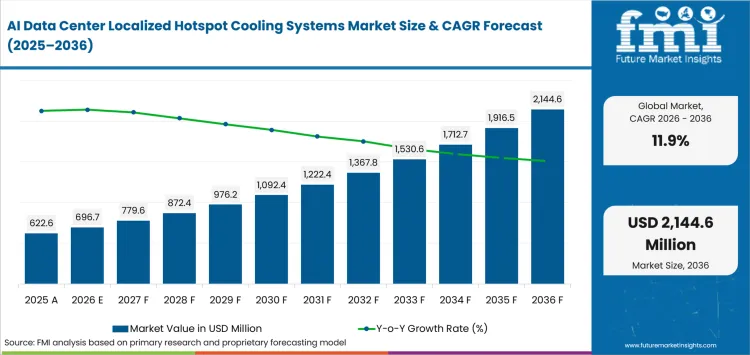
USD 696.7 million in 2026 and USD 2144.6 million by 2036 at an 11.9% CAGR.
Demand for AI data center localized hotspot cooling systems is projected to expand at 11.9% CAGR between 2026 and 2036, increasing valuation from USD 696.7 million in 2026 to USD 2144.6 million by 2036. AI rack densification is moving heat removal closer to processors, making cold plates, manifolds and coolant distribution units part of the initial infrastructure design rather than a later mechanical retrofit.
The USA Department of Energy reported in December 2024 that data centers consumed about 4.4% of USA electricity in 2023 and could account for roughly 6.7% to 12% by 2028. Higher compute power within constrained floor space raises the value of thermal designs that remove heat close to the chip while maintaining a controlled path to facility water or outdoor heat rejection.
Key Takeaways of AI Data Center Localized Hotspot Cooling Systems Market
- AI rack densification shifts thermal spending toward processor-level and rack-level liquid cooling systems that can be commissioned with the compute block.
- Direct-to-chip liquid cooling is projected at 44.0% share in 2026 because it removes heat at the processor while preserving conventional rack serviceability.
- Dry coolers are estimated at 29.0% of heat rejection / secondary loop demand in 2026 as warm-water loops increase the operating window for air-side heat rejection.
- The 251-500 kW rack-density band is forecast at 34.0% share in 2026 as rack and row cooling modules move into higher AI thermal loads.
- Multi-vendor interface ownership can delay qualification when cold plates, manifolds, CDUs and facility loops are specified separately.
- JetCool, nVent, Vertiv and Boyd Thermal by Eaton serve localized liquid-cooling requirements through different levels of rack integration and facility-loop coverage.
Analyst Perspective
"Localized cooling revenue will follow suppliers that can prove the complete heat path, not a single component rating. Buyers need known interfaces from the processor through the CDU and into heat rejection, with commissioning responsibility clear before AI racks arrive on site."
- Sudip Saha, Principal Consultant, Future Market Insights
How is the AI Data Center Localized Hotspot Cooling Systems Market segmented?
The market is segmented by cooling architecture, heat rejection / secondary loop, rack density, data center type, route to market and region.
Cooling architecture identifies where heat is captured. Heat rejection / secondary loop covers how that heat moves from the technology space to the facility or outdoor sink. Rack density separates deployments by concentrated thermal duty. Data center type reflects differences in scale and standardization, while route to market identifies the party carrying primary responsibility for specification and delivery.
Why does direct-to-chip liquid cooling lead the cooling architecture category?
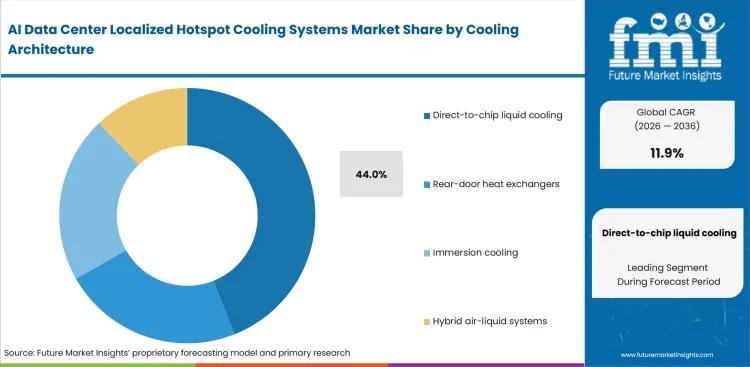
Direct-to-chip liquid cooling transfers heat from CPUs and GPUs into a controlled liquid loop before it spreads through the rack. The architecture fits conventional server and rack formats, which can reduce redesign compared with full immersion. The same engineering transition is visible across the broader liquid cooling market, where higher rack density is increasing the value of chip-level heat capture and defined coolant distribution.
- Based on cooling architecture, direct-to-chip liquid cooling is projected to account for 44.0% in 2026 because it addresses high heat flux at the processor while retaining familiar rack access.
- JetCool introduced its SmartSense CDU in April 2025 with up to 300 kW of cooling for one rack and more than 2 MW at row level when paired with its SmartPlate cold plates.
Why do dry coolers lead the heat rejection / secondary loop category?
Dry coolers become more useful when liquid-cooled racks operate with warmer water because a higher loop temperature increases the hours in which outdoor air can reject heat without heavy mechanical refrigeration. Chillers remain necessary where climate or coolant targets require lower temperatures, keeping data center chillers relevant to sites that cannot rely on dry heat rejection alone.
- Dry coolers are expected to lead the heat rejection / secondary loop category with 29.0% share in 2026 as warm-water loops increase the opportunity for air-side heat rejection.
- Vertiv introduced the CoolLoop Trim Cooler in March 2025 for liquid and hybrid AI cooling, combining free-cooling and mechanical modes within the downstream thermal chain.
Why does the 251-500 kW band lead the rack density category?
The 251-500 kW band captures a practical stage in AI rack densification. It exceeds the thermal duty associated with legacy air-cooled racks while remaining compatible with rack-level or adjacent-row coolant distribution equipment entering commercial portfolios. This aligns with the shift toward high-density racks where facility planning must account for concentrated power and cooling at the rack boundary.
- The 251-500 kW segment is likely to capture 34.0% share in 2026 because it aligns with current rack and row liquid-cooling modules used for dense AI loads.
- JetCool states that SmartSense can deliver up to 300 kW for a single rack, illustrating why modular rack-level systems fit this density band.
Why does hyperscale AI lead the data center type category?
Hyperscale AI facilities repeat similar accelerator racks across substantial capacity blocks, which makes dedicated fluid networks and standardized manifold layouts easier to justify than isolated retrofits. Large deployments also increase the importance of manufacturing capacity and repeatable rack distribution, including rack cooling manifolds that connect coolant distribution units to server-level cooling hardware.
- Hyperscale AI is forecast to account for 48.0% of data center type demand in 2026 because repeated rack designs support purpose-built cooling loops and standardized deployment.
- nVent announced another 160,000-square-foot liquid-cooling manufacturing site in Minnesota in July 2026, with production planned for the first half of 2027.
Why does cooling OEM direct lead the route to market category?
Localized hotspot cooling crosses several engineering interfaces. Buyers must align cold plates with rack manifolds and CDU pumps, then connect controls and fluid requirements to facility water and final heat rejection. Direct engagement with the cooling OEM can reduce handoffs while operating limits are still being defined and can clarify who owns commissioning support when the full thermal path is brought online.
- Cooling OEM direct is set to account for 36.0% share in 2026 because buyers need clear technical accountability across thermal design and control integration.
- Vertiv expanded its EMEA portfolio in May 2026 with the CoolChip CDU 2300 and fluid-network row manifolds positioned within an integrated thermal chain that also includes heat rejection and services.
What are the drivers, restraints and opportunities in the AI Data Center Localized Hotspot Cooling Systems Market?
AI rack densification is pulling heat removal closer to processors, while integration across several thermal interfaces can slow qualification and modular warm-water systems create a path to phased deployment.
- Driver: AI rack densification is shifting cooling spend toward direct liquid and hybrid hotspot architectures.
- Restraint: Qualification can slow when cold plates, manifolds, CDUs and facility-loop responsibilities are divided across several suppliers.
- Opportunity: Modular warm-water systems can support phased retrofits while reducing dependence on water-intensive heat rejection in suitable climates.
AI accelerator deployments concentrate more electrical power within each rack, increasing the thermal load that must be captured before it reaches room air. DOE-backed COOLERCHIPS work targets sharply lower cooling energy requirements and includes processor-level plus two-phase approaches, reinforcing the engineering case for cooling closer to the heat source as compute density rises.
Integration remains the principal commercial friction because the processor loop cannot be qualified in isolation from rack distribution and the facility sink. Buyers may compare direct-to-chip designs with immersion cooling, yet either route requires clear fluid limits and service responsibility. Retrofit sites face additional constraints where existing piping or planned downtime limits how quickly a localized system can be introduced.
The opportunity is strongest where modular systems let operators add cooling capacity in step with AI rack energization. Warm-water operation can extend free-cooling hours and reduce dependence on evaporative rejection in suitable climates. This is relevant to new AI campuses in the Middle East and to established sites where liquid-to-air or hybrid architectures can defer wider facility-water changes.
Which country CAGRs are included in the AI Data Center Localized Hotspot Cooling Systems Market?
| Country | CAGR |
|---|---|
| USA | 11.9% |
| South Korea | 12.9% |
| Japan | 13.2% |
| Saudi Arabia | 13.5% |
| UAE | 12.6% |
| France | 12.2% |
How do country-level CAGRs compare in the AI Data Center Localized Hotspot Cooling Systems Market?
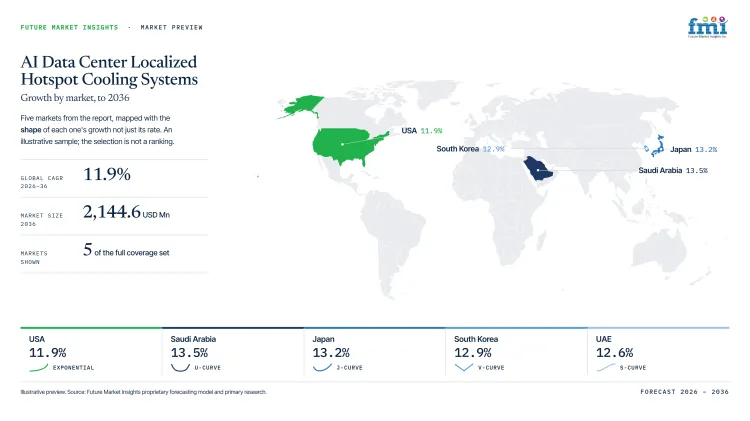
The six country CAGRs span 1.6 percentage points. The spacing reflects how quickly AI compute additions can convert into commissioned high-density rack load under different power, site and cooling conditions rather than the current size of each national market.
- Saudi Arabia is poised to record a 13.5% CAGR as expanding data center capacity creates opportunities to incorporate high-density cooling during the initial mechanical design stage.
- Japan is expected to register a 13.2% CAGR, with additional GPU cloud capacity increasing the need to accommodate dense computing within established site and utility constraints.
- At a 12.9% CAGR, South Korea is likely to see strong market expansion as public and private AI computing programs raise demand for modular cooling solutions alongside power and site approvals.
- The UAE market is forecast to advance at a 12.6% CAGR as large-scale AI campuses increasingly adopt standardized thermal architectures across repeated compute blocks.
- France is anticipated to grow at a 12.2% CAGR, supported by low-carbon electricity availability and data center investment, while gradual load increases favor modular approaches to cooling capacity.
- The USA is set to expand at an 11.9% CAGR as new AI data center projects generate additional demand, while the existing installed base maintains the importance of retrofit-compatible cooling solutions.
Similar growth rates can lead to different purchasing conditions. The full report provides country-level analysis across North America, Latin America, Western Europe, Eastern Europe, East Asia, South Asia and Pacific, and the Middle East and Africa.
Country-wise Analysis
- USA operators combine new AI campuses with an extensive installed base that makes retrofit compatibility commercially important. The USA market is set to expand at 11.9% CAGR through 2036. DOE reported that data centers used about 4.4% of USA electricity in 2023 and could reach roughly 6.7% to 12% by 2028. Suppliers need rack-level modules and commissioning plans that fit existing facility-water and mechanical arrangements.
- South Korea is likely to grow at 12.9% CAGR through 2036 as the country expands AI compute infrastructure. In February 2025, the Ministry of Science and ICT said the government aimed to secure 18,000 high-performance GPUs by the first half of 2026 while improving support related to power supply and site allocation. Cooling suppliers benefit when fluid-network requirements are defined before equipment installation.
- Japan is anticipated to expand at 13.2% CAGR through 2036 as cloud programs add GPU resources used for AI computation. METI approved support plans in April 2024 for stable cloud-program supply, including GPU cloud services. Localized systems must fit established facility constraints without extending commissioning schedules, which favors compact CDUs with documented coolant limits.
- Saudi Arabia is set to grow at 13.5% CAGR through 2036 as data center capacity continues to expand. The Ministry of Communications and Information Technology reported on August 18, 2026 that operational capacity had increased to more than 467 MW in the first quarter of 2026 from 68 MW in 2021. High ambient temperatures keep heat rejection and water strategy central to system selection.
- UAE demand is expected to rise at 12.6% CAGR through 2036 as large AI campuses create repeatable cooling blocks. Abu Dhabi announced Stargate UAE in May 2025 as a 1 GW compute cluster with an initial 200 MW AI cluster expected to go live in 2026. Closed-loop liquid systems paired with efficient heat rejection suit projects where water and thermal planning are established at campus scale.
- France is set to expand at 12.2% CAGR through 2036. RTE reported 770 MW of dedicated-site data center connection capacity at the end of 2025 and noted that new facilities typically ramp electricity use gradually after connection. Modular cooling blocks can follow rack energization and help preserve operating efficiency before sites reach their planned load.
Who are the notable companies in the AI Data Center Localized Hotspot Cooling Systems Market?
JetCool, nVent, Vertiv and Boyd Thermal by Eaton are the notable companies serving the AI data center localized hotspot cooling systems market.
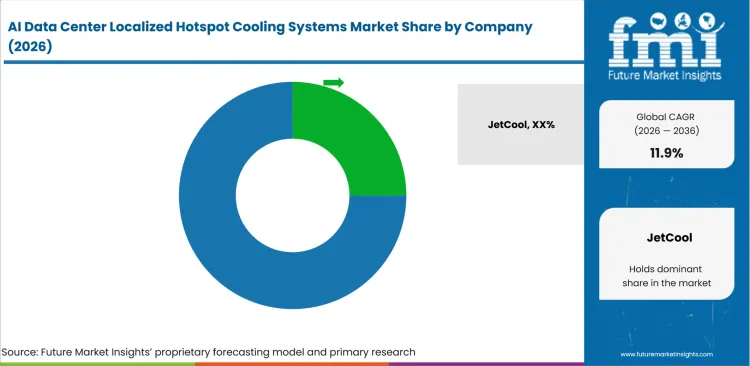
Competition separates into processor-to-rack specialists and suppliers that extend farther into facility heat rejection. JetCool focuses on direct-to-chip hotspot removal with rack-level coolant distribution and Flex-backed deployment support. nVent combines CDUs with rack and row liquid distribution. Vertiv spans direct liquid cooling through secondary-loop heat rejection and service infrastructure. Boyd Thermal by Eaton adds cold plates, liquid loops and CDUs to a wider power-management portfolio.
- JetCool and nVent compete around processor heat capture, rack manifolds and coolant distribution for dense AI equipment.
- Vertiv connects rack-level liquid cooling with facility-loop equipment, controls and service support across data center projects.
- Boyd Thermal by Eaton combines component engineering with packaged liquid-cooling systems and manufacturing across several regions.
Competitive Benchmarking: AI Data Center Localized Hotspot Cooling Systems Market
| Company | Processor-to-Rack Liquid Cooling | Heat-Rejection and Facility-Loop Breadth | Deployment and Lifecycle Support | Geographic Reach |
|---|---|---|---|---|
| JetCool | High | Medium | High | North America with wider manufacturing and deployment support through Flex |
| nVent | High | High | Medium | North America, Europe and Asia-Pacific |
| Vertiv | High | High | High | North America, EMEA and Asia-Pacific |
| Boyd Thermal by Eaton | High | High | Medium | North America, Asia and Europe |
Key Developments in the AI Data Center Localized Hotspot Cooling Systems Market
- In July 2026, nVent announced a 160,000-square-foot liquid-cooling manufacturing site in Blaine, Minnesota. Production is planned for the first half of 2027, adding capacity for AI and high-performance computing deployments.
- In May 2026, Vertiv expanded its EMEA liquid-cooling portfolio with the CoolChip CDU 2300 and CoolChip Fluid Network row manifolds for high-density AI data center deployments.
- In March 2026, Eaton completed its acquisition of Boyd Thermal, adding liquid-cooling components and systems to its data center infrastructure portfolio.
- In April 2025, JetCool introduced the SmartSense CDU with up to 300 kW of cooling for one rack and more than 2 MW at row level for AI and HPC applications.
Key Players in the AI Data Center Localized Hotspot Cooling Systems Market
Direct-to-Chip and Rack-Level Cooling Platforms
- JetCool
- nVent
Integrated Power-and-Thermal Infrastructure
- Vertiv
Cold-Plate, Loop and CDU Engineering
- Boyd Thermal by Eaton
AI Data Center Localized Hotspot Cooling Systems Market - Report Scope
| Coverage field | Report scope |
|---|---|
| Market breakdown | By cooling architecture, heat rejection / secondary loop, rack density, data center type, route to market and region. |
| Quantitative Units | Revenue in USD million and CAGR in %. |
| Market Definition | Localized hotspot cooling systems used in AI data centers to capture concentrated processor or rack heat and move it through dedicated liquid or hybrid thermal paths. Servers, GPUs, downstream compute services and generic facility cooling sold outside the defined system boundary are excluded. |
| Regions Covered | North America, Latin America, Western Europe, Eastern Europe, East Asia, South Asia and Pacific, and Middle East and Africa. |
| Countries Covered | USA, South Korea, Japan, Saudi Arabia, UAE, France and additional countries included in the full report. |
| Key Companies Covered | JetCool, nVent, Vertiv and Boyd Thermal by Eaton. |
| Forecast Period | 2026 to 2036. |
| Approach | Primary and secondary research with market triangulation. |
AI Data Center Localized Hotspot Cooling Systems Market - Research Methodology
| Method | Approach |
|---|---|
| Primary Research | FMI analysts gathered input from cooling OEMs, MEP and EPC integrators, server and rack ecosystem participants, data center operators, procurement teams and technical specialists. Interviews examined purchase criteria, integration friction, service expectations, channel behavior and expansion triggers. |
| Desk Research | Desk research covered government and ministry publications, energy and grid statistics, technical programs, corporate filings, company newsrooms and first-party product documentation. Sources were assessed for relevance to the defined market boundary and for evidence explaining operating conditions that affect purchasing. |
| Market Sizing and Forecasting | The market model reconciled supplier and product activity with cooling architecture, rack density, data center type, route-to-market structure and country AI infrastructure expansion. Forecast assumptions considered compute densification, the new-build and retrofit mix, utility readiness, heat-rejection constraints and supplier manufacturing capacity. |
| Data Validation | Estimates were checked against independent indicators, company activity and technical evidence. Validation also tested whether products and revenues fell inside the defined market boundary so bundled components and adjacent facility cooling were not counted twice. |
AI Data Center Localized Hotspot Cooling Systems Market by Segments
AI Data Center Localized Hotspot Cooling Systems Market segmented by Cooling Architecture:
- Direct-to-chip liquid cooling
- Rear-door heat exchangers
- Immersion cooling
- Hybrid air-liquid systems
AI Data Center Localized Hotspot Cooling Systems Market segmented by Heat Rejection / Secondary Loop:
- Dry coolers
- Chillers
- Cooling towers / evaporative
- Facility water loop / district interface
- Hybrid systems
AI Data Center Localized Hotspot Cooling Systems Market segmented by Rack Density:
- 251-500 kW
- 100-250 kW
- Below 100 kW
- Above 500 kW
AI Data Center Localized Hotspot Cooling Systems Market segmented by Data Center Type:
- Hyperscale AI
- Colocation AI
- Enterprise AI/HPC
- Research / sovereign compute
AI Data Center Localized Hotspot Cooling Systems Market segmented by Route to Market:
- Cooling OEM direct
- MEP / EPC integrator
- Server / rack OEM bundle
- Service & retrofit channel
AI Data Center Localized Hotspot Cooling Systems Market by Region:
- North America
- United States
- Canada
- Latin America
- Brazil
- Mexico
- Argentina
- Chile
- Rest of Latin America
- Western Europe
- Germany
- France
- United Kingdom
- Italy
- Spain
- Benelux
- Nordics
- Rest of Western Europe
- Eastern Europe
- Poland
- Czech Republic
- Romania
- Hungary
- Rest of Eastern Europe
- East Asia
- China
- Japan
- South Korea
- South Asia and Pacific
- India
- ASEAN
- Australia and New Zealand
- Rest of South Asia and Pacific
- Middle East and Africa
- Saudi Arabia
- Other GCC Countries
- Türkiye
- South Africa
- Other African Union Countries
- Rest of Middle East and Africa
Research Sources and Bibliography
- USA Department of Energy. (2024, December 20). DOE Releases New Report Evaluating Increase in Electricity Demand from Data Centers.
- ARPA-E. (2023, May 9). USA Department of Energy Announces $40 Million for More Efficient Cooling for Data Centers.
- Ministry of Science and ICT, Republic of Korea. (2025, February 20). Korea to Expand AI Computing Infrastructure to Strengthen National AI Competitiveness.
- Ministry of Economy, Trade and Industry, Japan. (2024, April 19). Approval of Plans for Ensuring a Stable Supply of Cloud Programs.
- Ministry of Communications and Information Technology, Saudi Arabia. (2026, August 18). Saudi Arabia Reshapes the Future of the Digital Economy Through Advanced Digital Infrastructure, Global Partnerships.
- Abu Dhabi Media Office. (2025, May 22). Global Tech Alliance Launches Stargate UAE.
- Abu Dhabi Department of Energy. (2024, August 7). Abu Dhabi Department of Energy Launches Regulatory Policy for Low-Carbon Water Certificates.
- RTE. (2026, February 5). 2025 Review - Consumption.
- JetCool. (2025, April 29). JetCool Launches SmartSense Coolant Distribution Unit for AI and HPC Applications.
- nVent. (2026, July 31). nVent Expands Data Center Liquid Cooling Capacity.
- Vertiv. (2026, May 26). Vertiv Expands Liquid Cooling Portfolio in EMEA to Accelerate AI-Ready Data Centre Deployments.
- Vertiv. (2025, March 11). Vertiv Introduces New Flexible High-Density Heat Rejection System to Support Hybrid Liquid and Air Cooling for AI Applications.
- Eaton. (2026, March 12). Eaton Completes Acquisition of Liquid-Cooling Solutions Provider Boyd Thermal.
- nVent. Data Center Liquid Cooling Solutions. Accessed August 2026.
- Boyd Thermal by Eaton. Coolant Distribution Unit for AI and Enterprise Data Centers. Accessed August 2026.
This bibliography is provided for reader reference and is not exhaustive. The full report contains the complete reference list and detailed citations.
This Report Answers
- How large is the AI Data Center Localized Hotspot Cooling Systems Market in 2026 and 2036?
- Which infrastructure conditions support localized hotspot cooling demand in AI data centers?
- Which cooling architecture accounts for the leading 2026 share?
- How do heat rejection and secondary-loop choices shape deployment?
- Which rack-density band accounts for the leading 2026 share?
- How do country growth rates affect commercial entry conditions?
- Which companies serve direct-to-chip and facility-integrated cooling requirements?
- What integration factors can delay commissioning of localized cooling systems?
Frequently Asked Questions
How big is the AI Data Center Localized Hotspot Cooling Systems Market in 2026?
USD 696.7 million represents the market value in 2026. Demand is expected to reach USD 2144.6 million by 2036 as AI racks place more thermal duty on processor-level and rack-level liquid cooling systems.
What is the CAGR of the AI Data Center Localized Hotspot Cooling Systems Market from 2026 to 2036?
An 11.9% CAGR is anticipated between 2026 and 2036. Growth depends on AI rack densification, new data center capacity and the ability to integrate coolant distribution with existing or planned facility heat rejection.
Which cooling architecture is projected to account for 44.0% of the market?
Direct-to-chip liquid cooling is projected to account for 44.0% of cooling architecture demand in 2026. It removes heat at CPUs and GPUs while keeping conventional rack access and service patterns available.
How much will the AI Data Center Localized Hotspot Cooling Systems Market add between 2026 and 2036?
USD 1447.9 million is expected to be added between 2026 and 2036. The increase reflects higher rack thermal loads and wider use of dedicated liquid paths from processors through coolant distribution and downstream heat rejection.
Which companies are active in the AI Data Center Localized Hotspot Cooling Systems Market?
JetCool, nVent, Vertiv and Boyd Thermal by Eaton are active across direct-to-chip cooling, rack coolant distribution and facility-loop integration. Their coverage differs in how far each supplier extends from processor heat capture into downstream thermal infrastructure.
Preview the report firsthand - request a free sample
Get SampleGet the brochure for pricing and purchase details.
Get PDFTable of Content
- Key Takeaways
- Market Size and CAGR
- Top Growth Driver
- Fastest Growing Segment
- Leading Region
- Key Companies
- Emerging Opportunities
- Executive Summary
- Global Market Outlook
- Demand-side Trends
- Supply-side Trends
- Technology Roadmap Analysis
- Analysis and Recommendations
- Analyst Perspective (What is happening? Why now? What should investors know?)
- Key Questions Answered
- How large is the market?
- What is the CAGR?
- What are key trends?
- Which region dominates?
- Who are the leaders?
- Market Overview
- Market Coverage / Taxonomy
- Market Definition / Scope / Limitations
- Research Methodology
- Chapter Orientation
- Analytical Lens and Working Hypotheses
- Market Structure, Signals, and Trend Drivers
- Benchmarking and Cross-market Comparability
- Market Sizing, Forecasting, and Opportunity Mapping
- Research Design and Evidence Framework
- Desk Research Programme (Secondary Evidence)
- Expert Input and Fieldwork (Primary Evidence)
- Tooling, Models, and Reference Databases
- Data Engineering and Model Build
- Quality Assurance and Audit Trail
- Market Background
- Market Dynamics (Drivers, Restraints, Opportunity, Trends)
- Scenario Forecast (Optimistic, Likely, Conservative)
- Impact Analysis
- AI Impact
- Sustainability Impact
- Regulatory Impact
- Technology Impact
- Consumer / Buyer Analysis
- Purchase Drivers
- Adoption Barriers
- Buyer Journey
- Opportunity Map Analysis
- Product Life Cycle Analysis
- Supply Chain Analysis
- Investment Feasibility Matrix
- Value Chain Analysis
- PESTLE and Porter's Analysis
- Regulatory Landscape
- Regional Parent Market Outlook
- Production and Consumption Statistics
- Import and Export Statistics
- Global Market Analysis and Forecast, 2021 to 2036
- Historical Market Size Value (USD Million) Analysis, 2021 to 2025
- Current and Future Market Size Value (USD Million) Projections, 2026 to 2036
- Y-o-Y Growth Trend Analysis
- Absolute $ Opportunity Analysis
- Global Market Pricing Analysis, 2021 to 2036
- Global Market Analysis and Forecast, By Cooling Architecture, 2021 to 2036
- Introduction / Key Findings
- Historical Market Size Value (USD Million) Analysis By Cooling Architecture, 2021 to 2025
- Current and Future Market Size Value (USD Million) Analysis and Forecast By Cooling Architecture, 2026 to 2036
- Direct-to-chip liquid cooling
- Rear-door heat exchangers
- Immersion cooling
- Hybrid air-liquid systems
- Direct-to-chip liquid cooling
- Y-o-Y Growth Trend Analysis By Cooling Architecture, 2021 to 2025
- Absolute $ Opportunity Analysis By Cooling Architecture, 2026 to 2036
- Global Market Analysis and Forecast, By Heat Rejection / Secondary Loop, 2021 to 2036
- Introduction / Key Findings
- Historical Market Size Value (USD Million) Analysis By Heat Rejection / Secondary Loop, 2021 to 2025
- Current and Future Market Size Value (USD Million) Analysis and Forecast By Heat Rejection / Secondary Loop, 2026 to 2036
- Dry coolers
- Chillers
- Cooling towers / evaporative
- Facility water loop / district interface
- Hybrid systems
- Dry coolers
- Y-o-Y Growth Trend Analysis By Heat Rejection / Secondary Loop, 2021 to 2025
- Absolute $ Opportunity Analysis By Heat Rejection / Secondary Loop, 2026 to 2036
- Global Market Analysis and Forecast, By Rack Density, 2021 to 2036
- Introduction / Key Findings
- Historical Market Size Value (USD Million) Analysis By Rack Density, 2021 to 2025
- Current and Future Market Size Value (USD Million) Analysis and Forecast By Rack Density, 2026 to 2036
- 251-500 kW
- 100-250 kW
- Below 100 kW
- Above 500 kW
- 251-500 kW
- Y-o-Y Growth Trend Analysis By Rack Density, 2021 to 2025
- Absolute $ Opportunity Analysis By Rack Density, 2026 to 2036
- Global Market Analysis and Forecast, By Data Center Type, 2021 to 2036
- Introduction / Key Findings
- Historical Market Size Value (USD Million) Analysis By Data Center Type, 2021 to 2025
- Current and Future Market Size Value (USD Million) Analysis and Forecast By Data Center Type, 2026 to 2036
- Hyperscale AI
- Colocation AI
- Enterprise AI/HPC
- Research / sovereign compute
- Hyperscale AI
- Y-o-Y Growth Trend Analysis By Data Center Type, 2021 to 2025
- Absolute $ Opportunity Analysis By Data Center Type, 2026 to 2036
- Global Market Analysis and Forecast, By Route to Market, 2021 to 2036
- Introduction / Key Findings
- Historical Market Size Value (USD Million) Analysis By Route to Market, 2021 to 2025
- Current and Future Market Size Value (USD Million) Analysis and Forecast By Route to Market, 2026 to 2036
- Cooling OEM direct
- MEP / EPC integrator
- Server / rack OEM bundle
- Service & retrofit channel
- Cooling OEM direct
- Y-o-Y Growth Trend Analysis By Route to Market, 2021 to 2025
- Absolute $ Opportunity Analysis By Route to Market, 2026 to 2036
- Global Market Analysis and Forecast, By Region, 2021 to 2036
- Introduction
- Historical Market Size Value (USD Million) Analysis By Region, 2021 to 2025
- Current Market Size Value (USD Million) Analysis and Forecast By Region, 2026 to 2036
- North America
- Latin America
- Western Europe
- Eastern Europe
- East Asia
- South Asia and Pacific
- Middle East & Africa
- Market Attractiveness Analysis By Region
- North America Market Analysis and Forecast, By Country, 2021 to 2036
- Historical Market Size Value (USD Million) Trend Analysis By Market Taxonomy, 2021 to 2025
- Market Size Value (USD Million) Forecast By Market Taxonomy, 2026 to 2036
- By Country
- USA
- Canada
- By Cooling Architecture
- By Heat Rejection / Secondary Loop
- By Rack Density
- By Data Center Type
- By Route to Market
- By Country
- Market Attractiveness Analysis
- By Country
- By Cooling Architecture
- By Heat Rejection / Secondary Loop
- By Rack Density
- By Data Center Type
- By Route to Market
- Key Takeaways
- Latin America Market Analysis and Forecast, By Country
- Historical Market Size Value (USD Million) Trend Analysis By Market Taxonomy, 2021 to 2025
- Market Size Value (USD Million) Forecast By Market Taxonomy, 2026 to 2036
- By Country
- Brazil
- Mexico
- Chile
- Rest of Latin America
- By Cooling Architecture
- By Heat Rejection / Secondary Loop
- By Rack Density
- By Data Center Type
- By Route to Market
- By Country
- Market Attractiveness Analysis
- By Country
- By Cooling Architecture
- By Heat Rejection / Secondary Loop
- By Rack Density
- By Data Center Type
- By Route to Market
- Key Takeaways
- Western Europe Market Analysis and Forecast, By Country
- Historical Market Size Value (USD Million) Trend Analysis By Market Taxonomy, 2021 to 2025
- Market Size Value (USD Million) Forecast By Market Taxonomy, 2026 to 2036
- By Country
- Germany
- UK
- Italy
- Spain
- France
- Nordic
- BENELUX
- Rest of Western Europe
- By Cooling Architecture
- By Heat Rejection / Secondary Loop
- By Rack Density
- By Data Center Type
- By Route to Market
- By Country
- Market Attractiveness Analysis
- By Country
- By Cooling Architecture
- By Heat Rejection / Secondary Loop
- By Rack Density
- By Data Center Type
- By Route to Market
- Key Takeaways
- Eastern Europe Market Analysis and Forecast, By Country
- Historical Market Size Value (USD Million) Trend Analysis By Market Taxonomy, 2021 to 2025
- Market Size Value (USD Million) Forecast By Market Taxonomy, 2026 to 2036
- By Country
- Russia
- Poland
- Hungary
- Balkan & Baltic
- Rest of Eastern Europe
- By Cooling Architecture
- By Heat Rejection / Secondary Loop
- By Rack Density
- By Data Center Type
- By Route to Market
- By Country
- Market Attractiveness Analysis
- By Country
- By Cooling Architecture
- By Heat Rejection / Secondary Loop
- By Rack Density
- By Data Center Type
- By Route to Market
- Key Takeaways
- East Asia Market Analysis and Forecast, By Country
- Historical Market Size Value (USD Million) Trend Analysis By Market Taxonomy, 2021 to 2025
- Market Size Value (USD Million) Forecast By Market Taxonomy, 2026 to 2036
- By Country
- China
- Japan
- South Korea
- By Cooling Architecture
- By Heat Rejection / Secondary Loop
- By Rack Density
- By Data Center Type
- By Route to Market
- By Country
- Market Attractiveness Analysis
- By Country
- By Cooling Architecture
- By Heat Rejection / Secondary Loop
- By Rack Density
- By Data Center Type
- By Route to Market
- Key Takeaways
- South Asia and Pacific Market Analysis and Forecast, By Country
- Historical Market Size Value (USD Million) Trend Analysis By Market Taxonomy, 2021 to 2025
- Market Size Value (USD Million) Forecast By Market Taxonomy, 2026 to 2036
- By Country
- India
- ASEAN
- Australia & New Zealand
- Rest of South Asia and Pacific
- By Cooling Architecture
- By Heat Rejection / Secondary Loop
- By Rack Density
- By Data Center Type
- By Route to Market
- By Country
- Market Attractiveness Analysis
- By Country
- By Cooling Architecture
- By Heat Rejection / Secondary Loop
- By Rack Density
- By Data Center Type
- By Route to Market
- Key Takeaways
- Middle East & Africa Market Analysis and Forecast, By Country
- Historical Market Size Value (USD Million) Trend Analysis By Market Taxonomy, 2021 to 2025
- Market Size Value (USD Million) Forecast By Market Taxonomy, 2026 to 2036
- By Country
- Kingdom of Saudi Arabia
- Other GCC Countries
- Türkiye
- South Africa
- Other African Union
- Rest of Middle East & Africa
- By Cooling Architecture
- By Heat Rejection / Secondary Loop
- By Rack Density
- By Data Center Type
- By Route to Market
- By Country
- Market Attractiveness Analysis
- By Country
- By Cooling Architecture
- By Heat Rejection / Secondary Loop
- By Rack Density
- By Data Center Type
- By Route to Market
- Key Takeaways
- Key Countries Market Analysis
- USA
- Pricing Analysis
- Market Share Analysis, 2025
- By Cooling Architecture
- By Heat Rejection / Secondary Loop
- By Rack Density
- By Data Center Type
- By Route to Market
- Canada
- Pricing Analysis
- Market Share Analysis, 2025
- By Cooling Architecture
- By Heat Rejection / Secondary Loop
- By Rack Density
- By Data Center Type
- By Route to Market
- Mexico
- Pricing Analysis
- Market Share Analysis, 2025
- By Cooling Architecture
- By Heat Rejection / Secondary Loop
- By Rack Density
- By Data Center Type
- By Route to Market
- Brazil
- Pricing Analysis
- Market Share Analysis, 2025
- By Cooling Architecture
- By Heat Rejection / Secondary Loop
- By Rack Density
- By Data Center Type
- By Route to Market
- Chile
- Pricing Analysis
- Market Share Analysis, 2025
- By Cooling Architecture
- By Heat Rejection / Secondary Loop
- By Rack Density
- By Data Center Type
- By Route to Market
- Germany
- Pricing Analysis
- Market Share Analysis, 2025
- By Cooling Architecture
- By Heat Rejection / Secondary Loop
- By Rack Density
- By Data Center Type
- By Route to Market
- UK
- Pricing Analysis
- Market Share Analysis, 2025
- By Cooling Architecture
- By Heat Rejection / Secondary Loop
- By Rack Density
- By Data Center Type
- By Route to Market
- Italy
- Pricing Analysis
- Market Share Analysis, 2025
- By Cooling Architecture
- By Heat Rejection / Secondary Loop
- By Rack Density
- By Data Center Type
- By Route to Market
- Spain
- Pricing Analysis
- Market Share Analysis, 2025
- By Cooling Architecture
- By Heat Rejection / Secondary Loop
- By Rack Density
- By Data Center Type
- By Route to Market
- France
- Pricing Analysis
- Market Share Analysis, 2025
- By Cooling Architecture
- By Heat Rejection / Secondary Loop
- By Rack Density
- By Data Center Type
- By Route to Market
- India
- Pricing Analysis
- Market Share Analysis, 2025
- By Cooling Architecture
- By Heat Rejection / Secondary Loop
- By Rack Density
- By Data Center Type
- By Route to Market
- ASEAN
- Pricing Analysis
- Market Share Analysis, 2025
- By Cooling Architecture
- By Heat Rejection / Secondary Loop
- By Rack Density
- By Data Center Type
- By Route to Market
- Australia & New Zealand
- Pricing Analysis
- Market Share Analysis, 2025
- By Cooling Architecture
- By Heat Rejection / Secondary Loop
- By Rack Density
- By Data Center Type
- By Route to Market
- China
- Pricing Analysis
- Market Share Analysis, 2025
- By Cooling Architecture
- By Heat Rejection / Secondary Loop
- By Rack Density
- By Data Center Type
- By Route to Market
- Japan
- Pricing Analysis
- Market Share Analysis, 2025
- By Cooling Architecture
- By Heat Rejection / Secondary Loop
- By Rack Density
- By Data Center Type
- By Route to Market
- South Korea
- Pricing Analysis
- Market Share Analysis, 2025
- By Cooling Architecture
- By Heat Rejection / Secondary Loop
- By Rack Density
- By Data Center Type
- By Route to Market
- Russia
- Pricing Analysis
- Market Share Analysis, 2025
- By Cooling Architecture
- By Heat Rejection / Secondary Loop
- By Rack Density
- By Data Center Type
- By Route to Market
- Poland
- Pricing Analysis
- Market Share Analysis, 2025
- By Cooling Architecture
- By Heat Rejection / Secondary Loop
- By Rack Density
- By Data Center Type
- By Route to Market
- Hungary
- Pricing Analysis
- Market Share Analysis, 2025
- By Cooling Architecture
- By Heat Rejection / Secondary Loop
- By Rack Density
- By Data Center Type
- By Route to Market
- Kingdom of Saudi Arabia
- Pricing Analysis
- Market Share Analysis, 2025
- By Cooling Architecture
- By Heat Rejection / Secondary Loop
- By Rack Density
- By Data Center Type
- By Route to Market
- Türkiye
- Pricing Analysis
- Market Share Analysis, 2025
- By Cooling Architecture
- By Heat Rejection / Secondary Loop
- By Rack Density
- By Data Center Type
- By Route to Market
- South Africa
- Pricing Analysis
- Market Share Analysis, 2025
- By Cooling Architecture
- By Heat Rejection / Secondary Loop
- By Rack Density
- By Data Center Type
- By Route to Market
- USA
- Market Structure Analysis
- Competition Dashboard
- Competition Benchmarking
- Market Share Analysis of Top Players
- By Regional
- By Cooling Architecture
- By Heat Rejection / Secondary Loop
- By Rack Density
- By Data Center Type
- By Route to Market
- Emerging Startups
- Innovation Benchmarking
- Competition Analysis
- Competition Deep Dive
- JetCool
- Overview
- Product Portfolio
- Profitability by Market Segments
- Sales Footprint
- Strategy Overview
- Marketing Strategy
- Product Strategy
- Channel Strategy
- nVent
- Vertiv
- Boyd
- JetCool
- Case Studies
- Success Stories
- Recent Developments
- Competition Deep Dive
- Assumptions & Acronyms Used


