

- Market Size (2026)
- USD 658.2 Mn
- Forecast (2036)
- USD 2195.0 Mn
- CAGR (2026 to 2036)
- 12.8%
How big is AI Rack Blind-Mate Fiber Interface Systems Market in 2026?
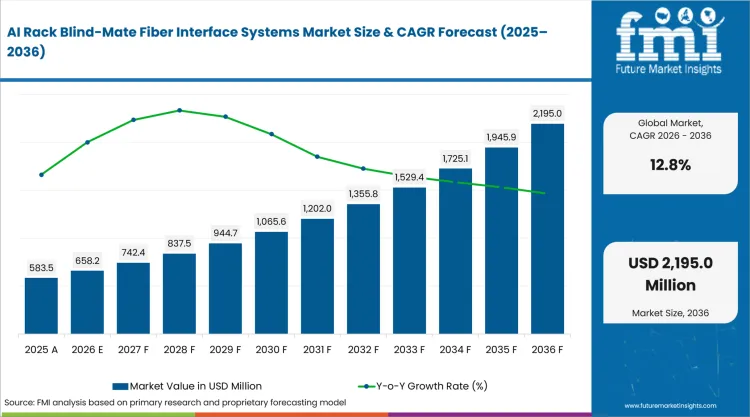
USD 658.2 million in 2026 and USD 2,195.0 million by 2036 at a 12.8% CAGR.
Demand for AI rack blind-mate fiber interface systems is projected to expand at 12.8% CAGR between 2026 and 2036, increasing valuation from USD 658.2 million in 2026 to USD 2,195.0 million by 2036. The commercial bridge is the rising number of optical paths that must cross rack, tray and switch boundaries without turning every replacement into a manual fiber-alignment task.
The standards environment is moving in the same direction. IEEE Ethernet work is extending 800G toward 1.6T links, while OIF projects cover pluggable, near-packaged and co-packaged optical interfaces for AI data centers. Open Compute Project rack specifications and optical-interconnect work reinforce the requirement for repeatable mechanical interfaces when compute trays and networking gear are installed or serviced at rack scale.
Key Takeaways of AI Rack Blind-Mate Fiber Interface Systems Market
- Blind-mate fiber interfaces gain relevance as AI racks need dense optical connectivity that can be installed and serviced without direct access to each mating point.
- 800G is projected at 38.0% by link speed in 2026, while pluggable optics are estimated at 32.0% by optical architecture.
- Inter-rack / scale-out is forecast at 36.0% by deployment location, with hyperscale AI data centers estimated at 48.0% by data center type.
- OEM direct is projected at 39.0% by route to market in 2026 because optical and mechanical qualification is typically resolved during system design-in.
- Insertion loss, contamination, repeated mating and intermateability remain adoption constraints when optical budgets tighten at higher link densities.
- SENKO Advanced Components, Inc., Corning Incorporated, USA Conec Ltd. and Molex, LLC provide blind-mate, high-density or optical-backplane connectivity relevant to AI rack architectures.
Analyst Perspective
"Blind-mate fiber only works commercially when optical loss, mechanical alignment and field replacement are treated as one interface specification. Buyers should test repeated mating, contamination tolerance and service access at the rack level before standardizing a connector architecture."
- Sudip saha, Principal Consultant, Future Market Insights
How is the AI Rack Blind-Mate Fiber Interface Systems Market segmented?
The AI rack blind-mate fiber interface systems market is segmented by link speed, optical architecture, deployment location, data center type, route to market and region.
Link speed covers 800G, 400G, 1.6T, and 3.2T and above. Optical architecture includes pluggable optics, near-packaged optics, co-packaged optics, and passive fiber / cabling systems. Deployment location covers inter-rack / scale-out, intra-rack / scale-up, spine-leaf fabric, and campus / DCI. Data center type includes hyperscale AI data centers, colocation AI facilities, enterprise AI/HPC, and research / sovereign compute. Route to market covers OEM direct, network system integrators, fiber/cabling specialists, and test & managed-service providers.
Why does 800G lead the link speed category?
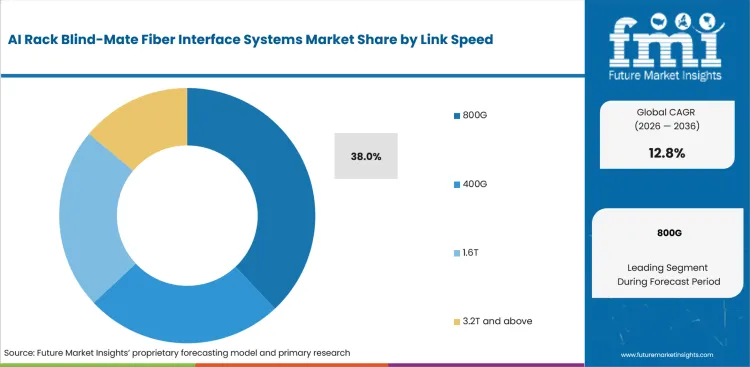
800G sits at the point where production data-center Ethernet, switch density and AI scale-out requirements already overlap. IEEE 802.3df standardized 800 Gb/s Ethernet physical layers, while subsequent industry work is extending lane rates and interfaces toward 1.6T operation.
- Based on link speed, 800G is projected to account for 38.0% in 2026 as AI clusters add higher-throughput connections without requiring every rack to move immediately to the next link generation.
- The installation issue is physical as much as electrical. Higher fiber counts at switch and accelerator boundaries make repeatable backplane or midplane mating useful where trays must be replaced without reworking individual connectors.
Why do pluggable optics lead the optical architecture category?
Pluggable optics preserve a familiar replacement boundary between the switch or server and the optical module. OIF work on energy-efficient interfaces continues to include pluggable designs alongside near-packaged optics and co-packaged optics, reflecting a transition in which several architectures coexist.
- In 2026, pluggable optics are expected to account for 32.0% of optical architecture demand because field replacement and established module ecosystems remain practical requirements during large AI network rollouts.
- Near-packaged and co-packaged designs can reduce electrical reach, but they move fiber attachment closer to silicon. That shift increases the value of detachable or blind-mate optical interfaces that preserve serviceability without undoing the density gains.
Why does inter-rack / scale-out lead the deployment location category?
Scale-out fabrics connect accelerator groups across racks and create repeated fiber crossings between leaf, spine and compute systems. The Open Compute Project has maintained optical-interconnect work for rack architectures, while current AI infrastructure discussions increasingly treat optical connectivity as part of the rack design rather than a separate cabling layer.
- The inter-rack / scale-out segment is forecast to capture 36.0% share in 2026 as larger accelerator clusters require more repeatable optical paths between compute racks and network tiers.
- Blind-mate interfaces can shorten service operations when a switch tray or compute sled is exchanged, but they must maintain alignment after repeated insertion. Mechanical tolerance therefore becomes part of the optical link budget at the rack boundary.
Why do hyperscale AI data centers lead the data center type category?
Hyperscale AI facilities concentrate accelerator trays, switching tiers and dense fiber routing in repeatable rack configurations. This makes service time and connector density more consequential because a single architecture is replicated across many racks and deployment waves.
- Hyperscale AI data centers are estimated at 48.0% of data center type demand in 2026 due to high rack counts and recurring need for standardized optical connections across compute and networking systems.
- Official infrastructure programs in the USA, South Korea, France, Japan, Germany and the UAE also show that AI computing capacity is becoming a national infrastructure issue. More compute capacity increases the downstream need for rack-level network interfaces that can be installed consistently.
Why does OEM direct lead the route to market category?
Blind-mate optical connections cross mechanical and optical design boundaries. The connector must fit the chassis, tolerate alignment variation and meet an insertion-loss target, so qualification usually begins with the rack, switch, server or accelerator-system design rather than after installation.
- OEM direct is projected to account for 39.0% of route-to-market demand in 2026 because connector geometry and fiber routing are commonly validated during the original equipment design cycle.
- System integrators and cabling specialists remain important during deployment, but OEM qualification determines whether a blind-mate interface can be repeated across a platform. That creates a longer design-in cycle with a more durable position once the interface is approved.
What are the drivers, restraints and opportunities in the AI Rack Blind-Mate Fiber Interface Systems Market?
Scale-out AI networking expands fiber density at rack boundaries while mating tolerance and contamination control remain qualification constraints as serviceable near-packaged and co-packaged optical interfaces move fiber closer to accelerators.
- Driver: AI scale-out fabrics require denser optical paths between racks, switches and accelerator trays as Ethernet link speeds advance.
- Restraint: Repeated mating, contamination sensitivity and connector intermateability can raise qualification effort when optical loss budgets are tight.
- Opportunity: Serviceable near-packaged and co-packaged optical architectures create demand for detachable blind-mate interfaces closer to switching and accelerator silicon.
IEEE and OIF work shows why physical connectivity is being redesigned around higher lane rates and AI-oriented network requirements. OIF is developing 224G linear interfaces for pluggable, co-packaged and near-package optics, together with a 12.8 Tb/s NPO module project and compute-optics work for AI scale-up links. Each step raises the value of dense fiber termination that does not make maintenance dependent on direct manual access to every connector.
The constraint is repeatability. A blind-mate interface has to absorb mechanical tolerance while preserving optical alignment, and the connection may be made inside a rack where visibility is limited. TIA released ANSI/TIA-604-20 in March 2026 to specify AIM connector interfaces and intermateability, showing that interface definition remains a practical requirement as new multifiber formats enter data-center designs.
Co-packaged optics creates a more direct opportunity because detachable fiber is needed closer to photonic integrated circuits. SENKO has demonstrated detachable PIC connectivity for 3D CPO, Corning has added blind-mate MMC options and a PRIZM TMT expanded-beam interface, and Molex has introduced an expanded-beam backplane connector for blind installation of cards and sleds. These designs aim to preserve service access as optical paths move deeper into the compute system.
Which country CAGRs are profiled in the AI Rack Blind-Mate Fiber Interface Systems Market?
| Country | CAGR |
|---|---|
| South Korea | 14.3% |
| USA | 14.0% |
| France | 13.7% |
| Japan | 13.3% |
| UAE | 13.0% |
| Germany | 12.7% |
How do country-level CAGRs compare in the AI Rack Blind-Mate Fiber Interface Systems Market?
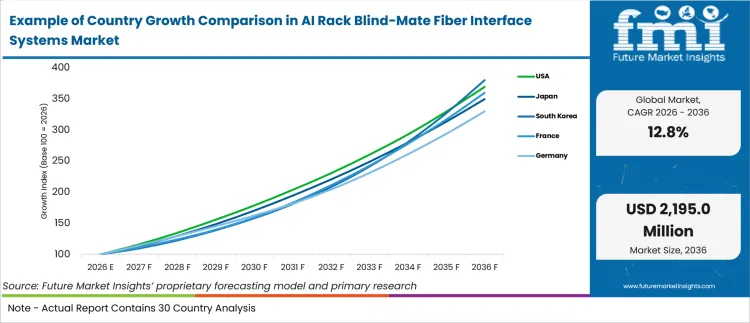
The six profiled CAGRs span 1.6 percentage points, indicating a relatively narrow growth band across markets that are expanding AI computing capacity through different public and private infrastructure routes. The rates measure expected market expansion rather than current installed capacity.
- South Korea is set to grow at 14.3% CAGR as national AI computing programs add accelerator capacity and encourage supporting data-center infrastructure.
- The USA is likely to expand at 14.0% CAGR as AI applications add data-center load and operators expand dense network fabrics around new compute capacity.
- France is forecast to grow at 13.7% CAGR as planned AI infrastructure investment and designated data-center sites support new compute deployments.
- Japan is expected to expand at 13.3% CAGR as public support for domestic cloud computing resources adds infrastructure for generative AI development.
- The UAE is anticipated to grow at 13.0% CAGR as hyperscale data-center projects add AI and sovereign-cloud capacity across new facilities.
- Germany is projected to expand at 12.7% CAGR as national data-center policy targets additional computing capacity, including more connection power for HPC and AI.
Comparable CAGRs can still produce different entry conditions because rack standards, colocation participation, system integrators and OEM qualification vary by country. The full report provides country-level CAGR analysis across North America, Latin America, Europe, East Asia, South Asia and Pacific, and the Middle East and Africa.
Country-wise Analysis
- South Korea is expanding public and private AI computing infrastructure through a national plan announced by the Ministry of Science and ICT in February 2025. The plan targets additional high-performance GPUs and the National AI Computing Center while addressing electricity supply and site allocation for AI facilities. The South Korean AI rack blind-mate fiber interface systems market is expected to grow at 14.3% CAGR during the assessment period as more accelerator capacity increases the need for dense, serviceable optical connections inside data centers.
- The USA combines a broad hyperscale footprint with continued data-center expansion tied in part to AI workloads. The USA Department of Energy reported in December 2024 that data-center load growth had tripled over the prior decade and was projected to rise further through 2028. The USA is likely to expand at 14.0% CAGR through 2036 as new compute clusters increase fiber counts between racks, although connector qualification and site-specific deployment practices remain important for adoption.
- France has linked AI policy with physical computing infrastructure. The Élysée stated in February 2025 that EUR 109 billion of investment announcements covered AI infrastructure and deployment, while also identifying sites and grid conditions suitable for data centers. Demand in France is projected to grow at 13.7% CAGR through 2036 as new AI facilities create a route for high-density optical backplanes and blind-mate interfaces within standardized rack deployments.
- Japan is supporting domestic computing resources for AI development through economic-security measures. In April 2024, the Ministry of Economy, Trade and Industry approved support for five projects to improve computational resources used by developers, with a focus on generative AI capacity. The Japanese market is expected to expand at 13.3% CAGR through 2036 as new cloud and AI systems increase demand for compact optical interfaces that can be serviced within dense equipment layouts.
- The UAE is adding hyperscale capacity through projects tied to AI and sovereign-cloud demand. Dubai Media Office reported in April 2025 the announcement of an AED 2 billion hyperscale data-center project in the UAE during Dubai AI Week. The UAE market is anticipated to grow at 13.0% CAGR during the assessment period as new facilities create demand for rack-scale optical connectivity, although qualification will depend on the architecture selected by each operator and equipment supplier.
- Germany has established a national data-center strategy that links additional computing capacity with AI infrastructure. The Federal Government stated in March 2026 that it aims to at least double data-center capacity by 2030, with a stronger expansion objective for HPC and AI connection power. Germany is forecast to expand at 12.7% CAGR through 2036 as denser compute systems increase the need for high-fiber-count interfaces that can be installed and replaced without disturbing adjacent rack connections.
Who are the notable companies in the AI Rack Blind-Mate Fiber Interface Systems Market?
SENKO Advanced Components, Inc., Corning Incorporated, US Conec Ltd. and Molex, LLC are the notable companies serving the AI rack blind-mate fiber interface systems market.
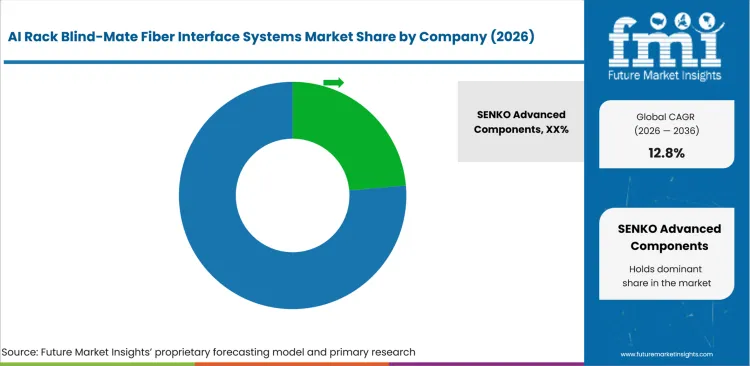
Competition is organized around connector density, mating mechanics, fiber-coupling technology and the ability to preserve serviceability as optics move closer to switches and accelerators. Product qualification is tied to rack geometry and optical-loss targets, so market participation depends on a verified interface that can be integrated into an OEM platform rather than a generic fiber connector alone.
- SENKO Advanced Components, Inc. and US Conec Ltd. offer high-density blind-mate backplane or midplane interfaces using multifiber connector platforms and alignment hardware.
- Corning Incorporated combines high-density MMC connectivity with PRIZM TMT expanded-beam technology for traditional, blind-mate and co-packaged optical applications.
- Molex, LLC provides optical backplane and CPO interface systems, including blind-installed expanded-beam backplane connectivity and external-laser interfaces.
Competitive Benchmarking: AI Rack Blind-Mate Fiber Interface Systems Market
| Company | Blind-mate optical interface | High-density fiber platform | AI rack / CPO relevance | Geographic Reach |
|---|---|---|---|---|
| SENKO Advanced Components, Inc. | High | High | High | Global |
| Corning Incorporated | High | High | High | Global |
| US Conec Ltd. | High | High | Medium | Global connector ecosystem |
| Molex, LLC | High | High | High | Global |
Key Developments in the AI Rack Blind-Mate Fiber Interface Systems Market
- In March 2026, Molex introduced the VersaBeam EBO Backplane Connector, designed to consolidate up to 192 fibers in one interface and support blind installation of cards and sleds through a preconfigured optical backplane.
- In March 2026, Corning announced a 32-fiber MMC connector option for traditional and blind-mate applications and highlighted its MMC platform with PRIZM TMT expanded-beam ferrule technology for dense AI data-center connectivity.
- In March 2026, SENKO announced detachable fiber connectivity with Lightmatter for 3D co-packaged optics, using a detachable optical interface between fiber arrays and photonic integrated circuits to preserve serviceability.
Key Players in the AI Rack Blind-Mate Fiber Interface Systems Market
Blind-Mate Backplane and VSFF Connectivity
- SENKO Advanced Components, Inc.
- US Conec Ltd.
Fiber and High-Density Connectivity Platforms
- Corning Incorporated
Optical Backplane and CPO Interconnects
- Molex, LLC
AI Rack Blind-Mate Fiber Interface Systems Market - Report Scope
| Coverage field | Report scope |
|---|---|
| Market breakdown | By link speed, optical architecture, deployment location, data center type, route to market and region. |
| Quantitative Units | Revenue in USD million and CAGR in %. |
| Market Definition | Blind-mate optical connectors, backplane or midplane interfaces, fiber coupling systems and related components designed for repeatable optical connection at AI rack, sled, switch or nearby compute interfaces without direct manual alignment at the mating point. |
| Regions Covered | North America, Latin America, Europe, East Asia, South Asia and Pacific, and Middle East and Africa. |
| Countries Covered | South Korea, USA, France, Japan, UAE, Germany, and 20+ countries included in the full report. |
| Key Companies Profiled | SENKO Advanced Components, Inc., Corning Incorporated, US Conec Ltd. and Molex, LLC. |
| Forecast Period | 2026 to 2036. |
| Approach | Primary and secondary research with market triangulation. |
AI Rack Blind-Mate Fiber Interface Systems Market - Research Methodology
| Method | Approach |
|---|---|
| Primary Research | FMI analysts gathered input from component suppliers, optical-interconnect developers, system OEMs, data-center operators, integrators, procurement teams and subject-matter experts. Interviews examined connector qualification, rack-level installation, serviceability, optical-loss requirements, purchasing criteria and adoption barriers. Respondents were also asked what evidence is required before a trial or platform design develops into regular purchasing. |
| Desk Research | Desk research covered government infrastructure programs, standards organizations, technical literature, industry associations, company filings, official product information and corporate announcements. Sources were reviewed for relevance, publication date, geographic coverage and consistency with the defined market scope. Claims relating to interface performance, applications, standards, capacity and commercial activity were retained only when supported by credible public evidence. |
| Market Sizing and Forecasting | The market model combined the baseline value with historical performance, segment structure, adoption levels, company participation and country-level demand conditions. Forecast assumptions considered AI infrastructure investment, optical-network transitions, purchasing cycles, rack architecture changes, supply availability and barriers to wider use. Segment and regional estimates were reconciled before the final market total was calculated. |
| Data Validation | Estimates were checked against multiple independent indicators, including public infrastructure data, standards activity, company product development, industry deployments and findings from primary interviews. Validation also tested whether products and company activity fell within the defined blind-mate AI rack interface boundaries. Adjacent cabling categories, unsupported claims and overlapping activities without direct market relevance were excluded to maintain consistency across segments and countries. |
AI Rack Blind-Mate Fiber Interface Systems Market by Segments
AI Rack Blind-Mate Fiber Interface Systems Market segmented by Link Speed:
- 800G
- 400G
- 1.6T
- 3.2T and above
AI Rack Blind-Mate Fiber Interface Systems Market segmented by Optical Architecture:
- Pluggable optics
- Near-packaged optics
- Co-packaged optics
- Passive fiber / cabling systems
AI Rack Blind-Mate Fiber Interface Systems Market segmented by Deployment Location:
- Inter-rack / scale-out
- Intra-rack / scale-up
- Spine-leaf fabric
- Campus / DCI
AI Rack Blind-Mate Fiber Interface Systems Market segmented by Data Center Type:
- Hyperscale AI data centers
- Colocation AI facilities
- Enterprise AI/HPC
- Research / sovereign compute
AI Rack Blind-Mate Fiber Interface Systems Market segmented by Route to Market:
- OEM direct
- Network system integrators
- Fiber/cabling specialists
- Test & managed-service providers
AI Rack Blind-Mate Fiber Interface Systems Market by Region:
- North America
- United States
- Canada
- Latin America
- Brazil
- Chile
- Mexico
- Rest of Latin America
- Western Europe
- Germany
- United Kingdom
- Italy
- Spain
- France
- Nordics
- Benelux
- Rest of Western Europe
- Eastern Europe
- Russia
- Poland
- Hungary
- Balkan and Baltic States
- Rest of Eastern Europe
- East Asia
- China
- Japan
- South Korea
- South Asia and Pacific
- India
- ASEAN
- Australia and New Zealand
- Rest of South Asia and Pacific
- Middle East and Africa
- Kingdom of Saudi Arabia
- Other GCC Countries
- Türkiye
- South Africa
- Other African Union Countries
- Rest of Middle East and Africa
Research Sources and Bibliography
- IEEE Standards Association. (2024). IEEE 802.3df-2024: IEEE Standard for Ethernet Amendment addressing 800 Gb/s Ethernet physical layers.
- IEEE Standards Association. (2024). IEEE P802.3dj project materials for 200 Gb/s, 400 Gb/s, 800 Gb/s and 1.6 Tb/s Ethernet.
- OIF. (2026). Current OIF Work: CEI-224G Linear, Energy Efficient Interfaces, 12.8Tb/s NPO Module and Compute Optics Interface projects.
- OIF. (2025). OIF Advances Interoperability at OFC 2025 with 800G, CEI-224G, CMIS and co-packaging demonstrations.
- Telecommunications Industry Association. (2026, March 11). TIA Publishes New Standard - ANSI/TIA-604-20.
- Open Compute Project. (2026). Open Rack Specifications and Designs.
- Open Compute Project. (2023). Optical Interconnect: Pathways to an Open Infrastructure for AI.
- Open Compute Project. (2024). Optical Compute Interconnect: Co-Packaged Optics for AI and Compute Infrastructure.
- USA Department of Energy. (2024, December 20). DOE Releases New Report Evaluating Increase in Electricity Demand from Data Centers.
- Ministry of Economy, Trade and Industry, Japan. (2024, April 19). Approval of Plans for Ensuring a Stable Supply of Cloud Programs under the Economic Security Promotion Act.
- Ministry of Science and ICT, Republic of Korea. (2025, February 20). Korea to Expand AI Computing Infrastructure to Strengthen National AI Capabilities.
- Élysée. (2025, February 11). Faire de la France une puissance de l’IA.
- Federal Government of Germany. (2026, March 18). Mehr Rechenpower für Deutschland.
- Government of Dubai Media Office. (2025, April 22). Hamdan bin Mohammed witnesses announcement of AED2 billion hyperscale data centre.
- SENKO Advanced Components, Inc. (2026, March 11). SENKO Collaborates with Lightmatter on Detachable Connectivity to the PIC for 3D Co-Packaged Optics.
- SENKO Advanced Components, Inc. (2026). SN/SN-MT 4-Port Blind Mate Backplane.
- Corning Incorporated. (2026, March 16). Corning To Launch AI Innovations in Fiber, Cable, and Connectivity at OFC 2026.
- US Conec Ltd. (2026). MXC Internal Plug, Single Port Blind Mate.
- Molex, LLC. (2026, March 17). Molex Accelerates AI Cluster Deployment with One-Stop Optical Interconnect Architecture and High-Radix Optical Circuit Switch Platform.
This bibliography is provided for reader reference and is not exhaustive. The full report contains the complete reference list and detailed citations.
This Report Answers
- How large is the AI Rack Blind-Mate Fiber Interface Systems Market in 2026 and 2036?
- Which operating conditions support blind-mate optical adoption across AI rack and sled interfaces?
- Which link speed category supports current AI rack optical-interface demand?
- How does optical architecture shape demand for serviceable fiber interfaces?
- Which deployment location supports recurring rack-level optical connections?
- Which data center type concentrates repeatable AI rack interfaces?
- How do profiled country growth rates affect commercial entry conditions?
- Which companies serve blind-mate, optical-backplane and high-density fiber applications?
Frequently Asked Questions
How big is the AI Rack Blind-Mate Fiber Interface Systems Market in 2026?
USD 658.2 million represents the AI rack blind-mate fiber interface systems market value in 2026. The market is projected to reach USD 2195.0 million by 2036 as higher-density optical links spread across AI racks, network fabrics and serviceable compute systems.
What is the CAGR of the AI Rack Blind-Mate Fiber Interface Systems Market from 2026 to 2036?
A 12.8% CAGR is projected for the AI rack blind-mate fiber interface systems market between 2026 and 2036. Growth is tied to scale-out AI networking, denser fiber routing and the need to preserve serviceability as optical interfaces move closer to switches and accelerators.
Which link speed segment is projected to account for 38.0% of the AI Rack Blind-Mate Fiber Interface Systems Market?
800G is projected to account for 38.0% of link speed demand in 2026. It combines current production Ethernet deployment with the fiber density and rack-service requirements created by expanding AI clusters.
How much will the AI Rack Blind-Mate Fiber Interface Systems Market add between 2026 and 2036?
USD 1,536.8 million is expected to be added to the AI rack blind-mate fiber interface systems market between 2026 and 2036. The increase reflects wider use of high-density fiber connections across inter-rack fabrics, optical backplanes and serviceable CPO or NPO architectures.
Which companies are active in the AI Rack Blind-Mate Fiber Interface Systems Market?
Four companies active in the AI rack blind-mate fiber interface systems market include SENKO Advanced Components, Inc., Corning Incorporated, US Conec Ltd. and Molex, LLC. Their verified offerings cover blind-mate backplanes, multifiber interfaces, expanded-beam connectivity and co-packaged optical serviceability.
Preview the report firsthand - request a free sample
Get SampleGet the brochure for pricing and purchase details.
Get PDFTable of Content
- Key Takeaways
- Market Size and CAGR
- Top Growth Driver
- Fastest Growing Segment
- Leading Region
- Key Companies
- Emerging Opportunities
- Executive Summary
- Global Market Outlook
- Demand-side Trends
- Supply-side Trends
- Technology Roadmap Analysis
- Analysis and Recommendations
- Analyst Perspective (What is happening? Why now? What should investors know?)
- Key Questions Answered
- How large is the market?
- What is the CAGR?
- What are key trends?
- Which region dominates?
- Who are the leaders?
- Market Overview
- Market Coverage / Taxonomy
- Market Definition / Scope / Limitations
- Research Methodology
- Chapter Orientation
- Analytical Lens and Working Hypotheses
- Market Structure, Signals, and Trend Drivers
- Benchmarking and Cross-market Comparability
- Market Sizing, Forecasting, and Opportunity Mapping
- Research Design and Evidence Framework
- Desk Research Programme (Secondary Evidence)
- Expert Input and Fieldwork (Primary Evidence)
- Tooling, Models, and Reference Databases
- Data Engineering and Model Build
- Quality Assurance and Audit Trail
- Market Background
- Market Dynamics (Drivers, Restraints, Opportunity, Trends)
- Scenario Forecast (Optimistic, Likely, Conservative)
- Impact Analysis
- AI Impact
- Sustainability Impact
- Regulatory Impact
- Technology Impact
- Consumer / Buyer Analysis
- Purchase Drivers
- Adoption Barriers
- Buyer Journey
- Opportunity Map Analysis
- Product Life Cycle Analysis
- Supply Chain Analysis
- Investment Feasibility Matrix
- Value Chain Analysis
- PESTLE and Porter's Analysis
- Regulatory Landscape
- Regional Parent Market Outlook
- Production and Consumption Statistics
- Import and Export Statistics
- Global Market Analysis and Forecast, 2021 to 2036
- Historical Market Size Value (USD Million) Analysis, 2021 to 2025
- Current and Future Market Size Value (USD Million) Projections, 2026 to 2036
- Y-o-Y Growth Trend Analysis
- Absolute $ Opportunity Analysis
- Global Market Pricing Analysis, 2021 to 2036
- Global Market Analysis and Forecast, By Link Speed, 2021 to 2036
- Introduction / Key Findings
- Historical Market Size Value (USD Million) Analysis By Link Speed, 2021 to 2025
- Current and Future Market Size Value (USD Million) Analysis and Forecast By Link Speed, 2026 to 2036
- 800G
- 400G
- 1.6T
- 3.2T and above
- 800G
- Y-o-Y Growth Trend Analysis By Link Speed, 2021 to 2025
- Absolute $ Opportunity Analysis By Link Speed, 2026 to 2036
- Global Market Analysis and Forecast, By Optical Architecture, 2021 to 2036
- Introduction / Key Findings
- Historical Market Size Value (USD Million) Analysis By Optical Architecture, 2021 to 2025
- Current and Future Market Size Value (USD Million) Analysis and Forecast By Optical Architecture, 2026 to 2036
- Pluggable optics
- Near-packaged optics
- Co-packaged optics
- Passive fiber / cabling systems
- Pluggable optics
- Y-o-Y Growth Trend Analysis By Optical Architecture, 2021 to 2025
- Absolute $ Opportunity Analysis By Optical Architecture, 2026 to 2036
- Global Market Analysis and Forecast, By Deployment Location, 2021 to 2036
- Introduction / Key Findings
- Historical Market Size Value (USD Million) Analysis By Deployment Location, 2021 to 2025
- Current and Future Market Size Value (USD Million) Analysis and Forecast By Deployment Location, 2026 to 2036
- Inter-rack / scale-out
- Intra-rack / scale-up
- Spine-leaf fabric
- Campus / DCI
- Inter-rack / scale-out
- Y-o-Y Growth Trend Analysis By Deployment Location, 2021 to 2025
- Absolute $ Opportunity Analysis By Deployment Location, 2026 to 2036
- Global Market Analysis and Forecast, By Data Center Type, 2021 to 2036
- Introduction / Key Findings
- Historical Market Size Value (USD Million) Analysis By Data Center Type, 2021 to 2025
- Current and Future Market Size Value (USD Million) Analysis and Forecast By Data Center Type, 2026 to 2036
- Hyperscale AI data centers
- Colocation AI facilities
- Enterprise AI/HPC
- Research / sovereign compute
- Hyperscale AI data centers
- Y-o-Y Growth Trend Analysis By Data Center Type, 2021 to 2025
- Absolute $ Opportunity Analysis By Data Center Type, 2026 to 2036
- Global Market Analysis and Forecast, By Route to Market, 2021 to 2036
- Introduction / Key Findings
- Historical Market Size Value (USD Million) Analysis By Route to Market, 2021 to 2025
- Current and Future Market Size Value (USD Million) Analysis and Forecast By Route to Market, 2026 to 2036
- OEM direct
- Network system integrators
- Fiber/cabling specialists
- Test & managed-service providers
- OEM direct
- Y-o-Y Growth Trend Analysis By Route to Market, 2021 to 2025
- Absolute $ Opportunity Analysis By Route to Market, 2026 to 2036
- Global Market Analysis and Forecast, By Region, 2021 to 2036
- Introduction
- Historical Market Size Value (USD Million) Analysis By Region, 2021 to 2025
- Current Market Size Value (USD Million) Analysis and Forecast By Region, 2026 to 2036
- North America
- Latin America
- Western Europe
- Eastern Europe
- East Asia
- South Asia and Pacific
- Middle East & Africa
- Market Attractiveness Analysis By Region
- North America Market Analysis and Forecast, By Country, 2021 to 2036
- Historical Market Size Value (USD Million) Trend Analysis By Market Taxonomy, 2021 to 2025
- Market Size Value (USD Million) Forecast By Market Taxonomy, 2026 to 2036
- By Country
- USA
- Canada
- By Link Speed
- By Optical Architecture
- By Deployment Location
- By Data Center Type
- By Route to Market
- By Country
- Market Attractiveness Analysis
- By Country
- By Link Speed
- By Optical Architecture
- By Deployment Location
- By Data Center Type
- By Route to Market
- Key Takeaways
- Latin America Market Analysis and Forecast, By Country
- Historical Market Size Value (USD Million) Trend Analysis By Market Taxonomy, 2021 to 2025
- Market Size Value (USD Million) Forecast By Market Taxonomy, 2026 to 2036
- By Country
- Brazil
- Mexico
- Chile
- Rest of Latin America
- By Link Speed
- By Optical Architecture
- By Deployment Location
- By Data Center Type
- By Route to Market
- By Country
- Market Attractiveness Analysis
- By Country
- By Link Speed
- By Optical Architecture
- By Deployment Location
- By Data Center Type
- By Route to Market
- Key Takeaways
- Western Europe Market Analysis and Forecast, By Country
- Historical Market Size Value (USD Million) Trend Analysis By Market Taxonomy, 2021 to 2025
- Market Size Value (USD Million) Forecast By Market Taxonomy, 2026 to 2036
- By Country
- Germany
- UK
- Italy
- Spain
- France
- Nordic
- BENELUX
- Rest of Western Europe
- By Link Speed
- By Optical Architecture
- By Deployment Location
- By Data Center Type
- By Route to Market
- By Country
- Market Attractiveness Analysis
- By Country
- By Link Speed
- By Optical Architecture
- By Deployment Location
- By Data Center Type
- By Route to Market
- Key Takeaways
- Eastern Europe Market Analysis and Forecast, By Country
- Historical Market Size Value (USD Million) Trend Analysis By Market Taxonomy, 2021 to 2025
- Market Size Value (USD Million) Forecast By Market Taxonomy, 2026 to 2036
- By Country
- Russia
- Poland
- Hungary
- Balkan & Baltic
- Rest of Eastern Europe
- By Link Speed
- By Optical Architecture
- By Deployment Location
- By Data Center Type
- By Route to Market
- By Country
- Market Attractiveness Analysis
- By Country
- By Link Speed
- By Optical Architecture
- By Deployment Location
- By Data Center Type
- By Route to Market
- Key Takeaways
- East Asia Market Analysis and Forecast, By Country
- Historical Market Size Value (USD Million) Trend Analysis By Market Taxonomy, 2021 to 2025
- Market Size Value (USD Million) Forecast By Market Taxonomy, 2026 to 2036
- By Country
- China
- Japan
- South Korea
- By Link Speed
- By Optical Architecture
- By Deployment Location
- By Data Center Type
- By Route to Market
- By Country
- Market Attractiveness Analysis
- By Country
- By Link Speed
- By Optical Architecture
- By Deployment Location
- By Data Center Type
- By Route to Market
- Key Takeaways
- South Asia and Pacific Market Analysis and Forecast, By Country
- Historical Market Size Value (USD Million) Trend Analysis By Market Taxonomy, 2021 to 2025
- Market Size Value (USD Million) Forecast By Market Taxonomy, 2026 to 2036
- By Country
- India
- ASEAN
- Australia & New Zealand
- Rest of South Asia and Pacific
- By Link Speed
- By Optical Architecture
- By Deployment Location
- By Data Center Type
- By Route to Market
- By Country
- Market Attractiveness Analysis
- By Country
- By Link Speed
- By Optical Architecture
- By Deployment Location
- By Data Center Type
- By Route to Market
- Key Takeaways
- Middle East & Africa Market Analysis and Forecast, By Country
- Historical Market Size Value (USD Million) Trend Analysis By Market Taxonomy, 2021 to 2025
- Market Size Value (USD Million) Forecast By Market Taxonomy, 2026 to 2036
- By Country
- Kingdom of Saudi Arabia
- Other GCC Countries
- Türkiye
- South Africa
- Other African Union
- Rest of Middle East & Africa
- By Link Speed
- By Optical Architecture
- By Deployment Location
- By Data Center Type
- By Route to Market
- By Country
- Market Attractiveness Analysis
- By Country
- By Link Speed
- By Optical Architecture
- By Deployment Location
- By Data Center Type
- By Route to Market
- Key Takeaways
- Key Countries Market Analysis
- USA
- Pricing Analysis
- Market Share Analysis, 2025
- By Link Speed
- By Optical Architecture
- By Deployment Location
- By Data Center Type
- By Route to Market
- Canada
- Pricing Analysis
- Market Share Analysis, 2025
- By Link Speed
- By Optical Architecture
- By Deployment Location
- By Data Center Type
- By Route to Market
- Mexico
- Pricing Analysis
- Market Share Analysis, 2025
- By Link Speed
- By Optical Architecture
- By Deployment Location
- By Data Center Type
- By Route to Market
- Brazil
- Pricing Analysis
- Market Share Analysis, 2025
- By Link Speed
- By Optical Architecture
- By Deployment Location
- By Data Center Type
- By Route to Market
- Chile
- Pricing Analysis
- Market Share Analysis, 2025
- By Link Speed
- By Optical Architecture
- By Deployment Location
- By Data Center Type
- By Route to Market
- Germany
- Pricing Analysis
- Market Share Analysis, 2025
- By Link Speed
- By Optical Architecture
- By Deployment Location
- By Data Center Type
- By Route to Market
- UK
- Pricing Analysis
- Market Share Analysis, 2025
- By Link Speed
- By Optical Architecture
- By Deployment Location
- By Data Center Type
- By Route to Market
- Italy
- Pricing Analysis
- Market Share Analysis, 2025
- By Link Speed
- By Optical Architecture
- By Deployment Location
- By Data Center Type
- By Route to Market
- Spain
- Pricing Analysis
- Market Share Analysis, 2025
- By Link Speed
- By Optical Architecture
- By Deployment Location
- By Data Center Type
- By Route to Market
- France
- Pricing Analysis
- Market Share Analysis, 2025
- By Link Speed
- By Optical Architecture
- By Deployment Location
- By Data Center Type
- By Route to Market
- India
- Pricing Analysis
- Market Share Analysis, 2025
- By Link Speed
- By Optical Architecture
- By Deployment Location
- By Data Center Type
- By Route to Market
- ASEAN
- Pricing Analysis
- Market Share Analysis, 2025
- By Link Speed
- By Optical Architecture
- By Deployment Location
- By Data Center Type
- By Route to Market
- Australia & New Zealand
- Pricing Analysis
- Market Share Analysis, 2025
- By Link Speed
- By Optical Architecture
- By Deployment Location
- By Data Center Type
- By Route to Market
- China
- Pricing Analysis
- Market Share Analysis, 2025
- By Link Speed
- By Optical Architecture
- By Deployment Location
- By Data Center Type
- By Route to Market
- Japan
- Pricing Analysis
- Market Share Analysis, 2025
- By Link Speed
- By Optical Architecture
- By Deployment Location
- By Data Center Type
- By Route to Market
- South Korea
- Pricing Analysis
- Market Share Analysis, 2025
- By Link Speed
- By Optical Architecture
- By Deployment Location
- By Data Center Type
- By Route to Market
- Russia
- Pricing Analysis
- Market Share Analysis, 2025
- By Link Speed
- By Optical Architecture
- By Deployment Location
- By Data Center Type
- By Route to Market
- Poland
- Pricing Analysis
- Market Share Analysis, 2025
- By Link Speed
- By Optical Architecture
- By Deployment Location
- By Data Center Type
- By Route to Market
- Hungary
- Pricing Analysis
- Market Share Analysis, 2025
- By Link Speed
- By Optical Architecture
- By Deployment Location
- By Data Center Type
- By Route to Market
- Kingdom of Saudi Arabia
- Pricing Analysis
- Market Share Analysis, 2025
- By Link Speed
- By Optical Architecture
- By Deployment Location
- By Data Center Type
- By Route to Market
- Türkiye
- Pricing Analysis
- Market Share Analysis, 2025
- By Link Speed
- By Optical Architecture
- By Deployment Location
- By Data Center Type
- By Route to Market
- South Africa
- Pricing Analysis
- Market Share Analysis, 2025
- By Link Speed
- By Optical Architecture
- By Deployment Location
- By Data Center Type
- By Route to Market
- USA
- Market Structure Analysis
- Competition Dashboard
- Competition Benchmarking
- Market Share Analysis of Top Players
- By Regional
- By Link Speed
- By Optical Architecture
- By Deployment Location
- By Data Center Type
- By Route to Market
- Emerging Startups
- Innovation Benchmarking
- Competition Analysis
- Competition Deep Dive
- SENKO Advanced Components
- Overview
- Product Portfolio
- Profitability by Market Segments
- Sales Footprint
- Strategy Overview
- Marketing Strategy
- Product Strategy
- Channel Strategy
- Corning
- US Conec
- Molex
- SENKO Advanced Components
- Case Studies
- Success Stories
- Recent Developments
- Competition Deep Dive
- Assumptions & Acronyms Used


