

- Market Size (2026)
- USD 8.9 Bn
- Forecast (2036)
- USD 27.6 Bn
- CAGR (2026 to 2036)
- 12.0%
How big is the Digital MRO Market in 2026?
USD 8.9 billion in 2026 and USD 27.6 billion by 2036 at a 12.0% CAGR.
Sales of digital MRO are estimated to rise at 12.0% CAGR through 2036, increasing valuation from USD 8.9 billion in 2026 to USD 27.6 billion by 2036. Airlines expand aircraft maintenance services while industrial operators align planning with equipment histories and parts availability.
Air-carrier data requires aviation analytics to preserve traceability through maintenance decisions across active aircraft operations. In April 2026, the FAA listed datasets covering operator and repair-station reports of aircraft defects. Engineers use asset performance management platforms to preserve identity as records enter work and release evidence.
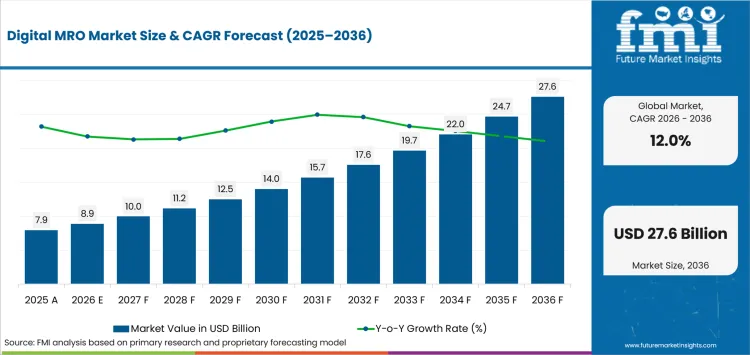
Key Takeaways of Digital MRO Market
- Connected platforms route condition findings into approved work across regulated aviation and industrial maintenance operations.
- MRO software platforms are projected at 35.0% in 2026 due to integrated planning and record governance.
- Aircraft maintenance is estimated at 37.0% in 2026 as airlines protect airworthiness and fleet availability.
- Aviation companies are forecast at 39.0% in 2026 driven by continuous technical control across active fleets.
- Fragmented histories restrain deployment since predictive recommendations require consistent terminology and traceable exchanges across systems.
- Lufthansa Technik AG, GE Aerospace, RTX Corporation, Airbus SE, The Boeing Company, Honeywell Aerospace Inc., IFS AB and Ramco Systems Limited are assessed.
Analyst Perspective
"Digital MRO investment should start with the maintenance decision causing the greatest avoidable delay or record risk. A platform deserves broader deployment once each alert remains traceable through aircraft configuration, approved work and technical release evidence."
- Sudip Saha, Principal Consultant, Future Market Insights
How is the Digital MRO Market segmented?
The digital MRO industry is segmented by solution type, application, end user, distribution channel, technology and region.
The digital MRO market covers solution type, application, end user, distribution channel, technology and region through software platforms, predictive maintenance, digital twins and connected maintenance for aircraft, industrial equipment, fleet and asset lifecycle applications. Aviation, manufacturing, defense and energy users purchase through direct sales, marketplaces, integrators or resellers using AI, IoT, cloud and digital twin technology.
What supports MRO software platforms within the solution type category?
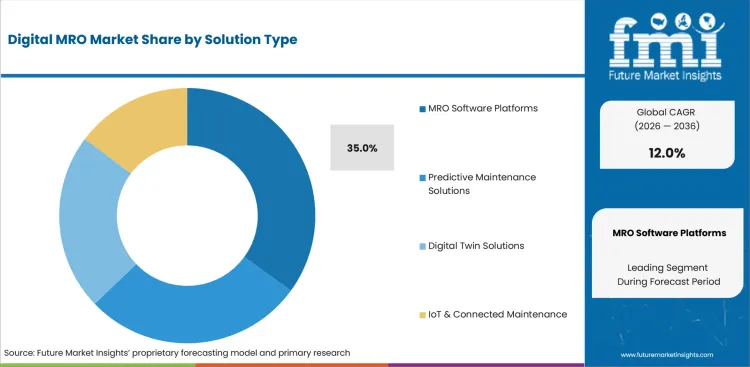
MRO software platforms connect engineering records with enterprise asset management workflows across regulated maintenance operations. In June 2025 IFS reported that Japan Airlines began replacing a maintenance system used for more than fifteen years. The migration links aircraft, engine and component work with corporate functions so technical teams retain one operational record.
- MRO software platforms are set to lead the solution type category with 35.0% share in 2026 due to integrated planning and record governance.
- One controlled platform reduces duplicate entry across engineering and materials teams while preserving current configuration history during phased system migration.
How does aircraft maintenance shape demand within the application category?
Aircraft maintenance combines strict release requirements with costly disruption exposure across line and base operations. Automated aircraft inspection becomes useful once engineers place findings inside controlled tasks and current records.
- Based on application, aircraft maintenance is projected to account for 37.0% in 2026 due to strict release control.
- Airline programs need analytics inside technical operations instead of separate dashboards without approved work context. In July 2025 Lufthansa Technik reported that Air Transat adopted its digital portfolio across forty-three Airbus aircraft. The deployment connected maintenance analytics with MRO software and electronic records across one operating fleet.
What makes aviation companies central to the end-user category?
Airlines use flight data monitoring to coordinate maintenance decisions across aircraft rotations and repair networks. In April 2025 Lufthansa Technik reported that LATAM selected predictive analytics for more than three hundred aircraft. That fleet scale requires consistent alert review across daily schedules and electronic technical record systems.
- In 2026, aviation companies are expected to lead the end-user category with 39.0% share because active fleets require continuous maintenance coordination.
- Continuous technical control becomes more valuable once predictive findings remain connected with approved tasks and current records across aircraft rotations and scheduled work at contracted repair stations.
How does artificial intelligence influence selection within the technology category?
AI predictive maintenance converts asset histories and sensor streams into prioritized findings across commercial fleets. Industrial data operations preserve source quality and explain how recommendations reach approved maintenance work processes.
- The technology category is forecast to be led by AI/ML at 33.0% share in 2026 due to embedded forecasting.
- Airlines compare alerts across aircraft families to assess one predictive service for fleetwide technical planning. Airbus said in April 2026 that JetBlue chose Skywise for A320 and A220 fleets. Common engineering rules let teams compare alerts without separating technical planning across both fleet families.
What are the drivers, restraints and opportunities in the Digital MRO Market?
Connected records support earlier decisions although fragmented histories limit reliability and implementation services determine deployment scale.
- Driver: Connected sensors support earlier planning so engineers schedule labor and parts without disrupting normal operations.
- Restraint: Inconsistent terminology reduces model reliability across fleets using different maintenance systems and repair organizations.
- Opportunity: Implementation specialists connect industrial digital twins with planning systems and measure reliability gains across operating sites.
Connected industrial IoT platforms detect abnormal equipment behavior early, giving maintenance teams enough planning time to schedule labor and parts without disrupting regular operations.
Model performance weakens across fleets that describe similar faults through inconsistent maintenance histories at separate operating sites. NIST described fragmented implementations and interoperability barriers in December 2025, requiring governed interfaces across multivendor environments.
Implementation specialists secure integration and support contracts by extending a proven digital twin workflow across additional sites without weakening approval controls or reliable data transfer.
Which country CAGRs are profiled in the Digital MRO Market?
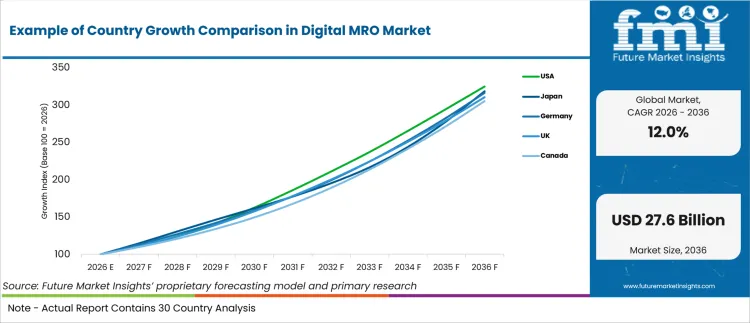
| Country | CAGR |
|---|---|
| United States | 12.5% |
| Japan | 12.3% |
| Germany | 12.2% |
| United Kingdom | 12.0% |
| Canada | 11.8% |
| Australia | 11.6% |
| France | 11.4% |
How do country-level CAGRs compare in the Digital MRO Market?
Country CAGRs span 1.1 percentage points and show similar forecast movement across established aviation markets. Commercial entry depends on fleet complexity and implementation coverage more than differences between forecast rates.
- United States deployments integrate airline fleets and independent repair stations operating separate maintenance systems nationwide.
- Japan requires localized migration that preserves technical records across airline groups and older enterprise platforms.
- Germany combines aerospace engineering with industrial sites that demand dependable interfaces and strict data governance.
- United Kingdom programs prioritize audit-ready records across approved organizations with limited specialist software support routes.
- Canada needs remote coordination across dispersed fleets facing long service routes and variable field connectivity.
- Australia values centralized oversight across remote airfields with limited specialist coverage and lengthy service travel.
- France combines aerospace software with airline platforms retaining separate boundaries around proprietary OEM data access.
Comparable rates produce different implementation costs across national maintenance networks and available technical support routes.
The full report covers North America, Latin America, Europe, East Asia, South Asia and Pacific, and Middle East and Africa.
Country-wise Analysis
- United States airlines manage large mixed fleets through major hubs and independent repair stations that require shared configuration records across technical control teams and contracted maintenance networks serving several aircraft types and approval structures. Adoption of digital MRO in the United States is estimated to expand at 12.5% CAGR through 2036, supported by nationwide implementation services and broad airline software coverage for phased deployments across active maintenance bases. BTS reported in July 2026 that scheduled passengers reached 80.4 million during April and this traffic scale supports continuous planning despite separate airline and repair-station systems raising integration costs across nationwide operations.
- Japan combines high-volume scheduled aviation with localized documentation across major bases as its transport ministry reported in June 2026 that domestic scheduled passengers reached 112.5 million during fiscal 2025 across nationwide airline maintenance programs. Digital MRO sales in Japan are forecast to expand at 12.3% CAGR by 2036, influenced by implementation expertise and coordinated cloud migration across large airline groups and fleetwide record governance during phased implementation. Domestic software specialists support sequenced cloud migration across large airline groups and fleetwide records but language-specific documentation and long-running enterprise systems extend conversion schedules across several operating bases during phased nationwide maintenance implementations.
- Germany supports digital MRO through airline maintenance organizations and industrial operators that require dependable interfaces between engineering records and controlled work execution across established aerospace centers and regional service networks throughout mixed asset operations. The German digital MRO sector is projected to record 12.2% CAGR during the assessment period, reinforced by aerospace engineering capacity and experienced implementation partners serving regulated operations across airline and industrial sites. Destatis reported in January 2026 that German main airports handled 207.2 million passengers during 2025 and operating scale favors coordinated planning despite fragmented enterprise systems and strict governance increasing integration effort across nationwide operations.
- United Kingdom operators rely on approved maintenance organizations and distributed service locations as the Civil Aviation Authority reported in August 2026 that passenger journeys reached 302 million during 2025 across the national aviation network. The United Kingdom digital MRO outlook is anticipated to advance at 12.0% CAGR over the assessment period, shaped by audit-ready workflows and established aviation technology services across airline and independent maintenance bases. Established aviation technology services support audit-ready workflows across airline and independent maintenance bases but software skills shortages and mixed-system migration lengthen deployment across regional facilities and contracted technical support routes throughout the national network.
- Canada combines airline hubs with remote operating locations that require shared maintenance records across long service distances and harsh weather conditions through centralized technical control and regional field-support routes across provincial operating environments. Canada is estimated to post 11.8% CAGR over the forecast period, aided by connected workflows and implementation services that support dispersed airline and public-sector operating bases through phased migration and remote support programs. Statistics Canada reported in February 2026 that aircraft movements reached 5.8 million during 2025 and this dispersed activity supports digital coordination but field-service travel raises deployment costs across remote northern and coastal operating regions.
- Australia operates a dispersed aircraft base across metropolitan centers and remote airfields as BITRE reported in July 2026 that domestic RPT passengers reached 60.76 million for the year ending May 2026 for national planning. By 2036 Australia is projected to grow at 11.6% CAGR, driven by remote access and distributed maintenance control across distant locations with limited specialist local software coverage and lengthy implementation travel requirements. Centralized engineering oversight supports remote access and distributed maintenance control across distant locations but limited specialist software coverage and technician travel raise support costs beyond major cities across regional operating networks and airfields nationwide.
- France combines airline technical operations with aerospace manufacturing and independent maintenance organizations across major airports and specialized engineering clusters supported by local software teams and OEM service relationships across national maintenance planning programs. Digital MRO demand in France is forecast to rise at 11.4% CAGR over the forecast period, attributable to aviation data services and fleet performance programs across active airline groups and mixed-fleet technical operations. DGAC reported in June 2026 that Paris Charles de Gaulle recorded 479,301 movements during 2025 and dense operations favor connected workflows despite airline platforms and OEM data boundaries complicating integration across maintenance environments.
Who are the notable companies in the Digital MRO Market?
Lufthansa Technik AG, GE Aerospace, RTX Corporation, Airbus SE, The Boeing Company, Honeywell Aerospace Inc., IFS AB and Ramco Systems Limited are assessed.
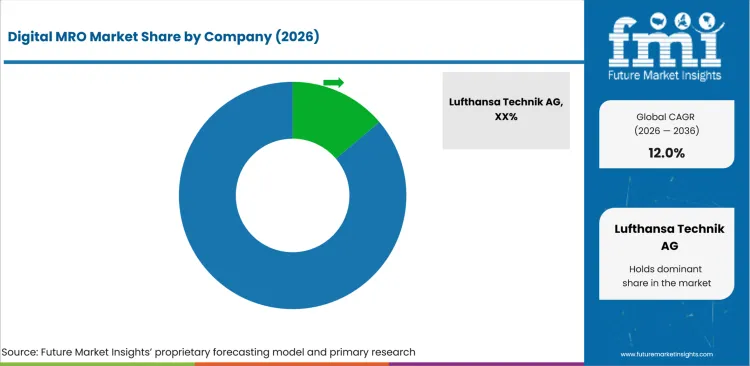
The field remains fragmented between aviation software specialists and aerospace groups controlling proprietary aircraft data and maintenance interfaces. Competition centers on regulated workflow depth and implementation coverage while entry requires aviation records expertise and disruption-free migration.
- Lufthansa Technik AG, IFS AB and Ramco Systems Limited integrate maintenance planning with work execution.
- GE Aerospace, RTX Corporation, Airbus SE and The Boeing Company connect aircraft data with analytics.
- Honeywell Aerospace Inc. combines engine monitoring with maintenance services following its completed June 2026 separation.
Competitive Benchmarking: Digital MRO Market
| Company | Regulated MRO Workflow | Predictive Analytics | Connected Fleet Data | Geographic Reach |
|---|---|---|---|---|
| Lufthansa Technik AG | High | High | High | Americas |
| GE Aerospace | Low | High | High | Europe |
| RTX Corporation | Low | High | High | Middle East |
| Airbus SE | Medium | High | High | Global |
| The Boeing Company | Medium | High | High | Africa and Middle East |
| Honeywell Aerospace Inc. | Low | High | High | Global |
| IFS AB | High | Medium | Medium | East Asia and Middle East |
| Ramco Systems Limited | High | Medium | Medium | East Asia |
Key Developments in the Digital MRO Market
- In April 2026, Lufthansa Technik AG completed Air Transat’s logbook rollout following maintenance authority approval.
- In February 2026, IFS announced SkyAlyne selected its platform for the Future Aircrew Training program.
- In November 2025, The Boeing Company reported FlySafair expanded Maintenance Performance Toolbox across its fleet.
Key Players in the Digital MRO Market
Integrated MRO Software Platforms
- Lufthansa Technik AG
- IFS AB
- Ramco Systems Limited
Aircraft and Engine Analytics Providers
- GE Aerospace
- RTX Corporation
- Honeywell Aerospace Inc.
OEM Digital Fleet Services
- Airbus SE
- The Boeing Company
Digital MRO Market - Report Scope
| Coverage field | Report scope |
|---|---|
| Market breakdown | By solution type, application, end user, distribution channel, technology and region. |
| Quantitative Units | Revenue in USD billion and CAGR in %. |
| Market Definition | Software and connected technology used to plan, monitor and execute MRO across aviation and industrial assets. |
| Regions Covered | North America, Latin America, Europe, East Asia, South Asia and Pacific, and Middle East and Africa. |
| Countries Covered | United States, Japan, Germany, United Kingdom, Canada, Australia, France, and 20+ countries included in the full report. |
| Key Companies Profiled | Lufthansa Technik AG, GE Aerospace, RTX Corporation, Airbus SE, The Boeing Company, Honeywell Aerospace Inc., IFS AB and Ramco Systems Limited. |
| Forecast Period | 2026 to 2036. |
| Approach | Primary and secondary research with market triangulation. |
Digital MRO Market - Research Methodology
| Method | Approach |
|---|---|
| Primary Research | FMI analysts gathered input from manufacturers, service providers, technology developers, distributors, end users, procurement teams, and subject-matter experts. Interviews examined purchasing decisions, product or service evaluation, adoption barriers, approval requirements, pricing considerations, and expectations for technical or commercial support. Respondents were also asked what evidence is required before a trial, pilot, or initial order develops into regular purchasing. |
| Desk Research | Desk research covered government statistics, regulatory publications, trade data, industry associations, technical literature, standards, company filings, product information, and official corporate announcements. Sources were reviewed for relevance, publication date, geographic coverage, and consistency with the defined market scope. Claims relating to performance, applications, approvals, capacity, investment, and commercial activity were retained only when supported by credible public evidence. |
| Market Sizing and Forecasting | The market model combined the baseline value with historical performance, segment structure, pricing and volume indicators, adoption levels, company participation, and country-level demand conditions. Forecast assumptions considered economic activity, investment trends, regulatory developments, technology adoption, purchasing cycles, supply availability, and barriers to wider market use. Segment and regional estimates were reconciled before the final market total was calculated. |
| Data Validation | Estimates were checked against multiple independent indicators, including public data, company activity, trade patterns, industry developments, and findings from primary interviews. Validation also tested whether products, services, applications, and company revenues fell within the defined market boundaries. Adjacent categories, unsupported claims, overlapping revenues, and activities without direct market relevance were excluded to reduce double counting and maintain consistency across segments and countries. |
Digital MRO Market by Segments
Digital MRO Market segmented by Solution Type:
- MRO Software Platforms
- Maintenance Management Software
- Asset Performance Management Software
- Predictive Maintenance Solutions
- AI-Based Predictive Maintenance
- Condition Monitoring Systems
- Digital Twin Solutions
- Aircraft Digital Twins
- Equipment Digital Twins
- IoT & Connected Maintenance
- Remote Equipment Monitoring
- Smart Sensor Platforms
Digital MRO Market segmented by Application:
- Aircraft Maintenance
- Line Maintenance
- Base Maintenance
- Industrial Equipment Maintenance
- Manufacturing Equipment
- Process Industry Equipment
- Fleet Management
- Vehicle Fleet Maintenance
- Rail Fleet Maintenance
- Asset Lifecycle Management
- Asset Performance Optimization
- Spare Parts Management
Digital MRO Market segmented by End User:
- Aviation Companies
- Commercial Airlines
- MRO Service Providers
- Manufacturing Companies
- Discrete Manufacturing
- Process Manufacturing
- Defense Organizations
- Military Aviation
- Defense Equipment Maintenance
- Energy & Utilities
- Power Generation Companies
- Oil & Gas Operators
Digital MRO Market segmented by Distribution Channel:
- Direct Sales
- Enterprise Contracts
- OEM Agreements
- Cloud Marketplace
- SaaS Platforms
- Industrial Cloud Marketplaces
- System Integrators
- Digital Transformation Partners
- Industrial Automation Integrators
- Value-Added Resellers
- Authorized Resellers
- Technology Partners
Digital MRO Market segmented by Technology:
- Artificial Intelligence & Machine Learning
- Predictive Analytics
- Machine Learning Algorithms
- Internet of Things (IoT)
- Connected Sensors
- Industrial IoT Platforms
- Cloud Computing
- Cloud-Based MRO Platforms
- Hybrid Cloud Infrastructure
- Digital Twin Technology
- Asset Digital Twins
- Process Simulation
Digital MRO Market by Region:
- North America
- United States
- Canada
- Mexico
- Latin America
- Brazil
- Chile
- Rest of Latin America
- Western Europe
- Germany
- United Kingdom
- Italy
- Spain
- France
- Nordics
- Benelux
- Rest of Western Europe
- Eastern Europe
- Russia
- Poland
- Hungary
- Balkan and Baltic States
- Rest of Eastern Europe
- East Asia
- China
- Japan
- South Korea
- South Asia and Pacific
- India
- ASEAN
- Australia and New Zealand
- Rest of South Asia and Pacific
- Middle East and Africa
- Kingdom of Saudi Arabia
- Other GCC Countries
- Türkiye
- South Africa
- Other African Union Countries
- Rest of Middle East and Africa
Research Sources and Bibliography
- IFS. (2025, June 2). Japan Airlines Selects IFS Cloud to Power Global Aviation Maintenance.
- Lufthansa Technik. (2025, July 3). Full Digital Tech Ops Ecosystem adopted by Air Transat.
- Lufthansa Technik. (2025, April 8). LATAM opts for Lufthansa Technik’s digital platform AVIATAR.
- Airbus. (2026, April 21). JetBlue signs for Skywise Fleet Performance+.
- National Institute of Standards and Technology. (2025, December 4). Digital Twin Standardization.
- Federal Aviation Administration. (2026, April 14). Download Service Difficulty Reports (SDR) by Year.
- Bureau of Transportation Statistics. (2026, July 10). April 2026 USA Airline Traffic Data Virtually Unchanged from the Same Month Last Year.
- Ministry of Land, Infrastructure, Transport and Tourism. (2026, June 30).
- Statistisches Bundesamt. (2026, January 29). 3,9 % mehr Fluggäste im Jahr 2025 als im Vorjahr.
- UK Civil Aviation Authority. (2026, August 4). UK aviation officially breaks records with over 300m passenger journeys in 2025.
- Statistics Canada. (2026, February 26). Aircraft movement and civil aviation statistics, December 2025.
- Bureau of Infrastructure and Transport Research Economics. (2026, July 17). Domestic aviation activity.
- Direction générale de l’aviation civile. (2025, October 3). Riverains des aéroports parisiens : données de trafic aérien.
- Honeywell Aerospace. (2026, June 29). Honeywell Aerospace completes spin-off from Honeywell Technologies and begins trading on Nasdaq.
- Lufthansa Technik. (2025, December 15). Frontier opts for more of Lufthansa Technik’s Digital Tech Ops and Engineering products.
- GE Aerospace. (2025, February 25). GE Aerospace and SAS collaborate on predictive maintenance initiative addressing ATA chapters 36 and 27.
- RTX. (2025, November 17). Qatar Airways taps RTX’s Collins Aerospace to optimize 787 fleet health and maintenance.
- Airbus. (2026, April 1). Airbus unveils Skywise subsidiary.
- The Boeing Company. (2026, February 5). Boeing and Oman Air extend predictive maintenance agreement for 787 Dreamliners.
- Honeywell Aerospace. (2025, May 14). How Honeywell Ensemble Uses AI to Predict Engine Health.
- IFS. (2025, February 10). TIM Aerospace DWC MRO Selects EmpowerMX from IFS to Enhance Operational Efficiency.
- Lufthansa Technik. (2026, April 20). AVIATAR Launches Electronic Technical Logbook with Digital Cabin Logbook in Global First with Air Transat.
- IFS. (2026, February 3). IFS chosen by SkyAlyne to drive aircraft readiness for the Royal Canadian Air Force’s Future Aircrew Training program.
- The Boeing Company. (2025, November 18). FlySafair extends use of Boeing Maintenance Performance Toolbox.
- BSI. (2025, November 5). AIRBUS SAS - IS 815238.
- Ramco Systems Limited. (2026, April 15). South Korea’s flag carrier and largest airline, Korean Air goes live with Ramco Aviation.
This bibliography is provided for reader reference and is not exhaustive. The full report contains the complete reference list and detailed citations.
This Report Answers
- How large is digital MRO?
- What supports digital adoption?
- Which solution leads?
- How does application shape planning?
- Which end user leads?
- How do countries differ?
- Which companies integrate analytics?
- What restricts deployment?
Frequently Asked Questions
How big is the digital MRO market in 2026?
In 2026 the digital MRO market is valued at USD 8.9 billion across aviation and industrial maintenance applications. Connected platforms link condition data with approved work planning as organizations replace fragmented records and isolated monitoring tools across complex asset operations.
What is the CAGR of the digital MRO market from 2026 to 2036?
The digital MRO market is projected to expand at 12.0% CAGR from 2026 to 2036 across aviation assets. Growth depends on dependable data integration that preserves technical records and converts predictive findings into controlled maintenance execution across mixed operating environments.
Which solution type is projected to account for 35.0% of the digital MRO market?
MRO software platforms are projected to account for 35.0% of the digital MRO market by solution type in 2026. Integrated planning and record governance help maintenance organizations coordinate engineering decisions with materials and approved work execution across regulated operating environments.
Which application is projected to account for 37.0% of the digital MRO market?
Aircraft maintenance is projected to account for 37.0% of the digital MRO market by application in 2026. Strict release requirements and costly disruptions favor platforms that connect condition findings with controlled tasks and current airworthiness records across regulated active fleets.
Which end user is projected to account for 39.0% of the digital MRO market?
Aviation companies are projected to account for 39.0% of the digital MRO market by end user in 2026. Continuous fleet operations require coordinated technical control across aircraft rotations and contracted repair networks with complete records for each regulated maintenance decision.
Which technology is projected to account for 33.0% of the digital MRO market?
Artificial intelligence and machine learning are projected to account for 33.0% of the digital MRO market by technology in 2026. Their commercial value depends on reliable asset histories and explainable recommendations that enter approved maintenance workflows without weakening current traceability.
How much will the digital MRO market add between 2026 and 2036?
Around USD 18.7 billion is expected to be added to the digital MRO market between 2026 and 2036. Forecast value depends on scalable interfaces that connect condition monitoring with maintenance planning while protecting configuration history and record traceability across complex assets.
Which companies are active in the digital MRO market?
Companies active in the digital MRO market include Lufthansa Technik AG, GE Aerospace, RTX Corporation and The Boeing Company. Airbus SE, Honeywell Aerospace Inc., IFS AB and Ramco Systems Limited extend coverage across regulated maintenance software and connected fleet analytics.
Preview the report firsthand - request a free sample
Get SampleGet the brochure for pricing and purchase details.
Get PDFTable of Content
- Key Takeaways
- Market Size and CAGR
- Top Growth Driver
- Fastest Growing Segment
- Leading Region
- Key Companies
- Emerging Opportunities
- Executive Summary
- Global Market Outlook
- Demand-side Trends
- Supply-side Trends
- Technology Roadmap Analysis
- Analysis and Recommendations
- Analyst Perspective (What is happening? Why now? What should investors know?)
- Key Questions Answered
- How large is the market?
- What is the CAGR?
- What are key trends?
- Which region dominates?
- Who are the leaders?
- Market Overview
- Market Coverage / Taxonomy
- Market Definition / Scope / Limitations
- Research Methodology
- Chapter Orientation
- Analytical Lens and Working Hypotheses
- Market Structure, Signals, and Trend Drivers
- Benchmarking and Cross-market Comparability
- Market Sizing, Forecasting, and Opportunity Mapping
- Research Design and Evidence Framework
- Desk Research Programme (Secondary Evidence)
- Expert Input and Fieldwork (Primary Evidence)
- Tooling, Models, and Reference Databases
- Data Engineering and Model Build
- Quality Assurance and Audit Trail
- Market Background
- Market Dynamics (Drivers, Restraints, Opportunity, Trends)
- Scenario Forecast (Optimistic, Likely, Conservative)
- Impact Analysis
- AI Impact
- Sustainability Impact
- Regulatory Impact
- Technology Impact
- Consumer / Buyer Analysis
- Purchase Drivers
- Adoption Barriers
- Buyer Journey
- Opportunity Map Analysis
- Product Life Cycle Analysis
- Supply Chain Analysis
- Investment Feasibility Matrix
- Value Chain Analysis
- PESTLE and Porter's Analysis
- Regulatory Landscape
- Regional Parent Market Outlook
- Production and Consumption Statistics
- Import and Export Statistics
- Global Market Analysis and Forecast, 2021 to 2036
- Historical Market Size Value (USD Billion) Analysis, 2021 to 2025
- Current and Future Market Size Value (USD Billion) Projections, 2026 to 2036
- Y-o-Y Growth Trend Analysis
- Absolute $ Opportunity Analysis
- Global Market Pricing Analysis, 2021 to 2036
- Global Market Analysis and Forecast, By Solution Type, 2021 to 2036
- Introduction / Key Findings
- Historical Market Size Value (USD Billion) Analysis By Solution Type, 2021 to 2025
- Current and Future Market Size Value (USD Billion) Analysis and Forecast By Solution Type, 2026 to 2036
- MRO Software Platforms
- Maintenance Management Software
- Asset Performance Management Software
- Predictive Maintenance Solutions
- AI-Based Predictive Maintenance
- Condition Monitoring Systems
- Digital Twin Solutions
- Aircraft Digital Twins
- Equipment Digital Twins
- IoT & Connected Maintenance
- Remote Equipment Monitoring
- Smart Sensor Platforms
- MRO Software Platforms
- Y-o-Y Growth Trend Analysis By Solution Type, 2021 to 2025
- Absolute $ Opportunity Analysis By Solution Type, 2026 to 2036
- Global Market Analysis and Forecast, By Application, 2021 to 2036
- Introduction / Key Findings
- Historical Market Size Value (USD Billion) Analysis By Application, 2021 to 2025
- Current and Future Market Size Value (USD Billion) Analysis and Forecast By Application, 2026 to 2036
- Aircraft Maintenance
- Line Maintenance
- Base Maintenance
- Industrial Equipment Maintenance
- Manufacturing Equipment
- Process Industry Equipment
- Fleet Management
- Vehicle Fleet Maintenance
- Rail Fleet Maintenance
- Asset Lifecycle Management
- Asset Performance Optimization
- Spare Parts Management
- Aircraft Maintenance
- Y-o-Y Growth Trend Analysis By Application, 2021 to 2025
- Absolute $ Opportunity Analysis By Application, 2026 to 2036
- Global Market Analysis and Forecast, By End User, 2021 to 2036
- Introduction / Key Findings
- Historical Market Size Value (USD Billion) Analysis By End User, 2021 to 2025
- Current and Future Market Size Value (USD Billion) Analysis and Forecast By End User, 2026 to 2036
- Aviation Companies
- Commercial Airlines
- MRO Service Providers
- Manufacturing Companies
- Discrete Manufacturing
- Process Manufacturing
- Defense Organizations
- Military Aviation
- Defense Equipment Maintenance
- Energy & Utilities
- Power Generation Companies
- Oil & Gas Operators
- Aviation Companies
- Y-o-Y Growth Trend Analysis By End User, 2021 to 2025
- Absolute $ Opportunity Analysis By End User, 2026 to 2036
- Global Market Analysis and Forecast, By Distribution Channel, 2021 to 2036
- Introduction / Key Findings
- Historical Market Size Value (USD Billion) Analysis By Distribution Channel, 2021 to 2025
- Current and Future Market Size Value (USD Billion) Analysis and Forecast By Distribution Channel, 2026 to 2036
- Direct Sales
- Enterprise Contracts
- OEM Agreements
- Cloud Marketplace
- SaaS Platforms
- Industrial Cloud Marketplaces
- System Integrators
- Digital Transformation Partners
- Industrial Automation Integrators
- Value-Added Resellers
- Authorized Resellers
- Technology Partners
- Direct Sales
- Y-o-Y Growth Trend Analysis By Distribution Channel, 2021 to 2025
- Absolute $ Opportunity Analysis By Distribution Channel, 2026 to 2036
- Global Market Analysis and Forecast, By Technology, 2021 to 2036
- Introduction / Key Findings
- Historical Market Size Value (USD Billion) Analysis By Technology, 2021 to 2025
- Current and Future Market Size Value (USD Billion) Analysis and Forecast By Technology, 2026 to 2036
- Artificial Intelligence & Machine Learning
- Predictive Analytics
- Machine Learning Algorithms
- Internet of Things (IoT)
- Connected Sensors
- Industrial IoT Platforms
- Cloud Computing
- Cloud-Based MRO Platforms
- Hybrid Cloud Infrastructure
- Digital Twin Technology
- Asset Digital Twins
- Process Simulation
- Artificial Intelligence & Machine Learning
- Y-o-Y Growth Trend Analysis By Technology, 2021 to 2025
- Absolute $ Opportunity Analysis By Technology, 2026 to 2036
- Global Market Analysis and Forecast, By Region, 2021 to 2036
- Introduction
- Historical Market Size Value (USD Billion) Analysis By Region, 2021 to 2025
- Current Market Size Value (USD Billion) Analysis and Forecast By Region, 2026 to 2036
- North America
- Latin America
- Western Europe
- Eastern Europe
- East Asia
- South Asia and Pacific
- Middle East & Africa
- Market Attractiveness Analysis By Region
- North America Market Analysis and Forecast, By Country, 2021 to 2036
- Historical Market Size Value (USD Billion) Trend Analysis By Market Taxonomy, 2021 to 2025
- Market Size Value (USD Billion) Forecast By Market Taxonomy, 2026 to 2036
- By Country
- USA
- Canada
- By Solution Type
- By Application
- By End User
- By Distribution Channel
- By Technology
- By Country
- Market Attractiveness Analysis
- By Country
- By Solution Type
- By Application
- By End User
- By Distribution Channel
- By Technology
- Key Takeaways
- Latin America Market Analysis and Forecast, By Country
- Historical Market Size Value (USD Billion) Trend Analysis By Market Taxonomy, 2021 to 2025
- Market Size Value (USD Billion) Forecast By Market Taxonomy, 2026 to 2036
- By Country
- Brazil
- Mexico
- Chile
- Rest of Latin America
- By Solution Type
- By Application
- By End User
- By Distribution Channel
- By Technology
- By Country
- Market Attractiveness Analysis
- By Country
- By Solution Type
- By Application
- By End User
- By Distribution Channel
- By Technology
- Key Takeaways
- Western Europe Market Analysis and Forecast, By Country
- Historical Market Size Value (USD Billion) Trend Analysis By Market Taxonomy, 2021 to 2025
- Market Size Value (USD Billion) Forecast By Market Taxonomy, 2026 to 2036
- By Country
- Germany
- UK
- Italy
- Spain
- France
- Nordic
- BENELUX
- Rest of Western Europe
- By Solution Type
- By Application
- By End User
- By Distribution Channel
- By Technology
- By Country
- Market Attractiveness Analysis
- By Country
- By Solution Type
- By Application
- By End User
- By Distribution Channel
- By Technology
- Key Takeaways
- Eastern Europe Market Analysis and Forecast, By Country
- Historical Market Size Value (USD Billion) Trend Analysis By Market Taxonomy, 2021 to 2025
- Market Size Value (USD Billion) Forecast By Market Taxonomy, 2026 to 2036
- By Country
- Russia
- Poland
- Hungary
- Balkan & Baltic
- Rest of Eastern Europe
- By Solution Type
- By Application
- By End User
- By Distribution Channel
- By Technology
- By Country
- Market Attractiveness Analysis
- By Country
- By Solution Type
- By Application
- By End User
- By Distribution Channel
- By Technology
- Key Takeaways
- East Asia Market Analysis and Forecast, By Country
- Historical Market Size Value (USD Billion) Trend Analysis By Market Taxonomy, 2021 to 2025
- Market Size Value (USD Billion) Forecast By Market Taxonomy, 2026 to 2036
- By Country
- China
- Japan
- South Korea
- By Solution Type
- By Application
- By End User
- By Distribution Channel
- By Technology
- By Country
- Market Attractiveness Analysis
- By Country
- By Solution Type
- By Application
- By End User
- By Distribution Channel
- By Technology
- Key Takeaways
- South Asia and Pacific Market Analysis and Forecast, By Country
- Historical Market Size Value (USD Billion) Trend Analysis By Market Taxonomy, 2021 to 2025
- Market Size Value (USD Billion) Forecast By Market Taxonomy, 2026 to 2036
- By Country
- India
- ASEAN
- Australia & New Zealand
- Rest of South Asia and Pacific
- By Solution Type
- By Application
- By End User
- By Distribution Channel
- By Technology
- By Country
- Market Attractiveness Analysis
- By Country
- By Solution Type
- By Application
- By End User
- By Distribution Channel
- By Technology
- Key Takeaways
- Middle East & Africa Market Analysis and Forecast, By Country
- Historical Market Size Value (USD Billion) Trend Analysis By Market Taxonomy, 2021 to 2025
- Market Size Value (USD Billion) Forecast By Market Taxonomy, 2026 to 2036
- By Country
- Kingdom of Saudi Arabia
- Other GCC Countries
- Türkiye
- South Africa
- Other African Union
- Rest of Middle East & Africa
- By Solution Type
- By Application
- By End User
- By Distribution Channel
- By Technology
- By Country
- Market Attractiveness Analysis
- By Country
- By Solution Type
- By Application
- By End User
- By Distribution Channel
- By Technology
- Key Takeaways
- Key Countries Market Analysis
- USA
- Pricing Analysis
- Market Share Analysis, 2025
- By Solution Type
- By Application
- By End User
- By Distribution Channel
- By Technology
- Canada
- Pricing Analysis
- Market Share Analysis, 2025
- By Solution Type
- By Application
- By End User
- By Distribution Channel
- By Technology
- Mexico
- Pricing Analysis
- Market Share Analysis, 2025
- By Solution Type
- By Application
- By End User
- By Distribution Channel
- By Technology
- Brazil
- Pricing Analysis
- Market Share Analysis, 2025
- By Solution Type
- By Application
- By End User
- By Distribution Channel
- By Technology
- Chile
- Pricing Analysis
- Market Share Analysis, 2025
- By Solution Type
- By Application
- By End User
- By Distribution Channel
- By Technology
- Germany
- Pricing Analysis
- Market Share Analysis, 2025
- By Solution Type
- By Application
- By End User
- By Distribution Channel
- By Technology
- UK
- Pricing Analysis
- Market Share Analysis, 2025
- By Solution Type
- By Application
- By End User
- By Distribution Channel
- By Technology
- Italy
- Pricing Analysis
- Market Share Analysis, 2025
- By Solution Type
- By Application
- By End User
- By Distribution Channel
- By Technology
- Spain
- Pricing Analysis
- Market Share Analysis, 2025
- By Solution Type
- By Application
- By End User
- By Distribution Channel
- By Technology
- France
- Pricing Analysis
- Market Share Analysis, 2025
- By Solution Type
- By Application
- By End User
- By Distribution Channel
- By Technology
- India
- Pricing Analysis
- Market Share Analysis, 2025
- By Solution Type
- By Application
- By End User
- By Distribution Channel
- By Technology
- ASEAN
- Pricing Analysis
- Market Share Analysis, 2025
- By Solution Type
- By Application
- By End User
- By Distribution Channel
- By Technology
- Australia & New Zealand
- Pricing Analysis
- Market Share Analysis, 2025
- By Solution Type
- By Application
- By End User
- By Distribution Channel
- By Technology
- China
- Pricing Analysis
- Market Share Analysis, 2025
- By Solution Type
- By Application
- By End User
- By Distribution Channel
- By Technology
- Japan
- Pricing Analysis
- Market Share Analysis, 2025
- By Solution Type
- By Application
- By End User
- By Distribution Channel
- By Technology
- South Korea
- Pricing Analysis
- Market Share Analysis, 2025
- By Solution Type
- By Application
- By End User
- By Distribution Channel
- By Technology
- Russia
- Pricing Analysis
- Market Share Analysis, 2025
- By Solution Type
- By Application
- By End User
- By Distribution Channel
- By Technology
- Poland
- Pricing Analysis
- Market Share Analysis, 2025
- By Solution Type
- By Application
- By End User
- By Distribution Channel
- By Technology
- Hungary
- Pricing Analysis
- Market Share Analysis, 2025
- By Solution Type
- By Application
- By End User
- By Distribution Channel
- By Technology
- Kingdom of Saudi Arabia
- Pricing Analysis
- Market Share Analysis, 2025
- By Solution Type
- By Application
- By End User
- By Distribution Channel
- By Technology
- Türkiye
- Pricing Analysis
- Market Share Analysis, 2025
- By Solution Type
- By Application
- By End User
- By Distribution Channel
- By Technology
- South Africa
- Pricing Analysis
- Market Share Analysis, 2025
- By Solution Type
- By Application
- By End User
- By Distribution Channel
- By Technology
- USA
- Market Structure Analysis
- Competition Dashboard
- Competition Benchmarking
- Market Share Analysis of Top Players
- By Regional
- By Solution Type
- By Application
- By End User
- By Distribution Channel
- By Technology
- Emerging Startups
- Innovation Benchmarking
- Competition Analysis
- Competition Deep Dive
- Lufthansa Technik AG
- Overview
- Product Portfolio
- Profitability by Market Segments
- Sales Footprint
- Strategy Overview
- Marketing Strategy
- Product Strategy
- Channel Strategy
- GE Aerospace
- RTX Corporation
- Airbus Services
- Boeing Global Services
- Honeywell International Inc.
- IBM Corporation
- SAP SE
- IFS AB
- Ramco Systems Ltd.
- Lufthansa Technik AG
- Case Studies
- Success Stories
- Recent Developments
- Competition Deep Dive
- Assumptions & Acronyms Used


